The Moon: The Next Great Gold Rush and America’s Future Frontier

I remember the moment clearly. My wife and I were leaving the Smithsonian in Washington, D.C., a few weeks ago, arms loaded with heavy stacks of books from the gift shops. We had already bought plenty—typical for me when I travel. Books are what I bring home most. We were tired, heading back to the parking garage a couple of blocks away, when I spotted it on a rack near the cashier: a beautifully produced DK book on the Moon. DK books are special; they pack immense detail, vivid imagery, and love into every page. As someone deeply involved in aerospace and passionate about SpaceX, Blue Origin, NASA, and lunar exploration, I couldn’t resist. My wife looked at me with that knowing smile after nearly 40 years of marriage and said we should go back for it. We did. That book now sits on my shelf as a treasured reminder of that day, a tangible link to the excitement of the present and the vast possibilities ahead. 

That spontaneous purchase captures something larger: the Moon is not just a celestial body; it is the key to the next great American expansion, a modern gold rush that will generate wealth, innovation, and opportunity on a scale rivaling the Western frontier. Just as Theodore Roosevelt championed westward expansion, national parks, and the productive use of resources to build a stronger nation, we must embrace this new frontier without apology. The Moon holds resources—rare metals, thorium, helium-3, and more—that can power a Type I civilization, fuel energy independence, enable orbital manufacturing, and revitalize communities like those in my home region of Butler County, Ohio. 

A Personal Encounter with Lunar Wonder

Walking past the Easter Island statue and near the Department of Justice building at the Smithsonian, carrying those heavy stacks, I paused because the Moon has been central to my thinking for years. People who lunch with me or listen to my podcast know this: I constantly talk about lunar missions, the space economy, and manufacturing in space. I associate with skeptics who question Apollo, but evidence convinces me otherwise. We can see the landing sites with powerful telescopes. Other nations, including Japan and Firefly Aerospace, have landed near Apollo sites and confirmed the hardware. These are real achievements, not Hollywood sets. 

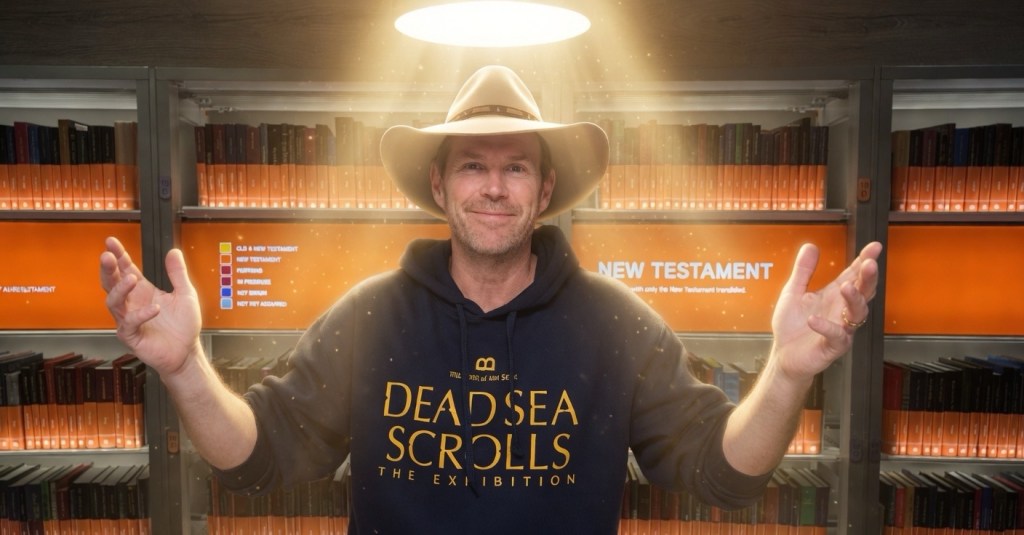
The DK book reinforced everything I believe. It covers the Moon’s history, what we know, and—crucially—its future. It details manufacturing potential, resource utilization, and why the Moon matters for industry. Flipping through it at home, with my reading light on and stacks of other books nearby (many from the Museum of the Bible’s Dead Sea Scrolls exhibit I visited on my birthday), I felt the same thrill as when launching model rockets with my grandsons or touring Kennedy Space Center facilities.

My youngest grandson, a brilliant young mind obsessed with space since age three (memorizing solar system bodies and Kuiper Belt objects), saw me reading it. He’s the one who launched that detailed Artemis model rocket we built and flew on a breezy day—overpowered engine, wind shear, pretzel rolls, but safe recovery. He wants to build, understand, and explore. This book and the future it represents are for him and his generation. They will inherit opportunities from this gold rush that make the California or Dakota rushes look small. 

The Moon as the New Gold Rush

Compare this to Teddy Roosevelt’s era. Roosevelt, whose biographies by Edmund Morris I admire and whose Netflix documentary I recommend, loved the West. He explained the moral and economic necessity of westward expansion. Gold funded infrastructure, mobility, and a great nation. Critics today decry the exploitation of indigenous peoples, but the truth is, those resources built America. On the Moon, there are no indigenous populations to displace. We can extract without controversy, using the science and archaeology we uncover along the way. 

Lunar resources are extraordinary. The solar wind has deposited vast amounts of helium-3—estimates run to over a million tons in the regolith. Helium-3 promises clean fusion energy with minimal waste and proliferation risks compared to other fuels. Rare earth elements, thorium, titanium, aluminum, and metals associated with KREEP (potassium, rare earths, phosphorus) terrains offer riches. Thorium concentrations signal nearby rare metals. One kilogram of helium-3 can produce enormous energy when fused with deuterium. Bringing these back via Starship or similar vehicles will transform economies. 

Thorium itself is abundant on the Moon and ideal for reactors. On Earth, thorium is three times more common than uranium. Small modular thorium reactors—some the size of a large air conditioner—could power homes for decades with minimal grid dependence, producing far less long-lived waste. Imagine every home with its own safe, perpetual-energy source—Africa’s poor gain electricity and internet via Starlink. Surplus power feeds grids or charges vehicles. This is abundance, not scarcity. I’ve advocated this for over a decade; lunar thorium accelerates it. 

Space Economy: Projections and Infrastructure

The numbers are staggering. The broader space economy could exceed $1 trillion by 2032. Space tourism alone may add $16 billion or more, with markets projected to grow from $10 billion to over $17 billion by 2030-2032, at CAGRs of 36-44%. Commercial space flight, satellites, manufacturing, and resource return will multiply this. 

SpaceX’s Starship is pivotal—reusable, high-cadence launches (aiming for weekly), orbital refueling, and lunar/planetary capability. Blue Origin’s Blue Moon landers and manufacturing facilities in Florida support Artemis. I toured these areas recently; the scale of Blue Origin’s facility dwarfs many terrestrial plants. Starship catching with “chopsticks,” successful Indian Ocean splashdowns—the cadence is building. Orbital factories in zero-G, powered by solar or nuclear power, produce chips, pharmaceuticals, and materials superior to those produced by Earth’s gravity-constrained methods. Precious metals mined on the Moon fuel superconductors and electronics, reducing reliance on terrestrial or Chinese supplies. 

Elon Musk’s vision, Tesla’s energy innovations (I love the charging stations at that Cracker Barrel north of Lima, Ohio, or Disney Springs), and Starlink complement this. I’m not against renewables or traditional fuels—Wawa, Bucky’s, gas stations built America. But nuclear power, including thorium, provides baseload capacity. Politicians who weakened the grid through poor policy must adapt. FirstEnergy and Ohio’s energy mix, plus lunar resources, are strengths.

Ohio’s Role: Spaceports, Data Centers, and Renewal

Ohio is primed. Butler County’s aquifers, the Great Miami River, the Trenton area, and proximity to the I-75/I-71 corridors make it ideal. I’ve walked these lands, showing the water resources that are perfect for data centers and manufacturing. Middletown and Monroe could host a spaceport. Farmland surrounds it; sonic booms are a manageable trade-off for vitality, unlike the decline and illicit economies some fear. Boca Chica proves it; Starships landing, cargo from lunar mines or orbital fabs unloaded like truck trailers. Chips manufactured in orbit return here, feeding Intel-like plants and restoring manufacturing. 

Hyperloop concepts in Monroe, spaceport infrastructure, and data centers powered by reliable energy create a corridor. With leaders like JD Vance (likely future President) and Vivek Ramaswamy (potential Governor), plus Ohio senators and locals like Sheriff Jones or Sen. Lang, bills are ready. This isn’t fantasy; it’s Rooseveltian vision meeting Musk-era execution. Vanderbilts, Rockefellers, and new dynasties emerge from such frontiers.

Critics worry about noise or change. But silence in cornfields while communities decay? No. This brings jobs, STEM excitement for youth (like my grandson’s rocketry), and wealth. Environmentalists note: no indigenous claims on the Moon. Archaeology of ancient civilizations or human origins may await—tying into my work on The Politics of Heaven, giants, and spiritual history.

Overcoming Skepticism and Embracing the Future

Some still doubt Moon landings. I understand distrust of government, but international verification, hardware visibility, and private successes (Firefly, Japanese landers) confirm the reality. The wreckage isn’t in a desert lot; it’s on the lunar surface. Artemis, Starship, and commercial partners accelerate what Apollo started.

Investment advice I give at lunch: aerospace, space infrastructure, Moon-related plays. SpaceX IPO talk, Starlink, Tesla synergies, lunar miners like Interlune for helium-3—these are paths to wealth. Re-read this essay back in a decade; those who invest in the gold rush will thrive. 

My wife and I carried those books, tired but joyful. That DK volume symbolizes commitment. Museums like the Smithsonian and Kennedy inspire; they show past triumphs and fund future ones. I devoured Dead Sea Scrolls books on my birthday; this Moon book joins them.

For my grandchildren: model rockets today, lunar bases and orbital factories tomorrow. They’ll read these pages, build, explore, and lead. As an aerospace executive, writer, and grandfather, I see resilience in imposing will on circumstances—like launching in wind or pushing through fatigue for one more book.

Call to Action for Leaders and Readers

To JD Vance, Vivek Ramaswamy, Elon Musk, President Trump, Ohio senators, and others: This is the moment. Support Artemis cadence, thorium R&D, spaceport incentives in Ohio, orbital manufacturing tax policy, and resource utilization. Fund archaeology tied to lunar discoveries. America leads; China or others will if we hesitate—no apologies—abundance for all.

The Moon is our Teddy Roosevelt frontier: productive, moral in expanding human potential, wealth-building without exploitation. Invest your paycheck, imagination, and policy here. Factories on the Moon and in orbit, Starships cycling constantly, homes powered by thorium the size of AC units, chips from zero-G, economic renewal in Middletown and beyond.

I stopped in my tracks for that book because the Moon is my place. It should be ours as a nation. The gold rush awaits. Let’s claim it.

Footnotes

1.  Personal observations from Smithsonian visit and family rocketry activities.

2.  DK The Moon book details lunar resources and future industry. 

3.  Helium-3 estimates from scientific literature. 

4.  Thorium advantages: abundance, waste reduction. 

5.  Space economy projections from market analyses. 

6.  Artemis/Blue Origin/SpaceX updates. 

7.  Ohio aerospace context. 

(Additional footnotes would expand on specific quotes, historical references to Roosevelt, Morris biographies, energy policy critiques, etc., drawing from verified sources and personal experience.)

Bibliography

•  DK Publishing. The Moon. (Recent edition available via Smithsonian and Amazon).

•  Morris, Edmund. Theodore Roosevelt trilogy.

•  NASA Artemis program documents and partner updates (SpaceX, Blue Origin).

•  Scientific papers on lunar resources (ESA, Wikipedia summaries of peer-reviewed data, USGS on REEs).

•  Market reports: Grand View Research, Market.us, Visual Capitalist on space economy.

•  Thorium energy literature (World Nuclear Association, etc.).

•  My previous works: The Gunfighter’s Guide to BusinessThe Politics of Heaven manuscript.

Rich Hoffman

More about me

Click Here to Protect Yourself with Second Call Defense https://www.secondcalldefense.org/?affiliate=20707
About the Author: Rich Hoffman

Rich Hoffman is an aerospace executive, political strategist, systems thinker, and independent researcher of ancient history, the paranormal, and the Dead Sea Scrolls tradition. His life in high‑stakes manufacturing, high‑level politics, and cross‑functional crisis management gives him a field‑tested understanding of power — both human and unseen.

He has advised candidates, executives, and public leaders, while conducting deep, hands‑on exploration of archaeological and supernatural hotspots across the world.

Hoffman writes with the credibility of a problem-solver, the curiosity of an archaeologist, and the courage of a frontline witness who has gone to very scary places and reported what lurked there. Hoffman has authored books including The Symposium of JusticeThe Gunfighter’s Guide to Business, and Tail of the Dragon, often exploring themes of freedom, individual will, and societal structures through a lens influenced by philosophy (e.g., Nietzschean overman concepts) and current events

The Evils of Corporate Culture: Why we love and hate them

One of the things that is most ill-defined in our country, and certainly in the world, is the understanding of why we tend to hate corporate culture.  Yet almost in the same sentence, we desire to be a part of them.  It’s actually pretty straightforward and obvious, which goes back to the foundations of capitalism and the work of Adam Smith in 1776, as well as the intrusive and corrosive nature of Karl Marx’s communism, which ultimately have led to many of the problems we see today.  We hate communism with the same ambiguity, and the reason in all cases is that corporations exist to allow the mediocre to feel validated in mass society, and that it shields them from the insults of competition.  Corporate cultures are often characterized by collectivism and are seldom driven by unique individuals with great vision.  By the time a company goes “corporate,” it loses that unique leadership that likely built the company into something publicly traded and valuable.  So when we say that something is “corporate,” we are saying that it is of less quality than something that isn’t.  Corporations allow mass collectivism to appear valuable by leveraging the efforts that built a company.   I’ve been thinking about this recently because I have had a front-row seat to a corporate takeover, and it has been astonishing to watch.  The people involved are really dumb.  And I don’t say that as an insult, but as an observation where individual intelligence is completely vacant from the minds of those involved, which is typically associated with stupidity or dumbness if taken in isolation.  But if many such people assert something, then there is a belief that a majority then gives validation, even to stupidity.  It’s one thing to read about these things happening in the world and to know the type of people involved.  But I usually have some insulation from this kind of thing by living my life, until those types of people stepped into my interaction by their own choice.  And I have had to establish their base reality, the only way that it can be defined, that they are dumb people looking for easy money in the world, and they accomplish this through mass collectivism, the same way that labor unions are a problem.  Wherever people hide value in groups, we see a loss in the quality of the visionary experience.  You don’t think of a boardroom as a group of people who solve big problems.  Typically, we think of a group of individuals who appease each other in a setting, at the expense of innovation.

I tend to support large organizations because their creation generates the flow of money, and I like money as a measure of a healthy society.  The more money a society has, the more corporations that create it, the more opportunities that society has to improve the lives of its people.  However, that is a very high-level assumption because, unfortunately, most people do not have positive corporate experiences, as many of the ideas we have about things are flawed from the start.  Even all the years of economic evolution that brought about the excellent book, The Wealth of Nations, there is always uncertainty in individuals about their ability to function in the world productively, so they seek joint relationships to hide in, and that is how the corporation came about as these ideas of capitalism and Marxism emerged as the world became smaller and easier to travel in.  Even if there were more opportunities for boldness and adventure, it was still the same kind of people who took them, leaving most of the rest of the world looking for a way to participate without the risk of actually doing so.  We prefer corporate jobs for the high pay we can earn within their structure.  But the pay usually comes at the cost of individual integrity.  You have to give up one thing to get the security of another.  And as human beings, we look down our noses at such a concession because we deem it inherently evil.  Evil because it destroys individuals, rather than enhancing them.

It’s not unusual for a family to applaud that a youthful personality has just joined a respected corporation at Thanksgiving Dinner.  The applause comes because we care about the young person and want them to have financial security.  But also in the back of our minds, we know that something is dying in that person, the ability to become all the dreams of youth as a unique individual.  Corporate environments are about giving voice to mediocrity for the benefits of mass collectivism. So that unique person we knew growing up will likely give up some of their dreams in the process of conformity.  They might gain an extensive paycheck, but in the process, they’ll lose their soul.  And we now understand this process well, having undergone many years of separating business from being run by kingdoms.  However, by default, the corporation evolved to give the mediocre a kind of unionized collective bargaining against the tendency toward cowardice, the act of waking up in the morning and having the courage to be an individual.  I know about such people, but I usually avoid them like a sickness until I had to speak to them often, when they came to my doorstep.  And it’s remarkable how typical dumbness is.  And when we say “dumbness,” we are referring to a lack of individual thought, where a person thinks something and acts on it without careful consideration. Instead, they feel a sense of unity for the preservation of the group, and their ambitions are collectively shaped through the force of numbers, rather than individual vision.  So, obviously, a corporation run by a board, even if there is a strong CEO, ultimately exists to sell mass collectivism to a consuming public, and we only notice when it impacts us, because there aren’t many pure examples of capitalism to measure real value against. 

We might like money, but there haven’t been enough examples of corporations that have survived due to corporate social responsibility efforts to give better examples of how things should be, or how humans should even make a living.  I’m talking about Robert Pirsig’s Metaphysics of Quality again, the difference between back-of-the-train people and those who dare to live in the front.  The corporate environment was not intended to put the best in charge.  But to make mediocrity rule the masses through collective ambition.  The loss of individuality to the concept of just being another number.  And in the process, everything is less effective.  And so, there is this cheerleading effort by corporations to acquire privately owned companies, as the corporation and its inhabitants want to believe, through the force of confiscated resources, that they can be as good as the visionary owner.  But they never are, and that little secret rots them into their graves.  They may be able to buy a second home in Florida and have the nicest cars to drive.  They may make enough money to turn their kids into younger versions of themselves by sending them to a communist camp we call “college,” by saying we want to give those kids the best chance at life, when we secretly fear that they will grow up to be better than us.  There is a lot wrong with corporate thought and the people who have defined it over the years. Based on what I’ve seen of it, an entirely new definition for money-making needs to be introduced.  The faceless monster of corporate ownership is just an extension of Marxism that emerged in the void of any other definition at that time of its growth into everyday language.  And many of us really want to be associated with the corporate culture for the security of income.  However, it comes at the expense of individual integrity, and for that reason, we secretly view corporations as inherently evil.  However, since most of us lack the security of personal wealth and thought, we want to be associated with something so that, by default, other people won’t see what we really are.  And that we won’t be found out as phonies, even if that’s what we think each day when we get out of bed. 

Rich Hoffman

Click Here to Protect Yourself with Second Call Defense https://www.secondcalldefense.org/?affiliate=20707

The Only Investment Guide You’ll Ever Need: How it all started

Here’s another good story about A.I. and why I think it is beneficial, not a hindrance to the human race.  I have a unique business philosophy regarding money and how to save a significant amount, allowing me to live comfortably without needing a lot of it for various reasons, which enables me to maintain my independence from parasitic individuals and vastly evil corporations.  And that started for me in the summer of 1987.  I don’t often tell this story because it’s usually better just to let the water drift under the bridge and move on.  We have a lot of family events each year, and I have to see many of these people and behave as nicely as possible. However, many things are simply unforgivable, and that’s what happened to me during the early stages of dating my wife, just after high school and before college.  She was being groomed to marry one of those race-to-mediocrity people from the Beckett Ridge Country Club during its heyday.  She was a model being considered for supermodel status, and her parents had ideas for her life that they wanted to be associated with.  When you have a beautiful kid like that, it’s hard not to want to cash in on her in some social way.  So the last thing they wanted was for her to let them know that she was dating a person whom everyone was scared of at the time.  To say I got into a lot of trouble would be an understatement.  I was not the kind of person that parents wanted their daughter to bring home.  Which I thought was always strange, and still do, because I am precisely the kind of person every parent should want their kids affiliated with, at least the way I see it.

So, her parents forbade the relationship. As is true with everything in my life, when someone challenges me to a fight, I never let go of it, and that would undoubtedly be the case in our marriage.  We’ve now been married for almost 38 years, but not without a lot of unnecessary hardship being imposed on us.  So our dating period got cut dramatically short when a family therapist advised them to throw her out of the house and force me to take care of her, essentially to take away all the fun stuff so that the romance would be taken out of our relationship and we’d break up and she would move back home and start dating people her parents liked, and be done with me.  So they kicked her out of her very nice house at the time and forced her to move in with me.  I had 36 points on my driver’s license and was at that time serving something like a 9-year suspension of my driver’s license, for reckless driving as society measures it.  I raced a lot of cars in those days, got into a lot of fights, and was in court a lot.  But I was willing to put that life away to marry this girl, because she was worth it.  It was, therefore, a very much a Romeo and Juliet romance, only without the tragic ending.  Instead, I was determined to fight off the world, whatever it took, and marry this young girl, making a family with her.  And nobody was going to get in the way.  So here I was in a little townhouse in Sharonville with a good friend of mine living on our own, and suddenly this girl was kicked out of her house and living with us in a kind of three-way arrangement that was very, very tough. 

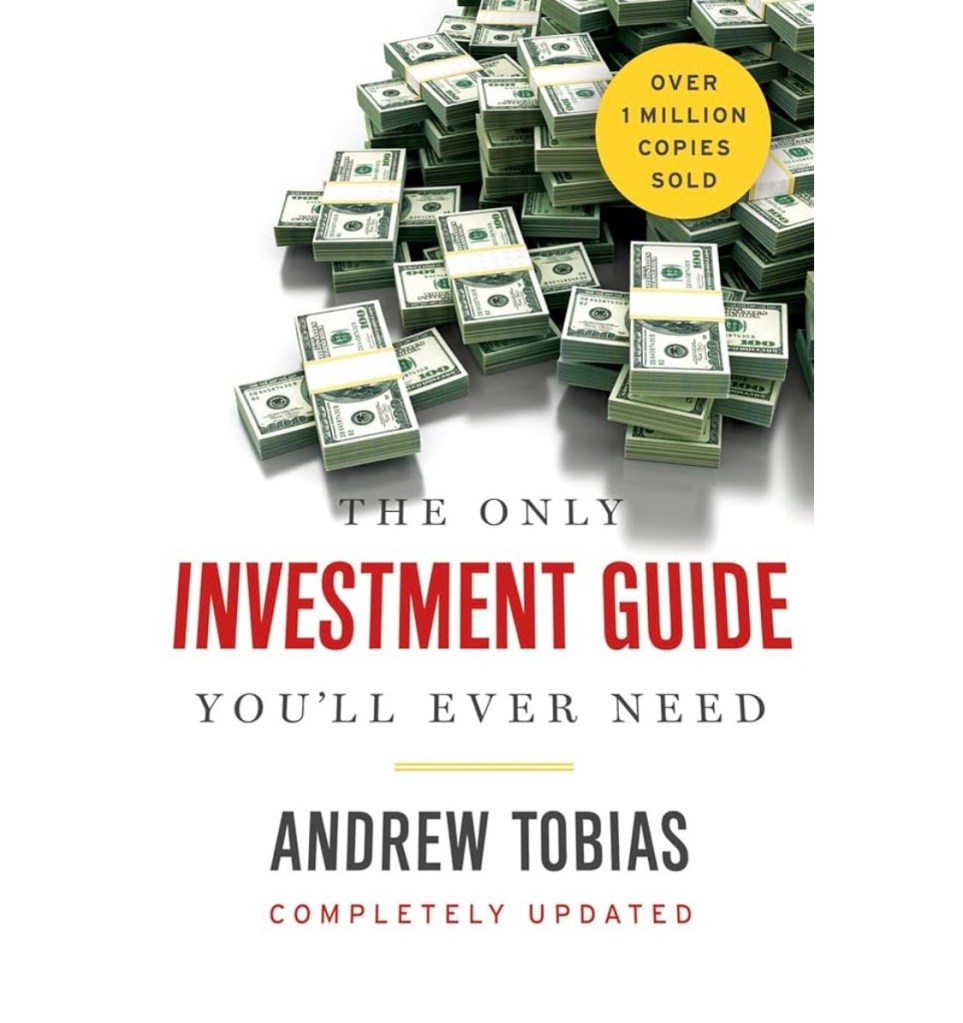
Like I usually do when things get tough, I read books. That summer, I had to learn a lot about money quickly so I could win the game of starting a family and become smart about the financial games of life.  I still do this, and it’s why I read an average of 3 to 4 books a week, still.  Because there’s a lot to know, and if you want to win at life, you have to know more than the people you are dealing with.  In that case, with my future wife, we would have been married a year later, but at that time, it was a tragedy of Shakespearean proportions, with all the ruthlessness one could imagine, difficult beyond reason or belief.  Crushing difficulty.  To alleviate that pressure, I went down the road from our townhouse and checked out Andrew Tobias’ very well-known book, ‘The Only Investment Guide You’ll Ever Need,’ from the library.  I spent the summer reading it, and the next several decades thinking about it, and it has formed my basic approach to wealth creation, to stay off the treadmill of social expectation, because there is a lot of wasted money spent on it, and to use good money to defeat bad, time and time again.  However, it is mostly on minimalism that Andrew Tobias discusses regarding money management. Stay out of the casino of money making, and you’ll actually come out way ahead.  And with that basic approach, my wife and I have navigated some treacherous waters over the years and defeated many formidable characters. 

I have been professionally dealing with a similar issue that involves a lot of money and people, and they have been commenting on my position, which gives them minimal access to my life and those in it, much to their frustration. This essentially stems from the basic strategy I formulated in that book so long ago.  But for the life of me, I couldn’t remember the title, just the contents.  Back then, I used to check out books at the library and had to return them.  These days, I put them on a shelf and refer to them repeatedly.  But that early in my life, I didn’t even have a house yet.  So once my wife moved back in with her parents and they reached out to me to see if we could all reconcile, I turned the book back into the Sharonville Library and never saw it again.  But at my current age, I wanted to reread it because it was relevant to my current circumstances and I wanted to reconnect with my roots.  So, I asked the Grok A.I. which book I had read on finance during the summer of 1987 from the Sharonville Library, and it told me within seconds, ‘The Only Investment Guide You’ll Ever Need.’  It was interesting because the book was on record in that library at the time, and they knew I had checked it out based on their reporting.  I was finally able to buy a copy from Amazon, and it was hand-delivered to my front porch the next day.  And I read it again and really enjoyed it.  It had been updated from the 1987 version I had read into a 2016 view of the world, but the same basic book was still there.  Same cover and everything.  It’s the kind of book everyone should read on finance, and that’s why it’s still popular, even today.  It has certainly helped me throughout the years, and strategically speaking, it works very well.  I have always thought of it, and because of A.I., I was able to reconnect with it.  Nobody will promise you a nice and easy future.  But if you are smart and apply innovative strategies to your life, you’d be surprised at what you can survive and endure.  And for a lot of reasons, Andrew’s book will always be a treasure for me.  A treasure I was able to enjoy because of A.I. and its ability to know so much, so quickly.

Rich Hoffman

Click Here to Protect Yourself with Second Call Defense https://www.secondcalldefense.org/?affiliate=20707

The Collapse of the Communist Left’s Expert World: Never stay in your lane, always challenge the “experts”

Another one of the reasons that the communist left will never recover from their present condition, which they put themselves in, is that trust in an expert class will never return.  The grand failure was in what they tried to do with COVID-19, but the general attitude toward a credentialed class of experts has been falling apart for many decades.  The fantasy that communists had of a world run by experts has blown itself apart in America, and the rest of the world is following our example.  And that is a power that will forever be gone from society building.  During COVID-19, we were told to “trust the experts,” and the experts then ran us all over a cliff toward social destruction.  America was designed as a decentralized country that promoted people within its society through merit, not expert status.  In America, being good at many things is very fashionable, not just one specific thing.  Of course, Dr. Fauci was the ultimate example of an expert society people put too much trust in, who abused that leverage for personal reasons and became a menace to society.  That was the last straw for many people in the wake of that activity.  But the first began a long time ago as the labor movement tried to apply to society, in general, this ridiculous notion they have afflicted culture through labor unions, where only specialists in work performed a task.  An engineer didn’t do labor.  Labor didn’t do engineering.  And management stayed in an office somewhere and practiced for the next golf game.  Everyone had a specialty, and they stayed in their lane.  But the needs of human beings are much more dynamic than that.  And people are not happy with such a cap on limited knowledge.  People are happiest when they know many things and can approach life with curiosity and vigor. 

My personal approach to life is based on the 9 Ways of the Samurai from The Book of Five Rings, which says, “develop intuitive judgment and understanding for everything.”  And “know the Way of all professions.”  A long time ago, I worked as a machine refurbisher at Cincinnati Milacron down in Oakley, Ohio, in its prime years, and I had a big toolbox that had those 9 Ways attached to my toolbox lid, where most of the other guys had cutouts of nude women from Penthouse Magazine.  They thought I was a weird young man, but I loved my samurai books and read them every day on my breaks during those years, and it used to drive them crazy that I wasn’t interested only in my primary job.  They used to tell me to “stay in my lane” all the time and not to disrupt the apple cart.  Make your living, go home, sleep on the couch like everyone else did, and don’t try to change it.  Well, that was never good enough for me; I wanted to know something about everything, so I read many weekly books on various subjects.  Technically, these days, I could claim to be an expert in more fields of endeavor than I have fingers on my hands.  And I think that’s how the human condition wants it to be.  We have curious minds and want to learn as many things as possible.  At least we start that way as kids.  Most people hit puberty and throw that curiosity away forever once they start chasing after sexual pursuits.  But that is more of a biological surrender than the mind’s condition.  But to pull off their grand scheme on the world, global communists needed people to stay in their lane, do only what they were good at, and wait for an expert to tell them all the other things in an interdependent society of specialists trained in liberalism at the local college.  And to stay that way forever. 

By decentralizing information and making it so that people could acquire as much knowledge over a lifetime as they dared to pursue, the concept of an expert class has collapsed.  In frustration, you could see them draw that line in the sand in late 2019 when they unleashed COVID-19.  I was sitting at a bar in Orlando, Florida, watching the news of the unleashing of Covid from Wuhan, China, and I knew right away what it was because my base of knowledge was not expert-driven on a single source of wisdom but was applied over many interconnecting fields from psychology, philosophy, to essential medicine, law, politics, strategy, and military history.  And I knew it was an attack by a frustrated group of experts who were like union stewards in a typical manufacturing facility, upset that someone not qualified to do mechanical work picked up a wrench to fix something themselves instead of waiting on the union worker to stop watching television during his long break, and come and perform the work as needed.  Trump was in office and shaking up this world of experts, and they unleashed COVID-19 out of frustration to get the world to listen to them, the experts in the medical profession.  All it did was make everyone frustrated and angry because, in America, we had access to all the information we could ever hope for, and people could learn more about COVID-19 than the “experts” wanted us to know.  And they lost massive amounts of power during this period.

That was always one of the keys to the success of the United States as opposed to other countries that were much less dynamic.  Waiting for a class of experts would not work in an impatient world where progress was measured in seconds, not days and years.  The complaints about this fast-moving world always come from the sluggish communists who want a world of experts to stay in their lane and provide specificity on only the topics they are credentialed for from a local university.  I hear it probably a thousand times a week; “what makes you think you have a right to provide expert opinions on law, medicine, or political strategy?  What university did you attend that provided you with a degree in those fields?”  And my answer is that I have done more work in those fields than most people with six-year degrees combined perform over their entire lifetimes.  And that real-world experience doing real things that matter is a far better education than a liberal arts major in a specified field that limits you for the rest of your life.  And more people are figuring that out for themselves, and they are much happier.  Doing for yourself is much more rewarding than hiring an expert.  America used to be known for its self-reliance, for the backyard mechanic, and the craftsman who could build a dining room table on the weekend for their family.  The world of experts has not been rewarding, and most people who have stuck to the rules have grown into miserable adults and boring spouses.  Look at the divorce rates of most people, and you will find that most of them are drowning under the burden of an expert life where they learn their little things, stayed in their lane as they were told to all their lives, and end up brain dead by their 40s because they lose interest in life because they are so bored.  So they develop sex addictions and other detriments to fill their vacant lives with something interesting, which never works because all the effort is misapplied.  That is the world the communists wanted to give us, and it has been soundly rejected in America.  And that movement is moving to the world as a whole.  And not a moment too soon. 

Rich Hoffman

Click Here to Protect Yourself with Second Call Defense https://www.secondcalldefense.org/?affiliate=20707

Todd Minniear Seeks to Protect Liberty Township: When progressives are angry it means that the right thing is happening

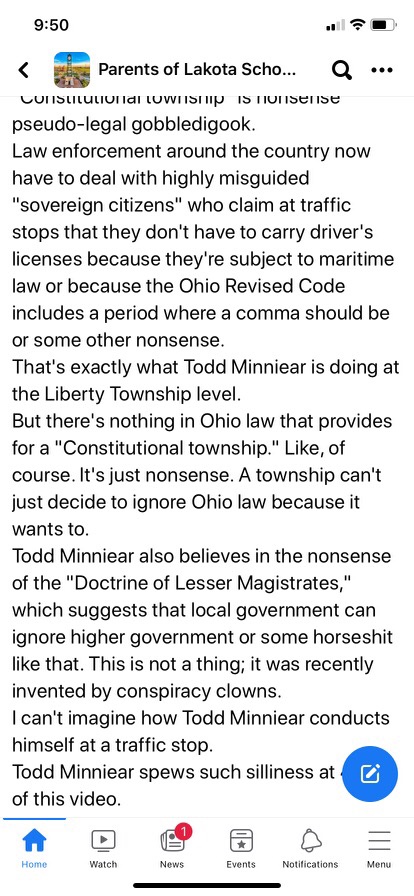
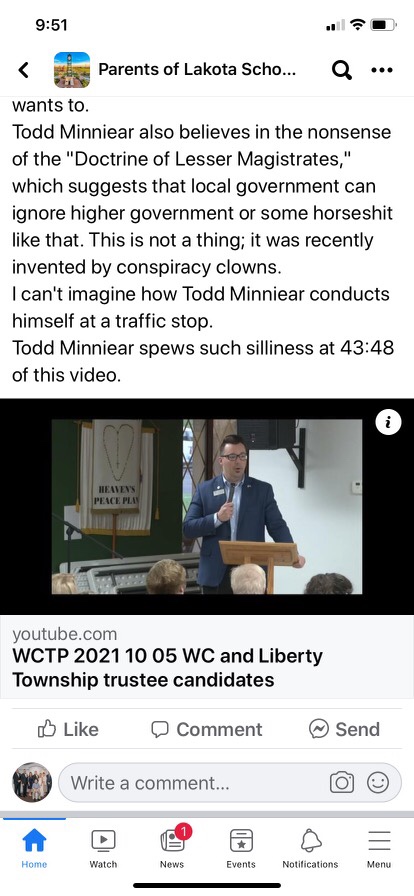
I said it when he was overwhelmingly elected in November of 2021, and I’m still saying it, I love Todd Minniear as the new trustee of Liberty Township, Ohio. He ran on a freedom platform, and he’s living up to it by proposing a resolution at the May 3rd, 2022, trustee meeting to make Liberty Township a “constitutional township,” with a written promise. However, for some reason, the sweat bees of Lakota are going crazy over the idea, which is very interesting.   When I first heard about the resolution, I thought it was a great idea but wondered why it was needed. After all, isn’t all townships supposed to be “constitutional townships?” Well, yeah, of course. So why was something like this proposal needed at all? In 2020, when the government made lots of mistakes over Covid, it was up to the local governments to step in and challenge the governor’s actions. In this case, the governor took on emergency powers and bypassed the legislature to assume powers that Governor DeWine did not have. The lockdowns and mask mandates that destroyed so many businesses were unconstitutional. None of them could be defended in court, and so far, all the cases have been lost and looking back on what went wrong, it’s clear that local trustees should have pushed back against the governor. One person can’t be allowed to ruin the lives of so many people with a bad decision. That’s why we have a republic and not some flea-bitten democracy in America. We have a local government that is accountable to the people instead of some top-down kingship, which is how Mike DeWine behaved. Joe Biden crossed those same lines with vaccine mandates and mask requirements, built entirely off misinformation and science in the pocket of big pharma. 

Yet, the same people who have been giving Darbi Boddy of the Lakota school board a hard time for trying to remove the mask mandates in the school as one of her first official duties newly elected are now going after Todd. Notice how arrogant they are and how condescending in their online postings. These are the same people who think that mask mandates should be forever, that sexual indoctrination of our kids in grade school should be normalized and that Joe Biden should be president. These people have had control of the political process for far too long because they make so much noise, but they are actually a small minority. In a community like Liberty Township, they can find a few thousand people who think the way they do. But Todd Minniear and Darbi Boddy were elected by many more thousands, both gaining the most vote totals in the last election. So plenty of people want to see these kinds of challenges to federal and state power. People did not like the way things happened with Covid and how vulnerable they were to an out-of-control government, and they wanted to see these new politicians representing their interests. Of course, these progressive lunatics don’t want to lose control of the process. They love to harass people into doing what they want to see done with threats and public attacks, which is why it’s so wonderful that we finally have some politicians who are willing to do the hard work. When I heard Todd wanted to make this resolution, I didn’t think it was a big deal at all. But he knew that there would be those same opposing voices who would come armed with their name-calling and arrogant slanders. 

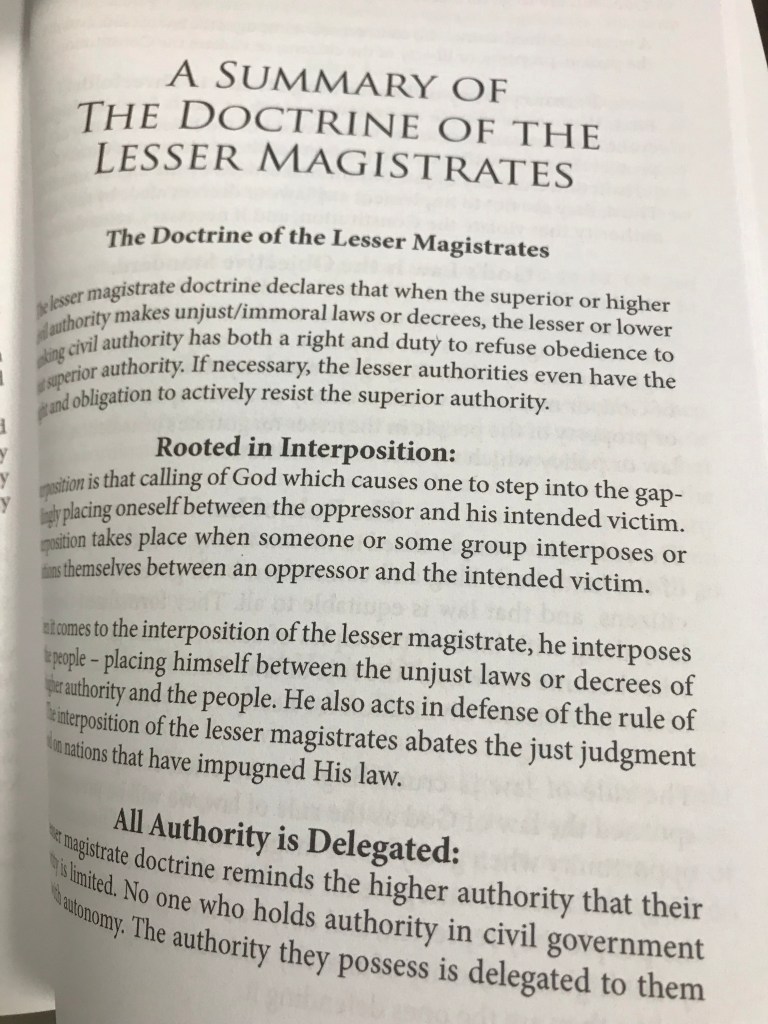
So why is something like this resolution for a “constitutional township” needed. Investors in the community, including homeowners, need to know that the trustees can provide a stable environment from intrusive government. Mike DeWine wasn’t accountable to people in Ohio, but their local representatives were. When a governor like DeWine takes action on his own to cut out our elected representatives in the legislature, we must have some mechanisms to resist the intrusion. For Todd Minniear, he looks to the great book The Doctrine of the Lesser Magistrates for how our constitutional republic is supposed to function. The book is a proper resistance to tyranny and a repudiation of unlimited obedience to civil government. The example given in the book is about a church leader who is taking money from the collection plate and should expect their congregation to question them should they skim from the pot. Human beings can fail, especially in intellect, and the purpose of our government is to keep innocent people free of those mistakes as much as possible. And as a trustee, Todd ran on a platform to keep Liberty Township free of those kinds of failures in government. Such a declaration like what Todd proposed is necessary so that the people of Liberty Township can feel some sense of protection from the government by their local representatives since our state and federal governments have failed us so obviously. 

The sweat bee progressives of Liberty Township are so upset because they have in mind the complete desecration of our republic and a merge into the chaos of a democracy which would then propel us into the Vico Cycle, which has destroyed so many civilizations over the years. The Vico Cycle is a theocracy, aristocracy, democracy, then anarchy. So if they are upset by this “constitutional township” resolution, that means it’s a great thing. When these people hate what you are doing, you know you are on the right side of history and doing what voters elected people like Todd Minniear to do. Traditionally, they have attacked people like Todd and Darbi, who have only been on the job for a few months. In Lakota, they already have a petition to get rid of her because she pushed for removing the mask mandates. And you see by their comments about this “constitutional township” resolution that they find it a threat to go back against centralized control. Because as liberals, that’s what they want, and for far too many years, politicians have given them the benefit of the doubt.   But we’ve seen where that takes us, and Covid showed us too much of what we didn’t want to know. Those same people felt the power of a centralized government that was out of control, and they liked it. They never want it to stop. And now that people are returning to normal and are electing people like Todd Minniear to represent them, instead of the classic politician of least resistance, they are worried about losing their power. 

All the noise aside, our task in Liberty Township is to provide stability for business investment and residential ownership. And to give that stability, we must remove the intrusive elements of government from some faraway land that is not accountable to us, who can then destroy our community with just the swipe of a pen. A mask mandate here, a lockdown there, a created crisis to hide bad inflation numbers, Liberty Township deserves to be free of the kinds of corruption we always see in centralized governments because accountability is often missing. Todd Minniear and the other Liberty Township trustees are accountable to their neighbors, which is how it should be. And the next time some government overreach occurs, we need to know that our trustees will follow the Ohio and federal constitutions. They didn’t in 2020. Nobody knew what to do because we had never seen such a thing before. But now we do know. We know all about Covid and how the government made it and managed it. And we saw what it did to all our lives. So, we deserve to be free of those intrusions in the future. And the more that the political left screams about it, the more of that kind of thing we should do because it just validates why it was so important in the first place. 

Rich Hoffman

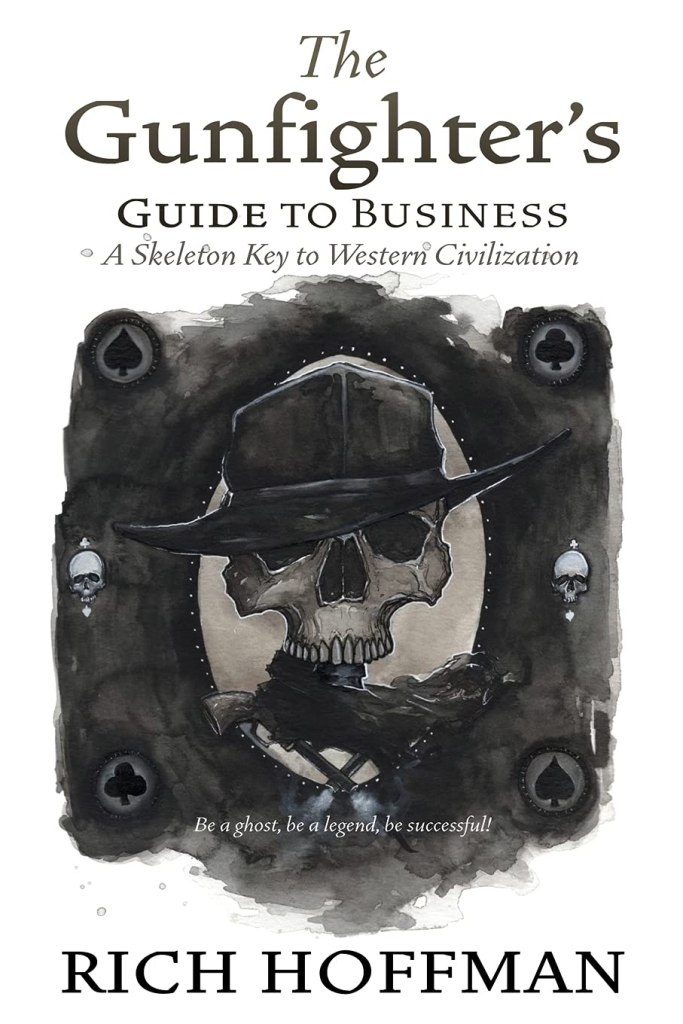
Click to buy The Gunfighter’s Guide to Business

I Love Corruption: Knowing the nature of people is worth more than the wealth of the measure

Corruption is Good if you Capture Human Behavior

Personally, I love corruption. There is a chapter in my book, The Gunfighter’s Guide to Business, called “Money is Not the Root of All Evil, It Reveals It,” that deals specifically with this unique way of looking at the world. Corruption is caused by the insecurity of a person, or a group of people, in their ability to produce. A person lacking corruption and is confident in their ability to produce will not seek shortcuts to success because they understand that the opportunities for which money is generated are always available to them. Whereas the cheaters trying to scam their way through each day feel they will only get a few open doors to financial opportunities in their lives, and they will bend their ethics to step through those open doors. Now all too often, those open doors are traps set by other people for the opportunity to take whatever value someone else has, and the whole game can seem very treacherous and bloodthirsty. But the value is in the money, which then reveals the content of the game’s characters. Once you can see and measure what people will do for money, you can then know everything you need to know about them and turn their efforts toward the success you want to see happening. Corruption shows what kind of people are playing the game, and knowing who is corrupt and who is not is very useful in playing the great games of value. There is a lot of evil in the world that would not be seen if we did not have the value of money to measure it and witness what people will do to get their hands on it.

I tend to view many things in life from the perspective of Poker. The religions of the world have tried for centuries to figure out the motives of mankind and to contain ambition behind otherworldly rules of conduct that, like Santa Claus, might get you into Heaven if you are a good little boy and girl. When religion doesn’t work, we turn to governments to regulate behavior, and the fear of being put in jail might keep us all honest and trustworthy in our interactions with each other. But what these methods essentially only do is to push corrupt behavior deep down and out of sight. It essentially makes all of society like a Thanksgiving Dinner with a family that doesn’t really like each other; when we pass the corn, it’s always very civil and polite. While behind everyone’s backs, there is always plotting and scheming going on. But at the table everyone is polite. That is what we generally have in society and why we are so shocked when we discover that corruption has been happening. Like how shocked many are to learn that Dr. Fauci has been a corrupt administrator in government health for most of his career. He can hide his corruption behind the façade of social rules and conduct. But when we study what he is willing to do for money, or how money moved from government to government employees as him acting as the broker for funding, the need for power is instantly recognizable, and that behavior tells us a lot about the people we are dealing with. The measurement of money reveals a lot about the people trying to possess it. The most corrupt people are the most insecure about how the value of money is generated. People least corrupt understand that money is produced from the value of production. But those naturally lazy and not wanting to produce in life will have all kinds of insecurities about their ability to acquire money and will jump easily at every opportunity to become corrupt to get it because they don’t think many such opportunities will come their way in their lives.

It really comes down to the question of what we want to know about people and if we want to really know it. Governments would like to believe that human behavior can be controlled through fear, such as fearing the law, fearing the power of government, or fearing the opinions of others. Religions believe that good conduct can be controlled in society by fearing what might happen to you in the afterlife. And if only you might listen to them, then maybe you might have everlasting life. Instead, to my eyes, a good poker game tells you everything you need to know about people, and a good player can control what everyone at the table is doing and thinking based on how big the pot gets. Poker is a uniquely American game that is born out of pure capitalism, and it’s actually much more moral than we have been led to believe by the same forces who today want us all to fall into centrally controlled socialism. Playing Poker reveals a lot about the characters playing the game to acquire the total sum of the pot bet between game rounds. The good and honest player will be willing to toss away a bad hand and play again in the next round. The corrupt player will try to cheat and stuff cards up their sleeve to pull out when the pots are significant because they fear they might miss such an opportunity if they don’t cheat in some way to make the conditions of the game more favorable to them. To my eyes, knowing such information about people is much more valuable than in the value of the money itself. Money is just a measurement of value. But what people will do to have it is far more critical. 

So it is in that way I see corruption as a good thing to see because it tells you who you are dealing with. The rules of society might make the preacher look like a bastion of Heavenly summation. But when alone with children of the congregation, they might be abusing them all in the name of God. Or the politician might seek legislation to provide good conduct in social interaction while they are taking money from a donor to do something voters don’t want. But the temptation of money makes it hard to turn away from. The social face may look like an outstanding citizen, complete with power dress and nice shoes. But what goes on in the politician’s mind is another matter, will they take shortcuts to get the money, or will they hold true to constitutional principles? Are they worried that they only have a few chances in life to make wealth for themselves, or is every day an opportunity to hit the jackpot and they play the game for the joy of it, knowing they will have plenty of chances for success because of their character? These are the fundamental ways to understand social behavior, and yes, corruption is just one more measurement of a thriving culture. If we have a society with a lot of corruption in it, we obviously need to change something to inspire different behavior. But we can’t delude ourselves into believing that the rules of mankind might encourage good behavior. Instead, we must understand that we must first see it with some kind of measurement and act on that knowledge. Pretending that corruption isn’t happening because we refuse to measure it is not a way to solve problems. Half the battle is in knowing, and when we have money to measure corruption, we can then see a lot that is true about the health of our society, which I find extremely valuable.   

Rich Hoffman

Click to buy The Gunfighter’s Guide to Business