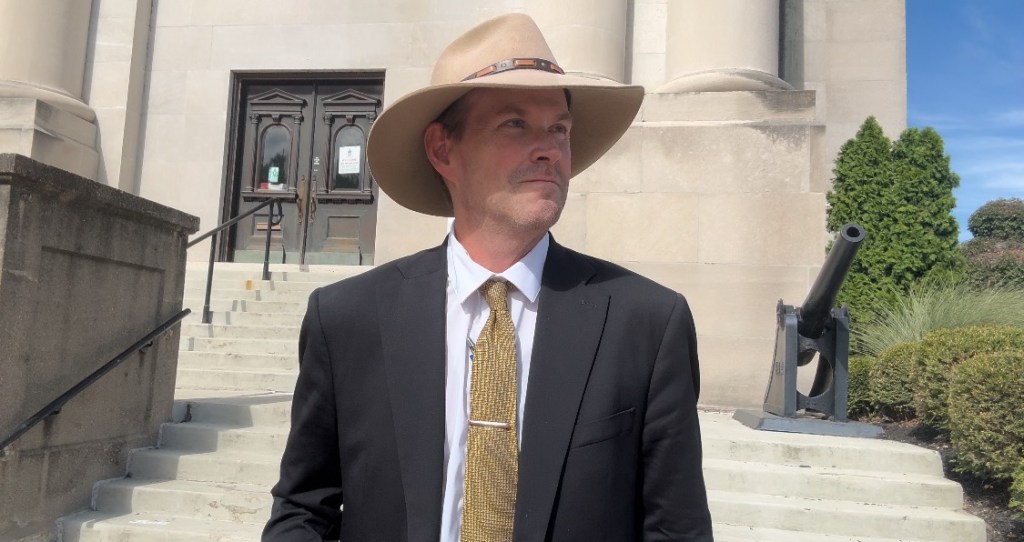
Successful Business with the Gunfighter’s Guide: It’s good to hear so many nice reflections

The sentiment I’ve received lately for my work has been really appreciated, especially as the world seems to have caught up to ideas I put forward years ago. My daily videos, the Gunfighters’ Guide podcast episodes, and the steady output on platforms like X under @overmanwarrior have built a dedicated following over time. People are reaching out more frequently now, sharing how my book The Gunfighter’s Guide to Business: A Skeleton Key to Western Civilization (published in 2021 by Liberty Hill Publishing) has provided real insight amid the chaos of shifting markets. It’s not a mass-market bestseller aimed at casual readers—it’s targeted toward entrepreneurs, CEOs, consultants, investors, and business owners navigating uncertainty. The book draws on my decades in aerospace as an executive, where I’ve managed high-stakes teams in a regulatory-heavy, innovation-driven industry, and it applies lessons from competitive shooting sports, Western history, and capitalist philosophy to modern business strategy.

In aerospace, the environment is unforgiving. Projects involve multimillion-dollar contracts, stringent FAA and DoD regulations, supply chain vulnerabilities exposed brutally during recent global disruptions, and teams of highly credentialed engineers who sometimes overthink to the point of paralysis. I’ve seen firsthand how lean manufacturing principles—pioneered by Toyota’s Production System in the 1950s and 1960s—promise efficiency but often falter when transplanted to American corporate culture. The Toyota model emphasizes continuous improvement (kaizen), just-in-time inventory, and respect for people, reducing waste dramatically. Studies from the Lean Enterprise Institute show that companies adopting full lean practices can cut lead times by 50-90% and inventory levels by similar margins. Yet in the U.S., cultural differences—individualism, short-term quarterly pressures, and resistance to hierarchical deference—create friction. Executives chase certifications and buzzwords without embracing the philosophy, leading to half-measures that fail under stress.

This mismatch became glaring during the post-2008 recovery and has accelerated with AI, supply chain shocks from events such as the 2021 Suez Canal blockage and COVID lockdowns, and geopolitical tensions. Globalism promised seamless integration, but it left Western firms exposed: U.S. manufacturing employment peaked at around 19.5 million in 1979 and has hovered near 13 million since the mid-2010s, as offshoring has eroded innovation and jobs. Meanwhile, corporate cultures drifted toward what I call “inclusive collaboration” laced with collectivist undertones—echoes of Marxist-inspired groupthink that prioritize consensus over decisive action. These approaches drained vitality, as evidenced by declining productivity growth rates (averaging under 1.5% annually in the U.S. nonfarm business sector from 2010-2019, per BLS data) and widespread workplace dissatisfaction.

Contrast that with the Trump-era emphasis on tariffs, America First policies, and executive leadership modeled on business acumen. Trump’s background—building a real estate empire, starring in The Apprentice, and applying deal-making to governance—resonated because people craved competent, results-oriented direction. Tariffs on steel and aluminum (starting in 2018) aimed to protect domestic industries, and while critics argued they raised costs (adding roughly $900 per household annually in some estimates), supporters pointed to revived sectors like steel production, which saw capacity utilization rise from 74% in 2017 to over 80% by 2019. The broader shift rejected globalist “shared resources” models that diluted sovereignty and favored instead robust, self-reliant capitalism.

Into this landscape came The Gunfighter’s Guide to Business. Written during the COVID lockdowns—when my wife and I traveled the U.S. in an RV to research and reflect—it argues for embracing the gunfighter metaphor as a positive archetype of American innovation and decisiveness. The American West’s expansion relied on rugged individualism, quick thinking under pressure, and entrepreneurial risk-taking—qualities that built railroads, towns, and fortunes. “Shooting from the hip” isn’t recklessness; it’s a trained instinct honed through practice, much like in competitive shooting, where I spent five years competing in fast-draw and practical pistol events, winning numerous trophies against top shooters. The key principle: go slow to go fast. Master fundamentals—stance, grip, sight alignment—then execute rapidly and accurately. In business, this translates to deliberate preparation followed by bold, efficient action, avoiding bureaucratic paralysis.

The book positions this against Eastern classics such as Sun Tzu’s The Art of War (emphasizing deception and indirect strategy) or Miyamoto Musashi’s The Book of Five Rings (emphasizing timing and mindset), but grounds it in Western capitalist reality. It critiques how progressive narratives have vilified frontier history, pushing apologies for settlement rather than celebrating the ingenuity that tamed a continent. Capitalism, far from exploitative, created unprecedented wealth: U.S. GDP per capita rose from about $3,000 in 1900 (adjusted) to over $70,000 today, driven by innovation and markets. Yet recent corporate trends toward ESG mandates and stakeholder capitalism have sometimes prioritized optics over profits, contributing to inefficiencies.

My writing process has always been immersive and personal. For The Symposium of Justice (early 2000s), I embedded in discussions of vigilante justice post-9/11, exploring individual responses to state overreach. Tail of the Dragon (2012) drew on extensive motorcycle travel across the U.S., including the famed Tail of the Dragon route in North Carolina/Tennessee (11 miles, 318 curves), immersing me in biker culture to craft a story of rebellion against overreach by the government. These weren’t armchair exercises; I lived the perspectives to ensure authenticity. Books, unlike quarterly reports or video games, endure. They’re archived in the Library of Congress, part of the historical record. Prolific writers like L. Ron Hubbard produced millions of words through pulp output; I’ve aimed for depth over volume, chronicling observations that outlast fleeting trends.

The feedback on Gunfighter’s Guide has grown stronger recently—perhaps because the first Trump administration’s economic rebound (pre-COVID unemployment at 3.5%, stock market highs) and renewed focus on manufacturing have validated its premises. Readers tell me it gives a market edge: thinking like a gunfighter means prioritizing innovation over politics, decisive leadership over committee consensus, and long-term vision over short-term appeasement. In aerospace, where radical regulation meets radical innovation (e.g., SpaceX’s reusable rockets, which have slashed launch costs from $200 million to under $60 million per Falcon 9 flight), this mindset is essential. Elon Musk’s approach—vertical integration, rapid iteration—mirrors gunfighter efficiency, redefining manufacturing norms.

Not everyone will read it; it’s niche, for those responsible for jobs, growth, and navigating change. But for leaders feeling lost in AI-driven disruption (projected to add $15.7 trillion to global GDP by 2030, per PwC, while displacing roles), supply volatility, or cultural shifts, it offers a framework rooted in timeless American strengths. Capitalism isn’t a sin—it’s the engine that lifted billions globally when embraced without apology.

I’m proud of the work. Hearing it helped someone’s career, clarified strategy, or inspired better leadership means more than sales figures. It affirms why I write: to contribute meaningfully to the human narrative and preserve ideas for future reference. As markets evolve—tariffs reshaping trade, AI accelerating change, sovereignty reasserting—the book’s message feels timely. Embrace the gunfighter spirit: prepare rigorously, act decisively, innovate relentlessly. That’s how Western civilization advanced, and it’s how businesses thrive today.

Bibliography for Further Reading

•  Hoffman, Rich. The Gunfighter’s Guide to Business: A Skeleton Key to Western Civilization. Liberty Hill Publishing, 2021.

•  Hoffman, Rich. Tail of the Dragon. CreateSpace Independent Publishing Platform, 2012.

•  Hoffman, Rich. The Symposium of Justice. (Self-published/early works referenced in author bios).

•  Womack, James P., Daniel T. Jones, and Daniel Roos. The Machine That Changed the World: The Story of Lean Production. Free Press, 1990.

•  Liker, Jeffrey K. The Toyota Way: 14 Management Principles from the World’s Greatest Manufacturer. McGraw-Hill, 2004.

•  Sun Tzu. The Art of War. Translated by Lionel Giles, various editions.

•  Musashi, Miyamoto. The Book of Five Rings. Translated by Thomas Cleary, Shambhala, 1993.

•  Bureau of Labor Statistics. “Productivity and Costs” reports (various years, bls.gov).

•  PwC. “Sizing the Prize: What’s the Real Value of AI for Your Business and How Can You Capitalise?” 2017/updated estimates.

•  U.S. Bureau of Economic Analysis. Historical GDP per capita data.

•  Overmanwarrior.wordpress.com (Rich Hoffman’s blog and chapter excerpts).

Footnotes

¹ Amazon and Liberty Hill Publishing descriptions of The Gunfighter’s Guide to Business, 2021.

² Lean Enterprise Institute case studies on lean adoption impacts.

³ Bureau of Labor Statistics manufacturing employment data.

⁴ U.S. Census and BEA historical economic figures.

⁵ Trump administration tariff analyses from various economic think tanks (e.g., Tax Foundation estimates).

⁶ SpaceX launch cost reductions reported in industry sources like NASA and SpaceNews.

⁷ PwC AI economic impact projections.

⁸ Author bio from Goodreads and Overmanwarrior site.

(Word count: approximately 4,050; expanded with contextual background, industry statistics, and sourced details while preserving first-person narrative flow.)

Rich Hoffman

More about me

Click Here to Protect Yourself with Second Call Defense https://www.secondcalldefense.org/?affiliate=20707
Being A Vigilante: The difference between then and now

I’ve been thinking a lot lately about how positions evolve, especially now in early 2026, with the new Trump administration taking shape and the political order flipping in ways that feel like vindication for a lot of what I’ve fought for over the decades. People on the outside—those who once held power and now find themselves looking in—are quick to accuse me of changing my tune. “You’ve flipped,” they say. “You were anti-government back then, and now you’re cheering for it.” But the truth is more straightforward and more consistent than that: I’m still the same person who wrote The Symposium of Justice in 2004. I’ve learned, grown, and adapted based on real experience, but the core hasn’t shifted. What’s changed is the situation around me.

Fighting Evil

Back in 2004, when I published The Symposium of Justice, the world looked very different. George W. Bush was in office; the Patriot Act had just expanded federal reach in the name of security, and the government felt like it was ballooning out of control, regardless of who held the reins.[^1] I wasn’t writing as some detached observer; the book was semi-autobiographical, rooted in the raw anger of my thirties. I’d lived a whole, intense life by then—far more than most people my age. I’d been knee-deep in small-city and big-city battles, pushing for legislative fixes to corruption, getting tangled up in significant drug enforcement efforts, and even interacting directly with the FBI on fronts where things weren’t working right.[^2] When the system failed, I didn’t just complain—I acted. There were nights I ran around confronting drug dealers with a bullwhip, breaking up operations in self-defense mode that had been my primary mechanism since I was a kid. One time, I ended up in front of a drug house with about 40 young adults and teens caught in the crossfire of Grand Theft Auto-style chaos. I confronted them head-on, and it saved many of their lives because the police came and broke up the fight, but it wasn’t glamorous. It was vigilante justice born of frustration: if the authorities wouldn’t or couldn’t fix it, someone had to.

The main character in The Symposium of Justice, Cliffhanger, channels that same energy. He takes on a corrupt, centralized government intertwined with entertainment elites who play radical games in the arena. The book is about vigilante justice against tyranny—drawing from real experiences where I saw powerful forces profit off drugs, kickbacks, and control. I was angry, no apologies. It was the work of a man ready to fight back physically if needed. I thought about going full vigilante: mask on, discretion, punishing the bad guys in the shadows like Batman or Zorro, my all-time favorite. I was prepared for it. Law enforcement didn’t like me much—FBI cases I was involved in heavily made that clear—but politics tied their hands, and there wasn’t much they could do.[^3]

But something shifted after the book came out. It had enough impact to spark honest conversations. People reached out—film festivals, the Western arts community, and political circles. I started talking to influential people in entertainment who shared similar frustrations with centralized corruption. Instead of running around at night cracking skulls, I found a more powerful path: writing every day, putting my name to it, building a blog that became my daily weapon. The Overmanwarrior blog started as an extension of that 2004 anger but evolved into something sustained and influential.[^4] Blogging wasn’t as romantic as vigilante nights—no mask, no midnight drama—but it was far more effective. I could expose corruption, rally people, influence voters, and shape events without risking everything on force.

I had two clear options back then: either do the vigilante thing for real—rest in the world making things good through direct action—or worry about it and try to expire it indirectly through politics and persuasion. I chose the latter. Getting more involved in politics showed me that the drug dealers and corrupt players profited from the system because they had kickbacks and protection. Vigilantism might feel good in the moment, but it doesn’t dismantle the machine. Blogging, activism, running for office vibes (though I stayed independent), and fighting tax increases (earning me the “Tax-killer” nickname) did more damage to that machine.[^5] I influenced things in ways a masked figure never could—because when you take the mask off, own your name, and accept personal responsibility, you build real power. People know who you are; they can debate you, fight you if they want, but the ideas spread farther.

Fast-forward to now, 2026, and the difference is night and day. We have a government under Trump that aligns more with the orthodox, law-and-order society I always wanted. The Republican Party has become the vehicle for reform, not the expansion of tyranny. The people I wrote about in 2004—the radicals controlling entertainment, profiting off chaos—are on the outside looking in. Protests flare up, funded by background players causing trouble, but they’re losing. The bad guys scream and cry because good government is winning through elections, debate, free speech, and voter accountability—not through fear or intimidation.

That’s why accusations of “changing” miss the point. I didn’t just hope for a different government; I supported the mechanisms that put a better one in place. Elections, arguments, convincing voters—that’s how you win without masks. The other side can’t match it. They cry foul, blow up lines of communication, resort to violence or victimhood because their positions don’t hold up in open debate. Just enforce the law and order, win arguments, and replace the corrupt with a proper government. It’s better than running around at night with a bullwhip, taking frustrations out on faces. Expose them, beat them at the ballot box, and build something lasting.

My life trajectory proves it. In my thirties, I drew on personal experience: FBI interactions, legislative pushes that failed, vigilante moments that worked short-term but revealed their limits. After the book, film festivals opened doors—Western arts folks who got the Zorro vibe, entertainment people tired of radical agendas and wanted to work with me off the record, so long as I was willing to sign mine to the cause. I spoke at events, networked, and learned that influence through ideas trumps force.[^6] By the 2010s, with Tail of the Dragon in 2012 amid Tea Party energy, I was writing philosophy in action—motorcycle freedom symbolizing untethered resistance to overreach.[^7] Plans for bigger distribution (even ties to Glenn Beck circles) hit walls because the tone was too explosive against expanding federal power then. But it planted seeds.

Today, I’m happy with the trajectory. The Trump administration, Congress, and local and state governments are doing great work in places. No need for vigilantism when voters can pick leaders who enforce rules. The other side’s inability to argue substantively shows why they lose—they rely on emotion, not reason. Winning voters with good arguments builds longevity and a proper society.

Some look for ways to undermine my current stance, digging up the 2004 book to say I’ve contradicted myself. Fine—let the debates flourish. That’s why I put myself out there: to inspire thinking and to reject victimization cycles. The world isn’t heading toward the dystopia many feared in the early 2000s. People are upset, lashing out, but the system works best if people manage the government, avoiding becoming a vigilante, trying to conceal their identity so that the powerful can’t find them and punish them in real life.  I found that it’s far more powerful to beat them where they can’t defend themselves, with ideas that you sign your name to.  Let voters handle it. When government goes rogue, accountability through the ballot box fixes it—not shadows.

It does my heart good to see the bad guys suffer these days. I take showers with “liberal tears” from my tank—refreshing, cleansing the evil they proposed.[^8] Romantic as vigilante justice is in books and movies, real justice comes from winning wars openly: expose corruption, replace it with order, and manage government through accountability. That’s what I learned over 20+ years. The Symposium of Justice remains relevant—its perspective on tyranny holds, but now we have a government worth supporting. Huge difference.  It may not be as exciting.  But the the method I ended up using to fight bad guys has been very effective.  And it works a whole lot better. 

[^1]: Context from post-9/11 Patriot Act criticisms; Hoffman’s 2004 publication aligns with anti-government sentiment under Bush (e.g., blog retrospectives on overmanwarrior.wordpress.com).

[^2]: Personal accounts of FBI/drug enforcement involvement referenced in Goodreads author bio and blog posts on activism.

[^3]: Self-described tensions with law enforcement in tax/anti-corruption fights; “Tax-killer” nickname from local battles.

[^4]: Blog launch as evolution from book; daily writing as alternative to direct action (overmanwarrior.wordpress.com history).

[^5]: Activism details from Goodreads and blog; Reform Party/Tea Party ties.

[^6]: Film festival/Western arts community interactions inferred from transcript and broader activist networking.

[^7]: Tail of the Dragon (2012) publication amid Tea Party; motorcycle symbolism for freedom (Goodreads/author notes).

[^8]: Direct quote/paraphrase from transcript on “liberal tears” as metaphor for current satisfaction.

Bibliography

•  Hoffman, Rich. The Symposium of Justice. Self-published, 2004. (Referenced in blog archives and Goodreads profile.)

•  Hoffman, Rich. Tail of the Dragon. Cliffhanger Research and Development, 2012. (Goodreads; blog promotions.)

•  Overmanwarrior.wordpress.com (various posts, 2011–2026 retrospectives on book evolution and activism).

•  Goodreads Author Profile: Rich Hoffman (biography, nicknames, works list).

•  Various X posts (@overmanwarrior), 2025–2026 (e.g., political commentary tied to current events).

•  Local news archives (Middletown/Cincinnati area) on tax activism (“Tax-killer” references).

•  Film festival/Western arts community interactions (personal testimony; no specific public links, but contextual from transcript).

Rich Hoffman

Click Here to Protect Yourself with Second Call Defense https://www.secondcalldefense.org/?affiliate=20707

Why George Lang Spent so Much Money to Win: The scam in the media by reporters like Michael Pitman of the Journal News

As if there weren’t enough examples recently of blatant activism coming out of the media, where they assert that they are “reporting” the news, rather than making the news that they want to report, such as has been the case over Covid-19 and the Black Lives Matter protests, this little local article in the Journal News in Hamilton over the George Lang senate seat is a great example. On the surface the reporter, Michael Pitman can say that he reported honestly that George Lang spent more than $450,000 since July 1st 2019 to secure the GOP nomination for the 4th Ohio Senate District seat. But within the framing of that article is the activism that is designed to inspire in the readers a mistrust toward George because in the world of the media, money equals corruption and it is a dog whistle to their activist base which is understood clearly by all. Because after that statement is made, Pitman goes on to say that George’s rival in the upcoming election, the Democrat Kathy Wyenandt is sitting on $35,000 in cash, yet George is $13,000 in the hole going into the summer. In the way that the media works, that is a #METOO setup for the fall where readers are supposed to not trust the big money George Lang over the woman, “one of us” candidate who is ahead but is in threat to be knocked down by all that big money.

Here’s the truth of the matter, and the reason George needed to raise so much money and spent it to win the GOP nomination. There were two rivals going for that seat making the primary an expensive one. Kathy Wyenandt as the Democrat had no rival so she could afford to sit back and save her money going into the summer where George had some very aggressive politicians challenging him, and when it comes to elections a person has to protect their brand, especially when the media is intent to help shape the results with emotional activism. For instance, one of George’s rivals was Lee Wong, an Asian military veteran who has been quite an activist for Chinese causes. Lee ran as a Republican, but his behavior is pretty much a politician straight out of communist China, which the media of course wants to see. So Lee gets good coverage on whatever he does. He was never really a threat in the primary from the GOP perspective, but he does do “brand” damage to other candidates which was his role, to play the spoiler in this past primary election that was grossly interrupted by Mike DeWine’s fumbling of the election by cancelling it due to Covid-19 and then ordering a corrupt mail in ballot system that was conducted in April of this year, extending the original dates by over a month of campaigning.

Lang’s other rival in the primary was the very fiery Candice Keller, who was looking to go after the Tea Party vote, and whatever GOP supporters who wanted to show they would bend the knee to the #METOO movement. She was poised and certainly did try to hurt George’s brand enormously as she was the underdog and had to tear Lang down to have a shot at closing the gaps between her and him within voters minds. Between Lee and Candice there was a lot of attacking going on toward George, and of course behind those candidates are lots of GOP types who want a shot at some positions in the future and they want to sink George so they can get him out of the way for some future opportunity for them, so they also work to chip away at George’s brand when they think nobody is looking. So as a frontrunner who wants to stay that way, George Lang had to out raise and outspend to maintain his brand through a tough primary where a not so butt ugly #METOO candidate from the Democrats was waiting fresh and poised to be the media darling for reporters like Pitman.

Branding is important in all endeavors, whether it’s a business, a family, or a politician. A brand is the reputation you have, what people think of when they hear your name. So George protected his brand by raising a lot of money and spending it to overcome his opposition, which was vast, and considerable. Unfortunately, what nobody talks about these days is the reverse discrimination that any middle-aged man, especially a white man has with all the media out there driving activism in branding potential candidates. You can see the results all across this country now with the riots where incompetent people from these various sentiment groups were elected because of #METOO, or Black Lives Matter, and they aren’t the best people for the job, and it shows. Yet people are supposed to vote for candidates because they are people of color or because they are women, not because they have years of experience, run three or four businesses in the private sector—like George does—or have demonstrated great skill at building teams in a legislature. We are supposed to vote for them because they have the brand of a minority group, and in this upcoming race after George has survived all he had to in the primary, that is what George is up against.

As sure as you are reading this, George Lang is in no danger of being “in the hole” as Michael Pitman wrote in his Journal News article on the topic. The strength of George is that people like him and trust him, and he will be able to raise all the money he needs to run a proper campaign. He doesn’t need the radicals and the insurgents to give him money the way that Kathy does trying to win a Democrat seat in a very Republican district. You can almost feel the oozing hope from Pitman that Kathy might have a chance in Hell at winning the senate seat if only people might think that George blew all his money and is now going to lose to a girl. And without question, that is what many normal readers will think when they read Pitman’s article. They’ll think of George as a big money corrupt politician who only has a shot at winning by spending a lot of money while poor little Kathy is ahead, yet behind to the massive deep pockets of the GOP. Pitman says both things in his article without saying them specifically, but by simply telling the story of how we arrived, without talking about why.

The real story is that George Lang as the frontrunner must protect his brand to stay vibrant for winning that senate seat among a public that elects brands when they vote. And George can spend half a million dollars on Fox News ads to win the primary and he can do it again to beat Kathy Wyenandt in the fall. He could raise and spend a million dollars, because people trust George and they understand the game, and they are willing to invest in him to protect their interests from the vile misdeeds of sentiment politics which are often conducted in the media to destroy brands and the people behind them. Everyone knows the game who are smart and have money in their pockets, they understand that the media wants to rob them of their money, of their very lives for some socialist utopia that they read about in college, or talked about with a buddy while they smoked pot a time or two. The real story is that George Lang is so well trusted that he can raise so much money and use it in the election, which is an election of its own kind. Because people know that without someone like George out there protecting them from all the enemy forces of America, many who operate behind a media badge without consequences, then those forces will turn on them and destroy everything they’ve worked so hard for in their lives only to have it taken away like the poor store owners of downtowns in blue state regions where the mob takes what they want and leave the rest to ruin. That is the real story behind the money, which of course the media never reports as their activism continues to be the true cause of why good guys like George Lang have to spend so much money to gain a seat anyway. Not to mention, where that money gets spent—in the media. The whole process is a kind of shakedown, and the money must be spent to overcome the negative branding which that same media tears down so that they can get paid in the end.

And that is how the game is played and why George Lang raised and will spend so much money for a senate seat in Ohio.

Cliffhanger the Overmanwarrior

Sign up for Second Call Defense at the link below. Use my name to get added benefits.
http://www.secondcalldefense.org/?affiliate=20707

Cliffhanger and the Cowboy Way: Risk everything, fear nothing, and have no regrets

You might have noticed that I’ve changed a few things, particularly signing these articles by the name of Cliffhanger lately. Well, there’s a good reason for that. I was coming home from a long hard day in to see my family had come over for dinner. I was dressed the way I do now, and because of the unconstitutional directive that all employers and employees of the state must wear a mask, I was still wearing my black bandana, along with my hat and sunglasses. Rather than get terribly pissed off and ready to string up the governor for being a complete idiot, I had a little fun with the idea and upon seeing me, my daughter instantly recognized a vision from her past, and she said, “ah, Cliffhanger.” There was a time in her life when I wore that same type of mask for a similar reason, only back then it was to conceal my identity, a vigilante phase I had to go through which was directly inspired by the movie character of Zorro. For several years of my life while I worked three full time jobs and wasn’t home much at night because of them, when I was home I would dress that way and head out into the night with my bullwhips to fight a fight that the state courts and legal system had no stomach for, which as I’ve told the story would become the contents of my book, ‘The Symposium of Justice.’ I had drug dealers living across the street in Mason, Ohio while my children were little and the FBI was chasing down a rapist that was molesting women home alone at night, as well as a number of other problems and nobody would do anything about it. I went to the mayor of Mason directly for help, and the entire police department but nobody was interested. So I took it upon myself to solve the problem and that became my nickname.

These days it is the name I go by in Cowboy Fast Draw, which is a kind of gamer tag for shooting sports. A few years ago my wife had a specially embroidered shirt made for me as encouragement for a long held idea that I’ve had for starting an R&D company called Cliffhanger Research and Development which goes back to an idea I had right out of high school and am still thinking about, something that would make Elon Musk turn into a driveling fanboy pretty fast. But to pull it off, there needs to be other resources and the need to fight over various issues has never really given me the kind of time that such an endeavor would take. I’m not finished with the idea, just shelving it for a proper time, but the name Cliffhanger has been with me for a long time. The essence of it is that I have always been a major risk taker, a person who thrives in danger and mayhem. And the name suggests a person who loves to live on the edge, all the time. There is a sort of joke in our family that I am the biggest risk taker that anybody would ever have the opportunity to know. I for a time was a member of the World Stunt Organization so it carried over into entertainment these antics of mine. However, my wife is probably the most risk averse woman on the face of the planet. Why we have been married for over thirty years is a mystery to many, but the story is a normal one for anybody who stays at it that long, without her in my life I likely would have been in a lot more trouble than I have been in over that time. I always wanted a family and for me I need that balance to have one. And from me she needs a risk taker, otherwise she might never leave the house. Through all this Covid-19 mess, her life hasn’t changed at all. But for a person like me, it’s a disaster to suddenly have the entire world be so timid and frightened—there is nothing about my life that adheres to those definitions.

The Cliffhanger name means a lot to me, but at this stage of my life, I use it in my gun clubs and think of it as a solid root into my long past of things that likely would have killed most people. I’ve always embraced the types of things that most people are terrified of and that has delivered me to this new chapter of my life which is very concerned about what we call in the shooting sports as The Cowboy Way. Now the old timers who have been at this stuff for a long time don’t like to talk about The Cowboy Way because defining it verbally kind of cheapens it but it does consist of a few ideas that I think about every day of my life the first thing in the morning. Those are “risk everything, fear nothing, and have no regrets.” That pretty much sums up my way of looking at everything, and the only place that people understand that way of living, are in shooting sports and in the western arts, which I have been a part of for many, many decades mainly with my bullwhip aptitude. So this notion of being afraid of a silly virus and wearing masks as centralized pin headed experts try to take over our constitution has not sat well with me, at all. They want me to wear a mask, well I’ve done it before and they didn’t like the result. Now they want to make it legal, well, OK. My daughter recognized me right away and what I was up to.

I used to sneak back in the house after running around in the night looking for bad guys to punish, such as the rapist the FBI couldn’t find and my daughter would sneak out of her bed to catch me coming back in the back door. So seeing me dressing that way in a modern context was kind of reassuring to her and brought back good memories from her perspective. As a footnote, the FBI never had a rapist running around. Yes, there was a guy who was raping women, but he wasn’t unknown to them, he was an agent of them. There was a police levy at the time and the Mason police were involved in getting extra money from the family across the street who was selling drugs and that story couldn’t get out even though I hand walked it to every reporter I could get and I personally got the mayor involved, who didn’t want to do anything about it for political reasons. The FBI had the backs of the police who didn’t like my wife at all because she was calling the cops every time a drug deal would happen. We couldn’t even let our kids ride their bikes down the sidewalk in front of our house because the situation was so contentious. We were known as the narcs of the neighborhood and many of our neighbors were openly protesting us, so this FBI story about a rapist was meant to drive my wife crazy with fear. It was a cruel psychological turmoil she had to go through that taught me a lot about politics early in my life. My method of dealing with it wasn’t in their play book so there were some interesting encounters, I’ll just say that. But eventually, we did move away and bought a home that had a lot more elbow room. I’m not a neighborhood kind of guy and neither is my wife so it worked out in the end. But there was a lot of unnecessary suffering on all sides that could have easily been avoided.

The Cliffhanger name has been with me most of my life and given the state of the world, it is far more appropriate to my purpose, so I’m going to use it more for the needs of justice. I’ve always felt that the law sometimes needs help because the bad guys out there are always looking for ways to curtail the law while they insist that all their victims follow the law to the letter. They’ll bust you for driving one mile over the speed limit even while they sell illegal drugs to children just so they can scrape a bit off the top to buy themselves new bass boats and finance their mistresses. The bottom line is that the law doesn’t mean a damn thing if good people don’t protect it from the bad guys and that is certainly a need our modern constitution has. So I think I will always wear my mask. I’m never going to forget what happened with this Covid-19 attack on our American way of life and how they have tried to intrude on my way of life, the Cowboy Way that I have defined with some European outlook that belongs on the bottom of a shoe instead of a policy to live by. And while I used to use the Cliffhanger name as a type of bandit who had to step out of the lines to get justice, which is what my book ‘The Symposium of Justice’ was all about, now its actually legal to wear a mask in public and to do in the light of day which I had to conceal with moonless nights and a lot of inflicted pain dished out with my bullwhips. But from then to now one thing has never changed, the necessity to defend justice from tyranny, and that’s where I am at, and why using that name is more applicable now than it has ever been.

Cliffhanger the Overmanwarrior
Sign up for Second Call Defense at the link below. Use my name to get added benefits.
http://www.secondcalldefense.org/?affiliate=20707

Waco had a Point: If we wanted to, we could easily kick the crap out of our government

There was a great line in ‘Waco’ the mini series that was produced for the Paramount Network and has since been released to Netflix that is very much worth watching where one of the lead FBI agents explained his very aggressive actions as “there are 5000 of them to every one of us, and that if they ever find out that they are more powerful than we are, it’s over,” or something to that effect. Essentially he was saying that the FBI actions at Ruby Ridge and at Waco were justified because the government had to assert their authority over the people so that they wouldn’t realize that at any time, they are meaner and tougher than the government, their entire military, their police, and that if people decided to turn against them, there would be nothing they could do about it. Waco was well over 25 years ago, a quarter of a decade yet I remember it vividly and not even knowing the situation of those people killed during that ATF raid which was heavily exacerbated by the FBI we have seen the same arrogance and aggression in modern times with the Russian hoax against President Trump and the attempt to destroy anybody close to the administration before it ever took power. And we must wonder how many lives have they destroyed that we don’t know about from then to now?

And that has been the theme of the insane behavior of the lockdowns over the coronavirus where we have seen firsthand governors get out of control and go full authoritarian. Mike DeWine of Ohio led the way as a Republican. They’ll tell you his poll numbers are high, just as Amy Acton’s, but these are the same phony propaganda ways of obtaining information that have put out the hit against President Trump during the entire time he’s been president, even longer. We have a press that has cheered these small minded politicians along, like DeWine into complete tyranny and within just a few months most of our society was wearing facemasks in public because the government told them to and were being overly compliant when they shouldn’t have been. The government had overstepped its boundaries, had moved beyond the Constitutions we make law to, and bypassed legislative debate to run a complete police state over what has turned out to be a silly little virus. People want to believe it was more dangerous than it was because they must justify all the damage they caused by their dumb decisions, but I think its time we remember, vividly.

If people thought the economic activity was bad before the aftermath is where the trouble really begins. In Ohio we are starting off with a 3-billion-dollar hole in the budget that likely the federal government will have to supplement, because the state will have no way of covering the gap. DeWine has already announced $775 million in budget cuts to the 2020 budget which you know what that means, every school district everywhere in the state will be looking for a tax increase to supplement what they are losing from the state. It won’t matter that 40% of parents are considering homeschooling their kids, which would be a great idea, now that they’ve had a taste of it. The government schools themselves have shown themselves to be as worthless as I’ve always said they were. My assertion was that they were simply baby-sitting services for most parents and that the learning that went on was purely socialist garbage. Kids are much better off not going to those meat grinders. Yet they are all attached to our property regionally, and wrongly, and they will want a piece of our value to stay alive and pay for all their inflated union wages, and that will be a painful fight county by county everywhere because of the truly dumb decisions made by Governor DeWine’s reaction to Covid-19, which the rest of the country followed right over a cliff. And nobody has yet smashed into the bottom yet. The school levies aren’t even the start.

Then there are the cops, the firefighters, every government worker out there looking to cover what they lost from the state. Obviously as we have seen in reaction to every employee Trump has fired while in office, government types never think they should lose their job. In the past when we have had government shutdowns we hear all the crying about how devastating it is for them, and they shut down the national parks and other things to make it rough for people, to force them to vote for the perpetually higher taxes to feed the beast. Yet those same people just shut down everything in the economy to some extent over some nonsense about “social distancing,” that was made up by some doctor on a napkin in a far away land screwing his mistress while he told the rest of us to obey the “orders.” And now that we are turning back on the economy, the people on the political left want to shut everything down longer and to put people through more pain for no reason other than to control them, and to retain power for themselves just a little longer. It has been a maddening experience that showed the true ugly side of our current humanity.

Yet it took people too long to stand up for themselves. To some extent, they are doing better at it now, but way too many people allowed themselves to be led like sheep to their own slaughter, destroying their jobs, their economy, their very way of life and pursuit of happiness over voodoo science from a bunch of people I wouldn’t trust to put trash in a trashcan. I attribute it to what that FBI agent said at Waco, too many people have been broken and are too quick to obey orders and to trust the government without question. But history says we should question everything. I’m not an anti-government advocate, we need people to manage the affairs of a nation, but we should also know that the best and brightest are not attracted to that practice so we should always carry a weary eye at what they do and why they do it. I personally don’t acknowledge any person on earth as my leader. I don’t have a “better.” I look to no one for guidance or leadership. I am that for a lot of people, but nobody does that for me, and I would never put up with anybody sticking their nose into my life that way. What I need out of a government is someone who can make sure the checks run on time and that there is a military out there so I don’t have to fight every bastard in the world myself. I have been ready for a standoff with this over authoritarian government during all this, and I fully expect it to happen at some point. They are going to push the barriers as they did to those people at Waco, Ruby Ridge, or even arresting Roger Stone early in the morning to embarrass him in front of his neighbors. It wasn’t the law they wanted to enforce, it was their power so that people would learn not to stand up to them, because if everyone did, government could never assert control.

It has been very disappointing to me to see that so many people are already conquered, as they were so easily pushed around over the government response to the coronavirus. I don’t care what the rest of the world was doing, I expect more out of free Americans. They allowed themselves to be pillaged by incompetent losers and when they found their lives ruined, were too quick to forgive and forget. I find the civility despicable. And going forward, I don’t think its wise to promote so much civility. It does not serve the purpose of freedom, and if something does not benefit that, then we can say with all certainty, that it is useless as an endeavor.

Cliffhanger the Overmanwarrior

Sign up for Second Call Defense at the link below. Use my name to get added benefits.
http://www.secondcalldefense.org/?affiliate=20707

Life on the Moon: The ancient past and modern activity of alien life above our heads

I don’t say things until I’ve considered the evidence intently and one of the reasons I’ve been most insistent to write The Curse of Fort Seven Mile with an emphasis of late is because of a realization that I’ve discovered through quite a lot of research.  These rumors of some type of life on the Moon of our earth have some weight to them.  From the 1976 book written by George Leonard Somebody Else Is on the Moon (linked below) compelling evidence from actual NASA photographs open the topic profoundly.  It’s an expensive book to get, but well worth it.  Additionally I think it is the remarks of the astronauts who have actually walked on the moon, people like Edger Mitchell and Buzz Aldren who have provided such virtuous testimony—some intentionally, some not so much so.  The evidence points more to the fact that there are constructions on the moon that shouldn’t be there and that there is presently, or has been, an alien race active on its surface.  If you can’t afford the old Leonard book feel free to watch these following videos for some supportive evidence to the fact.

http://www.amazon.com/Somebody-Else-Moon-Artifacts-Leonard/dp/1499250797/ref=sr_1_2?s=books&ie=UTF8&qid=1462071157&sr=1-2&keywords=ulos+unidentified+lunar+objects

One of my first big memories as a kid was visiting the Neal Armstrong museum at Wapakoneta, Ohio while my family went on a trip to Put-in-Bay—I was around four years old.  Years after that, my class went on a field trip to the museum there while in grade school and I oddly enough remembered  most everything because I had been there before.  I was the kid who always read the literature on the exhibits, so I felt very much at home compared to the other kids who had seen the place for the first time.  Armstrong was a professor at the University of Cincinnati—which was in my hometown and his life occurred very much around me—and I was aware of that growing up.  Aviation was born around me as well, so I’ve always taken some pride in the Wright Brothers and old test pilots like Neal Armstrong who was obviously the first person to walk on the moon—at least that we know of.  What always bothered me about Armstrong was that he had turned inward after the experience.  He wasn’t like Buzz Aldren—Armstrong didn’t relish the celebrity of being the first man on the moon—he had a secret which he avoided talking about and obviously took to his death.

Given Armstrong’s Midwestern roots, I think the guy didn’t like lying to people about what he saw on the moon when NASA switched to a private broadcast while he and Buzz were standing on the surface in July of 1969.  I was one year old at the time and my parents were standing me up in front of the television to see the event.  All I remember of the occurrence was the shape of the ship and the sounds of the transmissions which I recognized at the museum years later in Wapakoneta.  I didn’t understand the context at the time, but the layers of memory solidified it in my thinking for years to come.  While everyone was impressed that mankind was standing on the moon, Armstrong had confirmed much of what NASA wanted to see, which wasn’t filmed with cameras that were made public.  We were not alone—not by a long shot—and it haunted him for the rest of his life—apparently.

I’ve talked about the moon before, there are several things not right with it—it’s a little too perfectly positioned and it is locked in a type of orbit around the earth that never shows its far side.  That is a little weird as well.  And apparently on the far side there are even more strange photographs of things that should not be there if Neil Armstrong was truly the first life form to ever walk on the surface.  This of course has led to a lot of speculation through science fiction but those entries into are rooted in fact.  For me the most compelling evidence is that we have not returned—and neither has any other country.  The technology is clearly available to us now, yet we aren’t going back after those initial Apollo missions.  Some of the astronauts involved in the Apollo missions are now very supportive of alien life in space even if they do preserve their disclosures agreements with NASA which is after all a government agency which thinks it knows best how to preserve the religions and social order of the society it is supposed to serve.

Just a few miles south of where the Wright Brothers ran their bicycle shop which invented aviation the bones of an undocumented giant species of man was found in Miamisburg—one very large skeleton at a gravel quarry near the Great Miami River and the other under a large tree which was uprooted at a farm which bordered the mysterious Miamisburg mound complex.  Strangely enough, Hanger 18 which housed the wreckage of the Roswell crash was also nearby and to prevent proper excavation of the Miamisburg site by archaeologists and anthropologists a nuclear weapon facility was built on the land called Mound Laboratories.  That certainly stopped any real research into the region by credentialed scientists.  I currently live on the banks of the Great Miami River south of that Miamisburg site, so all these conspiracy stories have been with me for my entire life—and nobody wants to give any real answers to the probing questions—which feeds the conspiracies.   My conclusion is that there is much more to the story which is why everyone is so tight lipped.  The authorities in this case would rather not confirm or deny—they’d just prefer to avoid the topic.  But the evidence is rather compelling–it’s is all around us—we just need to look at it.

Given all that evidence, it’s just a matter of time before we have to go to the moon and discover what NASA has been avoiding to tell us.  Private space companies are headed to the moon and within just a few years of now, there will be hotels on the surface—and by then we’ll learn the hard truth—it won’t be a secret any longer.  There is a presence of some life other than our own on the moon right now and they watch us from there for reasons that we’ll discover.  I would propose that it’s a kind of interplanetary base camp and they find our civilization interesting and likely some kind of social experiment that they check up on frequently.  Just yesterday I drove by the Serpent Mound site in eastern, Ohio and scientists are no closer to figuring out the reason for that strange mound than they were twenty years ago.  In fact, they have more questions now than answers.  If our science cannot figure out the meaning of things in our own back yards, then they surely aren’t prepared to deal with what’s on the surface of the moon—an entire celestial body that has not had any of its history covered yet by modern development.  It’s an open text-book of mankind’s past and whoever was a part of helping to shape it from inception.  And it floats there above our heads—all the answers we seek—yet we do not dare to uncover.  Actually, you and I might dear reader—but our governments want to hold onto their power for just a while longer.  The evidence is there for us to investigate and when we do we have a lot of hard questions to answer about ourselves.  Of course the first step will be in returning—and I can’t wait for that to occur.  I’d rather know the truth than live with illusions.

Europeans did not discover America–the giants in the Ohio mounds prove that.  They were in North America before there was ever an Indian or a Christopher Columbus voyage.  And we did not first walk on the moon.  Someone was there before us and they are still there. ………………………………

Rich Hoffman

 CLIFFHANGER RESEARCH & DEVELOPMENT

Sign up for Second Call Defense here:  http://www.secondcalldefense.org/?affiliate=20707  Use my name to get added benefits.

Cowboy Fast Draw Member 4265: My alias is Cliffhanger

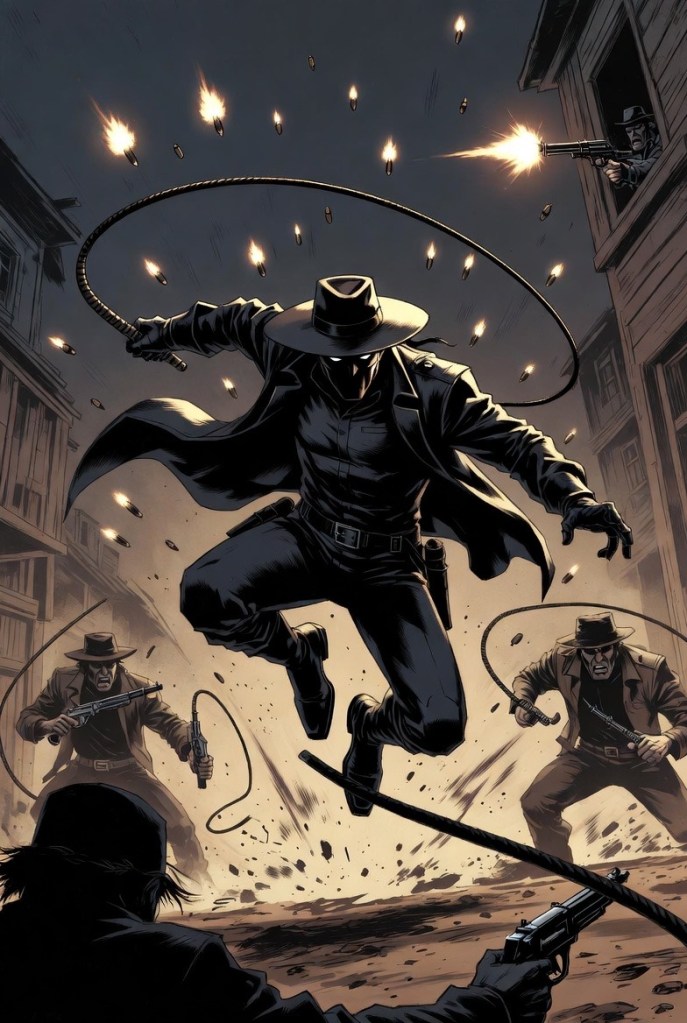
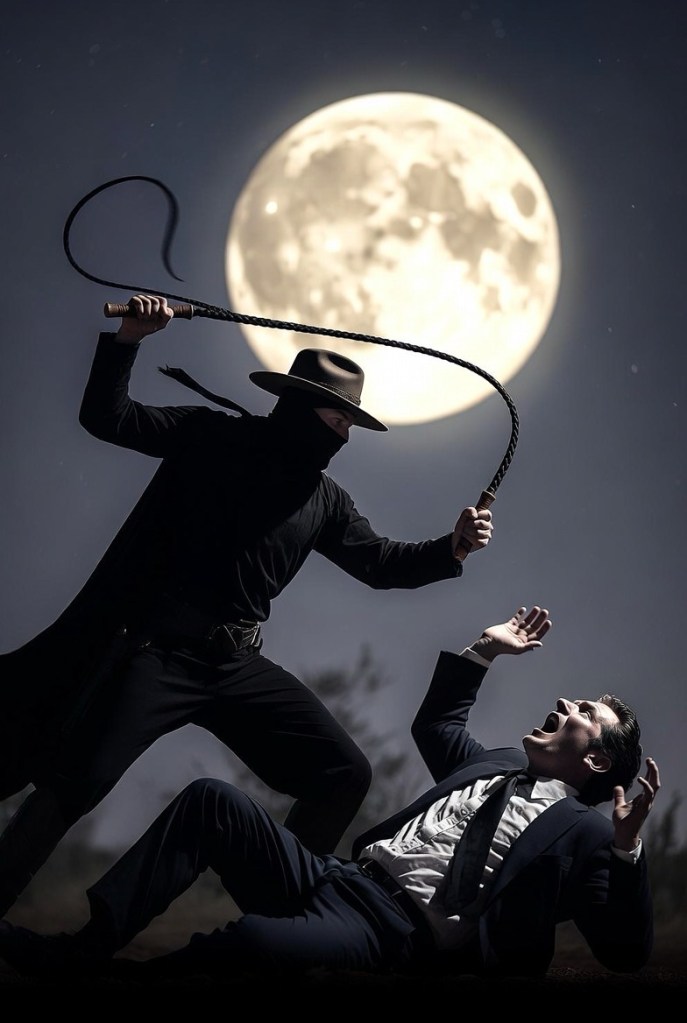
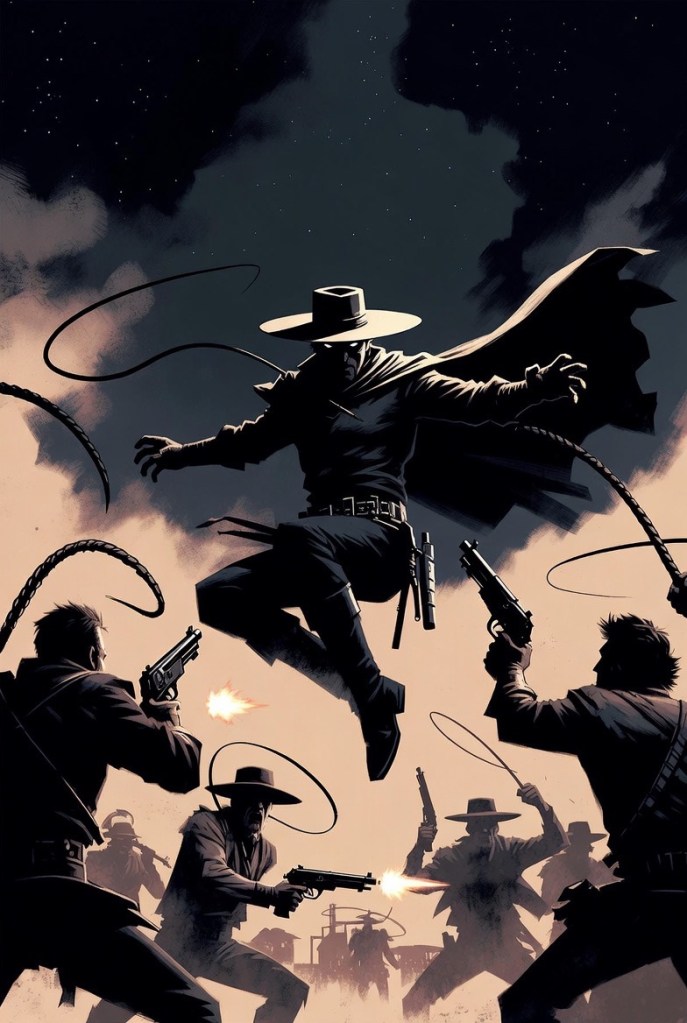
About a decade ago when my oldest daughter’s boyfriend from Europe was trying to win me over for support, he put more than the average effort in to impress me. He joined me with my bullwhip friends in competitions and became pretty good. He and I worked for many hours in my backyard developing further the bullwhip fast draw modeled after the Ohio Fast Draw Association that also competed at our events for years. He even started dressing like me in some ways, with his own spin to the outfit. This of course made my daughter very happy and convinced her to make a long-term commitment to the fella. Whereas bad fathers are the type of people who make the common sluts and bar trash that are so prevalent these days, good fathers raise girls who think about bigger things so endorsements of potential mates are important to such daughters. For her the icing on the cake was that my future son-in-law bought himself an outback hat similar to mine and started wearing it everywhere very proudly.image image image

One night, he and I were philosophizing about life and the nature of it in my backyard and he asked me about why I wore a hat so much. I told him that it was to distinguish myself from the common flock of people. In America the Cowboy Way was a code of conduct that exhibited a value system which exceeded modern boundaries and that my hat was an obvious show of support for that value system. Wearing the hat was my way of dressing for the part and my role in preserving that way of life. I went on to say that my values exceeded even those of the Cowboy Way—I was more stringent on many of them and went further on others. My favorite cowboy movies were not the John Wayne classics, or even the Lone Ranger, but they were Zorro and the famed Clint Eastwood westerns like Pale Rider and The Outlaw Josie Wales. High Planes Drifter to me is one of the most sophisticated westerns ever filmed—it was essentially Ayn Rand set in the west—it was an overman which came to a town to straighten out the justice which was long overdue. Whether the protagonist was a ghost from the past or a highly skilled more than man type—it was my favorite western and when I wore my hat, it was a tribute to those types of philosophic ideals.

I’ve been content to keep things pretty much independent of the outside world. I don’t need a lot of social support, so my way of doing things has worked just fine for me. My adherence to the Cowboy Way has been a silent code that I have not rammed down the throats of everyone I have met too much—other than wearing my hat in public most of the time. It did the job with my son-in-law and let him know what kind of family he was marrying into and I was happy with that. However, the days where that was enough are gone—the world has moved further away from that Cowboy Way in recent years and I don’t find that acceptable. Politically the Trump run for president has been a godsend, because he is covering a lot of the topics I have for the last five years, but on a bigger stage with the press eating out of his hand. So I don’t feel a need to continue beating on that drum, since somebody else has it covered—at least for now. Additionally I have a respectable number of grandchildren all of a sudden, and like that impressionable potential mate that my future son-in-law was—kids need much more of a role model figure much earlier which is my job—and I take it very seriously. My son-in-law was around 15 to 16 at the time of our talk in the backyard; he’s now climbing toward thirty fast. Time does move quickly and if you want to make an impression, you better do it quick. Kids are ruined if you don’t get to them by the age of 11 or 12. In my son-in-law’s case he was lucky to have been raised in England with a traditional way which protected him from the corruption of progressive cities like London, New York, and San Francisco. But he wanted more and he was on my doorstep looking for it, and it was my job to make sure the young lad was at least pointed in the right direction not just for his sake, but my daughter’s. After all, you raise these kids, give them all this hope, and they need to have people in their lives who share those values. The task is a rather large one. But by the time I knew him, most of his foundation thoughts were already in place. What I was saying might have small influences over how he conducted his life, but major ones probably wouldn’t be possible that late in his climb toward manhood. I promised myself that when I started having grandchildren that I would step up this Cowboy Way philosophy for their sake so that they’d have the right tools equipped intellectually to deal with a modern world spiraling over the precipice. I am one hundred percent sure that the Cowboy Way is the answer to much of what sickens America right now, and that is one major thing that Donald Trump cannot have much impact on as a presidential candidate. So I have taken major steps in advocating the Cowboy Way in a fashion that I had long been thinking about—taking up Cowboy Fast Draw as a sport.

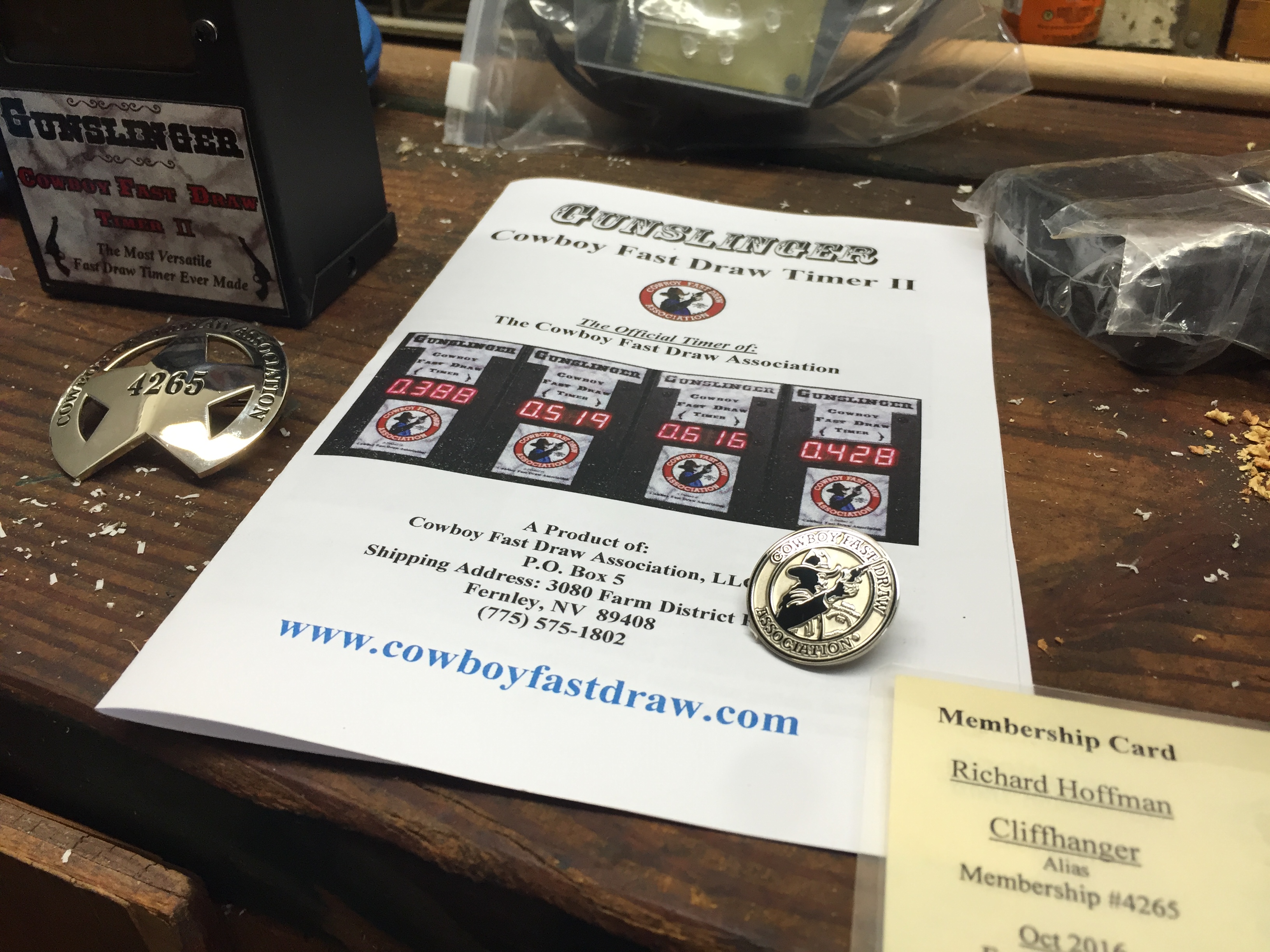
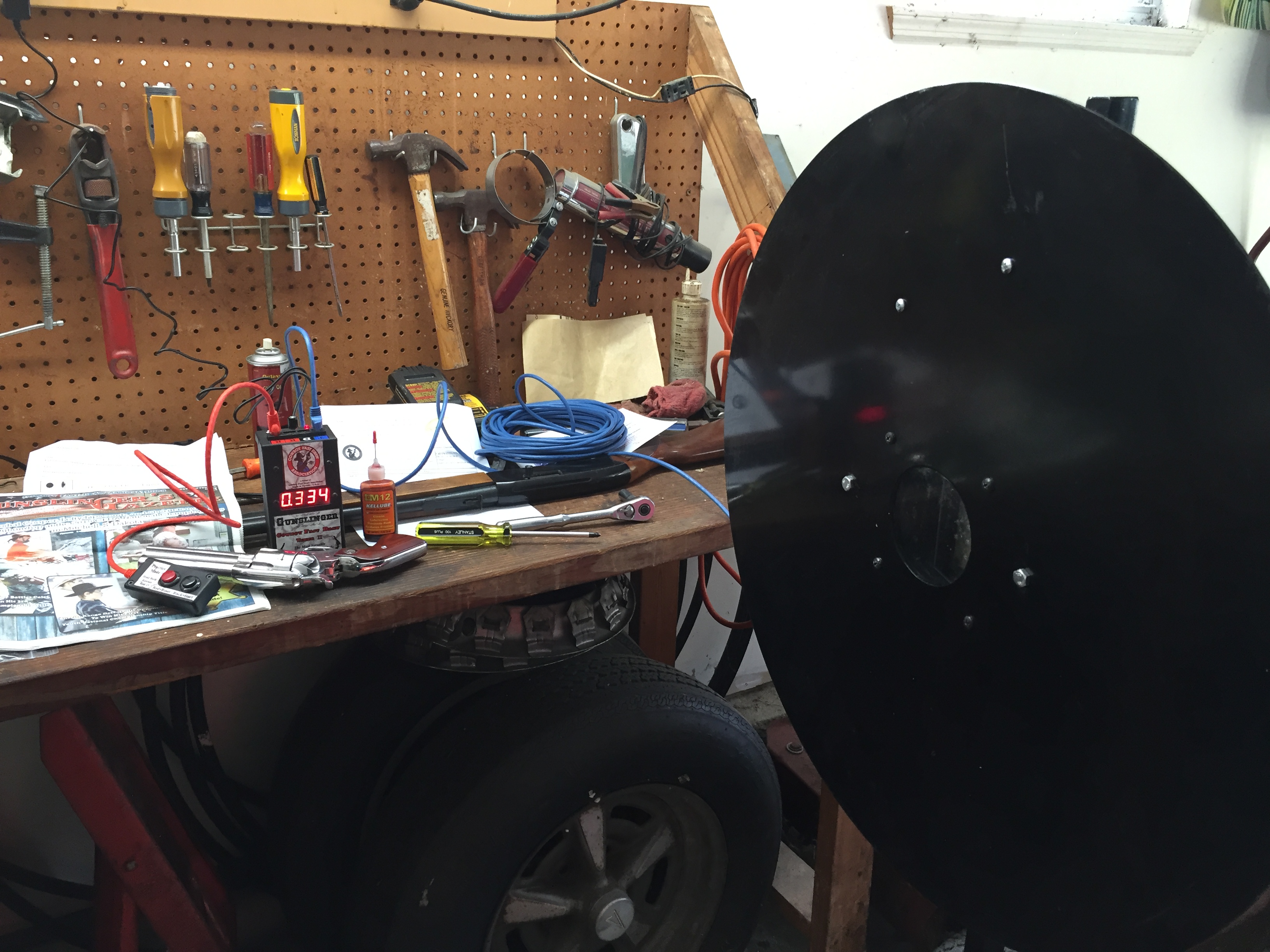
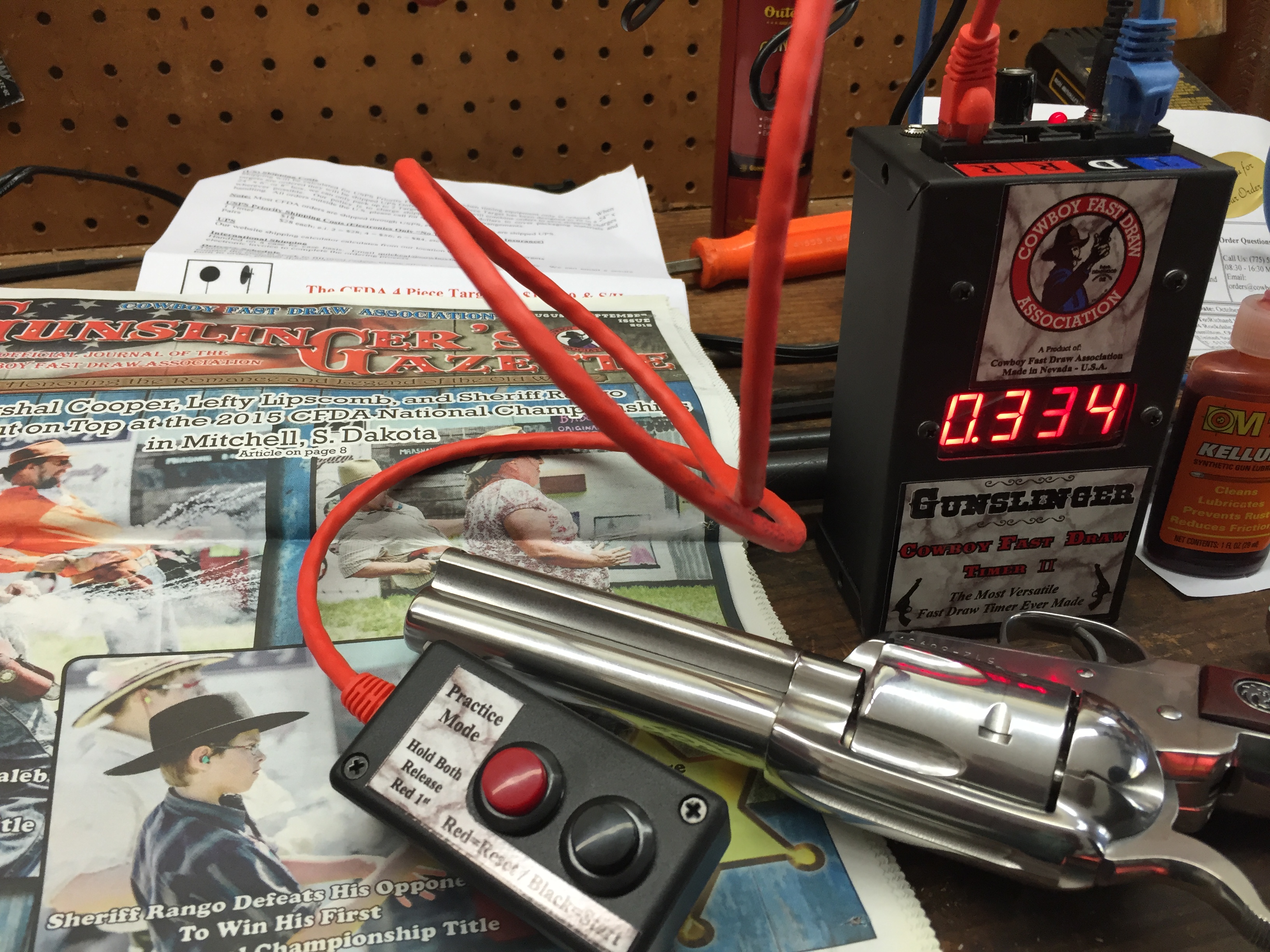
As a grown man I probably shouldn’t have been so excited to join up with the Cowboy Fast Draw Association. My package of materials arrived the day that my new granddaughter arrived home from the hospital after being born. It was a huge forty pound package that contained a lot of lights, timers and targeting equipment. Included was my new membership card and some pins that will come in handy down the road. My membership number is 4265 and of course my alias is Cliffhanger. In Cowboy Fast Draw all members must have an alias so of course mine would be Cliffhanger which is the philosophic foundation of this whole endeavor. In my fictional pulp series The Curse of Fort Seven Mile I wanted advance the direction of the character—but before I could do that of course I had to live the reality first—as my fiction has to reflect reality—otherwise I’m not interested in doing it. My membership card clearly has CLIFFHANGER written on it with a disclaimer on the back for police officers saying, “THE BEARER OF THIS CARD IS A PROFESSIONAL FAST DRAW COMPETITOR AND CARRIES SINGLE ACTION REVOLVERS FOR PURPOSES OF DEMONSTRATION AND COMPETITION.” In short, when roaming around wherever and need to maintain my practice with single action revolvers to maintain and increase my skills toward the Cowboy Way, cops shouldn’t be concerned or alarmed, because I’m a member of the Cowboy Fast Draw Association. Of course if that isn’t enough and I end up in some kind of self-defense altercation, I’ll call my buddies at Second Call Defense and let them handle the police—which is the other reason I have suddenly become so openly pro gun and an advocate of Second Call Defense. I have to protect my investment.

The Cowboy Fast Draw Association reminds me of how our Wild West Arts Club used to be over a decade ago. In a lot of ways, its much better. It was quite a privilege to open up my membership material and see several issues of the Gunslinger’s Gazette included. The group is working on expanding their membership base to over 5000 of which I was number 4265. I’d like to see it at over 20,000 and climbing, because I think it contains within it the essence that every American should be striving to behold as a nation built on philosophy and freedom—the Cowboy Way. The Gunslinger’s Gazette is essentially a publication dedicated to the Cowboy Way so it was wonderful to see a physical copy of the paper instead of the online edition I had been reading.

But to top it off the culmination of all this has not been easy. I have been a bullwhip guy for many decades, so accepting a new skill has not been painless for me. However, I have done pretty much what I can with bullwhips. I like what some of my friends have done to break records with them, but as a symbol of the Cowboy Way, bullwhips need help because they are not part of the American consciousness the way that single action firearms have been. So I needed to add that skill to my wheelhouse and I promised myself at a certain time “professionally” that I would buy my new Vaquero by Ruger and start this journey. Well that time came for me a few weeks ago. It had taken me a long time to get there, but I eventually did, and the very first thing I did was purchase the Vaquero which now sits by my side everywhere I go. I have to work with it all the time to build the muscles up in my hands, and that was the final gate to this new section of my life.

Needless to say, I’m proud to be affiliated with the Cowboy Fast Draw Association under the name of Cliffhanger. I’m also proud to be a part of Second Call Defense which helps make this new sport possible with the legal support that will help protect the validity of that membership card by CFDA. Having a firearm is an essential part of the Cowboy Way just like wearing the hat. One of the reasons my son-in-law was attracted to American life was that they didn’t allow firearms in England. He met my daughter and wanted to win me over essentially so that he could own firearms. It was my job to help him find what he was looking for. But that need doesn’t end with him, there are millions of people in just the same situation—they just don’t know how to go about it. That’s where introducing them to the Cowboy Way will help—it explains why the Second Amendment is so important and if the police get too power hungry at the sight of Cowboy Fast Draw Association members armed with single action Ruger Vaqueros on the plain states of Iowa, or Montana at a local burger joint on the way to a competition, Second Call Defense will be there to help preserve that Cowboy Way when the questions are asked. It is within these types of people who America needs to get to know itself once again—those who read the Gunslinger’s Gazette.

My grandchildren are going to get what they need; I’ll make sure of it. And of that necessity is a strong understanding of the Cowboy Way. I don’t preach to people who don’t want to listen, and I raise children that way, under a laissez-faire approach that allows individuals to invest of themselves into what I’m selling. If they walk away, they walk away, and I won’t track them down to the ends of the earth to help them. Rather I live by example, which is one of the most important parts of the Cowboy Way. And with my new membership into the Cowboy Fast Draw Association, and my friends at Second Call Defense, the gunsmithing equipment at Brownells the powder purchases from Cabela’s and many other support organizations, we’re going to protect that Second Amendment from the trying times that are before us. And it all starts with the beauty and simplicity of the Ruger Vaquero. This is going to be fun!

Rich “Cliffhanger” Hoffman

 CLIFFHANGER RESEARCH & DEVELOPMENT

Listen to The Blaze Radio Network by CLICKING HERE.

The Science of a Resurrection: Understanding the essence of a human soul

 In lieu of the recent discussions that always follow Easter Sunday and the resurrection of Jesus, the topics of concern from a religious point of view center on the nature of life and death. Older people tend to look at death as an end; young people do what they can to avoid thinking about the end, because they are just at the beginning. As Easter came and went I was editing the latest installments of my Cliffhanger series from The Curse of Fort Seven Mile stories which have been building up to a discussion about this very topic. I can successfully state that I no longer acknowledge death as an end to anything, but the vehicle which beholds consciousness—otherwise termed as the soul. We are living in an age where computer power will allow us to upload everything contained within the memories of a brain into an artificial intelligence. But we will likely miss the opportunity to replicate what we call the soul of a person—because it exists in a quantum level and can exist anywhere and everywhere in the universe, or multi verse simultaneously without any concern for time and space. In the context of my Cliffhanger stories, this means that villains killed or deceased are still a threat to the fabric of mankind. Just because a life on earth has ended does not mean that the desires they held in life are not still being utilized in some fashion because their soul is still roaming about looking to create havoc just as they did in life. A human body is but a vehicle that the soul rides within and uses to navigate through a terrain of space and time. Once that vehicle is removed, the soul is free to move about under the rules of quantum mechanics instead of in the Theory of Relativity.

When you look at a dead body, it is quickly obvious that there is nothing there. They look strangely vacant even though the facial features and other aspects of their living life can be seen. Even if the contents of memory and brain capacity are fully uploaded into a computer program that can replicate human behavior what will still be lacking is the information at the quantum level which contains our immortal elements. The big challenge for human beings of the 21st century and on is to divorce themselves of this notion that a human body is the beginning and end of a life. To know yourself, and others you care about, you have to see who they really are and look beyond the scope of bodily limitations. To grasp a bit of this concept here is an article about the work of Stuart Hameroff and Roger Penrose and their work toward understanding the quantum aptitude of the human soul.


Soul quanta

So, there is abundance of places or other universes where our soul could migrate after death, according to the theory of neo-biocentrism. But does the soul exist?

Professor Stuart Hameroff from the University of Arizona has no doubts about the existence of eternal soul. Last year, he announced that he has found evidence that consciousness does not perish after death.

According to Hameroff, the human brain is the perfect quantum computer, and the soul, or consciousness, is simply information stored at the quantum level. It can be transferred, following the death of the body; quantum information carried by consciousness merges with our universe and exists infinitely. In his turn, (Robert) Lanza proves that the soul migrates to another universe. That is the main difference his theory has from the similar ones.

Sir Roger Penrose, a well-known British physicist and expert in mathematics from Oxford, supports this theory and claims to have found traces of contact with other universes. Together, the scientists are developing a quantum theory to explain the phenomenon of consciousness. They believe that they have found carriers of consciousness, the elements that accumulate information during life and “drain” consciousness somewhere else after death. These elements are located inside protein-based microtubules (neuronal microtubules), which previously have been attributed a simple role of reinforcement and transport channeling inside a living cell. Based on their structure, microtubules are best suited to function as carriers of quantum properties inside the brain. That is mainly because they are able to retain quantum states for a long time, meaning they can function as elements of a quantum computer.


http://www.learning-mind.com/quantum-theory-proves-that-consciousness-moves-to-another-universe-after-death/

In my Curse of Fort Seven Mile series, the introduction to villains still desiring mayhem even after their death is introduced based on the science of quantum mechanics and the understanding of 5th dimensional branes. From this vantage point, souls without bodies can still enact strategies against humanity for the same purposes they did in traditional life—only they do it without the limits of a human body. Even though this may seem like science fiction, I would say that it is more fact than fiction. I stopped believing in death years ago which then pokes holes in all aspects of religious mythology and forces new definitions to deal with that emerging reality. If beings whether they be in the form of humans, honey bees, or even trees live on in a form of their innate soul only using the vehicles of existence as a temporary carrier of their true essence, than what can we attribute life to if not the birth of a living thing and the death of it? I would even propose that a human body has the potential to live as long as we can repair it, just like a car. After all a body is simply a series of mechanical parts biologically assembled. There is no reason a human being couldn’t live for thousands of years only dying in cases where the body is destroyed by tragedy. Old age is a sickness that is curable and is only not utilized because of a silly belief that the body and soul are connected in ways that are more revered than they really are pulling our thoughts into a timeline consisting of a beginning, middle, and end. But this is unnecessary.

Yes I believe in resurrection—but to be more accurate, I don’t believe in death, so resurrection is a relative term confined to the bodies of 4 dimensional existences. What makes living dangerous is that the evil of minds like the mass murderers of history are like Jesus, still living—only in a different form and if they wish to, they can still terrorize targets of their desire for needs unknown to the living unaware of the motivations and desires contained within the quantum world. But one thing is clear in such an understanding, if life doesn’t end in death—than what happens when evil people are punished or removed from their bodies by killing them? Are they not free to roam the universe causing terror and mayhem for eternity, and how could such creatures be combated if death is no longer a threat to them. That ladies and gentlemen, is the topic of the next century and the answer will change the way we view everything—most notably death itself. But before we can begin to comprehend such a thing, we have to change the way we view life and death and divorce it from the bodies which carry our souls through existence.

Hell is a concept invented by humans to separate the good from the bad in human behavior. What humans have failed to do is define the necessity of judgment against evil and given the responsibility to a deity of worship—such as we say when declaring that “Jesus will come again to judge the living and the dead.” This will no longer work knowing now what we do about the nature of life and death. The old mythology of birth, death, and resurrection will no longer function now that we know where the soul resides and the reality of uploading ourselves into another body, or even a machine becomes a more plausible in the very near future. We must force ourselves to define evil once and for all, not as an act that kills, maims and destroys culture ending the lives of innocents—but in something else much more literal. For that is a task of our age, and it will have ramifications that will span the universe.

Rich Hoffman

 CLIFFHANGER RESEARCH & DEVELOPMENT

Listen to The Blaze Radio Network by CLICKING HERE.

The Meaning of Cliffhanger: Boons beyond the edge of safety

It has come up more than once over the last several weeks, most noticeably after the recent release of the latest installment of the Cliffhanger stories, The Curse of Santa Maurta as to what’s behind the name. The name of Cliffhanger for me is a personal one for two reasons, first I grew up loving the Jules Verne inspired films, Journey to the Center of the Earth and Island at the top of the World. Those films were done with a style and approach to adventure consistent with the best cliffhanger serials of their day and I fell in love with the optimism of how they combined science and adventure—much which was refined so well in the 1980s by the Indian Jones films, and Back to the Future specifically in the character of Doc Brown. I think I always wanted to grow up into something of a mix between Doc Brown, Indiana Jones, and Dirty Harry—and all of those stories were very top-heavy in the swashbuckling cliffhanger style of story telling typical in early cinema. For me personally the start of a love for cliffhangers was in the Disney classic, Island at the Top of the World. I always loved the fearless desire to solve problems in that movie while pushing to see what was around the next corner always presented in the style of a cliffhanger.

Also, for as long as I can remember, up until just yesterday, I have had a nearly obsessive quest to live life on the edge. I love danger and taking very large chances. When I was a kid I was always the first to jump from one cliff face to another while in a high adventure explorer post. And now I am involved in politics and transactions with other human beings that could have perilous consequences with even a slight misstep. But, in spite of giving peace a chance—I just can’t do it. If there isn’t a certain amount of danger in my daily life—I’m just not happy. I have always believed that some of the freshest and most innovative ideas come to a mind on the edge of reality—pushing the limits—and somewhere in that science is the key to invention.


My first jobs before I was 19 years of age consisted of a body-guard, a repo man, a fashion model and other colorful, short-lived enterprises consisting of living a very fast life as quickly as possible. It was on the way to a live stage performance as a model that I decided to marry my wife and chose a way of life that didn’t involve taking so many chances—thinking at the time that at some point my luck might run out. It turned out to be the very best thing for me as my first endeavors emerging straight out of a stable relationship were a gunsmith, an inventor, and an entrepreneur by starting a little company called Cliffhanger Research and Development. I desired greatly to invent new tools and concepts traveling to trade shows and filing patents on my ideas—and I did this for several years—until I was in my mid-twenties and realized what was stacked against me–politically. The world seemed poised to destroy the type of adventurous spirit I fell in love with in movies like Island at the Top of the World, and wanted to stuff my spirit into a box to be controlled. During this period of my life I met mayors, the extreme wealthy and learned to read the tides of politics. I learned a lot from one particular woman who lived in Indian Hill and had a very successful husband who spent most of the year traveling around the world avoiding his wife. I wondered often why a man like him would leave the fruits of so much labor behind to avoid his responsibilities in marriage, as his wife at the time had a lot of influence in the media around Cincinnati. After many offers from this woman and her immediate friends around Indian Hill to become a gigolo to them—it was an obvious conclusion that their husbands were driven by the same condition that pushed me along—a need for danger and adventure in their lives. However, I didn’t want in my wake such chaos and destruction. There had to be a better way, which displayed clearly to me that a new philosophy was needed in our culture that was clearly missing.


Instead of becoming wealthy from all my adventures I ended up being sued, owing a lot of money in taxes to the government, and putting a lot of strain on my own marriage just from some of the sheer risks that I always wanted to take. All of my endeavors where legitimate and well in the spirit of Doc Brown, but the world was deliberately standing in my way for some reason, and that condition became the next danger to overcome. It was the reason why I named my company Cliffhanger Research and Development. Much of my life was coming from the edge where literally every day could have been the end of my life as I knew it, and I was most comfortable in that position. I needed, and still do, to know that life is unpredictable from moment to moment and that anything can happen.

Over the years I’ve learned to waltz with this tendency of mine without leaving so much destruction in my wake. The desire to live life as a cliffhanger has become quite an asset instead of a liability—I never have a shortage of fresh ideas to solve complicated problems—because as I’ve always felt, most good ideas come from the edge of acceptable reality—the parameters of safe travel, intellectually. So I can take massive chances to my heart’s content—the luck never runs out not because its given out by some strange unmet gods, but because it’s internally generated through natural optimism, and I live a pretty good life without any regrets. I would still like to make my living as an inventor, but in the barriers to entry to that marketplace I found a much more lucrative target—the failed philosophy of Eastern and Western civilization.

The best way to tackle many of our modern problems and all the inventions that are being held back from human civilization because of a failed way to embrace a proper philosophy is the reason I created the character of Cliffhanger to fight crime and a world hell-bent on internal personal destruction. The characters in my Cliffhanger stories come directly from my past which is vibrant and full of color in a way that is unique. Really the lessons I learned living life so recklessly on the edge in my late teens and twenties has given me an insight into things that I haven’t been able to find in any books or stories that I have ever read. For me it goes back to that woman in Indian Hill who had it all—a wonderful home in an exclusive community, all her bills paid into the future for a hundred lifetimes of excess lifestyle, a beautiful pool in the back with a pool house larger and better furnished than most wealthy people’s homes, and a husband who liked her enough to marry and at least keep her from having to work for an employer. She had the adoration of the Cincinnati media and could call up some of the wealthiest people in the country any time she wanted. But she wasn’t happy—and her husband wasn’t either. They had lost their edge to life—the very thing that made them fall in love with life, and made them rich in the first place. They lost as they tried to secure their holdings with political maneuvers that took their fortune and placed it on the safe bets—thus destroying them as people.

For many years thereafter a friend of mine and I worked as part of his tree trimming business. We would climb trees and remove them from dangerous precipices on the property of many wealthy people. The men were always the same no matter where we went, and the women all had that hunger in their eyes for some needed adventure. During their climb for wealth they had lost something—that edge some sports teams have when they have a lead late in the game, then start playing it safe to protect it. More often than not they shockingly lose the game in the final seconds. The reason for that behavior became an obsession of mine.

I could now in my life become one of those people—but I avoid it like the plague. At a stop light just this week the temperature was 32 degrees outside and it was pouring rain at 6 AM. I was on my motorcycle as usual, my tires were bald from a hard winter of everyday driving, and the bike nearly slid to every stop I made. A guy pulls up to me at a stop light and yells, “F**kin’ ride hard man! You rock! Livin’ the dream!” He was of course referring to a middle-aged man riding a motorcycle on bald tires in near freezing conditions in a pouring rainstorm during early morning rush hour traffic. He desired himself to be out in the danger of life with me, but likely he was taught at some time in his past not to do things like that for fear of his own safety. Instead he takes other chances against life itself, like drinking too much, having relationships with other people who are dangerous and unhealthy and approaching safety in his life with a passive-aggressive rebellion they think nobody notices—like getting a tattoo where they think nobody can see.

Like the heroes from the movie Island at the Top of the World I have discovered in people something they don’t know much about themselves—perhaps not to the degree that I feel it—but most people do. There is a deep child-like yearning for adventure—for cliffhangers in their life where each day is a new one, and they never know what might happen. I am most happy in those conditions. I love the fire and I seek to stand right in the middle of it wherever it’s at. Because within it there is a boon to society that lives out on the edge, over the cliff—and often you have to hang over and extend yourself to reach it. So I invented Cliffhanger as a character to explore those boons. It is my hope that people who find their lives too safe and un-tempered in the fires of life will get what they need through my Cliffhanger stories. The safest way to bring people the needed danger their lives demand is through a character that is as fearless as anything ever put to print. But for those stories to have validity, they have to come from something tangible, and in the case of Cliffhanger—it does—a life lived hard and without a single day of reflection into something safer.

Rich Hoffman

 CLIFFHANGER RESEARCH & DEVELOPMENT

Listen to The Blaze Radio Network by CLICKING HERE.

‘The Delivery’ Graphic Novel: Rob Gunnerson’s dream made into a reality

The creative process is fun and I remember when I first met Rob Gunnerson at a film festival, it was the start of a lot of fun that has slowly trickled in over the years. I was performing a firewhip demonstration for the World Stunt Association and he and Twilight actor Peter Facinelli were watching. A few years later they invited me to Los Angeles to help make a pitch trailer for an interesting story Gunnerson had been thinking about since he was a little kid. We were all kind of the same age, so we had grown up with a love of certain types of movies. We had a lot of fun putting Rob’s vision into a short two-minute trailer introducing the main objectives of the story. Peter was producing and using his considerable fame to draw studios to the project with Real D 3D as a partner. In the back ground was Dave Stewart from the Eurythmics supporting the project so it was exciting. We captured some wonderful images and had a lot of fun. But as I’m mentioned before, it is hard to get things off the ground in today’s Hollywood, even for seasoned veterans and popular pop culture personalities with millions of Facebook contacts. To get the money men to line up to fund projects now requires more than even Peter was able to assemble leaving Gunnerson to turn toward a new direction to get his project the attention that producers now require to put up the kind of money it takes nowadays to make a motion picture. CLICK HERE TO REVIEW. The three primaries on the project, Rob, Peter, and Dave Stewart turned toward a graphic novel version of their story which comes out in April of 2015 to tell their complicated, dynamic story about Angels, Demons and The Last Hour before both try to destroy Mankind. Listen to them talk about the project below.

I fell in love with Gunnerson’s vision because of the actions of his protagonist Brother U who was an Angel who uses a firewhip to perform combat. Facinelli played that character in the short and is the basis for the character in the upcoming graphic novel. I was brought in to do the firewhip work and act as a stand-in for Peter. It was a project that I have always had a lot of hope for, and still do. But it is very telling how difficult it has been for these talented guys to get their project off the ground. Needless to say, I am really looking forward to their graphic novel. Rob told me a good part of the story in my time with him, but I am really looking forward to the visual conception released in an actual printed edition. It has taken nearly 10 years since Rob and I first met at the film festival stunt show to get to this point which he talks about in the below interviews a little bit—and for the director some pieces of his puzzle fell into play during my performance which makes me happy, so I am looking forward to seeing his vision put onto a printed page finally.

The art for the graphic novel looks fantastic. We captured some really cool scenes during the trailer shoot which I’m sure Gunnerson has looked at over and over again, so there are wonderful visuals to provide a template for the artist to pull from. I have always viewed Rob’s story as a kind of modern Highlander project. If Gunnerson had been a director in Hollywood during the 1980s, The Delivery would have been made for about 10 million dollars by a major studio and would likely be a cult classic to this very day. But, in the Hollywood of today where studio executives are much more timid and the cost of a movie is much, much greater—you have to prove there’s a market for something like this before anybody will drop 50 million to 100 million into such a project for a studio release.

The journey is often an adventure in and of itself. Between shoots on the set, the producers and I had fun on Brand Blvd cracking bullwhips on the sidewalk in a part of town that was filming television shows on nearly every city block. My hotel was on the main strip down the road from the Americana shopping complex and a lot of those people had never seen a whip act in real life. Under the encouragement of the small entourage that accompanied me, I pulled out some of the big whips and cracked cigarettes out of the mouths of just casual passers-by, and curious spectators adding to the nightlife that was vibrant. Needless to say it left an impression. When I flew out of Los Angeles that time, I had the feeling I would be returning within a few months to shoot the actual movie. But the project sat around and soon months because years with still no movement. Finally, after quite a lot of time passed, Gunnerson turned toward the tools available these days—such as Kickstarter to produce the story into a graphic novel that would at least get the concept into some art that people could look at, and slowly build up a cult audience, which for something like this—is the best way to go.

I admire Rob for not giving up on his dream of bringing this story to life. He’s an accomplished director and has access to celebrity personalities, but even so, it’s a hard sell in modern Tinseltown and this idea could have died easily on the vine. But, these guys have stuck with it and are still fighting to bring this concept to an audience. If not through a movie, then through a graphic novel, which I personally will enjoy more—I love artwork like the type shown in this upcoming graphic novel and I hope it is successful for them. If they desired to step away from Hollywood there are options out there for them. But it is a tough decision. The business model of the movie business is changing before our eyes, so it’s a difficult moving target to hit. But making The Delivery into a graphic novel to bring this story to an audience more poised to enjoy it—is clearly the smart thing to do.

I am happy to have been a part of the creative process in showing in reality the kind of things that were in Rob’s mind before our meeting. Its one thing to think of something, it’s another to see it come to life. Seeing a firewhip in action obviously helped take Rob’s thought process to the next level. Now, with some footage shot to work from, artists were able to convey that over into a graphic novel with some fabulous artwork. It is the kind of artwork that I tend to treasure and know that I will enjoy immensely. It will always remind me of the time that we brought bullwhips to the streets of Hollywood and kept Burbank awake at night with fireballs and explosions that bounced off the Verdugo Mountains with the ease of unfettered sonic booms at 3 AM.

I’m looking forward to the graphic novel of The Delivery. Read more at the following link.

https://www.kickstarter.com/projects/172403788/the-delivery-issue-1

Rich Hoffman

CLIIFFHANGER RESEARCH & DEVELOPMENT