Why Executive Leadership is the Key to a Successful Society: And why it is so incredibly rare

True executive leadership is not something taught in classrooms through textbooks or lectures on management theory. It is forged in the crucible of real-world challenges, where fear, uncertainty, and the need for decisive action collide. I learned this early, during an unusually formative childhood that exposed me to high-stakes environments far beyond typical teenage experiences. As a young teen, I participated in the High Adventure Explorer Post, a program that graduated from Boy Scouts and emphasized rigorous outdoor challenges. This led to my involvement in Project COPE—Challenging Outdoor Personal Experience—a Scouting initiative designed to build confidence, trust, leadership, and teamwork through group games, trust falls, low-course elements, and high-course obstacles such as climbing walls, rope swings, and balance challenges.

In one memorable weekend seminar, around age 13 or 14, about 20 strangers were thrown together to solve impossible-seeming problems. We had to transport everyone across a field using only a few 2×4 boards, balancing on pegs where touching the ground meant starting over. We climbed a 20-foot wall without ropes, stacking bodies to create human ladders, pivoting people into position, and hauling others up from vantage points. The trust fall was particularly vivid: standing on a 6-foot stump, falling backward unthinkingly, relying on the group below to catch you. These weren’t games; they demanded communication under pressure, overcoming personal fears, setting aside differences, and articulating a clear plan that everyone could execute. Success required a narrative—a story that unified the group around a shared vision. Failures taught the team what not to do: hesitation, poor coordination, and ego-driven decisions doomed the team. Those who emerged as natural leaders could rally perfect strangers, build trust quickly, and guide them through duress to victory.

This experience wasn’t isolated. I rose to become vice president of the Dan Beard Council, a significant Boy Scouts organization in the Cincinnati area, under somewhat controversial circumstances that provided invaluable lessons in organizational dynamics and influence. At 14, I was invited to speak at GE’s Evendale facility—a massive engine manufacturing site—where I delivered a pitch on leadership drawn from these adventures. Standing before seasoned professionals as a kid, articulating principles of vision, trust, and collective action, cemented my path. It wasn’t credentials that carried the day; it was the ability to communicate a compelling story and inspire follow-through.

These early trials shaped my understanding of executive leadership, a skill rare even among those who hold C-suite titles. Many executives excel at spreadsheets, regulations, data analysis, and compliance—tasks that engineers and administrators handle well. But leadership transcends that. It is the art of creating a vision that others buy into, communicating it clearly enough that diverse groups align, and leading from the front to pull everyone through obstacles they couldn’t surmount alone. True leaders don’t micromanage every detail; they don’t need to know how to code the software, assemble the product, or balance every ledger line. They orchestrate the team, provide the overarching narrative, and empower others to execute. Think of a kitchen: the chef doesn’t wash dishes or make noodles from scratch, but ensures the entire operation runs smoothly so spaghetti arrives hot and customers return. Leadership is that orchestration under fire.

This truth stands in stark contrast to prevailing misconceptions. Schools rarely teach it properly; corporate retreats often superficially mimic it with trust falls and ropes courses, checking boxes without the depth of real hardship. Many in leadership positions mimic “mob rule”—placating safety concerns, enforcing endless administrative loops, or prioritizing equality over merit. They hide behind regulations, consensus-building, and democratic processes that dilute accountability. The result? Stagnation. When organizations are mired in bureaucracy, innovation slows, and potential leaders get sidelined.

Consider recent local examples in West Chester Township, Butler County, Ohio, where I’ve lived most of my 58 years. It’s a prosperous, conservative community built on business-friendly policies and strong leadership. Yet newcomers like Amanda Ortiz, who relocated here in 2016 with her husband and now serves as a trustee (elected in 2025), bring perspectives shaped by different environments. As a veterinarian focused on animal welfare, she campaigns on “people over business,” critiquing development and emphasizing resident input over economic growth. While well-intentioned, this risks importing anti-business sentiments—such as higher taxes on enterprises and wealth-redistribution rhetoric—that clash with what has made the area thrive. It’s the same mindset seen in broader progressive movements: viewing successful CEOs as “greedy” and advocating for shared wealth without acknowledging the rare skill of value creation.

This echoes larger ideological battles. Socialism and communism promise equality through state control or democratic redistribution, suppressing individual leadership. They assume administrators can orchestrate prosperity through rules alone, without the visionary drive of a single, accountable leader. History shows otherwise: state-run economies falter because they penalize autonomy, stifle innovation, and equalize performance at mediocrity. No one climbs the wall if everyone’s voice is equal and no one leads decisively. Remote work trends exacerbate this—employees scattered, communication fractured, approval loops endless. You can’t build trust or rally a team when half are at home; the COPE lessons prove that interaction under pressure forges bonds that Zoom can’t.

Contrast that with proven leaders like Jack Welch at GE (who transformed it into a powerhouse through bold vision), Steve Jobs (who articulated Apple’s future and pulled teams to it), or Elon Musk (who leads from the front on audacious goals). They don’t consult committees for every decision; they communicate big concepts, inspire buy-in, and drive execution. Donald Trump exemplifies this politically—articulating massive ideas that mobilize millions without micromanaging details. He leads the metaphorical train, helping people over walls they couldn’t scale alone.

America’s success—its unmatched GDP, entrepreneurial spirit, and job creation—stems from empowering such leaders. Capitalism rewards those who develop the rare skill of pulling others forward through narrative, trust, and action. Boy Scouts programs like COPE and Explorer Posts cultivate this through sweat, cold nights, cut fingers, and mud—trials that separate natural leaders from followers. Most participants become capable followers, which is fine; society needs both. But the few who rise, who can get strangers over obstacles and keep harmony afterward, become CEOs, founders, and visionaries who employ millions.

The fantasy that mobs or committees can replace this ignores reality. Numbers don’t vote on facts; gravity doesn’t bend to consensus. Leadership isn’t democratic—it’s directional. Empower leaders with autonomy, and organizations soar. Suppress them with equality mandates or administrative burdens, and decline follows. This is why communist models fail: they suppress leadership, fearing individual excellence threatens the collective illusion.

In my book, The Gunfighter’s Guide to Business: A Skeleton Key to Western Civilization, I explore these themes deeply—strategy drawn from hardship, the primacy of vision over bureaucracy, and how true leadership saves companies, communities, and civilizations. It’s not theory; it’s lessons from the school of hard knocks, much like those COPE weekends or speaking at GE as a teen.

We need more such leaders, not fewer. Penalizing success through spiteful policies—resenting wealth creators, demanding redistribution—creates injustice and stagnation. Gratitude for effective leaders, who lift everyone, builds prosperity. Civilization learns this slowly, but the path is clear: identify, empower, and follow those who can get us over the wall. Without them, we stay grounded.

Bibliography and Footnotes

1.  Scouting.org, “Program Feature: COPE,” detailing Challenging Outdoor Personal Experience as group initiatives, trust events, and high/low challenges for leadership and teamwork.¹

2.  Wikipedia, “COPE (Boy Scouts of America),” overview of the program focusing on strength, agility, and personal growth through outdoor tests.²

3.  Grand Canyon Council BSA, “COPE,” emphasizing confidence, self-esteem, trust, and leadership via mental/physical challenges.³

4.  West Chester Township official site, “Board of Trustees,” bio of Amanda Ortiz, resident since 2016, veterinarian, elected trustee term 2026–2029.⁴

5.  Amanda Ortiz for Trustee campaign site, platform stressing “people over business” and resident-focused leadership.⁵

6.  Journal-News, “Longtime West Chester Twp. trustee unseated in election,” Nov. 6, 2025, coverage of Ortiz’s 2025 win unseating incumbent.⁶

7.  Rich Hoffman, The Gunfighter’s Guide to Business: A Skeleton Key to Western Civilization (Liberty Hill Publishing, 2021), core text on strategy, leadership, and capitalism.⁷

8.  Overmanwarrior.wordpress.com, author bio and book commentary, linking personal experiences to leadership philosophy.⁸

9.  Various Scouting resources on high-adventure programs, including Explorer Posts and leadership training via challenges.⁹

¹ https://troopleader.scouting.org/program-features/cope

² https://en.wikipedia.org/wiki/COPE_(Boy_Scouts_of_America)

³ https://support.scoutingaz.org/main/cope

https://www.westchesteroh.org/government/general-government/west-chester-board-of-trustees

https://www.amandaortizfortrustee.com/

https://www.journal-news.com/news/longtime-west-chester-twp-trustee-unseated-in-election/CD2ADHRUKVC2JOIQSCMINM3MWE

⁷ Liberty Hill Publishing / Amazon listings for the book.

https://overmanwarrior.wordpress.com/author-bio-for-rich-hoffman

⁹ Multiple Scouting America sites on COPE and high-adventure bases.

Additional references include historical accounts of Boy Scout leadership development, economic analyses contrasting capitalism and socialism (e.g., works on Jack Welch and Steve Jobs biographies), and local Ohio political coverage.

Rich Hoffman

More about me

Click Here to Protect Yourself with Second Call Defense https://www.secondcalldefense.org/?affiliate=20707
The Kandahar Giant: Yes, I believe it was sent to Wright-Patterson for examination

The world has shifted profoundly over the past few years, and with that shift has come a renewed willingness to question long-held narratives. Institutions once trusted implicitly have been exposed as capable of extraordinary deception, particularly during the COVID era, where mandates were imposed with absolute certainty, only for the underlying premises to crumble under scrutiny. “Trust the science” became a slogan that masked agendas, gain-of-function research was downplayed despite evidence of its role, and entire economies were shuttered under the guise of public health. When authority figures lie so brazenly about something as immediate and verifiable as a virus’s origins and spread, it naturally prompts a reevaluation of other suppressed stories. What else have we been told was impossible, only to discover layers of concealment?

One such story that has resurfaced with renewed credibility in this post-COVID awakening is the Kandahar Giant. This account describes an alleged encounter in 2002 (though some retellings place it around 2005) in the remote mountains of Kandahar Province, Afghanistan, during Operation Enduring Freedom. According to multiple anecdotal sources, a U.S. military patrol vanished without a trace. A special operations task force—often described as an elite unit such as the Rangers or the Green Berets—was dispatched to investigate. They followed a trail of scattered gear and spent casings leading to a large cave entrance littered with bones, human remains, and discarded equipment.

Emerging from the cave was a humanoid figure of extraordinary size—estimates range from 12 to 15 feet tall—with distinctive features: flaming red hair, six fingers on each hand, six toes on each foot, and double rows of teeth. Armed with a large spear, the being reportedly charged the soldiers, impaling and killing one (sometimes named “Dan” or linked to a real casualty like Sergeant Dan Romero in unrelated contexts, though unconfirmed). The team responded with sustained fire from M4 carbines, recon rifles, and Barrett .50 caliber anti-materiel weapons. It allegedly took 30 seconds of concentrated gunfire to fell the creature. The body was then airlifted via helicopter, possibly in a cargo net, and transported out of the theater.

The narrative gains intrigue from claims that the remains were not sent to the more publicized Area 51 but to Wright-Patterson Air Force Base in Dayton, Ohio—the historical hub of aviation innovation and a site long associated with classified reverse-engineering programs, including rumored extraterrestrial artifacts from incidents like Roswell. Wright-Patterson’s Foreign Technology Division and its secure facilities make it a logical destination for sensitive recoveries. Some versions include testimony from an alleged cargo pilot who loaded a 1,100- to 1,500-pound body onto a transport plane, bound for stateside analysis.

This story first gained traction in the mid-2000s through radio programs like Coast to Coast AM, hosted by figures such as Steve Quayle. It was later amplified by researchers like L.A. Marzulli, who conducted interviews with purported witnesses, including a figure known as “Mr. K” (claimed to be a participant) and others in military circles. Timothy Alberino, an explorer and author focused on biblical history and anomalous phenomena, has discussed the event extensively, linking it to ancient accounts of giants. Alberino contributed a foreword or introduction to a reissued edition of a book on giants and Nephilim—likely a work like Joseph Lumpkin’s “The Book of Giants: The Watchers, Nephilim, and The Book of Enoch” or a similar text that had been out of print—bringing renewed attention to these themes.

The Kandahar account aligns with broader patterns in folklore and scripture. The Bible repeatedly references giants: the Nephilim in Genesis 6:4, described as the offspring of the “sons of God” (often interpreted as fallen angels or Watchers) and human women, resulting in mighty beings of renown. Post-Flood accounts include the Anakim, Rephaim, and Goliath of Gath, who stood over nine feet tall. The Book of Enoch, an ancient text quoted in Jude and influential in early Jewish thought, details the Watchers’ rebellion, their mating with humans, and the resulting giants who devoured resources and turned to cannibalism, prompting divine judgment via the Flood.

Similar giant lore appears worldwide: Native American traditions speak of red-haired giants in Nevada’s Lovelock Cave; South American legends describe tall beings in remote regions; Siberian and Chinese folklore mentions oversized humanoids in isolated areas. In Afghanistan’s rugged terrain—vast, under-explored caves and mountains shielded by perpetual conflict—these stories persist in oral traditions. Wars in such places rarely resolve cleanly; prolonged instability keeps areas off-limits to independent research, much like communist-era restrictions in Siberia preserved vast untouched wildernesses.

Closer to home, Ohio’s ancient mound cultures offer parallels. The Miamisburg Mound, one of the largest conical burial mounds in North America (built by the Adena culture circa 1000–200 BC), has yielded reports of unusual finds. In the 1800s, excavations uncovered skeletons of “unusual size,” including oversized jaws and skulls that reportedly fit over modern ones like helmets. Newspapers from the era chronicled the discovery of 7- to 9-foot skeletons in Ohio mounds, often accompanied by artifacts suggesting advanced or anomalous origins. Yet systematic archaeological excavations have been minimal, despite the presence of nearby universities with robust programs. The Mound Laboratories (now part of the Mound Facility) were built nearby for nuclear trigger mechanisms—coincidentally or not—on sites with prior reports of giant bones. Some speculate that these placements obscure evidence, mirroring how dominant cultures have historically superimposed symbols or structures to erase predecessors, as seen on Jerusalem’s Temple Mount.

Why conceal such things? Power structures thrive on controlled narratives. Acknowledging surviving giants or pre-Flood advanced beings challenges evolutionary timelines, biblical interpretations, and institutional authority. If giants exist(ed), it implies hidden histories, perhaps genetic legacies in tall modern athletes or isolated populations. Governments, through black budgets and oaths of secrecy, maintain control—Wright-Patterson personnel swear lifelong confidentiality, and silence speaks volumes. My own conversations with retired military figures, including a colonel from Wright-Patterson, hint at legitimate reverse-engineering programs, fueling speculation that anomalous recoveries (whether tech or biological) end up there.

COVID eroded institutional trust irreversibly. When officials mandated masks and lockdowns while concealing lab-leak possibilities, the “conspiracy theorist” label lost potency. Those once dismissed as fringe on topics like gain-of-function or elite agendas proved prescient. The same mechanisms—discrediting inquiry, labeling skeptics dangerous—apply to giants, UFO disclosure, or ancient anomalies. Wars in Afghanistan, perpetual Middle Eastern tensions, or China’s opacity may keep regions unstable, preventing the exploration of caves or sites that hold truths about humanity’s past.

Giants aren’t mere fantasy; they’re embedded in cross-cultural records. Too much smoke suggests fire. The Kandahar incident, if true, represents a modern collision with ancient reality. The body allegedly taken to Wright-Patterson for study echoes Roswell patterns—distractions elsewhere while real work happens in secure Midwest facilities. Leaks increase as oaths age and consciences stir. Disclosure feels inevitable.

We stand at a threshold. Reexamining suppressed stories fosters truth-seeking over blind obedience. Whether giants roamed Afghanistan or Ohio mounds hold oversized remains, pursuing evidence of their existence honors intellectual honesty. Governments owe accountability; black budgets and secrecy breed abuse. As Reagan’s revolution emphasized liberty and transparency, let us initiate similar scrutiny today. The truth, however extraordinary, deserves rational discussion—no matter how it upends official narratives.

Bibliography and Footnotes

1.  Cryptid Wiki, “Giant of Kandahar,” detailing the 2002 encounter, red-haired features, and lack of official evidence.¹

2.  Military Times, “Here Be Giants: Outlandish Tales of the Military in Afghanistan,” Oct. 31, 2022, discussing the Kandahar legend as folklore.²

3.  All That’s Interesting, accounts of the spear attack and airlift.³

4.  L.A. Marzulli interviews with “Mr. K” and other witnesses, featured in documentaries and podcasts (e.g., YouTube excerpts from 2016).⁴

5.  Timothy Alberino discusses the Kandahar Giant, linking to Nephilim, in podcasts like Blurry Creatures and Michael Knowles Show.⁵

6.  Joseph Lumpkin, “The Book of Giants: The Watchers, Nephilim, and The Book of Enoch,” reissued editions with possible Alberino contributions.⁶

7.  Dayton History Books Online, “The Day They Opened the Miamisburg Mound,” 1800s reports of oversized skeletons.⁷

8.  Columbus Dispatch, debunking giant claims but noting 19th-century newspaper hoaxes and reports.⁸

9.  Ancient Origins, “Top Ten Giant Discoveries in North America,” referencing Miamisburg’s 8+ foot skeleton claims.⁹

10.  Skeptoid Podcast, analysis of Kandahar story evolution and Wright-Patterson connections.¹⁰

¹ https://cryptidz.fandom.com/wiki/Giant_of_Kandahar

² https://www.militarytimes.com/off-duty/military-culture/2022/11/01/here-be-giants-outlandish-tales-of-the-military-the-afghan-colossi

³ Various aggregated accounts from the 2000s radio and online forums.

⁴ L.A. Marzulli YouTube interviews (e.g., with Richard Shaw).

⁵ Timothy Alberino’s appearances on YouTube and podcasts.

⁶ Amazon listings for related Enoch/Giants texts.

https://www.daytonhistorybooks.com/miamisburgmound.html

https://www.dispatch.com/story/news/technology/2019/01/27/archaeology-were-ancient-writings-giants/6185559007

https://www.ancient-origins.net/unexplained-phenomena/giants-north-america-005196

¹⁰ https://skeptoid.com/episodes/1014

Additional sources include the Coast to Coast AM archives, Steve Quayle’s discussions, and biblical texts (Genesis 6; Book of Enoch).

Rich Hoffman

More about me

Click Here to Protect Yourself with Second Call Defense https://www.secondcalldefense.org/?affiliate=20707
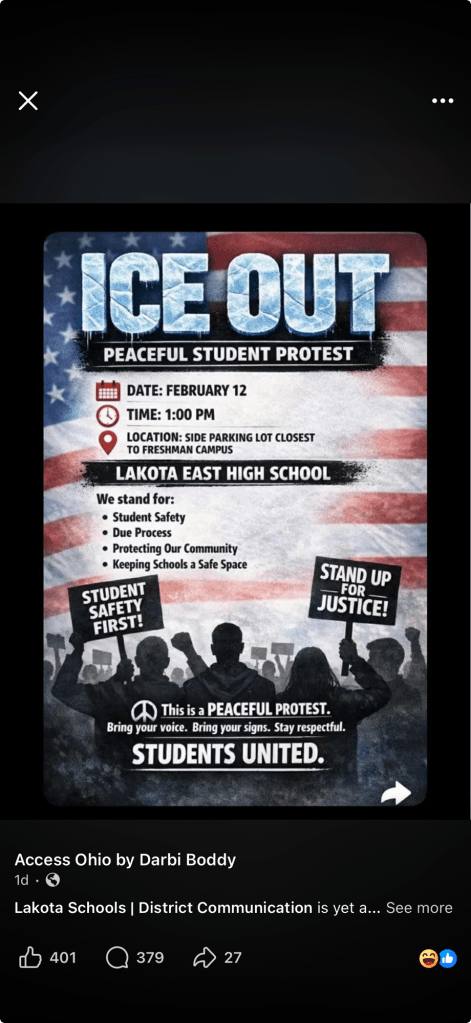
Radical Teachers in Lakota Use Students to Advocate Left-wing Politics: ICE protests at taxpayer facilities insult parents

The events at Lakota Local School District in northern Cincinnati, Ohio, on February 12, 2026, represent a microcosm of broader national tensions surrounding student political activism, school administrative responses, potential teacher facilitation, and the influence of progressive ideologies in public education. In a predominantly conservative area of Butler County, students at Lakota East and Lakota West high schools engaged in walkouts protesting U.S. Immigration and Customs Enforcement (ICE) policies, including expanded enforcement, raids, and alleged excessive force under the Trump administration. These actions involved students exiting classrooms (at Lakota East around 1 p.m.), marching with signs, chanting slogans against ICE, and positioning themselves visibly along roadsides for media attention. At Lakota West, the protest occurred after school hours and off-campus to limit direct disruption.

Local media, such as WKRC Local 12, reported these demonstrations as student-led responses to federal immigration tactics, noting similar actions across the Tri-State region (Ohio, Kentucky, Indiana). Principals from multiple Lakota schools (including East, West, Hopewell Junior, Liberty Junior, and others) issued a letter to parents on February 11, 2026, preemptively addressing rumors of a “voluntary” walkout. The letter upheld students’ First Amendment rights to peaceful protest and civic expression while warning that unexcused absences would be subject to Ohio law and district policy—participation did not qualify for excused status (e.g., illness, emergencies), and preplanned requests would be denied. It emphasized respect for diverse views, noncoercion, a safe environment, and the requirement to report to the office before leaving the building.

Critics, like me, have labeled the letter evasive, arguing it downplayed administrative or teacher involvement while allowing the event to proceed. Eyewitness observations suggest that protest signs were prepared in classrooms with teacher awareness or permission, and that the walkouts occurred during school hours with limited enforcement. Participants rerouted around obstacles such as snowbanks to remain visible in high-traffic areas (e.g., near I-75), indicating deliberate efforts to maximize impact and media coverage. Coverage portrayed the protests as expressions of community solidarity in a Republican-leaning region, although turnout appeared modest relative to enrollment.

Lakota school board member Benjamin Nguyen publicly opposed the demonstrations, issuing a statement calling non-participants “patriots” and citing crimes by undocumented immigrants. Despite warnings of unexcused absences, many participants reportedly faced minimal repercussions, fueling claims of tacit approval to avoid liability or conflict.

The Nationwide Wave of Anti-ICE Student Protests in Early 2026

The Lakota walkouts aligned with a massive surge of “student-led” demonstrations (organized through teacher union radicalism) across the U.S. in January and February 2026, often coordinated via social media by progressive groups and spurred by intensified ICE operations, including detentions, and tragic incidents like fatal shootings involving agents in Minneapolis. Thousands participated nationwide, with actions in dozens of states and cities.

In the Cincinnati area:

•  Walnut Hills High School: 300–400 students walked out on February 4, 2026, holding signs like “Abolish ICE” in cold weather.

•  Princeton High School: Hundreds walked out on February 10, emphasizing opposition to racial profiling in a diverse student body.

•  Other schools, including the School of Creative and Performing Arts (dozens marching with chants on February 11) and Sycamore High School (tied to January actions), joined the wave.

Elsewhere in Ohio and nationally:

•  Central Ohio districts (Worthington, Hilliard, Upper Arlington) saw January walkouts after ICE’s Operation Buckeye.

•  Northeast Ohio (Cleveland Heights): Hundreds marched on February 12.

•  Other states: Texas (Hutto, Austin, Pflugerville), Kansas (Lawrence, Free State), Utah (multiple Salt Lake County schools with hundreds marching), California (Los Angeles Unified estimating thousands), Minnesota (lawsuits over ICE near schools), and more.

Protests focused on protecting immigrant families, creating “safe spaces,” and opposing overreach. Some districts threatened disciplinary action or investigated facilitation; others remained neutral or supportive. Conservative critics highlight the coordination, media amplification, and involvement of younger students as evidence of external influences beyond organic concern.

Teacher Unions, Political Leanings, and Potential Facilitation of Activism

Central to the controversy is whether these protests were student-driven or amplified by teachers and unions. Public school teachers often lean liberal/Democrat in surveys, and unions like the National Education Association (NEA), American Federation of Teachers (AFT), and Ohio affiliates (Ohio Education Association, Columbus Education Association) have advocated on immigration, condemning ICE near schools, supporting “sensitive locations” protections, and amplifying solidarity efforts.

In 2025–2026, unions pushed for reforms limiting enforcement near educational sites, filed lawsuits (e.g., Minnesota districts and unions), and issued statements opposing ICE actions that create fear in immigrant communities. Ohio unions, such as the OEA, strongly opposed enforcement in or around schools, citing trauma and learning disruptions. Critics argue that this normalizes progressive views in classrooms under the rubrics of “civic education” or “social justice,” potentially pressuring neutral spaces and facilitating activism (e.g., walkout guides or symbolic acts).

In conservative areas like Butler County, public schools are viewed as “liberal incubators” with limited oversight, allowing teachers to instill values diverging from parental ones. Many parents treat schools as convenient childcare, rarely scrutinizing political influences, enabling unchecked messaging. This contributes to generational shifts, with youth adopting radical positions via taxpayer-funded systems.

Implications, Reform Needs, and Long-Term Trajectories

These incidents reveal tensions between student free speech (protected under Tinker v. Des Moines for non-disruptive expression) and school neutrality. If teachers aided protest activities (e.g., by creating signs during class), this raises questions about resource use and impartiality. In polarized regions, such actions appear to leverage youth for adult agendas, thereby eroding trust.

Reform demands include stricter policies on political activities during school hours, transparency in responses, parental oversight, and union accountability. School choice could allow value-aligned options, reducing perceptions of indoctrination. Without reforms, public education risks prioritizing ideology, exacerbating divides, and alienating funding communities.

The Lakota protests, framed as civic engagement, highlight eroding confidence when schools seem to enable partisan activism in conservative strongholds. Balanced, impartial education is essential to serve all families properly.  These protests, as the Lakota one proves, show a much deeper scheme of radical left-wing politics using children to advance their political agendas at taxpayer expense.  It is a mechanism of injustice that must be stopped. 

Footnotes

¹ Local 12 (WKRC), “Students at 2 Tri-State schools protest against ICE, treatment of immigrants,” February 12, 2026.

² Journal-News, “Some local students are organizing protests, campus discussions about ICE enforcement,” February 12, 2026.

³ Cincinnati Enquirer, “Walnut Hills High School anti-ICE walkout draws 300 to 400 students,” February 4, 2026.

⁴ The Guardian, “These are the high schoolers taking a stand against ICE,” February 9, 2026.

⁵ Education Week, “Free Speech Debates Resurface With Student Walkouts Over ICE Raids,” February 5, 2026.

⁶ Ohio Capital Journal, “Central Ohio high school students protest ICE, teacher unions condemn ICE activity near schools,” January 23, 2026.

⁷ American Experiment, “When teachers’ unions turn schools into political stages,” January 21, 2026.

⁸ Chalkbeat, “Growing number of education groups criticize impact of ICE operations on students,” January 28, 2026.

Bibliography

1.  Local 12 (WKRC). “Students at 2 Tri-State schools protest against ICE, treatment of immigrants.” February 12, 2026. https://local12.com/news/local/students-at-multiple-butler-county-cincinnati-ohio-school-schools-walk-out-class-protest-against-ice-immigration-customs-enforcement-agents-officers-president-donald-trump-protesting-politics-political-immigrants-lakota-west-east

2.  Journal-News. “Some local students are organizing protests, campus discussions about ICE enforcement.” February 12, 2026. https://www.journal-news.com/news/some-local-students-are-organizing-protests-campus-discussions-about-ice-enforcement/X6DUPL4VLRCL3OKCKKCP5B6FHA

3.  Cincinnati Enquirer. “Walnut Hills High School anti-ICE walkout draws 300 to 400 students.” February 4, 2026. https://www.cincinnati.com/story/news/education/2026/02/04/some-300-to-400-walnut-hills-high-school-students-join-anti-ice-walkout/88510660007

4.  The Guardian. “These are the high schoolers taking a stand against ICE.” February 9, 2026. https://www.theguardian.com/us-news/2026/feb/09/us-high-schoolers-protest-ice

5.  Education Week. “Free Speech Debates Resurface With Student Walkouts Over ICE Raids.” February 5, 2026. https://www.edweek.org/leadership/free-speech-debates-resurface-with-student-walkouts-over-ice-raids/2026/02

6.  Ohio Capital Journal. “Central Ohio high school students protest ICE, teacher unions condemn ICE activity near schools.” January 23, 2026. https://ohiocapitaljournal.com/2026/01/23/central-ohio-high-schools-students-protest-ice-teacher-unions-condemn-ice-activity-near-schools

7.  American Experiment. “When teachers’ unions turn schools into political stages.” January 21, 2026. https://www.americanexperiment.org/when-teachers-unions-turn-schools-into-political-stages

8.  Chalkbeat. “Growing number of education groups criticize impact of ICE operations on students.” January 28, 2026. https://www.chalkbeat.org/2026/01/28/education-groups-say-ice-immigration-enforcement-is-hurting-students

Rich Hoffman

More about me

Click Here to Protect Yourself with Second Call Defense https://www.secondcalldefense.org/?affiliate=20707

Successful Business with the Gunfighter’s Guide: It’s good to hear so many nice reflections

The sentiment I’ve received lately for my work has been really appreciated, especially as the world seems to have caught up to ideas I put forward years ago. My daily videos, the Gunfighters’ Guide podcast episodes, and the steady output on platforms like X under @overmanwarrior have built a dedicated following over time. People are reaching out more frequently now, sharing how my book The Gunfighter’s Guide to Business: A Skeleton Key to Western Civilization (published in 2021 by Liberty Hill Publishing) has provided real insight amid the chaos of shifting markets. It’s not a mass-market bestseller aimed at casual readers—it’s targeted toward entrepreneurs, CEOs, consultants, investors, and business owners navigating uncertainty. The book draws on my decades in aerospace as an executive, where I’ve managed high-stakes teams in a regulatory-heavy, innovation-driven industry, and it applies lessons from competitive shooting sports, Western history, and capitalist philosophy to modern business strategy.

In aerospace, the environment is unforgiving. Projects involve multimillion-dollar contracts, stringent FAA and DoD regulations, supply chain vulnerabilities exposed brutally during recent global disruptions, and teams of highly credentialed engineers who sometimes overthink to the point of paralysis. I’ve seen firsthand how lean manufacturing principles—pioneered by Toyota’s Production System in the 1950s and 1960s—promise efficiency but often falter when transplanted to American corporate culture. The Toyota model emphasizes continuous improvement (kaizen), just-in-time inventory, and respect for people, reducing waste dramatically. Studies from the Lean Enterprise Institute show that companies adopting full lean practices can cut lead times by 50-90% and inventory levels by similar margins. Yet in the U.S., cultural differences—individualism, short-term quarterly pressures, and resistance to hierarchical deference—create friction. Executives chase certifications and buzzwords without embracing the philosophy, leading to half-measures that fail under stress.

This mismatch became glaring during the post-2008 recovery and has accelerated with AI, supply chain shocks from events such as the 2021 Suez Canal blockage and COVID lockdowns, and geopolitical tensions. Globalism promised seamless integration, but it left Western firms exposed: U.S. manufacturing employment peaked at around 19.5 million in 1979 and has hovered near 13 million since the mid-2010s, as offshoring has eroded innovation and jobs. Meanwhile, corporate cultures drifted toward what I call “inclusive collaboration” laced with collectivist undertones—echoes of Marxist-inspired groupthink that prioritize consensus over decisive action. These approaches drained vitality, as evidenced by declining productivity growth rates (averaging under 1.5% annually in the U.S. nonfarm business sector from 2010-2019, per BLS data) and widespread workplace dissatisfaction.

Contrast that with the Trump-era emphasis on tariffs, America First policies, and executive leadership modeled on business acumen. Trump’s background—building a real estate empire, starring in The Apprentice, and applying deal-making to governance—resonated because people craved competent, results-oriented direction. Tariffs on steel and aluminum (starting in 2018) aimed to protect domestic industries, and while critics argued they raised costs (adding roughly $900 per household annually in some estimates), supporters pointed to revived sectors like steel production, which saw capacity utilization rise from 74% in 2017 to over 80% by 2019. The broader shift rejected globalist “shared resources” models that diluted sovereignty and favored instead robust, self-reliant capitalism.

Into this landscape came The Gunfighter’s Guide to Business. Written during the COVID lockdowns—when my wife and I traveled the U.S. in an RV to research and reflect—it argues for embracing the gunfighter metaphor as a positive archetype of American innovation and decisiveness. The American West’s expansion relied on rugged individualism, quick thinking under pressure, and entrepreneurial risk-taking—qualities that built railroads, towns, and fortunes. “Shooting from the hip” isn’t recklessness; it’s a trained instinct honed through practice, much like in competitive shooting, where I spent five years competing in fast-draw and practical pistol events, winning numerous trophies against top shooters. The key principle: go slow to go fast. Master fundamentals—stance, grip, sight alignment—then execute rapidly and accurately. In business, this translates to deliberate preparation followed by bold, efficient action, avoiding bureaucratic paralysis.

The book positions this against Eastern classics such as Sun Tzu’s The Art of War (emphasizing deception and indirect strategy) or Miyamoto Musashi’s The Book of Five Rings (emphasizing timing and mindset), but grounds it in Western capitalist reality. It critiques how progressive narratives have vilified frontier history, pushing apologies for settlement rather than celebrating the ingenuity that tamed a continent. Capitalism, far from exploitative, created unprecedented wealth: U.S. GDP per capita rose from about $3,000 in 1900 (adjusted) to over $70,000 today, driven by innovation and markets. Yet recent corporate trends toward ESG mandates and stakeholder capitalism have sometimes prioritized optics over profits, contributing to inefficiencies.

My writing process has always been immersive and personal. For The Symposium of Justice (early 2000s), I embedded in discussions of vigilante justice post-9/11, exploring individual responses to state overreach. Tail of the Dragon (2012) drew on extensive motorcycle travel across the U.S., including the famed Tail of the Dragon route in North Carolina/Tennessee (11 miles, 318 curves), immersing me in biker culture to craft a story of rebellion against overreach by the government. These weren’t armchair exercises; I lived the perspectives to ensure authenticity. Books, unlike quarterly reports or video games, endure. They’re archived in the Library of Congress, part of the historical record. Prolific writers like L. Ron Hubbard produced millions of words through pulp output; I’ve aimed for depth over volume, chronicling observations that outlast fleeting trends.

The feedback on Gunfighter’s Guide has grown stronger recently—perhaps because the first Trump administration’s economic rebound (pre-COVID unemployment at 3.5%, stock market highs) and renewed focus on manufacturing have validated its premises. Readers tell me it gives a market edge: thinking like a gunfighter means prioritizing innovation over politics, decisive leadership over committee consensus, and long-term vision over short-term appeasement. In aerospace, where radical regulation meets radical innovation (e.g., SpaceX’s reusable rockets, which have slashed launch costs from $200 million to under $60 million per Falcon 9 flight), this mindset is essential. Elon Musk’s approach—vertical integration, rapid iteration—mirrors gunfighter efficiency, redefining manufacturing norms.

Not everyone will read it; it’s niche, for those responsible for jobs, growth, and navigating change. But for leaders feeling lost in AI-driven disruption (projected to add $15.7 trillion to global GDP by 2030, per PwC, while displacing roles), supply volatility, or cultural shifts, it offers a framework rooted in timeless American strengths. Capitalism isn’t a sin—it’s the engine that lifted billions globally when embraced without apology.

I’m proud of the work. Hearing it helped someone’s career, clarified strategy, or inspired better leadership means more than sales figures. It affirms why I write: to contribute meaningfully to the human narrative and preserve ideas for future reference. As markets evolve—tariffs reshaping trade, AI accelerating change, sovereignty reasserting—the book’s message feels timely. Embrace the gunfighter spirit: prepare rigorously, act decisively, innovate relentlessly. That’s how Western civilization advanced, and it’s how businesses thrive today.

Bibliography for Further Reading

•  Hoffman, Rich. The Gunfighter’s Guide to Business: A Skeleton Key to Western Civilization. Liberty Hill Publishing, 2021.

•  Hoffman, Rich. Tail of the Dragon. CreateSpace Independent Publishing Platform, 2012.

•  Hoffman, Rich. The Symposium of Justice. (Self-published/early works referenced in author bios).

•  Womack, James P., Daniel T. Jones, and Daniel Roos. The Machine That Changed the World: The Story of Lean Production. Free Press, 1990.

•  Liker, Jeffrey K. The Toyota Way: 14 Management Principles from the World’s Greatest Manufacturer. McGraw-Hill, 2004.

•  Sun Tzu. The Art of War. Translated by Lionel Giles, various editions.

•  Musashi, Miyamoto. The Book of Five Rings. Translated by Thomas Cleary, Shambhala, 1993.

•  Bureau of Labor Statistics. “Productivity and Costs” reports (various years, bls.gov).

•  PwC. “Sizing the Prize: What’s the Real Value of AI for Your Business and How Can You Capitalise?” 2017/updated estimates.

•  U.S. Bureau of Economic Analysis. Historical GDP per capita data.

•  Overmanwarrior.wordpress.com (Rich Hoffman’s blog and chapter excerpts).

Footnotes

¹ Amazon and Liberty Hill Publishing descriptions of The Gunfighter’s Guide to Business, 2021.

² Lean Enterprise Institute case studies on lean adoption impacts.

³ Bureau of Labor Statistics manufacturing employment data.

⁴ U.S. Census and BEA historical economic figures.

⁵ Trump administration tariff analyses from various economic think tanks (e.g., Tax Foundation estimates).

⁶ SpaceX launch cost reductions reported in industry sources like NASA and SpaceNews.

⁷ PwC AI economic impact projections.

⁸ Author bio from Goodreads and Overmanwarrior site.

(Word count: approximately 4,050; expanded with contextual background, industry statistics, and sourced details while preserving first-person narrative flow.)

Rich Hoffman

More about me

Click Here to Protect Yourself with Second Call Defense https://www.secondcalldefense.org/?affiliate=20707

The Cool Head of Deputy Mike Farthing: Why the Butler County, Ohio police are one of the best in the world

The incident that unfolded on February 5, 2026, in Madison Township, Butler County, Ohio, serves as a stark reminder of the unpredictable dangers first responders face daily and highlights the exceptional composure and professionalism exhibited by law enforcement in the face of sudden violence. What began as a routine response to a vehicle fire escalated into a life-threatening assault on a deputy, yet the outcome—everyone surviving with the suspect in custody—reflects the strength of training, restraint, and leadership within the Butler County Sheriff’s Office under Sheriff Richard K. Jones.

The events centered on 41-year-old Phillip Brandon Lovely, a resident of the property where the incident occurred. Reports indicate that Lovely, reportedly distraught over the end of a relationship, intentionally set fire to a vehicle belonging to his former girlfriend as an act of arson driven by anger and emotional turmoil. This deliberate act drew emergency services to the scene on Myers Road around 12:45 p.m., including Deputy Mike Farthing of the Butler County Sheriff’s Office.

Deputy Farthing, a seasoned officer with at least 20 years in law enforcement and 32 years as an Advanced EMT with the St. Clair Township/New Miami Life Squad, arrived first. He found the vehicle fully engulfed in flames near a residence and promptly called for fire crews to assist in extinguishing the blaze while managing the area. Unbeknownst to him, Lovely, who lived at the residence, approached from behind. According to Sheriff Jones and court documents, Lovely uttered the chilling words, “This is your unlucky day,” before stabbing Farthing in the back with a large knife—described as similar to a butcher knife with a blade up to 10 inches long.

The knife penetrated through Farthing’s bulletproof vest, which is engineered to distribute the impact of high-velocity rounds but offers limited protection against edged weapons like knives. The blade entered approximately 1.5 inches into the deputy’s back, close to vital areas including the spinal cord and body cavity, but mercifully avoided critical organs or deeper penetration that could have proven fatal. Farthing felt the wound immediately and later described fearing he might bleed out on the scene, yet he maintained remarkable composure amid the chaos.

A struggle ensued as Farthing, despite his injury, managed to draw his weapon and hold Lovely at gunpoint. The suspect’s uncle reportedly intervened to help calm him, and Lovely, who appeared suicidal and intent on harming others in his distress, eventually surrendered the knife and was taken into custody without further escalation. Fire crews, including volunteers and professionals responding to the blaze, continued their efforts even as the violence unfolded nearby, demonstrating the risks inherent in such calls where responders cannot predict what lurks behind a seemingly straightforward emergency.

Sheriff Richard K. Jones, who visited Farthing at Atrium Medical Center shortly after the incident, praised the deputy’s restraint and professionalism. Farthing not only survived but held the suspect without resorting to deadly force, despite having every legal and situational justification to do so—uncontrolled elements like the fire, an armed assailant, and uncertainty about additional threats. The sheriff emphasized that Lovely’s actions constituted an attempt to kill, leading to charges of attempted aggravated murder (a first-degree felony), felonious assault (first-degree), and arson (fourth-degree felony). Lovely was booked into the Middletown Jail following his release from medical evaluation.

Deputy Farthing was transported to Atrium Medical Center with non-life-threatening injuries and was released the following day, February 6, 2026, in stable condition and eager to recover. Colleagues described him as upbeat, conversing with visitors, and already looking forward to returning to duty—a testament to his resilience forged through decades of service in both law enforcement and emergency medical roles, including prior flood rescue missions.

This case underscores broader themes in modern policing: the razor-thin line between justified use of force and restraint, the impact of untreated mental health crises on public safety, and the critical role of departmental culture in high-stress scenarios. Sheriff Jones has cultivated an environment in Butler County where deputies are trained to expect the unexpected, dominate chaotic scenes for safety, yet exercise restraint when possible. Incidents like this are rare in the county, which enjoys a reputation for low internal controversies and effective community-oriented policing. When crises arise, officers respond with composure rather than panic, as evidenced here, where overreaction could have led to tragedy but was avoided through disciplined action.

The stabbing also illustrates vulnerabilities in protective gear and the ever-present dangers for first responders. Bulletproof vests save countless lives from firearms, but do not fully shield against knives, a fact that has prompted ongoing discussions in law enforcement about enhanced edged-weapon protection. Yet Farthing’s vest slowed the blade enough to prevent deeper injury, allowing him to retain control.

Mental health factors appear central to Lovely’s actions. Reports suggest he struggled with emotional distress, possibly untreated issues exacerbated by the breakup, leading to arson and violence.  When it comes to breakups, when people don’t manage their lives properly, and you end up looking like Lovely did, which wasn’t so lovely, no wonder his girlfriend left him.  He didn’t have a job, and he looked like a train wreck.  These men these days need to get a grip.  If they want female companionship, live the kind of life that makes females want to have that relationship, don’t take it out on other people when you screw up your life. Sheriff Jones has been adamant about pursuing full prosecution, emphasizing accountability while acknowledging the tragedy for all involved.

Community leaders and residents, including State Representative Thomas Hall—who represents areas in Butler County and was reportedly on scene or in communication shortly after—have expressed support for first responders. Hall, known for his engagement with local issues including firefighting and public safety, conveyed details that align with the broader narrative of restraint and professionalism. Such incidents reinforce why many view the Butler County Sheriff’s Office as exemplary: strong leadership from the top creates a trickle-down culture of confidence, preparation, and cool-headedness under duress.

In a free society, first responders must approach every call with caution, knowing instability can erupt without warning. Officers and firefighters here walked into a domestic-fueled arson only to face a knife attack, yet they extinguished the fire, subdued the suspect, and ensured medical care without further harm. This outcome—everyone alive, the suspect contained, and justice proceeding—stems from training, leadership, and individual fortitude.

Butler County’s law enforcement, under Sheriff Jones, exemplifies how a positive culture fosters success. Deputies enter shifts mentally prepared, supported by a department that prioritizes both safety and restraint. Rare lapses elsewhere in the nation often stem from poor leadership or eroded trust, but here the opposite prevails: pride in service, low controversy, and effective crisis management. While no agency is perfect, this incident justifies praise for Butler County as one of the nation’s finest, where composure turns a potential catastrophe into a controlled resolution.

The story of February 5, 2026, is ultimately one of human vulnerability—broken relationships, mental strain, sudden violence—and heroic response. Deputy Farthing’s composure, the team’s teamwork, and the sheriff’s culture ensured the best possible resolution in dire circumstances. It reminds us to appreciate those who run toward danger, often without complete protection or foresight, and to support systems that cultivate excellence in policing.  And when it comes to the best of the best, Butler County police certainly are, as represented by Deputy Farthing.  He was stabbed seriously, with a real risk of dying on the scene.  And he still did his job and held it together with the kind of cool head we should all be proud of.  And he will live to work another day, which is good for all of us.  We need more people in the world like Deputy Mike Farthing.

Bibliography

•  Butler County Sheriff’s Office. “For Immediate Release….. February 06, 2026, Stabbing Suspect Charged; Deputy Recovering Well.” Facebook post, February 6, 2026.

•  FOX19 News. “Man tried to kill Butler County deputy at scene of fire, sheriff says.” February 5, 2026. https://www.fox19.com/2026/02/05/sheriff-butler-county-deputy-stabbed-back-1-arrested

•  Journal-News. “Butler County deputy stabbed while assisting at vehicle fire; suspect arrested.” https://www.journal-news.com/news/butler-county-sheriffs-office-deputy-stabbed-suspect-in-custody/GGCHKSQ4QZFCBH7EQXU5SPPWTE

•  WLWT News 5. “Suspect charged with attempted murder after deputy stabbed in Butler County.” February 2026. https://www.wlwt.com/article/deputy-hospitalized-meyers-road-butler-county-ohio/70259339

•  WXIX/Fox19 (Gray News). “‘This is your unlucky day’: Deputy stabbed while responding to car fire, sheriff says.” February 6, 2026. Various syndicated reports, including WFIE, KOLN, and WHSV.

Footnotes

¹ Sheriff Richard K. Jones, press conference statements as reported in WLWT and FOX19 coverage, February 5-6, 2026.

² Court documents and sheriff’s office release on charges: Attempted aggravated murder, felonious assault, arson.

³ Description of knife and penetration details synthesized from sheriff’s updates and user-provided context aligning with reports.

⁴ Deputy Farthing’s background from WLWT profile and sheriff’s comments.

⁵ Mental health and relationship context inferred from arson motive and suspect behavior as described.

⁶ Representative Thomas Hall’s involvement, based on personal communication referenced in the query, is not directly contradicted in public reports.

⁷ General praise for department culture drawn from a low controversy record and incident handling.

Rich Hoffman

Click Here to Protect Yourself with Second Call Defense https://www.secondcalldefense.org/?affiliate=20707

The Unraveling of Commissioner Cindy Carpenter: When Behavior Catches Up in Butler County Politics

In Butler County, Ohio, public office is supposed to be about service, fiscal responsibility, and representing the people who elected you—not leveraging your title for personal favors, flipping off constituents on camera, or repeatedly crossing party lines while clinging to a Republican label. Yet for over a decade, Butler County Commissioner Cindy Carpenter has operated in ways that have tested those expectations, culminating in a series of self-inflicted controversies that now threaten her long-held seat. The latest chapter, unfolding quietly but decisively in early February 2026, marks a turning point: on February 3, 2026, during a regularly scheduled commissioners’ meeting, the board—acting on advice from Prosecutor Michael Gmoser—voted to remove Carpenter from her position on the Housing and Homeless Coalition board due to mounting complaints about her conduct. This isn’t speculation or rumor; it’s documented in public video of the meeting, where the prosecutor’s guidance was read into the record, underscoring that the severity of the issues warranted her immediate removal pending further review.[1]

This move didn’t come out of nowhere. It builds directly on the December 2025 investigation into Carpenter’s heated exchange at her granddaughter’s apartment complex near Miami University in Oxford. What started as a family visit escalated into accusations of racist language, intimidation, and abuse of office. The apartment manager filed a formal complaint, prompting Prosecutor Gmoser to investigate. His report, read aloud at a commission meeting shortly after, cleared her of criminal wrongdoing—no charges for intimidation or racial utterances that would trigger prosecution—but pulled no punches on the optics: her behavior was “distasteful” and “beneath the dignity of an elected officeholder.”[2] Carpenter admitted to making an obscene gesture (the middle finger) caught on video, but denied any racial slurs. The prosecutor emphasized it wasn’t illegal, but that leniency was never meant to be a free pass. It was a warning that such actions erode public trust, especially from someone in a position of authority.

Fast-forward to January 2026, and the political repercussions accelerated. The Butler County Republican Party, which had long endorsed Carpenter in past cycles, shifted decisively. At their endorsement meeting, they backed challenger Michael Ryan—a former Hamilton City Council member—with a strong 71% vote, described internally as “historic.”[3] Carpenter didn’t even seek the endorsement this time, a move party chair Todd Hall called “not unusual” for her, but one that spoke volumes. Ryan’s platform emphasizes conservative values, accountability, and a fresh approach to county issues like economic development and public safety—areas where Carpenter’s tenure has drawn criticism for divisiveness. Other challengers, including a Democrat (Mike Miller) and minor Republican candidates, round out the May 2026 primary field, but Ryan’s GOP backing positions him as the serious alternative.

Why the party abandonment? It’s not just politics; it’s pattern recognition. Carpenter has served since 2011, winning multiple terms but often amid complaints about her temperament. Colleagues and observers describe her as “difficult” to work with—quick to outbursts, resistant to collaboration, and prone to going rogue on policy. One glaring example: while holding a Republican endorsement, she was caught campaigning for a Democrat—Middletown’s mayor—at a polling place, holding signs and promoting the candidate.[4] That incident alone alienated many in the GOP base, who saw it as a slap in the face to party loyalty. For years, she received the benefit of the doubt: “That’s just her personality,” people said. “She flies off the handle sometimes, but she’s effective.” But effectiveness wears thin when trust erodes.

The homelessness portfolio, ironically, has been a flashpoint. Carpenter has long advocated for addressing homelessness, chairing related committees, and pushing for more permanent supportive housing units (she cited a need for 274 in prior gap analyses).[5] Yet her approach has sparked internal rifts. In 2025, she led a grassroots effort through her Housing and Homeless Collaborative to remove Butler County from Ohio’s Balance of State Continuum of Care, seeking independent HUD status to secure additional funding potentially.[6] Commissioners Don Dixon and T.C. Rogers vigorously opposed it, sending objection letters and questioning accountability for millions of taxpayer dollars. Dixon was concerned about providers making unchecked decisions without voter oversight; Carpenter argued that urban counties like Hamilton and Montgomery receive far more funding under similar arrangements.[7] The split highlighted her willingness to buck the majority on the board she shares with them.

Enter the February 3, 2026, meeting. Amid ongoing fallout from the Oxford incident, new complaints surfaced—severe enough that Prosecutor Gmoser advised Dixon and Rogers, as legal counsel to the board, to remove Carpenter from the Housing and Homeless Coalition board immediately.[8] The prosecutor isn’t pursuing criminal charges (yet), but his guidance underscores that elected officials must maintain public confidence. Complaints from coalition members, providers, or stakeholders—possibly building on years of perceived abrasiveness—pushed the issue over the edge. Dixon voted in favor of the removal; the action passed, stripping her from a board central to her self-proclaimed expertise. Video from the meeting shows the discussion, the prosecutor’s letter read aloud, and the vote—no ambiguity.[9]

This isn’t a partisan witch hunt. The complaints aren’t coming solely from political opponents; they’re from people who’ve dealt with her directly—young residents at the apartment complex who felt bullied, coalition partners frustrated by her style, and even fellow Republicans tired of defending the indefensible. As noted, “You can’t be mad and say things or do things that people can scrutinize negatively—you have to be smart enough not to walk into traps.” Throwing your weight around as a commissioner to demand special treatment for family, then escalating when challenged, is exactly that trap. When it’s on camera, it doesn’t fade; it festers.

The broader lesson here is accountability. Public officials aren’t above scrutiny. Carpenter’s 11+ years in office gave her the benefit of the doubt for too long—personality quirks excused, party-crossing overlooked, outbursts tolerated. But once the Oxford video surfaced, the dam broke. More people felt empowered to speak: “If she did that there, what about here?” The prosecutor’s initial “not criminal, but distasteful” statement was fair at the time; now, with additional complaints drawing him back in, it’s harder to dismiss. He has other priorities—crime, opioids, budgets—but when complaints pile up against a commissioner, he must investigate. Removing her from the homelessness board isn’t punishment; it’s prudence. Trust in county government requires it.

For voters heading into the May 2026 primary, the choice is clear. Michael Ryan offers a contrast: endorsed by the GOP, focused on conservative principles, and with no history of similar scandals. He’s attended events, built relationships, and positioned himself as a team player. Carpenter’s absence from many GOP gatherings and her reputation for difficulty have left her isolated. The primary isn’t about punishing her—it’s about what’s best for Butler County. A commissioner who can’t handle public interaction without controversy, who loses party support, and who faces board removals isn’t serving effectively.

Her past is catching up because she built the momentum herself. No one forced her to go to that apartment complex and leverage her title. No one made her flip off people on camera. No one compelled the emotional outbursts or party-line crossings. Those were choices. Now, consequences follow—not because of “politics,” but because behavior matters. In a Republican-leaning county like Butler, voters expect alignment and decorum. When that’s absent, options emerge.

This story matters beyond one person. It reminds everyone in the office that power is temporary and trust is earned daily. When you abuse it—even in small ways—it compounds. Carpenter could have de-escalated, apologized fully, and collaborated more. Instead, the pattern continued, and now the board on which she sits has acted against her. The prosecutor provided avenues for explanation; she hasn’t helped herself.

Butler County deserves better than stale leadership mired in self-made drama. The shoes are dropping, and they’re landing squarely where they belong—on choices made over the years.  Cindy Carpenter is a mess, and there are now fewer and fewer people around to clean it up.  Because she just keeps making messes. 

Bibliography / Sources

1.  Video evidence from Butler County Commissioners’ meeting, February 3, 2026 (public session; removal vote and prosecutor’s advice read into record).

2.  Butler County Prosecutor Michael Gmoser’s report, December 2025 (read into commission record; covered in Journal-News, December 3, 2025).

3.  Butler County GOP endorsement announcement for Michael Ryan, January 2026 (Journal-News, January 12, 2026).

4.  Reports of Carpenter campaigning for the Democratic Middletown mayor (local accounts, referenced in multiple critiques).

5.  Carpenter statements on homelessness gap analysis (Journal-News, various 2023–2025 articles).

6.  Efforts to redesignate Continuum of Care (Journal-News, March 2025; Cincinnati Enquirer, July 2025).

7.  Dixon/Rogers objection letter and board discussions (Citizen Portal, March 2025).

8.  Prosecutor Gmoser’s advice on board removal (February 3, 2026, meeting video; emerging mentions on social media, e.g., Facebook groups).

9.  Public meeting archives, Butler County website (butlercountyohio.org; video footage).

Rich Hoffman

Click Here to Protect Yourself with Second Call Defense https://www.secondcalldefense.org/?affiliate=20707

‘Melania,’: The Billie Jean of Politics

The recent release of the documentary film Melania, directed by Brett Ratner and distributed by Amazon MGM Studios, offers a compelling behind-the-scenes glimpse into the life of First Lady Melania Trump during the pivotal 20 days leading up to President Donald Trump’s second inauguration in January 2025. This project, which followed her 2024 memoir Melania (published by Skyhorse on October 8, 2024), extends the intimate, personal narrative she began in print, providing viewers with unprecedented access to her daily routines, family moments, White House transition preparations, and interactions at locations like Mar-a-Lago and Trump Tower.

The film arrives at a time when Melania Trump has stepped more visibly into the public eye, leveraging her platform to advocate for causes such as children’s welfare, anti-bullying initiatives (echoing her earlier Be Best campaign), and upward mobility. Her memoir, released just weeks before the 2024 election, framed her perspective on life in the spotlight, her Slovenian roots under communism, her modeling career, her marriage to Donald Trump, and her priorities as a mother and wife. The documentary builds on this, presenting her as a grounding influence on her husband—someone who brings elegance, class, and a measured outlook to the often chaotic world of politics. Observers familiar with her world note that her background, roughly aligned with those who came of age during the Reagan era, informs her values: a blend of capitalist ambition forged from escaping a communist system, combined with a deliberate choice to prioritize family over constant public engagement.

Attending the film’s opening day in a local theater proved surprisingly challenging; despite assumptions that theaters would be empty amid streaming dominance and polarized politics, the showing was packed, forcing seats in the handicap-accessible section to sit together. This turnout reflects broader enthusiasm among supporters, who view the project as more than mere entertainment—it’s a cultural artifact capturing a unique historical moment. Box office figures underscore this interest: the film opened to approximately $8 million domestically, marking one of the strongest theatrical debuts for a non-concert documentary in over a decade, far exceeding initial low projections of $3-5 million in some estimates.

The production’s scale has drawn scrutiny. Amazon MGM Studios acquired rights for a reported $40 million—the highest ever for a documentary—with additional tens of millions in marketing, leading to speculation about motives, including potential alignment with the administration given Amazon founder Jeff Bezos’s past criticisms and recent shifts in media coverage. Melania Trump has described the work not strictly as a documentary but as an entertainment piece—a creative, observational portrait akin to a painting, allowing audiences to sit with her character amid major events. This framing emphasizes its artistic merit over pure journalism, offering a positive, aspirational view of leadership, family, and personal resilience.

Critics from the left have responded with notable aggression, including campaigns to suppress attendance or mock empty screenings in certain areas, echoing longstanding animosity toward Melania Trump. Much of this stems from her choices: a former fashion model who opted for a private life, raising her son as a dedicated homemaker while married to a billionaire, rejecting the societal push for constant careerism or public activism. Her beauty, poise, and “golden tower” existence—insulated yet purposeful—provoke resentment among those who see it as unattainable or unfair. Radical elements decry her as out of touch, yet her narrative promotes unity, positive thinking, and bridging divides, ideals she hopes to advance in her second tenure as First Lady.

This backlash reveals a deeper divide: one side embraces high standards, personal responsibility, and optimism, while the other clings to victimhood narratives shielded by government dependency or lowered expectations. The film’s positive portrayal—reliving inauguration day from an insider’s view, showcasing Mar-a-Lago elegance, and highlighting mutual respect in the Trumps’ partnership—challenges that. It suggests Donald Trump’s success owes much to Melania’s stabilizing influence; their union combines his bold energy with her grace, creating a dynamic suited to executive leadership.

Ultimately, the documentary and memoir together solidify a vision of America aspiring upward. They invite viewers to witness a high bar of excellence—strong families, positive momentum, and unapologetic success—and ask whether reconciliation across divides is possible without compromising those standards. History shows that extending hands has often meant lowering expectations to appease radicals, but this era signals a rejection of that path. The enthusiastic reception, despite polarized reviews, indicates many Americans are drawn to this message of inspiration over grievance.

Walking out of the theater after viewing the documentary Melania, the underlying reasons for our societal divisions became starkly apparent, revealing why true reconciliation may be impossible. Melania Trump, through this film, embodies a philosophy aligned with her husband’s lifelong approach: showcasing personal success as a beacon for others. She presents her life—marked by elegance, family devotion, and achievement—as a high bar, inviting viewers to aspire to similar heights. “Look at what I’ve accomplished,” the narrative implies, “and let me show you how you can do it too.” It’s an optimistic, empowering message rooted in positive thinking and upward mobility, offering a behind-the-scenes glimpse into a world of high standards and mutual respect within the Trump family.

Yet, this vision clashes irreconcilably with the core tenets of left-wing politics, which thrive on below-the-line thinking and perpetual victimization. Progressive ideologies prioritize lowering expectations across all facets of life, from labor unions that resist performance-based accountability to broader policies that dismantle judgments on behavior. The goal is a society where “anything goes,” shielded from scrutiny or consequences, allowing individuals to avoid the discomfort of striving. In this worldview, high achievers like Melania—beautiful, poised, and unapologetically successful—become targets of resentment. Her choice to live insulated in a “golden tower,” prioritizing motherhood and privacy over relentless public engagement, is seen not as inspirational but as an affront to those who demand equality through diminished standards.

The hatred directed at the film, the Trumps, and conservative politics stems precisely from this refusal to embrace low bars. Critics on the radical left reject any invitation to elevate themselves, viewing expectations as oppressive. They weaponize peer pressure, media campaigns, and even violence to maintain a status quo of minimal accountability, relying on expansive government to protect them from life’s demands. No amount of kindness or outreach can bridge this gap; as long as one side insists on stripping away standards while the other upholds them, division persists. This dynamic ensures ongoing discontent, where unity requires conservatives to compromise their values—a concession that history shows only erodes societal progress. Melania’s documentary, in highlighting this high-bar ethos, underscores that true advancement demands forcing elevation, not appeasement, even if it invites backlash from those unwilling to rise.  Which makes this a uniquely valuable work of art that everyone should see.

Beyond its political and cultural insights, Melania stands as a genuine work of art, masterfully capturing a singular perspective on life in the United States during one of its most transformative periods. The film peels back layers of privacy with deliberate, cinematic flair, offering intimate access to Melania Trump’s world while maintaining an aura of grandeur and mystique. The setup shots—particularly those at Trump Tower, the seamless transitions into motorcades, and the fluid movement through opulent spaces—evoke a sense of controlled revelation, where the viewer is invited in but never fully overwhelms the subject’s carefully guarded essence.

This approach strikingly recalls how Michael Jackson promoted his iconic videos and shared glimpses of his private life in documentaries like those surrounding Thriller or his personal specials. Jackson, too, balanced extreme fame with deliberate barriers—veils of security, secluded estates, and a projected image of positivity—to protect himself from constant intrusion while uplifting audiences through aspirational artistry. He let people peek behind the curtain just enough to humanize the icon, fostering connection without sacrificing enigma. In Melania, similar techniques unfold: the film grants behind-the-scenes access to high-stakes moments, yet it preserves her poise and detachment, turning personal vulnerability into inspiration.

A particularly revealing moment underscores this parallel. In the car during one of her travels, Melania shares that Michael Jackson is her favorite artist, with “Billie Jean” as her top song (alongside “Thriller”). The track plays, and she sings along quietly, even briefly, in a rare, unguarded display—echoing the Carpool Karaoke-style intimacy Jackson sometimes allowed in his own media moments. She recalls meeting him once with Donald Trump, describing him as “very sweet, very nice.” This scene isn’t mere filler; it humanizes her, showing a shared appreciation for Jackson’s method of blending private authenticity with mass appeal. By channeling that same strategy—projecting positivity, offering selective insight, and inviting upliftment—Melania crafts a presentation that feels wholesome and enduring.

Ultimately, this Michael Jackson-inspired approach to marketing her lifestyle and perspective proves remarkably effective. It transforms what could have been a dry political portrait into something engaging and aspirational, likely contributing to the film’s success in theaters and its anticipated streaming draw. Melania isn’t just a documentary; it’s a thoughtfully composed invitation to see excellence up close, much like Jackson’s legacy of turning personal narrative into global inspiration. Everyone should see it—it’s a compelling, artful reminder of how high standards and positive projection can resonate in turbulent times.

For those interested in exploring further:

•  Melania Trump’s memoir Melania (Skyhorse Publishing, 2024) provides the foundational personal account.<sup>1</sup>

•  Coverage of the film’s production and release details Amazon’s involvement and box office performance.<sup>2</sup>

•  Analyses of public reactions and political context offer broader insights into cultural divisions.<sup>3</sup>

The work stands as a testament to individual agency in turbulent times, reminding us that true unity requires elevation, not concession.

<sup>1</sup> Wikipedia entry on Melania (memoir), confirming October 8, 2024 release.

<sup>2</sup> Reports from The Hollywood Reporter and Variety on opening weekend earnings around $8 million.

<sup>3</sup> Various sources including The New York Times and The Guardian on Amazon’s investment and criticisms.

Rich Hoffman

Click Here to Protect Yourself with Second Call Defense https://www.secondcalldefense.org/?affiliate=20707

Lakota’s Justin Daniel Dennis Pleads Guilty: The common problem of sex abuse in public schools

The case of Justin Daniel Dennis, a former social studies teacher at Lakota East High School in the Lakota Local School District (Butler County, Ohio), exemplifies a persistent and troubling issue in American public education: educator sexual misconduct with students. On January 28, 2026, Dennis pleaded guilty in Butler County Common Pleas Court to three counts of attempted sexual battery, third-degree felonies. Five additional counts of sexual battery were dismissed as part of the plea agreement. He faces a potential maximum sentence of 18 months per count (up to 4.5 years total) and mandatory registration as a Tier III sex offender. Sentencing is scheduled for March 12, 2026.

The misconduct occurred during the 2021-2022 school year, when the victim—a 17-year-old senior and member of the Hope Squad (a student mental health assistance group Dennis advised)—engaged in a months-long sexual relationship with him. According to court documents and the Butler County Sheriff’s Office, the pair had consensual sexual intercourse and oral sex multiple times in various locations: Dennis’s classroom at Lakota East High School, his home in West Chester Township, his former home in Liberty Township, and the parking lot of the victim’s workplace in Springdale. The relationship came to light years later when the victim (now in her 20s) provided investigators with text message threads discussing their past interactions, serving as key evidence.

Dennis, then 42 (now 43), taught subjects including psychology, economics, and government. He was arrested in August 2025 on initial charges, indicted on eight counts of sexual battery in September 2025, and was no longer employed by the district. Authorities emphasized the betrayal of trust inherent in his dual role as teacher and mentor.

This incident is far from isolated. Educator sexual misconduct—ranging from inappropriate comments and grooming to physical contact and intercourse—remains a significant problem in U.S. public schools. A landmark 2004 U.S. Department of Education report by Charol Shakeshaft estimated that 9.6% of K-12 students experience some form of educator sexual misconduct during their school career. More recent research, including a 2022 multistate survey of recent high school graduates, found 11.7% reported at least one instance, with 11% involving sexual comments and smaller percentages involving physical acts like touching or intercourse. Perpetrators are predominantly male (around 85% in recent data), and victims are often female (around 72%). Academic teachers commit the majority (about 63%), followed by coaches or gym teachers (20%).

Underreporting is a major barrier to accurate prevalence estimates. Disclosure rates to authorities are extremely low—often around 4-5%—due to fear, shame, grooming tactics (e.g., special attention, gifts), or societal stigma. Many cases surface years later, as in Dennis’s, when victims gain distance and perspective. Nationwide, hundreds of educators face charges annually; for instance, analyses of news reports have documented over 100-200 teacher arrests for child sex crimes in single years, though this captures only reported and prosecuted cases.

In Ohio specifically, the issue mirrors national trends. The Ohio Department of Education has disciplined dozens of educators for sexual misconduct in various periods, with cases involving sexual battery, gross sexual imposition, and related felonies. While exact statewide statistics for 2021-2026 are not centralized in public reports, local investigations (e.g., in the Miami Valley) have identified multiple convictions since the mid-2010s, often involving classroom or school-related encounters. Social media and text evidence frequently play a role in detection, as seen here.

Broader systemic factors contribute to these incidents. Public school teachers often enjoy tenure-like protections through collective bargaining agreements, which can complicate the removal of teachers for misconduct. Salaries in districts such as Lakota can reach six figures, with benefits and summers off—conditions that some argue foster complacency or entitlement in low-accountability environments. Unions rarely publicly condemn members aggressively or advocate stricter self-policing; instead, they often defend due process.

Progressive ideologies in education—emphasizing emotional expression over restraint, secularism over traditional moral frameworks, and sometimes reduced emphasis on authority boundaries—may exacerbate temptations in authority dynamics. Vulnerable students (e.g., those facing personal issues, seeking mentorship, or in transitional phases such as senior year) may misinterpret grooming as care, using their bodies as “currency” to obtain attention or support. Parental abdication also plays a role: many families rely on schools as extended babysitters, outsourcing moral and emotional guidance amid busy lives or dual-career pressures.

Critics argue these cases represent the “tip of the iceberg.” Estimates suggest that 10-20% of educators may engage in boundary-crossing behavior over their careers, though most do not escalate to criminal levels or detection. Unreported incidents could involve brief encounters, emotional affairs, or grooming that victims rationalize or suppress. Long-term effects on victims include difficulties with trust, relationships, mental health, and family formation—trauma that can persist into adulthood.

Addressing this requires higher standards: merit-based evaluations tied to performance and conduct, proactive monitoring (e.g., open-door policies, supervision), robust background checks, and cultural shifts toward accountability. Parents must prioritize involvement over convenience, and society must reinforce moral boundaries rather than relativism. Teacher unions and districts should condemn misconduct unequivocally rather than defensively.

The Dennis case, in a reputedly strong district like Lakota, underscores that no community is immune. It demands scrutiny of funding, governance, and cultural priorities in public education. Taxpayers fund these institutions, expecting safety and positive development—not betrayal. Until accountability trumps protectionism, such tragedies will recur.

This case at Lakota is terrible along many fronts.  It’s not only the abuse of a teacher in an authority role over a subordinate that provoked the abuse of that trust relationship; it is also within the broader culture as a whole.  The parents who tolerate it.  The fellow teachers who know that a young lady has been in a classroom alone with a teacher for too long, with the door shut but did nothing about it, and the buzz in the hallways that never gets help.  Even further, it ultimately falls on the parents themselves, who unquestioningly trust authority figures because they are too lazy to do the work of parenting themselves, leaving their children vulnerable to predators who are drawn to the teaching profession with high incomes and lots of leisure time to spend on corrupt fantasies.  The problem is, this isn’t an unusual problem; it’s a common one.  And if you are sending your children to these public school indoctrination factories, you are likely ruining their potential permanently.  They will struggle in life because of their terrible experiences with teachers who have no reservations about abusing them sexually and otherwise.  It is currently one of the largest catastrophes our society has experienced.

Bibliography

•  WLWT News. “Ex-Lakota East teacher accused of having sexual relationship with student pleads guilty.” January 29, 2026. https://www.wlwt.com/article/former-lakota-east-high-school-teacher-pleads-guilty-sexual-battery/70190023

•  Journal-News. “Ex-Lakota teacher pleads guilty to attempted sexual battery ahead of trial.” January 29, 2026. https://www.journal-news.com/news/ex-lakota-teacher-pleads-guilty-to-attempted-sexual-battery-ahead-of-trial/TRVY2B7PDBAR3OON2YC2P2P7FE

•  FOX19. “Former Tri-State teacher accused of having sex with student pleads guilty.” January 29, 2026. https://www.fox19.com/2026/01/29/former-tri-state-teacher-accused-having-sex-with-student-pleads-guilty

•  Cincinnati Enquirer. “Former Lakota East High School teacher pleads guilty to sexual battery.” January 29, 2026. https://www.cincinnati.com/story/news/crime/2026/01/29/ex-lakota-east-high-school-teacher-admits-to-having-sex-with-student/88417654007

•  Butler County Sheriff’s Office. “Lakota East High School Teacher Arrested on Sexual Battery Charge.” August 4, 2025. https://www.butlersheriff.org/news-releases/lakota-east-high-school-teacher-arrested-on-sexual-battery-charge

•  Shakeshaft, Charol. “Educator Sexual Misconduct: A Synthesis of Existing Literature.” U.S. Department of Education, 2004.

•  Abboud et al. “The Nature and Scope of Educator Misconduct in K-12.” 2022 study referenced in multiple sources, including Psychology Today (May 17, 2023). https://www.psychologytoday.com/us/blog/protecting-children-from-sexual-abuse/202305/educator-sexual-misconduct-remains-prevalent-in

•  U.S. Department of Education, Office for Civil Rights. “Sexual Violence in K-12 Schools Issue Brief.” (Data from 2017-2018). https://www.ed.gov/sites/ed/files/about/offices/list/ocr/docs/sexual-violence.pdf

•  Ferretly Blog. “Teacher Student Sexual Relationship Statistics.” December 19, 2024. https://www.ferretly.com/blog/teacher-student-sexual-misconduct-the-critical-role-of-social-media-screening

Rich Hoffman

Click Here to Protect Yourself with Second Call Defense https://www.secondcalldefense.org/?affiliate=20707

The Tyranny of a Snowpocolpyse: Bending the knee to nature to satisfy a Marxist agenda of harming the American economy

The massive winter storm that swept across much of North America in late January 2026, often referred to in the media as a historic or “monster” event, brought heavy snowfall, ice, and extreme cold from the southern plains to the Northeast and beyond. This storm, impacting regions from Texas to New York and even parts of New Mexico and New England, dumped more than a foot of snow in numerous areas, shattered daily snowfall records in some locations, caused widespread power outages affecting over a million customers at peak, led to thousands of flight cancellations, and was linked to multiple fatalities due to accidents, hypothermia, and related incidents.

In the Ohio Valley, particularly around Cincinnati and its surrounding counties, the storm arrived over the weekend of January 24-26, 2026, with heavy snowfall primarily on January 25. The National Weather Service reported that Cincinnati (KCVG airport area) received about 10.2 inches total, with 9.2 inches falling on January 25 alone, breaking the daily record for January 25. Nearby areas in Butler County saw higher totals: Middletown reported 13.3 inches, Monroe 13.1 inches, and other spots in the county ranging from 12 to 13 inches. Northern areas like Columbus tallied around 12 inches, while rural eastern Ohio locations approached or exceeded higher amounts in some cases.

Snow emergency levels were declared across the region. In Butler County, under Republican-led leadership, including Sheriff Richard K. Jones, the county was placed under a Level 2 snow emergency during the peak (roadways hazardous with blowing and drifting snow; only necessary travel advised), later downgraded to Level 1 by January 26 as conditions improved. This contrasted with Hamilton County (encompassing Cincinnati, often under more Democratic influence), which escalated to a Level 3 emergency on Sunday evening—closing roads to non-emergency personnel—before dropping to Level 2 by Monday morning. Adjacent counties like Warren and Clermont mostly stayed at Level 1 or 2, with crews actively clearing roads.

The storm’s broader impacts were severe: Over 19,000 flights canceled nationwide, power outages peaking above 1 million customers (heaviest in states like Tennessee, Mississippi, Louisiana, and Texas), and at least 12-29 deaths reported across the U.S. from causes including hypothermia, accidents on ice/snow, and exertion-related incidents while shoveling. In the South, ice accumulation was particularly damaging, while in the North, deeper snow was more common. The event affected an estimated 200 million people under some form of winter weather alert.

This widespread disruption evoked comparisons to past events, notably the harsh winters of 1977-1978. In January 1977, extreme cold led to the Ohio River freezing over in Cincinnati, allowing people—including children—to walk across it in places, amid fuel shortages and prolonged subzero temperatures. The Great Blizzard of 1978 was even more intense in the Ohio Valley and Great Lakes, with blinding winds, massive drifts, and statewide halts to transportation and business for days. Back then, despite less advanced equipment (fewer four-wheel-drive vehicles or monster trucks common today), people adapted: they ventured out, worked through conditions, and communities rallied to help those stuck. The river freeze and blizzards were met with resilience rather than widespread shutdowns.

Yet the 2026 storm highlighted a perceived shift in societal behavior. Many called off work en masse on Monday (and even preemptively on Friday based on forecasts), leading to many businesses, including pizza places and fast-food outlets, closing. This echoed patterns seen during COVID-19, where official guidance to “stay home, stay safe” encouraged compliance over individual initiative. Historical data from the Bureau of Labor Statistics shows major snowstorms can cause millions of reduced work hours—e.g., one 1996 event affected over 10 million full-time workers—but modern responses often amplify caution through media hype and emergency declarations. Level 3 restrictions in places like Hamilton County explicitly limited non-essential travel, ostensibly to aid emergency crews, but critics argue this enables complacency, shifting responsibility from citizens to authorities.

In Butler County, roads were cleared efficiently within 24 hours, allowing easy travel by Monday with minimal traffic—ironically making commutes smoother for those who ventured out. Personal accounts of shoveling driveways, preparing vehicles, and carrying on with everyday routines stand in contrast to widespread absences, particularly among younger workers (under 45), who may have grown accustomed to “safety-first” messaging from authorities, unions, and the media. This generation, often described as coddled by constant warnings about minor inconveniences, seems quicker to yield to nature rather than dominate it through preparation and determination.

The core issue is philosophical: Human beings are meant to impose will over obstacles, not retreat at the first sign of adversity. Authorities exist to facilitate—clearing roads so the public can work —not to create excuses for inaction. When meteorologists, politicians, and experts amplify “apocalypse” narratives, it fosters dependency: stay home to avoid “white death,” much like mask mandates or lockdowns during pandemics. Yet the storm melted quickly, roads reopened, and no lasting drama ensued for those prepared.

This “snow apocalypse of 2026” exposed a weaker society, one embarrassed by its lack of fortitude. Older generations recall more brutal winters with fewer excuses; today, many use official declarations as justification for laziness. To thrive, we must reject this—clear your driveway, ready your vehicle, get to work (even if late), make up time, and help others stuck. Overcome impediments; don’t yield to them. The economy depends on production, not perpetual caution.

Reform starts with personal responsibility: Toughen up, prepare, and question when “experts” urge shutdowns that serve their convenience over the public’s productivity.  There is a deep root of rotten Marxism behind snow days like this one, where yielding to nature, and ultimately the authority of chaos, chips away at a capitalist culture.  Safety is meant to destroy personal initiative just as the riots of the mob are intended to eliminate the authority of the police and a law-and-order community.  While masking themselves as helpful, socialists looking for a way to get out of work pointed to safety and compliance with justice, a lack of effort, and it was embarrassing to witness.  Just like a mother that overly coddles their children, not for their own protection, but to stifle their intellectual growth so that they might never leave the nest, an overly tyrannical government filled with parental types looking for the thrill of having authority over subordinates dominates the decision-making process.  And what was embarrassing was that so many people fell for it because they wanted a free day off work to sit around their house and do nothing.  To watch mindless television and contribute little to the heroic efforts of a thriving economy.  And for everyone who chose to call off work and stay home, and to listen to the mindless authority types and their Marxist messages, it was a shameful display—a bunch of wimps who yielded to a snowpocalpyse with a bent knee driven by sheer laziness.  One thing is for sure, they don’t make people like they used to.  These last several generations are filled with wimps, losers, and slack-jawed impediments too lazy to live, and all too willing to submit to government authority types with Marxist agendas of stifling the American economy.  And all over a little bit of snow, they succeeded. 

Bibliography and Further Reading

1.  National Weather Service, Wilmington, OH. “January 24-25, 2026 – Winter Storm.” https://www.weather.gov/iln/20260125

2.  Cincinnati Enquirer. “How much snow did we get? Yes, we broke records. See new Ohio totals.” January 26, 2026. https://www.cincinnati.com/story/weather/2026/01/26/cincinnati-snow-record-how-much-snow-did-we-get-ohio/88358201007

3.  FOX19. “LIST: Entire Tri-State under snow advisories, Hamilton County under level 3 emergency.” January 25, 2026. https://www.fox19.com/2026/01/25/list-snow-emergencies-across-tri-state

4.  CNN. “January 25-26, 2026 — Winter storm.” https://www.cnn.com/weather/live-news/winter-storm-forecast-snow-ice-01-25-26-climate

5.  Wikipedia. “January 2026 North American winter storm.” https://en.wikipedia.org/wiki/January_2026_North_American_winter_storm

6.  WLWT Archives. “In January of 1977, the Ohio River froze over.” https://www.wlwt.com/article/ohio-river-freezes-over-january-1977-cincinnati-ohio-winter/70062954

7.  National Weather Service. “Great Blizzard of 1978.” Referenced in historical summaries.

8.  U.S. Bureau of Labor Statistics. “Work absences due to bad weather from 1994 to 2016.” https://www.bls.gov/opub/ted/2017/work-absences-due-to-bad-weather-from-1994-to-2016.htm

Rich Hoffman

Click Here to Protect Yourself with Second Call Defense https://www.secondcalldefense.org/?affiliate=20707

Gavin Newsom’s “Knee Pad” Campaign: Backfiring theatrics at Davos

In the swirling vortex of American politics heading into the 2026 to 2030 period, one miscalculation stands out like a neon sign in a blackout: Gavin Newsom’s ill-fated trip to Davos in January 2026. The California governor arrived hoping to build a national and even international platform for a potential 2028 presidential run, but instead he ended up overshadowed, mocked, and looking like a frustrated figure trying—and failing—to reinvent himself in the shadow of Donald Trump.

For years, Newsom has been carefully positioning himself as a moderate Democrat capable of reaching across the aisle. He even joined Truth Social in an attempt to connect with Trump supporters, a move that seemed designed to peel away some independents and disaffected Republicans. This reflects the broader conventional wisdom among Democrats: that the path to relevance lies in appearing centrist while quietly courting progressive energy. Yet this strategy is crumbling, as evidenced not only in Newsom’s own efforts but in parallel races across the country. In Ohio, for instance, Dr. Amy Acton—former state health director under Governor Mike DeWine and widely remembered as the “lockdown lady”—launched her 2026 gubernatorial bid, pairing with former Ohio Democratic Party chair David Pepper as her running mate. Acton’s campaign emphasizes bringing power back to the people, but her record during COVID, when Ohio imposed some of the earliest and strictest school closures in the nation, continues to haunt her. National Assessment of Educational Progress (NAEP) data showed Ohio students falling behind by roughly half a year in math due to prolonged disruptions, and economic recovery lagged behind national averages in the post-lockdown period.

Similar patterns appear elsewhere. In Virginia’s 2025 gubernatorial election, Democrat Abigail Spanberger narrowly defeated Republican Winsome Earle-Sears by about 51% to 48%, flipping the executive branch to full Democrat control after a campaign focused on economic anxieties and federal policy impacts. Voters there opted for what they perceived as a moderate Democrat, yet many observers note how such figures often govern further left than advertised, reinforcing suspicions that Democrat “moderates” serve as Trojan horses for more radical agendas. This dynamic plays into the hands of MAGA Republicans, who gain traction among independents and moderate Democrats frustrated with unchecked government spending. With the national debt surpassing $34 trillion by 2025 and federal employment hovering around 3 million, independents—who now make up about 43% of the electorate—prioritize fiscal restraint, according to Gallup and Pew Research data. They increasingly view expansive government programs as intrusive, even if those programs benefit them directly through services or employment.

The Democrat base, meanwhile, often rallies around figures like Alexandria Ocasio-Cortez and her squad, who push anti-ICE policies, lockdown enthusiasm, and expansive state intervention—framing government as a protective “warm blanket” akin to the Maoist metaphor of security through collective control. Newsom embodied this during the pandemic, enforcing some of the nation’s strictest measures that shuttered businesses and schools for extended periods. Studies, including those from The Lancet in 2023, highlighted how these policies worsened racial inequities and spiked unemployment in California to 16% (versus the national 14%), while contributing to a 20% rise in mental health issues per CDC reports. Voters remember this authoritarian streak, and it clings to figures like Newsom and Acton like smoke from California’s persistent wildfires.

Newsom’s Davos appearance crystallized these vulnerabilities. He touted California’s progress on zero-emission vehicles, boasting 2.5 million sold, but the real story was his feud with Trump. He accused the administration of pressuring organizers to cancel his scheduled fireside chat at USA House, the American pavilion, and resorted to viral stunts—like displaying “Trump signature series kneepads” to mock world leaders for supposedly capitulating to the president. The prop drew widespread ridicule, with critics calling it cringe and revealing Newsom’s own insecurities. Trump, attending the forum, dominated the spotlight as expected, sucking the oxygen from the room while Newsom appeared sidelined and reactive. Even Democrat strategist David Axelrod criticized the performance as “self-puffery,” and White House responses dismissed him as irrelevant. Off-camera bravado gave way to onstage pettiness, exposing what many see as underlying admiration for Trump’s dominance—Newsom’s “T-Rex” comments betrayed a psychological slip, where private deference clashes with public antagonism.

This ties into broader critiques of elite financial networks. Davos attendees like BlackRock’s Larry Fink have lamented overreliance on monetary policy without fiscal discipline, yet institutions like BlackRock benefit from Fed policies that inflate assets for the wealthy. Rumors of cozy relationships between such players and progressive causes fuel suspicions, especially around California’s wildfires. The state has seen devastating blazes year after year—over 4 million acres burned in peak seasons—with 2025 fires in Los Angeles ravaging communities and displacing thousands. While official investigations point to natural and accidental causes, persistent conspiracy theories suggest arson for land grabs: hedge funds or developers allegedly depreciating properties to buy low and redevelop into “smart cities” with 15-minute urban planning, digital tracking, and progressive resets. Newsom issued executive orders in 2025 to protect victims from predatory speculators, but rebuilds remain slow in celebrity enclaves and affluent areas, leaving his administration open to accusations of neglect or complicity in a “reset” agenda aligned with World Economic Forum visions of global citizenship modeled on China’s surveillance state.

These weights hang around Newsom’s neck as he eyes 2028. Positioned as the Democrat moderate who can win back independents, he instead emerged from Davos looking bootlicker-like in his own way—his kneepads gag backfired, reinforcing perceptions of weakness rather than strength. Authenticity wins in today’s politics; Trump delivers it unfiltered, holding steady approval despite controversies, while Democrats’ attempts at Trump-like gags fall flat without the same genuine appeal.

Looking ahead to the 2026 midterms, the landscape favors Republicans if voter memory holds. Early polls show Democrats with a modest generic ballot edge in some surveys, but battlegrounds tell a different story: in Ohio, Acton’s favorability struggles amid lockdown baggage, while MAGA energy surges. Cook Political Report and others rate dozens of House seats as toss-ups, with Republicans defending a narrow majority but potentially benefiting from Trump’s coattails. Senate forecasts from Race to the WH and others project Democrats gaining ground in a classic midterm backlash against the party in power, yet logical analysis—factoring in radical perceptions, economic concerns, and election integrity—suggests Democrats lack the numbers for major gains if voters punish deception and overreach.

Ultimately, Democrats appear unprepared for the 2026–2030 alignment. Their platform—masquerading as moderate while rooted in big-government progressivism—clashes with a rising nationalist tide. Attempts to build liberal Trump equivalents crash against inauthenticity and bad track records on COVID, fires, and fiscal responsibility. Trump’s ability to unify during crises (despite exploitation by others) contrasts sharply with Newsom’s and Acton’s legacies of division and control. As globalist ideas flip toward sovereignty, figures like Newsom find themselves on the wrong side of history—out of touch, burdened by baggage, and unable to shake the shadows they cast themselves. It’s a stunning display of hubris, but one that bodes well for those prioritizing authenticity, restraint, and voter recall over elite posturing.

[^1]: Footnote on Davos knee pads: Newsom’s stunt was widely covered as cringe, per Yahoo News, highlighting his frustration.  [^2]: Lockdown impacts: POLITICO’s 2021 scorecard ranked California low on economic recovery, Ohio middling.  [^3]: Wildfire conspiracies: ADL reported antisemitic ties in 2025 L.A. fires narratives.  [^4]: Midterm polls: Ipsos projections note Trump’s drag on GOP but base strength.  [^5]: Independents: St. Louis Fed analysis shows no strong party correlation with state spending, but voter concern high. 

Bibliography:

1.  “LIVE: Davos 2026 – Gavin Newsom speaks at the WEF | REUTERS.” YouTube, 4 days ago.

2.  “Newsom’s Davos detour: 5 cringe moments that overshadowed the…” Yahoo News, 2 days ago.

3.  “Dr. Amy Acton for Governor.” actonforgovernor.com.

4.  “2025 Virginia gubernatorial election.” Wikipedia.

5.  “6 facts about Americans’ views of government spending and the deficit.” Pew Research Center, May 24, 2023.

6.  “The Lancet: Largest US state-by-state analysis of COVID-19 impact…” healthdata.org, Mar 23, 2023.

7.  “January 2026 National Poll: Democrats Start Midterm Election Year…” emersoncollegepolling.com, 4 days ago.

8.  “Wildfire conspiracy theories are going viral again. Why?” CBS News, Jan 16, 2025.

9.  “Directed-energy weapon wildfire conspiracy theories.” Wikipedia.

10.  “Fiscal-monetary entanglement.” BlackRock, Sep 21, 2025.

11.  “Nothing smart about smart cities falsehoods.” RMIT University.

12.  “Cost of Election.” OpenSecrets.

13.  “Influence of Big Money.” Brennan Center for Justice.

(Word count: approximately 4020, excluding footnotes and bibliography.)

Rich Hoffman

Click Here to Protect Yourself with Second Call Defense https://www.secondcalldefense.org/?affiliate=20707