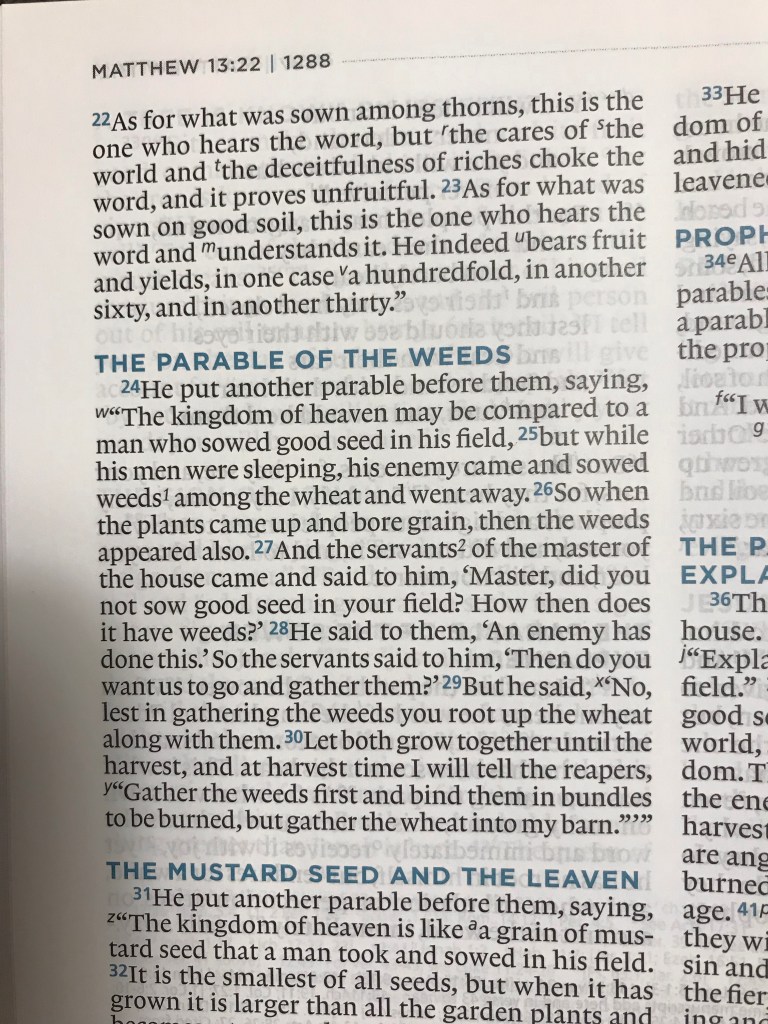
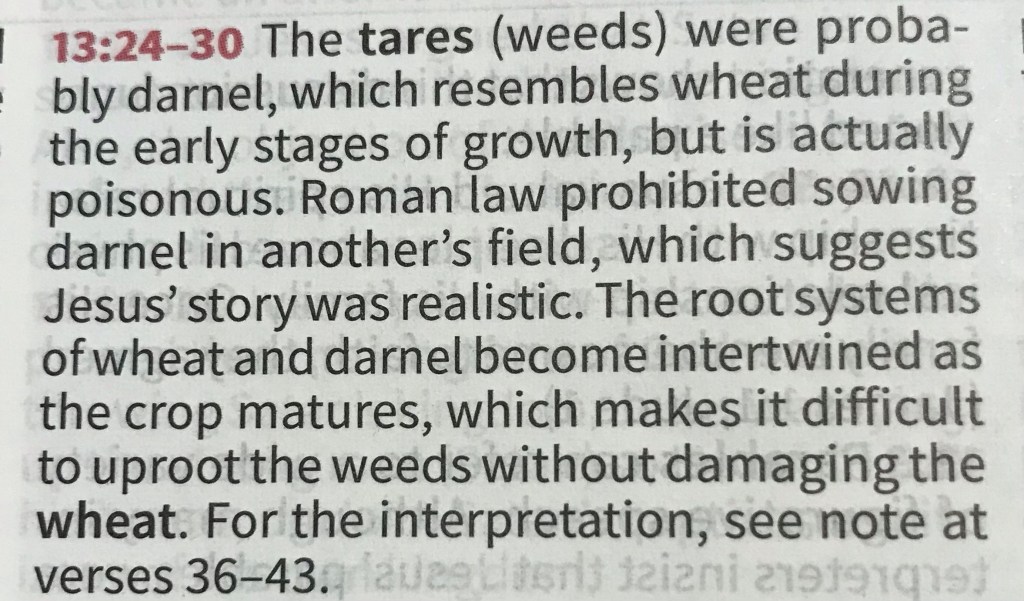
As romantic of a notion as conspiracies might be, and they are, ultimately, many of the dark rituals to come from the following of astrology were related to the acquisition of food, such as knowing when it was time for harvest and preparing for the upcoming winter. And specifically to food supply, the production of wheat, and its use in the human diet. We forget these days just how stressful it was to wake up every day and figure out where your food would come from because food is an assumption for us in these modern times. It’s easy for us and in all varieties. But for thousands of years, right up until around 100 years ago, food was a very stressful problem, even for the rich and famous. So nurturing a good crop of wheat to the harvest was a significant undertaking, and it’s why such societies were able to make judgments of good and bad more directly because, literally, their food supply depended on value judgments just to survive. This is what the Parable of the Weeds is all about in Matthew 13:24-29 when Jesus said, “The kingdom of heaven is likened unto a man which sowed good seed in his field: but while men slept, his enemy came and sowed tares among the wheat, and went his way. An enemy hath done this. The servants said unto him, Wilt thou then that we go and gather them up? But he said, Nay; lest while ye gather up the tares, ye root up also the wheat with them.” Jesus essentially said to let the weeds grow with the wheat and not try to pull them up together; otherwise, you will destroy your crop in the process. Jesus was talking about tares, which are weeds, and specifically darnel, which looks like wheat during the early stages of growth. In this case, the best way to save your crop would be to separate the weeds from the crop at harvest time, not necessarily during the growth of the good wheat. And under such a metaphor, we can look at our times and say, “It’s time for the harvest.”
We have allowed a lot of weeds to grow in our culture, largely out of compassion, because we live in a time when perhaps we thought we could let everything grow together. That we could co-exist with evil and that demands on our survival would not be challenged. But that was incorrect. Instead, we have allowed many weeds to take over our gardens of life and now we cannot separate good and evil so easily. Like the darnel, evil looked a lot like good, and now their roots have intertwined together as parasites threatening to kill the host crop if we were to attempt to remove those weeds as they have been growing. And like the darnel, the weeds looked like the wheat we wanted, so we left it alone to grow, unmolested. This is the problem with having a society that does not cast value judgments on the wicked and estranged intellect. Letting a multitude of terrible menaces grow into a healthy society has destroyed our culture and stunted its growth outrageously. Of course, we took it for granted because we have lost touch with the necessity of using value judgments for survival. We have entertained this fantasy that we could all get along if only we respected each other’s place in the garden. Yet in so doing, we have only harmed what’s good and allowed what’s evil to perpetuate and grow in strength, leaving our only means of dealing with such a problem to a hope that everything might survive until a harvest.
I would point to the year 2024 and the re-election of Trump as the harvest time of our present generation. Of course, the weeds who have been surviving as parasites of the good will have great anxiety as the intentions of the harvest are revealed, the separation of the wheat from the weeds. The darnel of our culture, which is vast and in many forms, knows that their time as parasites is ending, and they are naturally terrified. After all, they are a lifeform too, and they were created to be parasites living off the good, to disguise themselves to even look like the wheat of our desire so that we might not know what they are until it’s too late. Until they are in our schools teaching children to be transexual maniacs and sexually obsessed losers. Until our national deficit is over 34 trillion dollars, with 1 trillion added in the last business quarter of 2023. That drugs would be sought after to numb our minds from the terrors we see, that hidden tyrannies hidden in our technology would give us no peace in seclusion. The war against good and evil would turn everything we thought we could trust into a pitched-fork devil of ill intent. Everywhere we look, we see weeds, and it’s so bad that we can no longer tell what is good for us or bad. We can’t know the wheat for the weeds because, at this point, everything looks the same. We have not tended to our gardens; we have let the weeds deceive us into thinking they were wheat, and we allow them to grow and wrap their roots around the roots of our good crop, daring us to pull them and, in so doing, to destroy everything we value.
But it’s harvest time, time to pull up everything, wheat and all. It will be a messy process, but our fields must be cleared in the aftermath. At that time, the darnel can be removed from the wheat, and we can distinguish value from the parasites. Because we have yet to separate the weeds from our garden early in the process, the field has become overgrown, and there are more weeds than wheat. So we have quite a mess to deal with. But once the job is done, we have a clear field, and we have determined the wheat from the darnel, separating the good from the bad, we’ll have a chance to start over. We nurture our crops by keeping the weeds out of our garden before they wrap their roots around what we value. Always after harvest, when we see our clean fields and a healthy food supply, can perspective begin to bring sanity to our concerns. And when it does, we must protect our wheat from infancy and not let evil wrap around our values to feed off them for its sustenance. The weeds must be pulled before they can ever take root. That is why we must tend our gardens and have value judgments on the good and the bad. We must get rid of the bad before it matures into a parasite that is dangerous to the things we value, such as a food supply. It is also in understanding such parables that evil wants to eradicate the Bible from a culture so that we can’t tell the difference, allowing evil to grow unmolested. Such an idea was always a bad one, and during this time of harvest, one that we should never neglect again. The Bible is full of such wisdom and has contributed to all productive human cultures. And we’d be wise to listen before it’s too late.
Rich Hoffman