Thank Goodness Ohio Has Thomas Hall: Gun rights are the only things keeping us safe in a Democrat-run government intent to destroy America

I continue to be proud of State Representative Thomas Hall for his bill that Governor DeWine signed on Monday, June 13th providing minimum training requirements for teachers to arm themselves in public schools and to act as first responders should a tragic event occur. It was the kind of bill that was controversial in the face of an aggressive anti-gun lobby, so it took a lot of political skill for Representative Hall to move his bill through the House and Senate and go through all the revisions that it took to get it onto Governor DeWine’s desk. The bill was signed on the same day that Constitutional Carry went into effect in Ohio, so after a few rough years with Mike DeWine, particularly on Covid, we are seeing an administration that has been very good on Second Amendment issues. DeWine was eager to sign Thomas’ bill and rebuild some bridges that were lost over the Covid lockdowns. A few years ago, I would have never thought that Governor DeWine would become one of the most pro-Second Amendment governors in the country, but with the signing of House Bill 99 sponsored by Thomas Hall, that’s what he has become. It’s interesting to see how DeWine has evolved on gun rights over the last four years, which I think says more about the conditions of society than anything. It goes beyond him looking to repair his relationship with Republicans over Covid lockdowns. It was only a few years ago that DeWine was showing support for Red Flag Laws. Yet now, DeWine is one of the most pro-gun governors in the country, and that is great to see.

Meanwhile, there is a hard push from progressives who have managed to snag some GOP senators to ride some gun control legislation to give Biden a token win using recent mass shootings as a driver for more government control over gun rights. The Biden administration, which Texas has been one of the first to admit the illegitimacy due to the election questions that have been increasing with each day, wants to get more progressive gun control legislation on the books before they lose all their power. The Republican Party of Texas is starting to say that quiet part out loud, and as I have been saying for a while now, that quiet part will only get louder as more join the chorus. More centralized control over the American population is why there is an election fraud scandal. Would the government attempt to seize power through election fraud to disarm American society? Well, obviously so. And they are aggressive about it. The Biden administration is already trying to leverage Winchester ammunition with government contracts to alter its sales to the public, hoping to drive up the price of ammunition just as they have been doing with gas prices, to alter the behavior of the consumer. If they can’t ban guns, the Biden administration hopes to discourage through supply chain problems the flow of ammunition that shooters can get access to. The illegitimate Biden administration will be forever known in history as the government force that attacked America through supply chains. If you consider the terrorism that is obviously happening at food processing plants, again to alter supply chains with a radical Weather Underground sabotage of them under the Biden watch, a real menace to society is revealing itself. And it is within that climate that the government is pushing for more gun control. 

Because of Democrats, we are looking at a much more dangerous and unstable world. And the Biden administration has been laughing about it, even mocking Republicans, daring them to fight. It’s the same type of attitude that was revealed when members of the Colbert Show were caught and arrested in the U.S. Capitol after hours harassing families of the J6 defendants. NBC tried to downplay the incident, but the radicalism couldn’t be more obvious. We are dealing with an outright Marxist political move in America from the political left, and they are taking their talking points straight out of the book The Communist Manifesto. Now, I’ve been saying all this for a long time that the political left is communist in nature, using socialism as a soft door to enter through. Many people didn’t want to think of their fellow Democrats in such a way, but after four years of Trump, which I have also been saying would happen for a long time, their masks were ripped off. Now they are showing themselves for what they always were, America hating Marxists who are intent on destroying our country no matter what it takes. When members of popular media like those from the Colbert Show are so desperate and audacious in their actions, you can see the level of desperation; they mean to kill the country behind their actions. Would these same people commit election fraud and attempt to cover it up with everything they have in them? You bet they would. 

We are now in a world of liberal lunacy gone terribly wrong; crime is up because of Democrats. Concerns over the power grid because of BlackRock’s control over American energy policy leading straight to the World Economic Forum Marxists in Europe have people worried about constant brownouts and other mass grid failures. We have been closing coal plants and not replacing them with real viable energy generators. Gas prices are artificially high; it’s as if the Biden administration has an obsession with the Mad Max films and is trying to make them come true. We are seeing a plot designed outside the United States that has entered American life through politics and finance that intends to destroy everything we are. And even Mike DeWine sees it as governor of Ohio and has modified his position on gun control to reflect it. Truly, the First and Second Amendments are the only things keeping America alive at the moment. Gun ownership is the only thing that has kept this out-of-control society from completely destroying the American idea and keeps families somewhat safe in their homes. We are witnessing a progressive nightmare created by the Biden administration for the ultimate destruction of America while they still have the power to do it. And they can tell that the window for their attempts is closing, and their desperation level reflects that knowledge. They only have a few months to destroy the country, and they are picking up the pace of their attacks.

Their guiding manual, The Communist Manifesto, will tell us what they plan to do next. And for that reason, we must be happy to live in a state where State Representatives like Thomas Hall represent Ohio politics to head that aggression off at the pass and do good work for the people. To sign H.B. 99 on the same day that Ohio moved to Constitutional Carry says much more about the actual state of our country. While the gun grabbers are the same type of people reflected in the arrests of the Cobert staff at the Capitol, the only defense anybody has against that aggression, and the progressive, globalist activism of the Biden administration, is to be armed with guns. Preferably lots of guns. Because the enemy is among us, and they mean to destroy everything we represent, and they have no intentions of holding back. The only thing keeping them in check is our guns. They have no respect for our laws. They have no respect for our country. The only thing they do respect is force, and that force for us comes from our gun rights and our ability to always have them with us. 

Rich Hoffman
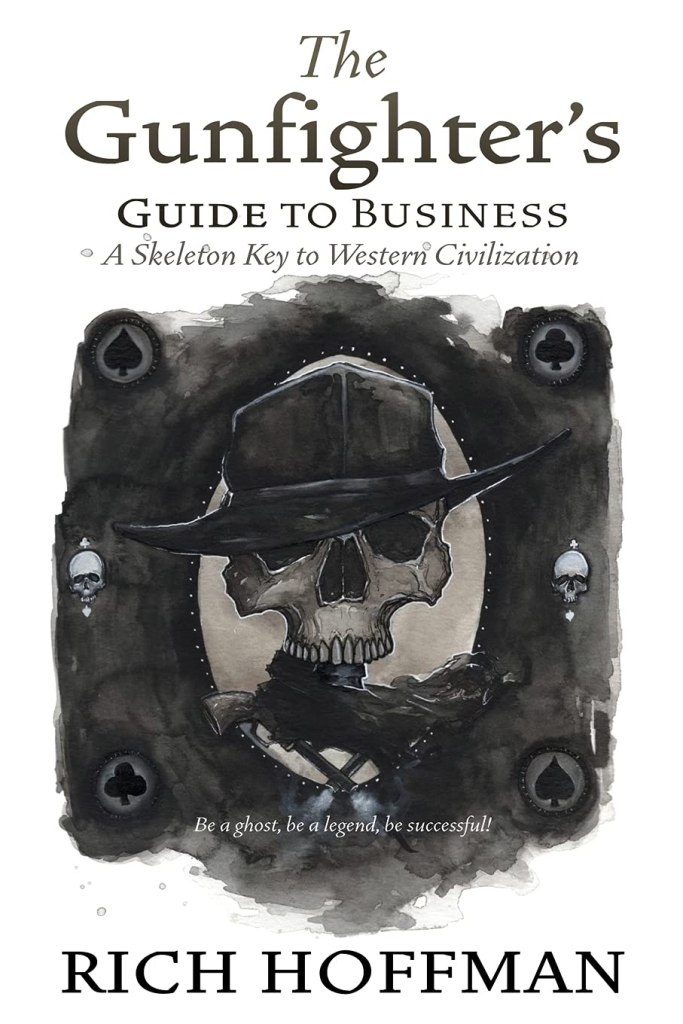
Click to buy The Gunfighter’s Guide to Business

The Brilliance of Junkie XL: A review of ‘Fury Road’s’ soundtrack

I was just a bit stunned by the wonderful music I heard while watching the latest Mad Max film.  You can see a bit of why in the video clip below dedicated to the composer Junkie XL—who used to be a DJ in a previous life.  The music to me sounded remarkably like Hans Zimmer’s score on Man of Steel.  So I wondered if Zimmer knew that Junkie used some of his Man of Steel music in Fury Road.  After a quick check I discovered that the two composers have studios next to each other in Santa Monica and that they have become close friends.  So that explained why the music was so jaw dropping phenomenal.  The use of drums in Man of Steel for me was a major milestone in soundtrack design and I have been looking forward to other scores utilizing the same creative use.  Fury Road was that next film and the music is so heart pounding excellent that the moment the movie was over, my wife and I went on an incredible journey to find the soundtrack.

On May 15th I had long-planned to take the afternoon off my normal obligations and see Mad Max with my wife.  When we were dating I showed her all the Mad Max films along with Dirty Harry so we could see if we’d like each other enough to continue our relationship.  She of course loved them, so we got married.  For me, if a woman didn’t understand Mad Max and Dirty Harry, she wouldn’t be capable of sharing a life with me, so liking those films was a deal breaker.   For me it’s almost a religious experience to see a Mad Max film, so I blocked off the afternoon to see the move.  Before the film I was able to have lunch with my wife, one of my daughters and my grandson.  It put me in an exceptionally good mood for actually seeing the movie.  I knew I would like the film—I wasn’t sure how much—but it was overall leading up to the movie a very positive, long-planned experience.

After the movie my wife and I looked at each other knowing we had just watched a masterpiece for the first time and professed our love for the film until the last credit cleared the screen.  READ MY REVIEW BY CLICKING HERE.  But that soundtrack for Junkie XL was stuck in my head and I wanted the music.  I didn’t want to wait to receive it from Amazon.com.  I wanted it in the car for my ride home.  So we went on a journey all over Cincinnati to find it.  We checked Barnes and Nobel on Fields Ertle Road first—they didn’t have it.  Then we went to Target and Best Buy in that same area.  They didn’t have it.  We then hit the highway and headed to the Streets of West Chester to the Barnes and Nobel there.  They surprisingly didn’t have it either.  I was really getting frustrated.  So we were about to give up and go home.  But not wanting to surrender we hit one last spot, the Best Buy at Bridgewater Falls.

I love the Best Buy at that location because it’s full of new technology all the time.  It’s a big store relative to some of the others and always has a nice ambiance to it.  I’ve bought a lot of computer equipment, video games and appliances there, so I generally love my visits to the Best Buy at Bridgewater Falls.  After some frantic looking I found two copies of Fury Road stuck behind soundtracks to Pitch Perfect 2—and I beheld them as if they were treasures from the Sierra Madre.  We bought one of them and headed to our car where we spent the next hour listening to the music from our sound system.  It was a brilliant score well worth the purchase.  I didn’t stop the music over the whole duration of the following weekend.

The key to the success of the music is the inventiveness of the ambition behind the score that obviously is inspired by Hans Zimmer.  But Junkie XL brought a kind of rock and roll ambition to it that is strangely evocative of the dystopian world of George Miller.  Unlike the old Blade Runner soundtrack which is a favorite of mine, Fury Road is full of hope and energy.  I found it strangely compelling which is something I didn’t expect.

It didn’t take much time for me to get the soundtrack on my iPod where I proceeded to listen to it on a loop for several days.  By the time I wrote this little piece on it, I have heard it upwards of 25 complete times and I like it more each time I hear it.  It is another wonderful and often unappreciated journey into musical mayhem by some of the most creative people in the movie business.  I have included some videos on this article about Hans Zimmer and Junkie XL to provide some context as to why I love soundtracks so much—often more than the movies themselves.  As I’ve said before there isn’t one work of music on my iPod out of 8 gigs of storage ability that is not a soundtrack to some movie.  I love mythology, movies are modern mythology, and the music of movies is what holds those stories together.  Without a good soundtrack, a movie isn’t much.  But with a good soundtrack, a movie can tell its story on a scale that lasts.  For me one of those benchmarks was the Man of Steel soundtrack.  So it came to me as a surprise to learn that Hans Zimmer and his friend Junkie XL were working on the soundtrack to Dawn of Justice together, with Junkie handling the Batman tracks while Zimmer works the Superman needs.  Now that I’ve heard Junkie XL named more formally Tom Holkenborg, create such a masterpiece with Fury Road I am eagerly looking forward to the next Superman film by Zach Snyder.

Music is one of those things that stays with you long after the lights come up in a darkened theater.  If the story was a good one, the music of the movie can go with you anywhere you wish by the soundtrack of the film.  After Fury Road I couldn’t wait to keep my mind in that mythology because there were thoughts there that were pertinent to my observations—and the music helped usher those thoughts along.  So the journey was hard-fought and worth the effort, because the work that Junkie XL brought forth is indicative of a treasure that will continue giving for many years.  And for me, that means many more Friday afternoons with my wife and the treasures of cinema that come from blocked off mythology given to minds that love the stories they tell on the backs of really good music.

Rich Hoffman

 CLIFFHANGER RESEARCH & DEVELOPMENT

Listen to The Blaze Radio Network by CLICKING HERE.

‘Fury Road’: Why the film is a work of George Miller genius

For all the reasons that Mad Max: Fury Road is a modern masterpiece on par with films like Citizen Kane, The Good, The Bad, and The Ugly, and Ben Hur is to look at the film itself.  In 1981 if anyone would have predicted that the maker of the Road Warrior would 30 years in the future create such a scathing representation of human culture nobody would have believed it.  Yet our current society has devolved to such a degree that the evidence of such a future nightmare is fast upon us which brings a sort of exasperation at the end of the film.  Fury Road is many things all at the same time; it’s a modern morality western on wheels and can be enjoyed as popcorn entertainment.  This part of it was clear already in the previous Mad Max films.  But, there was always a hint at something deeper, which a younger director in George Miller probably wanted to utter, but didn’t yet have the whole package ready to wrap.  Fury Road dives deeper into the well of the human condition seamlessly like all great works of art.  It gives the viewer more of what they already know, and dares them to step beyond their comfort zone in a way that Picasso’s cubic paintings did.  But then again, Fury Road is deeper than even that—it jumps headlong into the vast depths of James Joyce’s literary masterpiece Finnegan’s Wake to play at Giambattista Vico’s four cycles of civilization.   When it is said that Fury Road is the work of genius, this would be the reason, it is modern art evoked in some of the most provocative ways ever put to film, and it is done so in a way that at the end viewers will wonder what the just saw.  Was the movie just another summer blockbuster in superhero clothing, or was it the genius of a new religion after mankind has fallen back to its beginnings as it has so many times before?

If George Miller was not a fan of Finnegan’s Wake, and had a firm understanding of the Vico cycle, I would be surprised—because that is clearly the theme of Fury Road.  Human beings have devolved from a race that once put satellites into the sky to a society clamoring over water.  Anarchy has given way to a new theocracy and at the end of the move, the last line shown on the screen before the end credits read like the first sentence in a new book of Genesis.  I can’t say that I have ever seen a critic rating of 98% on Rottentomatos.com for a movie, yet Fury Road had virtually everyone who had seen it eating out of its hand—something that certainly would not have been the case in 1982 when the Road Warrior came out.  Some radio movie reviewers on the Friday of the film’s release were actually giving the movie 5 out of 5 stars—which is something else I can’t ever recall happening.  Even great films typically get a 4 or a 4.5, but many critics were giving Fury Road a full unfettered five stars essentially calling it a perfect movie.  I don’t think Fury Road is a perfect movie.  It was on par to me to all the great western’s I have seen over the years—but it has the added dimension of hidden sophistication that all viewers sense which hangs in the air at the end of the movie.  It touches something very primal in us all and hints at long suppressed beliefs touched for the first time perhaps in some people’s lives.  Yes, the Vico cycle is well at hand.   In a time where nearly every movie is a retread from the past society has forgotten that all these retreads came from a period when our culture produced these kinds of stories every couple of months.  Just like the mixed up cars in Fury Road are representatives of a previous society which mass manufactured them, they are assembled on the screen hodgepodged together in bizarre and imaginative ways that still evoke a lesser society that inherited something great from the past yet didn’t quite know how to sustain them.  Fury Road is a metaphor of itself in a very tongue in cheek way.  There seems to be a very firm knowledge from George Miller of what he’s doing as he is clearly an artist at the top of his game.

Other progressive reviewers saw in Immortan Joe a greedy capitalist regulating vast resources to enslave people.  To their minds Immortan Joe was the Bilderberg bankers and Illuminati currency manipulators of the current times and the revolution of the people to overtake such a greedy bastard is communism so everyone can have equal share in the wonders of water stored in his magical pumps within his fortress Citadel.  Yet again, Fury Road is a deeper movie than that—it cuts to a primal rage contained within every human being—the desire to be free.  Immortan Joe might have been slain, and a new government might rule in his place—but the results would be the same.  So long as mankind follows the trends of the Vico cycle whoever is in power will always seek to suppress those under their control.  The reason the film has such high critical ratings is because of things like this, where the kinds of topics that are really important to people are expressed.  But like all great works of art, those people are limited by what they can see.  They may not have the ability to see too far, so they only see representations of feminism, or communism as factors for redemption—but there is clearly more going on.

I thought the most powerful part of the movie was a quiet scene where the characters named brilliantly, Toast the Knowing, Cheedo the Fragile, and the Capable were watching a star filled night sky as they saw a satellite flying across their view from horizon to horizon.  They contemplated the previous culture that actually made such things that could talk to people across the whole of the world.  They wondered who killed the world.  It’s not global warming which has done the destruction.  It was the Vico cycle—mankind’s innate desire to advance and regress along its formulated parameters.

As I bought my ticket for Fury Road the attendant whispered to himself, “Max, great choice.”  He locked knowing eyes with mine.  “I loved it.”  And that was the general feeling of everyone I bumped into who saw the movie.  They realized that they were seeing something that was strangely important, yet they didn’t really know why.  It is our present story played out in a way that they can easily see no matter what vantage point of political reality they approach the subject—because the road all leads to the same place.  It doesn’t matter if the vantage point is conservative, liberal, deeply socialist, fascist, or manically religious it all ends up in the same place, the cycle of Giambattista Vico, theocracy, aristocracy, democracy, followed by anarchy which has persisted in human lives for as long as we have had breath.  Most of us want to be Max or Furiosa, but know that they will always ever be at best like the old lady in Fury Road, the Keeper of the Seeds.  Worse yet, most people will spend their whole lives begging for water, or allowing themselves to be harvested for their bodies–their motherly milk, or their blind devotion to a male patriarchy more concerned with their place in a masculine peaking order than in inventing satellites to go to space.  Even though the world has gone mad Max at least has not surrendered himself to its cycle.  In the end he is the hero who carries those who want to back to a hope of advancing their cause instead of just retreating from it. It was a brilliant film by a brilliant director at the absolute top of his game.  The above and below line talent in the picture are all at the peak of film making genius and if there is any justice Fury Road will win many Oscars in 2016.  But that in and of itself will prove just how valid Fury Road truly is.  In a free culture capable of making all the stories it can deem possible, it is a retread from the past that is evoking so much of a response in a culture that subconsciously seems to realize it is slipping back into the abyss of anarchy and theocracy.   They don’t understand why or how—but know that it’s happening.  And the only way they can measure that slide is with a good ol’ Mad Max movie which shows them the map of how it’s happening, even if they are powerless to stop it.

Rich Hoffman

 CLIFFHANGER RESEARCH & DEVELOPMENT

Listen to The Blaze Radio Network by CLICKING HERE.

‘Fury Road’: Rebelling against Giambattista Vico

I have a general assumption about mankind that is quite opposite of typical academia. Civilizations rise on the backs of innovative individuals and flourishing capitalism. They decline with more centralized control and absorption of individual achievement into the fabric of a collective society. When an unworthy king or bureaucratic democracy takes over the direction of economic enterprise and invention, a society is in decline. It is due to the hard wiring of human beings trained from their infancy to follow the Giambattista Vico cycle always witnessing societies fall only to be born again in a much regimented pattern. This holds true no matter what the society, whether it be the Mayan people, the Inca, the Mongol, the Roman Empire—all societies so far have followed the Giambattista cycle. This is why anybody with any honesty looks at George Miller’s Mad Max films and declares him a genius. It’s also why it was more than symbolic that Mel Gibson showed up at the premier of Fury Road, the latest Mad Max film now staring Tom Hardy. Studios didn’t want Gibson in the film as the Vico cycle declares that what’s old must be recycled to make way for the young and new. But Gibson showed up to give the young Hardy a bit of support because any Mad Max fan knows that Mel Gibson will always be the iconic Road Warrior. It all started with this movie.

Our current world is not very far from the world of the first Mad Max movie. Police are now being openly murdered and Vico’s final phase of anarchy is fully at hand. What happens next is the rise of a theocratic society followed again by aristocratic, then democratic rule, followed by chaos once again. In the film Fury Road we find that in the period between the first Mad Max film society has devolved into the rise of theocratic civilization. No longer is society concerned with missions to Mars or inventing a new iWatch—now the primary concern as it has been in the past is to establish a new deity figure for the society at large.

I have always loved the Mad Max character because he maintains himself throughout the entire cycle as a constant reminder into the phase of the Gambattista cycle from which everything was taken from him, his wife, child, friend, career—everything he cherished from that time. Unlike the rest of the world he finds himself standing up against the tide of regression. He is a representation in these Mad Max films as Nietzsche’s ubermensch-otherwise translated as the overman. Nietzsche’s ubermensch is one who has graduated from mankind and stepped away from the Gambattista cycle all together—and has decided to advance their life based on individual creativity.   But this is a dangerous road, Hitler tried to take Nietzsche’s ubermensch and advance Germany, but failed in his interpretation and instead moved his country into a Karl Marx inspired socialist democracy—followed by war defined anarchy, then back to a theocratic/democratic existence where it currently finds itself in a European Union—otherwise a democracy that is once again plunging into anarchy now inspired by the failing economies of Greece.   Mad Max is the figure who refuses to submit to these tides of the world.

I have no doubt that George Miller would agree with this assessment. He knows all too well what he’s doing. He’s not just making a popcorn action thriller with great car stunts and bizarre characters. He’s making a rejection statement against Gambattista’s famed cycle. He may not have set out to be conscious about that statement but rather let his intellect drive those elements of the story along as evolution of the various aspects of the story evolved, but based on the presentation of Fury Road, it is clear he understands what he’s doing all too well. It’s also clear why so many people are excited to see such an apocalyptic story and why after all these years it’s so close to the hearts of so many people. This is not a typical summer blockbuster film.

So, how excited am I for the upcoming Fury Road? Well, let me tell you, I have dedicated this upcoming Friday to seeing it. I will certainly be one of the first, and I will likely see it several times. I love the action, I love Mad Max and all that he stands for, but more than anything I love seeing the Gambattista cycle challenged. The world may have went crazy in relation to the advanced days of invention when oil was being produced to propel cars from city to city, to instigate the growth of economies of various trade. All that can and will fall apart within just a few decades of human development—just like the Maya abandoned their cities apparently very fast—as if they just evaporated. It’s not that such people abandoned their cities because they left earth for alien destinations, the people of Ur did not suddenly become equivalent to the Neanderthal after building hanging gardens and massive temples—they regressed because they emerged into war then reinvented theocracy starting the Vico cycle fresh again losing all that they had gained before. Mad Max is that personality in these George Miller movies who in spite of everything that he has lost and continues to lose, refuses to give up on his heroic past and be the last representation of a time when mankind was truly great.

How many people do you know who would at the drop of a hat become one of the mindless followers of some future attempt at theocratic rule? The current Muslim obsession is but the latest. How many maniacs would kill the masses for a chance at everlasting life in the hereafter because some slug of a wanna’ be king dictated that such a thing would bring redemption to the soul? The answer is probably everyone that you know. Most of the people shopping at the grocery and working in a corner cubical would gladly trade in their suits and ties for a thong and Mohawk if some skull inspired death cult instructed them that through worship of his heavenly presence that someday they too might rise up to greatness if only they adhere to the tenets of collectivism.   Miller’s brilliance is that he was able to see such a clear vision from our present age. It’s not easy to see that overweight school levy supporter buying meat at the grocery as a future sex slave to a blood thirsty cult fighting over the worship of water—but Miller does, and with a grand design. It’s not easy to see that corrupt politician kissing babies and whatever else as the skull wearing Immortan Joe hunting down the wives who are desperate to leave him. But in Miller’s films, it is quickly recognizable that most people we know under similar conditions would find themselves as some character in that wasteland. It doesn’t take much to forgo everything we have ever been and throw it away in exchange for basic human necessities, like food, water, and sex.

I am excited for Fury Road, but for reasons that go well beyond the visual spectacle. I love it for the rebellion against Vico. On one hand the Vico cycle is shown in all its brutal honesty, but through the character of Max—using almost no dialogue—Miller beholds the ubermensch—a character that launched the career of Mel Gibson who in almost every movie refused to buckle under the pressure of Vico to decline—but always to advance. Whether it was Riggs from Lethal Weapon or William Wallace from Braveheart, Mel Gibson started as Mad Max, that hero from the past who punched through the Vico cycle with the throttle down and the skill of a Road Warrior as the rest of the world attempted to drag him back into the Stone Age. That’s why Fury Road is more important than a four-year degree in college studying history and the Vico cycle. Because Fury Road shows through art the results of that path—and how treacherously close we always are to falling off the edge of reality into an abyss controlled by maniacs like Immortan Joe—or the Toe Cutter.

Rich Hoffman

 CLIFFHANGER RESEARCH & DEVELOPMENT

Listen to The Blaze Radio Network by CLICKING HERE.

‘Tail of the Dragon’s’ Parent: Mad Max’s ‘Fury Road ‘unleashes itself at LAST!

One of the great treats for me that came out of this year’s Comic Con in San Diego was the interview with the great George Miller and the preview of the new Mad Max movie, Fury Road. I can admit without shame of any kind that George Miller’s Mad Max films were deep on my mind while I was writing Tail of the Dragon. I have watched the development of the new Mad Max film for over a decade now and remember well when it was first proposed back in 2002. Back then Mel Gibson with all his box office horsepower was behind the project with Miller, but the project still didn’t get off the ground. Then Gibson fell from grace and nobody in Hollywood wanted to touch the project and there were film delays and all types of issues. But Miller—finally—has managed to make the film with Tom Hardy now playing Max and I am ecstatically excited for the project.

http://insidemovies.ew.com/2014/07/27/george-miller-mad-max-interview-comic-con/

I was a bit shocked that the review of the San Diego Comic Con thought that preview of Fury Road was the most interesting thing they had witnessed. I couldn’t help but think of my own car chase story Tail of the Dragon which surpasses car crash wise anything seen in that preview or any of the Fast and Furious movies. The biggest difference was that I set my car chase story in the present as opposed to the future. My character is trying to save society from the kind of collapse that Max is reacting to. But I agree with Miller, car chases stories are essentially westerns on wheels. Hearing his articulation and the general audience reaction to his new Mad Max film gave me encouragement that Tail of the Dragon might someday find the right elements to end up on film. But it would take a really good director to pull off—and people like Miller are not exactly falling from the trees like apples.

I wasn’t sure how I’d feel about somebody besides Mel Gibson playing Mad Max. I grew up with Max and brought those experiences to my Tail of the Dragon novel mixed with plenty of Smokey and the Bandit. Star Wars is often compared to a western in space, and car chase films are like Miller described, westerns on wheels. Whenever a film has something to say about morality they are usually termed as “westerns.” Growing up with Mad Max I learned a lot about the depravity of the human spirit which was remarkably insightful. The opening of the first Mad Max film with the Nightrider on a rage across the desert with his crazed girlfriend was classic cinema that climbed into the mind of insanity at its finest and took viewers into the essence of a mind gone mad. I watched that movie almost every day from age 12 to 16. Not because of the movie influence but because of what it revealed about human nature, I became Mad Max at age 16 and I have the car chases, races and crashes to provide the testimony. Those experiences then became my own story, Tail of the Dragon—the horse of the western had been replaced by a car and I used mine as a kind of weapon against depravity. And when I couldn’t defeat depravity I out ran it with sheer speed.

I will forever be grateful to George Miller—his films are art with a value into the human mind that goes well beyond what people are comfortable revealing about themselves. The stunts in the Road Warrior, the second Mad Max film were unbelievably intense and I never forgot them. Even after all these years they still hold up as some of the best stunt work done in any picture. The cinematography has never been surpassed even after thirty years by anybody in the business. The dust, the smoke, the blood and violence of the car crashes are both beautiful yet horrific to look at and nobody does it like George Miller.

Miller’s vision of the future is not far off—if the engines of the world are turned off—the minds that drive society forward–people certainly do revert back into a tribal abyss. It is not hard to conceive that they would devolve into the kind of villains seen in Miller’s Mad Max films. Max was a good man during the days of civilization; he had a child, a nice wife and wanted to give up life as a cop to get away from the madness of the people he was holding back from taking over. Miller understood the strange mix of great charisma and madness that Mel Gibson was able to bring to the screen when he was in a 100 MPH stand-off with the Toe Cutter at the beginning of the first Mad Max. Mel Gibson would show throughout his career that his real life was more like Max than anybody would have guessed, and that brought some humor to the 2014 Comic Con that Miller addressed correctly. I share with Gibson some of those traits and as a young man I would discover the real genius of Miller’s Max character when I too had to face off against an opponent traveling at me at over 100 MPH in a game of chicken. Like Max, I didn’t budge even though I had far more to lose than the other guy.

I know what it feels like to be that close to the edge and to push beyond it to a place of fearlessness. Whether or not there had ever been a Mad Max film, my fate would have put me in the same circumstance. But as those circumstances occurred, I always thought of how much insight into the human condition George Miller had in his Mad Max films—a brutal reality not beheld by any other artist in any other art form—and I could confirm its authenticity.

Max couldn’t escape madness and it finally caught up to him and killed his family leaving Max a very sane man bent with rage in an insane world that only devolved from there. Fury Road takes place between the first Mad Max film and the Road Warrior, so there is some rich material there to delve into for Miller as society devolves from a rich industrious culture into tribal nomads desperate for value of any kind fleeing constantly from chaos. In the Road Warrior there was always sadness to Max—an awareness of how far down the drain the world had devolved, but a resolute charisma that refused to join it. It was as if he alone stood against the insanity of the world and was aware that the only way to meet it was by going “mad” himself when pressed by danger. As a result, those still sane in the world gravitated to Max to be saved, which he did in the Road Warrior, then on a more epic scale in Beyond Thunder Dome.

Beyond Thunder Dome was a bit too light for a Mad Max film but was still enjoyable. Mel Gibson was moving into a mainstream actor and George Miller was being lured in to doing more commercial work. It was the weakest film of the series but was still a work of art visually and in concept. I went to see it in 1985 all by myself at a summer matinée. I had some time to kill before work so I went to see it alone, just me and Max and I loved it. It was a wonderful way to watch George Miller’s version of a “western”—like Max himself.   All alone.

As much as I am rooting for Fury Road—and I will see it on opening day—it won’t surpass the violence and sheer magnitude of car crash carnage I wrote about in Tail of the Dragon. I am a product in some ways of Miller and I took that into real life then wrote about it with a new perspective. But it is encouraging to see such positive audience reaction from Comic Con as they had toward Fury Road. There may be hope for my own project yet due to the forecasted success of Miller’s resurrection of the Mad Max franchise. Apparently Miller has a sequel to Fury Road already written and is ready to head into production. For that film, yet unnamed, I will be the first to that one as well, and for every film that comes after—because George Miller is a master of the car chase western, and I am grateful to him in ways that are beyond description.

As for Tail of the Dragon, it is a shame it takes a positive reaction from audiences at Comic Con to tell studios that movie goers want car chase movies. I didn’t see anything in the Fury Road preview that eclipses what was done in Tail of the Dragon. So I was a bit impressed that audiences thought Fury Road was the most intense preview coming out of the event which showcased the latest and greatest that Hollywood was churning up. That certainly puts Tail of the Dragon in a class of its own but like Miller’s journey to bring Fury Road to the screen; the trip for Tail of the Dragon will likely be longer and will take just the right personalities—which has not yet been assembled.

Rich Hoffman

www.OVERMANWARRIOR.com