Lakota Schools Never Learns: New Superintendent Ashley Whitely is more of the same past failures–ask for more tax money, and teach kids Democrat politics

Public education in the United States stands as one of the most entrenched institutions of modern civilization, yet its fundamental design reveals a profound misalignment with human nature and family sovereignty.[^1] For centuries, the transmission of knowledge, values, and skills occurred primarily within the family unit, reinforced by community and society as supportive extensions rather than replacements. Compulsory schooling, modeled after 19th-century Prussian systems and imported into America through reformers like Horace Mann, shifted this dynamic dramatically. Children were removed from the familial hearth—where organic, personalized mentorship could flourish—and placed into centralized social hierarchies designed to enforce conformity, pecking orders, and state-approved narratives. This model, while promising universal literacy and opportunity, has instead fostered dependency, ideological indoctrination, and fiscal inefficiency. As John Taylor Gatto argued in his seminal critique The Underground History of American Education, the system was never primarily about empowerment but about social control and workforce standardization.[^2]

Nowhere is this misalignment more evident than in suburban districts like Lakota Local Schools in Butler County, Ohio—the largest suburban public school system in southwest Ohio, serving approximately 17,887 students across 22–23 schools in West Chester and Liberty Townships.[^3] Located in the greater Cincinnati area, Lakota exemplifies the carbon-copy problems plaguing districts nationwide: escalating property tax burdens, bloated administrative layers, union-driven wage spirals, and a progressive ideological tilt that often prioritizes social engineering over academic excellence and parental authority. Residents like those in nearby Middletown, Ohio, witness these issues firsthand, as similar patterns repeat across Hamilton and Butler Counties. The district’s recent leadership transition and repeated levy defeats offer a microcosm of why the public education model is fundamentally broken—and why resistance through low-tax advocacy and school choice represents the path forward.

At its core, effective education marries parental responsibility with societal support, not the reverse. Removing children from the family for seven to eight hours daily, five days a week, severs the natural bonds of mentorship and moral formation. Teachers, once envisioned as extensions of the home, have become agents of a bureaucratic “social order” where students navigate artificial pecking orders—cliques, grade-point competitions, and now identity-based hierarchies—rather than real-world apprenticeships. This detachment has proven devastating: declining test scores, rising mental health crises, and generational alienation from parental values. Progressive education, amplified since the 1960s, has accelerated the divorce of children from family, promoting platforms that emphasize state-defined equity, gender fluidity, and partisan activism over timeless skills like reading, math, and critical thinking rooted in heritage.[^4]

Critics across the political spectrum—from libertarian school-choice advocates to traditionalists—note that U.S. public schools consume over $800 billion annually nationwide yet produce outcomes inferior to many peer nations, especially when adjusted for per-pupil spending.[^5] Ohio’s model, heavily reliant on local property taxes (supplemented by state aid), exacerbates inequities tied to ZIP codes. Funding follows geography, not merit or parental demand. The result? Districts like Lakota operate as monopolies, insulated from market pressures. True reform demands detaching funding from residence: vouchers, education savings accounts, open enrollment, and charter expansion. Parents, not bureaucrats, should direct resources to institutions that deliver value—whether traditional public, private, homeschool, or hybrid. Lakota’s story illustrates why clinging to the status quo fails both fiscally and culturally.

Lakota’s fiscal narrative is one of repeated tax extraction attempts met with growing taxpayer fatigue. The district’s last successful operating and permanent improvement levy passed in 2013, intended as a five-year measure but stretched to 15 years through pressure management and economic conditions.[^6] It funded operations amid post-recession recovery, but by the 2020s, escalating costs—driven by union contracts, inflation, and administrative bloat—necessitated more. Earlier attempts tell a cautionary tale. In 2011 alone, voters rejected Lakota levies three times in 18 months, reflecting early resistance to millage hikes amid economic uncertainty.[^7] Fast-forward to November 4, 2025: The district placed one of Ohio’s largest school levies ever on the ballot—a $506.4 million bond issue (4.99 mills) paired with a 0.95-mill permanent improvement levy for its Master Facilities Plan. The proposal aimed to demolish, renovate, and consolidate 21 buildings into 16 (including four new elementary schools), promising operational savings, smaller class sizes, enhanced security, and fewer grade transitions.[^8]

Financial details were layered with optimistic projections: State co-funding via the Ohio Facilities Construction Commission would cover 32 percent (roughly $200 million), reducing the effective bond collection to 3.99 mills. An existing 2.28-mill bond roll-off in 2028 would offset much of the hike, yielding a net increase of just 2.66 mills—or roughly $93.10 annually per $100,000 of auditor-appraised home value ($208 gross, delayed collection to 2029). Seniors and low-income disabled residents would see even less (about $68.71).[^9] District leaders, including Treasurer/CFO Adam Zink, framed it as a “last resort” to avoid deeper operating cuts and redirect savings to classrooms. Yet voters delivered a decisive rejection: 61 percent “no” (approximately 60.81 percent to 39.19 percent), one of the starkest defeats in recent memory.[^10]

This was no anomaly. The district’s 12-year streak of balanced budgets (because of declining enrollment through FY2024) masked underlying pressures: staffing costs (predominantly wages and benefits under union contracts), enrollment fluctuations, and state funding volatility.[^11] The 2013 levy’s longevity proved temporary; without new revenue, forecasts warned of shortfalls by FY2028–2029. Superintendent Dr. Ashley Whitely, in a January 2026 interview, conceded another levy is “a matter of when, not if,” signaling plans for a revised, perhaps scaled-down proposal after community input sessions and a ThoughtExchange survey.[^12] This “shell game”—big ask first, retreat to smaller—has become predictable, eroding trust.

The 2025 levy push occurred under new leadership installed amid crisis. Former Superintendent Matt Miller resigned in January 2023 after a tumultuous year. Board member Darbi Boddy and others highlighted allegations stemming from his divorce, detailed in police records: Miller admitted arranging and participating in group sexual encounters with his ex-wife.[^13] A private investigation cleared him of on-the-job misconduct or legal violations, but the public spectacle—coupled with claims of board hostility—doomed his tenure. Miller had positioned himself as a progressive exemplar, yet the revelations shattered that image.[^14]

In May 2024, the board hired Dr. Ashley Whitely as Superintendent/CEO, effective August 1, 2024. A former Lakota East English teacher and department chair (five years in-district), plus assistant superintendent at Wyoming City Schools, Whitely brought local roots and a “proven track record” in professional development and community partnership.[^15] Her vision, outlined in district messages and the “Let’s Go Lakota!” video series, emphasizes “Building OUR Future…One Piece at a Time,” the E + R = O performance pathway (Events + Responses = Outcomes), a staff-co-created Culture Blueprint, and over 100 listening sessions. She champions the Master Facilities Plan for safety, programming, and efficiencies.[^16]

Initial hopes for reform—perhaps embracing competition via open enrollment or market-driven efficiencies—faded quickly. Whitely’s role evolved into levy cheerleader, promoting the 2025 ballot as essential for “redirect[ing] dollars toward academics.” Post-defeat, she solicits input on facilities but insists on future tax measures.[^17] This aligns with the district’s pattern: Administrators for administrators. National Center for Education Statistics data shows 5 district-level administrators, 49 school administrators, 76 administrative support staff, and total FTE staff of roughly 1,988 (including about 729 teachers) for 17,500-plus students.[^18] Total headcount exceeds 2,061. Salaries reflect this top-heaviness: Former Superintendent Miller earned $199,639 (2023 peak); current structures project assistant superintendents up to $165,000-plus.[^19]

Critics, including new board member Benjamin Nguyen (elected 2025 alongside incumbents), highlight the mismatch with private-sector accountability. Unlike CEOs who scale operations amid market shifts, Lakota’s leadership maintains escalating wages, refuses workforce reductions despite declining enrollment trends in some areas, and layers bureaucracy. The “famous” salary transparency reports (local analyses comparing Lakota admins to regional peers) have long shown disproportion—often exceeding governors’ pay or comparable private roles—yet little reform follows.[^20]

Lakota’s budget—predominantly staffing (teachers and classified unions under contract)—grows unchecked. Five-year forecasts assume wage hikes, new programming for state report cards, and no scaling despite efficiencies promised in the failed Master Facilities Plan.[^21] Too many administrators oversee administrators; summer-heavy schedules (nine-month operations for many) yield high per-day costs. Property taxes fund this while state models collapse under pension liabilities and mandates.

Worse, cultural drift compounds the issue. Public schools nationwide increasingly insert progressive curricula—gender ideology, pronoun policies, CRT undertones—divorcing students from parental authority. While Lakota has removed some problematic materials and adopted neutral policies under board pressure, the broader model recruits youth toward statist loyalty rather than family-centric independence. Teachers’ unions, dominant in negotiations, prioritize compensation over innovation. The “free babysitting” value proposition of yesteryear—drop kids off, secure college/job outcomes—has evaporated amid rising costs, ideological conflicts, and mediocre proficiency (69 percent in core subjects per state metrics).[^22]

Voters recognize the scam: Levies no longer “invest” but subsidize inefficiency. The 2025 defeat echoed taxpayer weariness after decades of escalation. Economic illusions of endless growth once masked the burden; now, with inflation, remote work, and housing costs, resistance grows. Low taxes foster community vitality—business attraction, population retention—far more than shiny facilities. As one analysis notes, districts failing levies often thrive via market adaptation; Lakota’s monopoly mindset persists.[^23]

True CEOs innovate. Lakota should pursue open enrollment aggressively, attracting students (and per-pupil state aid) from underperforming districts. Detach funding from ZIP codes via Ohio’s expanding voucher/EdChoice programs. Embrace hybrid models, reduce admin layers (target fewer than 40 total), benchmark salaries privately, and cut non-essential staff. Competition would force excellence: Lower “prices” (effective tax cost per outcome), higher value.

School board members like Nguyen offer glimmers of accountability. Anti-levy organizations and citizen groups—doing the oversight boards often neglect—have proven more valuable than cheerleaders. Ohio’s property tax reliance is unsustainable; broader reforms (income-based or choice-driven funding) loom.

Nationally, districts adopting choice outperform monopolies. Florida and Arizona models demonstrate gains without endless bonds. Lakota could lead by proving smaller government yields better education.

Dr. Ashley Whitely’s tenure, like predecessors’, risks perpetuating the cycle: Cheerlead taxes, ignore marketplace realities, double down on bureaucracy. The 2025 defeat and her “matter of when” stance confirm no learning occurred. Yet community pushback—rejecting the $506 million ask—signals maturity. Low taxes and fiscal restraint build stronger neighborhoods than lavish, ideologically captured schools.

Public education’s inception promised uplift; its execution delivered dependency. Lakota proves the thesis: Family teaching, societal backup, and competitive choice outperform removal and regimentation. Voters must sustain resistance until leaders adapt—or parents exit via choice. The next levy attempt will test this resolve. History suggests defeat again, until the model evolves. Residents owe it to future generations to demand better: Not more spending, but smarter, freer education.  And the new superintendent at Lakota schools is just more of the same failure-based education approach that nobody likes, and is poised to change dramatically in the times to come.

Over the past decade, the consistent rejection of new school levies in the Lakota Local Schools district has functioned as an informal tax‑stabilization mechanism. When a district of Lakota’s size goes twelve-plus years without a new operating levy, the cumulative savings for homeowners and businesses become enormous. A single failed levy—typically in the range of 5–7 mills—can represent millions of dollars per year that remain in private hands. Spread across more than 110,000 residents and tens of thousands of parcels, the avoided tax burdens since 2013 likely total hundreds of millions over the decade. For most families, that means thousands of dollars that stayed in their household budgets; for businesses with larger property footprints, it means tens of thousands saved per year that could instead be invested in hiring, equipment, or expansion.

The opportunity cost dimension may actually be the most important. Property‑tax‑resistant communities often grow faster because stable taxes encourage residential investment, business development, and long‑term homeownership. West Chester and Liberty Township have repeatedly been cited as among the fastest‑growing and most competitive economic corridors in Ohio—not in spite of tax restraint, but largely because of it. Keeping levy pressure low increases disposable income, which boosts retail, construction, restaurants, and small business dynamism. Over a decade, that economic flywheel compounds: more residents, more businesses, more payroll, and more value creation than would have existed under a heavier tax regime.

There’s also a governance value created by tax resistance. When levies fail, districts are forced to prioritize, modernize operations, and seek non‑tax solutions to structural problems. Lakota’s delayed levy cycle has pushed administrators—Miller previously, and now Dr. Whitely—to be more transparent, more financially innovative, and more accountable to the public. That pressure often leads to leaner operations, better auditing, and a clearer articulation of needs versus wants. From a community perspective, that’s a form of economic value too: it disciplines public institutions to behave more like private ones, where efficiency isn’t optional.

Taken together, the anti‑tax presence in the Lakota district hasn’t just saved residents money—it has shaped the character of Butler County’s growth. Lower tax burdens helped produce one of the most economically vibrant suburban regions in the state, attracting investment and stabilizing property markets even during volatile national periods. The savings are measurable, but the long-term community value—strong growth, predictable tax environments, and a business‑friendly climate—is the larger legacy.

Footnotes

[^1]: Based on historical analysis of Prussian compulsory education models adopted in the U.S. during the 19th century.

[^2]: John Taylor Gatto, The Underground History of American Education (New York: Oxford Village Press, 2000).

[^3]: Lakota Local School District official enrollment data and National Center for Education Statistics (NCES) district profile, 2024–2025.

[^4]: See critiques in progressive education history, including works by Diane Ravitch and E.D. Hirsch Jr. on curriculum shifts since the 1960s.

[^5]: U.S. Department of Education and OECD PISA comparative spending/outcome reports, latest available cycles.

[^6]: Lakota Local Schools historical levy records and Ohio Department of Education financial reports.

[^7]: Journal-News (Hamilton, Ohio) coverage of 2011 levy elections.

[^8]: Lakota Local School District Master Facilities Plan documents and ballot language, September 2025.

[^9]: Lakota “Financial Facts Behind the 2025 Ballot” publication and auditor’s office millage calculators.

[^10]: Official election results from Butler County Board of Elections, November 4, 2025, reported by WLWT and Cincinnati Enquirer.

[^11]: Lakota five-year financial forecasts submitted to Ohio Department of Education, FY2024–2029.

[^12]: Cincinnati Business Courier interview with Dr. Ashley Whitely, January 2026.

[^13]: Police records and board meeting minutes referencing Miller’s resignation, January 2023.

[^14]: Cincinnati Enquirer and Journal-News reporting on the investigation and public fallout.

[^15]: Lakota Local Schools board announcement and Cincinnati Enquirer, May 4, 2024.

[^16]: District “Let’s Go Lakota!” communications and superintendent message archive on lakotaonline.com.

[^17]: Post-election statements and ThoughtExchange survey updates from Superintendent Whitely.

[^18]: NCES Common Core of Data, Lakota Local School District staffing tables, 2024–2025.

[^19]: OpenPayrolls.com and Lakota salary schedules, 2023–2025 data.

[^20]: Local salary comparison reports circulated in Butler County media and taxpayer analyses.

[^21]: Lakota five-year forecast assumptions and board budget documents.

[^22]: Ohio State Report Card metrics for Lakota Local Schools, latest proficiency data.

[^23]: Comparative studies on levy-failure districts by EdChoice and Ohio Auditor of State performance audits.

Bibliography for Further Reading

Cincinnati Enquirer. “Lakota Local Schools names Ashley Whitely as its superintendent.” May 4, 2024.

Journal-News. Coverage of 2011–2025 levy attempts and Miller resignation.

Lakota Local School District. Master Facilities Plan financial documents and superintendent messages (lakotaonline.com).

National Center for Education Statistics (NCES). Lakota Local District Detail, 2024–2025.

Ohio Department of Education. School district financial forecasts and report cards.

WLWT / WVXU. Election results and levy coverage, November 2025.

Cincinnati Business Courier. Whitely interview on future levies, January 2026.

OpenPayrolls.com. Lakota employee salary database.

Gatto, John Taylor. The Underground History of American Education.

EdChoice.org and Ohio Auditor of State reports on vouchers, choice, and district audits.

Rich Hoffman

More about me

Click Here to Protect Yourself with Second Call Defense https://www.secondcalldefense.org/?affiliate=20707

About the Author: Rich Hoffman

Rich Hoffman is an independent writer, philosopher, political advisor, and strategist based in the Cincinnati/Middletown, Ohio area. Born in Hamilton, Ohio, he has worked professionally since age 12 in various roles, from manual labor to high-level executive positions in aerospace and related industries. Known as “The Tax-killer” for his activism against tax increases, Hoffman has authored books including The Symposium of JusticeThe Gunfighter’s Guide to Business, and Tail of the Dragon, often exploring themes of freedom, individual will, and societal structures through a lens influenced by philosophy (e.g., Nietzschean overman concepts) and current events.

He publishes the blog The Overmanwarrior (overmanwarrior.wordpress.com), where he shares insights on politics, culture, history, and personal stories. Active on X as @overmanwarrior, Instagram, and YouTube, Hoffman frequently discusses space exploration, family values, and human potential. An avid fast-draw artist and family man, he emphasizes passing practical skills and intellectual curiosity to younger generations.

Teachers Making Zombies in Lakota Schools: The ICE protests reveal a deeper, darker problem

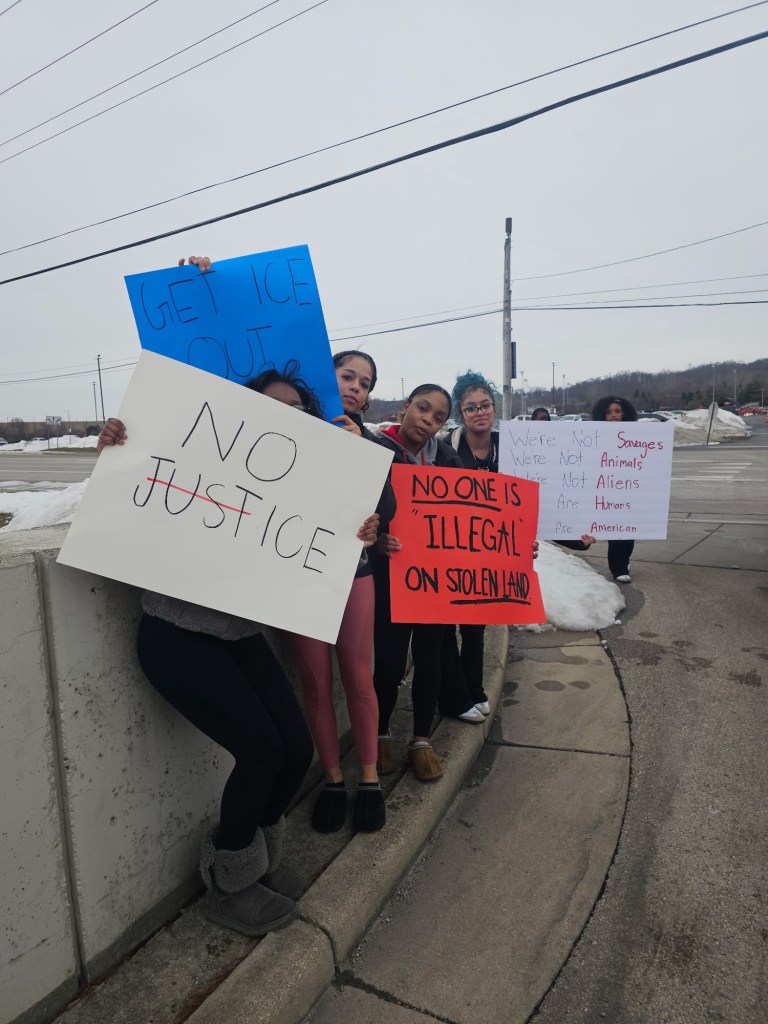
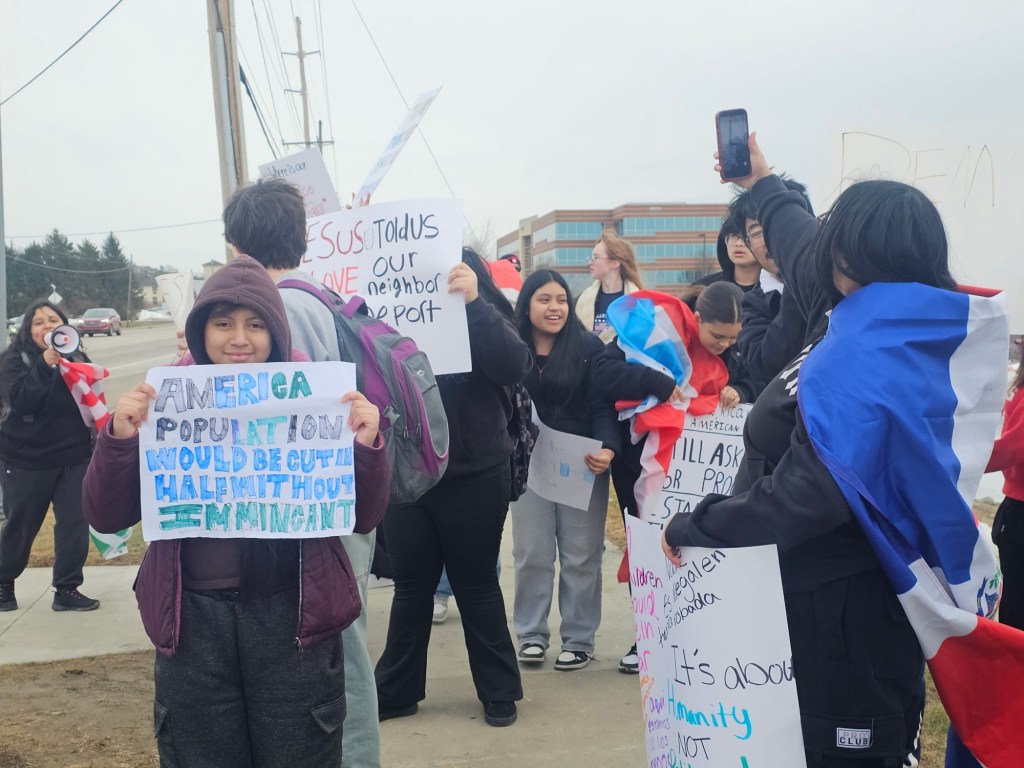
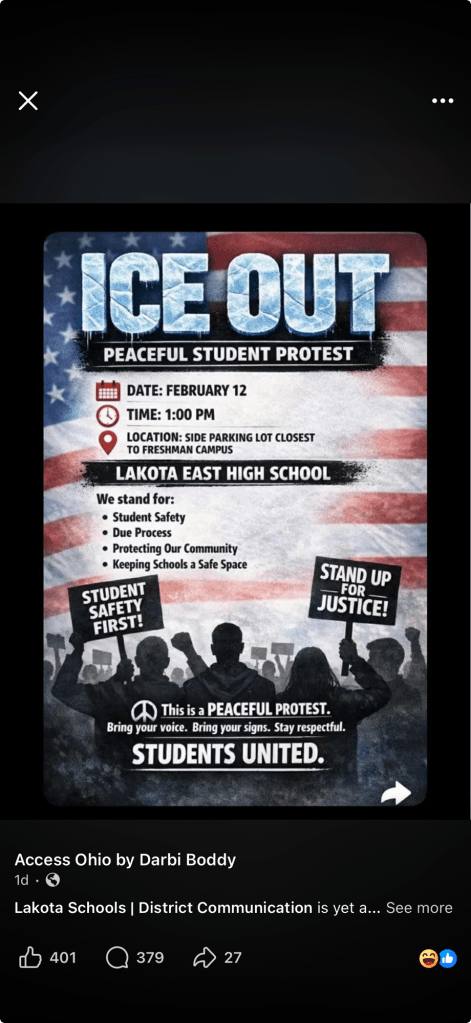
The recent student protests against Immigration and Customs Enforcement (ICE) at Lakota Local Schools in Butler County, Ohio, exemplify a broader and deeply troubling pattern in American public education. On February 12, 2026, students at Lakota East and Lakota West high schools walked out of classes during school hours, marching and carrying signs in opposition to ICE’s immigration enforcement actions and the treatment of immigrants. Reports indicate that at Lakota East, the walkout began around 1 p.m., with students leaving classrooms to demonstrate. These events were part of a wave of similar student-led demonstrations across the Tri-State area and nationwide, often framed by media and school officials as spontaneous expressions of youthful concern over federal policies.

Yet a closer examination reveals questions that demand answers: If these were truly student-initiated movements driven by genuine adolescent passion for immigration issues, how did high schoolers—many too young to vote or fully grasp complex policy debates—come to adopt such uniformly radical left-wing positions? Where did they acquire the ideological framework to view ICE enforcement as inherently unjust, to chant against law enforcement, or to equate border security with oppression? The evidence points overwhelmingly not to parental influence or organic self-education, but to a systemic infusion of progressive ideology within the public school environment itself, facilitated and encouraged by teachers, administrators, and union-aligned staff.

Public schools, funded by taxpayer dollars, are legally and ethically obligated to remain politically neutral. School boards are intended to be non-partisan, and classrooms should present balanced perspectives on history, government, and current events. Instead, what we observe in districts like Lakota is a pattern where left-leaning views dominate. Teachers, often represented by powerful unions with progressive platforms, shape curricula, discussions, and even extracurricular activities to emphasize one side of the political spectrum. Students hear repeated narratives praising figures like Barack Obama, Alexandria Ocasio-Cortez, or Bernie Sanders, while conservative viewpoints—rooted in rule of law, national sovereignty, or traditional values—are marginalized or absent. History classes may highlight speeches from Democrat leaders but rarely balance them with opposing arguments from figures emphasizing constitutional limits on federal power or the importance of secure borders.

This ideological imbalance is not accidental. It reflects broader trends in teacher preparation programs, hiring practices, and professional development, where progressive ideologies are normalized. Administrators, to advance in their careers, often align with these prevailing views; dissenting voices risk being labeled as disruptive or “right-wing.” In such an environment, vulnerable adolescents—navigating identity formation, peer pressure, family conflicts, or rebellion against authority—become receptive to messages that position teachers as enlightened alternatives to “strict” or “outdated” parental guidance. A student grounded at home for misbehavior, resentful of church attendance, or frustrated with family rules finds validation in a classroom where authority figures affirm that systemic injustices (like immigration enforcement) justify defiance.

The Lakota ICE protests illustrate this dynamic starkly. Students carried pre-made signs and marched during school hours, actions that typically require coordination and tacit approval. Reports suggest teachers permitted or even facilitated sign-making in classrooms, despite principal statements denying involvement. No widespread punishments followed for truancy or disruption—administrators cited free speech protections under Supreme Court precedents like Tinker v. Des Moines (1969), which allows student expression unless it substantially disrupts the educational process. Yet the absence of meaningful consequences speaks volumes: it signals endorsement or at least tolerance from a workforce insulated from accountability. When students feel entitled to leave class for political activism without repercussions, it reveals a culture where progressive causes trump academic priorities.

This is not isolated to Lakota. Nationwide, similar anti-ICE walkouts have occurred, with varying degrees of adult facilitation. In some districts, teachers openly encouraged participation; in others, parents or organizers aided logistics. The pattern echoes historical efforts to use youth as proxies for ideological agendas, from the KGB-influenced campus protests of the 1960s hippie movement to color revolution tactics employing young activists as shields. Adults—particularly those in positions of influence over impressionable minds—hide behind “student-led” rhetoric to advance views they cannot openly espouse without professional risk.

Compounding this is the erosion of trust in the teacher-student relationship. Public schools have seen too many cases of boundary violations, including sexual misconduct. In Lakota itself, a former Lakota East teacher, Justin Daniel Dennis, pleaded guilty in early 2026 to attempted sexual battery after an inappropriate relationship with a 17-year-old student during the 2021-22 school year. Such incidents, while prosecuted when reported, occur with disturbing frequency across districts—often underreported or quietly resolved. If a teacher can manipulate a vulnerable student into a sexual relationship through grooming and authority, it is not a stretch to see parallel manipulation in the political realm: filling ideological voids with radical views, turning students into unwitting advocates for defunding ICE, police reform, or other left-wing priorities.

These vulnerabilities stem from broader societal and familial factors. Many students come from homes with inconsistent structure, where parents may lack confidence in imparting values or face their own stresses. Progressive teachers exploit this void, presenting themselves as allies against “oppressive” conservative norms. The result: a minority of activated students become mouthpieces for adult agendas, protesting on behalf of causes like open borders or sanctuary policies—issues far removed from typical teenage concerns like sports, dating, or social media.

Critics may argue that youth naturally gravitate toward idealism and social justice. Yet the uniformity of the messaging—always left-leaning, rarely balanced—suggests curation rather than spontaneity. True education equips students with facts from all sides: the economic costs of unchecked immigration, the rule of law’s role in sovereignty, historical precedents of secure borders benefiting societies. Instead, one-sided exposure fosters entitlement and division, pitting children against parents, communities, and lawful institutions.

This dynamic mirrors historical socialist movements. Adolf Hitler’s National Socialist German Workers’ Party (Nazis) and Benito Mussolini’s fascism drew from left-wing collectivism, emphasizing state control over individual rights—far removed from classical liberalism, Christianity, or Bill of Rights conservatism. Modern equivalents appear in calls to “defund” agencies like ICE or police, echoing Bernie Sanders or AOC-style democratic socialism. Teachers aligned with these views use public institutions to propagate them, often at odds with the conservative-leaning communities funding them, such as Butler County’s Republican-leaning voters.

Parents who entrust their children to public schools expect neutral education, not indoctrination. When students return home echoing radical slogans, it signals a betrayal: taxpayer-funded employees turning children against family values and community standards. The media, often left-leaning itself, amplifies these “organic” protests while downplaying adult involvement or lack of consequences.

Change requires accountability: transparent curricula audits, balanced instruction mandates, consequences for unauthorized activism, and greater parental oversight. Without it, public education risks becoming a vehicle for ideological capture, eroding trust and fueling the very divisions it claims to heal. Students may one day reflect on these experiences as youthful folly, crediting strong family foundations for pulling them back. But for those without such anchors, the damage lingers—zombified into perpetual activism, detached from reality.

The Lakota protests are a microcosm of this crisis. They were not child-led revolutions but symptoms of adult manipulation in a system that has strayed far from its mission. Until we confront this, public schools will continue losing credibility, funding, and purpose.

Bibliography and Footnotes

1.  WKRC Local 12, “Students at 2 Tri-State schools protest against ICE, treatment of immigrants,” February 12, 2026. Details the walkouts at Lakota East and West during school hours.

2.  Journal-News, “Some local students are organizing protests, campus discussions about ICE enforcement,” February 12, 2026. Covers student emails and planning.

3.  WLWT Cincinnati, “Ex-Lakota East teacher accused of having sexual relationship with student pleads guilty,” January 29, 2026. Covers Justin Dennis case.

4.  Tinker v. Des Moines Independent Community School District, 393 U.S. 503 (1969). Supreme Court ruling on student free speech.

5.  Butler County Sheriff’s Office reports on Dennis case (2025-2026 filings).

6.  Historical references to Nazi and fascist socialism drawn from standard sources like William L. Shirer, The Rise and Fall of the Third Reich (1960), and Jonah Goldberg, Liberal Fascism (2008).

7.  Various reports on nationwide anti-ICE student walkouts (e.g., Guardian, EdSource, 2026 coverage).

Rich Hoffman

More about me

Click Here to Protect Yourself with Second Call Defense https://www.secondcalldefense.org/?affiliate=20707

Radical Teachers in Lakota Use Students to Advocate Left-wing Politics: ICE protests at taxpayer facilities insult parents

The events at Lakota Local School District in northern Cincinnati, Ohio, on February 12, 2026, represent a microcosm of broader national tensions surrounding student political activism, school administrative responses, potential teacher facilitation, and the influence of progressive ideologies in public education. In a predominantly conservative area of Butler County, students at Lakota East and Lakota West high schools engaged in walkouts protesting U.S. Immigration and Customs Enforcement (ICE) policies, including expanded enforcement, raids, and alleged excessive force under the Trump administration. These actions involved students exiting classrooms (at Lakota East around 1 p.m.), marching with signs, chanting slogans against ICE, and positioning themselves visibly along roadsides for media attention. At Lakota West, the protest occurred after school hours and off-campus to limit direct disruption.

Local media, such as WKRC Local 12, reported these demonstrations as student-led responses to federal immigration tactics, noting similar actions across the Tri-State region (Ohio, Kentucky, Indiana). Principals from multiple Lakota schools (including East, West, Hopewell Junior, Liberty Junior, and others) issued a letter to parents on February 11, 2026, preemptively addressing rumors of a “voluntary” walkout. The letter upheld students’ First Amendment rights to peaceful protest and civic expression while warning that unexcused absences would be subject to Ohio law and district policy—participation did not qualify for excused status (e.g., illness, emergencies), and preplanned requests would be denied. It emphasized respect for diverse views, noncoercion, a safe environment, and the requirement to report to the office before leaving the building.

Critics, like me, have labeled the letter evasive, arguing it downplayed administrative or teacher involvement while allowing the event to proceed. Eyewitness observations suggest that protest signs were prepared in classrooms with teacher awareness or permission, and that the walkouts occurred during school hours with limited enforcement. Participants rerouted around obstacles such as snowbanks to remain visible in high-traffic areas (e.g., near I-75), indicating deliberate efforts to maximize impact and media coverage. Coverage portrayed the protests as expressions of community solidarity in a Republican-leaning region, although turnout appeared modest relative to enrollment.

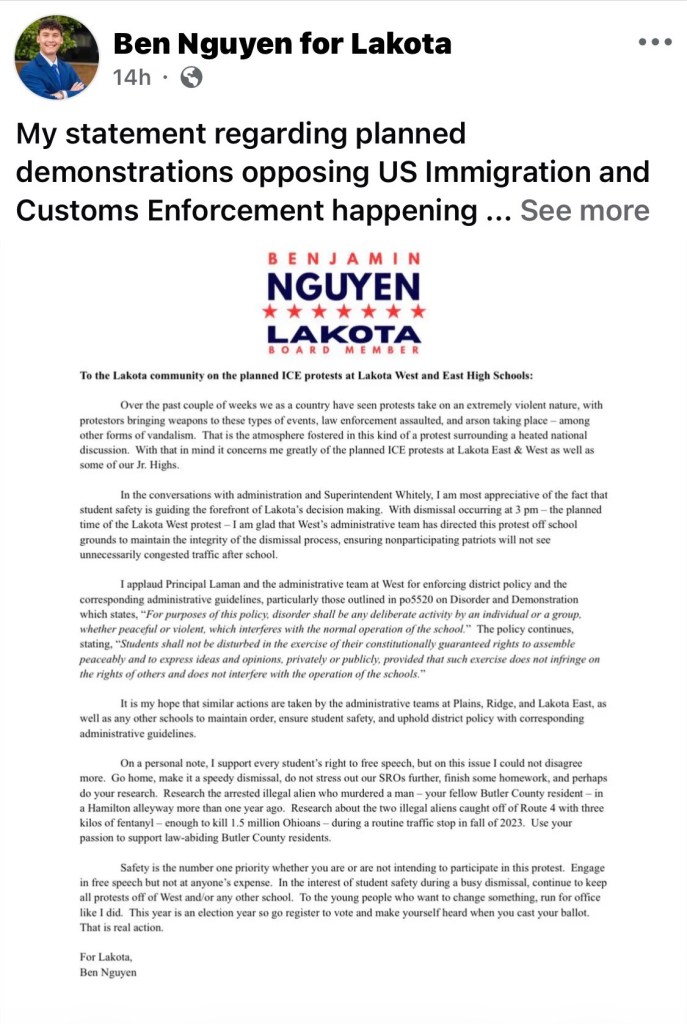
Lakota school board member Benjamin Nguyen publicly opposed the demonstrations, issuing a statement calling non-participants “patriots” and citing crimes by undocumented immigrants. Despite warnings of unexcused absences, many participants reportedly faced minimal repercussions, fueling claims of tacit approval to avoid liability or conflict.

The Nationwide Wave of Anti-ICE Student Protests in Early 2026

The Lakota walkouts aligned with a massive surge of “student-led” demonstrations (organized through teacher union radicalism) across the U.S. in January and February 2026, often coordinated via social media by progressive groups and spurred by intensified ICE operations, including detentions, and tragic incidents like fatal shootings involving agents in Minneapolis. Thousands participated nationwide, with actions in dozens of states and cities.

In the Cincinnati area:

•  Walnut Hills High School: 300–400 students walked out on February 4, 2026, holding signs like “Abolish ICE” in cold weather.

•  Princeton High School: Hundreds walked out on February 10, emphasizing opposition to racial profiling in a diverse student body.

•  Other schools, including the School of Creative and Performing Arts (dozens marching with chants on February 11) and Sycamore High School (tied to January actions), joined the wave.

Elsewhere in Ohio and nationally:

•  Central Ohio districts (Worthington, Hilliard, Upper Arlington) saw January walkouts after ICE’s Operation Buckeye.

•  Northeast Ohio (Cleveland Heights): Hundreds marched on February 12.

•  Other states: Texas (Hutto, Austin, Pflugerville), Kansas (Lawrence, Free State), Utah (multiple Salt Lake County schools with hundreds marching), California (Los Angeles Unified estimating thousands), Minnesota (lawsuits over ICE near schools), and more.

Protests focused on protecting immigrant families, creating “safe spaces,” and opposing overreach. Some districts threatened disciplinary action or investigated facilitation; others remained neutral or supportive. Conservative critics highlight the coordination, media amplification, and involvement of younger students as evidence of external influences beyond organic concern.

Teacher Unions, Political Leanings, and Potential Facilitation of Activism

Central to the controversy is whether these protests were student-driven or amplified by teachers and unions. Public school teachers often lean liberal/Democrat in surveys, and unions like the National Education Association (NEA), American Federation of Teachers (AFT), and Ohio affiliates (Ohio Education Association, Columbus Education Association) have advocated on immigration, condemning ICE near schools, supporting “sensitive locations” protections, and amplifying solidarity efforts.

In 2025–2026, unions pushed for reforms limiting enforcement near educational sites, filed lawsuits (e.g., Minnesota districts and unions), and issued statements opposing ICE actions that create fear in immigrant communities. Ohio unions, such as the OEA, strongly opposed enforcement in or around schools, citing trauma and learning disruptions. Critics argue that this normalizes progressive views in classrooms under the rubrics of “civic education” or “social justice,” potentially pressuring neutral spaces and facilitating activism (e.g., walkout guides or symbolic acts).

In conservative areas like Butler County, public schools are viewed as “liberal incubators” with limited oversight, allowing teachers to instill values diverging from parental ones. Many parents treat schools as convenient childcare, rarely scrutinizing political influences, enabling unchecked messaging. This contributes to generational shifts, with youth adopting radical positions via taxpayer-funded systems.

Implications, Reform Needs, and Long-Term Trajectories

These incidents reveal tensions between student free speech (protected under Tinker v. Des Moines for non-disruptive expression) and school neutrality. If teachers aided protest activities (e.g., by creating signs during class), this raises questions about resource use and impartiality. In polarized regions, such actions appear to leverage youth for adult agendas, thereby eroding trust.

Reform demands include stricter policies on political activities during school hours, transparency in responses, parental oversight, and union accountability. School choice could allow value-aligned options, reducing perceptions of indoctrination. Without reforms, public education risks prioritizing ideology, exacerbating divides, and alienating funding communities.

The Lakota protests, framed as civic engagement, highlight eroding confidence when schools seem to enable partisan activism in conservative strongholds. Balanced, impartial education is essential to serve all families properly.  These protests, as the Lakota one proves, show a much deeper scheme of radical left-wing politics using children to advance their political agendas at taxpayer expense.  It is a mechanism of injustice that must be stopped. 

Footnotes

¹ Local 12 (WKRC), “Students at 2 Tri-State schools protest against ICE, treatment of immigrants,” February 12, 2026.

² Journal-News, “Some local students are organizing protests, campus discussions about ICE enforcement,” February 12, 2026.

³ Cincinnati Enquirer, “Walnut Hills High School anti-ICE walkout draws 300 to 400 students,” February 4, 2026.

⁴ The Guardian, “These are the high schoolers taking a stand against ICE,” February 9, 2026.

⁵ Education Week, “Free Speech Debates Resurface With Student Walkouts Over ICE Raids,” February 5, 2026.

⁶ Ohio Capital Journal, “Central Ohio high school students protest ICE, teacher unions condemn ICE activity near schools,” January 23, 2026.

⁷ American Experiment, “When teachers’ unions turn schools into political stages,” January 21, 2026.

⁸ Chalkbeat, “Growing number of education groups criticize impact of ICE operations on students,” January 28, 2026.

Bibliography

1.  Local 12 (WKRC). “Students at 2 Tri-State schools protest against ICE, treatment of immigrants.” February 12, 2026. https://local12.com/news/local/students-at-multiple-butler-county-cincinnati-ohio-school-schools-walk-out-class-protest-against-ice-immigration-customs-enforcement-agents-officers-president-donald-trump-protesting-politics-political-immigrants-lakota-west-east

2.  Journal-News. “Some local students are organizing protests, campus discussions about ICE enforcement.” February 12, 2026. https://www.journal-news.com/news/some-local-students-are-organizing-protests-campus-discussions-about-ice-enforcement/X6DUPL4VLRCL3OKCKKCP5B6FHA

3.  Cincinnati Enquirer. “Walnut Hills High School anti-ICE walkout draws 300 to 400 students.” February 4, 2026. https://www.cincinnati.com/story/news/education/2026/02/04/some-300-to-400-walnut-hills-high-school-students-join-anti-ice-walkout/88510660007

4.  The Guardian. “These are the high schoolers taking a stand against ICE.” February 9, 2026. https://www.theguardian.com/us-news/2026/feb/09/us-high-schoolers-protest-ice

5.  Education Week. “Free Speech Debates Resurface With Student Walkouts Over ICE Raids.” February 5, 2026. https://www.edweek.org/leadership/free-speech-debates-resurface-with-student-walkouts-over-ice-raids/2026/02

6.  Ohio Capital Journal. “Central Ohio high school students protest ICE, teacher unions condemn ICE activity near schools.” January 23, 2026. https://ohiocapitaljournal.com/2026/01/23/central-ohio-high-schools-students-protest-ice-teacher-unions-condemn-ice-activity-near-schools

7.  American Experiment. “When teachers’ unions turn schools into political stages.” January 21, 2026. https://www.americanexperiment.org/when-teachers-unions-turn-schools-into-political-stages

8.  Chalkbeat. “Growing number of education groups criticize impact of ICE operations on students.” January 28, 2026. https://www.chalkbeat.org/2026/01/28/education-groups-say-ice-immigration-enforcement-is-hurting-students

Rich Hoffman

More about me

Click Here to Protect Yourself with Second Call Defense https://www.secondcalldefense.org/?affiliate=20707

Why Lakota Voters Should Reject the Largest School Levy in Ohio History: Vote for Ben Nguyen and listen to my Friend, Jamie Minniear on 55 KRC

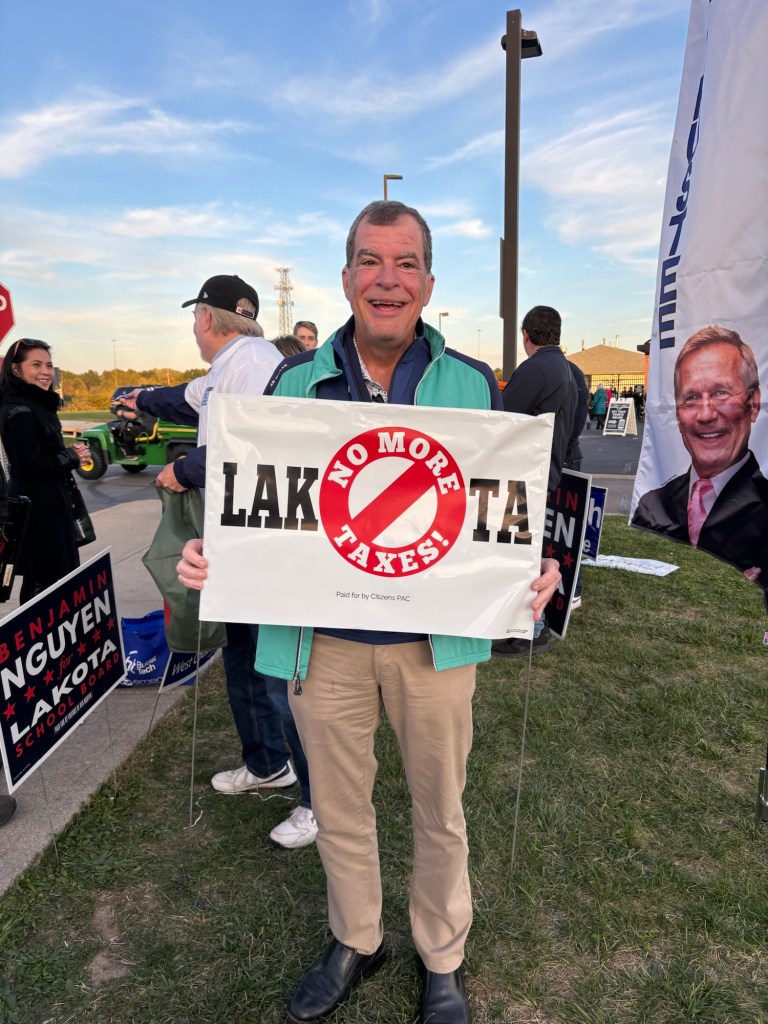
In the heart of Butler County, the Lakota School District is asking voters to approve what would be the largest school tax levy in Ohio history—a staggering $506.4 million bond issue paired with a permanent improvement levy. This proposal, if passed, would cost homeowners $208 per year for every $100,000 of appraised property value, with collections beginning in 2029. While district officials claim the net increase will be closer to $93.10 per $100,000 due to retiring debt, the reality remains: this is a massive financial commitment for taxpayers, especially seniors and working families already burdened by inflation and rising costs. The levy’s purpose? To demolish nine existing schools—some only 40 years old—and build four new elementary schools, while reducing the total number of buildings from 21 to 16. But many residents, including Jamie and Todd Minniear, leaders of the No More Lakota Taxes campaign, argue that this plan is fiscally irresponsible and prioritizes construction over classroom needs.

Jamie Minniear, speaking on 55KRC with Brian Thomas, passionately advocated for Ben Nguyen, a 2025 Lakota graduate and conservative school board candidate who opposes the levy. She described Nguyen as a sharp, creative thinker with fresh ideas for education reform and a deep understanding of the district’s challenges. Nguyen’s candidacy represents a new generation of leadership—one that values fiscal discipline, educational outcomes, and community engagement over extravagant spending. Jamie emphasized that the levy is not about improving teacher pay or classroom instruction; it’s about tearing down buildings and replacing them with new ones, regardless of whether they truly need replacement. She and Brian Thomas, the host, recalled his own experience attending classes in trailers and rundown buildings, yet still receiving a quality education. Her point was clear: education doesn’t require luxury—it requires commitment, good teachers, and community support.

The Minniear-led opposition has gained traction by highlighting the lack of transparency and misleading ballot language. While the ballot shows a 5.94-mill increase, the district claims the real impact will be 2.66 mills due to debt roll-off. This discrepancy has confused voters and raised concerns about the district’s communication strategy. Moreover, the district’s plan to reconfigure grade bands, shift students between buildings, and consolidate campuses has sparked anxiety among parents who fear disruption and overcrowding. Critics argue that the district should focus on maintaining existing infrastructure, investing in teacher development, and enhancing academic programs—not launching a half-billion-dollar construction spree. The Ohio Facilities Construction Commission rated many of the buildings slated for demolition as “borderline” or “satisfactory,” further questioning the necessity of such drastic measures.

Ultimately, the levy represents a philosophical divide in the community: between those who believe more spending equals better education, and those who believe in doing more with less. Jamie Minniear and her husband Todd have galvanized a grassroots movement that champions responsible stewardship, local control, and student-centered priorities. Their campaign is not anti-education—it’s pro-accountability. They believe that rejecting this levy is the first step toward a broader conversation about what truly matters in public education. With Ben Nguyen on the ballot and a growing chorus of concerned citizens, Lakota voters have a chance to send a clear message: we support our schools, but we demand smarter solutions. On November 4, vote NO on the Lakota levy!

Rich Hoffman

Click Here to Protect Yourself with Second Call Defense https://www.secondcalldefense.org/?affiliate=20707

The Lakota Levy of 2025 is Just the First Step: Until there are conservatives on the school board, public schools will seek tax increases

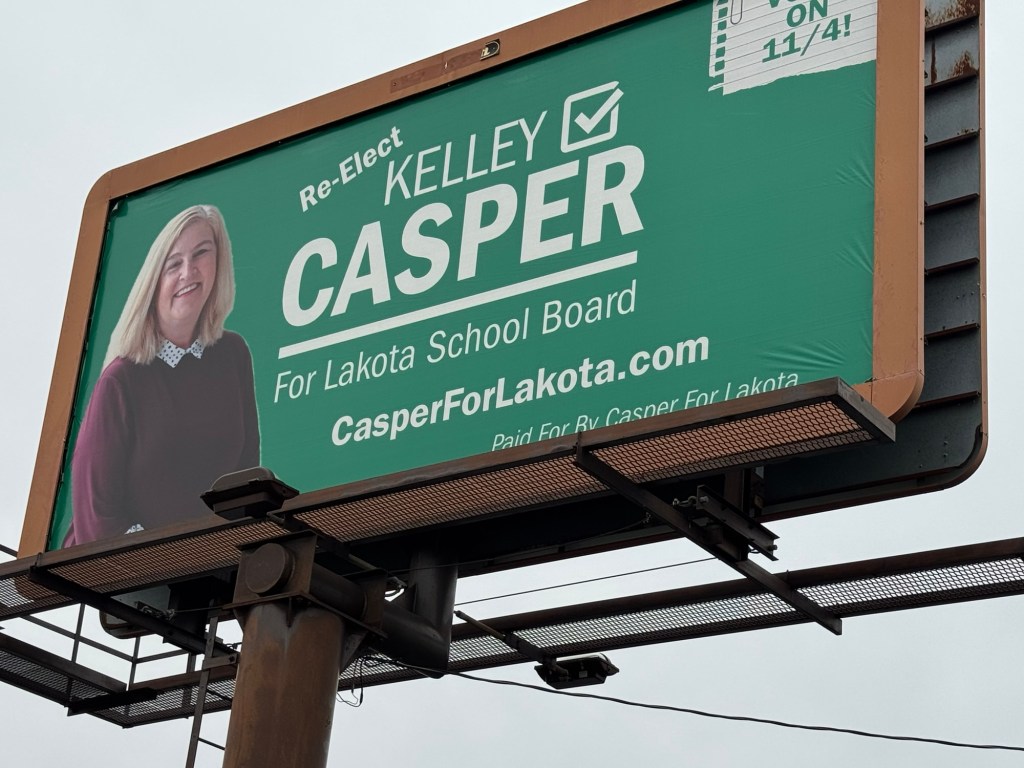
I’m really proud of the interview I did with Senator George Lang just ahead of the election of 2025.  George, first and foremost, is a friend of mine, so I tend not to drag him into things I’m involved in, and when it comes to politics, he and I agree on most everything.  The only significant difference is that he tends to be more considerate of people than I am.  He gives the other side more of a voice than I think they deserve, because he’s a nice guy.  During our interview, when he said that he thinks of Lakota school board members Julie Shaffer and Kelly Casper as friendly people, I disagreed with him.  I think between the two of them at a drunken school board meeting out of town, you couldn’t find enough clothes to half-dress one mannequin in the back of a Dillard’s.  Lakota’s school board is very liberal, and those two individuals lead it, which is embarrassing.  And expensive.  But George is good to everyone.  He has his opinions, but he gives everyone a fair shake, and I often don’t get to show that to people.  Neither does he, as the Majority Whip of Ohio’s Senate, a significant position with considerable influence.  He knows that around me, he can be himself and that I won’t run off and talk about anything that we discuss privately.  It was pretty unique that I got to put him on camera and talk for an hour about everything, from the upcoming Lakota levy to his battles with stage 4 cancer.  However, to clear up some misconceptions people had about George and a donation he was shown giving for the pro-Lakota levy efforts, we conducted an interview together that I think was better than he could have achieved anywhere, by any modern media method, news outlet, or podcaster. 

The only people who do the level of interview at the level of what George and I did were someone like Tucker Carlson or Joe Rogan, and I don’t think either of them could have done a better job.  George and I have known each other for several decades, but we had never sat down and just talked in front of the camera like that. What was captured was very useful to many people who wonder about various things.  I even asked George before the interview, “What’s off limits?  Is there anything you don’t want to talk about?”  He said quickly, “No, nothing, anything, and everything is on the table.”  So, we just talked like a couple of people and let others in to observe, and I was able to show them why I like George so much, even though he has evolved into a powerful politician and a prominent figure in Butler County politics.   And over the course of that interview, which was mainly about the upcoming Lakota levy, the most significant tax increase in the history of Ohio, I think he said a mouthful, which I completely agree with.  We all believe that the Lakota levy is going to crash and burn.  But don’t assume that this wasn’t their plan all along: to give the public a considerable blowout number and lose badly in an election.  Then, to say in the spring or summer that they listened to the public and came back with a reduced number.  Just because we defeated this levy in the 2025 election, it doesn’t mean it won’t come back in some form or another.  These public schools are only known for one thing: wasting tax money and asking the public for more, often on the back of property tax increases, to fund an overly progressive society. 

As George said, he thinks that the Lakota school board and its satellites, which include the treasurer and superintendent, are smart people.  I think what he calls “smart” is very maliciously manipulative, even evil.  But Genghis Khan was considered intelligent too, and so were most of the mass murderers of the world.  People thought that Jeffrey Dahmer was smart, even as he dismembered people in his kitchen and stored their remains in his refrigerator.  I would say that the Lakota school board members are very manipulative, which they have to be, given their liberal leanings.  Because people on the left often have to figure out how to get others to do things for them that they can’t do for themselves, they become pretty skilled at it over time.  However, as George and I reflected, this levy attempt is merely them dipping their toe in the water to see how the public reacts.  The details of that kind of election scope are why I think that interview is better than any other outlet could have pulled off, because we covered a lot of ground that most people would blank out after 15 minutes.  However, what we covered was essential to nearly every living, breathing human being, especially those residing in Butler County, Ohio.  It’s encouraging that in Butler County, an effective resistance to the Lakota tax increases has emerged in the No More Taxes group, which is fighting the Lakota levy.  And there are some really good people involved, and they have raised money not just for this levy, but for several upcoming ones as well.  However, for voters who have to show up and vote, they really need context on the scope of the problem.

So, how do we prevent more tax increases from being imposed in the future?  Well, don’t put liberals on the school board, and right now, there are four solid Democrats.  They call themselves other things to avoid the stigma of not being conservative in Butler County, but they are hard leftists on most policies.  And lefties love to waste money.  So, to stop wasting money, which Lakota already has a quarter of a billion dollar budget for a school, which I argue is just a dressed-up babysitting service, elect conservative school board members.  For this election, Ben Nguyen is the guy.  But in future elections, we need more people like Ben.  You need at least a three-vote majority, which we had for a while at Lakota.  And as soon as we didn’t, Lakota went for a tax increase.  That’s all they know to do—because they are liberals, and because liberals are never smart with money.  They might be manipulative, deceitful, scandalous, or monstrously unprincipled.  But they are spendthrifts who want to live off the efforts of others, starting with the real estate of Butler County.  Once Vivek Ramaswamy is the governor of Ohio next year, and Trump continues to dismantle the Department of Education and unleash the power of School Choice, all the public schools will have to change and do a lot more with less.  Their cost structure is significantly inflated due to their collective bargaining agreements, which stem from their union membership. We are all aware that unions often disrupt cost structures wherever they emerge, as they allow the mediocre to receive disproportionately high incomes.  And that is certainly the case at Lakota schools.  So, yes, the levy will likely fail in a big way on election day, provided people don’t sit on their hands and watch Netflix instead of voting.  People need to go out and vote.  But this is only step one.  People are going to have to dig in and fight to keep our taxes reasonably low until there is a new school board with conservatives on it.  Because, as sure as you are reading this, Lakota is planning the next levy, once the smoke clears from this one, because they have spent themselves into oblivion.  And only higher taxes can satisfy their never-ending hunger for more money to waste.

Rich Hoffman

Click Here to Protect Yourself with Second Call Defense https://www.secondcalldefense.org/?affiliate=20707

George Lang Donated A Lot of Money to No More Taxes at Lakota: Fighting and beating stage 4 cancer

I’ve known George Lang for a long time, and I would say I know a fighting side of him that a lot of people don’t know about.  And we talked about all those fights as he gave an update on his stage 4 cancer treatment. And to let you know how well it’s going, after we concluded our interview, we made a promise to each other to attend the White House together once the new ballroom opens.  So he’s not planning to die, he expects to beat the cancer thoroughly, and he gave details on just how and what comes next during our discussion.  But speaking of cancers, there was a lot of controversy when his name appeared on a donation list for the pro-levy campaign for Lakota schools, for $2000.  When I first heard about that, I was skeptical, yet his name was there.  I happen to know that George gave at least $2000 to the No More Taxes group opposing Lakota.  So what was going on?  George explained that, too, as best he could.  In the end, he gave $4000 to the No Tax Levy Lakota group and asked the Pro Lakota Levy people for his money back, which they were in the process of doing as we spoke.  I’ve known George for well over two decades, and we’ve talked about that long history and the many fights we’ve both been in over the years.  So I thought it was weird that he would suddenly be for any tax increases.  As it turned out, he very much wanted me to know that it was an accident and that he wasn’t all of a sudden a supporter of higher taxes.  Tax rates are killers of communities, and for his entire life, George has fought high taxes.

No More Taxes!

So the next question everyone has is: how could his $2000 have been an accident?  Wouldn’t he notice a missing $2000?  Well, when I saw it, I thought George was trying to be supportive of Lakota schools because he works with them a lot as a legislator.  One thing in politics is that making enemies isn’t a great way to bring people together.  And as a politician, you are supposed to represent all people, not just your own point of view.  But then again, people vote for you based on your point of view, and they expect you to be authentic.  So right out of the gate, no matter what you do, someone is going to be mad at you.  George has told me for years that I have a lot of talent for politics and has tried to nudge me into several offices, but I have been very resistant, because I reserve the right to throw rocks.  In political theater, there needs to be lots of personalities to test the market of ideas, and we need rock throwers.  But we also need bridgebuilders.  George has always been a bridgebuilder, and I respect him for that.  I have always been a rock thrower.  And he respects me for that.  And we both like a good fight, which is what we have in common.  I figured that if he was donating money to the Lakota levy, there must be a strategic reason, and that he would explain it to me.  I couldn’t imagine what that good reason would be.  But I would be at least open to his explanation.  But as it turned out, he blamed it on his wife, Debbie.  And they get involved in several hundred thousand dollars a year in political donations, and in the amount of that, George didn’t notice the charge on his credit card, because there were so many transactions. 

She voted for the largest tax increase in Ohio’s history!

I’ve known Debbie for a long time too, and I know where her mind is.  She and George give everyone the benefit of the doubt.  I hold grudges forever, and most of the time when people do me wrong, I never forget it.  But Debbie is a loving person.  I could see her playing nice with the Lakota school board.  She and George want to work with the board to make things work well.  Lakota Schools is the largest employer in Butler County, so they aren’t the kind of people to draw lines that they can’t walk out of if they need to.  Knowing both of them, I can’t imagine a scenario in which they accidently voted for a tax increase.  But they give a lot of things, and when it involves that much money, it is possible to get the wires crossed.  George and Debbie have worked very hard for a very long time, and they are very successful.  They didn’t get that way because of politics.  But they have carried their business success into their interest in politics and their desire to make the world a little better through their political involvement.  A lot of us on this Lakota issue see the public school as a vile enemy, teaching children all kinds of terrible things, and wasting a lot of money while doing it.  I am in that camp.  But Debbie’s always hopeful and uses her vibrant personality to build relationships wherever possible.  The important thing to me is that, once they realized where the donation had gone, they worked to correct it, put their money where it counts, and donated against the Lakota levy of 2025. 

A lot of people can’t imagine writing a $2000 check once in their life, let alone writing so many of them that you don’t even notice it on a credit card statement.  And to make sure everyone is clear on the subject, to turn around and give $2000 more to the No Tax Lakota group, in addition to the previous amount.  I say it all the time, politics is a blood sport.  Sometimes you have to be brutal.  Sometimes you want to be nice.  Sometimes you have to be a combination of all kinds of approaches; no one thing works every time for everything.  But when you have been successful for a long time, and survived a lot of battles over the years, which stage 4 cancer is just the latest, resource management can give you all kinds of options.  And what matters is how those resources are managed.  And as soon as he could, George called me and wanted to set the record straight, because he cares about these things.  We spoke for over an hour, about a lot of topics.  And for everything anyone would want to know, the interview with George was great, full of fascinating details.  But even through the fog of politics, which can get hazy at times, I have seen George fight through some really tough moments with his wife, and they are a good team.  They certainly aren’t phonies, which I think makes them very unique, given that they have achieved a lot of success by anybody’s measure with a level of authenticity that many would think wouldn’t be possible.  But I know it’s true.  And we talked about it all.  And I am looking forward to George beating the cancer, to the Lakota levy going down in spectacular flames, and to Trump building that new ballroom.  I think by then we will all have earned a nice night out on the town to see it for the first time.  The White House is a special place, but only because there are special people who have fought in the trenches to make it so.  And George and Debbie Lang are among those who have.  And with their donation to the No More Tax group of Lakota, they are supporting the next generation of fighters, who have a lot of good work ahead of them.  And by the time the smoke clears, we’ll all be proud of the roles we played in that magnificent contest.

Somebody wasted a lot of money on this!

Rich Hoffman

Click Here to Protect Yourself with Second Call Defense https://www.secondcalldefense.org/?affiliate=20707

Public Schools Were Designed By Dumb People to Make More Dumb People: Dewey always wanted communism

I’ve always been consistent on homeschooling issues; I’ve never thought that the public education system was any good.  In a conversation the other day with some people, they asked me about this, and I always hate answering the question because the essential elements aren’t very complimentary.  The person I was talking to said about themselves, “I’m not very smart, I barely made it through school myself, so I wouldn’t want to harm my kids by teaching them.  I would rather have a professional do it.”  I hate that conversation because it forces you to admit to how stupid most people are, which makes it hard to deal with them willingly.  I don’t have that confidence problem.  I think I can do everything, including working on my car, better than other people and feel better equipped to do it.  Especially teaching my kids.  I think the public education system was set up wrong from the start, and I’ve never been a fan, including in my own school days. I was friends with several honors-type students who were very high-IQ, genius-level students, and I watched how the school leeched off them.  There was nothing for the school to add to their education because all the people teaching those kids were stupid.  And you don’t want to hurt people’s feelings, but usually, people who choose to become school teachers aren’t the best and brightest; otherwise, they would try to make a go of things in the private sector, where they could make a lot of money.  The people who end up teaching are often like the person who was talking to me about public school —they aren’t the brightest our society has to offer.  Neither my wife nor my children finished their senior year of school; they graduated during their junior year.  They did graduate, but they never attended the ceremony, and none of them has ever looked back. 

Government schools are big business. Look how much money was raised by Lakota schools to pass the biggest tax increase in Ohio’s history!

Both of my children spent their senior years traveling Europe to finish their education, and we never sit around wishing they had done anything different.  If anything, we talk about wanting to homeschool them earlier.  A few times during their junior high years, we tried it, but family members really got in the way and were grotesquely unsupportive.  The experience was so bad that we pulled our kids out of school anyway and just finished their education online.  And that was twenty years ago.  There are many more options available now.  We had a close-knit family, so it was hard to ignore their opinions, and back then, those opinions mattered a lot more than they do today.  And, as always, the public school experience —the other kids, the employees, the choice of what to teach—was all constructed by stupid people so that kids can grow up to become more stupid people, and I can’t support that process. Instead, my view of education is that it is far more valuable than the public school system was designed to facilitate.  As I have always said, when John Dewey designed public education, it was made to teach communism.  Not how to teach kids how to think.  And I find it despicable.  I have tried to let other people change my mind, but over time, I have become even more firm in my positions because nobody has ever been able to, even though I have tried to give them the space to do so.  They have never been able to change my mind, even when given more than enough of a fair chance. 

During one of the previous No Lakota Tax campaigns, years ago, the standard teacher’s union complaint has always been classroom sizes, and that was their justification for needing more tax money to hire more teachers to reduce classroom sizes.  I said on the radio, on television, and in public forums that the reason was that the teachers were too lazy to teach a lot of kids, and that all that extra money was essentially to fund laziness.  So they got mad and challenged me to come into the school to teach a class myself so I could find out just how hard it was.  So I went to Lakota East and sat down in one of the classrooms to accept the challenge.  Kids and staff from Spark Magazine, which is a published magazine for the Lakota school system that goes out to a lot of people in a big district full of over 100,000 people, met me to propose the challenge, which they thought I would shy away from at the last minute.  I told them I was ready to teach not just one class, but four at once.  Bring four classrooms into the auditorium, and I would teach them all personally, any subject they wanted to cover, for as long as they could handle.  Now you have to understand that I work an average of 15 hours a day, most days of the week.  And my mind never stops working.  I have been married for more than 37 years and now have grandchildren.  This challenge was about 10 years ago, but I was pretty much the same as I am now.  Teaching a class is something I would call very easy. 

They chickened out because the teachers balked at the proposal.  They didn’t want me to make them look bad, and whenever there has been a public debate on the matter, they never hold up and are easily defeated.  And not to rub salt in the wound, but I have never met a person better equipped to teach any of my children or grandchildren anything, better than me.  And I know a lot of people.  I know a lot of people who think of themselves as brilliant.  And I would say none of them are better at teaching my children anything.  It’s lazy to drop a kid off at school and turn that vital task over to a professional.  So with all that in mind, remember, public schools were designed to teach kids the emerging communism of Karl Marx in those pre-Civil War days.  They were never intended to produce the next generation of geniuses.  And I expect my kids and my grandkids to be the best people they can be.  To elaborate on the point, I will put up some videos here of one of my grandsons and his dad, who have a weekly YouTube channel that I think is pretty neat.   It shows just how important it is to teach a child from a parent, and it’s so much better than the public school experience.  I think that my youngest grandson has a chance to be the next Thomas Edison or Albert Einstein.  The public school system does not make those types of people, and if it were effective, they certainly would.  So if we want people to live up to their full potential, you have to get them as far away from the public school system as possible.  And the truth is, most parents are too lazy to give their kids that chance.  And it’s a shame.  I feel sorry for every kid whose parent is too lazy to homeschool them.  My experience with it is that kids become so much better when they don’t have to endure the corrosive effects of being taught by grown adults to be dumb.  Because public school was designed by communists who wanted to suppress intellect, not expand it, and until we deal with that truth, we will continue to be very disappointed by the results.

Rich Hoffman

Click Here to Protect Yourself with Second Call Defense https://www.secondcalldefense.org/?affiliate=20707

Dirty Tricks by the Pro Levy People at Lakota Schools: Trying to sneak their issue under the door at the last minute

Just a few observations about the upcoming Lakota school levy, the biggest and most ridiculous in the state of Ohio, where they essentially want to tear down a bunch of schools and rebuild all new schools, to make the classrooms smaller and drive up payroll by hiring more teachers to teach the same number of students.  It’s expensive and stupid, but what do we expect from these people?  But there is a lot more to notice than just how flat-footed their campaign is.  We always talk about how liberal they are who run and manage the school, and as they are pushing for their levy passage, they look to have taken their entire campaign out of the Kamala Harris playbook.  They have waited until essentially two weeks before the election to put out their signs, and what they have put out is a minimal number.  I’ve been all over the district and was looking for more signs in places more friendly to their position, but they are pretty flat, and where they do have signs, they have tried to appear bigger and more of a mainstream position.  Especially in places where Mark Welch has yard signs, they have been attempting to put the limited amount of signs that they do have next to him to give people the illusion that he supports the Lakota levy, when I know for sure, he does not.  These are not politically savvy people running the Lakota campaign for their massive tax increase, which is fine with me.  I want to see that levy crash and burn more than anybody.  But things have changed a lot over the last ten to twenty years, since I was on the front line of these things, and it’s certainly worth talking about.  Of course, anything can happen in an election; it will all depend on turnout.  But the Lakota people are certainly on their back foot on this one.

The pro tax people are trying to associate with the No More Taxes position of the very popular Mark Welch

It costs a lot of money to run these campaigns, and usually, Lakota schools have plenty of mad moms trying to hide how terrible they are for their kids from the public by supporting the schools that give them a free babysitting service, because they are too lazy to be good parents themselves.  It’s a well-known personality type, the mad and crazy mothers who campaign for tax increases on other people’s property.  And even worse than those neurotic types come their queer eye for a straight guy husbands, who are more interested in doing the dishes, hoping to get laid by their wives’ best friends husbands because they are so progressive themselves, that all traces of manhood have vanished from their cell structure like clowns at an anti-mime rally.  (that’s how you know that I don’t use AI to write my articles, I do everything the old fashioned way)  And watching their campaign this time around, after watching lots of campaigns from the past, it looks like their entire approach to this tax increase is based on that inner firing squad of transgender losers, wife-swapping scandals, and corporate bootlickers too busy to know that their children had their 8th birthday.  They don’t understand the forces against them because they haven’t worked very hard to get to know them, and you can tell by the way they have put out their signs and raised money for the effort.  They are doing what I call the Kamala Harris approach, where they know they have a weak position and their strategy is to surprise everyone at the last minute, before anybody knows what’s really going on.  And where they are present, they are trying to affiliate themselves with well-known politicians, like Mark Welch, who is an obvious frontrunner for the upcoming West Chester trustee race. 

A very weak campaign by the pro tax people

Another thing that I noticed while driving around the district is that there are a lot fewer businesses supporting this levy than there used to be.  The school has always acted like a bunch of mobsters when it came to pushing for business support.  If businesses did not support massive tax increases, those businesses were attacked by that mob of angry moms, and they’d try to inspire a boycott against those businesses.  Lakota schools traditionally has quite a collection agency force that is very aggressive on tax shakedowns, and they have been pretty ruthless.  But things have changed over the years; it’s been a long time since Lakota went for a tax increase because the community has been so hostile toward them.  And the shoe is on the other foot now, for sure.  When the mad moms think they are getting a hook in the water by putting their signs next to Mark Welch, to attempt to trick voters into supporting massive tax increases, hoping to get bleed off votes from low information people, there is an air of desperation looming over the whole effort.  I could tell a lot of stories about the past where the outcome was never obvious.  I have done interviews with some of the big media, a Channel 5 broadcast on prime time television comes to mind, where the pro-Levy people had the streets all lined up with supporters, and they looked like everyone was going to vote for them.  Then they’d put me in a lonely parking lot, trying to make it look like I was on my own and had little support from anybody.  And once the election happened, the silent majority showed up and crushed the visuals in embarrassing ways.  Those were the old days, and these Lakota people are certainly not functioning from that kind of strength. 

I think this says everything about the election of 2025

It costs about $5 per yard sign.  And based on the yard signs, you can tell the strength of the political party because the early investment usually indicates how much community support there is ahead of the election.  On the No More Taxes at Lakota side, the push was to raise about $20K to fight this levy attempt and to be prepared for follow-up attempts after this first one fails.  For Lakota’s side, once the filings get reported, it would not be surprising that their donations are in the six figures, as many schools are these days.  But in Lakota’s case, that money isn’t seen yet, and obviously, they are worried about giving people too much time to learn the facts, so they are doing a last-minute push just like Kamala Harris did, hoping to catch people a little off guard, which doesn’t spell confidence in their position.  They don’t have many signs out really late in the campaign.  The No More Taxes campaign has had its signs out since the last week of September.  So, impressions by the public who didn’t already have a strong opinion on the matter were being made during October.  But early voting has already been going on, so the Lakota effort has been noticeably flat-footed.  And where they hoped to win over people, they are trying to give the illusion that a popular local trustee, Mark Welch, is on their side, which he most certainly isn’t.  But those are the strategies of the desperate, and not very smart.  And a group of people who think that everyone is with them when they are only talking among themselves, with a couple of cats and dogs to greet them at the door.  When it comes to the community as a whole, I think they are in for quite a shock when the reality of the vote totals comes in.  They don’t seem to know just how bad people have come to hate them.  But they will, the election is near.  And for all the normal people out there, those who are not dysfunctional misfits hoping to hide in society through an overly liberal education built on a foundation of DEI hires, make sure to vote NO on the Lakota Levy, and do it in a big way.  These losers need to learn a lesson. 

Rich Hoffman

Click Here to Protect Yourself with Second Call Defense https://www.secondcalldefense.org/?affiliate=20707

I Have Personally Saved Lakota School District Businesses and Residences Many Hundreds of Millions of Dollars: What the next generation looks like

I don’t talk about it much or think about it in any significant way, but I have had at least three school board members tell me what someone reminded me of this past week.  I have personally saved the Lakota school district, businesses, and homes many millions of dollars in tax money because of my stance against Lakota schools.  Its pretty unusual for a school district the size of Lakota schools to go as long as they have without a request for a tax increase and the hidden element that doesn’t get discussed by the school and the media that reports hand in hand with them is that it has been my name that they don’t want to deal with in their public relations efforts to extract more taxes from the public.  Going back to the No Lakota Levy days, from 2010 to 2013, it was me and a few business owners who got together and put forth a resistance to tax increases proposed by Lakota schools in the form of levy initiatives.  And I was the spokesman who did all the radio spots, television and wrote articles for the media, and even produced my own material.  So much so that the reporter for the Cincinnati Enquirer told me directly that I was his biggest competition, as he was interviewing me for my anti-tax positions.  We defeated three consecutive tax increases until school board member Julie Shaffer and some of her cohorts devised a scheme with the same Enquirer to try to destroy me personally.  Of course, it didn’t work for a lot of the same reasons. After they finally got a tax increase passed in 2013, by the slimmest margin they could have had and still call it a win, they haven’t tried since, until recently.  This year, in 2025, they will try again, starting with a facilities plan.  Then, after it cools off a bit, they will push for an operational tax increase.  However, I am happy to say that these days, it’s not just me who is resisting. 

Following that win in 2013, many members of No Lakota Levy were tired of feeling socially excluded.  They were primarily people who attended all the social functions, which, at that time, Lakota controlled exclusively as the region’s largest employer.  And the longer I was the front man, the more rhetoric that would come my way.  And I do not tolerate intimidation from anyone.  So I dug in for a fight that would last for another 15 years, and it has become very vicious.  It started for me by simply discussing how Lakota’s wage structure was out of control, with too many six-figure salaries inflating the budget, which caused them to take money from property owners.  But Lakota’s plot to deal with me was to get rid of me.  And because they weren’t able to do that, they haven’t been able to put a levy on the ballot all this time, even though they have wanted to.  They’ve been dipping their toes in the water since 2019, but wouldn’t, fearing the mess it would cause and the potential for a levy fight they knew they couldn’t win, with declining enrollment keeping them from having to.  Yes, I have personally saved the Lakota school district’s businesses and personal residences many hundreds of millions of dollars over the years, and I have been happy to lend my name to that endeavor for that purpose. 

It’s better to pay for lawn signs than the high taxes of a Lakota levy passage

At many social events, knowing that Lakota schools planned to go for a tax increase at some point, we have been talking about getting the old ‘No Lakota Levy’ band back together again.  And there is a lot of hope in putting this facilities plan first, as many of those old members probably won’t want to join against a tax increase going forward because they want to be part of the construction of new facilities.  And while we’re all community members who generally like each other, I have been that one person who couldn’t care less what anybody at Lakota schools thinks of me, and that conflict has kept them in check to a large degree, not wanting the public relations nightmare that a conflict with me will undoubtedly cause them.  So we have been able to prove in the Lakota district that schools do not make communities great.  They are essentially free babysitting services to busy parents.  The reason the part of Butler County where Lakota schools are located has continued to have excellent resale value, and numerous businesses have come to the region and stayed, is that we have kept taxes low.  And to that point, we have kept Lakota schools from requesting additional funding every couple of years, unlike most schools around the country.  Making the Lakota district very attractive to investors in commercial and residential opportunities, not for the schools, but for the lack of taxes.  So in that way, my name has been worth many millions of dollars in gained opportunity costs that high taxes would have otherwise destroyed.  However, in the same conversation where I was being given credit for stopping Lakota schools from tax increases over 15 years, I was also asked what I considered success to be, if I was being a bit reserved in taking all the credit.  And I said what I have said to many successful people, hundreds of consultants over the years, lawyers, and media professionals: how do I define success?  And my statement has been, when you work yourself out of a job. 

I am very proud of many people over those 15 years who have found their voice and are stepping up to take all this to an entirely new level.  Of course, I will always be involved in these kinds of fights.  And I am involved in a lot more fights than just this Lakota thing.  I am happy to see that some brilliant people, who are very ambitious in their own way, have started to meet the new tax increase from Lakota schools with the next generation of No Lakota Levy.  They have signs going to the printer as I write this and are ready for a vicious campaign in September and October of 2025, and beyond.  They have started a PAC called Citizens PAC, where people can donate money to cover the costs of signs and mailers, which can be pretty expensive.  And that PAC isn’t just for this levy, but to fund at least the next 5 to 6 attempts, so that we can keep taxes down in the district, as they have been.  I would dare say these guys are better positioned than we were at No Lakota Levy all those years ago, where so much good did come out of it.  This next generation is much more vicious, articulate, and engaged than previous ones, because back then, nobody knew what this kind of resistance looked like.  However, we now have a wealth of history to draw from, including what works, what doesn’t work, and the cost of such resistance.  And what it saves.  Saving hundreds of millions of dollars in lost taxes for these public schools is a huge deal that wasn’t as well known back in the day.  However, in the future, we will be much better prepared, with years of history to draw from.  I’m thrilled to tell everyone that not only will there be resistance to these new levies from Lakota schools, but also from other schools.  But I think the coverage will be much better.  And it fits my model for success.  How do you know if you’ve been successful?  If you work yourself out of a job, you can pursue other interests.  You should never make anything all about you.  And while I appreciate the nice comments and credit, I want to see success.  I think the members of this new Citizens PAC will do a better job and be more successful because they now have a track record and know how to utilize it.  Of course, I will always do what I do.  However, there are now many more people doing it.  I would encourage donations because the goal is to save the millions more in tax increases, which a few yard signs here and there are more than worth spending to save massive amounts of money that Lakota schools want to confiscate and waste on a terrible product.  But to answer the question, will No Lakota Levy get together for a new tour?  And the answer is, it’s time for the old band to retire.  A new band is rising to the occasion, and the music they play I think will be much better.  Nobody wants to see David Lee Roth in concert these days.  They want the latest and greatest, and that is what the Lakota school district is going to get.

This situation makes me think of David Lee Roth, and watching him sing recently, it makes it abundantly clear that people need to know when to hang it up. I have a fascinating personal David Lee Roth story I’ll tell sometime. He should have retired years ago.

Rich Hoffman

Click Here to Protect Yourself with Second Call Defense https://www.secondcalldefense.org/?affiliate=20707

Lakota School Teachers Need to Stop Having Sex with Students: The problem starts at the top

The worst thing about the recent case of 42-year old Lakota school teacher Justin Daniel Dennis from Lakota East, who had sex with a 17-year-old girl in his classroom and many other places, was that we warned about it when it was happening, during the 2021 school year.  And hundreds of people allowed it to happen because of their open sexual attitudes within the public school, from the school board, to other administrators, to the schools’ at all costs supporters.  At that time, we were discussing many administrative problems leading to the school superintendent’s resignation due to his bizarre sexual lifestyle, and many of us warned the Lakota schools that he was just the tip of the iceberg.  And instead of doing anything about it, the school board chose to do what they are known for, dancing on tabletops naked and passing out drunk in dirty bathrooms face down.  No wonder people like Justin Daniel Dennis thought he could get away with it.  And not just once, but according to the victim, the girl, now that she is a few years older and in her 20s, in college, who stated to police, they had sex in the school, in parking lots, all over the place, many times.  Lakota schools, like many public schools, have a permissive attitude toward sex in general, and it’s been out of control for a long time, and it starts at the top.  When you have stories like this one, it’s no wonder teachers think this behavior is acceptable.  Rather than addressing these problems when they arise, the school seeks to conceal the information.  We only became aware of this incident because four years later, the former student provided police with a statement, which they were able to verify, leading to an arrest on the first Monday of August, 2025. 

Justin Dennis taught psychology, economics, government, and cybersecurity at Lakota East and Lakota West, and was a listed advisor for the Hope Squad, a student assistance group.  This is more than an accusation of loose lips; his arrest was based on a recorded statement from the victim to Butler County deputies, provided on August 4, 2025, and they were shown corresponding evidence of a text thread with the teacher discussing their past relationship.  Of course, he is pleading not guilty as he is facing one to five years in prison and a $10K fine, and he’ll have to register as a sex offender.  Most criminals always deny committing the crime.  By the court documents that we have so far, it’s pretty obvious what happened, and it goes far beyond the sex of a 40-something-year-old teacher and a 17-year-old student.  It points to a culture itself that facilitates this kind of loose behavior, and it’s a massive problem.  Most of the teachers engaging in this behavior are not getting caught because nobody ever comes forward to report them.  And when we have discussed these things in the past in a community setting, all the apologists get upset and call us all right-winged extremists, because they think it’s unreasonable that we expect good behavior out of the teachers we pay for with property tax money.  And when something like this happens, they are all a little guilty, from the school board that covers up all these cases, to the school’s cheerleaders who overlook everything for the chance to keep their free babysitting service.  We now have numerous screenshots from this Lakota teacher’s social media accounts, and it’s pretty apparent what he was doing, as many in his position are as well: using the children of the school to mask their failures as individuals.  The shell game of unionized public education employment provides them with a convenient mask to hide their true identity from the public. 

There is an alarming post that Dennis made once this girl graduated from high school, where he said, “We did it, kid.  I’m so proud of you.”  What he didn’t say was that they were having sex in his classroom, at his home, in the parking lot where she worked in Springdale, and many other places.  He was using his position of authority to gain personal sexual fulfillment out of a young person who was at a very vulnerable time in her life. As we learn more about the situation, it appears that this young lady was initially considering becoming a young man but has decided to remain a woman.  And when you reflect on the kind of Biden-era pronoun usage, which this guy Dennis has indications of on his X page, no wonder this kid was so confused.  And under the mask of helping troubled young kids, it gives teachers a mask to hide their sexual perversions.  Even making that statement, many people who live and work in the Lakota school system think that kind of value judgment is unfair.  If you are a man and you walk by a knothole in the fence, you should not feel inclined to stick stuff into it.  As a rational human being, you should know better than to indulge some animal instinct toward pleasure.  And that is even more the case when it comes to other human beings under your care—vulnerable young people who trust the adults in their lives.  And Lakota schools, as a culture, let these kids down time and time again.

And this teacher isn’t some guy stuck in the corner that nobody knew about.  On his X social media account, he only had 370 followers, and Lakota school board president Julie Shaffer is one of them.  And another school board member, Kelly Casper, reposted some of his articles.  So he’s an insider, known to the people who run the school.  And they were either foolish or they were in on it.  And based on what I know of the former school superintendent, who had all kinds of sexual problems of his own, which they worked very hard to cover up, the evidence points to them being in on it.  People were aware of what was happening, but they didn’t take action.  And it’s much bigger than just this case.  These are rotten individuals who often engage in questionable activities, and they exploit children to mask their flawed personalities. This is why the bad behavior from Lakota’s school board, which I was first-hand informed about by another school board member, is so important.  You can’t dance on tabletops with no panties and end the night puking your guts out and expect all the employees of the school to behave themselves.  The Lakota school board has created a permissive environment that is dangerous for children.  Cases like this give us just a hint of the magnitude of the problem.  And all the apologists who are talking about what a good teacher this Justin Dennis guy was, they are part of the problem too.  They are suckers, and they are all contributors to the guilt of this case.  It’s bad enough that an old man was having sex with a kid.  The crime is the abuse of authority that violates a relationship of trust, only to surrender to animal instincts and to act no better than a dog humping somebody’s leg.  And if you are a teacher or someone in authority, you never do it, under any condition.  However, instead, Lakota schools, like most public schools, often yield to primal instincts and surrender to the worst of human nature.  And it’s what they teach, and it’s what their role in the community entails.

Rich Hoffman

Click Here to Protect Yourself with Second Call Defense https://www.secondcalldefense.org/?affiliate=20707