I Love War: The greatest joy in life is destroying your enemies

Erika Kirk’s statements at the memorial service for her husband were nice, but it has been something that has come up in my direction many more times than a few this past week.  I am more aligned with what President Trump said about his enemies: I hate them.  I don’t want to get along with them.  And I would be bored to death in life if I didn’t have someone to fight.  The idea of going to Heaven and sitting around playing a harp on a cloud all day for eternity is not appealing.  Forgiving enemies is not something I will ever do.  I love war, and I love being in fights with other people.  I love to destroy my enemies.  That destruction either happens fast or it happens over a great many years, depending on the circumstance.  But one way or another, the destruction of my enemies is something that is going to happen, and I spend a lot of my life thinking about it.  The idea of waking up every morning, sipping coffee, and watching the dew gather on blades of grass without having to fight is incredibly dull to me, and I would not be happy.  So even though the concept of Christianity is to forgive your enemies and all kinds of platitudes that I think were incorrectly interpreted over time into organized religion, that is where my thoughts end on these kinds of things.  I may share a lot of values with very religious people, but if there is no conflict involved in communicating those ideas, then I lose interest really fast.  Because to me, the fight is the only thing that matters, and if people aren’t fighting, they aren’t trying to get to the truth of a matter. 

Human beings are so deceitful; they have numerous value systems that protect their motivations behind the creative lies that surround their lives intensely.  That is the first problem with a society of peace: a lot of truth gets buried behind deceit.  When people ask me why I can sniff out so much truth about things, and have over a long period of time, it’s because I like to fight for that truth about people.  The pressure of conflict brings about the truth in people and exposes them from their hiding places.  In my experience, that is the only way to understand what people are all about truly.  Otherwise, they will conceal their true thoughts behind the façade of polite society.  If you love the truth, you have to love the means of extracting it from society in general, and the only real way to do that is through conflict.  People often reveal a great deal about themselves through conflict that they would otherwise conceal.  Along with war, I love uncovering the truth about things.  Whatever that truth may be.  I love war because I love the truth, and you can only learn it through conflict.  Because people, all people, will lie to protect their version of the truth until their dying day, if they are allowed to.  The reason for conflict is to settle differing ideas about things.  And to avoid war is to suppress the truth about what those things might be in favor of some common understanding that is usually a watered-down version of reality.  So the assumption of peace is the surrender of the truth, as people are willing to fight for it.  And that lowers the value of a society in general as a result. 

I suppose this has arisen recently, before Erika Kirk made her statements, because many truly reprehensible individuals believed they had some leverage over me.  And they have been very frustrated by my reaction to their aggressions.  Most people conduct strategies assuming that peace is the motivating factor in a human being.  To wake up in the morning and be left alone so that everything is just perfect.  I don’t see the world like that.  If there isn’t something to fight, then I’m bored.  So when I have a lot of enemies trying to plot my demise, I am far happier than if everyone just left me alone.  Many people are frustrated by my approach because they assumed, like most people, that I would do anything for peace.  They should have done their homework.  Ever since I was a little kid, most of my thoughts have been about war and fighting someone over something.  That’s why I love politics.  That’s why I love the business world.  That’s why I like most things, because they involve people, and those people are often at cross-purposes with each other. I love uncovering the truth behind concealed smiles and handshakes.  I never sit down with people and look for common ground or ways to enjoy another person.  I want to challenge them, with everyone, and to discover what it is they don’t want to be known for to the world.  I never assume that my interactions with anyone will be peaceful, and if they are, I lose interest in those people quickly.  In my youth, I wore army fatigues everywhere, under every circumstance, because they reminded me of my love for constant fighting.  I never wanted to join the military to “serve.”  Serving others was always a misguided idea because what if, in doing so, those people were found to be unworthy of my dedication, which is a common discovery in all institutionalism.  However, the fighting aspect has always been appealing. 

The teachings of Jesus are appealing ideas on the surface.  But if you like the truth of a matter, you will either be killed for it, as Jesus was, and John the Baptist was, and as was Charlie Kirk, and many others.  Or you will have to fight everyone, and like it.  And that means everyone, because most people are very deceitful even within their families.  There are plenty of fights, and if you want to know the truth about things, you’d better be willing to fight for it.  Fighting is more than just the physical aspect, because humans are very emotional creatures; they create many layers of deceit in their lives to protect themselves from the harm of judgment.  And the more people you deal with, the more deceit you can expect to be exposed to.  The only way to get to the truth of anything is through conflict, in stripping away the things people use to protect themselves so you can get to the foundation of their intellects.  Such a thing is never given up voluntarily; you have to pound away at their defenses to know who they really are, which only happens under duress.  So, if many people have found that they now have a handful with me, they should have thought about things a bit more carefully.  I am only thrilled when the world around me is on fire, and that is how it will always be with me, even in Heaven.  Heaven to me would be at the gates of Hell putting evil’s heads on a pike and spitting on their tortured bodies.  Everyone else can play a harp at the golden gates of Heaven and sing songs to each other in a quest for peace.  Which, for me, is the same as serving an obligation toward dishonesty.  Only in war do people really tell the truth, even in Heaven.

Rich Hoffman

Click Here to Protect Yourself with Second Call Defense https://www.secondcalldefense.org/?affiliate=20707

The Fight Between Yahweh and Baal: Studying the Bible to beat globalism and the nature of evil everywhere

There are a lot of people contemplating evil these days. We aren’t exactly living in a stable culture anymore. I had a person ask me about the picture on my blog with me at Jackson Hole the other day, which provoked a question about its significance. Well, the spot I was standing is where the fight in the Clint Eastwood movie Any Which Way You Can ended, with Eastwood winning in front of the entire town. And that is where I bought my white hat at Jackson Hole, Wyoming because I always loved that movie which I watched again recently. It’s not as good as Any Which Way But Loose, but it’s a fun movie about macho material and the problems men have specifically. It’s also a movie that wouldn’t be made today because woke culture has pretty much stamped it out of existence. You don’t see that movie playing on network television anymore, but twenty years ago, it was on all the time. We have a real struggle on our hands with this massive woke conglomerate that wants globalism everywhere and communism for all that is trying to impose itself on all of us. And there is a pushback from our culture against it and a return to the reverence that made movies like those old Clint Eastwood films so popular, to begin with. I loved that movie so much that I had to visit all the places where that big fight took place in the film because it met so much to me. But why, why was it so important, and what are we fighting? Many of us would call it evil. But the macho behavior that is expressed in that movie and many movies from that age was what the globalists would call evil. So, who is right?

It’s an impossible cliché to avoid when discussing evil, but the best book in the world to deal with it is the Holy Bible. I personally love the Bible; it’s been part of my life since I was very little. I grew up in church listening to “Onward Christian Soldiers” at the end of the service as the pews let out, I went to Sunday school most every week, and I had two years of catechism. But I didn’t stop there, I have read widely on all topics over the last 50 years, and I have a pretty good handle on where everyone in the world is coming from based on their personal histories. I can say with great confidence that there isn’t a better book ever written than the Bible in exploring the nature of evil and how detrimental it can be for the human race. Yet my interests in history go far beyond the time frame of the Bible, which is around 4000 B.C. with the start of Adam and Eve and extends to our present time roughly 6000 years later. I consider sources that talk about the “pre-Adamites” and their religions. And when you start getting into the Gnostic beliefs from the Book of Enoch, you open the door to consider humans came not just from the earth but many other places in the galaxy.   I would say the evidence points to “many other places.” And that doesn’t mean that the Bible was wrong in its description of the creation of Adam and Eve. But what we see in the Bible is an experiment by God to break a tribe of humans away from the masses and free them from the bondage of the worship of Baal, an ancient deity from Egypt that persisted with great reverence in the land of Canaan and was the primary villain of the Bible, much more so than Satan, or mentions of the Devil, which don’t come along until almost the end of the Bible, in the New Testament.

You could spend a lifetime putting together all the various puzzles regarding prehistory, the mysteries of today, and how the Bible plays a part in it all. Like most books, it only captures one point of view in a very specific timeframe. But unlike most books, it covers exact references to a family line of descendants over many thousands of years to conduct a particular experiment on the nature of good versus evil and essentially the struggle of Yahweh against the primal nature of all people to worship Baal. This is where western civilization starts, and eastern religions separate themselves, leading to globalism’s primary struggle today, how to merge these two radical forces, which is absolutely impossible. In a world where communist China is being used to sell globalism through corporate control, this issue of Baal is persistently a problem, the worship of the forces of nature and submission to it, as opposed to the western view of conquering nature and using it as a tool for human advancement. The essential problem is what the Bible is about. The Old Testament is a chronicle of this struggle and the ramifications of failure to adhere to it. That’s why I love the Bible because nothing else ever done in literature has really attempted to solve this problem of evil.  Other attempts have tried to define it, but they do very little to solve it.  Are all the worshipers of Baal evil? Why is Yahweh so jealous of Baal, to the point that he would destroy his own people by turning to Baal for worship? I would say that Yahweh was a rebel, a fighter who was trying to free people from the clutches of an ancient problem, one that persisted for many millions of years, the worship of nature to the detriment of human development. Once people started listening to God, the Yahweh of the Bible, then civilization lurched forward, and we have what is called in another book I love quite a lot, The 5000 Year Leap, by Cleon Skousen. 

I recently saw a lot of talk about satanic references, with a picture of three women at the Golden Globes dressed in bizarre outfits. As I’ve pointed out, Satan doesn’t appear in the Bible until 1 Chronicles 21:1, nearly halfway through the text, and when he appears, he’s a kind of census taker. I’m sure there is a lot more to that story somewhere. But the villain of the Bible is Baal, and the plot device is escaping from its rule, which looks to have been around well before the events of the Bible. Much of the modern “satanic” worship referenced is actually humanity’s lazy trend to continue worshiping Baal. Its Baal worship that is essentially behind climate change and is the religion of globalism, especially from the point of view of the communist Chinese. They call their gods by different names, but the nature worship aspect of merging light and darkness as a kind of balance stands opposed to light conquering darkness; that is the message of the Bible. And the two are not compatible. They cannot coexist as the bumper stickers indicate. And to avoid the conflict, you can’t just throw out all religion, which has been the weapon of choice of those globalist-minded. It can all get very confusing, especially if you listen to the authority figures. So if you need to get your bearings, I would suggest rereading the Bible, or for the first time, and getting your mind wrapped around the struggle. Because of all the great things that have happened in history, the essential conflict that we are all still engaged in is this fight between Yahweh and Baal. The battle between human progress and yielding to the forces of nature. And that fight is literally in everything we do. So, understanding it will help your life a lot. Simply put, the path to evil is in the lazy; the worship of Baal comes from those too lazy to do for themselves and hope that nature will give them a way out of personal responsibility. And good, as the Bible defines it, is in self-responsibility and assertiveness to do good in the world by leading a productive life toward the aims of creation.

Rich Hoffman

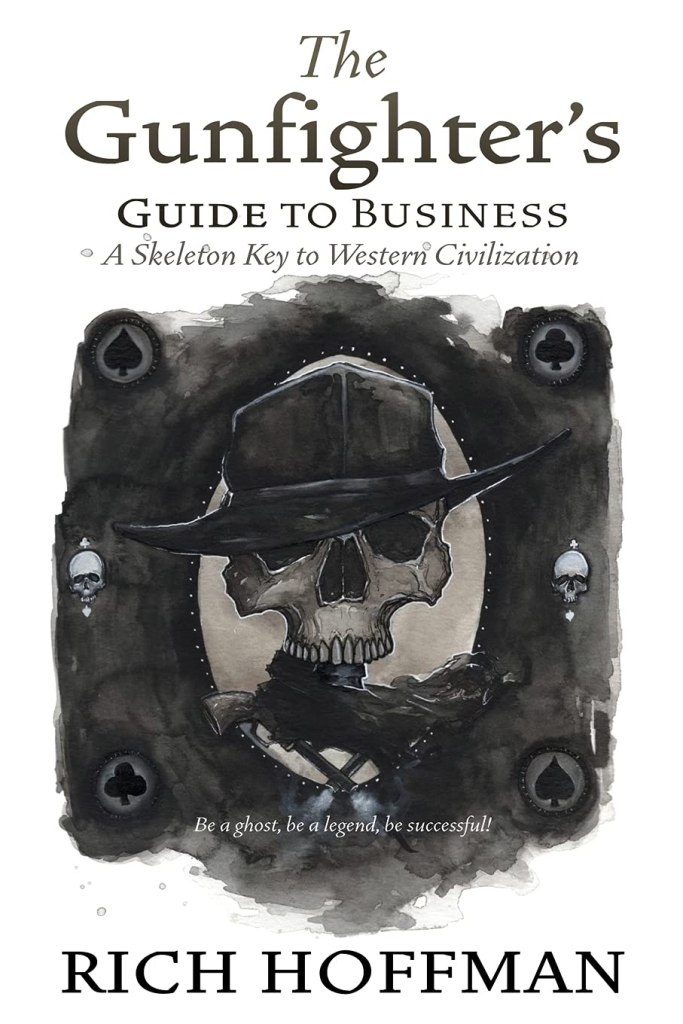
Click to buy The Gunfighter’s Guide to Business