
I Disagree with the Bible on Wealth Creation: Money is a measure of good and evil

One of the problems I have always had with the Bible, going all the way back to bible school, which I had most Sundays from age 5 to the 8th grade, was this idea that a rich person was evil and working against God unless they gave away all their material items during their life and wholly dedicated their life to God, in every way. I have never read the Bible that way nor interpreted religion with such narrowmindedness. Making money and religion were always two separate things as defined by the old powers of Europe, and I really didn’t have a personal approach to it until recently, when I spent a considerable time in the deserts of New Mexico writing my book The Gunfighter’s Guide to Business, and specifically the chapter where I say, “Money is not the Root of all Evil.” There I argue that America has been a different kind of invention that couldn’t have been understood during the Biblical period, nor when the Romans decided what books of the Bible to include in the Council of Nicaea. Cultures have been hindering themselves with this problem for many thousands of years at this point, and it’s caused a lot of problems. But before you can come to a rational conclusion on the matter, you have to go against literally every pastor, minister, and biblical interpreter that has ever been known because I think they all got it wrong and that they have been holding civilization back, and creating many of the problems we see today politically, and have actually empowered evil to thrive behind the definitions as they have been interpreted by institutionalism, as the Roman Empire was undoubtedly inspired to do.

A few of the most controversial passages from the Bible regarding wealth come from the Book of James 2:6 “But ye have despised the poor. Do not rich men oppress you and draw you before the judgment seats?”  Then again, with Jesus saying in Luke 18:25 that “it is easier for a camel to go through the eye of a needle than for a rich man to enter the kingdom of God,” There are many others, of course, littered throughout the Bible and I would argue not so much that they are wrong, but that they don’t capture the entirety of the morality of money. I have personally been able to forgive the Bible for these definitions, which run counter to the essence of a life well lived, but at the core of how the political left attacks conservatives is this deeply rooted guilt of making money and taking care of the poor. Because if a conservative has made a lot of money in their life, then by association, they will turn away from the Bible because it doesn’t fit their life experience with definitions like what the Bible provides. But with all other things, especially in the definitions of evil, which are well articulated throughout the Bible, then those get tossed away as well. My argument has been that the concept of American capitalism, as established by the wonderful book The Wealth of Nations by Adam Smith, is that in the times of Jesus, nobody had good definitions of money and how they were moral markers in a healthy society. And who would have expected the writers of the Bible to ever figure it out during that period of human history? Indeed, proper definitions of the value of money in a culture did not arrive upon the human race until Ayn Rand did it in her outstanding work, Atlas Shrugged, in 1957. And such a definition would have only come from a culture like America, which was vastly different in its use of capitalism than any other place in the world.

America was created to answer an ancient problem: living life free of kings and regional governors. In such a society, the only way to get rich was to obtain permission to be so by schmoozing up to the powers that controlled the region people lived in. And this is undoubtedly the issue during the teachings of Jesus. To preach the ways of God that he was, away from Jewish institutionalism, was a severe rebellion in those times. It was an unheard-of menace, so they plotted to kill him. And, of course, the people who were protecting their wealth would have been the villains of what Jesus was preaching. But there wasn’t an America even conceived of at the time, and the writers of the Bible never could imagine anything like freedom being possible. So the problem persists for a nation like America that it was built around a religious connection to ancient documents that defined money before the concept of individual freedom had been worked out politically. And for the human race, that is a very recent development. It’s even more recent than the work of Karl Marx in Europe. There is a morality to money, as applied by the United States, that is quite a good measure that is fundamental to rooting out evil in a society that is very much the topic of our present politics and is the theme of our times. 

I benefit from knowing many people in my life who are very rich. In some cases, they are extremely rich, and I have been able to see up close how that wealth creation has benefited the world around them. Adding to that an extensive study of comparative religion and reverence specifically for biblical research, I can see how definitions working against the rich, or materialism in general, would cause people problems. But I would say the Bible is wrong about wealth creation and the “rich” in general while being “right” about the definitions of “evil” itself. We can’t just pick and choose what we like in the Bible and toss out that which we don’t, which most religions do, no matter what their source material is. Instead, I would say that wealth creation has benefited from inventions in politics over the years and that the criteria for rich people have changed with the creation of America. Money helps a healthy society measure the morality of a culture in ways that institutions have never achieved after many centuries of trying. In a free culture, those who make money do so because society values something they produce for that society. But we associate wealth creation such as the Biden family has achieved as a sell-out of his office to the rivals who would like to destroy the concept of capitalism to hide their evil actions behind the traditional definitions they can’t live up to. But for a person like President Trump, who has acquired all the material items and wealth that could be imagined in a single lifetime, then used that wealth to fight for the cause of truth and justice, then suddenly the Biblical definitions aren’t broad enough to encompass the morality of money as a representative of a life well lived. Then, in that case, all wealth creation is not equal; it is good and bad among the wealthy, and how they have made their money roots out their behavior in ways that benefit moral discourse. And in that way, the right kind of wealthy people are paramount to a healthy society, especially in contrast to those who were likely just as Jesus spoke about in his time with the metaphor of the camel and the eye of the needle. 

Rich Hoffman
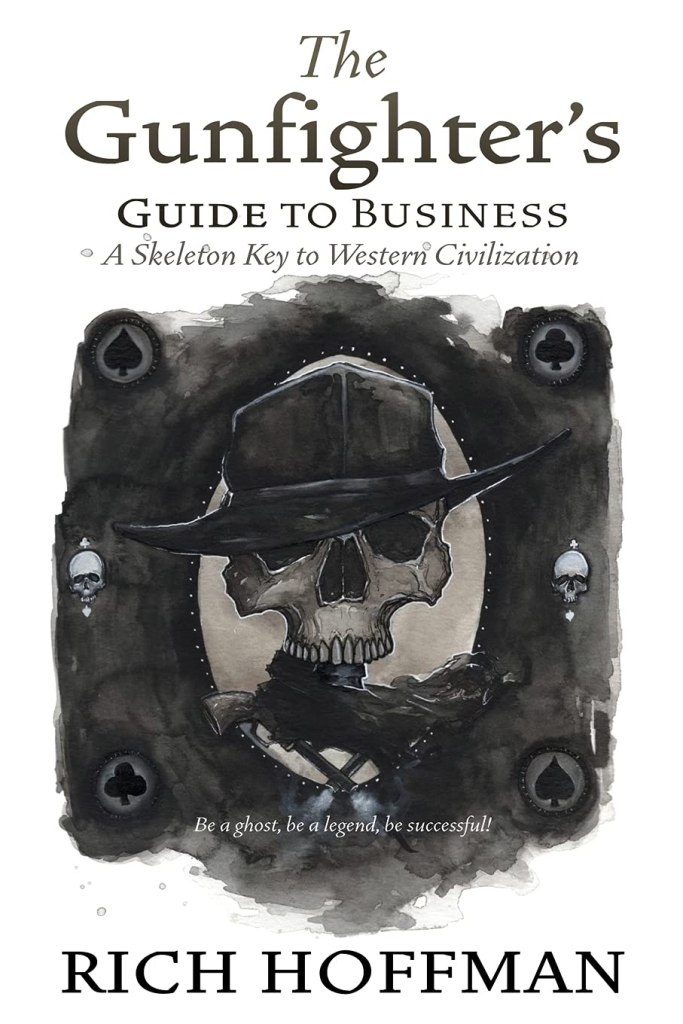
Click to buy The Gunfighter’s Guide to Business

Understanding Leadership: The difference between success and failure

Compared to most everyone else I have some bizarre ideals about leadership that certainly don’t travel well with the currents of civilization. Yet I am so certain of them that I no longer entertain opinions to the contrary because I recognize it as a special gift that is of great benefit not only to myself, but everyone I happen to know. Of course this leads to many matters of conflict which part of me strategically avoids while at the same time seeking it out. Leadership is one of the least understood attributes to modern society even though it should be easily plotted through history. Our best modern attempts is to believe that somehow West Point makes leaders through the military and that somehow the armed services through the concept of sacrifice makes great people. The other belief is that somehow in the classrooms of our colleges a teacher touches the life of a student and magic happens and a leader is born. So the mystical belief is that if society wants leaders, they need more procedures and rules to create an environment for a leader to evolve into the role of a savior willing to sacrifice themselves for a common good—so most schools of thought travel down that path. Yet, that grasp is likely the most ardent enemy of leadership that there is, and ends up crushing such opportunities for such people to emerge leaving in the wake chaos and process driven bureaucracy where everything just grinds to a halt with inaction.

Many times while dealing with a political system from local government to a business of some kind, what is found there is a process driven commitment to a rigid line of thought mystically protecting them from the scandal of inefficiency. The belief is actually as stupid as a group of head hunters from a South Pacific island refusing to allow their picture to be taken because they believe that their soul will be captured in the process. The belief in processes and procedures comes directly from a lack of leadership—it doesn’t act as a substitute. Where it gets really confusing is that some sense of order is needed for mankind to act with one another but to have real leadership it often requires visionaries to break those rules so that leadership can occur.

Readers here know of my thoughts on the work of Robert Pirsig who developed the Metaphysics of Quality and specifically captured the essence of leadership in his contemplations on philosophy. I often refer to his train motif to explain leadership—who is always the character at the front of a long train spotting things at the cutting edge of travel along the tracks. Process driven analysis is usually at the back of the train—away from the leader—as far as possible in most organizations. They are never in a position to make decisions at the cutting edge because by the time the problem gets to their part of the train at the back, decisions are long passed the point of no return. The only way that decisions can be made at the back of a train is for the train to go very slow or to stop all together—so that communication from the front can get to the back of the train in time for decision makers to consider the information and then project it back up to where the engineer is, and the train can turn, stop, or go faster depending on what is needed. It takes courage to be at the front of the train, and when decisions are made there, they can be immediately applied allowing for more swiftness in movement. Most modern organizations, the American military included, function from the back of a train of thought.

The back of the train is safe. It covers up the great mystery as to why some people are naturally better than others at the task of leadership. In fact, it avoids the entire question when process driven analysis can just keep everyone busy giving the illusion of productivity. But frustration often emerges that the train just doesn’t move fast enough—and that is because there isn’t anybody competent at the front of the train because everyone is stuck in the back. Those most able to be great leaders get bored and just step off in frustration leaving an organization even more befuddled than they were before. This is essentially why Apple fired Steve Jobs the first time—before hiring him again to save their company. Steve Jobs was always at the front of the train—and was happy no place else. Most great companies with the most innovation coming out of them have a leader at the front of the train who is most comfortable being there. There are of course people in the back who collect data to analyze, but the train is not driven from there. It is given to the leader to create a history to learn from so that decisions can most fluidly be made at the very front of the train as the future progresses.

I would never make it in todays military. Even while watching American Sniper I kept thinking how stifling the military is on a human mind, and that is for a good reason. When you become a soldier, you become part of a system and surrender your individuality to process driven goals. I could never do that, and I never have been able to. Yet great individuals in the military like Chris Kyle, Chuck Yeager, General Claire Lee Chennault, and General Patton all had a strong streak of individuality in them that sometimes defied orders and acted on their own merit from the front of whatever train they were on. All those characters found life at the back of the train boring and stifling desiring instead to be at the cutting edge of action. For those characters, the orders were less process driven because they were literally on the front lines of combat. However, especially in Chennault’s case when General Stillwell became U.S. Army commander in China during World War II Chennault was much less effective as a leader because the jealous Stillwell insisted on running the war from the back of the train, instead of the front where Chennault resided. This caused constant feuding between the two generals and cost the lives of many soldiers as the end result. Patton was much the same kind of man, and if reading the book Killing Patton is studied, it was likely that someone killed the general because nobody wanted to deal with him in peace time.   Likely it was Stalin who ordered the assassination, and at the time they were supposedly allies with the United States-but Stalin just didn’t want to deal with Patton in a future war—so they killed him—likely. And many in the U.S.—including the White House—secretly breathed a sigh of relief. But why? Because, Patton insisted not only at being at the front of the train, he wanted to be on the sweep at the front—the closest to the tracks as he could get. He was a real, natural-born leader and he often defied orders to do what he thought was best. If not for Patton, it is likely that the Germans would have beat America to the bomb—and the Allies would have lost.

So given all this historical data—why are organizations still insistent on back of the train analysis designed to stifle leadership? Well, it is the same vile human emotion that desires communism over capitalism—the jealous refusal to accept that some people have leadership, and some people don’t. Those that don’t desire process driven rules and regulations to protect them from their own inadequacies—and that pretty much sums it up. They hover like ghosts behind a leader in the back of the train and look for ways to take the credit for decisions made at the front once they think the situation is safe for them to do so. In Patton’s case they of course waited for a few days after the war ended to kill Patton. Authorities did something similar in China with Chennault sending him quickly to pasture once the conflict ended trying quickly to silence the petulant general. Instead Chennault wrote a great book The Way of the Fighter which revealed all his contentious exchanges between FDR, General Stillwell, and Truman up until the publication of the book in 1949. Chennault was irate with frustration saying that the conflict in China was not against the Japanese, but with the encroaching communists from the North. The authorities at the back of the train laughed it off and pulled out the United States surrendering all the hard-fought gains to the communists to become our future enemy. If Truman had listened to Chennault instead of Stillwell, there wouldn’t have been a Korean War, and there wouldn’t have been a Vietnam. And China would to this day be a capitalist country and friend to the United States instead of the holder of its debts and leveraging itself for a fiscal take-over of the American economy. And for a modern context, Chris Kyle would have likely had many less killings if he had always done what he was told. It’s part of the American way to think on ones feet and to make judgment calls from the front of the train. But first someone has to have the courage to reside there—and that is what’s short in most organizations. If they can find someone who wants to be at the front of the train, they are lucky. Those types of leaders are rare, but they are the key to making an endeavor successful or a failure. In classrooms look at the kids in the back of the class as opposed to those who voluntarily sit in the front—and you will see the difference between potential leaders and slugs who want to hide in the masses.

The failure to recognize such people is the problem, and they are often concealed behind jealousy, inflated egos, and overly educated process driven knuckle-draggers. Even the best leaders were hated even when they were loved. People love the results, but they hate that they can’t emulate a leader through processes, graphs, and structural definitions. There isn’t a class at West Point that can properly teach leadership and there isn’t a single course anywhere that can teach the proper behavior. It comes to some people naturally who love to stand in the fire at the front of the train. Leadership takes a natural courage that is vacant from most people, and if a society wants more leaders—it has to create an environment that produces more of them. But more often than when potential leaders are discovered within government schools they are beat into submission before they get out of the fifth grade and destroyed like baby seals surrounded by sharks that just want a meal. Most leaders are destroyed before they ever make it to adulthood. Today’s real leaders are taught early and often to stand at the back of the train and to shut up. So, not knowing any better, they do—and live desperate lives unfulfilled quietly screaming in silence to words that can’t be articulated.

For more on this topic read my article “Making Omelets: The essence of leadership” which features several videos of Gordon Ramsay the popular chef and television personality who is famous for fixing failed restaurants. There are millions upon millions of people who can cook, and there are hundreds of others who have made successful television careers out of cooking. But Ramsay is different. It’s because he makes decisions at the front of the train instead of the back—and that skill is one of the most unusual in the world—the culinary world is much, much better off.   Whether its food, war, or just aspects of manufacturing, real leaders are hard to come by, but when they are found, they are more precious than a treasure trove of wealth discovered.   They have the ability to see and guide others through dangers not yet seen and can create what’s needed before anybody even understands why. But before one can be a leader they must have courage—because the front of the train is scary. And that is why organizations without good leadership languish in bureaucracy. Because they have to go slow enough for the cowards in the back to make a decision—and that is a promise of inevitable failure—because the competition out there will likely happen across a leader—and they won’t be moving slowly—they’ll travel fast because they have a leader at the front of the train. It’s not the size of an organization that makes it successful; it’s about the quality of their leadership. And to understand that, quality has to be understood—which is the topic of a whole new article.

Rich Hoffman

CLIIFFHANGER RESEARCH & DEVELOPMENT