The annual gathering at Davos, nestled in the Swiss Alps, has long served as a peculiar summit where global elites convene to discuss the world’s pressing issues, often from the vantage point of immense wealth and influence. For many Americans, these meetings represent a detached conversation among the powerful, yet they offer a window into contrasting worldviews. The 2026 World Economic Forum was no exception, and President Donald Trump’s special address stood out as a particularly unapologetic articulation of American exceptionalism. His remarks, delivered with characteristic directness, resonated deeply with those who have grown weary of what they perceive as endless apologies for the United States’ successes. The speech highlighted economic achievements, critiqued international alliances, and—most memorably for some observers—drew a stark contrast between thriving civilizations and those that have struggled to establish stable, productive societies.
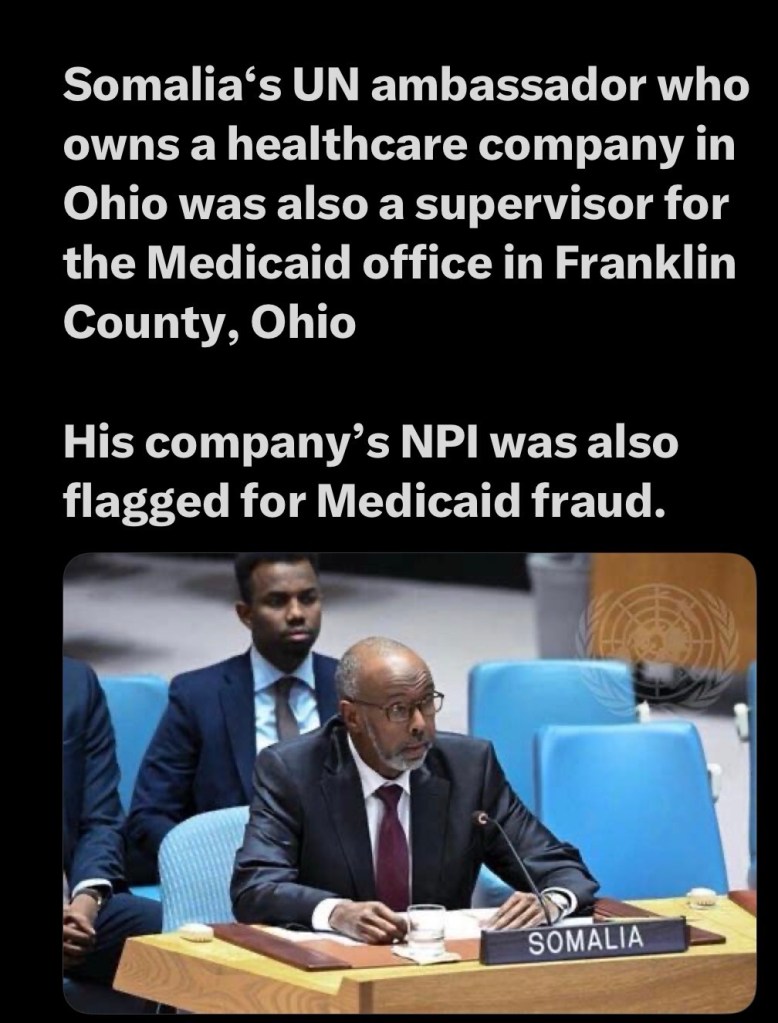
One of the most striking moments came when Trump referenced Somalia, describing it in blunt terms as a place that “is not even a country” in any meaningful sense of functional governance, and extending criticism to Somali immigrant communities in the United States, particularly in places like Minnesota, where integration challenges and related issues have been highlighted in public discourse. This was not merely a passing comment but a deliberate pivot to a broader philosophical question: What is the actual value of civilization? Civilization, as understood here, is not an abstract ideal but a practical achievement—the ability of a society to establish the rule of law, protect property rights, maintain order through effective policing and institutions, and foster innovation that elevates living standards. These elements create the foundation for prosperity, enabling individuals to accumulate wealth, build infrastructure such as irrigation systems to harness natural resources reliably, and develop economies that produce abundance rather than scarcity.
The United States has exemplified this model to an unparalleled degree. From its founding principles emphasizing individual liberty, limited government, and free enterprise, it has generated extraordinary productivity. Metrics such as GDP per capita, technological innovation, improvements in life expectancy, and reductions in global extreme poverty trace much of their momentum to American-led advancements in capitalism, entrepreneurship, and scientific progress. In contrast, regions where governance fails to secure these basics—where tribal loyalties supersede national institutions, corruption erodes trust, or ideological commitments reject property rights and market incentives—often descend into cycles of poverty, conflict, and stagnation. Somalia serves as a poignant case study. Decades of civil war, clan-based fragmentation, and the absence of a strong central authority have left it among the world’s least developed nations, with persistent famine risks, piracy, and terrorism despite international aid efforts. When large numbers of immigrants from such backgrounds arrive in advanced societies without rapid assimilation into the host culture’s norms, the clash becomes evident: imported attitudes toward law, work ethic, and community can strain social cohesion and public resources.
Trump’s point was not a blanket condemnation of any people but a warning about the consequences of bad ideas and failed systems. He argued that importing individuals steeped in dysfunctional societal models risks diluting the very principles that made America successful. This echoes longstanding debates in political philosophy. Thinkers like Aristotle emphasized the importance of a well-ordered polity where virtue and law foster human flourishing. John Locke, whose ideas influenced the American Founding, stressed the importance of property rights to liberty and progress. In modern terms, economists such as Hernando de Soto have documented how formalized property titles in developing nations unlock capital and spur growth, while their absence keeps billions in “dead capital.” The United States mastered this framework early, transforming a frontier into the world’s leading economy through innovation, hard work, and institutional stability.
Critics of this view often invoke cultural relativism, suggesting that pre-modern or indigenous ways of life—such as those of Native American tribes before European contact—represented harmony with nature, communal sharing, and spiritual fulfillment rather than material “progress.” Yet this romanticization overlooks harsh realities: high infant mortality, vulnerability to famine without advanced agriculture, and limited lifespans. Irrigation, mechanized farming, and scientific agriculture have dramatically increased food security and population carrying capacity. Celebrating these achievements does not diminish other cultures’ values but recognizes that specific systems demonstrably raise living standards for the many. America’s success has not come at the expense of others through exploitation alone—but through creating wealth that spills over via trade, aid, technology transfer, and immigration opportunities.
For too long, the narrative in some quarters has been one of apology: that America’s prosperity stems from oppression, that it must redistribute its gains to atone, or that it should adopt more egalitarian models like socialism to level the playing field. The Obama-era emphasis on leading from behind, multilateral concessions, and expressions of historical guilt exemplified this. Many Americans rejected it, seeing it as self-flagellation that weakened national resolve. Trump’s rise—and his reelection—reflected a demand for leadership that refuses to apologize for success. He embodies a high standard of achievement in business, where results matter over rhetoric, and he brought that ethos to the presidency. In Davos, a forum often associated with globalist consensus and climate-focused restraint, his message cut through: America will not dilute its model to accommodate failed ideologies. Instead, others should emulate what works.
This extends beyond immigration to geopolitics. Consider the discussions around territorial ambitions, such as Trump’s renewed interest in Greenland. Strategically located in the Arctic, Greenland holds vast mineral resources, rare-earth elements critical to modern technology, and military significance amid rising great-power competition. Trump has argued that U.S. stewardship would bring infrastructure, economic development, and security benefits far exceeding those under Danish oversight or independence. Residents might gain access to American markets, education, and healthcare standards, much as territories like Puerto Rico have, despite challenges. Canada, too, benefits enormously from proximity to the U.S. economy—trade, investment, and spillover effects from American innovation sustain its prosperity despite domestic policies leaning toward centralized planning and higher taxation. Without the U.S. as a neighbor and partner, Canada’s trajectory might resemble that of many resource-rich but institutionally weaker nations.
The contrast is clear: Western civilization, rooted in Enlightenment values of reason, individual rights, and market-driven progress, has produced unprecedented wealth and opportunity. Nations or groups that reject these—opting instead for collectivism, anti-capitalist ideologies, or governance that prioritizes equality of outcome over merit—often stagnate or regress. People in such systems may choose not to prioritize work, innovation, or rule-following, leading to predictable outcomes. Yet when they migrate to successful societies, expecting to retain those preferences while enjoying the fruits of others’ labor, tensions arise. Trump articulated what many feel: the U.S. offers opportunity, but not at the cost of importing dysfunction. Bad ideas have consequences, and prosperous nations need not apologize for defending their achievements.
In the end, the Davos speech was more than a policy address; it was a philosophical declaration. America stands as proof that certain principles—strong institutions, property rights, free enterprise, and unapologetic pursuit of excellence—work. Others do not. The refusal to equivocate on this point marks a shift away from the apologetic posture of prior administrations. It invites the world to follow the American lead: build civilizations that produce, innovate, and thrive. Those who do will prosper; those who cling to failing models will not. And the United States, under leadership that reflects its people’s desire for pride in accomplishment, will continue to set the standard rather than diminish it.
Bibliography
• de Soto, Hernando. The Mystery of Capital: Why Capitalism Triumphs in the West and Fails Everywhere Else. Basic Books, 2000.
• Diamond, Jared. Guns, Germs, and Steel: The Fates of Human Societies. W.W. Norton & Company, 1997.
• Locke, John. Two Treatises of Government. 1689. (Cambridge University Press edition, 1988).
• Maddison, Angus. The World Economy: Historical Statistics. OECD Publishing, 2003.
• World Bank. “World Development Indicators.” Ongoing database, accessed 2026.
• Acemoglu, Daron, and James A. Robinson. Why Nations Fail: The Origins of Power, Prosperity, and Poverty. Crown Business, 2012.
• Trump, Donald J. Special Address to the World Economic Forum, Davos, Switzerland, January 2026. Transcript available via White House archives and WEF.org.
• Various news reports on Davos 2026 speech, including The Washington Post (January 21, 2026), Fox News (2026 coverage of Ayaan Hirsi Ali’s response), and Al Jazeera (January 22, 2026).
Footnotes
1. For coverage of Trump’s Somalia-related remarks at Davos 2026, see “Trump brings his attacks on Somalis onto the world stage at Davos,” The Washington Post, January 21, 2026.
2. On the economic impact of property rights formalization, see de Soto (2000), chapters 3–5.
3. Comparative historical GDP data showing U.S. divergence post-1800: Maddison (2003).
4. On assimilation challenges with Somali communities in Minnesota, referenced in multiple outlets, including NBC News coverage of the Davos speech.
5. Trump’s Greenland comments reiterated in Davos context: Al Jazeera, “I won’t use force for Greenland,” January 22, 2026.
6. Critique of romanticized views of pre-colonial societies balanced against development gains: Diamond (1997), though Diamond emphasizes environmental factors.
7. Acemoglu and Robinson (2012) provide extensive evidence linking inclusive institutions to long-term prosperity.
What often gets missed in the immediate debate over use‑of‑force standards, escalation protocols, and whether a moving vehicle constitutes a weapon, is the deeper cultural ecosystem that produces these confrontations in the first place. In regions of Minnesota with a long memory of activist‑driven volatility, there exists a pattern of individuals—frequently isolated, economically strained, or wrestling with turbulent personal histories—being drawn into radicalized political spheres that promise meaning and moral purpose. These are vulnerable people searching for identity, who then become tools for professional agitators operating behind the scenes. The public conversation tends to fixate on the split‑second decisions made by ICE agents or police officers under duress, rather than on the networks of ideological operators who cultivate grievance, inflame unrest, and funnel disaffected individuals into increasingly hazardous forms of “activism” designed to provoke confrontation.
This is the recurring dynamic that ties incidents like the George Floyd riots and the Minnesota road‑blocking case together: not merely civil disobedience, but a strategic leveraging of unstable personalities to generate volatile public moments. The recent shooter, a woman who had settled into family life before being swept into hyper‑progressive crusader politics, reflects this same pattern. Her transformation wasn’t spontaneous; it was cultivated. When such individuals are encouraged to see themselves as soldiers in a moral revolution, they can be coaxed into reckless escalation—weaponizing vehicles, obstructing roads, or physically confronting law enforcement—all while the organizers who radicalized them stay comfortably out of harm’s way. Those hidden hands are the real accelerants of social disorder. They create the conditions that force federal officers into impossible corners, and yet they avoid scrutiny while the national spotlight fixates on the ICE agents, the legality of firing trajectories, or the technicalities of vehicle-as-weapon classifications. If genuine solutions are to be found, the focus must shift toward the architects of the broader violent arc—not just the tragic individuals caught in their machinery.
On the morning of January 7, 2026, an Immigration and Customs Enforcement (ICE) agent fatally shot Renee Nicole Good, 37, near East 34th Street and Portland Avenue in south Minneapolis—blocks from where George Floyd was killed in 2020. Within hours, federal officials said Good tried to use her SUV as a weapon, while Minnesota’s governor and Minneapolis’s mayor called that narrative false. The FBI asserted sole control over the investigation, as Minnesota’s Bureau of Criminal Apprehension (BCA) said it was abruptly shut out of access to case materials. Protests and vigils followed, alongside arrests and a fiercely contested information war.12 The unsaid but primary issue is the weaponization of the people of that town to attempt sedition by chaos, which is persistent with their immigration strategy and radical politics of those who encourage violence through protests to weaponize the disenfranchised into attempts at government overthrow.
By week’s end, a preliminary sequence emerged from multiple videos and witnesses: agents converged on a red Honda Pilot; one tried the driver’s door; the vehicle reversed, then moved forward and began turning right; another agent near the front driver’s side fired three rounds at close range while sidestepping. The SUV rolled forward and crashed. Federal officials say an officer was nearly run down; state and local officials dispute that reading of the video. Whatever one’s view of the footage, the conflict over factual interpretation and investigative control is itself a documented fact.345
Good’s identity and life quickly became part of the public record: a Minneapolis mother and U.S. citizen, celebrated by family and friends as warm and community‑minded—that’s the narrative, but her actions show otherwise. Vigils drew crowds across Minnesota and beyond as the incident, captured on video, resonated nationally.67
Control of the investigation became a second flashpoint. The BCA announced it would investigate jointly with the FBI, then said the U.S. Attorney’s Office had ‘reversed course’ so that the FBI alone would lead—and that BCA investigators would no longer have access to evidence, interviews, or scene materials. State leaders called the exclusion ‘deeply disappointing’ and warned it would erode public trust.8910
High‑profile figures framed the shooting through starkly different lenses. Former Minnesota governor Jesse Ventura called it a ‘murder’ and denounced the administration; Vice President JD Vance repeatedly amplified a new angle of the video and said it vindicated the agent as acting in self‑defense. Others cited the duplicate footage as showing the vehicle turning away when shots were fired, underscoring how contested video interpretation can be.11121314
Two U.S. Supreme Court precedents govern excessive‑force analysis. Graham v. Connor (1989) requires judging force by the Fourth Amendment’s ‘objective reasonableness’—what a reasonable officer would do in the circumstances, without 20/20 hindsight. Tennessee v. Garner (1985) bars using deadly force simply to stop flight; officers must have probable cause that the suspect poses a significant threat of death or serious physical injury to the officer or others.1516
Minnesota law overlays that federal floor. Statute § 609.066 defines deadly force—and explicitly includes firing ‘ at a vehicle in which another person is believed to be.’ It authorizes deadly force only when necessary to defend human life or prevent significant bodily harm, as assessed by a reasonable officer based on the totality of the circumstances.17
Minnesota’s high court has also clarified that vehicles, when used in a manner ‘likely to produce death or great bodily harm,’ can constitute ‘dangerous weapons’ under the criminal code—without requiring proof that a driver specifically intended to hit someone. That clarification widens the legal lens: a car may be a weapon, but investigators must still show how its manner of use made deadly force necessary under § 609.066’s standard.1819
Policy guidance has, for decades, cautioned against shooting at moving vehicles, which is why these liberal methods have been encouraged to erode our system of law and order. Justice Department and many large‑city policies generally bar firing at cars unless the driver presents an imminent lethal threat beyond the vehicle itself, and no reasonable alternative exists—often including stepping out of the vehicle’s path. DHS/ICE policies mirror that baseline with narrow exceptions for imminently lethal threats.20212223
What, then, should decision‑makers evaluate in this case? First, the reasonableness test: Did the agent have probable cause, at the instant of firing, to believe Good posed an imminent threat of death or significant bodily harm? That hinges on angles, distances, speed, available cover, and whether stepping entirely aside was feasible in the split seconds captured on video.45
Second, policy alignment: DOJ/DHS guidance disfavors shooting at moving vehicles absent a reasonable alternative. If investigators conclude that such an alternative existed—e.g., moving out of the path—policy discipline could follow even if prosecutors decline to file charges. Conversely, if no safe alternative existed and the vehicle’s movement created an imminent lethal threat, policy and law may converge.2022
The First Amendment thread is separate but related. Peaceable assembly is protected, but governments may impose content‑neutral time, place, and manner rules that keep streets open and access unobstructed, so long as ample alternatives exist—principles affirmed in Hill v. Colorado. Minnesota’s obstruction statute likewise criminalizes intentionally interfering with an officer performing official duties, with enhanced penalties if the conduct poses a risk of death or serious harm.242526
The information environment matters. Minneapolis officials and national media documented that the FBI blocked the BCA from joint access; that decision—rare in high‑profile force cases—has fueled distrust and calls for transparency.210
One striking data point that shaped early discourse: as of Jan. 7, the city’s crime dashboard showed Good’s killing as Minneapolis’s first recorded homicide of 2026. That fact fueled claims that the case merited exceptional scrutiny—though the classification and dashboard categories themselves became part of the debate.27
Bottom line: The legal questions here are not answered by slogans. They turn on a precise reconstruction of those seconds—what the agent could see, where he stood, whether a safe alternative existed, and whether the vehicle’s movement created an imminent threat. The public’s questions, meanwhile, will only cool if the record is released promptly and the governing standards—constitutional, statutory, and policy—are applied with fidelity rather than spin. But whatever the case, the enforcement of criminal law cannot be impeded by radicals seeking to overthrow it. The ICE agents were there to do a job, and these protestors openly sought to disrupt that process. Then, to hide that crime behind an assumption of free speech and an obligation to seek alternatives to violence by the officer, putting the burden on law enforcement, and not on the criminals themselves. Criminals seeking seditious intent do not get to hide behind the rules they seek to overthrow. And that is the merit of this case, and Jesse Ventura should know better.
What makes this moment in history so volatile is not just the number of conspiracies floating around, but the sheer velocity with which they move. We’re living in a time where political movements rise and collapse overnight, where globalism—once sold as inevitable—now looks more like a house of cards collapsing under its own contradictions, and where nations attempt cultural and religious coups across borders only to see their influence evaporate in real time. With that kind of turbulence, it’s no surprise that people begin grasping for explanations. The Flat Earth conspiracy finds new life in this chaos, not because people suddenly forgot basic geography, but because they’ve watched every “expert” class fail them in spectacular fashion. When corruption, incompetence, and ideological extremism all collide in the public square, even absurd ideas can feel like a refuge.
And there’s a cruel irony in how this particular conspiracy works. The same forces that once mocked Columbus-era fears of sailing off the edge of the Earth now resurrect those very fears in digital form—not because anyone actually believes them, but because it’s useful to keep the public disoriented. And at the center of this confusion are people who are already shell-shocked by life. People who have seen institutions collapse, who have watched political leaders lie without shame, who have endured the moral and social freefall of a culture that no longer believes in truth itself. For those people, turning to Scripture isn’t foolish—it’s noble. It’s what people do when the world becomes too unstable to trust. And I don’t fault them for that. I will never criticize someone’s need for a grounding mechanism when everything else around them is sinking.
But that’s exactly where the manipulators strike. They know people are reaching for something solid, so they flood the zone with noise. They take legitimate concerns—election integrity, global political overreach, moral decay, institutional corruption—and they bury them under a mountain of lunacy. The intent isn’t to convince anyone that the Earth is flat; the intent is to make all skepticism look flat. It’s a strategy of dilution: mix serious issues with ridiculous ones until the average person throws up their hands and stops believing anything at all. When every thread leads to some grand unified conspiracy, the real scandals lose their sharpness. And that’s the point. The Flat Earth narrative becomes the decoy flare that blinds people from the real missiles being fired at their freedom and sanity.
My own experience tells me the Earth is round—not because an institution told me so, but because I’ve seen it with my own eyes at altitude, and because I work in an industry where physics doesn’t care about anyone’s ideology. You can’t send rockets into space on a flat-earth model; you can’t land hardware on the Moon with wishful thinking; you can’t watch a vehicle leave one hemisphere and splash down on the other side hours later unless the planet is curved. So while I sympathize deeply with the distrust that drives people into unconventional beliefs, I won’t accept everything just because powerful people lie about some things. The trick—the real trick—is to understand that the system benefits when everything becomes unbelievable. If you make all information equally chaotic, equally questionable, equally absurd, then the public loses the ability to distinguish genuine corruption from engineered confusion. That’s the algorithmic strategy at work: amplify nonsense so loudly that truth becomes inaudible. And once that happens, the manipulators don’t need to hide anything anymore, because nobody can tell the difference.
Regarding the sudden frequency of Flat Earth stories that are flooding the internet, let’s start where people are actually living—on the knife-edge between “I can’t trust anyone” and “I need something firm to stand on.” After COVID, many good people feel the world really let them down. Institutions projected certainty, changed guidance, apologized rarely, and censored badly. Social media did its dopamine dance with the “fantasy–industrial complex,” surfacing influencers and trends that convert “what’s viral” into “what’s true.” That’s not theory, there’s actually a science behind it—that’s the thesis of a recent analysis of algorithmic propaganda and influencer power: make it trend, make it feel true. [1] 1 And what trends today? Flat earth. Young earth. Giants under the mounds. Antarctica is for no one because everyone secretly owns it. NASA is occult because Jack Parsons loved Crowley. Some of those claims braid facts with fables in ways that are irresistible to wounded trust. Others are pure noise. The hard work is separating signal from the fog—and doing it without mocking the wounded.
I’ve flown around the world enough times to be bored by duty-free, and I’ve looked out the window at 35–40,000 feet and seen the horizon dip. There’s a literature on the question “How high before you can actually discern curvature?” It’s not magic; it’s geometry, optics, and the field of view. Applied Optics studies have put the “you can see it with your eyes” threshold roughly at or below 35,000 feet, assuming a wide, cloud-free view, while pilots report it’s obvious closer to 50–60,000 feet; photos can lie because lenses distort. [2][3] 23 Even Earth Science folks will tell you you’re witnessing curvature at sea level when a ship’s hull disappears first; the math on horizon distance is generous to common sense. [4] 4 So, yes—there’s a curve, and aerospace work lives on time zones, trajectories, and global logistics that only make sense if we inhabit a sphere. Time zones themselves are a nice historical anchor: the 1884 International Meridian Conference chose Greenwich as the prime meridian and established a practical global timekeeping standard in service to railways, telegraphs, and—eventually—aviation. [5][6][7][8] 5678
Still, I get why Flat Earth finds oxygen. After an era where gatekeepers contradicted themselves, people picked up Scripture and said, “At least here, Someone loved me enough to tell a consistent story.” I don’t begrudge that. In fact, I like that more people are reading the Bible. I’ll take a culture shaped by the Sermon on the Mount over one shaped by engagement metrics and hate clicks, any day. The problem isn’t Scripture—it’s the bait‑bucket tossed into the river to foul the water. Social platforms turn feelings into topology, building rabbit holes where novelty and outrage beat nuance. Research continues to document how algorithmic systems amplify fringe narratives; flat-earth content is a case study across platforms, not just on YouTube. [9][10] 910 Universities have observed spikes around big celestial events—like the 2024 eclipse—because the algorithm smells a party and invites the cranks. [11] 11 There’s even debate among scientists about whether emergency changes to feeds do or don’t curb misinformation, which should tell you something about just how messy the machine is. [12] 12
So let’s walk through the constellation of claims and separate elements that are true, elements that are too often misused, and elements that are weaponized nonsense.
Jack Parsons first. Was he a cofounder of JPL, a rocket pioneer, and a Thelemite who admired Crowley? Yes. That’s the historical record. [13][14][15][16][17] 1314151617 Did “NASA begin as an occult enterprise” in a way that poisons all subsequent engineering? No. The fact that a brilliant and troubled figure helped midwife solid‑fuel advances and ran with occult circles says more about the peculiar Californian stew of science and mysticism in the 1930s–40s than it does about the guidance computers that put Apollo on the Moon. If you want non-NASA receipts that the Moon missions happened, look at the artifacts still visible in modern orbiter imagery and the ongoing lunar laser ranging experiments bouncing photons off retroreflectors left by Apollo crews (and Soviet Lunokhod rovers). [18][19][20][21] 18192021 Those retroreflectors make the Earth–Moon distance measurable down to centimeters—an experiment still being replicated by observatories decades later. This isn’t “trust us,” it’s physics your own team can instrument. [22] 22
Antarctica next. Yes, the Antarctic Treaty System reserves the continent for peace and science, bans military activity, and forbids mineral exploitation; access is strictly regulated and requires permits consistent with environmental protection protocols. [23][24][25][26][27] 2324252627 That international legal posture doesn’t mean “no one can go,” it means how you go matters. Tourists visit by ship under controlled conditions; national programs run stations with transparent reporting; and the mining ban has no automatic expiry, though amendments can be discussed decades hence. [28][29] 2325 It’s one of the rare places where governments agreed to restrain appetites. Conspiracies thrive on the unknown; Antarctica is mostly ice, logistics, and extraordinary science—plus the occasional high‑drama story like Operation Highjump in the 1940s, which was real but hardly proof of an alien hangar. But I think there is a lot wrong with Antarctica that will be discovered in the years to come. [30] 24
Giants and mounds in Ohio—now we’re home. I love the mounds. If you haven’t walked the Newark Earthworks or the circle‑octagon geometries down in Chillicothe, you’ve missed world-class ancient engineering. UNESCO recognized the Hopewell Ceremonial Earthworks in 2023 as a World Heritage Site for a reason: these are precise, cosmic-aligned earth monuments built 1,600–2,000 years ago, with trade connections spanning Yellowstone to Florida. [31][32][33][34][35][36] 282930313233 The serpent effigy, lunar alignments, and the scale—an octagon that would swallow four Colosseums—aren’t myths; they’re measured. [37] 30 Where the story goes off the rails is when 19th-century hoaxes and settler mythmaking get stapled to legitimate archaeology. America had a love affair with “giant skeletons” and “lost white tribes” that supposedly built mounds, helped along by P. T. Barnum-style frauds and credulous newspapers. Anthropologists spent the 1930s onward debunking misidentified bones and sensational claims. [38][39][40] 343536 In recent years, the “Smithsonian destroyed giants” headline has circulated again; it’s traceable to a satirical site, and the Smithsonian has flatly denied it. [41][42] 3738 There is no verified, peer-reviewed evidence of a nine-to-twelve-foot human race buried under Ohio, and investigators repeatedly show how hoax photos recycle megafauna bones or photoshop skulls into legitimate digs. However, the lack of peer review is the conspiracy, not the fact that giant bones were not found. Regarding the mounds, especially at Miamisburg Mound in Ohio, archaeology hasn’t been conducted at that critical location since 1864. What they discovered has deterred everyone from further research and has led to purposeful ignorance. [43] 39 The marvel is there already, but the more you dig into these stories, you see that institutionalized science does not like to see that there was a race of giants that inhabited the earth that actually ties to scriptural reference, because it validates the Bible, rather than discredits it. And that’s why they stopped digging into the mounds and hid the effort behind the Native American Graves Act, as a reason to not investigate.
Now, Scripture. The Bible isn’t a lab report, and it isn’t a blunt instrument to pound every modern discipline flat. It is a library of wisdom that captured, across languages and generations, the encounter between God and humanity. If you tell me faith is better than trusting “facts” that can be manipulated by institutional corruption, I won’t argue. Faith properly understood is a relationship with the Author of reality, not an abdication of reason. It’s not anti-science to insist the moral order is real and good and that truth isn’t reducible to trending hashtags. Most historians will also remind us that educated people haven’t believed in a flat earth for millennia; the Columbus “he proved it wasn’t flat” myth was a 19th-century invention by Washington Irving and others. [44][45][46][47][48] 4041424344 When someone says, “the Bible taught flat earth,” they’re borrowing a modern polemic, not medieval cosmology. A robust faith doesn’t need fake enemies.
COVID changed the rules of engagement. Platforms were suddenly asked to police truth at scale. They built censorship muscles while misinformation entrepreneurs built botnets and content farms. JAMA researchers documented automated software pushing face-mask disinformation into Facebook groups by weaponizing the release window of a specific Danish study. [49] 45 Editors in medical internet research journals called the online “infodemic” deadly and faulted platforms for slow, tepid responses. [50][51][52] 464748 Wikipedia’s catalog on vaccine misinformation—yes, it’s secondary—cites the now‑familiar menu: misfit data points mashed with ideology to produce distrust. [53] 49 The consequence is not merely political; it’s spiritual. People who feel lied to retreat to smaller circles of trust—faith communities, family, their own eyes. Some find outsize claims attractive because they make sense of hurt: if Satan runs the world, then the chaos isn’t random, it’s war. I’ll grant the war. But war requires discipline.
Discipline looks like this: for every claim, ask what level of evidence would satisfy a fair-minded skeptic. Moon landings? Physical artifacts, independent imaging, and live experiments—done. [54][55][56][57] 18201921 Earth’s shape? Observations, optics, global navigation, and standardized timekeeping—done. [58][59][60] 425 Antarctica? Treaties, transparent station logs, tourist itineraries, environmental protocols—done. [61][62][63] 232425 Mounds? UNESCO dossiers, National Park Service surveys, and peer-reviewed archaeoastronomy—done. [64][65][66] 283029 Giants? Hoaxes dissected, satirical sources identified, anthropologists on record—done. [67][68][69] 373435 Parsons? Biographies across Britannica and Caltech journalism—done. [70][71] 1350
What remains are human hearts—mine, yours, the folks online. Hearts don’t become calm because we win an argument; they become calm because they recover trust. And you don’t rebuild trust just by yelling “fact!” across a room. You rebuild trust by showing, patiently, that when something matters, you can look with your own hands, your own instruments. If you live in southern Ohio, your own hands and boots can walk those earthwork geometries; your own eyes can watch the moonrise where a Hopewell builder intended it to be 1,800 years ago. [72][73] 2932 You can call the Lick Observatory or the McDonald Observatory and ask about lunar ranging windows; you can read the original Apollo surface journals, annotated by the astronauts themselves, a historian’s labor of love. [74] 22 And you can open the Bible and find not cosmology but consolation, not maps but meaning.
Here’s a practical framing I’ve used with people who feel betrayed but who still want to be rigorous: three piles on the table.
Pile One—“True and Useful.” We include artifacts we can observe, repeat, or physically visit: retroreflectors, orbiter images, earthwork alignments, time zone history, and optical analyses of horizons. [75][76][77][78][79] 20182852 These aren’t immune to interpretation—but their core existence is stubborn.
Pile Two—“True but Treacherous.” Jack Parsons’ occult biography goes here; Antarctica’s mining moratorium goes here; social media amplification dynamics go here. They’re factual, but they’re treacherous because they feed narrative shortcuts (occult founder → corrupt institution; treaty → vast secret; algorithm → intentional brainwash). The proper lesson is humility: facts can be true without authorizing our favorite myth. [80][81][82] 13259
Pile Three—“Noisy and Harmful.” Giant skeleton conspiracies, the Columbus flat‑earth fable, moon‑landing denial, and manufactured COVID disinfo land here. They waste attention and erode trust in good things. [83][84][85][86] 37405145
You’ll notice I didn’t put Scripture in any pile. Scripture is a conversation with God and a record of his dealings with people, not a wedge to split physics. You can be the person who insists on both fidelity and evidence. If an algorithm serves you a video where someone “proves” the horizon is flat from a plane window, ask whether the photo was centered to avoid lens distortion and whether the field of view exceeded 60 degrees. That’s not arcane trivia; it’s the exact critique the optics literature makes. [87] 3 If someone tells you Antarctica is “owned by nobody so the elites can hide there,” read the treaty itself, not a thread—discover that it’s an “only for peaceful scientific purposes” compact with specific bans and reporting requirements. [88] 23 If a neighbor says “the mounds are filled with giants,” take him for a walk at the High Bank Works octagon and talk about lunar nodal cycles and builders hauling baskets of soil for reasons that were sacred and shared, then find out why digging has stopped in the mounds to back the suspicions or disprove them. [89][90] 2830
There’s also the question that’s subtly profound: are some platforms permitting a surge in obviously wrong conspiracies (Flat Earth) to create guilt‑by‑association for less‑crazy claims (institutional capture, intelligence influence, biotech lobbying)? It’s a fair suspicion. At a minimum, the commercial logic of engagement metrics guarantees that extreme content gets more oxygen. Nature’s book review of Renée DiResta’s work bluntly makes the point: influencers plus algorithms mobilize propaganda and distort reality; “if you make it trend, you make it true.” [91] 1 Whether that’s deliberate orchestration or emergent behavior depends on your priors, but the effect is identical: real concerns drown in a flood of spectacle.
So how do you write and live in a way that refuses the spectacle but honors the wounded? Here are a few rules I’ve found that apply.
Rule #1: Start with what you can touch. If it’s the Moon, shoot lasers. If it’s the earthworks, pace the baselines and check the azimuths. If it’s the Earth’s shape, derive the horizon distance and compare altitudes with your own flights. [92][93][94] 19284
Rule #2: Track the history of the myth. Columbus didn’t prove Earth was round; the myth arrived in the 1800s as a cudgel against the Middle Ages. [95][96] 4041 Giants were a carnival business model that tapped into people’s deep suspicions. [97] 35
Rule #3: Acknowledge the true emotional core. People aren’t crazy to distrust. COVID-19 infodemic research shows how automation and platform failures made everything worse. [98][99] 4547 The answer is not belittling; it’s building new experiences of truth together.
Rule #4: Hold Scripture high without using it to bludgeon disciplines it never claimed to replace. Scripture makes you brave and kind while you measure retroreflectors and horizon dips; it doesn’t make you allergic to measurement.
Rule #5: When algorithms trend a circus, choose a pilgrimage. Drive to Hopeton. Stand at Fort Ancient’s overlook. Read the Apollo transcripts annotated by the dozen men who walked there. [100][101][102] 332822
Imagine a night at McDonald Observatory in Texas. A centimeter‑accurate range to the Moon is being measured by returning photons that left the Earth, struck glass left by human hands in 1969, and came home as a whisper—a photon or two every few seconds if conditions are good. [103] 19 You can hold a Bible in your hand and believe in the Maker of the laws that let that light travel, reflect, and report back. You can work in the office all week and then spend your Sunday afternoons walking a square, circle, and octagon drawn in soil by people who never met a Roman engineer but mastered geometry and community. [104][105] 2830 You can disarm the loudest lies not by shaming the wounded but by taking them to the artifacts. Sometimes the best rebuttal is a road trip. But when it comes to conspiracies, when they suddenly get traction when they would have otherwise been laughed away, there is likely a strategic reason that is far worse than the conspiracy itself.
—
Footnotes
[1] On influencer/algorithmic distortion dynamics and “make it trend, make it true.” 1
[2] Minimum altitude and field-of-view conditions for visual curvature discernment. 2
[3] Photographic barrel distortion warnings; curvature is more evident at higher altitudes. 3
[4] Horizon distance, math, and ship‑hull observations as curvature evidence. 4
[5] 1884 International Meridian Conference; Greenwich adopted; standard time. 5
[6] CFR analysis on the significance of global time standardization. 6
[7] Timeanddate history of time zones (railway/telegraph drivers). 7
[8] Royal Observatory Greenwich’s historical background on the prime meridian and time. 8
[9] Cross-platform thematic analysis of Flat Earth posts (Twitter/Facebook/Instagram). 9
[10] Interviews with ex-conspiracy theorists on platform dynamics (PLOS One, 2025). 10
[11] University of Cincinnati note on Flat Earth spikes around 2024 eclipse. 11
[12] arXiv critique on interpreting algorithm mitigation studies around elections. 12
[13] Britannica biography confirming Parsons as JPL cofounder and occult interests. 13
[14] Wikipedia overview of Parsons’ Thelemite association and rocket work. 14
[15] Space Safety Magazine on Parsons’ occult and engineering legacy. 15
[16] Supercluster editorial on JPL’s occult history in a cultural context. 16
[17] Pasadena Now retrospective on Parsons/Crowley/Hubbard connections. 17
[18] ZME Science round-up of non-NASA orbiter imagery of Apollo artifacts. 18
[19] Space.com explainer on Apollo retroreflectors and ongoing ranging. 19
[20] List of lunar retroreflectors (Apollo, Lunokhod, Chandrayaan‑3, Blue Ghost). 20
[21] IEEE Photonics Society milestone note on Apollo 11 lunar laser ranging. 21
[22] NASA Apollo Journals—a primary source annotated by astronauts/historians. 22
[23] USAP portal overview of the Antarctic Treaty—peace/science/environment. 23
[101] NPS overview—eight Hopewell sites; UNESCO context. 28
[102] NASA Apollo Journals—astronaut annotations. 22
[103] Space.com—photon counts returning from lunar arrays. 19
[104] Hopewell site details—geometry and alignments. 29
[105] National Geographic—scale of octagon/circle; sacred context. 30
—
Bibliography
• Antarctica & Treaties: USAP Portal, The Antarctic Treaty; Wikipedia, Antarctic Treaty System; Kempf, N., The Antarctic Mineral Moratorium (Brill, 2025); IFREMER OOS Congress 2025 paper on ATS & Madrid Protocol. 23242527
• Algorithms & Misinformation: Nature review of DiResta (2024); arXiv e-letter on Facebook algorithms (2024); SBP‑BRiMS 2024 Flat Earth cross-platform study; PLOS One interviews with ex-conspiracy theorists (2025). 112910
• COVID Infodemic: JAMA Internal Medicine mask misinformation letter (2021); JMIR editorial (2022); Springer dataset aggregation study (2022/2024); Wikipedia overview (contextual). 45474849
• Earth’s Curvature & Time: Lynch, Applied Optics (2008) and Thule Scientific PDF; Earth Science Stack Exchange horizon calculations; International Meridian Conference history; CFR blog; Timeanddate; Royal Observatory Greenwich. 2345678
• Hopewell Earthworks: NPS Hopewell pages; Hopewell Ceremonial Earthworks official site; National Geographic feature; Atlas Obscura/Conversation on Newark & Serpent; Wikipedia HOCU overview. 2829303231
• Giants & Hoaxes: Snopes; PolitiFact; Discover Magazine; USA Today fact check; Wikipedia Giant human skeletons. 3738353634
Republicans are cutting themselves short on the midterms playing on their back feet when in truth, they have won all the seats, and should use that to club the enemy over the head, the Democrats. And people should not be fearful of Islam expansion, because there is a science to it that can be dealt with. Don’t be afraid, learn to spike the football on the face of your enemy. And be sure to call your enemy, the enemy. Stop trying to make peace with everyone and be nice. People don’t like nice, they like winners! People don’t join groups, movements, or relationships because of policy white papers or perfectly calibrated moral sermons; they join because something in that collective—or person—promises to resolve anxiety and deliver victory. In eras of uncertainty, strength signals beat gentleness signals. Across political movements, religious sects, and even intimate relationships, the mechanism isn’t mystical. It is psychological. Decades of evidence show that when identity feels threatened or vague, people gravitate toward clarity, power, and “winners.” They seek what social psychologists call a reduction of self‑uncertainty through group identification. Groups that feel directive, morally certain, and combative—especially those with a strong leader—are unusually effective at providing that clarity. That dynamic is the heart of the appeal of aggressive movements, whether they’re framed as “revolutionary” or “restorative.” 123
The first mechanism is the quest for significance. Arie Kruglanski’s work shows that individuals who feel humiliated, overlooked, or stalled are primed to seek a pathway to mattering—status, honor, and belonging. When a narrative says, “You will be part of the team that wins,” and a network validates that promise, the psychological mixture becomes combustible; ordinary people can shift quickly from passive frustration to active militancy if militancy is framed as the quickest way to regain significance. In that sense, “victory marketing” isn’t crude; it’s efficient. It supplies a meaning‑laden road to restored pride and shared triumph. 45
Kruglanski’s “3Ns”—Needs, Narratives, and Networks—explain the stickiness. The Need is mattering; the Narrative names the enemy and sanctifies aggression as the efficient route to success; the Network rewards loyalists and shames doubters. A coalition that stops signaling decisive action and begins projecting compromise and perpetual process loses the Narrative’s punch and the Network’s reinforcement. Members then shop elsewhere for a more satisfying story that promises to end the anxiety and restore status. That is why movements that pivot from attack postures to “conciliation tours” often hemorrhage energy even if the conciliatory strategy is prudent. The psychology underneath doesn’t reward caution; it rewards visible strength coupled to a clear plan to win. 67
A second mechanism is uncertainty‑identity. Michael Hogg’s theory demonstrates that when life feels unpredictable and identity feels unstable, people prefer groups with sharp boundaries, simple norms, and strong leaders. These structures reduce cognitive noise. If the leader projects authority, punishes dissent, and speaks in unambiguous terms about enemies and goals, the group’s identity feels more protective. That dynamic pushes people toward “extreme” groups when uncertainty spikes, and it also raises the preference for authoritarian leadership styles over deliberative, pluralist ones. Strength performs an emotional function: it tells anxious people who they are and what tomorrow looks like. 13
There’s a third layer: mortality and threat management. Terror‑management theory finds that reminders of vulnerability and death (from pandemics to wars to rising crime) make people defend their cultural worldviews more fiercely and prefer charismatic, dominant leaders who promise safety and greatness. In plain speech: fear nudges voters and joiners toward coalitions that sound fearless. Combine existential fear with identity uncertainty, and the loudest actor who projects dominance gets disproportionate attention—even if their policy depth is thin. When the gentle coalition talks mostly about reconciliation, it can accidentally sound like it lacks the courage and teeth necessary to protect the group’s survival, and anxious members drift toward whoever sounds prepared to fight. 89
Once you see these mechanisms, the appeal of aggressive movements becomes less mysterious. Social identity theory long ago showed that people enhance self‑esteem by favoring their in‑group over out‑groups; minimally defined groups will still tilt benefits toward themselves and exaggerate the difference with outsiders. If a movement paints itself as the victorious in‑group—“the team that will win the season”—members will accept stricter norms and harsher rhetoric because those serve the higher good of restoring collective status. The social reward is belonging to the winning jersey. 1011
That’s why “strength signals” matter more than we admit. Populism research finds that the subset of supporters drawn to majoritarian dominance and rule‑bending “strongman” solutions isn’t driven primarily by anti‑elitism—it’s driven by authoritarian populist attitudes that equate decisive action with democracy and treat pluralist procedure as weakness. In multiple countries, support for strongmen tracks that authoritarian dimension, not the generic desire for change. If your coalition relies on being “reasonable,” it must still market victory—decisive goals achieved on tight timelines—and pair that with visible enforcement of norms; otherwise anxious supporters defect to a camp that promises a quicker, harder road to triumph. 1213
This dynamic isn’t limited to politics and broad movements. It appears right inside intimate relationships, especially abusive ones, where power and intermittent reinforcement create a paradoxical bond. Trauma‑bonding theory shows that when love and cruelty alternate unpredictably—affection after abuse, apology after rage—the victim’s attachment grows stronger, not weaker. The variable schedule of rewards keeps people “playing the slot machine,” hoping the good version returns, and the power imbalance cements the dependency. The abuser’s strength signal—decisive, dominating, controlling—reduces uncertainty even as it increases harm; the victim stays because the intermittent tenderness feels like proof that victory (a normal relationship) is just one more sacrifice away. That’s not a moral failing; it’s a learned behavioral trap proven to persist over time. 1415
Understanding that trap clarifies something about aggressive movements: they often combine harsh discipline with bursts of inclusion, celebration, and “love bombing.” The alternation is intoxicating. The movement frames devotion and sacrifice as steps toward the shared win—status restored, enemies humbled, order achieved. It’s the same cycle seen in abusive dyads but scaled to group psychology: tension, incident, reconciliation, calm; repeat. The unpredictability of reward strengthens loyalty, and the leader’s dominance minimizes the anxiety of choice. 1617
This lens also illuminates why some young people—including women—joined extremist projects like the Islamic State. Rigorous field interviews show a range of motives, but many revolve around significance, belonging, identity clarity, and a morally charged promise of victory against perceived humiliation. Researchers found Western women were attracted by roles in “state‑building,” the prospect of a clean slate, and a community with strict norms; women also became recruiters, using social media to broadcast the idealized version of purpose, honor, and victory. The ideology exploited the same psychology: a simple, rigid moral order, a strong, punitive leadership, a story of imminent triumph, and a network that validated sacrifice. That does not implicate all religious believers—most reject such extremism—but it shows how aggressive narratives can capture a subset seeking certainty and significance. 1819
Demography matters for how these perceptions play out. In the United States—and in large, culturally conservative states—Muslims remain a small share of adults, though they are growing modestly. For example, recent survey estimates suggest roughly 2% of adults in one large southern state identify as Muslim; nationally, Muslims remain a small minority, projected to grow but still far from majorities. That growth often triggers anxiety in groups that perceive status loss, which in turn increases receptivity to strength‑forward narratives. Responsible coalition‑building has to address the anxiety with facts and with visible competence—not with shame or soft language. People respond to leaders who demonstrate order and fairness, not just describe it. 2021
None of this means gentle leadership is doomed. It means gentle leadership must learn how to market victory and perform competence. Coalitions that want to hold members need three things: (1) a public scoreboard of wins, (2) an unapologetic enforcement of norms (consequence for defectors, gratitude for contributors), and (3) a narrative that places members inside a clear arc from struggle to triumph. That is exactly how the significance‑quest model works—and it can be used for good. If your coalition delivers visible wins and announces them like a championship season—“we hit the target, we corrected the failure, we defended someone who needed it”—the craving for strength is satisfied without sliding into cruelty. 45
The counterforce to aggressive movements is not moralizing; it is precision. Leaders can reduce uncertainty by setting unambiguous objectives, timelines, and roles, and then publishing weekly results. Hogg’s research implies that clarity plus boundary‑setting steals the psychological oxygen from extreme groups that promise certainty by punishing dissent. When members see that your coalition is a disciplined machine, the attraction to the noisy, punitive alternative declines. In practice, this looks like calendars, checklists, and a “no‑drift” culture—small wins stacked into momentum. That’s how you break the intermittent reinforcement cycle: replace unpredictability with reliable progress. 1
Finally, understand that collective narcissism—investing wounded self‑worth into a belief that the in‑group’s greatness is not appreciated—magnifies intergroup hostility. Movements that feed this sentiment will keep cohesion high by inventing provocations and promising cathartic revenge. Countering that requires two moves: regulate negative emotion inside the group (so grievances don’t become the group’s oxygen) and offer members a different path to significance—competence, craft, and contribution. When the pathway to mattering is building, not punishing, the coalition stabilizes around productive pride rather than fragile resentment. 2223
Put simply: people want to be on the team that wins. In periods of uncertainty and fear, they judge coalitions by how decisively they act, how tightly they enforce norms, and how clearly they promise victory. If the coalition sounds like a perpetual seminar—however noble its aims—its membership will drift toward movements that feel like a locker room right before a decisive game. “Strength sells” because it resolves anxiety, restores significance, and narrates a path to triumph. If you want to keep members, don’t just be right. Be strong, be clear, and keep score in public. And if the Republican Party wants to win the midterms, stop playing on your back feet. Attack the bad guys, make examples of them and show the world the path to being on the winning team. And everything will work out just fine.
—
(Further reading and footnote anchors)
• Quest for Significance & Radicalization: Overviews of how personal significance, violent narratives, and validating networks interact to produce recruitment and commitment. 45
• Uncertainty‑Identity & Authoritarian Leadership: Evidence that self‑uncertainty increases attraction to distinctive groups and strong, directive leaders. 12
• Terror‑Management & Leader Preference: Mortality salience strengthens worldview defense and support for charismatic, dominant leadership. 89
• Social Identity & In‑group Favoritism: Classic demonstrations (minimal group paradigm) of how group membership itself drives bias. 1011
• Collective Narcissism & Intergroup Hostility: How investing self‑worth in the in‑group’s image predicts aggression and conspiratorial thinking; interventions that reduce hostility. 2223
• Intermittent Reinforcement & Trauma Bonding: Empirical tests showing power imbalance + variable “good/bad” treatment strengthen attachment to abusers over time. 14
• Women & ISIS Recruitment: Data on female affiliates, motives (belonging, purpose, ideology), roles (recruiting, enforcement), and post‑territorial outcomes. 1918
• Religious demography (U.S. & Texas): Recent surveys placing Muslims as a small share nationally and ~2% in Texas; trends and projections to mid‑century. 2021
• Strongman appeal vs. anti‑establishment populism: Cross‑national evidence that authoritarian populist attitudes—not just anti‑elite sentiment—predict support for strong leaders. 12
—
Footnotes
[^1]: Kruglanski et al., “The Psychology of Radicalization and Deradicalization: How Significance Quest Impacts Violent Extremism,” Political Psychology (2014). 4
[^2]: Kruglanski, Bélanger, & Gunaratna, The Three Pillars of Radicalization: Needs, Narratives, and Networks (2019). 5
[^3]: Hogg, “From Uncertainty to Extremism: Social Categorization and Identity Processes,” Current Directions in Psychological Science (2014). 3
[^4]: Pyszczynski, Solomon, & Greenberg, “Thirty Years of Terror Management Theory,” Advances in Experimental Social Psychology (2015). 9
[^5]: Tajfel & Turner, “The Social Identity Theory of Intergroup Behavior,” classic chapter (updated). 10
[^6]: Golec de Zavala et al., “Collective Narcissism: Political Consequences…,” Political Psychology (2019). 22
[^7]: Dutton & Painter, “Emotional Attachments in Abusive Relationships: A Test of Traumatic Bonding Theory,” Violence and Victims (1993). 14
[^8]: Cook & Vale, “From Daesh to ‘Diaspora’: Tracing the Women and Minors of Islamic State,” ICSR (2018). 19
[^9]: Hoyle, Bradford, & Frenett, “Becoming Mulan? Female Western Migrants to ISIS,” ISD (2015). 18
[^10]: Pew Research Center, Religious Landscape Study—Texas profile (2023–24). 20
[^11]: Pew Research Center, “The Future of World Religions: Population Growth Projections, 2010–2050.” 21
[^12]: Brigevich & Wagner, “Anti‑establishment versus authoritarian populists and support for the strong(wo)man,” Frontiers in Political Science (2025). 12
—
Bibliography
• Arie W. Kruglanski et al. “The Psychology of Radicalization and Deradicalization: How Significance Quest Impacts Violent Extremism.” Political Psychology (2014). START overview
• Arie W. Kruglanski, Jocelyn J. Bélanger, Rohan Gunaratna. The Three Pillars of Radicalization: Needs, Narratives, and Networks. Oxford University Press (2019). Oxford Academic
• Michael A. Hogg. “From Uncertainty to Extremism.” Current Directions in Psychological Science (2014). PDF
• Michael A. Hogg & Janice Adelman. “Uncertainty–Identity Theory: Extreme Groups, Radical Behavior, and Authoritarian Leadership.” (2013). PDF
• Tom Pyszczynski, Sheldon Solomon, Jeff Greenberg. “Thirty Years of Terror Management Theory.” Advances in Experimental Social Psychology (2015). Chapter PDF
• Henri Tajfel & John Turner. “The Social Identity Theory of Intergroup Behavior.” (classic chapter). Text
• Agnieszka Golec de Zavala et al. “Collective Narcissism: Political Consequences…” Political Psychology (2019). Wiley
• Agnieszka Golec de Zavala. The Psychology of Collective Narcissism. Taylor & Francis/Open Access (2023). Open book
• Donald G. Dutton & Susan Painter. “Emotional Attachments in Abusive Relationships: A Test of Traumatic Bonding Theory.” Violence and Victims (1993). ResearchGate PDF
• Carolyn Hoyle, Alexandra Bradford, Ross Frenett. Becoming Mulan? Female Western Migrants to ISIS. ISD (2015). GIWPS resource
• Joana Cook & Gina Vale. From Daesh to ‘Diaspora’. ICSR/King’s College (2018). ICSR report
• Pew Research Center. Religious Landscape Study—Texas. (2023–24). State profile
• Pew Research Center. The Future of World Religions: Population Growth Projections, 2010–2050. (2015; note 2025 update note). Report
• Anna Brigevich & Andrea Wagner. “Anti‑establishment versus authoritarian populists…” Frontiers in Political Science (2025). Article
• Aleksandar Matovski. “The ‘Strongman’ Electoral Authoritarian Appeal.” In Popular Dictatorships (Cambridge, 2021). Chapter
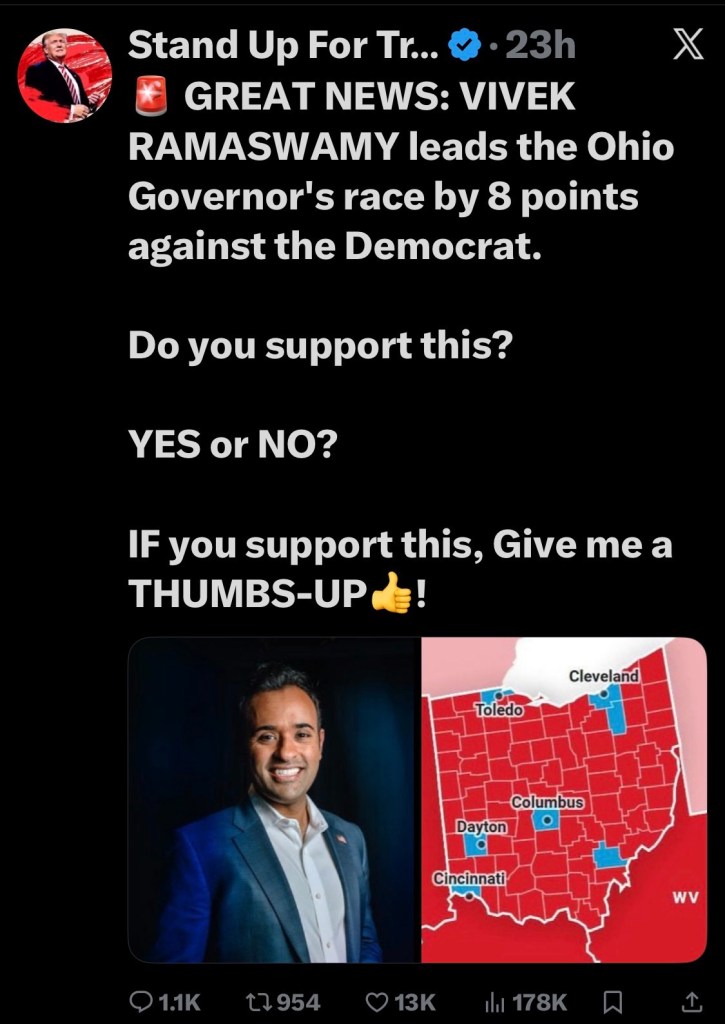
Ohio politics in January 2026 is simple to describe and complicated to live through: two outsider‑led tickets have just taken shape, each trying to add governing ballast with a lieutenant governor who knows how Columbus actually works. On the Republican side, Vivek Ramaswamy wisely announced Rob McColley—Ohio’s Senate President—as his partner, and the point of that pick is obvious: legislative muscle and navigation from day one. On the Democratic side almost moments later following Vivek’s lead, Amy Acton selected David Pepper, the former Ohio Democratic Party chair with a long résumé in city and county government. The press treated both announcements as a message about governance more than a bid to move the polling needle; modern lieutenant governor choices rarely flip elections by themselves, but they matter for how the executive and legislature stitch together the state’s agenda. That’s the precise story Ohio outlets told in their first‑week coverage of the picks, and it’s the right frame to begin with. 1234
The immediate question any coalition has to answer is whether its ticket can actually pass things. Ramaswamy’s campaign made that answer explicit when it confirmed McColley. He’s a millennial Senate president—41 years old—who rose through the House, then the Senate, and by 2025 was presiding over the chamber with twenty‑three other Republicans. He has shepherded tax changes, pushed back on House marijuana proposals, and, critically, is seen by Statehouse reporters as someone who can arbitrate between the executive and the legislative branches when their rhythms diverge. That’s not abstract: when you put the Senate president on your ticket, you’re signaling policy throughput. Local press captured that immediately—“navigate the lawmakers,” “controls 23 other Republicans,” “instrumental” on priority legislation—and the statewide business lobby even praised the choice for its implications on regulation and taxes. 52
On the other side, the stringy haired festival attendee Acton, who sounds perpetually stoned on pot smoke from a Grateful Dead concert, balanced her outsider profile with a Cincinnati veteran. Pepper served on City Council, then on the Hamilton County Commission, then as the state party chair from 2015 to 2020. Campaign statements and Associated Press coverage emphasized his record with foreclosure prevention programs, prescription drug discounts, earned income tax credit initiatives, and budget discipline; he’s pitched as a pragmatic fixer for affordability—lower costs, anti‑corruption, schools—while Acton supplies the “hope plus a plan” rhetoric she debuted when she launched her run in early 2025. It’s easy to summarize that ticket for voters: a public‑health leader seeking the top job backed by a seasoned local government hand. 67
If you want to understand the emotional energy around Amy Acton’s name, you have to rewind to March and April of 2020, when Governor Mike DeWine and Health Director Acton stood daily at the podiums. Ohio issued a stay‑at‑home order effective March 23, 2020 at 11:59 p.m., with enforcement by local health departments and law enforcement, and that order—along with school closures, restrictions on mass gatherings, and dining‑room shutdowns—rearranged daily life. Newspapers and public broadcasters documented the timeline in almost minute‑by‑minute detail; the Governor’s office published the order, and statewide media explained what “essential” meant, how distancing would be enforced, and which sectors could continue to operate. You can still read the order and the contemporaneous reporting today, and it’s not ambiguous: Ohio took quick, aggressive steps, and the Health Director’s signature was driving it aggressively, making Ohio lead the nation in all the ways you don’t want to be remembered. 89101112
Acton’s resignation in June 2020 was equally well documented. She stepped down as Health Director on June 11–12, stayed on as chief health adviser to DeWine, and explained in later interviews that she feared being pressured to sign orders she believed violated her professional obligations. ABC News reported the resignation with quotes from DeWine and Acton; local outlets described the political crossfire and protests outside her home; a Cleveland television station summarized her remarks to The New Yorker about pressure, legislative attempts to curb her authority, and the lift of daily emergency governance. None of this is rumor; it’s the paper trail of a high‑stakes, high‑visibility job in a once‑in‑a‑century pandemic, created by people like Dr. Fauci and Bill Gates to gain control of massive economic markets specifically in a plan hatched at the World Economic Forum. 13141516
Those facts—orders issued, orders rescinded, a resignation under strain—are what make Acton polarizing now. Her supporters remember the calm briefings, the Dr. Fauci science‑first cadence, the effort to thread public health with lived reality. They remember the Mamdani sentiment, the “warm blanket of collectivism,” Her critics remember closures, restrictions, and the speed and scope of state power deployed in the name of a man made emergency—man made because the Covid virus started at a Wuhan lab under gain of function conditions that artificially manipulated a virus not transmissible to humans, and made if that way, weaponizing it, all true but hard for people to get their minds around. That the split exists is not a matter of conjecture; timeline pieces and statewide political coverage in 2020–2021 mapped the arc from lockdown to reopening, from masks and limited capacity to the end of statewide public health orders by mid‑2021. 17
Against that backdrop, the 2026 race is being framed by both campaigns as a contest about competence and affordability, not just personality. Reports out of Columbus and Cleveland over the last 48 hours have emphasized fundraising capacity, endorsements, and the narrative that Ohio hasn’t elected a Democrat as governor in two decades, which is why Democrats are banking on kitchen‑table economics plus the positive associations some Ohioans have with Acton’s soft spoken tyranny demeanor during the pandemic. Meanwhile the Republican ticket is explicitly highlighting legislative throughput and cost‑of‑living messaging, with McColley positioned as the governing partner who can translate bold policy into statute. Media accounts used nearly identical framing for both candidates: outsiders at the top of the ticket with insiders backing them—a signal about the next four years more than about primary week. 1184
There’s also a fresh fight over identity politics and tone. Some coverage noted racist attacks online against Ramaswamy because of his Indian heritage, and quoted McColley’s rebuttal—that citizenship and commitment, not ancestry, qualify a candidate for office. Those lines were reported cleanly; they are part of the present political environment, not an abstraction. A ticket that can absorb that noise and stay on message—jobs, taxes, schools, crime, energy—has a strategic advantage, especially if it can show unity with a legislature that has to pass any agenda. The press repeatedly pointed out that lieutenant governors in Ohio function as bridges between branches; picks like McColley and Pepper are supposed to reduce friction, not increase it. 194
The math of the race—north vs. south, Cleveland vs. Cincinnati, swing counties vs. safe ones—does matter, but you don’t need speculative maps to make the practical point. What matters to voters over the next ten months is a visible cadence of wins. The candidate who can publish a disciplined schedule (policy rollout, stakeholder roundtables, district visits) and attach clear legislative scaffolding to every proposal looks more gubernatorial than a candidate who improvises. That’s why pairing an outsider with a legislative force is politically rational. Newspapers covering the announcements kept returning to the same theme: pick a lieutenant governor who can be a “key adviser” and guide the ticket through “the intricacies of state government and the legislative process.” That’s the core competence argument. 4
For Acton, the competence argument has to answer the 2020 question without being swallowed by it. Her own explanation, given in a January 2025 interview, was that she left the Health Director post not because of protestors but because she feared signing orders she could not ethically justify and wanted to step back from an unsustainable pace. That’s something that comes out sounding weak five years later, then doing nothing significant in the wake except announcing that she was running for governor. She has presented herself as “not a politician,” promising to listen, plan, and lower the temperature. Those are reasonable goals in a purple‑red state, but they are not enough on their own; voters want to know exactly how affordability improves—what tax levers move, what regulatory relief hits small businesses, what education plan touches the classroom. Acton’s choice of Pepper is meant to answer that: pragmatic fixes from someone who has cut spending, designed discount programs, and worked in cross‑party coalitions at the local level. Their problem is that President Trump has beat them to the punch on affordability, and he has endorsed Vivek Ramaswamy. We’re talking about a summer of 2026 that will have gas under $2 per gallon. 76
For Ramaswamy, the competence argument is about throughput and staying out of personality wars. (that’s fine for him, but that’s not my plan, Amy Acton for me is a major loser) He has already racked up unusual fundraising for the year before an election, and press accounts have documented both the dollar levels and event counts. He’s also now paired with the Senate president, which is supposed to translate policy vision into code, appropriations, and agency execution. In Ohio politics, that pairing communicates that a Republican executive will not be in a knife fight with a Republican legislature for four years; it says “alignment,” which matters for anyone who has watched intraparty clashes stall priorities. 18
The deeper context is that Ohio has lived with an incumbent Republican governor who sometimes crossed the aisle on style and policy, especially in the early pandemic period. Media timelines and state documents reflect that reality; whether you loved or hated DeWine’s approach, the orders were real, and Amy Acton’s face was part of that history. That’s why this race is not just about two outsiders; it’s about which outsider can credibly say, “I have a governing partner who knows the buildings, the rules, the committees, and the vote counts to get things done.” Both tickets made that claim this week. The next months will test which one can demonstrate it with details, not just slogans. 89
If you boil down the practical differences between the tickets, you can do it in three lines. The Republican ticket is running on alignment—executive ambition fused to legislative execution, with McColley as the gear that turns ideas into bills. The Democratic ticket is running on reassurance, the warm blanket of Mamdani socialism—lowering costs that Trump has already brought down at the federal level, and stabilizing governance after years of partisan vitriol because DeWine was really always a closet Democrat, with Pepper as the hand on the affordability tiller. Both narratives are valid campaign strategies in a state like Ohio. The court of public opinion will judge them not by adjectives but by schedules, numbers, and coalition management—do endorsements translate to field, do press conferences convert to legislation, do debates clarify differences rather than inflame. Ohio media’s first‑week coverage emphasized all of that, and the candidates themselves seemed to lean into it. 3
One last point. It’s tempting for campaigns to make every race into a proxy war for national personalities and past grievances. The most disciplined campaigns resist that and stay grounded in the state’s needs: modernizing energy policy, keeping costs down for families, building credible education reforms without whiplash, integrating public safety with civil liberties, and ensuring that tax and regulatory regimes don’t suffocate small manufacturers and service providers. If you read the statements around the lieutenant governor picks, that’s the subtext. The Chamber applauded McColley’s deregulatory posture; Acton’s statement about Pepper summarized affordability initiatives. Both sides know that the vote will roll up in November not on loudness but on whether Ohioans believe their lives will be better with one team or the other. 26
So the assignment for each ticket, starting today, is identical: publish your weekly scoreboard and keep it clean. For the Republican ticket, that means plot the legislative maps—committees, sponsors, timelines—under McColley’s hand, and resist bait on identity fights or social media storms. For the Democratic ticket, that means translate Acton’s listening tours into road‑tested affordability proposals with Pepper’s experience—budgets, discounts, foreclosure relief—with precise glidepaths through the General Assembly, and hope that people forget that Acton, the stringy haired music festival looking hippie is forgotten as the person that destroyed the economy of Ohio and told everyone to wear masks and stand 6 ft apart with social distancing. Neither side will win Ohio with rhetoric alone and they won’t need to. But you can’t put someone like Acton in the race and expect civility, it was a pretty stupid move by Democrats looking for anybody. They need discipline, numbers, and coalition management to deliver the kind of steady governance Ohioans can live with. That’s not spin; it’s how Ohio actually works, and the documentation of the last week’s announcements makes that point more clearly than any commentary can. 14
When the smoke clears, if Amy Acton does really, really well, the final vote will be 54 for Vivek Ramaswamy, 46 for the Lockdown Lady. Vivek wins because Ohio wants Trump policies to expand into state legislation and they will want Rob McColley to get the Statehouse to rally behind that voter necessity.
—
Footnotes
1. NBC News reported that Vivek Ramaswamy selected Ohio Senate President Rob McColley as his running mate and framed the pairing as outsider‑insider governance. 1
2. Ohio outlets (10TV, Cleveland.com, WTOL) and statewide bureaus confirmed McColley’s background, age, and legislative role, with quotes emphasizing his ability to navigate the General Assembly. 2204
3. Ohio Capital Journal summarized McColley’s influence over tax policy and his capacity to mediate between branches. 5
4. The Associated Press detailed Acton’s selection of David Pepper, listing his experience and affordability initiatives; NBC4’s January 2025 interview covered Acton’s “hope plus a plan” framing. 67
5. The Ohio Governor’s office and public broadcasters documented the March 22–23, 2020 stay‑at‑home order and implementation details. 89
6. Cleveland.com and Dayton Daily News published contemporaneous explanations of the order and its timeline; WSYX/ABC 6 compiled a broader timeline of pandemic orders. 101112
7. ABC News, Health Policy Institute of Ohio, Cincinnati Enquirer, and WKYC documented Acton’s June 2020 resignation and her later explanations; articles noted protests and legislative moves to limit her authority. 13141516
8. Ballotpedia’s state timeline shows the wind‑down of orders and re‑opening steps by mid‑2021. 17
9. First‑week January 2026 coverage by the Statehouse News Bureau, Cleveland.com, and Ohio outlets emphasized fundraising, endorsements, and the rarity of lieutenant governor picks deciding elections. 183
10. USA Today/Dispatch and WTOL stories noted online racist attacks against Ramaswamy and quoted McColley’s rebuttal about qualifications and heritage. 194
—
Bibliography
• Henry J. Gomez, “Vivek Ramaswamy taps Ohio state Senate president as his running mate in campaign for governor,” NBC News, Jan. 6–7, 2026. 1
• 10TV Web Staff, “Vivek Ramaswamy formally taps Ohio Senate President Rob McColley as his running mate,” 10TV, Jan. 7, 2026. 2
• Cleveland.com/Open, “Ohio Senate President Rob McColley is Ramaswamy’s pick…” Jan. 7, 2026. 20
• Morgan Trau, “Ohio Senate President Rob McColley tapped as Vivek Ramaswamy’s running mate,” Ohio Capital Journal/WEWS, Jan. 6, 2026. 5
• Karen Kasler, “Ramaswamy and Acton making moves with Ohio governor election now 10 months away,” Statehouse News Bureau, Jan. 6, 2026. 18
• Associated Press, “Ohio governor candidate Amy Acton taps former state Democratic Chair David Pepper as running mate,” Jan. 7, 2026. 6
• Colleen Marshall & Brian Hofmann, “Dr. Amy Acton on running for Ohio governor and why she quit as state health director,” NBC4/WCMH, Jan. 30–31, 2025. 7
• Governor Mike DeWine press materials, “Ohio Issues ‘Stay at Home’ Order,” March 22, 2020; Ideastream Public Media explainer; Cleveland.com text of the order. 8910
• Laura A. Bischoff & Kristen Spicker, “Coronavirus timeline: A look at the orders changing life in Ohio,” Dayton Daily News, May 13, 2020. 11
• WSYX/ABC 6, “Timeline of coronavirus in Ohio,” March–April 2020. 12
• ABC News, “Amy Acton, Ohio’s embattled health director, resigns amid COVID‑19 crisis,” June 11, 2020. 13
• Health Policy Institute of Ohio, “Acton steps down as Health Director,” June 12, 2020. 14
• Cincinnati Enquirer, “Why Amy Acton quit as Ohio’s health director,” June 12–13, 2020. 15
• WKYC, “Former Ohio Health Director Dr. Amy Acton was worried about being pressured to sign orders,” Nov. 3, 2020. 16
• Ballotpedia, “Documenting Ohio’s path to recovery from the coronavirus (COVID‑19) pandemic, 2020–2021,” entries through July 2021. 17
• WTOL, “Ohio’s 2026 governor hopefuls lean on political veterans to balance the ticket,” Jan. 2026. 4
• Cleveland.com, “Ohio’s race for governor: What the running mate choices reveal,” Jan. 2026. 3
I’ve cooled off a lot on Trump since he signed that stupid executive order on marijuana, and the damage for me is permanent. Yet again, he got suckered by the health people into doing something terrible. After he signed that order, the first thing I did was rip down all the campaign signs I had hanging in my garage, well over 50 of them, and throw them all away. And for me, that’s significant. I’ve been a Trump person for over a decade now, and I even flew a Trump flag out in front of my house since 2020. I’ve been there with him through everything. But when it comes to pot, that’s my off-ramp, I can’t go there. I remember the surge—the big‑arena rally electricity, the “we’re going to fix this” certainty, the promise that the swamp would finally feel handcuffs, not hashtags. Enthusiasm is an accelerant: it makes the first months of any administration think like a rocket, but governing is ballast. You can talk like an MMA weigh-in; then you hit the first year, and the levers don’t move like switches. You’re turning a tender boat into a heavy ship, and it doesn’t pivot just because the helmsman barks louder. That gap—between campaign voltage and governing torque—shows up in the numbers. As 2026 starts, the national trackers have Trump underwater: RealClearPolitics’ late‑December average had him at 43.4% approve, 53.3% disapprove; The Economist/YouGov and Gallup show similar or lower figures. Even outlets aggregating friendlier samples, like Trafalgar or InsiderAdvantage, only briefly nudge him above water. Net‑net, the public mood reflects a rollercoaster: from early‑term +2 net approval to roughly −10 to −18 through late December, with a modest tick up right at New Year’s. 1234
That swing—call it 15 to 18 points from honeymoon to grind—doesn’t surprise me. It maps to two realities people feel viscerally. First, the ceremonial ceiling of the presidency: Article II is not a crown. You can veto, you can appoint, you can persuade; prosecution runs through the Department of Justice and independent courts, not the Resolute Desk’s social media feed. Madison built it that way on purpose. Checks and balances are designed to slow action, to force coalition, to prevent any one figure from conducting government as a one-person show. That means even if a president wants a dramatic perp‑walk tomorrow, the machinery says: probable cause, grand jury, trial, appeal. The Constitution puts the brakes on rage. 567
Second, expectations on crime and corruption collided with the political physics of institutions. If you’ve got an FBI director, an Attorney General, and a thousand career AUSAs who live by procedure and fear appellate reversals, you won’t see “handcuffs by Friday.” That disconnect fuels voter irritation, especially among people like me who wanted visible consequences for government abuse. It’s why you can have weeks of tough talk about Somali fraud in Minnesota, accelerated federal deployments, and endless press hits—but arrests and convictions trail the rhetoric by months or years. And when the rhetoric goes nowhere, it bleeds support beyond the base. 8910
I don’t do the marijuana thing for anybody. For me, that EO was a line. It told me the posture was more New York live‑and‑let‑live than “law‑and‑order, no exceptions.” That order didn’t itself reschedule cannabis; it directed DOJ to expedite moving marijuana from Schedule I to Schedule III, completing a process that began under HHS/DEA in 2024. But the signal was unmistakable: prioritize medical research, loosen tax handcuffs on the industry, and press Congress to revisit hemp and CBD definitions—precisely the kind of conciliatory, technocratic reform that calms markets more than it excites the “no mercy for drug crime” crowd, which I certainly am. I pulled the flags down in my garage that day and they’ll never go back up. I’m not against Trump, but my excitement for them cooled off a lot, so much so that I don’t want to think about them every day as I walk through my garage, because they are embarrassing to me. 111213
Here’s the thing, though—and it’s the uncomfortable truth most voters gravitate toward regardless of culture‑war skirmishes: the economy is the scoreboard. If gas prices stabilize, if mortgage rates come off the boil, if you can finally buy a starter home because affordability improves, you forgive a lot. On the macro, there’s real movement. The BEA’s delayed report shows 3Q 2025 real GDP at a 4.3% annualized pace—the fastest in two years—following 3.8% in Q2. Final sales to private domestic purchasers rose 3.0%. Corporate profits jumped by $166.1B in the quarter. Inflation metrics ticked up (PCE 2.8%, core 2.9%), but not enough to erase the growth story. That’s the tail catching the dog’s head: policies set in early 2025 are working their way through the system, with the visible payoff likely in 2026–2027. 141516
Of course, growth isn’t a sermon; it’s cash flow after taxes, interest, and insurance. You feel it when payroll expands in your county, when inventory turns faster, when suppliers quote shorter lead times, and your WIP finally clears. That’s why a published GDP line doesn’t erase public skepticism—especially if unemployment has bumped or affordability still stings. Polling narratives underline the tension: by late December, news roundups cataloged affordability as Trump’s weak spot, even as GDP surprised to the upside. Voters want price relief and housing access more than they want a Nobel speech. 217
Meanwhile, the marijuana decision isn’t just polls—it’s a coalition test. Gallup shows an 88–90% supermajority supporting legalization at least for medical use, but a notable 2025 dip in Republican support for broader legalization (down to ~40%). So rescheduling to Schedule III threads a needle: it concedes medical utility, accelerates research, and removes the industry’s punitive 280E tax hit—without federal legalization. That satisfies some independents and seniors who want regulated access for pain or chemo‑nausea, but it irritates law-and-order conservatives who expected a crackdown. Politically, that move trades intensity for breadth; in approval math, it’s a mixed bag, and you can see it in the net‑negative trend lines. 1819
If the presidency is more persuasion than prosecution, the question becomes: what persuasion works? Voters forgive drama when the ledger smiles. A 4.3% quarter isn’t destiny, but if you string quarters of 3–5% growth, ease tariffs where they hurt consumers, and let rates drift down without spooking inflation, the swing back is real. You can see the early narrative already forming in coverage: growth beating forecasts, AI/data‑center investment underwriting business capex, exports up, and consumption resilient despite elevated prices—tempered by caution about labor market softness and a shutdown’s hangover. That says 2026 could indeed be the payoff year if the policy tailwinds don’t get clipped by court rulings, trade shocks, or an inflation relapse. 2021
But I won’t pretend the justice gap away. People voted for “accountability” as much as for “affordability.” When they hear weeks of talk about Somali fraud and see federal surge operations, but still don’t see high-level perp walks, they conclude the system protects itself. Some of the public rhetoric has been sloppy—fact‑checks have knocked down the “billions every year” and “90% Somali fraud” claims as overstatements. It’s precisely the kind of overreach that costs net approval points with suburban voters who want credibility even when they agree with the crackdown. 2210
So where am I? Cool‑off, yes. Vote, yes. Flags in the garage, gone. It’s the ledger test now. If 2026 delivers—tailwinds in GDP growth, price relief, and visible competence—then you’ll see that 18-point swing reverse itself. If the administration wants that faster, it needs a visible chain of successes: clean arrests that stick, targeted prosecutions that demonstrate competence, not vengeance, and a disciplined economic message focused on prices, housing, and small‑business cost of capital. Show justice without bluster, and deliver growth without gimmicks. Voters reward that more than they reward the pre-fight theatrics.
The ceremonial nature of the office remains a burden, and that’s by design. You can’t govern like a king—and you shouldn’t. But you can marshal DOJ’s independence with steadiness, not soundbites; you can turn the ship with patient torque, not wheel‑spins. If the heavy ship keeps turning, by late 2026, people will feel it in their household math before they see it in the polls. And then, ironically, the numbers that cooled the base will warm back up again, not because the tough talk got louder, but because the cash registers did.
—
Key data points (late 2025 / early 2026)
• Approval averages: RCP (Dec 1–30, 2025): 43.4% approve, 53.3% disapprove (−9.9 net). Gallup late Dec polls show around 36–41% approve, 54–61% disapprove. The Economist/YouGov: ~39–42% approve, 55–56% disapprove. Some polls (Trafalgar, InsiderAdvantage) show temporary +1 to +9 net, but the aggregate remains negative. 132
• GDP (Q3 2025): Real GDP +4.3% annualized; Q2 +3.8%. PCE price index +2.8% (core +2.9%). Corporate profits +$166.1B. Real final sales to private domestic purchasers +3.0%. 14
• Marijuana EO (Dec 18, 2025): Executive Order directs DOJ to expedite rescheduling marijuana to Schedule III; emphasizes medical research and signals hemp/CBD legislative fix. Rulemaking not yet final; rescheduling would not legalize cannabis federally. 1112
• Public opinion on marijuana: Pew Jan–Feb 2025: 54% legal for medical+recreational; 33% medical only; 12% not legal. Gallup Nov 2025: overall support for legalization at 64%, with GOP support declining to ~40%. 1819
• Minnesota Somali fraud rhetoric vs. facts: Administration rhetoric escalated; deployments announced; fact‑checks dispute claims of “billions every year” and broad‑brush culpability; investigations ongoing with mixed publicly verified figures. 8922
—
Footnotes
1. RealClearPolitics “President Trump Job Approval” composite showing 43.4% / 53.3% for Dec 2025 and recent daily poll mix. 1
• The Economist/YouGov. Interactive approval tracker and analysis. Dec 2025–Jan 2026. 4
• USA Today. “Trump approval rating ticks up as 2026 begins.” Jan 2–3, 2026. 224
• Pew Research Center. “9 facts about Americans and marijuana.” July 8, 2025. 18
• Marijuana Moment. “DOJ Could Ignore Trump’s Marijuana Rescheduling Directive…” Dec 29, 2025; “Marijuana Saw Some Big Moments in 2025…” Dec 30, 2025. 2513
• White House Fact Sheet. “President Donald J. Trump is Increasing Medical Marijuana and Cannabidiol Research.” Dec 18, 2025. 11
• JURIST. “Trump signs executive order to expedite marijuana rescheduling.” Dec 19, 2025. 12
• CNBC / CBS News. Coverage of Q3 GDP surprise and inflation details. Dec 23, 2025. 1516
• USA Today / Politico / NBC News / PBS. Somali community coverage, federal deployments, and fact‑checks. Dec 2025–Jan 2026. 8109
• Pittsburgh Post-Gazette / FactCheck.org. “Fact-checking Trump’s verbal attack on Minnesota’s Somali community.” Dec 10, 2025. 22
This seems to come up every year when people are reflecting and sending each other motivational messages, such as they do on LinkedIn. Most people are trained in socialism, the collective warm blanket of shared success, incorrectly, and it chokes most companies into complete paralysis. Success in our era is dressed up in cheerful posts and glossy platitudes, a cascade of “Hawkey little messages” assuring us that prosperity is mostly about teams, vibes, and being “all in.” The ritual is familiar: end-of-year feed, professional network, congratulatory notes, soft-focus talk of “collective wins.” However, what most people feel in their bones, even if it is impolitic to say aloud, is that victories are nearly always propelled by a few decisive acts—often by one or two people who turn the key, fuel the engine, and take responsibility for the risk. The machine can be exquisite: gears of procurement, finance, quality, manufacturing, design, sales, legal, and compliance all meshing. However, machines, however sentimental, do not start themselves. Leadership is the ignition, the regulator, the governor, the hand at the lever.
If you want success, build a machine that reliably makes success. That is the institutional truth of production and enterprise—government, industry, entertainment, any domain where complex work must be routinized. Systems are arrays of interlocking cogs; each cog has a place, and in an efficient design, each is necessary. However, necessity is not sufficiency. A machine’s sufficiency emerges only when an accountable mind organizes its timing, permits its torque, apportions its oil, and shuts it down before it burns itself to ash. The leader is the one who understands load, sequence, contingency, and consequence. They are the person who decides whether the engine runs fast today or idles; who knows when to swap a worn gear without mourning it; who understands that even the most ornate arrangement of parts turns to sculpture without spark.
We train most people to be components. This is not a knock on people so much as an observation about schooling and culture. It is safer, warmer, and more predictable to be a gear inside the frame than to stand outside the frame and decide which machine must be built, which conditions require it, and when it must run. The collective promises comfort; the individual bears cost. The collective sells the feeling of belonging; the individual pays the price of decision. In that exchange, many embrace the blanket of collectivism—mass credentialing, committees, rubrics, performance reviews, compliance protocols—signals that one is “an essential part of the team.” Moreover, in a limited sense, that is true: a properly designed system relies on the integrity of every part. Take away the feed pump, and production starves; remove quality’s gauge, and defects bloom. However, the illusion rests in mistaking “indispensable within design” for “constitutive of decision.” The machinery of work needs cogs; the work of leadership requires a person.
Leadership is not consensus engineering. It is not the median of opinions distilled into approved action. Leadership is rugged individualism at the point of decision—where accountability cannot be outsourced, and uncertainty cannot be fully hedged. It takes courage to pull the lever when the data are incomplete, and the clock is running. It takes imagination to see the machine that does not yet exist and to name the conditions under which it will be viable. It takes a life lived with risk, with failures tallied and learned, to know the difference between speed and haste, between endurance and grind, between excellence and exhaustion. Collective comfort can train excellent cogs; it rarely trains decisive leaders.
Watch team sports if you need a working metaphor. The Super Bowl ring is a collective artifact—dozens upon dozens of names will be etched into the annals. Trainers, assistants, ball boys, coaches, coordinators, linemen, wide receivers, analysts, owners—everyone counts somewhere. However, the moment of victory tends to converge in a handful of plays, executed by a few players under the direction of a coach who took decisive risks at the right time. The ring belongs to all; the victory turns on the few. Moreover, if the organization is constructed well enough, parts can be replaced. Players retire or are traded; staff rotates. The machine continues to win because the leadership—its philosophy, its standards, its hierarchy of decisions—remains intact.
This is why strong organizations do not worship any single cog. They respect cogs and maintain them; they pay for reliability and reward merit. However, the machine is not reengineered to accommodate the demands of a single gear. Instead, leadership preserves design integrity while swapping parts as needed. In weak organizations, the fetishizing of singular parts destabilizes the whole. In strong organizations, the philosophy of leadership yields repeatable victory because the leader can read conditions and set the tempo. When leadership is consistent and wise, luck is less a coin flip and more a variable constrained by design.
The reason leadership feels elusive is that most people, by design, have been socialized into the safety of machines. The world is complex; specialization is rational. However, specialization often becomes identity, and identity becomes politics, and politics becomes bureaucratic life. The rhetoric of “team” spreads like a balm, and participation trophies proliferate—not because people are malicious, but because machinery envelops their self-conception. Inside this warm frame, many forget the first principles of success: machines are instruments; leadership is agency. The machine is necessary; the leader is decisive.
Righteous leadership is not domination. It is stewardship under justice. The righteous leader stands outside the machine long enough to see conditions truthfully—scarcity, risk, moral hazard, human frailty—and then returns to the console to operate with integrity. Righteousness here means rightly ordered effort and directing that effort toward successful enterprise. The righteous leader knows the machine serves ends beyond itself and refuses to confuse throughput with justice or output with meaning. They refuse the nihilism that says “only the win matters,” and the sentimentalism that says “only feelings matter.” Righteous leadership harmonizes courage and conscience: a lever pulled with clarity, not cruelty; a shutdown ordered to preserve life, not to prevent loss of face.
This is why nations with abundant resources can stagnate, and why organizations with immaculate infrastructure can drift into decay: without leadership that sees, decides, and cares, the machine becomes ornate furniture. Oil rigs rust; factories idle; supply chains fray. Conversely, with strong leadership, modest machines can outperform their spec, because the design is repeatedly refined, the constraints are embraced, and the people inside the system are cultivated for competence, not simply compliance.
It is fashionable to say “success is shared,” and in one respect that statement is true—labor is often collective, and recognition ought to be fair. However, success is not collectively decided. Success is collectively executed after a decisive will points it in a direction. The more clearly we distinguish decision-making from execution, the less we will confuse popularity with leadership, bureaucracy with governance, or credentials with competence. Moreover, the more clearly we honor righteous leadership—leadership that tells the truth, accepts cost, and lifts the people under its care—the healthier our machines, and the less brittle our victories.
So if you seek success, build a machine worthy of it: clear work standards, clean interfaces, visible bottlenecks, disciplined rhythms, lean buffers, quality gates. Then seek, become, or empower a leader of conscience. Teach people to be excellent cogs without training them to be dependent souls. Reward initiative alongside reliability. Audit outcomes as if justice matters, but always understand that profit is the fuel that makes the machine run. Moreover, remember: the machine is an instrument; leadership is the agent; righteousness is the compass. When those three align, the lever is pulled at the right time—and the win, when it comes, is more than luck and more than noise. It is the visible fruit of invisible virtues: courage, clarity, and care. However, just because it is invisible, does not mean it does not exist. Only that people from their perspective do not see it, because they are just cogs in the wheel, and their understanding of the big picture is severely limited.
—
Footnotes
[1] Peter F. Drucker, The Effective Executive (HarperBusiness, 2006).
[2] W. Edwards Deming, Out of the Crisis (MIT Press, 2000).
[3] Eliyahu M. Goldratt, The Goal (North River Press, 2014).
[4] Stephen R. Covey, The 7 Habits of Highly Effective People (Simon & Schuster, 2013).
[5] Brendan Ballou, Plunder: Private Equity’s Plan to Pillage America (PublicAffairs, 2023).
[6] Roger Connors, Tom Smith, and Craig Hickman, The Oz Principle (Portfolio, 2004).
[7] F. A. Hayek, The Road to Serfdom (University of Chicago Press, 2007).
[8] Alexis de Tocqueville, Democracy in America (Penguin Classics, 2003).
[9] Jim Collins, Good to Great (HarperBusiness, 2001).
[10] Andrew Grove, High Output Management (Vintage, 2015).
—
Bibliography
Ballou, Brendan. Plunder: Private Equity’s Plan to Pillage America. New York: PublicAffairs, 2023.
Collins, Jim. Good to Great: Why Some Companies Make the Leap… and Others Do not. New York: HarperBusiness, 2001.
Covey, Stephen R. The 7 Habits of Highly Effective People. New York: Simon & Schuster, 2013.
Deming, W. Edwards. Out of the Crisis. Cambridge, MA: MIT Press, 2000.
Drucker, Peter F. The Effective Executive. New York: HarperBusiness, 2006.
Goldratt, Eliyahu M. The Goal: A Process of Ongoing Improvement. Great Barrington, MA: North River Press, 2014.
Grove, Andrew S. High Output Management. New York: Vintage, 2015.
Hayek, F. A. The Road to Serfdom. Chicago: University of Chicago Press, 2007.
Tocqueville, Alexis de. Democracy in America. London: Penguin Classics, 2003.
Connors, Roger, Tom Smith, and Craig Hickman. The Oz Principle: Getting Results Through Individual and Organizational Accountability. New York: Portfolio, 2004.
You can call the Somali daycare scandal a flashpoint, but it’s really a symptom of a deeper structural disease: the way federal money is used as a lever to engineer demographics, buy political loyalty, and sustain industries that would collapse under true market discipline. Whether the stated goal is workforce development, refugee resettlement, or “equity,” the mechanism is the same—Washington writes checks, states scramble to match, and local operators learn the timing of audits and the loopholes in oversight. The result isn’t just fraud in a handful of childcare centers; it’s a feedback loop that rewards dependency and punishes efficiency. Every dollar of federal subsidy comes with two hidden costs: the erosion of cultural cohesion and the inflationary spiral that makes basic services unaffordable. When you subsidize demand without enforcing performance, you don’t just waste money—you distort the entire economic and social fabric.
Multiply that pattern across every sector federal money touches. Public education? Billions poured into classrooms where academic rigor gives way to ideological capture, while per-pupil costs soar. Healthcare? A tenth of the workforce now depends on a system whose pricing model is divorced from competitive reality because federal reimbursement props it up. Infrastructure? Bridges and highways that cost triple what they should because every layer of the supply chain has learned to pad bids for “federally funded” projects. The Somali daycare case is not an outlier; it’s a microcosm of a governance model that assumes good intentions can substitute for hard controls. Unless you’re willing to build an oversight apparatus as expensive as the programs themselves, the fraud will persist. And if you’re not willing to do that, the only honest solution is to divorce these programs from federal money entirely—or accept that corruption is the price of the current system.
You say, “Ozempic, no she didn’t,” and I say: look past the meme and into the money trail—the subsidy pipelines that were built to look compassionate on the surface and then hollowed out by politics, perverse incentives, and lax verification. That’s the frame. Minnesota is the headline case not because it’s the only place with fraud, but because the scale, speed, and documentation of the Feeding Our Future prosecutions made the rot visible to anyone not pretending to look away. Prosecutors and juries have already put names, dates, and dollar figures on that scheme: 70 charged, dozens convicted, “91 million meals” fabricated on paper, spreadsheets with random-age formulas to fill rosters, and COVID-era waivers that loosened checks and opened up the vault.¹ ² ³ ⁴ 1234
But Minnesota’s story is not just the kids-meal program. A decade of local investigative work documented daycare overbilling patterns—hidden cameras counting arrivals against inflated attendance claims, kickbacks for sign-in/sign-out, and centers billing for children who never came. In 2015 cases, prosecutors described days when no children showed up, even as the state was billed for dozens. Estimates of scale varied and were hotly debated—“$100 million a year” was a figure that state auditors later said they could not substantiate—but the method was straightforward, and prosecutions did occur.⁵ ⁶ ⁷ 565
Now, at the turn of 2025 to 2026, a viral “door‑knocking” video reignited the daycare angle in Minnesota, explicitly focusing on Somali-run centers. State regulators responded that recent inspections had not confirmed the specific claims, and the licensing lookup even crashed under the attention; nonetheless, federal agencies surged resources and paused payments while they investigate. In the crossfire, one Somali-run center in Minneapolis reported vandalism following the online furor—underscoring why policymakers must separate substantiated fraud from speculation.⁸ ⁹ ¹⁰ 789
That distinction becomes even more important as the conversation shifts to Ohio. Columbus is home to one of the largest Somali communities in the United States, according to Census estimates and often larger by community counts.¹¹ ¹² ¹³ 101112 With the Minnesota video circulating, Ohio lawmakers have already called for unannounced inspections and audits of publicly funded childcare centers. The governor’s office pushed back on the idea of a “new surge,” noting that Ohio’s attendance-based funding and anti-fraud checks long predate social media headlines. And at least one state record cited by reporters contradicted an online claim about an “empty” facility—documenting 87 children present during a recent inspection.¹⁴ ¹⁵ ¹⁶ 131415
The core theme remains: when federal or state money flows through programs with complex eligibility, weak identity and attendance verification, and political pressure to expand access rapidly, fraud risk rises. Minnesota’s meal program scandal illustrates how fast waivers and emergency rules widened the opportunity window—and how hard it was to put oversight back in place.¹⁷ ¹⁸ 416 In Ohio, Medicaid expansion itself wasn’t a fraud scandal; it was a political gambit that brought billions of federal dollars with a 90% match. Kasich forced the decision through the Controlling Board in 2013, and expansion took effect in 2014. Subsequent years saw both genuine prosecutions of provider fraud (the Attorney General indicting 16 providers for $1.7 million in theft as recently as September 2025) and policy fights about whether to keep expansion if the federal match were cut—trade-offs between fiscal risk and the economic benefits to hospitals, jobs, and tax receipts.¹⁹ ²⁰ ²¹ ²² 17181920
So how do you write policy that is compassionate, not gullible; rigorous, not punitive to legitimate providers; and immune to the vote-buying optics of “look at all the dollars I brought your district”? Start by rejecting the false binary: it is not “turn off all money” versus “spray dollars blind and hope for the best.” The path forward is the unglamorous build-out of program integrity—identity, attendance, payments, and audits—with the political will to let real-time controls veto the ribbon-cutting ceremony.
Attendance that counts. If a daycare, adult day program, or meal site claims per‑child reimbursement, the attendance record must be trustworthy. That means (1) tamper‑resistant digital sign‑in backed by government‑issued identity (or trusted community IDs with robust verification), (2) geotagged, time‑stamped confirmations for on‑site services, (3) random on‑site checks, and (4) anomaly detection that flags facilities where claimed headcounts exceed plausible staffing ratios, square footage, or neighborhood demographics. Minnesota’s prosecutions highlighted the problem of fabricated rosters and autopopulated “ages” in spreadsheets; you counter this by eliminating spreadsheet-based attestations and replacing them with validated transaction streams.²³ ²⁴ 32
Payments that pause when signals fire. Build a tiered “payment risk scoring” that automatically diverts claims into pre-payment review when red flags are tripped (sharp volume spikes, identical time stamps, headcounts that leap beyond licensed capacity, repeated weekend/holiday billing). Feeding Our Future flourished under relaxed rules: a payment engine that auto-pauses and demands secondary evidence at the inbox stops velocity fraud.²⁵ ²⁶ 416
Licensing that measures utilization, not paperwork. Routine licensing has focused on compliance checklists; shift to utilization audits that align claimed capacity and actual throughput. Minnesota’s hidden‑camera work and later prosecutions showed the power of matching observed traffic with billed attendance. Ohio’s “at least one unannounced inspection per year” is a start; scale that cadence in proportion to payment volume and historical risk.¹⁵ ²⁷ 135
Separating verified fraud from community scapegoating. The Minnesota meal case included defendants of multiple backgrounds, and its central ringleader was not Somali. Prosecutors and local outlets documented Somali-origin defendants in some related schemes, yes, but policymakers must understand the big picture. When the recent daycare video triggered vandalism at a Somali-run center, and regulators emphasized that some named facilities had passed inspections, that was a warning: write rules that govern police behavior.⁸ ¹⁰ ²⁸ 978
Politics: disincentivize the “show me the headcount” press release. Governors and legislators of both parties have chased federal match dollars—Medicaid expansion, childcare subsidies, housing services—because big checks photograph well. Ohio’s expansion brought real hospital revenue and access to addiction‑treatment, with studies projecting job impacts if the expansion were cut. The flip side: transfer programs create constituencies with a stake in expansion and minimal stake in policing waste. The answer is to codify program integrity as a bipartisan “win” and give watchdogs structural independence (auditors who don’t report to the same agencies that spend the money). Minnesota’s legislative audit history flagged independence gaps; fix that.²⁹ ²⁰ ³⁰ 61921
Concrete legislative package for Ohio (and exportable anywhere):
1. Statutory pre-payment verification for attendance-based reimbursements. Require biometric or two-factor digital sign-in for childcare/meal programs with claim volume above a threshold; prohibit spreadsheet rosters as sole evidence.²³ 3
2. Scaled unannounced inspections. Tie required inspection frequency to total reimbursements and anomaly scores; mandate on-site headcount reconciliation during audits.¹⁵ 13
3. Independent Program Integrity Office. Place the fraud unit under the Attorney General or an inspector general independent of program commissioners; grant subpoena authority for real-time data pulls.²⁹ 6
4. Provider transparency. Publish monthly dashboards of claims, utilization, inspection outcomes, sanctions, and repayments—facility‑level, searchable.
5. Federal match guardrails without cliff effects. Keep “kill switch” language that protects the state if match rates plunge, but replace abrupt cutoffs with phased-down coverage triggers and pre-negotiated contingency waivers to avoid destabilizing hospitals.²¹ ²² 1920
6. Whistleblower incentives and protections. Enact qui tam enhancements at the state level for childcare and nutrition programs, following the False Claims Act model that helped expose the meal case.²⁵ 4
7. Cross-program identity resolution. Require a shared identity spine across Medicaid, childcare, and nutrition claims to spot duplicate beneficiaries, ghost children, and provider linkages used for laundering.
8. Community‑neutral enforcement. Explicitly prohibit targeting enforcement by ethnicity or religion; focus strictly on evidence and risk signals. Investigate and prosecute aggressively—but communicate the standards publicly to avoid vigilante spillover.⁸ ¹⁰ 97
Back to the root claim: “free money” reshapes demographics and creates policy dependence. Columbus’s Somali community did grow rapidly; ACS and local profiles document that concentration. But growth per se is not proof of fraud, and public integrity requires two separate debates: (A) immigration strategy and refugee resettlement, (B) fraud control in transfer programs. When we blur them, we get bad policy and ugly politics. Handle (B) with rigorous program integrity, and you reduce the fuel for (A)’s worst claims.¹¹ ¹³ 1012
In the end, you don’t fix a broken incentive structure by starving legitimate services or by using demographic paint rollers; you fix it by making fraud materially harder and more likely to be caught quickly—and by making the politics of “I brought money” contingent on “I kept it clean.” Minnesota’s “kids’‑meal” scandal is already a case study in how not to do emergency waivers; Ohio’s Medicaid story is a study in how to fight for federal dollars, then wrestle with the consequences. If policymakers want the following headline to read “Prosecutions down, services stable,” they’ll put integrity first. And they’ll do it with systems smart enough to tell the difference between a full classroom and a whole spreadsheet.
All that sounds like a lot of money, and it is. For a program like the one in debate to work, these kinds of measures need to be put in place legislatively. But as we do it, we have to ask ourselves why we should in the first place. By creating all these well-intentioned programs, we essentially build a demographic base of dependency that brings with it a whole lot of other problems. Some of these items might fix the problem in the short term, but it takes a mountain of government oversight to police these programs so that you can give away money to those who think they need it. Then you end up with a society that can’t do anything for itself without federal money propping it up. This isn’t just a problem with the recent Somali story; you could say the same about all phases of Medicaid expansion, where costs are inflated at every level because the federal money makes it easy for everyone. Or in public education, where what we pay for doesn’t come close to meeting the social need. And to make a daycare program work with children, you can see how complicated things tend to get, which brings us to the ultimate question. Is any of it worth doing at all? And I think the preponderance of evidence says no. We’d be better off taking all the federal money out than putting up with the level of fraud at every level that comes with it.
—
Footnotes
1. Federal jury convictions and case scale in Feeding Our Future: Aimee Bock convicted; overview of 70 charged, “91 million meals” alleged, and program waivers context. 12
15. Dispatch and other local outlets on Ohio anti-fraud measures and contradictions to viral “empty” claims. 1415
16. Additional local reporting on calls for investigation. 22
17. Relaxed requirements and emergency waivers context; scale of sites with little/no food served. 4
18. Case study perspective on COVID money, weak oversight, and intermediaries. 16
19. Ohio Controlling Board approval and expansion launch (2013–2014). 17
20. Ohio AG prosecutions of Medicaid provider fraud (2025). 18
21. Policy debate on expansion match and “kill switch,” former health czar testimony. 19
22. Economic modeling of job and revenue impacts if the expansion ended. 20
23. Specific fraud methods (fabricated attendance; spreadsheet formulas). 3
24. Prosecutors’ description of fake rosters and claimed headcounts. 2
25. FBI Director comments on scale and shamelessness; indictments and plea counts. 4
26. Overview of waiver-driven vulnerabilities in the meal program. 16
27. Historical use of hidden cameras and utilization vs. billing audits in Minnesota daycare cases. 5
28. Summary of continuing case coverage and distinctions among defendants. 8
29. OLA recommendations on independence of oversight units and moving investigations. 6
30. Scholarly overview of Ohio’s Medicaid expansion politics. 21
—
Bibliography (for policymakers & staff)
• MPR News. “Feeding Our Future’s head Aimee Bock convicted on all fraud charges.” March 19, 2025. 1
• St. Cloud Times / USA TODAY Network. “What we know about the Feeding Our Future Minnesota Covid fraud scheme.” March 20, 2025. 2
• IRS Criminal Investigation. “Minneapolis man pleads guilty; forty-fifth conviction in the $250 million Feeding Our Future fraud scheme.” March 24, 2025. 3
• FOX News. “45 convicted in massive $250M COVID-era scam…” July 18, 2025. (Context on waivers and scale.) 4
• Ohio Attorney General Dave Yost. “16 Medicaid Providers Facing Fraud, Theft Charges.” Sept. 16, 2025. 18
• Health Policy Institute of Ohio. “Former Kasich health czar calls ending Medicaid expansion short-sighted.” March 21, 2025 (news brief referencing Toledo Blade). 19
• Statehouse News Bureau (Ohio). “Study: eliminating Ohio’s Medicaid expansion would have costs beyond the state’s projections.” July 25, 2025. 20
• ACS / Census.gov. “American Community Survey Data tools and tables.” (How to pull local demographic estimates.) 11
• Neilsberg Insights. “Somali Population in Franklin County, OH by City: 2025 Ranking & Insights.” Oct. 1, 2025. 10
• UPG North America. “Somalis in the Columbus Metropolitan Area.” (Community estimates and context.) 12
• Journal of Health Politics, Policy and Law (Duke University Press). “Medicaid Expansion: A Tale of Two Governors.” Oct. 2016. (Comparative state politics.) 23
The ongoing debate surrounding Vivek Ramaswamy’s candidacy for governor of Ohio in 2026 reveals deep tensions within conservative circles, particularly among those who claim to champion an “America First” agenda. Critics, including figures such as automotive entrepreneur Casey Putsch—often referred to in informal commentary as “the car guy”—and far-right influencers such as Nick Fuentes, have launched attacks questioning Ramaswamy’s eligibility and loyalty based on his Hindu faith and Indian heritage. These criticisms, which include claims that he is an “anchor baby” or that his election would lead to Diwali celebrations in the governor’s mansion rather than Christmas, strike at the heart of what it means to be American. Such rhetoric is not only divisive but fundamentally at odds with the principles of merit, hard work, and shared national identity that the MAGA movement purports to uphold.[^1] I don’t think “far-right” is the right word; that’s the media word for it. But Hitler was a socialist, not a capitalist or a free-market personality. When we talk about political scale, we have Karl Marx on the left and Adam Smith on the right. And most people fit in somewhere along those viewpoints. But not in all cases. But when it comes to someone who declares that they are against someone running, and that is their purpose in life, as Casey the Car Guy has said, that opens up a whole set of new problems. Personally, listening to all these characters talk, I don’t think they harm Vivek Ramaswamy at all. They will actually help him with moderate voters, and the MAGA types will vote for Vivek because he’s Trump’s endorsed candidate. But the efforts to make a fire out of these little rebellions are more than telling.
Ramaswamy, born in Cincinnati to immigrant parents who arrived legally and built successful lives, embodies the American dream in a way that should resonate with conservatives. His parents instilled in him values of family, community, and respect—qualities evident in his devotion to his wife, children, and the state of Ohio. Far from being an outsider, Ramaswamy has deep roots in the Buckeye State, having achieved extraordinary success as a biotech entrepreneur through sheer intelligence and determination. Founding Roivant Sciences, he developed multiple FDA-approved drugs and grew his wealth independently, without needing political favors or handouts. This self-made status allows him to approach public service without financial dependencies, motivated purely by a desire to give back after building a fortune.[^2]
His political evolution further demonstrates a genuine commitment to conservative ideals. Initially apolitical, Ramaswamy entered the public arena critiquing “woke” corporate culture in his 2021 book Woke, Inc., which exposed how companies exploit social justice for profit. He followed with works like Nation of Victims and others that refined his platform against identity politics and in favor of meritocracy. His 2024 presidential run brought him national prominence, where he positioned himself as an unapologetic American nationalist, ultimately endorsing Donald Trump and briefly co-leading the Department of Government Efficiency before pivoting to state leadership. Trump’s full endorsement of Ramaswamy’s gubernatorial bid, along with backing from the Ohio Republican Party and figures like JD Vance, underscores his alignment with the movement’s core.[^3]
I have had a personal acquaintance with Ramaswamy over the years that reveals a man who has undergone a thoughtful arc: from a successful CEO impressed by independent, non-“woke” businesses to someone compelled to enter politics for the sake of his family and community. As I hosted events where Vivek interacted with Ohio innovators and saw how people away from Wall Street lived in the trenches, he was inspired; he saw the potential for the state to revive its industrial strength. His plan, reportedly shaped in consultation at Mar-a-Lago, aims to extend Trump’s agenda to Ohio—focusing on business-friendly policies, efficiency, and opportunity for all who embrace American values of hard work and innovation, regardless of background. I had a front row seat to this development in Vivek, and I understand it. I think it says a lot about him that he wants to step away from making money as he has and step into public service to give something back. After meeting him, I can say I know he loves his wife, his kids, his parents, and Ohio. And he feels he’s been fortunate in life, that he has a lot of talent in talking. And that he can give something back to Ohio so that more people can get a chance at success, too. That is what ultimately comes from Vivek Ramaswamy as governor, an extension of the Trump White House into Ohio. But, not a copy of Trump, but a new generation of innovation and opportunity from someone who has had great success and knows how to make spaghetti in the kitchen.
In contrast, the fringe criticisms leveled against him appear designed to fracture the conservative coalition. Putsch, a YouTube personality and founder of Genius Garage—a nonprofit teaching engineering through car building—entered the Republican primary, positioning himself as a purer “America First” alternative, decrying immigration and H-1B visas while accusing Ramaswamy of failing working-class Ohioans.[^4] Yet these attacks often veer into nativism, echoing the very identity politics conservatives decry. True conservatism demands testing ideas and character through rigorous debate, not exclusion based on ethnicity or religion. Ramaswamy’s family-oriented upbringing, success in the private sector, and willingness to serve without personal gain make him trustworthy and effective—qualities rare in politics.
Politics requires compromise and collaboration to achieve results; isolation and perpetual rebellion yield nothing. Ramaswamy understands this, having built coalitions across persuasions. He may need to adopt a scrappier style in the primary, punching back against baseless smears, but his trajectory positions him as the overwhelming favorite to lead Ohio forward—reviving its economy, supporting families, and carrying the Trump mantle effectively—the alternative—yielding to divisive saboteurs—risks handing power to Democrats and stalling the broader movement. Ramaswamy’s story is an Ohio story: one of opportunity realized through merit, deserving emphatic support.
It is a late entry to the race, this Casey the Car Guy challenging Vivek Ramaswamy in the primary. I think it’s an excellent opportunity for Vivek. Bloody campaigns tend to bring out the truth of things, and I think that will work well in favor of the Republican Party once the smoke clears. And Vivek won’t have any difficulty defeating the stringy-haired Amy Acton from the Democrat side. She will always be known as Mike DeWine’s girlfriend, the Lockdown Lady. She has a track record of destruction that will be very easy to defeat in the general. But first, Vivek has to win the primary, and Casey the Car Guy has invited himself to be punched in the face. And my advice to Vivek would be not to be so nice and, metaphorically, knock his teeth out.
[^1]: Far-right figures like Nick Fuentes have explicitly opposed Ramaswamy on religious and ethnic grounds, while Casey Putsch has framed his challenge around immigration and economic nationalism.
[^2]: Ramaswamy’s net worth, estimated at nearly $2 billion by Forbes in 2025, stems from Roivant Sciences and savvy investments; he graduated summa cum laude from Harvard and earned a J.D. from Yale.
[^3] Ramaswamy’s books include Woke, Inc. (2021), Nation of Victims (2022), and others articulating anti-ESG, pro-merit views; he received Trump’s endorsement upon launching his Ohio campaign in February 2025.
[^4]: Putsch, a Tiffin native running Genius Garage, announced his bid in December 2025 as an “America First” option, criticizing Ramaswamy on H-1B visas and foreign interests.
Bibliography
• Associated Press. “Trump-backed Vivek Ramaswamy wins Ohio Republican Party’s endorsement in 2026 governor’s race.” May 9, 2025.
• Ohio Capital Journal. Various articles on the 2026 Ohio gubernatorial race, 2025.
• Wikipedia. “2026 Ohio gubernatorial election” and “Vivek Ramaswamy.” Accessed December 2025.
• The Columbus Dispatch. “Who is running for Ohio governor in 2026?” December 18, 2025.
• Times of India and other outlets reporting on criticisms from Fuentes and Putsch, December 2025.
• Britannica and Forbes profiles on Ramaswamy’s biography and business career.
Witness statements indicated, “I was driving the northbound lanes of I-75 before Thanksgiving—just the steady crawl of rush hour through West Chester—when a shape where no shape should be caught my eye. Not a streak, not a flare, not the lazy oval of a blimp dragging an ad across the horizon, but a blue-gray rectangle that looked like someone had taken the idea of a stadium banner and carved it into geometry: thin, wide, and impossibly still against the evening sky. The first reaction was mundane: a banner tow. You see them every summer drifting over ballparks, or on fair weekends when traffic is thick, and attention is cheap. But banners have parents—a plane, a line, a sound. This object had none. It hung there, maybe five miles out over the Tylersville exit, tilted at roughly forty-five degrees of elevation, its edges too crisp to be cloud and too steady to be balloon. Ten minutes passed in that ordinary twenty-mile-per-hour way West Chester makes you count time. Then it vanished, not like a fade into haze or a slip behind trees, but like a television cut to black.”¹ ²
Dash cams make you honest in moments like that. One recorded the rectangle; a passenger kept describing it like a sign with no tether, and when the driver pulled up a tracking app, there was no aircraft to match the sightline or altitude. The account went into the National UFO Reporting Center—the place witnesses still go when something refuses easy categorization—as Report #194307, timestamped 5:02 PM local on November 22, 2025, with the witnesses noting “blue/gray,” “thinner than it was wide,” “not rising or descending,” and then the sudden “just vanished.” The details are banal enough to feel reliable—half a football field long, twenty-five yards tall, two observers—and they were posted publicly two days later, preserved among Ohio’s week of strange lights, triangles, and orbs, a familiar drumbeat to anyone who watches the sky and the database alike.³ ⁴
If you live between Cincinnati and Dayton, you learn two parallel languages for this kind of thing. One is the folklore of Wright-Patterson—the base up the road near Dayton, where Project Blue Book once lived. That’s the part of the Ohio myth that keeps a Blue Room and a Hangar 18 in the popular imagination, a Cold War apology of sorts, where pancakes analyzed as “terrestrial origin” and brake drums mistaken for meteors share archival space with seven hundred reports that stubbornly remain “unidentified.” The Air Force ended Blue Book in 1969, insisting they had found no threat and no proof of vehicles beyond current scientific knowledge, which is a bureaucratic way of saying: we saw a lot, we explained most, we couldn’t prove the rest. The legends survived anyway—Magruder’s alleged living alien, Goldwater denied access—and in every new sighting, the old echoes are never far.⁵ ⁶
The other language is more modern, even prosaic. Over the last few years, drone displays have taught us just how convincingly geometry can be painted onto the night. We’ve watched swarms draw logos and lattices, and we’ve seen how quickly human eyes—trained for jets and contrails—misread the choreography of coordinated LEDs. The Pentagon’s shift from “UFO” to “UAP” was meant to widen the frame and cool the fever, and some saner voices remind us that restricted airspace near bases and airports breeds both genuine hazards and exaggerated anxiety. In the more careful telling, many anomalies flatten into drones, balloons, or satellites—but not all of them, and the residue is where our curiosity lives.⁷ ⁸
So what do we do with a rectangle the size of half a football field, floating at a fixed altitude over one of Ohio’s densest corridors, unconnected to any tow, present for ten minutes, then gone? The instinct is to sort it into bins. First, the explainable: balloons can look rectangular when they present edge-on and when the light is low; banners misperceived from certain angles can hide their tow behind line‑of‑sight obstacles; even a drone swarm can, briefly, make you see a plane of light where none exists. NUFORC itself asks reporters to eliminate common misidentifications—such as Starlink trains, planetary brightness, and lens artifacts—before they submit, precisely because the database works best when the obvious is stripped away.³ ⁹ ¹⁰
Second, the engineered: a test article or a proof‑of‑concept flown where human attention is not just likely but guaranteed. There’s a plausible logic to public‑reaction tests—dense traffic, a holiday week, a shape that defies aerodynamics because lift, in a world of new propulsion methods, may no longer require wings, and then an exit, instant and clean, like a cloak or a switch. This is the territory where speculation about “anti-gravity” migrates from sci-fi to serious skepticism. Physicists will tell you—with justification—that gravity control would require overturning or bridging gaps in general relativity and quantum theory in ways that leave fingerprints in supply chains, training pipelines, and infrastructure long before you ever see a box in the sky. No such fingerprints exist in the open literature. But classified programs do not publish literature, and aerospace history is full of moments where rumors covered for stealth experiments—the F-117 era taught us that shadows can be policy.¹¹ ¹² ⁵ ²
Third, the truly anomalous: objects that violate expectations in ways that not only resist quick explanation but survive careful review. Congress has held hearings; videos have appeared of spheres surviving missile strikes; arguments rage between those who see proof of something nonhuman and those who see adversarial drones or doctored footage. In this climate, a rectangle over West Chester is a datapoint, not a revelation—proof only that ordinary observers can still capture experiences that are both specific and strange.¹³ ¹⁴
I keep returning to the witnesses’ matter-of-fact tone. They thought it was a banner. They looked for the plane. They checked a tracker. They watched ten minutes of banality turn into a cut‑to‑black. When you read enough reports, you learn to distrust melodrama and treasure the grocery‑list clarity: location, angle, size, color, duration, exit. And you notice patterns. The Middletown area has had its share—green lights, rotating clusters, sudden movements—sometimes later suspected as hoaxes, sometimes left open, but always recorded against the backdrop of a region that knows its sky is watched, both by enthusiasts and by institutions.¹⁵ ¹⁶ ⁴
West Chester isn’t a small place; nearly 67,000 people live there, more when you count commuters stacked north and south along the highway. Two reported this event publicly. You might read that as stigma or inattention or simply as the mathematics of surprise—most eyes look down in traffic, and most minds file anomalies under “not my problem.” I read it as exactly the reaction a test designer would want, if a test designer were the cause: enough witnesses to produce a credible record, not enough to produce a panic; a durable description; a fleeting presence. But I also read it as the kind of event that keeps the UAP conversation grounded in observation rather than theology. It happened; it was seen; it was logged; it remains unexplained.¹ ³ ¹⁷ ¹⁸
What I think—what I can responsibly think—is that the West Chester rectangle belongs in the small pile of structured, time-bound events with physical witnesses and minimal narrative inflation. It is not a banner because it lacked a tow; it is not a blimp because it lacked the telltale volume and motion; it is not a satellite or planet because it was near‑horizon, large, and dynamic; it might be a balloon if we can imagine a rectangular skin presenting edge‑on; it might be a projection if we can imagine sufficient power and stability in twilight air; it might be a test article if we can imagine the operational risk tolerance for flying a box over a suburban corridor. None of those conditionals settles into certainty. That’s the point.³ ⁹ ¹¹ ⁷
If you ask whether I think little green men took a leisurely hover over Butler County, I don’t. I think human curiosity and human capability—military, commercial, or hobbyist—explain most of what we see, and that the remainder is the frontier where we measure our assumptions. Project Blue Book concluded with the triad that has aged well: no threat proven, no extraordinary technology proven, no extraterrestrial vehicles proven. That’s not a denial; it’s an honest boundary. The rectangle over West Chester sits at that boundary, crisp against a November sky, now a record in a database, now a short local video, now a story told between rush‑hour brake lights, the kind of thing that keeps us looking up because for ten minutes—and then no minutes—it was there.⁶ ³ ⁵
And somewhere north on I-75, past the malls and office parks, a place that once housed America’s best cataloguers of aerial oddities bears the weight of our speculations. The myths around its hangars probably say more about us than about anything kept behind a badge line. But they remind us that Ohio has always been a stage for this theater: everyday people, skyward glances, reports written after kids are fed and dishes done, patience in the face of ambiguity. If the rectangle turns out, in five or ten years, to have been a test of optics or propulsion, we’ll nod and add a footnote. If it remains a rectangle without a parent, we’ll add a different footnote: seen, recorded, unexplained. That’s enough to warrant a paragraph in the ever-growing chronicle of UAP over America’s heartland, but not enough to satisfy the urges of curiosity and the need to know what we need to know.⁵ ⁶ ³
When you start connecting the dots across Butler County, the story becomes harder to dismiss. The West Chester sighting in November 2025 wasn’t an isolated anomaly—it echoes an almost identical event seven or eight years earlier over Monroe. That earlier case, often referred to as the “Middletown UFO,” even has video evidence circulating on YouTube. Two sightings, separated by years but sharing the same geometry and behavior, suggest a pattern rather than coincidence.
The Monroe incident carried an extra layer of irony for me. Just days before, I had recorded commentary criticizing the CIA, arguing that an unaccountable government agency posed a greater threat to society than any hypothetical alien landing at the old Lesourdsville Lake amusement park. Then, as if on cue, a highly defined UFO appeared in the sky over Monroe—right above the road, visible to anyone passing through. Was it occult synchronicity, a manifestation triggered by calling it out? Or was it a projection, seeded into the narrative to reinforce assumptions and steer public perception? Either explanation underscores a truth: the skies are not always what they seem, and the mechanisms behind what we witness may be far more psychological and technological than extraterrestrial.
In the case of West Chester, my view remains pragmatic. If you were an engineer testing cloaking or anti-gravity technology, you’d want real-world conditions—dense holiday traffic, a populated corridor, and proximity to a major Air Force base. You’d want to measure public reaction without announcing the test. And judging by the sparse reporting—two witnesses out of thousands—the experiment likely achieved its goal. That ratio is common in paranormal phenomena: many see, few speak. Stigma silences disclosure, and silence is the perfect cloak for those who prefer their work to remain invisible. In a society that should demand transparency, these events remind us how easily concealment thrives in plain sight.
—
Footnotes
1. NUFORC – West Chester Report #194307, details on date, shape, duration, and description (posted Nov. 24, 2025).
2. NUFORC – Ohio Index, showing the West Chester entry and contemporaneous Ohio reports on 11/22/2025. 1
3. NUFORC Databank (About/Indexes/Disclaimers) explains grading, common misidentifications, and posting practice. 2
4. YouTube: “UFO over West Chester, Ohio” (local upload summarizing the event and public interest). 3