The Anti-Business Amanda Ortiz: A socialist experiment people will quickly regret

The recent election in West Chester Township, Ohio, marked a significant shift in local governance when political newcomer Amanda Ortiz unseated longtime incumbent Trustee Mark Welch in the November 4, 2025, general election. West Chester Township, located in Butler County and known for its strong economic growth, low tax burden, and high quality of life, has long been a model of conservative-leaning, business-friendly administration in a largely Republican-leaning area. The township’s success stems from a deliberate balance between residential appeal and commercial/industrial development, which generates substantial tax revenue to fund services without heavy reliance on property taxes from homeowners. This model has positioned West Chester as one of the most desirable places to live in the United States, attracting families and businesses alike.

The 2025 trustee race involved four candidates vying for two at-large seats on what they call a nonpartisan Board of Trustees, but there is no such thing. Incumbent Lee Wong retained his position with 26.1% of the vote, while Amanda Ortiz emerged as the top vote-getter at 27.1%. Mark Welch, who had served for 12 years and was widely credited with contributing to the township’s prosperity through pro-growth policies, finished third with 24.3%. Alyssa Louagie received 22.5%. Ortiz’s victory was narrow but decisive, reflecting voter turnout and a desire among some residents for fresh perspectives focused on “resident-first” priorities.

Amanda Ortiz, a veterinarian, has lived in West Chester since 2016, not very long, with her husband, Matt, and their two young daughters. She holds a Doctor of Veterinary Medicine from The Ohio State University (earned in 2010) and has worked in private practice and at a local cat shelter, focusing on animal welfare, rehabilitation, and placement for abused or neglected animals. Her campaign emphasized shifting township decisions away from developer priorities toward residents’ needs, including better roads, safer intersections, more walkable communities, improved parks, bike lanes, sidewalks, and collaboration with local schools. Her platform slogan, “People over Business,” highlighted concerns about overdevelopment and the impact of rapid commercial growth on quality of life.

Ortiz campaigned as a community-oriented candidate and mother, stressing resident-focused governance. She received support from groups such as Matriots Ohio, an organization that promotes women in local politics. While the trustee race is officially non-partisan under Ohio law for township positions, questions arose post-election about her political leanings. Some residents and observers noted endorsements or alignments that suggested Democrat sympathies, though her campaign materials did not prominently feature party affiliation. Her website and social media focused on practical, family-centric issues such as pedestrian safety and parks, rather than overtly partisan rhetoric. Critics, including some who felt misled, pointed to her as embodying a “concerned mom” archetype common in suburban Democrat circles—prioritizing protective measures for children, such as traffic calming, bike paths, and limits on aggressive development that might increase truck traffic or visual impacts near homes.

Mark Welch, by contrast, represented continuity with the township’s established pro-business approach. During his tenure, West Chester maintained a healthy mix of residential and commercial properties, with industrial and warehouse developments along corridors like State Route 747 contributing significant tax revenue. These developments help keep residential property taxes low, fund schools and services, and allow the township to operate in the black without excessive burdens on homeowners. Welch and similar trustees have supported strategic growth that attracts jobs and revenue while preserving the residential character that draws families to the area.

This highlights a common tension in growing suburbs: rapid commercial expansion, particularly warehouses and logistics facilities near major roads like I-75 and SR 747, can bring economic benefits but also drawbacks. Residents on the western side of the township, or near these corridors, have expressed dissatisfaction with the volume of such developments, citing increased traffic, noise, and landscape changes. Some developments in the area predate Ortiz’s election and involvement, but her campaign rhetoric about prioritizing residents over developers resonated with those wary of unchecked growth. Post-election, discussions have included concerns that her third vote on the board could tilt decisions toward more restrictive policies on commercial projects, potentially disrupting the revenue balance that has kept taxes low.

This dynamic reflects broader patterns in American suburbs. Many high-growth areas in Ohio and elsewhere attract newcomers fleeing high-tax, heavily regulated blue states or cities, seeking lower taxes, safer streets, and better schools. Yet once settled, some voters support candidates who advocate for “quality of life” measures—slower growth, stricter development regulations, and enhanced safety features like bike lanes and stop signs—that can inadvertently strain the economic engine sustaining low taxes. Democrats or left-leaning independents often emphasize resident protections, environmental concerns, and family safety, sometimes at the expense of pro-business policies. In conservative-leaning townships like West Chester, non-partisan races can obscure these differences until after the vote, leading to feelings of deception when post-election actions or affiliations emerge.

The “protective mother” instinct is a real phenomenon, rooted in biology and amplified by modern parenting culture. Mothers of young children often prioritize risk aversion—slowing traffic, adding buffers near roads, enforcing helmet laws, or limiting perceived hazards—which can translate into policy preferences for greater government intervention in everyday life. While sympathetic in personal contexts, these instincts in elected office can lead to overregulation that stifles growth or unfairly shifts costs. In West Chester’s case, the township’s success relies on commercial tax contributions offsetting residential demands. If policies tilt too far toward restricting warehouses and industrial sites in favor of purely residential zoning, revenue could decline, leading to higher property taxes or service cuts—precisely what many residents moved to Butler County to escape.

Economic literacy plays a key role here. Conservative trustees like Welch understand that a balanced tax base—residential charm paired with commercial vitality—is essential to fiscal health. Democrats or progressive-leaning officials sometimes focus on spending priorities (schools, parks, social services) without grasping how revenue is generated. Ohio’s ongoing property tax debates, school funding challenges, and shifting revenue streams make this balance even more critical.

Ortiz was sworn in on January 13, 2026, alongside returning Trustee Lee Wong, with Butler County Common Pleas Court Judge Erik Niehaus administering the oath. Her term runs through December 31, 2029. Early actions include participation in township initiatives, such as updates to development moratoriums along corridors like Cincinnati-Dayton Road and SR 747, to support planning studies. These steps suggest ongoing attention to growth management, which could align with her campaign promises but test the board’s commitment to economic balance.

The election outcome serves as a cautionary tale about voter complacency in non-partisan races. Longtime incumbents like Welch can be taken for granted, especially after years of success. Voters seeking “something new” may overlook underlying differences until policies shift. In West Chester, a community that has thrived under pro-growth leadership, the addition of a trustee who prioritizes resident protections over business expansion could lead to noticeable changes—higher scrutiny of developments, greater emphasis on walkability and safety, or resistance to certain commercial projects. If these alter the tax base or growth trajectory, residents may face the hard lessons of ideological shifts in local government.

West Chester’s story is not unique; similar dynamics play out in suburbs nationwide, where prosperity breeds experimentation with new ideas, sometimes at the risk of eroding what made the place attractive. The coming years will reveal whether Ortiz’s approach enhances or undermines the township’s model. For those who supported continuity, it underscores the importance of vetting candidates beyond surface appeal. For others, it represents a chance to test resident-focused governance in a high-performing community.

Ultimately, local elections matter profoundly because they directly shape daily life—taxes, services, development, and community character. West Chester’s trajectory under its new board will offer valuable insights into balancing growth, resident concerns, and fiscal responsibility in modern America.  And I would bet that people will regret voting for this liberal experiment quickly.

Bibliography and Further Reading

•  Journal-News article: “Longtime West Chester Twp. trustee unseated in election” (November 6, 2025) – Primary source on election results and candidate statements.

•  West Chester Township official website: Board of Trustees page and news releases (e.g., swearing-in on January 13, 2026).

•  Amanda Ortiz campaign website: amandaortizfortrustee.com – Platform details and priorities.

•  Ballotpedia: Entries for Amanda Ortiz and Mark Welch (2025 candidate profiles).

•  Butler County Board of Elections: Official 2025 general election results.

•  Additional context on Ohio township governance and non-partisan races from Ohio.gov election resources.

Rich Hoffman

More about me

Click Here to Protect Yourself with Second Call Defense https://www.secondcalldefense.org/?affiliate=20707
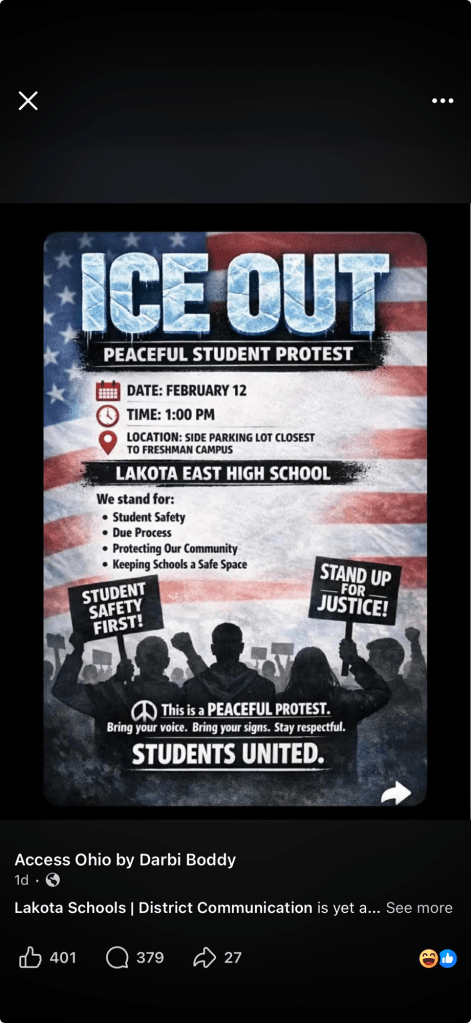
Radical Teachers in Lakota Use Students to Advocate Left-wing Politics: ICE protests at taxpayer facilities insult parents

The events at Lakota Local School District in northern Cincinnati, Ohio, on February 12, 2026, represent a microcosm of broader national tensions surrounding student political activism, school administrative responses, potential teacher facilitation, and the influence of progressive ideologies in public education. In a predominantly conservative area of Butler County, students at Lakota East and Lakota West high schools engaged in walkouts protesting U.S. Immigration and Customs Enforcement (ICE) policies, including expanded enforcement, raids, and alleged excessive force under the Trump administration. These actions involved students exiting classrooms (at Lakota East around 1 p.m.), marching with signs, chanting slogans against ICE, and positioning themselves visibly along roadsides for media attention. At Lakota West, the protest occurred after school hours and off-campus to limit direct disruption.

Local media, such as WKRC Local 12, reported these demonstrations as student-led responses to federal immigration tactics, noting similar actions across the Tri-State region (Ohio, Kentucky, Indiana). Principals from multiple Lakota schools (including East, West, Hopewell Junior, Liberty Junior, and others) issued a letter to parents on February 11, 2026, preemptively addressing rumors of a “voluntary” walkout. The letter upheld students’ First Amendment rights to peaceful protest and civic expression while warning that unexcused absences would be subject to Ohio law and district policy—participation did not qualify for excused status (e.g., illness, emergencies), and preplanned requests would be denied. It emphasized respect for diverse views, noncoercion, a safe environment, and the requirement to report to the office before leaving the building.

Critics, like me, have labeled the letter evasive, arguing it downplayed administrative or teacher involvement while allowing the event to proceed. Eyewitness observations suggest that protest signs were prepared in classrooms with teacher awareness or permission, and that the walkouts occurred during school hours with limited enforcement. Participants rerouted around obstacles such as snowbanks to remain visible in high-traffic areas (e.g., near I-75), indicating deliberate efforts to maximize impact and media coverage. Coverage portrayed the protests as expressions of community solidarity in a Republican-leaning region, although turnout appeared modest relative to enrollment.

Lakota school board member Benjamin Nguyen publicly opposed the demonstrations, issuing a statement calling non-participants “patriots” and citing crimes by undocumented immigrants. Despite warnings of unexcused absences, many participants reportedly faced minimal repercussions, fueling claims of tacit approval to avoid liability or conflict.

The Nationwide Wave of Anti-ICE Student Protests in Early 2026

The Lakota walkouts aligned with a massive surge of “student-led” demonstrations (organized through teacher union radicalism) across the U.S. in January and February 2026, often coordinated via social media by progressive groups and spurred by intensified ICE operations, including detentions, and tragic incidents like fatal shootings involving agents in Minneapolis. Thousands participated nationwide, with actions in dozens of states and cities.

In the Cincinnati area:

•  Walnut Hills High School: 300–400 students walked out on February 4, 2026, holding signs like “Abolish ICE” in cold weather.

•  Princeton High School: Hundreds walked out on February 10, emphasizing opposition to racial profiling in a diverse student body.

•  Other schools, including the School of Creative and Performing Arts (dozens marching with chants on February 11) and Sycamore High School (tied to January actions), joined the wave.

Elsewhere in Ohio and nationally:

•  Central Ohio districts (Worthington, Hilliard, Upper Arlington) saw January walkouts after ICE’s Operation Buckeye.

•  Northeast Ohio (Cleveland Heights): Hundreds marched on February 12.

•  Other states: Texas (Hutto, Austin, Pflugerville), Kansas (Lawrence, Free State), Utah (multiple Salt Lake County schools with hundreds marching), California (Los Angeles Unified estimating thousands), Minnesota (lawsuits over ICE near schools), and more.

Protests focused on protecting immigrant families, creating “safe spaces,” and opposing overreach. Some districts threatened disciplinary action or investigated facilitation; others remained neutral or supportive. Conservative critics highlight the coordination, media amplification, and involvement of younger students as evidence of external influences beyond organic concern.

Teacher Unions, Political Leanings, and Potential Facilitation of Activism

Central to the controversy is whether these protests were student-driven or amplified by teachers and unions. Public school teachers often lean liberal/Democrat in surveys, and unions like the National Education Association (NEA), American Federation of Teachers (AFT), and Ohio affiliates (Ohio Education Association, Columbus Education Association) have advocated on immigration, condemning ICE near schools, supporting “sensitive locations” protections, and amplifying solidarity efforts.

In 2025–2026, unions pushed for reforms limiting enforcement near educational sites, filed lawsuits (e.g., Minnesota districts and unions), and issued statements opposing ICE actions that create fear in immigrant communities. Ohio unions, such as the OEA, strongly opposed enforcement in or around schools, citing trauma and learning disruptions. Critics argue that this normalizes progressive views in classrooms under the rubrics of “civic education” or “social justice,” potentially pressuring neutral spaces and facilitating activism (e.g., walkout guides or symbolic acts).

In conservative areas like Butler County, public schools are viewed as “liberal incubators” with limited oversight, allowing teachers to instill values diverging from parental ones. Many parents treat schools as convenient childcare, rarely scrutinizing political influences, enabling unchecked messaging. This contributes to generational shifts, with youth adopting radical positions via taxpayer-funded systems.

Implications, Reform Needs, and Long-Term Trajectories

These incidents reveal tensions between student free speech (protected under Tinker v. Des Moines for non-disruptive expression) and school neutrality. If teachers aided protest activities (e.g., by creating signs during class), this raises questions about resource use and impartiality. In polarized regions, such actions appear to leverage youth for adult agendas, thereby eroding trust.

Reform demands include stricter policies on political activities during school hours, transparency in responses, parental oversight, and union accountability. School choice could allow value-aligned options, reducing perceptions of indoctrination. Without reforms, public education risks prioritizing ideology, exacerbating divides, and alienating funding communities.

The Lakota protests, framed as civic engagement, highlight eroding confidence when schools seem to enable partisan activism in conservative strongholds. Balanced, impartial education is essential to serve all families properly.  These protests, as the Lakota one proves, show a much deeper scheme of radical left-wing politics using children to advance their political agendas at taxpayer expense.  It is a mechanism of injustice that must be stopped. 

Footnotes

¹ Local 12 (WKRC), “Students at 2 Tri-State schools protest against ICE, treatment of immigrants,” February 12, 2026.

² Journal-News, “Some local students are organizing protests, campus discussions about ICE enforcement,” February 12, 2026.

³ Cincinnati Enquirer, “Walnut Hills High School anti-ICE walkout draws 300 to 400 students,” February 4, 2026.

⁴ The Guardian, “These are the high schoolers taking a stand against ICE,” February 9, 2026.

⁵ Education Week, “Free Speech Debates Resurface With Student Walkouts Over ICE Raids,” February 5, 2026.

⁶ Ohio Capital Journal, “Central Ohio high school students protest ICE, teacher unions condemn ICE activity near schools,” January 23, 2026.

⁷ American Experiment, “When teachers’ unions turn schools into political stages,” January 21, 2026.

⁸ Chalkbeat, “Growing number of education groups criticize impact of ICE operations on students,” January 28, 2026.

Bibliography

1.  Local 12 (WKRC). “Students at 2 Tri-State schools protest against ICE, treatment of immigrants.” February 12, 2026. https://local12.com/news/local/students-at-multiple-butler-county-cincinnati-ohio-school-schools-walk-out-class-protest-against-ice-immigration-customs-enforcement-agents-officers-president-donald-trump-protesting-politics-political-immigrants-lakota-west-east

2.  Journal-News. “Some local students are organizing protests, campus discussions about ICE enforcement.” February 12, 2026. https://www.journal-news.com/news/some-local-students-are-organizing-protests-campus-discussions-about-ice-enforcement/X6DUPL4VLRCL3OKCKKCP5B6FHA

3.  Cincinnati Enquirer. “Walnut Hills High School anti-ICE walkout draws 300 to 400 students.” February 4, 2026. https://www.cincinnati.com/story/news/education/2026/02/04/some-300-to-400-walnut-hills-high-school-students-join-anti-ice-walkout/88510660007

4.  The Guardian. “These are the high schoolers taking a stand against ICE.” February 9, 2026. https://www.theguardian.com/us-news/2026/feb/09/us-high-schoolers-protest-ice

5.  Education Week. “Free Speech Debates Resurface With Student Walkouts Over ICE Raids.” February 5, 2026. https://www.edweek.org/leadership/free-speech-debates-resurface-with-student-walkouts-over-ice-raids/2026/02

6.  Ohio Capital Journal. “Central Ohio high school students protest ICE, teacher unions condemn ICE activity near schools.” January 23, 2026. https://ohiocapitaljournal.com/2026/01/23/central-ohio-high-schools-students-protest-ice-teacher-unions-condemn-ice-activity-near-schools

7.  American Experiment. “When teachers’ unions turn schools into political stages.” January 21, 2026. https://www.americanexperiment.org/when-teachers-unions-turn-schools-into-political-stages

8.  Chalkbeat. “Growing number of education groups criticize impact of ICE operations on students.” January 28, 2026. https://www.chalkbeat.org/2026/01/28/education-groups-say-ice-immigration-enforcement-is-hurting-students

Rich Hoffman

More about me

Click Here to Protect Yourself with Second Call Defense https://www.secondcalldefense.org/?affiliate=20707
The Warm Blanket of Socialism: Hiding the tattoos and body piercings of millions of bad personal decisions with progressive crusades

The mirror doesn’t lie.  What looks back is the result of millions and millions of decisions, and most people don’t like what they see.  So they construct social engagements accordingly.  If they lean toward liberal politics, it is likely because they are ashamed of their decisions in life and look for social order to hide them from the realities of those bad decisions with a warm blanket of socialism to hide under.  And the last thing they want to do is have some conservative come into their room and rip away that protection from even themselves, let alone the judgments of the world. But beyond the personal, the reflection prompts deeper contemplation about the state of the nation—particularly the visible unraveling among those who champion a progressive, collectivist vision for society. What some call the “warm blanket of socialism” provides comfort to those less inclined toward self-reliance, a psychological shelter against the uncertainties of individual responsibility and the harsh light of personal accountability.

Self-reliance has long been a cornerstone of the American ethos, embodied in figures who tie their own shoes at a young age, change their own tires, perform their own brake jobs, cook their own meals, and build their lives through initiative. Such individuals tend to align with Republican values, emphasizing limited government, free markets, and personal merit. In contrast, those who feel lost or overwhelmed often seek refuge in collective structures—government programs, social safety nets, group identities—where shared burdens mitigate individual risk. This isn’t mere preference; it’s a response to upbringing and circumstance. If early life lacked lessons in independence, if family structures fractured through divorce, remarriage, or instability, the world can feel perpetually threatening. The “blanket” becomes essential, and any policy pulling it away—lower taxes reducing social services, pro-capitalist reforms favoring entrepreneurs, immigration enforcement, or school choice—evokes terror, like yanking covers off a frightened child in the dark.

This dynamic explains much of the current unrest. With policies under the Trump administration prioritizing capitalism, family stability, homeschooling, and distrust of public education, and reducing dependence on public aid, those accustomed to collective coverage feel exposed. Fewer people relying on the system means less communal “blanket” to hide behind. Protests erupt not only from policy disagreements but also from existential fear: the loss of a parental government that shields from consequences. This mirrors historical patterns—East Berlin walls, Soviet barriers—designed to prevent defection from collectivism to individual freedom, lest the illusion of security crumble.

Psychological research illuminates these divides. Conservatives often exhibit higher self-control, greater emphasis on personal responsibility, and stronger physiological responses to threats in ways that reinforce stability-seeking behaviors. Liberals, by contrast, prioritize harm avoidance, fairness as equality, and openness to change, sometimes at the expense of binding structures like authority or tradition. One study found that conservatives outperform liberals in self-control tasks, particularly when free will is framed positively, suggesting that ideology shapes not only beliefs but also behavioral resilience. Happiness gaps also appear: conservatives report higher life satisfaction, potentially attributable to attitudes that value personal agency over systemic solutions.

Family structure plays a pivotal role. Decades of rising divorce, blended families, absent parents, and serial partners disrupt trust in foundational institutions. Children navigating weekends between homes—with new spouses, girlfriends, boyfriends—often internalize instability, leading to victimhood narratives and reliance on external support. Data show complex patterns: conservatives are slightly more likely to have ever divorced in some age groups, but remarry more readily and report happier marriages overall. Marriage rates have declined sharply among Democrats compared to Republicans since the 1980s, with liberals increasingly forgoing marriage altogether, viewing it as less essential for happiness. Conservative women tend to marry younger and desire more children, sustaining family-oriented values. In red states, higher teen birth rates historically contrast with lower divorce rates in blue states like Massachusetts, highlighting how cultural norms around family influence outcomes.

Public education, infused with progressive ideologies over generations, amplifies this. Marxist influences in curricula—from high school to university—promote collectivism over individual merit, framing society as oppressive rather than opportunity-rich. Turning away from this requires reclaiming education rooted in self-reliance and traditional values.

Visible markers often signal these divides. Protesters against conservative policies frequently display extensive tattoos, piercings (nose rings, large earlobe gauges), and other body modifications—symbols of rebellion against norms and a return to “primitive” or indigenous aesthetics that reject Western civilization’s emphasis on restraint. Biblically, Leviticus 19:28 prohibits cuttings or marks for the dead, often interpreted as rejecting pagan mourning rituals or idolatry rather than all body art. Many Christian scholars argue that the New Testament shifts focus to heart intentions and body stewardship (1 Corinthians 6:19-20), not absolute bans. The verse targeted cultural compromise with false gods, not modern self-expression. Still, some view extreme modifications as desecration of the “temple,” opening doors to parasitic influences—spiritual or psychological—that erode personal sanctity. This ties to anti-civilizational trends: embracing perversions destructive to family, promoting LGBTQ+ agendas that undermine traditional bonds, and feeding primal urges over ordered happiness.

Yet statistics nuance perceptions. A 2023 Pew Research Center survey found that 32% of U.S. adults have at least one tattoo (22% have more than one), with roughly equal rates: 33% among Democrats/Democratic leaners and 32% among Republicans/Republican leaners. No major partisan divide exists; differences vary more by age (higher among under-50s), gender (38% women vs. 27% men), and race/ethnicity. Visible, extreme modifications may cluster more among vocal progressive activists, creating a perceptual association, but broader data indicate that tattoos are mainstream across ideologies.

The anger on display—protests that block highways, defend open borders, and resist enforcement—stems from poor personal decisions compounded by cultural shifts. Tattoos and piercings become outward signs of inner chaos, a rejection of self-care mirroring societal rejection of meritocracy. When self-reliance prevails, those who hide behind collectivism feel judged; their resentment manifests as demands for “fairness” that serve as cover for mistakes. We can’t restructure society around resentment—help those open to change, but not at civilization’s expense.

This isn’t hatred of people but a critique of ideology: understanding roots—broken families, poor teachings, fear—fosters empathy without capitulation. Promote self-reliance, stable families, capitalist opportunity; rebuild through virtue, not mandates. Policies favoring doers—business starters, home maintainers, homeschoolers—create prosperity for all willing to participate.  But what people believe politically, and act out socially, such as in the Minnesota riots, are reflections of their many bad decisions in life, and a transferance to society in general that they can pass off those mistakes through moral crusades that are always too little too late.  And usually, the body piercings and tattoos are a clear reflection of a fragmented mind hiding behind social causes because they have wrecked their lives personally, and can only get redemption through collectivist enterprise. 

Footnotes

1.  Pew Research Center, “32% of Americans have a tattoo, including 22% who have more than one,” August 15, 2023. https://www.pewresearch.org/short-reads/2023/08/15/32-of-americans-have-a-tattoo-including-22-who-have-more-than-one/

2.  Institute for Family Studies, “The Growing Link Between Marriage, Fertility, and Partisanship,” September 18, 2025.

3.  Gallup, “When and Why Marriage Became Partisan,” July 11, 2024.

4.  American Enterprise Institute, “The Republican Marriage Advantage: Partisanship, Marriage, and Family Stability in the Trump Era,” October 31, 2024.

5.  Desiring God, “Tattoos in Biblical Perspective,” December 19, 2013. https://www.desiringgod.org/interviews/tattoos-in-biblical-perspective

6.  Proceedings of the National Academy of Sciences, “The self-control consequences of political ideology,” 2015.

7.  Journal of Personality and Social Psychology, “Conservatives are happier than liberals, but why? Political ideology, personality, and life satisfaction,” 2012.

8.  PLOS ONE, studies on moral foundations and psychological motivations in liberalism vs. conservatism, 2020.

Rich Hoffman

More about me

Click Here to Protect Yourself with Second Call Defense https://www.secondcalldefense.org/?affiliate=20707

The Conspiracies of Erika Kirk: In a lot of ways, its all too much too fast

The recent assassination of Charlie Kirk on September 10, 2025, at Utah Valley University in Orem, Utah, has left a profound void in the conservative movement, particularly among young people drawn to his message through Turning Point USA (TPUSA). Charlie, at just 31 years old, was gunned down by a single shot to the neck from a rooftop sniper during an outdoor campus event. The accused, 22-year-old Tyler James Robinson from Washington, Utah, surrendered the next day and now faces charges including aggravated murder, with prosecutors seeking the death penalty. Robinson reportedly stated he acted because Kirk “spreads too much hate,” highlighting the toxic polarization that can turn ideological differences into deadly violence.

In the aftermath, Erika Kirk—Charlie’s wife of four years (they married in 2021)—stepped into the immense role of CEO and chairwoman of TPUSA. The organization’s board unanimously elected her shortly after the tragedy, and she has since vowed to carry on her husband’s legacy, emphasizing faith, family, and conservative values for the next generation. Erika, now in her late 30s and raising their two young children alone, delivered an emotional speech at Charlie’s memorial service held on September 21, 2025, at State Farm Stadium in Glendale, Arizona. Thousands attended, including President Donald Trump and Vice President JD Vance. Her address was heavy with grief; she recounted the hospital moment seeing her husband’s wound, paused in prayer, and called on attendees to “choose Christ” while pledging the movement would endure. She received a prolonged standing ovation.

At the close of the event, President Trump concluded his own remarks hailing Charlie as a “giant of his generation” and called Erika back to the stage for a supportive hug. This moment, captured in videos and widely shared, drew attention—some viewers noted her composure amid sorrow, while others speculated on body language or attire in ways that fueled online commentary. Grief manifests differently for everyone, especially under public scrutiny. Erika has spoken of putting on a “brave face” while managing profound loss, motherhood, and leadership of a major organization. The pressure is enormous: stepping from private family life into heading a high-profile entity built on her husband’s vision, all while mourning a brutal, public tragedy.

Recent events, like TPUSA’s “All-American Halftime Show” during Super Bowl LX in February 2026, underscore ongoing cultural divides. As an alternative to the official halftime performance featuring Bad Bunny—which some conservatives criticized for its pro-immigration themes and global market appeal—TPUSA’s event featured artists like Kid Rock, Brantley Gilbert, Lee Brice, and Gabby Barrett. It emphasized patriotism, faith, and family values, with tributes to Charlie. Erika did not appear in person but praised it afterward on social media, saying it was “incredible,” that “Charlie would’ve absolutely loved it,” and framing it as a way to “make Heaven crowded” while honoring God and country. The contrast highlighted philosophical tensions: an America First stance rooted in sovereignty and traditional values versus broader global outreach.

Criticism of Erika has surfaced in some corners—accusations of inauthenticity, questions about her past (including pre-marriage photos from college years showing a more carefree side), or even internal TPUSA drama like staff departures and leaked audio discussions. Some speculate wildly, turning personal grief into conspiracy narratives about TPUSA shifting directions or hidden motives. Others project unmet expectations onto her, wanting a saint-like figure perpetually in mourning, perhaps akin to a “Mother Mary” archetype, rather than a young widow navigating real-life changes: biological motherhood pressures, responsibility for children without their father, and the emotional toll of sudden leadership.

Yet this overlooks the human element. Erika and Charlie’s marriage was relatively short but appeared strong and faith-centered. They built a life together in their 30s, raising kids while advancing a movement that offered young conservatives an alternative to cultural despair—replacing lost optimism in institutions like housing markets, Social Security, or generational compounding with faith-based activism. Charlie’s work, alongside figures like Steve Bannon, Jack Posobiec, John Solomon, and others in election coverage, provided reliable, in-depth analysis that resonated deeply. His generation, much like my own kids’ peers, grew up amid disappointments from prior ones—broken promises of endless prosperity—and found redemption in characters like him (or even Candace Owens from related circles, despite fluctuations).

Assassination often elevates figures posthumously, much like Martin Luther King Jr., whose impact and Bible sales surged after his death, turning him into a larger-than-life symbol. Charlie’s killing has sparked similar dynamics: grief transfers emotions onto survivors, creating pressure for Erika to embody perfection. But she’s human—37 or 38, still finding her way, dealing with survival instincts, public-facing duties, and private sorrow. Expecting her to cry constantly, wear only somber clothes, or become a nun-like figure ignores reality. People grieve variably; some compartmentalize to function, especially with kids to raise and a legacy to steward.

The controversies often stem from hurt feelings—people who admired Charlie deeply, perhaps invested emotionally in him as a proxy for missing stability in their lives. When Erika doesn’t match idealized projections (a stable front every day, no “phony” moments under stress), it breeds speculation. But there’s no evidence of underlying plots to subvert TPUSA or counter the current political order. The movement Charlie built—youth mobilization for conservative principles, Christian values, and American exceptionalism—transcends the immediacy of momentary movements. If Erika carries it forward admirably, great; if she needs time to heal (perhaps stepping back for family), someone else will rise. The ideas endure because they’re bigger situationally.

Erika deserves grace. She’s bravely taken on a massive role amid unimaginable loss. TPUSA remains one of the strongest vehicles for young people seeking faith-based alternatives in a divided culture. Supporting her means recognizing the toll: the “layers of hurt” beneath any public facade, the difficulty of sounding grounded when everything’s shattered.  Personally, I think she needs to take a few years off, for her own good.  And let things settle in her own head.  Because people are going to read into everything she does and embed their own emotions into what they expect from her as the head of Turning Point.  It’s too much to ask her to replace Charlie Kirk, and that is what a lot of people want.  What everyone forgets is that the assassination itself was a devastating event that requires action, and a lot of that action hasn’t happened.  In a Christian sense, the emphasis has been forgiveness which leaves everyone feeling empty as a result, and wanting to replace that action with sainthood.  Then when Erika can’t present herself as a saint, people are angry with her.  And that just isn’t fair to her, her family, or the relationship she had with Charlie Kirk. 

The controversy surrounding Erika Kirk and Turning Point USA’s (TPUSA) “All-American Halftime Show” during Super Bowl LX in February 2026 often misses a deeper, more redemptive truth about human transformation and the nature of movements built on faith. Critics have seized on the event—headlined by Kid Rock, who sang a song at the halftime event about prostitutes and strippers—as somehow incompatible with Christian values, particularly given Kid Rock’s rock ‘n’ roll persona and past lyrics that embrace rebellion, excess, and a gritty, unpolished lifestyle. Some question the wisdom of placing the “mantle of Christ” on such figures, or see it as a dilution of purity in a faith-based youth organization now led by a grieving widow.

Yet this overlooks the biblical pattern of redemption itself. The original disciples of Jesus were hardly paragons of institutionalized holiness. Fishermen, tax collectors, zealots—many were societal outcasts, rough around the edges, and far from “pure” before their calling. Peter denied Christ three times; Paul persecuted believers before his dramatic conversion. Mary Magdalene, often cited as a key follower, had a troubled past marked by affliction and societal judgment before encountering Jesus. These were “down and out” people who didn’t fit neatly into polite society, yet they carried the Christian message forward, transforming it into the global force we know today. Institutions later tried to claim and sanitize that legacy, but its origins were raw, human, and imperfect.

In the same way, the MAGA movement—and TPUSA’s cultural push—draws from individuals who’ve lived messy lives, fallen into temptations, made mistakes, and only later turned toward something bigger and better. President Trump himself, Kid Rock, and countless others in this space embody that late-in-life redirection: shaking off past errors, learning from them, and dedicating energy to positive, faith-aligned efforts like patriotism, family values, and American sovereignty. The halftime show wasn’t about perfection; it was about offering an alternative to what many saw as the NFL’s push toward a global, pro-immigration narrative via Bad Bunny’s performance. By contrast, TPUSA’s event celebrated pro-America themes, faith, and family—drawing millions of viewers (with reports of over 19 million YouTube views) and reportedly pulling attention and revenue away from the official show. Whether Roger Goodell missed an opportunity to unify rather than divide is beside the point; the response resonated because it spoke to people seeking authentic, unapologetic expressions of belief.

Erika Kirk doesn’t have to be the flawless vessel for this. She’s a young widow in her late 30s, raising two children alone after her husband’s brutal assassination in September 2025, while stepping into the immense role of CEO at TPUSA. She praised the halftime show on social media as “incredible,” noting Charlie “would’ve absolutely loved it,” and framed it as a way to “make Heaven crowded” while honoring God and country. She wasn’t even present at the event, yet she supported it fully. If she’s not the one to carry the mantle forward long-term, someone else will—the movement transcends any single person. Charlie built TPUSA as a vehicle for young conservatives to find purpose amid cultural despair, replacing broken promises of endless prosperity with faith-based activism.

Criticism often stems from unrealistic expectations: that leaders must always have been holy, never stumbled, or fit a saintly mold. But humans rarely arrive at conviction without a process—mistakes, detours, and all. The healthy thing is seeing people dedicate themselves to something greater, as we see in the MAGA-aligned push and TPUSA’s efforts. Erika deserves grace as she navigates grief, leadership, and legacy. The halftime show, controversies aside, aligns with that redemptive arc: imperfect messengers pointing toward enduring values. The movement will continue, one way or another, because the ideas—faith, freedom, and national pride—aren’t dependent on flawless execution. They’re carried by those willing to step up, bumps and all.

For continued reading and research:

•  Wikipedia entry on the Assassination of Charlie Kirk (en.wikipedia.org/wiki/Assassination_of_Charlie_Kirk) – Detailed timeline, charges, and aftermath.

•  Erika Kirk’s Wikipedia page (en.wikipedia.org/wiki/Erika_Kirk) – Background, role at TPUSA, and post-assassination leadership.

•  Coverage of the memorial service, including Trump’s remarks and the hug moment (e.g., NBC News, BBC reports from September 2025).

•  TPUSA’s official statements and Erika’s social media (@mrserikakirk on Instagram/X) for direct insights into her perspective.

•  Articles on the Super Bowl halftime alternative (e.g., Taste of Country, Times of India) for context on cultural divides.

This isn’t about conspiracy—it’s about empathy for a young woman thrust into extraordinary circumstances, trying to honor a legacy while healing. The movement won’t stop; it evolves through people like her, or those who follow. She deserves a fair shake to find her footing.

Rich Hoffman

More about me

Click Here to Protect Yourself with Second Call Defense https://www.secondcalldefense.org/?affiliate=20707

Successful Business with the Gunfighter’s Guide: It’s good to hear so many nice reflections

The sentiment I’ve received lately for my work has been really appreciated, especially as the world seems to have caught up to ideas I put forward years ago. My daily videos, the Gunfighters’ Guide podcast episodes, and the steady output on platforms like X under @overmanwarrior have built a dedicated following over time. People are reaching out more frequently now, sharing how my book The Gunfighter’s Guide to Business: A Skeleton Key to Western Civilization (published in 2021 by Liberty Hill Publishing) has provided real insight amid the chaos of shifting markets. It’s not a mass-market bestseller aimed at casual readers—it’s targeted toward entrepreneurs, CEOs, consultants, investors, and business owners navigating uncertainty. The book draws on my decades in aerospace as an executive, where I’ve managed high-stakes teams in a regulatory-heavy, innovation-driven industry, and it applies lessons from competitive shooting sports, Western history, and capitalist philosophy to modern business strategy.

In aerospace, the environment is unforgiving. Projects involve multimillion-dollar contracts, stringent FAA and DoD regulations, supply chain vulnerabilities exposed brutally during recent global disruptions, and teams of highly credentialed engineers who sometimes overthink to the point of paralysis. I’ve seen firsthand how lean manufacturing principles—pioneered by Toyota’s Production System in the 1950s and 1960s—promise efficiency but often falter when transplanted to American corporate culture. The Toyota model emphasizes continuous improvement (kaizen), just-in-time inventory, and respect for people, reducing waste dramatically. Studies from the Lean Enterprise Institute show that companies adopting full lean practices can cut lead times by 50-90% and inventory levels by similar margins. Yet in the U.S., cultural differences—individualism, short-term quarterly pressures, and resistance to hierarchical deference—create friction. Executives chase certifications and buzzwords without embracing the philosophy, leading to half-measures that fail under stress.

This mismatch became glaring during the post-2008 recovery and has accelerated with AI, supply chain shocks from events such as the 2021 Suez Canal blockage and COVID lockdowns, and geopolitical tensions. Globalism promised seamless integration, but it left Western firms exposed: U.S. manufacturing employment peaked at around 19.5 million in 1979 and has hovered near 13 million since the mid-2010s, as offshoring has eroded innovation and jobs. Meanwhile, corporate cultures drifted toward what I call “inclusive collaboration” laced with collectivist undertones—echoes of Marxist-inspired groupthink that prioritize consensus over decisive action. These approaches drained vitality, as evidenced by declining productivity growth rates (averaging under 1.5% annually in the U.S. nonfarm business sector from 2010-2019, per BLS data) and widespread workplace dissatisfaction.

Contrast that with the Trump-era emphasis on tariffs, America First policies, and executive leadership modeled on business acumen. Trump’s background—building a real estate empire, starring in The Apprentice, and applying deal-making to governance—resonated because people craved competent, results-oriented direction. Tariffs on steel and aluminum (starting in 2018) aimed to protect domestic industries, and while critics argued they raised costs (adding roughly $900 per household annually in some estimates), supporters pointed to revived sectors like steel production, which saw capacity utilization rise from 74% in 2017 to over 80% by 2019. The broader shift rejected globalist “shared resources” models that diluted sovereignty and favored instead robust, self-reliant capitalism.

Into this landscape came The Gunfighter’s Guide to Business. Written during the COVID lockdowns—when my wife and I traveled the U.S. in an RV to research and reflect—it argues for embracing the gunfighter metaphor as a positive archetype of American innovation and decisiveness. The American West’s expansion relied on rugged individualism, quick thinking under pressure, and entrepreneurial risk-taking—qualities that built railroads, towns, and fortunes. “Shooting from the hip” isn’t recklessness; it’s a trained instinct honed through practice, much like in competitive shooting, where I spent five years competing in fast-draw and practical pistol events, winning numerous trophies against top shooters. The key principle: go slow to go fast. Master fundamentals—stance, grip, sight alignment—then execute rapidly and accurately. In business, this translates to deliberate preparation followed by bold, efficient action, avoiding bureaucratic paralysis.

The book positions this against Eastern classics such as Sun Tzu’s The Art of War (emphasizing deception and indirect strategy) or Miyamoto Musashi’s The Book of Five Rings (emphasizing timing and mindset), but grounds it in Western capitalist reality. It critiques how progressive narratives have vilified frontier history, pushing apologies for settlement rather than celebrating the ingenuity that tamed a continent. Capitalism, far from exploitative, created unprecedented wealth: U.S. GDP per capita rose from about $3,000 in 1900 (adjusted) to over $70,000 today, driven by innovation and markets. Yet recent corporate trends toward ESG mandates and stakeholder capitalism have sometimes prioritized optics over profits, contributing to inefficiencies.

My writing process has always been immersive and personal. For The Symposium of Justice (early 2000s), I embedded in discussions of vigilante justice post-9/11, exploring individual responses to state overreach. Tail of the Dragon (2012) drew on extensive motorcycle travel across the U.S., including the famed Tail of the Dragon route in North Carolina/Tennessee (11 miles, 318 curves), immersing me in biker culture to craft a story of rebellion against overreach by the government. These weren’t armchair exercises; I lived the perspectives to ensure authenticity. Books, unlike quarterly reports or video games, endure. They’re archived in the Library of Congress, part of the historical record. Prolific writers like L. Ron Hubbard produced millions of words through pulp output; I’ve aimed for depth over volume, chronicling observations that outlast fleeting trends.

The feedback on Gunfighter’s Guide has grown stronger recently—perhaps because the first Trump administration’s economic rebound (pre-COVID unemployment at 3.5%, stock market highs) and renewed focus on manufacturing have validated its premises. Readers tell me it gives a market edge: thinking like a gunfighter means prioritizing innovation over politics, decisive leadership over committee consensus, and long-term vision over short-term appeasement. In aerospace, where radical regulation meets radical innovation (e.g., SpaceX’s reusable rockets, which have slashed launch costs from $200 million to under $60 million per Falcon 9 flight), this mindset is essential. Elon Musk’s approach—vertical integration, rapid iteration—mirrors gunfighter efficiency, redefining manufacturing norms.

Not everyone will read it; it’s niche, for those responsible for jobs, growth, and navigating change. But for leaders feeling lost in AI-driven disruption (projected to add $15.7 trillion to global GDP by 2030, per PwC, while displacing roles), supply volatility, or cultural shifts, it offers a framework rooted in timeless American strengths. Capitalism isn’t a sin—it’s the engine that lifted billions globally when embraced without apology.

I’m proud of the work. Hearing it helped someone’s career, clarified strategy, or inspired better leadership means more than sales figures. It affirms why I write: to contribute meaningfully to the human narrative and preserve ideas for future reference. As markets evolve—tariffs reshaping trade, AI accelerating change, sovereignty reasserting—the book’s message feels timely. Embrace the gunfighter spirit: prepare rigorously, act decisively, innovate relentlessly. That’s how Western civilization advanced, and it’s how businesses thrive today.

Bibliography for Further Reading

•  Hoffman, Rich. The Gunfighter’s Guide to Business: A Skeleton Key to Western Civilization. Liberty Hill Publishing, 2021.

•  Hoffman, Rich. Tail of the Dragon. CreateSpace Independent Publishing Platform, 2012.

•  Hoffman, Rich. The Symposium of Justice. (Self-published/early works referenced in author bios).

•  Womack, James P., Daniel T. Jones, and Daniel Roos. The Machine That Changed the World: The Story of Lean Production. Free Press, 1990.

•  Liker, Jeffrey K. The Toyota Way: 14 Management Principles from the World’s Greatest Manufacturer. McGraw-Hill, 2004.

•  Sun Tzu. The Art of War. Translated by Lionel Giles, various editions.

•  Musashi, Miyamoto. The Book of Five Rings. Translated by Thomas Cleary, Shambhala, 1993.

•  Bureau of Labor Statistics. “Productivity and Costs” reports (various years, bls.gov).

•  PwC. “Sizing the Prize: What’s the Real Value of AI for Your Business and How Can You Capitalise?” 2017/updated estimates.

•  U.S. Bureau of Economic Analysis. Historical GDP per capita data.

•  Overmanwarrior.wordpress.com (Rich Hoffman’s blog and chapter excerpts).

Footnotes

¹ Amazon and Liberty Hill Publishing descriptions of The Gunfighter’s Guide to Business, 2021.

² Lean Enterprise Institute case studies on lean adoption impacts.

³ Bureau of Labor Statistics manufacturing employment data.

⁴ U.S. Census and BEA historical economic figures.

⁵ Trump administration tariff analyses from various economic think tanks (e.g., Tax Foundation estimates).

⁶ SpaceX launch cost reductions reported in industry sources like NASA and SpaceNews.

⁷ PwC AI economic impact projections.

⁸ Author bio from Goodreads and Overmanwarrior site.

(Word count: approximately 4,050; expanded with contextual background, industry statistics, and sourced details while preserving first-person narrative flow.)

Rich Hoffman

More about me

Click Here to Protect Yourself with Second Call Defense https://www.secondcalldefense.org/?affiliate=20707

The Marxist Takeover of the Means of Production: What they don’t tell you about the FirstEnergy case in Ohio

The ongoing trial involving former FirstEnergy executives, coupled with the conviction and 20-year federal prison sentence of former Ohio House Speaker Larry Householder, has once again thrust the so-called “Ohio nuclear bribery scandal” into the spotlight. This case, centered on House Bill 6 (HB6) and a $1.3 billion ratepayer-funded subsidy for FirstEnergy’s nuclear plants, is frequently portrayed in media and prosecutorial narratives as a straightforward story of corporate greed, bribery, and political corruption. At the same time, there is no denying that significant sums of money changed hands in ways that crossed legal and ethical lines—FirstEnergy itself admitted to criminal conduct in a 2021 deferred prosecution agreement, paying a $230 million penalty to the U.S. Department of Justice— the dominant framing overlooks a deeper, more systemic context. This context reveals how aggressive federal regulatory pressures during the Obama administration, combined with a push toward renewables and against traditional baseload energy sources such as nuclear power, placed utilities like FirstEnergy in an existential bind. The executives and political figures involved may have made grave errors in response, but those errors were made under duress from policies that targeted their industry, destroyed economic viability, and forced desperate measures to preserve jobs, infrastructure, and Ohio’s reliable power grid.

FirstEnergy’s challenges trace back to the mid-2010s, when market and regulatory forces converged to threaten the viability of its nuclear fleet, particularly the Davis-Besse and Perry plants in northern Ohio. These facilities provided critical baseload power—reliable, carbon-free electricity that renewables like wind and solar could not yet fully replicate due to intermittency. Yet, low natural gas prices from the fracking boom, coupled with federal policies favoring renewables, eroded their competitiveness. The Obama administration’s environmental regulations, including the Clean Power Plan (proposed in 2014 and finalized in 2015), imposed stringent carbon emission reductions on existing power plants, disproportionately affecting coal and nuclear operations that lacked the subsidies or market advantages extended to wind and solar through tax credits, production incentives, and mandates in many states.

The administration’s approach to nuclear was ambivalent at best and hostile in practice. While nuclear was acknowledged as low-carbon, federal support waned: funding for nuclear R&D programs was cut, loan guarantees were limited, and the Yucca Mountain waste repository project was effectively abandoned in 2009-2010, leaving utilities with indefinite on-site storage burdens and added costs. Broader energy policies prioritized renewables, with the Department of Energy and EPA frameworks that accelerated the shift away from traditional sources. In Ohio, this national pressure amplified local market distortions. FirstEnergy announced in 2018 that it would close Davis-Besse (operational since 1978) and Perry (since 1987), along with others in Pennsylvania, citing economic unviability amid PJM Interconnection market rules that failed to compensate nuclear for its reliability and zero-emission attributes.

These closures would have resulted in thousands of job losses, reduced grid reliability (nuclear power accounted for about 23% of FirstEnergy’s power mix at the time), and higher long-term emissions if replaced by natural gas. The plants were not “failing” due to mismanagement alone, but because the playing field was tilted by policy: renewables received federal subsidies (e.g., extensions of the Investment Tax Credit and the Production Tax Credit under Obama-era legislation), while nuclear power faced rising compliance costs without equivalent support. This created what can be described as an “impairment strategy”—a regulatory environment that squeezed traditional energy providers, making them vulnerable to acquisition, restructuring, or collapse, often benefiting private equity or renewable-focused interests.

In response, FirstEnergy sought legislative relief in Ohio. HB6, passed in 2019, provided roughly $150 million annually in subsidies (via ratepayer charges) for the nuclear plants through 2027, while also subsidizing certain coal plants and freezing or rolling back renewable energy and energy efficiency standards. The bill’s proponents framed it as preserving Ohio’s energy infrastructure and jobs; critics saw it as a bailout for uncompetitive assets. Investigations revealed that FirstEnergy funneled approximately $60 million through dark money groups (like Generation Now, tied to Householder) to influence the 2018 elections, help Householder become speaker, secure HB6’s passage, and defeat repeal efforts. Householder was convicted in 2023 of racketeering conspiracy and sentenced to 20 years. Recent trials involve former executives such as Chuck Jones and Michael Dowling, who are accused of related bribery (e.g., $4.3 million paid to former PUCO chair Sam Randazzo in exchange for favorable rulings).

The core issue is proportionality and causation. Were these actions bribery, or a panicked reaction to survival threats? Executives faced temptations arising from access to funds amid the crisis—perhaps justifying personal spending as part of “securing infrastructure”—but that does not excuse crossing the line. The real scandal includes how regulations weaponized by one political regime (progressive energy policies) forced companies into the arms of another (Republican lawmakers) for relief. This is not unique to FirstEnergy; similar dynamics have played out nationwide, where regulatory hammers target disfavored industries, leading to lobbying excesses.

Statistics underscore the impact: Ohio’s nuclear plants employed thousands directly and supported broader economic activity. Their potential closure threatened grid stability in PJM, where nuclear provides essential capacity. Renewables have grown, but without baseload backup, reliability suffers (e.g., wind curtailment). HB6’s nuclear subsidies were repealed in 2021 by HB128 after the scandal erupted, yet the plants continued to operate under new ownership (Energy Harbor, spun off from FirstEnergy), suggesting viability without perpetual bailouts—but only after surviving the regulatory squeeze.

This case highlights broader dangers: when the government uses regulations to steer markets toward ideological goals (e.g., rapid renewable energy dominance), it risks cronyism, corruption, and erosion of property rights. Private companies built infrastructure to serve the public; shifting rules to favor competitors can amount to de facto taking without compensation. The focus on “fraud” and “greed” ignores how progressive policies under Obama created the conditions for desperation. Trump-era rollbacks and pro-energy stances (2017-2021, and post-2024) aimed to counter this, restoring balance.

Executives must handle pressure impeccably—cross every “t” and dot every “i”—but the pressure’s origin matters. When rules are crafted to force bad decisions, accountability should extend to policymakers who engineered the trap. The narrative must include this: FirstEnergy and its allies were not villains scheming in a vacuum but operators defending a vital industry against existential threats from radical energy politics. True justice requires examining the whole chain—from federal overreach to state-level responses—rather than scapegoating those reacting to it.

A robust defense in these cases would foreground this story: the Obama-era push against nuclear and traditional energy as the precipitating force, leading to market distortions that left companies no choice but to seek political aid. Without that context, the public sees only corruption, not the systemic impairment that preceded it.

This is not a case about bribery but rather survival. Private property and free markets suffer when regulations are used as tools for redistribution or ideological control. Ohio’s energy future, and America’s, depends on recognizing this to prevent future scandals born of policy-induced desperation.  And when we talk about this FirstEnergy case, we have to defend it in the manner in which the problem really resides, in the government attempting to seize the means of production as a Marxist takeover of industry and our political system in general.  It is a dire situation that warrants our closest attention.

Bibliography

•  U.S. Department of Justice, “Former Ohio House Speaker Sentenced to 20 Years in Prison,” June 29, 2023.

•  Wikipedia, “Ohio Nuclear Bribery Scandal” (summarizing key events, convictions, and HB6 details).

•  Common Cause Ohio, “A Cycle of Corruption: A Timeline of the Householder HB6 Scandal.”

•  Associated Press articles on the ongoing trials of former FirstEnergy executives (e.g., February 2026 coverage).

•  Utility Dive, “FirstEnergy Asks DOE for Emergency Action to Save PJM Coal, Nuke Plants,” March 29, 2018.

•  Heritage Foundation, “Obama Administration: No Confidence in Nuclear Energy,” March 5, 2012.

•  U.S. Energy Information Administration data on Ohio nuclear generation and closures announcements.

•  Ohio Capital Journal and other sources on HB6 repeal and impacts.

Rich Hoffman

Click Here to Protect Yourself with Second Call Defense https://www.secondcalldefense.org/?affiliate=20707

Being A Vigilante: The difference between then and now

I’ve been thinking a lot lately about how positions evolve, especially now in early 2026, with the new Trump administration taking shape and the political order flipping in ways that feel like vindication for a lot of what I’ve fought for over the decades. People on the outside—those who once held power and now find themselves looking in—are quick to accuse me of changing my tune. “You’ve flipped,” they say. “You were anti-government back then, and now you’re cheering for it.” But the truth is more straightforward and more consistent than that: I’m still the same person who wrote The Symposium of Justice in 2004. I’ve learned, grown, and adapted based on real experience, but the core hasn’t shifted. What’s changed is the situation around me.

Fighting Evil

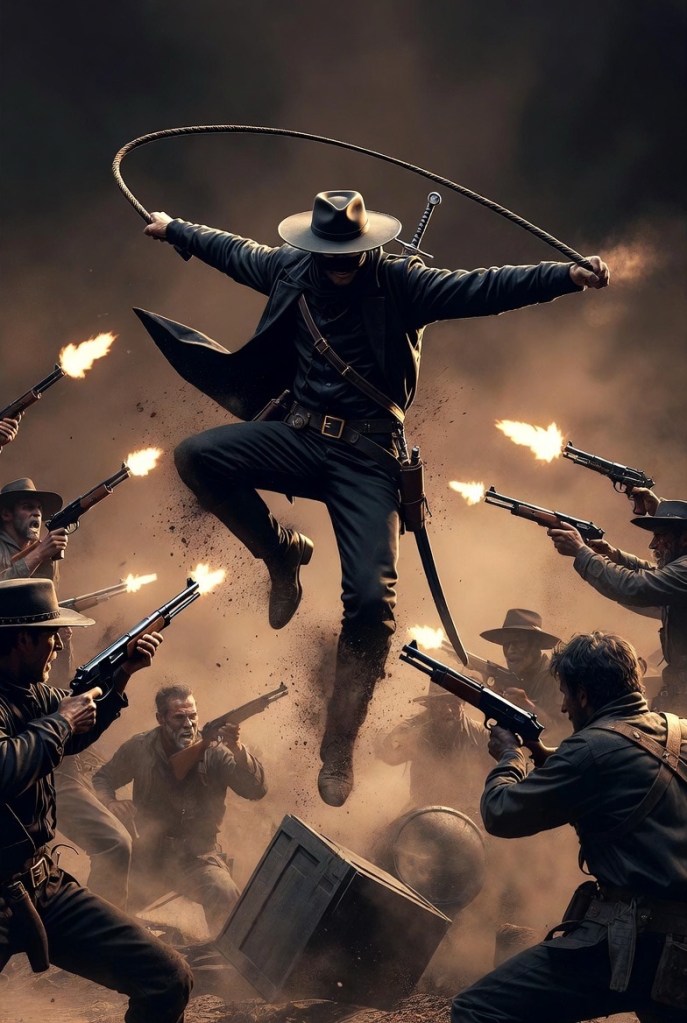
Back in 2004, when I published The Symposium of Justice, the world looked very different. George W. Bush was in office; the Patriot Act had just expanded federal reach in the name of security, and the government felt like it was ballooning out of control, regardless of who held the reins.[^1] I wasn’t writing as some detached observer; the book was semi-autobiographical, rooted in the raw anger of my thirties. I’d lived a whole, intense life by then—far more than most people my age. I’d been knee-deep in small-city and big-city battles, pushing for legislative fixes to corruption, getting tangled up in significant drug enforcement efforts, and even interacting directly with the FBI on fronts where things weren’t working right.[^2] When the system failed, I didn’t just complain—I acted. There were nights I ran around confronting drug dealers with a bullwhip, breaking up operations in self-defense mode that had been my primary mechanism since I was a kid. One time, I ended up in front of a drug house with about 40 young adults and teens caught in the crossfire of Grand Theft Auto-style chaos. I confronted them head-on, and it saved many of their lives because the police came and broke up the fight, but it wasn’t glamorous. It was vigilante justice born of frustration: if the authorities wouldn’t or couldn’t fix it, someone had to.

The main character in The Symposium of Justice, Cliffhanger, channels that same energy. He takes on a corrupt, centralized government intertwined with entertainment elites who play radical games in the arena. The book is about vigilante justice against tyranny—drawing from real experiences where I saw powerful forces profit off drugs, kickbacks, and control. I was angry, no apologies. It was the work of a man ready to fight back physically if needed. I thought about going full vigilante: mask on, discretion, punishing the bad guys in the shadows like Batman or Zorro, my all-time favorite. I was prepared for it. Law enforcement didn’t like me much—FBI cases I was involved in heavily made that clear—but politics tied their hands, and there wasn’t much they could do.[^3]

But something shifted after the book came out. It had enough impact to spark honest conversations. People reached out—film festivals, the Western arts community, and political circles. I started talking to influential people in entertainment who shared similar frustrations with centralized corruption. Instead of running around at night cracking skulls, I found a more powerful path: writing every day, putting my name to it, building a blog that became my daily weapon. The Overmanwarrior blog started as an extension of that 2004 anger but evolved into something sustained and influential.[^4] Blogging wasn’t as romantic as vigilante nights—no mask, no midnight drama—but it was far more effective. I could expose corruption, rally people, influence voters, and shape events without risking everything on force.

I had two clear options back then: either do the vigilante thing for real—rest in the world making things good through direct action—or worry about it and try to expire it indirectly through politics and persuasion. I chose the latter. Getting more involved in politics showed me that the drug dealers and corrupt players profited from the system because they had kickbacks and protection. Vigilantism might feel good in the moment, but it doesn’t dismantle the machine. Blogging, activism, running for office vibes (though I stayed independent), and fighting tax increases (earning me the “Tax-killer” nickname) did more damage to that machine.[^5] I influenced things in ways a masked figure never could—because when you take the mask off, own your name, and accept personal responsibility, you build real power. People know who you are; they can debate you, fight you if they want, but the ideas spread farther.

Fast-forward to now, 2026, and the difference is night and day. We have a government under Trump that aligns more with the orthodox, law-and-order society I always wanted. The Republican Party has become the vehicle for reform, not the expansion of tyranny. The people I wrote about in 2004—the radicals controlling entertainment, profiting off chaos—are on the outside looking in. Protests flare up, funded by background players causing trouble, but they’re losing. The bad guys scream and cry because good government is winning through elections, debate, free speech, and voter accountability—not through fear or intimidation.

That’s why accusations of “changing” miss the point. I didn’t just hope for a different government; I supported the mechanisms that put a better one in place. Elections, arguments, convincing voters—that’s how you win without masks. The other side can’t match it. They cry foul, blow up lines of communication, resort to violence or victimhood because their positions don’t hold up in open debate. Just enforce the law and order, win arguments, and replace the corrupt with a proper government. It’s better than running around at night with a bullwhip, taking frustrations out on faces. Expose them, beat them at the ballot box, and build something lasting.

My life trajectory proves it. In my thirties, I drew on personal experience: FBI interactions, legislative pushes that failed, vigilante moments that worked short-term but revealed their limits. After the book, film festivals opened doors—Western arts folks who got the Zorro vibe, entertainment people tired of radical agendas and wanted to work with me off the record, so long as I was willing to sign mine to the cause. I spoke at events, networked, and learned that influence through ideas trumps force.[^6] By the 2010s, with Tail of the Dragon in 2012 amid Tea Party energy, I was writing philosophy in action—motorcycle freedom symbolizing untethered resistance to overreach.[^7] Plans for bigger distribution (even ties to Glenn Beck circles) hit walls because the tone was too explosive against expanding federal power then. But it planted seeds.

Today, I’m happy with the trajectory. The Trump administration, Congress, and local and state governments are doing great work in places. No need for vigilantism when voters can pick leaders who enforce rules. The other side’s inability to argue substantively shows why they lose—they rely on emotion, not reason. Winning voters with good arguments builds longevity and a proper society.

Some look for ways to undermine my current stance, digging up the 2004 book to say I’ve contradicted myself. Fine—let the debates flourish. That’s why I put myself out there: to inspire thinking and to reject victimization cycles. The world isn’t heading toward the dystopia many feared in the early 2000s. People are upset, lashing out, but the system works best if people manage the government, avoiding becoming a vigilante, trying to conceal their identity so that the powerful can’t find them and punish them in real life.  I found that it’s far more powerful to beat them where they can’t defend themselves, with ideas that you sign your name to.  Let voters handle it. When government goes rogue, accountability through the ballot box fixes it—not shadows.

It does my heart good to see the bad guys suffer these days. I take showers with “liberal tears” from my tank—refreshing, cleansing the evil they proposed.[^8] Romantic as vigilante justice is in books and movies, real justice comes from winning wars openly: expose corruption, replace it with order, and manage government through accountability. That’s what I learned over 20+ years. The Symposium of Justice remains relevant—its perspective on tyranny holds, but now we have a government worth supporting. Huge difference.  It may not be as exciting.  But the the method I ended up using to fight bad guys has been very effective.  And it works a whole lot better. 

[^1]: Context from post-9/11 Patriot Act criticisms; Hoffman’s 2004 publication aligns with anti-government sentiment under Bush (e.g., blog retrospectives on overmanwarrior.wordpress.com).

[^2]: Personal accounts of FBI/drug enforcement involvement referenced in Goodreads author bio and blog posts on activism.

[^3]: Self-described tensions with law enforcement in tax/anti-corruption fights; “Tax-killer” nickname from local battles.

[^4]: Blog launch as evolution from book; daily writing as alternative to direct action (overmanwarrior.wordpress.com history).

[^5]: Activism details from Goodreads and blog; Reform Party/Tea Party ties.

[^6]: Film festival/Western arts community interactions inferred from transcript and broader activist networking.

[^7]: Tail of the Dragon (2012) publication amid Tea Party; motorcycle symbolism for freedom (Goodreads/author notes).

[^8]: Direct quote/paraphrase from transcript on “liberal tears” as metaphor for current satisfaction.

Bibliography

•  Hoffman, Rich. The Symposium of Justice. Self-published, 2004. (Referenced in blog archives and Goodreads profile.)

•  Hoffman, Rich. Tail of the Dragon. Cliffhanger Research and Development, 2012. (Goodreads; blog promotions.)

•  Overmanwarrior.wordpress.com (various posts, 2011–2026 retrospectives on book evolution and activism).

•  Goodreads Author Profile: Rich Hoffman (biography, nicknames, works list).

•  Various X posts (@overmanwarrior), 2025–2026 (e.g., political commentary tied to current events).

•  Local news archives (Middletown/Cincinnati area) on tax activism (“Tax-killer” references).

•  Film festival/Western arts community interactions (personal testimony; no specific public links, but contextual from transcript).

Rich Hoffman

Click Here to Protect Yourself with Second Call Defense https://www.secondcalldefense.org/?affiliate=20707
‘Tail of the Dragon’: A Prophetic Blend of High-Octane Action and Philosophical Inquiry into Freedom and Government—then and now

In 2012, amid the political turbulence of the early Obama years and the rise of the Tea Party movement, Rich Hoffman published Tail of the Dragon, a novel that defied easy categorization. Officially designated “philosophy in action” by its publisher, the book combines the adrenaline-fueled thrills of classic car-chase stories with a deep exploration of individual liberty, governmental overreach, and the moral ambiguities of resistance. Far from a mere pulp thriller, it serves as a vehicle—literally and figuratively—for Hoffman’s enduring belief that books, unlike fleeting articles, podcasts, or blog posts, can endure for centuries, delivering ideas that challenge readers across generations.

The story centers on Rick Stevens, a NASCAR-loving everyman whose dreams have been stifled by a mundane life of conformity. After being wronged by an overzealous highway patrol backed by political ambition, Stevens embarks on what becomes the most incredible car chase in literary history. Armed with a custom-built red Firebird and twenty million dollars, he races through the treacherous curves of the Tail of the Dragon—a real-world stretch of U.S. Route 129 along the Tennessee-North Carolina border, notorious among gearheads for its 318 curves in 11 miles. Joined by Renee, his wife, the chase evolves into a journey of self-discovery, romance, and defiance against a tyrannical system that extends to the White House. The narrative draws inspiration from films like Smokey and the Bandit, The Dukes of Hazzard, and Bonnie and Clyde, but infuses them with a serious anti-government critique in which breaking laws becomes a philosophical experiment in freedom.

Hoffman’s inspiration stemmed from personal experience and extensive research. A longtime activist in the Reform Party—supporting Ross Perot and Pat Buchanan—and an early participant in the Tea Party, he viewed government as often tyrannical, especially in local tax and regulatory battles that earned him the nickname “Tax-killer.” Motorcycle trips with his wife across the United States immersed him in road culture, the freedom of the open highway, and the allure of untethered motion. The Tail of the Dragon road itself, a mecca for performance car enthusiasts, provided the perfect backdrop: a place where drivers test limits against nature’s unforgiving twists, mirroring the broader struggle against oppressive authority.

Yet the book resists simple libertarian categorization. Hoffman has never identified strictly as a libertarian; his perspective is more pragmatic and optimistic. The novel’s “perfect ending”—praised by readers as one of the greatest in independent fiction—avoids the tragic downfall of outlaws like Bonnie and Clyde. Instead, it offers resolution that affirms individual triumph over systemic oppression, without descending into nihilism. This optimism reflects Hoffman’s worldview: even amid chaos, positivity can emerge, turning potential hell into something constructive.

Published during a time of political polarization, Tail of the Dragon initially struggled for mainstream appeal. Plans for broader distribution, including ties to Glenn Beck’s circle, faltered because of its explosive anti-government tone amid an administration seen as expanding federal power. It found a niche audience among motorcycle enthusiasts, road warriors, and Tea Party activists, who distributed copies at tourist sites along the Dragon Road in North Carolina. Reviews highlighted its action, romance, and philosophical depth, with some comparing it to Ayn Rand’s works for its portrayal of an Übermensch-like figure defying collectivist constraints. One early commentator noted it as a “wake-up call to stand strong and firm to protect America the way it was founded.”

Over the subsequent years, the book’s prescience became evident. Hoffman argues that its themes anticipated the rise of Donald Trump and the MAGA movement—three years before Trump’s 2015 candidacy. The novel’s critique of entrenched power, lawfare, and the hypocrisy of those who decry tyranny only when out of favor resonated with real-world events: the Tea Party’s evolution into broader populist resistance, Trump’s first term amid investigations, the COVID-era restrictions, and the shift in political fortunes. Readers who once viewed the book as overly angry or extreme returned to it years later, finding its arguments validated. Questions arose: How could the author, once fiercely anti-government, now support vigorous enforcement under a Trump-aligned administration? The response lies in the book’s core philosophy: opposition to tyranny depends on whose interests the government serves. When “our people” hold power, representing the majority’s will and individual freedom, authority becomes legitimate—a “freedom-fighting government” rather than oppression.

This distinction—between a tyrannical regime and one aligned with liberty—defines the novel’s enduring message. It challenges readers to think beyond blanket anti-statism, exploring why one government might be resisted violently while another is defended. In a post-2020 landscape of protests, immigration enforcement, and shifting power dynamics, the book’s ending feels prophetic: the protagonists’ victory mirrors a broader societal realignment in which former outsiders gain control and yesterday’s rebels become today’s defenders of order.

More than a decade later, Tail of the Dragon continues to circulate in niche circles, selling copies sporadically and sparking discussions at rallies and events. Its lack of mass-market success is unsurprising; Hoffman writes for longevity, not immediate gain, targeting specialized audiences who grapple with fundamental questions of power, freedom, and justice. The book remains a testament to the idea that philosophy can ride shotgun in an action story, delivering uncomfortable truths that take years—or elections—to register fully.

When I write books, I intend them to say something larger than a temporary platform commentary, and Tail of the Dragon is one of those projects.  Even if the reform sought in the book turned out to be the Presidency of Donald Trump, that outcome was hinted at in the ending of Tail of the Dragon.  At that time, people couldn’t imagine the kind of government we have now, as we had just had 8 years of George W. Bush and 4 years of Obama, with the leanings of 4 more years.  The Tea Party movement was in full swing, but nobody really knew where it was going.  So the events in the book were quite scandalous at the time, and I faced a lot of wrath because of them.  But what happened was essentially the same.  It was always going to take something like what happened at the Tail of the Dragon to change the political order, and President Trump put that on himself.  And I think what we ended up with was something better.  So yes, what’s the difference between then and now?  Well, my people won offices and are now running the government, unlike what we experienced in 2012, when this book came out.  And with this government in charge, I like it and fully support it.  I fought for this government, and I’m happy to have it.

Bibliography

•  Hoffman, Rich. Tail of the Dragon. Cliffhanger Research and Development, 2012 (various editions, including CreateSpace Independent Publishing Platform reprints).

Footnotes

1.  Plot summary and quotes drawn from book descriptions on Goodreads and Amazon listings.

2.  Author background and intentions from Hoffman’s own commentary on his blog (overmanwarrior.wordpress.com) and Goodreads author profile.

3.  Reviews and comparisons (e.g., to Ayn Rand, Zen and the Art of Motorcycle Maintenance) from contemporary reader feedback and promotional materials.

4.  Tail of the Dragon road details are widely documented in automotive and tourism sources; Hoffman’s research involved on-site motorcycle trips.

5.  Political context aligns with the Tea Party era (2010–2012) and subsequent MAGA developments, as reflected in Hoffman’s retrospective analysis.

Rich Hoffman

Click Here to Protect Yourself with Second Call Defense https://www.secondcalldefense.org/?affiliate=20707
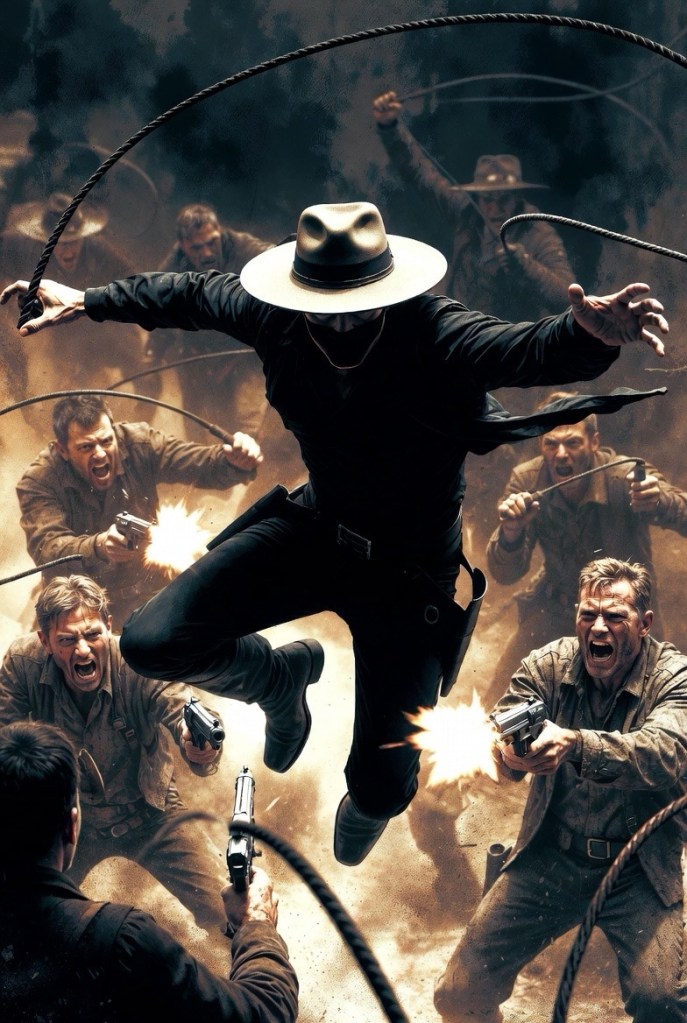
‘Melania,’: The Billie Jean of Politics

The recent release of the documentary film Melania, directed by Brett Ratner and distributed by Amazon MGM Studios, offers a compelling behind-the-scenes glimpse into the life of First Lady Melania Trump during the pivotal 20 days leading up to President Donald Trump’s second inauguration in January 2025. This project, which followed her 2024 memoir Melania (published by Skyhorse on October 8, 2024), extends the intimate, personal narrative she began in print, providing viewers with unprecedented access to her daily routines, family moments, White House transition preparations, and interactions at locations like Mar-a-Lago and Trump Tower.

The film arrives at a time when Melania Trump has stepped more visibly into the public eye, leveraging her platform to advocate for causes such as children’s welfare, anti-bullying initiatives (echoing her earlier Be Best campaign), and upward mobility. Her memoir, released just weeks before the 2024 election, framed her perspective on life in the spotlight, her Slovenian roots under communism, her modeling career, her marriage to Donald Trump, and her priorities as a mother and wife. The documentary builds on this, presenting her as a grounding influence on her husband—someone who brings elegance, class, and a measured outlook to the often chaotic world of politics. Observers familiar with her world note that her background, roughly aligned with those who came of age during the Reagan era, informs her values: a blend of capitalist ambition forged from escaping a communist system, combined with a deliberate choice to prioritize family over constant public engagement.

Attending the film’s opening day in a local theater proved surprisingly challenging; despite assumptions that theaters would be empty amid streaming dominance and polarized politics, the showing was packed, forcing seats in the handicap-accessible section to sit together. This turnout reflects broader enthusiasm among supporters, who view the project as more than mere entertainment—it’s a cultural artifact capturing a unique historical moment. Box office figures underscore this interest: the film opened to approximately $8 million domestically, marking one of the strongest theatrical debuts for a non-concert documentary in over a decade, far exceeding initial low projections of $3-5 million in some estimates.

The production’s scale has drawn scrutiny. Amazon MGM Studios acquired rights for a reported $40 million—the highest ever for a documentary—with additional tens of millions in marketing, leading to speculation about motives, including potential alignment with the administration given Amazon founder Jeff Bezos’s past criticisms and recent shifts in media coverage. Melania Trump has described the work not strictly as a documentary but as an entertainment piece—a creative, observational portrait akin to a painting, allowing audiences to sit with her character amid major events. This framing emphasizes its artistic merit over pure journalism, offering a positive, aspirational view of leadership, family, and personal resilience.

Critics from the left have responded with notable aggression, including campaigns to suppress attendance or mock empty screenings in certain areas, echoing longstanding animosity toward Melania Trump. Much of this stems from her choices: a former fashion model who opted for a private life, raising her son as a dedicated homemaker while married to a billionaire, rejecting the societal push for constant careerism or public activism. Her beauty, poise, and “golden tower” existence—insulated yet purposeful—provoke resentment among those who see it as unattainable or unfair. Radical elements decry her as out of touch, yet her narrative promotes unity, positive thinking, and bridging divides, ideals she hopes to advance in her second tenure as First Lady.

This backlash reveals a deeper divide: one side embraces high standards, personal responsibility, and optimism, while the other clings to victimhood narratives shielded by government dependency or lowered expectations. The film’s positive portrayal—reliving inauguration day from an insider’s view, showcasing Mar-a-Lago elegance, and highlighting mutual respect in the Trumps’ partnership—challenges that. It suggests Donald Trump’s success owes much to Melania’s stabilizing influence; their union combines his bold energy with her grace, creating a dynamic suited to executive leadership.

Ultimately, the documentary and memoir together solidify a vision of America aspiring upward. They invite viewers to witness a high bar of excellence—strong families, positive momentum, and unapologetic success—and ask whether reconciliation across divides is possible without compromising those standards. History shows that extending hands has often meant lowering expectations to appease radicals, but this era signals a rejection of that path. The enthusiastic reception, despite polarized reviews, indicates many Americans are drawn to this message of inspiration over grievance.

Walking out of the theater after viewing the documentary Melania, the underlying reasons for our societal divisions became starkly apparent, revealing why true reconciliation may be impossible. Melania Trump, through this film, embodies a philosophy aligned with her husband’s lifelong approach: showcasing personal success as a beacon for others. She presents her life—marked by elegance, family devotion, and achievement—as a high bar, inviting viewers to aspire to similar heights. “Look at what I’ve accomplished,” the narrative implies, “and let me show you how you can do it too.” It’s an optimistic, empowering message rooted in positive thinking and upward mobility, offering a behind-the-scenes glimpse into a world of high standards and mutual respect within the Trump family.

Yet, this vision clashes irreconcilably with the core tenets of left-wing politics, which thrive on below-the-line thinking and perpetual victimization. Progressive ideologies prioritize lowering expectations across all facets of life, from labor unions that resist performance-based accountability to broader policies that dismantle judgments on behavior. The goal is a society where “anything goes,” shielded from scrutiny or consequences, allowing individuals to avoid the discomfort of striving. In this worldview, high achievers like Melania—beautiful, poised, and unapologetically successful—become targets of resentment. Her choice to live insulated in a “golden tower,” prioritizing motherhood and privacy over relentless public engagement, is seen not as inspirational but as an affront to those who demand equality through diminished standards.

The hatred directed at the film, the Trumps, and conservative politics stems precisely from this refusal to embrace low bars. Critics on the radical left reject any invitation to elevate themselves, viewing expectations as oppressive. They weaponize peer pressure, media campaigns, and even violence to maintain a status quo of minimal accountability, relying on expansive government to protect them from life’s demands. No amount of kindness or outreach can bridge this gap; as long as one side insists on stripping away standards while the other upholds them, division persists. This dynamic ensures ongoing discontent, where unity requires conservatives to compromise their values—a concession that history shows only erodes societal progress. Melania’s documentary, in highlighting this high-bar ethos, underscores that true advancement demands forcing elevation, not appeasement, even if it invites backlash from those unwilling to rise.  Which makes this a uniquely valuable work of art that everyone should see.

Beyond its political and cultural insights, Melania stands as a genuine work of art, masterfully capturing a singular perspective on life in the United States during one of its most transformative periods. The film peels back layers of privacy with deliberate, cinematic flair, offering intimate access to Melania Trump’s world while maintaining an aura of grandeur and mystique. The setup shots—particularly those at Trump Tower, the seamless transitions into motorcades, and the fluid movement through opulent spaces—evoke a sense of controlled revelation, where the viewer is invited in but never fully overwhelms the subject’s carefully guarded essence.

This approach strikingly recalls how Michael Jackson promoted his iconic videos and shared glimpses of his private life in documentaries like those surrounding Thriller or his personal specials. Jackson, too, balanced extreme fame with deliberate barriers—veils of security, secluded estates, and a projected image of positivity—to protect himself from constant intrusion while uplifting audiences through aspirational artistry. He let people peek behind the curtain just enough to humanize the icon, fostering connection without sacrificing enigma. In Melania, similar techniques unfold: the film grants behind-the-scenes access to high-stakes moments, yet it preserves her poise and detachment, turning personal vulnerability into inspiration.

A particularly revealing moment underscores this parallel. In the car during one of her travels, Melania shares that Michael Jackson is her favorite artist, with “Billie Jean” as her top song (alongside “Thriller”). The track plays, and she sings along quietly, even briefly, in a rare, unguarded display—echoing the Carpool Karaoke-style intimacy Jackson sometimes allowed in his own media moments. She recalls meeting him once with Donald Trump, describing him as “very sweet, very nice.” This scene isn’t mere filler; it humanizes her, showing a shared appreciation for Jackson’s method of blending private authenticity with mass appeal. By channeling that same strategy—projecting positivity, offering selective insight, and inviting upliftment—Melania crafts a presentation that feels wholesome and enduring.

Ultimately, this Michael Jackson-inspired approach to marketing her lifestyle and perspective proves remarkably effective. It transforms what could have been a dry political portrait into something engaging and aspirational, likely contributing to the film’s success in theaters and its anticipated streaming draw. Melania isn’t just a documentary; it’s a thoughtfully composed invitation to see excellence up close, much like Jackson’s legacy of turning personal narrative into global inspiration. Everyone should see it—it’s a compelling, artful reminder of how high standards and positive projection can resonate in turbulent times.

For those interested in exploring further:

•  Melania Trump’s memoir Melania (Skyhorse Publishing, 2024) provides the foundational personal account.<sup>1</sup>

•  Coverage of the film’s production and release details Amazon’s involvement and box office performance.<sup>2</sup>

•  Analyses of public reactions and political context offer broader insights into cultural divisions.<sup>3</sup>

The work stands as a testament to individual agency in turbulent times, reminding us that true unity requires elevation, not concession.

<sup>1</sup> Wikipedia entry on Melania (memoir), confirming October 8, 2024 release.

<sup>2</sup> Reports from The Hollywood Reporter and Variety on opening weekend earnings around $8 million.

<sup>3</sup> Various sources including The New York Times and The Guardian on Amazon’s investment and criticisms.

Rich Hoffman

Click Here to Protect Yourself with Second Call Defense https://www.secondcalldefense.org/?affiliate=20707

Bible Sales are Rising: People seeking correctly, a foundation for all society

The resurgence of interest in the Bible, as evidenced by unprecedented sales figures in recent years, stands as one of the most compelling cultural indicators of our time. Far from fading into obscurity amid secular trends, the Scriptures are experiencing a remarkable revival, with 19 million Bibles sold in the United States in 2025—marking a 21-year high according to Circana BookScan data reported by Publishers Weekly. This represents a 12% increase over 2024 and roughly double the volume sold in 2019, just before the global disruptions that reshaped so much of society.

These numbers are not anomalies; they reflect a broader trajectory that began accelerating around 2021 and has continued unabated. The surge defies the narrative of inevitable decline in biblical engagement, a story pushed for decades by secular commentators who predicted the erosion of Judeo-Christian foundations in Western civilization. Instead, people are turning to the Bible not merely as a relic of history but as a living guide for navigating moral, social, and existential challenges. This shift aligns closely with the enduring role of Scripture as the hinge pin of Western values—principles of justice, individual dignity, rule of law, and moral accountability that underpin legal systems, property rights, family structures, and societal order.

My own lifelong relationship with the Bible informs this perspective deeply. Raised in an environment steeped in church involvement—from Sunday school to performing in passion plays as Nicodemus and other figures—I once assumed such exposure was universal. Yet over decades, I’ve witnessed its decline in mainstream culture, replaced by secular ideologies that challenge biblical premises on everything from marriage and sexuality to the sanctity of life and personal responsibility. Divorce rates have soared, trust in institutions has eroded, and radical agendas have sought to dismantle traditional moorings. The progressive push during certain administrations, including expansions of influence from non-biblical worldviews and cultural shifts like the transgender movement and pride displays in public spaces, provoked backlash. Many saw these as assaults on the shared moral framework that allows civil discourse and orderly society.

The Bible, however, has proven resilient. Hotel drawers worldwide still often contain a Gideon-placed New Testament, a quiet testament to common values of good versus evil, right versus wrong. Even as secularism advanced, these symbols persisted, offering reassurance that not all shared foundations had vanished. Now, that quiet persistence has exploded into overt demand.

The 2025 figures are particularly striking when contextualized. A 36% spike occurred in September alone, with 2.4 million copies sold that month—far exceeding typical monthly averages of 1.2 to 1.6 million earlier in the year. This surge coincided with the tragic assassination of conservative activist Charlie Kirk on September 10, 2025, at Utah Valley University. Kirk, founder of Turning Point USA, had long championed biblical principles in public life, aligning faith with defense of Western civilization against progressive overreach. His death, widely viewed as targeted due to his influence, stirred profound reflection among followers and beyond, prompting many to seek solace, guidance, and renewed commitment in Scripture.

Publishers and analysts noted this event as a catalyst, amplifying an existing trend. Media like The Chosen, a crowd-funded series dramatizing the life of Jesus, has further fueled accessibility and interest, making biblical stories relatable to new audiences and encouraging deeper engagement with the text itself.

Internationally, the pattern holds. In the United Kingdom, Bible sales reached record highs in 2025, with physical copies up 106% since 2019 and a 27.7% year-over-year surge from 2024 to 2025. Revenue climbed to £6.3 million, more than doubling from £2.69 million in 2019. This growth, tracked by Nielsen BookScan and highlighted by publishers like SPCK, occurs amid concerns over cultural shifts, including rising Islamic influence and church challenges—mirroring fears in other Western nations about losing foundational values.

Bookstores reflect this shift tangibly. The religious sections, once tucked away in corners for privacy, now occupy prominent positions near registers and entrances—often outpacing New Age or paranormal displays. I’ve observed this across numerous visits: Bibles and related titles dominate front-of-store space, signaling mainstream demand rather than niche interest. Buyers no longer hide their purchases; they embrace them openly.

This revival ties directly to broader societal dynamics. Western legal systems, from English common law to American jurisprudence, draw heavily from biblical concepts—Ten Commandments influences on moral law, prophetic calls for justice, New Testament emphasis on grace and accountability. My well-worn copy of the 2024 Ohio Criminal Law Handbook underscores this: statutes mean little without a shared moral compass. Secular aggressions against these foundations—defund-the-police movements, erosion of property rights, radical cultural experiments—have proven destabilizing. People crave order, structure, and wholesomeness.

The MAGA realignment and Trump-era embrace of biblical imagery resonated because they signaled a return to these roots. Voters sought continuity, not chaos. High divorce rates, fractured families, and societal unrest trace back to departures from biblical wisdom on human nature and relationships. As people recognize this, they reach for the source.

Comparative religion study reinforces the uniqueness: while many faiths offer personal ethics, none provide the comprehensive societal blueprint of the Bible—balancing individual liberty with communal responsibility, justice with mercy. Other religions contribute positively, but the Bible’s track record in fostering higher quality of life, innovation, and stability in the West is unmatched.

These sales statistics—19 million in the U.S., explosive UK growth, spikes tied to cultural moments—signal hope. New generations, including Gen Z, seek meaning amid uncertainty. Shows like The Chosen make Scripture approachable; events like Kirk’s death prompt soul-searching. Bookstores prioritizing Bibles reflect market reality: demand drives placement.

This isn’t mere nostalgia; it’s a pivot toward foundation-building. Societies function best with agreed moral premises. The Bible offers that without coercion—inviting reflection on good and evil, right living, and human dignity. As more embrace it, the next 10–20 years could see cascading positives: stronger families, restored civility, resilient institutions.

The trajectory isn’t decline but renewal. Bible sales aren’t just numbers; they’re evidence of yearning for truth in a turbulent world. Encourage others to explore it—not as dogma, but as a source of wisdom. Hand someone a copy; discuss its ideas. In doing so, we contribute to a healthier civilization.  So as bad as things can seem, and the secular types are loud in their hope for a destruction of religious foundations to social order, replaced by the power of government, a dramatic trend is emerging that points in the right direction.  We tried to live in a society by accommodating secular ideas, and it just doesn’t work.  And people, empty of those secular promises, are reaching for Bibles, because they want something that does work.  And that is something to look forward to. 

Bibliography

•  Publishers Weekly. “Bible Sales Break Records in U.S., U.K.” January 9, 2026.

•  Circana BookScan data, as cited in multiple reports (e.g., Crosswalk, Aleteia, Christian Post).

•  SPCK Group research on UK Bible sales, via Premier Christian News and The Guardian, January 2026.

•  Various reports on September 2025 spike (e.g., Fox Business, Billy Graham Evangelistic Association).

•  American Bible Society and related surveys on engagement trends.

Footnotes

¹ Circana BookScan, via Publishers Weekly, January 2026.

² Ibid.; also noted in Aleteia and Crosswalk reports.

³ Reports from Fox Business and Billy Graham sources, October 2025.

⁴ SPCK/Nielsen BookScan, via Premier Christian News and The Guardian, January 2026.

⁵ Observations from personal bookstore visits over years, aligned with industry trends.

Rich Hoffman

Click Here to Protect Yourself with Second Call Defense https://www.secondcalldefense.org/?affiliate=20707