Can you honestly answer it? Because blue ribbons and excellent ratings are just words on a banner. The true excellence is in the quality of our society, and by the sound of that girl, we’re in a lot of trouble.
I am reminded of that little piece of history because so many critics seem hungry to criticize Atlas director Paul Johansson for his lack of experience directing only One Tree Hill episodes. The criticism that the film received a flat screen treatment meaning it seemed to resemble a high production value television show is sophomoric and is uttered strictly from the mouths of the unions, and have no merit. What are they comparing Atlas to as far as a film of value, something like Jackass 3-D? Atlas Shrugged is an ambitious film that takes on a lot of ground. I personally think they went too fast in the development of the story. They could have gotten away with another 50 minutes of film time, something the producers may want to release as a director cut when the film comes out on DVD. There were exposition shots of the government action in the macrocosm that needed to be there to develop why building the train line was such a big deal, and people who have not read the book might find it difficult to follow the story without repeated viewings. Because the cut of the film is trying to fit into under 2 hours at 1 hour and 40 minutes Atlas focused on the microcosm of the characters Dagney and Rearden. I understood it because I know the book so well, and people who do know the book will be happy to see that the filmmakers went to a lot of trouble to stay true to the nature of the book.
Atlas Shrugged because of the amount of characters and scale of the story will not work as a traditional film, with a lead like Angelina Jolie as Dagney and Brad Pitt as Rearden with a top-level director making over one million for his work along with all the supporting characters of John Galt, Francisco, James Taggert, and the other 50 or 60 characters that would all require SAG minimums depending on the scale driven off Jolie’s 20 million minimum and Pitt’s 20+ million per picture. Before anybody shot one frame of film there would be over 80 million in just wages alone committed to the film, which is why the movie had not been done up to this point. And a movie like Atlas Shrugged will never pull a ROI at the box office if the budget exceeds 100 million. This is a film for thinking people, so the scope of the film must match the intention, and that is to bring an epic story to thinking people and keep the budget to where the filmmakers can actually produce parts 2 and 3 without the contingency of waiting for DVD sales to refill the budget coffers.
My wife and I sat till the last credit scrolled across the screen at approximately 12:45 in the morning. I had to catch the late show because I attended the Tax Day Rally in Glendale where Doc Thompson was the MC. We left that event to catch the 8:20 showing at Newport on the Levee. I arrived about 7:45 to find the film sold out! Crowds of people swarmed around the ticket windows trying to get a ticket to Atlas Shrugged. So we bought a ticket to the 10:45 showing and killed our time at a nearby Irish Pub and enjoyed the storm that swept across the Ohio River while we waited. Our late show was about half full, which surprised me. What also surprised me was that many of the viewers were by themselves. I can’t recall seeing a movie that had a majority of the audience showing up by themselves. Now, the left normally would criticize those types of people as loners, and belittle them. But wishing them not to exist will not make them go away. These loners are the people who reject TV shows like How I Met Your Mother, or Two and a Half Men. These are also the types that reject reality TV shows, so their only entertainment is books, and the History Channel, because Hollywood isn’t making their kind of movies anymore. Atlas Shrugged is their kind of movie and many of them clapped at the end and stayed for most of the credits.
It was well acted. I thought Dagney was a believable person. In fact, the characters weren’t so beautiful that they were beyond the realm of reality which I think helps the film a lot. Again, with A list actors, that would have been a problem. Our society has become used to seeing extraordinarily beautiful people in leading roles, and that takes the situations out of our contemporary realities. When we leave the theater people don’t look like what we see in the films. So films take on a mystic of escapism. Atlas Shrugged is not out to do that. It seeks to place itself into the mind of the viewer’s experience, which is another reason for the cast to appear as it was. I thought the casting of Francisco D’Anconia played by Jsu Garcia was very good. Also of Paul Larkin by Patrick Fischler, that actor captured perfectly the treason of the good friend that was supposed to be of Mr. Larkin. Grant Bowler who played Rearden was excellent. This film is an obvious set-up for the part two which goes down the psychological rabbit hole, and I can’t wait to see Bowler stand in front of the federal court and tell them he does not acknowledge their authority or right to exist. Bowler will be able to pull it off.
Now the criticism that I’ve read is one from people who don’t understand what the big deal is. “Why is she so upset?” “What’s going on?” “So what, the guy left and burnt down his oil field. All conservatives are a bunch of greedy, oil loving bastards, serves them right!”Besides the fact that fuel costs were excessively high and Ellis was one of the only hopes in the United States for bringing the costs back down, why don’t people make the connection between oil and their own prosperity? Reardon asked the question in Atlas Shrugged, “What’s wrong with people?” Paul answered, “Why ask questions that have no answer?” He’s right, because the reason for those statements is because there are an alarming number of people in our society that no longer feel the pressure of a promise, because to care about a promise to a friend, wife or business partner, you have to care, and sadly, many people no longer care about things like a promise. So the lack of understanding directed at the confusion of Dagney’s motives in the film is more of a commentary on modern life, which is what Dagney is screaming at. She is afraid of becoming what we actually are. I would pay to see Atlas Shrugged 20 more times just to see that last scene. I thought it was vividly powerful. I loved how the camera pulled back to reveal the sign that Ellis left as his oil fields burned while she stood helpless to stop it. The reason for her “robotic” behavior is because she is determined to succeed no matter what the cost. My wife nailed Dagney’s performance by saying, “she reminds me of the terminator from Terminator 3.” And she’s right, Dagney will not be stopped. If she wants something, she will achieve it. And the scream represents that with all her ambition, with all her good will, all her energy, cleverness, and innovation, she could not stop Ellis from giving up. She saw the look in his eyes when Ellis was in her office chastising her for her brother’s incompetence and she thought if she did everything right, that she could keep Ellis from leaving wherever all the “men of the mind” were going.
I also read criticism of how the exposition was displayed with news broadcasts and this was somehow bad. I don’t agree. I think it was wonderfully done in this film. It reminded me of how the director Paul Verhoeven used newscasts from the film Robocop to propel the complicated aspects of the story along. Hollywood and critics in general have gotten used to the type of films produced in the 90’s and 2000’s that pamper to their every wish. This is something that Roger Ebert and Gene Siskal started. Those two reviewers created an industry of film critics and gave them much more power than they deserve. Movie reviewers have become breakers or makers of box office results, and that’s not necessarily healthy. Because the views of the reviewers become the editors of public opinion, and if those reviewers are progressive types, then studios will cater to those reviewers to get the “thumbs up.” I actually respect Roger Ebert quite a bit. He’s usually right on. But when he runs into something above his intellectual capacity, he gets stumped. You can see how Siskal and Ebert used to bounce off each other in this review of White Hunter Back Heart, which is one of my personal favorites films.
Ebert was fair from his perspective in his review. He knows Atlas Shrugged is loved by millions so he was careful in his comments. I think his mistake is he should have reviewed the film more the way he’d review an independent film like Koyannisquatsi. He like many people who go to see this film will mistakenly watch this film as a literal film, not as an atmosphere of images reflecting a philosophy. That’s the reason for the cityscape shots and the views of the mountains. Once all the films are completed, it will make sense. This first film is just an introduction. It’s also an experiment in filmmaking that I think is very healthy. It’s bold and deserves credit for that boldness alone. The merit of Atlas Shrugged will be felt down the road. It is the first step of bringing a new kind of entertainment to popular culture so it will suffer from opinion in the short run, but will stand the test of time over the long haul.
My review of the film is that I like it a lot. I think it will be better when viewed with the other two films. For the DVD release I hope they can lengthen the running time with more exposition that had to be cut to keep the film under two hours. (the reason is to squeeze more showings in a day, very important for recovering a films costs.) And I think the film needs to be watched in the context of an artistic piece, just to sit back and enjoy the sights and sounds without trying to follow every word. The film moves too fast to be watched once. Repeated viewings are essential.
It also is rare to see a politician that will take on an old-time friend and conservative that prides himself as the conservative voice of the common man, and in the times when it really counts between those two old friends, it is obvious who meant what they said over the years and who was all talk.
Kasich should be representing the position that all businesses have an equal opportunity even if he doesn’t like them. There is a Hustler of Hollywood store near my house that I can’t stand. I think it ruins the small town of Monroe, Ohio with its presence. But, every time I drive by it, it’s full of people looking for their pornography fix and all the tax collected through each sale is paying taxes. I don’t agree with the pornography, but I vote by not going, and I won’t be going to a casino in Cincinnati for many of the same reasons. If the business model fails, it fails. I’d be happy about it, but I won’t do anything to bring it about either, because it’s a business that has the right to attempt. If it finds a market, even if that market is evil, so be it. It’s not for me to decide what’s evil for someone else.
The theme of the article was that Lakota is operating with fewer administrators than the state average, so doesn’t that mean they are operating more efficiently than other school districts?
No. Statements like that, just like the president’s speech, is full of smoke and mirrors designed to justify excessively high costs of an out-of-control government at all levels, hoping that people will be foolish enough to just look at the smoke and not at what causes it.
Read that article here:
Lakota has 58% fewer administrators per pupil than state average, report says By Lindsey Hilty, Staff Writer Updated 1:43 AM Thursday, April 14, 2011
LIBERTY TWP. — At a time when finances of the Lakota Local School District have come under intense scrutiny from voters, officials say state data shows they are running a lean operation.
The district has 58 percent fewer administrators per pupil than the state average, and 20 percent fewer administrators than similar districts, which are categorized by size and demographics, according to the latest report released from the Ohio Department of Education in March.
In the 2009 report, Lakota had 43 percent fewer administrators than the state average, Interim Superintendent Ron Spurlcok said; however, “with our recent budget reductions and consolidations, we have seen that number grow.” While that number may be touted as a good thing for the bottom line, he warned that it puts a strain on operations.
Assistant principals are responsible for discipline and also must sit in on all individual education plan meetings for students with disabilities.
“We realize economies of scale by running larger buildings, so we can economize where possible,” Kursman said. However, fewer administrators in larger buildings means a bigger demand for their time, whether it is handling parent concerns, analyzing student data or reviewing teacher performance.
Many buildings now share assistant principals, she said, if the principal is called away for a meeting or to direct traffic due to transportation cuts, there is no one left to manage the building.
Levy opponent Rich Hoffman said he isn’t impressed with the numbers. “I don’t believe any of the stats they give me anymore, because the reality is that they could do a lot more with a lot less if things really get pushy,” he said.
Hoffman said administrators could be reduced more, but they aren’t the issue.
The problem, he said, is “I think Lakota has drowned itself in salary obligations, and when you’re trying to cover 22 buildings when management of those salary obligations has been bad, it turns out to be a catastrophic mistake. Administrators get paid a lot, but there aren’t so many of them that it affects the bottom line costs, so their damage to the budget is negligible.”
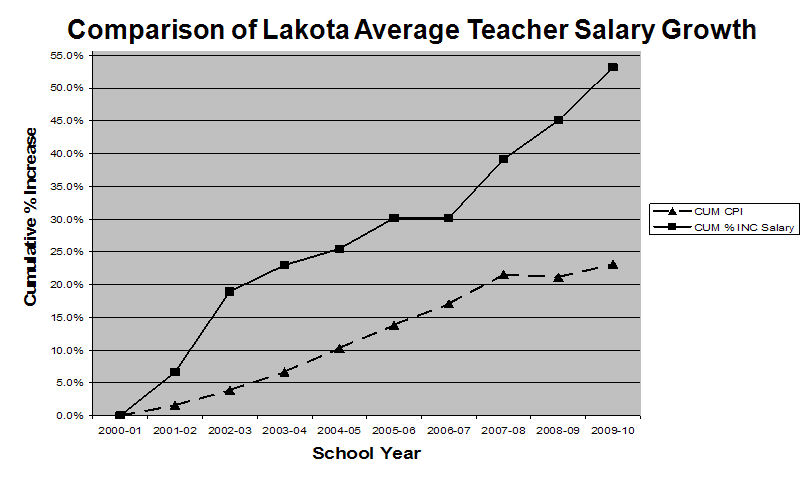
There are too many employees netting more than $65,000 annually, he said, and that is the crux of the problem. He pointed to the salary lists recently published in the Pulse-Journal, and said the increase in employees in just one year who reached the $65,000 plus benchmark is unsustainable.
“You have to get the costs in line, but the costs are your salaries … None of us can afford it anymore.” Hoffman called for tough negotiations as the board as the Lakota Education Association reopen the 2011-2012 school year contract, and said many in the community would stand behind the board as long as it was aggressive in controlling costs.
In fiscal year 2010, Lakota spent $96 million on salaries. In 2011, that number dropped $2 million due to retirements, no increase to the base salaries and a reduction in force. Employees still earned close to $2 million in step raises, Treasurer Jenni Logan said, but one third of employees, who are at the top of the pay scale, saw no step increase. As details from legislation like SB 5 keep the district in a holding pattern, Logan said, “Inside the walls of Lakota, we’re focusing on the job at hand, which is educating our students.”
From that place, the world is placed into its perspective. All the things that the “looters” like the aforementioned Weiner’s proclaim to be important will quickly be seen for what they truly are, just the cries of small-minded children.
So now you know a secret of mine. I fear no breakdown of society because of that place. I know what the world could look like if you took away all government, because there isn’t a government at that place. It is beyond the reach of people like President Obama, George Soros and his silly Huffington Post and all the Weiner’s he likes so much. Those people are the representatives of the lead-foot travelers that are either too scared or too unhealthy to move on their own. And they do not represent the direction of the human race.
All things should evolve into improvements, not in decline, and Atlas Shrugged besides the book Thus Spoke Zarathustra is the first serious work that explores that evolution. And it is understandable that those who are close to that transition themselves would be attracted to the message. That message will be missed by the Weiner’s and those like them. Because of their limited perspective, they will cleave like fools to the world of their understanding, and will always fear the perspective of a mountaintop hideaway. The revelations that would fall upon them will shatter their reality in ways that they aren’t prepared to deal with.
The contract was voided because of the following clause: This contract shall become effective on the 1st day of July, 2010 and shall expire on the 30th day of June 2012. Contingent upon the District’s legal ability for the Board President, Treasurer, and Superintendent to sign the R.C. 5705.412 certificate. In the event that the Board Representatives are unable to sign the R.C. 5704.412 certificate the second year of this Agreement then agreed to between the parties related to the second year shall be considered null and void.”
According to the Pulse Journal the move allows the board to void its contract with its teachers’ union, while at the same time, giving it flexibility to create a more sustainable long-term plan for the district, board President Joan Powell said.
“In the past three weeks as this information started coming to us from Columbus, it has become apparent that to maintain the future viability of this district, we need to look deeper than just the proposed budget reductions,” she said.
“Some fundamental changes to the contract are needed, and we have a window of opportunity to do so,” Powell said. “In light of the negative impact of this proposed state budget, we must take that opportunity. Our financial reality today is different than it was last November or last August when we executed this contract.”
“I’m anxious to see the forecast, because we have not been able to look at it,” she said. “We feel as though we’ve been cooperating and collaborating, and have given up a lot of things in those memorandums of understanding. And to change direction this late in the game — now everything is slowed down.”
Treasurer Jenni Logan said deficit spending next year is expected to be $22 million, up from $13.9 million in 2011.
A $28 million negative cash balance is expected in 2013.
The stress to the budget, Logan said, is coming from three areas: the state is reducing tangible personal property taxes starting next year, Lakota is expecting less money locally, and federal stimulus dollars have gone away.
For those that just want money, go to another district. Because soon that district will be going through the same problems Lakota is going through. So run from district to district like a thief in the night and collect your money. But for those teachers that want to work for Lakota, and want to be a part of our great community, work with us and we’ll work with you. But don’t even think of a strike or any other public relations stunt. There are people this time that will be there to expose you for what you truly are.
The best way to combat this type of undercutting from the media is to prove them wrong. Go see the movie and support it with the purchase of a ticket.
Now, study how the left will attempt to frame the opinions of the masses in the review from Todd McCarthy of the Hollywood Reporter. Notice that many of the comments are similar to the way the government reports they can’t cut spending, or a school levy attempts passage. It’s spin toward a “collective” society.
Atlas Shrugged: Film Review
4:02 PM 4/7/2011 by Todd McCarthy
The Bottom Line
Flubbed, under-produced representation of the first third of Ayn Rand’s still controversial novel bodes ill for parts two and three.
Opens
April 15
Cast
Taylor Schilling, Grant Bowler, Matthew Marsden, Edi Gathegi, Grahame Beckel, Jsu Garcia, Jon Polito, Michael Lerner, Rebecca Wisocky, Neill Barry
Director
Paul Johansson
The independently financed-and-distributed rendition of the book’s first third is unlikely to generate sufficient box office to inspire production of the final two installments.
“There were a few rare men of talent around her, but they were becoming rarer every year,” it is lamented about the circle surrounding Ayn Rand‘s ultra-capable heroine Dagny Taggart in Atlas Shrugged, and the complaint certainly applies in the case of this botched partial screen adaptation of the mammoth novel that has materialized 54 years after the book’s publication. Although the recent surge in annual sales of the revered and despised author’s fictional manifesto arguably testifies to its continuing relevance, the central battle between fearsomely independent corporate mavericks and hostile big government has been updated in a half-baked, unconvincing way that’s exacerbated by button-pushing TV-style direction, threadbare production values and blah performances except for that of Taylor Schilling in the central role. Set to bow in roughly 200 theaters on April 15, this independently financed-and-distributed rendition of the book’s first third is unlikely to generate sufficient box office to inspire production of the final two installments (the 1,000-plus-page novel is divided into three sections of 10 chapters apiece), although the producers could conceivably forge ahead anyway if their pockets are deep enough. A TV miniseries with a high-powered cast–several were planned at various points over the past four decades–would have been a preferable way to go with this didactic, sometimes risible but still powerful material.
Published in 1957, Rand’s summation novel continues to compel and repel; designed as a paean and exhortation to fulfillment of personal excellence and unrestrained industrial productivity, it is also seen as an abject endorsement of wanton selfishness and the right of the capable few to lord it over the parasitical many. Especially as former Federal Reserve Chairman Alan Greenspan had been an ardent Randian, it’s recently become easier than ever to blame contemporary economic ills on the fallout from her unregulated philosophy, even if the fiscal blundering of many governments provides equally persuasive arguments on the other side.
These philosophical debates can and will go on forever, but screenwriters Brian Patrick O’Toole and John Aglialoro (also a producer) have themselves bungled in their attempt to remain faithful to the letter of the sacred text while moving the action to the near-future (specifically, 2016). Many scenes are devoted to dull conversations among business fatcats about the economics of railways and steel, central industries that helped drive the nation 60 years ago but seem like afterthoughts today (Amtrak, anyone?). Updating the story would provide a provocative test to any writer but could certainly be done; however, to do so without acknowledging the present-day realities of high-tech industries, outsourcing, shifting transportation modes and advanced information technology (the characters here actually read newspapers) places the action in an unrecognizable twilight zone. So does the fact that the central manufacturing triumph here is the construction of a high-speed train (managed from scratch within a few months, no less). Not only is it unremarked that Asia and Europe are decades ahead on this front, but conservatives who might be perceived as the core audience for this film are the very ones currently fighting against fast-train funding and construction in the U.S.
For these reasons alone, a serious cultural/historical disjunction derails the enterprise from the outset. Television news clips portray a nation in recognizable disarray and decay, as well as a Middle East that has imploded, triggering unimaginable oil prices, but these seem like overwhelming issues unlikely to be turned around by the efforts of the laser-focused Dagny to take over decision-making at rail giant Taggart Transcontinental from her ineffectual brother James (Matthew Marsden).
Poised, beautifully groomed and impeccably coiffed, Dagny strides through the corridors of male hesitation, indecision and ineffectuality with a fierce confidence shaken only by the inexplicable “retirement” of certain skilled executives and the baffling question she increasingly hears at unexpected moments, “Who is John Galt?” This is a query that may or may not ever be answered onscreen, depending upon whether the next two parts are made, but suffice it to say that in Part I he is a shadowy figure resembling the Humphrey Bogart character in Woody Allen‘s “Play It Again, Sam.”
Galt is impersonated here by Paul Johansson, a young actor who stepped in to direct Atlas Shrugged when the original director left shortly before shooting began. The best that can be said for his work is that it’s perfunctory, a word that also describes all the performances except that of Schilling, a blond beauty whose open face, direct gaze and plain speaking do more than anything else to make watching the film tolerable. One has little doubt that, in a more substantial version of this story, one populated by strong actors in the other principal roles, she would have held her own and moreso, justifying the casting of a relative unknown in the most important part.
Although ostensibly set in New York City, the film features various buildings and cityscapes recognizable from Los Angeles and Chicago.
Opens: April 15 (Strike Prods. Release)
Production: Harmon Kaslow, John Aglialoro Prods.
Cast: Taylor Schilling, Grant Bowler, Matthew Marsden, Edi Gathegi, Grahame Beckel, Jsu Garcia, Jon Polito, Michael Lerner, Rebecca Wisocky, Neill Barry
Director: Paul Johansson
Screenwriters: Brian Patrick O’Toole, John Aglialoro
If you’ve studied other cultures, their rise and fall, there are common themes. Visit any ruin of an ancient civilization and you will see that all those societies bankrupted themselves. They either ran out of water, food, or their currency. Visit Ankor Watt, Chitzen Itza, or any city in Egypt and you’ll see it. Study the past to see your future.
In Mel Gibson’s brilliant film, Apocalypto Gibson showed wonderfully the height of the Mayan Empire and displayed the problems they were having. The Mayans built huge cities, depleted their food supply and built a corrupt hierarchy of politics that sought human sacrifice to appease the mob, and to keep the masses believing that the ruling class held some sort of power with the “gods,” so that society could continue for just a bit longer hoping by some miracle that if they cut off just one more head, or paint their faces just a few more colors so the gods would take mercy on their lives and save them all. In this case the god is Kukulcan. For those of you that don’t know much about history, the main street in Cancun that all the nightclubs are on, is named after that god.
• A mass burial containing 40 men and women who appear to have been violently killed. The suggestion has been made that some of these were buried alive: “From the vertical position of some of the fingers, which appear to have been digging in the sand, it is apparent that not all of the victims were dead when they were interred – that some had been trying to pull themselves out of the mass of bodies.”
The relationship of these burials to the central burial is unclear. It is unlikely that they were all deposited at the same time. Wood in several parts of the mound has been radiocarbon-dated to between 950 and 1000 CE. Check out more about this from this article. http://en.wikipedia.org/wiki/Cahokia
Many people don’t even know that Cahokia is even there in the middle of the United States. It’s the giant hill alongside the highway on the way into St. Louis. You can see the arch of St. Louis easily from the ruins of Cahokia, yet people don’t know much about the ancient city. In fact, Cahokia wasn’t even discovered until developers tried to build a neighborhood over it. I wrote a screenplay about the place for some financial people a few years ago and we had an actress and a director, but the whole thing fell apart in pre-production. But here was the conception teaser for it. The history that I speak about is real. The modern aspect of it is fiction.
On the other hand there are people like Porter Standsberry out there that are “really” looking at the real problems coming to our culture, and people like Porter are the kind of people our government wants to cut their head off in human sacrifice, figuratively speaking of course.
As stated in the interview, there is a preponderance of evidence that Obama was born in Hawaii. What that means is that there are some newspaper reports, and some other documents that lean in the direction of birth in Hawaii, but it appears that Obama claimed otherwise to get financial aid. So on one side of the story or another, Obama has lied in his past. He’s either claimed to be a foreign student for admission into Occidental College or he was really born in Kenya and his grandparents placed the notification in the newspaper in Hawaii. I think many Americans would forgive him for the first offense. Because the second offense is much more serious, which is why over 10 million dollars and much public relation debate has been created to combat even bring up the question.
If we are stuck with this joke for a few more years because everyone is too weak to actually demand that our public officials live by the actual rules of our law, then I say the law goes our way too. Ignore that speed limit sign, those demands to buckle up, forget the DUI laws. And for taxes, forget about April 15th, just send in your taxes whenever you feel like it. Heck, it’s just rules and laws. Who cares……..right?
I write a lot about education. Within the education reform movement, I receive a lot of information from very passionate people who are doing their best to address some of the issues involving education, and today I heard from a couple of them that find themselves defending the community of Lebanon from another tax increase.
After that interview I received notes from Cyd and Sandy Trugrul about Lebanon and education issues in general, that they both spent a lot of time putting together. I thought those notes deserved to be listed in their entirety below.
A Note From Cyd Zimmerman: The woman on the Darryl Parks interview below.
It’s important to preface this conversation by laying the framework as to how I got here and why I’m so angry and frustrated. So many that are staring down the barrel of another school levy have the same feeling coursing through their veins and are confused or unorganized in how to go about change. After all, Spring now means levy season. Not good.
Radio is a tough gig and it’s easy to lose your way. So much to say, and so little time, and that happened to me. I had caught wind of yet another school levy mid January of this year. This was on the heels of a 5.41 mill emergency levy that was passed in November of 2010. It generates 4.2 million per year. I could not believe it. I had no clue who to talk to or where to begin so I attended my first ever board meeting that following Monday. It was just an announcement that they were deciding one of three amounts to choose from in my early understanding. Nevertheless, I was alone in a sea of empty chairs. There were a couple of others and I now know one of those people was Rick McPherson filming. I left as they were just finishing up and thought to myself…I’m screwed. Where are all the people? Where are the taxpayers? I was aware of the Lakota levy last November and the great deal of press it had gotten, having moved to Lebanon from West Chester. I Googled them and was pleased to see the site still up. I contacted them through the email and asked for help. The response was immediate. I had found Rich Hoffman’s site via the NolakotaLevy.com and the journey began. I found someone commenting on the site, speaking of the levy, and contacted her. I then met Rick McPherson who was looking for others and they gave him my email.
That’s all takes, but you can’t be thin-skinned or shy. That’s not a problem if you’re mad enough to demand some answers. On to the bigger picture and where does the money go? I went to the Lebanon School site and it was pretty well layed out. Here’s the problem. 77.6% going just for wages and benefits. I would never begrudge the salary of a great teacher. They are pillars of the community. But where is the line in the sand?? Here is where SB5 would have made a huge difference. Don’t call it a pay freeze and continue step increases not to mention the other perks still in play. This has happened and you had no say. Contracts signed before the bill. We all know it. This is all about fiscal responsibility and accountability. I have to do it in my home and I expect the same from this entity.
Broken
Someone school me on why we pay for this supers $650.00 a month car allowance, family YMCA membership which on their site is $73.00 per month, cell phone (50 bucks a month), when he makes more than the Governor of Ohio?? More than the Lieutenant Governor, more than the Secretary of State, more than the Attorney General, on and on. It’s all on the web site. http://www.lebanonschoolfacts.com
I’m sorry, but that is borderline criminal in my book. And it’s NOT ok. And shouldn’t be with you either.
Broken
3.2% goes for supplies and materials. Hold on…3.4% is for other. What other? If it’s all about the children why is the “other” number higher? I still don’t have that answer…Do You?
I hear the phone calls have started for support of more sweaty cash. I’d like to get one of those calls. Hopefully it would not be a shallow conversation as was the one that ensued yesterday with Mr. North. He totally missed my side. Fine. He’s doing his job. Straddling the line between the unions and community must be brutal. Don’t say to me you have no intentions of having at the very least, an open Q&A or a town hall and then ask for millions. NO. Why? Because they can’t answer the tough questions on the spot. Oh sure, I can fill out the card and send it in. He said he has hundreds of cards. How much would the postage and cost be to them if I took them up on that offer? Small in the massive scope but this is the mindset I do not understand.
School bus drivers making over 16 bucks an hour? Really? Shrink wrapping the books at Little Miami because you have to be a certified librarian to hand them out? This is all just so bizarre.
Broken
This is the tip of the iceberg but some of the key points from emails I get. I understand. They ask the simplest questions. I know exactly where they come from. They are busy. It gets so deep, it will blow your mind. But I too have a life and if I had time to say on the radio what was on my mind, this touches the surface.
To those out there in our shoes…We hear you. Darryl spoke of the numerous emails last week asking him to pick your district. We never would be here without the help of those from neighboring districts, particularly Dan Varney and Rich Hoffman. These guys get it.
So reach out to us. We’re busy but you can email the lebanonschoolfacts site and we’ll respond. Keep the hate mail at bay. It won’t be tolerated and end up in spam. Our vision is clear and we won’t be bogged down with the naysayers. You had your time.
I’ve been working to educate people on school funding and the effects of the “mandatory” school curriculum for over thirty years. The one and only reason I have stuck to this is because I believe that the demise of our country is at stake.
The schools, their funding, their administrators, their unions are the lowest level of government that “we the people” have any hope of effecting change. If we can’t make an impact at that level the Federal level is certainly hopeless. I have not wanted to give up on my country.
In my opinion, last night’s fiasco regarding the federal budget was a diversionary tactic for covering up other more serious issues taking place in the world. I feel sure of that. The media loved covering the situation. Another 7.++ earthquake in Japan hardly got noticed. I guess the four nuclear towers are “all better.” That’s off topic now too.
The school unions and leaders use the same tactics when going after the property owners for more money. Anyone that is against raising taxes “hates the children” and doesn’t support education. In their propaganda their job is the most important job in the country. No salary level is too high. I have heard teachers say that they should be paid at the level of doctors. Their mantra is that the future of our country depends on the great education that the children receive from the union teachers. Of course “the more it costs the better the outcomes.” Nothing could be further from the truth in that statement unless you consider the outcomes that they want to occur. These may be much different from what the average person believes should be happening.
We all notice that the cuts that the boards propose are always ones affect the children the most harshly. You have mentioned all of them quite precisely.
Many people are afraid to speak out regarding their opposition to a levy. They are afraid of retaliation to their children or to themselves. One parent told me that her child came home crying because she didn’t love him. She said, “where did you ever hear such a thing.” His answer, “My teacher said that if you weren’t voting for the levy you don’t love me.” He had heard his parent discussing that they couldn’t afford to vote for the levy. In other words, the teachers are polling the children. The teachers are working in the classroom against the parents; this for their own monetary gain. How repugnant is this?
When I checked on “who funds levies” through the years, it is always the same people with the same vested interests. In Lebanon it is highly touted and supported by LCNB. (Chip Bonny, a board member, now works for LCNB. He formerly worked for Huntington Bank. The district obtained over $1M from Huntington Bank last year to buy back the buses that they formerly turned over to Laidlaw.) (I was told by my banker that transaction was a totally irregular transaction and would not be tolerated by his bank. He also said that Bonny, no doubt, received a nice bonus for that business. It would have been the case at his bank.) The postcard sent out by the Pro-Levy group lists Eric Meilstrup as the treasurer. He is an officer with LCNB. Steve Wilson, CEO of LCNB has served on the district finance committee and heads up the full page of endorsements listed in the local paper.
LCNB also owned (until this month) Dakin Insurance. Lebanon buys it’s insurance from Dakin.
Other special interest groups funding levies are developers, construction companies, architectural firms, lawyers and other business leaders. Small amounts are given by the teachers, who can look forward to nice raises every time a levy passes.
Over 85% of the budgets pays for salaries and benefits. Other salaries can be hidden in many areas of the financial states and could make that percentage go up.
Any cuts suggested are called “draconian” and “extreme.” No cuts are acceptable to the schools, county, city, township, state or federal levels of government.
The costs listed to give the per pupil amount are only from the General Fund that is for the operation of the schools. They never list the huge debt owed for the costs pertaining to the buildings And other loans they get (buses, copy equipment, phones, etc.) Those projections go on for years and years into the future. Our great-grandchildren will still be paying off those debts. ironically the buildings and equipment will be considered obsolete or even trashed. By the time the final payments are made.
When they speak to the people they try to use terminology that most people don’t understand. (I call it educationese.) This way they speak “down” to you, as though you are a child. They are the “professional” and you are insignificant in the scheme of things. They are taught how to “handle” the public a part of their college curriculum. It is part of the “Training for Change Agents” text. They study how to change your beliefs and those of your children. How to change your values from Christian to Secular Humanism. The fact is that last year the board hired at least two new administrators.
Krista Foley (from Piqua – Student Services and Mason, Kindergarten Supervisor.) She is listed as administrator of various student programs at a salary of $95,626.
Bill Lautar, former student services director in Kettering (where he retired) Director of Human Resources at $98,343. (double-dipper)
July 15, 2010, Western Star: Lautar said he is in the process of filling other certified and classified positions before the next school year, including a secretary for the transportation office, coaching and extracurricular positions and teaching positions in special education, language arts and science.”
Schools are divided in this totally ridiculous configuration.
Louisa Wright – Early Childhood, Principal, secretary, 17 teachers Bowman – First and Second Grades, two principals, two secretaries, 53 teachers. Donovan – Third and Fourth Grades, two principals, two secretaries, 53 teachers. Berry – Fifth and Sixth Grades, two principals, 2 secretaries
Jr. H. S. – (Former H.S.) Seventh and Eighth Grades, two principals, two counselors,
High School – Three principals, 1466 total students 9-12
The total enrollment is around 5,000. I see plenty of room for cuts.
There are several people listed in the salaries listed on the blog as receiving “Retirement Incentive” payments.
Many “Teacher Assistants” listed for our overworked teachers. Many substitutes listed. I am told they have a higher absentee rate than the students.
We pay the entire retirement costs for the administrators (pickup on the pickup), we pay the entire health benefits for North and other admin. I admit that I haven’t read all of the contracts. Mark North is given unlimited time off to attend meetings and to consult. (I can’t imagine him consulting at anything.) There are numerous meeting held all over the country and world. I am going to request who traveled where in the past five years. It won’t help this time around, but good to have on hand for the future. I assure you that the Lakota people travel all the time. There is a NSBA conference in San Francisco this weekend. Most of them go with their “significant other.” After all, the room is paid for.
How many non-essential personnel is Lebanon employing if the superintendent isn’t doing anything? That’s the kind of question you have to ask before any levy should ever be put on a ballot. And the fact that the question wasn’t ask should insult every person in Lebanon that pays taxes.