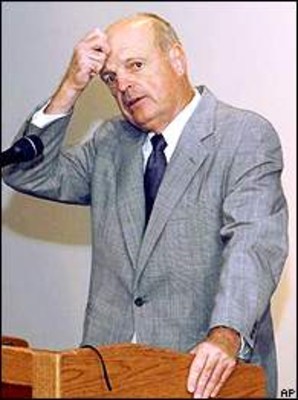
Jim Tressel, John Kasich Speak From the Fires of Columbus

The nation’s eyes were on Columbus, Ohio March 8th, 2011 for more than one reason, but shared a common sickness.Here is a clip from Governor Kasich’s State of the State speech and the reaction from those that don’t agree with S.B.5. Of note is the teacher upset that she is about to lose her retirement.

One thing that we must wonder is where did those people riding the system with such wonderful benefits think the money was coming from? With all their education didn’t they do the math? Did they think the system could grow and grow and grow without the revenue running out at some point?

The answer is, no, they didn’t. Because such realities are ugly truths that school administrations and other tax payer funded organizations seek at every opportunity not to consider.

For Police and Firefighters, they use a perceived “danger” to justify their extraordinary costs. “We run to danger when others run away.” It takes an argument away from logic and places it in emotion, so the people who fund the whole business don’t think about the reality, because most people want to run away from danger and will gladly throw any amount of money at a situation to “feel” safe.

But in schools, the way they disguise their perils is through sports. Sports are a wonderful unifying factor that virtually everyone can sympathize with and it keeps people entertained and from prying too deeply into the secrets that are pushed under the carpet.

This is why when it was discovered that Jim Tressel, head coach of the OSU Football Program had covered up improprieties at Ohio State University that many on the inside were well aware of, or had plausible deniability, but on the outside Ohio State is marketed as a beacon of academic and athletic excellence. So to appease the growing anger at having been caught attempting to cover up improper behavior from players on the football team, the school imposed a two game suspension and fined Tressel $250,000 of his $3.5 million annual salary.

For details of those improprieties listen to this exchange between Bill Cunningham and Lance McAlister of 700 WLW.

Ohio State hopes that the NCAA will be appeased and not implement further punishment to the football program. After all, Ohio State is one of the largest universities in the country. Its football team is nationally recognized and in the end, this is wonderful advertisement for the school that sells a tremendous amount of merchandise to former alumni and potential students. It’s big business.

To understand that business a bit I refer to the great film, The Program staring James Caan which came out in 1993. Caan reminds me a lot of Jim Tressel in that film so if you want to understand the situation of college football, and how it is used to sell the university system to millions of fans, have a look at this clip.

Improprieties are routinely overlooked because it’s a competitive world especially in sports, and the difference between winning and losing for a university is millions of dollars. But why? Because if the public perception can be built around a “program” and the public feels their money is going to produce a winner, people have shown time and time again that they are willing to look the other way to have victory.

Much of the film The Program, James Caan’s character is putting out fires from his players that are constantly getting in trouble. But as Caan said in a review board considering suspension of the star quarterback, “70,000 people don’t come out on a Saturday to see other students do math! They come out to see a star!”

Ohio State and it’s fans will seek quickly to put this whole issue behind them, and on opening day it will be forgotten, except for Tressel’s absence and the suspension of the other suspended players, because everyone wants to look the other way, because the fans, students, administration, even the sports world want to discuss a winner.

How does all this apply to John Kasich’s speech, which occurred just hours before the Tressel press conference? Well, because tax payers are finally out of money to throw at police and firefighters that run into danger while the rest of us run away. Many of us, me included, are saying “I’ll be happy to run into danger if it will save me some money.” Danger doesn’t impress me as something to avoid.

And the whole teaching profession has hidden carefully behind the marketing machine of sports. Even small schools have sports programs that communities will seek to attend on an autumn Friday evening. The dirty little secret is that when people look back on their education days, they usually remember the things they did, the games they played and the events they did with their friends as opposed to what they learned on a Thursday in February during history class. Most of the teachers in student’s lives come and go as a montage of faces. Occasionally a teacher here and there jumps out as exceptional, but for the most part the education process is viewed as something to be endured, not embraced and because of that little fact, the education finance system has placed band-aid after band-aid on the situation. Administrators attempt to whisk improper sex cases and other improprieties between students and teachers under the carpet behind public relations consultants and friendly newspapers in the trade-off for sports information. After all, sports pages occupy whole sections of newspapers and reporters need content to fill those pages. And for some households, the sports page offers entertainment that their own child may actually be a part of, and that’s exciting.

Discussion of the blurred lines between education and sports must occur in order to discuss the revenue needs of those institutions. This is something that will come under increasing scrutiny, especially when it comes to School Choice as a spotlight on academics will become the focus with less attention applied to sports programs.

The battles that our society normally regulated to football players on a football field are now migrating into finance and politics, because the real fight has been discovered to be there, not in an entertainment venue between the hash marks. The world is changing because of that shift and those that cling to the old model will find their eyes filled with tears because in this game there will be winners and losers, just like in football. And we can no longer hide those tears with the cheers of football, and the sins that are committed all in the name of winning, because that ethical approach has bankrupted us both financially and morally.

Just look at Jim Tressel, the poster boy of both finance and ethics at Ohio State University to understand what Kasich is trying to protect Ohio from.

Rich Hoffman

https://overmanwarrior.wordpress.com/2010/12/04/ten-rules-to-live-by/
http://twitter.com/#!/overmanwarrior
www.overmanwarrior.com

The NFL Crises: Doc Thompson Attacks “Collective Bargaining” and wants to start a sports union!

With the NFL Labor Dispute looming the largest casualty of this “collective bargaining” issue between the players and the NFL owners is the fans.

Doc Thompson discusses many of the NFL issues and introduces the concept of a sports fan union to protect the fans from labor disputes.

Here are the issues involved in the NFL Labor dispute. You can see the original article here from John McClain.
http://www.chron.com/disp/story.mpl/sports/fb/texansfront/7454328.html

Key issues in the NFL labor dispute:

Q: What is the difference between a lockout and a strike?
A: The owners lock out the players. The players go on strike. The players went on strike in 1982 and 1987.
Q: What are the primary issues behind a lockout?
A: The NFL generates approximately $9 billion a year. The owners take $1 billion off the top for expenses. The players get 59.6 percent of the remaining revenue. The owners believe that’s too much. The owners want to take another $1 billion off the top. The owners also want an 18-game schedule and a rookie wage scale that would cap salaries for draft choices. No top pick would be guaranteed $50 million, as St. Louis quarterback Sam Bradford was last year.
Q: What happens when the lockout begins?
A: There can be no contact between players and their teams. They’re not supposed to communicate. No players will be signed, including rookies, and no trades can be made.
Q: What about players who are undergoing treatment for injuries?
A: Players are on their own, but teams were able to set up a place for players to undergo rehabilitation.
Q: What about players working out, lifting weights and doing what would have been organized team activities?
A: Players are on their own as far as finding a place to lift and work out. Eventually, they’ll practice on their own. When the lock-out ends, those in the best shape should start faster.
Q: How long is the lockout likely to last and could we miss games?
A: The NFL lost seven games in 1982 and four in 1987 because of player strikes. This time, both sides would lose a lot of money. Some owners are determined to get back a large portion of revenue that goes to players. The players will have to give something back.
Q: Will there be a draft in April?
A: Yes. Players aren’t union members until they sign and pay dues.
Q: Can drafted players sign?
A: No.
Q: Can other players sign?
A: No.
Q: When do players start losing money?
A: Those with roster bonuses in March won’t be paid. That’s more than $200 million. Players draw game checks over 17 weeks, starting when the regular season begins in September.
Q: Won’t the 500 players who’d be free agents and those who would have gotten the $200 million in roster bonuses force the union to make a deal?
A: They might try to, but they’ve been warned for two years to save their money. The union will do a deal when it believes it has the best one possible.
Q: What about the ruling this week that the owners can’t spend the television network money they’re getting?
A: A special master ruled in favor of the owners. The players filed an appeal. Federal Judge David Doty ruled in favor of the players, saying the owners can’t spend the money. For instance, owners need money to make payments on their stadiums, practice facilities, etc. They’ll have to find other revenue. The owners will appeal Doty’s ruling, which could take months.
Q: Will it help for the union to decertify?
A: Every team gave the union the right to decertify. Unions can’t sue their bosses. If there’s no union, the players can sue the owners and hope they win in court. That’s a risky business for both sides. If players decertify, they can always reform as a union.
Q: Is there any individual in the NFL who has the power and respect to influence both sides and help get a deal done?
A: In 1982 and 1987, Pittsburgh owner Dan Rooney played an instrumental role in helping settle the player strikes. But he’s older, and he’s the ambassador to Ireland and may not have another fight in him. Rooney said during the playoffs he was against the 18-game schedule because the players don’t want it, and he’d rather make less money than force it down the players’ throats. No wonder the players respect him so much. As it stands now, commissioner Roger Goodell is the most likely candidate because he’s respected by both sides.

john.mcclain@chron.com

The shame in all this discussion is that the fans just want to look forward to football. Most people who spend their Sunday afternoons drinking beer and watching football would be willing to give an arm and a leg to have the opportunity to play professional football, let alone be paid so well that they’d never have to work again.

The NFL situation better be solved soon, but I don’t have faith in a resolution. I personally think that the owners will lock out the season because the upfront costs of rookie players is just too great, and there isn’t any way the owners can guarantee that the money will find its way to veteran players. And my thoughts about “collective bargaining” are the same as they are for the public sector workers. I’m not a fan.

My advice to the players is to take what the owners offer and get on the practice field and start playing football, because the fans want their football. Give it to them!

Rich Hoffman

https://overmanwarrior.wordpress.com/2010/12/04/ten-rules-to-live-by/
http://twitter.com/#!/overmanwarrior
www.overmanwarrior.com

Generation Y and the Bland Superbowl: Why Kids are so weak, blame the babyboomers

Watching the Superbowl “event” on Sunday February 6, 2011 everything from the Star Spangled Banner to the Half-Time Show convinced me that finally the detrimental effects of the Baby Boom Generation had finally shown its dismal failure in Generation Y.

Listen to this simple-minded Generation Y Guy analyzing Glenn Beck  discussing the Superbowl.

The Superbowl is a wonderful reflection of American society, from the commercials, the nature of the competition, the glitz and glitter, and the hunger for entertainment. For years, especially since the Janet Jackson publicity stunt, the NFL has played it safe with older acts during the halftime show that were at least mature enough to keep their cloths on.

This Superbowl though had a peculiar blandness to it that was unique to 2011. This is the year we are collectively facing the massive bankruptcies that are challenging virtually every program created by government in this last century. This is also the first year that I have almost no interest in the films being nominated at the Academy Awards.

There is something cheap in films these days, much like everything else. It probably has something to do with the emergence of Netflix and the downfall of Blockbuster. The emergence of cheap, big screen televisions, and the film distributors and production houses banking on 3D to keep people wanting to go to the theater, and not waiting for the film to show up on their Xbox where all they have to do is push a button and the film arrives.

The music industry too is in the same boat, because of IPods and downloadable music, investment in music is on the decline. Where are the Michael Jackson’s or the Elvis’s today? The Black Eyed Peas earned my respect with the fantastic live performance on Saturday Night Live when they played Hey Mama. So I had high expectations that their half time show would be great. But what came out was four used up people who looked tired, as if the entire music industry was hanging its hat on them while they experiment with other revenue sources and commitment behind artists.

If you look at American Culture we are bankrupt in almost every facet you can think of. Our cars are behind. Our manufacturing is behind. Our aviation is behind. Our culture is behind, and preoccupied with a one world utopia, which Americans don’t want. (hint, hint entertainment industry. That’s why you’re revenues are down) Our financial institutions are stressed to the max, and our entitlements that we’ve built through politics are out of money. Things are so bad, that even American Football is on hold till a contentious labor dispute is settled, which I don’t think will happen in time to save the season. I think the owners will turn away from a season because it will hurt the players worse, and owners need to get their upfront money invested in players fixed. And they also have to listen to market demand which wants a longer season and they’ll find a way to provide that.

So who’s to blame?

Doc Thompson is asking the same questions and he discusses that here. His theory is that it all falls on the Baby Boomers.

He’s right.

I’ve never been happy with the Baby Boomers. Even when I was a kid I thought they were off. It never made sense to me why they seemed to count their lives in a declining value from the age of 30 on. They craved to always be 16 to 18 years old and built their whole collective psychology around that yearning. I’ve also despised that. Even when I was young, the people I most identified with were senior citizens, because they knew how to live and didn’t expect life to be comfortable.

When I came to work today it was hovering around zero degrees with a wind chill down around -10. There was much astonishment from other drivers who watched me drive my 1500 CC motorcycle down the frozen asphalt well before the sun came up. Most of those people were baby boomers and members of Generation X who were around my current age. I will have to admit that I have pity on almost all of those people, because they view aging as a regressing process. Many of the people of my generation and the baby boomers strive for their lives at the end of high school and start of college. Those are the best days of their lives.

I see my own life as improving each year. When I was younger I dreamed of being the age I’m at right now with the physical presence to do anything I want, and the wisdom to match it. Part of the reason I walk several miles a day, ride motorcycles in the cold and work with bullwhips and medicine balls like toys while my mind contemplates thousands of topics simultaneously, is because I love living life. Avoiding pain is avoiding life. I wouldn’t trade anything in the world to even go backwards one year. I enjoy every birthday as an opportunity to become even better than the last year. That’s why I name this site the way I do, because I’m always leaning forward to learn and be better. Complacency and failure are simply not options.

But complacency is the fad of the modern age and it started with those lazy, baby boomers. And they started the trend we see now, where a whole generation of young people are lost and clueless. You can see it in young people everywhere you look. They are overly commercialized and have lost the ability to think critically. They are a lost generation, and it’s really not their fault. It’s the fault of Generation X that didn’t solve the problems of the Baby Boomers and all the issues Doc Thompson brought up in his discussion above.

That’s why the Superbowl seemed flat to me, less spectacular than in years past, and somehow distracted and aloof. It was the first time I visibly noticed that the social problems we’ve all been holding back and pushing under the rug, started to show even above all the festivities of an American Ritual.

And this is how it’s supposed to sound! Don’t make a joke of it next year just to play to the younger crowd. They don’t know the difference. But some of us do.

Rich Hoffman
http://twitter.com/#!/overmanwarrior
www.overmanwarrior.com

Trolley Car of Terror: Breaking the Budget of Cincinnati Soon

One of the problems with a representative government is if the per capita population is of a certain class, or political persuasion then the representatives will likely represent those people in political ideology. And if those values of the population are built on entitlements, and liberal ideas, it is no surprise that the city councils and mayors will seem to reflect that hand-out culture.

Cities for decades have lost some of their best and brightest residents to the suburbs while the percentage of the population that embraces welfare policies have migrated to the cities where protection of their entitlements are safe from public scrutiny.

The Streetcar in Cincinnati is just one such project that is supported by a clueless city council and liberal mayor. To them, the 50 million the project will cost comes from some giant government entity in the land of Obama where the money grows on trees and is handed out to needy citizens, so the streetcar cost is not of consequence.

Instead, the mayor and liberal council members are looking at old data of their favorite cities and wanting to bring the nostalgia of a streetcar to the streets of Cincinnati.

Listen to Doc Thompson discuss this issue with Chris Finney of COAST.

What these political representatives admit by endorsing this streetcar is that they have no idea of how to lure talent and corporations back to the city. They cling to silly ideas like a trolley car and think young people and companies will find it an attractive magnet to industrious behavior within the city. When the reality is it is just another example of ignorant politicians grabbing for straws while they blow their own horns of accomplishment. True reform to a city can’t happen in an election cycle, and the residents they represent may not understand good business practice. A trolley car is something that people can see, so it gives the elected officials something to take credit for.

How many projects like this trolley car project have been implemented over the years for just such a silly reason? How many bridges were built for the same reason? How many ridiculously expensive projects implemented only for the protection of a political seat.

That’s all this $50 million trolley car in Cincinnati is. It’s a waste of money. It’s an appeasement to a population with a short attention span and it is actually technically going backwards instead of forward with use of technology.

If this project was regulated to only Cincinnati and these clueless politicians end up bankrupting the city continuing to drive away companies and talented people leaving only the portion of the population desiring entitlements, then Cincinnati will become bankrupt, and will fail as a city. The problem, in the end is that the state of Ohio won’t be able to let a city fail, so the tax payers of Ohio will have to bail this city out even though the politicians have shown they don’t have fiscal understanding and can’t manage their own finances. So the Ohio tax payer will compensate for the politicians bad, foolish decisions.

That’s why I’m a huge “NO” on the trolley car in downtown Ohio. There are other forms of transportation and if the Cincinnati Reds, or the Cincinnati Bengals or the new Casino wants a way to get young people transported from Clifton to the Riverfront, well then let them pay for it. Cincinnati built to stadiums that are putting serious financial strain on the city. $50 million more for a useless form of transportation that is only attractive to the entitlement culture is not a wise use of taxpayer funds.

Rich Hoffman
http://twitter.com/#!/overmanwarrior
www.overmanwarrior.com

Who is Stacy Schuler? Reading between the lines.

(On July 13th 2011 Stacy Schuler plead guilty by reason of insanity to these charges.  I took a lot of heat for putting this post up by members of the union who wanted to take the light off this situation.  However, since this case, many of the guilty with knowledge of the case have left town for new jobs hoping to cool things down.  And now Schuler has declared herself guilty hoping to get a plea deal for a lesser charge to the charges leveled at her.  So, read this article again knowing what you know now and compare it to what we knew then and do as I do, and that’s wonder how many more “insane” teachers are out there asking for money and claiming that they can teach our kids more than the parent.)

Also consider the date of the article in which she gave the interview below.  She was “supposedly” insane while she was speaking to the reporter.  However, the Mason School System had enough confidence in her to use her to help sell their school levy to the public, even as she had another relationship with her direct supervisor, George Coates going on during all this activity. 

To see more about the Stacy Schuler situation check out these articles as well:

https://overmanwarrior.wordpress.com/2011/10/29/the-tragedy-of-stacy-schuler-the-real-crime-is-still-under-the-rug/

https://overmanwarrior.wordpress.com/2011/07/16/all-about-the-stacy-schuler-sex-case-whos-responsible/

https://overmanwarrior.wordpress.com/2011/02/04/sex-murder-teachers-and-the-taxpayer-ryan-widmer-and-the-mason-teacher/

https://overmanwarrior.wordpress.com/2011/07/14/stacy-schuler-is-bait-in-the-water-the-real-problem-is-whats-holding-the-fishing-pole/

https://overmanwarrior.wordpress.com/2011/02/05/so-what-are-you-going-to-do-about-it-sex-money-and-public-schools/

Now, the article as it appeared originally when the story broke.


________________________________________________________

I don’t really want to pick on this young woman. She is innocent until proven guilty. But there are some facts that we already know and whether or not a jury convicts her of the charges leveled in her direction only time will tell. She certainly involved herself in behavior that is left to debate. The severity of that behavior will be up to the prosecutor and a jury to decide which will establish new social standards moving forward.

What I’m interested in when I run into an article like the one written below by the Mason High School’s online magazine, The Cronline, is what is the overall message.  The Cronline is a student magazine at the school which is designed to create an impression to the public and give student reporters a way to hone their reporting skills.  So it’s partly an education device for the school and a public relations arm. 

When I read articles like the one below, I can’t help but see patterns hidden in the wording. It’s a habit of mine.  You could say I’ve made a living seeing what other people overlook. So I went back and re-read this article that I remembered from right after the levy campaigns in November 2010 ended. I took it back then as a nice PR piece that teachers do to let parents know that their kids are in good hands with ambitious professionals. My initial impression was I thought Stacy was putting a lot of emphasis on being busy, and was probably trying to hide the fact that she was actually bored, and the slant of the writing was to help make parents want to vote “yes” for their levy in November.  However something seemed wrong with it that I couldn’t quite get my teeth in it. But because it was Mason, and not Lakota, I left it alone.

When this sex scandal story broke I went back to see if I could find that article online, because I thought I recognized the name, and found that The Cronline still had it up, so I posted it below before they took it down. I thought it would be interesting now, knowing what we know about the 16 count indictment that she is accused of sexual battery of 5 football players, and having a sexually oriented relationship with the assistant principle of the same school, to look at the below interview with the eyes of psychological analysis. So read the article below. I’ll highlight the sections that I think were particularly revealing about her character.


____________________________________________________

The balancing act
October 29, 2010 No Comments
Between five jobs, Schuler uses meditation, organization to control stress
Janica Kaneshiro | Staff Writer

A common excuse among high school students is, “I didn’t have time,” and many times, they feel like their teachers don’t understand their busy schedules, according to Mind and Body Wellness and Sports Medicine teacher Stacy Schuler. She said what many don’t realize is that school is just one aspect of many teachers’ lives. For example: Schuler has five other jobs.

“I teach at Mason High School,” Schuler said. “I work for Atrium Medical Center, so that means I do athletic training at Mason and other schools that Atrium covers. I work for Miami Valley Hospital. I do athletic training for [Alter High School], and I also do strength and conditioning [there]. I also work for the sports advantage clinic [at Miami Valley Hospital], and that’s for people who do post-surgery rehab, and athletes trying to improve their fitness. I [also do] yoga and personal training at people’s houses.”

Senior Justin Lamb, who works with Schuler after school in the training room and at the Atrium as an intern, said she has taught him various ways to deal with time constraints.

“She’s taught me a lot,” Lamb said. “With physical training everything is about time management. She’s taught me that you have to keep everything in place for everybody, like water for the football players and dealing with injuries in a timely manner. She’s really good at managing her time; she has to be.”

Schuler said she understands that students sometimes have hectic schedules since her own demanding lifestyle is crazy.
“Kids [say], ‘You don’t understand; you don’t know what it’s like to be busy,’” Schuler said. “But I’m like, ‘Yes, I really do understand what it’s like to be busy.’ Sometimes I laugh because I feel like students don’t see teachers as anything else besides the [people] standing in front of the class.”

Besides just her paying jobs, Schuler said her other time commitments include being an avid animal rights activist, starting her own business, to practicing her black belt in the art of Ninjutsu.

“I have my own photography business,” Schuler said. “Also, in my spare time, I love to do my martial arts training. That’s something that, right now, I only get to do really very sporadically, [and] it used to be a weekly thing for me.”

Schuler said she was raised as a busy person, so it’s only natural for her to want to take on several commitments. She said her current time commitments fill her schedule with activities from dawn to dusk.

“[Monday through Friday,] I wake up at five a.m.,” Schuler said. “I’m usually home around ten. On Friday nights [I get home] a lot later because of [football] games, so sometimes I won’t get home until midnight. On weekends, I still have to get up early because I have football injury checks in the morning. I usually have games and tournaments on the weekends [at which I have to work,] so I might get up at six a.m. on Saturdays, and I won’t get home till 8:30 or 9 p.m.”

With everything she does, Schuler said that she can get stressed out, but sleep and organization are major factors in the way she handles it.

“[T]he way I deal with [stress] is really through yoga and meditation, because even if I don’t get enough sleep, …I meditate,” Schuler said. “If I lost [my iPhone calendar,] I would show up to the wrong place wearing the wrong work shirt or something, so I have to be really organized.”

Schuler said that even sleep and organization aren’t enough to keep her relaxed all the time, and when she gets really stressed, she tries to change her perceptions.

“If you just…get perspective on a situation, [you] realize that stressing does you no good,” Schuler said. “It’s not going to fix the situation and it really just takes you further away from any sort of resolution or any productive work towards whatever needs to be done.”

Senior Chloe Crites, who is in Schuler’s Mind and Body Wellness class, said that Schuler has taught her to look at her commitments with a fresh perspective when she gets stressed.

“I think it’s crazy [that Schuler has so many jobs],” Crites said. “I can’t imagine her schedule, because I get stressed and I just have one job. But [by being in her class,] I’ve learned from her that [when I get stressed, it helps] to know everything has a purpose and if I focus on one thing at a time it isn’t so bad. She teaches us to always take a break for yourself, because that helps you focus.”

Schuler said she isn’t perfect and she knows of a healthier lifestyle than she is living now.
“I used to wake up earlier to come in [to the school] and work out,” Schuler said. “But I just wasn’t getting enough sleep, and as much as I preach a healthy lifestyle, I would say I’m not a good example of a healthy lifestyle right now.”
Even with her demanding schedule, Schuler said she aspires to do even more in the future.

“There’s so much I want to do,” Schuler said. “I love learning other languages [and traveling]. So [I want to do] more of that. I also really enjoy music, …so there [are] things I want to finish, and things I don’t have enough time for. I also want to spend more time with the people close to me.”

Teachers’ Secret Lives

____________________________________________________________________

Now, it’s easy to look at that article and see the Freudian slips. Actually they are quite obvious and funny if you think about it. The trick is in learning to read between the lines without the benefit of hindsight so you can avoid peril. If we can learn anything from articles like this one, it’s that whenever you listen to a public official of any kind, listen carefully to what they tell you and how they say it. Because you may save yourself a lot of headache if you listen to that little voice that goes off in the back of your head instead of ignoring it out of convenience.

Rich Hoffman
http://twitter.com/#!/overmanwarrior
www.overmanwarrior.com

China and the Cincinnati Bengals: Being tough, winning and losing.

When you talk to just about anybody about sports they are quick to declare what their favorite team should do in order to win. “Get rid of T.O. He costs too much and is a pain in the ass!” Or, “get rid of Chad, he runs his mouth too much, he’s too expensive and they can’t even win with him.” I am refereeing to a couple of players for the Cincinnati Bengals, and I hear comments to that effect all the time.

But speak to those same people about how to deal with Social Security, or Education, or any number of social programs, and people clam up and refuse to commit an opinion. I suppose that’s because the game under which politics is played is just too complicated for many of them, or they are taking something out of the systems in question, and lack the courage to assert an opinion.

And that’s the beauty of sports. Sports allow people to become arm-chair coaches because they don’t have anything invested in the team other than committing to an occasional game or a sport jersey. So they can be objective as to the possible problems with the team they’re watching.

People like Doc Thompson, and myself, can be objective about social issues, because we aren’t expecting government to do anything for us. I wrote off Social Security a long time ago, along with all the other entitlements that are floating around out there. So I particularly enjoyed Doc’s show on January 18, 2011 where he laid it on the line as to what the real problems are. Listen to that here.

Hey, he’s not exaggerating. The issue truly is whether or not the United States will stay on top of the heap in world affairs. We won’t do it complaining about silly issues as to whether or not Native American bones are returned to their graves, or whether or not the entire Constitution can be read because of our internal guilt over slavery. The rest of the world is not hindered by that type of restrictive guilt, and we have to compete with them economically.

My team, the Tampa Bay Buccaneers are not in the playoffs, but I am proud of how they played over the 2010 season. I watched how management approached the off-season last year and I believe they are on the march to winning ways going forward. But the team in my home town, the Cincinnati Bengals continue to be a bad team no matter how much money they spend.

Now you can go to any sports bar in America and even a drunken fool could tell you why the Bengals can’t win. And the same holds true for our county. Everybody knows how to fix the problems. But we won’t win if we don’t toughen up. It’s that simple.

What Doc talks about in that clip is a perfectly articulated synopsis of our counties problem. It sounds easy to hear him say it, but he has the luxury of seeing things clearly, because he doesn’t want anything from government. People like Thompson rely on themselves first to do most things, so the problems are easy to see.

So America, you better get tough quick. Because being tough is how you win.

Rich Hoffman
http://twitter.com/#!/overmanwarrior
www.overmanwarrior.com

Why The Bengals are a Terrible Team

Lately I was having dinner with a man who was very impressed with himself, and he spent a lot of time showing off the items that he had amassed through his successful career endeavors to his dinner guests.

When I talk with such people I don’t have the heart to tell them that the reason they are well compensated in the way they are is to placate them from thinking outside the box, and to settle in their lives. The compensation is to purchase their very soul from the curiosity of personal growth and invention. So I often feel pity for such types, because down the bumpy roads of life, somewhere way down there at the end of that road will come the realization that they short-changed themselves and lived an otherwise eventless life of little fulfillment.

And while I politely placated the man’s proud achievements with my attention, my thoughts fell on the Cincinnati Bengals, because there were elements of this man’s character that I believe are extraordinarily similar to Mike Brown, the owner of the Bengals.

The similarity comes from the popular belief that just because someone may have success in the legal profession, as Brown has, or finance, as this man has, or in some other endeavor, the game of football requires the ability to think outside the box to have leverage over your opposition, and therefore requires that type of thinker to have success.

As this man showed me the features of his new car, my thoughts lingered on a Bengal game recently that told the whole story.

An arctic front had brought temperatures hovering in the teens to Paul Brown Stadium, a palace that is operating in tremendous dept, currently projected at nearly $700 million dollars by the year 2032. For the moment, the burden the palace has placed on the city of Cincinnati is forgotten because it’s the fourth quarter with just seconds to play, and the Bengals are beating the far superior team of the New Orleans Saints and the crowd is gripping their seats in ecstatic disbelief and hope.

But the Saints drive down the field and are in scoring position. Kick the field goal and the tie. Go for it on 4th down, and the Saints get a 1st and goal.

In an ultimate act of disrespect, the Saints go for it. They line up and Drew Brees does his hard count, and everyone’s fears in the world of Bengal Football were confirmed. The Bengals defense jumps offside’s. The penalty gives the Saints a first down.

The Bengals lose…………………………again.

The Bengals are a terrible franchise. They have had only a few winning years in the last 20 years, since Mike Brown took over the franchise from his deceased father. The first thing Mike did was fire Sam Wyche, a fiery, motivated coach that always had a chance to win. I loved Sam Wyche because he thought outside the box all the time. He always was competitive and it was fun to watch his teams play on the field. He went to the Tampa Bay Buccaneer organization and my loyalty followed him there.

The Bengals have been a terrible franchise since. In fact, as Marvin Lewis completes his contract at the end of the 2010 season, he is the fourth head coach since Wyche left, and none of the coaches have been able to take the Bengals consistently to a playoff game, let alone a Superbowl.

• Paul Brown (1968–1975)
• Bill “Tiger” Johnson (1976–1978)
• Homer Rice (1978–1979)
• Forrest Gregg (1980–1983)
• Sam Wyche (1984–1991)
• Dave Shula (1992–1996)
• Bruce Coslet (1996–2000)
• Dick LeBeau (2000–2002)
• Marvin Lewis (2003–present)

Rebuilding years are expected. For instance, the time between Forrest Gregg’s Superbowl appearance and Sam Wayche’s was five years, something at the time the Bengal fans thought was unacceptable. Nobody would have fathomed at the close of the 80’s that the Bengals would become a complete joke among professional sports circles and fans by the far off-year of 2010, and yet another head coach would be dismissed at the end of the season and another rudderless recruiting process would take place for another head coach.

So why are the Bengals so bad? They’ve had plenty of first round draft picks. Here’s just a couple.

David Pollack, 2005
Chris Perry, 2004
Peter Warrick, 2000
Akili Smith, 1999
Ki Jana Carter, 1995
Dan Wilkinson, 1994
David Klingler, 1992

Not to mention Carson Palmer, Terrell Owens, Chad Johnson, all in the 2010 season were they had only won three games prior to Christmas.

Well, the organization is bad from the top and all that runs down hill. Evidence of that starts with the emblem, which is just a simple “B.”

If it was my team, and I had a tiger for a mascot name, I’d capitalize on that, but not the Bengals.

I was at another person’s home just the other day, and I saw a grill in the back of his townhouse, and I saw that he had a Bengal grill cover, and that “B”was on it. I felt sorry for the poor man. What a sap. He must be a real sucker to actually go out and buy that cover to support such a constantly bad team.

That’s what I thought. What a wonderful marketing strategy the Bengals have.  That stupid “B” is the most lazy emblem I can think of for an multi-million dollar franchise. 

It’s one thing to support your favorite team, win-lose or draw. But the Bengals just make fools out of their fans, because they do not offer a product on the field that can actually win.

The Bengals under Mike Brown make emotional decisions based on arrogance and a belief that the answers are inside the box, within the rules of society. Their ego’s get in the way of understanding what it means to win. They hire “yes” man coaches, and insist on top down management. They have no recruiting and believe that money can buy them a good team.

The Bengals spent the money on Terrell Owens for the 2010 season without considering the impact Terrell might have on Palmer. The Bengals have three charismatic players that have their own TV shows, and two of those guys are their star receivers. Didn’t anybody in the Bengal organization think that there might be some chemistry problems on the field?

No. Nobody even addressed it, because they don’t have any real scouting and have very limited understanding of the value of leadership. The Bengals could have spent less money on someone like Terrell Owens and instead spent the money on scouting and brought in some really good, fundamental players that fit in the schemes of Palmer.

But no, the people who run the Bengal organization are the classic thinkers that material wealth can purchase leadership and victory. And they are noticeably confounded when all their effort only produces losses.

The way the Bengals could win would be to change their uniforms, and kick-start a change in culture. They need to hire a new coach that can run the whole show, someone like Jon Gruden. And they need a General Manager to allow the coach to worry about only coaching and promoting the team through the media.

But the Bengals won’t do any of that. They’ll cling to their old ways and think they can buy a championship because money buys everything else in life.

However, in football, money does not always buy you victory. Ask Jerry Jones and his Dallas Cowboy problems. It takes heart and a desire to overpower and destroy your opponent.

The Bengals don’t inspire that kind of mentality with that stupid “B.” An emblem like that belongs on the chest of a high school cheerleader. Not the face of a great American city like Cincinnati.

I finished listening to the man flaunt his worldly possession like a small child displaying his boy scout merit badges, and my first instinct was to pat him on the head and say, “good boy.” But I didn’t, because somewhere in Mike Browns past, somebody placated his ego in a way that put this curse on Cincinnati called the Cincinnati Bengals. So all I did was sip my wine and go back in the house letting the guy revel in his temporary victories, and I didn’t want to ruin his Christmas with my piercing conviction that he was as clueless as Mike Brown.

The rest of the men stayed outside and continued to discuss sports stats and who had what, or what the next item they’d purchase would be. The sport stats were humorous as though they mattered and had an over-all impact on the ability to achieve victory. There are better things to think about, rather than the time that Mike Brown threatened to leave the city if Cincinnati did not build a new stadium for the team. An inept city government put themselves in debt to build the palace, and now the city is stuck with a huge bill and a terrible team to play in it. The Bengals are a lost cause and not worth the speech.

Rich Hoffman

http://twitter.com/#!/overmanwarrior
www.overmanwarrior.com

Throwback Game at Tampa Bay: Always a great show!

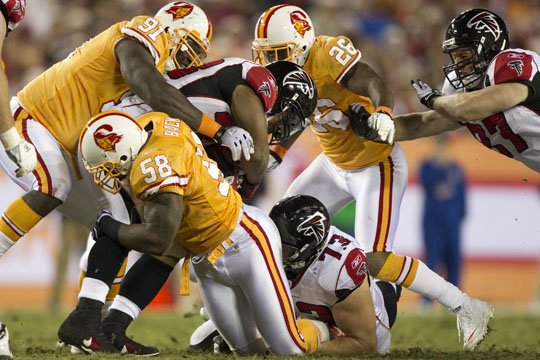
One thing you can always count on at Raymond James Stadium, is the Glazer Family will put everything they can into a Buccaneer game.  And that’s what happened at the recent throwback game against the Falcons.

The uniforms were fun to look at.  I am always impressed with the way they arrange the stadium during events like this.  And the most notable improvements is with the cheerleaders.  Their outfits are always well done and fashionable.   

First class. 

Too bad in Cincinnati, the Bengal organization doesn’t understand the role football plays in a city. 

That’s why the Buccaneers are playing for a wild  card spot just one year after completely reorganizing their team, and the Bengals can’t win if they tried.  It all starts in the front office.  Just like everything in life. 

Leadership is contagious, and the Tampa Bay Buccaneer organization has leadership at every single position from the office to the position players.  And it shows in the end result. 

They may not win every time, but they’re always fun to watch. 

Rich Hoffman

http://twitter.com/#!/overmanwarrior

www.overmanwarrior.com

Institutional Failure and the Healing Power of Key West

What follows is a history of institutionalism in the United States and its impact on the minds of the American people. It is long, so be ready to take your time. But if you stick with it, you might find it very rewarding.

So enjoy.

What do Walt Disney, John D. Rockefeller, Bill Gates, Henry Ford, Richard Branson, and Rachel Ray all have in common; none of those people have a college degree. It has always confounded me as to why and how the myth that an institution can give someone the needed components to be successful became such a universally accepted concept.

There is a lot of history on the subject of the progressive movement and its evolution from 1880 to the modern era, so there is no need to lay it all out in this work. The research is there for anyone that wants it. The important thing is to ask, why do some of the most powerful and successful people in the world push formal schooling aside. After all, if parents really wanted their kids to have a good life, why would they steer them in that direction spending tens of thousands of dollars on education per year when some of the most successful people in our history have either not gone to formal schooling, or had to drop out because the institution got in the way of their personal gumption.

The answer is remarkably foolish and I’m going to spell it out here. First we’ll deal with what the problem with college education is, then we’ll deal with the impact it has had on society.

College, and most of our education in general from grade school and up, is just forms of analytic thinking. This thinking is extremely useful for finding out where you’ve been, and it can tell you where you’re going if you can find a way to incorporate it with creative thinking, I’ll explain that in a minute. The successful people mentioned, and many others, realize that while the world outside the class room is going by, the college professors are insisting to freeze time while their class is being conducted to study processes.

In management, I have watched hundreds of college educated, well intentioned souls wrestle with a complicated problem for days, or weeks, only to have someone who works on the floor solve the problem in a matter of hours, which of course is quite insulting to the person with a degree. They are supposed to be smarter, and better equipped to deal with problems. After all, that’s what society told them would happen if they pursued a degree.

What they ended up with was a job, and a decent paying job relatively speaking. Enough money to make a decent living, buy a decent home, drive a decent car, and take a decent vacation. But deep inside most everyone is some silly little form of rot that knows they sold themselves short. They wonder how such uneducated specimens as the laborer could know how to reason anything out or have any ideas of value.

The best example I’ve ever heard of why the process of higher education, which is the parent to analytic thinking, comes from Zen and The Art of Motorcycle Maintenance by Robert Pirsig. In that fine book, Pirsig paints a picture of this analytic process by referencing a train moving down a long track. The track represents the quality of whatever you’re dealing with, whether it is business, or your personal life. At the front of the train is a locomotive of course, and behind it are box cars of cargo. Within each box car is the history of whatever is behind pulled by the train, he calls this Classic Knowledge. In business, it’s the sales records, inventory variances, staffing requirements, engineering development, etc. In your personal life; it’s much the same, mortgage values, asset management, and livelihood issues. Pirsig made the designation that at the front of the train is a thing called Romantic Knowledge. This is important because on the train tracks of life, seldom does the track just run infinitely off into the horizon, but rather there are many decisions that must be made along the way. And someone has to be at the front of the train to see those changes coming and make the decision to take a different course when those situations present themselves. Romantic Knowledge is what we see and how it relates to the track of life we’re on. The Classic approach is to analyze where the train is and where it’s been to figure out where to go. But in life, the train is always in motion so by strictly using the classic approach, the decisions are often not made in time.

I’ll take this explanation one step further. In my experience, people who swear by the classic approach are often the ones less certain of their course of action, because after all, they did not earn their knowledge, but gained it by assessing data collected. So they tend to rule from the back of the train, in the caboose. I know not many trains have a caboose anymore, but I like cabooses, so I’m going to use it here. Most of the meetings I’ve ever been in, at all levels take place in the caboose.

Why, because life is always a game of hot potato, and nobody wants to be holding the potato when the music stops. We all remember that game from grade school, right. You get the point. And the same holds true from even company presidents, and owners, accountants, engineers, sales people, everyone from the top down. It works this way in business and politics. Those people in the back of the train, drinking tea in luxury in the caboose, with their finger to the wind studying the contents of the train, but at the first sign of trouble, they can jump off the back, or perhaps even detach themselves from rest of the train by pulling the release lever if it is discovered that the train is headed over a cliff.

Meanwhile, at the front of the train is the romantic knowledge person, who is at the complete other end of the train. Those are the people that are most invested and the workhorses that drive the company because if they go over a cliff, they’ll be the first ones to fall. You’ll also find your visionary types up there, at the front with all the workhorses, scanning the countryside for pending trouble. They leave the analytic work to those in the back of the train to deal with the necessary hum drum of business compliance and government regulation, but to them, the real work is at the front.

It takes guts to be at the front of the train. You are essentially on a branch all by yourself, because the structure of every company is of course behind you, but they will abandon you at the first sign of trouble. And the romantic knows this, but stays in that position regardless.

Without realizing why I was doing a lot of things in my life, I ran across Pirsig’s book because it was noticed by many that since I ride motorcycles in the harsh cold of winter, and it is well known that I do many long distance trips by motorcycle, and that I was a different kind of thinker, that I would like the book. It had been out for many years after all. There were two things that came at me in discussions regarding my love of motorcycles. That I should watch the TV series by Ewan McGregor and Charlie Borman called Long Way Round, where they rode a motorcycle all the way around the world, and this book by Pirsig, Zen and the Art of Motorcycle Maintenance.

Knowing both items were about long distance motorcycle riding, I wanted to complete a trip to Key West that had been on my mind for a while, so I put them off until I had done that. My decision to make my big trip to Key West came at a time when the company I had been working for had an annual inventory, and was the best time for me to get away for a weeklong trip. And since I had been working in aerospace, there are typically a lot of details that must get covered in an inventory, where just a few weeks prior, we had our annual NADCAP audit, which really slows things down. So a vacation to Key West with my wife on the back of a 1500 cc Suzuki Boulevard was just the right experience.

In sharp contrast to my daily life of rigid rules and very tight production deadlines, life on Duval Street was the polar opposite. Reputedly loose, and known for its gay population, I found it easy to not notice too much of that. Instead, I found the lack of politics on that small island ideal for total relaxation. It was to me the way humans if left to their own devices would create everything, for good and bad. On that island, there wasn’t much discussion of social hierarchy. There wasn’t much desire for status. The goal seemed to be to watch the sunset at Mallory Square, buy drinks from a street vendor, and possibly get naked on the roof top bar of Adam and Eve.

That type of thing is a bit too calm for me, but it did give me insight into the truth of the human condition because as I looked around, I saw a lot of professionals that were there for similar reasons. I’m not a big fan of intoxication, and many of the visitors I saw were, what they shared with me on that visit was a desire to travel to the end of the earth and just get away from the mainland, but still be under the umbrella of the United States, which is a great thing. More on that later.

Anyway, what that has to do with Pirsig, and this whole idea of institutionalism is that I made a point to read that book after my trip there, and was happy to find I had similar thoughts as he did when he made a motorcycle trip with his son across the northern part of the country going from Minnesota to California. I was worried that if I had read the book before I made a big trip of my own, that my own thoughts might have been corrupted somewhat instead of enhanced by a shared experience.

Long trips like that on a motorcycle have a way of putting you in touch with things, and your observations are much keener, because they have to be. There is not protection from the elements. There are no air bags in case of a crash. It’s you, and the road a few inches below your feet rolling by at 70 mph. Rocks, bugs, rain, the rays of the sun, can have devastating effects to your body, and after traveling over 1500 miles one way to get to such a place as Key West on a motorcycle, you find yourself driving down Duval street with your wife in a bathing suit pressed to your back and knowing you traveled a road till it just dropped off into the ocean. And you feel the relief of social convention drop away with each island you travel through down US 1. And when you come to the sign that says “welcome to paradise,” you get the feeling you’ve arrived truly at one of the world’s great places.

For me, and apparently for thousands of others that go to Key West for fishing, snorkeling, or just to visit the drinking establishments on Duval Street, the island is devoid of institutions as much as is possible in organized society. And that is what makes it a paradise.

And it takes stepping away from something sometimes before you can clearly see it, and I had been on a 20 year crusade against institutions without really knowing why, just that I was at the front of the train in every position I had ever held, but I had no explanation as to why some things that came easy for me, were so confusing to others, especially those that insist that analytic data is the only data worth looking at.
I had been to college myself three different times. The first time was right after high school, I did the typical enroll in classes because society says that the best way to get a decent job. I took night classes in economics while I worked full time during the day. But, the professors to me seemed out of touch, and my conclusion was that they taught because they couldn’t practice it in reality. And I really couldn’t see how those classes were going to equate to a good job. I was working at a metal stamping plant at the time, and I identified with the people on the floor more than the people in the front office. On the floor was where the battles were taking place. Out on the shop floor was where people got injured, lost fingers and sometimes worse. The front office was a place I saw little value being done, and the people went home safely every night. That life seemed boring, so why would I want a job up there? So I could make an extra $20,000 a year as a white collar worker?

My wife and I had one car at the time, so I rode a bicycle 8 miles each way to work so she could have the car during the day. And it was a mild excuse for me to bring some adventure to each day with my exposure to the elements. The rides to work by bicycle, and the danger of life on the shop floor was more appealing to me than what the college promised, so I quite after the first year. The late nights staying up and boring classes just didn’t hold much appeal.

I returned to classes a few years later when management at that same company suggested I had the kind of leadership ability they were looking for, and I’d need school to advance. I signed up for the classes, waiting in the lines at the enrolment office at the University of Cincinnati’s Raymond Walters College, and went to the first day of classes. College level English, business math, economics, that kind of stuff. I could not see how this was going to help me, or my family, so after one night, I quit again.

The third time was after several jobs. I had felt the sting of being a floor worker and holding token leadership positions, and having contracts cancelled and job reductions result. I bounced around from several different companies always finding myself in a position of a leader, by default, but not really having job security. I had a couple of kids, and since my wife and I agreed to have her stay home to be available at all times to raise our children, I worked several odd jobs to make supplement income. Some of those odd jobs included grill cooks at McDonalds, and Wendy’s, I did various sales work, I did janitorial work, and I worked as a tree trimmer.

The tree trimming was dangerous work and I liked it most of the time. But it was hard to work all day at a normal punch the time clock type job and have the gumption to climb a tree at the end of the day and remove it piece by piece hanging from a rope. So I lobbied to switch to third shift at my machine rebuilding job at Cincinnati Milacron, which was a pretty good job at the time, and went back to school full time during the day so I could go for a white collar position either at Milacron, or someplace else.

In a couple of weeks of classes, I couldn’t help but see the blank looks on all the students, many were my age, some were coming back to school to get a better job, some were just kids out of high school, doing the college thing because they wanted a good job. But the overall atmosphere was one of decay, and stagnation. The professors had not changed, and why should I expect them to. And I had not changed in the direction needed to complete school. I still had too many questions for the authority in charge, and they could not give me the answers I needed.

Only books could do that, and I read extensively over the years. One powerful quote that came to me from some of Joseph Campbell’s works was that often the reason many stories involve a hero having to leave society in order to find a way to save it is because society is the one in trouble, so they are not equipped to give the hero what he needs. So the answers are often outside the establishment.
So I quite school for the third and last time. And I looked outside society to find answers to some of the problems within it. And that led to many adventures that we will discuss as the chapters progress. But for now, Key West, outside of society in a way, Pirsig’s thoughts on romantic knowledge, which certainly defines my approach and my own long motorcycle trips.

I have had great success in management positions over the years. It has been a routine for me to take over positions from other managers and quickly fix the problems they had been having. What I never did do was look at the fish bones and other charts from the previous managers. I created my own fresh perspective. This of course is not what’s taught. Teamwork and collaboration are the cornerstones of modern business, so says Bill Smith of Motorola and pioneer of its Six Sigma applications in 1986. He died of a heart attack in 1993 at work but not before seeing Motorola receive the Malcolm Baldrige National Quality Award. GE and Honeywell were two of the first to jump on the Six Sigma bandwagon and used it as a way to find savings they should have always seen, but for the fact that they are huge companies that had huge waste, undetected while they strolled the golf courses of America. Nothing against Mr. Smith, hindsight is 20/20, and he was only trying to get his bosses to listen to reason from pioneers such as Genichi Taguchi who helped Japan reclaim itself after World War II. As it’s turned out though, like many things, good intentions pave the way to hell. Of the 58 large companies that took Six Sigma as a method 91% have trailed the S&P 500 since making that decision. The invisible villain to Six Sigma is it stifles creativity, and ingenuity, and prohibits growth. It saves money by cutting logical waste, but puts everyone in the back of the train leaving nobody up front to make decisions. That is why it is an unmitigated failure to American society.

As you read this, look around at your peers in business and politics. Look at the course of life they are on, and see if they aren’t in for a similar fate as Bill Smith. Organizations such as Six Sigma have gone to great strides, unintentionally, to bring about our lack of competitive advantage currently. And they have worked their way into every aspect of society.

And colleges, like all institutions, have swelled in this later half century because they offer the same thing large companies like GE have bought in to with Six Sigma; a savings of money, and ease of effort, to maximize some proportional return on the investment. But what ends up happening, is a loss of future development while you may show slight profit on paper.

That’s why the answers were always along the road less traveled. While I was on my motorcycle trip in Key West I had to look around at the people packed into Sloppy Joes to listen to a half decent band play while drinking profusely. And I had for them a new understanding to explain their behavior. Escape.

Escape from the world and all its childish institutions. For me, it was a long standing answer to the question I had, why is drinking so prominent in our culture. Adults from 1947 to current that routinely drink alcohol hovers around 64%, and my question has always been why? What makes anyone want to consume a beverage that dehydrates your body, and can make you feel terrible the next day? It is a learned behavior and natural byproduct of going against our natures where we all feel is progressing along without our help or input. So the alcohol provides some needed numbness barrier against that sense of impending doom. And this is a steady and predictable reaction to the slow, eroding conditions institutions place upon our society. College age kids are learning this wherever they are going to school. Every campus has this culture as a natural counter to the mundane diatribe of the college professors.

And for working adults that have to either put up with some company line where the heads of companies force a Six Sigma program on their company whether it’s at the front office level, or the manufacturing floor, it impacts everyone within the organization. For every dollar gained from saved waste, there is always the loss of potential income gained through ingenuity. And everyone at some level feels it, even if they can’t articulate it. And those leaders in those companies typically are at the back of the train looking at powerful companies like GE and they see the report that GE saved 12 billion over a 5 year period and added 1 dollar to their market share, and they allow that information to steer their decision to commit to a program that basically goes against American ingenuity, which is something we have as Americans innate, because we all grew up in a free society. So powerless to stop the avalanche, we turn to the drink, or turn to religion, and many times both.

Six Sigma is not an American idea. It is a concept started in Japan, that Mr. Smith put some new names to, and added a few processes to in order to make a claim to invention. And I’m picking on Six Sigma because it is one of many institutions that are in place in modern business that is prohibitive to what America is naturally good at. And it’s so popular now, that it has name recognition even if the company you do work for isn’t using it.

I’ve personally had to sit through hours of classes in my positions studying this concept and feeling sorry for the instructors, and the owners of the companies I’ve worked for because they are just like fish that bit the hook of a fisherman, with a line in the water. In this case, the Japanese, have a book, actually a couple of books, one is called The Art of War, and the other is The Book of Five Rings which explains in great detail what they are doing to us, and both books will be talked about in further chapters. But in post World War II, we had just bombed their small island with nuclear bombs after a very bitter conflict, and we thought they were just going to go away and be our friends? No, they gave us Six Sigma, a slow poison of which they have immunity to.

The reason they are immune to the effects is because they are not like us. We’re all people with two arms, two legs, a head, hands and feet, and I certainly don’t mean they are inferior, or superior, only how they think is different than us. They are very good at group organizing and incorporating the analytic process. They will work around the clock and not ask for much in return. They live in much smaller living space than the average American, and will often stay with their parents even after they marry. They in many ways understand us more than we understand ourselves. And they knew they could out manufacture us, and what they’ve done as an international business strategy, was to get the world to follow them.

But we can’t be like them without fundamentally changing ourselves and they know that. And to properly do their Six Sigma program, you have to think like a person from the East.

Americans do not like to work together though. We’ll go to the grocery and pass two feet from someone, and not make eye contact with another person. We are one of the few places on earth where we grew up in space, and we like our elbow room. We do not feel compelled to acknowledge another person even if they bump into us. And while the world, that has been jealous of the space we have, points its finger and tells us we are wrong, and we should change, it is probably time that we put some sort of definition on what an American is.

An American isn’t a white homosapien, a Native American, an African-American, a Hispanic American, and Asian American or any of those titles. We are a people that love space, liberties around the clock, and we are a very individualistic group. And we’ve wasted a tremendous amount of time being defensive about that from Europe, and Asia where individualism is not near as important to them because it has not been an option in thousands of years of social development. And it’s time we focus on what we are good at and stop trying to copy everyone else. If you want evidence of this, look at the football played by the rest of the world, and look at the football we play. Our football is a uniquely American idea, and most of the star players are not decedents from Europe. But the concept is all American. The other things to study are who made the last blockbuster film from Tokyo, or Paris? How about London? They all make films, but the films produced are often reflective, by default, of the cultures that produce them. You want to know about a culture, study their art. And studying American art is easy, go to your local video store. Our films are the envy of the world because American culture has so much to say, because we actually think and naturally question authority.

So let’s get back to a guy like Walt Disney, who never went to college. He dropped out of high school at age 16 even, and never came close to entering college. Books by themselves could and have been written about Disney. But the short of it is this, who has been able to replace Disney as a media empire? What foreign company has come close to equally Walt Disney? Don’t you think they would if they could? George Lucas is the closest that comes to my mind, and he uses Disney’s model. And before you say Disney as a company has made more money since the theme parks opened in the 70’s than it did while he was alive, it was that they stayed true to his vision and did not stray. So they’ve kept the quality of his work intact.

After Walt Disney died, the animation division faltered and was not resurrected until the 90’s with when Jeffery Katzenberg took over the animation division. Most of Disney’s modern era animation films, which they are known for, came while Katzenberg was at Disney. Once he and Michael Eisner had a power struggle where Eisner failed to promote Katzenberg to president of the company, Eisner left to found DreamWorks with Steven Spielberg. And before you say that Pixar, a Disney company that still makes great animated films, which was started by George Lucas and bought by Disney, they didn’t develop that on their own.

However, not since Jeffery Katzenberg left Disney’s animation division has Disney been able to recapture the magic, and they are still waiting for that special guy to come and help them make great animated musicals again. The reasons I bring all this up is because consider the power the Disney Corporation has. Consider the reach they have. Think of all the top students at all the universities all across the country that wish to work for Disney. And they have vast resources to develop with, yet why is it so difficult to put out a film like The Little Mermaid again? Because people like Katzenberg, Walt Disney, George Lucas, and those types of people, cannot be duplicated in an institution. No matter how hard they try, no class anywhere can create people who produce at that high level.

If the intention were to teach students to be thinkers at a high level, it would be a different story, and one that I could see would be something of value. But the intention is only to produce some mediocre specimen in a social context. None of my experience at college or even grade school has shown me there is any quest in the student body to find the exceptional among us, except in sports.

There’s nothing wrong if you did go out and pursued a degree, and spent a great deal of money on it. But the degree will not make you the next Walt Disney or Henry Ford, just so long as everyone understands that.

While it’s true that things were different back in the early days of the industrial revolution, and very few people pursued a formal education then, the same rules apply in the modern era. Bill Gates dropped out of Harvard. He did find some friends there that helped him work out his thoughts, but what at Harvard was some professor going to do for someone as forward thinking as Gates? He set up a deal with Micro Instrumentation and Telemetry Systems(MITS), after reading a popular science article and told them he and his friends had been working on a BASIC interpreter for the platform. In truth, they had not, but they figured it out in time for a meeting with the MITS president a few weeks later. One thing led to another and pretty soon Gates and Paul Allen started Microsoft within a few months.

Steven Spielberg snuck onto the lot of Universal Studios and set up an office and pretended to be important and just sort of hung around as an unpaid intern. He applied three times to USC’s School of Theater but was turned down because of his C average. So he enrolled at California State University at Longbeach. But it was his sneaking onto the lot of Universal that got his career moving. 35 years later, Spielberg did get a degree at USC; I suppose to prove a point, that after he made some of the most successful movies of all time.

What colleges have done is firmly imbed themselves into politics. It is now an expected part of our culture. Parents begin saving for their children’s college before their kids even enter kindergarten. And it is an unfashionable taboo to question the institutional process even though much of the liberal oriented political viewpoints are imposed by professors upon the students at universities. Not necessarily a harmful thing directly, but does become a force to contend with at election time when millions of college age students go to vote. The institution then becomes a political weapon.

No matter what you’re political persuasion is, having an entire age group think in one political manner does not accurately reflect the values of the society at large. As it currently is, higher education is a powerful mechanism for the DNC, and for that type of vote buying power, they should be paying us for the influence they have over our kids. Not us paying them.

Not all students buy into the liberal positions of colleges, and of course not all professors are liberal hippies. But overwhelmingly, the young people between 18 and 22 are likely to believe in gun control, social reforms, and minority rights, as important voting issues in an election. And that makes the institution not just something that will get them a professional position at some company.

Woodrow Wilson went from being president of Princeton University, to governor of New Jersey, then soon after, President of the United States. He is responsible for the League of Nations which paved the way for the United Nations. And while he worked with England and France to divide up the post World War 1 Europe through the Treaty of Versailles. During this wonderful divide, the Middle East was created which led to most of the current troubles in the region today. Iraq was formed due to the Treaty. Germany was forced to pay the reparations of the war completely, which bankrupted them and gave Hitler a platform to rise, and a young Vietnamese bus boy at the Ritz in Paris called Ho Chi Minh begged for a chance to plead for Vietnam’s independence to Wilson, who was ignored because Vietnam was not near the issues of Europe. At that time, Ho Chi Minh was a nationalist, and a fan of the American Revolution. He wanted the same for his county, but when the League of Nations wouldn’t listen he turned to the communists in the Soviet Union which eventually led to the Vietnam War, more on that later. So with all the great intentions Wilson had in forming a massive League of Nations, that stood on the high ground of morality and international good will, he really screwed up. In historical context ninety years isn’t very long, but it exceeds our short memories as Americans. It is difficult to look that far back and see how decisions made then impact now. But they sure did. The Treaty of Versailles caused World War II, The Vietnam War, and the Gulf War, both of them. And that is the model of the current United Nations. With all the current activity going on at the old Palace of Nations in Geneva we can only guess at the many plots boiling there that will impact us twenty, thirty years down the road. But that’s just me talking from the front of the train. All you in the back enjoy the ride.

Wilson is a hero to the progressive movement, and the modern democrats as well as colleges across the country because he was in essence an intellectual, like them, so he is widely followed. But looking at the Treaty of Versailles, even though the intentions were good, turned out to be absolutely devastating to the American way of life.
Institutions whether you’re talking about a typical college, or something like Six Sigma are not American ideas. They are foreign ideas, and should be available under the umbrella of freedom. But of the founding fathers, which Jefferson graduated from the college of William and Mary, Madison from Princeton, and Adams from Harvard, George Washington did not go to any college, and he was the first president, and that says a lot about our character. It wasn’t just the bravery he exhibited, but there was a sense of logic to whatever Washington did. But he wasn’t the only found father that did not attend college. Ben Franklin was never schooled beyond age 10. Come to think of it, Abraham Lincoln never attended a university. He passed the bar exam by reading books on his own, sometimes walking over 12 miles to borrow a book as a kid.

Here’s the bottom line. Using a European model for colleges, and an Asian model for programs like Six Sigma, institutions have within a 200 year span of time, and most rapidly since the industrial revolution, taken over much of what we do and how we do it in America. And it has been a slow poison that has robbed us of our vigor. In our freedom from the shackles the rest of the world has been burdened with whether it is feudal families of Asia, or kingdoms of Europe, we developed truly original ideas that has greatly improved the livelihood of most of earth. And we have been raised with massive corn fields, and farms, and shopping malls, and free press for all of our adult lives. But to us all, the institutions feel wrong, and we know it on an innate level, but feel powerless to question the process because we all need jobs to fuel our personal economies. So when our business leaders, lazily copy off each other, because that’s human nature, and listen without thought to Jack Welch spew on about Six Sigma and how much money they saved, a careful investigator would ask, Jack, why did you need the Japanese to tell you how to create a product with little waste and deliver it on time to a customer? What he really meant to say, but couldn’t is that GE is a huge union company and he needed some program like Six Sigma that is too complicated for union stewards to understand, to sell the idea of actually applying common sense to everyday business practices. But what he did, like the blundering escapade of the Treaty of Versailles is creating more institutional limits to the American Imagination, good intentions gone badly.

So powerless to take in the whole picture, we watch our football games and drink our beer. We talk about going out at night and getting hammered and root for the players on a football field where the rules are simple. Get a first down, score a touchdown.

And that is the real cost of this institutionalized society we’re currently in. At a personal level, we feel it, but in most cases we’re willing to trade a decent wage for some loss of personal input. But on a national level, we’re allowing influences from the outside to define our national identity. When the reality is that no place else in the world has the ingenuity that has come from the United States been shown, why would we be so willing to listen to inferior strategies?

Being a great leader, manager, politician, or even an artist requires vision, and that is something institutions cannot give you. They can help you set goals, and figure out how to get the analytic data. But they cannot give you the vision to see what is coming. Only those that are willing, and bold enough to put themselves out on the cutting edge, and not hide in the safety of the masses, will have the ability to make their vision a reality.

Rich Hoffman

http://twitter.com/#!/overmanwarrior

www.overmanwarrior.com

We Are At WAR!

You won’t see tanks driving down your street. You won’t see troops knocking on your door. But you will see your way of life being destroyed in a way that is no different than a military unit cutting off a railroad or other major supply line to a strong opponent. Philosophically, economically, ethically, we are at war.

Another one of my favorite books, which is a book I studied carefully over a period of years because it’s one thing to read the book word for word and gain a basic understanding. But the work of Sun Tzu requires an understanding of eastern philosophy, which is something specifically unique to Japan and China. The following quote is from The Art of War under PLANNING A SIEGE.

Complete victory is when the army does not fight, the city is not besieged, the destruction does not go on long, but in each case the enemy is overcome by strategy. So the rule for use of the military is that if you outnumber the opponent ten to one, then surround them; five to one, attack; two to one, divide. If you are equal, then fight if you are able. If you are fewer, then keep away if you are able. If you are not as good, then flee if you are able. This advice applies to the case where all else is equal. If your forces are orderly while theirs are chaotic, if you are excited and they are sluggish, then even if they are more numerous you can do battle. If your soldiers, strength, strategy, and courage are all less than that of the opponent, then you should retreat and watch for an opening. Therefore if the smaller side is stubborn, it becomes the captive of the larger side.

There are five ways of knowing who will win. Those who know when to fight ad when not to fight are victorious. Those who discern when to use many or few troops are victorious. Those whose upper and lower ranks have the same desire are victorious. Those whose generals are able and are not constrained by their governments are victorious. These five are the ways to know who will win.

This section is under FORMATION:

To perceive victory when it is known to all is not really skillful. Everyone calls victory in battle good, but it is not really good. Everyone says victory in battle is good, but if you see the subtle and notice the hidden so as to seize victory where there is no form, this is really good. It does not take much strength to lift a hair, it does not take sharp eyes to see the sun and moon, it does not take sharp ears to hear a thunderclap. What everyone knows is not called wisdom. Victory over others by forced battle is not considered good. In ancient times those known as good warriors prevailed when it was easy to prevail. If you are only able to ensure victory after engaging an opponent in armed conflict, that victory is a hard one. If you see the subtle and notice the hidden, breaking through before formation, that victory is an easy one. Therefore the victories of good warriors are not noted for cleverness or bravery. Therefore their victories in battle are not flukes. Their victories are not flukes because they position themselves where they will surely win, prevailing over those who have already lost.


Great wisdom is not obvious, great merit is not advertised. When you see the subtle it is easy to win—what has it to do with bravery or cleverness? When trouble is solved before it forms who call that clever? When there is victory without battle, who talks about bravery?

For those who will say that I am over exaggerating or that I am seeing what I want to see in the matter, you are part of the problem. The information is in books. Sun Tzu to the Chinese is probably revered more highly than George Washington is to the United States. Chairman Mao used The Art of War to defeat Chiang Kai-shek. I was a big fan of Kai-shek. My favorite modern military figure is Claire Lee Chennault leader of the Flying Tigers. Chennault worked closely with Kai-shek to hold off communism in China, but weak US policy after World War II lead to Mao taking over the country in 1949. Chennault warned of the possibility of future war with China in his WONDERFUL book Way of the Fighter published in 1949. In that book, that is now considered a rare book, Chennault predicted the trouble with Korea and Vietnam years before they occurred. It was a shame that nobody listened then.

Starting on page 505 of Joseph Campbell’s masterpiece called Oriental Mythology, published in 1962 and was part of four books he spent 12 years writing; he chronicles the beginning of communism in China quite startlingly. While China was showing propaganda pictures to the world such as a family sitting at the table under a picture of Mao, the following events occurred. Keep in mind this is just one account of many.

A man, aged twenty-two from Doi-Dura in th Amdo region was told by the Chinese that he required treatment to make him more intelligent. The Chinese at the time were telling Tibetans that they were a stupid inferior race and would have to be sup-planted by Russians and Chinese. They took blood tests of this man, his wife, and many others, and there are a number of corresponding reports from different parts of Tibet detailing the sort of operation to which this young man and his wife were the next day forced to submit. They were both taken to the hospital. “He was completely undressed, placed on a chair and his genital organs were examined. Then a digital rectal examination was carried out and the finger was agitated. He then ejaculated a whitish fluid and one or more drops fell on a glass slide which was taken away. After this a long pointed instrument with handles like those of scissors was inserted inside the urethra and he fainted with pain. When he came round the doctors gave him a white tablet which they said would give him strength. Then he received an injection at the base of the penis where it joins the scrotum. The needle itself hurt but the injection did not. He felt momentarily numb in the region until the needle was removed. He stayed ten days in the hospital and then a month in be at home….he had been married for only two years and prior to this treatment had very strong sexual feelings…Afterwards he had no sexual desire at all….”

Meanwhile, his wife “was undressed and tied down. Her legs were raised and outstretched. Something very odd which became painful was inserted inside the vagina. She saw a kind of rubber balloon with a rubber tube attached, the end of which was inserted inside the vagina. The balloon was squeezed and his wife felt something very cold inside her. This caused no pain and only the tube and not the balloon was inserted. She remained conscious throughout. Then she was taken to bed. The same procedure was carried on every day for about a week. Then she went home and stayed in bed for about three weeks,” and thereafter she had neither sexual feeling nor menstruation.

There will always be the types of individuals on this planet that seek to control others. And with the United States having the most advanced war weapons on the face of the planet, enemies of the United States will not attack us directly, because they can’t. But they will undermine us from within. They will use propaganda to divide our nation. They will use our movie stars to perpetuate their message. They will seek to wreck our economy, our life style. They will seek to get our politicians moving in a direction that is not of the people’s wishes. And they will be patient and strike when they are sure to win.
Don’t kid yourself. We are at war right now.


And if you don’t watch any of the above, watch this one.

This is extremely serious. Pay attention and understand what’s happening. That’s the first step to turning this around.
Nothing is impossible. For inspiration I look to our AMERICAN games. If we get our minds in the game, this could be our a nation instead of just a game from my favorite sports team. I look to this game as a metaphor that nothing is ever lost until the clock runs out of time. Here is Matt Bryant’s 62 yard field goal against the Eagles in the final seconds of the game. In theory, a kick from mid-field should be impossible.


Here is the view from the stands, under the Pirate ship, where I like to sit.

And the box seats.

And leaving the stadium after the big kick.

America needs a victory like this. We need to get our currency strong again, and to regain our strength on the world stage. It’s not too late.

Rich Hoffman

www.NoLakotaLevy.com