
The Litigation Profiteers: How Election Lawyers and Government Legal Firms Thrive on Political Chaos and Taxpayer Funds

As I drove past the law practice in Beckett Ridge the other day, I noticed the big sign out front supporting Cindy Carpenter in the Republican primary for Butler County Commissioner. It struck me as odd. The lawyer who runs that firm shows up at Republican events, associates with Republican circles, and presents himself as one of us. Yet here he was, publicly backing a candidate the party had dumped in favor of its endorsed choice, Michael Ryan. That sign crystallized something I’ve observed for years in Ohio politics: certain legal professionals operate in the shadows, injecting themselves into local disputes not out of ideological consistency but because chaos creates billable hours. This isn’t isolated to one small firm or one county. It scales up dramatically when you reach the national level, where figures like Marc Elias have built entire practices—and substantial wealth—by turning election law into a high-volume litigation machine that drains public resources while advancing partisan goals. What follows is my endeavor to shed light on this system, drawing on personal experiences in Ohio and broader patterns affecting taxpayers nationwide. 

Marc Elias, the prominent Democratic election law attorney (often referred to in shorthand as “Mark” in casual conversation), stands as the archetype of this phenomenon. Elias, a partner at Elias Law Group, and is a direct supporter of Amy Acton in Ohio, which he founded after leaving Perkins Coie in 2021, has positioned himself as the go-to litigator for voting rights challenges. He founded Democracy Docket in 2020 as a platform to track and analyze these cases, and his firm has been extraordinarily active. In October 2025, Elias publicly stated that his team of fewer than 60 lawyers was litigating 63 voting and election cases across 30 states. By May 2026, that number had climbed to 85 cases in 43 states plus the District of Columbia. His side claims victories in the overwhelming majority of post-2020 challenges to Republican-backed election measures, framing them as defenses against “voter suppression.” Critics, however, see a deliberate strategy of lawfare: filing lawsuits in multiple jurisdictions to force states, counties, and local governments to expend vast sums to defend laws that enjoy broad public support, such as voter ID requirements. Elias himself has acknowledged the volume, noting in one Democracy Docket piece that his firm’s work is relentless and expanding. 

This isn’t new for Elias. In 2020, he led the Democratic legal response to more than 60 lawsuits filed by Donald Trump and his allies challenging election results. Nearly all of those suits failed, often on procedural grounds or for lack of evidence. Elias’s team prevailed in the lion’s share, cementing his reputation. But the pattern predates 2020. He has challenged voter ID laws, early voting restrictions, ballot-collection rules, and redistricting efforts in dozens of states. In Ohio specifically, Elias Law Group filed suit in January 2023 against House Bill 458, signed by Republican Governor Mike DeWine. The law included photo voter ID requirements and other provisions that the plaintiffs—groups like the Northeast Ohio Coalition for the Homeless, Ohio Federation of Teachers, Ohio Alliance for Retired Americans, and Union Veterans Council—called “voter suppression.” The suit argued the measures disproportionately harmed young, elderly, Black, military, and overseas voters. Elias’s firm has also targeted Ohio’s rules on drop boxes and foreign funding in ballot measures. These actions align with a national playbook: challenge decentralized election administration in as many venues as possible, knowing that even if many suits are dismissed, the cumulative cost to defenders mounts. 

What makes this infrastructure so effective—and so corrosive—is the decentralized nature of American elections. Unlike a centralized national system, voting rules are set and administered at the state and county levels. A single law, such as Ohio’s voter ID requirement or restrictions on “Golden Week” early voting and registration (which Elias’s earlier work also targeted), can trigger parallel lawsuits in federal and state courts. Each filing forces election officials, secretaries of state, and attorneys general to respond. Defense isn’t cheap. Routine election litigation for a state or county can run between $50,000 and $250,000 per case, according to estimates from officials who have faced these challenges. When emergency injunctions, appeals, and discovery are involved, costs balloon into the hundreds of thousands or even millions per major dispute. Multiply that across dozens or hundreds of suits nationwide, and the taxpayer burden becomes enormous. Many of these expenses are buried in general budgets, election administration line items, or outside counsel contracts rather than isolated as “litigation defense.” There is no national requirement to itemize plaintiff-specific legal fees, making the full picture opaque. Reporters rarely dig into the granular accounting, so the public seldom sees the true price tag. 

I have seen this dynamic play out up close in Ohio. During my involvement with local issues, particularly around Lakota Local Schools in Butler County, I witnessed how legal strategies can be weaponized to remove elected officials who don’t align with certain interests. A school board member endorsed by the Republican Party faced removal efforts involving coordinated complaints, legal maneuvering, and outside pressure. The board ultimately acted against her amid disputes over absences and other procedural issues. Public records battles followed, including a case that reached the Ohio Supreme Court, where Lakota was ordered to pay thousands in fees for failing to promptly release documents related to legal spending and threats of litigation. The district also settled other suits involving residents barred from speaking at meetings, covering plaintiff legal fees. These aren’t abstract costs. They come out of the same budgets funded by local property taxes—the very taxes that already strain families and businesses. School boards negotiate collective bargaining agreements with unions, and the legalisms involved in those contracts, disputes, and related litigation generate substantial revenue for outside firms. Chaos in the public school system, whether over board composition, curriculum, or operations, keeps the meter running. 

The same lawyer I saw with the Carpenter sign had previously inserted himself into the school board removal effort. He helped craft or advise on the legal strategy that contributed to ousting a Republican-backed member. It surprised me at first—someone who attends Republican events playing along with what appeared to be an effort to shift the board toward more liberal control. But it makes sense once you follow the money. Law firms that specialize in government work—whether at the school board, county, or state level—thrive when there is perpetual conflict. They represent municipalities in defense matters, advise on contracts, and sometimes moonlight on partisan challenges. The incentive is clear: more lawsuits mean more retainers, more billable hours, more settlements. In Lakota’s case, the legal spend tied to board disputes and public records requests added up quickly, all ultimately borne by taxpayers.

This pattern repeats at the state and national scale. Elias’s firm has received tens of millions in payments from Democratic committees and campaigns. OpenSecrets data for the 2024 cycle alone shows Elias Law Group receiving over $40 million in legal services from various Democratic entities. These funds don’t come from thin air; they originate with donors who expect results in the form of favorable court rulings, delayed or blocked reforms, and sustained pressure on Republican-led election administrations. When states settle early to avoid mounting defense costs—as some attorneys general have done rather than fight every challenge to the bitter end—the litigation achieves its strategic goal without a full trial. The threat of bankruptcy through legal fees is real for smaller jurisdictions. Communities facing multiple simultaneous suits often lack the resources to defend aggressively, leading to procedural changes or policy retreats that might not have occurred on the merits. 

Critics of voter ID and other common-sense reforms frequently point to the absence of widespread fraud findings in court as proof that the measures are unnecessary. But that misses the point. Many challenges never reach a full evidentiary hearing on fraud because the sheer expense of litigation forces capitulation or dismissal on narrower grounds. Elias and similar litigators understand this leverage perfectly. They file suits knowing that even meritless claims impose real costs. One notable example involved sanctions against Elias and co-counsel. In a Texas case concerning the elimination of straight-ticket voting, the Fifth Circuit Court of Appeals sanctioned the team for filing redundant and misleading motions. The court ordered payment of opposing attorney fees and double costs, describing the conduct as problematic. While Elias’s defenders called it a technicality or good-faith error, the episode illustrates how aggressive tactics can cross lines—and still generate fees along the way. A federal court in another context also addressed Elias-related conduct with fee-shifting orders. 

The broader legal profession has learned to mine government budgets in similar ways. Public sector collective bargaining, school board disputes, redistricting battles, and election administration all require specialized counsel. Firms embed themselves in these ecosystems, often representing both sides of the table at different times. The result is a self-perpetuating cycle: policies that invite litigation create demand for lawyers; lawyers file suits that generate more litigation; governments pay to defend or settle, raising taxes or cutting services elsewhere. Property taxes, in particular, become a reliable revenue stream for these activities because they are local and somewhat insulated from immediate voter backlash. In Ohio, where property taxes fund much of local government and schools, the inability to rationalize budgets amid endless legal challenges keeps rates elevated. Media rarely connect the dots between litigation infrastructure and tax burdens, but the connection is direct.

I’ve dealt with my share of lawyers and consultants lately, both personally and in observing public affairs. They are expensive—often prohibitively so. They jump between contracts, charge premium rates, and extract significant value from the top of any deal or dispute. When legal issues arise, they can drain bank accounts with astonishing speed. In government contexts, this dynamic is amplified because the payer is diffuse: the taxpayer. Most citizens don’t have the expertise or resources to challenge the system themselves. Self-representation is possible but risky and time-consuming; hiring specialists is the default for institutions. Judges, many of whom come from the same legal circles or socialize with attorneys at events, often defer to the professionals. The result is a clubby environment where loyalty to the bar most of the time trumps accountability to the public.

Nationally, the scale is staggering. Democracy Docket’s own tracking shows hundreds of voting and election lawsuits filed in recent cycles—228 in 2024 alone, part of a total of 306 from early 2023 through Election Day. While Elias frames these as necessary defenses of democracy, the cumulative burden of defense falls on public coffers. States like Texas have spent millions defending voter ID and redistricting laws over the years. North Carolina expended roughly $5 million on voter ID litigation between 2011 and 2016. Local Voting Rights Act Section 2 suits have cost jurisdictions millions apiece in defense and settlements—Charleston County, South Carolina, spent $2 million unsuccessfully; Yakima, Washington, nearly $3 million. These figures represent conservative estimates; appeals and repeated filings multiply the impact. When aggregated across the country, the high single digits of millions—or likely far more—disappear into budgets without clear public accounting. 

Elias’s involvement in Ohio is not abstract. Beyond the 2023 HB 458 challenge, his network has engaged with issues such as foreign money in ballot campaigns and drop box rules. He has also sued to overturn certain restrictions on foreign nationals’ spending in Ohio ballot measures. These actions, while presented as principled stands for access, have the practical effect of complicating administration and forcing expenditure. Meanwhile, at the local level, analogous tactics play out in school boards and county commissions. The removal of a Republican-endorsed school board member in Lakota, the public records fights, and the legal maneuvering around board composition all illustrate how law can be used to reshape governance without direct voter input at the ballot box. The lawyer with the Carpenter sign understood the game: support the candidate who sustains the ecosystem of disputes.

This is not to say every lawsuit is frivolous or that voting rights concerns are imaginary. Legitimate disputes exist, and courts rightly resolve them. But the volume, the targeting of popular reforms like voter ID (supported by large majorities in polls), and the financial incentives create a corrosive feedback loop. Democrats benefit from the chaos because it undermines Republican-led integrity measures. Law firms benefit regardless of the outcome because fees accrue during the process. Taxpayers lose either way—directly through documented legal bills and indirectly through higher taxes, diverted election funds, and eroded trust. When cases settle or procedural changes are mandated to avoid further expense, the public rarely sees the full ledger.

The decentralized structure of elections is a feature of federalism, but it becomes a vulnerability when exploited systematically. Each county must defend its own processes. State attorneys general face a barrage. The strategy is clear: file enough suits to overwhelm capacity, force settlements, and normalize the idea that basic safeguards are legally suspect. Elias has coordinated responses to dozens of cases, and affiliated litigation has filed over 100 suits in a single year. His personal involvement in 64 election cases during the 2020-2021 period is well-documented. The goal, from the critic’s perspective, is not merely to win discrete cases but to make enforcement of election laws so costly that officials stop trying.

Personal experiences reinforce the systemic view. Dealing with consultants and attorneys in various contexts has shown me how quickly costs escalate. They take a large cut off the top, move from job to job, and thrive on complexity. In government, this is magnified. School board members who push back against the status quo often find themselves targeted legally. Elected officials hesitate to fight because they fear draining community resources. The result is a shadow governance where law firms exert outsized influence.

To break the cycle, we need structural changes. Stronger voter ID laws with clear, unambiguous standards reduce litigation fodder. Meaningful sanctions for abusive filings, greater transparency in government legal spending, and centralized tracking of litigation costs would help. Term limits or ethics rules for government attorneys might limit revolving-door incentives. Most importantly, voters must recognize that these “phantom costs” are real and fund them through taxes. Integrity in elections isn’t free, but neither is the endless litigation that undermines it.

As someone who has watched this play out from the ground level in Ohio—seeing yard signs that reveal divided loyalties, school board battles that consume resources, and national players like Elias shaping the battlefield—I believe the public deserves better. The litigation infrastructure built on chaos benefits a small class of professionals at the expense of representative government. Taxpayers foot the bill, often without realizing the full scope. Shining a light on these practices, demanding accountability, and supporting reforms that prioritize clarity over ambiguity are essential. Otherwise, the parasites will continue to thrive while the body politic weakens. We have the tools to fix it; what remains is the will to use them.

Footnotes

1.  Personal observation of law practice signage and political involvement in Butler County, Ohio, 2026 primary context.

2.  Democracy Docket reports and Elias public statements on case volume.

3.  Ohio Capital Journal coverage of HB 458 lawsuit filed by Elias Law Group.

4.  Estimates drawn from public official reports and historical litigation defense data (e.g., Texas, North Carolina voter ID cases).

5.  Ohio Supreme Court ruling in Lakota Local Schools public records case, 2024.

6.  OpenSecrets vendor payment data for Elias Law Group, 2024 cycle.

7.  Fifth Circuit sanctions order in Texas straight-ticket voting litigation.

8.  Washington Post compilation of election-related public expenditures.

9.  Additional sources: Wikipedia entry on Marc Elias; Brennan Center and Campaign Legal Center litigation trackers; local Butler County reporting on Carpenter/Ryan primary and Lakota board disputes.

Bibliography

•  Elias, Marc. Various articles, Democracy Docket (2020–2026).

•  “Marc Elias,” Wikipedia.

•  Ohio Capital Journal articles on Elias Law Group Ohio lawsuits (2023).

•  OpenSecrets.org vendor profile: Elias Law Group.

•  Washington Post, “Trump’s false election claims cost taxpayers over $500 million” (2021, updated analyses).

•  Court documents: Fifth Circuit sanctions ruling; Ohio Supreme Court Lakota records case (2024).

•  Additional reporting: Cincinnati Enquirer, WLWT, Ballotpedia on Butler County and Lakota Local Schools.

Rich Hoffman

More about me

Click Here to Protect Yourself with Second Call Defense https://www.secondcalldefense.org/?affiliate=20707
About the Author: Rich Hoffman

Rich Hoffman is an aerospace executive, political strategist, systems thinker, and independent researcher of ancient history, the paranormal, and the Dead Sea Scrolls tradition. His life in high‑stakes manufacturing, high‑level politics, and cross‑functional crisis management gives him a field‑tested understanding of power — both human and unseen.

He has advised candidates, executives, and public leaders, while conducting deep, hands‑on exploration of archaeological and supernatural hotspots across the world.

Hoffman writes with the credibility of a problem-solver, the curiosity of an archaeologist, and the courage of a frontline witness who has gone to very scary places and reported what lurked there. Hoffman has authored books including The Symposium of Justice, The Gunfighter’s Guide to Business, and Tail of the Dragon, often exploring themes of freedom, individual will, and societal structures through a lens influenced by philosophy (e.g., Nietzschean overman concepts) and current events.
7 Seconds of Terror: What the bad guys want to do and how to stop them

Watching those grainy surveillance clips from the Washington Hilton on April 25, 2026, is a reminder of how insanity is a persistent threat to the propensity for personal freedom.  Even Mark Hamill, the guy who played Luke Skywalker in the Star Wars movies, was in on this push by the radical Marxist left to kill off those in their way for the destruction of Western civilization itself.  The annual White House Correspondents’ Dinner— that odd, decades-old ritual where journalists, celebrities, politicians, and power brokers cram into the International Ballroom under the pretense of civility—had been humming along as usual. Over 2,600 guests, including President Trump, the First Lady, the Vice President, Cabinet members, and a chunk of the presidential line of succession, all dressed to the nines, trading polite laughs while the country outside kept grinding through its divisions. Then, at roughly 8:36 p.m. Eastern, the illusion shattered in under ten seconds. Gunfire cracked near the security screening area one level above the ballroom. Chaos rippled through the dining hall. Secret Service agents moved like they were trained to: shielding the President, evacuating the principals, and locking down the succession. The rest of us watching from afar didn’t know it yet, but an armed man named Cole Tomas Allen, a 31-year-old teacher and mechanical engineer from Torrance, California, had just sprinted through a metal detector checkpoint, shotgun and .38-caliber handgun in hand, knives strapped on, treating the whole thing like a level in Call of Duty he’d rehearsed in his head for who knows how long. 

I watched the footage from multiple angles—the one that captured him charging from a 90-degree side view made it look lightning-fast, almost cinematic, but the head-on camera told a different story. He looked reckless, almost naïve, the way he barreled straight at that first barrier like the game’s respawn button was waiting. He fired; a Secret Service officer took a shotgun pellet to the chest, but the ballistic vest and the officer’s cell phone absorbed the worst of it. The agent drew, returned fire, and within about seven seconds from the moment Allen hit the checkpoint until he was wrestled down, it was over. No one in the ballroom was hurt. The President and the inner circle were evacuated safely. By any narrow metric, catastrophe was averted. But narrow metrics don’t tell the whole tale, and that’s why I’ve been turning this over in my mind ever since. Why didn’t anyone flag this guy earlier? How did he check into the very hotel hosting the event, spend days scouting access points, and still get that close? And what does it say about the limits of layering more security when the real breakdown is happening in the culture long before anyone reaches for a trigger?

I have experience in personal protection, and I know how these things go. You stand post for hours—sometimes thousands of them—where nothing happens, people are laughing inside the ballroom, you’re thinking about Netflix or grabbing Chinese on the way home to your wife, and then suddenly a figure is sprinting your way with a long gun. Context collapses. Decision time compresses to fractions of a second. That officer who got hit? He reacted fast, drew clean, and did his job. The team neutralized the threat without letting it reach the principals. That’s a positive outcome, even if it wasn’t flawless. But the broader questions linger, and they’re the ones the public is rightly screaming about. How do we prevent the next one without turning every public gathering into a TSA-style gauntlet that makes normal life miserable? Because layering metal detectors, more agents, more dogs, more AI profiling only gets you so far when the problem isn’t just tactical—it’s behavioral, cultural, rooted in how we raise kids, what we feed their minds through screens, and the toxic political rhetoric that lights the fuse.

Take Allen himself. Thirty-one years old, no prior criminal record that’s come out yet, educated—mechanical engineering background, game developer, part-time teacher. He wasn’t some drifter; he was the kind of guy who could blend in, book a room at the Hilton weeks ahead, ride the train cross-country from California, and case the place like it was reconnaissance for a mission. He left a manifesto—over a thousand words—sent to family members just minutes before he charged, calling himself the “Friendly Federal Assassin” and laying out “rules of engagement” for targeting Trump administration officials, prioritized by rank. He wasn’t after random guests or hotel staff, but he was willing to go through them to get there. He referenced his duty, his outrage at policies, the whole grievance cocktail that’s become too familiar in these lone-actor cases. And yes, he had the video-game vibe written all over it: dressed for the occasion, shotgun ready, sprinting the perimeter like he expected the respawn or the cutscene reward. I laughed a little when I first saw the clips—not because it was funny, but because I’ve seen this pattern before with these younger guys who’ve spent years in simulated combat, where death is temporary, and glory is instant. Reality doesn’t work that way. He fell, got tackled, and now faces federal charges: attempt to assassinate the President, interstate transport of firearms with intent to commit a felony, and discharge of a firearm during a crime of violence. Potential life sentence. Good. But the real failure happened upstream, in whatever radicalized him to the point where he thought charging a Secret Service checkpoint was a viable strategy to “change behavior” in American politics.

This isn’t the first time the Hilton has seen this kind of violence. Forty-five years earlier, almost to the month, John Hinckley Jr. waited outside the same hotel after Reagan spoke at a conference and opened fire, wounding the President, his press secretary Jim Brady, a police officer, and a Secret Service agent. Reagan survived, but the parallels hit hard: same venue, same sense of a public ritual turned lethal in seconds. Historically, we’ve had about 18 assassination attempts or plots on U.S. presidents where the attacker got close enough to pose a real physical threat—four successful kills (Lincoln, Garfield, McKinley, Kennedy), several woundings (Reagan, Teddy Roosevelt as a former president, Trump himself in 2024 at that Pennsylvania rally), and a litany of foiled plots.  Most attackers have been lone actors driven by personal grievances, mental health struggles, ideological fixations, or some toxic mix. Many left manifestos or rambling notes, just like Allen. In 1835, Andrew Jackson in 1835 beat off an assailant with his cane after both pistols misfired. Gerald Ford survived two attempts in 1975, within weeks of each other. The list goes on, and the pattern is depressingly consistent: security layers get breached because no perimeter is perfect when someone is willing to die for the cause, and the real variable is human behavior on both sides—the attacker’s and the society that produced him.

What’s changed in the modern era is the accelerant: online radicalization, 24/7 political outrage cycles, and entertainment that gamifies violence. I’ve said it before on the show, and I’ll say it again here—kids (and adults who never grew out of it) spend countless hours in first-person shooters where charging a fortified position with a shotgun is a power move, where the AI enemies drop, and you rack up points. Allen wasn’t the first to treat real-world targeting like a mission brief. We’ve seen it in other mass violence cases where perpetrators referenced games explicitly. It’s not the sole cause—plenty of gamers never hurt anyone—but when you combine it with manifestos railing against “the administration,” echo-chamber rhetoric from politicians who’ve flirted with “fight like hell” language or “by any means necessary” vibes and a culture that’s lost its grip on basic moral foundations, you get powder kegs like this. Allen wasn’t some mastermind; he was a product of the times, radicalized enough to cross the country, arm up, and sprint into history. His sister reportedly told investigators he’d made extreme statements before. There were signs, perhaps, but in a free society, we can’t pre-crime every disgruntled soul with an online footprint without shredding the Constitution. That’s the free-speech tension everyone’s yelling about now: should we have been monitoring his posts more aggressively? Should AI have flagged the cross-country trip combined with his hotel booking and known grievances? Maybe. But intrusive surveillance comes with its own costs, and we’ve already seen how that path leads to overreach.

The aftermath has been predictable. The dinner was postponed or scaled back in future planning talks. Congressional briefings are demanded. Reviews launched by the FBI, Secret Service, ATF—screening enhancements, internal movement controls, all the usual post-incident layers. And that’s fine as far as it goes, but I keep coming back to the deeper point: you can’t just secure your way out of a behavior problem. We’ve tried that with airports—TSA pat-downs, body scanners, the whole theater of it—and people grumbled but accepted it after 9/11 because the threat felt existential. Yet even there, determined attackers have slipped through. Here, at a black-tie event meant to celebrate the press and democracy, we don’t want guests feeling groped or stripped down to hear a few jokes. Striking that balance is tough. Secret Service leadership has rightly defended the response: the outer layer was breached, but the inner perimeter held. That’s layered defense working as designed. A former agent I respect called it a “positive outcome, not a successful one”—acknowledging the breach while praising the neutralization. Fair enough. But critics are right too: visible posture in the outer areas, minimal ID checks in a functioning hotel space, complexity of securing mixed public-private venues—all vulnerabilities.

Statistically, these events are rare, but their costs are enormous. The global economic impact of violence hit about $19.97 trillion in 2024 (11.6% of world GDP, or roughly $2,455 per person), with military spending, internal security, and homicide making up the bulk.  In the U.S., post-9/11 terrorism and related conflicts have run into the trillions when you tally direct damages, lost output, heightened security, wars, and long-term health costs for responders and veterans. One study pegged immediate 9/11 losses at $20-60 billion, with broader “terror tax” effects on airlines, insurance, logistics, and GDP drag of 0.1-0.3% annually for years. A single event like this WHCD incident? Immediate costs include the officer’s hospitalization (thankfully brief), massive law enforcement mobilization, hotel lockdowns, event cancellations or rescheduling, and the inevitable bump in protective details. The Secret Service’s FY2025 budget is already $3.2 billion, with over $1.2 billion allocated to protective operations alone—covering not just the President but also former officials, candidates, and major events.  Add in local police overtime, FBI investigations, congressional hearings, and the intangible hit to public confidence, and one botched sprint through a checkpoint can easily run into tens of millions. And that’s before you factor the copycat effect: bad actors worldwide study these videos, learning what worked and what didn’t. Allen’s failure—getting stopped before the ballroom—will inspire some to refine the tactic: faster, better armed, maybe drones or diversions next time. We can’t afford to pretend otherwise.

Side stories often get lost in the headlines, but they matter. Consider the security canine that reportedly reacted to Allen’s presence moments before, but whose handler didn’t intervene in time. Critics pounced: missed signals. Defenders noted the dog pulled, but real-time human judgment in a crowded corridor is messy. Or the crossfire dynamics—agents firing, missing Allen initially, rounds potentially endangering bystanders in a hotel full of civilians. Training scenarios rarely replicate the exact stress of a black-tie crowd with the President yards away. Then there’s the human element on the security side: 20-plus officers on post, but sometimes more bodies can breed diffusion of responsibility—“someone else has got this.” Complacency creeps in during the quiet hours. I’ve been in those shoes; it’s human. That’s why personal foundations—character, vigilance, moral clarity—matter more than extra badges.

Politically, this lands in the third assassination attempt on Trump in recent years (the Butler rally in 2024, the golf course plot, now this). It marks something ugly: political violence isn’t episodic anymore; it’s persistent, compressed, modern. Assassins used to be mentally ill loners with pistols; now they’re often ideologically fueled, manifesto-writing, game-trained actors who see themselves as protagonists in a larger war. Allen wasn’t fighting for “freedom”—he wanted to force behavioral change through terror, echoing 9/11 logic but on a smaller, more personal scale. We can’t surrender to that. We don’t cancel the dinner, hide the President forever, or let radicals dictate how we govern. But neither can we ignore the rhetoric that poisons minds. When leaders on any side joke about or wink at violence—“punching Nazis,” “fight like hell,” late-night host monologues that cross into incitement—it adds fuel. Allen’s irrationality didn’t come from nowhere; it was cultivated. How do we counter radicalization without becoming the thought police? That’s the free-speech tightrope. I favor more armed, responsible citizens as the ultimate backstop—law-abiding people trained to stop threats in progress—because police and Secret Service can’t be everywhere. A well-armed, well-behaved society is the best deterrent—more guns in good hands, fewer in the unstable ones. Enforce existing laws, prosecute threats, but don’t disarm the law-abiding.

Zoom out historically, and the data bears this out. The Violence Project’s presidential attacks database traces these incidents back to 1835, revealing patterns linked to periods of high polarization, economic stress, or cultural upheaval. Many perpetrators had recent life stressors, a fascination with prior attackers, or exposure to violent media. Mental health plays a role, but so does ideology. Post-2026, we’ll see calls for red-flag laws, online monitoring, and more funding for mental health—some good, some overreach. What we really need is a cultural reset: stronger families, communities that prioritize reality testing over fantasy escapism, education that values debate over demonization, and, yes, a recommitment to the Second Amendment as both a right and a responsibility. I hate heavy security personally; I carry, I train, and I want to move freely without feeling like I’m in a police state. But after events like this, the public demands action. The trick is action that targets roots—discouraging the hatred, the loss of touch with reality—rather than just adding layers that make society paranoid and miserable.

Democrats often push the “more control” angle, which I get, but it’s proven that it can’t eliminate the human variable. Republicans emphasize personal agency and armed self-defense, which aligns with my view. Neither side has a monopoly on solutions, but pretending this was just a security lapse misses the forest. Allen planned it academically, almost academically detached from consequences, willing to die to “send a message.” That mindset is the real enemy. We saw similar in the 2024 attempts on Trump: lone actors, manifestos or online trails, grievances against “the system.” Each time, the distance between public ritual and lethal intent shrinks. The Hilton ballroom, once a symbol of Washington pomp, now carries that scar.

Looking ahead, expect tighter protocols: advanced intelligence fusion (AI cross-referencing travel, bookings, and online activity with threat databases), better hotel vetting for high-profile events, and perhaps moving more gatherings to hardened venues like the White House itself or military bases where lockdown is feasible. But that changes the “dance”—the odd ritual of press and power mingling. We need it, warts and all, for transparency and normalcy. The alternative is bunker mentality, and that hands victory to the Allens of the world. Ultimately, more security isn’t just more guards; it’s more people living with their eyes open, ready to act as good Samaritans or armed defenders when the moment demands it. It starts with personal foundations: teach kids reality over fantasy, hold media and politicians accountable for inflammatory language, celebrate responsible gun ownership, and reject the victimhood narratives that breed assassins. We can’t overreact to every threat and make life unlivable, but we can’t underreact either and pretend behavior doesn’t matter.

In the weeks since, I’ve reflected a lot on my own experiences—times I’ve been heavily armed in uncertain environments, the split-second decisions that define protection work. It’s never easy. Those agents weren’t “hoping for two more hours till shift end”; they were professionals doing a thankless job. The public owes them gratitude, not just criticism. Yet we also owe it to ourselves to learn. This incident—seven seconds of terror—reveals the compressed threat environment of 2026 America. Political violence persists because underlying values have frayed. Rebuilding those—family, faith, personal responsibility, civic duty—is the only long-term fix. More layers buy time; better people prevent the need for them.  We solve this at the foundation, or we keep paying the price in blood, treasure, and lost liberty. The ballroom lights are back on, but the warning lingers.

Footnotes

1.  NBC News, CBS News, and DOJ reports on Cole Tomas Allen’s charges and actions, April 2026.

2.  Wikipedia entry on 2026 WHCD shooting and historical parallels to Reagan 1981 at the Hilton.

3.  The Violence Project Presidential Attacks Database (18 incidents tracked).

4.  Institute for Economics and Peace, Economic Impact of Violence 2025 report ($19.97T global figure).

5.  DHS FY2025 Secret Service budget overview ($3.2B total, $1.2B protective).

6.  Joint Economic Committee historical analyses of terrorism costs post-9/11.

7.  NYT, WaPo, and NY Post coverage of Allen’s manifesto and background (teacher/engineer, Cal State/LinkedIn details).

Bibliography for Further Reading

•  U.S. Department of Justice Press Release: “Suspect in White House Correspondents’ Dinner Shooting Charged with Attempt to Assassinate the President,” April 27, 2026.

•  The Violence Project. “Presidential Assassinations Database,” ongoing.

•  Institute for Economics and Peace. “The Economic Impact of Violence,” 2025.

•  Wikipedia. “List of United States Presidential Assassination Attempts and Plots.”

•  U.S. Department of Homeland Security. “U.S. Secret Service Budget Overview,” FY2025.

•  New York Post. “Read WHCD Suspect Cole Allen’s Full Anti-Trump Manifesto,” April 26, 2026.

•  CBS News and NPR profiles on Cole Tomas Allen, April 2026.

•  Joint Economic Committee. “The Economic Costs of Terrorism,” historical studies.

•  Additional sources: NYT visual investigations of WHCD footage; historical accounts from HistoryExtra and Statista on presidential attacks.

Rich Hoffman

More about me

Click Here to Protect Yourself with Second Call Defense https://www.secondcalldefense.org/?affiliate=20707

About the Author: Rich Hoffman

Rich Hoffman is an aerospace executive, political strategist, systems thinker, and independent researcher of ancient history, the paranormal, and the Dead Sea Scrolls tradition. His life in high‑stakes manufacturing, high‑level politics, and cross‑functional crisis management gives him a field‑tested understanding of power — both human and unseen.

He has advised candidates, executives, and public leaders, while conducting deep, hands‑on exploration of archaeological and supernatural hotspots across the world.

Hoffman writes with the credibility of a problem-solver, the curiosity of an archaeologist, and the courage of a frontline witness who has gone to very scary places and reported what lurked there. Hoffman has authored books including The Symposium of Justice, The Gunfighter’s Guide to Business, and Tail of the Dragon, often exploring themes of freedom, individual will, and societal structures through a lens influenced by philosophy (e.g., Nietzschean overman concepts) and current events.

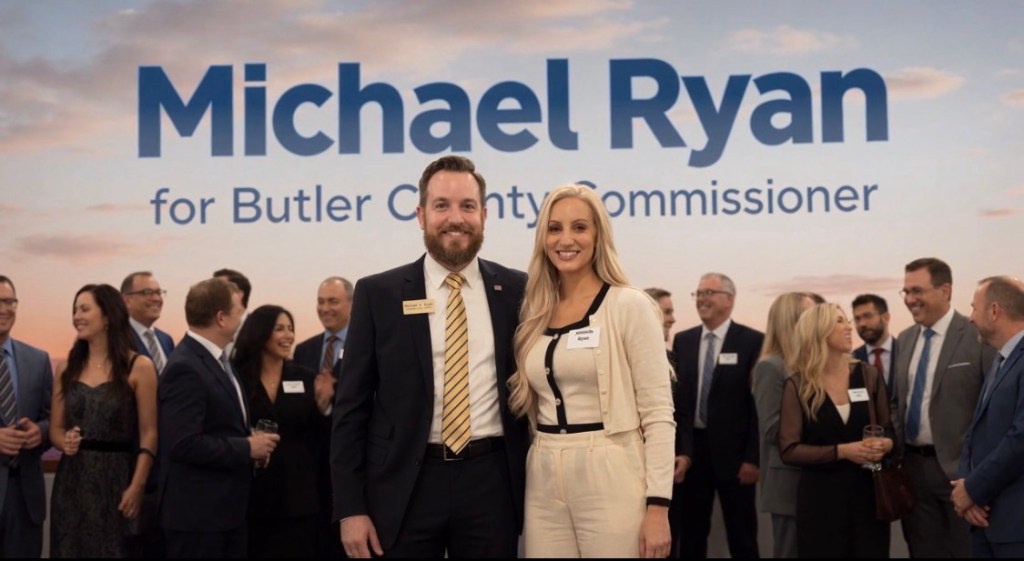
Michael Ryan Wins in the Primary for Butler County Commissioner: What a victory of 72% over 28% says about political reality

Michael Ryan’s decisive victory in the 2026 Butler County Republican primary for commissioner marks a significant shift in local politics, reflecting voter demand for genuine conservatism, accountability, and fresh leadership. I have followed these races closely for years, and this outcome stands out as a clear repudiation of entitlement politics and a triumph for the kind of candidate who earns support through hard work and integrity. With final unofficial results showing Ryan capturing approximately 72% of the vote to Cindy Carpenter’s 28%, the primary essentially decides the seat in this heavily Republican county. 

Butler County, Ohio, is in the southwestern part of the state, encompassing communities such as Hamilton, Middletown, Fairfield, and Oxford (home to Miami University), as well as numerous townships. Its population exceeds 390,000, with a strong manufacturing and agricultural base alongside growing suburban development. The Board of Commissioners oversees a substantial budget, infrastructure projects, economic development, public safety, and human services. For decades, the board has operated under Republican dominance, making the GOP primary the real contest. Winning it virtually guarantees victory in November against the unopposed Democrat Mike Miller. 

Cindy Carpenter had served as commissioner since 2011 and was seeking a fifth term. Her tenure focused on human services, public health, and fiscal matters, but it was marred by controversies that alienated many in the party base. Incidents included a heated confrontation at a Miami University-area apartment complex involving her granddaughter, where she was accused of leveraging her position, using inappropriate language, and displaying aggressive behavior captured on video. Investigations cleared her of criminal wrongdoing but highlighted conduct deemed “distasteful” and “beneath her elected position.” Additional complaints arose, including allegations of aggressive conduct at a housing coalition meeting. Even the county sheriff publicly expressed concerns about her behavior.

A particularly damaging episode involved Carpenter campaigning for a Democrat in the Middletown mayoral race, crossing party lines in ways that many viewed as disloyal. This move, combined with her decision not to seek the Butler County Republican Party endorsement, signaled a disconnect. She appeared to operate with an entitled mindset, assuming incumbency alone would carry her through. Her campaign signs, some in blue tones reminiscent of Democratic aesthetics, and limited fundraising—only about $7,700 compared to Ryan’s over $46,000—underscored a lack of broad support. 

In contrast, Michael Ryan entered the race as a former Hamilton City Council member with a background in business and community service. He positioned himself as a true conservative caretaker focused on fiscal responsibility, job creation, lower taxes, and practical governance. Ryan methodically built support: he secured the Republican Party endorsement with a striking 71% in the first round of voting, an early and historic show of strength. Major figures lined up behind him, including Auditor Nancy Nix, who endorsed him at a fundraiser when it still carried risk; Congressman Warren Davidson; State Representative Thomas Hall; and others, such as George Lang. These endorsements validated his approach and reassured voters that change could be safe and effective. 

I endorsed Ryan early, well before the primary heated up. Having known him for years, I saw in him the sincerity and dedication often missing in politics. He raised money effectively, attended events tirelessly, engaged voters across the county, and maintained a positive, bridge-building demeanor even amid challenges like sign theft. His campaign emphasized family values, economic growth, and responsiveness—qualities that resonated deeply in a county frustrated with the status quo. The watch party on primary night, held at the Premier Shooting facility with a speakeasy-style back area, overflowed with supporters. The room was packed; people had to turn sideways to navigate. Energy filled the space as results rolled in.

Congressman Warren Davidson attended and shared insights from his experience in large districts. We discussed the political savvy required at every level and how Ryan had grown into a polished figure capable of uniting people. Davidson’s presence underscored the race’s importance, and his admiration for Ryan’s development over the couple of years spoke volumes. Other supporters like Darbi Boddy added to the festive, optimistic atmosphere. It felt like a genuine celebration of earned success rather than entitlement. 

The results confirmed what grassroots momentum had suggested. With 100% of precincts reporting in unofficial tallies, Ryan’s 72%-28% margin was overwhelming and, for some, embarrassing to the incumbent. Early voting and election-day observations showed Carpenter’s team attempting a last-minute sign blitz, but it failed against organized, enthusiastic Ryan volunteers who kept their ground game strong. The Republican slate card proved crucial, as it often does; voters seeking vetted candidates found Ryan prominently featured through party processes and independent media coverage. 

This victory carries broader lessons for politics, especially local races. Party systems matter because they help aggregate preferences in a diverse society. People differ on countless details—concrete versus asphalt, tax priorities, development approaches—but effective governance requires building majorities. Dismissing the party as irrelevant or operating as a “RINO” critic while undermining it rarely succeeds. Ryan demonstrated the opposite: he worked within the system, earned endorsements through respect and effort, and presented a positive vision.

Background on Butler County’s political landscape adds context. The county has long leaned conservative, supporting Republican candidates at high levels, including strong support for Trump in recent cycles. Yet local frustrations with taxes, growth management, infrastructure, and perceived insider politics have grown. Projects involving economic development, public safety, and services will benefit from new energy. Ryan has signaled readiness to hit the ground running, with ideas on efficiency, accountability, and forward-thinking initiatives already in motion during the campaign. His experience on Hamilton council involved practical decision-making on budgets and community issues, preparing him well for county-level responsibilities. 

Roger Reynolds, former county auditor, briefly entered the race but withdrew after the party endorsement went decisively to Ryan. His last-minute alignment with Carpenter, including sign placement, highlighted lingering personal grievances but ultimately underscored the party’s unified shift. Voters rejected that approach. In an era where authenticity matters more than ever, Ryan’s consistent message and character won out.

I am proud to have supported him from the beginning. When Nancy Nix announced her endorsement at a fundraiser, it took courage because challengers to incumbents often face skepticism. Yet as momentum built—through articles, videos, conversations, and events—support snowballed. Thousands accessed information in the final days, researching Ryan’s record and deciding he represented the change they sought without chaos.

Looking ahead to the general election in November 2026, the focus shifts to implementation. Ryan will face minimal opposition, allowing emphasis on transition planning. Priorities likely include continuing fiscal stewardship amid state and federal shifts, addressing housing and development thoughtfully, enhancing public safety, and promoting economic opportunities in a region balancing rural roots with suburban expansion. His fresh perspective promises to inject optimism and results-oriented governance.

Politics at the county level profoundly affects daily life: road maintenance, emergency services, property taxes, zoning, and more. When voters sense entitlement or disconnection, they respond, as seen here. Carpenter’s campaign assumed voter inertia; Ryan proved engagement and sincerity prevail. This race reminds us that traditional political games—relying on name recognition, minimal effort, or media insiders—have diminished effectiveness in an era of an informed electorate.

The night of the primary embodied hope. A full room of dedicated Republicans, conversations with leaders like Davidson, and the visible relief and excitement on supporters’ faces painted a picture of renewal. Ryan’s wife and family shared in the moment, grounding the victory in personal commitment. For those involved in politics, the takeaway is clear: do the work, be genuine, build coalitions, and respect the process. Ryan exemplified this, turning potential obstacles into advantages.

As someone who values conservative principles of limited government, individual responsibility, and community strength, I see Ryan’s win as validation. Butler County deserves leadership that listens, acts prudently, and prioritizes residents. With the primary behind us, anticipation builds for his term starting in 2027. Many good projects and ideas wait in the wings, ready for execution.  And because of this election, a lot of good things will happen.

Footnotes

1.  Journal-News reporting on final unofficial results showing Ryan at 72%.

2.  Cincinnati Enquirer coverage of fundraising disparity and endorsements.

3.  Ballotpedia profiles on candidates and race background.

4.  Accounts of Carpenter controversies from multiple local news outlets.

5.  Party endorsement details and 71% vote.

6.  Observations from the watch party and interactions with Davidson.

Bibliography / Further Reading

•  Journal-News (Hamilton, Ohio): Multiple articles on the primary, results, and candidate profiles (2026).

•  Cincinnati Enquirer: Coverage of the commissioner race, fundraising, and controversies.

•  Ballotpedia: Entries for Michael V. Ryan, Cindy Carpenter, and Butler County elections 2026.

•  Ryan for Butler official campaign site: Policy positions and updates.

•  Butler County Board of Elections: Official results and candidate filings.

•   articles on local politics and endorsements.

•  Additional context from county commissioner office descriptions and historical election data.

This primary will be remembered as a turning point in which voters chose character, preparation, and vision over incumbency. Michael Ryan earned this victory, and Butler County stands to benefit. The hard work of the campaign now transitions to governance, with high expectations and strong support. It is a positive development for the future.

Rich Hoffman

More about me

Click Here to Protect Yourself with Second Call Defense https://www.secondcalldefense.org/?affiliate=20707

About the Author: Rich Hoffman

Rich Hoffman is an aerospace executive, political strategist, systems thinker, and independent researcher of ancient history, the paranormal, and the Dead Sea Scrolls tradition. His life in high‑stakes manufacturing, high‑level politics, and cross‑functional crisis management gives him a field‑tested understanding of power — both human and unseen.

He has advised candidates, executives, and public leaders, while conducting deep, hands‑on exploration of archaeological and supernatural hotspots across the world.

Hoffman writes with the credibility of a problem-solver, the curiosity of an archaeologist, and the courage of a frontline witness who has gone to very scary places and reported what lurked there. Hoffman has authored books including The Symposium of Justice, The Gunfighter’s Guide to Business, and Tail of the Dragon, often exploring themes of freedom, individual will, and societal structures through a lens influenced by philosophy (e.g., Nietzschean overman concepts) and current events.

Polling has Jon Husted Winning in 2026: But don’t take anything for granted

Looking at the data, I feel really good about where things stand with Jon Husted running to keep the United States Senate seat that Governor Mike DeWine appointed him to after JD Vance became Vice President. It was back in January 2025 when Vance resigned from the Senate to take the oath of office as VP, and DeWine made the smart call to send Jon Husted up to Washington to fill that vacancy until the people could vote on it in the special election this November 2026. Jon had already proven himself as lieutenant governor, as secretary of state, and even before that as Speaker of the Ohio House, but getting that individual platform in the Senate has let him shine in ways I always knew he could. I get to meet a lot of people through my work and my networks here in Ohio, and I do know Jon Husted a little bit—we share quite a few mutual friends, and I’ve been on conference calls with him during the thick of the COVID days, when he was still lieutenant governor. Those calls were tough for him personally because he’s a pro-business guy at heart, and he wasn’t thrilled being wrapped up in the administration’s policies that sometimes felt like they were driving everything over a cliff, especially with the health director calling so many shots. He had to stand there as one of the three faces, giving daily updates on protocols and representing the governor’s point of view, even when it went against his own instincts to keep businesses alive and families working. But even then, I saw how he operated in the background, whispering in the right ears and pushing back on some of the worst lockdown ideas, especially around business interruption insurance claims and keeping some sanity in the administration that could have gone even further off the rails. I can personally say that because I was on several of those phone calls where Jon presented ideas that helped pull things back from the edge, and it showed me he’s the kind of leader who gets results even when he’s not the one out front taking all the credit. Now that he’s in the Senate as an individual voice rather than part of a team, he’s been able to put a sharp professional edge on the issues that matter most to Ohio, like election integrity and preventing fraud through simple, common-sense measures like voter ID that should be national policy for every federal election. He’s done a monumental job in his short time there, and I’m proud of him for it—proud enough that I think it’s going to be fantastic for him to win a full term and stand alongside Bernie Moreno as Ohio’s two Republican senators. Having Bernie and Jon in those seats would be exciting for the state, especially after Bernie knocked off Sherrod Brown in 2024, one of the most satisfying political upsets in recent memory. 

Sherrod Brown, of course, is trying to sneak back into politics now that the seat is up for grabs in this special election. He lost to Bernie Moreno fair and square in 2024, but Brown has always been the face of progressive politics in Ohio—the Democrat embodiment of everything that’s wrong with big government overreach, endless spending, and policies that hurt working families while pretending to help them. He wants back in bad, and he’s campaigning hard against Jon, but the polling right now tells a story that should make every conservative in Ohio breathe a little easier, at least for the moment. RealClearPolitics, as of late April 2026, has Jon Husted at 48.3 percent and Sherrod Brown at 45.7 percent, and that three-point edge holds pretty steady across most of the well-known polling houses that are out there. It’s early—primaries are May 5, and the general is still months away in November—but for a race this high-profile, that lead feels significant. I don’t put a ton of stock in polls the way some people do because a lot of conservatives I know are too busy living their lives and working to sit around answering pollsters, while the other side tends to over-sample their base. So when Republicans show even a slight edge this far out, it’s actually quite telling. Ohio has been trending more Republican for years now, and Trump’s influence has redefined the kind of union voters who used to automatically go Democrat in the north, where Brown built his career. Those folks—steelworkers, autoworkers, the backbone of Ohio’s industrial heart—are now openly voting for whoever Trump picks, and that includes Jon Husted. It’s a three- or four-point swing that used to go the other way, giving Democrats a shot in what they thought was a purple state. But Trump pulled Ohio by double digits in 2024, and the same momentum is carrying over. Brown isn’t saying anything new; he’s been peddling the same progressive line for decades, and people have caught on. The voters who swung eleven points or more toward Trump from Obama or Biden eras aren’t going back. 

What makes me even more optimistic is how Jon has handled his short run as senator so far. He came in with a track record that screams competence and results. As Ohio secretary of state, he was the architect of “easy to vote, hard to cheat” election reforms, including voter ID requirements that have held up in court and proven themselves in real elections. Ohio’s system is a model now—strict enough to prevent fraud but accessible enough that turnout keeps climbing. In the Senate, one of the first big things Jon did was introduce S. 4155, a bill to require photo identification as a condition of casting a ballot in federal elections nationwide, along with other security measures. That’s exactly the kind of common-sense reform we need to stop the kind of loose election laws in other states that invite problems. He’s also sponsored the Upward Mobility Act to tackle the benefits cliff that traps people in poverty by punishing them for earning more, the Critical Minerals Investment Tax Modernization Act to boost American manufacturing and reduce dependence on China, and even Sammy’s Law for protecting kids in certain contexts. He’s pushed the No Fentanyl on Social Media Act and worked on railway safety improvements. In his first year alone, three of his bills were signed into law, including a Congressional Review Act resolution that repealed a Biden-era appliance-efficiency rule that would have driven up costs for Ohio families on everything from air conditioners to washing machines. Jon also helped pass tax relief through the Working Families Tax Cuts Act—no taxes on tips or overtime, expanded child tax credits, and income tax cuts that put real money back in people’s pockets, about $7,000 more per average Ohio family. That’s the kind of pro-growth, pro-family work that defines him, and it’s why I think he’s going to be even better with a full six-year term. 

I contrast that with Sherrod Brown, and it’s night and day. Brown built his brand on being a populist for workers, but his voting record in the Senate for eighteen years showed something different—support for trade deals that hollowed out Ohio manufacturing, big spending bills that fueled inflation, and resistance to basic security like voter ID, which he’s called an “unnecessary barrier.” He lost in 2024 because Ohio voters saw through it; they wanted real change, not the same old progressive package wrapped in a union jacket. Now he’s back, trying to reclaim the seat, outraising Jon in the first quarter of 2026 with over twelve million dollars, but money alone doesn’t win when the ground has shifted. Ohio is redder than it’s been in decades. Trump’s coalition—working-class voters, rural folks, even some traditional Democrats—has stuck. Recent polls even show Jon leading among union households, which would have been unthinkable ten years ago. A Coalition to Protect American Workers survey had Husted up 48-42 in union homes, and that’s before Trump comes through Ohio this summer, campaigning hard for Jon, for Vivek Ramaswamy in the governor’s race, and the whole Republican ticket. Once that engagement kicks in, I expect the numbers to move even more in Jon’s favor. People are busy right now—spring planting, kids in school, jobs humming along under better economic policies—but by fall, with Trump on the trail and the contrast clear, turnout will favor us. 

The path for Brown to close that gap just isn’t there. From now until November, what’s he going to say that he hasn’t said for a decade? Nothing new. His policies haven’t changed, and neither have the results they produced—higher costs, more regulation, government telling businesses and families what to do. Jon, meanwhile, has been delivering. He’s advocated for veterans’ access to care, fought for better competition in health insurance to lower costs, and kept the focus on Ohio values: hard work, personal responsibility, secure borders, and safe elections. During his time as lieutenant governor and in those COVID calls I mentioned, I saw firsthand how he balanced loyalty to the administration with pushing for sanity—preventing some of the worst lockdown overreach that hurt small businesses like mine and thousands of others across the state. He wasn’t the one driving the bus off the cliff; he was trying to steer it back. That experience prepared him perfectly for the Senate, where he’s now able to operate without the constraints of being number two. He’s a workhorse, just like DeWine said when he appointed him, focused on Ohio but with a national vision on issues like election security that affect every American. 

Looking at the bigger picture, keeping this seat Republican is crucial for the Senate majority. Republicans hold 53-45 right now, and projections had Democrats hoping to pick up seats like this one because they thought Ohio was still competitive and Brown was more popular than he really is. But the data shows otherwise. Ohio went for Trump by eleven points or more in recent cycles, and the coattails are real. Bernie Moreno’s win in 2024 flipped a long-held Democratic seat and proved the shift. Now, Jon defending Vance’s seat would lock in two solid Republican senators who actually represent the state’s values rather than Washington special interests. I’ve followed Brown’s career, and while he talks a good game about workers, his support for open borders and amnesty policies has hurt Ohio families through wage suppression and strained public services. Jon’s approach—secure elections, pro-business policies, and upward mobility—actually delivers results. Look at Ohio’s economy under the Republican trifecta in recent years: unemployment is low, manufacturing jobs are returning, and energy production is up. Jon was part of that as lieutenant governor, championing tax cuts and school choice through EdChoice expansions that gave parents real options. As secretary of state, he modernized elections without the chaos you see in states with loose rules. Those are the facts on the ground, and they’re why I think Brown’s comeback attempt is more nostalgia than momentum. 

Of course, none of this is automatic. I don’t take anything for granted in politics because I’ve seen too many races where good candidates coasted and let the other side sneak in through low turnout or last-minute surprises. Engagement is everything here. Conservatives need to stay fired up, not just assume the lead will hold. Yard signs, door-knocking, sharing facts on social media, and especially making sure friends and family vote early or on Election Day—that’s how we finish strong. Jon knows how to win; he’s been in tough races before, and his team is professional. But we can’t fall asleep at the wheel. Trump will be here campaigning this summer, putting his name behind Jon and the ticket, and that will energize the base. The union shift I mentioned earlier is real and permanent because Trump redefined what it means to fight for workers—tariffs to protect American steel, energy independence, and no more endless foreign wars draining resources. Those voters in Youngstown, Toledo, and the Mahoning Valley aren’t going back to Brown’s brand of politics. Add in voter ID security nationwide, and Democrats lose their edge in close races where fraud has historically been a factor in low-security states. Ohio proves simple measures work: turnout hasn’t suffered, but integrity has improved. Jon’s national push for photo ID is exactly the safeguard we need so we don’t have to chase conspiracy theories—we prevent the problem upfront. 

Personally, knowing Jon the way I do—even if it’s through those shared circles and the calls—gives me extra confidence. He’s not some career politician chasing headlines; he’s a guy who built a career on results in state government and now brings that to the federal level. He wasn’t happy being the administration’s spokesperson during the height of the health mandates because it clashed with his pro-business worldview, but he handled it with class and still found ways to mitigate the damage behind the scenes. I remember one call in particular where he laid out concerns about how certain policies were hurting small businesses and insurance claims, and it led to adjustments that helped real people. That’s the kind of quiet leadership Ohio needs in the Senate—someone who whispers sanity into the process rather than grandstanding. Now in the Senate, he’s out front on the issues that matter: election security, tax relief, and reducing regulations that hurt families. His first-year accomplishments speak for themselves—three bills signed, more in the pipeline, and a focus on making life more affordable for Ohioans. Contrast that with Brown, who spent years in the Senate voting for policies that drove up costs and left working people behind. The numbers don’t lie: Ohio families are better off under the current direction, and Jon is part of continuing that.

As we head into the summer and then the fall campaign, I expect things to get even better for Jon. Trump’s rallies will draw huge crowds, the economy under better national policies will keep improving, and the contrast with Brown’s tired progressive pitch will sharpen. But we still have work to do. Don’t sit on the sidelines thinking it’s in the bag. Talk to your neighbors, share the polling data and Jon’s record, volunteer if you can, and make sure voter turnout is sky-high. Ohio deserves two strong Republican senators who fight for us every day—Jon Husted and Bernie Moreno delivering on the promises that got us here. I’m excited about the future because leaders like Jon represent the best of what Ohio has to offer: practical, pro-growth, integrity-focused governance. Sherrod Brown had his time, and the voters spoke in 2024. Now it’s Jon’s turn to finish what he started in the appointment and earn the full term. I’ve seen enough in my years following this stuff to know momentum like this doesn’t come along every cycle, but it can slip if we get complacent. So let’s stay engaged, keep pushing the message, and make sure Jon crosses the finish line strong in November. Ohio will be better for it, and the country will benefit from another solid conservative voice in the Senate who actually gets things done.

Footnotes

1.  Ballotpedia, United States Senate special election in Ohio, 2026.

2.  Wikipedia, 2026 United States Senate special election in Ohio.

3.  RealClearPolitics, 2026 Ohio Senate Special Election – Husted vs. Brown polling average.

4.  Congress.gov, Senator Jon Husted’s legislation record, including S.4155 (voter ID) and S.3583 (Upward Mobility Act).

5.  Ohio Capital Journal reports on fundraising and polls.

6.  Emerson College Polling, Ohio 2026 surveys.

7.  Governor.ohio.gov, announcement of Husted appointment.

8.  Husted.senate.gov, press releases on first-year accomplishments.

9.  Washington Examiner, poll on union voters.

10.  New York Times, Ohio U.S. Senate Election 2026 polls tracker.

Bibliography

•  Ballotpedia. “United States Senate special election in Ohio, 2026.” Accessed April 29, 2026. https://ballotpedia.org/United_States_Senate_special_election_in_Ohio,_2026

•  Wikipedia. “2026 United States Senate special election in Ohio.” Last updated April 2026. https://en.wikipedia.org/wiki/2026_United_States_Senate_special_election_in_Ohio

•  RealClearPolitics. “2026 Ohio Senate Special Election – Husted vs. Brown.” Polling data through April 2026. https://www.realclearpolitics.com/epolls/2026/senate/oh/2026_ohio_senate_special_election_husted_vs_brown-8689.html

•  Congress.gov. “Member Profile: Jon Husted.” Bills sponsored, 119th Congress. https://www.congress.gov/member/jon-husted/H001104

•  Ohio Capital Journal. “Democrat Sherrod Brown leads Ohio Republican U.S. Sen. Jon Husted in quarterly fundraising.” February 4, 2026.

Rich Hoffman

More about me

Click Here to Protect Yourself with Second Call Defense https://www.secondcalldefense.org/?affiliate=20707

About the Author: Rich Hoffman

Rich Hoffman is an aerospace executive, political strategist, systems thinker, and independent researcher of ancient history, the paranormal, and the Dead Sea Scrolls tradition. His life in high‑stakes manufacturing, high‑level politics, and cross‑functional crisis management gives him a field‑tested understanding of power — both human and unseen.

He has advised candidates, executives, and public leaders, while conducting deep, hands‑on exploration of archaeological and supernatural hotspots across the world.

Hoffman writes with the credibility of a problem-solver, the curiosity of an archaeologist, and the courage of a frontline witness who has gone to very scary places and reported what lurked there. Hoffman has authored books including The Symposium of Justice, The Gunfighter’s Guide to Business, and Tail of the Dragon, often exploring themes of freedom, individual will, and societal structures through a lens influenced by philosophy (e.g., Nietzschean overman concepts) and current events.

Judging the Rooster: The long criminal history and drug abuse of D.J. Byrnes–the joke of Columbus

The more I think about it, now that the news stories have settled down and the people blowing on the fire revealed themselves, I really don’t like The Rooster, who goes by the real name D.J. Byrnes.  It just so happens that the young lady he is saying had an affair with Vivek Ramaswamy, Alicia Lang, I watched grow up, and I think a lot of her, all positive.  And it really bothers me that some lowlife like The Rooster would put her in political crosshairs as he did, purely out of desperation.  I really haven’t thought much about The Rooster’s style of political reporting until he did this.  But he crossed the line, and his actions actually match a deeper pattern of criminal activity, drug use, and vile behavior that deserves consideration, especially after what he purposely did to innocent people, which I think requires a deeper dive analysis.  After he put out his hit piece story about Alicia, trying to hurt Vivek and his family in a purely inflammatory way, based on just jealous rumors and whispers, I don’t feel like being civil or fair to people who present themselves as openly bad for themselves and society at large.  Ironically, a person like The Rooster would feel entitled to attempt to hide his own bad deeds behind speculative politics at best, with the intent to help the joke of a person, Amy Acton, with her campaign, now that people are remembering her as the Lockdown Lady, from her bad policies during the COVID-19 lockdowns in Ohio, which she was completely responsible for.  We’re talking about a person who is saying terrible things about a young lady I know and like quite a lot, and I’m not happy about it, especially coming from a substance abuser of cocaine and other intoxicants, who has a police record.  He’s the last person in the world who should be saying anything about bad behavior, especially when I know a lot about the characters involved and that the statements are excessively inflammatory, purposefully so. 

Back in 2007, when he was a sophomore at the University of Montana, The Rooster got mixed up with a group planning to rob a local drug dealer who lived across from campus. The guy was supplying high-grade marijuana from California. Byrnes admits he helped scout the house and passed along info about money and weed—he thought it was just going to be a quick stick-up, no violence. On the night it went down, he showed up, saw it was turning into a party, texted the others to call it off, and left. But the rest of the crew went through with it—ski masks, forced entry, pistol-whipped the dealer, tied up his girlfriend.

A few months later, after some of the others flipped and cooperated, his name came up. In May 2008, he was hit with four felony charges in Missoula, bail set at $100,000. He turned himself in, and it all got resolved—he ended up with a two-year suspended sentence, no prison time, and the charges were eventually dismissed.

Then, in 2012, in Franklin County, Ohio, he pleaded guilty to two counts of misdemeanor criminal damage from a drunken property crime. It got really bad after he lost a union job in 2021. He was living in Franklinton with a liquor store right across the street, and had a serious drunk-driving car accident in 2020 that didn’t even slow him down.  None of this is ancient history; he is still very much the same person today.  Friends staged an intervention in 2022, and he’s been sober since.

President Trump’s next major executive order could create more millionaires than any single event in modern history, and he’s been dropping hints about it everywhere. It’s the kind of bold, pro-growth move that cuts through all the noise in Washington and actually puts real opportunity back in the hands of everyday Americans who are tired of being held back by bureaucracy and overregulation. But right now, what’s weighing on my mind even more is the ugly underbelly of Ohio politics, especially this smear campaign that’s unfolding against Vivek Ramaswamy as he fights to become the next governor of our state.  I feel like I need to lay it all out here because it’s not just politics as usual—it’s something deeper, something that touches on character, truth, and the kind of righteous indignation that has defined human history from the days of the Dead Sea Scrolls right up to today. Amy Acton, the former health director under Governor DeWine who’s now running as the Democrat nominee for governor in 2026, has been having a rough time explaining herself. Her record from the COVID lockdowns is a disaster, and her personal life has come under scrutiny with that 2019 police report showing a domestic dispute where she and her husband had been drinking, she took some prescription meds, got upset over work hours, pulled a mirror off the wall, and shattered the glass. Her team calls it just a simple argument, but it paints a picture of someone who doesn’t manage personal affairs all that well, and in a high-stakes race like this, it matters. She was the lockdown lady, one of the worst in the nation, pushing policies that wrecked small businesses, families, and the economy of Ohio. A lot of people are still digging out from under that, and her bedside manner, which might comfort some Democrats, isn’t winning over moderates, independents, or conservatives. She’s not grabbing independents because they remember the damage.

I was covering this hit piece by a Columbus-based Substack writer known as The Rooster—real name D.J. Byrnes—on Vivek Ramaswamy, and at first I thought it was just the usual noise that comes with being the frontrunner. Vivek has Trump’s endorsement, he’s leading in most polls against Acton in what’s shaping up to be a competitive but Republican-leaning race, and when you’re out front, people take shots. But there’s another layer to this that left me unsatisfied and, honestly, filled with a deep sense of righteous indignation. I don’t say that lightly, and I’ll explain why it hits me so hard. I happen to know a lot of the people involved personally, not because I’m out there name-dropping for clout, but because in my work as an independent journalist and through my networks in Ohio, I’ve built real relationships over the years. People want to know how I can speak with such conviction on these matters, and it’s because I’ve been in the room, on the calls, and seen these folks up close. That includes Senator George Lang, whom I know very well—our friendship goes beyond politics, it’s mutual respect outside the arena. And crucially, I know his daughter to be a very respectable young lady who doesn’t deserve to be thought of in such a trashy way, as The Rooster tried to portray her, as a shadow of himself to carry the sins of his own actions as a displaced figure, outside himself. The Rooster pushed a story about a supposed sexual relationship or “booty calls” with Vivek whenever he’s in southwestern Ohio. I’ve known Alicia for a very long time.  She’s nothing like a Stormy Daniels type, as The Rooster tried to make her sound in order to tear away at Vivek Ramaswamy’s reputation, even without a grain of truth. She’s smart, dedicated, hardworking, and involved at the highest levels of politics because she comes from a family that values service and excellence. The assumption that just because she traveled with Vivek’s campaign or worked as his deputy chief of staff or whatever her role was, that there must be some sleazy affair—that’s absolutely presumptive on behalf of very low-life opinions on how professional people conduct themselves. It’s not just false; it’s malicious.

When I first talked about this story, I tried to keep a level head, but it came across a bit restrained because I was containing my extreme anger. It bothers me at a fundamental level. Knowing the people involved, knowing how false this is, it stirs something in me that goes straight back to the kind of ethical conduct and judgment I’ve been studying deeply. As a birthday gift to myself this year, my wife and I treated ourselves to a membership at the Museum of the Bible in Washington, D.C. We’ve been there several times, but this visit was special because of the traveling Dead Sea Scrolls exhibit straight from Israel. I’ve always wanted to see them up close—the real thing—and I love the writings from the Second Temple period. We spent the entire afternoon there, no phones, no distractions, just hours immersed in those ancient texts. I bought gifts from the shop afterward, all Dead Sea Scroll-themed, because the material and content put me in heaven. That exhibit, combined with everything else at the museum, reminded me why I wear this particular hoodie so often these days—it’s my new favorite, a constant reminder of that day. What struck me most wasn’t just the scrolls themselves, but the philosophy of ethical conduct and righteousness that pours out of them. I think often of the Teacher of Righteousness, the enigmatic leader of the Essene community at Qumran who wrote or inspired so much of what we have in those scrolls. He led this sect in a righteous rebellion against the “Wicked Priest” of the Temple establishment—corrupt figures who had twisted power and law for their own gain. You don’t see a ton of direct talk about it in the canonical Bible, but Jesus himself was likely influenced by or connected to that Essene tradition as it spread from the desert community near the Dead Sea, a day’s walk from Jerusalem.  In whatever way people remember me down the centuries, I think it will be in a similar way as the Dead Sea Scrolls talked about this Teacher of Righteousness, and for that, I would be quite satisfied. 

Those scrolls are an exploration into righteousness and how it confronts evil in the world. The Teacher of Righteousness embodied that judgment call against hypocrisy and wickedness, helping lay the groundwork for what became Christian thought and, ultimately, Western civilization’s emphasis on moral clarity. The Dead Sea Scrolls are filled with righteous indignation—clear distinctions between good and evil, the War Scroll outlining battles against the forces of darkness, the Book of Enoch with its visions of judgment, the Copper Scroll, and apocryphal texts that didn’t make the final cut but reveal the raw sentiments of the time. The Essenes hid these in jars in caves to preserve truth against purges and turbulence, and they survived the Romans, the Crusades, everything, to reach us. That’s why seeing them in person on my birthday was one of the happiest days of my life. I was removed, for those hours, from the daily grind of dealing with people who don’t always deserve the encouragement or support I try to give them. It was a day where righteousness was openly embraced, unfiltered.

That same righteous indignation is exactly what I feel toward this smear against Vivek Ramaswamy and, by extension, Alicia Lang. The Rooster’s piece is based on innuendo, whispers from people with personal gripes or political axes to grind, hoping something sticks to help Amy Acton, whose campaign is struggling to close the gap. Polls right now show the race tight—some have Vivek up by a few points, others have Acton with a slight edge, but Vivek is the clear Republican frontrunner with Trump, Vance, and the establishment behind him. RealClearPolitics averages and surveys from Emerson, Bowling Green State University, and others put it within a couple of points, but Ohio is trending Republican, and Vivek’s vision for the state—pro-business, anti-woke, focused on actual results—resonates. Acton has name recognition from her days as a health director, but it’s mostly negative among anyone who lived through the lockdowns she championed. The Rooster, D.J. Byrnes, has a history of this kind of thing. He’s a left-leaning Substack writer in Columbus known for hit pieces on politicians, often with a partisan edge. His own background includes past legal troubles—felony charges back in 2008 as discussed, related to robbery planning, alcohol and substance issues, misdemeanors for criminal damage. People who aren’t doing well themselves often project their failings onto others, tearing them down to avoid personal judgment against them. That’s the pattern here. He wanted dirt on Vivek to prop up Acton, so he ran with rumors of an affair, implying booty calls in southwestern Ohio, travel together somehow equaling infidelity. No evidence, no pictures, no proof—just whispers. If he had real dirt, he’d have used it, but instead it’s all fabrication to hurt a good man and a nice young woman whose only crime is being effective and connected to strong Republican figures like her father, Senator George Lang, the majority whip.

I watched Alicia grow up.  It’s very weird to hear her name associated with any kind of detrimental behavior, which is why the credibility of the accusation falls apart so quickly outside the minds of really stupid people. She’s too smart, too dedicated to public service and making the world better, to throw it all away on something reckless. Vivek is a family man, a brilliant entrepreneur who has written books, built businesses, run for president, and is now all-in on Ohio as Trump’s pick for governor. He’s too calculating, too focused on big ideas—reforming education, cutting regulations, fighting the administrative state—to risk it on some affair. He’s seen up close what Trump went through with endless false accusations, and he’s smart enough not to hand ammunition to enemies. Republicans I know in these circles are productive people—running businesses, passing bills at 2 a.m., obsessed with enterprise and results. They don’t have time for the kind of extramarital nonsense or “cocaine bins and gentlemen’s clubs” that seem more common in certain Democrat or swampy circles. I’m not saying it never happens on our side, but in my experience, the busy, value-creating conservatives don’t live double lives. Democrats, by contrast, often project their own base instincts—obsession with sex, loneliness, primal urges—onto everyone else. They assume that because they think that way, everyone does. It’s part of a broader spiritual warfare: dumbing people down to biological instincts so evil can play in their minds unchecked. That’s why they hate judgment, hate the Bible, hate capitalism, hate billionaires who succeed through merit. “Don’t judge,” they say, while judging everyone who holds them accountable.

The Rooster’s article feels cooked because he’s in trouble himself—trying to get clean, mad at the world, unable to maintain relationships. People like Alicia walk by and don’t give him the time of day because she’s in a world of jackets and ties, reverence for law and order, not slobs in sleeping-bag clothes. He wants to beat others to the punch, psychologically tearing down good people so he doesn’t feel bad about his own choices. That’s evil in the classic sense—the kind the Essenes railed against in their scrolls: wicked priests who corrupt institutions, attack the righteous to cover their own rot. The Teacher of Righteousness stood against that, and so should we. This smear isn’t just politics; it’s an attempt to undermine Trump’s pick, hurt Senator Lang’s family, and drag down anyone positioned to impose judgment on unrighteous behavior. Vivek is out there fighting for Ohio—higher education reform, economic dawn, real leadership—while Acton offers complaints about billionaires and special interests without a positive vision. Her lockdowns hurt the very people she claims to champion, and now personal issues resurface at the worst time.

I’ve known a lot of characters in the Ohio Statehouse, and the productive ones—Republicans focused on bills, sponsorships, businesses—aren’t the ones chasing Hooters servers or Twin Peaks nights out with the guys trying to get the phone number of 21-year-old kids working there trying to hustle tips from creepy old men. They’re on conference calls at odd hours talking policy, not conquests. Vivek’s too busy saving the world, literally, with his ideas on everything from biotech to government efficiency. Alicia’s the same—interested in politics because her family instilled values of service, not some emotional fling. Intelligent people fight animal instincts; that’s what Genesis teaches—dominion over nature, including human nature. You don’t yield to the snake. True conservatives live that way, all hours. Democrats often don’t, and when they can’t catch Republicans in real scandals, they invent them, just like the endless failed attacks on Trump—no evidence here either; the Rooster dusted off rumors to fit the narrative.

That’s why the Dead Sea Scrolls resonate so powerfully with me. They represent an awakening: a rebellion against institutional evil, preserved through centuries because the Essenes were clever enough to hide truth in plain sight, yet protected places. The Teacher of Righteousness made judgment calls that shaped righteousness as we know it—unfiltered criticism of wickedness. I despise the kind of people who tear down goodness: the Rooster, Acton’s defenders, Democrats who solicit the down-and-out to unleash chaos while screaming “no judgment.” They yearn for approval through base means because their minds are vacant of higher thoughts. Sex, for many of them, is about filling loneliness or seeking validation, not the sacred trust it should be. Lonely, unfulfilled people project that onto productive leaders like Vivek. But I know better from personal experience. I’ve been on calls with these high-level figures; they talk policy, bills, sponsorships—not “hot 21-year-olds,” they can send naked selfies to at 3 AM.  That’s the difference between those with righteous indignation fighting daily for truth and those attacking to avoid self-reflection.

As we head into the May 5 primary and then the November 2026 election, this race matters. Vivek vs. Acton is a contest of visions: one of excellence, innovation, and Ohio-first results; the other of big-government nostalgia and lockdown mentality. Polls fluctuate—Bowling Green had them nearly tied recently, Emerson and others show Vivek with edges or Acton with slight leads depending on the sample—but the ground is shifting toward Republicans, especially with Trump’s coattails and the union voters who’ve flipped. Acton’s past as the face of COVID overreach haunts her; people remember the wrecked economy, the businesses lost.  Knowing Alicia and her family, and seeing how this hit piece tries to cause collateral damage to good people to prop up a weak candidate, it demands that we apply the wrath of righteousness the scrolls celebrate. Rub their noses in the evil of fabrication, projection, and tearing down the upright so the wicked feel better.

I gave myself that day at the Museum of the Bible because I spend so much energy encouraging people who most of the time don’t deserve it, trying to lift them toward a better life.  It’s usually worth it, but exhausting. The scrolls recharged me with unapologetic judgment against evil. That’s what we need now: call out the Rooster’s pattern of hit pieces rooted in his own unresolved issues, Acton’s inability to escape her record, and the broader Democrat strategy of no judgment on themselves while attacking anyone who might impose it. Vivek and Alicia represent the productive, value-creating side—the capitalists, the church-goers, the constitutionalists who think big thoughts, not just act on instinct. They don’t have room for double lives because they’re too busy building.

In my upcoming book, The Politics of Heaven, which I’m excited to release in 2027, I dig deep into these themes—a treasure hunt through heaven and human history, exploring how spiritual warfare plays out in politics and daily life. The Dead Sea Scrolls are a big part of that, showing how righteousness rebels against the kingdoms of evil, did good things that have impacted many thousands of years in a positive way. This whole episode with the Rooster’s article fits perfectly: an attempt to dirty the best-positioned people to cast judgment, just like the Wicked Priest against the Teacher. But truth prevails, as those scrolls did. I’ve seen enough in my years following politics to know that lies like this eventually flush out. Vivek will win because Ohio voters see the contrast, and people like me will keep shining light on it. Don’t take anything for granted—engagement matters, turnout matters. But I feel good about where things stand because leaders of character rise above smears.

Personally, this fills me with the kind of indignation the Essenes captured so vividly. The world hates righteousness because it exposes darkness. Democrats hate judgment because they don’t want mirrors held up to their choices. The Rooster attacks Alicia and Vivek because good people make him feel small. But we judge bad behavior—that’s our duty. The scrolls teach that, the Bible affirms it, and Western civilization thrives on it. I’m proud to stand with Vivek, with the Lang family, and with anyone fighting that good fight. Ohio deserves better than recycled lockdown architects or rumor-mongers. We deserve governors who create opportunity, not destroy it—like the executive orders Trump hints at that could mint millionaires by unleashing American potential.

What really bothers me about people like the Rooster is how they’ve wrapped themselves in layer after layer of bad conduct—criminal enterprises, drug abuse, alcohol abuse—and then spent the rest of their days trying to bury it by tearing down everyone else. He’s never built a real life for himself: no lasting relationship, no wife, no kids, no one who depends on him in the way that forces a man to grow up and take responsibility. Instead, all he has is this parasitic habit of pointing fingers at others, inventing lies when there’s nothing real to find, all so he doesn’t have to face the wreckage of his own choices. That’s why he gravitates to Democrat politics; it’s the same reason most of them do. They’re drowning in their own bad decisions, and they want government to prop them up, to blur the standards and give them a false sense of value, the way that union jobs once did before it all fell apart. I’ve watched him for years now, and it’s clear he’s the type who can’t stand the sight of good people succeeding because it reminds him how far he’s fallen.

The people in the Statehouse—Republicans especially—have treated him with more decency than he deserves. They gave him the presumption of free speech, let him roam the halls, answered his questions, and never turned their backs on him, even when his “investigative reports” were obviously aimed at dragging everyone down to his level. They let him get away with it for too long, thinking fairness and open dialogue would eventually win out. But fairness only works with people who still have a conscience. With someone like the Rooster, that goodwill just gets weaponized. He abuses the very respect he’s been shown, using it as cover while he tries to smear good families, good candidates, and good public servants who actually build things instead of tearing them down.

At the end of the day, people like him are just bad from the inside out, and they’re what makes the world, politics, and every social interaction worse. They flock to tyrannical, centralized figures like Amy Acton because that kind of top-down control lets them avoid judgment and lets them keep living the same reckless, unaccountable lives. They’re a detriment to the perpetuation of the human race, plain and simple. The only real solution isn’t dragging them into some court or legal loophole—it’s maintaining a steady, unapologetic presence of righteous indignation. They need to feel the full wrath of righteous judgment cast straight at them, not out of cruelty, but because they’ve proven themselves too despicable to be granted the same affiliation and respect given to people of real value. Only then will they lose the free rein to keep casting their weapons against the good people who are actually trying to make things better.

In Columbus, reporters like The Rooster have stepped into this fray to fill a void they desperately seek to hide from the public. He has been somewhat open about his criminal past, struggles with drug and alcohol abuse, and the inability to maintain relationships. This reflects the broader plight of unrighteous Democrats and their fervent support for figures like Amy Acton, collective bargaining agreements, and leftist policies in general. These approaches serve primarily to conceal the fact that many of them have spent significant portions of their lives making poor choices.

They resent and actively hate individuals like future governor Vivek Ramaswamy, Senator George Lang, President Trump, and the broader billionaire class because these people demonstrate what is possible through discipline, innovation, and hard work. While successful Americans build businesses, create wealth, and provide sustainable upward mobility for their families and communities, others squander what little they have on casinos, drugs, and self-destructive behaviors. Rather than emulate what works, they tear down the achievers and advocate for government collectivism—a system where the unrighteous mob rules over the productive through taxation and redistribution. This allows them to confiscate resources from wealth builders and funnel them to those who refuse to build value in their own lives. Through Substack writings and similar platforms, they pretend to be crusaders against crime or corruption, when in reality, they are waging war on anyone who exposes their own shortcomings.

Ultimately, Vivek Ramaswamy and President Trump represent the opposite philosophy: they strive to restore opportunity so that anyone willing to get out of bed and work hard can achieve upward mobility. In the latter part of his life, President Trump has focused on giving back this chance to the American people. The critics, like this Columbus reporter and his ideological allies, know deep down they will never get their own lives in order enough to seize such opportunities. Staring into the mirror each morning reveals their failures, breeding a deep resentment toward those who succeed. This is why they slander the virtuous and push policies designed to drag everyone down to their level of dysfunction.

Footnotes

1.  The Rooster Substack article on Vivek Ramaswamy and Alicia Lang rumors, published April 2026.

2.  NBC News report on Amy Acton’s 2019 police report, April 2026.

3.  Ballotpedia and Wikipedia entries on the 2026 Ohio gubernatorial election, with Amy Acton as the Democratic nominee.

4.  RealClearPolitics and Bowling Green State University polling averages for Ramaswamy vs. Acton, April 2026.

5.  Museum of the Bible official site on Dead Sea Scrolls Exhibition, November 2025–September 2026.

6.  Wikipedia and scholarly sources on Teacher of Righteousness, Essenes, Qumran, and Damascus Document.

7.  Ohio Capital Journal and Dispatch coverage of Acton campaign and fundraising, 2026.

8.  Background on D.J. Byrnes (The Rooster), past legal issues from public records and reporting.

Bibliography

•  The Rooster. “The woman at the center of the Vivek Ramaswamy cheating rumors.” Rooster.info, April 2026. https://www.rooster.info/p/vivek-ramaswamy-alicia-lang-cheating-rumors

•  NBC News. “Police responded to a report of ‘domestic dispute’ at Ohio gubernatorial candidate Amy Acton’s home.” April 11, 2026. https://www.nbcnews.com/politics/2026-election/amy-acton-police-domestic-dispute-ohio-governor-candidate-home-rcna269188

•  Ballotpedia. “Amy Acton.” Candidate profile for Governor of Ohio, 2026. https://ballotpedia.org/Amy_Acton

•  Wikipedia. “2026 Ohio gubernatorial election.” Last updated April 2026. https://en.wikipedia.org/wiki/2026_Ohio_gubernatorial_election

•  RealClearPolitics. “2026 Ohio Governor – Ramaswamy vs. Acton.” Polling data through April 2026. https://www.realclearpolitics.com/epolls/2026/governor/oh/2026_ohio_governor_ramaswamy_vs_acton-8720.html

•  Museum of the Bible. “Dead Sea Scrolls: The Exhibition.” Official page, 2025–2026. https://www.museumofthebible.org/exhibits/dead-sea-scrolls-the-exhibition

•  Wikipedia. “Teacher of Righteousness.” Entry on Dead Sea Scrolls figure. https://en.wikipedia.org/wiki/Teacher_of_Righteousness

•  Ohio Capital Journal. “Amy Acton’s team defends 2019 police visit as a ‘simple argument.’” April 15, 2026. https://ohiocapitaljournal.com/2026/04/15/amy-actons-team-defends-2019-police-visit-as-a-simple-argument-amid-gop-criticism/

•  Public records and reporting on D.J. Byrnes legal history (2008 charges and related misdemeanors). Various Ohio court and news archives.

•  The Hill. “Vivek Ramaswamy, Amy Acton nearly tied in Ohio gubernatorial race: Poll.” April 20, 2026. https://thehill.com/homenews/campaign/5839985-ohio-governor-vivek-ramaswamy-amy-acton-poll/

Rich Hoffman

More about me

Click Here to Protect Yourself with Second Call Defense https://www.secondcalldefense.org/?affiliate=20707

About the Author: Rich Hoffman

Rich Hoffman is an aerospace executive, political strategist, systems thinker, and independent researcher of ancient history, the paranormal, and the Dead Sea Scrolls tradition. His life in high‑stakes manufacturing, high‑level politics, and cross‑functional crisis management gives him a field‑tested understanding of power — both human and unseen.

He has advised candidates, executives, and public leaders, while conducting deep, hands‑on exploration of archaeological and supernatural hotspots across the world.

Hoffman writes with the credibility of a problem-solver, the curiosity of an archaeologist, and the courage of a frontline witness who has gone to very scary places and reported what lurked there. Hoffman has authored books including The Symposium of Justice, The Gunfighter’s Guide to Business, and Tail of the Dragon, often exploring themes of freedom, individual will, and societal structures through a lens influenced by philosophy (e.g., Nietzschean overman concepts) and current events.

Taxes Have Consequences: A Century of Mistakes, Human Nature, and the Path Forward

I’ve been catching a lot of heat lately for talking about socialism on my podcast, but honestly, I don’t see why it should be controversial at all. The pushback tells me everything I need to know: a whole lot of people have built their entire lives around government paychecks, public-sector benefits, and the steady drip of tax revenue that keeps the whole machine humming. They get defensive because the conversation about taxes hits too close to home. When you point out that the income tax proposal of 1913 was a colossal mistake—one that’s strangled growth, rewarded bureaucrats, and penalized the very risk-takers who drive real prosperity—you’re not just debating policy. You’re challenging the foundation of how they pay their mortgages and fund their retirements. And the data, especially from that outstanding book Taxes Have Consequences: An Income Tax History of the United States by Arthur B. Laffer, Brian Domitrovic, and Jeanne Cairns Sinquefield, backs me up every step of the way. 

Let me take you back to 1913. That single year changed everything. The 16th Amendment was ratified on February 3, giving Congress the power to lay and collect taxes on incomes “from whatever source derived, without apportionment among the several States.” Just months later, the Revenue Act of 1913 imposed a 1 percent tax on incomes above $3,000 (about $90,000 in today’s dollars) with a top rate of 7 percent on incomes over $500,000. It affected maybe 1 to 3 percent of the population at first, and early revenue was tiny—only about $28 million in 1914.  At the same time, the Federal Reserve Act was signed on December 23, creating a centralized banking system that promised stability but, in my view, locked in the same progressive-era thinking that favored administrative control over free markets. Both moves came during the Wilson administration, a time when socialist ideas were swirling globally, and centralized power looked like the future to some. Tariffs and excise taxes had kept federal revenue under 3 percent of GDP before 1913; after the amendment, the door was wide open. By the post-war era, federal receipts stabilized around 17-18 percent of GDP, no matter how high the rates climbed—a pattern economists call Hauser’s Law.  The pie didn’t grow faster just because the government took a bigger slice; people and capital adjusted.

What Taxes Have Consequences lays out so clearly—and what a century of statistics confirms—is that the top marginal income tax rate has been the single biggest determinant of economic fate, tax revenue from the wealthy, and even outcomes for lower earners. The authors divide the income-tax era into five periods of tax cuts and explosive growth and four periods of high rates and stagnation. When rates were slashed—as in the 1920s under Treasury Secretary Andrew Mellon (top rate down to 25 percent), the 1960s Kennedy cuts, the 1980s Reagan revolution, the 1990s, and briefly under President Trump’s 2017 reforms—the economy roared. Investment flooded in, jobs multiplied, and the rich actually paid a larger share of total revenue because the tax base expanded dramatically. In the 1920s, for example, real GDP nearly doubled, unemployment plummeted, and revenues from the top brackets rose even as rates fell. The same pattern repeated in the 1980s: top rates dropped from 70 percent to 28 percent, the top 1 percent’s share of income taxes climbed from about 25 percent to over 37 percent by the late 1990s, and real per-capita GDP growth accelerated. 

Contrast that with the high-rate eras. The late 1910s, the 1930s, the 1940s-1950s, and especially the 1970s saw top rates reach 77 percent during World War I, 94 percent during World War II, and remain north of 90 percent for decades afterward. The book makes a compelling case that the 1932 tax hikes—pushing the top rate to 63 percent amid the Depression—actually deepened the crisis. Revenue from the rich collapsed, investment dried up, and the economy stayed mired until wartime spending and later rate reductions kicked in. During the 1970s stagflation, 70 percent-plus top rates coincided with sluggish growth, high unemployment, and inflation that hammered everyone, especially the working class. Lower earners suffered precisely because the rich weren’t investing or expanding businesses when the government was confiscating the upside. The Laffer Curve isn’t a theory; it’s observable history. Push rates too high, and you cross into the prohibitive range, where behavior changes: less work, less risk, more avoidance, and ultimately, less revenue. 

I’ve seen this play out in real time with people I talk to. Just the other day, I was explaining basic economics to some younger folks who were upset they weren’t making enough money. Their lifestyles told the story—video games, complaints, minimal effort. I told them straight: this is a free country. You have twenty-four hours every day. If you’re only pulling in $20,000 a year, maximize the hours. Get a second job, learn a skill, take a risk. Once you get a little capital, that engine starts turning faster. Money makes money, but you have to earn the first bit through productive behavior. The progressive tax system we’ve had since 1913 punishes exactly that ambition. Why grind harder if the government is going to take 37 percent—or more when you add state taxes—just because you succeeded? The book spends chapters on this psychological reality: high earners respond to incentives. They hire lawyers, accountants, and lobbyists. They structure investments to minimize liability. They move. And who can blame them?

Look at the migration numbers today. IRS data from 2022-2023 shows high-tax states hemorrhaging wealth and people. California lost $11.9 billion in adjusted gross income from net out-migration; New York lost $9.9 billion; Illinois lost $6 billion. Meanwhile, no-income-tax states cleaned up: Florida gained $20.6 billion in AGI, Texas $5.5 billion, South Carolina and North Carolina billions more. High earners—those making $200,000 and up—drove most of the shift. Florida’s net gain came disproportionately from wealthy movers, whose average incomes were far higher than those of those leaving. This isn’t random; it’s rational human behavior. People vote with their feet when the “fair share” rhetoric turns into confiscation. The same dynamic happened after California and New York jacked up top rates: businesses and talent fled to Texas and Florida, starving the high-tax states of the very revenue they claimed the rich owed them. 

And don’t get me started on the people who lecture us about “fair share” while enriching themselves in public office. Nancy Pelosi comes to mind immediately. She entered Congress in 1987 with a few hundred thousand in stocks; today her family’s net worth is estimated at north of $280 million, with massive gains from timely trades in tech and other sectors while she sat on committees with insider knowledge. Critics have hammered her for years over this, yet no charges stick because the rules somehow allow it. The rest of us pay accountants to navigate a tax code thicker than a phone book while members of Congress trade on information the public doesn’t have. That’s not wealth creation through risk and ingenuity; that’s parasitic behavior enabled by the very system that claims to soak the rich. The book details how, throughout history, the wealthy have found ways around punitive rates—through capital flight, tax shelters, and reduced effort. Congress critters have a faster, easier on-ramp. 

This brings me to the real heart of the problem: the administrative state and the public-sector workforce that depends on confiscated wealth. I was in Washington, D.C., recently, and the parking garages told the story better than any chart. At 8 a.m., they’re packed—government workers streaming in. By noon? Empty. Half-day culture, cushy benefits, pay scales that often run 20-25 percent above comparable private-sector jobs when you factor in pensions and job security. Federal data show the pay gap persists; total compensation for many federal roles exceeds that of private-sector equivalents, especially at mid- to senior levels. Meanwhile, private-sector risk-takers—the ones who actually grow the economy—get penalized. We’re not funding productive infrastructure or national defense with all this revenue; we’re propping up a class of paper-pushers who enjoy lives the average taxpayer can only dream of. Democrats love to create these jobs and fund them with “progressive” taxes, then act shocked when the rich use every legal tool to protect what they’ve earned. It’s human nature. People who work hard, innovate, and build don’t willingly hand over the fruits of their labor to subsidize easy government gigs. The 1913 experiment assumed otherwise, and a century of data proves it wrong. 

The book hammers this point with statistical precision. When top rates are low, the rich bring capital out of hiding, invest it, hire workers, and expand the tax base. When rates are high, they shelter, defer, or produce less. The result? Less overall growth, which hurts everyone. Real per-capita GDP growth averaged around 2 percent across eras, but the booms under low-rate policies lifted lower incomes far more effectively. Poverty fell faster, wages rose, and government actually collected more from the top 1 percent—not because of higher rates, but because of a bigger, more dynamic economy. In 2022, the top 1 percent (incomes above roughly $663,000) earned about 21 percent of income but paid 40 percent of all federal income taxes—an effective rate around 26 percent after deductions. That share has risen over the decades as rates have come down and growth has accelerated. The progressive myth that “the rich get richer and everyone else suffers” ignores how the system actually works. Once you have capital, you can leverage it—but you earned that first pile by outworking and out-risking everyone else. Penalizing success doesn’t create fairness; it creates stagnation. 

President Trump understood this during his first term, and especially in the interregnum before his second term. His tax policies—cutting corporate rates, lowering individual brackets, doubling the standard deduction—aligned with everything we’ve learned since 1913. The 2017 Tax Cuts and Jobs Act delivered exactly the results Taxes Have Consequences predicts: strong GDP growth, record-low unemployment (especially for minorities and low-wage workers), and higher revenue from the top brackets. The rich got richer in absolute terms, but so did everyone else, and the government’s slice of the larger pie increased. That’s the opposite of the socialist collective model, which assumes we can perpetually extract from producers to fund a utopia. Centralized banking and progressive taxation were sold as stabilizers, but they became tools for an administrative state that grows regardless of economic reality. The Federal Reserve’s money creation, paired with endless deficit spending, has only amplified the damage—debt now exceeds GDP, and interest payments alone rival major budget items.

I’m not saying there should be no taxes. A consumption-based system—sales taxes on what people actually use, transaction fees tied to real economic activity—would align incentives far better. Fund highways and services through the people who use them. Let growth compound without the drag of income confiscation. The book shows that broad-based, low-rate systems maximize revenue while minimizing distortion. We’ve tried the Marxist-inspired “from each according to ability, to each according to need” approach for over a century, and it has delivered exactly what human psychology predicts: avoidance, resentment, and slower progress. Younger generations especially need to hear this. Stop waiting for the system to hand you enough; the system was never designed to reward complaints or video-game marathons. Get out there, create value, take risks. The engine only accelerates once you’re in motion.

The backlash I get for saying these things proves the point. People whose livelihoods depend on the status quo—government employees, public-sector unions, politicians who promise “free stuff” funded by someone else’s ingenuity—don’t want the conversation. But facts don’t care about feelings. We have a century of statistics now. The 1913 experiment failed. It fed a monster of debt, bureaucracy, and distorted incentives that neither party has fully dismantled. President Trump’s approach pointed the way forward, and the next decade must be about rethinking the entire process. Repeal or radically simplify the income tax. Reconsider the Federal Reserve’s role in enabling endless spending. Align policy with human nature: reward risk, protect what people earn, and stop pretending government workers deserve 30 percent more compensation for half-day effort while the private sector carries the load.

This isn’t some fringe, scandalous idea. It’s an observable reality documented in Taxes Have Consequences across hundreds of pages of data, charts, and historical analysis. The rich don’t pay their “fair share” under high rates because they’re not stupid—they adjust. The economy doesn’t grow when ambition is taxed into oblivion. And society doesn’t thrive when we build it on the backs of parasites who show up at 8 a.m. and vanish by lunch, all paid for by confiscated wealth. At their core, human beings do not want to slave away so others can live easily. That truth has never changed, and no amount of political spin or election-year rhetoric can repeal it.

As we head into the 2030s, the discussion will only intensify. People are done subsidizing inefficiency. The genie is out of the bottle. If you’ve followed my work, you know I’ve been saying this for years. Subscribe to my blog and business updates—I think you’ll love the deeper dives into these ideas and practical ways to protect and grow what you earn in a world that still rewards the ambitious. The progressive tax experiment of 1913 was a gamble based on flawed psychology and socialist dreams. A century later, we have the receipts. It’s time to learn the lesson and move on.

Footnotes

1.  Laffer, Arthur B., Domitrovic, Brian, and Sinquefield, Jeanne Cairns. Taxes Have Consequences: An Income Tax History of the United States. Post Hill Press, 2022.

2.  U.S. National Archives. “16th Amendment to the U.S. Constitution.”

3.  Revenue Act of 1913 historical summaries, IRS and congressional records.

4.  Federal Reserve Act of 1913 documentation.

5.  FRED Economic Data, Federal Receipts as Percent of GDP (historical series).

6.  Tax Foundation and IRS Statistics of Income reports on top 1% tax contributions.

7.  IRS migration data 2022-2023, state AGI flows.

8.  Congressional financial disclosures and OpenSecrets analyses on member wealth.

9.  Bureau of Labor Statistics and Federal Salary Council reports on public vs. private compensation.

10.  Laffer Center summaries and book excerpts on specific historical periods.

Bibliography

•  Laffer, Arthur B., et al. Taxes Have Consequences. Post Hill Press, 2022.

•  U.S. Internal Revenue Service. Statistics of Income historical reports (1913-present).

•  Tax Foundation. Various reports on historical tax rates, migration, and economic growth.

•  Federal Reserve Bank of St. Louis (FRED). Federal Receipts as % of GDP.

•  Congressional Budget Office and Tax Policy Center data on effective tax rates and income shares.

•  OpenSecrets.org and Quiver Quantitative congressional wealth tracking.

•  Bureau of Economic Analysis and BLS employment and payroll data.

This essay reflects exactly what I’ve been saying and living: free markets, personal responsibility, and an honest look at a century of bad policy. The evidence is overwhelming. Now it’s time to act on it.

Rich Hoffman

More about me

Click Here to Protect Yourself with Second Call Defense https://www.secondcalldefense.org/?affiliate=20707

About the Author: Rich Hoffman

Rich Hoffman is an aerospace executive, political strategist, systems thinker, and independent researcher of ancient history, the paranormal, and the Dead Sea Scrolls tradition. His life in high‑stakes manufacturing, high‑level politics, and cross‑functional crisis management gives him a field‑tested understanding of power — both human and unseen.

He has advised candidates, executives, and public leaders, while conducting deep, hands‑on exploration of archaeological and supernatural hotspots across the world.

Hoffman writes with the credibility of a problem-solver, the curiosity of an archaeologist, and the courage of a frontline witness who has gone to very scary places and reported what lurked there. Hoffman has authored books including The Symposium of Justice, The Gunfighter’s Guide to Business, and Tail of the Dragon, often exploring themes of freedom, individual will, and societal structures through a lens influenced by philosophy (e.g., Nietzschean overman concepts) and current events.

Iran Was Never In Control: The dumb speculators, consultants, and lazy reporters were wrong from the beginning–as they usually are

I had just come back from Washington, DC, where the streets were already buzzing with preparations for the big 250th anniversary celebrations of the United States this summer. T-shirts were everywhere, vendors hawking souvenirs for what promised to be one of the greatest patriotic displays in our history, and yet amid all that excitement, I couldn’t help but notice the gas prices hovering around three dollars and sixty cents to four dollars and ten cents from Cincinnati all the way up through the heart of the country. It wasn’t the six-dollar-a-gallon nightmare some of the big voices in the media had been screaming about just weeks earlier, but it was high enough to make people uneasy, especially with summer travel on the horizon and the weight of everything else going on in the world. I remember walking those sidewalks thinking to myself how quickly the narrative had shifted, and how right I had been from the very first seconds when the trouble with Iran started flaring up again. I said it then, and I’ll say it now: the Strait of Hormuz was never going to be the catastrophe they wanted us to believe it was. Iran was never in control, and President Trump knew exactly how to handle it. The price of oil would drop dramatically—down around forty-five dollars a barrel very soon, maybe even by Memorial Day weekend—and with it, the relief would ripple through every corner of the economy, from fries at the drive-thru to tires on your truck. 

Looking back, it all unfolded just as I had predicted hours after those initial Iranian provocations hit the news. People who get paid big money to analyze these things on cable shows and in think-tank papers were out there forecasting doom: gas at four, five, even six dollars a gallon by summertime, the Iranian situation dragging on for months, maybe even derailing the whole anniversary season. But I saw through it immediately. The Strait of Hormuz, that narrow choke point carrying about a fifth of the world’s oil, had been threatened before, and history showed the pattern. Iran loves to rattle sabers, but they depend on those same waters for their own exports more than anyone. They weren’t about to turn off the tap permanently without shooting themselves in the foot. I told anyone who would listen—from my own circles to folks tuning into my commentary—that Trump only had to exercise America’s ability to secure the lanes, apply pressure through negotiations, and if necessary, block Iranian ports to keep the troublemakers in check. That’s exactly what happened. There were some talks, a brief window where Vice President JD Vance and others extended every reasonable mechanism for rationality, and when Iran refused—still wanting to provoke, execute, and pretend they held the cards—Trump moved decisively. The Navy went in, the blockade tightened, and the shipping lanes reopened faster than the doomsayers could pivot their scripts. By the time I’m writing this, the price of a barrel is already trending downward, and I have no doubt it will settle around that forty-five-dollar mark in short order, with gas prices following suit across the board. 

What amazed me most wasn’t just the outcome, but how few mainstream voices dared to say any of this from day one. I did. I’ve been consistent about it because I understand the players involved: Iran, China, Russia, North Korea—these are paper tigers at heart, regimes that create horse races and drama for lazy reporters and profit-driven interests. They bluff because that’s all they have left after years of internal rot. Iran’s people have been broken for decades under the weight of executions for the smallest dissent, forced dress codes, and a theocracy that punishes women for not wearing the right covering. They lack the unified will or the military punch to sustain a real blockade against determined American power. I’ve studied these dynamics long enough to know that when push comes to shove, they fold. Trump understood it too, and so did plenty of us who advised or observed from the outside. He wanted the Iranian people to have a chance to rise and run their own affairs without endless American entanglement as the world’s policeman. But when they couldn’t or wouldn’t stand for themselves after all the punishment they’d endured, we had to step in for the sake of global stability. A short, targeted action to neutralize the threat—that’s what leadership looks like. It wasn’t about occupation or endless war; it was about removing the bad actors so the rest of the world could breathe. 

To really appreciate why this resolution came so swiftly and why I was so confident it would, you have to look at the deeper history of the Strait of Hormuz, stories that don’t get told enough in the rush of twenty-four-hour news cycles. Take the Tanker War of the 1980s during the Iran-Iraq conflict. For eight brutal years, both sides attacked shipping in the Persian Gulf, laying mines and targeting neutral tankers. Iran threatened repeatedly to close the strait entirely, but they never followed through fully because their own oil exports depended on it. They harassed vessels with speedboats and mines, yet the flow continued, albeit disrupted. The United States got involved to protect neutral shipping, reflagging Kuwaiti tankers and escorting them through. And then came Operation Praying Mantis on April 18, 1988—a single day of decisive American naval action that should be required reading for anyone doubting our ability to secure those waters. After the USS Samuel B. Roberts struck an Iranian mine, the U.S. Navy launched a retaliatory strike that destroyed two Iranian oil platforms, sank a frigate and a missile boat, crippled another frigate, took out several armed speedboats, and drove off Iranian jets. It was the largest surface engagement for the U.S. Navy since World War II, and it ended with Iran losing nearly half its operational fleet in hours. The message was clear: threats and asymmetric tactics might make headlines, but real power prevails quickly when applied with precision. That history echoed in 2026. Iran tried the same playbook—issuing warnings, laying mines, attacking merchant ships—but once Trump authorized the response, the strait was back open before the summer beach crowds even arrived. No stalemate, no prolonged crisis wrecking our economy or the midterms. Just decisive action rooted in precedent. 

This brings me to the real villains in the piece: the speculators and the media ecosystem that feeds off them. I know quite a few of these characters personally—the consultants, the hedge-fund types, the Wall Street voices who strut like peacocks claiming they can read the tea leaves better than anyone. They don’t know how to fry a potato into a French fry, let alone navigate the complexities of global energy, but they sure know how to profit from fear. In this case, they wanted oil prices to climb. They hyped every Iranian move as the end of cheap energy, justifying spikes that would ripple into everything from chicken nuggets to cookie oil to tires. Historical precedent shows how this works. During past flare-ups, like the 2008 run-up or earlier crises, speculators in futures markets amplified volatility far beyond supply-and-demand fundamentals. Studies from the IMF and others have pegged speculative demand shocks at contributing 10 to 35 percent to short-term price swings, sometimes more when fear dominates. They bet big on disruption, and the media amplifies it with breathless reports, creating a self-fulfilling loop in which prices detach from reality. Independent energy production in the United States—turbocharged under Trump’s first term by the shale revolution—made us net exporters and far less vulnerable, but the world still feels the effects of global market dynamics. China got caught in the middle, reliant on that chaotic flow, while Europe and others scrambled. Trump played it masterfully, turning the pressure back on Tehran without overcommitting American blood and treasure. Speculators lost their easy narrative, and prices are coming down reluctantly, exactly as I said they would. 

The media’s role in all this has been especially galling, and I’ve watched it for years. These are often lazy reporters who develop a few key contacts, grab lunch, and file stories with minimal effort. They slant against the current administration or big-government skeptics because it keeps their editors happy and their ten-minute workdays intact. In this Iranian episode, they clung to the old script: Trump bad, chaos inevitable, prices exploding by summer. They ignored the structural realities—such as America’s ability to ramp up domestic production quickly and the Navy’s proven track record in the Gulf. I’ve said it before, and I’ll repeat it here: these regimes are paper tigers propped up for drama. Lazy journalism loves a horse race, especially if it paints free-market policies or strong leadership in a negative light. Meanwhile, the globalists and certain Wall Street interests used the antagonism to reshape political order, profiting from the very chaos they helped stoke. Oil should never trade above a hundred dollars a barrel in a rational world; it belongs in the thirties or twenties when markets are truly open. Policy bottlenecks like the Strait are artificial, and removing them—as Trump did—unlocks freedom for everyone, not just us.

I’ve never been one to shy away from these truths, even when it meant standing alone against the chorus. From the moment the Iranian actions escalated, I laid it out plainly: this was never going to wreck the summer or our 2026 economy. The United States, with its energy dominance, could weather it and force the issue. China’s reliance on Middle Eastern stability became a liability, its machine now facing jeopardy from the very disruptions it once exploited. Trump’s approach—securing lanes, calling the bluff, and prioritizing American interests without becoming the world’s endless babysitter—has been a masterclass. Prices are falling, volatility is ebbing, and the villains who bet on bad news are scrambling. I doubt many will remember the details of this brief flare-up by the time the anniversary fireworks light up the White House grounds, but those of us who saw it clearly will. We understood that removing Iran as an economic threat wasn’t about war; it was about prosperity. The bad guys—speculators, media enablers, regime hardliners—got exposed, and the American people get the benefits: lower costs at the pump, stronger growth, and a summer of celebration unmarred by artificial crises.

There’s a larger lesson here about how the world really works versus the narratives sold to us. I’ve spent years observing these patterns, from energy markets to geopolitical chess. Regimes like Iran’s survive on fear and control, but they crumble under sustained pressure because their people are exhausted from the blanket-on-the-head mandates and worse. Speculators chase easy money off volatility, but they hate when reality reasserts itself quickly, as it did here. And the media? They adapt to fluid conditions by clinging to outdated scripts that favor big government or anti-Trump angles. Trump knew it all along, just as I did. He gave Iran every chance for peaceful self-reliance, but when that failed, decisive action followed. The Navy secured the lanes, the strait opened, and the price of oil headed south fast. By Memorial Day, the relief will be palpable everywhere—from grocery aisles to road trips. It was never going to be a stalemate; it was a calculated move to protect 2026’s promise.

Some might wonder why I keep emphasizing these points. It’s because I’ve seen the cost of ignoring them. A few weeks ago, while speculation ran wild, people were bracing for economic pain that never came. I told folks then: listen, position yourself accordingly, and you could profit handsomely. Some did, and good for them. Others clung to the fear. Next time, I hope more people pay attention.

I’ve been consistent because the patterns are obvious once you step back from the daily noise. Iran’s provocations were real but limited; their control was illusory. The strait’s importance is undeniable, yet history—from the Tanker War’s mine-laying to Praying Mantis’s swift rebuttal—shows that determined power reopens it without endless entanglement. Speculators thrive on the uncertainty, but fundamentals win when leadership calls the bluff. Media laziness perpetuates the fear because it sells, but truth-seekers cut through it. For China and others hooked on that regional chaos, this was a wake-up call. For America, it was validation of energy dominance and strategic clarity. Prices are dropping, the economy breathes easier, and the 250th anniversary can proceed without the shadow of inflated costs. I said it from the start, and events proved it. If you listened early, you likely made some smart moves. If not, there’s always next time.

Bibliography

•  Strauss Center. “Strait of Hormuz – Tanker War.” https://www.strausscenter.org/strait-of-hormuz-tanker-war/

•  History.com. “The Strait of Hormuz: A Timeline of Tensions.” Published March 13, 2026.

•  Wikipedia. “2026 Strait of Hormuz Crisis.”

•  Congressional Research Service. “Iran Conflict and the Strait of Hormuz: Impacts on Oil, Gas…” March 11, 2026.

•  IMF Working Paper. “Oil Price Volatility and the Role of Speculation.” WP/14/218.

•  CFTC Report. “The Role of Speculators in the Crude Oil Futures Market.”

•  U.S. Navy Historical Center. “Operation Praying Mantis.”

•  Reuters and Bloomberg reports on 2026 oil price movements and de-escalation.

•  Additional historical analyses from National Interest and U.S. Naval Institute Proceedings on Tanker War and Praying Mantis.

•  White House and energy policy releases on U.S. shale production and energy dominance, 2026.

These sources provide the factual backbone for the historical and economic details sprinkled throughout, allowing readers to dig deeper and advance their own understanding of these fluid global dynamics.

Rich Hoffman

More about me

Click Here to Protect Yourself with Second Call Defense https://www.secondcalldefense.org/?affiliate=20707

About the Author: Rich Hoffman

Rich Hoffman is an aerospace executive, political strategist, systems thinker, and independent researcher of ancient history, the paranormal, and the Dead Sea Scrolls tradition. His life in high‑stakes manufacturing, high‑level politics, and cross‑functional crisis management gives him a field‑tested understanding of power — both human and unseen.

He has advised candidates, executives, and public leaders, while conducting deep, hands‑on exploration of archaeological and supernatural hotspots across the world.

Hoffman writes with the credibility of a problem-solver, the curiosity of an archaeologist, and the courage of a frontline witness who has gone to very scary places and reported what lurked there. Hoffman has authored books including The Symposium of Justice, The Gunfighter’s Guide to Business, and Tail of the Dragon, often exploring themes of freedom, individual will, and societal structures through a lens influenced by philosophy (e.g., Nietzschean overman concepts) and current events.

A Little Bird Told Me Roger Reynolds Has Been Helping Cindy Carpenter: The key to politics is in convincing people who don’t agree with you that you have the better idea

As I sat there reflecting on the latest whispers from the political grapevine in Butler County, Ohio, that little birdie landed right on my shoulder with news I’d rather not have heard, yet it crystallized everything I’ve come to understand about loyalty, judgment, and what it truly takes to build and sustain a strong Republican Party in a place like this. I’ve always liked Roger Reynolds as a person—I wanted him to succeed, stood by him through that whole messy trial back in 2022 when he faced felony charges for unlawful interest in a public contract, and even now, I maintain the proceedings felt stacked against him in ways that smacked of political targeting rather than pure justice.  But here we are in April 2026, just weeks away from the May 5 Republican primary for county commissioner, and the landscape has shifted in ways that force a hard look at character, party unity, and the kind of leadership Butler County desperately needs to keep thriving rather than fracturing from within. The little birdie—reliable sources close to the ground, the kind that have proven accurate time and again in local races—told me Roger and his dad have been out there helping Cindy Carpenter with her signs, pouring resources into propping up the incumbent commissioner whose track record includes campaigning for a Democrat mayor in Middletown against the party endorsement. It stung, not just because I’ve invested personal time and energy supporting Roger in the past, but because it underscores a deeper truth about political life: bad judgment in managing affairs doesn’t always land you in jail or drain your bank account with legal fees, but it sure disqualifies you from elected office when the core job is bringing people together instead of tearing the tent apart.

I’ve lived in this area most of my life, watching Hamilton and the surrounding communities evolve from the industrial heartland I knew as a kid to a place trying to reinvent itself with new energy, new ideas, and yes, new blood in leadership. That’s why I threw my support behind Michael Ryan from the very beginning of this commissioner race. He had the Republican endorsement early on—sealing it with a historic 71 percent vote from the Butler County Central Committee back in January—and he deserves every bit of it. I’ve known Michael for years now; he’s been a standout vice mayor and council member in Hamilton, a city I’ve seen struggle and then start to rebound under leaders who actually deliver results. Hamilton has always been close to my heart. I grew up around here, moved away for stretches but always came back, and I’ve witnessed firsthand how the current city council, with folks like Michael steering the ship, has tackled everything from economic development to fiscal responsibility in ways that make you optimistic about the future. Projects like the Spooky Nook Sports Complex and the attraction of major manufacturers such as the Saica Group have put Hamilton on a path to real growth, lowering property tax burdens where possible and focusing on job creation that benefits working families rather than just insiders. Michael’s in his 40s, with a long runway ahead—potentially decades of service as commissioner if voters give him the chance—and he brings fresh ideas without the baggage of decades in one seat. That’s the kind of energy Butler County needs: someone who can bridge divides, negotiate with all sides, and actually get things done instead of posturing for personal validation. 

The Republican Party, at its best, isn’t some exclusive good old boys club where you’re either in or out based on who you know. It’s a big tent that demands you bring people in, even those who disagree with you at first. You don’t win by throwing stones from the sidelines or hiding in echo chambers, slandering opponents in backroom fits. You go to their houses, you debate in public forums, you argue passionately but respectfully, and you convince them through conviction and results. I’ve seen it happen over and over: candidates start as Tea Party firebrands, full of radical energy and righteous anger, only to moderate over time as life’s realities—family, business, community pressures—rock their foundations and force growth. Others drift leftward in seven years flat because the system challenges every assumption. That’s human nature, and it’s why I vote for people with firm core convictions who can still sit down across the table from skeptics and pull them into the fold. Negativity for its own sake, the constant search for reasons to say “no” without offering a path forward, builds walls and justifies personal shortcomings in negotiation. Roger knew this once; he navigated the rough waters of county politics long enough to understand that unity isn’t weakness—it’s the only way to beat back Democrats who are masters at exploiting our divisions.

That’s precisely why Cindy Carpenter’s actions have been so damaging. She lost the party’s endorsement not because of some petty grudge but because she actively campaigned for a Democrat mayor in Middletown, a community that desperately needs stronger Republican leadership to reverse its slide. Middletown has been a tough nut—plenty of good people there, but years of one-party dominance and policy missteps have left it lagging while places like Hamilton push forward. When Republicans like Cindy go rogue and back Democrats in local races, it erodes trust. Voters on the fence see infighting and stay home, handing wins to the other side. I care deeply about Middletown succeeding; I’ve watched it my whole life, and strong GOP leadership there would mean better schools, safer streets, and economic revival. Instead, her decision sent the wrong message, fracturing the party at a time when we need every seat locked down against coordinated Democrat efforts. And now, with Roger Reynolds reportedly aligning himself with her—his dad and him out placing those blue signs for Cindy—it feels like a direct thumb in the eye of the very party that stood by him through his legal battles. Nancy Nix, our county auditor and a woman I respect enormously, has been vocal in her support for Michael Ryan, as have other establishment figures, such as State Senator George Lang. They backed Ryan because of his proven track record, not out of spite. Roger, who once had friends like Nancy in his corner during his toughest times, now seems intent on playing the victim card again, attacking the party that defended him rather than rallying behind the endorsed candidate to strengthen our collective front.

Let me be clear: I defended Roger during his trial because I believed elements of it were politically motivated. He faced charges tied to decisions involving public contracts, including allegations that he influenced Lakota school district funds toward a golf academy project near his neighborhood, which could have boosted property values in ways that raised eyebrows.  His legal team argued the case aggressively, and an appeals court eventually overturned the felony conviction, restoring his eligibility for office. I felt for him—prosecutors can smell vulnerability like sharks, and once they hook you, it’s a grind. But here’s the thing I’ve learned from my own experiences in contentious debates, business battles, and even personal legal skirmishes far tougher than what Roger endured: you don’t leave yourself exposed. You handle potential conflicts before they hit a lawyer’s desk. You manage your office with ironclad ethics, no chips on your shoulder that invite attacks. Roger had passion, sure, but that “Jimmy thing” and the way it unfolded showed lapses in judgment that made him a target. Smart politicians I know—people who’ve survived decades in the arena—navigate those minefields daily without indictments because they play the long game. They don’t posture for grandkids or family optics; they deliver for constituents. Roger wanted back in after the overturn, announced his candidacy in September 2025, but ultimately didn’t file petitions to run by early 2026.  Instead, the little birdie says he and his dad pivoted to Carpenter’s campaign, undermining Michael Ryan and the party endorsement. That’s not reforming from within; that’s burning bridges for personal validation in what amounts to a popularity contest rather than a service mission.

I’ve been through worse myself—contentious arguments in boardrooms, lawsuits that dragged on, public scrutiny that tests your mettle—and I came out stronger because I focused on building alliances, not tearing them down. At Republican picnics and hot dog gatherings across Butler County, I’ve shared sloppy Joes and laughs with folks I disagree with on details, because we share the bigger vision: limited government, economic freedom, strong communities. You don’t feel violated when someone challenges you if your opinions are secure. Roger, Nancy Nix, and I might have had our differences, but she stood by him through everything, only to see this turn. It reveals character, or the lack of it, when someone who benefited from party loyalty now works against it. Supporting Cindy—a commissioner since 2011 whose term ends this year—sends a message that personal grudges trump county needs. Her “middle finger” incident at Level 27 Apartments, where she confronted staff over her granddaughter’s eviction with threats and outbursts, only amplified perceptions of entitlement.  Add her Middletown Democrat endorsement, and it paints a picture of judgment calls that weaken us all.

Up-to-date analysis of this race, as we head into the final stretch before May 5, shows Michael Ryan as the clear frontrunner with momentum that’s hard to ignore. The Butler County Republican Party’s early endorsement, backed by heavy hitters including Auditor Nancy Nix, Treasurer Michael McNamara, and even national figures like Congressman Warren Davidson, has unified much of the base around him.  Ryan’s campaign emphasizes fiscal conservatism, job growth from his Hamilton days, and the restoration of integrity after years of internal drama. Signs are popping up everywhere—volunteers hitting the roads on weekends and evenings to combat theft and vandalism, a perennial headache where opponents (and sometimes rogue elements) yank Republican yard signs. Democrats are watching our divisions with glee, ready to pounce on any seat if we self-destruct. Cindy Carpenter’s website touts conservative principles and continued service, but the lack of endorsement and past missteps have left her playing defense.  Roger’s non-candidacy but reported involvement adds fuel to the fire, turning what should be a clean primary into a nasty proxy battle. Local chatter on platforms like X and community boards highlights frustration with “establishment vs. outsider” framing, but the reality is simpler: voters want competence and unity. Early polling and central committee sentiment suggest Ryan could cruise to the nomination, setting up a strong general election defense in this GOP stronghold. Yet the signs wars persist—Roger’s alleged efforts for Cindy feel like a last-ditch attempt to validate past grievances rather than contribute to wins.

Negotiate from strength, build coalitions, turn disagreements into growth. Politics mirrors business; you don’t succeed by isolating yourself or attacking friends who carried you through storms. Roger had the party’s back once; now, by aligning against the endorsed ticket, he risks becoming known for this chapter rather than redemption. Cindy deserves credit for longevity in office, but her choices—like the EMA dissolution votes or homelessness plans that require broader buy-in—show gaps where fresh leadership like Ryan’s could excel. 

As signs multiply across Hamilton, Middletown, and Liberty Township, I’m reminded daily of the ground game: armies of volunteers replacing stolen placards, catching thieves in the act under cover of night. It’s grueling but necessary. Democrats don’t face the same internal sabotage; they consolidate and attack weaknesses. We can’t afford to hand them openings. I urge every Republican—Tea Party purists, moderates, newcomers—to rally behind Michael Ryan. He’s earned it through service, not entitlement. Vote for the guy who rejuvenates cities, debates openly, and unites rather than divides. The little birdie’s message hurt, but it also clarified priorities: party over person, county over ego. Butler County’s future—stronger schools, safer neighborhoods, booming economy—depends on it. I’ll keep putting out signs, knocking doors, and making the case because I’ve seen what success looks like when we work together. Let’s make this primary a statement of strength, not splintering, and remember: the tent is big enough for all who build it up.

Footnotes

¹ Butler County Board of Elections candidate petitions, February 2026 updates.

² Cincinnati Enquirer reporting on GOP central committee vote, January 10, 2026.

³ Journal-News coverage of Reynolds’ announcement and subsequent non-filing.

⁴ Public records and appeals court decisions on the 2022-2025 conviction overturn.

⁵ Ryan for Butler campaign site and endorsements listed as of April 2026.

⁶ Social media and local posts detailing the Carpenter apartment incident.

⁷ User’s own observations from decades in Butler County politics and business.

Bibliography for Further Reading

•  Cincinnati Enquirer. “County GOP backs new face for commissioner over incumbent.” January 10, 2026. https://www.cincinnati.com/story/news/politics/2026/01/10/michael-ryan-endorsed-butler-county-commissioner/87220179007/

•  Journal-News (Hamilton). Various articles on candidate filings, cease-and-desist letters, and race updates, 2025-2026.

•  Butler County Board of Elections. May 2026 Primary Candidate List (PDF). February 11, 2026.

•  RyanForButler.com – Official campaign platform and endorsements.

•  Overmanwarrior.wordpress.com – Archival posts on local races and personal analysis.

•  Ballotpedia: Butler County, Ohio elections and candidate profiles.

•  WCPO and local TV coverage of the Reynolds trial and the overturn.

•  Carpenter campaign site: cindycarpenter.com.

Rich Hoffman

More about me

Click Here to Protect Yourself with Second Call Defense https://www.secondcalldefense.org/?affiliate=20707

About the Author: Rich Hoffman

Rich Hoffman is an aerospace executive, political strategist, systems thinker, and independent researcher of ancient history, the paranormal, and the Dead Sea Scrolls tradition. His life in high‑stakes manufacturing, high‑level politics, and cross‑functional crisis management gives him a field‑tested understanding of power — both human and unseen.

He has advised candidates, executives, and public leaders, while conducting deep, hands‑on exploration of archaeological and supernatural hotspots across the world.

Hoffman writes with the credibility of a problem-solver, the curiosity of an archaeologist, and the courage of a frontline witness who has gone to very scary places and reported what lurked there. Hoffman has authored books including The Symposium of Justice, The Gunfighter’s Guide to Business, and Tail of the Dragon, often exploring themes of freedom, individual will, and societal structures through a lens influenced by philosophy (e.g., Nietzschean overman concepts) and current events.

Why Democrats are Against the SAVE Act: How else can “the will of the people” be determined without secure elections

The federal law in question, which has major implications for retirement savings, is not some hidden raid on IRAs or 401(k)s held by those over 60. Recent IRS updates for 2026 have actually increased contribution limits, including catch-up provisions for older savers, and executive actions have aimed to expand investment options in these accounts, such as greater access to alternative assets. Claims of it being the “single biggest threat” to retirement often stem from broader debates over taxes, inflation, or regulatory shifts, but the real vulnerability many see in the system lies elsewhere: in the integrity of the democratic process that ultimately decides who controls fiscal policy, spending, and the rules governing those very retirement accounts.

In my observations from years of following politics closely in Ohio and nationally, the maintenance of razor-thin margins in elections has preserved a balance of power that benefits entrenched interests. Close races allow for leverage, delay, and negotiation that keep big decisions hostage. Without stronger safeguards, speculation persists about how votes are cast, verified, and counted. This ambiguity creates opportunities that should not exist in a representative republic. The push for basic security measures—like requiring proof of citizenship to register and photo identification to vote—is not about making it harder for legitimate citizens to participate. It is about removing doubt so that the true will of the people can be known without question. When elections are secure, majorities reflect actual voter intent rather than procedural fog.

Consider the recent history in Ohio. In 2024, Republican Bernie Moreno defeated longtime Democrat incumbent Sherrod Brown in the U.S. Senate race, flipping the seat and contributing to Republican gains. Brown had held the position since 2006, but the state’s shift toward stronger Republican performance at the presidential and statewide levels made the outcome decisive.  Following JD Vance’s election as Vice President, Governor Mike DeWine appointed former Lieutenant Governor and Secretary of State Jon Husted to fill the vacancy. Husted, with his background in election administration, has brought a focus on common-sense integrity measures. In early 2026, Husted proposed an amendment requiring photo ID at the polls for federal elections, listing straightforward options such as a state driver’s license, state ID, U.S. passport, military ID, or tribal ID with photo and expiration date. This aligns with practices already in place in Ohio, where photo ID has been required for in-person voting. 

Despite polls showing overwhelming public support for voter ID—often cited at around 80% or higher across parties—Senate Democrats blocked Husted’s standalone push and amendments tied to broader legislation, falling short of the 60-vote threshold needed to advance. Opponents labeled it unnecessary or intimidating, echoing arguments from figures like Chuck Schumer. Yet the logic is straightforward: if showing ID to board a plane, purchase alcohol, or handle banking transactions is uncontroversial, why resist it for the act that selects our elected representatives? In Ohio, we have seen how paper ballots, voter-verified trails, and ID requirements provide layers of protection. Electronic systems can have vulnerabilities, as demonstrated in various audits and tests nationwide, but the ability to cross-check against a physical record and confirm identity reduces the risk of unauthorized or duplicate votes. 

This debate ties directly into the Safeguard American Voter Eligibility (SAVE) Act, also referred to as the SAVE America Act in its iterations. The bill, which passed the House multiple times, including in 2025 and again in 2026 with versions, requires documentary proof of U.S. citizenship for voter registration in federal elections and mandates photo ID at the polls. It also directs states to maintain cleaner voter rolls by cross-referencing with federal databases. Proponents argue it closes loopholes that allow non-citizens or ineligible individuals to register, while ensuring one person, one vote. Critics claim it creates barriers, but evidence from states with similar rules shows turnout among eligible citizens remains strong or even increases when trust in the system rises. The bill has faced filibuster threats in the Senate, highlighting how procedural tools and narrow majorities sustain the status quo. 

Sherrod Brown’s path back into contention for the 2026 special election in Ohio underscores the stakes. After his 2024 loss to Moreno, Brown has signaled interest in reclaiming influence, framing voter ID efforts as voter suppression. This rhetoric aligns with Democrat resistance to the SAVE Act and Husted’s proposals.  Yet in practice, making voting “easier” through loose verification—mail-in voting without strict ID matching, same-day registration without robust checks, or reliance on systems prone to untraceable alterations—opens the door to abuse. Practices such as ballot harvesting, vote-buying, or remote manipulation of tabulation equipment have been alleged in tight contests. While courts often dismiss broad claims due to procedural hurdles and resource disparities, the pattern of suspiciously close outcomes in key races raises legitimate questions. Maintaining ambiguity benefits those who thrive in fog, allowing legal maneuvers that drain challengers’ resources through prolonged litigation rather than transparent resolution.

Look at other examples. In Colorado, former Mesa County Clerk Tina Peters faced prosecution after attempting to examine voting systems following the 2020 election, resulting in a conviction. In April 2026, a Colorado appeals court upheld her convictions but reversed her nine-year sentence, ruling that the original judge improperly considered her public statements on election integrity, and remanded the case for resentencing. Peters became a symbol for those questioning machine security and access protocols. Her case illustrates how efforts to audit or expose potential weaknesses can lead to severe personal consequences, while defenders of the system emphasize existing safeguards. 

Ohio stands as a stronger model. With requirements for in-person photo ID, options for absentee verification, and a mix of paper ballots in many counties, officials have maintained that elections here are among the most secure. Voters receive receipts or can confirm their selections, and machines are not internet-connected in ways that allow remote interference. Yet even here, vigilance is needed against mail-in vulnerabilities or chain-of-custody gaps. Husted’s experience as former Secretary of State gives him credibility on these issues—he understands both the administrative realities and the public demand for confidence. 

The broader point is structural. When elections remain artificially competitive due to lax rules, it distorts representation. Democrats have argued that stricter ID laws suppress turnout among certain groups, but data from implementing states contradicts widespread disenfranchisement. Instead, secure processes deter fraud, whether through ineligible voting, duplicate ballots, or sophisticated interference with tabulation. Public examples of vulnerabilities in voting machines—such as flipping votes in controlled tests or weak passcodes—have been documented over the years. Without paper backups and identity confirmation, trust erodes. Opponents of reform often pivot to “voter intimidation” claims, but requiring basic documentation is no more intimidating than everyday transactions.

This connects to retirement security because policy outcomes depend on who holds power. With secure majorities reflecting genuine voter will, Congress could more effectively address threats to savings—whether through inflation control, tax stability, or protecting accounts from overreach. Loose election practices have historically enabled narrow Democrat leverage in the Senate or House, stalling reforms or forcing compromises that favor special interests. If Republicans secure clear mandates through integrity measures, they can deliver on promises without constant obstruction. The SAVE Act and photo ID amendments are foundational: they eliminate speculation, affirm citizenship as a prerequisite, and make “making it harder to vote” mean “making it harder to cheat.” 

In my view, based on observed patterns, media suppression of dissenting voices, and the incentives in tight races, the system has rewarded ambiguity for too long. Platforms and institutions have incentives to throttle visibility on controversial topics, pushing creators toward paid promotion to reach audiences. This mirrors how legal and procedural barriers discourage challenges to outcomes. Courage means facing these realities without apology. Voter intent should drive governance, not backroom balances or fear of scrutiny.

For those over 60 relying on IRAs and 401(k)s, the true long-term threat is not a single “federal law” targeting accounts directly, but rather unstable policy driven by questionable electoral foundations. Secure elections lead to accountable majorities that prioritize economic strength, lower inflation, and protection of private savings. Proposals like Husted’s—allowing multiple common forms of ID—are logical, minimal barriers that align with public opinion and existing successful state practices.

Further reading and sources for deeper exploration include official congressional records on the SAVE Act, Ohio Secretary of State voter ID guidelines, Husted’s Senate statements on his amendment, court filings in the Tina Peters case, and analyses of 2024 Ohio Senate results. Public polling on voter ID consistently shows broad bipartisan support. Engaging these materials reveals that the push for integrity is about restoring faith in the republic, not restricting rights. When every eligible citizen’s vote is verifiable, and every ineligible one prevented, the system self-corrects toward the actual preferences of the people—often favoring policies that safeguard retirement security and individual prosperity.

This is not speculation but a call grounded in witnessed close contests, administrative experience, and the simple principle that a republic functions best when its elections are beyond reasonable doubt. Implementing the SAVE Act and supporting leaders like Husted who advance photo ID requirements would remove the fog, deter abuse, and allow true majorities to govern without perpetual hostage-taking over funding or critical legislation. The path forward requires rejecting the narrative that basic verification equals suppression. It equals confidence.

Footnotes

1.  H.R.22 – 119th Congress (2025-2026): SAVE Act, Congress.gov.

2.  Text of H.R.22, Congress.gov.

3.  Jon Husted Senate press release on photo ID amendment, March 26, 2026.

4.  Bernie Moreno defeats Sherrod Brown, 2024 Ohio Senate results, Politico, and Wikipedia summaries.

5.  Ohio voter ID requirements, Ohio Secretary of State website.

6.  Tina Peters case, Colorado Court of Appeals decision, April 2026.

7.  Public polling on voter ID, Gallup and Pew Research references via White House summary, 2026.

8.  Husted bill on photo ID blocked, Senate actions reported March 2026.

9.  Sherrod Brown 2026 special election context, Ballotpedia and Ohio Capital Journal.

10.  SAVE America Act provisions, Congress.gov, and related analyses.

Bibliography

•  Congress.gov. H.R.22 – SAVE Act, 119th Congress (2025-2026). https://www.congress.gov/bill/119th-congress/house-bill/22

•  Congress.gov. H.R.7296 – SAVE America Act, 119th Congress (2025-2026). https://www.congress.gov/bill/119th-congress/house-bill/7296

•  Husted, Jon. Senate Press Releases on Voter ID Amendment (March 2026). https://www.husted.senate.gov/media/press-releases/

•  Ohio Secretary of State. Voter Identification Requirements. https://www.ohiosos.gov/elections/voter-ID-requirements

•  Politico. 2024 Ohio Senate Election Results. https://www.politico.com/2024-election/results/ohio/senate/

•  Colorado Judicial Branch. People v. Peters, Court of Appeals Opinion (April 2026). https://www.coloradojudicial.gov/system/files/opinions-2026-04/24CA1951-PD.pdf

•  Pew Research Center and Gallup. Polling data on voter ID support (referenced in 2025-2026 summaries).

•  Ballotpedia. United States Senate Special Election in Ohio, 2026. https://ballotpedia.org/United_States_Senate_special_election_in_Ohio,_2026

•  White House. Fact Sheet on Voter ID Popularity (February 2026).

These sources provide the factual backbone drawn from public records, official statements, and court documents. They support the emphasis on election integrity as essential to a functioning republic and, by extension, to stable policies that protect retirement savings. My opinions on the patterns of close races and the need for courage in addressing them are based on long-term personal observations of Ohio and national politics.

Rich Hoffman

More about me

Click Here to Protect Yourself with Second Call Defense https://www.secondcalldefense.org/?affiliate=20707

About the Author: Rich Hoffman

Rich Hoffman is an aerospace executive, political strategist, systems thinker, and independent researcher of ancient history, the paranormal, and the Dead Sea Scrolls tradition. His life in high‑stakes manufacturing, high‑level politics, and cross‑functional crisis management gives him a field‑tested understanding of power — both human and unseen.

He has advised candidates, executives, and public leaders, while conducting deep, hands‑on exploration of archaeological and supernatural hotspots across the world.

Hoffman writes with the credibility of a problem-solver, the curiosity of an archaeologist, and the courage of a frontline witness who has gone to very scary places and reported what lurked there. Hoffman has authored books including The Symposium of Justice, The Gunfighter’s Guide to Business, and Tail of the Dragon, often exploring themes of freedom, individual will, and societal structures through a lens influenced by philosophy (e.g., Nietzschean overman concepts) and current events.

The No Kings Sedition: Its all paid for by those trying to overthrow America

Democrats have been lying low in the shadows, licking their wounds after the last election cycle, and waiting for the perfect moment to strike back with all their usual finagling. They’ve been pounding away with constant pushback on everything from the economy to foreign policy, but the Iranian situation right now—this whole mess with the Strait of Hormuz and the threats of escalation—is where they’re making their big, calculated move. It’s not random; it’s orchestrated. They’ve been taking it on the chin for a while, staying quiet while the country started to feel the momentum of real leadership again, and now they’re emerging with their germs of dissent and their coordinated push because they see an opening. But here’s the thing I keep telling everyone who tunes in: there’s always a counter to their moves, and President Trump is the master of reading the room and delivering it. This Iranian thing couldn’t have come at a better time, even if it looks threatening and bad on the surface. If you’re going to confront it, do it decisively, get it out of the way before summer fully hits, and watch the gas prices snap back under control—which is exactly what’s going to happen. I told everybody weeks ago that the Iranians are not going to be allowed to clog up that vital waterway. It’s just not going to work out the way they ever wanted or planned. Their little game of running speedboats and firing rockets at tankers might make headlines for a day or two, but it’ll be dealt with pretty quickly. In the grand scheme of things, it’s not the insurmountable problem they’re hyping it up to be.

To really understand why this moment feels so pivotal, you have to go back into the background of U.S.-Iran relations, something I’ve unpacked in detail because it’s not just current events—it’s decades of bad policy piling up. The story starts in the 1950s with the CIA-backed coup against Prime Minister Mohammad Mossadegh, which put the Shah back in power and set the stage for resentment that boiled over in the 1979 Islamic Revolution. That revolution wasn’t some organic people’s uprising in the way the left likes to romanticize it; it was a theocratic takeover that replaced a flawed but modernizing monarchy with a brutal mullah regime that has oppressed its own citizens ever since. The embassy hostage crisis, the Iran-Iraq War, where they used human waves and chemical weapons, the tanker wars in the Strait of Hormuz back in the 1980s—including the U.S. Navy’s Operation Earnest Will and the downing of Iran Air Flight 655 by the USS Vincennes—all of that set patterns we’re still living with. Iran has threatened to close the Strait dozens of times over the years because they know it carries about 20 percent of the world’s oil supply. A blockade spikes global prices overnight, which is exactly what we’ve seen in the last few weeks with gas creeping toward five dollars a gallon in some spots before the latest pause kicked in. Trump pulled us out of Obama’s JCPOA nuclear deal in 2018 for good reason—it was a giveaway that funneled cash to the regime while they kept enriching uranium and funding proxies like Hezbollah and the Houthis. His “maximum pressure” campaign starved them of revenue, and now, in 2026, we’re seeing the regime double down because they’re cornered. I believe Trump was counting on the Iranian people themselves to take back their country eventually. They’ve been beaten down by decades of oppression—the morality police, the executions, the economic misery—but recent protests like the 2022 Woman, Life, Freedom movement after Mahsa Amini’s death showed flashes of resistance. Hundreds killed, thousands arrested, yet it fizzled because the regime’s Revolutionary Guard and Basij thugs are a mismatched bunch of enforcers, not a unified military facing a real, organized opposition. The people run around in rubber boats trying to clog up the Strait with rockets and mines, but that’ll be handled fast—not a big problem when you have real naval power and allies who understand the stakes.

Democrats, on the other hand, have always had a soft spot for Iran and other authoritarian governments. They loved the JCPOA because it let them pretend diplomacy was working while the mullahs built their bomb and spread terror. They cozy up to China’s Communist Party, overlook Venezuela’s socialist collapse under Maduro, and cheer whenever a strongman sticks it to the West. It’s all about it for them now—power centralized, control over the masses, the illusion of equity through force. That’s why this rash of protests we’ve been watching—the so-called “No Kings” movement—isn’t just a spontaneous reaction to the Iranian standoff. They attempt to manufacture chaos and shift the narrative back in their direction. And I think it’s a great thing in the long run. All this stuff forces the opposition to show their true colors. Elections, at their core, are negotiations over positions and power. Republicans have historically read the room wrong because so many of us are good Christian people raised to turn the other cheek. We forgive our neighbor even when that neighbor wants to cut our heads off and crucify us on live television. We look for ways to have lunch and find common ground, which is noble but leaves us on the wrong side of hard negotiations. That’s exactly why so many of us gravitated to Trump—he’s not the typical Republican who folds for the sake of decorum. Trump is about wins, plain and simple. He’s Republican in name but results-oriented in action, and that’s why people keep supporting him even through the noise. He gets things done. Just to let everybody know, Trump’s going to be back on the road this summer doing all that good stuff—rallies, appearances, the full campaign energy even though he’s already in office. It’s like he’s running for president all over again because momentum never stops. The best way to start getting everything moving in the right direction when you’re in a fight is to bring your past along—bring Speaker Johnson and the whole unified team, just like he did before. Get everybody together, have some fun, and show the country that government can be energetic and effective again instead of this dour, bureaucratic slog we endured for years.

I would also say to everybody paying attention that disclosure is a smart play here. Releasing more on the UFO/UAP files takes away a huge media headline that the Democrats and their allies have been salivating over. They love that stuff because it feeds into narratives of government secrecy and elite control, something very close to their hearts. Trump could snatch that away from them entirely, and he’s already signaling he’s willing to do a lot of good things in that space. It gives him leeway on the Iranian deal, too—he has to give a little on the political theater side to break something loose that’s been a problem forever. Ultimately, it will bring gas prices down to a great level and solve many downstream issues. There are plenty of speculators out there right now profiting off the manufactured crisis; media reports are spiking prices for the moment, but they’ll get back under control pretty fast once the Strait reopens and the visits from U.S. assets make their point. Let’s talk more about the “No Kings” movement because calling Trump a king or an authoritarian is the height of projection. He certainly isn’t one, but I think all this noise is good because it forces the opposition to reveal who they really are. I’ve seen these movements pop up in England, all over Europe, Washington D.C., and right here at the Ohio Statehouse in Columbus—not far from my home in Middletown. They look the same everywhere: not organic grassroots uprisings driven by free speech or genuine voter frustration. This is a coordinated effort involving roughly 500 organizations—radical liberal, socialist, and even radical Islamic elements—all tied together by the Soros network. George Soros and his son Alex have poured billions—estimates put the Open Society Foundations and related groups at over three billion dollars funneled through these channels—buying influence, printing signs, busing people in, and funding media amplification. If not for the money, a lot of these folks wouldn’t show up at all. They’re franchise Democrats who turn out for a free lunch, a free T-shirt, or a pallet of pre-printed rocks and signs ready to throw. That’s the kind of organization we’re dealing with—hostile to the American experiment, cheerleading from corporate media outlets that pretend it’s all spontaneous outrage against the Trump White House.

In my view, and I’ve said this locally in Ohio and at the federal level, this “No Kings” push is no organic movement. It’s a paid-for infomercial produced by the radical left to try to destroy the United States from within. They used to hide behind other liberal causes—racism narratives, minority crisis issues—but now the mask is off with a bunch of crazy radicals who look and sound like people you wouldn’t want to sit next to on a bus. Those are the faces on TV advocating for the movement, and it’s pushing independents straight into the arms of Republicans. If only the GOP would dare wrap its arms around those voters, it couldn’t be easier. Trump has a clear strategy to steer things back on track, playing the Iran game in a way no previous president has dared. That’s why these problems festered in the background for so long—the left’s weapons of radical Islam, radical Marxism, and communism are being taken away one by one. So, of course, the money flows: three billion dollars into five hundred organizations, protests erupting like clockwork the moment Trump takes a hard line. But here’s the reality check: locally in Ohio, where I live, and certainly at the national level, Democrats have scored a few little pickup victories only when Republicans got asleep at the wheel or too cocky riding the Trump wave without defending turf properly. Some in the party got their hearts out of it because they secretly expected Democrats to retake power and didn’t want the responsibility that comes with winning. It’s hard when you’re in charge—you have no one to complain about except yourself. There’s a fair number of Republicans who want Democrats back in so they can stay in the comfortable role of opposition. This movement gives them an off-ramp from behaving like actual Republicans. But it’s going to blow up in everybody’s face because it’s not organic. It’s a funded operation by radicals who’ve been trying to undermine the country for decades. What they don’t have anymore is the polite illusion. People watching these idiots on TV are saying, “I don’t want that. I don’t want to be associated with that. I can’t vote for that.” It’s pushing the country the other way.

Just look at the contrast: Trump supporters stand in line for eight, twelve, twenty-four hours to get a seat ten rows back at a rally because they’re excited about real change. These protest crowds don’t have that energy. They’ve got franchise lunatics trading time for cash, drugs, or free swag. They’re not high-quality people showing up on camera, and it’s kind of humorous how badly it makes their side look. As far as worrying about it goes, only Republicans who don’t understand how to read the leaves are sweating this. They need more confidence in themselves because the victory is clear if you’re actually listening beyond the nightly news spin. Where do you think all that three billion dollars is coming from, and who’s receiving it? The media will say anything for a few bucks or a free steak dinner, but that money buys influence and it shows in the quality of the foot soldiers—radical losers who look horrible on screen and remind everyday Americans exactly why they voted for Trump in the first place. The most likely consequence as we head into June and July—especially if Trump keeps the pressure on without letting the Democrats steal the narrative—is that gas prices recover rapidly. This isn’t something that lingers for years or even months once the Strait issue is settled. Real victories are there for the taking, and it really comes down to having the courage to stay in power whether some in the party want the responsibility or not. Democrats don’t have much gas left in their tank; it takes three billion dollars just to get their people to show up and look stupid on camera. That’s not a winning position. You might as well be a Republican right now, and that’s how the ball is going to bounce when the dust settles. Don’t worry about it. It’s going to come out just the way logic and history say it will. In the meantime, they’re being exposed as the crazy lunatics they always were, and we know exactly how much they were paid to act that way. Good things come to those who wait, especially those who hate what we’ve picked for representative government and are trying to flatten the tires to push toward the midterms. They’re acting desperate, and desperate doesn’t photograph well. Looking good for Republicans overall.

If you ever want to dig deeper into the philosophy that underpins all this—how to navigate chaos, win negotiations, and build something lasting instead of tearing down—I’d point you toward my book, The Gunfighter’s Guide to Business: A Skeleton Key to Western Civilization. It lays out the mindset that treats life and politics like the Old West: know your terrain, carry the right tools, and don’t apologize for defending what’s yours. Trump embodies a lot of that frontier spirit, which is why the radical left hates it so much. They prefer managed decline and dependency. We prefer wins, clarity, and a government that gets out of the way so people can thrive.

Looking ahead, Trump’s going to keep leveraging this Iran situation for broader gains—getting the Russia-Ukraine conflict out of the headlines where it’s been conveniently ignored, pushing for better negotiating positions on everything from rare earth metals to energy independence. A lot is going on behind the scenes that’s headed toward proper closure, and the Democrats know it. That’s why the protests are ramping up—to try and bring people to their cause. But again, their whole side is paid for. It’s not organic. It’s not the kind of passion that fills arenas or lines up for hours. It’s manufactured, and the country is seeing through it. The bad guys are desperate, and that desperation is their undoing. Republicans need to keep reading the room correctly, stay unified, and remember that we win when we stop turning the other cheek and start delivering results. I’m confident it’s all going to balance out in our favor by the time summer rolls around, and the American people will be reminded once again why they put their trust in leadership that actually fights for them.

Footnotes

1.  Recent reporting on the April 2026 U.S.-Iran ceasefire negotiations and Strait of Hormuz reopening conditional on infrastructure threats; see coverage from Reuters and Al Jazeera on Trump’s deadlines and conditional pause.

2.  Background on U.S.-Iran history drawn from Council on Foreign Relations timelines, including JCPOA withdrawal (2018), maximum pressure campaign, and 2022-2023 Woman, Life, Freedom protests (BBC, Human Rights Watch reports on regime crackdowns).

3.  Trump’s 2026 public schedule and rally-style events referenced in White House releases and conservative outlets, noting continued campaign-style travel.

4.  “No Kings” protest network details, including Indivisible’s Soros/Open Society Foundations grants (~$3M direct) and broader ecosystem of 500+ progressive groups with combined revenues exceeding $3 billion; Fox News investigations and Capital Research Center analyses of funding flows.

5.  Ohio-specific protest activity at Statehouse and local coverage in Columbus Dispatch/Middletown outlets; national patterns documented in New York Post and Washington Examiner reporting on astroturf elements.

Bibliography

•  Council on Foreign Relations. “U.S.-Iran Relations: A Timeline.” CFR.org (updated 2026).

•  Open Society Foundations annual reports and grant databases (public filings via InfluenceWatch/Capital Research Center).

•  Human Rights Watch. “Iran: Crackdown on Woman, Life, Freedom Protests” (2022-2025 updates).

•  Hoffman, Rich. The Gunfighter’s Guide to Business: A Skeleton Key to Western Civilization. Self-published, 2021 (expanded editions available via Overmanwarrior.com).

•  Reuters. “Trump Announces Conditional Ceasefire in Iran Standoff” (April 2026).

•  Fox News. “Soros Network Funds ‘No Kings’ Protests: Inside the $3B Progressive Machine” (2026 investigative series).

•  BBC Persian Service archives on Iranian internal dissent and Strait of Hormuz incidents.

•  U.S. Energy Information Administration. “Strait of Hormuz Oil Transit Chokepoint” (fact sheets, 2026).

•  Additional further reading: George Soros’s Open Society writings for a primary source on his philanthropy philosophy; compare with critiques in David Horowitz’s The Shadow Party (updated editions) and recent think-tank papers from Heritage Foundation on foreign policy leverage strategies.

Rich Hoffman

More about me

Click Here to Protect Yourself with Second Call Defense https://www.secondcalldefense.org/?affiliate=20707

About the Author: Rich Hoffman

Rich Hoffman is an aerospace executive, political strategist, systems thinker, and independent researcher of ancient history, the paranormal, and the Dead Sea Scrolls tradition. His life in high‑stakes manufacturing, high‑level politics, and cross‑functional crisis management gives him a field‑tested understanding of power — both human and unseen.

He has advised candidates, executives, and public leaders, while conducting deep, hands‑on exploration of archaeological and supernatural hotspots across the world.

Hoffman writes with the credibility of a problem-solver, the curiosity of an archaeologist, and the courage of a frontline witness who has gone to very scary places and reported what lurked there. Hoffman has authored books including The Symposium of Justice, The Gunfighter’s Guide to Business, and Tail of the Dragon, often exploring themes of freedom, individual will, and societal structures through a lens influenced by philosophy (e.g., Nietzschean overman concepts) and current events.