The Jaw-dropping Impact of David Flynn’s Work: Uncovering a lost history of Mars and the migration of people to Earth

I’ve talked about Cydonia: The Secret Chronicles of Mars by David E. Flynn before, but after diving into the newly republished edition, I felt compelled to share my thoughts in depth. This book, originally self-published around 2002 by End Time Thunder Publishers, was ahead of its time—a dense, brilliant exploration that ties ancient mythology, biblical narratives, and apparent anomalies on Mars into a cohesive narrative about humanity’s origins. Thanks to Timothy Alberino’s advocacy, including his foreword in the new edition released in early 2026 by Sunteleia Press (with contributions from Mark Flynn), it’s now more accessible in hardcover, paperback, and digital formats, reaching a broader audience ready for these ideas.

I wouldn’t have picked it up without Alberino’s influence. I’ve followed his work since Birthright in 2020, appreciating how he bridges scriptural truth with adventurous inquiry into giants, Nephilim, and posthuman themes. He’s a genuine explorer with a scriptural backbone, not the stereotypical “New Age” figure some might dismiss. His promotion of Flynn’s work—calling it one of the most consequential books ever written—sparked my interest. I grabbed the new edition as soon as it dropped, read it multiple times to let the concepts sink in, and recorded my podcast thoughts because this material deserves serious consideration.

Flynn was a high-IQ thinker who operated outside mainstream channels. Through his Watcher website in the 1990s and early 2000s, he delved into biblical ufology, eschatology, sacred geometry, and the implications of structures photographed in Mars’ Cydonia region—like the so-called “Face on Mars” from the 1976 Viking images and nearby pyramid-like formations. He argued these weren’t mere pareidolia but encoded remnants of a civilization that fled Mars after catastrophe, bringing knowledge to Earth. Myths from Sumer, Egypt, the Indus Valley, Greece, Rome, and even indigenous Americas trace back to this diffusion, centered in the Near East near Mount Hermon—the biblical entry point for fallen angels (Watchers) in the Book of Enoch.

In Flynn’s view, these “sons of God” descended, fathered giants (Nephilim), taught forbidden arts, and corrupted humanity, leading to the Flood. Post-flood, survivors or their cultural echoes rebuilt civilizations, with megalithic sites worldwide aligning on geometric grids—pentagrams anchored at Giza and the Prime Meridian. This “As Above, So Below” principle suggests Mars’ Cydonia as a template for earthly monuments, from Stonehenge to Ohio’s Serpent Mound. Flynn connected this to ley lines, occult symbolism (serpents, hyperborean origins), and mystery schools preserving elite knowledge while suppressing it from the masses.

I’ve long collected accounts of giants in Ohio mounds—newspaper clippings from the 19th and early 20th centuries reporting oversized skeletons unearthed during excavations, often dismissed or “lost” by institutions like the Smithsonian. Many researchers chase these leads, get excited, then fade when mainstream scrutiny hits. Flynn escaped that cycle by grounding his work in scripture and comparative mythology rather than pure speculation. He wasn’t chasing kooks; he was synthesizing evidence that scripture and emerging science increasingly align.

This shift—from fringe “New Age” shelves (Graham Hancock, Zecharia Sitchin, Erich von Däniken) to respectable inquiry—began with thinkers like Flynn and accelerated with Michael Heiser’s The Unseen Realm and Reversing Hermon. Heiser, a Semitic languages scholar, unpacked Genesis 6 without extraterrestrial leaps, focusing on divine council and supernatural rebellion. Alberino builds on this, applying it to modern threats like transhumanism. Reading Flynn after Heiser and Alberino feels like puzzle pieces clicking: ancient myths aren’t fiction but distorted memories of real events, possibly involving ultra-terrestrial and/or extraterrestrial contact preserved in Enochian texts and global lore.

Critics point to NASA’s higher-resolution images (Mars Global Surveyor 1998 onward) showing the “Face” as a natural mesa eroded by wind, with no artificial symmetry. Pareidolia explains much—humans see faces in rocks, just as in clouds or toast. Yet Flynn’s geometric arguments persist intriguingly: if alignments predict undiscovered sites, why not consider cosmic origins? Hallucinogens like ayahuasca induce shared visions across cultures, echoing cave art from Lascaux to remote tribes, suggesting subconscious or spiritual exchanges. UFO phenomena add layers—disclosure talks under recent administrations hint at deeper truths.

I want to go to Mars not to abandon Earth but to verify. SpaceX and commercial efforts make it inevitable; we’ll build habitats, explore, and likely find preserved ruins—pyramids, mounds, architectural echoes—on a stripped world. No thick atmosphere or active society buries evidence there. If we discover ancient civilization remnants 10,000, 100,000, or millions of years old, it redefines history: humanity as refugees or engineered arrivals, not isolated evolution. Myths become chronicles; scripture’s miracles include survival of truth through millennia.

Power structures suppress this—China buries pyramids to control narrative; mystery schools hoard knowledge for dominance. Flynn exposed that, self-publishing because no mainstream house would touch it. Early internet allowed geniuses like him to connect, compare notes at 3 a.m., and build followings organically. Alberino, inspired, helped republish it, giving it legitimacy. His podcasts dissecting it (dozens in his community) make it digestible.

This book shatters illusions but in a good way. As disclosure ramps up—political, technological, archaeological—we must prepare. Root-cause analysis demands we question origins beyond Darwin or uniformitarianism. Mars may have been part of our past, not just future. Stories of tragedy, survival, and migration from the asteroid belt (Phobos/Deimos as remnants?) to Earth explain gods’ names and shared archetypes.

I’ve read extensively—Heiser, Sitchin (for contrast), Enoch translations, Hoagland’s Monuments of Mars—and Flynn stands out as genius-level synthesis. It’s dense, requires rereading, but rewards with awe at God’s design amid cosmic drama. Humanity’s dominion over Earth includes exploring to reclaim lost truth, bringing heaven here as representatives.

In these times, with information exploding and institutions failing, books like this empower us. Read it on your terms before media forces the conversation. It prepares for paradigm shifts—good ones, shattering control for freedom.

Bibliography

•  Flynn, David E. Cydonia: The Secret Chronicles of Mars. End Time Thunder Publishers, 2002 (original); Sunteleia Press edition with forewords by Timothy Alberino and Mark Flynn, 2026.

•  Alberino, Timothy. Birthright: The Coming Posthuman Apocalypse and the Usurpation of Adam’s Dominion on Planet Earth. Self-published, 2020.

•  Heiser, Michael S. The Unseen Realm: Recovering the Supernatural Worldview of the Bible. Lexham Press, 2015.

•  Heiser, Michael S. Reversing Hermon: Enoch, the Watchers & the Forgotten Mission of Jesus Christ. Defender Publishing, 2017.

•  The Book of Enoch (R.H. Charles translation, 1917; various modern editions).

•  Hoagland, Richard C. The Monuments of Mars: A City on the Edge of Forever. North Atlantic Books, 5th ed., 2001.

•  Sitchin, Zecharia. The 12th Planet. Bear & Company, 2004 reprint.

•  Hancock, Graham. Fingerprints of the Gods. Crown, 1995 (for comparative ancient mysteries context).

•  NASA Mars mission archives (Viking 1976, Mars Global Surveyor 1998–2006, etc.).

•  Flynn’s Watcher website (archived materials via secondary sources).

Footnotes for Further Reading

1.  On Cydonia anomalies and pareidolia: NASA press releases post-1998; Carl Sagan, The Demon-Haunted World: Science as a Candle in the Dark (1995).

2.  Nephilim and divine council: Genesis 6; Deuteronomy 32; Job 1–2; Heiser’s works above.

3.  Alberino’s role: His X posts and The Alberino Analysis community podcasts on Cydonia.

4.  Giant mound reports: 19th-century newspapers (e.g., New York Times archives); critiques in mainstream anthropology.

5.  Sacred geometry/ley lines: Alfred Watkins, The Old Straight Track (1925); Flynn’s pentagram grid discussions.

6.  Disclosure context: 2020s UAP Task Force reports; SpaceX Starship/Mars plans.

7.  Myth diffusion: Joseph Campbell, The Hero with a Thousand Faces (1949).

8.  Mystery schools/esotericism: Manly P. Hall, The Secret Teachings of All Ages (1928).

9.  Enochian influences: Dead Sea Scrolls fragments; 1 Enoch translations.

10.  Mars exploration potential: Recent Perseverance rover findings; astrobiology papers on ancient habitability.

Rich Hoffman

More about me

Click Here to Protect Yourself with Second Call Defense https://www.secondcalldefense.org/?affiliate=20707
Timothy Alberino’s Fantastic book ‘Birthright’: Why we shouldn’t sell our souls for a bowl of stew

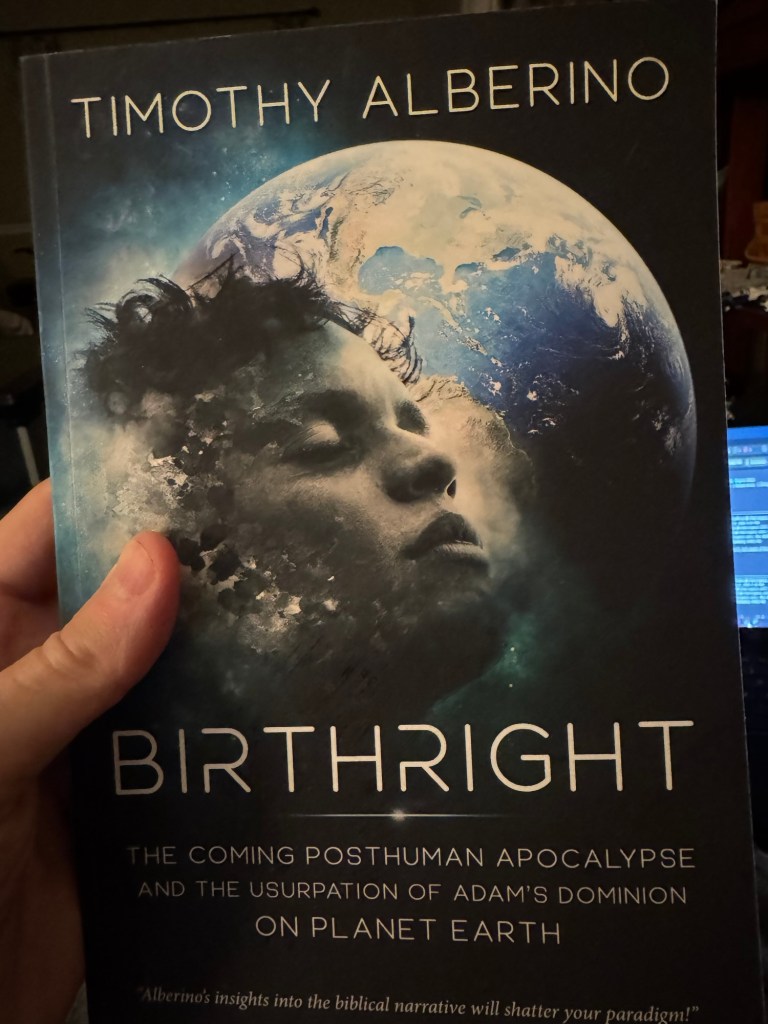
In the quiet moments away from the relentless pace of political battles, economic analysis, and the daily grind of defending principles in a world that often seems intent on erosion, there’s something profoundly refreshing about diving into a book that pulls back the curtain on deeper realities. One such discovery came recently with Timothy Alberino’s Birthright: The Coming Posthuman Apocalypse and the Usurpation of Adam’s Dominion on Planet Earth, published in 2020. This isn’t just another volume on ancient mysteries or fringe theories; it’s a meticulously crafted narrative that weaves biblical scholarship, historical inquiry, and contemporary phenomena into a cohesive worldview. It challenges the sanitized, compartmentalized versions of history and scripture we’ve been fed, urging readers to step out of Plato’s cave—where we’ve been chained, staring at shadows on the wall—and confront the fuller light of reality.

I finished the book on the day of the Olympic opening ceremonies that many viewed as laden with overt satanic symbolism and references to Luciferian themes. Such public displays, alongside scandals in Hollywood, the music industry, and elite circles involving ritualized sex, power, and exploitation—from Aleister Crowley’s influence to modern figures like Sean Combs or echoes in the Epstein saga—underscore a persistent undercurrent. Alberino argues these aren’t isolated excesses but part of an ancient war over humanity’s inheritance, a theme he traces back to the very beginning of the biblical account.

At the heart of Birthright is the concept of dominion granted to Adam and Eve in Genesis. Humanity, created in God’s image, was given authority over the Earth—to expand Eden, steward creation, and bring heaven’s order to the physical realm. This birthright represents not just land or resources but a divine mandate for rule, creativity, and moral governance. Yet from the outset, forces sought to usurp it. The serpent’s temptation in Eden was the first theft attempt, leading to the fall and the squandering of that authority through disobedience. Alberino expands this into a cosmic drama, drawing on the Book of Enoch (an apocryphal text preserved in the Dead Sea Scrolls and quoted in the New Testament) to detail the rebellion of the Watchers—200 fallen angels who descended, took human wives, and produced the Nephilim, hybrid giants whose existence corrupted the Earth with violence and forbidden knowledge.<sup>1</sup>

These events, detailed in Genesis 6:1-4 and elaborated in Enoch, explain the pre-Flood world’s wickedness, necessitating the deluge as divine judgment. The Nephilim weren’t mere tall humans but offspring engineered to challenge human dominion, their spirits becoming demons after their bodies perished.<sup>2</sup> Alberino connects this ancient incursion to modern phenomena: UFO sightings, alien abductions, and what he sees as a deceptive “alien” presence masquerading as extraterrestrial but rooted in the same fallen spiritual realm. He posits that today’s transhumanist agenda—merging human biology with technology, AI, and genetic engineering—represents the latest phase in this usurpation, aiming for a posthuman apocalypse where humanity’s birthright is fully stripped away, replaced by hybrid or enhanced entities loyal to adversarial forces.<sup>3</sup>

This framework resonates deeply with longstanding interests in giants, ancient history, and the Nephilim. For years, discussions of giants in North America—mound builder discoveries from the 1800s along rivers like the Miami Valley, often dismissed as carnival hoaxes or pseudoscience—were marginalized. An early article I wrote on these topics back in 2010 drew massive attention but faced backlash for blending “serious” issues like tax policy with what mainstream culture deemed conspiracy territory. Institutions prefer neat categories: politics here, religion there, ancient anomalies safely labeled myth. Yet evidence persists, from biblical references to global giant lore, suggesting a suppressed history.

Alberino’s work builds on scholars like Michael Heiser, who applied rigorous biblical exegesis to the divine council and supernatural elements in scripture.<sup>4</sup> The Bible, as an artifact, is remarkable—preserved through millennia of translation, political editing (from early Roman church councils to Renaissance interpretations), and textual discoveries like the Dead Sea Scrolls, which confirm remarkable consistency. Yet it’s dense, fragmented, like shadows in Plato’s allegory: we see projections but not always the sources. Alberino encourages turning from the wall to examine the fire, the figures casting shadows, and ultimately stepping into the world beyond illusion.

He frames the ongoing battle as one over this birthright. The story of Esau and Jacob in Genesis 25 illustrates it starkly. Esau, the firstborn, sells his birthright to Jacob for a bowl of stew when hungry and impatient, valuing immediate gratification over eternal inheritance. Yahweh honors the transaction, leading to Jacob (renamed Israel) fathering the tribes and claiming the promised land. This narrative isn’t just family drama; it’s a microcosm of humanity’s temptation to trade divine authority for fleeting pleasures—sex, power, convenience, or modern equivalents like celebrity, wealth, or technological transcendence.<sup>5</sup>

Alberino ties this to figures who rejected paternal guidance and embraced rebellion. Aleister Crowley and Friedrich Nietzsche, both losing religious fathers young, spiraled into philosophies that influenced destructive movements—Crowley’s occult sex magic permeating Hollywood and music, Nietzsche’s Übermensch (overman) twisted into Nazi ideology. These represent selling the birthright for Luciferian promises of godhood without God. In contrast, the biblical Overman ideal—Adam as God’s supreme representation on Earth, uncorrupted—offers a heroic vision: humanity as stewards, not slaves to temptation or manipulation.

My affinity for the “Overman warrior” concept aligns here—not the corrupted Nietzschean version that fueled tyranny, but a Superman-like ideal of strength, virtue, and resistance to evil. It’s about refusing to be broken, manipulated, or seduced into yielding dominion. Personal history in passion plays, portraying biblical roles, fostered a lifelong engagement with these themes, yet frustration with weak portrayals of figures like Adam (easily tempted) or institutional failures to confront modern implications has been, to say the least, infinitely disappointing for me.

Alberino’s book bridges gaps: why the Bible omits details (political censorship, lost texts), why giants and fallen angels matter (they explain evil’s origins), and why UFOs fit (as modern deceptions echoing ancient incursions). He critiques institutional religion for downplaying Enoch or supernatural elements, allowing secular science to dismiss anomalies. Yet fresh scholarship—Dead Sea Scrolls, archaeological confirmations of biblical sites like the City of David—validates the narrative’s core.

This isn’t pseudoscience; it’s interdisciplinary inquiry challenging controlled categories. The Temple Mount disputes—Islam denying Jewish archaeological evidence despite visible proof—mirror broader suppressions of inconvenient truths. Similarly, giants’ stories were ridiculed as roadshow myths to justify land theft or secularize history, but persistent global accounts suggest otherwise.

In an era of disclosure debates, black budgets, and fear-based control narratives around “mysteries,” Alberino reframes UFOs as spiritual, not merely technological. The 200 Watchers’ rebellion sought to corrupt the human line, preventing Eden’s expansion. Today’s equivalents—rituals in entertainment, elite exploitation—continue that agenda, luring people to sell their birthright cheaply.

The hope lies in reclamation. Humanity’s mandate remains: expand Eden, resist deception, claim dominion through alignment with divine order. Alberino’s work, alongside emerging discussions in UFO communities, biblical studies, and alternative history, signals a shift—people untying from Plato’s cave, exploring freely.

This book stands out for its scholarly precision, narrative flow, and refusal to compartmentalize. It entertains while provoking profound reflection, much like Graham Hancock’s works or Vera brothers’ explorations, but with stronger biblical anchoring. For anyone weary of surface-level politics or religion, it’s a reminder that the real fight transcends the visible—it’s eternal, cosmic, and personal.

Highly recommended. It elevates understanding, inspires resistance to temptation, and reaffirms the value of pursuing truth beyond shadows. More from Alberino—on Enoch commentary, expeditions—promises further illumination. In a world pushing posthuman futures, remembering our birthright may be the ultimate act of defiance and hope.

Bibliography and Further Reading

•  Alberino, Timothy. Birthright: The Coming Posthuman Apocalypse and the Usurpation of Adam’s Dominion on Planet Earth. Independently published, 2020. (Primary text; available on Amazon, author’s site.)

•  Alberino, Timothy. The Book of Enoch: With Commentary & Concept Art on the Book of the Watchers.

•  Heiser, Michael S. The Unseen Realm: Recovering the Supernatural Worldview of the Bible. Lexham Press, 2015.

•  The Book of Enoch (Ethiopic version, translated editions; referenced in Jude 1:14-15).

•  Dead Sea Scrolls publications (e.g., via Biblical Archaeology Society resources).

•  Reviews and summaries: Goodreads (4.5+ average), Shortform book summary, Amazon customer reviews.

•  Related discussions: YouTube interviews with Alberino (e.g., Shawn Ryan Show, various podcasts).

<sup>1</sup> Alberino, Birthright, drawing on Book of Enoch chapters 6-16; see also Genesis 6:1-4.

<sup>2</sup> Ibid.; Heiser, The Unseen Realm, pp. 92-110 on Nephilim as hybrid offspring.

<sup>3</sup> Alberino, Birthright, chapters on UFOs and transhumanism; Shortform summary highlights the “posthuman apocalypse” thesis.

<sup>4</sup> Heiser, The Unseen Realm, core argument on divine council and rebellious “sons of God.”

<sup>5</sup> Genesis 25:29-34; Alberino frames this as emblematic of selling dominion for temporal gain.

Footnotes reference key biblical passages, book sections, and supporting scholarship for further personal exploration.

Rich Hoffman

More about me

Click Here to Protect Yourself with Second Call Defense https://www.secondcalldefense.org/?affiliate=20707