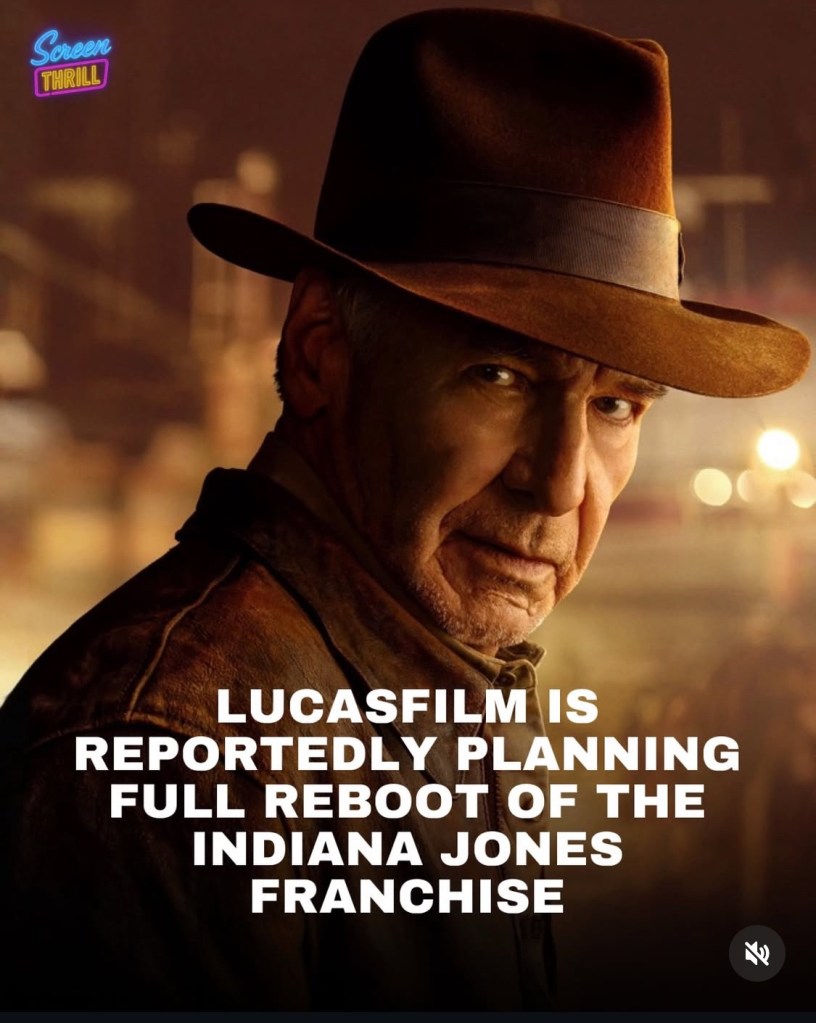
The Only Way A New Indiana Jones Movie Would Be Successful: Consultants and corporate looters can’t copy success, it never works

There is a way to do it, to make more Indiana Jones movies.  There have been at least seven different people who have played Indiana Jones at some point in time, everyone from George Hall, to Corey Carrier, to Sean Patrick Flanery—even River Phoenix.  Then, of course, there are all the video games and commercial appearances where an Indiana Jones-like character is seen doing something, from amusement park rides and Coke commercials to cameos in other movies.  Unlike other franchise characters, however, Indiana Jones is different in that Harrison Ford created a particular kind of character with a timeline expectation that society will hold Disney to.  There is a nice period in the character’s timeline, from age 25 to 35, where a new actor who resembles Harrison Ford could tell all-new stories that the public would love.  Most of the best Indiana Jones movies take place within a specific 3-4 year timeline that centers on Harrison Ford playing Indiana Jones in the iconic movie Raiders of the Lost Ark, a film that revolutionized the way stories are told and movies are presented.  I personally think it was the best movie ever made and that changed the value of the character created for the public forever.  The chances of doing something like that again with the same character but a different actor is impossible. I think it’s possible to make more movies after seeing how Disney and Bethesda, the video game maker, produced the latest Indiana Jones video game, Indiana Jones and the Great Circle.  It was a great game and a lot of fun, and it didn’t try to “reboot” Indiana Jones; it respected the timeline that people had come to know and trust.  And many actors contributed to that effort, and those are the rules of engagement.  There is a lot of talk now, halfway through 2025, that Disney wants to reboot the Indiana Jones movies.  They own the property and want to make money from it.  However, there are rules they must follow; otherwise, they will cause all kinds of social problems, just as they did with the Star Wars movies.  If they want Indiana Jones to remain valuable to the public, they’ll listen and stay respectful.

But if they think they are going to retell Raiders of the Lost Ark with a woke actor like Pedro Pascal, or even a woman, then they are out of their minds, and another Indiana Jones movie would be a disaster.  Indiana Jones is not something that can be ruined in the way that studios often do with Batman movies or James Bond stories.  There has been over 40 years of story telling from books, television, comics, video games that for that entire time held to a stringent canon timeline, and that trust has been built across many generations of fans, from kids today to their grandparents who saw the movies in the theater when they were kids.  I love the Indiana Jones Stunt Spectacular in Orlando, Florida, the stunt show that has been performed for years at Hollywood Studios. It has featured several different actors portraying Indiana Jones in that stage play.  However, the difference was that all content creators were very respectful of the original idea.  During the period I mentioned, numerous exciting stories could be told about a younger Indiana Jones as he establishes his excellent and famous reputation, which people would love to see depicted in movies.  However, those movies would require directors, producers, and musical talent as passionate about making the movies as were Steven Spielberg, George Lucas, and John Williams, originally.  Disney thought they would get away with a reboot of Star Wars by ignoring the story canon and essentially retelling A New Hope with The Force Awakens, and people have never forgiven them for it.  They might have made some short-term cash, but they destroyed the brand, and that has cost Disney a lot.  

This is important because the character of Indiana Jones has likely been the single most valuable narrative device that has advanced the arts and sciences in the world today.  There are many people who have become scientists because of Indiana Jones and the inspiration they received from him as children, which has been very beneficial.  The value of the Indiana Jones property lies in this social motivation.  And unless Disney respects that sentiment, it will harm them in very detrimental ways, and erode the character it currently holds socially.  Indiana Jones is more than just Harrison Ford, and unless a new production is presented with the same level of commitment as those original films were, it will be rejected at the box office, just as the Star Wars movies have been.  There is an arrogance that comes from the consultant class in society, who often con their way into the motion picture studios, never figuring these things out.  And those are the voices at Disney who think they could make a movie as good as the originals were, without understanding the social consequences of destroying the public’s love of the property.   The Indiana Jones timeline is unique in that it spans from his infancy in The Young Indiana Jones Chronicles to his portrayal by a 93-94-year-old man with an eye patch.  Within that timeline, there is room to make movies just as exciting as Temple of Doom and Raiders of the Lost Ark, if the stories deal with the post-college years.  However, suppose they recast and retell the stories for modern audiences with music by different composers, cinematography that fails to capture the spirit, and scripts that don’t adhere to the formula. In that case, the project will be a disaster.

I think Disney should leave it all alone and let it be what it is.  They’ll make more money off Indiana Jones if they allow it to stay valuable in people’s consciousness.  However, Disney is not filled with creative people; it is essentially run by consultants who choose to live by copying what they think is successful and trying to pass it off as their own.  And it never works well, and it certainly won’t work with Indiana Jones.  So, with all the talk about Disney developing another actor to play Indiana Jones in a new movie, I would advise them to proceed with great caution.  I’d see the film if they were respectful to the established timeline.  But if they want to put a minority character in the role instead of a white guy, and change elements of Indiana Jones for a more modern audience, then it will be a disaster.  And I’m only writing this now in the hope of keeping them from making that big mistake.  But I don’t have much faith that they’ll listen, and will destroy this as they have so many other things in life, and the impact of that in the world is very significant. It matters more than people think it does; we’re talking about the way that humans create reality for themselves through story and narrative devices, and Indiana Jones emerged as a necessity for human consciousness that was more than entertaining.  Disney has been warned, so we’ll see what they do.  I’d like to see it work.  I think there is an actor out there who could carry the torch of Indiana Jones during an exciting period that audiences would accept.  However, short of that, it would be best to leave it alone, as the social impact of changing the value with new content would be devastating in ways that most people cannot measure.  What I have said is the only way that it could be done because all other methods would be very destructive and unnecessary. People are pretty forgiving as long as they know they can trust a story not to change on them. And that’s true with everything in life. People can come and go, but people want to know that the story stays the same.

Rich Hoffman

Click Here to Protect Yourself with Second Call Defense https://www.secondcalldefense.org/?affiliate=20707
Solo: A Star Wars Story Box office discussion–what it means to everyone–and nobody cares about China

Box office numbers are often a good thermometer into what the world is thinking, and I pay attention to them closely, and sadly the new Star Wars movie Solo: A Star Wars Story is falling well short of the kind of numbers its going to need to make. I found it interesting to see how many news outlets were already writing stories on Friday about how dismal the box office numbers were for the new Star Wars movie, like The Hollywood Reporter for instance. Their story was that Solo was bombing big time in China. Well, since when was China the market decider for films, they are communists, more aligned with the villains in these stories? Solo: A Star Wars Story is all about freedom and I’m sure the “state” wasn’t all that happy with the film, and that whether or not people saw the film or even advertised it so that their billion people had access to it is probably a big factor. Asians especially in China are not big on the Star Wars films, but that’s OK, they haven’t been a big part of the box office numbers all this time—who really needs them now? Solo isn’t any different, yet The Hollywood Reporter was almost as happy as a kid on Christmas Day to learn that China was not supporting the new Star Wars picture. There’s a lot going on with this one which justifies a good long discussion.  (CLICK HERE FOR MY REVIEW OF THE FILM)

First of all, I don’t think the poor box office numbers so far reflect that Solo: A Star Wars Story is a bad movie. If you took the box office numbers of Infinity War and Deadpool 2 and released Solo: A Star Wars Story on a light release month, such as April I think this Star Wars movie would be on track easily to achieve a billion dollars at the box office, but with some competition out there, it would appear there is only so much money on the table to divide up between all the movies, and that’s not a bad thing for theater owners. I often say that Hollywood has let down all the personal investments that theater owners have to shoulder with less than stout productions that drive their concessions. That certainly isn’t the problem currently, there are a lot of movies released right now, and coming up as the summer unfolds which should help theater owners sell lots of popcorn. Hollywood owes them for always being available to display the Hollywood product to the public. That same public has a lot to do on Memorial Day weekend, that’s when the pools open in the states and people typically have things to do outside. In America Memorial Day weekend was pretty nice except for some flash flooding in the eastern part of the country. Everywhere else it was sunny and hot—and people spent time outside. May 25th may have been a traditional release date for Star Wars, but it’s no longer a great weekend for opening a movie because it’s the gateway to summer and people are often doing a lot of things that involve going outside.

Additionally, there are problems for Star Wars to overcome, the entertainment media is trying to do with Lucasfilm and Disney what the general media is trying to do with President Trump, and that is torpedo anything that they do that’s good, because everyone else is struggling to compete. Disney is going to make a lot of money this summer between the Marvel films and Pixar’s Incredibles 2—many in the entertainment business are very happy to see a Star Wars movie get bad press, because it’s a shot at Disney as a media company they are competing with. It’s like how the rest of the NFL teams around the country enjoy it when the New England Patriots lose a game, or Tom Brady throws an occasional interception. The trade media rushes out to talk about how Tom Brady is too old and is losing it. But the very next week Brady will throw for 400 yards and have a quarterback rating over 100 and the Patriots will win by 24 points over whoever they are playing. Disney and its tent pole of Star Wars is a big presence in the marketplace and the second handers love to see trouble happening in the Star Wars universe.

But then there is the very legitimate problem that I have talked about before and that is the mistake that Kathleen Kennedy and her story group at Lucasfilm has made in throwing out the extended universe of Star Wars and pushing very progressive themes in these new Star Wars movies cramming PC culture down the throats of the fans who clearly don’t want those elements in these movies. To me the Lucasfilm efforts with Solo: A Star Wars Story went a long way to fixing those problems with the fan base where some still want to enjoy new instalments, while others want to boycott the films in hopes that Disney will fire Kathleen Kennedy for messing with the elements that made Star Wars great to begin with. Nobody cared that Princess Leia was a bit of a feminist in the original A New Hope. George Lucas tried to make people happy by putting a black guy in the stories with the character of Lando. But in general, the heroes were white people, especially men and Kennedy has been very active to change that. But while doing so she literally destroyed two of the most popular female characters that fans loved, Jaina Solo, Han’s very strong daughter, and the wife of Luke Skywalker, Mara Jade. Fans who read the books went on a lot of journeys with those characters over two decades and suddenly fans were told that those people didn’t exist in Star Wars anymore, and that has caused a lot of consternation. When The Last Jedi failed to reveal who the parents of Rey were—many people were hoping that she was actually Jaina which would at least explain why she is flying around in Han Solo’s precious Millennium Falcon—a lot of fans stepped away from Star Wars at that point and now this second film in only a year has hit theaters and people are ambivalent about it. The Last Jedi was a very progressive movie that really split the fanbase, from not revealing the parentage of Rey, to the killing of Luke and the obvious progressive messages of feminism and sacrifice where everyone was blowing themselves up instead of taking the fight to the enemy, it’s that which made it so the fans stepped away from Solo: A Star Wars Story.

I have been enjoying the new Star Wars stuff the best I could. I have not been a fan of what Lucasfilm has done. I was a big fan of the Star Wars EU and I think Lucasfilm could have easily have just picked up these stories where the books left off and would have done something really special. However, I think the value of the movies and all the merchandise that is coming from the franchise does far more good than bad. I think Lucasfilm and Disney made a major mistake with Star Wars and that they are trying to remedy that now. For me Solo: A Star Wars Story was a huge step in that direction—of making things right with the fans. But its obvious that the fans are going to make Disney and ultimately Lucasfilm earn back that respect which is where things are today. There was a boycott of this latest Han Solo movie and it had an impact on the final ticket sales. As the word is getting out, because Solo: A Star Wars Story is pretty good—I think its one of the best and is certainly on par with the original films somewhere in quality of story telling between The Empire Strikes Back and Return of the Jedi. But the film is more fun like A New Hope was. I like the prequel films but can admit that Solo: A Star Wars Story is better than those films and it is certainly better than The Force Awakens. But these new young actors are making a name for themselves, the young Alden Ehrenreich is earning his respect from the fans little by little. Many fans have been sitting on the fence with Solo: A Star Wars Story because they weren’t sure how to feel about a new actor taking over for the legendary Harrison Ford. If this latest Star Wars film does anything it shows fans that its possible to have a younger actor playing an old favorite, and because of that I think Solo: A Star Wars Story will have good legs into the future of the franchise, and people will come back to the films and forgive Lucasfilm and Disney for their mistakes with the first three films made since the acquisition in 2012.

Alden Ehrenreich is a smart young actor with a good head on his shoulders, and he likes playing Han Solo in Star Wars. He’s good for the franchise and understands that taking less money for the opportunity to do more films like this makes good business sense because it could place him in Hollywood as the next big demand actor—like Harrison Ford was. With all that under consideration I think Disney certainly put the cards down on the table with this one holding nothing back promotionally. I wouldn’t be surprised to learn that they spent $500 million on the movie and are worried at this point of making that money back, which I think they will. But they spent the money expecting a billion in return and that could cool them on launching the other projects that are in the pipeline. Hopefully they let Lucasfilm go forward with the budgets on those new films, the Kenobi film, the Boba Fett film, the Rian series, and of course at least two more movies about the young Han Solo—as well as a whole bunch of other films not yet released. It’s not too late to make these films into the kind of successes that were experienced with Marvel—but getting the fan base back on board is the key.

To win back the audience, and this is just my advice, do with it whatever you want Lucasfilm, you have to get Mara Jade and Jaina Solo into Episode Nine as its being directed now with J.J. Abrams. Everyone gets what they want if that happens, Kennedy gets her strong female leads, Luke has a reason for being so distressed in The Last Jedi, and Rey gets a name and a reason for having the Falcon with Chewie as her co-pilot. A new trilogy featuring Jaina could even take things further 30 years after Episode Nine—the possibilities are endless. It took Marvel ten films to build up the kind of anticipation that was seen in Infinity War, Star Wars could do something very similar, but they’ll have to earn back the fans, and Solo: A Star Wars Story was a big first step. Hopefully Disney doesn’t get cold feet after they study these box office results and consider whether fans will support two Star Wars movies in the same year. They will, and they will support three or four a year if Disney will make them and be very profitable with $200 million budgets. But it will take more movies like Solo: A Star Wars Story to earn back that fan trust, not more movies like The Last Jedi or even The Force Awakens. The nostalgia wore off and now reality is there for Star Wars films, going forward, people want to see new ground that pays respect to what they know from the original EU—and fans don’t want to be preached to with gay characters, or black characters, or women. They just want to see a story set in a galaxy far, far away that will endure for centuries—and not fall out of favor with whatever new political movements come in the next few decades. Star Wars fans want their traditions, and they want the long view—and its their money that Disney wants, so it’s up to the giant entertainment company to give it to them.

I think I’ve listened to the new Han Solo theme from the John Powell soundtrack back to back for a solid four days now and I love it, it’s so full of optimism. It reminds me of how it was when Christopher Nolan’s Dark Night series started back in 2008, with a movie that many people didn’t think was needed because at that point Batman had been done so many times. The Nolan trilogy built up a nice audience and earned a reputation by the fans that they trusted and supported. Those films each went on to make over a billion dollars each. Iron Man the first Avenger film also came out that year with a fantastic performance by Robert Downey Jr. The film only grossed around $500 million globally much like I think this new Han Solo movie will make, but it became the glue that built up those next nine Marvel films. Disney purchased Marvel shortly after that film’s release and the rest is now history, and has been very successful. It has allowed Disney to make obscure films like The Black Panther, which I thought was pretty good—which would have never been made unless there was a need for the ever-expanding universe. Star Wars could do better, but the fan base will have to be built and listening to that soundtrack of Solo: A Star Wars Story that new Han Solo theme could serve as a nice light in the darkness for all the Disney executives timid about the next stage of the adventure. The best thing to do would be to support the effort and not panic, there is a lot of good that came out of Solo, and it hints at how things truly could be now that it looks like Lucasfilm is starting to figure out how to make these Star Wars movies without the guidance of George Lucas. The John Williams contribution is absolutely brilliant and I hope that everyone involved can use it to launch something really special, because the opportunity is certainly there.

Rich Hoffman
Sign up for Second Call Defense here: http://www.secondcalldefense.org/?affiliate=20707 Use my name to get added benefits.

The Best Thing About ‘The Force Awakens’: John Williams

Matt Clark and I over the weekend did a rather important show about the new Star Wars picture and the radicalism of Disney from its employees based on an article I wrote several weeks ago. You will be able to listen to that broadcast on WAAM radio soon. However, Matt had on a guest that was late to the call at the bottom of the hour and needed to fill some time while his producer got him on the phone. So we had to come up with a bit of off-script content to bridge the gap. I brought up something I had been thinking about a lot in anticipation of the new Force Awakens Star Wars film based on persistent fears that the expectations were just so high. There was a real danger of walking away disappointed. I realized after a lot of thought that the primary reason I was looking forward to the new Star Wars film was for one simple reason—I want to hear new Star Wars music from John Williams. Everything else is literally secondary. To understand why, watch this old 20/20 segment about John Williams from 1983.

I was a strange kid—which should have been assumed based on a casual reading of my millions and millions of words. There are a lot of people who get paid decent amounts of money for writing far less than I do about far, far fewer topics. Yet I know that I have to write otherwise my head would explode with too many thoughts. I have too many hobbies, too many passions, too many philosophical quandaries that reside at the root of politics that if I don’t get them out and onto some kind of page to look at I may well explode with enthusiasm. So I have to write because I opened the door to something when I was very young that I have never closed. I only wanted to be one thing when I grew up—but I was caught between two worlds really. There was no other job that I wanted to be involved with than a director of movies. The trouble was I also had a pretty powerful physical aptitude. Creative types tend to enjoy escaping from reality and creating what they do in a vacuum of contemplation—whereas I didn’t. I wanted to be in the thick of reality at all times, which flew in the face of the film industry. But at age 13 in 1983 when that 20/20 episode came out on John Williams I wanted to be a film director so that I could work with people like him. What I learned eventually, and much later that there really isn’t anyone like John Williams, the great composer and conductor for some of the most powerful and important movies our American culture has ever produced. So that 20/20 episode was very important to me—I watched it over and over again on a new device called a VHS video tape. I had recorded it and showed it to every member of my family whenever there was some gathering trying to share with them the passion I felt for John Williams music. Most of them didn’t understand.

John Williams is the most important musical personality of the millennia—more so than Beethoven, Mozart, Bach or anybody else. Many years later as I worked at Cincinnati Milicron in Oakley, just north of downtown Cincinnati I listened to all those composers religiously on NPR radio while I worked as a tear-down person for rebuilt machine lathes. The other workers had a typical unionized approach to work, they watched the break clock closely—paced out their day making sure not to produce too much too quickly, and they listened to a lot of classic rock. I wasn’t adverse to rock and roll—there is a certain magic to it blaring from a radio in a machine shop—a freedom that is healthy and defiant in all the right ways—but its not very intellectual. Rock music is very linier—which has never been something I was interested in—rock music equals a can of beer resulting in unstable personal relationships. I enjoyed it for its ambiance, not for the lifestyles that draped off it—the limited vision of the world and lack-luster ambition typical of its fans. So I listened to my radio tuned to NPR’s classical station in Cincinnati and listened to the greats for hours on end while I worked. I was the only one who did this within the entire facility which eventually was dismantled and is now covered by the upgraded development occurring around the Rockwood shopping complex. I have always thought that if more people listened to that classical station with me that the employees would have been smart enough to see the writing on the wall years ago, and Cincinnati Milicron would not have eventually closed down their Oakley facility—but that’s a story we’ve covered before. For this purpose, I considered classical music to be the supreme type of music a human being can listen to—and among them at the very top is John Williams. There is nobody better—and I’ve listened to them all.

Most classical composers wrote their music for some play centuries before they ever appeared on NPR radio. So to me it was not deficient to look at John Williams as one who will eventually surpass the memory of all the obvious musical minds in the future. Movies are modern plays, so a film score is tomorrow’s classical music that will play on NPR radio in the future, all the time. These days however if anybody happened to look at my iPod they would only see two primary names on the entire 10G device, John Williams and Hans Zimmer. There are a few others, but 95% of my iPod is filled with those two musical film composers. Of those two, Hans Zimmer is clearly the student of the master, John Williams. I don’t see them as comparable in any way—other than they both make music. Nobody writes music like John Williams—I listen to him nearly every day in some fashion or another and I never get tired of the way he strings together compositions.

As we were sitting at the bottom of the hour trying to get Matt’s guest on the air, I thought about why I was eager for The Force Awakens by thinking about what I liked most about the recently released trailer—the final one before the film opens on December 18th. It was the scene from a series of clips where the Millennium Falcon was entering hyperspace from the inverted direction speeding into blue light accompanied musically by an upgrade from the previous Han and Leia theme. That was fresh music made just for this trailer and it was stunning in how it helped invoke curiosity. John Williams understands just the right notes to put on a page for what is happening on the screen. The way he tells stories through music is extraordinary, and it was his music that I wanted to hear most regarding the new film.

I meant it when I said it on the air, the Disney Company could put hand puppets on the screen for The Force Awakens and I wouldn’t care so long as I had yet another opportunity to listen to a film score by the great John Williams. He enjoys making swashbuckler type of compositions and really thrives in the type of story that Star Wars is, so it typically brings out the best in him. If the story is not something I can get into, I will at least enjoy the John Williams music—which is what I am looking forward to most. It’s not often that the entire world will attend a musical concert that is classical in nature. Literally the entire planet will be attending a John Williams concert when The Force Awakens opens just ahead of Christmas 2015. And there is nothing negative about that.

Music doesn’t need language—it transcends social limitations and reaches for the pit of our very souls for understanding. Based on that 20/20 clip, it was obvious then that John Williams was on a crash course with destiny as the greatest composer of all time—at least over the last 1000 years—because there has been nobody like him ever. He’s just the right mix of everything musical. No matter how much I listened to Bach, or Mozart on NPR radio, when they would occasionally put on some John Williams music—from any movie—it was clear that a master had assembled the notes. With that in mind there isn’t much Disney can do to ruin Star Wars so long as John Williams is the man behind the music. Star Wars will always be good so long as the music from those movies are made by the 83-year-old composer who was always ahead of his time and is the best that ever occupied nostalgia. Film music is considered low-brow entertainment among the art critics of our day—but that’s because they’re in the back of the train. Eventually those art analyzers will catch up to what I’m saying today—that John Williams is the primary reason that millions will love the new film and it will be the largest and most diverse opening to an orchestral concert in the history of earth—and that is enough to give anyone goose bumps because the impact it will have on shaping our future generations will be paramount. I suspect that The Force Awakens score will be the grand fortissimo to a long and prosperous career.   But more than that, it will be the last act of a brilliant mind, who would rather write alone all day behind a piano than do anything else—which is why he has been and will always be the greatest.

Rich “Cliffhanger” Hoffman

 CLIFFHANGER RESEARCH & DEVELOPMENT

Listen to The Blaze Radio Network by CLICKING HERE.

Star Wars and Political Science

Star Wars and Political Science

I have to report something that many, many people will find excessively disturbing. Now, in the context of what I’m about to say, keep in mind that I am well read, and have studied history about as extensively as a non-professional can without becoming professional.

Of my favorite books that I’ve read is the wonderful series by Joseph Campbell, The Masks of God four book series. I’m a tremendous fan of Friedrich Nietzsche, particularly Thus Spoke Zarathustra. I just completed A Patriots History of the United States. I love the book the Mothman Prophecies by John Keel, and all his further reporting of the strange and unusual. And I have read many of the popular modern news anchor books, such as Glenn Beck, Bill O’Rielly, and many of the others. I particularly enjoyed Arianna Huffington’s Pigs at the Trough. The point of this qualifying statement is that my reading range is varied and not party influenced. And it is extensive enough to make proclamations.

And the proclamation that I’m going to make is that the work in Star Wars, not just the films, but the books, is some of the best work of political science done in the history of mankind. And I say that as I pour over The Federalist Papers, and The Anti-Federalist Papers, and The Second Treatise of Government by John Locke 1667. In the Star Wars books, starting with the New Jedi Order series which started in 1999 and went on for 19 books, all the way up through Fate of the Jedi, the content while typically Star Wars is quite deep and universal in their exploration of political and human deficiencies.

How popular is it? Look at this tribute to John Williams, whom I think is the greatest musician there ever was, not just because he did the music for Star Wars, but most of the memorable, and inspirational music ever created. He will surpass Beethoven, Mozart and all others in the context of history.

Anyone not familiar with Star Wars, or who haven’t taken the time to work through the story line, let me bring you up to speed. The Jedi Knights are protectors of the Republic Government throughout a galaxy. The Jedi became complacent by their unchecked power. So a Sith Lord, an opposite of a Jedi in political motives, infiltrated the government, manipulated his way to become Emperor, and ruled the galaxy with an iron fist. The Emperor works with the Force, an unseen god-like presence that embodies all matter, much the way Jedi do, but otherwise is very similar to the motivations of Adolf Hitler, Joseph Stalin, or Alexander the Great in real historical concept. The Jedi are all but destroyed and are forced into hiding.

To give you an idea how popular Star Wars still is, here is Harrison Ford at the 30th Anniversary of The Empire Strikes Back. (THE 30TH ANNIVERSERY! Most people don’t know who the president was 30 years ago, but they still know Star Wars)

Eventually the Jedi led by Luke Skywalker overtake the Emperor. They replace the government with the New Republic, and the problems commence. What kind of government do they replace the Emperor with, as many power hungry factions emerge to fill the power void, and what role do the Jedi play in that government? For the next 30 to 40 years the Jedi watch many governments rise and fall, while they try to build their role of protector of the galaxy back to a respectable position, all the while fighting political squabbles, the re-emergence of the Sith, the Jedi’s own insecurities in becoming too power hungry themselves, and the role of spiritualism in the whole enterprise.

This video from the Celebration V in Orlando Florida, August 2010.

The ongoing struggle of the Jedi v. government, and the Jedi v. Sith, and the Jedi v. self is a marvelous and highly sophisticated exploration of political science done against a science fiction back drop. It is because Star Wars is more than just pure entertainment, but at a deep subconscious level, food for the mind, that it has become such a memorable story that is so endured by the public to this day.

More from Celebration V.

And here is a word of warning to the entire political structure as it now exists. The world has moved to a place you cannot follow. With Star Wars, many similar science fiction stories have emerged. And now with the emergences of on-line gaming, whether it be Halo, or Gears of War, Modern Warfare, or Madden Football through Xbox, or Play Station or more advanced games like World of War Craft, and Star Wars on the PC game front, the youth, and in many cases the middle agers playing them, are starting to see through the smoke screens employed by politics for all of human history. Such tactics have worked in the past, and up to the last thirty years, were very effective. Even though the last 15 years seem to have made tremendous gains turning the republic of the United States into a socialist country with a European blueprint, this is an illusion. It’s the tail behind the head of the snake. The head is already moving in a different direction.

Here’s George Lucas talking about the Smithsonian exhibit in Washington D.C.

Sure, many will look at current personalities like Glenn Beck and call him seditious. But they are only looking at the symptom. Glenn Beck has emerged to fill a market need. He is not the market itself but has only emerged to supply to that market, and that is where many of the fools that cast blame in his direction go wrong. Beck is a product of the same generation I am, and we grew up asking questions, and all one has to do is read history to see that fiction has its roots in reality.

George Lucas on the Clone Wars, animated TV series on Cartoon Network.

And Star Wars has done much to ask the questions that a technological society like the one we currently have, needed to ask. And those questions are much bigger than Fannie and Freddy, or the government take-over of GM. They are bigger than government bail-outs, and Union deals with government officials.
One of the most sophisticated video games I’ve ever played in my life was the first Knights of the Old Republic. It is a Star Wars game, but I’d just as soon call it a training game for becoming a Jedi Knight. In that game you do everything from fighting Sith and other criminals that seek to harm the innocent, to helping solve crimes in complicated scenarios that most lawyers would find difficult. The goal of the Jedi is to see beyond the obvious, to the truth, and to fight for that truth. Because many criminal elements have hidden their crimes behind legitimacy, such as how our current government works. And that has worked for a long time, but it is changing as people think about the concepts discussed in Star Wars and other popular fiction.

Even though the game is several years old now, it still looks exciting.

Call them nerds, those people that sit and play games and read comic books and ramble on about The Force. Make fun of them because they don’t know much about sports and don’t play golf. But the world is changing. And politicians don’t understand it. They think the same old tricks will work, so they ignore and ridicule what they don’t understand.

Here is a big Star Wars Fan. Give him credit. At least he knows what makes him happy.

But even 50 years ago, there wasn’t anything like Star Wars out there for the public to digest. There was Plato’s Republic. There was Shakespeare. There was Tom Sawyer, Huck Finn, there was Uncle Tom’s Cabin, all books that helped shape political policy even to this day. But Star Wars puts out a significant book at least twice a year for a couple of decades now, and each book goes deeper and deeper down the rabbit hole of personal relationships and spirituality, against the conflict and impulse of politics. And that is a new element to the tapestry of human history, one that will have a significant impact on the future of our race.

I’m proud of my wife for reading over 57 Star Wars books. But this guy is doing a pretty good job.

Anyone that says entertainment can’t also be meaningful is not paying attention. Below is the preview of The Force Unleashed, another Star Wars game that I will be playing.

So while I explore my own ideas in the overmanwarrior concept, the work in Star Wars is where everything starts. And it is one of the most important stories that have ever been told. And the Star Wars stories are more important than anything the current president has to say, or the speaker of the house, or anyone that currently thinks they are the authority to the human race.

Rich Hoffman

www.overmwarrior.com