
We Are Not Better Together: The illusion of leadership

Let’s clear some things up right now, because I’m tired of hearing the term.  We are not better together.  More minds do not make something better.  These are dumb, communist ideas by outside influencers who have tried over time to slide dumb ideas about how society should be structured under the door and have left us with a lot of garbage like that term to muddle through.  I receive numerous emails from people, and someone sent me one of those LinkedIn links to a statement from a consultant group about leadership, as if to refute my position on the matter. I had to give that person a healthy dose of reality.   More is not always better.  More administrative minds do not improve processes. Instead, you often get the opposite; usually, you end up with more of a mess than any improvement.  If you want to improve something, identify your leader and then listen to them.  But don’t think that a bunch of useless people meandering through life can come together and improve something.  It never works.  The concept of teamwork has been grossly misused to incorporate elements of Marxism over the years through our public education system, and it was always a flawed idea. I think the reason for this was best captured in books like Robert Persig’s ideas on the Metaphysics of Quality.  His metaphor of people who sit in the back of a moving train is a particularly apt one that accurately reflects the truth in this matter.  Good leaders are at the front of the train where things can be seen as they are happening.  But most of the world sits in the back, where it’s safe, and analyzes data that has already passed.  It can be helpful information, but that’s not leadership.  And the communist societies of the world have tried to sell cowardice that way to make the timid feel like they were equal to good leaders.  And they are not. 

That is where most consultants get things wrong, and LinkedIn is full of those types of people who attend all the business seminars and listen to all that “team building” nonsense, such as the idea that no one person has all the answers and that more minds are better than just one.  What causes trouble in cultures that need leadership is the presence of committees, where administrative types try to lead an organization from the back of the train, rather than from the front, where they belong.  And often up front, where things are scary and coming fast, most people don’t have the guts to live there.  They always pick where it’s safe and build their 9-to-5 lives around the value of analysis, often from the caboose of a train, complete with lots of spreadsheets and graphs, but without the voice of leadership to guide the timid toward greatness.  Good leaders are listened to, not debated with.  So, any culture that wants to succeed needs to hear more than hold hands in the back of the train while the world outside moves quickly.  Leadership is not safe; it’s usually hazardous, and it requires a lot of toughness that most people never develop in their lives.  That doesn’t make those people useless.  However, they are unable to lead because they never developed the stomach for the rigors of the leadership task.  They have come up with all kinds of excuses why failure is best elevated in group consensus rather than the responsibility of leadership at the front of the train, where things are much more dangerous.

I’ve heard every excuse in the book as to why most people prefer the back of the train as opposed to where leadership lives, at the front.  They say, people, say dumb things like, “I don’t want the stress and want to avoid a heart attack.”  Or they will point to the need for time to decompress after work.  All they are doing is telling the world that they aren’t tough enough to be a leader of an organization and that they prefer the back of the train, where things are safe, and where they can share the experience with others holding hands for safety and security.  And it’s those types of people who want to believe that more is better and that no one mind is better than a collective whole.  This is the kind of flawed thinking that assumes the United Nations is better as a one-world government than the individual results of leadership that come from the United States, for instance.  You don’t see that the United Nations has accomplished much over the years to bring the kind of peace it has always intended.  It takes a strong individual country like the United States to provide that leadership.  And that same mentality could be applied to every organization; if a strong leader isn’t leading it, it is, to some degree, inefficient and destructive.  The only real way to pull off the illusion that more is better is to stop the train, which is impossible in day-to-day life.  But for the fantasy to work, the trains of life can’t be moving so that all those in the back can analyze data and make decisions in time to do something about it, which is unrealistic.  Trains are constantly moving, and they require sharp, focused minds to be at the front of the train, leading everyone at the cutting edge. 

I’m usually nice to people who send me stupid ideas like this one, the LinkedIn warriors who buy into all the corporate placations created by consultants who are leeching off the profitability of the few.  Consultants like teachers do what they do not because they are good or the best in their field.  Occasionally, you find an exception, but not very often, certainly not often enough to alter the statistical analysis.  What you get are people who lack the courage to lead an organization and try to sell companies on a scam that more analysis from the back of the train will help a struggling company.  However, as soon as the consultant leaves with their misguided ideas of ‘better together,’ the organization falls back into its previous state because it failed to identify its leaders and place them in the correct positions to succeed.  And success is usually found by shutting up and listening to a leader, not in building consensus with a bunch of people in the back of the fast-moving train who are too timid to do what it takes to lead people.  To conceal their timidity from the world, they have adopted these misguided notions about leadership, none of which are accurate.  And they have made a mess out of the world at every level.  So, if you really want to fix anything, figure out who you are: either a back-of-the-train analysis cruncher who likes things safe and secure, or a daring, cutting-edge type who will go it alone and make decisions where they matter, and tell people behind them what to do and when to do it.  If you find a good leader, you’ll find a successful organization.  However, once that leader is gone, the people are left without direction and powerless to improve their lives, and this is the case in almost every circumstance.  We are not better together.  We are better when those people shut up, and listen to the leader among them.  And then, and only then, does everything get better for everyone.

Rich Hoffman

Click Here to Protect Yourself with Second Call Defense https://www.secondcalldefense.org/?affiliate=20707

I Tried to Tell Them: Why consultants often fail

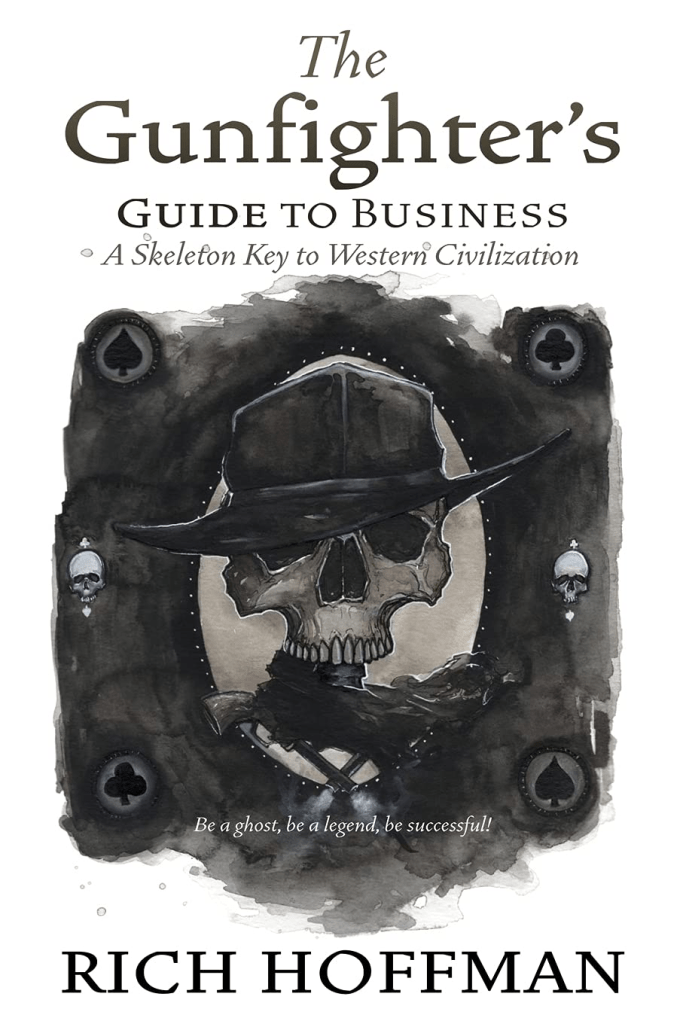
It’s been a little time now, but I suppose it’s appropriate to spike the football a bit and talk a bit more about the details of why I wrote my book, The Gunfighter’s Guide to Business.  I had in my life at that time a lot of people who were really gunning for me, literally.  They did many terrible things, and their world has crumbled around them, leaving them surprised by the consequences.  However, I had already informed them of what was going to happen in my book, which is one of the reasons I wrote it.  I really wanted to be fair, but the bloodthirsty nature of people provoked a lot of bad behavior that has since collapsed, and there was always something of a science to it.  So they can’t say they weren’t warned.  And it really is simple.  One of the key metaphors in The Gunfighter’s Guide to Business, which has achieved what I wanted out of it as a book on business that can help a select few understand why success or failure occurs, is the use of Wild West metaphors to put everything into context.  Why are some people successful while others aren’t? There is a real shell game in the world of people who seek equality and inclusion, who don’t want to admit to themselves the facts of this very distinct reality.  It takes courage to be successful, and you can’t replicate that with process improvements and administrative handholding.  And most of the world doesn’t want to believe that, so I had to write it down in a way that would predict the future.  And that future is now before many people who are finding their personal destruction quite a surprise.  So I explained it to them beforehand.

I love Wild West towns and the idea of them on the open expansion of the American idea.  A vast horizon of opportunity coming together to form a city of ambition, unleashed by capitalist ideas.  Wild West towns were unique to the American experience for many reasons, and I find them infinitely fascinating as a result of human need.  And upon their formation, of course, there were always bad guys trying to get a lot for very little and were willing to bring significant harm to people for their own profit.  So, in that way, how could you bring security to a town without hampering the ambitions of people seeking capitalist outcomes?  And to do so without letting bad guys take everything that was made.  Successful towns established a law and order that centered on gunslingers fighting it out in duels, and good guys like Doc Holiday, Wyatt Earp, and Wild Bill Hickock would meet the bad guys in the street and be willing to risk their lives to shoot their nemesis dead.  And as long as the bad guys were removed from harming good people, a town would grow and thrive.  But without such characters, evil would overrun the process and everything would fall apart.  And that is pretty much true in any endeavor that human beings involve themselves in, even to this day.  You can’t fake courage, and others need to survive in the world and lead good lives.  It all starts with a few unique personalities who have abundant courage and the skill to defeat all others.  Gunfighters come to mind in the concept of fast draw for obvious reasons; they are a uniquely American invention that points directly to why the United States has the largest GDP of any country in the world, especially considering the relatively small number of people contributing to the economy. 

The trick is, once a town was formed, then what?  In those cases of success, there were always plenty of parasites who would come into the city and try to establish rules to maintain order without losing the courage that the town was founded on.  In historical terms, these “Dandies” and “Bounty Hunters,” as I call them, are contemporaries of today’s consultant class, which is quite extensive, who attempt to feed off the carcass of those who have come before them and to steal the profit of their lives ruthlessly.  And they expect everything to work out well.  My response to all these occasions, including before I wrote that book, is to, as the gunslinger, get on my horse and leave town, not sharing the crime-fighting of the town’s profits with the newcomers.  Usually, the gunslinger would move from town to town once success set in, as tag-alongs would then create an administrative barrier.  Instead of a gunslinging gunman, towns would then form a sheriff and a court system. Although things were never quite as good, more people could join in stabilizing a town’s economy.  Gunslingers were not welcomed once things were working well, as collective-based people would then want to share in the glory of success without having the courage to propel it forward with their own sentiments. Consistently, these parasites would seek to steal success from those who created it, without expecting that success to fail in their hands.  However, it never works out that way; yet, after many thousands of years, people still expect a different outcome.  So I wrote my book to explain why that outcome never changes.  Success is directly attached to courage, and you can’t fake that.

I have dealt with people who think they are the most intelligent individuals in the world at many levels, and their ruthlessness has been very easy to overcome.  Usually, these people come out of the consultant classes, and they have a belief that collective administration can replace courage in process improvement, and it just doesn’t work that way.  And no matter what the tag-alongs try to do, when faced up against courageous personalities, they can not compete.  This was the reason that Wild Bill was shot in the back of the head in Deadwood, South Dakota.  The town did not want law and order.  They wanted crime to thrive, and they wanted an administrative mechanism to rule instead of a reputable gunman.  And that is the typical reaction that most people have toward the few who actually achieve success in the world.  Once they see success, they try to shoot the person who made it possible dead, and throw their bodies off the side of the road into an unmarked grave.  They steal the wealth and hope to mimic success.  However, they never quite manage to do it.  Knowing all this, I have not allowed anybody to sneak up on me, which has robbed them of the opportunity to steal what I have created.  They are pretty surprised by the results.  But if only they had listened, I told them well beforehand how it was going to be.  And it is always that way.  Courage beats collectivism every time.  And collectivism allows those with fake courage to appear bold.  But you can’t change the heart of what people are.  They either are, or they aren’t.  And everyone knows the difference.  Courage can’t be duplicated, just as a gunfighter can stand in a dusty street and face down a bullet intended to kill them, and laugh at the danger.  While others hope they can hire a sheriff to do that hard work for them.  But it’s never quite the same.  It takes courage to achieve true success.  And the truth is, there just aren’t many in the world who have real courage.  And when they find they can’t fake it, they get very frustrated when they lose because the illusions of the world couldn’t hide the truth about their bland natures.  That’s why I wrote the book.  As I often say about some of the books I like most, there may be only 20,000 to 30,000 people in the world who read such books, and only 4 of them understand it.  I tend to write books like The Gunfighter’s Guide to Business for those who do.  And to let the other 20,000 people scratch their heads in confusion, because that is about the ratio of people in the world with real courage and an opportunity to be successful at the things they do.  Success is not for everyone; you can’t fake it.  And yes, I tried to tell them.

Rich Hoffman

Click Here to Protect Yourself with Second Call Defense https://www.secondcalldefense.org/?affiliate=20707
Future Debates are Over: Trump is redefining the expectations of politics for the better

It’s an exciting trend, not a surprising one, but certainly telling, and that is debates no longer matter in presidential politics, and as a byproduct of that, money is much less of a factor.  One thing that was grossly obvious in the last Fox News debate was how much things have changed in just a very short period, and if you watched it, or at least some of it as I did, you can see a desperation from the cable news networks to assert a power that they used to have over the process, which they are desperate to hang on to.  Among those under 10% types, there was a consistency to bend allegiance to the media moguls who wanted to set the presidential agenda around consultants and Beltway priorities to keep a globalist narrative on track.  And Trump wisely stepped beyond those controls, leaving essentially the old-world Republicans to battle it out for the bottom in an utterly meaningless debate.  While the discussion was occurring, Trump, of course, did his now famous Tucker Carlson interview, which very quickly gathered up a quarter of a billion views, so the differences in future state politics and the past that have been primarily controlled by consulting firms and media tycoons couldn’t be more obvious.  It’s all about the horse race and the coverage leading up to it for all the parasites who have injected themselves into the process and, over time, taken complete control of the narrative.  But that’s changing now, as it should have long ago.  All presidential politics should be about managing the republic and nothing else.  However, just like in sports, we have turned a game into it, and many people have figured out how to make a living off the coverage of that game. Some have even toyed with the idea that they can run the country if only they force the candidates to stay within the debate framework established by the media. 

One of the big arguments that were made toward Trump joining the Fox News debate was that if the President started a trend of not participating in discussions, then Joe Biden would likely skip doing any arguments in 2024.  Well, I have news for everyone: Joe Biden will never do any more debates.  His handlers will not put him on a stage to talk outside a controlled format.  It’s just not going to happen.  There will be no presidential debates in 2024, which, of course, all the people who make their living covering the horse race of politics find devastating.  But that’s a good thing because all those tag-alongs were useless anyway.  The debates in elections were meant to show people who the candidates were.  But they have evolved into setting the presidential agenda.  Everyone knows who Trump is; he’s the most famous person on Earth.  Nobody is going to learn anything new about Trump after a debate.  The only people who would benefit would be the people hosting the discussion and trying to sell airtime while covering the horse race of politics.  That is essentially all Fox News is and has been for a long time.  They cover the horse race but don’t care much for what horse wins.  They make their money off the event’s coverage, not the actual results in the aftermath.  This kind of culture has led to all the wrong priorities, leading blank-minded candidates to dance to the strings of media owners who then take the business of the republic and form fit it into their business needs. 

During his last term, Trump showed how easy it is to fix many of these issues that consultants have been getting in the way of for a long time, which has hidden itself behind the debate culture of the past.  That’s another reason the media hates Trump; he has exposed this game.  He doesn’t need the money that donors can give, and he doesn’t need the media to make him into a star.  He’s his own person, which infuriates the consultant class.  They can’t make him who he is; he doesn’t need them, which is one of the scariest realities they could have for a lot of people who are parasites in the world–not to be needed, and Trump doesn’t.  It also points out the political change where money is used to buy influence.  Money doesn’t have so much power these days because the game used to be that the media would make a star out of a candidate, and that star would then use that success to raise money, so the money could then be used to buy airtime on the media that created the star, to begin with.  Trump has stepped over that entire process altogether.  It’s all been a shell game that has benefited the wrong people.  The voters have been used to generate the money, but they never get what they want out of politics, leaving everyone perpetually hungry for the next horse race, which Fox News starts covering three years before an election.  It’s been a big scam that does nothing to help solve problems; it only makes money for those who cause all the trouble in the first place, and people are no longer interested.  That may be terrifying to the people who make money off politics, but it’s a changing business, and they’ll have to adapt. 

The Biden people ripped off the scab when they tried to put him in office with a campaign in his basement during Covid.  Trump and Biden had a debate that year, 2020, but they fell short of completing the traditional three that had preceded their terms.  Biden is a primarily handled media caricature kept in power by stolen elections, just as most communist countries stay in control.  Only in America people know better because we do have a free media culture.  And if traditional media doesn’t serve the people, then they will find alternatives, and they have.  And Trump’s campaign in 2024 will completely embrace that new media.  The old media isn’t doing anything useful anyway, so Trump doesn’t need them.  Biden has shown that he doesn’t need them either.  So, there won’t be any presidential debates in 2024.  Fox News hosting these debates is over; nobody cares.  And there will be no return to that type of shell game, rightfully, because money has essentially been taken out of politics.  Money can’t buy support the way it has been sold in the past.  People form opinions about political candidates much differently now, and consultants are finding themselves out of a job they never should have had in the first place.  The future of Trump is to move much faster than the Beltway consultants ever could, and the news will occur at a speed only fast-moving social media can cover.  Newsrooms with editors picking the top three stories of the day are a thing of the past.  The need to know, and quickly, is the wave of tomorrow, and people will form their opinions on their own, not to be shaped by the glitz of media machines and slick ad campaigns.  No, for a change, candidates will be judged by what they do, not what they say, and the future of politics is all about achievement, not manipulation, which is a needed change that we’ve needed for a long time. 

Rich Hoffman