The Wounded Deer Strategy: When banks seek to destroy business for politically strategic reasons

The practice of financial institutions abruptly severing relationships with clients—often termed “debanking”—has emerged as a serious threat to American businesses, particularly those in politically sensitive sectors like defense contracting. This phenomenon is not merely a business decision; it can resemble a calculated impairment strategy, where a bank or lender deliberately wounds a company financially, leaving it vulnerable to acquisition or collapse by opportunistic players, such as private equity firms. I refer to this as the “wounded deer strategy,” drawing from a vivid analogy: imagine a majestic buck, seasoned and resilient, evading hunters for years. One day, lured by trusted advice toward greener pastures across a road, it is struck by a vehicle, breaking its legs and leaving it helpless on the roadside. The driver speeds away, and soon a truck full of opportunists arrives, claiming the easy prize as a trophy without the risk or skill of a true hunt.

In the business world, the “trusted advisor” is often the bank that has provided liquidity and guidance for years. When ideological or political divergences arise—perhaps a lender’s leadership shifts toward progressive priorities incompatible with supporting defense suppliers under a particular administration—the institution can withdraw credit lines, demand accelerated repayments, or impose punitive terms. The company, suddenly cash-strapped and unable to meet obligations, becomes the wounded deer: limping, exposed, and prime for plunder by private equity firms eager to acquire distressed assets at fire-sale prices.

This is not hypothetical. Reports have highlighted cases where companies face account closures or service denials seemingly tied to political affiliations or industries disfavored by regulators or bank leadership. For instance, defense contractors and suppliers aligned with certain administrations have encountered scrutiny, with some executives and observers pointing to “politicized debanking” as a tactic to undermine supply chains indirectly. While direct evidence of widespread ideological targeting in defense remains anecdotal in public discourse, the broader pattern of debanking—often justified under vague “reputational risk” guidelines—has affected industries from cryptocurrency to politically active individuals and businesses. In one high-profile context, executive actions have sought to curb such practices by requiring risk-based, individualized assessments rather than blanket political exclusions.

The vulnerability stems from the absence of strong guardrails. Banks hold immense power over liquidity, and without legislative protections, they can exit relationships with minimal recourse for the client. A clean “divorce”—mutual termination of lending without malice or destruction—should be possible, but too often, the exit inflicts maximum damage: frozen accounts, called loans, or reputational smears that cascade into further isolation. This leaves companies unable to pivot to new lenders quickly, especially in capital-intensive fields like aerospace or defense, where contracts demand stability.
Compounding this is the explosive growth of private equity, which thrives on distressed opportunities. Private equity firms manage trillions in assets; global private equity deal value rebounded sharply in recent years, reaching $2.6 trillion in 2025, with buyouts alone nearing $1.8 trillion. Assets under management in the sector have ballooned, with estimates placing private equity-held companies at record levels and dry powder (uninvested capital) fueling aggressive acquisitions. Firms often use leveraged buyouts—acquiring targets with borrowed money loaded onto the acquired company itself—leading to high failure rates: roughly one in five large leveraged buyouts results in bankruptcy within a decade.
Brendan Ballou’s book Plunder: Private Equity’s Plan to Pillage America (2023) provides a stark examination of this dynamic. Ballou, a former federal prosecutor and special counsel for private equity at the Justice Department, details how firms acquire businesses—often retailers, medical practices, nursing homes, or other essential services—using minimal equity while saddling them with debt. Profits are extracted through fee structures, cost-cutting (including job reductions), price hikes, and quality reductions, shifting resources from productive enterprise to financial engineering. The result: higher costs for consumers, lost jobs, and weakened companies. Reviews describe the book as “infuriating” and “essential,” highlighting how private equity has reshaped the economy by prioritizing extraction over long-term value creation.

A parallel Ohio example illustrates how regulatory pressure can wound companies, creating openings for corruption and plunder. FirstEnergy, facing challenges from Obama-era policies promoting renewables over traditional nuclear and coal, sought bailouts amid financial strain. This culminated in the House Bill 6 scandal—the largest corruption case in Ohio history—involving $60 million in bribes funneled through dark money groups to secure legislation subsidizing failing nuclear plants. FirstEnergy admitted involvement, paying $230 million in penalties, while executives and politicians faced charges. The scandal exposed how wounded utilities, pressured by federal regulations, turned to political influence rather than market adaptation—ultimately harming ratepayers and eroding trust.

Private equity’s role in housing offers another cautionary tale. Firms like Blackstone (often confused with BlackRock) pioneered large-scale single-family home purchases post-2008 crisis, converting them to rentals. While institutional ownership remains a small fraction nationally, concentrated in certain markets, it has driven up prices and rents in hotspots by outbidding families with cash offers and low borrowing costs. Tenants face added fees, and communities lose owner-occupied stability. This mirrors the “plunder” pattern: acquire undervalued or distressed assets, extract value, and leave diminished foundations.

These examples underscore a systemic issue: without regulatory constraints, financial institutions can act as activists against disfavored sectors or politics. Large international banks, with global priorities over domestic patriotism, pose particular risks. They fund diverse causes, yet behind the scenes may undercut supply chains supporting certain administrations—eroding American infrastructure indirectly. Fiduciary responsibility demands impartiality, but temptations arise when no guardrails exist. Ethics alone fails; self-discipline yields to pettiness or ideology.

Ohio can lead by enacting legislation to protect businesses. Proposals could include:

•  Mandating civil, non-destructive terminations of financial relationships, with notice periods and transition assistance.

•  Prohibiting impairment tactics driven by political or ideological motives, with penalties for violations.

•  Strengthening fiduciary standards to prevent malicious wounding.

•  Requiring transparency in debanking decisions, allowing appeals or independent reviews.

Such measures would encourage local and regional banks—more rooted in community values—over distant giants. Entrepreneurs deserve protection to innovate without fear of becoming roadkill for ideological or opportunistic predators.

The stakes are high. A thriving economy relies on confident investment and job creation. When private equity controls trillions, often through plunder rather than creation, and banks enable impairment without consequence, the foundation weakens. Ohio, with its manufacturing and defense ties, must act to install guardrails before irreversible damage. Reading Plunder and examining cases like FirstEnergy provides the intellectual foundation; legislative action provides the solution.

Bibliography

•  Ballou, Brendan. Plunder: Private Equity’s Plan to Pillage America. PublicAffairs, 2023.

•  Morgenson, Gretchen, and Joshua Rosner. These Are the Plunderers: How Private Equity Runs—and Wrecks—America. Simon & Schuster, 2023.

•  McKinsey & Company. “Global Private Markets Report 2026.” McKinsey, 2026.

•  Preqin and iCapital. “Alternatives Decoded,” with data to February 2026.

•  U.S. Department of Justice and Securities and Exchange Commission filings on FirstEnergy/Ohio nuclear bribery scandal (various, 2020–2025).

•  Ohio Public Utilities Commission decisions on FirstEnergy penalties (2025).

•  Various reports on debanking, including executive orders and congressional investigations (2025–2026).

•  PitchBook and KPMG analyses of private equity trends (2025–2026).

Footnotes

¹ Ballou, Plunder, on leveraged buyout bankruptcy rates.

² McKinsey Global Private Markets Report 2026, deal value statistics.

³ Preqin/iCapital data on private equity AUM growth to $7 trillion by end-2025.

⁴ Wikipedia and AP News summaries of Ohio nuclear bribery scandal involving FirstEnergy and HB 6.

⁵ Reports on institutional single-family rental ownership (e.g., Blackstone/Invitation Homes strategies).

Rich Hoffman

More about me

Click Here to Protect Yourself with Second Call Defense https://www.secondcalldefense.org/?affiliate=20707
Wells Fargo Analyst Matthew Akers Was Purposely Wrong: When bankers are more dangerous in the world than Hamas

There’s a very public case going on right now that I’m in the middle of, and all this is on public record so that people can judge for themselves the contents.  But when I have to explain it to people —many thousands of people —the only thing that comes to mind is pirates.  People who rob other ships at sea and kill the crew and steal all the wealth on the ship.  The case I’m referring to involves a huge bank, Wells Fargo.  But as I have learned, what they are doing in the finance world is very common, not unique to just them.  We have a lot of plundering pirates in the finance and legal world, who, to put it mildly, steal wealth for all kinds of radical reasons.   And they have grown so large over the years that they have turned to piracy as their mode of operation.  The system we have allowed to exsist has created pirates in the finance industry that are completely stealing the kind of wealth that Trump is trying to unleash and based on my experience, because none of these people will ever admit any of this in court, it all comes back to politics and radicalism of human beings who have been allowed by law to get too much power over industry standards.  In the case I am talking about, Wells Fargo published an analytical opinion in April of 2025 that indicated the aerospace industry was going to suffer through a tough year.  This opinion appeared in multiple trade publications aimed at investors, and, to make a long story short, the intent of the opinion and its publication across multiple fronts was to depress the aerospace industry as a whole.  The comment by Wells Fargo analyst Matthew Akers regarding the poor performance of the aerospace industry was way off the mark, and I knew it then.  But the reason for the comment is that the piracy begins there, and is no different than the robbery we know occurred on the high seas in 1690, or in the finance industry in 2025. 

Banks like Wells Fargo did not get to be so big by their own power, there is a whole corrupt story that involves BlackRock, State Street, and Vanguard, and the Federal Reserve pumping a lot of printed money in the system that essentially gives public companies like Wells Fargo a pirate ship to attack the finance industry, while appearing to a media they largely control through advertising, to dress them up as good vessels.  Pirate ships used to perform this trick all the time: they would pretend to be a normal merchant vessel, then, just before they pulled up alongside another boat, they would hoist the Jolly Roger flag to scare the inhabitants of the ship they were trying to attack into surrendering.  And from there, the boat would be plundered for all its worth.  I see that happening to a lot of companies these days, especially after Trump was put back into office, which, based on the case I’m involved in, appears to be the motivating factor behind Matthew Akers’s statement.  I could have easily told him all about the aerospace industry and that he was incredibly wrong about his forecast in April of 2025.  But he wasn’t looking for the truth.  He was putting up a friendly flag to look helpful to the industry, to pull up alongside unsuspecting vessels to rob them.  That was the apparent purpose of his statement to the investment media.  And they thought they’d get away with it cleanly because they have for years, and have acquired more power, they believe, than our court systems can process.

There are a couple of strategies for why Matthew Akers and the people at Wells Fargo would make this prediction, knowing it was not the case.  2025 was projected to be a big year for the aerospace industry.  Trump was back in office.  The economy was poised to be red-hot.  And when people are happy and spending money, they fly to places.  Knowing a lot of people in this finance industry who are Democrat rats in disguise of pirates wearing suits, I would bet a lot of money that the purpose of the Wells Fargo statement to the industry was to attack the aerospace industry as a whole because they wanted to depress the incoming Trump economy.  If the Autopen president were still in office, I think the Wells Fargo forecast would have been the opposite.  And this is one of the primary reasons so many businesspeople are wishy-washy about politics.  They don’t want to be targeted by pirates who try to take over their business and industry.  So by depressing the industry, a large bank like Wells Fargo thinks it can actually shape politics.  And we see the same behavior wherever significant money is controlled by political radicals, such as in the pharmaceutical industry.  Only in aerospace, if you want to attack the military that Trump was to have access to, and the free flow of money into commercial aerospace because you want to protect the earth from the carbon footprint of a lot of new airplanes being built, you would if you could seek to tank the stock and harm the supply chain so that the industry would meet the expectations of a forecast that was not measured in real market value, but the strategic intent of the pirates involved at the front of the lending practices. 

Even worse than the political motivations is the ability to actually steal value.  In the case of the Wells Fargo April analysis, the mention was on the impact on Boeing stock, which a large bank’s opinion could greatly influence.  Such negative news could easily spark a mass sell-off and lower the price.  Only to have BlackRock, which owns a lot of Wells Fargo, sweep in and buy up all that stock for a very low cost.  And that money came straight from the Federal Reserve.  So we have a terrible game going on here that is really restricting a positive American economy and a global aerospace industry critical to Trump’s goals in the world.  In the case I’m involved in, the pirate ship is being fought; it was recognized well before they raised their pirate flag.  And the intention is to sink that pirate ship and bring disaster to all who are on it.  Ruthlessness has to be the means of proper conduct when its necessity is discovered.  But this practice isn’t unique; it’s common, and it is shocking how many court cases are spawned from this very behavioral practice.  These big banks have way too much confiscated power.  And Matthew Akers at Wells Fargo obviously is abusing that power for all kinds of political and financial reasons.  And the biggest threat to the American economy isn’t coming from foreign attackers, but from the banking industry that is entirely way too politically radicalized.  They keep their pirate flags lowered until it’s too late.  They pretend to be friends and helpful merchants.  But they are ruthless pirates by their conduct, and they intend to do anything to destroy positive financial growth in opposition to the politics they disagree with.  And in the case I mentioned, they went too far.  I know a lot more about the business of aerospace than Matthew Akers does.  So being wrong revealed a deeper problem, and it was easy to see in this case.  But often, nobody figures it out until it’s too late.  And if we want to have a good economy, we can’t let our bankers be more dangerous than Hamas. 

Rich Hoffman

Click Here to Protect Yourself with Second Call Defense https://www.secondcalldefense.org/?affiliate=20707
What’s Behind the $55 Billion Electronic Arts Deal: Fighting the new method of empire building by investment firms

War never went away; the idea of conquering another nation, or its inhabitants, in the way that Genghis Khan, Alexander the Great, Napoleon, Hitler, or even the modern communist movement did, persists.  All that really happened was that the nations of the world were neutered; however, the desire for conquest went underground and has since emerged in the finance industry.  Why did Napoleon invade Russia?  Because he wanted to rule over the largest empire the world had ever seen.  And so it is the same desire that a modern bank looks at a good, privately owned company and seeks to raid it, destroy it, and collect its assets for its own use.  Why did the Vikings raid other territories and kill all the men, and rape their women brutally?  To show conquest over them, to capture them, and rule over them.  And in the communist movement, the way to destroy capitalism as the world understands it is to control the means of production.  So, when people want to know why Electronic Arts suddenly wants to go private after being public for so long, and everyone is scratching their heads over the $55 billion deal, the largest of its kind ever, I’m saying this is a trend to prevent invasion, rather than to conduct innovative business.  Publicly traded companies have been vulnerable to radical leftist politics, which ultimately destroy their brands, so the trend of tomorrow is to maintain good old private ownership.  And this is something I am all too familiar with.  And most people don’t see it until it’s too late because the invaders are the types of people who work outside the rules of good business conduct.  And those rules are usually defined by what happens within the four walls of a business.  But the invaders are just as aggressive and malicious as any empire seeker ever was, and that power and desire for control starts with companies like BlackRock, State Street, and Vanguard, investment firms that run majority stock options to control the conduct of large companies that, in turn, control vast amounts of the population and their income. 

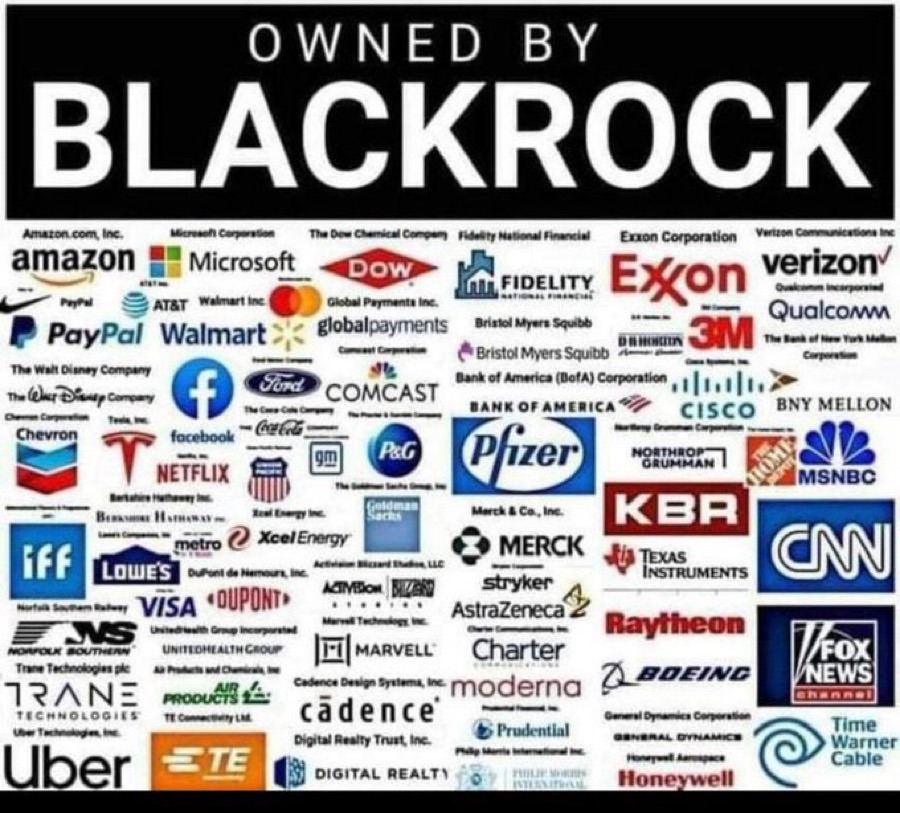
For instance, large banks like Wells Fargo have Vanguard, the investment firm, owning about 8% of their stock, BlackRock owns 7.9%, and State Street owns 4.1%.  Add them all up, and those huge progressive investment firms control a significant number of banks like that. We have seen very aggressive, woke policies embed themselves into those banking practices.  BlackRock isn’t shy about it; they are very aggressive about progressive politics, and when they own more shares of stock than the average 401K investor, they control the essential direction of the company, who they hire, and how they conduct themselves.  And it is that kind of menace that has essentially destroyed Disney as a company.  And they are doing the same to all large companies.  For instance, GE Aerospace has a nearly identical stock management portfolio, with Vanguard at 8.7%, BlackRock at 7.8%, and State Street at 4.2%.  See a pattern?  That translates to Vanguard controlling $27.4 billion, BlackRock $24.6 billion, and State Street at $13.2 billion.  Where did those investment firms get all that money to be able to buy up all that stock, and control that much of so many huge companies and banks, and to set policies of woke politics to steer them all in anti-American ways?  For Disney, it’s the same formula: Vanguard at $16.7 billion, BlackRock at $13.2 billion, and State Street at $8.2 billion.  Among the three, the same pattern emerges, and from there, power and control flow into every aspect of the industry.  The purpose of their enterprise was to control the means of production as Karl Marx envisioned it, and the method of achieving this was to be publicly traded. 

The crime of the century essentially started with the 2008 banking crisis, where the Fed began buying up a lot of bad debt. Through quantitative easing, the printing of money, they infused it into Wall Street, allowing people like Larry Fink to clean it up by buying up large companies.  To sustain the perception of value, they would clean up their portfolio by acquiring other companies and integrating them, attempting to conceal the inflationary trend of printed money that would lose its value on the open market.  It might look good on paper for everyone’s 401K plans, but what was lost as they imposed themselves on their conquered assets was the companies themselves.  This has become grotesquely obvious at Disney, where the public has rejected the new money-driven company in favor of Uncle Walt, who represented Main Street USA.  That vision was attacked by these big globalist bankers and investors who had the same motivations of invasion as any tyrant the world has ever seen.  However, the form of battle remains the same.  For those big companies mentioned, the conquered management hires people who facilitate the invading culture. Because of the nature of people to appease the powerful, they don’t question their reality so long as they can get a paycheck.  Who controls the paycheck, then controls the individual people.  But how did Vanguard, BlackRock, and State Street get all that money?  Because they printed it by gaining control of governments, such as the United States, through the Federal Reserve.  Whoever controls the money supply can theoretically control the world, on paper. 

I’ve been dealing with this kind of thing very up close and personal myself, and I’ve had to explain it to many hundreds of people over these last several weeks.  And most people don’t understand it because the invasion is happening on a vast scale that is even bigger than the management at those investment firms.  Larry Fink is aware of what he’s doing, to a point.  But it’s even bigger than him.  However, it’s no surprise that a giant video game developer would want to step off the publicly traded treadmill and seek to go private, where it can have better control over its management.  EA has been successful for a long time, but it’s challenging for a company to maintain its momentum once it matures, showcasing flashy PowerPoints and spreadsheets that demonstrate the kind of profit that keeps investors engaged.  And the big firms and their radical leftist politics need that cover of publicly traded companies to hide their influence over all these big firms.  So, it’s no surprise, especially now that the trend is emerging to see huge companies like Electronic Arts stepping away from the publicly traded scam.  This all became very clear to me as I watched an enormous bank do some really dumb things that made absolutely no fiduciary sense, but in the context of conquest as outlined by those top three investment firms and their global objectives.  It’s not the value of the companies themselves that they are after, but the need to hide their efforts behind real manufacturing that has not yet become encumbered by woke politics, and can still produce tangible goods.  Because those large firms are dealing with fake money printed by an out-of-control Federal Reserve, the value of the money means nothing to them.  But what that phony money can buy under the assumption of publicly traded companies does give them power that nobody else without that kind of access to the money supply can fight off.  At least for now, until more and more companies do as Electronic Arts is doing, and that is to step back into private ownership so that they can hedge away the influence of the liberal monsters of Wall Street, these practices will be a danger to any economy.

Rich Hoffman

Click Here to Protect Yourself with Second Call Defense https://www.secondcalldefense.org/?affiliate=20707
The Government Robbery of 1933: Removing the gold standard was always a mistake

It’s always been about who controls the money, and in 1913, when the Fed convinced a group of starry-eyed congresspeople to relinquish their Article I, Section 8 powers to coin money to a group of bankers to manage the money, they made a significant mistake.  And, of course, we are discussing this now as we contemplate why Jerome Powell, the current head of the Federal Reserve, has interest rates so high and is artificially holding back the flow of money to the public.  Should or could President Trump fire him?  And why is there a claim of independence that Janet Yellen asserts is necessary for the Fed to function correctly?  She used to be the chairman, as Jerome Powell is now, and she was the economic lady for Biden’s administration.  She is also a prominent member of the World Economic Forum, placing her at the heart of this modern discussion.  The answer to all this Fed talk is that, of course, Trump should and could fire Powell.  Because Powell has not performed well, now that Trump has created an environment where the economy is moving along nicely, the excuses that the Fed hides typically behind to control the levers of power over the money supply have been taken away.  The only people making money from the Fed’s system are the banks, whose interest rates are holding back economic growth.  And of course, the banks don’t want to give up that easy money.  So, for his sabotage of the current economy, Trump should fire him.  The Fed’s mess in 1913 was a mistake, and it’s time to admit it.  Because what happened 20 years later with FDR in the White House would well cross the line toward poor money management, which is a crime that still looms.  And we have to correct it. 

If we had our money connected to a gold standard, BlackRock would not own all these properties

On April 5, 1933, President Franklin D. Roosevelt signed Executive Order 6102, which required U.S. citizens to surrender most of their gold bullion, coins, and certificates to the government by May of that same year, in exchange for $20.67 per troy ounce.  This was just as bad as a buy-back program for something like personal firearms.  The reason for the order was to unleash money into the supply that people were hoarding and let the government manage the depression.  However, looking back on history, the Great Depression was caused by excessive government intervention, which exacerbated the problem it was trying to fix by taking people’s ownership of gold and unleashing it into the economy, thereby loosening things up.  Now, this was the Red Decade, when communist ideas were being experimented with, following the Roaring Twenties, which had a lot of open capitalism.  Communist movements were widespread, and they certainly infiltrated Roosevelt’s administration.  But how could this arrangement work, where the Fed was given everyone’s personal gold reserves, and where did they get the money to buy it?  Well, they printed the money, just as they did after the 2008 crisis, and gave that money to Larry Fink to essentially buy up bad loans with quantitative easing.  In the case of 1933, they were able to make some money off the deal and profit from the exchange.  But the Fed got the money by essentially printing it.  And it was this critical step that would take America off the gold standard by 1971.  After that, gold would become a commodity with no inherent value.  The goal of the Fed was to remove the stabilizing grounding gold provided to the economy, where people were regulating that value off a common exchange.  Instead, the government sought to empower centralized bankers with the ability to micromanage the economy, decisively removing the process from any free market consideration —a move that was distinctly communist and remains a mistake we are still dealing with to this day. 

By removing America from the gold standard, the Fed gained significant centralized power that it had previously been unable to achieve. This power was acquired after the Fed confiscated people’s wealth and issued banknotes that would, from then on, have a value adjusted by the Fed’s actions.  This was to protect the global international bankers, who have long sought to rule the world from the shadows.  And they are still a serious menace to this very day.  This is essentially what opened the door to Modern Monetary Theory and enabled individuals like Larry Fink to accumulate significant power at BlackRock.  The money managers who laundered the money through Wall Street were able to take all that printed money and buy up bad debt, thereby gaining control of the boards of numerous United States companies.   And Larry Fink is a bleeding heart liberal, otherwise known as a communist.  The original crime was the creation of the Fed in 1913, but the robbery took place in 1933 when the Fed, under FDR, took everyone’s private gold and replaced it with a monetary system that would fluctuate over time at an inflation rate of at least 2.5% per year.  So, doing nothing with that original $20.67, it would take $513.46 today to buy just as much.  But if grandpa had given you that much in gold, the value would still be relatively the same.  Taking away the gold standard meant that if Grandpa gave us $20.67 in 1933, and you wanted to buy something, it would now cost you $513.46 to buy the same thing. 

Deep in the heart of many things that members of the Federal Reserve believe is that employers are reluctant to reduce the wages of their employees over time.  They may receive raises, but in terms of real buying power, the Fed believes that it must step in to offset the value of increasing paychecks due to employer reluctance.  So long as they control the value of money, they can micromanage all factors of our economy in ways that are not driven by market value.  In the case of pay, which we all experience, we might make an average of 2% increases over our lifetime, but the Fed is using purposeful inflation to take that value away as we age giving our buying power much less with the same dollars because they believe that actual productivity goes down as we age, so we should not continue to get more money for doing less work.  That kind of thinking would only come out of the Red Decade.  And it has now caused a lot of significant problems that we need to address under this new Trump administration.  And Jerome Powell is going to have to go.  Reluctantly, but critically, he will have to lower Fed interest rates in September and maintain them through up to Christmas in 2025, because the pressure will be too great.  Trump’s economy is forcing everyone to come clean, and people are figuring out how the game has been played against them.  We can’t have foreign centralized bankers controlling our money supply through our Federal Reserve.  And the Fed can’t be independent of representative management.  They have been openly robbing our money supply, and it’s time for all that to stop.  The 1933 confiscation of personal ownership of gold was a form of open government theft, and it should never have happened because it empowered centralized bankers to gain control over the dollar and use it to access power. Today, banks have way too much power.  And we have to take it away from them by force.  Because they won’t give that power back now, they will have to be made to.  But we have no choice. 

Rich Hoffman

Click Here to Protect Yourself with Second Call Defense https://www.secondcalldefense.org/?affiliate=20707
The Danger of Big Banks to American Infrastructure: Why gold is the color of freedom

Over the last two months, I have spoken to a collection of the most intelligent people on planet earth, internationally, including senators, representatives, bankers, lawyers, engineers, former Fed members, supreme court judges, governors, CEOs, and top investors, trying to solve a big problem that is a major infrastructure problem in America.  That is the need for banking reform, and all things considered, regarding how we measure and distribute money as a free country.  The problem, as it has been presented, arises when a huge American bank, tied to various global standards, purposely attempts to remove private, relational ownership from its portfolio, using every trick in the book to convert the business into the open market.  As a large bank with international ties to central banks, big banks have become increasingly aware of their role and are acting in a parasitic manner toward American private ownership of industry, pushing them into conglomerations.  The problem with the situation I am involved in is that the company is an aerospace manufacturer with direct connections to a lot of important work that is critical to American infrastructure. These banking policies, unveiled during the COVID-19 crisis, pose a direct threat to American security.  It’s the same kind of radical ideas that central planners had when they thought they could use COVID to change human behavior, how we work, how we conduct recreation, and how we manage economies.  Taking the example of the Fed, it stops the economy, then prints fake money through quantitative easing to saturate the market with economic losses and hide inflation with phony interest rates.  And for banks to survive, they must use the chaos to undermine the concept of private ownership in America and fulfill one of Karl Marx’s key objectives: the state acquisition of the means of production.  And when we talk about the state, we’re not talking about elected governments, but banks that consider themselves the secret rulers of the world because nobody understands money the way they do. 

All this came to a dramatic head as we considered the recent executive order from President Trump on bank reform, which has raised concerns about the potential for demonetizing individuals and companies based on their political ideology.  Banks should never have had that kind of power, but they have become very radical.  I know of a few good bankers who have not fallen into this dark place, but most of them are playing the game to win from their perspective, and that entails destroying private ownership in America toward the global goals of socialists around the world and managed economies where financial institutions are really in charge of everything that happens.  We can elect representatives to build roads and figure out if there should be a death penalty for serious crimes.  However, when it comes to financial matters, financial institutions often view themselves as the rulers of the world, and if you want to play along, you have to buy into the woke agenda they present.  Trump’s executive order was a sign that things could improve and that he was taking steps in that direction, which was a positive development.  But the situation is much worse than just that woke banking policy.  A much bigger can of worms was being exposed, and the Fed is a big part of that problem.  Many people have attempted to reform the Fed over the years, but the issue has been detaching gold from our issued money and relying on centralized planning to cover the real costs.  And central planning doesn’t work, anywhere.  We essentially have communist ideas, the same ideas that collapsed the Soviet Union, running our central banks, our Federal Reserve, and our financial flow for all American businesses. 

People criticize Trump’s love of gold.  But I love how he has decorated the Oval Office, and over the years, Trump’s love of gold is more than an appreciation for an interesting color.  Gold represents freedom because, when measured in terms of money, it decouples individuals from the speculative tendencies of money managers.  And they make a killing off the chaos of money creation and its distribution.  So, of course, they don’t want to see any reforms to the industry because it’s a rigged system that benefits them.  Meanwhile, people are chained to the administrative bureaucracy that flows down to us through centralized banking.  In the case I brought up after speaking with all those brilliant people, most of whom have advanced degrees, the cost of regulation prevents big banks from dealing with small companies, so they prefer public ownership simply because it allows them to shoulder their responsibility to the customer.  However, that situation didn’t happen by accident; it was purposeful in the policy-making process to impose those kinds of restrictions on our economy. This has really only been exploited once all the other masks have been removed, revealing all the bad behavior that had been hiding in plain sight all along.  Trump’s love of gold is a love of the freedom that comes with attaching money to a precious metal, as it shields against interpretations of tyranny that allow money manipulators to alter values and acquire power over others.  Such as what BlackRock and other large money managers have done, which is work directly with the Fed to print a lot of fake money and wash that money through the system by buying up real companies and controlling their boards and CEOs with radical leftist policies.  That money came from printed money controlled by central banks, which gave them power over individual businesses and aligned with the communist goal of maintaining control over the means of production.  

If you are very savvy, you can survive in this hostile banking environment, and that will undoubtedly be the case with the situation I have been involved in.  However, what has been alarming is that this is a common practice, and it is no wonder that private ownership is becoming increasingly rare across the country, as it struggles to survive these open hostilities, which Trump’s executive order only begins to address, albeit just the tip of the spear.  The truth is that we need very aggressive banking reform if we want to run a free country.  And we can’t allow international centralized banking, to which all American banks are tied, to control our governments and our lives by managing our money.  Trump’s love of gold is more of a love of freedom attached to a stable value that piratical financiers and money manipulators cannot openly rob people of their political targets just because they can, and they can write the rules that everyone else has to follow.  And if we ever wondered about the intent of these aggressive financial administrators, remember how they all acted during Covid, for which the world has not yet recovered.  They fully intend to control the lives of the people who need money.  And they have the ability, through the Fed, to print as much as they want and distribute it to whomever they wish to, thereby gaining control over entire markets.  And suppose they don’t like American manufacturing returning to North America. In that case, they will find ways to prevent funding that growth, thereby halting the positive economic activity that Trump is trying to restore to our nation.  Only the big banks can fund many of these endeavors, and they are attached to international wokeness, decoupled from the gold standard, and they can make up the rules as they go to gain control over entire markets.  It’s a huge problem that requires serious reform.  And it’s a problem that everyone is aware of, but considers too significant to address at present.  And in the process of fixing it, they don’t want a target painted on their back for fear they might become the next victim.  And that’s not how a country should run under any condition.

Rich Hoffman

Click Here to Protect Yourself with Second Call Defense https://www.secondcalldefense.org/?affiliate=20707

The Global Mafia Rule of The Octagon Group: “He who owns the gold, rules”

I think you’ll find that most people associated with group activity are drawn to the safety blanket of such community affiliation out of their insecurities.  For instance, one of the most influential people in the world and a financial powerhouse in America was J.P. Morgan Sr., a womanizer, a believer in astrology, and a passionate collector of art.  He was also very insecure about how big his nose was.  Many early bankers, such as Morgan, were socialists who were much more attracted to limited competition because it made their lives much easier than the chaos of the free market.  Much discussion about his professional and public life has been discussed because of who he is, but what he believes gets much less attention than how we have learned to report details of people’s lives.  Because we don’t want to be exposed ourselves, as reporters, we don’t often ask all the detailed questions.  But it was common among such people, the most powerful and influential in the world, to have deep personal insecurities that they hid behind various group affiliations.  So when you hear that these kinds of people, whether it’s the Morgans, the Rothschilds, or the Vanderbilts, pick your big family of strong influence, you’ll see some common traits that sound more like mafia bosses than normal church-going patrons on a Sunday afternoon. They find themselves in secret societies not because what they do is all that secret but because they wish to conceal a power they get from group affiliation from a general public they wish to rule over, to mask their insecurities.  They want to be elite compared to the ordinary person to provide that illusion to themselves through classic group consensus.  This is why I have said that the organized crime mobs moved from the power that the sudden invention of mass communication and transportation gave them and migrated into government.  Because that’s where the power was.  For instance, in Morgan’s case, or any of them thinking of starting a Federal Reserve in 1910, their primary interest was using the government to cover loans they made to various countries.  How else could they recover funds owed to them but take over the government and use that power to collect when people, or other countries, stiffed them? 

In many ways, we have all assumed that everyone in the world played by and respected our Constitutional rules in America.  However, from the point of view of the globalist power broker who is deeply involved in international business, the rules were for thee, but not for me, as a general social position.  To swallow that pill, they would belong to various groups, such as Masons, and seek protection from the spirit world in secret societies, which is how membership into the largest and most secretive came to be for some and why it’s still a problem today, which hides a lot of organized crime.  And that is essentially how and why there is a group called the Octagon Group, which makes up an ultra-secret globalist network based out of Switzerland and comprises influential Catholic and Jewish families whose lineage traces back to the Egyptian Pharaohs.  It is the wealthiest, most deadly, and most technologically advanced mafia in the world, which umbrellas hundreds of other organizations and has the shape of an 8-sided logo as a symbol.  For instance, one of the most public expressions of their power is the Dome of the Rock at Solomon’s Temple in Jerusalem.  The conflict there between Islam, the Christians, and the Jews is an artificial construct meant to control public sentiment and keep political tensions from allowing the public at large to get too close to their actual clandestine actions.  It’s a turf war essentially between the global mafia and ordinary people who will enable themselves to be divided into various religious factions controlled by these personalities.

It’s not like membership in this club has a charter and a chain of command that the public would understand.  Most of the membership happens by default rather than a conscious decision.  But when we talk about the Knights of Malta, the Khazarian Mafia, the Nazis, the World Economic Forum, the Jesuits, the Masons, the Black Nobility, the Vatican, the Rothschilds, the Morgans, the British Empire, the Black Pope, even the Roman Empire as it was created and implemented, then studied over the years, it all traces back to this membership of the Octagon Group. Around the world, the eight sides of their logo represent the eight main cities of their control, such as Rome, Jerusalem, Washington D.C., Munich, London, Zurich, Geneva, and Bern.  Notice the names of cities not on this list, such as Beijing, Delhi, Tokyo, or even Moscow.  When you pull away all the curtains as to how mob mentality has ruled the world, most of it traces back to this international mob of the Octagon Group operating out of these eight primary cities and using the mask of traditional governments as their personal collection agencies to be the heavies of their international funding operations.  To play the game, you have to be a member.   Otherwise, they use the power of governments they control to destroy all challengers.  The members join out of self-interest to rule the world from the shadows.  But they aren’t any better than anybody else.  They are prone to acquire power and money and protect their gains through globalist affiliations under the umbrella of the Octagon Group.  And before you say such a thing is crazy, remember, there is a giant obelisk from ancient Egypt in the middle of America’s capital, hiding in plain sight.  It’s hardly a conspiracy theory; it’s right out in the open. 

People not so obsessed with power and control, which under any other conditions would be considered a mental illness, generally want to live their lives, do what they need to to make a living, and can live and let live when it comes to other people.  But the members of these massive globalist mobs who have grown over time to control the entire finance industry and used the power of government to collect on debts owed to them generally have a few screws loose that don’t get analyzed commonly because the scrutiny would come from the same people seeking jobs and employment.  So, people typically look the other way, hoping that they might profit from the discretion.  That’s how such groups have gained power over society in general, which they don’t deserve to have.  It’s also why they believe they don’t have to obey any laws in America and that they function above and beyond governments. Technically, they view the government as their direct employees, not public representatives.  The public serves them as elite members of society, as do the governments they pick for their representation.  Until recently, these members of the Octagon Group hid their behavior behind the typical ring knockers of the military, who believe in rigid social constructs in society that are not merit-based but built to support social mechanisms rooted in aristocratic rule.  They don’t respect American independence from this structure.  They used American independence to topple kingdoms in Europe for their own needs of control.  But never forget, “he who owns the gold rules.”  And if you don’t control the gold, you don’t rule.  Whoever controls the monetary policy of a society is the ruler of that society, and this collection of various social mobs under the Octagon Group are the characters behind globalism.  They expected the governments to dance at their feet, as was the case, starting with Grover Cleveland in America and migrating through the Roosevelt, Taft, and then Wilson administrations.  After that, they were all too deeply embedded to stop traditionally.  The governments of the world became the captured assets we see today and are being smoked out by populism.  But their expectations to maintain their authority are pretty audacious.  They picked their guy in Biden because he was an excellent stooge for their movement.  But it’s coming unraveled as we speak, and panic is deep in their ranks on a global scale.  And it couldn’t happen to a better group of people and their mafia of discontent.  They have been controlling the money of the world.  But they are losing control now, and justifiably so.  If you want to end their rule, get control of your money management.  Otherwise, these destructive secret societies will continue to rule without any challenges to their authority.

Rich Hoffman

Click Here to Protect Yourself with Second Call Defense https://www.secondcalldefense.org/?affiliate=20707
‘Unrestricted Warfare’: What’s really going on and how America’s destruction is the goal of the world

One thing we have to admit to ourselves, as Americans, is that our government does not represent us and is acting as a rogue agent in the world, creating hostilities for a New World Order, which is not in our best interest. The role our military has in the world and how our diplomatic relations have transpired are not American, as much as they serve the Desecrators of Davos. The proof is seeing America the way other countries do, specifically the Chinese. By reading the book by the People’s Liberation Army Documents titled ‘Unrestricted Warfare’ published in 1999 and based on the world at that time, it’s clear that China is at war with America. Its also clear that other countries such as Russia, Iran, and many South American and Central American countries are also at war with the United States. But they are not stupid; they all acknowledge that America is the king in technological warfare. They dare not to attack us in conventional ways and likely never will in the future. Instead, they acknowledge different methods of war that they are aggressively applying against us to eradicate us, all of which are discussed in that book. It was an assessment essentially of American performance after the Gulf War when it was written. America led a coalition of nations to fight Saddam Hussain over his aggressions in Kuwait over the protection of oil flow worldwide. Knowing what we do know about Ukraine and Russia, along with the strategic aims to create a kind of sequel to the United Nations approach to global warfare, for which the United States leads and funds, the game is obvious. It’s just too painful to admit to ourselves that we have a separation between the intentions of our government and the needs of the people of our country who desire a much different future. We are not one nation under God. We are a nation split between the Constitution of our tradition and the Desecrators of Davos who control our government against our will.

What’s worse, especially in reading Unrestricted Warfare, is that the people of America conceptually understand what needs to be done. We elected Donald Trump twice to deal with the war that is applied to us and pull back from the mob-like attitude of world-building. We get all the blame only to run cover for the globalists who want a one-world government at the expense of American sovereignty. When we tried to elect Trump again in 2020, they simply took the vote away from us. That’s the real power of a media culture with six companies who control 90% of everything we see, read and hear. In 1983 just a few years ahead of the Gulf War that was the subject of study in Unrestricted Warfare, 50 media companies dominated the media landscape. Today, only six control everything, Comcast, Disney, AT&T, Sony, Fox, and Paramount Global (formally known as ViacomCBS). We have witnessed over the last few years how much those companies are controlled by the prominent money management firms, such as BlackRock, Blackstone, State Street, and Vanguard, and are using the Desecrators of Davos measures of ESG scores to change politics completely, without any voters, or choice in the matter in how the world behaves. Of course, behind this aggression is the American military that those globalist types have used to impose their will on the world and pave the way for this massive takeover of every sovereign country. America used to be the bad cop that the Desecrators of Davos used for their global takeover. Now, because crushing the dollar is very much a modern strategic objective and the military might of the United States is no longer needed for the kind of wars we fight these days, China is the new bad guy on the world stage propped up by those same money management firms, and America is being kicked to the curb. 

The world knew not to attack America directly, but they have not been shy about their intentions to destroy us. It’s all spelled out quite clearly from the turn of the century mindset of the Chinese in Unrestricted Warfare. I picked it up to read because Steve Bannon from the WarRoom podcast spoke highly of it, and for a good reason. We tend not to get the perspective of how other countries see us because, over the last few decades, trillions of dollars in consolidations narrowed all those 1983 options down to just the six we have today. The kiss of death started in 1996 when Bill Clinton opened the door with his Telecommunications Act, which allowed large corporations already dominating the media market to further expand their control through acquisitions and mergers. By 2017 the FCC reversed a regulation that opened the floodgates on those consolidations even further. That is the warfare being applied to America, which the Chinese were quite aware of all along. Because Americans see the war through technology and might, the war that has been used against the United States has been to expose our vulnerability and attack us through our leisure, through open borders and the illegal drug trade and the absolute poisoning of our culture by any means necessary. A couple of things that really jumped out at me in Unrestricted Warfare was their identification of George Soros as a threat to the world through financial warfare, which is something to say two decades ago. Why he has been allowed to conduct his personal war against the world’s nations for all this time is astonishing. And we’ve allowed him to run his warlike affairs unmolested within the United States, which is an obvious problem. The other thing that the Chinese acknowledged was happening but has been a serious conspiracy theory in the United States has been the use of climate weapons, such as DARPA is rumored to have, where the weather can be manipulated, earthquakes created. Hurricanes stirred up to bring havoc and chaos to targets worldwide ripe for government overthrow in the aftermath. 

The main thing you learn from Unrestricted Warfare is the illusion of peace that America has been lured into believing. Hence, they continue to play along, fund all these global projects, and walk themselves to the slaughterhouse that the Desecrators of Davos have built just for them once they are done with the measly 300 million people who live in America. War in full-scale world domination has been at play for many years, and America has been used and abused in the process. We mindlessly salute our military based on wars won long ago. But our head of the snake has been captured by investments and motives from outside our country, who hide behind finance, and are working the world at war with each other, whether it be Iran, Russia, Ukraine, or China, so they can do as they have been doing to American media companies and corporations, to unite them all under just a few primary companies that were easily controlled by the liberal money management firms backdooring American politics with the strategic goals of an enemy that doesn’t even have a nation to call their own. Through the new kind of war that we are seeing right now, they are intent on our destruction in America, and we see it playing out on every front. All was not well, and when we tried to correct that situation, we were punished. They stole Trump; they put us all on vaccine mandates by using a virus they manufactured as a bioweapon of war, killing many people in the process and causing at least a million vaccine injuries to which the pharma companies have no liability to rectify. And we have been acting like all was OK in the world, that the worst thing was to accidentally call a woman a man who suddenly woke up one day and wanted to play in a woman’s sport because they couldn’t compete in the men’s category. When you read Unrestricted Warfare by two military minds of the Chinese People’s Liberation Army, you get an idea of the war that we have been fighting all along and the intention for our destruction the world wishes upon us with every effort that they can muster. 

Rich Hoffman

Click to buy The Gunfighter’s Guide to Business