

Want to Know Why We Aren’t Using Ivermectin to Treat Covid: Read Ayn Rand’s ‘Anthem’ to understand

More so than before Trump was in office, Ayn Rand’s work has absolute power in identifying who the enemy of our modern times is and what can be done to defeat them. Before Trump, there were many considerations, and nobody really knew whether or not the American Constitution would hold up under the Obama presidency. But now we know it will. Trump was a good, Constitutional president, and he showed the world just how powerful America could be if it followed its Constitution. It took him essentially just a few years, even under great fire, to fix many things that had been long paralyzing our country from the countless attacks that came from those unnamed enemies over the last century. Even with all their efforts, America could snap back into good effect quickly, and that is what we learned with Trump, historically. So now that we have seen the Constitution tested authentically, we can now turn our attention to the enemies and understand them and their motives so we can eradicate them from our lives. And to do that, I can’t think of a better writer, or creative person, in all human history that has put their hand on who that enemy to humanity is than Ayn Rand. Ayn Rand is the Holy Water to evil in the world. They hate her, and for great reason. But she is very much a product of American culture. Specifically, under this current Biden administration, the most significant authority of what is wrong with the kind of people who want to end America. And of all her works, I would say that her book Anthem, from 1938, is the best at showing who those enemies are and what they want to drive us all to, and I’d recommend everyone to read it now.

I read many books; it’s one of my favorite things to do. I’ve read Brave New World, Animal Farm,and 1984. I’ve spoken a lot about the novel by Edward Bellamy, Looking Backward from 1888, which projected a socialist utopia across the world. These are all dystopian novels that many consider irrefutable classics in literature, and they have gone to a great measure to shape our modern world and our opinions about authority and government. But a better and more hopeful dystopian novel has never been written than Ayn Rand’s Anthem. I’ve read all her books many times, and I don’t think there is a better novel of this type out there. Anthem isn’t very long; you can easily read it in an afternoon. But its scope and story are undoubtedly influential and insightful. As a Russian immigrant who suffered greatly under communism and retreated to America for a safe haven, Ayn Rand took her unique perspective and passion and translated it into this magnificent masterpiece. And even though at this point it is nearly 100 years old, it is as relevant today as it was then, perhaps more so. I tend to think that everyone knows these books until I hear the constant complaints by many regarding Covid protocols and the lack of use of Hydroxychloroquine and Ivermectin to treat the virus, and I say to them, “didn’t you read Anthem? That’s what the whole book was about?” Of course, the look I get back is mystification. “What’s Anthem?”

Essentially the point of the book is that a future society has regressed along the Vico Cycle back to a theocratic society that has retreated to a time before technological invention. A village council of wise people called the Council of Candlemakers spent 50 years inventing and getting it approved, the great new technology of making candles. The lead character, who has never known anything about the world like the rest of society, but social collectivism, doesn’t even have an understanding of the word “I” or “me.” Yet through a series of accidents, he discovers a lightbulb deep in a tunnel that has been hidden from the world hundreds of years in the past, perhaps even thousands. And upon discovering the light bulb (again), he takes it to the Council of Candlemakers, expecting them to be thankful. But what he finds instead are a bunch of threatened people who have spent their whole life inventing the candle and sharing it with the world. The lightbulb would destroy their power and prestige in their community which has far more power to them than the convenience of using lightbulbs over candles in that particular society. Many before Covid came along couldn’t understand such a reference. But now, they have seen it firsthand. Ivermectin is that modern lightbulb that the health authority class is threatened by. They want power and control, not a solution to Covid, and there you have it; we have the evidence of the villains in Anthem, except clearly now in real life in a way that people can understand. 

The book, as I said, is very easy to read. It’s short. But to make things even easier for new readers, or even old readers of Ayn Rand, The Atlas Society back in 2018 turned Anthem into a graphic novel, which was then turned into a series of videos that were easy to watch. Eighteen episodes will take viewers through the entire book. When The Atlas Society did this work, Trump was in the White House, so I guess the effort went unnoticed. People had an Ayn Rand character in the White House, and people dropped off interest a bit because of it in this kind of reading material. Ayn Rand was very popular during the Obama presidency. Now that Biden is in the White House, which continues that “enemy” of America perspective, Ayn Rand is making a comeback. I have had so many people talking to me about Ayn Rand and wanting to know more about her that I decided to do this to make it easier for people to get easy access to all her great works. The difference between now and the past obviously is that Constitutional element. In Ayn Rand’s day, she saw only a gradual erosion until the world would literally be destroyed in the way it was in Anthem. But a hundred years later, the American Constitution is still intact and is working. Of late, the Biden Vaccine mandates have been slapped down by the Supreme Court in a healthy way, so we have survived a lot of trouble since Anthem was written. But understanding the motives of the bad guys is another matter. They are still doing their work, and we now must know what they are after and stop them in the tracks. For that, Anthem will help a lot.

The villains of Ayn Rand’s novels are very much a real thing; we see them every one, in our communities, our national governments, our businesses, and even our families. It can be hard to see them because of the emotion that comes with our relationships with them that can cause us not to want to know the truth. Yet the truth is the truth, and if we really want to solve our modern problems, we must not turn away from it. Literature is a great refuge to get our thoughts together and to seek solutions, and to do that; you must know how to identify the problem. Nobody but Ayn Rand was better at articulating that problem, and Anthem is a masterwork of hers that everyone should read. And to make it as easy as possible, the graphic novel videos are fantastic introductions to her work or tenacious reminders of its relevancy. Yet whatever the case, Anthem is the only way to understand Covid-19 because all other reasons for rationality fall short otherwise.

Rich Hoffman
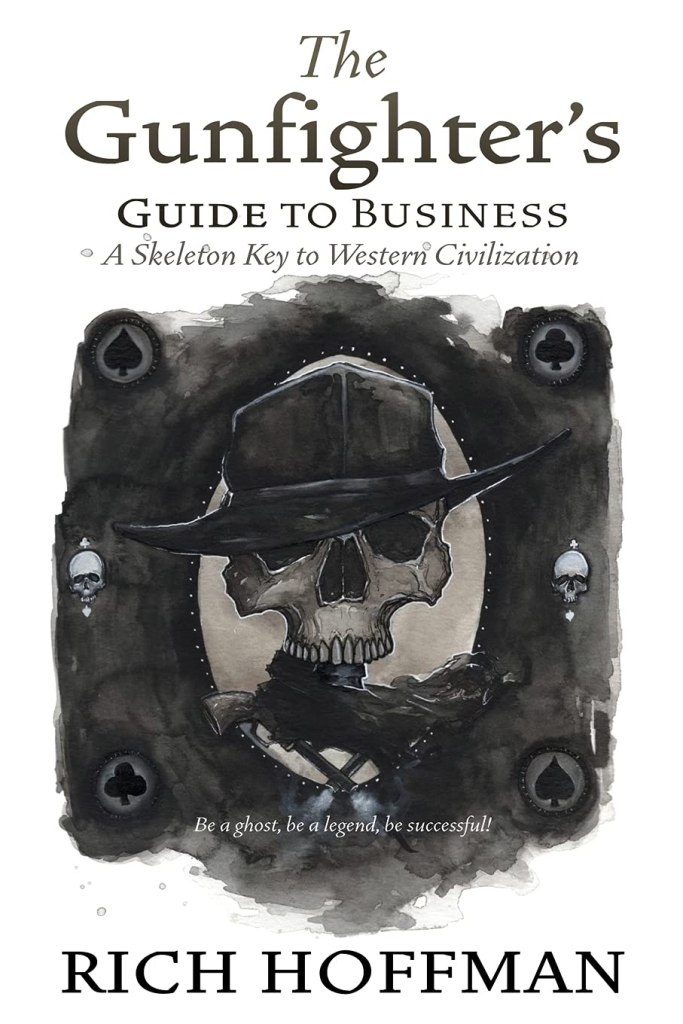
Click to buy The Gunfighter’s Guide to Business

Yes, there was Life on Mars: Relearning our own ancinet past and meeting our future with honesty

As sure as you are reading this, I am quite sure that there was life on Mars and that at least at a microbial level, there may still be. When the question of as to whether there is life on other planets comes up I view such a proposal as absolutely preposterous—of course there was. Life on Mars is not at all farfetched, the big difference with it is that it supersedes the timeline that we accept on earth as a history of understanding. Entire civilizations could have risen and fallen in the hundreds of millions of years before the relatively recent period on earth that we might call loosely the days of the dinosaurs. I am reading a very good book right now by Peter Frankopan called The Silk Roads: A New History of the World which puts a focus on our own world history around the Caspian Sea region just over the last 1000 years or so and a lot of things change as to our own historical perspective if looked at in such a way. Take the center of focus of human civilization from a study point of view away from London and suddenly many things look different. I have for instance written many articles talking about how the orient settled North America much sooner than anyone previously has thought, and how trade around the world occurred even back in time to the period of the Phoenicians. It is surprising how many people have trouble with just these very easy understandings of history, so they just aren’t intellectually prepared to deal with the fact that many human beings on earth are likely descendants of Martians, and that by the time that planet had lost its atmosphere and water, life there that could, found a way to reestablish themselves on earth for their basic survival, just as we today are looking for options among the stars for our next phases, if we can survive the present one.

Announced this week in a story that would have been the biggest news on planet earth a few years ago, NASA’s Curiosity rover was reported to have uncovered signatures of an environment on the red planet that may once have been habitable. In two separate studies on data collected by the Mars rover over the last few years, scientists have identified an abundant source of organic matter in the ancient soil of a long dried up lake bed and traced some of the planet’s atmospheric methane to its roots. The findings could help to guide the search for ancient microbial life and improve our understanding of seasonal processes on Mars which indicate that there may be some forms of life still functioning there. I am quite sure that once mankind starts settling on Mars during the upcoming 2020s that we will find all types of archaeology on that red planet that really for us will be like coming home. Its been a long time, but I think innately we all understand that our roots on earth started in the stars, not that we are now going to them for the first time.

It’s not just the scientific proof that is now emerging that points toward this conclusion, but its two books from our human culture that has basically captured how this can happen which I’d advise everyone to read. The first is Finnegan’s Wake, within that great novel is the keys to all known human history—centered from the European perspective—and articulates how the human race continues to reinvent itself over and over again through birth and death leaving the original history difficult to trace due to poor philosophies of mankind constantly destroying all our progress only to rise again somewhere else in the world over and over again perpetually. It doesn’t take long to realize that great societies long forgotten in our history books are probably on the bottom of the Pacific Ocean, or under the English Channel, lost under the Persian Gulf and many other places as the ocean levels were much shallower tens of thousands of years ago, even hundreds of millions of years ago. Big cities like New York and Tokyo of course would have been along coastal waters in those ancient times and those locations are now under water making archaeology difficult to study if not impossible, because anything older than 10,000 years old would be by now virtually erased due to erosion and other forms of degradation.

The second book is by Ayn Rand which doesn’t get much attention where it should, and that is her little book called Anthem. In that novelette mankind has recently just discovered the light bulb—set well into the future. Obviously, that is hard for us all to comprehend, after all we are preparing to recolonize Mars, and we enjoy a technological society with the internet and Amazon.com delivering packages from all over the world to our doorsteps. But over the many years we find that the human need to blanket their minds with religion and superstition clouds their observations of reality—such as building an epistemological belief system in America that slavery and the abuse of the Indian are political concerns specific to the foundation of the greatest capitalist country on earth—if successful it would be possible to erase all the history of the United States from any record and to reinterpret everything through the lens of whatever political order arrives to replace it—which is a process that was well on its way to occurring before Donald Trump became president. But barring similar dynamic circumstances it is evident that all through human history this is precisely how events have unfolded, meaning that the inventions born from humanity may have occurred over and over again out of necessity only to be wiped out by political decadence and a yearning to always start over. A society might be said to be successful if it can stave off this trend for a few thousand years, but it is unrealistic to assume that it can do so over millions of years, which is the primary reason that we as human beings think that our history began only 12 thousand years ago with the stone monuments of Egypt, or Gobekli Tepe. There are even people functioning today especially in the Appalachia culture from the American south who believe that all of the history of the world is only a few thousand biblical years old—according to the latest religion of Christianity.

It’s easy to see how this could happen, most of us can relate to some circumstance where we may have a cheating spouse, and we chose not to see it because it’s too painful to deal with, or we may have bad parents which we fail to see their faults because it makes looking in the mirror much more difficult—when we do this on a much larger scale as nations it makes the analysis of history much more difficult to resurrect. I can say personally I find the history of England very fascinating, and they have fabulous programs on archaeology, but their national history sort of begins and ends after William the Conquer arrived on the scene and shaped their national identity. The current communist government of China is completely ignoring their own ancient past as they don’t want their people to have reverence for what came before, but rather what is before them now. Africa has some wonderful treasures from the past, but uncovering it is impossible as Marxist strife has enveloped the entire continent—and we all know the history of the Middle East today, what was obviously a cradle of civilization is locked behind a struggle of Islam versus Christianity.

Those are our struggles on earth, so it’s not hard to understand how we have managed to bury our own past with the planet Mars which likely took place before there were ever dinosaurs on earth, or after—or both. There could have been travel between there and here for many thousands of years until Mars was uninhabitable, then some stayed on earth while others headed for elsewhere. The evidence of such feats is in our own mythologies, which are obviously more than stories—they are footprints in the sand which do get washed away over time but are there just long enough to indicate that something happened which provoked a story in the minds of humans. The big news from NASA on the building blocks of life being discovered on Mars isn’t at all surprising to me. I expect we’ll have many more and much more profound discoveries over the coming years. The big question remains however, how can we avoid the pitfalls of the past that tend to erase such memories to begin with, so that mankind can continue to expand and exist instead of always reinventing the light bulb over and over again? That is the big question, not as to whether there was ever life on other planets and if they interacted or even started life on earth, its whether life can sustain itself long enough to advance as a civilization so that history isn’t always repeating itself for millions and millions of years. The question is not are we alone in the universe, it is whether or not we can keep life directed long enough to actually advance. That is the achievement that seems to be the biggest challenge of human life—how long can we last under a philosophic system that allows for actual progress. That is the real answer that we will soon be digging up on Mars, and how we deal with that evidence will decide our fates as humans for the next several million years—which is just a blip of geological time in the perspective of our solar system.

Rich Hoffman

Sign up for Second Call Defense here: http://www.secondcalldefense.org/?affiliate=20707 Use my name to get added benefits.