Progressive Politics 100 Years Later: Report Card gets and “F” “Epic Fail”

I’ve been doing a lot of reading about the start of “progressivism” as it emerged in the early 1900’s. I was shocked to learn that the first “socialist” congressman was elected during the election of 1910, that gives you an idea of the kinds of discussions that were taking place during that time. I can understand to some point the hunger to bust up the monopolies that business had over the working population. I admire Teddy Roosevelt for sticking up to the court decision by Simeon E. Baldwin for the ruling of Hoxie v. the New Haven Railroad of 1909 which denied liberty of labor compensation for the loss of a leg of an employee in a collision of two trains. Such stories ushered on its back progressive ideas that sought to regulate “big business” abuse.

Now, after 100 years of asking questions, we know what went wrong, and why it went wrong, and the experiments of “fairness” have caused trouble on the radical opposite end of the political spectrum. And that trouble has literally bankrupted our nation.

Listen to Doc Thompson discuss the State of the Union the way President Obama should have done during his State of the Union Address on Tuesday January 25th, 2011.

Obama should not have said that the state of our nation was “good.” While I understand not wanting to scare people, saying such things is like a football coach telling his team at half time, when his team is down three touchdowns, “hey, you guys are playing good. Keep it up.” What the coach should say if he’s a good coach is, “hey, you guys are down three touchdowns. You still have a chance. Toughen up and win this game!” No, instead the President said America is strong, because he doesn’t want to admit to anybody that changes are coming.

But who can blame him. All politicians at all levels are doing the same kind of put-off game. They behave like children that didn’t study for a big test, and hope by some miracle even up to the moment they have to take the test that somehow they will just wing through it. City council members fail to level with the people on a regular basis. School Boards do the same leaning to preserve the structure of education monopolies instead of looking out for the residents of their communities, like they’re supposed to. Everywhere virtually everyone in elected positions is weak to make the announcements that need to be stated to the voters. Why, because the money is good. The benefits are too good, and the wrong kinds of people are attractive to public service. And the situation was exacerbated with “progressive” thought at the turn of the century over a hundred years ago. Politicians get into public service because of what they will get out of it, not out of a feeling of service. I’ve met a few politicians here and there that are the exception, but mostly the rule of corruption applies to the minds of the elected representative because the quality of their minds is weak to start with. The strong minds make their livings in the private sector. The weak seek the public.

How screwed up is it? Listen to this radio bit about the Death Tax. Here Doc has on an expert about the Death Tax as it applies to Ohio, but the examples could be applied nation wide.

We have a lot of problems dear reader. A lot! But they can all be solved as long as you are willing to do for yourself, and keep the government out of your life. They can help with the big issues, but the reason for the Constitution was to keep government at bay. The central argument in 1787 was between the Federalists and the Anti-Federalists and that argument created the Constitution that we have today, and it is the most unique document of its kind the world has ever seen. We should cherish it, because it worked! History proves it!

The hinge-pin of American society is self-reliance however, and people like Teddy Roosevelt knew that. The Progressive Party wasn’t supposed to become the monstrosity of naïveté that it currently is. It was supposed to free people to live good lives. But weak, power-hungry politicians quickly distorted the policies to create jobs for themselves by expanding government to an extraordinary size that it was never intended to become. And now government is collapsing on itself.

America will survive because the people that made up the country are still out there. But the government in the size it is now will not. It would be advisable that everyone unhook themselves from as many Federal shackles they can handle, and to do it rapidly. It will be less painful now than later when you won’t have a choice.

I spent a year reading the Federalist Papers, the Anti-Federalist Papers, and the work of John Locke. It was not easy, because it can be a dull read, and is sometimes repetitive. The volume of that work however is deeply innovative and provable, and far more philosophical and intellectually sound than anything produced in any nation in the history of the world. And if you want to see this nation succeed in the future, America will stick with the blueprint that works. The other social experiments that have been attempted need to stop, now.

Rich Hoffman
http://twitter.com/#!/overmanwarrior
www.overmanwarrior.com

Lakota is Blind to the Coming Change: No Levy in May, but soon.

At first I was ready to praise the Lakota School Board when they made the announcement that they were going to wait and look at the numbers from the state budget before placing the next levy attempt on a ballot. Until Mike Taylor commented, “Lakota needs new revenue, there’s no question about it. That need has not diminished, but no matter when a levy is passed, May, August, or November, funds would not be collected until 2012.”

What??????

What is the plan if Lakota doesn’t get another revenue stream, because the community hasn’t shown that it wants to add to their tax burden of $11 dollars per $1000 evaluation. Any more than that would actually be detrimental to home values of the community because people won’t move here in droves for a good school if they can’t afford the property tax. The school system needs to look hard at itself and figure out how it can survive on a $155 million dollar budget.

What will happen to the revenue stream if people decide they can’t live in the district because the taxes are too high, and they leave, collapsing the housing market? It’s happened in cities, it could happen to West Chester, and Liberty Twp. If the tax base left, where would the revenue stream come from? Another levy on top of the one they intend to pass sometime in 2011?

These are questions the arrogant school administrators just aren’t willing to look at. And I say arrogant because there are still comments to the effect that schools going well into the future will still be Zip Code oriented. Such a position is a refusal to look at the facts of what’s to come. In fact, the whole concept of public education has become less about reading, writing and arithmetic, but more of “social justice.”

That guy is out of his mind, but if you talk to most people who head up public education, especially union leaders, they think the same way. They just want to give children a good life. But they do so at the expense of individuality, and that costs money. A lot of money. What happens if parents don’t want their children’s individuality educated out of them into some collective ant colony that is perpetuated by public education? It’s a question that comes up by many parents that are deeply religious, or parents that take an active interest in their children’s lives.

Many moons ago, my wife and I home-schooled our children for about a year, I had to pay for the cost of educating them, and I still had to pay the property tax to the local school district, which I shouldn’t have had to do. Now it was important to us that the kids were home-schooled, because I felt the school system was holding them back, and we didn’t want our kids to feel that wall in front of them. I wanted my kids to want an exceptional life. Not just some silly life tossed into a big pot with everybody else like discussed in the above video. So we took the wall away, much to the opposition of friends and family. They just didn’t understand why we’d do such a thing. After all, wasn’t the school experience going to football games on a Friday night? Wasn’t it having a school jacket, a sense of belonging to a group identity?  (check out what Bill Ayers says at that link, 4th video down) Wasn’t part of the school experience graduating with your class mates and tossing your hat into the air? Isn’t it all about school year books and other social aspects of the education process, because that’s what people told my wife and I when we were home-schooling our kids. They really didn’t understand our whole reluctance to the “social justice” concern.

I accomplished pretty much what I wanted after a year, and we re-enrolled our kids into Lakota. My kids had friends in school, but many of them have since fallen away now that they are all grown. Anymore, if they don’t speak to people on Facebook, they don’t care to maintain friendships with the kids they went to school with. Out of all the members of our family, only I graduated with my class-mates, and to be honest, I thought the whole experience was a waste of time. My wife graduated early, even though she was an honor roll student. And both my kids did the same, graduating a whole year early, finishing their senior years with online courses. To this day, my wife expresses no regrets about missing her graduation ceremonies; she and I went to dinner at The Golden Chain Restaurant as a married couple while her classmates were running around like idiots on their graduation night. We had fun in a way many of those people couldn’t even imagine at the time. Both of my children had similar experiences exploring Europe while the kids they went to school with were opening graduation presents and trying to figure out what party to go to that night. My kids find school pride sentiments to be trivial, and rather childish.

The reason I support alternative education methods is because I’ve seen the benefit. And obviously I have no sentimental value to those other social aspects of the school experience. Because of that, I don’t see why anyone would value any of those things. If you want to have friends, talk to them on Facebook, or Xbox. Why do you have to have relationships established in the halls of a school building? In the age we live in, it really doesn’t make any sense any more.

So why is there so much focus on a “revenue stream?” And why does Lakota have to increase it?

What happens to Lakota’s revenue stream if the money they get from the state doesn’t just go to the district but to the student, for the parents to use any way they see fit. Because a group I’m involved with, School Choice is about just that very issue. That’s the article I wrote that had all the giant sand castles only to have them wash away in the ocean. That’s really an appropriate metaphor for the situation. Most school systems are just elaborate sand castles that communities have grown attached to out of sentiment, and they are willing to spend infinite amounts of money to fight back the encroaching waves.

What’s going to happen as more and more people move into the country working from their home computers and aren’t needed in a centralized building as is currently required. Or because of the efficiency of cars and other transportation devices that are emerging, people move further away out of the districts. What’s going to happen to the revenue at schools like Lakota when that happens?

If we look at the sentimental avenue of education being all about the “experience” of school, so it’s football games, class-rings, and school jackets, then paying extraordinary amounts of money to educating children is something to entertain. But increasingly, the world we live in is becoming less centralized, and people will want the options of that freedom. Sentimentality has a terrible cost, and these days, fewer people are willing to pay it. I’m certainly not alone in my lack of sentiment.

I’m strictly a performance based individual. I expect an education that continues throughout life, and doesn’t just end at grade 12, or even college. My experience with college is that people are putting their lives on hold to fulfill the dreams and market sentiment of the baby boomer generation that swallowed whole the pill of a college degree will be a cure-all and is a life-time of security. We’re learning now that’s not the case. I’ve had to give job interviews to grown adults with 4 to 6 year degrees trying to get a job paying ten to twelve dollars an hour, and wanting the job badly. The world that was promised to those recipients of degrees isn’t there. It is for some, but more and more, people are discovering that they are terribly in debt after their college experience, because the tuition is just too expensive for what you get, and the jobs available in the marketplace are not paying the type of wages that will allow those people to pay off their debts.

According though to the Lakota School Board, they seem to think everything will always be as it has been, and that’s not very forward-looking. To survive, they need to look hard at their expenses and not only consider a loss of revenue because of the next failed levy, but also the loss of revenue from parents that take their money from the state and use it on a program like School Choice. The only real hindrance to School Choice has been the union lobby in Columbus, and given the inefficiency in schools and the continuing increase per pupil of the cost of education, and the continuing problem of our state funding structure being unconstitutional, the new Governor could go a long way to solving all those problems by using School Choice to create competition and using that competition to drive down the cost of education per pupil. Think about it, $10K per kid is out of control. The state funding issue can never be addressed when the cost per pupil is that high. Changes to that perception have to be implemented now.

That’s what’s coming, and why comments like the Lakota School System will need further revenue streams, are arrogant. Lakota needs to prepare for less revenue streams, not more. To assume that education is so central to the community, not just the parents that enjoy watching their kids play sports, but the entire community, is audacious, and short-sighted.

Innovation and the embrace of technology will bring down the cost of education in the future. It will start first with parents that take an active role in their children’s education, which will put pressure on parents that are basically using the schools as a day care facility, or possible scholarship generator, clinging to the education methods that have been in place since frontiersman settled the North American Continent is expensive, archaic, and will be phased out soon. The schools that survive will be the ones that adapt to those changing circumstances. The ones that stand in the way will find themselves on the outside looking in.

If I ran the LEA, I’d renegotiate that expensive contract quickly, before I became irrelevant. Just some friendly advice.

Rich Hoffman
http://twitter.com/#!/overmanwarrior
www.overmanwarrior.com

Bulldog and the Streetcar

Streetcar of no desire update:

Bulldog Nation did a very nice bit of reporting into the streetcar issues surrounding the planned project due for construction in downtown Cincinnati. It’s well worth watching.

For those of you that don’t know who the “Bulldog” is, he’s Eric Deters, local attorney and part-time WLW host. He’s a passionate guy that I enjoy quite a bit. If the world had more people like Eric, we wouldn’t have too many problems in the country.

American’s don’t always have to agree. But American’s do need to care in order for our republic to work, and no one can accuse The Bulldog of not caring.

Now, because he is passionate, and I can relate, he has plenty of enemies. So for those of you that are putting together the name Eric Deters to the recent Enquirer controversy, you have to understand the nature of politics. Bulldog has recently produced a fantastic video dealing with the U.S. Border issues in Arizona, and now he’s done this thing on the streetcar. So special interests are coming after him.

One of the great things about Eric is he’s not afraid to speak up though, and I’ll put up his defense of those allocations here, so any doubts that might come up which might detract from the great video on the streetcar issue, can be settled right now.


If Cincinnati doesn’t watch Eric’s video about the streetcar and step in to stop the whole thing before it’s too late, the city will pay dearly for years into the future.

Many of the same people who spoke out about the stadium deals in the 90’s are the same people warning about the streetcar now. How are the financial situations surrounding those stadiums today?

And 5 to 10 years down the road, the streetcar will be another drain on our local economy. But it won’t be because the information wasn’t given to the public beforehand. It’ll be because people sat on their hands and did nothing.

Besides, who wants to ride a trolley when better technology is on the way.

Rich Hoffman
http://twitter.com/#!/overmanwarrior
www.overmanwarrior.com

The Majestic Adventure of Space

A sure way to clear your mind is to think from high places. Two of my favorite places on planet earth are the Kennedy Space Center and the Epcot Center because both of those places are about ideas, and perspective.

That’s why this video is a thing of beauty. It is a fine example of the best and brightest that the human mind has yet produced.

The following video is a collection of Space Shuttle launches from 1981 to 2010. I first fell in love with the shuttle program when I was able to stand in one at the Kennedy Space Center. And I will never forget the 3D Imax film they showed at the Center of a shuttle docking with the International Space Station. This video is of the same caliber and is a true thing of marvel.

And here is a camera view from the booster rockets during launch and decent when ejected after the stage 1 process. Enjoy the ride to space and back to the Atlantic Ocean again. When you see the splash down, the rockets will be approximately 150 miles northeast of the Kennedy Space Center.

Once in space there are many questions that transcend the things we think are important back on earth. Perspective is relative. The definitions of what we consider to be time changes subtly at first, then radically.

Ironically, we discover when studying the very large reaches of space that it is the very, very small that affects everything we experience.

Rich Hoffman
http://twitter.com/#!/overmanwarrior
www.overmanwarrior.com

Fly A SkyCar Today: The Future of Transportation

So how does America become a primary manufacturer again, where we are exporting something the rest of the world wants, instead of being a primary importer? It seems like a daunting task, after all, we’ve lost the car market to the East, the computer age was born here, but now is developing in the East, and we are no longer pushing the space race in America. In order to recapture the technological lead on the world stage, America would have to invent something dramatically, and radically new, that every person on the face of the planet would want.

Let me introduce the M400 Skycar. It’s a personal Skycar with a top speed of 350 MPH and has a range of 750 miles and a flight ceiling of 30,000 feet. It is the future. Now, there are a lot of videos here. This is one of the rare times that I’ll say the videos are more important than the text I provide. So take your time and watch the videos, all of them. And pass this link on to a friend so the word can get out. I believe this is extremely important to the United States in 2011 and on.

I’ve followed the work of Paul Moller for most of my life and am a tremendous fan of his. So much so, that I dedicated a large part of my book The Symposium of Justice to the M400 Skycar in hopes that the military would see the potential for applications, and get the ball rolling.

Paul Moller is the equivalent to the modern-day Henry Ford, or Bill Gates. His idea could be just as explosive if only politics would embrace the concept and accept that highways, manufacturing unions, and current aerospace manufacturers and their government contracts, are becoming obsolete. Can you imagine the changes that would have to take place in the airline industry? Can you imagine the airline industry lobby against the Skycar concept? Do you think GE would want this technology to emerge unless they had their feet already in the game, which they don’t? If the TSA employees join a union, can you imagine the protests trying to protect their jobs that would be leaving as people gained the independence of personal transport and wouldn’t need TSA Security any longer; all the vehicles would be controlled by GPS Systems? Nobody would be running into buildings with these things because they’d just be riding around like a passenger while computers do all the flying. Of the large aerospace companies, only Boeing has entertained the construction of Skycars so far, so the protective interests are actively in place.

I gave a Powerpoint, to John Boehner so he could possibly do something to help with the lobbyist politics that exist on K-Street and other places so the M400 Skycar could enter the marketplace. I also sent the same Powerpoint to the current President and to the head of General Motors, giving them the idea to “re-invent” themselves. They of course are committed to building electric cars, which will soon be irrelevant.

Does it work? Yes! Now that these tests are completed and on the record, even if Moller never gets this M400 into production, the steps have been taken, and a vertical takeoff personal vehicle will emerge for personal use. The sky is the future because it costs less to maintain and eliminates costly infrastructure need. There will always be need for highways for shipping reasons, but personal transportation of 50 miles or more needs to go to the air. That might seem like science fiction, but it’s currently science fact. All that fact needs is for public consciousness to catch up and accept the technology, and that will happen when people understand how they’ll benefit.

Here is the testing of stability in flight, hovering controls. Pretty important so the vehicle can land in a parking lot with reliability. This is one of the most difficult technical feats the vehicle had to overcome, and it has been successful.

So who is Paul Moller? Meet him here. He has testified before congress on this issue and has worked with NASA. This entire infrastructure is in place now. All it will take to bring it to a reality is for you to demand it. Paul will explain the whole concept, just listen, and enjoy.


I personally can’t wait to have one. For my life style, it will be perfect. I could be in New York within a morning, take care of my business, and be back that night for dinner without any difficulty. Same for Atlanta, Chicago and Washington D.C. since all those cities are within 500 miles from Cincinnati. In other places around the country, the trip from LA to Las Vegas would be minutes, and from San Fran to LA under an hour with most of the flight time being accent and descent. New Yorker’s could be out of the city and up into Connecticut, Vermont and Massachusetts within an hour. No traffic because the GPS system would stack all the destinations at different elevations. Weather conditions would be the only variable, but conditions would be favorable over 95% of the time. Only heavy wind and thunderstorms would prevent flight.

Image the trip from London to Paris, which currently takes a few hours by their high-speed rail system that goes under the English Channel from the time you buy your ticket, get on the train, and arrive at your destination. You could literally travel from the British Museum of Natural History and arrive at The Louver Museum in well under an hour including getting into the Skycar and exiting.

However, there is a lot of resistance to the Skycar out there, particularly from the existing infrastructure, and politics and I have a sincere concern that Paul Moller’s dream may be all too reminiscent of one of my personal hero’s, Preston Tucker. If you don’t know the story, Tucker was a GREAT car builder and was WAY ahead of his time. His car was so ahead of its time that the Big Three put pressure on the government to prosecute Tucker though Senator Ferguson, who was taking lobby money from the Big Three, before he could launch his car to the public. Listen to this clip from the film Tucker: A Man and His Dream as delivered by Jeff Bridges.


This is one of my favorite films. If you haven’t seen it you are missing a classic from Executive Producer George Lucas and Director Francis Ford Coppela.

I don’t want to see Paul Moller become a Preston Tucker. I see dramatic parallels between the two men. I think Moller is a lot more level-headed, and more classical engineering minded where Tucker was a salesman first and an engineer second, Moller has the great ability to stay out of trouble.

Eventually, the Big Three automakers would adapt to the innovations that Tucker introduced in 1948, by the 1970’s. If we were a smart society, we’d learn from history and listen to Paul Moller now, and not shove him into the corner to protect the status quo, and put off technology we need today. Because we may lose it to the East, or to a costly two or three decades only to have it emerge in the distant future anyway. It’s really up to the United States.

Tucker died shortly after his trial, which he was of course innocent, but the experience cost him market delivery of his vastly superior automobile. The Big Three grudgingly adopted many of Tucker’s features but not for another 20 years. The Big Three didn’t want to absorb the cost of competition, so they put him out of business. And that is the problem that Paul Moller will have to overcome. It’s not the technical obstacles that are the problem. It’s the political ones that hold back our country. Here is Tucker’s story.


You can have the world you want if you have the courage to put horse-sense ahead of politics. If that happens, then you could have a Skycar to drive and fly within a decade. You may have a job in the Skycar emerging field in the same time frame, and the United States could return to the world stage as a primary manufacturer of something the rest of the world wants, while China and Japan continue to make cars, which will decline in importance, and become a secondary market item similar in usefulness to a motorcycle or bicycle, and certainly high-speed rail which is next to useless compared to Skycar technology.

But I suspect that history will repeat itself and Paul Moller will go the way of Tucker obscurity, and our great nation the United States will too drift into the cloudy recesses of a foggy morning in history, which once lifted everyone, will wonder if the fog had ever been at all.

It’s up to you.

Rich Hoffman
http://twitter.com/#!/overmanwarrior
www.overmanwarrior.com

The Lakota Busing Cuts: Going Forward in Reverse

Seeing miles and miles of backed up traffic the morning that Lakota’s busing cuts were implemented was like watching a world of sanity coming undone and going backwards into a time of primeval foolishness. Scott Sloan and Tracy Jones capture the lunacy wonderfully.

It was the day after the dreaded “B Day” busing cuts at Lakota when I discussed the aftermath on The Big One with Doc Thompson.

So what’s the next step? Without question, the school system is poised to put another levy issue on the ballot targeting the roughly 10% that are anti-tax but only moderately. Those people will have to decide if they will be steadfast, or buckle under the pressure extorted by the busing cut strategy, because it’s all about converting a few percentage points in voter turnout, into a “yes” vote.

Oh, and click here to get a taste of what Doc was talking about regarding college education.

Rich Hoffman
http://twitter.com/#!/overmanwarrior
www.overmanwarrior.com

Forensic Anthropology Jobs Needed: Another Government Debacle

My wife and I had dinner with an instructor for Forensic Anthropology on Saturday and I learned how there is a shortage of Forensic Anthropologists. That little fact surprised me. “How can that be? Where do you find Forensic Anthropology employment? Who’s paying for them?” It was an honest question.

I received an honest answer. “The shortage is due to museums and other research facilities that are trying to comply with the “Native American Graves Protection and Repatriation Act”

“The what?” I asked. “What the hell is that?”

He proceeded to educate me which is most accurately described in this definition from Wikipedia.
________________________________________________________________________________________________________

The Native American Graves Protection and Repatriation Act (NAGPRA), Pub.L. 101-601, 104 Stat. 3048, is a United States federal law passed on 16 November 1990 requiring federal agencies and institutions that receive federal funding[1] to return Native American cultural items and human remains to their respective peoples. Cultural items include funerary objects, sacred objects, and objects of cultural patrimony. In addition, it authorizes a program of federal grants to assist in the repatriation process. It is now the strongest federal legislation pertaining to aboriginal remains and artifacts.
_________________________________________________________________________________________________________

“Are you kidding me?” I asked. “What bunch of idiots passed that law? That has to cost a fortune.”

My dinner guest was agreeing with me, but being a man of science, he is eternally sympathetic to funding needs. Then I remembered when he and I had watched John Dunbar’s epic journey into the land of the Sioux Nation together around that time, then it came back to me. The film Dances with Wolves by Kevin Costner came out on November 21st of 1990. And the NAGPRA was passed just days before the release of the film.

The Heard Museum Report had been debated for three years starting in 1987 and had been passed by the 101st Congress as advanced copies of Dances With Wolves was circulating around Washington, after all Costner has just had a wild success with Field of Dreams. So there was a lot of buzz around the new movie about Native Americans. So with the usual sentimentality that engulfs the puffy coffee enriched minds of bureaucracy, they passed the NAGPRA without thinking much about the cost to science, or the tax payer.

“That is one of the dumbest ideas I’ve ever heard in the history of bad ideas,” I stated in clichéd fashion, knowing it was a cliché when I said it.

My dinner guest proceeded to educate me on various cases and pointed me in the direction of an article by Jan Bernstein:
________________________________________________________________________________________________________

NAGPRA – Future Applicability Rule
Article written for SPNHC by Jan Bernstein
Does the institution that you work for have Native American cultural items under its control or in its possession and does it also receive Federal funds? If so, more than likely you already know that your institution is a “museum” and therefore is legally required to comply with 25 U.S.C. 3001, which is more commonly known as the Native American Graves Protection and Repatriation Act or NAGPRA. But what you might not know is that there are new NAGPRA compliance rules for what is known in the Act as Future Applicability.

These rules apply to the following situations: 1) The museum or Federal agency acquires a new collection item or finds a previously unreported item that may be covered by the Act (covered items are Native American human remains, funerary objects, sacred objects, and objects of cultural patrimony; 2) A previously unrecognized Indian group is recognized by the Federal government as an Indian tribe. 3) An institution in possession or control of an item or items that may be covered by the Act receives Federal funds for the first time; and 4) The museum or Federal agency revises a decision previously published in the Federal Register.

The Native American Graves Protection and Repatriation Act (NAGPRA) was signed into law on November 16, 1990, but it wasn’t until March 21, 2007 that the final rule for §10.13 Future Applicability of NAGPRA was promulgated. It was published in Federal Register Volume 72, Number 54 and it applies to existing and newly acquired museum collections. Those are Sections Five, Six, and Seven of the Act. It does not apply to inadvertent discoveries or planned excavations which are addressed in Section Three of the Act.

The Future Applicability rules became effective on April 20, 2007. And on that date it established statutory deadlines for completion of NAGPRA Section Five Human Remains Inventories/Notices of Inventory Completion and NAGPRA Section Six Summaries (unassociated funerary objects, sacred objects, and objects of cultural patrimony). For you organization, the first deadline may be October 20, 2007. The rule set a six months deadline to produce and distribute a NAGPRA Section Six Summary for a new holding or a previously unreported holding newly located that may be unassociated funerary objects, sacred objects, or objects of cultural patrimony. October 20, 2007 is the deadline for the Summary distribution if the new holding was acquired or found prior to April 20, 2007. Your organization has two years from the promulgation date or acquisition/discovery date to prepare a NAGPRA Section Five Human Remains Inventory/Notice of Inventory Completion in consultation with affiliated Indian tribes or Native Hawaiian organizations. If the new holding was acquired or located prior to April 20, 2007, you have until April 20, 2009 to do culturally affiliation consultation and distribute a NAGPRA Section Five Human Remains Inventory and publish a Notice of Inventory Completion in the Federal Register.

A newly Federally recognized Indian tribe has standing under NAGPRA and museums and Federal agencies covered by the Act are required by the Future Applicability Rule to send Section Six Summaries to these Tribes within six month of recognition. Federal Agencies and museums are also required within two years of recognition to prepare in consultation with culturally affiliated Indian tribes NAGPRA Section Five Inventories/Notices of Inventory Completion.

Maybe your organization didn’t receive any Federal funds between November 16, 1990 when the law passed and November 16, 1995 when the last deadline occurred. But since that time it began to receive such funds. Those funds may be flowing directly to your organization or to your parent organization. For example, maybe you are working for private college anthropology or art department and another department at the college started to accept Federal contracts or grants after 11/16/1995. Those funds have redefined your department as a museum covered by NAGPRA. If this is the case, your organization is required to comply with NAGPRA. If you find your organization is in this situation, you must within three years from the time the Federal funds were received or from the effective date of the Rule (4/10/07), whichever is later provide a Section Six Summary to Indian tribes or Native Hawaiian organizations that are most likely to be culturally affiliated. Within Five years of the date of receipt of Federal funds, or within five years of the effective date of this Rule, whichever is later, you must prepare, in consultation with affiliated Indian tribes or Native Hawaiian organizations, a Section Five Human Remains Inventory/Notice of Inventory Completion.

If your organization previously published a Notice of Inventory Completion, but the information has since substantively changed, the Future Applicability Rule requires a Notice of Inventory Completion Correction be published in the Federal Register. A substantive change is a change in the culturally affiliated Indian tribes or a change in the minimum number of individuals count. The National NAGPRA Program will assist you with this process.

What does this mean for those of you who represent a Federally Recognized Indian tribe? Well, I hope you will see some new Summaries hitting your desk as well as an increase in the number of requests to consult in preparation of new human remains Inventories.
The rules can be found on the National NAGPRA Program’s web site. I wish you all great success in your NAGPRA compliance efforts.
________________________________________________________________________________________________________
“How can an anthropologist or archeologist be expected to return the remains of Indian Tribes when much of the tribal movements aren’t even understood by anybody yet? There are still completely mysterious cultures that no science organization understands regarding Native Americans.” I was thinking of Cahokia outside of St. Louis, and several of the mound builders in the Ohio Valley. The Shawnee had in fact migrated from Florida before settling in Ohio. Few tribes could be traced back for thousands of years.

The instructor laughed. “That’s part of the problem. There are a lot of finds and burial relics that predate 1492, so it is nearly impossible to return cultural items to specific tribes.”

I was getting angry. “What about the ancestors of Anglo Saxons that were fleeing tyrants of Europe to settle the frontier that were cannibalized in giant kettles and eaten like soup, entire families were slain for no reason what-so-ever.”

“That’s not politically correct,” he laughed at me.

“That’s politics, which is the same as what comes out of an elephants ass.”

“Well,” he said, “its business. Laws like that put people to work and make people feel like they’re doing something important.”

He mentioned Bernstein and Associates, who I looked up and read their literature.
_____________________________________________________________________________________________________
Bernstein & Associates, LLC
We work with Indian tribes, museums, universities, and governmental agencies on Native American Graves Protection and Repatriation Act (NAGPRA) compliance projects.

Services we provide to our clients

NAGPRA Grant Writing
We write successful Consultation/Documentation and Repatriation grant proposals.
Our clients have received over $1,000,000 (one million dollars) in
NAGPRA Consultation/Documentation and Repatriation Grant grant awards.
Annually since 1999, we have written at least one NAGPRA Consultation/Documentation grant for clients and every year we’ve had a grant funded.

Jan Bernstein teaches a two-day NAGPRA Grant Writing Seminar for the National Preservation Institute.

NAGPRA Consultation Support
There is a tremendous amount of work that goes into NAGPRA consultation planning, implementation, documentation, and follow-up. Official tribal representatives frequently praise our culturally sensitive, insightful, respectful approach to consultation. Bernstein & Associates helps Indian tribes, museums, and federal agencies with all phases to whatever degree suits your needs:
• Meeting planning
• Consultation preparation including document research and assembly
• Consultation documentation
• Consultation follow-up

Since 1990, we have organized and facilitated several hundred individual and group consultations with tribes that have traditional territory in all regions of the country including Alaska and Hawaii.

Repatriation, Physical Transfer, and Reburial
We have worked with tribal leaders, official tribal NAGPRA representatives, and traditional religious leaders in the Southwest, Plains, Great Basin, and Southeastern US as well as Peru (non-NAGPRA) to facilitate the repatriation and reburial of nearly 1000 individuals and hundreds of cultural items. Bernstein & Associates is available to:
• Write repatriation grant proposals for up to $15,000 to defray the costs associated with reburial
• Provide assistance in writing valid repatriation requests and repatriation claims
• Write draft notices of intent to repatriate
• Facilitate the development and implementation of reburial plans and agreements

NAGPRA Summary and Human Remains Inventory Preparation
Because of the long-standing, positive working relationships that we have built with the tribes throughout the U.S since the mid 1980s, we are extremely successful in aiding clients in the preparation of culturally sensitive NAGPRA Summaries and Inventories. Every client utilizes our services in a slightly different way. Some of the many services we provided to clients are:
. Assess collections to determine which tribes should receive summaries and invitations to consult on cultural affiliation for development of Inventories
– Write letters to tribes using our tribal contact database, which is constantly updated with current contact information for tribal leaders and NAGPRA reps, as well as consultation style preferences
– Initiate Summary consultation after initial correspondence
– Facilitate NAGPRA consultation conferences

Strategic Planning

We help clients assess what needs to be done to comply with NAGPRA, how long it will take, and develop a chronology. We then break it down into manageable projects that could be funded by grants for museum clients. We provide clients with a written plan that can be used to track progress.

____________________________________________________________
“So it’s all about getting federal grants,” I asked.

He smiled and sipped his wine. “It’s always about money, and that’s why there’s a need for Forensic Anthropologists.”
Then our conversation over the rest of the wine migrated to the Kennewick Man, which I found a nice back story below.
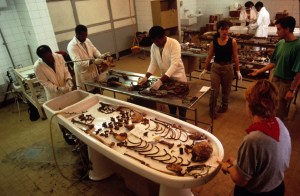
__________________________________________
Source World of Forensic Science
The remains of an ancient human found along a river in Kennewick, Washington, in 1996 set off a heated debate about the ownership and future of the skeleton. Scientists argued that the skeleton, dubbed Kennewick Man, could provide new information about human migration in North America, while Native Americans claimed him as an ancestor and wanted to bury him according to their rites. Forensic anthropological findings and cultural evidence were presented in court procedures over the course of nine years while the fate of the Kennewick Man was debated.

The story of Kennewick Man began in July 1996, when two college students watching hydroplane races found a human skeleton along the Columbia River. The young men turned the remains over to local police, who realized that they were probably very old. The bones were then given to forensic anthropologist James Chatters for evaluation. Chatters reconstructed the skeleton, which was 80–90% complete. He determined that it was from a man who was probably five feet nine or 10 inches and about 40–50 years old when he died. He showed little evidence of arthritis, indicating that he wasn’t used to carrying heavy weights and that he might have been a wandering hunter. Dental examinations showed that the skull contained 30 of the 32 teeth and that they were in good shape, indicating that he probably had a diet that included lots of soft foods like meat. He was taller and thinner than most ancient Native Americans and the back of his skull was not flattened from a cradleboard as is commonly observed in skeletons of ancient Native Americans. In addition, the man had a stone spear point lodged in his pelvis and there was evidence of severe trauma to his rib cage that probably limited the use of his arm. Using computerized tomography (CT), Chatters determined that the spear point was serrated and leaf-shaped and typical of the types of spears used between 8500–4500 years ago. He hypothesized that the skeleton was either from a European pioneer who had been attacked by native people using stone-age weapons or from an ancient human. Chatters sent pieces of the bones to a laboratory for carbon dating, which determined that the age of the skeleton was between 9,200–9,400 years old, making the skeleton one of the oldest, and most complete, ever found in North America.
Once the age of the skeleton was determined, several groups came forward, vying for control of the remains. A group of five Native American tribes in the region, the Umatilla, the Yakama, the Nez Perce, the Wanapum, and the Colville, wanted to accord the remains the same rites given to any Native American, namely a speedy burial. They cited the legal authority of the Native American Graves and Repatriation Act (NAGRA), which requires the return of American Indian remains to tribes. As news of the unique find spread throughout the scientific community, a coalition of eight anthropologists and archaeologists petitioned for their right to study the ancient remains prior to burial. The scientists believed that study of the Kennewick Man could reveal important information about early human migrations into North America. The Native American group believed that any manipulation of the remains would show enormous disrespect to the dead and vehemently opposed scientific investigation of the skeleton, which they called the Ancient One. Because some of the features of the Kennewick Man, such as his height and the shape of his skull, indicated that he might not be of Native American ancestry but rather of European descent, a group of people representing the ancient Norse religion called Asatru also petitioned the court for the right to the remains.

The ensuing legal battle raged for more than nine years. One of the key questions of debate in the courts concerned whether or not the skeleton was subject to NAGRA. NAGRA requires that all Native American remains be returned to the tribe for burial, however it was unclear if the Kennewick man was of Native American ancestry. Eventually the court ruled that some scientific study was required in order to establish the origin of the skeleton and between 1998 and 2000, the Department of the Interior coordinated these studies. A 1999 physical examination of the bones established that the Kennewick Man shared most physical characteristics with people from Southern Asia. In April 2000, samples of bone from the Kennewick Man’s skeleton were removed and sent to two different laboratories for DNA testing. Because of the age of the bones, it was impossible to extract sufficient DNA for analysis and the results of the study were inconclusive. After a series of appeals by all sides, in February 2004, a U.S. Federal judge ruled that it was impossible to prove that the Kennewick Man’s ancestry was culturally affiliated to any of the Native American tribes in the region and gave scientists the right to go forward with their investigation. In 2005, plans were outlined for study three-phase study involving as many as 23 different scientists.

The dinner was over and it was time to go home. The impact of this NAGPRA has seriously hampered science by bringing politics into the whole business and allowed ourselves to be hampered by sensitivity. America had allowed our guilt over pushing the Native American’s westward to cripple us the same way we currently do over slavery, neither of which we can do anything about now. All we can do is learn from those experiences, which is what science is all about.

Instead of learning and expanding our worldly knowledge, we’re wasting time appeasing political factions, getting grants so we can move some bones around the country and argue over bones that pre-date our known understanding of history, which is shallow at best.

But that is the nature of politics. It’s equivalent to living life in a straight jacket. All I can do is shake my head at the invention of yet another useless government created position, a Forensic Anthropologist that spends less time digging and understanding the past, and more time filling out papers to qualify for federal grants.

Rich Hoffman
http://twitter.com/#!/overmanwarrior
www.overmanwarrior.com
Facebook to PeopleString: The Next Step is Right in Front of You.

I’ve been doing a lot of thinking about innovation and the “next” generation of things. It was in Hollywood that I first learned about Facebook, which to this day refuse to participate in. When Facebook came out all the rage was Myspace so the evolution of these “social networking” sites was well under way.

My feeling about Facebook is mixed. I personally don’t like how open it is, and I don’t like how it knows and remembers so much about you. It is too good at connecting people, and to me is creepy. I read a book years ago by Jim Mars called Rule By Secrecy, which seemed like extreme fiction at the time, but since that book’s publication only a decade or so ago, much has changed. Governments don’t have to do a lot of “big brother” surveillance of its citizenship, because people are posting their every movement now on Facebook, GPS units and cell phones anyway.

That aside, “social network” sites are good at what they do, and obviously human beings desire such easy interaction. That leads to the obvious question, what’s the next generation of social networking?

When I first heard about Facebook, only a handful of actors were participating, to help launch it and get other people to want to use it. Myspace was still way out in front, and Facebook was not a reasonable challenge………yet.
Now Myspace is old news, and Facebook is all the rage. All that happened in about a 5 year span. You have to move fast in this new “computer economy.”

My son-in-law is actually riding one of the waves of what may become the “next step” in that computer economy. When he first told me about it I was skeptical. But I’ve watched it develop over the last 9 months and I’ve seen him get some fairly decent returns on his entrepreneurial investment. So I have some inside info on what I think is the next step. It’s at least a bridge to the next step, and is worth looking at. It’s called PeopleString. So I’ll let him explain it, because he’s the expert.
This is how to get set up.

This guy isn’t my son-in-law, but he does a nice job of explaining some of the features.


So far, there are a lot of these types of videos emerging, and this is reminding me of how Facebook felt when it was first introduced. So if you’re looking for something new and fresh that can connect to all your current stuff, you might want to look into it.

http://www.thenewsocialportal.com/

No catch, there’s a chance to make a little money with their ponzi setup to get the word out, but the real value is in the convenience. The web is definitely headed in the direction PeopleString is exploring. So you might as well get on the train while it’s in the station.

Check out my son-in-law’s Youtube site dedicated to PeopleString for more info.
http://www.youtube.com/afewcentsaday

Rich Hoffman
http://twitter.com/#!/overmanwarrior
www.overmanwarrior.com

Net Neutrality is the Villian from Tron

The following line is NOT a bit of dialogue from the new Disney film Tron.

“We must take action to protect consumers against price hikes and closed access to the Internet—and our proposed framework is designed to do just that: to guard against these risks while recognizing the legitimate needs and interests of broadband providers.” FCC Chairman Julius Genachowski

What?

Who do these people think they are? That’s almost as audacious as trying to regulate the air. But that statement almost sounded like the uttering’s of the character Clu as he addresses a sea of program soldiers about to be unleashed upon society in the new Tron Legacy film.

This is clearly a power grab by the FCC to further attempt to justify their existence. It must be terribly frustrating for them to have a part of the media that they don’t have any control over, and this is an attempt by a government agency to get control.

If you don’t understand what NET NEUTRALITY is, listen to Bill Cunningham of 700 WLW discuss it here:

As far as the platform the FCC is using to justify this move, the prices on the internet have regulated themselves. Prices too high are beat out by companies that offer better rates. It’s pretty simple really.

I can remember when the internet was new, and charged by the hour, then service for the month for a flat fee. There were many different combinations of price packages that were created along the way, but ultimately cheaper prices in a competitive fashion created the internet we have today, where a single user can talk on their Smart Phone, while talking on a headset over their XBOX and answering their email on a laptop, all done on the internet. The bandwidth drop that the FCC is talking about is a complete fabrication.

It has regulated itself and is one of the only aspects of society that is free. The internet is the model for what society should mimic.

But the FCC under the disguise of “fairness” is attempting to get their little feet in the door, and once there they will unleash many, many, many more regulations, just as they have for television and radio. It won’t take long for everyone that wants a website to have apply for one to the FCC just as a radio broadcaster does. And if you violate their terms, you’ll lose your license.

You have to consider what we’re talking about here, and that is access to the internet. Since the internet is just a bunch of computers talking independently of each other, it might as well be air. It has no central location and does not stop at a nation’s border. Therefore, the only way a government can get control of the internet is to control the on-ramp to the World Wide Web. In this case the FCC is using “fairness” to begin a relationship with internet providers that will become a much more parental relationship down the road.

This power move is so audacious that they by-passed congress to do it. We can’t even blame the incompetence of our congressional politicians on this one. This is a raw power grab from a branch of government functioning without any checks or balances, and in the context of things, is very serious.

If you dear reader scanning over these words don’t find this whole NET NEUTRALITY issue to be EVIL, and doesn’t provoke you into an outrage of forced accountability of the FCC, you can count the days that you soon won’t be able to read these words, because I will, along with this entire Blog Site will be found in violation of the FCC regulations, and will be shut down. And you will have to get thoughtful comments from an “orthodox” source that the FCC has given an approved license to.

That’s what’s at stake. As always, government sells itself as having your best interest in mind. It’s all about fairness, according to them. But history says otherwise.

The internet has thrived without any government regulation. And now, those public employees that have their socialist tendencies toward securing their own wallets in a collective utopia desire to hang themselves like parasites from internet commerce.

As always, it’s about the money.

While I write this there is a court case against WLW for setting up a Christmas manger at their tower in Mason, Ohio. The reason for the law suit is because they have a FCC license and that the argument is any government entity should have a separation of church and state.

Also, the FCC is using AL Sharpten to crack down on conservative talk show hosts like Rush Limbaugh, because the bottom line is people like Rush need to be shut down in order for government to expand, which is the goal of these types of regulators. They desire to secure employment for themselves from tax dollars. That’s all there is to it. The whole concept is incredibly short-sighted and selfish. But that’s what you usually find are the quality of people that desire to make a living off government work.

Once this line is crossed, these parasites of government regulation will embed themselves like a tick on a dog to suck the life-force of the creature.

Without Net-Neutrality, an entire industry, which young people are quite aware of has risen. These sad politicians wouldn’t know much about that industry because they are too busy pursuing lobby supplied prostitutes on K-street, or exotic dinners where they believe their discussion will pave the way for the nation.

No.

You can see the future by simply turning on a Nintendo Wii. The interface of either the Wii, the XBOX or the PlayStation 3, which is all internet based, provides at a glance Netflex, weather updates, news from around the world, and a portal to play Black Ops with a friend from half-way around the world in real time. That is the world of tomorrow, and it was created without governmental control.

Before I went with my family to see the new Tron film, I watched my kids swordfight with each other on the Wii, and many of those images came to me while I was watching that very interesting film. Tron is all about the world of cyberspace and the empires that can rise and fall within that world. And every new game created is a new experience for each and every human being on this planet to be a part of. But the overall theme of Tron was the perilous course of pursuing perfection.

In Tron, Jeff Bridges created an exact opposite of himself called Clu to implement the perfect world, a utopia. What it turned out to be was a hellish digital fascism that Bridges was unable to control and that society completely turned on him. It was heady stuff, not intended to be watched with just a light eye for entertainment.

Net Neutrality is in our world the fictional villain of the Tron film. Initiated with good intentions, but resulting in a hellish existence.

Art becomes reality, most of the time. “Your focus will determine your reality,” a line from another great science fiction film proclaims, and it’s true. Too bad human beings don’t think through things and learn from their art, instead of repeating the same mistakes over, and over, and over, and over, and over, and over…………………………………infinity.

We don’t remember what life was like before social security, or Medicare, or any number of government programs. But every one of us knows what the internet was like before the government decided to stick its nose in it. And it has thrived.

Don’t believe the lies. Encourage the new congress to escort the FCC to court for this gross imposition on our freedoms and liberty, and instruct them to stay out of our nation’s way.

Guess who is the main man behind this push………………..George Soros.  Listen to Rush Limbaugh discuss it here. 


Rich Hoffman
http://twitter.com/#!/overmanwarrior
www.overmanwarrior.com