
Radical Teachers in Lakota Use Students to Advocate Left-wing Politics: ICE protests at taxpayer facilities insult parents

The events at Lakota Local School District in northern Cincinnati, Ohio, on February 12, 2026, represent a microcosm of broader national tensions surrounding student political activism, school administrative responses, potential teacher facilitation, and the influence of progressive ideologies in public education. In a predominantly conservative area of Butler County, students at Lakota East and Lakota West high schools engaged in walkouts protesting U.S. Immigration and Customs Enforcement (ICE) policies, including expanded enforcement, raids, and alleged excessive force under the Trump administration. These actions involved students exiting classrooms (at Lakota East around 1 p.m.), marching with signs, chanting slogans against ICE, and positioning themselves visibly along roadsides for media attention. At Lakota West, the protest occurred after school hours and off-campus to limit direct disruption.
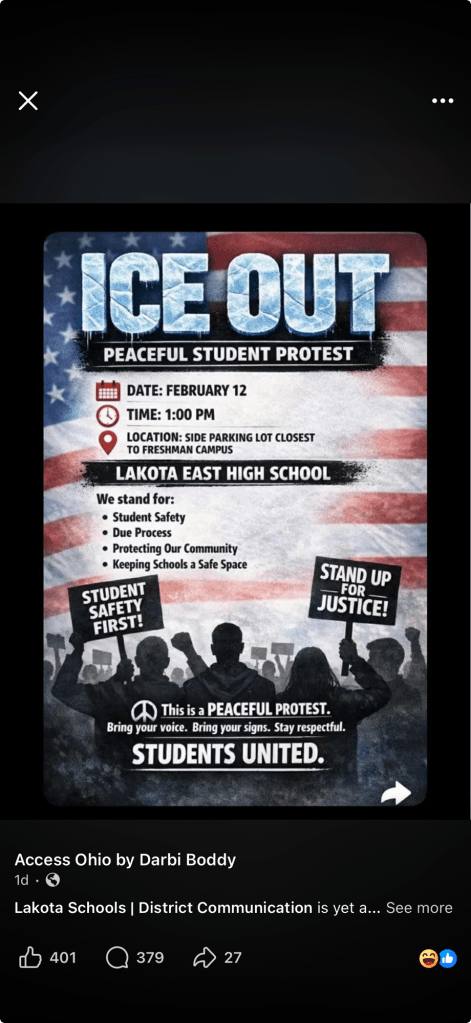
Local media, such as WKRC Local 12, reported these demonstrations as student-led responses to federal immigration tactics, noting similar actions across the Tri-State region (Ohio, Kentucky, Indiana). Principals from multiple Lakota schools (including East, West, Hopewell Junior, Liberty Junior, and others) issued a letter to parents on February 11, 2026, preemptively addressing rumors of a “voluntary” walkout. The letter upheld students’ First Amendment rights to peaceful protest and civic expression while warning that unexcused absences would be subject to Ohio law and district policy—participation did not qualify for excused status (e.g., illness, emergencies), and preplanned requests would be denied. It emphasized respect for diverse views, noncoercion, a safe environment, and the requirement to report to the office before leaving the building.

Critics, like me, have labeled the letter evasive, arguing it downplayed administrative or teacher involvement while allowing the event to proceed. Eyewitness observations suggest that protest signs were prepared in classrooms with teacher awareness or permission, and that the walkouts occurred during school hours with limited enforcement. Participants rerouted around obstacles such as snowbanks to remain visible in high-traffic areas (e.g., near I-75), indicating deliberate efforts to maximize impact and media coverage. Coverage portrayed the protests as expressions of community solidarity in a Republican-leaning region, although turnout appeared modest relative to enrollment.

Lakota school board member Benjamin Nguyen publicly opposed the demonstrations, issuing a statement calling non-participants “patriots” and citing crimes by undocumented immigrants. Despite warnings of unexcused absences, many participants reportedly faced minimal repercussions, fueling claims of tacit approval to avoid liability or conflict.

The Nationwide Wave of Anti-ICE Student Protests in Early 2026

The Lakota walkouts aligned with a massive surge of “student-led” demonstrations (organized through teacher union radicalism) across the U.S. in January and February 2026, often coordinated via social media by progressive groups and spurred by intensified ICE operations, including detentions, and tragic incidents like fatal shootings involving agents in Minneapolis. Thousands participated nationwide, with actions in dozens of states and cities.

In the Cincinnati area:

•  Walnut Hills High School: 300–400 students walked out on February 4, 2026, holding signs like “Abolish ICE” in cold weather.

•  Princeton High School: Hundreds walked out on February 10, emphasizing opposition to racial profiling in a diverse student body.

•  Other schools, including the School of Creative and Performing Arts (dozens marching with chants on February 11) and Sycamore High School (tied to January actions), joined the wave.

Elsewhere in Ohio and nationally:

•  Central Ohio districts (Worthington, Hilliard, Upper Arlington) saw January walkouts after ICE’s Operation Buckeye.

•  Northeast Ohio (Cleveland Heights): Hundreds marched on February 12.

•  Other states: Texas (Hutto, Austin, Pflugerville), Kansas (Lawrence, Free State), Utah (multiple Salt Lake County schools with hundreds marching), California (Los Angeles Unified estimating thousands), Minnesota (lawsuits over ICE near schools), and more.

Protests focused on protecting immigrant families, creating “safe spaces,” and opposing overreach. Some districts threatened disciplinary action or investigated facilitation; others remained neutral or supportive. Conservative critics highlight the coordination, media amplification, and involvement of younger students as evidence of external influences beyond organic concern.

Teacher Unions, Political Leanings, and Potential Facilitation of Activism

Central to the controversy is whether these protests were student-driven or amplified by teachers and unions. Public school teachers often lean liberal/Democrat in surveys, and unions like the National Education Association (NEA), American Federation of Teachers (AFT), and Ohio affiliates (Ohio Education Association, Columbus Education Association) have advocated on immigration, condemning ICE near schools, supporting “sensitive locations” protections, and amplifying solidarity efforts.

In 2025–2026, unions pushed for reforms limiting enforcement near educational sites, filed lawsuits (e.g., Minnesota districts and unions), and issued statements opposing ICE actions that create fear in immigrant communities. Ohio unions, such as the OEA, strongly opposed enforcement in or around schools, citing trauma and learning disruptions. Critics argue that this normalizes progressive views in classrooms under the rubrics of “civic education” or “social justice,” potentially pressuring neutral spaces and facilitating activism (e.g., walkout guides or symbolic acts).

In conservative areas like Butler County, public schools are viewed as “liberal incubators” with limited oversight, allowing teachers to instill values diverging from parental ones. Many parents treat schools as convenient childcare, rarely scrutinizing political influences, enabling unchecked messaging. This contributes to generational shifts, with youth adopting radical positions via taxpayer-funded systems.

Implications, Reform Needs, and Long-Term Trajectories

These incidents reveal tensions between student free speech (protected under Tinker v. Des Moines for non-disruptive expression) and school neutrality. If teachers aided protest activities (e.g., by creating signs during class), this raises questions about resource use and impartiality. In polarized regions, such actions appear to leverage youth for adult agendas, thereby eroding trust.

Reform demands include stricter policies on political activities during school hours, transparency in responses, parental oversight, and union accountability. School choice could allow value-aligned options, reducing perceptions of indoctrination. Without reforms, public education risks prioritizing ideology, exacerbating divides, and alienating funding communities.

The Lakota protests, framed as civic engagement, highlight eroding confidence when schools seem to enable partisan activism in conservative strongholds. Balanced, impartial education is essential to serve all families properly.  These protests, as the Lakota one proves, show a much deeper scheme of radical left-wing politics using children to advance their political agendas at taxpayer expense.  It is a mechanism of injustice that must be stopped. 

Footnotes

¹ Local 12 (WKRC), “Students at 2 Tri-State schools protest against ICE, treatment of immigrants,” February 12, 2026.

² Journal-News, “Some local students are organizing protests, campus discussions about ICE enforcement,” February 12, 2026.

³ Cincinnati Enquirer, “Walnut Hills High School anti-ICE walkout draws 300 to 400 students,” February 4, 2026.

⁴ The Guardian, “These are the high schoolers taking a stand against ICE,” February 9, 2026.

⁵ Education Week, “Free Speech Debates Resurface With Student Walkouts Over ICE Raids,” February 5, 2026.

⁶ Ohio Capital Journal, “Central Ohio high school students protest ICE, teacher unions condemn ICE activity near schools,” January 23, 2026.

⁷ American Experiment, “When teachers’ unions turn schools into political stages,” January 21, 2026.

⁸ Chalkbeat, “Growing number of education groups criticize impact of ICE operations on students,” January 28, 2026.

Bibliography

1.  Local 12 (WKRC). “Students at 2 Tri-State schools protest against ICE, treatment of immigrants.” February 12, 2026. https://local12.com/news/local/students-at-multiple-butler-county-cincinnati-ohio-school-schools-walk-out-class-protest-against-ice-immigration-customs-enforcement-agents-officers-president-donald-trump-protesting-politics-political-immigrants-lakota-west-east

2.  Journal-News. “Some local students are organizing protests, campus discussions about ICE enforcement.” February 12, 2026. https://www.journal-news.com/news/some-local-students-are-organizing-protests-campus-discussions-about-ice-enforcement/X6DUPL4VLRCL3OKCKKCP5B6FHA

3.  Cincinnati Enquirer. “Walnut Hills High School anti-ICE walkout draws 300 to 400 students.” February 4, 2026. https://www.cincinnati.com/story/news/education/2026/02/04/some-300-to-400-walnut-hills-high-school-students-join-anti-ice-walkout/88510660007

4.  The Guardian. “These are the high schoolers taking a stand against ICE.” February 9, 2026. https://www.theguardian.com/us-news/2026/feb/09/us-high-schoolers-protest-ice

5.  Education Week. “Free Speech Debates Resurface With Student Walkouts Over ICE Raids.” February 5, 2026. https://www.edweek.org/leadership/free-speech-debates-resurface-with-student-walkouts-over-ice-raids/2026/02

6.  Ohio Capital Journal. “Central Ohio high school students protest ICE, teacher unions condemn ICE activity near schools.” January 23, 2026. https://ohiocapitaljournal.com/2026/01/23/central-ohio-high-schools-students-protest-ice-teacher-unions-condemn-ice-activity-near-schools

7.  American Experiment. “When teachers’ unions turn schools into political stages.” January 21, 2026. https://www.americanexperiment.org/when-teachers-unions-turn-schools-into-political-stages

8.  Chalkbeat. “Growing number of education groups criticize impact of ICE operations on students.” January 28, 2026. https://www.chalkbeat.org/2026/01/28/education-groups-say-ice-immigration-enforcement-is-hurting-students

Rich Hoffman

More about me

Click Here to Protect Yourself with Second Call Defense https://www.secondcalldefense.org/?affiliate=20707
Good and Bad Protests: It all comes down to free elections

In the realm of global politics, protests serve as a barometer of societal discontent, yet their legitimacy often hinges on the nature of the regime they challenge. Distinguishing between “good” and “bad” protesters requires an examination of context: are they rallying against an elected, representative government, or are they resisting tyrannical rule? This question came into sharp focus during the 2020 protests in Minneapolis, Minnesota, which erupted following the death of George Floyd in police custody on May 25, 2020. These demonstrations, part of the broader Black Lives Matter movement, quickly escalated into widespread unrest, including looting, arson, and clashes with law enforcement, resulting in an estimated $500 million in damages across the Twin Cities area.  In contrast, protests in countries like Venezuela, Hong Kong, and Iran have often been viewed through a different lens by the United States—supported as righteous uprisings against oppressive dictatorships. The key difference lies in the foundational principles of democracy, free will, and self-governance. Protests in the U.S. that aim to undermine policies enacted by a duly elected administration, such as those under President Donald Trump, border on sedition, while those abroad that seek to dismantle authoritarian structures align with American values of liberty and human rights. If we explore these distinctions, delving into historical and contemporary contexts, the role of money and culture in measuring societal value, the mechanics of representative republics versus mob rule, and the perils of communist influences attempting to exploit civil unrest for revolutionary ends.

To understand the Minneapolis protests, one must first grasp their origins and evolution. On May 25, 2020, George Floyd, a 46-year-old African American man, was arrested by Minneapolis police officers on suspicion of using a counterfeit $20 bill. During the arrest, Officer Derek Chauvin knelt on Floyd’s neck for over nine minutes, leading to his death, which was ruled a homicide.  Video footage of the incident, captured by bystanders, went viral, igniting outrage over police brutality and systemic racism. Protests began the next day, initially peaceful, with thousands gathering at the site of Floyd’s death on East 38th Street and Chicago Avenue.  However, by May 27, the demonstrations turned violent, with looting at stores like Target and Cub Foods, and arson setting fire to buildings along Lake Street, including the Third Precinct police station, which protesters overran and burned.  Over the following days, the unrest spread to Saint Paul and other cities, leading to 604 arrests, 164 arsons, and two deaths during the initial phase from May 26 to June 7.  The protests were characterized by demands for police reform, but they also included calls to defund or abolish police departments, which critics argued amounted to an assault on established law and order.

These events occurred against the backdrop of the Trump administration’s policies, particularly on immigration and law enforcement, which protesters often decried as oppressive. Trump’s approach emphasized strict border control, including the construction of a border wall and enhanced deportation efforts, aimed at enforcing existing laws passed by Congress.  In Minnesota, a state with significant immigrant communities, some protests intertwined racial justice with immigration issues, portraying federal policies as tools of suppression. Yet, from the perspective of election legitimacy, these protests challenged the outcomes of the 2016 election, where Trump was elected on a platform promising stronger law enforcement and border security. The 2020 election, which saw Trump lose amid widespread mail-in voting due to the COVID-19 pandemic, further fueled debates over electoral integrity. Claims of irregularities, such as unverified mail ballots and changes to voting rules by state officials without legislative approval, led to lawsuits and audits, though courts largely upheld the results.  Protesters in Minneapolis, by seeking to force policy changes through disruption rather than the ballot box, exemplified what some view as seditious behavior—actions that undermine a government chosen by the people.

Sedition, as defined in U.S. law under 18 U.S.C. § 2384, involves conspiring to overthrow or oppose by force the authority of the government or to prevent the execution of its laws.  Historically, sedition laws have been controversial, dating back to the Alien and Sedition Acts of 1798, which criminalized false statements against the government amid fears of French influence.  These acts were repealed, but similar provisions resurfaced in the Espionage Act of 1917 and its 1918 amendments, targeting anti-war speech during World War I.  In modern times, sedition charges are rare due to First Amendment protections, requiring speech to incite imminent lawless action per Brandenburg v. Ohio (1969).  However, the Minneapolis unrest, with its destruction of public property and calls to dismantle police forces enforcing federal and state laws, raised questions about whether such actions crossed into seditious territory. Critics argue that while peaceful protest is protected, violence aimed at policy overthrow bypasses democratic processes, echoing the point that these actions seek to subvert a government “picked by the people.”

Contrast this with protests in Venezuela, where demonstrators have long challenged the authoritarian regime of Nicolás Maduro. Since 2013, Venezuelans have protested against economic collapse, hyperinflation, shortages, and political repression under Maduro’s socialist government, which succeeded Hugo Chávez’s Bolivarian Revolution.  Major waves occurred in 2014, following the attempted rape of a student and subsequent arrests, leading to 43 deaths and thousands of arrests.  In 2017, protests intensified over Maduro’s attempts to consolidate power, including dissolving the opposition-led National Assembly. By 2019, opposition leader Juan Guaidó declared himself interim president, sparking massive demonstrations against Maduro’s fraudulent re-election in 2018, where voter turnout was artificially inflated and opposition candidates were barred.  The U.S. supported these protests, recognizing Guaidó and imposing sanctions on Maduro’s regime to pressure for democratic restoration.  Unlike Minneapolis, these protests targeted a regime that suppressed elections, jailed opponents, and relied on violence to maintain control, aligning with U.S. interests in promoting self-governance.

Similarly, Hong Kong’s 2019 pro-democracy protests arose from opposition to an extradition bill that would allow transfers to mainland China, threatening the city’s autonomy under the “one country, two systems” framework established in 1997.  Beginning in March 2019, millions marched peacefully, but clashes with police escalated, involving tear gas, rubber bullets, and arrests.  Protesters demanded withdrawal of the bill, an inquiry into police brutality, and universal suffrage for legislative and chief executive elections.  The U.S. condemned China’s crackdown, passing the Hong Kong Human Rights and Democracy Act in November 2019 to support protesters and sanction officials.  These actions were seen as resistance to communist encroachment by the Chinese Communist Party, which imposed a national security law in 2020, leading to mass arrests and the erosion of freedoms. 

In Iran, the 2022 protests following the death of Mahsa Amini in morality police custody highlighted resistance to theocratic rule.  Amini, arrested for improper hijab, died on September 16, 2022, sparking nationwide demonstrations led by women removing veils and chanting “Woman, Life, Freedom.”  The regime responded with violence, killing at least 551 protesters, including 68 children, and arresting thousands.  The U.S. supported these protests by easing sanctions on technology to aid communication and condemning the repression.  Unlike U.S. protests, these aimed to dismantle a regime that denies free elections and enforces religious law through brutality.

The U.S. has historically backed such international protests as vehicles for promoting democracy and human rights.  In Venezuela, the Trump administration recognized Guaidó and imposed sanctions to isolate Maduro.  For Hong Kong, bipartisan legislation provided support against Chinese influence.  In Iran, statements and actions affirmed solidarity with protesters seeking freedom.  This aligns with America’s foundational values, where money measures initiative and ownership, fostering a culture of self-reliance and free will. In representative republics, citizens elect officials to enact policies, as in Trump’s immigration agenda, which prioritized enforcement to preserve national sovereignty.  Protests forcing change through violence confuse this with direct democracy, potentially leading to majority tyranny.

Election integrity is central to this distinction. The 2020 U.S. election faced scrutiny over mail-in ballots, with claims of fraud in swing states like Georgia and Pennsylvania.  Audits and lawsuits revealed serious issues.  In contrast, regimes like Maduro’s rig elections, justifying protests as the only recourse.  Elections are rigged in other countries, and its hard to admit that it has been happening in America.  Concern about “mail balls made up in a Walmart parking lot” echoes debates over ballot security, highlighting why preserving electoral processes is vital to prevent insurrection.

Underlying U.S. protests, is communist infiltration via progressive politics.  Historical fears, like McCarthyism in the 1950s, targeted alleged communist subversion.  Today, claims persist of cultural Marxism influencing movements like BLM, seen as platforms to usher in socialism by undermining capitalism and family structures.  In Minneapolis, some viewed protests as exploiting civil rights for communist ends, contrasting with genuine struggles abroad against actual communist dictators.

The difference boils down to intent and system: U.S. protests against elected policies risk sedition, while those abroad against tyranny merit support. Preserving free elections, resisting infiltration, and valuing self-governance ensure America’s republic endures, unlike faraway places lacking such freedoms.

Bibliography

1.  Wikipedia. “George Floyd protests in Minneapolis–Saint Paul.” https://en.wikipedia.org/wiki/George_Floyd_protests_in_Minneapolis%E2%80%93Saint_Paul

2.  The New York Times. “George Floyd Protests: A Timeline.” https://www.nytimes.com/article/george-floyd-protests-timeline.html

3.  CNN. “How George Floyd’s death reignited a movement.” https://www.cnn.com/2021/05/21/us/gallery/george-floyd-protests-2020-look-back

4.  Wikipedia. “Protests against Nicolás Maduro.” https://en.wikipedia.org/wiki/Protests_against_Nicol%C3%A1s_Maduro

5.  Amnesty International. “Human rights in Venezuela.” https://www.amnesty.org/en/location/americas/south-america/venezuela/report-venezuela

6.  Wikipedia. “2019–2020 Hong Kong protests.” https://en.wikipedia.org/wiki/2019%E2%80%932020_Hong_Kong_protests

7.  Amnesty International. “Hong Kong’s protests explained.” https://www.amnesty.org/en/latest/news/2019/09/hong-kong-protests-explained

8.  Wikipedia. “Mahsa Amini protests.” https://en.wikipedia.org/wiki/Mahsa_Amini_protests

9.  House of Commons Library. “Two-year anniversary of the Mahsa Amini protests in Iran.” https://commonslibrary.parliament.uk/two-year-anniversary-of-the-mahsa-amini-protests-in-iran

10.  U.S. Code. “18 USC Ch. 115: TREASON, SEDITION, AND SUBVERSIVE ACTIVITIES.” https://uscode.house.gov/view.xhtml?edition=prelim&path=%2Fprelim%40title18%2Fpart1%2Fchapter115

11.  Cornell Law School. “Sedition.” https://www.law.cornell.edu/wex/sedition

12.  Wikipedia. “Attempts to overturn the 2020 United States presidential election.” https://en.wikipedia.org/wiki/Attempts_to_overturn_the_2020_United_States_presidential_election

13.  Wikipedia. “McCarthyism.” https://en.wikipedia.org/wiki/McCarthyism

14.  The Heritage Foundation. “The Secret Communist Movement Inside America.” https://www.heritage.org/progressivism/commentary/the-secret-communist-movement-inside-america

Footnotes

1.  For more on the economic impact of the Minneapolis riots, see the Property Claim Services report estimating damages at over $2 billion nationwide.

2.  The U.N. Fact-Finding Mission on Iran documented extrajudicial executions during the 2022 protests.

3.  Historical sedition cases, like the Hollywood Ten, illustrate how fears of communism led to blacklisting in the 1950s.<|control12|>

Rich Hoffman

Click Here to Protect Yourself with Second Call Defense https://www.secondcalldefense.org/?affiliate=20707

Protecting Drivers from Protestors: The trick of using free speech to destroy the Constitution

Protestors Should Not Be in the Road, Ever

It’s about time; Oklahoma is proposing legislation to protect drivers who run protestors carrying their anarchy into the roadways of that state.  Other states such as Indiana and Florida pursuing similar protections, which is a perfect thing and long overdue.  We have witnessed many riots over the last several years, especially the race-baiting Democrats who have been engaged.  With them, it’s been quite a show; they were the ones who were responsible for slavery and fighting to keep it in place.  Now to cover that crime, they seek to control people of color another way. They are obliged all too often with riots in the streets every time Democrats find they need a diversion from their many crimes and liabilities derived from legislative errors.  Many of these protests are just thinly disguised attempts to exert Marxism into American society. Hence, their target is always commerce, which is why these mobs have been seeking to shut down our nation’s highways.  On several occasions, panicked drivers being forced to sit in traffic as these mobs destroy their property in terrifying ways have tried to drive through the attackers harming and even killing them.  For the drivers, not only did they have their property destroyed and had to sit through a terrifying occasion, but then they end up prosecuted for using their car as a deadly weapon.  It is hardly fair, and justice has been desperately needed. 

Thankfully, states like Oklahoma are providing that justice.  While nobody wants anybody to get hurt, no protestor should ever expect their free speech to harm other people’s liberty, specifically their right to commerce.  The moment that any protestor affects the individual lives of other people, such as showing up at their homes and playing loud music or chanting through a bullhorn to keep the occupants inside awake, we are then dealing with a disturbance of the peace situation.  The violators have then surrendered their constitutional protections of free speech and should then be arrested and prosecuted.  That is the same with protestors who have disrupted the meals of their targets in public.  Those protests are then disturbance of the peace violations and need to be met with aggressive action.  The occupants of a restaurant are there to pay for a nice meal.  It is their right and privilege.  Robbing that experience from people to usher in some protest is not acceptable and not part of the ground rules of a free society.  The protestors may be free to speak their mind, even if it’s wrong.  But they do not have a right to rob other people of enjoyment.  Whatever legal jargon might allow for a gray spot in interpretation requires clarity quickly, which, thankfully, these states mentioned are beginning to do. 

Now protestors might argue that taking away their right to get people’s attention will weaken their ability to get their point across.  That is not the problem of a society of commerce.  That is the problem of the protestor.  If the protestor has a good point, people will follow them.  If people think of the protestors as an inconvenience, they will be ignored, and their points glazed over.  That is how battles in a free-market economy are conducted.  Nobody has a right to dominate the minds and thoughts of others.  However, that’s not what the protestors want.  If we read the many books that they have been circulating for years, books such as The Coming Insurrection, Mao’s Little Red Book, and Rules for Radicals, it’s clear they want Marxism disguised as fairness.  So, they don’t care at all about individual rights, and they openly seek to destroy unregulated commerce.  And to deal with protestors legally in this regard, we can’t allow ourselves to think that we are protecting free speech when in all reality, we are working against all the other rights of the Constitution. 

It is a basic premise in our society that if people are walking around on railroad tracks or a highway, their safety is not the responsibility of other people. Suppose they put themselves in danger by being within the means of commerce of any kind, boat, plane, car, train—anything, that their life is in their own hands.  That is true even if there is a mob of hundreds and hundreds of people.  It is not the truck driver’s duty to stop the work and delay shipment of their product from one place to another because many protestors decided to bring their gripes to the truck driver’s life and alter his reality. While traveling at a moderate rate of speed, the truck driver should be unable to slow down and move right on through the mob unimpeded.  If there are injuries or deaths, then that obligation rests on the people in the road, not the drivers, to have one more thing to worry about.  If animals cross into a road, which could be understood since they don’t know better, they are struck all the time.  It is understood generally that the right to commerce is more important than an accident from some creature, unfortunately, being in the road when a car comes along.  However, in the case of humans, they do know better.  Now they may be impaired by drugs, or they may be sick with political ideology.  Regardless, they are still ill of mind and prone to destruction if they end up in the road and are hit by a car or truck while protesting. 

For many years, these ideas have been generally understood.  However, in our now overly litigious society, we see challenges to this premise. Many drivers have been stopping and yielding to these protestors because they are more afraid of the legal system than the derelicts of destruction that often end up in these mobs.  That is why the many state legislators must do as Oklahoma are doing now, making the issue quite specific.  Commerce must be a protected right, people’s ability to be free of a protest should they want to be supported.  We cannot allow people who wish to bring harm to our constitutional republic to use our rules against us disguised as free speech, but with the intent of violating the whole foundation of our legal system while in the process, which is what has been happening.  The challenge has left people feeling defenseless and vulnerable, which should never be the case in a civil society.  Because the alternative is that if protesters act with lawlessness, which is their premise when they loot and vandalize during protests, we fight back with lawlessness.  I don’t think that’s where we all want to go.  It would be better if everyone agreed with the laws, and we could at least have that as a common means of exchange.  But putting up with the chaos and aggression against commerce is not an option.  Commerce is much more sacred than the feelings of a Marxist minority, or even a majority, should that ever occur.  And before open violence between drivers and protests happens, the ground rules need to be clear: what Oklahoma and many other states are now doing, and not a moment too soon.

Cliffhanger the Overmanwarrior


Share, subscribe, and see you later,https://rumble.com/embed/vciikp/?pub=3rih5#?secret=bniNjt4gII


Sign up for Second Call Defense at the link below. Use my name to get added benefits.
http://www.secondcalldefense.org/?affiliate=20707

The Understanding of Law and Order: When the cops are the bad guys and when they are the good

Over the last several weeks I have expressed positions where it likely would be needed, and there were points certainly where it would have been justified to remove governors and mayors from power under force. I have shown support for people bringing guns to the capitals of their states to enforce rule of law to out of control politicians who had obviously lost their minds during the Covid-19 lockdowns. Yet I have also expressed opinions where I have said police need to bust up protestors, rip them from our city streets and put them in jail—or worse. Whatever needed to be done to restore order to our marketplace and our rule of law. That of course could be very confusing to people who only lightly follow these events. In my own life, I have spent an enormous amount of time on this subject and have written two books on the matter, ‘The Symposium of Justice’ and ‘The Tail of the Dragon.’ The question of the day is when do police have an obligation to bust up protestors and when do protestors have a right and obligation to fight the police for justice? And those questions require correct answers in these very confusing times, because most people just don’t know where the boundaries are.

The essence of the matter centers around property rights. Over many years weak politicians and activist judges have severely weakened the Bill of Rights and created in their state’s case law very liberal interpretations of castle doctrines and duties to retreat rewarding in the nature of all living things a right to live no matter what actions they impose on others. The sentiment is that property is acquired and can be replaced, but life cannot, so every form of life has an obligation to let other life live. On the surface that sounds like a noble cause but in that process lawyers and politicians failed to identify the nature of evil and thus putting much more aggressive people, and those with nothing to lose in a leverage position over the good people who follow the rules, do what they are supposed to, and usually end up doing most of the work in a society. This is the nature of most riots, especially in inner city environments where property value is not treasured but looked down upon by socialist administrations in Democrat Parties empowering looters, thugs, and other criminals to action against the good.

When any police force believes it can bust into anybody’s home even with a search warrant, such as the case in Louisville recently where police forced their way into Breonna Taylor’s residence unannounced. Her boyfriend thought the police were burglars, so he shot at them. They returned more than 20 shots back into the apartment killing Breonna for no good reason. The police got the whole thing wrong and the people inside their homes were victims to that stupidity. My policy at my house is that if anybody comes onto my property, Ohio law is incorrect in their position of the castle doctrine where it assumes that property owners have a duty to retreat under all conditions.

I have read the constitution of Ohio and of the United States backwards and forwards and the law is quite clear to me even if modern politics has failed to understand the meaning, so defending my castle to whatever extent is the priority. Nobody, not the FBI, not the local police, nobody has a right to bust down my door at any point in time. I consider that a standoff that I have no plans to lose against. Defending property is more important than taking the issue to court where political forces will manipulate the situation while you rot in jail with incompetent lawyers handling the issue the way they did with Michael Flynn and others abused by the modern legal system. The laws of Ohio, and the laws of Kentucky where the police thought they had such a right were clearly wrong. The police are paid to protect lives and private property. When they abuse both, they are in the wrong clearly and emphatically.

However, Trump’s position during his speech Monday, June 1st where he sent police into the street to break up the anarchists and protestors there so that he could travel outside of the White House gates to show that he was the “law and order” president was 100% correct. Protestors especially those filled with anti-American anarchists do not have a right to protest and stop traffic and commerce. They do not have a right to bust up store fronts, and to loot them because they are attacking “private property.” Once people lose their rights to private property, or the aggressors are attacking the value of private property, then that is where the line is drawn. Trump is correct to assert law and order to protect private property and the owners of those possessions. Mobs cannot violate property rights to make their point and when they do, they have lost any moral resolution to their cause.

When we talk about the nature of life and its potential this is what the police are supposed to protect and why the Constitution and Bill of Rights are written as they are. Things get confusing when we attempt to devalue life to serve a collectivist philosophy that is not American, such as Marxism and its various off-shoots communism and socialism. Modern protestors who tend to align with the modern Democrat Party of anarchy and climate change green new deal communism are forging concepts imported from Europe and other places such as Asia where the nature of private property is looked down upon, where the goal of the religions of those places are to rid yourself of possessions before your death and resurrection. Those concepts are incorrect as they relate to American law and order. Life at abortion is cheated for instance when they are not given an opportunity to achieve in life. The nature of life, the scoreboard of experience is in the property that is acquired, and the experiences generated from their acquisition. The life of a looter breaking into a home to steal the many hours of work and love a property owner put into the property cannot be replaced by insurance, or even a direct replacement. It is the experience of acquiring the property that matters in the measure of life and that is what is robbed when a crime happens.

Economic activity rather is a spiritual experience that our previous religions and cultures from the other side of the world have not caught up to. America is a modern idea and the protestors who seek to destroy property are fighting that updated concept for chains of thought rooted in the past. And the American idea of law and order, the kind of law and order President Trump declared himself to protect is about protecting that concept. Thus, the police and military better get on board with that sentiment, otherwise they are working against American ideas. It is not for the police to kneel to protestors and anarchists, and it is not for anybody to pay reparations for sins of the past. And to appease those who don’t accept American ideas about the value of private property and barge into people’s castle to raid them unaware, or even aware, police do not have such a right and a fight is mandated. In those cases, the police and our courts are wrong, and their interpretation of law is as well. These are the differences between right and wrong and law and order. And for our modern experience, it is good to see that we at least have a president who gets it. There is a long way to go to fighting off the instigators, but at least we are exploring the definitions that have been screwed up for well over a century now. And perhaps we can finally rectify it once and for all.

Cliffhanger the Overmanwarrior

Sign up for Second Call Defense at the link below. Use my name to get added benefits.
http://www.secondcalldefense.org/?affiliate=20707