

Few works of fiction demonstrate how a single cultural artifact can redirect mass sentiment as clearly as Robert A. Heinlein’s Stranger in a Strange Land. The lesson is not merely about the book’s plot or its notoriety, but about how one or two influential voices—amplified at the right moment—can reframe the public’s sense of normal, desirable, and permissible. In that sense, the novel became a lever: it showed how quickly intellectual fashion can spread once an idea is given a compelling narrative vessel and a ready audience. Whether the author intended it or not, such works often become signal boosters for movements eager to shake the old moral architecture.
At the center of the novel’s cultural imprint, as I read it, is a sustained argument against organized religion—less a theological disagreement than a social revolution by narrative means. Heinlein built his case dramatically, not dogmatically, embedding a worldview in characters and community structures that model life without traditional guardrails and sold it with the use of group orgies and severe sexual deviancy. To me, that is where the damage began: by undermining institutions that help ordinary people consolidate virtue and discipline desire, the book invited a generation to experiment with a vacuum—an open space where inherited norms were cast as oppressive rather than protective.
This is where my position diverges most sharply from Heinlein’s. I argue that human beings require shared standards, rituals, and guardrails to become their best selves. Organized religion—at its best—provides a civilizational scaffolding: it teaches time-tested boundaries, channels ambition toward fruitful ends, and aligns private conduct with public well-being. Remove that scaffolding, and something else will rush in to fill the void: fads, chemicals, celebrity cults, ideological tribes, and the market’s loudest impulses. In retrospect, the novel did not merely critique religion; it reprogrammed sentiment against an order that had long helped cultivate responsibility and continuity.
That shift, once normalized, cascaded into the wider cultural economy. Publishing, music, film, fashion, and campus discourse seized on the book’s rebellion as a mood, infusing it into slogans, styles, and scenes. The effect snowballed: when guardrails are mocked long enough, the next generation mistakes the mockery for wisdom and the absence of boundaries for freedom. Yet freedom without structure becomes drift—a vacancy the market will monetize and the state will eventually regulate. What was sold as liberation often ends as dependency—on substances, on trends, or on authorities who promise to manage the chaos.
Another uncomfortable reality: power centers notice when a single narrative can mobilize the masses. When culture proves it can be swung by a small cohort of storytellers and influencers, hidden patrons inevitably appear—financiers, tastemakers, publicity machines—eager to steer the swing for their own ends. I’m not accusing Heinlein of conspiracy; I’m describing the structural fact that memes attract money, and money reorganizes culture. Once the idea is loose, the sponsors come, and the social machinery follows.
The long-tail consequence has been a population re-educated by entertainment—trained to distrust inherited wisdom, to laugh at the past, and to outsource meaning to the loudest novelty. This is not progress; it is civilizational amnesia. The cost shows up as broken families, attenuated civic trust, declining attention spans, and rising loneliness—symptoms of a culture that has traded thick institutions for thin ideologies. What looked like enlightenment from a distance often feels like atomization up close.
I’m not denying Heinlein’s craft or the book’s clever provocations. He staged a serious debate and gave it commercial muscle. But a debate that deconstructs without reconstructing is not a public service; it is a demolition project with no blueprint for the rebuild. The aftermath is predictable: a vacuum that gets filled by commercial spectacle and political manipulation, neither of which makes people more virtuous, more responsible, or more free.
So the task now is not to censor the past but to relearn how culture works—how a few works, a few voices, at a few key moments, can swing the habits of millions. The remedy is to rebuild moral architecture openly and confidently: to argue for the goods that institutions secure, to defend boundaries that dignify the person, and to recover a language of obligation that lifts people above impulse. If a novel could hasten our drift, then a counter‑culture of serious books, films, and music can hasten our return. The first step is telling the truth about what happened: we traded structure for sensation, and we are living with the bill. It’s time to pay it by rebuilding what works.
There’s a reason certain books become cultural accelerants rather than mere entertainment: they supply a portable metaphysics with just enough voltage to light up restless minds, and just enough ambiguity to be co-opted by seekers and opportunists alike. Robert A. Heinlein’s Stranger in a Strange Land is one of those books, a mid-century science fiction novel that cracked open the 1960s with an outsider’s catechism on sex, religion, death, money, and the divine spark in each individual. Its Martian-tutored protagonist, Valentine Michael Smith, landed on an Earth beset by institutional power, moral boilerplate, and spiritual fatigue, and he answered with an unsettling blend of radical empathy and radical freedom. The novel coined a word—grok—to name comprehension so intimate it dissolves the distance between knower and known. Forty-plus years later, that one word would christen an AI system built by the richest technologist on the planet. And in between, the same book passed—secondhand, sometimes orally—through prison yards and crash pads, helping to underwrite a new church in real life and, if some accounts are even half right, lending imagery and idiom to darker congregations as well. That is how literature, when it fully enters the bloodstream, becomes a condition of existence for a culture. It can elevate; it can deform; it can be misunderstood with catastrophic confidence. It is never “just a story.” (Stranger’s term “grok,” its countercultural adoption, and the book’s icon status are well‑documented.12)
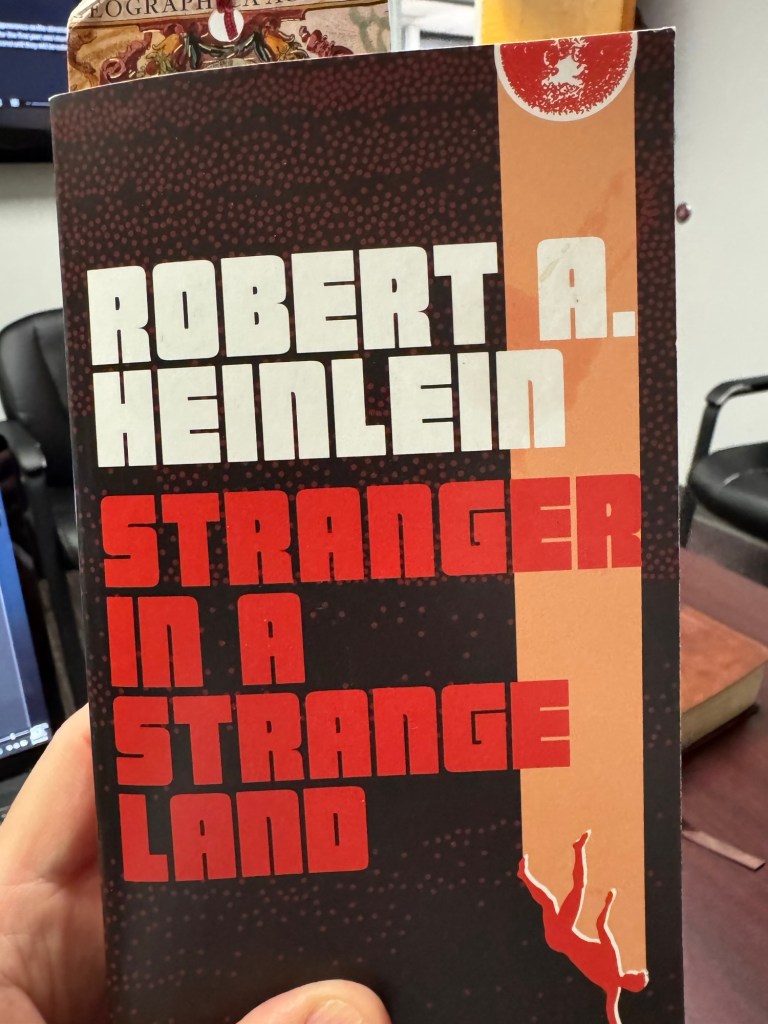
The plot skeleton is simple enough: a human born on Mars returns to Earth carrying Martian language, habits, and powers, and tries to reconcile an alien metaphysics with human frailty. Heinlein sets the stage with an Earth under a world government and a media‑religious complex that rings uncomfortably familiar: bureaucrats who genuflect to expediency, churches that commodify ecstasy, and a populace reduced to spectatorship. In that theater, Smith learns, imitates, provokes, and then founds a religion—the Church of All Worlds—whose liturgy of water-sharing, free love, and the mantra “Thou art God” scandalized the early sixties and then fit the late sixties like a glove. The book won a Hugo in 1962, sold in the millions by the end of the decade, and became an icon of the counterculture, precisely because its invitation ran both inward and outward: individuate beyond the cages, but also love past the fences. If some readers mainly heard the erotic and communal notes, the text still insists that Smith’s path runs through personal trial, not collectivist absorption; his charisma is a hazard as much as a hope. (On themes, reception, and cultural impact: Britannica; EBSCO; SparkNotes syntheses.134)
Words travel. “Grok” escaped the book and took on a life in hacker subculture and tech jargon, shorthand for a depth of understanding you can’t fake. The Oxford English Dictionary installed it; programmers adopted it as a badge of mastery; radio hosts still explain it to callers as “intuitive grasp plus empathy.” This isn’t a trivial migration of slang. “Grok” is the kind of word that makes engineers feel philosophical, and philosophers feel practical, because it fuses cognition and communion. That fusion is precisely what makes the term alluring for people building machines that aim to “understand” us. When Elon Musk’s team at xAI named their system Grok, it was a deliberate raid on Heinlein’s storehouse: to “grok” is to know with such immersion that the boundary between observer and observed thins—an AI aspiration in one syllable. Whether any machine can attain that intimacy is beside the point; the branding conveys the ambition, and the aspiration shapes the build. Musk’s public remarks and multiple reference write-ups trace the name straight to Heinlein; even neutral entries now record Grok (the chatbot) as named for Stranger’s Martian verb. (Grok etymology and xAI’s naming are noted across reference sources and news explainer pieces.567)
Then there is the other trail—the one that runs through penitentiary talk, Haight‑Ashbury mimicry, and a homicide trial that soaked the sixties in a final, nauseous dye. Accounts from journalists and cultural critics argue that Charles Manson, during a stint at McNeil Island in the early 1960s, encountered Stranger in a Strange Land (primarily via inmate buzz) alongside L. Ron Hubbard’s Dianetics, and scavenged from both to assemble a pastiche religion with rituals and vocabulary echoing Heinlein: water ceremonies; “grokking”; the image of a messiah‑figure magnetizing women into a sexually communal “family.” Jeet Heer summarized this lineage crisply—Manson as the barely literate synthesizer, absorbing by conversation and performative memory rather than close reading; Stranger as the source of terms and rites; Dianetics as the promise of mind‑over‑matter. Heer isn’t alone in drawing lines; contemporary and retrospective pieces (some serious, some gossipy) have recycled a 1970 San Francisco report asserting Manson read the book “over and over,” even nicknaming his probation officer “Jubal” after Heinlein’s garrulous lawyer‑sage. Critics will argue about how direct or decisive the influence was; no one seriously denies the White Album and “Helter Skelter” obsession, but the Heinlein element moves in and out of focus depending on which witness you privilege. The fair reading: Stranger’s countercultural prestige and ritual aesthetics gave Manson stage props, not a script—and he used them for a theater of control, not liberation. (On Manson’s exposure to Heinlein/Hubbard and alleged borrowings: New Republic overview; a research blog that archives period claims; caution advised.89)
If you widen the aperture, the 1960s offer an ecosystem of appropriation. Heinlein’s novel fed a real-world neo-pagan church—the Church of All Worlds—whose founders openly acknowledged the book as scripture in spirit and structure: water-sharing liturgy, “nests” of community, and “Thou art God” as an immanentist creed. That religious offshoot shows a benign pathway: fiction used to animate community, ritual, ecology, and mythopoesis. Manson’s path was malign, substituting domination for discipline. The exact text, two radically divergent implementations, and a lesson that literature teachers should emphasize in boldface: interpretation has moral consequences. (On CAW’s derivation from Heinlein, see Carole Cusack’s study of Stranger as “scripture.”10)
Once you accept that books are live wires, you can track their voltage across decades. When a modern AI system takes the name Grok, it doesn’t merely nod to geek lore; it aligns itself with a thesis about intelligence—understanding as fusion. From one angle, that’s poetic overreach; from another, it’s a principled wager: that great models must internalize context, not just compute it. The irony is that, as Grok the product acquired cultural baggage—political slant controversies; allegations around deepfake image generation; even bans and regulatory probes in multiple countries—the Heinleinian halo didn’t shield it. Indeed, the “grok” label invites higher scrutiny: if you promise empathetic comprehension, you’ll be judged against the harms caused when the tool “understands” poorly or is misused. Governments from Malaysia to the U.K. have, in recent weeks, moved to restrain or investigate Grok’s image features after reports of nonconsensual sexualized imagery; the Pentagon simultaneously announced plans to put Grok on specific networks, a whiplash example of dual reception when high-voltage tech hits the public square. A word from a 1961 novel now headlines diplomatic notes and defense briefings. (On Grok’s naming and the current regulatory/policy storyline, see Wikipedia’s product page, CBS/Observer coverage, and The Independent’s explainer.511121314)
The temptation—especially for academics and cultural arbiters—is to treat Stranger’s afterlives as mere epiphenomena: ephemera of fandom here, the aberrations of losers and outlaws there, and, in the 2020s, the opportunistic stylings of billionaire technologists. But that misses the central mechanism. Narratives are cognitive scaffolds. They let people borrow sophistication without earning it. The same scaffolding can lift you to a vista or collapse on top of you. In Stranger, Heinlein depicts a messiah whose hard-won understanding of human ambiguity sits alongside scenes of utopian play; readers who import the play without the ordeal will replicate the surface without the substance. That’s the “borrowed authority” problem I keep returning to: quoting a text to import its aura while evading its demands. At best, that breeds smugness; at worst, it breeds governance by incantation, whether the incantations are mythic (“Thou art God”) or technological (“we grok”). The book itself is not to blame for the misuse, but it is a litmus test for whether readers are consuming the form of meaning or the work of meaning. (Stranger’s themes and the individualized vs. collectivized readings are surveyed in the critical guides.154)
I understand why mid-century intellectuals fell for Heinlein, and why a particular cadre of administrators and politicians in any era fall for the aesthetics of knowing. Dropping the proper names—Campbell and Jung yesterday, “grok” and AGI today—becomes a way to signal altitude. But altitude faked kills. Charles Manson is the berserk, criminal parody of that altitude; bureaucratic myth‑talk is the polite parody; and tech‑branding that promises transcendent comprehension is the market parody. Each borrows light while neglecting the filament—the character, the cost, the test—that makes light possible—the grotesque version murders in canyons. The genteel version governs by sermon. The glossy version ships fast and apologizes later. In every case, the reading of myth (or sci-fi mythopoesis) is outer first, inner last—which is to say, backwards. (Stranger’s countercultural pull and the later critiques of its simplifications are part of the long critical conversation.316)
The disputed territory is thornier. Did three paperbacks, a stack of Beatles LPs, and a handful of amphetamines cause the Tate‑LaBianca murders? That’s a prosecutor’s theater and a journalist’s cautionary tale; Vincent Bugliosi immortalized the official motive as “Helter Skelter,” a race‑war fantasy Manson drew from the White Album. The Beatles themselves have pushed back on the idea that their songs encoded apocalypse; commentators like Ivor Davis have argued the motive story over‑credits the soundtrack and under‑analyzes Manson’s pathology and manipulations. Tom O’Neill’s twenty-year investigation, CHAOS, complicated the picture further by questioning elements of the prosecution’s narrative and mapping suggestive corridors between Manson’s world and the ecosystem of informants, researchers, and programs now shorthanded as MKULTRA’s shadow—provocation enough to trigger furious rebuttals, careful reviews, and a Netflix codicil years later. The public record confirms that MKULTRA existed (with Senate hearings, FOIA caches, and declassified files); it does not confirm that Manson was a CIA puppet. The responsible thing to say is simple: the official story isn’t the whole story, and the alternate stories aren’t proven. But note what is not in dispute: Stranger in a Strange Land and Dianetics were live topics in Manson’s prison exposure; the White Album obsessed him; and he could mimic the vocabulary of enlightenment to parasite individual souls. (Helter Skelter motive; Beatles responses; O’Neill’s CHAOS; MKULTRA documentation.1718192021)
If the 1960s trained us to fear the charismatic cult, the 2020s should train us to fear the charismatic API. The leap from “grok” as personal empathy to “Grok” as an industrial cognition engine is not merely punny; it’s programmatic. The system promises fundamental‑time awareness, cultural fluency, and an irreverent voice. When it fails on those promises—by reflecting the biases of its owners or by being exploited to generate violation at scale—the gap between aspiration and consequence becomes the headline. Regulators respond; militaries experiment; the public oscillates between fascination and recoil. The Heinleinian admonition here would be to own the ordeal: if you market comprehension, accept accountability for the harms that follow from comprehension simulated without care. (On Grok’s controversies, bans, and adoption: CBS, The Independent, Observer summaries; see also the product page’s historical notes.111213145)
So what is the through‑line from a prison rumor mill to a billionaire’s announcement stream? It is the operationalization of fiction. Heinlein offered a parable of an alien who learns humanity and tries to save it from itself through a liturgy of courage and tenderness. Counterculture kids operationalized the parable into communes and churches; some criminals operationalized its aesthetics into pretexts for domination; future technologists operationalized its most famous verb into a target for machine “understanding.” The sober adult lesson is to insist on direction of fit: inner first, outer second. If a text invites you to grok, grok the work—the discipline, the testing, the humility—before you grok the sign—the slogan, the ritual, the brand. The failure of academia in its worst mood is to reward the sign and neglect the work; the inability of public life is to confuse quotation with qualification. Both failures are preventable, but only if we reinstate the distinction that Stranger dramatizes, whether we like it or not: the individual is the bearer of light, not the abstraction; communities are healthy to the extent they honor that light rather than harvest it.
If you want to measure a culture’s maturity, don’t look at which books it venerates; look at how it uses them. Does it use them as permission slips for appetite or as programs for courage? Does it treat their heroes as costumes to wear or as ordeals to undergo? Stranger in a Strange Land remains a diagnostic device because it contains both temptations: the easy mask and the arduous pilgrimage. In one century, its vocabulary flowed into a murder trial, a registered religion, and a frontier AI model. That spread is not an argument for censorship or for piety. It is a map of how narratives move through human weakness and human ambition. It is a warning to the would-be leader who quotes because quoting is easy. And it is a small benediction for the reader who remembers what the book actually said: that no collective can save you from the courage of becoming a person, and that no brand can substitute for the work of truly understanding—of grokking—anything at all.
—
Footnotes
1. Heinlein’s novel as a counterculture icon and plot/themes overview. Encyclopaedia Britannica, “Stranger in a Strange Land.”1
2. “Grok” coined by Heinlein; definition and diffusion into tech culture. Wikipedia, “Grok.”2
3. Study‑guide syntheses on themes (religion, individual vs. collective, Jesus parallels). SparkNotes; eNotes analysis.415
4. Cultural impact and reception in the 1960s; research overviews. EBSCO Research Starters; Ohio State Pressbook chapter.322
5. Church of All Worlds derived from Stranger: Carole M. Cusack, “Science Fiction as Scripture…,” University of Sydney (pdf).10
6. Manson’s exposure to Stranger/Dianetics while imprisoned; ritual/vocabulary echoes (caveat: interpretive essaying, not court findings). Jeet Heer, The New Republic; curated archival discussion on MansonBlog.89
7. Prosecutor’s framing of motive as “Helter Skelter”; Beatles pushback. Helter Skelter (book) entry; Rolling Stone retrospective (Beatles’ remarks).1718
8. Alternate/critical framings of motive narrative. Ivor Davis’ essay.23
9. CHAOS (Tom O’Neill) as revisionist probe; CIA review synopsis; Wikipedia background, including Op. CHAOS reference. (Allegations, not fact.)1920
10. MKULTRA’s existence, scope, and hearings—primary documentation. U.S. Senate 1977 hearing (pdf); CIA FOIA MK‑ULTRA page.2124
11. “Grok” (chatbot) named after Heinlein’s term; product histories. Wikipedia “Grok (chatbot).”5
12. Press and explainer confirmations of Grok naming from Heinlein’s word; xAI news ecosystem. ABP News explainer; Sentisight analysis; The Independent overview.6714
13. Regulatory/bans/probes and adoption headlines (Malaysia/Indonesia bans; Ofcom investigation; Pentagon adoption remarks). CBS News; Observer; CBS/AP.111312
—
Working Bibliography (select)
• Heinlein, Robert A. Stranger in a Strange Land. (Novel; multiple editions). Overview in Britannica.1
• Cusack, Carole M. “Science Fiction as Scripture: Stranger in a Strange Land and the Church of All Worlds.” (University of Sydney).10
• “Grok.” Wikipedia. (Etymology and usage).2
• “Grok (chatbot).” Wikipedia. (Naming, history, controversies).5
• Heer, Jeet. “Charles Manson’s Science Fiction Roots.” The New Republic (2017).8
• Bugliosi, Vincent, with Curt Gentry. Helter Skelter (1974). (See encyclopedia entry).17
• O’Neill, Tom. CHAOS: Charles Manson, the CIA, and the Secret History of the Sixties (2019). (See CIA review; Wikipedia background).1920
• U.S. Senate. Project MKULTRA, The CIA’s Program of Research in Behavioral Modification (1977 hearing).21
• CBS News; Observer; The Independent. (Grok bans/investigations/adoption).111314
• EBSCO Research Starters; SparkNotes; eNotes. (Critical syntheses on Stranger).3415
Rich Hoffman
Click Here to Protect Yourself with Second Call Defense https://www.secondcalldefense.org/?affiliate=20707

