
The Left’s Trojan Horse: Nick Fuentes and Tucker Carlson–fallen angels who are trying to stop Vivek Ramaswamy in Ohio

The left-leaning media strategy is obvious: platform a disruptive young firebrand, inject anti-Jewish chatter, agitate through YouTube and podcasts, then aim the shrapnel at Trump and at Trump-aligned picks like Vivek Ramaswamy in Ohio to destroy the MAGA movement in ways that have not previously been successful under any condition.  Suddenly, a kid I’d barely heard of—Nick Fuentes—gets catapulted into mainstream attention. He was the tag-along at Ye’s (Kanye West’s) dinner with Trump in 2022 at Mar-a-Lago; the former president later said he didn’t know who Fuentes was when he sat down, but the meeting still drew bipartisan condemnation because Fuentes is a white nationalist and Holocaust denier.  Not the kind of guy the media would typically embrace, but under these conditions, where nothing to take down Trump has worked, this is the strategy of the left, to promote these fallen stars from the MAGA movement in one last Hail Mary, no matter who gets hurt in the process.  I’m certainly not one who would be calling for censorship.  But it is surprising how quickly everyone forgot about some basic rules of decency in these political fights, which have changed the landscape of debate forever. 123

Ordinarily, a guy with that track record wouldn’t touch mainstream platforms; they would be pushed off into obscurity, and they certainly never would have been on the Piers Morgan show or any other form of media.  Newspapers would have gone on a crusade of personal destruction, much the way they did with Marge Schott back when she owned the Reds and made similar comments, and had her life utterly destroyed for it.  Nick has been banned by YouTube and other majors for hate‑speech violations, with intermittent reinstatements elsewhere and then more removals; even Rumble has suspended his streams for “incitement to violence” after an antisemitic rally—so historically, gatekeepers did act. 45 But now, post‑Musk’s changes to X, he’s back on high‑visibility rails, popping up in interviews and friendly chats that launder his extremism for broader audiences. When you see that kind of boost—especially in late-cycle political windows—it looks less like “free speech flourishing” and more like a tactical Hail Mary to fracture the coalition right before decisive races. 67

Layer onto that Tucker Carlson’s recent, sharp pivot into anti-Israel rhetoric and repeated platforming of figures accused of antisemitism. Multiple watchdogs and Jewish outlets have documented the shift and the blowback—Shapiro blasting him at Heritage, Newsmax siding against him, and even StopAntisemitism labeling Carlson “Antisemite of the Year” in December 2025. I don’t endorse that label; I’m noting the documentation and the political consequence: it’s a wedge inside MAGA world, precisely when unity matters, but don’t cry about it, all is fair in love and war, with war being the point of emphasis. 8910

The script is predictable: amplify anti-Jewish frames, set up a fight between “America First” isolationists and pro-Israel conservatives, then bait Republicans into intramural brawls—Ben Shapiro versus Tucker Carlson, Heritage under strain, Turning Point USA’s AmericaFest turning into a civil‑war stage after Charlie Kirk’s assassination and the conspiracy storms that followed. The result isn’t persuasion; it’s erosion—energy wasted on policing purity rather than winning seats. 11129

My stance is well defined: antisemitism is not appropriate. Praising Hitler is evil. That isn’t “edgy” speech; it’s a moral rot that corrodes any serious movement. Fuentes has a documented record of white nationalist and Holocaust‑denying rhetoric; platforming him in chum-style interviews mainstreams what should remain radioactive. If the goal is to split MAGA and sandbag Trump-aligned candidates, this is the fastest path—smuggle in bigotry so the whole tent gets smeared. Don’t take the bait. 113

Ohio is the case study. Vivek Ramaswamy launched his 2026 gubernatorial run in February 2025, attracted heavy attention, and is now the clear GOP frontrunner in most coverage. Democrats have rallied around Amy Acton; early polling varies by sponsor, but the race is competitive at the surface level. None of that changes the fundamentals: if you let provocateurs redefine “America First” as a race-based or anti-Jewish crusade, you’re handing your opponent a cudgel. Stay on economic delivery, state competence, and merit-driven reform—the stuff that wins governors’ races. 141516

So the advice to Vivek—and by extension to Trump’s slate—is steady and aggressive: do what got you here. Don’t chase the troll theater or appease the grievance‑economy influencers. Use your success arc as a shield and spear: wealth built ethically, businesses scaled, a vision for schools, safety, and jobs—make that the daily drumbeat. When the attack line is “he’s a globalist” or “he’s Hindu,” swat it down as the unserious bigotry it is; it’s not Ohio’s problem set. Ohio’s problem set is growth, crime, schools, and affordability, not the color of Vivek’s skin or whether he wears shoes on stage. 17

In past examples, American society—especially institutions and mainstream media—moved swiftly to suppress voices veering into anti-Semitic or extremist territory. Take, for instance, the post-WWII era: the “Columbians,” an openly pro-Hitler group in Atlanta circa 1946, were acting out Nazi salutes and rhetoric in public. Their organizational charter was revoked and leaders were arrested within months—demonstrating how clear the lines were once drawn against fascist ideologies 1. Likewise, throughout much of the 20th century, publishers, broadcasters, and even churches regularly screened out Holocaust denial, pro-Hitler propaganda, or conspiracies about Rothschilds or “Jewish control.” These ideologies were actively repressed, not platformed.

Fast forward to just a few years ago in Ohio: when the West Chester Tea Party hosted Harald Zieger, who promoted conspiratorial tropes of “Jews control the media, economy, government, even child sacrifice,” it sparked immediate backlash 23. The local Jewish Community Relations Council publicly condemned the event, and the church hosting them was effectively “cancelled,” cutting off their meeting space within weeks 4. It was a classic case of communal and media accountability shutting down extremist speech—without hesitation.

Contrast that with today’s landscape: figures like Nick Fuentes—an avowed white supremacist who praises Hitler, espouses Holocaust denial, and rails against minorities—are not only finding platforms but being endorsed by mainstream media (e.g., Tucker Carlson, Piers Morgan) and embraced by major tech alike 567. Fuentes’s X account, once deplatformed for hate speech, was restored by Elon Musk; he now commands millions of followers, with his extremist rhetoric once erased now normalized—even cheered—on major platforms 68.

This dramatic shift—the difference between swift cancellation and open platforming—highlights a deeper cultural realignment. What was once unthinkable and renounced without hesitation is now acceptable if it serves the political objective of undermining Trump-endorsed candidates. It’s as if the old moral guard has crumbled: conspiratorial tropes against Jews, previously banished, are now resurfacing with institutional backing. The West Chester Tea Party’s fate—banished from public space for a single speaker’s conspiracies—is emblematic of a past where community standards mattered. Today, those same standards are reversed: bigoted voices are amplified if they align with the current political winds. The irony is stark and unsettling.

The broader conservative movement also needs line‑drawing without self-sabotage: condemn antisemitism unequivocally, refuse to sugarcoat Nazi apologetics, and stop platforming it as “debate.” That doesn’t mean gagging policy critique of Israel; it means rejecting conspiratorial claims about “organized Jewry” and dual‑loyalty smears that historically precede violence. When Ben Shapiro calls that out, he’s not gatekeeping taste; he’s trying to keep the movement morally sane. And when Tucker frames it as “just asking questions,” the net effect is still mainstreaming. The cycle is well documented across Jewish and mainstream outlets.  This is a new element to these kinds of games that has never succeeded before, under any circumstances.  But free speech works both ways; success is the best voice for a vote, and these critics have done nothing in their lives except say things.  Vivek has a long track record of great success, and that is his calling card for this election. If that is made clear, there is nothing any of these verbal attackers can do to move the mark.  And as hurtful as all that might be, success heals a lot of wounds, and that is where the focus in Ohio needs to remain.  Vote for Vivek Ramaswamy for governor in 2026 and take politics to a place it’s never been before as a representative republic that will do great things for a very optimistic future. 818

—

Supplemental material (footnoted):

• Mar-a-Lago dinner (Nov. 2022): Trump dined with Ye and Nick Fuentes; Trump said he didn’t know Fuentes; bipartisan condemnation followed because Fuentes is a white nationalist/Holocaust denier. 123

• Fuentes’ platform status: Banned by YouTube (2020) for hate speech; Spotify removed his podcast for hate‑speech violations; Meta/Twitch/Reddit bans noted; Rumble suspended streams after “holy war” rhetoric; X reinstated him under Musk, boosting reach. 456

• Carlson’s anti-Israel turn & intra-right backlash: Watchdogs charted rising harmful Israel content; Shapiro publicly denounced Carlson at Heritage; Newsmax echoed criticism; “Antisemite of the Year” label amplified controversy. 1881910

• TPUSA/AmericaFest fracture: After Charlie Kirk’s assassination, AmericaFest showcased rifts (Owens/Fuentes/Israel); JD Vance urged unity; Shapiro attacked “frauds and grifters”; coverage across CBS/USA Today/Deseret. 92011

• Ohio 2026 governor landscape: Ramaswamy announced run (Feb. 24, 2025) with platform on education/safety/regulation; media note Trump endorsement and competitive polling vs. Amy Acton. 14171516

—

Bibliography / Further reading:

1. ABC News, “Trump hosts Kanye West, Nick Fuentes at Mar‑a‑Lago dinner.” 1

2. NBC News, “Inside story of Trump’s explosive dinner with Ye and Nick Fuentes.” 2

3. USA Today, “Donald Trump dined with Holocaust denier Nick Fuentes… at Mar‑a‑Lago.” 3

4. Global Project Against Hate & Extremism, “The Sanitization of Antisemite Nick Fuentes.” 13

5. Media Matters, “Rumble removed Nick Fuentes’ antisemitic rally; far‑right figures turned on Rumble.” 5

6. JTA, “Conservative influencers Tucker Carlson and Candace Owens sharply increased anti-Israel rhetoric in 2025.” 18

7. Times of Israel, “Ben Shapiro blasts Tucker Carlson at Heritage.” 8

8. CBS News, “AmericaFest puts conservative rift on display.” 9

9. USA Today, “Tucker Carlson, Ben Shapiro clash over Candace Owens in Phoenix.” 20

10. Ohio Capital Journal, “Vivek Ramaswamy officially launches bid for Ohio governor in 2026.” 14

11. Deseret News, “Ramaswamy announces Ohio governor run, outlines platform.” 17

12. Fox News, “Ramaswamy announces 2026 bid for Ohio governor.” 15

13. Newsweek, “Polls on Amy Acton vs. Vivek Ramaswamy.” 16

Rich Hoffman
Click Here to Protect Yourself with Second Call Defense https://www.secondcalldefense.org/?affiliate=20707
It All Comes Down to Sullivan: Live by the Legal Sword, die by it too

These people never learn. When you are the front runner in a serious commissioner election in Butler County, Ohio, as Michael Ryan is, the dirty tricks trying to prevent his momentum are just the kind of thing that give politics a bad name.  What starts you on the road to good health in politics isn’t kale or cardio, it’s truth without legalese, straight talk without a billable hour attached. I deal with lawyers all the time—good ones, bad ones, and the “print this from the shelf and scare them” variety—and my general opinion, even conceding that the profession began with noble intentions, is that far too much of it has drifted into a uniform intimidation racket. You’ve seen the type: the form-letter cease-and-desist that looks like an astrology reading for defamation, except the fortune costs you a retainer and the outcome is a long, nervous wait for a judge who usually tosses it after you’ve lost sleep and savings. The trick is the tone, not the law: it’s written to make you believe you must respond with a lawyer, because only priests of the temple may interpret the runes. I don’t like the practice and personally think it should be destroyed, and that the perpetrators of such legal manipulation should be thrown in jail and punished with career-ending justice, just for applying the kind of abuses of power that are all too common.

And then there’s this, additionally

This is why the old play of lawfare against rivals—especially in local races where reputations are accessible targets—needs to be called out. We’ve watched how it stains the process in Butler County. Roger Reynolds, who was convicted on a single count in late 2022, later saw that conviction overturned on appeal in May 2024 for “insufficient evidence,” with the appellate panel ordering an acquittal and discharge. The case centered on the golf academy idea tied to Lakota Schools and Four Bridges; the court noted that the proposal never matured, that the school board held the authority, and that the key witness’s legal counsel ended the discussion before any contract could be secured. 1234 In September 2024, the Ohio Supreme Court declined to restore him to the auditor’s office immediately (the seat had been filled due to the bar against felons holding office at the time of his conviction) but clarified he remains eligible to run in the future. 5 That’s the landscape: facts matter, timelines matter, and our politics should run on open argument, not legal intimidation.

Then there’s Cindy Carpenter. She recently walked into a student housing office in Oxford to resolve back rent tied to a family member. A surveillance camera caught her flipping off the counter during the exchange; staff alleged racist language and abuse of office. The Butler County Prosecutor investigated and concluded that her conduct, while “unseemly,” did not rise to the level of misconduct or abuse of power. 67 It’s all on tape and all public now; the gesture happened, the allegations were made, and the official finding closed the matter without charges. 86 You can dislike the behavior—I do—but voters deserve a campaign where candidates fight this out in daylight, not by hiring attorneys to stuff the mailbox of a rival.

Enter Michael Ryan. He’s a Hamilton City Councilman turned countywide candidate, and he’s collected a long list of conservative endorsements—state senator George Lang, multiple township trustees and councilmembers, and county auditor Nancy Nix among them—because he’s making the case for generational leadership and a forward-looking county agenda. 9 He launched his commission bid in May 2025, framing it around growth, jobs, and fewer distractions—promising to fight for every city, township, and village, and to recruit the next-generation workforce. 10 Ryan’s pitch has resonated in part because people are tired of courthouse drama and lawfare theatrics; they want a debate about budgets, infrastructure, and living standards, not another stack of demand letters mailed in bulk from counsel. And he’s not alone—the GOP field is crowded, with Reynolds and Carpenter in the mix for the May 2026 primary—but the voter mood described by local reporting is unmistakable: they’re weighing future capacity, not re-litigating yesterday’s trials. 11

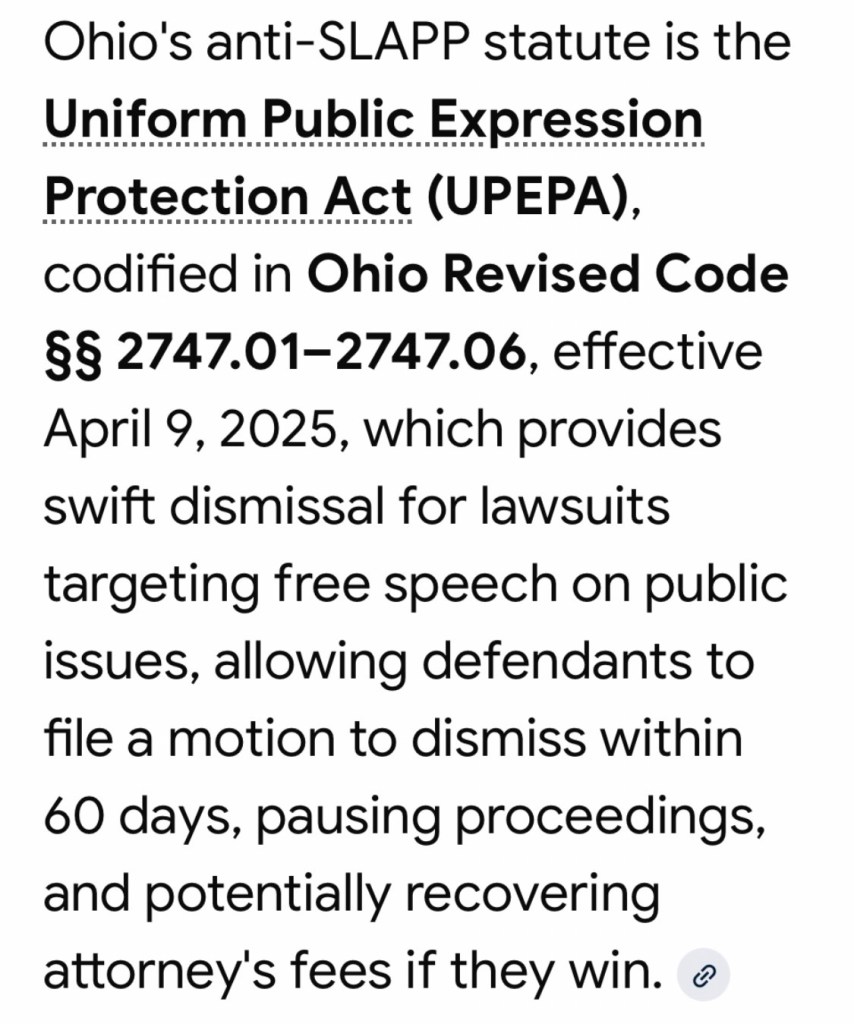
Now, when the intimidation letter lands—as it did from Reynolds to Ryan—you don’t have to swallow the premise that only a lawyer can answer it. You can answer it yourself, plainly and legally, because the guardrail is still the Sullivan standard from 1964. New York Times Co. v. Sullivan was a 9–0 Supreme Court decision that put a constitutional backbone into defamation law for public officials: to win, a public official must prove “actual malice,” meaning the speaker knew the statement was false or acted with reckless disregard for its truth, and must do so with “convincing clarity.” 1213 The case grew out of a civil rights-era advertisement that contained factual errors; a local jury hit the Times with $500,000 in damages, but the Supreme Court reversed, explaining that debate on public issues must be “uninhibited, robust, and wide-open,” even when the attacks are “vehement” and sometimes “unpleasantly sharp.” 1415

If you want numbers: the jury’s original $500,000 damage award (an enormous sum in 1960) was wiped away; the final holding established a higher burden that has, for six decades, made defamation claims by public officials very hard to win without proof of knowing falsity or reckless disregard. 1514 In practical terms, that means campaign statements, press releases, and political commentary about public officeholders are protected—unless the speaker crosses the line into deliberate falsehood or reckless disregard for the truth. 1316 The standard is why you don’t need to hire a lawyer to say, “We disagree, and our statements are protected political speech,” and it’s why cease-and-desist letters are so often theatre: they depend on the recipient’s fear, not on an actual path to winning under Sullivan.

So let’s put it together. Reynolds’ single-count conviction was reversed; whatever lessons he took from the ordeal, sending form-letter threats at a rival to police campaign commentary is the wrong takeaway. 12 Carpenter’s apartment-office incident was embarrassing but not criminal; voters can judge her temperament, but the prosecutor closed the file. 6 Ryan, meanwhile, has stacked endorsements and is running an argument-heavy, growth-forward race; that’s where the energy is. 9 Let them debate. Let voters see who can build coalitions and deliver results without resorting to legal cudgels. And when the legal cudgel shows up anyway, answer it with Sullivan—because in American political life, the First Amendment demands a high tolerance for hard speech about public officials, and the courts have enforced that by design. 1315

In the decades since Sullivan, the Supreme Court clarified and extended the actual-malice requirement through several landmark decisions:

Gertz v. Robert Welch, Inc. (1974)

This case distinguished between public officials, public figures, and private individuals. The Court held that the actual‑malice standard does not apply to defamation claims by private individuals. Instead, states may allow recovery with a lower standard of fault—such as negligence—when proven, and plaintiffs are limited to actual damages unless actual malice is shown 12.

• Outcome: Private individuals need not meet the high threshold; states can define fault and damages within constitutional bounds 23.

Curtis Publishing Co. v. Wally Butts (1967)

Extending Sullivan, the Court held that public figures (like former coach Wally Butts) must prove actual malice to prevail in libel suits. The investigation in question fell short of reasonable journalistic standards, leading to damages after the Court found reckless disregard for truth 45.

Philadelphia Newspapers v. Hepps (1986)

When private individuals sue over speech on matters of public concern, the Court ruled they must bear the burden of proving falsity—not leave it to the defendant. This ensures truth holds primacy in public discourse and avoids chilling speech 67.

Hustler Magazine, Inc. v. Falwell (1988)

This case affirmed that even intentional infliction of emotional distress torts related to offensive parody do not evade the actual‑malice rule when a public figure is involved. Religious leader Jerry Falwell could not recover without proving that Hustler knowingly published false statements or acted with reckless disregard 89.

• Result: Political satire and parody targeting public figures are constitutionally protected—even if deeply offensive—absent false statements made with actual malice.

—

Together, these rulings illustrate how Sullivan’s actual‑malice standard has been reinforced and nuanced:

• It does apply to both public officials and public figures (Butts, Falwell).

• It does not apply to private individuals (Gertz), though they must still show fault and harm.

• Plaintiffs challenge private or public speech tied to public concern must prove falsity (Hepps).

These cases bolster the legal shield for political speech—underscoring that public dialogue outpaces legal intimidation unless clearly false and malicious.

We’ve seen it too often, when candidates in politics can’t make a good argument, they turn to lawfare and hope that the public perception of expensive lawyers will do the work for them of winning an office they otherwise don’t deserve.  In Roger Reynold’s case, he is the one who got himself into trouble in the first place, and nobody wants to see that kind of trouble in the office of the Butler County Commissioners, just to repair the reputation of a person looking for respect that he lost during the process.  There are other ways to win respect, and this isn’t how you do it.  Showing leadership is the way to restore party integrity, not to make more rifts that cost more than reputations.  And hiring expensive, pin-headed lawyers to send out form letters of intimidation on a case they know is phony as they sent it, is why there are problems in politics to begin with.

Footnotes

1. New York Times Co. v. Sullivan set the “actual malice” standard for public officials, requiring proof that the defendant knew a statement was false or acted with reckless disregard, and emphasized “uninhibited, robust, and wide-open” debate on public issues. 1314

2. The original jury verdict in Alabama awarded L.B. Sullivan $500,000 in damages; the U.S. Supreme Court reversed unanimously in 1964. 15

3. Former Butler County Auditor Roger Reynolds’ 2022 unlawful-interest conviction was overturned for insufficient evidence in May 2024; the appeals court ordered acquittal and discharge. 12

4. The Ohio Supreme Court, in September 2024, declined to restore Reynolds to office mid-term but affirmed his eligibility to run in the future. 5

5. Butler County Prosecutor Michael Gmoser cleared Commissioner Cindy Carpenter of misconduct after the Oxford apartment incident, noting the gesture was “unseemly” but not unlawful. 6

6. Michael Ryan launched his commission bid in May 2025 and lists numerous Republican endorsements on his campaign website. 109

7. Local reporting describes a crowded May 2026 GOP primary field for the commission seat and outlines competing narratives about experience versus future focus. 11

Bibliography

• New York Times Co. v. Sullivan case summaries and analyses: LII / Cornell Wex; First Amendment Encyclopedia (MTSU); Wikipedia overview; FindLaw case history; Encyclopaedia Britannica.

• Reynolds appellate decision and related coverage: Twelfth District opinion (PDF); WCPO; Cincinnati Enquirer; WLWT; Ohio Supreme Court case update.

• Carpenter incident and prosecutorial review: Journal-News; Local 12 WKRC; Cincinnati.com video clip.

• Michael Ryan campaign and endorsements: Ryan for Butler County website; Journal-News launch story; Primary field coverage.

Rich Hoffman

Click Here to Protect Yourself with Second Call Defense https://www.secondcalldefense.org/?affiliate=20707
The Ohio Governor Race: Vivek Ramaswamy vs. Amy Acton—”the lockdown lady”

You know, people keep asking me about this Ohio governor race, and I’ll tell you what I think: Vivek Ramaswamy is going to win, and he’s going to win big. But that doesn’t mean you sit back and assume it’s all going to happen on autopilot. Campaigns aren’t won by assumptions; they’re won by hard work, strategy, and relentless execution. And if you’ve seen some of the chatter online—polls showing Amy Acton up by a point or two—you might think, “Wow, is Vivek in trouble?” No, he’s not. But let’s break this down because there’s a lot of smoke and mirrors in these early numbers.

First, let’s talk about Amy Acton. Who is she? Most people don’t even remember her name right now, and that’s part of the problem. She’s the former Ohio Health Director who became the face of lockdowns during COVID. Back in 2020, she was the one telling you to stay home, mask up, and cancel your life. She shut down schools, businesses, county fairs—you name it.¹ She was Ohio’s Dr. Fauci, taking cues straight from the CDC and enforcing some of the harshest restrictions in the Midwest. And it wasn’t just policy; it was the tone. She leaned into fear. She made people miserable. And when the heat got too much, she resigned in June 2020 because she refused to lift bans on county fairs.² That’s her legacy.

Now, fast forward to 2025. People have short memories, and Democrats are counting on that. They’re hoping voters see “Dr. Acton” and think “compassionate health expert” instead of “lockdown czar.” But here’s the reality: once she starts talking, once Vivek and his team start connecting her to those lockdowns, it’s game over. Ohioans haven’t forgotten the pain of 2020—they’ve just moved on. But if you remind them who caused it, they’ll move on from her real fast.

And what’s she running on? Abortion rights, reproductive freedom, and vague promises of “public health leadership.”³ That’s it. No major accomplishments since leaving office. No executive experience beyond a failed stint as health director. She’s endorsed by unions like AFSCME and UAW, and big-city mayors are lining up behind her.⁴ But endorsements don’t erase a record of failure. And in a state that leans red, with Trump back in the White House and MAGA energy surging, that’s not enough.

Now, Vivek Ramaswamy—he’s the opposite story. Entrepreneur, author, former presidential candidate. He’s smart, articulate, and aggressive. He’s raised nearly $10 million for this race, compared to Acton’s $1.4 million.⁵ He’s got Trump’s endorsement, JD Vance in his corner, and the Ohio GOP machine behind him.⁶ His platform? Bold: eliminate income and property taxes, merit pay for teachers, work requirements for Medicaid.⁷ He’s even courting unions, which is a savvy move in a state where blue-collar voters matter.⁸

So why the tight polls? Because polls lie. Or, more accurately, they mislead. Early polls oversample urban areas, lean left in methodology, and create narratives that help Democrats fundraise. RealClearPolitics has Vivek up by 6.5 points (49.5% to 43%).⁹ But Impact Research claims Acton is down by just one point, and Hart Research even shows her up by one among likely voters.¹⁰ Sounds scary, right? Until you realize these are snapshots taken before the campaign really starts. Acton hasn’t been vetted yet. She hasn’t faced Vivek on a debate stage. She hasn’t had to answer for the misery she caused during COVID. When that happens, those numbers will swing hard.

Here’s what I told people: don’t panic, but don’t get complacent. Vivek could walk out today and win by 15 points, maybe more. On Acton’s best day, she loses by eight. But campaigns aren’t about best days; they’re about execution. Vivek needs ads, billboards, ground game, and a war chest big enough to drown out the noise. And that’s why he’s smart to push fundraising now. Take nothing for granted. Because Democrats will throw everything at this race—they know Ohio is a battleground, and they’d love to embarrass Trump by flipping it blue.

And let’s not forget the Trump factor. If Trump does a couple of rallies in Ohio for Vivek, it’s lights out for Acton. He probably doesn’t even need that help, but it would seal the deal. MAGA voters will turn out in force. Independents? They’ll break for Vivek once they see Acton’s record. And suburban moms—the group Democrats are banking on—aren’t going to forget who kept their kids out of school for months. That’s political kryptonite.

So what happens when Acton starts talking? Disaster. She’s awkward, ideological, and out of touch. She was a radical during COVID, and she hasn’t changed. Democrats think they can hide that, but they can’t. The minute Vivek’s team rolls out ads showing her press conferences from 2020, it’s over. She’s the lockdown lady. The face of fear. And Ohioans aren’t voting for that in 2026.

Now, let’s talk strategy. Vivek needs to keep doing what he’s doing: stay aggressive, stay visible, and keep hammering the contrast. He’s a builder; she’s a bureaucrat. He’s about freedom; she’s about control. And he needs to remind voters that elections have consequences—because if Acton wins, Ohio goes backward. More mandates, more government overreach, more progressive nonsense. That’s the choice.

So, bottom line: Vivek wins. Easily. But only if he fights like he’s ten points down. No coasting, no assumptions. Raise the money, run the ads, knock the doors. Because politics is like football—you don’t win by reading the headlines; you win by playing the game. And when the game starts, Amy Acton is going to get crushed. She’s going to be exposed for what she is: a failed health director with no vision, no leadership, and no chance. 

And let’s not forget just how angry people were at Amy Acton during and after those lockdowns. This wasn’t mild criticism—it was rage, rage that she provoked.  People had been pushed beyond their limit, and she knew it as she did it. Protesters showed up at her home in Bexley, some carrying rifles, shouting slogans, and waving signs with anti-Semitic slurs.¹ Armed demonstrators patrolled her street while others plastered her address online.² She had to be assigned a security detail and eventually went into hiding because the threats were so severe.³ People doxed her, compared her to Nazis, and called her a “globalist” for extending stay-at-home orders.⁴ It got so bad that she resigned under pressure, citing concerns for her safety and her family’s well-being.⁵ That’s the level of backlash we’re talking about—the kind of fury that doesn’t just disappear. Ohioans haven’t forgotten that, and once voters are reminded, it will come roaring back.  And all that was just for a member of the DeWine administration.  Imagine her as the head of the Executive Branch. 

Notes on doxing actions:

1. Forward. “Ohio Protesters Gather in Front of Dr. Amy Acton’s Home.” May 2020.

2. Times of Israel. “Jewish Ohio Health Official Resigns After Anti-Semitic Backlash.” June 2020.

3. FOX 5 New York. “Public Health Officials Resign, Some Assigned Security Detail Amid Threats.” June 2020.

4. WKYC. “Why Did Dr. Amy Acton Resign as Ohio Health Director?” November 2020.

5. Jewish Telegraphic Agency. “Amy Acton Faced Anti-Semitic Backlash After Lockdown Orders.” February 2021.

Bibliography

1. Cleveland.com. “Amy Acton’s Role in Ohio COVID Lockdowns.” June 2020.

2. Columbus Dispatch. “Acton Resigns Amid Controversy Over Fair Bans.” June 2020.

3. Cincinnati Enquirer. “Amy Acton Campaign Platform: Abortion Rights and Public Health.” October 2025.

4. Dayton Daily News. “Unions Back Acton for Governor.” November 2025.

5. RealClearPolitics. “Ohio Governor Race Polling Average.” December 2025.

6. Fox News. “Trump Endorses Vivek Ramaswamy for Ohio Governor.” November 2025.

7. Politico. “Ramaswamy’s Policy Agenda: Taxes, Education, Medicaid.” November 2025.

8. Wall Street Journal. “Ramaswamy Courts Unions in Ohio.” December 2025.

9. RealClearPolitics. “Ohio Governor Race Polling Average.” December 2025.

10. Impact Research and Hart Research Polls. “Ohio Governor Race Polling.” November 2025.

Rich Hoffman

Click Here to Protect Yourself with Second Call Defense https://www.secondcalldefense.org/?affiliate=20707

Justice Deferred: Why Prosecutions Under Trump’s Second Term Remain Slow—and What Global Parallels Reveal

Donald Trump’s second term reignited expectations of sweeping accountability for political corruption. Yet, despite strong rhetoric and high-profile promises, major prosecutions remain elusive.  One year into Trump’s second term, the question persists: Why haven’t the big names gone to jail? Hillary Clinton remains free, despite years of allegations. The Clintons’ ties to corruption, Epstein’s network, and the weaponization of law enforcement against Trump allies have fueled public frustration. From Rudy Giuliani to Peter Navarro, loyalists have faced bankruptcy and imprisonment for defending election integrity. Meanwhile, figures like Letitia James and James Comey—central to prosecutorial misconduct—walk free after cases were dismissed due to procedural irregularities, not innocence.

This paradox underscores a deeper truth: prosecutions are not merely legal acts—they are political acts requiring stability, mandate, and timing. In a polarized nation, aggressive prosecutions without securing legislative dominance risk triggering retaliatory cycles, undermining the very agenda they aim to protect.

The dismissal of cases against Letitia James and James Comey illustrates the fragility of prosecutorial authority. A federal judge recently threw out charges citing the unlawful appointment of Lindsey Halligan as interim U.S. attorney, despite clear evidence of misconduct. The crime was procedural, not substantive—a loophole exploited to shield political elites from accountability1.

This is not unique. DOJ statistics reveal that high-profile political cases often span 3–7 years from indictment to resolution, with declination rates exceeding 39% when political volatility threatens institutional legitimacy2. Prosecutors, like any actors, weigh personal risk: firebomb threats, reputational ruin, and career destruction loom large when partisan control can flip overnight.

Trump’s own experience reinforces this caution. His first term saw relentless lawfare—Mueller investigations, impeachment trials, and civil suits—weaponized to cripple his agenda. The lesson? Without a stable mandate, prosecutions become pyrrhic victories, inviting reciprocal vengeance when power shifts.

The human toll of this legal warfare is staggering. Rudy Giuliani, once America’s Mayor, now faces $1.36 million in unpaid legal fees, with bankruptcy looming3. Mike Lindell, the MyPillow CEO, has liquidated assets to fund election integrity lawsuits, burning through millions4. Tina Peters, a Colorado clerk, sits in jail for investigating election fraud—a chilling precedent for dissent5.

These cases illustrate the asymmetry of lawfare: defending truth costs fortunes, while weaponizing law costs taxpayers. The financial attrition of Trump allies serves as a deterrent, signaling to future operatives that loyalty carries existential risk.

Enter the Epstein files—a political gambit disguised as transparency. Democrats, desperate to derail Trump ahead of midterms, embraced Epstein disclosures as a “gotcha” strategy, betting on salacious ties to tarnish MAGA credibility6. What they miscalculated was Trump’s counterplay: full release of the files, exposing a Democratic nexus of sexual trafficking, influence peddling, and elite corruption7.

This maneuver exemplifies asymmetric warfare: bait the opposition into overreach, then detonate the trap. As Trump played it, “rat poison in the nest”—a tactic to implode the colony from within. The fallout promises to be seismic, not for Trump, but for the progressive aristocracy entangled in Epstein’s web.

Brazil offers a cautionary mirror. Jair Bolsonaro, ousted after contesting election fraud, now faces 27 years in prison for an alleged coup attempt8. His successor, Lula da Silva—himself a convict released to reclaim power—embodies the cyclical weaponization of law. The message is clear: in politicized systems, justice is not blind; it is partisan.

For MAGA strategists, Bolsonaro’s fate underscores the imperative of institutional entrenchment. Without securing Congress and insulating the judiciary, Trump’s prosecutions risk reversal under a Democratic resurgence.

According to the Bureau of Justice Statistics, U.S. attorneys prosecuted 61% of suspects in matters concluded in FY 2023, with political cases often delayed beyond five years due to appeals and procedural challenges2. The median time from investigation to decision: 61 days, but high-profile cases involving political figures skew far longer, often requiring special counsel oversight.

Public impatience for “perp walks” is understandable. Yet, in the calculus of power, timing trumps theatrics. Immediate arrests may gratify the base but jeopardize the agenda if Democrats reclaim legislative control. Trump’s restraint is not weakness—it is war by other means.

The Epstein gambit, midterm positioning, and structural reforms signal a long game: secure the mandate, then strike decisively. Until then, justice remains deferred—not denied.  I would say to all who are seeking justice, defend Trump for the midterms, keep the Democrats running for the hills.  And sweep them up once the rat nest is poisoned and they can no longer do any harm.  But don’t play nice with them.  They would never give you the same benefit. 

References

NBC News. Judge dismisses cases against James Comey and Letitia James after finding prosecutor was unlawfully appointed. Nov. 24, 2025.1

Bureau of Justice Statistics. Federal Justice Statistics, 2023. March 2025.2

USA Today. Rudy Giuliani must pay his defense lawyers $1.36 million. Sept. 17, 2025.3

CBS News. Convicted Colorado election clerk Tina Peters transfer controversy. Nov. 23, 2025.4

PBS News. Trump signs bill to release Jeffrey Epstein case files. Nov. 20, 2025.7

CBS News. Jair Bolsonaro arrested before serving 27-year sentence for coup attempt. Nov. 22, 2025.8


To understand why prosecutions under Trump’s second term remain slow, we must situate this phenomenon within a broader historical and theoretical context. Lawfare—the strategic use of legal systems as instruments of political warfare—is not an American invention. It is a global sport, played with Machiavellian finesse and Foucauldian precision

Consider South Korea: former presidents Park Geun-hye and Lee Myung-bak were imprisoned for corruption, only to be pardoned later in a theatrical display of political mercy. This oscillation between punishment and absolution mirrors Michel Foucault’s thesis on power as a dynamic, relational force rather than a static possession [1]. In Israel, Benjamin Netanyahu’s corruption trials have dragged on for years, punctuated by coalition collapses and judicial reforms—a case study in how legal timing intersects with political survival [2].

Historical parallels abound. Watergate, often romanticized as a triumph of accountability, was in fact a slow burn. The scandal erupted in 1972, yet Nixon resigned only in 1974 after exhaustive hearings and strategic delays. Roman legal systems offer an even older template: prosecutions were frequently deferred until political winds shifted, illustrating Cicero’s dictum that law is the servant of politics, not its master [3].

Theoretical frameworks enrich this analysis. Machiavelli, in The Prince, counseled rulers to appear just while wielding power ruthlessly—a maxim evident in Trump’s calibrated restraint. Foucault’s Discipline and Punish reminds us that law is a technology of control, deployed to normalize behavior and consolidate authority [4]. When Trump delays prosecutions, he is not abdicating justice; he is performing sovereignty, signaling that timing—not immediacy—defines true dominion.

Global data corroborates this thesis. Transparency International reports that high-profile political prosecutions in democracies average 4–6 years from indictment to resolution, with delays often justified as procedural safeguards [5]. In Brazil, Lula da Silva’s conviction and subsequent resurgence exemplify lawfare’s cyclical nature: today’s convict is tomorrow’s kingmaker [6].

This expanded lens reframes Trump’s strategy as part of a transnational pattern: justice deferred is not justice denied—it is justice weaponized. The playful irony? While pundits clamor for perp walks, seasoned strategists know that the real game is chess, not checkers. Arrests gratify the mob; timing secures the throne.

Footnotes:
[1] Foucault, M. (1977). Discipline and Punish: The Birth of the Prison. Vintage Books.
[2] Peleg, I. (2023). Judicial Politics in Israel: Between Law and Power. Israel Studies Review.
[3] Cicero, M.T. (54 BCE). De Legibus.
[4] Machiavelli, N. (1532). The Prince.
[5] Transparency International. Global Corruption Report, 2024.
[6] Hunter, W. (2020). The Politics of Corruption in Brazil. Journal of Democracy.

Bibliography

Foucault, M. (1977). Discipline and Punish: The Birth of the Prison. Vintage Books.

Machiavelli, N. (1532). The Prince.

Cicero, M.T. (54 BCE). De Legibus.

Peleg, I. (2023). Judicial Politics in Israel: Between Law and Power. Israel Studies Review.

Transparency International. Global Corruption Report, 2024.

Hunter, W. (2020). The Politics of Corruption in Brazil. Journal of Democracy.

Rich Hoffman

Click Here to Protect Yourself with Second Call Defense https://www.secondcalldefense.org/?affiliate=20707

Thanksgiving, Family, and the Weight of Choices: Why Generations Rise or Fall Together

Thanksgiving is one of those rare moments in American life where everything slows down just enough for us to notice what really matters. The smell of turkey fills the house, football hums in the background, and for a few hours, the world’s chaos takes a back seat to mashed potatoes and pumpkin pie. I love this time of year. I love the family gatherings, the laughter, the jokes that only make sense to people who share your last name. But, Thanksgiving is also a fascinating study in human nature. You sit around that table and, without saying a word, you can see the weight of another year on everyone’s face—the triumphs, the mistakes, the quiet regrets.

What is family, really? People say it’s blood, but I think it’s more complicated than that. Family is biology, sure, but it’s also choices—every choice we make and every choice our kids make. And those choices stack up like bricks over time, building the life we live. Some people build palaces; others build prisons. Thanksgiving is where you see the architecture of those choices on full display.

When you’re born, you don’t get to pick your family. You’re handed a set of people and told, “These are yours.” But as life goes on, family becomes less about biology and more about decisions. Who you marry, how you raise your kids, what values you teach them—those choices ripple through generations. I’ve raised kids and now grandkids, and I can tell you this: the quality of a family gathering isn’t determined by the turkey on the table; it’s determined by the choices everyone made to get there.

I’ve seen families where bitterness hangs in the air like smoke because bad decisions piled up—wrong marriages, financial disasters, grudges that never healed. And I’ve seen families where people genuinely enjoy each other’s company because they made better choices. It’s not luck. It’s not fate. It’s choices.

I’ve always said this—and sometimes people look at me funny when I do—but I treat kids differently than I treat adults. Why? Because kids still have options. They haven’t stacked up a lifetime of mistakes yet. They’re like a blank canvas with endless possibilities. Adults, on the other hand, well… by the time you hit your 40s or 50s, the mistakes start showing. You can see it in their faces, in their posture, in the way they talk about life. Every bad decision leaves a mark.

I’ve sat at Thanksgiving tables and watched this play out. You see the cousin who married the wrong person, and now every conversation is about how hard life is. You see the uncle who spent his 20s chasing quick thrills and now looks like a relic of his former self. And then you look at the kids—bright-eyed, full of energy, thinking they’re invincible. They don’t know yet that life is a marathon, not a sprint.

That’s why I invest in kids. I talk to them differently. I try to steer them away from the mistakes that everyone else seems determined to make. Because if you can help a kid avoid even half the bad choices their peers make, you’ve given them a head start that will pay off for decades.

Life is like a marathon. At the starting line, everyone looks the same—bunched up, full of energy, ready to run. But five miles in, the pack starts to spread out. Some people are way ahead, others are falling behind, and the gap keeps growing. That’s what choices do.

And the stats prove it. By middle age, the spread is enormous:

• 41% of first marriages end in divorce, and the odds get worse with each attempt.

• The average U.S. household carries $105,056 in debt, with mortgage debt alone averaging $268,060.

• Over 40% of adults are obese, and the highest rates are among people in their 40s and 50s.

These aren’t random outcomes. They’re the result of choices stacked up over decades. The people who finish strong aren’t the ones who sprint early—they’re the ones who pace themselves, make smart decisions, and stay disciplined when everyone else is falling apart.

Here’s something I’ve noticed over the years: misery loves company. People who make bad choices don’t just suffer quietly—they want everyone else to make the same mistakes. Why? Because it makes them feel less alone. If you’ve wrecked your finances, married the wrong person, and let your health go, it’s comforting to see the next generation do the same. It’s almost like a twisted form of validation: “See? It’s not just me. This is how life works.”

But let’s be honest—it’s not “how life works.” It’s how bad decisions impact outcomes. And the numbers back this up. Divorce, debt, obesity—they’re all connected. Stress from debt leads to overeating. Relationship breakdowns lead to depression. Depression leads to bad health habits. It’s a cycle, and once you’re in it, climbing out feels impossible.

I’ve seen this at family gatherings. You hear the stories—another year of bills piling up, another kid in trouble, another health scare. And everyone nods like it’s normal. But it’s not normal. It’s the result of choices. And the sad part? People cling to the idea that something magical will fix it—a lottery win, a miracle from God, a quick fix that wipes the slate clean. But most of the time, that fix never comes.

Here’s the good news: the cycle can be broken. It’s not easy, but it’s possible—and it starts with the next generation. The key isn’t to make kids perfect. The key is to help them avoid the big mistakes—the ones that derail lives. Teach them that life isn’t about following the crowd. Because the crowd? The crowd is headed straight for debt, divorce, and diabolical outcomes.

So what do you do? You teach kids to think long-term. You teach them that every choice is a brick in the house they’re building. Pick the wrong bricks, and the house collapses. Pick the right ones, and you’ve got a fortress.

I tell my grandkids, “Don’t chase what everyone else is chasing. Most people are running toward misery and calling it fun.” I remind them that life is a marathon, and the people who finish strong aren’t the ones who sprint early—they’re the ones who pace themselves, make smart decisions, and stay disciplined when everyone else is falling apart.

And here’s the beautiful part: when you do this, you don’t just change one life. You change a family. You change a legacy. Because good choices ripple forward just like bad ones do. Imagine a Thanksgiving table where everyone is healthy, happy, and financially secure—not because they got lucky, but because they made choices that built that reality. That’s possible. I’ve seen glimpses of it in my own family, and it’s worth every ounce of effort.

Thanksgiving is more than turkey and football—it’s a mirror. Every year, when the family gathers, you can see the story of choices written on people’s faces. Some look vibrant, full of life, laughing easily. Others look worn down, carrying the weight of years of bad decisions. And it’s not just physical—it’s in the conversations. You hear who’s struggling with debt, who’s on their third marriage, who’s battling health problems.

But here’s the thing: Thanksgiving also gives us hope. It’s a chance to reset, to remind ourselves what matters. For a few hours, the bills and the stress fade away, and we just enjoy being together. And if we use that time wisely—not just to eat, but to inspire—we can plant seeds that change the next generation.

Family is a gift, but it’s also a responsibility. It’s not just about biology—it’s about choices. Every choice we make ripples through generations, shaping the lives of people who haven’t even been born yet. That’s heavy, but it’s also empowering. Because if bad choices can create misery, good choices can create joy.

So this Thanksgiving, as you sit around the table, look at the faces you care about and ask yourself: What legacy are we building? Are we passing down wisdom, or just repeating the same mistakes? Because the truth is, the cycle doesn’t have to continue. We can break it. We can teach our kids to run the marathon wisely, to pace themselves, to make decisions that lead to health, happiness, and freedom.

And if we do that—if we choose better and inspire better—then maybe, just maybe, the next Thanksgiving will feel different. The laughter will be louder, the smiles will be brighter, and the weight of bad choices will be replaced by the joy of good ones. That’s something worth being thankful for.

Rich Hoffman

Click Here to Protect Yourself with Second Call Defense https://www.secondcalldefense.org/?affiliate=20707

The Drug War’s Turning Point: Why Mexico’s Palace Was Stormed and Venezuela Became Ground Zero

Latin America is boiling over. In Mexico, hundreds of thousands of protesters stormed the National Palace in Mexico City, demanding accountability from President Claudia Sheinbaum after years of cartel-driven violence and corruption. In Venezuela, Nicolás Maduro clings to power through brazen election fraud, while his regime funnels billions from narcotics and oil into global networks tied to China, Russia, and Iran.

What triggered this sudden wave of defiance? The assassination of Uruapan Mayor Carlos Manzo—a rare politician who dared to defy cartel intimidation—was the spark. But the fuel was a psychological shift: the sight of U.S. aircraft carriers off Venezuela’s coast and Trump’s aggressive strikes on cartel-linked vessels in the Caribbean. For millions living under cartel terror, this was a signal: Big Brother is watching—and ready to act.

Section 1: Claudia Sheinbaum’s Crisis of Credibility

Mexico’s first female president, Claudia Sheinbaum, entered office in 2024, promising reform. Instead, her administration is mired in scandal. Two former officials accused of running a cartel-linked criminal enterprise remain at large—one even holds a Senate seat. U.S. Treasury sanctions forced Mexican banks to shut down after laundering millions for cartels.

Key Facts:

• Corruption Allegations: Intercam and CIBanco closed after U.S. sanctions for laundering cartel money.

• Public Perception: 60% of Americans view Mexico’s government unfavorably; nearly half say it’s doing a “terrible job” on border security.

• Protests: November 15 saw the largest anti-government rally in decades—120 injured, 20 arrested, and palace gates torn down.

Sheinbaum’s dilemma is apparent: appease cartels or risk destabilization. Her socialist platform, like AMLO’s before her, has created fertile ground for corruption—because authoritarian systems are easy to buy off.

Section 2: The Cartel State—Mexico’s Parallel Government

Cartels are not fringe actors—they are the state behind the state. Their reach extends from rural villages to federal institutions.

Scope of Influence:

• Major Players: Sinaloa Cartel and Jalisco New Generation Cartel (CJNG) dominate, alongside Gulf, Juárez, and splinter groups.

• Revenue: Mexican cartels generate $12.1 billion annually, surpassing Colombia as the world’s top drug-trafficking economy.

• Territorial Control: CJNG operates on every continent except Antarctica, controlling ports, smuggling routes, and even illicit gold mines in Venezuela.

Officials face a simple calculus: profit or perish. This systemic corruption explains why extermination camps—complete with crematoriums—exist in Jalisco and Colima, with authorities complicit in cover-ups.

Section 3: Fentanyl—Mexico’s Deadliest Export

Since 2019, Mexico has replaced China as the primary source of U.S.-bound fentanyl. The scale is staggering:

• Labs: CJNG and Sinaloa run industrial-scale “super labs” producing fentanyl powder and pills using Chinese precursors.

• Lab Dismantling: Under Sheinbaum, authorities dismantled 750 clandestine labs, seized 1.5 tons of fentanyl, and confiscated over 2 million pills in six months.

• Largest Bust: In Sinaloa, forces seized 630,000 pills and 282 lbs of powdered fentanyl—the biggest in history.

• Border Seizures:

    • FY 2023: 27,275 lbs (12,370 kg)

    • FY 2024: 21,489 lbs (9,750 kg)

    • FY 2025 YTD: 5,515 lbs (2,500 kg)

• DEA Estimates: Cartels produce enough fentanyl for billions of lethal doses annually.

Economics:

• A single kilogram yields 500,000–1,000,000 doses, retailing for $20–$30 per pill in the U.S.—a street value exceeding $20 million per kg.

• CJNG and Sinaloa launder $1.4 billion annually through U.S. casinos and shell companies tied to fentanyl proceeds.

This is not just a criminal enterprise—it’s a weapon of mass destruction disguised as commerce.

Section 4: The Assassination That Sparked a Revolt

Carlos Manzo, Uruapan’s mayor, was gunned down on November 1 during Day of the Dead festivities. His crime? Publicly denouncing cartel extortion of avocado growers and demanding federal action.

Aftermath:

• Mastermind Arrested: Jorge Armando “El Licenciado,” linked to CJNG, ordered the hit via encrypted messaging.

• Security Failure: Seven of Manzo’s own bodyguards were arrested for complicity.

• Protests: His murder ignited nationwide outrage, culminating in the storming of the National Palace.

Manzo’s assassination was not isolated—seven mayors have been killed in 2025 alone. For ordinary Mexicans, his death symbolized a truth long whispered: the government serves the cartels, not the people.

Section 5: Venezuela—The Cartel Republic

While Mexico bleeds, Venezuela metastasizes. Maduro’s regime is a narco-state masquerading as a government.

Election Fraud:

• Maduro declared victory in 2024 with 51.2% of votes, but opposition tallies show 67–70% for Edmundo González.

• International observers condemned the process as illegitimate.

Drug Trade Dynamics:

• Venezuela is a key transshipment hub for cocaine and synthetic drugs, generating billions for elites tied to the Cartel of the Suns.

• Chinese chemical suppliers provide precursors; Chinese money-laundering networks move cartel cash globally.

Geopolitical Stakes:

• China relies on Venezuelan oil to fuel its Belt and Road ambitions; Russia and Iran exploit Caracas as a Western Hemisphere foothold.

• U.S. warships and the USS Gerald Ford carrier group now patrol Caribbean waters, signaling a counternarcotics mission—or regime change.

Section 6: The Trump Doctrine—Psychology as Strategy

Trump’s decision to strike cartel-linked vessels in international waters was more than a military maneuver—it was a psychological operation.

Impact:

• 22 vessels destroyed; 83 killed in Caribbean strikes since September.

• For Mexicans and Venezuelans living under cartel terror, these images broadcast hope: The U.S. is here, and the cartels are not invincible.

This perception emboldened protesters to storm Mexico’s palace and fueled whispers of resistance in Venezuela. Military presence, even without boots on the ground, alters the risk calculus for oppressed populations.

Section 7: The Human Cost

• Mexico: Over 460,000 homicides since 2006 in cartel-related violence.

• Border Spillover: Cartels issue bounties up to $50,000 for hits on U.S. law enforcement; ICE and CBP agents face ambushes and drone surveillance.

• Ohio Connection: Even local sheriffs like Butler County’s Richard Jones have been on cartel hit lists for years—a testament to the reach of these networks.

Section 8: Why This Matters

This is not just a regional crisis—it’s a global one. Cartels are the connective tissue between socialist regimes, authoritarian states, and transnational crime. They finance corruption, destabilize democracies, and weaponize narcotics against civil societies.

Solutions:

1. Designate Cartels as Terrorist Organizations (already underway for CJNG and Sinaloa).

2. Target Financial Networks—especially Chinese-linked laundering operations.

3. Deploy Persistent Naval Presence to disrupt trafficking routes.

4. Empower Local Resistance through intelligence and logistical support.

5. Expose Ideological Cover—Marxism cloaked in populism.

Closing Thoughts

The storming of Mexico’s palace and the unrest in Venezuela are not isolated events—they are symptoms of a deeper ideological and criminal convergence. Trump’s military strategy has cracked the psychological armor of cartel dominance, giving ordinary people a reason to fight back.  And for anybody who wants to fight back against sex trafficking and the degradation of human intellect, this fight against the cartels, from many directions, is the right thing.  A window has opened for the people of Mexico that they have long been waiting for, and they are starting to take action.  The best way to defeat the cartels is to turn the hunters into the hunted and make the people of Mexico defend themselves, knowing that their big brother is just offshore to help them out at a moment’s notice.  And of course, it’s much more than Mexico; the entire region has been overrun by communist influences for the last century, so attacking the drug boats is about reclaiming territorial security from very hostile, foreign invaders.  And the drug boats are just the start of something really good. 

Rich Hoffman

Click Here to Protect Yourself with Second Call Defense https://www.secondcalldefense.org/?affiliate=20707

The Communist Mamdani in New York: Its time to pull away the masks

The election of Zohran Mamdani as mayor of New York City marks a turning point in American politics. For decades, the Democrat Party has flirted with socialist ideas under the guise of progressivism, soft-selling policies that inch toward state control while maintaining a capitalist façade. Figures like Hillary Clinton, Barack Obama, and Joe Biden represented this strategy—identity politics and incremental reforms masking deeper ideological ambitions. But Mamdani’s victory strips away the pretense. Running openly as a democratic socialist, he secured 50.4% of the vote, defeating establishment candidates and signaling that the radical wing of the Democratic Party is no longer content to operate in the shadows.

This is not an isolated phenomenon. It is the culmination of decades of ideological conditioning in public schools and universities, where Marxist thought has been normalized under academic freedom. The result? A generation of voters who see socialism not as a foreign threat but as a moral imperative. Mamdani’s platform—price controls, free transit, and housing guarantees—echoes the promises of past revolutions. His rhetoric of affordability resonates in a city where 1 in 5 residents cannot afford $2.90 for transit fare, a statistic he cited during his Oval Office meeting with Donald Trump. But beneath the compassionate language lies the same economic logic that has historically led nations down the path of stagnation and authoritarianism.

To understand the implications of Mamdani’s rise, one must revisit the Cuban Revolution. In 1959, Fidel Castro and Che Guevara overthrew Fulgencio Batista, promising justice, equality, and prosperity. Initially, they were hailed as liberators—a narrative strikingly similar to Mamdani’s portrayal of them as champions of the working class. Yet within two years, Cuba declared itself a Marxist-Leninist state aligned with the Soviet Union, cementing a system that would devastate its economy and freeze its society in time.

The revolution’s human cost was staggering. Che Guevara personally oversaw firing squads at La Cabaña fortress, where at least 151 executions occurred under his orders, and estimates suggest 5,600 Cubans died by firing squad overall during the early years of communist rule.  These were not isolated acts of violence but systemic purges designed to eliminate dissent—a grim reminder that revolutions promising equality often deliver tyranny.

Economically, Cuba became dependent on Soviet subsidies, which accounted for 20–25% of its GDP. When the USSR collapsed in 1991, Cuba’s GDP plummeted 35% between 1989 and 1993, imports fell 75%, and caloric intake dropped by 30%, causing widespread malnutrition. The island remains a museum of mid-20th-century technology, with 1950s cars still on the roads—a testament to how communism halts progress. These outcomes were not accidents; they were the inevitable result of policies that prioritize ideological purity over economic reality.

New York City is not Cuba, but the ideological blueprint is eerily familiar. Mamdani’s proposals—free bus fare, price controls on groceries, and expanded public housing—mirror the early promises of Castro’s regime. These measures appeal to voters crushed by rising costs, yet history warns that such policies rarely solve the underlying problems. Price controls distort markets, leading to shortages and black markets. Free services strain public budgets, necessitating higher taxes or debt financing, which in turn discourage investment and innovation.

The danger lies not in the intent but in the trajectory. Once the state assumes responsibility for housing, transportation, and food, the logic of control expands. Businesses become targets for regulation, then expropriation. Property rights erode, and with them, the foundation of capitalist prosperity. This is not speculation; it is the documented pattern of every Marxist experiment from Cuba to Venezuela. The question is not whether Mamdani’s policies will work—they won’t—but how far they will go before the economic engine of New York stalls.

Against this backdrop, Donald Trump’s meeting with Mamdani on November 21, 2025, was a study in strategic restraint. Despite branding Mamdani a “communist lunatic” during the campaign, Trump extended an olive branch, emphasizing shared priorities like crime reduction and housing. “The better he does, the happier I am,” Trump remarked—a statement that projects confidence while hedging against failure.  This was not mere politeness; it was a calculated move to position himself as the voice of reason should Mamdani’s socialist experiment implode.

Yet beneath the cordiality lurks an ideological fault line. Trump represents a populist capitalism that thrives on deregulation and private enterprise. Mamdani embodies democratic socialism, which seeks to redistribute wealth and expand state control. Their meeting was less a dialogue than a prelude to conflict—a clash of systems that cannot coexist indefinitely. If Mamdani’s policies trigger economic decline, Trump will claim vindication, framing the episode as proof that socialism fails.  The stakes extend far beyond New York City; they touch the core of America’s identity as a capitalist nation.

The Mamdani election is not an anomaly; it is the logical outcome of decades of ideological drift. For years, the left has advanced Marxist principles under softer labels—progressivism, social justice, democratic socialism—while conservatives clung to a crumbling center. That era is over. The façade has fallen, and the raw contest between capitalism and communism is back on the political stage. History offers a clear verdict: societies that embrace Marxism stagnate, starve, and silence dissent. Yet history also warns that complacency is fatal. If America fails to articulate and defend the merits of capitalism—innovation, property rights, individual liberty—the allure of “free everything” will prevail, and the cost will be measured not in dollars but in freedom.

The fight ahead is not about bike paths or zoning laws; it is about the system that will define America’s future. Will we remain a nation of entrepreneurs and private property, or will we slide into the gray uniformity of state control? The answer begins in New York City, with a mayor who calls himself a democratic socialist but walks the well-worn path of Marxist revolution. The question is whether we have learned enough from history to stop it.  And what did anybody expect when generations of youth trained in public schools toward outright communism are now the voters picking representatives?  Of course, they will want communism; they have been told all their lives that capitalism is bad and that communism is the future.  And now the future is here.  Bernie Sanders was always the populist wing of Democrats, and if they had not pushed him aside for Hillary and Biden, a communist would have been their presidential candidate.  Communism is what Antifa has wanted.  It’s what most of the minority disruptions have been pushing for.  It’s what all taxation on private property seeks to impose.  And while people might be shocked to see how Trump handled Mamdani, it was nothing short of how fighters treat each other before a big match.  Trump showed graciousness before the gloves had to be put on.  But the fight will occur, and I think it’s a good time for it.  People need to see this communist attempt without the smokescreen of identity politics to hide it.  And rather than worry about the results, the choice is better when all the factors are known.  Because when people have had to deal with open communism, they have suffered and turned away from it.  And that will be the same result in New York, as well as everywhere.  Take away the façade and show things as they always, really, have been.

Rich Hoffman

Click Here to Protect Yourself with Second Call Defense https://www.secondcalldefense.org/?affiliate=20707

The Privacy Paradox and the Digital ID Debate: 2028’s presidential platform

The question of privacy in the modern era is no longer theoretical—it’s a daily decision. Every time we swipe a loyalty card, sign up for a rewards program, or accept a digital convenience, we trade a piece of our autonomy for a discount or a faster checkout. For many, this trade-off seems harmless. But for those of us who value privacy as a cornerstone of freedom, the implications are profound. I recently visited a new Barnes & Noble near my home—a store I frequent so often that my purchases probably keep the lights on. Yet, when asked if I wanted to join their rewards program, I declined, as I always do. Not because I don’t appreciate saving money, but because I refuse to surrender my personal data for a 10% discount. This small act reflects a larger resistance to the creeping normalization of digital IDs—a system designed to consolidate personal information under the guise of convenience. From Apple’s digital ID initiatives to Real ID requirements at airports, the infrastructure for a fully digitized identity system is being laid brick by brick. And while older generations instinctively recoil from this erosion of privacy, younger generations—raised in a world of constant connectivity—see it as the natural order of things. For them, convenience trumps confidentiality.

This generational divide poses a strategic challenge for political movements, particularly the Republican Party as it looks beyond 2028. Simply saying “no” to digital IDs will not resonate with voters who prioritize ease over encryption. To win the argument, conservatives must dismantle the premise that makes digital IDs seem indispensable: the centralized control of healthcare. The pandemic revealed the authoritarian potential of health-based governance. When government controls your medical access, it controls your life. Digital IDs are marketed as tools for streamlining health records, insurance claims, and prescription tracking—but their true function is to tether individual freedom to bureaucratic oversight. The antidote is not nostalgia for paper records; it is innovation that renders such control obsolete. If the most convenient healthcare option is not to get sick, then the rationale for universal health IDs collapses. And that is where regenerative medicine enters the conversation—not as a niche scientific curiosity, but as a political game-changer.

Regenerative medicine is no longer science fiction; it is a rapidly expanding industry poised to redefine healthcare economics and human longevity. The global regenerative medicine market was valued at $35.47 billion in 2024 and is projected to reach $90.01 billion by 2030, growing at a CAGR of 16.8%. Some forecasts are even more aggressive, predicting a market size of $233.5 billion by 2033. This growth is fueled by breakthroughs in stem cell therapy, tissue engineering, and gene editing—technologies that promise not just treatment, but prevention. Imagine a future where nanobots patrol your bloodstream, repairing cellular damage before symptoms appear. According to futurists like Ray Kurzweil, this reality could arrive by 2030, with DNA-based nanorobots already in animal trials for cancer treatment. AI-powered nanobots are being designed to deliver drugs with pinpoint accuracy, unclog arteries, and even perform microsurgeries autonomously. These innovations, combined with wearable health monitors like the Apple Watch—which now predicts health conditions with up to 92% accuracy using behavioral data—signal a paradigm shift: healthcare will move from reactive to proactive, from treatment to optimization.

The implications for cost and convenience are staggering. Traditional healthcare is built on a model of chronic intervention—doctor visits, prescriptions, surgeries—all of which generate revenue streams for insurers, hospitals, and pharmaceutical giants. Regenerative medicine disrupts this model by reducing the need for ongoing care. While stem cell therapy today can cost between $5,000 and $50,000 per treatment, its long-term savings are significant, eliminating recurring expenses for medications and procedures. Platelet-rich plasma (PRP) treatments, often priced between $4,500 and $9,000 per session, offer similar benefits. Compare this to the lifetime cost of managing conditions like diabetes or heart disease, which can exceed $100,000 per patient. As regenerative therapies scale and automation reduces labor costs, these prices will fall—especially as AI-driven surgical robots, already performing 1.8 million procedures annually worldwide, become standard practice. Hospitals adopting robotic systems report 30% fewer complications, 15–25% less postoperative pain, and 20% shorter recovery times, all of which translate into lower systemic costs.

For Republicans seeking to define the post-Trump era, regenerative medicine offers more than a healthcare solution—it offers a narrative that aligns with core conservative values: freedom, innovation, and individual empowerment. Democrats have staked their future on preserving a centralized, insurance-driven model of care, pouring trillions into socialized medicine schemes like Obamacare. Their argument hinges on fear: fear of losing coverage, fear of job displacement in healthcare, fear of change. And indeed, the healthcare sector is a major employer—12.1% of Butler County’s workforce is in health care and social assistance. Nationwide, millions of jobs depend on the current system. But clinging to inefficiency for the sake of employment is economic malpractice. Automation will reshape these roles regardless; AI is already reducing administrative burdens, diagnostic errors, and surgical risks, while creating new tech-driven positions in data analysis and robotics oversight. The question is not whether disruption will occur, but who will lead it—and how they will frame it.

Republicans can lead by making health freedom synonymous with privacy. Instead of forcing citizens into digital ID systems that track every prescription and procedure, offer them a future where such tracking is unnecessary because illness itself is rare. Position regenerative medicine as the ultimate convenience: no insurance battles, no bureaucratic gatekeepers, no invasive data collection—just a healthier life enabled by cutting-edge science. This approach neutralizes the Democrat platform, which depends on perpetuating dependency. It also resonates with younger voters, for whom convenience is king. If the GOP becomes the party that delivers both convenience and privacy, it wins not just the next election, but the next generation.  There is no benefit into holding on to the old model, the way healthcare has been.  This is the issue that will shape social discourse for the 2028 election.  The authority-based systems wore out their welcome during 2020 with COVID-19. 

The debate over digital IDs, privacy, and healthcare is not a technical argument—it is a cultural one. It asks whether Americans will accept a future of centralized control or demand a future of decentralized freedom. Regenerative medicine tilts the scales toward freedom by attacking the root premise of authoritarian health systems: the inevitability of sickness. By embracing technologies that prevent disease rather than manage it, we eliminate the need for surveillance-based care models. This is not speculative; it is imminent. The regenerative medicine market is doubling every few years, nanobot trials are underway, and AI-driven diagnostics are already in consumers’ hands. The party that seizes this moment—framing it not as a scientific curiosity but as a moral imperative—will own the political high ground for decades. For JD Vance, Vivek Ramaswamy, and the rising generation of conservative leaders, the message is clear: don’t just say no to digital IDs. Make them irrelevant. Offer a vision of health so advanced, so convenient, and so private that the old debates dissolve. In doing so, Republicans can transform healthcare from a liability into a legacy—and redefine what it means to make America great again.

Rich Hoffman

Click Here to Protect Yourself with Second Call Defense https://www.secondcalldefense.org/?affiliate=20707

The Conditions that Make People Poor: Bill Gates as usual, is way off the mark

In the modern discourse surrounding climate change, healthcare, and economic disparity, we often find ourselves circling the same ideological drain without ever confronting the root of the issue: how we define and address poverty. Recently, Bill Gates made headlines by walking back some of his climate change positions, suggesting that economic development must be prioritized alongside environmental goals. This echoes a more profound truth—one that Donald Trump touched on when he proposed sending healthcare payments directly to individuals rather than filtering them through bureaucratic systems. These moments reveal a fundamental tension in our society: the battle between centralized control and individual empowerment. At the heart of this tension lies a philosophical divide between those who believe in micromanaging outcomes through administrative states and those who believe in unleashing human potential through economic liberty. The former seeks to engineer fairness through redistribution, while the latter aims to cultivate prosperity by removing barriers to opportunity.

This divide is best understood through the lens of The Oz Principle, published in 1994 by Roger Connors, Tom Smith, and Craig Hickman, a widely respected business philosophy that categorizes individuals and cultures as either “above the line” or “below the line.” I love the book and its sequel, The Oz Principle Journey, which was published in 2011, many years later, offering a wealth of new ideas that utilize Wizard of Oz metaphors to articulate effective business practices and the proper social conduct of society at large.  Above-the-line thinkers are proactive, solution-oriented, and driven by positive energy. They ask, “What else can I do?” and take ownership of outcomes. Below-the-line thinkers, by contrast, dwell in a state of victimhood, blaming others and avoiding accountability. In business, cultures dominated by above-the-line thinkers thrive—they innovate, adapt, and grow. Cultures saturated with below-the-line mentalities stagnate, collapse, or become toxic. The same applies to nations. When a country fosters a culture of victimization, entitlement, and dependency, it creates systemic poverty. It’s not merely about access to resources; it’s about the mindset with which people approach life. Suppose the dominant narrative teaches individuals that they are powerless, oppressed, or owed something by the state. In that case, the result is a population that waits for handouts rather than builds solutions.

This is the trap of the administrative state, particularly as envisioned by modern leftist ideologies. The Democrat Party, increasingly driven by collectivist impulses, seeks to centralize control over healthcare, education, and economic redistribution. Their vision of “fairness” is not about equal opportunity but about equal outcomes, regardless of effort or merit. They create systems that reward victimhood and penalize initiative. Public education, once a bastion of enlightenment and upward mobility, has become a breeding ground for thought patterns that are below the line. Teachers, often radicalized by personal grievances and ideological indoctrination, pass on a worldview that prioritizes identity politics, grievance culture, and dependency over personal responsibility, excellence, and ambition. Instead of teaching Shakespeare or the principles of economics, they teach children to see themselves as oppressed, marginalized, and incapable of success without government intervention. This is not education—it’s indoctrination into failure.

As of 2025, approximately 10.1% of the global population—roughly 839 million people—live in extreme poverty, defined by the World Bank as surviving on less than $3.00 per day (2021 PPP). The burden of poverty is not evenly distributed across all individuals. Sub-Saharan Africa remains the most affected region, with 46% of its population living in extreme poverty. Within this region, Eastern and Southern Africa report rates exceeding 53%, while Western and Central Africa hover around 35.7%. In stark contrast, high-income countries and territories, such as Europe, East Asia, and North America, report poverty rates below 1%, underscoring the profound impact of economic systems and governance on wealth distribution.

The disparity in GDP per capita between economically free and administratively controlled nations is staggering. In 2025, Luxembourg leads the world with a GDP per capita of $141,080, followed by Switzerland ($111,716), Ireland ($107,243), and Singapore ($93,956). These nations consistently rank among the highest in economic freedom indices, characterized by low regulatory burdens, strong property rights, and open markets. Meanwhile, countries with heavy administrative oversight and limited economic freedom—such as Burundi, South Sudan, and the Central African Republic—report GDP per capita figures below $1,000, reflecting the economic stagnation that results from centralized control and restricted market access.

The Fraser Institute’s Economic Freedom of the World (EFW) report reveals a direct correlation between economic freedom and prosperity. Nations in the freest quartile enjoy an average income of $40,376, compared to just $5,649 in the least free quartile—a 7.1x difference. The poorest 10% in free economies earn 7.9x more than their counterparts in the least free nations. Moreover, life expectancy in free countries is 15 years longer, and infant mortality rates are 6.8x lower. The UN World Happiness Index also shows that citizens in economically free nations report life satisfaction scores two points higher on average than those in restrictive economies.  These metrics confirm that economic liberty is not just a path to wealth—it’s a foundation for human flourishing.  If you want to help people have access to wealth, teach them, and empower them to be “above the line people.”  Solution-based and to enjoy the result of that way of thinking with wealth creation, the ability to enjoy a full bank account, and the results of a task well done. 

The rise of the administrative state—defined by expansive government agencies that regulate economic activity—has been linked to sluggish growth and persistent poverty. While initially intended to address industrial complexity and social inequality, these bureaucracies often stifle innovation and delay wealth creation. The U.S. federal administrative apparatus now issues thousands of regulations annually, with the Code of Federal Regulations exceeding 185,000 pages, quadruple the size of the U.S. Code of Laws passed by Congress.  This regulatory overload disproportionately affects small businesses and low-income entrepreneurs, who face barriers to entry and limited access to capital. In contrast, countries that have adopted deregulation, sound monetary policies, and trade expansion have experienced significant reductions in poverty and increases in GDP.

The solution is not more government, more regulation, or more redistribution. The solution is to cultivate a culture of thinking above the line. This means empowering individuals to take control of their lives, make better decisions, and pursue success through effort and innovation. Capitalism, despite its imperfections, remains the most effective mechanism for lifting people out of poverty because it rewards productivity, creativity, and personal responsibility. When people have access to capital and the freedom to use it, they build wealth—not just for themselves, but for their communities and nations. The administrative state, by contrast, stifles this process. It throws up regulatory stop sticks, preventing people from even starting a lemonade stand. It confiscates wealth under the guise of fairness and redistributes it through inefficient bureaucracies that serve more to perpetuate their own existence than to solve problems. To reduce poverty, we must dismantle these barriers, reject the cult of victimization, and return to a model that celebrates personal agency, economic liberty, and the power of positive thinking. That’s how you build a society that thrives—not by managing poverty, but by eliminating the conditions that create it.  Too much “below the line thinking” creates depraved conditions that bring down all cultures.  And if you want to prevent that way of thinking, then you have to change where people are on that invisible line that we draw in the sand, above and below.  It’s not a political line, it’s one of personal responsibility.  And when you teach people to be victims, of course, you are then teaching them to be poor.  And no amount of money that you throw at them will help them if they don’t think right about how to use it. 

Rich Hoffman

Click Here to Protect Yourself with Second Call Defense https://www.secondcalldefense.org/?affiliate=20707

The Heart to Take Away Hearts: Taking a stand against mediocrity in Ohio

The 2025 redistricting process in Ohio has emerged as a pivotal moment in the broader national battle over congressional control, with implications that stretch far beyond the Buckeye State. On October 31, the Ohio Redistricting Commission unanimously approved a new congressional map that shifts the balance of power decisively toward Republicans, giving them a projected 12-3 advantage across the state’s 15 districts. This outcome was the result of a tense, behind-the-scenes negotiation between Republican and Democratic leaders, including Governor Mike DeWine, Secretary of State Frank LaRose, Auditor Keith Faber, and legislative appointees like Rep. Brian Stewart and Sen. Jane Timken. Democrats on the commission—Senate Minority Leader Nickie Antonio and House Minority Leader Dani Isaacsohn—reluctantly supported the map, citing the threat of a more extreme 13-2 GOP-dominated map if negotiations failed. The new map redraws key battlegrounds: Rep. Greg Landsman’s OH-1 district now leans Republican (54%-47%), Marcy Kaptur’s OH-9 shifts to a 54.5%-45.5% GOP tilt, while Emilia Sykes’ OH-13 becomes slightly more Democratic at 52%-48%. These changes reflect a broader national trend, where Republican-led states, such as Texas, Missouri, and North Carolina, have aggressively redrawn maps to consolidate power, often under direct encouragement from President Donald Trump. Ohio’s redistricting, however, was not entirely unilateral; constitutional reforms passed in 2015 and 2018 required bipartisan approval for maps to remain valid for a full decade. The compromise avoided a costly referendum that could have frozen the existing 10-5 map and delayed the 2026 primaries, potentially costing taxpayers $50 million.

The political personalities behind Ohio’s redistricting drama reflect the ideological fault lines within the Republican Party itself. Senator Bernie Moreno, a staunch Trump ally, predicted early on that Ohio Republicans would push for a map that reduced Democrats to just two seats. His comments echoed the sentiments of Rep. Warren Davidson and State Senator George Lang, both of whom have expressed frustration with what they perceive as excessive compromise with Democrats. Davidson’s own district, OH-8, has long been a textbook case of gerrymandering, stretching from Troy to majority-minority communities in Hamilton County, effectively diluting Democratic votes. Lang, known for his “business-first” approach, has remained relatively quiet on the specifics of redistricting but is widely seen as aligned with the GOP’s strategic goals. Secretary of State Frank LaRose, meanwhile, played a key role in supporting the bipartisan map, arguing that it reflected Ohio’s political geography and avoided a chaotic referendum fight backed by “dark money special interests”. His stance, however, has drawn criticism from grassroots activists and legal watchdogs, many of whom argue that the map remains a gerrymandered artifact of one-party rule. Former Attorney General Eric Holder, chair of the National Democratic Redistricting Committee, called the map “a gerrymander placed on top of another gerrymander,” though he acknowledged it preserved Democratic incumbents’ ability to compete.  And when you get a compliment from Eric Holder, you are doing the wrong thing for the wrong reasons.

Nationally, Ohio’s redistricting fits into a broader pattern of mid-decade map manipulation driven by Trump’s directive to Republican governors and legislatures. Texas led the charge, redrawing its map to flip five Democratic seats, followed by Missouri and North Carolina, each adding one GOP-leaning district. Ohio’s shift adds two more Republican-leaning districts to the national tally, bringing the potential GOP gain to nine seats before the 2026 midterms. Democrats have responded in kind: California passed Proposition 50, a ballot measure allowing the legislature to redraw its map to add five Democratic seats, countering Texas’s move. Virginia and Illinois are also considering redistricting maneuvers, while states like Indiana and Florida have begun legislative discussions under pressure from Trump and Vice President J.D. Vance. The redistricting arms race has triggered lawsuits, referendums, and constitutional amendments across the country, with the Supreme Court’s upcoming ruling on the Voting Rights Act poised to reshape the landscape further. In this context, Ohio’s 12-3 map is seen by many Republicans as a strategic win, while Democrats view it as a defensive maneuver to preserve viability in key districts. The bipartisan nature of Ohio’s deal, although rare, underscores the high stakes and complex trade-offs involved in redistricting under the Trump-era political landscape, which is a good thing.  The Trump White House understands the situation.

Ultimately, Ohio’s redistricting saga reveals the tension between political pragmatism and ideological purity. Democrats like Dani Isaacsohn and Nickie Antonio have defended their votes as necessary to preserve competitive districts and avoid a worse outcome, even as activists accuse them of capitulation. Republicans, meanwhile, remain divided between hardliners like Moreno and Davidson, who favor aggressive gerrymandering, and institutionalists like DeWine and LaRose, who prioritize stability and legal defensibility. The map itself, while favoring Republicans, does not guarantee outcomes; Democrats have won in GOP-leaning districts before, and the 2026 midterms will test the durability of these new boundaries. What’s clear is that redistricting has become a central battlefield in the fight for congressional control, with Ohio playing a critical role in shaping the national narrative. As Trump’s second term unfolds, and as Democrats mobilize to counteract GOP gains, the redistricting wars will continue to define the contours of American democracy. Whether Ohio’s compromise map proves to be a tactical success or a strategic misstep remains to be seen—but it has already become a case study in the politics of power, representation, and the enduring struggle between exceptionalism and mediocrity.

The fundamental flaw in compromising with Democrats during redistricting—especially under the guise of fairness—is that it inadvertently empowers the very mediocrity that exceptional societies must resist. While it may appear noble or politically sophisticated to preserve all viewpoints and accommodate ideological diversity, the reality is that mediocrity, when institutionalized, becomes a corrosive force. It stifles innovation, suppresses excellence, and erodes the competitive spirit that drives societal advancement. Democrats, often aligned with collectivist ideologies like socialism and Marxism, have historically championed policies that prioritize equality of outcome over merit-based achievement. In doing so, they mask mediocrity as compassion, and fairness becomes a Trojan horse for cultural stagnation. When Republicans yield ground in the name of bipartisanship, they risk legitimizing this mediocrity and weakening the foundations of a high-performing society. Authentic leadership demands the courage to elevate exceptionalism—not dilute it. Redistricting is not merely a cartographic exercise; it is a strategic opportunity to shape the future. If Republicans fail to assert dominance when the political terrain allows it, they may find themselves governed by the very forces they sought to contain. The Ohio map, while a tactical win, reflects a deeper philosophical hesitation—a reluctance to confront mediocrity head-on. And in that hesitation lies the danger of losing the war for cultural and political excellence.  So, while many think it was good to play nice with Democrats, the danger lies in compromise when standards are set and social norms are established.  A failure to take away the heart of mediocrity in a society advancing for greatness might appear to have a merit of its own.  However, in the context of achievement, it undermines the very foundation of excellence we strive for.  And in going forward with these mechanisms of government strategy, when you get a chance to put your foot on the throat of the enemy and put them out of existence, we should do it. Playing fair with Democrats if it brings down your entire society is not a good thing.  It might make those lunches with colleagues more approachable, less tense.  However, by letting mediocrity prevail over logic, nobody is enjoying a better life under the influence of compromise.

Rich Hoffman

Click Here to Protect Yourself with Second Call Defense https://www.secondcalldefense.org/?affiliate=20707