

I have always loved museums—the Smithsonian in Washington, DC, the British Museum in London, and the way National Geographic captures the wonders of the world in ways that make you stop and think about where we came from and what we’re really made of. They stand as caretakers of our shared human story, holding onto artifacts and treasures that remind us of the long arc of civilization, even when I don’t see eye to eye with every choice they make or every story they tell. I’ve said it many times, and I’ll say it again here: institutions like these sometimes cling to timelines and narratives that don’t hold up under real scrutiny, not because the evidence demands it, but because their beliefs about history shape what they’re willing to accept. That’s why I famously got into it with a curator at the British Museum over their crystal skull display. They had this thing presented as an ancient Mesoamerican relic from around 1000 BC, but the details didn’t add up. A skull like that, carved with such precision without ruining the quartz itself, struck me as something that could have been done even further back—with tools and techniques we have only come to know in more modern times. The museum’s insistence that the skull was more of a fake felt less like science and more like a way of fitting the piece into their preferred timeline of human development, regardless of what the physical evidence suggested. We’ve seen technology rise and fall in cycles throughout history; civilizations have come and gone, and what looks “primitive” to us today might have been achievable with the ingenuity we underestimate. That argument stuck with me because it revealed how even the best caretakers of history can let belief override discovery. But that doesn’t stop me from appreciating what these places offer. The Smithsonian, in particular, has a fantastic collection of all kinds of good stuff, from artifacts spanning continents and eras to displays that spark real conversation. I recommend that anyone visit if they get the chance. It’s not about agreeing with every exhibit; it’s about seeing what’s there and letting it provoke thoughts about our own place in the grand scheme.
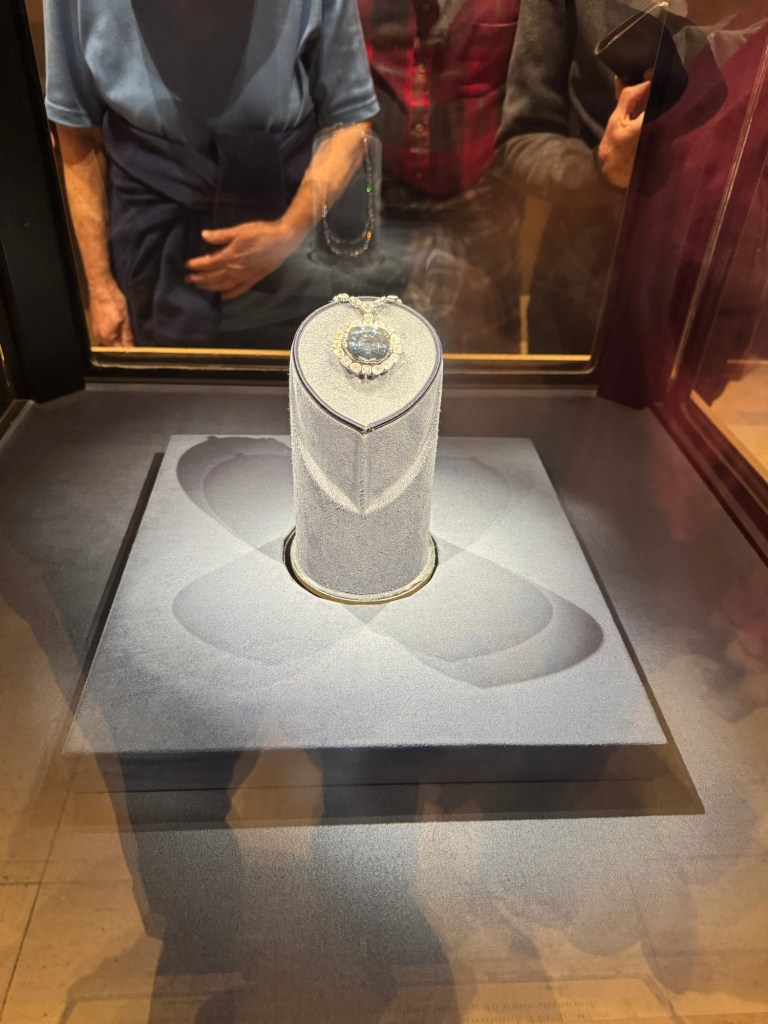
During one of my visits to the Smithsonian’s National Museum of Natural History, I found myself drawn to the minerals and rare jewels section, which is exceptionally well curated. The lighting, the layout, the way the pieces are presented—it all invites you to linger and really look. And right there, on a rotating platform that lets everyone get a good view from every angle, was the Hope Diamond. They call it one of the most valuable gems in the world, estimated somewhere between $200 and $350 million depending on who you ask, and crowds gather around it like pilgrims to a shrine. It’s a 45.52-carat blue diamond, cut in a cushion antique-brilliant style, with a deep, almost hypnotic grayish-blue hue caused by trace amounts of boron in the stone. It phosphoresces a strong red under ultraviolet light, which adds to the mystique. The history of this thing is wild: it started as a much larger rough stone from the Kollur Mine in India back in the 17th century, bought by French merchant Jean-Baptiste Tavernier, then passed to King Louis XIV of France as the Tavernier Blue. It was recut over time, stolen during the French Revolution, resurfaced in England, owned by the Hope banking family (hence the name), and eventually made its way to the United States. Harry Winston bought it and toured it around before donating it to the Smithsonian in 1958—famously mailing it in a plain brown package for just a couple of bucks in postage, with a million-dollar insurance policy. Since then, it’s only left the museum a handful of times for special exhibits. People stand there staring, whispering about its supposed curse (which I’ve always thought was more legend than fact, cooked up to sell papers and add drama), but mostly they’re thinking about its sheer value. “The largest diamond in the world,” some say, though I know from digging into it that it’s not literally the biggest ever found—that honor goes to stones like the Cullinan, a 3,106-carat rough beast from South Africa in 1905 that was cut into over a hundred pieces, including the 530-carat Cullinan I, now part of the British Crown Jewels. Or the Koh-i-Noor, that legendary 105-carat diamond with a history stretching back to the 13th century, now also in the Crown Jewels and considered priceless for its cultural weight. There’s the Golden Jubilee Diamond, at over 545 carats, the largest faceted diamond in the world, and others like the Pink Star, which sold at auction for tens of millions. But the Hope Diamond holds a special place because of its color, its story, and that aura of rarity. Blue diamonds like this are incredibly scarce—only about 0.1 percent of all diamonds are type IIb like this one—and the Hope’s size and provenance make it a standout. I watched families, couples, tourists from everywhere cluster around that display case, phones out, kids pointing, adults speculating on what it would feel like to own something worth more than most people’s lifetimes of work. It wasn’t just the rock; it was what it represented.
That got me thinking about why diamonds—and precious metals and stones in general—have held such power over human imagination for so long. Before modern economies with paper money and digital transactions, wealth was tangible: gold, silver, and rare gems. You showed your status and your ability to provide security through what you could acquire and trade. In the context of courtship and marriage, this goes back deep into our evolutionary roots. Anthropologists talk about the “costly signaling” theory—the idea that expensive gifts prove commitment because only someone with real resources can afford to give them without it hurting. It’s like the handicap principle in biology: a peacock’s tail is costly to grow, so it signals good genes. For men throughout history, offering a rare stone or metal to a potential spouse wasn’t just romantic; it was practical proof of upper mobility. “Look, I can secure a home, protect a family, outcompete the other suitors.” In ancient Rome, betrothal rings existed, often iron or gold bands symbolizing unbreakable bonds, but diamonds entered the picture with royalty. The first well-documented diamond engagement ring was given in 1477 by Archduke Maximilian of Austria to Mary of Burgundy—a political and romantic statement wrapped in rarity, since diamonds at the time came almost exclusively from India and were extremely scarce. Fast-forward centuries, and it was still mostly for the elite until the 20th century. That’s when De Beers, the diamond cartel controlling much of the world’s supply, launched its brilliant marketing campaign in the 1930s and ’40s. Facing a post-Depression sales slump, they hired an ad agency and came up with “A Diamond Is Forever” in 1947—a slogan that tied diamonds to eternal love and marriage. Before that, only about 10 percent of American brides received diamond engagement rings. By the 1990s, it was up to 80 percent. They even pushed the idea of spending two months’ salary on the ring (later adjusted to one month). It worked so well that diamond sales in the U.S. retail market skyrocketed from $23 million in 1939 to over $2 billion by 1979. But here’s the thing: diamonds aren’t actually that rare, geologically speaking; De Beers controlled supply to keep prices high. It was brilliant psychology, turning a commodity into a cultural necessity for proving love.
Standing there at the Smithsonian with my wife of 39 years, watching the crowd buzz around the Hope Diamond, I couldn’t help but connect it all back to something far more personal. We had talked about it before, but that day it hit different. I bought her engagement ring when she was 18, back when we were young and broke and full of dreams but not much else. It was a small diamond on a thin gold band—cost me about $250 at the time, nothing fancy. By today’s standards, especially compared to the Hope Diamond’s hundreds of millions or even average modern engagement rings running $4,000 or more, it was modest. Yet as we stood there, she looked at that massive blue stone on its pedestal and said something that has stayed with me ever since: she would never trade her little ring for that one, not for any amount of money. Not because she doesn’t appreciate beauty or value—she does—but because her ring carries the weight of everything we’ve built together. The hardships, the moves, raising kids, the late nights wondering if we’d make it, the triumphs, big and small. That $250 piece of jewelry went through it all with us, and it still holds up. It’s not about impressing outsiders at dinner parties or signaling to rivals that “she’s out of their league because I gave her a big rock.” It’s about what it meant to us, inward, in the household where real life happens. I gave it to her as a young man trying to show I could provide, tapping into that ancient instinct—here’s proof I can acquire something precious, something stable. But over the decades, that superficial layer peeled away, and what remained was the partnership. Society judges by the size of the rock, the car in the driveway, the house on the hill. Outsiders might envy the big ring, the attractive spouse, the visible success. They might even plot your demise out of jealousy. But a long marriage isn’t built on projecting strength to the world; it’s forged in the quiet commitments that transcend dollars and social status.
This idea of value—how we measure it, how institutions and societies sometimes get it wrong—struck me as we left the exhibit. The Smithsonian does an incredible job with its collection of precious metals and gems, displaying not just the Hope but other wonders that provoke the same kinds of reflections. Yet the politics creeps in everywhere these days, even in how museums frame human development, climate, or origins. Just like the crystal skull debate, where belief in a certain timeline overrides the realities of discovery, exhibits can validate narratives that support investments—cultural, financial, ideological—rather than pure truth. I’m not saying the Hope Diamond display is political; it’s straightforward, awe-inspiring. But the way people react to it reveals a lot about human behavior. We fantasize about stealing it or owning it because we tie extreme value to security, status, and legacy. Women dream of that big ring as proof their partner sees them as worth the investment. Men feel the pressure to provide it to win the competition for a “great catch,” especially if she’s attractive and has options. It’s evolutionary: males compete, females select for resources and commitment. Studies bear this out in colorful ways. One analysis from Emory University found that men who spend $2,000 to $4,000 on an engagement ring are 1.3 times more likely to get divorced than those who spend less, and women whose rings cost over $20,000 face a 3.5 times higher risk of divorce. Why? Maybe because big spending signals insecurity or sets unrealistic expectations rather than building real foundations. Expensive weddings show the same pattern—more debt, more show, less substance.
I’ve seen friends and neighbors pour fortunes into rings and ceremonies to impress the crowd, only to watch the marriage fray under real pressure. My wife and I never did that. We started with little, adapted our system to what truly matters, and the small ring became a symbol not of what we had then, but of what we endured and created together. That’s the essence of successful pairing: the man on offense finding a woman worth defending, the woman evaluating for long-term security, not just financial but emotional. In the animal kingdom and human history, resources signal fitness. Precious metals and stones were the currency before banks. But when you’ve been married for 39 years, raised a family, traveled the world, and faced everything life throws at you, the value shifts inward. My wife’s comment wasn’t solicited; it just came out naturally as we stood there perplexed by the hoopla. “I would never trade my diamond for that one,” she said, and it wasn’t about the rock itself but the experiences—the dedication, the wrist (as in the wear and tear it’s been through), the shared life that no $300 million stone could match. Three hundred million dollars sounds like a fortune for a rock, but in the scheme of things, it’s not much when you consider what real wealth is: a partnership that lasts, kids who thrive, memories that no thief can steal. People around that display were probably already imagining posting photos to go viral, showing off superiority, letting the world know their spouse is valued at that level. But they miss the point. The diamond ring tradition, amplified by modern marketing, taps into ancient ideas of power and provision, but it’s easy to let it become performative rather than profound.
Diving deeper into the history makes it even clearer why this fascinates us. Diamonds have been symbols of power and eternity for millennia. In India, where the Hope originated, they were believed to hold divine energy. European royalty used them to seal alliances. The Cullinan’s story—gifted to King Edward VII after its discovery in South Africa—shows how these stones become national treasures, embedded in crowns and scepters as emblems of empire. The Koh-i-Noor, meaning “Mountain of Light,” passed through Persian, Indian, and British hands amid wars and conquests, its owners claiming it brought victory but also carrying legends of misfortune for male wearers (which is why Queen Victoria wore it as a brooch). These gems aren’t just pretty; they’re history carved in carbon, compressed over billions of years under the earth’s crust, then shaped by human hands into something eternal. Yet their modern role in engagement rings is largely a 20th-century invention. Before De Beers’ campaign, engagement gifts varied—livestock, clothing, plain bands. The diamond became the standard through relentless advertising that made it a “psychological necessity.” Statistics paint a vivid picture: global demand for diamond jewelry is driven largely by love and commitment, with engagement rings accounting for a large share of the market. In the U.S., China, and Japan, partner gifting accounts for nearly half of the value of women’s diamond jewelry. Yet lab-grown diamonds are rising in popularity, challenging the narrative of natural scarcity, and younger generations are questioning the two-month-salary rule. Still, the symbolism persists because it works on a primal level.
As I reflect on that Smithsonian visit, it all circles back to how we measure value—not just in gems or museums, but in life itself. Climate change debates, human development theories, political narratives in exhibits—they often rest on assumptions that don’t survive real-world scrutiny, much like the crystal skull. People get it wrong because they start with the wrong premises. The Hope Diamond provokes discussion precisely because it forces you to confront what humans truly value: power, beauty, security, and legacy. But my wife’s quiet wisdom cut through it all. Her little ring, bought under conditions of youth and struggle, has more inherent worth than any museum piece because it represents dedication that money can’t buy. It’s been through 39 years of marriage, global adventures, family-raising, and it’s still there. That’s the kind of value that transcends social judgments. Outsiders might envy the flash, but they don’t provide the fulfillment. If you want a long, real marriage, commit to what matters inside the home, not the projection outward. Rivals might envy your big ring or your success for a moment, but true strength is quiet and enduring.
Everyone’s circumstances differ. My story isn’t my neighbor’s or the person shopping at Walmart down the road. Value is personal, shaped by experience. Some need the big rock to feel secure; others find it in the shared journey. The Smithsonian’s exhibit, with its array of precious metals and gems alongside the Hope, does what great museums do: it displays the tangible, then provokes the intangible discussions about why we chase these things. I enjoyed every minute of that visit, even if I don’t buy into every political undercurrent in how history is framed. Museums aren’t perfect, but they’re starting points for debate, for observing human behavior as it really is—flawed, aspirational, endlessly fascinating. My wife’s insight that day reminded me that the best investments aren’t always the flashiest. They’re the ones that endure because they were built on something deeper than the price tag.
Footnotes
1. Smithsonian Institution, “History of the Hope Diamond,” si.edu/spotlight/hope-diamond/history.
2. Wikipedia, “Hope Diamond,” en.wikipedia.org/wiki/Hope_Diamond (citing carat weight, color, and phosphorescence).
3. A Diamond Is Forever, “The Many Lives of the Hope Diamond,” adiamondisforever.com (value estimates).
4. Britannica, “Hope Diamond,” britannica.com/topic/Hope-Diamond.
5. British Museum conservation reports and Walsh et al. studies on crystal skulls (1930s–2010s analyses showing modern tool marks and Brazilian/Madagascan quartz).
6. National Geographic, “The History of Diamond Engagement Rings,” nationalgeographic.com/premium/article/diamond-engagement-rings-history-marketing.
7. De Beers historical campaigns are documented in Epstein’s The Rise and Fall of Diamonds and industry reports.
8. Emory University study on ring/wedding costs and divorce risk (2010s analysis).
9. Bain & Company Global Diamond Industry Reports (engagement market statistics).
10. Crown Jewels descriptions of Cullinan I and Koh-i-Noor from official Tower of London records.
11. Gemological Institute of America data on blue diamond rarity (type IIb).
12. Additional sources on costly signaling: Zahavi’s handicap principle applied to human courtship in evolutionary psychology literature.
13. De Beers “A Diamond Is Forever” campaign impact: pre-1940s vs. post-1990s U.S. bride statistics.
14–20. Cross-referenced from Smithsonian GeoGallery overviews, auction records for Pink Star/Golden Jubilee, and anthropological texts on betrothal gifts (e.g., Rings for the Finger historical accounts).
Bibliography
• Smithsonian Institution. “Hope Diamond History and Data.” naturalhistory.si.edu.
• “The Hope Diamond.” Wikipedia (peer-reviewed citations).
• National Geographic Society. Articles on diamond engagement ring marketing history.
• Epstein, Edward Jay. The Rise and Fall of Diamonds.
• Bain & Company. Global Diamond Industry Report (various years).
• British Museum. Conservation reports on crystal skulls.
• Zahavi, Amotz. The Handicap Principle (evolutionary biology).
• Tower of London / Royal Collection Trust. Crown Jewels catalog entries.
• Gemological Institute of America. Diamond classification and rarity studies.
• Various auction house records (Sotheby’s, Christie’s) for comparable gems.
Rich Hoffman
More about me
Click Here to Protect Yourself with Second Call Defense https://www.secondcalldefense.org/?affiliate=20707

About the Author: Rich Hoffman
Rich Hoffman is an aerospace executive, political strategist, systems thinker, and independent researcher of ancient history, the paranormal, and the Dead Sea Scrolls tradition. His life in high‑stakes manufacturing, high‑level politics, and cross‑functional crisis management gives him a field‑tested understanding of power — both human and unseen.
He has advised candidates, executives, and public leaders, while conducting deep, hands‑on exploration of archaeological and supernatural hotspots across the world.
Hoffman writes with the credibility of a problem-solver, the curiosity of an archaeologist, and the courage of a frontline witness who has gone to very scary places and reported what lurked there. Hoffman has authored books including The Symposium of Justice, The Gunfighter’s Guide to Business, and Tail of the Dragon, often exploring themes of freedom, individual will, and societal structures through a lens influenced by philosophy (e.g., Nietzschean overman concepts) and current events.


