

Human history may not merely be the history of humans interacting with one another. It may also be the history of humanity interacting with forms of intelligence that are perceived through altered states, religious experiences, visions, dreams, shamanic practices, meditation, ritual, and perhaps other mechanisms not yet fully understood.
I know this all sounds pretty crazy to a lot of people. But that’s only because the truth has been buried under layers of official stories, political correctness, and institutional pressure for a very long time. I didn’t want to be that guy—the one who connects the dots between ancient Ohio earthworks, strange artifacts that don’t fit the narrative, non-human intelligence, and the spiritual forces that have been pulling strings on human politics since the beginning. As an aerospace executive who has spent decades managing complex programs, dealing with real-world engineering challenges, and advising on politics, I would much rather focus on more profitable and straightforward work. But here I am, sitting in front of the evidence, realizing I have to write this book, The Politics of Heaven, because the journey has pulled me in too deep to ignore.
A few weeks ago, my oldest daughter took a photograph of me at the Johnson-Humrickhouse Museum in Coshocton, Ohio. I was sitting right in front of the Newark Holy Stones. She’s a professional photographer, and she knows how to capture more than just an image—she captures the moment when someone is wrestling with something big. In that photo, you can see it on my face. I didn’t want this. I didn’t ask for it. But as I sat there looking at those stones found by surveyor David Wyrick in the 1860s, considering everything I’ve seen in my travels, my reading, and my own experiences, I knew I had to push forward. This book isn’t just about ancient mounds in Ohio. It’s about the real power behind human history—what the Bible calls spiritual warfare, what modern disclosures call UAP or non-human intelligence, and how those forces have shaped politics, culture, and power on this planet for thousands of years.
Let me start with the Shaman of Newark, that remarkable little stone figurine found in the Newark Earthworks. It’s a small carving, often called the Wray Figurine, depicting a figure in bear regalia—a bear head as a headdress, bear paws on the hands—holding a severed human head in its lap. It was discovered in 1881 near one of the burial mounds at the Great Circle. Archaeologists usually describe it as a shaman in the middle of a transformation ritual, tapping into animal spirits for power. That interpretation makes sense on one level, but it also feels like it’s missing something deeper. Why a severed head? What kind of ceremony or understanding of life, death, and power does that represent? In a culture that built some of the most sophisticated geometric earthworks in the ancient world—the Octagon, the Great Circle, the precise lunar alignments at Newark—this wasn’t primitive superstition. These people had knowledge. They had mathematics. They had a worldview that saw connections among the earth, the sky, and forces beyond the material world.
John Hancock, the architect and author who played a major role in securing the Ohio Hopewell sites’ designation as UNESCO World Heritage Sites, has done excellent work examining these mounds with fresh eyes. I met him at Fort Ancient after grabbing his book at the Newark visitors center. As a retired professor from the University of Cincinnati, he approaches the earthworks as architecture—with intentional design, astronomical alignments, and ceremonial precision. Listening to him speak and reading his travel guide Ancient Ohio, you start to see these sites not as random piles of dirt but as massive, planned expressions of a sophisticated culture. The Newark Earthworks alone cover an enormous area with geometric perfection that still impresses today. These weren’t built by people who didn’t understand the world. They were building something that reflected their understanding of cosmic order.
But here’s where it gets uncomfortable for the official narrative. Right alongside these sites, we have artifacts such as the Newark Holy Stones—the Decalogue Stone, with what appears to be a condensed version of the Ten Commandments in ancient Hebrew, the Keystone, and others found by David Wyrick in the 1860s. The mainstream view is that they are hoaxes, planted to push a pro-Christian or anti-indigenous narrative during the Civil War era. David Wyrick’s life was ruined over it; he died in 1864 from an opium overdose after being accused of fraud. The museum now frames them squarely in the context of 19th-century politics, abolitionism, and efforts to undermine Native claims to the land.
I get why that story is convenient. But it’s also too neat. Why go to all that trouble to carve intricate Hebrew inscriptions if it was just a hoax? And why do similar mysterious tablets keep showing up in Adena and Hopewell contexts—the Cincinnati Tablet, the Wilmington Tablet? The Wilmington Tablet, found in Ohio, has markings that some see as reminiscent of Olmec designs from far away in Mexico. The Cincinnati Tablet was pulled from display at the Cincinnati Museum Center, in part due to NAGPRA sensitivities. These aren’t isolated oddities. They point to long-distance travel and cultural exchange that the standard timeline struggles to explain.
We already know the Hopewell were master traders. They brought copper from the Lake Superior mines hundreds of miles away—mines that some evidence suggests were worked as far back as 5,000 BC or earlier. They hauled obsidian from Wyoming, mica from the Appalachians. If they could do that, why is it so unthinkable that ideas, artifacts, or even people moved along the Mississippi River system and the Gulf to places like the Olmec heartland? The dismissal feels less like science and more like an effort to protect a preferred story. And that story gets even more protected when NAGPRA kicks in, repatriating remains and limiting study of artifacts that might challenge the narrative of continuous indigenous occupation by specific modern tribes.
The Shawnee, for example, have a connection to this region, but they weren’t here continuously for thousands of years. They returned to the Miami Valley in the 1700s after being displaced. Yet modern politics treats them and other tribes as the unquestioned inheritors of everything Adena and Hopewell, giving them influence over what gets displayed or studied. This isn’t respect for evidence; it’s politics overriding archaeology. We’ve talked about this before—the Windover bog people in Florida, from 8,000 years ago, whose DNA doesn’t neatly match that of later tribes. Early populations were more diverse. The idea of unbroken cultural continuity from the mounds to today’s tribes is convenient for land claims and repatriation, but the physical record tells a more complicated story.
This brings me to the bigger question at the heart of The Politics of Heaven: What are the politics of Satan? Is he a Democrat? A Republican? Or something else entirely—something that operates above and behind human parties?
I see history through the lens of spiritual warfare, as described in Ephesians 6:12—“For we wrestle not against flesh and blood, but against principalities, against powers, against the rulers of the darkness of this world, against spiritual wickedness in high places.” The ancient world was full of accounts of gods, giants, watchers, and interactions with non-human beings. The Book of Enoch, the Dead Sea Scrolls, biblical references to Nephilim—these aren’t fairy tales. They describe real influences on human civilization. The mounds, the alignments, the shamanic figures—they may reflect attempts to tap into or negotiate with those forces.
Modern UAP disclosures add another layer. The government has admitted to encounters with craft and beings that defy our physics. Reports of multiple species interacting with humanity. If that’s true—and the evidence is mounting—then humanity has never had full sovereignty. There has always been an outside influence shaping events. Satan, in the biblical sense, isn’t some cartoon devil with a pitchfork. He’s a sophisticated adversary with a political agenda: rebellion against the Creator, domination of humanity, and the perversion of God’s order. His “politics” aren’t partisan in the way we think of left versus right. They are anti-human, anti-God, and aimed at keeping us enslaved to deception, whether through pagan practices in ancient mounds, occult influences in modern culture, or centralized power structures that erode individual liberty and truth-seeking.
Look at how the narrative around these sites is managed. Inconvenient artifacts are dismissed as fakes or removed from view. Oral tradition is elevated over physical evidence under updated NAGPRA rules. The shaman figure holding a severed head gets sanitized into “spiritual transformation,” while any suggestion of deeper, darker knowledge or outside influence is shut down. Meanwhile, we celebrate the geometric precision of the earthworks—the lunar alignments at Newark are astonishing—but stop short of asking what kind of knowledge enabled that, or what spiritual purpose it served.
I’ve spent my life in aerospace, watching humanity push into space, building rockets, solving technical problems. I’ve seen model rocketry with my grandson, teaching resilience when launches fail in bad weather. That hands-on experience makes me appreciate what the ancient builders achieved. But it also makes me skeptical of stories that downplay their sophistication or attribute everything to mundane explanations while ignoring the anomalies.
My travels have taken me to many of these sites, from Newark to Fort Ancient, from the Mothman Museum in Point Pleasant to arguments with staff at the British Museum over the crystal skull (another “fake” that raises the same questions—why the effort if it’s not real?). I love museums and their gift shops. I’ve found replicas of the Wilmington Tablet there, and it always strikes me how obscure these things are to the average visitor. Yet they hold clues.
The Politics of Satan plays out in the suppression of truth. It plays out when we prioritize feelings and political reconciliation over evidence. It plays out when we assume ancient people were isolated primitives rather than connected participants in a larger cosmic drama. And it plays out today in the way power structures—whether in government, academia, or media—control what we’re allowed to question.
This book is my effort to follow the evidence wherever it leads, even when it takes me places I didn’t want to go. It’s personal. It includes family stories, like that rocket launch with my grandson on a windy day, or RV trips, or political activism in Butler County. Because truth-seeking isn’t abstract, it happens in real life, with real people, while you’re trying to live, work, and raise resilient kids in a world under unseen influences.
I don’t claim to have all the answers. But I do know this: the official narrative has too many holes. The mounds, the tablets, the shaman, the trade networks, the astronomical knowledge—they point to something more. Non-human intelligence has been here a long time. The question is whether we recognize the spiritual dimension and reclaim our sovereignty under God, or continue letting the politics of rebellion shape our future.
That’s the journey The Politics of Heaven invites you on. It’s not comfortable. But ignoring it won’t make it go away. The truth is coming fast, whether we’re ready or not.
Rich Hoffman
More about me
Click Here to Protect Yourself with Second Call Defense https://www.secondcalldefense.org/?affiliate=20707
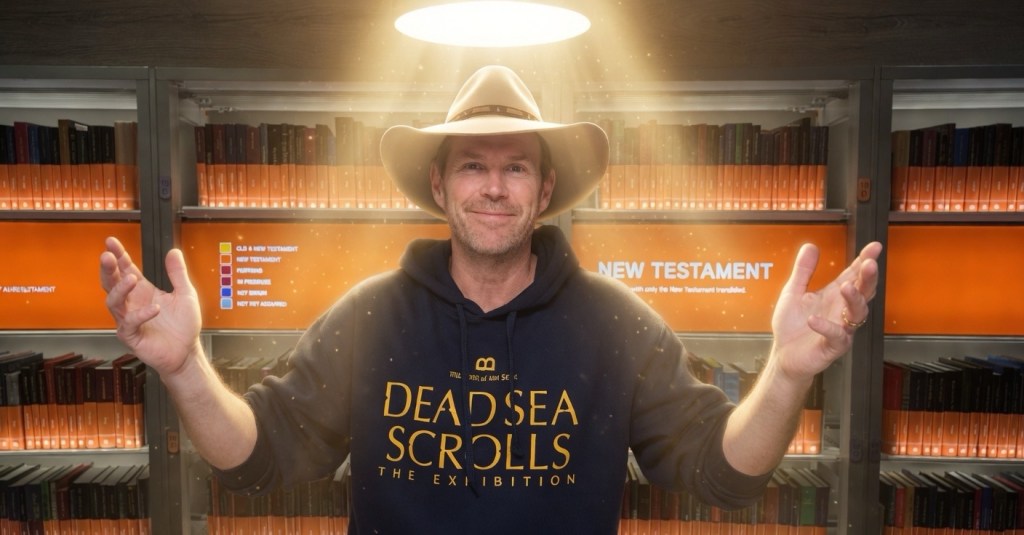
About the Author: Rich Hoffman
Rich Hoffman is an author, political consultant, and strategic advisor based in Cincinnati, Ohio, and the creator of The Politics of Heaven—a unique framework that connects biblical theology, ancient history, and modern power structures to explain how moral alignment and spiritual forces shape global events. Blending real-world political experience with deep research into archaeology, UFO phenomena, and suppressed historical narratives, Hoffman offers compelling commentary on topics ranging from ancient civilizations and the Dead Sea Scrolls to modern populist movements, paranormal continuity, and leadership strategy in chaotic environments. As the author of The Gunfighter’s Guide to Business and the forthcoming Politics of Heaven, he brings a grounded yet provocative voice to media discussions, supported by firsthand experiences and a cross-disciplinary approach that bridges science, history, and theology. For interviews, speaking engagements, or expert analysis, visit richhoffmanbooks.com or contact directly via phone at 513-307-5815 or email at rhoffman@richhoffmanbooks.com. If you’ve seen the movie, Disclosure Day and want to talk about it and the implications of Presidnet Trump’s UAP disclosures, let me know and we can bring some color to your coverage. https://richhoffmanbooks.com/media-inquiries-broadcast-topics-and-contact-info/?frame-nonce=ad51e7ecba I do have a firsthand UFO encounter to discuss.

