

I have been following the developments in space with a kind of quiet intensity these past few years, the way a man watches the weather when he knows his livelihood and his grandchildren’s future depend on understanding which way the wind is truly blowing. What is unfolding right now is not just another round of rocket launches or another billionaire’s side project. It is the opening of an entirely new economic frontier, one that will make the industrial revolutions of the past look small by comparison. The space economy is already measured in the hundreds of billions and is projected to reach $1.8 trillion by 2035, with some projections running well beyond that once Starship-class vehicles make mass-to-orbit routine and cheap.
I picked up Rainer Zitelmann’s new book, New Space Capitalism: The Entrepreneurial Path to the Stars, the week it came out, the same week SpaceX went public in what is already being called one of the largest IPOs in history. It is a little over three hundred pages, the kind of book a man can start after dinner and finish before midnight if he reads with purpose. I read it straight through in one of my evening sessions, the same way I have been working through four or five books a week for years. Zitelmann lays out the historical case plainly: government monopoly and central planning never scaled space the way private enterprise, property rights, and relentless iteration can. The book arrived at exactly the right moment, when the largest single company in the sector was opening itself to Main Street investors, and the manufacturing revolution at Boca Chica was becoming impossible to ignore.
A day or so later, I watched the CNBC interview with Gwynne Shotwell, president and COO of SpaceX. She has been there from the early days, the steady hand next to Elon Musk’s electricity. The conversation was one of those rare television moments where you could feel the ground shifting under the old assumptions. She spoke about manufacturing techniques the way a craftsman talks about a well-tuned machine, not the way most aerospace executives talk about compliance and risk matrices. She described facilities where the design-test-fly-fix loop runs so fast that what was not even contemplated on flight twelve is already being incorporated for the next ones. The flame trench and diverter that now channel the exhaust were not part of the original flight-one plan; necessity and data drove the change, and they made it happen without waiting for a decade of committee reviews. That is the new standard.
I have spent my working life in aerospace. I know what the old way looked like from the inside: layers of requirements that accumulated over decades, change orders that took months or years to process, engineers who had learned to protect themselves by writing rules that nobody could later say they ignored. The result was predictable. Progress crawled. Costs ballooned. The same organizations that once put men on the Moon in less than a decade now need longer to decide whether a minor material substitution was acceptable. SpaceX has broken that pattern at Boca Chica and the new facilities rising at Cape Canaveral. They are building the equivalent of a Toyota Production System for orbital-class vehicles, only the takt time is measured in days and weeks instead of minutes on an assembly line. The goal is a Starship every couple of days, with longer-term ambitions of three per day once the infrastructure matures. They are already talking about monthly flights by the end of 2026 and then scaling from there.
Marcus House has been documenting every step of this on his YouTube channel, week after week, with the kind of detail that lets a serious observer see the trend lines before the headlines catch up. Flight twelve went up a few weeks ago. Thirteen, fourteen, and fifteen are already in various stages of stacking and testing. The new Gigabay structures going up will give them dozens of parallel workstations. That is how you move from a handful of flights a year to something that starts to look like routine transportation.
What Shotwell made clear, and what the book reinforces, is that this manufacturing revolution is not limited to rockets. Once you have a vehicle that can put serious mass into orbit on a regular cadence, everything downstream changes. Starlink already blankets the planet with broadband and is moving to direct-to-cell. The same architecture that delivers low-latency internet can host compute. There is serious discussion now about data centers in orbit, where power and cooling constraints on the ground become someone else’s problem and latency to certain users drops dramatically. Rare-earth mining on the Moon stops being science fiction once you have a bus that can go up and come back with tonnage instead of ounces. Orbital manufacturing, propellant depots, and eventually point-to-point Earth transport all become engineering problems rather than physics problems.
The economic implications are straightforward. Abundance at this scale does not require redistribution; it requires production. The old arguments that we must slow growth so that workers can be paid more or protected from robots miss the point entirely. I have seen what happens when labor is unreliable. I worked service jobs when I was younger and watched people spit in food because they were mad at a manager or distracted by drive-through drama. Robots do not have bad days, do not call off, and do not need a union to show up on time. They are tools. The people who own the tools, or who own shares in the companies that deploy them at scale, will see the returns. That is how wealth has always compounded when new production frontiers open. The difference this time is that the frontier is not a continent or an ocean; it is everything above the Kármán line and everything those vehicles can enable on Earth.
I hear the same tired pushback I heard in 2020 and 2021. Lock everything down, work from home, let the government manage the allocation of resources and risk. We tried that experiment on a national scale. Manufacturing and logistics do not run on Microsoft Teams. The people who insisted they did were usually the same voices that had spent years teaching children that socialism was just “being nice to each other” and that capitalism was exploitation. By 2035, those lessons will look as primitive as slide rules. The children who were told the economy is a fixed pie will watch robots and AI handle the drudge work while new markets in orbit and on the Moon create wealth that did not exist before. Some of them will have equity in the companies doing the work. Others will live in a world where goods and services that once required human hands at every step are cheaper and more reliable.
Here in Butler County, the evidence is already visible if you drive the roads I have driven for fifty years. The data centers going up around Trenton are not abstract. They are the physical plant that will run the AI models training the next generation of robots and processing the firehose of data coming down from Starlink constellations. I pass the old Armco site and the steel legacy of Middletown on one side and the Garver family farm on the other, stopping for fresh apple juice at their little store the way I have for years. The new infrastructure needs power, land, and water. Ohio has all three. The question is whether we welcome the growth that funds schools and roads and keeps farms viable, or let the same regulatory and cultural habits that slowed aerospace for decades strangle this opportunity, too. I know which side I am on.
My own life has been a long argument for the same principle that Shotwell and Musk are proving at industrial scale. Show up. Do the work. Iterate faster than the problem can change. I have worked sixteen- to twenty-two-hour days for most of my career, with power naps when the body demands them, because the alternative was letting someone else define the pace. That is the same mindset that turns a flame trench that was not on the original drawing into standard equipment on the next vehicle. It is also the mindset that lets a man in his later decades look at regenerative medicine, extended healthspan, and robot labor not as threats but as tools that let him keep contributing on his own terms, rather than being forced into some bureaucratic retirement at sixty-five or seventy.
By 2035, we will look back on 2026 the way we now look back on 1995. The phones will be different, the medicine will be different, the available jobs and the definition of retirement will be different, and a meaningful fraction of the global economy will trace its supply chains through orbit. The people who positioned themselves to own a piece of that expansion, whether through equity, skills, or simply the willingness to adapt, will have options their parents could not have imagined. The people who spent the intervening years trying to slow the world down to the speed of the least ambitious regulator will be wondering what happened.
I am not telling anyone to quit their job and day-trade Starship futures. I am saying pay attention. Watch the weekly updates from people like Marcus House who track every stack and every test fire without corporate spin. Read the book that puts the current moment in historical context. Catch the interviews with the people actually building the hardware, the ones who have to make payroll and hit launch windows while the rest of the world argues about pronouns and pronouns and pronouns. The manufacturing standard being set at Boca Chica is already leaking into every other industry that has to move metal and electrons at scale. The capital that flowed into the SpaceX IPO is the first wave of what will become a much larger reallocation toward anything that reduces the cost of moving mass or processing information above the atmosphere.
I have grandchildren. I want them to grow up in a country that still knows how to build things faster than it can regulate them into mediocrity. I want them to have the option to work because they choose to, not because a clock is ticking on their productive years. The space economy does not guarantee any of that on its own. Only the underlying philosophy does: that human beings thrive when they are free to try, free to fail, free to keep the fruits of success, and free to try the next morning again with better data. That is what I see when I watch a Starship climb out of Boca Chica and when I read a book that explains why private enterprise, not state planning, is the only force that has ever scaled a frontier this far.
The old arguments will keep coming. They always do. The people who benefit from scarcity and control will insist that abundance is dangerous, unfair, or bad for the planet. They will be wrong in the same way they were wrong about the internet, wrong about container shipping, wrong about every technology that lets ordinary people do more with less supervision. The evidence is already in the sky and on the factory floor in South Texas. It is also in the data centers rising in places like Trenton and in the quiet confidence of the engineers who have stopped asking permission to move fast.
I intend to keep watching, keep reading, and keep saying what I see. The next ten years are going to be loud. They are also going to be the most opportunity-rich stretch any generation has seen since the opening of the American West. The only question worth asking is whether we will meet that opportunity with the same spirit that built the first Starships, or let the people who have never built anything tell us it is moving too fast.
Footnotes
¹ McKinsey & Company / World Economic Forum, Space: The $1.8 Trillion Opportunity for Global Economic Growth (2024/2025 projections).
² Rainer Zitelmann, New Space Capitalism: The Entrepreneurial Path to the Stars (Skyhorse Publishing, June 9, 2026).
³ CNBC interview with Gwynne Shotwell, June 12, 2026 (Morgan Brennan).
⁴ SpaceX official updates and production reports, 2026.
⁵ Marcus House YouTube channel, weekly Starship and SpaceX updates (e.g., “SpaceX Just Revealed Its Biggest Plans Yet,” June 2026).
⁶ Walter Isaacson CNBC/Squawk Box discussion on SpaceX IPO and new space economy, June 2026.
⁷ Additional context from Zitelmann’s book and historical analysis of private vs. public space efforts.
⁸ Personal observations from aerospace executive experience and local Butler County development (Trenton data centers, Garver Farms area).
Bibliography
• Zitelmann, Rainer. New Space Capitalism: The Entrepreneurial Path to the Stars. Skyhorse Publishing, 2026. (With contributions/foreword elements involving Newt Gingrich in related coverage.)
• McKinsey & Company and World Economic Forum. Space: The $1.8 Trillion Opportunity for Global Economic Growth. 2025 report.
• SpaceX official website updates on Starship production and facilities (Starbase/Boca Chica, 2026).
• CNBC transcripts and videos: Gwynne Shotwell interview (June 12, 2026) and Walter Isaacson on SpaceX IPO.
• Marcus House. YouTube channel – regular, in-depth coverage of Starship flights, manufacturing, and space-economy news.
• Additional economic analyses from Payload Space, Morgan Stanley, and related space industry reports on trillion-dollar projections and manufacturing shifts.
Rich Hoffman
More about me
Click Here to Protect Yourself with Second Call Defense https://www.secondcalldefense.org/?affiliate=20707

About the Author: Rich Hoffman
Rich Hoffman is an author, political consultant, and strategic advisor based in Cincinnati, Ohio, and the creator of The Politics of Heaven—a unique framework that connects biblical theology, ancient history, and modern power structures to explain how moral alignment and spiritual forces shape global events. Blending real-world political experience with deep research into archaeology, UFO phenomena, and suppressed historical narratives, Hoffman offers compelling commentary on topics ranging from ancient civilizations and the Dead Sea Scrolls to modern populist movements, paranormal continuity, and leadership strategy in chaotic environments. As the author of The Gunfighter’s Guide to Business and the forthcoming Politics of Heaven, he brings a grounded yet provocative voice to media discussions, supported by firsthand experiences and a cross-disciplinary approach that bridges science, history, and theology. For interviews, speaking engagements, or expert analysis, visit richhoffmanbooks.com or contact directly via phone at 513-307-5815 or email at rhoffman@richhoffmanbooks.com. If you’ve seen the movie, Disclosure Day and want to talk about it and the implications of Presidnet Trump’s UAP disclosures, let me know and we can bring some color to your coverage. https://richhoffmanbooks.com/media-inquiries-broadcast-topics-and-contact-info/?frame-nonce=ad51e7ecba I do have a firsthand UFO encounter to discuss.

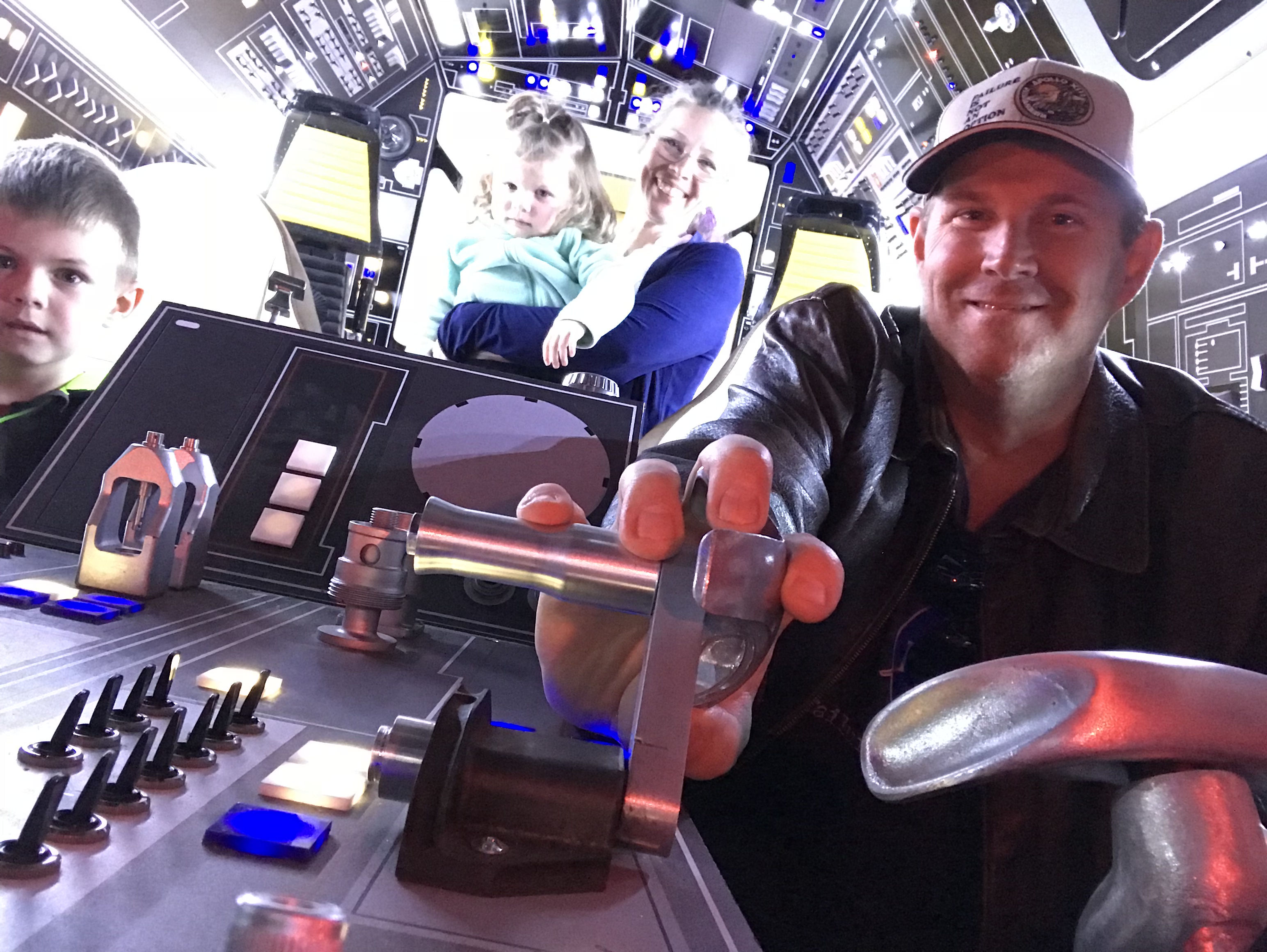 The first thought I had while touring The Millennium Falcon Experience at the Northern Kentucky University campus was that this fictional ship from the Star Wars stories would be the best way to travel from Earth to Mars, or the moon and some more distant destination within our solar system. I thought of Jules Verne’s great book From the Earth to the Moon where he conceived of the rocket design that would be used 100 years later when NASA would eventually launch people into space and land on the moon. Star Wars was much more than just geek fandom. While I had personally thought about sitting in the cockpit of the Millennium Falcon from the movies most of my life, and never thought I’d ever get a chance to actually do so, when the time did come I couldn’t help but think of real space travel using the actual design of the Millennium Falcon to serve as a foundation for a fleet of ships that would take commercial space travel to the next level.
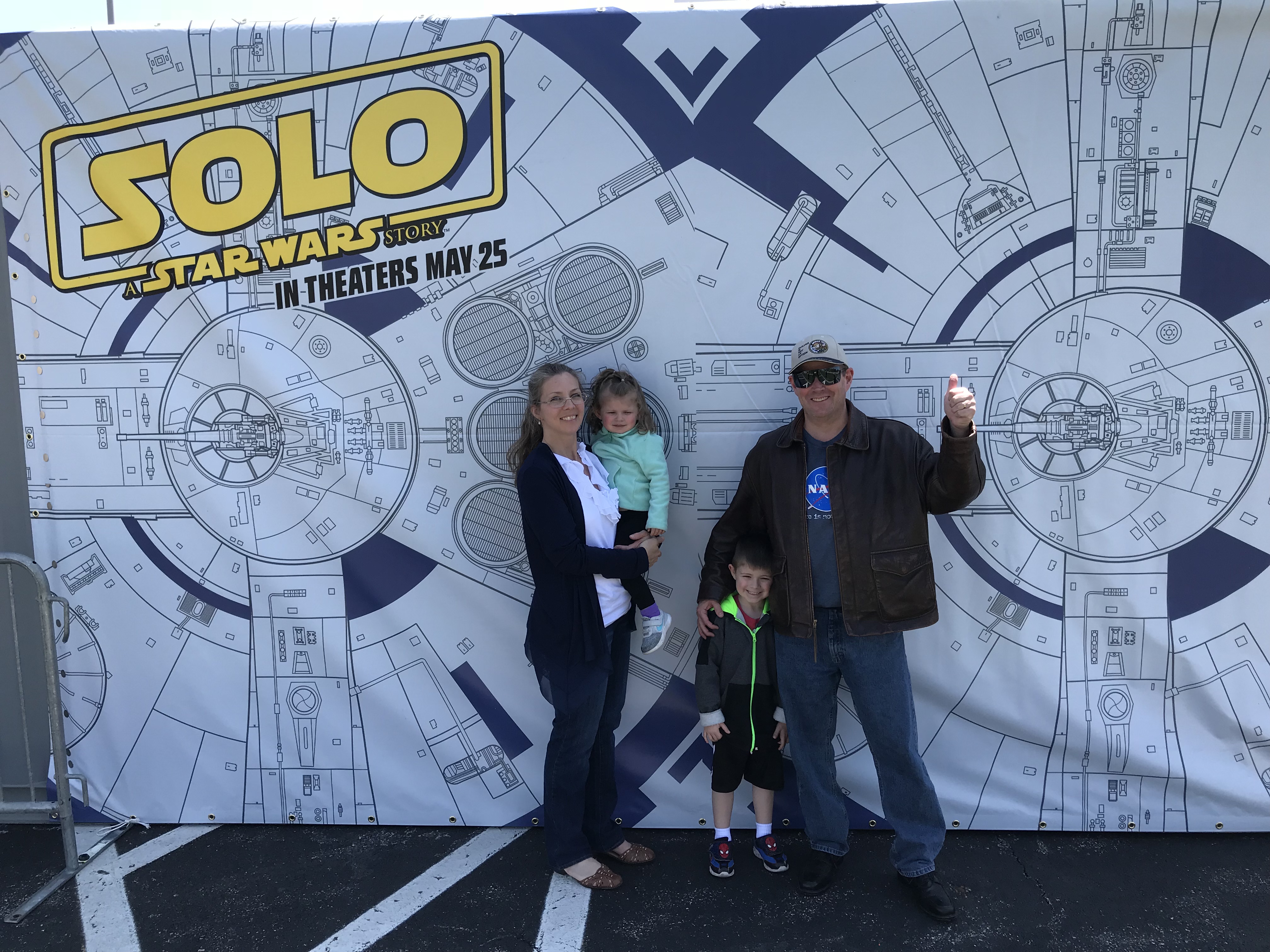
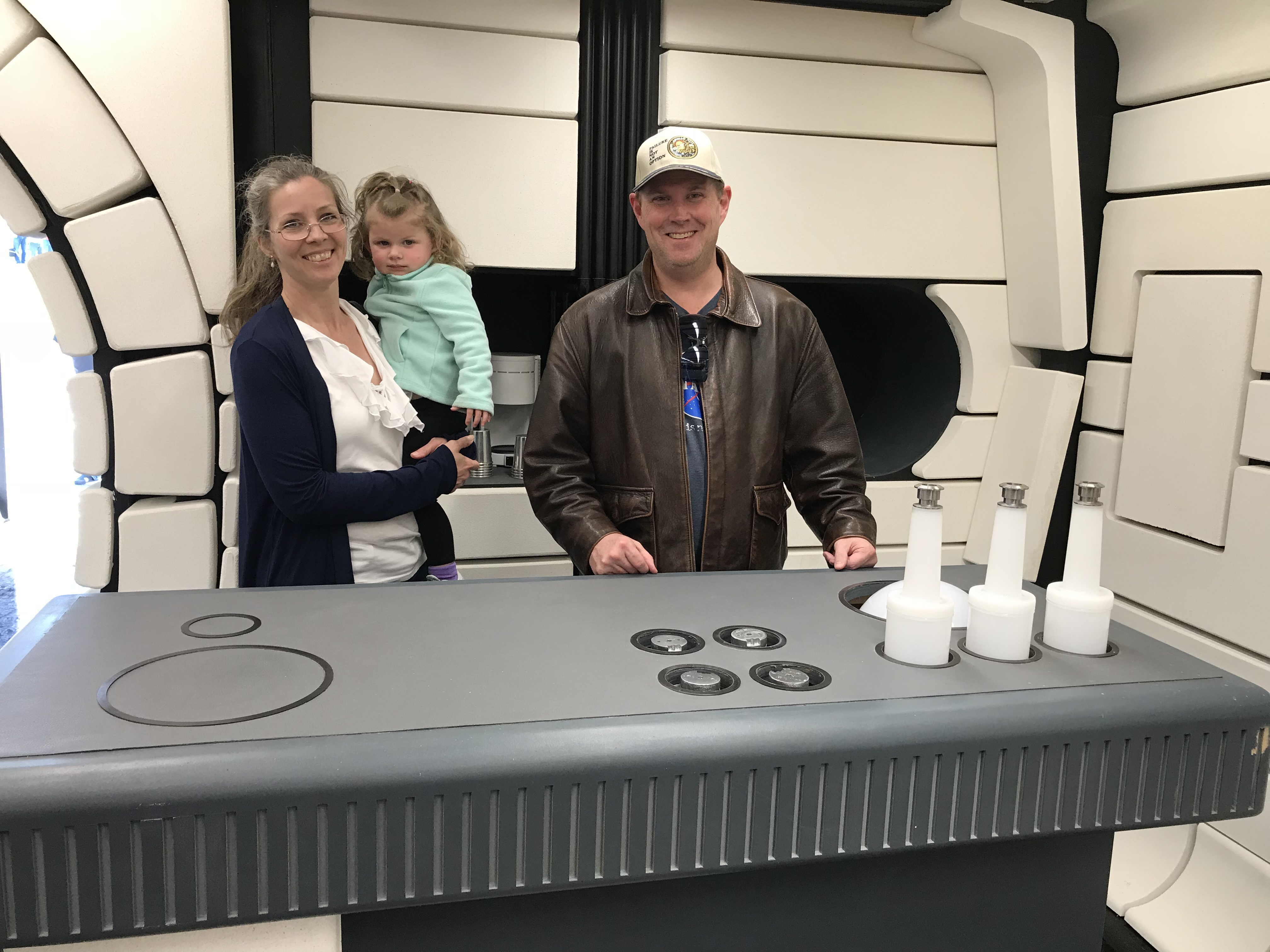


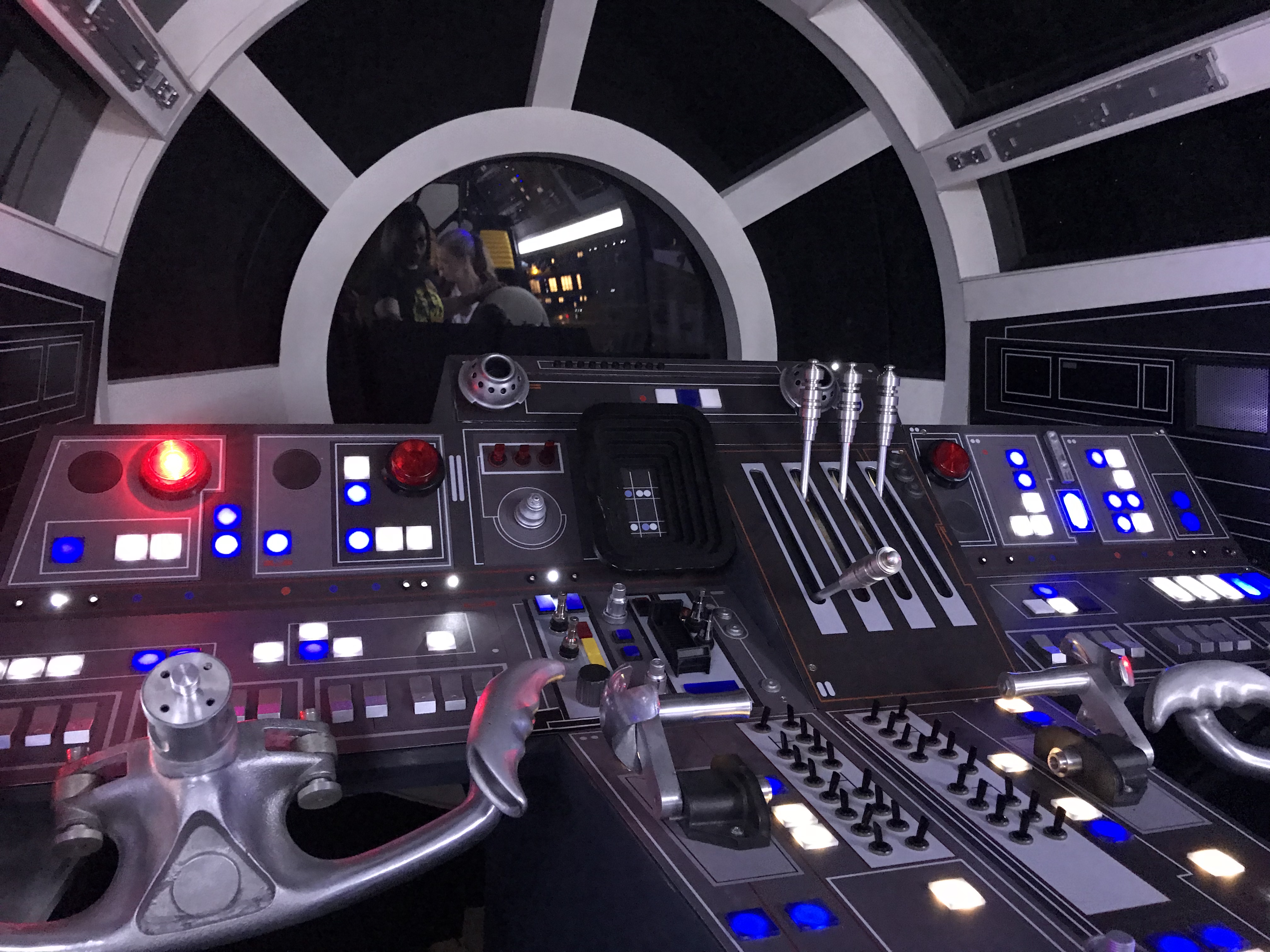 To me the most impressive thing about the Millennium Falcon Experience was that after only 50 years of film history fans of the movies have finally figured out how to make the ships that were shown in Star Wars, and now artists and craftsmen are able to actually recreate what we see in the movies in real life. The next steps become rather obvious at that point and that is truly exciting. The Millennium Falcon Experience at NKU advertising a new Han Solo movie was something I personally never thought I’d see. But after seeing it, and touching it, and soaking it all in—I have a feeling that we will all be seeing a lot more of it in the years to come. As I left that exhibit I had the strange feeling that I may just own my own Millennium Falcon in a few years that can fly to Mars and back many times over as routinely as we can now drive to Florida now in a car. And I think I would like that world very much!
