The worldwide total box office take for Disney’s The Lone Ranger was $239,131,00 which is respectable. It was hardly the box office flop that the entertainment industry has attempted to project it to be. I felt that The Lone Ranger deserved a bit of defense because it was a hack of a good movie. I heavily promoted it, I loved the film, and I am sure that when it hits the home theater market, it will do excessively well. Disney spent the enormous sum of $215 million on the production of the modern western plus many tens of millions on advertising hoping the picture would bring in a billion dollars as a summertime blockbuster. But the money wasn’t there. By the time the summer box office market hit the Fourth of July, movie goers had already spent their money on superhero pictures like Iron Man 3 and Man of Steel. Money was still spent on children’s films like Monster’s U and Disney’s Planes, but for the most part, movie audiences had run out of money leaving many studio films to fail at the box office. But when it came to The Lone Ranger, there was a hatred from the entertainment community that caused them to even turn against Johnny Depp, which I found fascinating, and I know exactly why. A good portion of the why is seen in a totally unrelated Blaze Television piece that Glenn Beck did about his experiences on a real western ranch. The entertainment community in Hollywood’s Wilshire Blvd and Broadway in New York has grown to despise the “flyover states” and Glenn Beck is part of that New York culture which is where he made his fame and fortune. But wisely, he has moved away in search for truth and discovered the America that the rest of us already know about, and he is touched by the results.
The Lone Ranger as a Disney film was about these good ol’ fashioned attributes of self-reliance and rugged individualism. The movie will be looked back upon as a success as it will become a fan favorite in the years to come once it gets away from the entertainment machine that is rooted in progressive political causes. The Lone Ranger was in fact too good for the modern film community. They did not want it to do well because they didn’t want to have to compete against it with future remakes and copy-cat attempts by other studios. Modern progressives do not want to revisit the era of the American western. They do not want western values to exist in American culture for many of the reasons Glenn Beck uttered in his short video clip above.
The movie business is changing dramatically, and industry insiders know it will not be to their advantage. They resent Disney as a family film studio and the amount of money they generate. Disney thankfully holds the rights to Marvel Comics, Pixar, their own slate of family programming and now the massive franchise of Star Wars which I’m going to state emphatically is set to change the world with “western values.” Star Wars is a modern western. George Lucas made Star Wars in the spirit of the old Saturday morning serials that made The Lone Ranger so popular and there is little that the world can do at this point to stop the explosion of Star Wars that is about to burst upon the world. Movie studios attempting fixed progressive social messages can see that Disney is positioned to get the “family friendly” message out to the flyover states for the next 20 years while they collapse under the weight of competition.
That competition is driven by union labor. The cost to make movies is too high because labor demands are too ridiculously over-rated and most studios cannot make films that will garner over $500 million in worldwide market sales which is what it takes to cover modern production costs. So many studios will drown within the next decade because they will have to produce more comedies, more chick flicks, and more small pictures that are not so effects driven, because during the summer of 2013, many of them took a bath that they drowned in. The impact of 2013 won’t be seen until 2015. In that year, Disney will become the most dominant film studio in entertainment as the rest of the entertainment establishment reels. Other studios will have to file for bankruptcy. They will not be able to compete.
Disney has their own internal marketing machine, their own amusement park revenue, and they own ABC, ESPN and many other media outlets, so they can afford to have the rest of the industry turn their back on them, which they did when The Lone Ranger was released. Critics went after the film more for the power that Disney had, than because the film was bad. The industry wanted to see Disney fail because they know what’s coming, and they resent the filmmaker Jerry Bruckheimer openly naming himself a conservative while he was promoting The Lone Ranger. That is where the real hatred for The Lone Ranger filmmakers and the film itself stemmed from. Disney is not making movies for the Los Angeles and New York markets, but for the other 48 states that are the “flyovers.”
When Star Wars hits the release phase, Lucasfilm under the protection of Disney is going to produce the most intense schedule of family programming ever seen in the motion picture, and television industry. I have read just about every Star Wars novel, and I can report that there is so much wealth in that story line that literature has never seen anything like it. When that material becomes television shows, cartoons on the Disney Channel, more novels, more movies, more video games, entertainment will be changed forever. And Star Wars is not a progressive production—it is traditional in the way that The Lone Ranger was a western set in the desert during a historical past; Star Wars is a western set in the distant past in deep space.
When it is wondered what the Huffington Post and Glenn Beck have in common, it is Star Wars. The Huffington Post covers every move of the Star Wars production with keen interest and if anybody has read any books by Glenn Beck Star Wars references are common, especially in his novel The Overton Window. When Star Wars hits theaters in the winter of 2015 after Avengers Two dominates the summer box office the world will change in entertainment. A new bar will be set, and many studios will collapse under the pressure. They know this instinctively and they took out their frustration on The Lone Ranger.
In the end, The Lone Ranger will get the last laugh. It will not be a financial loss for the Disney studio as it will easily cover its marketing budget with home sales on Blu Ray. But more than that, The Lone Ranger is one of the many influences of Star Wars. The values of The Lone Ranger are the values of Jaina Solo who will be the star of the next Star Wars film. She will go down in history as the strongest female protagonist in any movie at any point in time, and Disney will be the studio that can take credit for it. Disney will not need the New York and Los Angeles media in their court. They will have the “fly over states” and a very hungry international market that is poised to consume the intensely “western” values of Star Wars which will eclipse everything else produced by all other studios. In the end, The Lone Ranger produced by the Disney Company will ride off into the sunset knowing the part it played in the creation. Critics attacked The Lone Ranger not because it was a bad movie, but because of the values it articulated. But even their parade of insults did not prevent the film from doing respectable business. For Disney however, the best is yet to come, and for those who were afraid of The Lone Ranger, wait till the impact of the new generation of Star Wars hits a youth that is so hungry for heroes that they can think of little else. The emotional void left by our modern progressive society will fill quickly with values that were born in the American western.
And no group of progressives, Fabian socialists, or open communists will be able to stop it this time……………………………………….
The western is back. But this time the horse will be replaced by space ships, the gun and the whip by the lightsaber of Jaina Solo.
Many kids these days have no idea that the character of Woody from the popular Toy Story films was directly inspired by The Lone Ranger television show that was so extremely popular immediately after World War II. The last time the Lone Ranger made any kind of legitimate appearance in either television or motion pictures it was in the 1981 film The Legend of the Lone Ranger which had mild success, but involved the tragic injury of Terry Leonard, the famous stuntman from Raiders of the Lost Ark. In the 1981 film, a stagecoach accident ran over both of Terry’s legs which tarnished the film a bit to even my young eyes. The scene made it into the movie, but was difficult to accept as I always related more with the stuntmen in films than I ever did the actual actors. There was a time in my life where I wanted to be a stuntman more than anything else, but that idea subsided a bit after several violent car crashes, encounters with actual villains who shot real bullets, and a few years of marriage. But deep in my heart is the love of the Lone Ranger and his code of moral conduct that helped shape America’s identity with his classic white hat, black mask, and silver bullets.
My primary exposure to the Lone Ranger came from Saturday morning serials. For me it was always a toss-up between the Lone Ranger, and Zorro who I loved more. One of those classic Republic serials can be seen throughout this article. I’m sharing it in the same way that I shared the Republic serial, Zorro’s Fighting Legion. These types of programs made a point to teach children and adults values they could both share. This is why I am so eager to see the new Lone Ranger film by the Disney Company.
The Lone Ranger is a fictional character: a masked ex-Texas Ranger who, with his Indian companion Tonto, fights injustice in the American Old West. The character has become an enduring icon of American culture.[7]
He first appeared in 1933 in a radio show conceived either by WXYZ radio station owner George W. Trendle[3][4][5] or by Fran Striker,[8] the show’s writer.[9][10] It has been suggested that Bass Reeves, a legendary Federal peace officer in the Indian Territory (1875 – 1907) was the inspiration for this character.[11][12] The show proved to be a hit, and spawned a series of books (largely written by Striker), an equally popular television show that ran from 1949 to 1957, and comic books and movies. The title character was played on radio by George Seaton, Earle Graser, and most memorably Brace Beemer.[8] To television viewers, Clayton Moore was the Lone Ranger. Tonto was played by, among others, John Todd, Roland Parker, and in the television series, Jay Silverheels.
Departing on his white stallion, Silver, the Lone Ranger would shout, “Hi-Ho, Silver! Away!” As they galloped off, someone would ask, “Who was that masked man, anyway?” Tonto usually referred to the Lone Ranger as “Ke-mo sah-bee“, meaning “trusty scout” or “trusted friend.”[13] These catchphrases, his trademark silver bullets, and the theme music from the William Tell overture have become tropes of popular culture.
In every incarnation of the character to date, the Lone Ranger conducts himself by a strict moral code put in place by Striker at the inception of the character. Actors Clayton Moore[6] and Jay Silverheels[citation needed] both took their positions as role models to children very seriously and tried their best to live by this creed. It reads as follows:
I believe…
That to have a friend, a man must be one.
That all men are created equal and that everyone has within himself the power to make this a better world.
That God put the firewood there, but that every man must gather and light it himself.
In being prepared physically, mentally, and morally to fight when necessary for that which is right.
That a man should make the most of what equipment he has.
That ‘this government of the people, by the people, and for the people’ shall live always.
That all things change but truth, and that truth alone, lives on forever.
The most updated version of The Lone Ranger comes out on July 3rd, and I can’t think of a better film to see which celebrates the 4th of July. The Lone Ranger is a special kind of film and I sincerely hope that Jerry Bruckheimer is able to do for the American western what he did for swashbuckling pirate films. If he does, then western values have a real chance at re-emerging in American culture.
It is about time that children learn clean speaking cowboys are not just playthings in a toy box like Woody was in Toy Story. The Lone Ranger is the original Woody, and I relish that the film is coming out around such a patriotic holiday, because the Lone Ranger is a uniquely American creation for a uniquely American audience that is being exported to every corner of the world by one of the largest and most successful companies in the world. It should go without saying that I will be seeing it at the earliest possible screening.
Now, one of the most heavily searched items on my site here at Overmanwarrior’s Wisdom for the last three months has been the question, “Is the William Tell Overture in the new Lone Ranger.” Well, for the answer, you can hear it from Han’s Zimmer himself.
Don Steinberg from The Wall Street Journal — Ok, so over to “The Lone Ranger.” And speaking of theme music: there’s probably never been any audible version of the Lone Ranger that didn’t use the William Tell Overture. Do you nod to that?
Hans Zimmer response – I was listening to a Billy Connolly quote, and he said the definition of an intellectual is if you can listen to the William tell Overture and not think of the Lone Ranger. Ok, we didn’t go the intellectual journey. We fully embraced the William Tell. Needless to say, we couldn’t leave well enough alone, so it has a little tweak. Actually it’s tweaked quite bit. I don’t know how long the Overture is — it depends on how fast you play it — but that Lone Ranger bit is two minutes long, at the most. And, as I found out, Mr. Rossini felt that was all he had to say. So there are some expansion opportunities. Plus, needless to say, they don’t hire me just to orchestrate Rossini. They want a bit of my dirty fingerprints all over it.
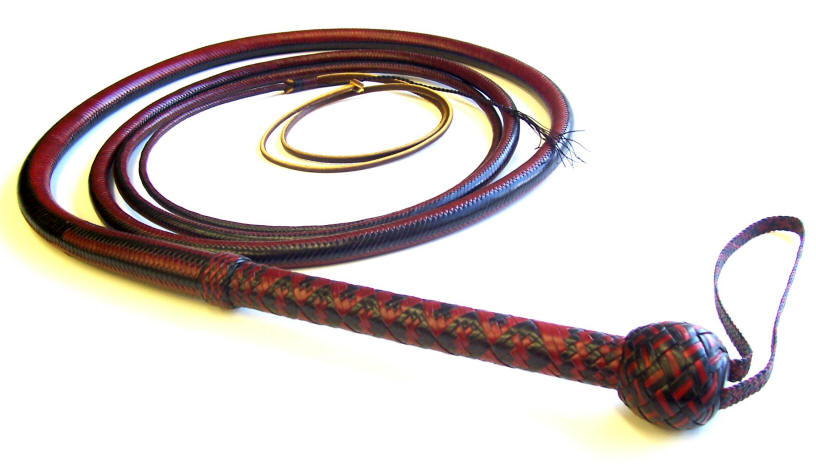
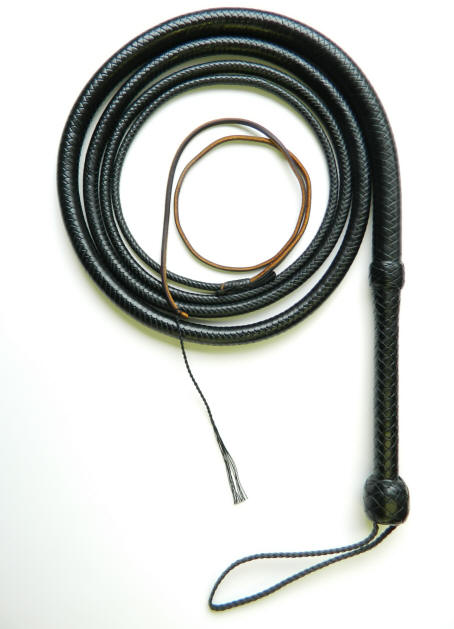
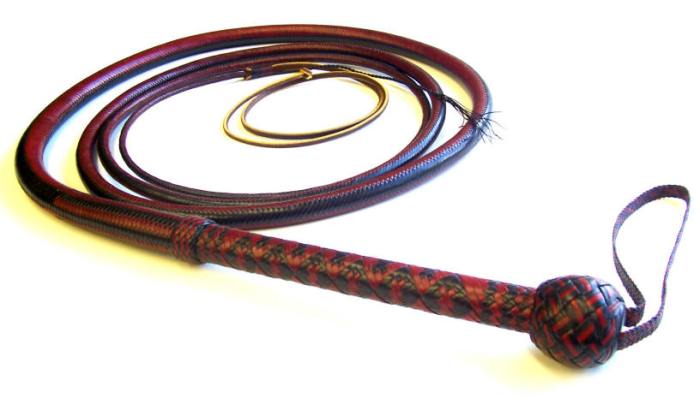
Joseph Strain supplied 3 whips for the 2013 production of The Lone Ranger, one black 10 foot, one black 12 foot and one brandy 12 foot.
The whip pictured below is the black 10 foot prototype. The whips were all made from kangaroo, had 10 inch handles, were a finely cut 12 plait with 2 plaited kangaroo bellies. The 32″ falls were alum tanned burgundy latigo and the poppers were black nylon. The whips also had a narrower 4 plait wrist loop measuring 7 inches long.
For a limited time, you can order one of these whips exactly as made for the movie by Joseph Strain. Production will take from 4 to 6 weeks from the time of order.
If you love the Lone Ranger, this is a must have item. You can order one at the link below!
I know that especially lately, each new movie that comes out; I have had grand things to say about them which weaves back through my life to points of origin that are not only sentimental, but deliberately placed there by the important people in my life who raised me. Part of being alive as opposed to half-dead or socially subdued is that you feel things. And I feel things, lots of things—because I have never turned my mind off to the world. I love movies, I love music, I love visiting places, I love food, I love family, I love books, I love comic books, but probably more than anything in my life besides family, I love bullwhips, and I was elated to discover recently that one of the great whip makers with ties to Western Stage Props had made three bullwhips for the upcoming Disney film The Lone Ranger. I was happy to hear that Joe Strain from his business The Northern Whip Company had supplied the whips for the grand revisit to the Old West by The Lone Ranger because it would not only help my friends in the bullwhip industry who make large parts of their livings off sharing their unique skills with the public, but that the modern makers of The Lone Ranger were going to pay tribute to the use of the whip in the classic stories that took place from the 1930s to the late 1950s. Not only would the new Lone Ranger from Disney pay direct tribute to the classic silver bullet mythology, the tenacious horse named “Silver,” the “William Tell Overture,” a very ambitious rendition of Tonto played by Johnny Depp, but they were even going to put a few whip scenes in the film, which used to be a standard in westerns.
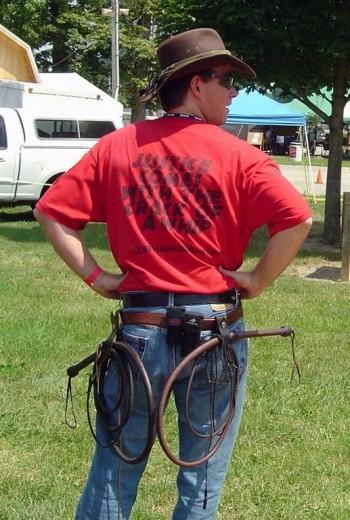
I watched every television episode of The Lone Ranger at some point of my life at least once. I used to watch it with my grandfather when I was a very small child. CLICK HERE FOR MORE. When I was a kid it was a combination of The Lone Ranger, Disney’s Zorro, John Wayne westerns, and Clint Eastwood westerns that I watched with my family as entertainment before there was ever a Star Wars, or an Indiana Jones. In most of those old westerns, a bullwhip was the secondary weapon of choice on many occasions. So I grew up with a tremendous reverence for the bullwhip as have many of my friends from the bullwhip world who are seen scattered throughout this article in videos of their own displaying their love of a uniquely American art form. In fact the only place in the world where the bullwhip holds even more reverence than in America is in Australia. It is there that the whip maker who made the two whips seen hanging from my holsters in the picture above resides–Terry Jacka.
In the typical Lone Ranger stories, the hero Texas Ranger Reid is gunned down with a group of fellow Rangers and left for dead by a group of thugs who wish to inject crony capitalism into their local business operations. (Do not confuse this with pure capitalism which I support adamantly) To do so, they gun down the legitimate law so that they can make easy prey of the people they wish to exploit. It’s a classic theme that can be seen in virtually every western made and no matter how many hundreds of westerns I have seen, I never tire of the message. It is a theme I resurrected in my novel The Symposium of Justice in 2004 which essentially was a modern western set in the current time, and featured the marketing slogan “Justice Comes with the Crack of a Whip.” I enjoyed tremendously the opportunities writing that novel gave me, the ability to do some stunt work for the World Stunt Association, make public appearances, and even do some consulting work in feature films, CLICK HERE TO REVIEW. I understood why my bullwhip friends enjoyed traveling the country doing tricks for audiences and performing in large shows. But from 2007 to 2009 I was getting the overwhelming feeling that something of a real Lone Ranger was needed in the actual world and I wasn’t quite sure how to go about it. As I looked around at the diminishing crowds at some of the western events I attended and my friends with their commitment to traditional western arts were looking more antiquated each year by audiences who were rapidly losing an understanding of the typical values displayed in film westerns, I had noticed that a similar evil that was clear in the old Lone Ranger episodes was sucking the life out of the world around us, and I wasn’t content to just write about it in books, and show up on movie sets earning acclaim from top actors, directors, and producers just because I had a unique talent. I felt an overwhelming desire to not just talk about it, or write about it, but to actually fight for the values of the Lone Ranger in real life.
The whip trick video was featured on The Blaze by Glenn Beck’s new enterprise during its opening weekend. CLICK FOR REVIEW. Just a few days later I did a personal interview with The Cincinnati Enquirer where I spoke out openly against the tax increases proposed by the school and I did whip tricks for the reporters knowing full well what would follow. I knew that the established order of things would attempt to paint me as a radical traditionalist who was so in love with the “old days” that I couldn’t see the wonderful benefits of “progress” as it has been brought to America by intelligentsia, CLICK TO REVIEW. At the time, I had been involved in many personal fights with others, one on one, or otherwise, and had no problem with direct conflict. But as I was writing The Symposium of Justice and telling the story of Fletcher Finnegan, who was a modern masked outlaw named “Cliffhanger,” I had a persistent nagging desire to prove a theory that I had constructed in the book which had to be proven for the follow-up novel, which is how one man can take on a giant statist organization and survive. In my novel, it was the heroics of Cliffhanger that inspired good people in the town of Fort Seven-Mile to join together and form Cliffhanger’s Fighting Legion, to fight tyranny all the way to the powers that pulled the strings of political puppets beyond the reach of Washington D.C. Fletcher Finnegan was my modern version of The Lone Ranger, a masked man who instead of a silver bullet, used bullwhips to bring justice to the world. But for me, that wasn’t enough. I wanted to strike at the heart of the evil, not just the reaction to it, which had always bothered me about every western I had ever seen. It was one thing to fight evil and stand for the good, but what was the cause of the evil? To answer that I had to go on a dark quest of my own.
The bull whip video had started me down a road for justice and soon after I was doing many radio broadcasts, granting interviews to the AP, and speaking on television. As I had been working with several local Tea Party groups, I had grown concerned that my work with the whips might draw bad publicity for them so I backed off some of my public bull whip presentations relying instead on my speaking ability to perform the pursuit of justice. At this point I was already deep into my experimental theory which I am about to reveal the result. Over the next couple of years I found that like the Lone Ranger, I had put on a kind of social mask to protect the people I cared about in the Tea Party movement, and traded business attire as my mask, keeping the whip hidden from a media that was looking for every opportunity to paint me as an extremist radical that wanted to destroy the lives of children—instead of saving them.
What I learned during this endeavor is exactly what I set out to understand. Government statists spread their evil by creating anti-concepts. If the American western was about creating in the mind of viewers a “concept” about tradition, and value, then the anti-concept was about destroying that value. This was the cause of the declining popularity of the American western and why my bull whip friends were finding declining interest in their art form over the years. This anti-concept theory is being taught in public schools to metaphorically deliver the souls of millions of young people to the slavery of a giant Cavendish gang represented in reality by statist governments all over the world. Before I started all this activity the biggest fear that small government activists had was retaliation, particularly from labor unions set up like parasites in government institutions such as public schools, and IRS agencies. These unions got what they wanted by acting identically to the gangs of the Old West who robbed trains, stole cattle, and harassed settlers. They used force, or the threat of it, to take what they wanted and imposed fear on their victims so they could maintain their regional power. These statists functioned from misleading facts through the formation of the “anti-concept”—by stripping away values from society. The way to destroy a concept is with open attack, using the threat of force, or by subversion, by undercutting the value of an argument. For instance with the public school mentioned, they failed to recognize the need for their tax increase was caused by their mismanaged finances. They associated the value of education to money equaling goodness for children even though the facts had nothing to do with that reality. If someone challenged that premise, the union would show up in collective force to protest the school board sending a message to the community that if anyone stood in their way, they’d be vandalized, personally harassed, their children would be tortured in various degrees, and they’d be turned into social outcasts. Because of this threat, nobody challenged them, even the so-called wealthy elite who understood clearly what was happening but were unable to do anything about it for fear that their businesses would come under attack by union thugs and social radicals. What the unions were doing was no different from what the Cavendish gang did in The Lone Ranger. They used fear to impose their statist will on the innocent.
It is one thing to think such a thing, but quite another to speak out against it. After all, nobody wants to be called a mean, selfish, or a diabolical menace to the fibers of an interconnected society which is how the villains in this case had destroyed the concept of goodness. They had subverted entire communities into sitting on their hands and not speaking out in fear of being considered socially as an outcast—or even an outlaw. I theorized in The Symposium of Justice that the way to beat these types of villains was to challenge their premise with the question “why.” When the statist enemy cannot answer, which they never can, they then turn to force. This is where my hero Fletcher Finnegan/Cliffhanger used his bullwhips to impose justice on those who tried to use force to remove the concept of goodness from society. My problem was that I knew such an idea worked in small combat situations with fewer than ten combatants at a time from personal experience. But I wasn’t sure if the same could be applied to statist government all the way to the top of the food chain which is what my next novel in the series is all about.
When I did the Enquirer interview Mike Clark asked me if I knew what I was doing in bringing my whips to the front page of Cincinnati’s largest paper. I knew as he asked the question that I was looking at a future Judas, a betrayer who would pretend to be a friend just like the villain in The Lone Ranger who led the Texas Rangers to their deaths in the canyon trap set by the Cavendish gang. But this time, I would use the bait to my advantage—and I did. I knew that if the threat of personal harm was removed from the unions’ arsenal of weapons that they’d be defenseless against me because they certainly couldn’t answer any questions regarding “why.” When I have my Terry Jacka whips, nobody is going to bring personal harm to me with any melee weapon. For those hired thugs who don’t care to use a firearm, the decision of that kind falls into a level of thuggery that our current statist society still recognizes as bad, so it doesn’t happen often and that is when firearms are needed for defense. But for all other circumstances, no gang of thugs can bring harm to a person who can use bullwhips in the fashion that I do. By presenting my whips to the unions all across the State of Ohio through popular media, I had taken away the weapon that all statist organizations use to impose their will, the threat of force. This allowed me to give many dozens of interviews to the media against unarmed opposition because the statist representatives of public schools could not answer the “why” and they could not stop me with force. So they were unable to stop me and this remains the case to this day. Without thuggish force, without bringing harm to others, they have no ground to stand on. The way to beat them time and time again is to ask them “why” which they can never answer, and then to let it be known that physical force, social intimidation, and extortion will not serve them. When they learn that, their game is over. They cannot win with facts of any kind.
When I say, “Justice Comes with the Crack of a Whip” this is what is meant; that statist villains have had their most important weapon removed from them—the ability to apply force. This is why whips were so popular in the early westerns like The Lone Ranger and Zorro, because they represented the “concept” of justice in a way that does not involve killing your opponent. The whip allows the wielder an ability to disarm those who wish to use force against others. The bull whip cuts like a knife, is far faster than a pair of nunchucks, and much more versatile than a sword, staff, or baseball bat. In short, a person who learns to use the bull whip anywhere close to the kind of people shown in the videos on this article know in their mind that nobody can harm them in one-on-one or group combat. That self-assurance is a measure of freedom that allows goodness to be seen clearly, and solutions to statism are then solved.
As The Lone Ranger puts on his mask in the new Disney film, I’m taking mine off. I am no longer concerned about what anybody thinks about my use of the bullwhip as I have made my point. For me, the bull whip is a symbol of justice because it prevents those who wish to steal away righteousness from the innocent eliminating the ability to invoke any fear to do so. It forces statist opponents to take the next step which involves more lethal force and in this way the “ground” to combat is controlled by the whip holder, because they know what their opponent is going to do since their options are so limited. Before that next step, which obviously the Clinton’s have no problem utilizing, CLICK HERE FOR REVIEW; decisions have to be made on how the public perception of such an action can be justified. Most statist enemies lack this type of arrogance, or network to pull off such a feat, so they are paralyzed when threat of force is removed from their social holsters, and that is invoked by the bull whip.
There are many great whip makers in the world for my money; Terry Jacka is the absolute best. Right up there with him is Joe Strain and my old friend Paul Nolan who was seen in the video on the pillars at sunset with his wife and friend T-Rex. A lot of whip masters don’t talk about it, but when they put a whip in their hand the power they feel is not one to inflict pain and suffering on other people the way some statist slave master might think. What they feel is the power to defend themselves from any melee force that might attempt to enter their barrier of protection. Speaking personally, when you see a whip artist standing at the center of a two-handed Queensland Crossover, or other two-handed routine, they know they are standing in the middle of spinning knives that can cut to shreds anyone who tries to penetrate that parameter. When I wear my Jacka whips with the long 12” handles pointing out like Samurai swords on both sides of my hip I do so to have quick access to them off my quick release holsters, which were specially designed for me by Gery Deer. I know when I walk around with them that I have complete control over my life because the whip keeps anybody who might wish me harm from entering my parameter of individuality, and that is a wonderful feeling.
It is in this spirit that the bull whip was used in the Old West mythology as a symbol of justice instead of pain. The greatest of them all was Lash LaRue who was known as The King of the Bullwhip. He was another of my favorite western protagonists. So it brought me great delight to see that Disney had purchased three whips from The Northern Whip Company to be featured in the new Lone Ranger film. I would love to see a film where whips are used in them to the level that Lash LaRue or Zorro did, but I’ll be very happy to see a scene or two with the Lone Ranger bringing about a bullwhip to implement justice in a way that only bullwhip masters understand.
As for me, the bullwhip is an important part of my life, and I am taking the social mask I put on for a brief time off. The justice I seek doesn’t require a mask, because in the hands of a bull whip master, there is nothing to fear. It would be my hope that I could share this self-assurance with as many people possible so that they too could learn such a skill that would free them from the tyranny of fear that so cripples such vast majorities with the constant threat of personal harm while in pursuit of honor.
Check out Joe Strain’s bull whips for yourself. I’m sure he will have replicas of the ones he made for The Lone Ranger available soon.
Another great champion of the bull whip sport is Adam Winrich. He is a wonderful whip maker, but spends most of his time these days doing professional gigs. He also has dozens and dozens of instructional videos on technique some seen here on this article.
Then of course there’s Chris Camp who laid the foundation for many world record endeavors and stays busy as a whip professional traveling the world with his family for many corporate clients.
And if you want to take some classes on how to get started in a nice comfortable bull whip training studio that is just a short drive north of Cincinnati, contact my friend Gery Deer. It’s the only one of its kind in the world. Most of the names mentioned have attended Gery’s Annie Oakley Western Showcase event each year in Ohio during the last weekend of July.
But the first step is in deciding not to live in fear, then learning what can be done about it. Justice Comes with the Crack of a Whip, and for each of us, there is nothing more important.
Ahead of Disney’s new Lone Ranger film they are running a promotion for all fighters for justice to receive an advance screening of their new film prior to its July 3rd release. Given the kind of readers who frequent Overmanwarrior’s Wisdom, there are more than a few such people in Southern Ohio who deserve a ticket.
Nominate a local hero or agency who rides for Justice in your community to receive the Lone Ranger Ride for Justice Award and an advance screening of Disney’s The Lone Ranger. Post your nominations to @LoneRanger on Twitter with the #LRRideforJustice and your city of residence, to honor your local heroes.
As we close out the year of 2012, some might ask what I am most hopeful for in 2013—what I most desire out of the upcoming year—world peace, the resurgence of the American economy, or even the announcement that humans will colonize the moon and begin a manufacturing industry there. No, what I want out of 2013 is far better than all those things, and as was just announced, it looks like I might get it. Hans Zimmer has just been announced as the musical composer for the new Lone Ranger film that is being done by the same people who did the Pirates of the Caribbean films, and I am ESTATIC about all these combinations coming together in this updated western.
I have loved The Lone Ranger my entire life. I used to watch re-runs of the old Republic serials on TV with my grandfather as far back as I can remember. In fact, my grandpa—the one who taught me how to use a bullwhip, shoot a gun, and avoid detection from the law as he was a former moonshine runner–used to play The Lone Ranger theme song on his banjo in the kitchen while my grandmother made friend chicken and chopped potatoes fried in pig fat. The Lone Ranger may have been my very first memory as a child of about one and a half years old. In fact from age 1 to about 5 years old my beliefs of what a man should be was summed up in three heroic characters, Zorro, Popeye the Sailor, and The Lone Ranger. To this very day all three of those characters resonate in my daily life more than any other influence and it was that Lone Ranger theme song played on a banjo by my grandfather that rings in my head almost every minute of every day—and I love it dearly.
The William Tell Overture will always be a treasured bit of music to me because my grandfather pounded it into my subconscious and I will always adore him for it. In the darkest days of my life when things sometimes seemed to be overwhelmingly evil that theme song to the classic Lone Ranger westerns bounced around in my mind to always show me the light. And yes, like the Lone Ranger sometimes the fight against evil means that good men do have to wear a mask, they do have to conceal their identity to hide their loved ones from the harm of their heroic crusades. However, these days, I prefer the methods of Popeye the Sailor. I no longer attempt to hide, I just eat spinach and proclaim, “I am what I am and that’s all that I am.” If you don’t like it, take a hike.
But the William Tell Overture playing while the Lone Ranger rode his trusted horse Silver to fight against the worst that resides in the hearts of mankind is a theme I have always trusted and I imagine that Hans Zimmer will pay tribute to it in some fashion—if not, he is perfectly capable of inventing something that is even better if that could possibly be imagined. I am quite a fan of Hans Zimmer, so much so that the CD player in our car has been playing the soundtrack to Pirates of the Caribbean and Dark Knight Rises for over a year now every time we get in to drive somewhere.
My new grandson is about three months old and I have been working with him teaching him the art of the bullwhip. He watches me intently but can’t yet grip the handle under his own control. He can only wiggle with enthusiasm at the intense sound it makes. I recognize that like my grandfather did for me, I will have to do the same kind of thing for my own grandson, and I will. The foundations are already set, and it pleases me greatly to think that good old Disney is reinventing The Lone Ranger just in time for my grandson to carry on a tradition that my own grandfather started with me. If I have it my way, he will be wearing a black mask, a white hat and riding around a white horse everywhere he goes within a couple short years. And he will be going with us to see The Lone Ranger even though he will only be 10 months old when it comes out over the summer. If anything, the little boy will at least register some of the images with the stirring Hans Zimmer score that is sure to be magnificent.
So 2013 will be good for me, you can bet on it. I remember like it was yesterday how my grandfather looked in a sweaty white t-shirt in an un-air-conditioned farm-house kitchen plucking away at his banjo the William Tell Overture as my grandmother slaved over a hot stove stirring fried potatoes as evaporated pig grease dripped from the vent hood. The desire to be more than just an average man, the desire to be a good guy fighting the destitute, the corrupt, the very epitome of evil was thrust into my mind with the banjo strings of my grandfather and those old Republic serials of the Lone Ranger and his trusted horse Silver.
I simply can’t wait to see Johnny Depp as Tonto in Monument Valley. The new Lone Ranger film by the makers of Pirates of the Caribbean and distributed by The Walt Disney Company has great promise to be the next great western in a tapestry of tradition that has been vanquished by a modern age more akin to the villains of the classic westerns, than the heroes who rode white horses and hid their identity behind a black mask. It’s a sad commentary that good men must wear a mask, as evil has far too much control, and it will remain so as long as villainy is promoted as merit. That is something the adults who raised me never stood for, and that tradition will be passed on to a new generation. Hans Zimmer’s new musical score will make my job thankfully easier when The Lone Ranger hits theaters this upcoming July 2013.


 I know that especially lately, each new movie that comes out; I have had grand things to say about them which weaves back through my life to points of origin that are not only sentimental, but deliberately placed there by the important people in my life who raised me. Part of being alive as opposed to half-dead or socially subdued is that you feel things. And I feel things, lots of things—because I have never turned my mind off to the world. I love movies, I love music, I love visiting places, I love food, I love family, I love books, I love comic books, but probably more than anything in my life besides family, I love bullwhips, and I was elated to discover recently that one of the great whip makers with ties to Western Stage Props had made three bullwhips for the upcoming Disney film The Lone Ranger. I was happy to hear that Joe Strain from his business The Northern Whip Company had supplied the whips for the grand revisit to the Old West by The Lone Ranger because it would not only help my friends in the bullwhip industry who make large parts of their livings off sharing their unique skills with the public, but that the modern makers of The Lone Ranger were going to pay tribute to the use of the whip in the classic stories that took place from the 1930s to the late 1950s. Not only would the new Lone Ranger from Disney pay direct tribute to the classic silver bullet mythology, the tenacious horse named “Silver,” the “William Tell Overture,” a very ambitious rendition of Tonto played by Johnny Depp, but they were even going to put a few whip scenes in the film, which used to be a standard in westerns.