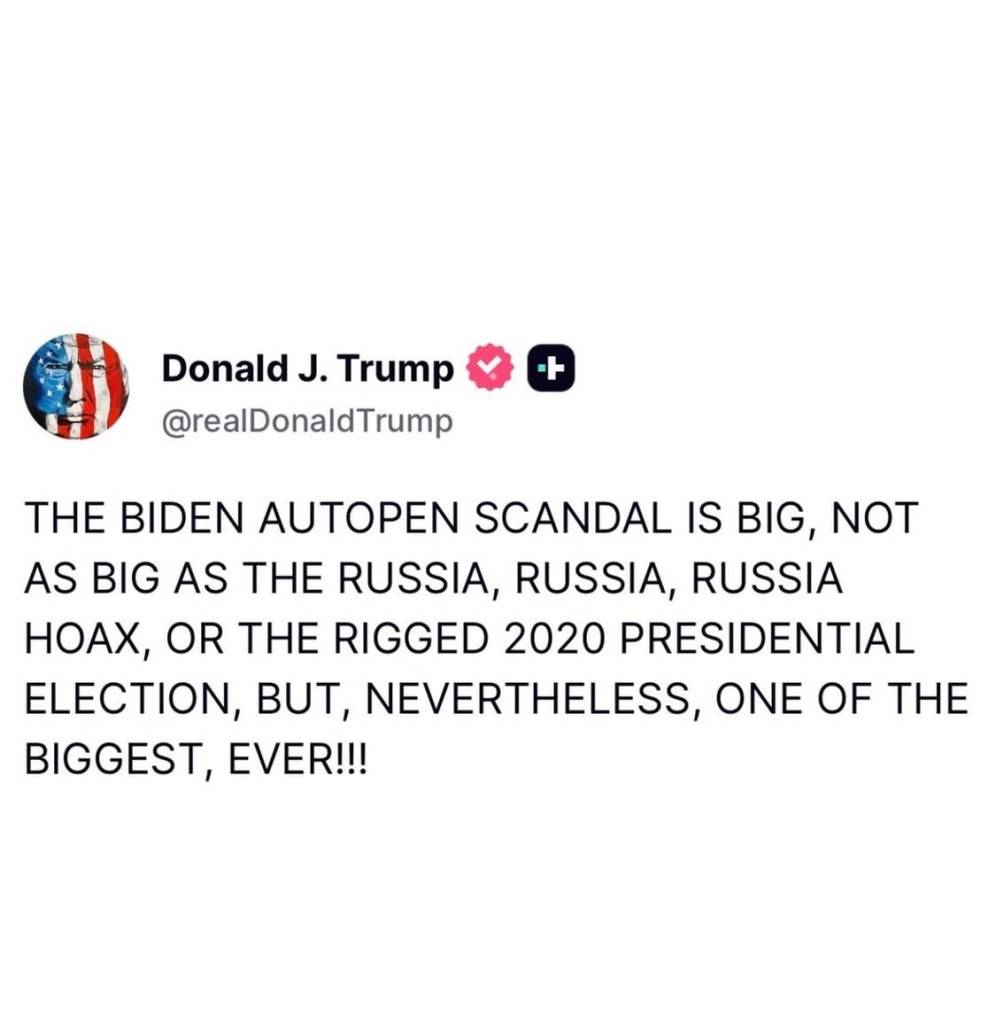
From a position of principled dissent, one must assert: it is both appropriate and necessary for President Trump to rescind the executive orders and other instruments signed by President Biden via autopen. This move is not a partisan slight against Biden himself—instead, it’s a justified protest against the institutional apparatus that hijacked executive authority during his presidency.
Trump’s decision signals a break with what has become a “fourth branch” of government. Bureaucrats, intelligence officials, and political operatives effectively commandeered presidential power behind the scenes, wearing its cloak while burying proper accountability. If MAGA goes silent—if it ceases to challenge the corruptive center of institutionalism—that deviation will be permanent. The people’s voice, once quieted by the elite through procedural manipulation, seldom returns.
Rooted in ancient traditions, the MAGA movement echoes the Teacher of Righteousness dissenters described in the Damascus Document of the Dead Sea Scrolls: insurgents who arise whenever authority no longer serves its constituents but rather entangles them in webs of venality. These protestations are not aberrations; they are hardwired into human nature and political life. Revolts are rhetoric, yes—but when discourse fails, and trust is broken, they become relentless, even righteous rebellion.
This moment is not historically unique. We are neither living through an aberration nor an anomaly—we are participating in a time-tested cycle of institutional decay and public backlash. Unless actively disrupted, this cycle does not correct itself. It requires decisive, uncompromising change.
Consider the COVID-19 pandemic. Beginning in 2020, it became a vehicle for global actors to consolidate control—governmental, financial, technological—and push bio-political frameworks that were as deadly as they were deceptive. Millions perished under directives engineered from the top. Those who operate these levers today are leveraging their power to set conditions for continued control—some of which may require enduring Trump another three years, or at least until 2028.
Biden did not genuinely win control—an elaborate maneuver of autopen, election doubt, and pandemic-induced panic that carried over into his administration. This isn’t about policy disagreement; it’s about the subversion of election integrity and democratic process. The Republican moderates—the power brokers in both parties—are complicit. They reap the financial rewards of insider governance even as they masquerade as safeguards of free enterprise.
The result is a system in which corporate power is maintained not by competitive markets but by governmental decree. Industry giants lobby, they legislate, and they leverage regulated advantage into an immovable monopoly. This is neither capitalism nor democracy—it is centralized privilege.
Trump was placed in office to correct this—not because of policy disagreements but due to the growing realization that the system had mutated into an oligarchy, one that served the same servile beneficiaries from Washington to Wall Street.
But removing Trump in the middle of the purging process transformed what should have been a transitional restoration into something dangerously uncertain. The institutionalists within government, sensing their loss, have regrouped. Joe Biden is not a break in continuity—he is an extension of their covert agenda.
Consider Biden’s record: 162 executive orders in four years—an aggressive use of unilateral powers and far above average relative to modern presidents12. Nearly 41% were revoked by Trump within days of resuming office. These orders spanned everything from invoking the Defense Production Act on electric vehicles and biotech34 to mandating federal minimum wage increases4, forcing climate policies4, and rerouting federal dollars into union apprenticeship programs34.
The extraordinary scale and scope of these unilateral actions—used to circumvent Congressional approval—highlight why the MAGA movement fears complacency above all else.
The autopen controversy, then, wasn’t accidental. Biden’s use of an autopen—a device that mechanically reproduces signatures—became the focal point of MAGA’s alarm. Trump asserts that some 92% of Biden’s signed actions were processed via autopen and are thus inherently invalid 56. Among those, suggestions range from presidential orders to pardons, including those granted to Fauci, General Milley, and members of the January 6 committee 78. Critics argued that such coverage without the President’s direct signature was illegitimate—even perjurious.
Legal experts, however, dismissed this view. A 2005 Department of Justice memo confirmed that autopen signatures are legally valid when authorized910. Courts have noted that presidential pardons need not be in writing at all. Scholars point out that once issued, pardons are inviolable and immune from revocation by successor administrations.
Yet that technical legality missed the moral point. MAGA supporters argue that legality without legitimacy is insufficient. Just because the bureaucratic mechanism parses it as valid doesn’t mean it bears democratic authority. The autopen represented the final straw—evidence that control had left the people’s hands and entered automated dominance.
And Trump understood that scenery. So he initiated investigations, revoked dozens of orders, and canceled more—drastically—by first-day cutbacks, then March 2025 revocations, then this sweeping de-autopenization3414.
With every revocation, MAGA restored control to the people. But letting institutional leverage settle in would have been worse. Trump resisted governing by consensus because consensus had betrayed the people. These were not minor adjustments—this was a reset intended to reassert popular mandate over administrative stealth.
But MAGA supporters rationalize: corruption must be uprooted in bulk. If parts of the system are irredeemably corrupt, small-scale reform isn’t enough. Action requires either unyielding disruption, not temporary band-aids.
Looking ahead, that disruption must be institutionalized. It cannot rely on Trump alone. Political seats must be won—governorships, Congress, school boards, city halls—to institutionalize disruption.
Look at the midterms and below: they are won not by playing nice, but by embodying the fight. MAGA must not compromise away the only movements capable of checking deep corruption at its root.
Yes, Trump governed as though working within the system would tame it. But the system used that effort to reassure itself. Civil servants nodded in his face, only to conspire behind his back.
We saw the phenomenon in COVID policies, ending that contradictory presidency. Those pushing pandemic mandates operated beyond democratic oversight—unelected experts, bureaucratic rule. It took an insurgent presidency to expose the duplicity.
Now, Trump fights back by reclaiming the instruments of executive power—by drawing lines in the sand, and by vociferously naming those who conspired in executive hollowing.
If he retreats now—if MAGA shrinks in the face of institutional backlash—the effort is for naught. As Jesus said: A house divided cannot stand.
But if MAGA rallies—if cities and states choose representatives willing to enact true reform—then Trump’s disruption becomes permanent. That means a crackdown on conspirators, a legal reckoning for the autopen cabal, and an end to post-hoc presidential puppeting by hidden staffs.
Statistically, the number of executive orders matters. Biden averaged ~40 EO’s per year1718—a pace far above average, and far above what would be sustainable if the presidency were not treated as a governing elite office. Removing the excessive orders flipped control from institutions back to voters.
Yet the statistics also warn that Biden’s focus on memoranda, including national security memoranda—a bladeshot form of autocratic bypass—became a hallmark of invisible governance. Often, a memo could usurp statutory authority or declare an emergency under concealment.
This leads to election security.
After 2020, mistrust was deep. Pew reported that only 58% of Trump voters trusted that the outcome would be clear after counting, and 92% believed the result should be known within days19. Meanwhile, nine out of ten voters overall prioritize preventing illegal voting. That’s trust based on process, not rhetoric.
But trust evaporates when systems are vulnerable. Since 2020, 92% of local election officials reported enhanced security measures in 2021. That heightened security owes to both increased systemic threats and widespread mistrust.
MAGA’s claim: if the institutions are deploying executive power without transparency—or are altering election governance through memo rather than law—they steal not merely ballots, but trust, legitimacy, and authority. Trump’s aggressive stance on revocation isn’t mere revenge. It’s a necessary action to preserve our republic.
For that to endure, strong, secure elections are the baseline—not tokenism. If elections are hacked or adjudicated behind closed doors, the outcome is irrelevant. No amount of EO revocation matters if the mechanism behind the vote remains under covert control.
If Trump secures seat wins in the next elections—not because of compromise but through campaign-first messaging—then the movement becomes structural, not merely rhetorical.
We fought for Trump for this structural change. We didn’t give him a mandate to play nice. We gave him a mandate to fight.
So—Go hard. Rescind, revoke, prosecute. Take out the institutional rot with precision. Shut down the cabals. If you’re going to mess with systems, do it permanently. Don’t hesitate. Strike fast.
It is time to institutionalize MAGA, not depersonalize it. If regulations housed the poison, uproot them entirely. If rival offices conspired, expose them and break them. If colluding agencies diverted funds, revoke and defund them. If secretive pardons sheltered corruption, expose them to the sunlight and eliminate their immunity.
And then, pivot—once the rot is removed—to reconstruction: a government that serves the people with genuine transparency, limited-term appointments, reformed election security, and executive power that is retrievable, contestable, and transparent.
It’s not enough to protest with words. Words are hollow if the power is in the hands of the few. Remove the instruments of unilateral control, and stand them up anew in the hands of governors, legislators, and citizens.
Let Trump’s actions serve not as a cult, but as a crucible: to temper institutions to service, not mastery.
The autopen exposes the lie. Insurgency confronts the machine. If MAGA falters, they reassert it. If MAGA stands firm, the movement morphs into stewardship.
Now is the choice—not tomorrow.
Footnotes
1. U.S. Department of Justice, Memorandum Opinion for the Counsel to the President: Use of Autopen to Sign Enrolled Bills, July 7, 2005.
2. Congressional Research Service, “Presidential Pardons: Legal Authority and Limitations,” CRS Report RL31340, updated 2023.
3. Federal Register, “Executive Orders by President Joseph R. Biden,” 2021–2024.
4. Pew Research Center, “Public Confidence in Election Integrity,” October 2020.
5. National Association of Secretaries of State, “Election Security Measures Post-2020,” Annual Report, 2023.
6. White House Archives, “Executive Orders Revoked by President Trump,” March 2025.
7. Brennan Center for Justice, “The Autopen Controversy and Presidential Authority,” Policy Brief, 2024.
8. U.S. Government Accountability Office, “Insider Trading Risks in Federal Governance,” GAO-22-104, 2022.
9. Centers for Disease Control and Prevention, “COVID-19 Mortality Data,” 2020–2022.
10. Congressional Budget Office, “Economic Impact of COVID-19 Policies,” 2021.
11. Department of Homeland Security, “Cybersecurity and Election Infrastructure,” 2023.
—
Bibliography
• Brennan Center for Justice. The Autopen Controversy and Presidential Authority. Policy Brief, 2024.
• Congressional Research Service. Presidential Pardons: Legal Authority and Limitations. CRS Report RL31340, updated 2023.
• Federal Register. “Executive Orders by President Joseph R. Biden.” 2021–2024.
• Pew Research Center. “Public Confidence in Election Integrity.” October 2020.
• U.S. Department of Justice. Memorandum Opinion for the Counsel to the President: Use of Autopen to Sign Enrolled Bills. July 7, 2005.
• U.S. Government Accountability Office. Insider Trading Risks in Federal Governance. GAO-22-104, 2022.
• White House Archives. “Executive Orders Revoked by President Trump.” March 2025.
• Centers for Disease Control and Prevention. “COVID-19 Mortality Data.” 2020–2022.
• Congressional Budget Office. Economic Impact of COVID-19 Policies. 2021.
• Department of Homeland Security. Cybersecurity and Election Infrastructure. 2023.
Rich Hoffman

Click Here to Protect Yourself with Second Call Defense https://www.secondcalldefense.org/?affiliate=20707