Unions think collective bargaining reform is about revenge, or it’s some conservative conspiracy. Yet this is what the union opposition say is happening. A guy sent me this comment while I was writing this article.
I listen to Doc’s show on 700; he is clueless on Labor and the issues that surround labor. Unions and collective bargaining have built the middle class in this country. What you’re seeing is big corporate interest trying to tear it down. Fire, Police, Teachers and all public workers should be getting a big thank you everyday for the job’s they perform. When you have a Gov that is bought and paid for by Wall ST. this is what you get.
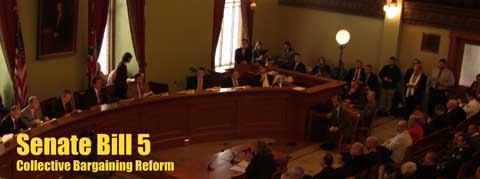
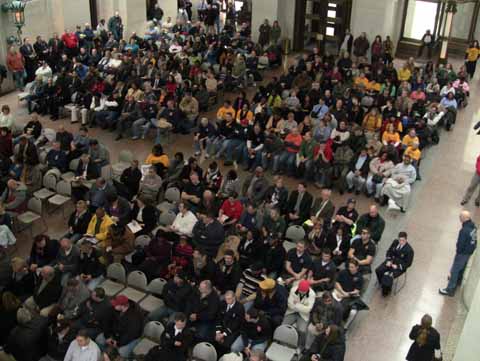
COLUMBUS, OHIO – An overflow crowd of over 800 concerned Ohioans packed the halls of the Ohio Statehouse today in opposition of Senate Bill 5, a job-killing, anti-worker bill that would silence the voice of Ohio’s public servants. If passed by the Ohio legislature, Senate Bill 5 would eliminate collective bargaining for Ohio’s public employees and make it more difficult to attract and retain quality staff.
“Today, Senator Shannon Jones and her anti-worker allies jump-started their job-killing vendetta against Ohio’s middle class,” said Becky Williams, President of SEIU District 1199 which represents over 9,000 public sector workers in Ohio. “Reducing government, cutting taxes for the rich, and taking rights away from workers might sound good to Jones, but when you talk about taking safety forces off of our streets, educators out of our communities and leaving criminals unsupervised in our towns – it’s just not practical.”
While working under the misrepresented premise of “transparency” and “reducing the size and scope of government,” Jones openly admits that there will be no direct financial benefit to the taxpayers after her exhaustive one-year research of collective bargaining. To the contrary, a report published by Policy Matters Ohio found that “allowing public sector workers to bargain collectively reduces labor strife, reduce the likelihood of strikes and can lead to better training and higher productivity for public sector workers.”
……………………………………………………………….
This type of rhetoric is dangerous, and extremely misleading. Their use of terminology such as Anti-worker and the such are manipulations of the basic facts. I know many hard-working people who routinely work circles around public workers as far as quality and it angers me greatly to hear that union represented workers are “working families.” It’s that kind of discussion that has created our bankrupt conditions that began 27 years ago.
Notice how many people showed up for this event. Those are your working families. The reason their voices get heard and the “real” working families get ignored are because the real workers are working. These people are just paid lobbyists. Groups like the OEA, Progress Ohio and many others have their members take off work to participate in these lobby events, and that’s how things became so messed up to begin with.
In the face of such scandals as what is being dealt with currently at the Mason School System, and one month ago at the Lakota School System, thousands of rank and file participants within the teachers union crave to put these episodes of unpleasantness behind them. The worst thing in their eyes is for public debate to occur beyond a two-day news cycle. If a story lingers for too long, the value for the service they want to offer diminishes in the eyes of the taxpayer.
The downfall of those status quo protectionists however is technology. No longer can a spokesman tell a group of friendly reporters a controlled diatribe of manipulation intended to diffuse a crisis till it falls from people’s minds as their busy lives consume commitment to a righteous cause. Now with text messaging, and blog sites like this one, information moves freely without the control mechanism of political machines, and is why the FCC is pushing Net Neutrality.
That’s why what happened on 700 WLW February 4th of 2011 was unique as a story broke on that station throughout the day preceding a major indictment from a prosecutor’s office. It started with Sharon Poe speaking about the crises with Doc Thompson and ended 9 hours later after the indictments were announced and attorneys started to chime in with legal discussion. The story is basically this, a teacher Stacy Schuler of the Mason School System was indicted for 16 counts of sexual battery with 5 students. She is also involved in a sexual way with a separate issue involving the assistant principal George Coates. George called in his resignation on February 2, 2011. The story arch was fascinating and is captured in the video below. It is recommended that you activate the video and finish this article while listening if you are fortunate enough to be able to do both. If not, then give yourself some time. It’s a video that is 2 hours and 7 minutes long but condenses 9 hours of radio news breaking evolution over the day and is a compelling story in itself. So turn off the TV and let the video play and enjoy the theater of the mind without commercial interruption for the drama is as good if not better than any movie available to rent.
Sharon (the woman in the interview) and I have known, as most in the Mason community and in neighboring Lakota have known for some time that serious sexual allocations were transpiring in Mason. In fact I have the list of many improprieties, most of them taking place with consenting adults within the system and not directly effecting students. But the number and rank of the participants is alarming for any workplace. This teacher is just the most obvious participant because she got caught. Her actions since they involved students that posted information on Facebook and other online forums could not be quieted by the spin doctors and the info got out into the community.
Check these links for information on all the soap opera issues going on in Mason. There are several articles on those pages. Scroll down to the “Sex and Drugs for All” School Districts section to read the information. This information was published by Charles Foster Kane.
Scott Sloan came on after Sharon and had been working with the same information we all had but Scott had the guts to act on it. After he went off the air with Doc, a caller from Mason came on and defended the district and proclaimed that WLW was behind on the story and it wasn’t a big deal. WLW was in fact the only news organization running with the story. All the other outlets were waiting for the indictment to come down and reacted predictably once the story broke. That particular caller reflected a huge part of the population that just doesn’t want to deal with bad news.
It is because of people like the caller that these problems in schools have continued. They empower the perpetuation of illicit behavior in public institutions with the same careless abandon that a large portion of the population accepted the seductress explanations from former President Clinton.
The target audience of complacency which Clinton, Obama and teachers unions, along with others, speak to know what they’re doing. They hope to solicit more recruits to their thinking by encouraging public drunkenness, sexual exploits and other forms of decadent behavior because in such personalities are future apologists that won’t have the courage or fortitude to confront difficult issues when they present themselves. And on the backs of such weak souls were built the corruption we are finding in public education. In fact, as I was writing this article I received this comment from a reader which fits in the category just discussed.
Author : thompson (IP: 72.173.182.116 , 72-173-182-116.cust.wildblue.net) URL : Whois : http://whois.arin.net/rest/ip/72.173.182.116 Comment: you’re nuts. Salaries have nothing do to with morality. And for the record, teaching salaries are NOT I sugges you collect your thoughts before you put them out there to be read. Hope I don’t stumble onto anything else you rant, I mean write.
That is a guy that doesn’t see how things connect. The misspellings are because that’s how he wrote it, I duplicated it the way I received it. And to respond to that guy, being nuts is to take things at face value, like he obviously does.
You see, it’s not just the sex that is going on with some of the teachers, and administrators. Or principles and assistants that think it’s acceptable to send naked pictures of themselves to co-workers on computers owned by the school. Or child pornography obsessed teachers taking pictures of kids with their shirts off in the classroom. This is about the wholesome advertising of public education services to the community to justify extraordinarily high salaries negotiated by public sector unions. It’s like most things in life, in the end it’s about money.
During the levy campaign back in September after I had made a couple of appearances on WLW the Pro Lakota Campaign had flooded the station with protest letters and accused the station of being disingenuous to teachers and rationalized my questing of the amount of wages being imposed on our community budget as hateful. Their assertion is that because of their educational background and the fact that many of them have master’s degrees that they are better positioned to teach our children and that spending more and more money on public education will yield increased results. Or in the case of Lakota and Mason, it was to keep those districts excellent by approving a tax levy on our properties. We were told, “Wouldn’t you spend just 20 bucks a month to keep your kids safe.”
However, what we are finding is that these people in public positions are just as human as anybody. And these teachers and administrators in these schools are no more qualified to raise our children than our average citizens. This whole issue comes back to the topic of wages and whether or not public education officials should be paid so much and communities should be required to supported collective bargaining agreements.
My day on this historic date started as one of my employees told me about his experience of dropping off his son at Lakota because of the busing cuts. Lakota had stopped using police to guide traffic at the entrance my employee was using as a drop off. Instead a school official named by his son as an assistant principal was directing traffic. That assistant audaciously knocked on my employee’s window and told him to use a different entrance. “You can’t pull in that lot. You have to go to the other side.”
My employee told him that they had a paid parking spot in that particular lot and he had a right to be where he was.
The assistant principal directing traffic told him again to use the other lot.
My employee asked what he was supposed to do about his paid lot, the assistant said; “you should have passed the levy.”
I have instance upon instance given to me about principles at Lakota taking active roles in creating an environment of hostility that if they occurred in my work place, I’d be obligated to address the issue before the behavior corrupted my workforce, but not in public education. They live by different rules than the rest of us. And that becomes evident when you get to know some of them.
That’s why the sex scandals in Mason are important. Even if the teacher is innocent of all 16 counts we know that there is inappropriate behavior that went on between the teacher and the assistant principal at a minimum. As a society do we put up with it, because the taxpayers are the boss in this situation? Or do we just look away? Do we just approve the next levy while the bloated, corrupt monster of public education lingers on under collective bargaining agreements negotiated under school board members trained by the OSBA to carry out to the letter policies created by the teachers unions which are bankrupting communities?
I remember specifically when Lakota threatened to go on strike in 2008. What was their sticking point? Wages. They tried the same general tactic floating the strike word around back in March of 2010. It wasn’t about kids. It was money. Watch that video here. They got what they wanted. It didn’t matter to them if the community could afford it or not.
For those that don’t want to discuss the issue of cost and whether we get the value for the money we spend, I put the blame squarely on your shoulders for the current state of things, public education being just one, but very costly issue. When I hear stories like this sex case, and again, I know there is a lot more to the story which will be revealed, I get angry. I can’t understand why stories like this wouldn’t make people angry. But I also tend to view the world from the perspective of an employer. People that just want to punch their time card and cruise through life tend to look the other way when trouble comes or when taxes are too high and harming the community.
The underlining issue is arrogance. These Mason school employees that are currently in trouble have so little appreciation and respect for their community and where the money comes from that supplies their income that they participate in these reckless sexual activities. That behavior speaks volumes of how public education views the public they serve and it comes out when they are pressed.
The ultimate audacity is revealed in the Mason spokesman Tracy Carson when she was on with Tracy Jones and Scott Sloan putting on a happy face for the Mason District on January 26th, the same day that Stacy Schuler was put on leave. No doubt Mrs. Carson will say that she didn’t know about the teachers coming legal trouble, but what kind of spokesman wouldn’t know about this story, because I was hearing about it, and it’s not even my job to know. I find it hard to believe Tracy didn’t know. The story was out well before implementing the leave and if the spokesman knew anything about what was happening in the school, she’d know about this teacher, because everyone else did.
Yet, listen to her words on WLW. Do you think she actually thought the Mason school system could contain this story? Depending on how you answer that question will determine your ability to think critically. Because the bet from these people is this, you can’t think critically even when the evidence is right in front of you.
Georgetta voteyeslakota@aol.com 75.185.0.41 Submitted on 2011/01/20 at 11:14 pm Evil prevails when good people do nothing. I am a good person and I am about good education. I am doing something: speaking out. Rich Hoffman is misleading people. Teachers teach children so they DON’T end up working themselves into an early grave and barely making payments on a lot in a trailer park. The good teachers will go elsewhere in order to make a living wage. Rich Hoffman raised children and his wife didn’t work. Apparently he is making too much money. Yet, I hear no one attacking him. Some of us have to have both parents work in order to put food on the table.
Georgetta here reflects many of the comments that I get from people who think just like her. The premise is this, that education is a right, they hide the actual numbers in the scribble of government bureaucracy, and if you show that you don’t support it, or if you even question their reasoning, they use “peer pressure” to shape the community to their will, just like kids on a playground. That’s the mentality. They end up sounding like children with their minds wrapped up in extreme assertions to make their points seem to carry more weight.
The first thing they do is attack you “the tax payer” and your ability to pay the increase in tax. They’ll say, “Public education was there for your children, but now that you don’t have children in the school, you don’t want to pay.” They do the same with business leaders, “We built the good schools and you provided the homes, and now you don’t want to pay.” What doesn’t get said is that as all this growth was going on, the LEA, the teachers union at Lakota, negotiated an aggressive contract in October of 2008 that was focused on wages and that contract is bankrupting the community because at the same time, indications were that state funding was on a decreasing trend. So the contract was irresponsible, and what is happening now, is the community is establishing the parameters of future contract negotiations, because we can’t trust school officials to do the job, otherwise it wouldn’t have gotten this far out of control.
These pro levy people will attempt to proclaim that nobody but them can look at the numbers and understand the situation. They sadly put out apologist groups to plead the case like what you will hear in the below interview. What they don’t want to discuss is why there is a financial crises. They simply discuss finance as if it were beyond their control. When listening to this interview ask these questions, if cutting only a million here, or there isn’t much because the numbers are so large, then why is it such a large savings that cutting busing to 9000 students will only save $600,000, then why cut busing? And how has Lakota done everything it can do before cutting busing. Did the LEA come to the bargaining table to renegotiate their contract? And how does the tax dollars stay in the district when the union spends the union dues on political candidates. One of the reasons the LEA wants its teachers to make so much is so that the teachers will want to pay their union dues without hardship. But nobody talks about any of that here. The sum of this discussion is that there isn’t an answer. These are nice parents that just want the system to work long enough for their children to get an education. Nobody wants to play the hot potato game when the music stops, and the music is stopping. All they can really do in an interview like this is paint over the dirt.
All businesses whether they are service oriented or manufacturing oriented have a responsibility to keep their costs in line. One way that businesses do that is to use the 10-80-10 rule as it’s applied to labor. That rule states that 10% of your workforce will be your typical “top” performers, and they will get the most dramatic increases, 4% to 15% depending on the situation. 80% of your workers are average, and will typically get a standard 2% to 3% increase, otherwise considered a “cost of living” increase. And of course every place of business has approximately 10% that are poor performers and they won’t get an increase of any kind. Why? Because those bottom 10% you want to look for another job, and you want them to leave so you don’t have to pay them. It gives you a chance to hire somebody that might want to compete for the top 10% percentile. If you manage things correctly, your bottom 10% are the kind of people that your competition is hiring at the middle 80%, and you want that so you can maintain a competitive edge.
What you don’t do is uniformly advance everyone in your place of business with some socialist “everybody is equal” policy like what we have in school systems, and unions advocate. That’s a disastrous concept and gives employees like Ryan Fahrenkemp time and the luxury of job security to participate in an evil deed like child pornography. I would argue from experience that if Ryan had to fear for his job, and didn’t feel comfortable hiding in the muddy 80%, he probably would have not indulged in his warped perversion while at school. He might have done it in hiding, or in his mother’s basement, but not with his students, and not with school equipment. And he certainly wouldn’t have been making 70K at only age 42 no matter how much experience he had with the amount of tenure he’d accumulated in a relatively short time.
I used Fahrenkemp as an example because he belonged in the bottom 10% and somebody didn’t do their job in the review process of weeding him out. And that didn’t happen because he was protected by the complicated process created by the OEA which the president of the LEA had been a big part of, and knew how to manipulate the system to the advantage of her members.
I’d say you are, by telling the tax payers that the budget just “grows” on its own. That the school system had no way to deal with people like Fahrenkemp, and that all teachers are worth over 62K, and if the community doesn’t pay it, those beloved teachers will leave the district for another one.
I would say any teacher that would leave Lakota is only in it for the money, and those are personalities that I would rate low on a review, and may be tempted to put them on the bottom 10% anyway, so for them to leave would be desirable.
All the Yes Lakota people have to argue with is emotion,
• “The money is for the kids.” No it’s not, if it was, the LEA wouldn’t have threatened to strike in 2008 to get more money, and again in the spring of 2010.
• “We have to offer top pay for top teachers or they will leave.” No they won’t because the other districts are broke too and are getting ready to go through the same process Lakota is.
• “We have to protect property values by voting for the schools.” No you don’t. If taxes keep increasing that will kill real estate values anyway, tax payers in the district already pay $11 per $1000 assessment on their property.
• “I’m for education.” No you’re not. If you were, you’d keep the budget under $160 million. Throwing money at something doesn’t mean you’re for education. It means you don’t value the source of the money but want what the money can buy.
• “We have had explosive growth and must adjust to it.” Growth, like budgets can be controlled. If the cost is too high, growth will slow down, and growth will slow down because of the economy. Growth will also slow down from parents wanting to go to Lakota who aren’t willing to pay for the extra things they want, too. One of the reasons Yes People want sports and extracurricular activities is so enrollment will increase, so parents looking for those items can move to the district and participate cheaply. It’s all about job creating and getting parents used to programs that the district tax payers fund collectively. No different from colleges with NCAA programs that are nationally known for their sports, will see increases in enrollment. It’s always about increased enrollment so money can be justified.
• “The state is forcing us to all-day kindergarten.” No, the OEA lobbied to get all-day kindergarten passed, and the Republicans in the state house are getting ready to eliminate that unfunded mandate along with many other mandates lacking funding. So that anticipated requirement will be taken away from district budgets.
• “We have to spend $50,000 dollars to get the best superintendent we can get.” No, you are throwing money at the situation like you do everything else. It’s that kind of mentality that locked us into the contract with the LEA that is causing the current financial crises. Money does not equal quality. It seldom does. Money can be used to create competition, but it is useless without competition. If money is not getting you dramatic results, it is simply killing your budget.
• “Paying for a school levy keeps your money in the community.” No it doesn’t. The union dues collected by school unions are directly applied to liberal politicians that further perpetuate the bureaucratic mess creating expensive economic necessity. The OEA had revenue of over $62 million dollars in 2008. Where did that money come from? They don’t make any products that they can sell? Check the info for yourself here. http://teachersunionexposed.com/state.cfm?state=OH All that money comes from union dues, paid from the salaries of teachers that are paid exceptionally well by the local tax payers. The average pay at Lakota for teachers is 62K per year. So the money doesn’t stay in the community.
And you Yes Lakota people go ahead and leave your comments. I’ll post them, and I’ll use them. People need to see your thoughts. For those of you wanting to see some of them, read the comments here. I am quite aware that there are many people at many levels reading all the posts I’ve put up here and you’re looking for a way to spin it to your advantage. For an example, have a look at the work David Little from Progress Ohio attempted. I’m happy to fight your sloppy facts with the truth and if you want to spin the community around and make them so dizzy they can’t tell which way is up or down, I’ll continue to prevent it, as I have. And I’ll do it because I love my community, and I want to see education continue to be an option for families in the future. But it won’t be in a form controlled by organized labor. Those days are over.
Don’t believe me; read this from your parent union the OEA, this is how bad the financial situation is. Even the union staff is threatening to strike and the union itself is participating in union busting strategies.
The Ohio Education Association and Its Goose
The executives of the Ohio Education Association sent a memo informing local presidents that if the union gave in to striking staffers’ demands, it would require an $80 to $90 dues increase per member. Such an increase would raise roughly $10 million. That sounded familiar to me, so I checked the archives and found this, in the May 8, 2000 EIA Communiqué: Ohio Education Association in Severe Financial Straits. The last time the Ohio Education Association negotiated a staff contract, in September 1997, it resulted in a two-week strike, restraining orders against picketers, and a lot of bad publicity. That contract expires this year and it’s bad financial news all around for OEA, its members, and the staff. OEA recently informed its local presidents that the union is facing a projected deficit of $6.3 million for next year. The union is asking staff to accept benefit cuts totaling $4 million. The rest of the deficit would be eliminated through a dues increase of up to $25 per member.
“Specifically, and regrettably, we can no longer afford to sustain the current number of OEA employees at their current level of compensation and benefits and continue to provide the expected level of services and programs without significantly raising OEA dues for you and every other member,” reads a memo from OEA President Mike Billirakis and Executive Director Robert Barkley.
If our community is going to continue to be a “great” and “excellent” district, we have to get in front of this problem. Not avoid it by tossing more money at the problem. And the Yes Lakota people need to listen to the No Lakota People, because the solution is in good business strategy. The same tired old bullet points won’t be valid any longer. I’ll make sure of it.
Bill Cunningham had on a superintendent from Clermont Northeastern that has been very successful at saving his district money by thinking “outside the box.” Listen to that interview here.
What’s interesting about that interview is the superintendent is actively pursuing innovative cost savings as opposed to the approach at Lakota where they spent over $50,000 just searching for a new superintendent to replace the retiring Mike Taylor. The Lakota method is the “old” way, where inflated costs are built into every step of the process, and the footprints most always lead to organized labor.
The superintendent of tomorrow will find ways to save money at every turn, including the elimination of such extraordinary candidate searches as Lakota participated in. The School Board elected to spend $40,000 looking for a treasurer, and $50,000 looking for a superintendent that they haven’t yet hired.
The superintendent of tomorrow will not be bullied by union leaders as what happened at Lakota on the last Thursday of October 2008 where the teacher’s union of 1,200 members threatened to walk out on all 18,000 students they profess to think so much of. What was the primary issue in that proposed strike? Pay!
The superintendent of tomorrow wouldn’t have paid into the union system for 25 years or more and then take a passive position at the negotiating table as what happened when both sides, the LEA and the Lakota officials sat down after school that memorable Wednesday just before Halloween and finally hammered out an agreement at 12:30 AM Thursday morning, the day the LEA was ready to walk off the job.
I know quite a few teachers around the country. Specifically, in Oldham County, KY, which is one of Kentucky’s most exclusive communities, there is a teacher with a master’s degree in science that teaches geology, and his rate of pay is just shy of 50K. Doc Thompson a few weeks ago had on another teacher that was from Atlanta that was making wages in the mid-40’s, and I thought he had some valid arguments.
At Lakota, the LEA has been successful at convincing the School Board and the Superintendent that teachers should be paid on average over 62K per year, which is what they are currently being paid at Lakota. In fact, Mike Taylor is quoted saying, “I don’t think teachers are paid enough.” Such superintendents have recklessly encouraged the extraordinary wage rates that are occurring at Lakota.
And the economic disaster that is being described which is hitting Lakota is caused by these same wages that are too high if it is considered that state money is not a factor and that the communities must fund the budget on their own. The superintendent of tomorrow will help keep wage cost in line to protect the communities they serve and still maintain great teachers for a good price.
When we find this superintendent of tomorrow, we can begin to solve some of the problems of today, but not until then.
Now for those of you that want more information check out this press release from from the Buckeye Institute. I’m not the only one saying this stuff. Feel free to check the link at the end of the press release. Oh, and you YesLakota people, I’m for education too. Keep it under our 160 million dollar budget and we’ll all get along. But don’t ask the community to pay for your poor business understanding. Go ahead, check the link below.
Buckeye Institute News Alert Where Transparency Is More Than A Slogan And Ideas Really Do Matter
PRESS RELEASE January 18, 2010
Contact: Matt Mayer,
2010 K-12 Teacher Salary and Estimated Pension Data added to Searchable Database along with Search Counter
COLUMBUS – The Buckeye Institute for Public Policy Solutions today released on its website the 2010 K-12 salary and estimated pension data for all Ohio public school teachers. Unlike the data collected for previous years, the 2010 data includes salary and pension information for many superintendents, principals, and other administrative staff members. The pension data includes each teacher’s salary based on a 2,080-hour year (40 hour work-week, 52 week year) so users can properly evaluate teacher pay, as most teachers are contractually limited to working 1,350 hours per year.
In 2010, approximately 1,800 school employees earned over $100,000 per year. Due to increasing staffing costs, Ohio’s 613 public school districts are expected to face a $7.6 billion funding deficit by 2015, with personnel expenses consuming 96 percent of tax revenues.
In the last election, citizens used the Teacher Salary Database to hold their school districts accountable for spending choices, citing that average teacher salaries had grown at rates that, in many cases, far outpaced inflation.
In addition to the new data, the website now contains a search counter which records the number of searches performed in the eight database tools (State Salary, Federal Salary, Higher Ed Salary, Teacher Salary, Local Salary, School Data, County Data, and State Lobbyists). Since the website’s launch on April 30, 2010, visitors from 473 Ohio cities, the 49 other states, and 119 foreign countries have spent over 20,000 hours conducting almost 1.5 million data searches.
Buckeye Institute President Matt A. Mayer stated: “With so many school districts under financial duress, it is now even more important than ever that taxpayers know how school districts are spending their money. Instead of cutting staff positions, sports, bussing, and other programs, most school districts could balance their budgets without raising taxes through cutting staff compensation packages by a small percentage.”
The gravy days are over. The citizens are paying attention to many aspects of education that were never discussed, like teacher salaries being excessively high, and buildings with luxurious amenities. In a recent survey from Braun Research Inc. who conducted phone interviews with more than 3,400 Hoosier registered voters November 12-17, 2010, that firm’s president, Paul Braun, expressed confidence in the accuracy of the study’s results, due to “thorough briefings stressing objectivity, heavy monitoring, sample performance reviews, verifications and post-data-collection checks on each survey by interviewer and phone center.” Of the many conclusions of that survey Indiana voters lacked awareness and information about how much is spent in public schools. Nearly two out of three respondents (64 percent) underestimated per-student spending in the public schools.
As usual, Doc Thompson did some great work on this topic that he covered on the January 12, 2011 broadcast that is worth listening to. It is refreshing to have real discussions about these issues now. The gist of this discussion is that things are going to change, and change rapidly for public education funding.
But know the door has been opened. I know how difficult it was and I felt the wrath of attacks when I first started the enterprise of enlightening the public about education funding. The organized labor behind these tax levies attempted to apply The Delphi Technique on me, like they do everyone who speaks against wasteful spending, so I understand first-hand how the information has been kept quiet all over the nation for such a long time.
I countered that technique by using aspects of my personality that are entertainment oriented, something I’ve developed over the years performing in wild west shows and interviews for other projects, to throw a curve-ball at their strategy and start the ball rolling so others could hold the door open, and then others behind them could start pouring in to get control of the out-of-control spending that has been occurring in schools. It took that initial surprise from the organized unions by my approach to pry the door open. They really believed that by painting me as some hick cowboy running around with a whip that I would be made into something of a fool, which they counted on. What they didn’t know was that I have a business background, and I’m better at understanding difficult concepts than I am with the whip work. So because of their one-dimensional understanding of people, they were unprepared. And much to my surprise, people enjoyed the image I was projecting, of rugged individualism, and standing firm in overwhelming odds.
The truth of the matter was that it felt that way to me, like I was against the world. But I actually had hundreds of people behind me supporting the structure of everything, people who put up the money for the yard signs, people who went to all the meetings and took notes that they’d pass to me. People from inside the school system that was tipping us off to what was going on, and people who were going door to door to pass out literature. There were other people who worked the email campaign, and helped in so many other ways. But since I was the face of it, the wrath came at me, and I deflected it with the cowboy image while the business side worked with some very smart people to crunch numbers and get to the truth.
At the end of the day, that cowboy image says more about me than the business side. My children and grandchildren won’t discuss someday how good I was at working with numbers in a spreadsheet or negotiated a contentious point in a dispute. They’ll talk about the speed and accuracy competitions at cowboy events, and the many times I’ve shocked audiences with my fire whip displays, including professional stuntmen. So that image is far from just some conjured up image for marketing reasons. But it did help in this case, to overcome the opposition in a unique way.
What usually happens in management is that once you show people how to do something, they’ll then take that information and put their own spin on it. And that’s what’s happening by people who are far more passionate about education reform than I am. I have discovered now through correspondence from people who have been fighting this fight for many, many years, that all some of these people needed was a crack in the door. And they understand more about how the game is played than ever, now that we’ve started having really intelligent conversations on WLW.
Darryl Parks has been talking this talk much longer than I have, so it wasn’t difficult for him and me to feel some passion about the shake-down that occurs. But I think everyone was surprised when I went on WLW with our treasurer, Dan Varney and discussed the wage levels back in September, because that information was straight out of the newspaper. But the game that is played is that information is released in March, when the last things people are thinking about are schools or elections. Spring is on their minds, and coming out of a long winter. So most people would wad up the paper and toss it in the trash.
But my good buddy Graham George, who is a senior citizen, and is always organized kept that paper from March of 2010, and we went on the air at WLW and discussed it with Scott Sloan. The reaction from the public was so violent and sudden that I was surprised that nobody had done this kind of thing before.
Fortunately I had scheduled with the Cincinnati Enquire to have a backyard interview with me because of my YouTube video, A Whip Trick to Save America the very next day, and they wanted to do a feature about that and how it applied to my resistance to the school levy. So when that story came out, the gloves came off. The progressives all over the state that were listening to WLW decided to make me out to be some illiterate cowboy, which of course didn’t fit the facts I was able to put out on the radio broadcasts. People saw how the game was played and when I didn’t turn away and hide, but only increased my activity, it allowed people to see the structure of the game.
Now that the deed is done, the School Board is struggling to figure out what to do next. They are talking about solar panels, which is fine, but still doesn’t address the largest cost to the budget which is wages, and should be explored regardless of a budget crisis. The board is now fighting for the president position arguing over who should lead. Ray Murry is talking the right type of issues, discussing whether or not the district should have spent 90K on an employment search for a new treasure and superintendent. Those are nice discussions and I’m happy to hear the debate on both sides, but in reality, it’s just politics because the numbers are just peanuts compared to the elephant eating them.
However, the problems will only get tougher, so while the School Board is struggling with each other to figure out what the community wants, they would be very “wise” to accept the help of our local business leaders that have offered to assist.
I have placed the offer to the board and was told that “most business people would probably become frustrated by the restrictions.” That was a polite way to say that the situation is too complicated for most businessmen to deal with. Well, that complication has been made complicated for a reason, and it’s to prevent “outsiders” from being able to offer fixes. It’s all part of the organized labor strategy, and the community knows it.
And I can promise that the education of those types of methods will only increase as more and more people send me information hoping that I’ll articulate it on the radio or on this blog.
So it is advisable that the games stop now. Grab the hands that are offering to help and be ready to do things you’d consider unthinkable 6 months ago. If you do it now, you can save the district and yourselves, and many, many jobs. If you don’t we will go off a cliff as a district.
The next levy attempt will not be about Rich Hoffman the cowboy whip cracker. Too many people want to be involved and I will gladly accept their help. I have enough personality and success that I don’t need the attention. I’ll put myself out there if people don’t feel comfortable doing it themselves, but I don’t see that being a problem in 2011. Because I see a wave of volunteerism, and other people who can speak coming boldly forth to push that door open even wider. So the decision doesn’t just sit on the shoulders of Lakota, but every public school everywhere.
So stop the games. Embrace the public, because they are your employers anyway, and be ready to do what’s right. Things are at a point where many things can be fixed and nobody has to be contentious enemies. It’s just business, and there are people who can offer that assistance for free, and once it’s done, Lakota could serve as a bright light of hope for all others to follow. But it takes one school to courageously step forward and be the first to open the door. Everything else will take care of itself.
But cling to the way things have been done, and the world will soon swallow you up. So make a decision…..quick!
Have you ever been to a public meeting, like a school board meeting, or a city council meeting, or a trustee public hearing on a zoning change, only to find out that the decisions had been made before the meeting ever began? And on your way home from those meetings where you had stood up and voiced your opinion, but the group preceded anyway in spite of your protests and asked yourself why you even bothered. It’s because of The Delphi Technique or some variation of it which is designed to build group consensus for a desired idea while creating the illusion of community participation. The Delphi Technique is something that everyone needs to understand. Since intellectuals began to implement these types of manipulative studies, which require specialized training to use and understand, techniques like the Delphi have subverted our election process in a subtle way nationally by subverting common sense logic in favor of a socialist oriented group conscious founded on illusion, because the end results are most of the time pre-determined.
So enjoy the information below and use it in your communities to begin to take back your local government. Only when we can diffuse the effects of The Delphi Technique can we return the actions of government to the people it is supposed to serve.
The following information is written by Lynn Stuter. Her home web site is linked at the end of this portion. The photographs come from the PDF page also listed at the end of this article.
Using the Delphi Technique to Achieve Consensus
How it is leading us away from representative government to an illusion of citizen participation
The Delphi Technique and consensus building are both founded in the same principle – the Hegelian dialectic of thesis, antithesis, and synthesis, with synthesis becoming the new thesis. The goal is a continual evolution to “oneness of mind” (consensus means solidarity of belief) -the collective mind, the wholistic society, the wholistic earth, etc. In thesis and antithesis, opinions or views are presented on a subject to establish views and opposing views. In synthesis, opposites are brought together to form the new thesis. All participants in the process are then to accept ownership of the new thesis and support it, changing their views to align with the new thesis. Through a continual process of evolution, “oneness of mind” will supposedly occur.
In group settings, the Delphi Technique is an unethical method of achieving consensus on controversial topics. It requires well-trained professionals, known as “facilitators” or “change agents,” who deliberately escalate tension among group members, pitting one faction against another to make a preordained viewpoint appear “sensible,” while making opposing views appear ridiculous.
In her book Educating for the New World Order, author and educator Beverly Eakman makes numerous references to the need of those in power to preserve the illusion that there is “community participation in decision-making processes, while in fact lay citizens are being squeezed out.”
The setting or type of group is immaterial for the success of the technique. The point is that, when people are in groups that tend to share a particular knowledge base, they display certain identifiable characteristics, known as group dynamics, which allows the facilitator to apply the basic strategy.
The facilitators or change agents encourage each person in a group to express concerns about the programs, projects, or policies in question. They listen attentively, elicit input from group members, form “task forces,” urge participants to make lists, and in going through these motions, learn about each member of a group. They are trained to identify the “leaders,” the “loud mouths,” the “weak or non-committal members,” and those who are apt to change sides frequently during an argument.
Suddenly, the amiable facilitators become professional agitators and “devil’s advocates.” Using the “divide and conquer” principle, they manipulate one opinion against another, making those who are out of step appear “ridiculous, unknowledgeable, inarticulate, or dogmatic.” They attempt to anger certain participants, thereby accelerating tensions. The facilitators are well trained in psychological manipulation. They are able to predict the reactions of each member in a group. Individuals in opposition to the desired policy or program will be shut out.
The Delphi Technique works. It is very effective with parents, teachers, school children, and community groups. The “targets” rarely, if ever, realize that they are being manipulated. If they do suspect what is happening, they do not know how to end the process. The facilitator seeks to polarize the group in order to become an accepted member of the group and of the process. The desired idea is then placed on the table and individual opinions are sought during discussion. Soon, associates from the divided group begin to adopt the idea as if it were their own, and they pressure the entire group to accept their proposition.
How the Delphi Technique Works
Consistent use of this technique to control public participation in our political system is causing alarm among people who cherish the form of government established by our Founding Fathers. Efforts in education and other areas have brought the emerging picture into focus.
In the not-too-distant past, the city of Spokane, in Washington state, hired a consultant to the tune of $47,000 to facilitate the direction of city government. This development brought a hue and cry from the local population. The ensuing course of action holds an eerie similarity to what is happening in education reform. A newspaper editorial described how groups of disenfranchised citizens were brought together to “discuss” what they felt needed to be changed at the local government level. A compilation of the outcomes of those “discussions” influenced the writing of the city/county charter.
That sounds innocuous. But what actually happened in Spokane is happening in communities and school districts all across the country. Let’s review the process that occurs in these meetings.
First, a facilitator is hired. While his job is supposedly neutral and non-judgmental, the opposite is actually true. The facilitator is there to direct the meeting to a preset conclusion.
The facilitator begins by working the crowd to establish a good-guy-bad-guy scenario. Anyone disagreeing with the facilitator must be made to appear as the bad guy, with the facilitator appearing as the good guy. To accomplish this, the facilitator seeks out those who disagree and makes them look foolish, inept, or aggressive, which sends a clear message to the rest of the audience that, if they don’t want the same treatment, they must keep quiet. When the opposition has been identified and alienated, the facilitator becomes the good guy – a friend – and the agenda and direction of the meeting are established without the audience ever realizing what has happened.
Next, the attendees are broken up into smaller groups of seven or eight people. Each group has its own facilitator. The group facilitators steer participants to discuss preset issues, employing the same tactics as the lead facilitator.
Participants are encouraged to put their ideas and disagreements on paper, with the results to be compiled later. Who does the compiling? If you ask participants, you typically hear: “Those running the meeting compiled the results.” Oh-h! The next question is: “How do you know that what you wrote on your sheet of paper was incorporated into the final outcome?” The typical answer is: “Well, I’ve wondered about that, because what I wrote doesn’t seem to be reflected. I guess my views were in the minority.”
That is the crux of the situation. If 50 people write down their ideas individually, to be compiled later into a final outcome, no one knows what anyone else has written. That the final outcome of such a meeting reflects anyone’s input at all is highly questionable, and the same holds true when the facilitator records the group’s comments on paper. But participants in these types of meetings usually don’t question the process.
Why hold such meetings at all if the outcomes are already established? The answer is because it is imperative for the acceptance of the School-to-Work agenda, or the environmental agenda, or whatever the agenda, that ordinary people assume ownership of the preset outcomes. If people believe an idea is theirs, they’ll support it. If they believe an idea is being forced on them, they’ll resist.
The Delphi Technique is being used very effectively to change our government from a representative form in which elected individuals represent the people, to a “participatory democracy” in which citizens selected at large are facilitated into ownership of preset outcomes. These citizens believe that their input is important to the result, whereas the reality is that the outcome was already established by people not apparent to the participants.
How to Diffuse the Delphi Technique
Three steps can diffuse the Delphi Technique as facilitators attempt to steer a meeting in a specific direction.
1. Always be charming, courteous, and pleasant. Smile. Moderate your voice so as not to come across as belligerent or aggressive.
2. Stay focused. If possible, jot down your thoughts or questions. When facilitators are asked questions they don’t want to answer, they often digress from the issue that was raised and try instead to put the questioner on the defensive. Do not fall for this tactic. Courteously bring the facilitator back to your original question. If he rephrases it so that it becomes an accusatory statement (a popular tactic), simply say, “That is not what I asked. What I asked was . . .” and repeat your question.
3. Be persistent. If putting you on the defensive doesn’t work, facilitators often resort to long monologues that drag on for several minutes. During that time, the group usually forgets the question that was asked, which is the intent. Let the facilitator finish. Then with polite persistence state: “But you didn’t answer my question. My question was . . .” and repeat your question.
Never become angry under any circumstances. Anger directed at the facilitator will immediately make the facilitator the victim. This defeats the purpose. The goal of facilitators is to make the majority of the group members like them, and to alienate anyone who might pose a threat to the realization of their agenda. People with firm, fixed beliefs, who are not afraid to stand up for what they believe in, are obvious threats. If a participant becomes a victim, the facilitator loses face and favor with the crowd. This is why crowds are broken up into groups of seven or eight, and why objections are written on paper rather than voiced aloud where they can be open to public discussion and debate. It’s called crowd control.
At a meeting, have two or three people who know the Delphi Technique dispersed through the crowd so that, when the facilitator digresses from a question, they can stand up and politely say: “But you didn’t answer that lady/gentleman’s question.” Even if the facilitator suspects certain group members are working together, he will not want to alienate the crowd by making accusations. Occasionally, it takes only one incident of this type for the crowd to figure out what’s going on.
Establish a plan of action before a meeting. Everyone on your team should know his part. Later, analyze what went right, what went wrong and why, and what needs to happen the next time. Never strategize during a meeting.
A popular tactic of facilitators, if a session is meeting with resistance, is to call a recess. During the recess, the facilitator and his spotters (people who observe the crowd during the course of a meeting) watch the crowd to see who congregates where, especially those who have offered resistance. If the resistors congregate in one place, a spotter will gravitate to that group and join in the conversation, reporting what was said to the facilitator. When the meeting resumes, the facilitator will steer clear of the resistors. Do not congregate. Instead gravitate to where the facilitators or spotters are. Stay away from your team members.
This strategy also works in a face-to-face, one-on-one meeting with anyone trained to use the Delphi Technique.
Lynn Stuter is an education researcher in Washington state. Her web site address is www.learn-usa.com/.
For a much more detailed paper on the Delphi Technique, one wrote by academics very much enchanted by the process, check out their paper here: That PDF file represents much of what my experience with the Delphi Technique consists of, primarily in business applications. However, to my experience as well, such consensus building almost always fails to some degree making the Delphi Technique good for public manipulation but not in true process improvement as Six Sigma would evolve into. The reason is explained in this article written by me.