I have been getting a lot of questions about Senator George Lang’s support of a bill moving around in Columbus, SB 132, which involves all the gender neutrality talk that is so prevalent in politics these days, and why I still support him because of it. While I have strong ideas about social responsibility and behavior, I have known George Lang for a long time and know his mind and family. And I know his politics. I reached out to talk to George about this controversial bill and understand where he’s at on it, which I can sympathize with. Because when you deal with a lot of people and are functioning from a broad base, you go into it knowing that there are lots of people from lots of different backgrounds and beliefs that you are going to work with, and you must be secure enough in your integrity not to become corrupted by the exchange. And to understand George Lang, and this is kind of a running joke in Columbus in a good way, George is all about business first. His second concern is business first. His third concern is business first, etc. I certainly understand that George Lang is primarily concerned about bringing more business opportunities to Ohio. Having an excellent economy allows us to have deeper conversations about political discourse. And to attract businesses, you must address all their concerns, which presently are formulated by BlackRock and many other progressive influences. And when you are dealing with businesspeople, you are dealing with Chamber of Commerce types.
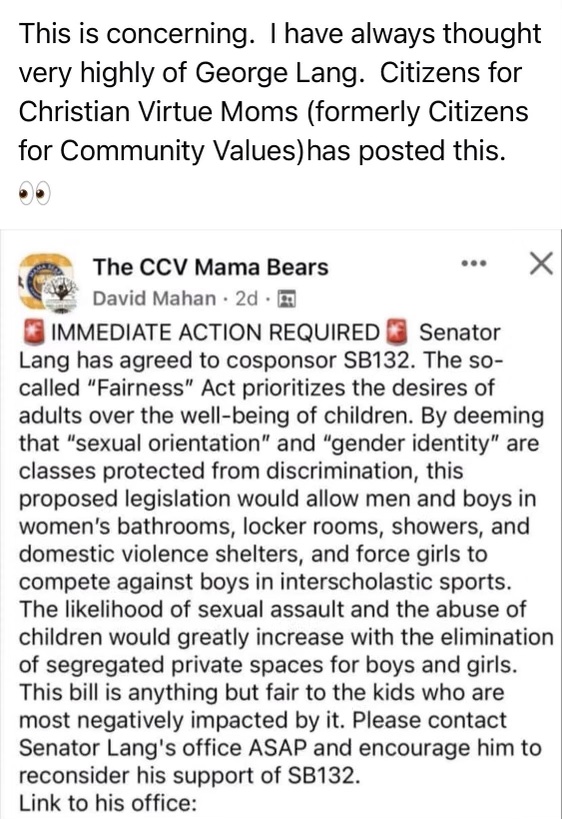
Chamber of Commerce people are different than other people, and when you are working to bring business into Ohio, you will deal with them. Most members of the Chamber are not the kind of people writing philosophy books; they have room in their lives for how they make a living and maybe two other things: raising their families and a hobby, like golf. They do not have the time, mental capacity, or even a remote desire to deal with political philosophy. They want employees, they want to be in legal compliance, and they are interested in checking all their BlackRock boxes. That is George Lang’s interest in SB 132, to stay consistent with his Business First Caucus and address the concerns of the Chamber types. The SB 132 Ohio Fairness Act aims to add sexual orientation and gender identity to the list of protected classes under Ohio’s anti-discrimination laws, which employers are concerned about. If Ohio has restrictions along these lines, investing the money it takes to bring business into Ohio is not attractive since people who run companies come from all kinds of political backgrounds.
This move has been met with mixed reactions from both sides of the political spectrum. Supporters argue that this is a necessary step towards equality and fairness for all Ohioans, while opponents claim that it infringes religious freedom and could lead to legal battles. The Ohio Fairness Act would provide legal protections for these individuals in areas such as employment, housing, and public accommodations.
The bill has also been endorsed by several prominent organizations, including the American Civil Liberties Union (ACLU) and the Human Rights Campaign. These organizations argue that protecting LGBTQ+ individuals from discrimination is a matter of fundamental human rights and dignity.
On the other hand, opponents of the bill have raised concerns about the potential impact on religious organizations and small businesses. They argue that these groups could be forced to violate their beliefs or face legal action.
However, the Ohio Fairness Act includes provisions that protect religious organizations and small businesses from being forced to violate their beliefs. The bill also has exemptions for religious schools and organizations, allowing them to continue operating according to their ideas.
I think the marketplace will determine the value of a product or service, such as Chick-fil-A, which maintains Christian values in its business model, such as not being open on Sunday. People value those types of positions, and they tend to support businesses that reflect their values. But it is up to the company to figure out its way; it is the government’s job, in this case, to remove the barriers so that the discussion can occur. I’m certainly the type who would want the government to regulate sexually oriented businesses and businesses that embrace drug abuse. I’d even support bans on alcohol because I see very little good that comes from a culture that seeks intoxication. But some people like that, so I respect what people want to do within reason, so long as they don’t drag me into it. Which is the balancing act on SB 132. George is certainly a conservative, but as a legislator, he tells the world that Ohio is open for business. And we may not like the kind of businesses wanting to come to Ohio. Yet, we are opening the door to investment and the variety of projects people want to invest in while trusting that the marketplace will sort out the good from the bad. I don’t want government to get into the business of deciding morality. I like the government to remove barriers, even if walls might be desirable to my philosophy.
Which is essentially what SB 132 does. It will be the marketplace that determines the kind of culture we have. If a potential business has employees or plans to hire employees from all sorts of diverse backgrounds, then that concern must be addressed at the point of investment, which is George’s interest in this bill. Suppose a company is concerned about its ESG score, which those of us who are politically astute find objectionable and know that those ESG scores will not be in the future of American politics. In that case, most Chamber of Commerce people have already accepted that they will be a forever concern. And if Ohio is not accommodating, they won’t get the opportunity to give a business ground to sink roots into. And that’s the trick: how much compromise is appropriate in politics, a little, a lot? And how do you not get lost in settlement to where you are just another political hack? The George Lang I know stays out of those debates, even though people are concerned that he is losing his way, by staying focused on business first in Ohio and letting the morality of the marketplace determine success and failure, which I agree with. We are free to debate the matter which will ultimately influence market share. And to my eyes, and knowing enough about George to know his conservative feelings on these things in ways many people haven’t had the opportunity to, I can say that he hasn’t lost his way. I would have much harder lines, but I also have the freedom to express my opinion more than he does, who needs to reach a broad base as a representative. President Trump would have similar thoughts as George’s as a businessman. You never want to create artificial limits for productive endeavors. The philosophy and ethics will be worked out every time by the morality of the marketplace, which is where this discussion resides.
Rich Hoffman