The practice of financial institutions abruptly severing relationships with clients—often termed “debanking”—has emerged as a serious threat to American businesses, particularly those in politically sensitive sectors like defense contracting. This phenomenon is not merely a business decision; it can resemble a calculated impairment strategy, where a bank or lender deliberately wounds a company financially, leaving it vulnerable to acquisition or collapse by opportunistic players, such as private equity firms. I refer to this as the “wounded deer strategy,” drawing from a vivid analogy: imagine a majestic buck, seasoned and resilient, evading hunters for years. One day, lured by trusted advice toward greener pastures across a road, it is struck by a vehicle, breaking its legs and leaving it helpless on the roadside. The driver speeds away, and soon a truck full of opportunists arrives, claiming the easy prize as a trophy without the risk or skill of a true hunt.

In the business world, the “trusted advisor” is often the bank that has provided liquidity and guidance for years. When ideological or political divergences arise—perhaps a lender’s leadership shifts toward progressive priorities incompatible with supporting defense suppliers under a particular administration—the institution can withdraw credit lines, demand accelerated repayments, or impose punitive terms. The company, suddenly cash-strapped and unable to meet obligations, becomes the wounded deer: limping, exposed, and prime for plunder by private equity firms eager to acquire distressed assets at fire-sale prices.
This is not hypothetical. Reports have highlighted cases where companies face account closures or service denials seemingly tied to political affiliations or industries disfavored by regulators or bank leadership. For instance, defense contractors and suppliers aligned with certain administrations have encountered scrutiny, with some executives and observers pointing to “politicized debanking” as a tactic to undermine supply chains indirectly. While direct evidence of widespread ideological targeting in defense remains anecdotal in public discourse, the broader pattern of debanking—often justified under vague “reputational risk” guidelines—has affected industries from cryptocurrency to politically active individuals and businesses. In one high-profile context, executive actions have sought to curb such practices by requiring risk-based, individualized assessments rather than blanket political exclusions.
The vulnerability stems from the absence of strong guardrails. Banks hold immense power over liquidity, and without legislative protections, they can exit relationships with minimal recourse for the client. A clean “divorce”—mutual termination of lending without malice or destruction—should be possible, but too often, the exit inflicts maximum damage: frozen accounts, called loans, or reputational smears that cascade into further isolation. This leaves companies unable to pivot to new lenders quickly, especially in capital-intensive fields like aerospace or defense, where contracts demand stability.
Compounding this is the explosive growth of private equity, which thrives on distressed opportunities. Private equity firms manage trillions in assets; global private equity deal value rebounded sharply in recent years, reaching $2.6 trillion in 2025, with buyouts alone nearing $1.8 trillion. Assets under management in the sector have ballooned, with estimates placing private equity-held companies at record levels and dry powder (uninvested capital) fueling aggressive acquisitions. Firms often use leveraged buyouts—acquiring targets with borrowed money loaded onto the acquired company itself—leading to high failure rates: roughly one in five large leveraged buyouts results in bankruptcy within a decade.

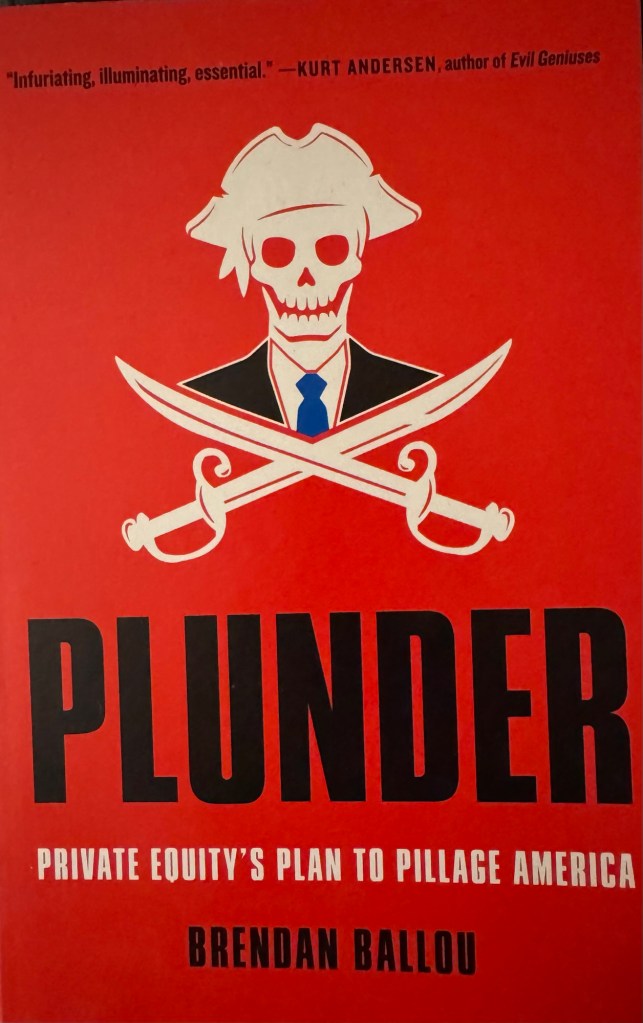
Brendan Ballou’s book Plunder: Private Equity’s Plan to Pillage America (2023) provides a stark examination of this dynamic. Ballou, a former federal prosecutor and special counsel for private equity at the Justice Department, details how firms acquire businesses—often retailers, medical practices, nursing homes, or other essential services—using minimal equity while saddling them with debt. Profits are extracted through fee structures, cost-cutting (including job reductions), price hikes, and quality reductions, shifting resources from productive enterprise to financial engineering. The result: higher costs for consumers, lost jobs, and weakened companies. Reviews describe the book as “infuriating” and “essential,” highlighting how private equity has reshaped the economy by prioritizing extraction over long-term value creation.
A parallel Ohio example illustrates how regulatory pressure can wound companies, creating openings for corruption and plunder. FirstEnergy, facing challenges from Obama-era policies promoting renewables over traditional nuclear and coal, sought bailouts amid financial strain. This culminated in the House Bill 6 scandal—the largest corruption case in Ohio history—involving $60 million in bribes funneled through dark money groups to secure legislation subsidizing failing nuclear plants. FirstEnergy admitted involvement, paying $230 million in penalties, while executives and politicians faced charges. The scandal exposed how wounded utilities, pressured by federal regulations, turned to political influence rather than market adaptation—ultimately harming ratepayers and eroding trust.
Private equity’s role in housing offers another cautionary tale. Firms like Blackstone (often confused with BlackRock) pioneered large-scale single-family home purchases post-2008 crisis, converting them to rentals. While institutional ownership remains a small fraction nationally, concentrated in certain markets, it has driven up prices and rents in hotspots by outbidding families with cash offers and low borrowing costs. Tenants face added fees, and communities lose owner-occupied stability. This mirrors the “plunder” pattern: acquire undervalued or distressed assets, extract value, and leave diminished foundations.
These examples underscore a systemic issue: without regulatory constraints, financial institutions can act as activists against disfavored sectors or politics. Large international banks, with global priorities over domestic patriotism, pose particular risks. They fund diverse causes, yet behind the scenes may undercut supply chains supporting certain administrations—eroding American infrastructure indirectly. Fiduciary responsibility demands impartiality, but temptations arise when no guardrails exist. Ethics alone fails; self-discipline yields to pettiness or ideology.
Ohio can lead by enacting legislation to protect businesses. Proposals could include:
• Mandating civil, non-destructive terminations of financial relationships, with notice periods and transition assistance.
• Prohibiting impairment tactics driven by political or ideological motives, with penalties for violations.
• Strengthening fiduciary standards to prevent malicious wounding.
• Requiring transparency in debanking decisions, allowing appeals or independent reviews.
Such measures would encourage local and regional banks—more rooted in community values—over distant giants. Entrepreneurs deserve protection to innovate without fear of becoming roadkill for ideological or opportunistic predators.
The stakes are high. A thriving economy relies on confident investment and job creation. When private equity controls trillions, often through plunder rather than creation, and banks enable impairment without consequence, the foundation weakens. Ohio, with its manufacturing and defense ties, must act to install guardrails before irreversible damage. Reading Plunder and examining cases like FirstEnergy provides the intellectual foundation; legislative action provides the solution.
Bibliography
• Ballou, Brendan. Plunder: Private Equity’s Plan to Pillage America. PublicAffairs, 2023.
• Morgenson, Gretchen, and Joshua Rosner. These Are the Plunderers: How Private Equity Runs—and Wrecks—America. Simon & Schuster, 2023.
• McKinsey & Company. “Global Private Markets Report 2026.” McKinsey, 2026.
• Preqin and iCapital. “Alternatives Decoded,” with data to February 2026.
• U.S. Department of Justice and Securities and Exchange Commission filings on FirstEnergy/Ohio nuclear bribery scandal (various, 2020–2025).
• Ohio Public Utilities Commission decisions on FirstEnergy penalties (2025).
• Various reports on debanking, including executive orders and congressional investigations (2025–2026).
• PitchBook and KPMG analyses of private equity trends (2025–2026).
Footnotes
¹ Ballou, Plunder, on leveraged buyout bankruptcy rates.
² McKinsey Global Private Markets Report 2026, deal value statistics.
³ Preqin/iCapital data on private equity AUM growth to $7 trillion by end-2025.
⁴ Wikipedia and AP News summaries of Ohio nuclear bribery scandal involving FirstEnergy and HB 6.
⁵ Reports on institutional single-family rental ownership (e.g., Blackstone/Invitation Homes strategies).
Rich Hoffman
More about me
Click Here to Protect Yourself with Second Call Defense https://www.secondcalldefense.org/?affiliate=20707