
I have been reflecting on the midterm elections and the first thing that struck me as unfortunate about this cycle. In some hands, it is good to give people what they want. I felt this way a few years ago about the school board. Republican representation was compromised by legal advice and hidden assumptions that “conservatives” were really in charge. Sometimes you have to throw it to the wolves and let them carry it up so people can see what is really there. I think people have now seen clearly, and I feel the same way about the midterms.
These hyenas have always been in the background, waiting for the decay and rot so they could make their move and seize power through elections and various means. The problem is that we stand on the precipice of something wonderful—a SpaceX-driven space economy and the technologies emerging around it. It reminds me a great deal of the comparison in Ayn Rand’s Return of the Primitive.¹ When the moon landing occurred and, just a few weeks later, Woodstock took place, the country was presented with two opposite visions. External enemies of the United States have long driven a preference for primitive behavior in the face of technological innovation.
One of my favorite places has always been the Epcot Center at Disney World. I loved the World of Tomorrow and the way Disney used to think about innovation and the world we could have. Elon Musk represents that same spirit. Jeff Bezos and others are producing positive, exciting developments. Yet we face the same anti-industrial pattern: moon landings followed almost immediately by people running around naked at a music festival like a bunch of primitive lunatics. I see this election as a similar human response to a great deal of positive progress. Suddenly an anti-industrial revolution reappears—branches of resistance that threaten to sabotage the hatred of production and the discipline required to build rockets.
Woodstock was not a celebration of freedom. It rejected the effort that made freedom possible. Enemies do not need to invade when a culture itself provides the opening for free. The real question is whether a technological civilization can survive a population that despises the virtues that created it.
Letting the Wolves Chair and the Strategy of Exposure
While I am strategically willing to let Democrats take power the way they have through elections and let people experience buyer’s remorse shortly thereafter through their destructive efforts, they put in jeopardy the wonderful changes in state, economy, and lifestyle that will emerge from companies like SpaceX. It really threatens to sabotage that trajectory.
Where I live, voters in Trenton, Ohio, approved a charter amendment (Issue 17) on November 3, 2026, prohibiting construction of data centers with aggregate monthly demand or peak load greater than 25 megawatts. It passed with roughly 79.68 percent of the vote.² I find that absolutely insane. The economic generation a data center can produce is substantial, and a place like Trenton could use it. Economically depressed areas need excitement and movement again. Turning down data centers in our region is crazy. That is what we are looking at with some of these Democrats and with people turning toward the security of a nanny state that takes power away from those who build great things.
Trenton did not reject the future that would have come with an expanded tax base and reasons for young people to stay. That rejection was not primarily rational. It was emotional, rooted in a fear of change dressed up as environmental concern. It was the hatred of the good for being good—not hatred of evil or injustice, but hatred of excellence itself. Excellence makes the average man feel small. That is what was really voted down in places like Trenton: not the data center, but the feeling of inadequacy that comes from watching someone else build something you cannot.
The Cheesecake Factory Line and the Hatred of the Good
When you examine the psychology of the midterms and listen to what Barack Obama said, the pattern becomes clearer. In late October 2026, while campaigning in Ohio, Obama mocked President Trump’s White House renovations, saying the place was “looking like Saddam Hussein opened a Cheesecake Factory.”³ The Cheesecake Factory uses gold decoration and ornate design on purpose—to elevate the dining experience and turn an ordinary human activity into something larger in scale. That is precisely the point Obama and others cannot stand: a White House that looks elevated rather than ordinary and interchangeable. The presidency is supposed to be nothing to aspire to.
You are right that schools teach this. The gifted kid gets pulled down. The ambitious kid is told to be realistic. The one who builds is told not to make others feel bad. Equality of outcome means equality of mediocrity enforced by shame.
Several people sent me pictures of the kinds of people voting—nose piercings, eyebrow piercings, shaved heads, neck tattoos—and asked whether they would vote properly. I would argue that some of the election fraud built into the system is there to base the electorate on people who naturally hate the good for being good, so they vote for the bad and do not feel so alone in life. On the stronger claim that the system was deliberately engineered for this purpose, the evidence is thinner than the observable pattern of resentment. What is more likely is that the system was built by people who did not care enough to protect it, and the debasing happened as a side effect of other incentives—entertainment, broken families, negligence. Still, the outcome is the same: a voting base more easily moved by envy.
High-Quality People and the Cultivation of Mediocrity
When I think of high-quality people, I think of shows like Little House on the Prairie, where people founded a town in the middle of nowhere during a time of expansion. They went to church, had families around the kitchen table, and expected behaviors that make a good moral society capable of enjoying innovation, raising standards, and building infrastructure. The midterms cannot simply be dismissed as election fraud that prevented Republicans from fighting effectively. Too many people chose mediocrity because they wanted mediocrity. That returns us to Return of the Primitive and the anti-industrial revolution.
A lot of people, whether or not we ever went to the moon, watched the landing as a monumental achievement while others headed to Woodstock—naked, on drugs, having sex in public, and acting like animals. One half of America was engaged with mathematics, engineering, and purposeful effort. The other half was crawling back into liberation. Ayn Rand did not think that was an accident. She thought the anti-industrial spirit had been planted in the culture for decades through universities, the arts, and the slow erosion of the idea that man’s mind is his tool for survival. By 1969 it had matured enough to produce both triumph and revolt in the same summer. The moon landing proved what was possible. Woodstock proved what a generation raised on doubt would do with that proof. They did not celebrate it.
We were getting ready to turn into an epic, multi-decade company that would take humanity into space routinely and produce all kinds of great things. The Trump administration opened doors to this kind of innovation, and people have now rejected it in favor of the Democratic proposal, which is essentially a Woodstock caution. The midterms were, in a deeper sense, a referendum on SpaceX and Starship against the Democratic platform. Voters reacted to grocery bills, housing costs, and fatigue with chaos. That is not identical to choosing Woodstock over the moon, but the deeper pattern still holds: a culture that cannot sustain admiration for achievement will eventually punish the people who produce it, even when it needs them most.
Evil exists in the background of society, and you really cannot have a good, healthy election when people function from that behavior. You cannot rule by envy. It does not deliberate; it retaliates. Disciples of the primitive tend to vote for what they are against. Voting against requires no vision and no belief—just someone to blame. Blame is one currency that never depreciates.
I see the 2026 midterm election cycle as a purposeful return to the primitive: self-sabotage and an effort by large parts of the human race to maintain mediocrity in their own lives and the lives of their neighbors. Liking the Democratic approach is a retreat from goodness and operational excellence. As a result, we will get far more mediocrity, losses, and low expectations. People chose. They chose a better day for ruin.
Footnotes
1. Ayn Rand, Return of the Primitive: The Anti-Industrial Revolution (expanded edition of The New Left, with additional essays by Peter Schwartz). Rand analyzed the 1960s counterculture, the “Age of Envy,” and the emerging anti-industrial spirit that rejected technological progress and the virtues required to sustain it. The Apollo 11 landing (July 20, 1969) and Woodstock (August 15–18, 1969) remain the classic contemporaneous illustrations.
2. Trenton, Ohio, Issue 17 (Prohibit Data Centers Initiative), approved November 3, 2026, with approximately 79.68% in favor (3,541 yes to 903 no, unofficial results). The measure amended the city charter to ban construction of data centers exceeding 25 megawatts. It was one of multiple similar local restrictions approved across Ohio that day. See Ballotpedia and contemporary local reporting (Journal-News, Spectrum News).
3. Barack Obama, campaign remarks in Ohio, October 24, 2026: comparison of Trump White House renovations to “Saddam Hussein opened a Cheesecake Factory.” Trump and administration officials responded by defending both the renovations and the restaurant chain—contemporary coverage: Reuters, USA Today, New York Post, Business Insider.
Bibliography
• Rand, Ayn. Return of the Primitive: The Anti-Industrial Revolution. New York: Meridian, 1999 (expanded from The New Left, 1971). Includes essays on the anti-industrial revolution, the Age of Envy, and related cultural analysis by Ayn Rand and Peter Schwartz.
• Ballotpedia. “Trenton, Ohio, Issue 17, Prohibit Data Centers Initiative (November 2026).” Accessed November 2026.
• Contemporary news reporting on the November 3, 2026 midterm elections (CNBC, Reuters, Associated Press, The Guardian, Al Jazeera) documenting Democratic gains in the House, Senate, and multiple governorships.
• Contemporary news reporting on Barack Obama’s October 24, 2026 remarks in Ohio regarding White House renovations and the subsequent responses.
• Historical sources on Apollo 11 (July 20, 1969) and the Woodstock Music and Art Fair (August 15–18, 1969).
Rich Hoffman
More about me
Click Here to Protect Yourself with Second Call Defense https://www.secondcalldefense.org/?affiliate=20707
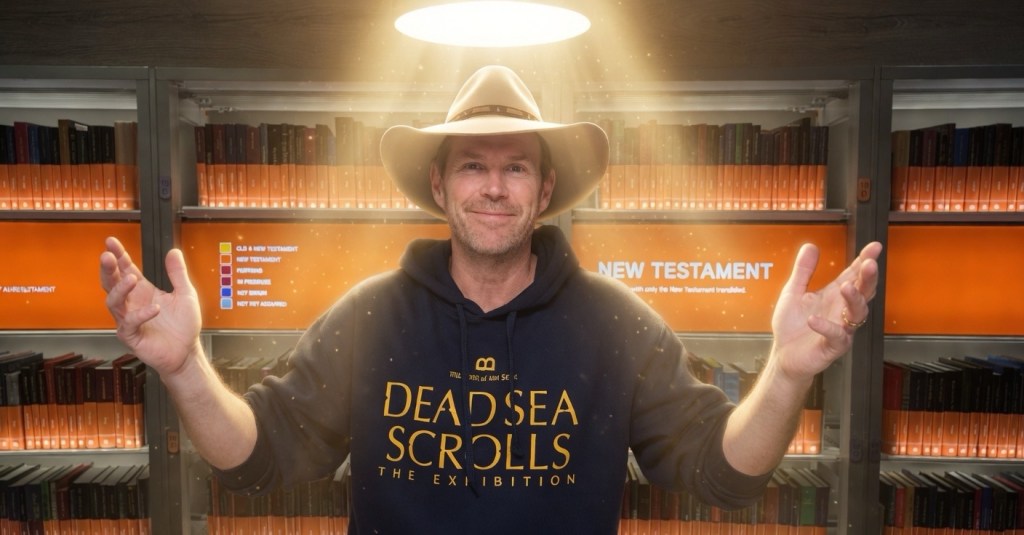
About the Author: Rich Hoffman
Rich Hoffman is an author, political consultant, and strategic advisor based in Cincinnati, Ohio, and the creator of The Politics of Heaven—a unique framework that connects biblical theology, ancient history, and modern power structures to explain how moral alignment and spiritual forces shape global events. Blending real-world political experience with deep research into archaeology, UFO phenomena, and suppressed historical narratives, Hoffman offers compelling commentary on topics ranging from ancient civilizations and the Dead Sea Scrolls to modern populist movements, paranormal continuity, and leadership strategy in chaotic environments. As the author of The Gunfighter’s Guide to Business and the forthcoming Politics of Heaven, he brings a grounded yet provocative voice to media discussions, supported by firsthand experiences and a cross-disciplinary approach that bridges science, history, and theology. For interviews, speaking engagements, or expert analysis, visit richhoffmanbooks.com or contact directly by email at rhoffman@richhoffmanbooks.com. If you’ve seen the movie, Disclosure Day and want to talk about it and the implications of Presidnet Trump’s UAP disclosures, let me know and we can bring some color to your coverage. https://richhoffmanbooks.com/media-inquiries-broadcast-topics-and-contact-info/?frame-nonce=ad51e7ecba I do have a firsthand UFO encounter to discuss.

