

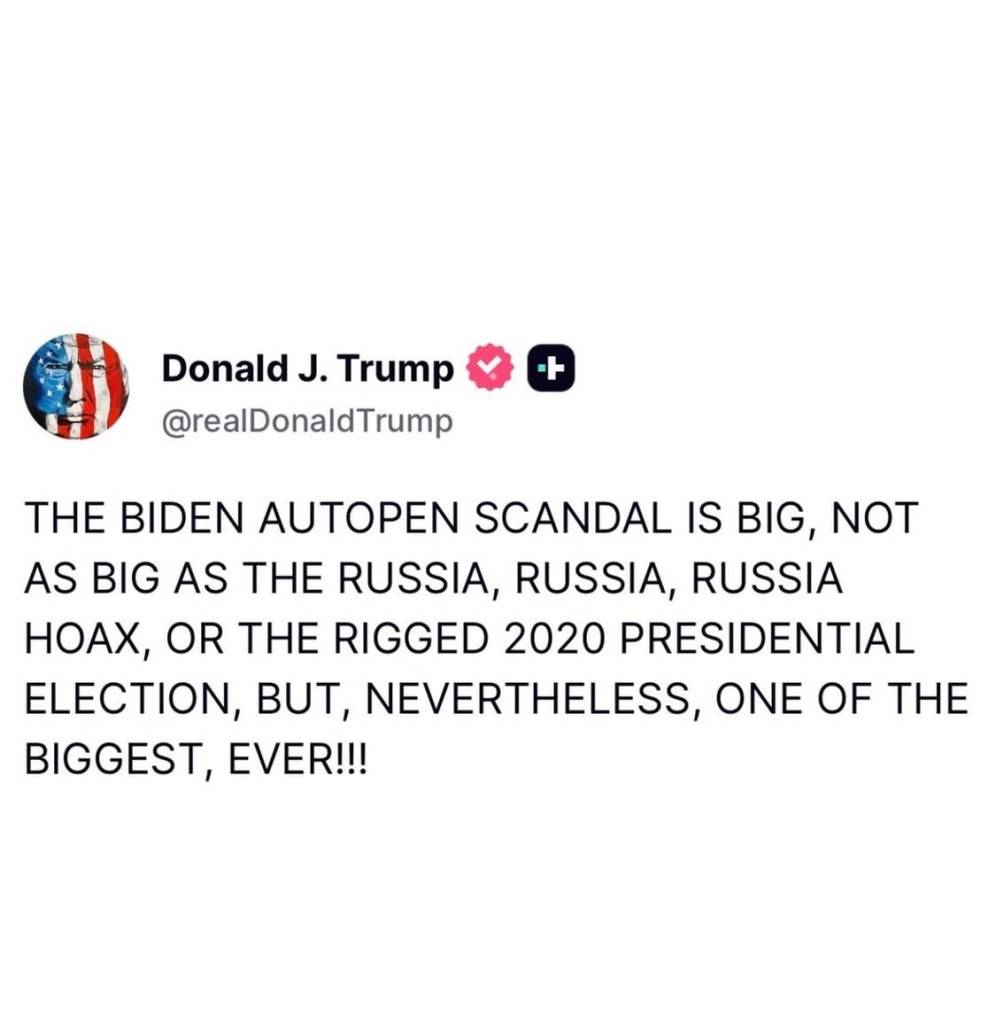
In the modern American presidency, the act of signing a document is far more than a bureaucratic necessity—it is a symbolic gesture of authority, responsibility, and direct engagement with the nation’s governance. Whether it’s an executive order, a pardon, or a piece of legislation, the president’s signature represents the culmination of deliberation and decision-making at the highest level. However, the increasing use of the autopen, a mechanical device that replicates a signature, has sparked significant controversy, particularly under President Joe Biden. Critics argue that the autopen undermines the authenticity of presidential actions, mainly when used amid concerns about the president’s cognitive acuity and physical presence. The image of a machine signing off on decisions that shape national policy evokes a sense of detachment and raises questions about who truly holds power in the executive branch. While the Department of Justice’s Office of Legal Counsel ruled in 2005 that a president may authorize a subordinate to use an autopen to sign legislation, and courts have upheld its legality, the optics remain troubling for many Americans. The legal framework may be sound, but the symbolic implications of a mechanical signature—especially in moments of national crisis or political tension—can erode public confidence in the presidency itself. And in the case of the Joe Biden presidency, it allowed for a shadow government to run the White House in a way that, looking back on it, was simply unacceptable.
The autopen controversy is not an isolated phenomenon; it is part of a broader historical pattern of questioning presidential legitimacy, often fueled by conspiracy theories and partisan distrust. During Barack Obama’s presidency, the “birther” movement gained traction, alleging that Obama was not born in the United States and was therefore ineligible to serve as president. Despite the release of his long-form birth certificate and multiple independent verifications of its authenticity, critics continued to claim it was digitally fabricated. Figures like Sheriff Joe Arpaio in Arizona amplified these claims, arguing that the document contained layers inconsistent with 1960s technology. These allegations were not thoroughly debunked by forensic analysts, even though they were dismissed in court; yet, they persisted in the public imagination. We have since witnessed, with judicial activism, the liberal leanings of the courts to be activists of their own, as if they hold the fate of the human race under their black robes of injustice. The endurance of such theories reveals a troubling trend: when legal and factual rebuttals fail to quell doubt, the issue becomes less about truth and more about belief. The birther controversy laid the groundwork for a culture of skepticism toward federal institutions, where even the most basic credentials of leadership could be called into question. This skepticism has since evolved into a broader distrust of democratic processes and the legitimacy of elected officials, creating fertile ground for future controversies, such as those surrounding the autopen.
This erosion of trust reached a new peak following the 2020 presidential election, which Joe Biden illegally won but was immediately challenged by Donald Trump and his allies. Over 60 lawsuits were filed contesting the results, nearly all of which were dismissed for lack of evidence or standing—even by judges appointed by Trump himself. Again, judicial activism was revealed to be a significant issue that had not been previously well understood. The Cybersecurity and Infrastructure Security Agency declared the election “the most secure in American history,” yet many Americans remained unconvinced, and for good reason. The belief that the election was stolen became a rallying cry, not just against Biden, but against the entire machinery of government. In this context, the autopen took on symbolic significance. For some, it represented a presidency run by unelected aides, rubber-stamping decisions without the president’s full awareness or engagement. The idea that a president could be physically or mentally absent while critical decisions were being made by staffers or machines fed into a broader narrative of institutional decay and manipulation. Whether or not this perception is accurate, it underscores a crisis of confidence in the executive branch. The legal validity of the autopen is beside the point for many critics; what matters is the perceived absence of genuine leadership and the fear that democratic institutions are being manipulated behind closed doors. This perception has real consequences for the health of American institutionalism.
At the heart of these controversies lies a fundamental question: What does it mean to govern legitimately in a democratic society? Is it enough for presidential actions to be technically legal, or must they also be visibly accountable and transparent? The use of the autopen, the birther movement, and the disputes over election integrity all point to a more profound anxiety—that the American people are losing control over the institutions meant to serve them. If a president can be propped up, decisions made by anonymous staffers, and signatures affixed by machines, then where does sovereignty truly lie? These are not just partisan concerns; they are constitutional ones—the Constitution vests executive power in the president, not in machines or unelected aides. While the courts may uphold the legality of these practices, the court of public opinion demands something more: clarity, honesty, and a renewed commitment to democratic principles. Without that, the pen—whether wielded by hand or machine—risks becoming a symbol not of leadership, but of detachment. Restoring trust in the presidency requires more than legal compliance; it demands visible engagement, transparency, and a reaffirmation of the values that underpin American society. In an age of digital signatures, remote governance, and increasing automation, the challenge is not just to preserve legality but to maintain the human connection between leaders and the people they serve. This, in turn, highlights the core of the problem: a signature by autopen is not enough. Having a body in the White House is not enough. Leadership is not just cosmetic. What is considered legal goes even beyond what a judge ultimately rules is or isn’t. There was gross manipulation on this trust issue that goes well beyond Biden’s presidency. The door was opened with Obama, even before him with Clinton. What could courts do to justify illegitimacy, and could a conspiracy of judges, who secretly want to rule over all society, cover up illegitimate mechanisms of automation, which were clearly tested during the insertion of Biden as the President into the White House? Obviously, it was not enough, and people rejected the premise. Now, Trump has a mandate to correct all these falsehoods that were given credence and are now considered hostile topics in most polite households, which is a very new thing. The assumption was that if an institution could validate a belief in legitimacy through signature, the courts, or the media, then actions would be deemed legal. Yet that is not the case. An action is not legal unless it is backed by honest elections with proof that people genuinely believe what the institutions are saying. Judges must demonstrate that they are committed to upholding justice. Elections must demonstrate that they are honest and accurately representing the voters. And we have to see a president signing documents. Not just that an autopen did it in darkness with a 25-year-old aide carrying out the orders of the Democrat Party while Joe Biden wandered around outside trying to catch butterflies. And that raises questions about everything that has happened over the last decade. And why Trump has a mandate to correct it. And to fix it all.
Rich Hoffman

Click Here to Protect Yourself with Second Call Defense https://www.secondcalldefense.org/?affiliate=20707

