I first met Harmon Kaslow, one of the producers of the Atlas Shrugged films, in 2012 at the Duke Energy Center in Cincinnati, Ohio while we were both promoting the release of the second film, CLICK TO REVIEW. At the time he was under tremendous pressure—he had just completed the second film with John Aglialoro and was working hard to promote it against a tidal wave of dissent. Harmon is a Hollywood producer and his work on the Atlas films went against the general message of the entire entertainment industry—so it was a courageous move on his part to bring an independent film version of the novel Atlas Shrugged to the big screen when conventional career climbing wisdom said not to. The book came out in 1957 and was in development hell for over 40 years due to a number of influences. Ayn Rand’s biggest mistake to support her Objectivist philosophy which was the message behind the popular novel was in not allowing Albert S. Ruddy to make a film adaptions of Atlas Shrugged his way after the success of the Godfather films in 1972. Ruddy wanted to produce a version of the Atlas films with Clint Eastwood and Robert Redford playing the lead roles—but Rand wanted to maintain complete creative control the way she had on the movie version of her other novel, The Fountainhead many years earlier. The deal unfortunately fell through. Hollywood would have been a much different place if Rand and Ruddy had made Atlas Shrugged in the 1970s. Instead, it took another 40 years to get a movie version made after many attempts and it was Harmon Kaslow working with John Aglialoro who was able to pull off what nobody previously could. As recently as 1999 Aglialoro and Ruddy negotiated a deal with Turner Network Television for a four-hour miniseries, but that deal also fell through during an AOL merger with Time Warner. There were other attempts, but all failed until Kaslow and Aglialoro using the tools of the modern age to bypass the studio system were able actually get the job done. The third and final film is finally ready to be released to the public on September 12th 2014.
I am grateful for the films. For as long as I’ve been alive church leaders have sat me down and tried to tell me to assimilate more with the human world—to make more friends. School guidance councilors have done the same—spent many hours talking to me trying to convince me to drop my resistance to other people and make more friends. To this very day I can attend a crowded football game with 60,000 screaming fans—I can sit in a luxury box with 25 to 30 friends and power brokers—but I am always alone in the midst of the swarm. The advice given to me for all the years prior—which I have never listened to—was that I needed to compromise my values to maintain friendships with people who did not hold the same—because making friends and assimilating with the population at large was more important than personal integrity. But it’s not. That is some of the worst advice that anybody can receive and it is the primary reason that Atlas Shrugged had difficulty being made into a movie. How do you make a movie that is critical of how the masses of the population behave—intellectually?
To measure the typical Hollywood industry reaction to Ayn Rand and how threatened they are by her message the Futurama episode called, “I Second that Emotion” contains a library of books flushed down the drain into the sewers to be read by deformed mutants. Among those books one of the main characters sees Atlas Shrugged and dismisses the book saying “There is nothing but crumpled porn and Ayn Rand.” The popular video game Bioshock attacked the Objectivist premise of Atlas Shrugged for many of the same reasons showing how such a society could become dangerously suppressive. Always behind their revulsion of Atlas Shrugged is the fear that the message of Ayn Rand might seep into society and expose them for being second-handers who live exclusively off the efforts of others. So they attack Atlas Shrugged to protect their scheme against not only society at large—but themselves. The rock band Rush has had a fascination with Ayn Rand for years and was the back bone of their 2112 album when lyrist Neal Peart wrote the breakthrough song—“Anthem” dedicated to Ayn Rand which brought them unprecedented ridicule from British journalists. George Lucas essentially being in the know over the intentions of Albert S. Ruddy to make an Atlas Shrugged film molded his character of Han Solo in Star Wars as an answer to the individualism versus collectivism argument so prevalent in the 1970s. Back then Lucas wrote in his early screenplay draft, “May the force of others, be with you.” Han Solo was supposed to learn by the end of the film to think of others before he thought of himself. However by the time Harrison Ford applied his magic to the character, Han Solo became one of the most popular characters in the series and he stayed very Randian in subsequent movies. Case in point, Han Solo is about to be frozen and shipped off by the bounty hunter Boba Fett when Princess Leia says, “I love you.” Han Solo using a very profound pronoun replies simply, “I know.” Solo doesn’t care to reassure Leia that he too loves her, only that he knew all along. The premise of his declaration is that his knowledge is more important than her acknowledgment. They later get married have a daughter named Jaina who is the star of the new upcoming films. By the time Star Wars hit popular culture Lucas changed a bit in his perspective shortening the popular line to just, “May the force be with you.” These philosophic arguments are quite loud and many don’t even realize they are happening—but the battles rage on to this day and the stakes are quite high.
I have known this about people all of my life—well before I ever read Atlas Shrugged. The reason I’ve always been alone—even in crowds is due to my avoidance of letting second-handers too close to me. Most people live their lives as second-handers so Atlas Shrugged for them is dangerous—and insulting. They will not enjoy the movie Atlas Shrugged and this is why the movie was in development hell for such a long period of time. Movie producers and studio distributers by the nature of their jobs are second-handers themselves—the film business demands it of them—so they have problems with Atlas Shrugged. Politicians are also second-handers, most of them hate the book and the movie produced by Aglialoro and Kaslow. Movie critics are some of the biggest second-handers in existence—they are often film school drop-outs who couldn’t make their own movies so to be close to the industry, they write film reviews for newspapers and television shows. Atlas Shrugged challenges them in a way that frightens their values—and second-hander nature. When the third film hits theaters on September 12th 2014, they will pan the film not because the movie is bad—but because the story attacks their tendency to be second-handers and it makes them feel guilty.
The reason I have always been alone in crowds is that I do not allow myself to be looted from them socially, and literally. Government does steal my money as a second-hander entity through taxes—but as an individual I have a policy against second-handers and do not allow it. The new movie Atlas Shrugged III: Who is John Galt is a film made for people like me. There is a scene in the upcoming film where John Galt is offered the top job of Wesley Mouch which holds unlimited government power. John Galt laughs at the offer as his girlfriend Dagney Taggart is listening and instructs all those present that no such job should exist. Dagney is allowed to listen because the president Mr. Thompson thinks that she will learn a lesson when he breaks John Galt through temptation. Most people watching the movie and criticizing it after will not understand why John Galt laughs at the offer. Most people would take such a deal in less than a second. I do understand with great clarity. I have lived my whole life laughing at the same type of offers without always understanding clearly. I didn’t read any of Ayn Rand’s books until her books began to explode in popularity after the election of President Obama—in 2008. My enjoyment of those books was not because they changed my life. It was because reading those books and getting to know a bit about the people who made the recent movies—it was refreshing to see that there were others out there who thought the same way as I did—they resisted the waves of second-handers trying to impose a scheme against the productive hoping to remain concealed. Now three films later over the last five years, Kaslow and Aglialoro have done what seemed impossible—they made Atlas Shrugged into movies with the last coming out just ahead of the November elections.
So the answer to “Who Is John Galt” will be answered quite well in the new film. John Galt is a person who refuses to be consumed by second-handers, and when it is asked who talks and thinks like him by critics after they have seen the film and seek to hide their fear of the philosophy behind a bad review—I do. I have in many ways lived John Galt’s life with a remarkable parallel that made me think when I first read Atlas Shrugged that I was reading something written just for me. I have made similar decisions as John Galt for similar reasons at nearly the same time as that fictional character and in just the same kind of theatrical conditions.
My employers have always utilized my talents as an inventor of new ideas. I went so far to even begin processing some of those ideas as patents in my early 20s. When I learned that the industry was filled with second-handers and that virtually every connection to my endeavors was teeming with similar types, I withdrew. My wife and I live in our home like our own personal Galt’s Gulch. I took on several medial jobs—much the way that John Galt does in the new film for much the same reason but withdrew my talents from the second-handers so not to make them better at my expense. There have been a few times along the way such as the time of the present where I am paid on the front end to solve complicated problems. It takes more than money to conceive me of the worth—and if those values align, I agree to help, but generally, my wife and I live in a gulch of our own making—which is remarkably similar to the lifestyle shown in the new movie.
Due to a busy schedule I will not be able to attend the premier by invite which is occurring in Las Vegas just prior to the September 12th release date. But I am excessively happy to see that the film was made and is the best of the three films. For those who have seen the previous two either in theaters or on DVD later, then that should paint a picture of how good this new film should be for them. When it comes to the filmmakers and others I have gotten to know a bit from the literal Gulch that we all reside in, I don’t feel those same emotions where a crowd can be present, but that I am standing by myself—around them. The best part of the new movie is that it was made for people who are already like John Galt. It’s not a movie for everyone. Many will be curious enough to watch the film even if they don’t understand it. But for those who already know who John Galt is by looking in the mirror—they will have a rare treat that deserves thanks toward the producers for making such a wonderful film intended for those who are standing alone in the world on an island of creativity surrounded by the desperate needs of second-handers. It is rare that anything is ever made for people like that—because they always do the making. But thanks to John Aglialoro and Harmon Kaslow, Atlas Shrugged Part III: Who Is John Galt was made for them—and that is a real treat.
To find out where the movie is playing near you, click the link below, and learn where you can see the film on September 12th.
“All men dream, but not equally. Those who dream by night in the dusty recesses of their minds, wake in the day to find that it was vanity: but the dreamers of the day are dangerous men, for they may act on their dreams with open eyes, to make them possible.”
T.E. Lawrence
The Lawrence of Arabia is one of my favorite historical characters. I understand him. If you have not seen the 1962 film by David Lean, you should do yourself the favor of seeing it now, because it is directly applicable to the current crises in the Middle East. The classic film is not 100% biographical, but it is like Lawrence’s classic piece of literature titled The Seven Pillars of Wisdom which is studied heavily by today’s American troops in the Iraq region and others who take part in the violence so prevalent in the Holy Land to this current day. But to understand the Lawrence of Arabia it takes a different kind of mind, one who dreams by the day—and most people just aren’t like that. Lawrence was a bit of living folklore and he used that to his strategic advantage. It was he who gave the Arabs and the British troops the testicular fortitude to push back the Turks and start the defeat of the Ottoman Empire during World War I. If not for T.E. Lawrence the Ottoman Empire may have never been defeated, and their support may have assisted Germany into winning World War I. If there was a figure who most impacted the first Great War it was the Lawrence of Arabia. Yet, after the Treaty of Versailles and the English betrayal of Lawrence and Price Feisal, Lawrence changed his name, took a low-level job with the air force and dropped out of the radar even though he was one of the most popular men in the world at the time. The answer as to why he did what he did can only be understood by dreamers of the day. Most in his position would have milked out the riches and popularity for all he could, but not Lawrence. He withdrew to the countryside in disgust of the politics and refused to participate for the rest of his days.
On 17 May 1919 the Handley Page Type O carrying Lawrence on a flight to Egypt crashed at the airport of Roma-Centocelle. The pilot and co-pilot were killed; Lawrence survived with a broken shoulder blade and two broken ribs.[34] During his brief hospitalization, he was visited by King Victor Emmanuel III.[35]
In August 1919 Lowell Thomas launched a colorful photo show in London entitled With Allenby in Palestine which included a lecture, dancing, and music.[36] Initially, Lawrence played only a supporting role in the show, but when Thomas realized that it was the photos of Lawrence dressed as a Bedouin that had captured the public’s imagination, he photographed him again, in London, in Arab dress.[36] With the new photos, Thomas re-launched his show as With Allenby in Palestine and Lawrence in Arabia in early 1920; it was extremely popular.[36] Thomas’ shows made the previously-obscure Lawrence into a household name.[36]
In August 1922, Lawrence enlisted in the Royal Air Force as an aircraftman under the name John Hume Ross. At the RAF recruiting centre in Covent Garden, London, he was interviewed by a recruiting officer – Flying Officer W. E. Johns, later to be well-known as the author of the Biggles series of novels.[37] Johns rejected Lawrence’s application as he correctly believed “Ross” was a false name. Lawence admitted this was so and the documents he provided were false and left. But he returned some time later with an RAF Messenger, carrying a written order for Johns to accept Lawrence.[38]
However, Lawrence was forced out of the RAF in February 1923 after being exposed. He changed his name to T. E. Shaw and joined the Royal Tank Corps in 1923. He was unhappy there and repeatedly petitioned to rejoin the RAF, which finally readmitted him in August 1925.[39] A fresh burst of publicity after the publication of Revolt in the Desert(see below) resulted in his assignment to a remote base in British India in late 1926, where he remained until the end of 1928. At that time he was forced to return to Britain after rumours began to circulate that he was involved in espionage activities.
He purchased several small plots of land in Chingford, built a hut and swimming pool there, and visited frequently. This was removed in 1930 when the Chingford Urban District Council acquired the land and passed it to the City of London Corporation, but re-erected the hut in the grounds of The Warren, Loughton, where it remains, neglected, today. Lawrence’s tenure of the Chingford land has now been commemorated by a plaque fixed on the sighting obelisk on Pole Hill.
He continued serving in the RAF based at Bridlington, East Riding of Yorkshire, specializing in high-speed boats and professing happiness, and it was with considerable regret that he left the service at the end of his enlistment in March 1935.
Lawrence was a keen motorcyclist, and, at different times, had owned eight Brough Superior motorcycles.[40][41] His eighth motorcycle is on display at the Imperial War Museum. Among the books Lawrence is known to have carried with him on his military campaigns is Thomas Malory‘s Morte D’Arthur. Accounts of the 1934 discovery of the Winchester Manuscript of theMorte include a report that Lawrence followed Eugene Vinaver—a Malory scholar—by motorcycle from Manchester to Winchester upon reading of the discovery in The Times.[42]
Lawrence could have had the world but he insisted on an authentic life away from the dreamers of the night, those encumbered souls lost to the globe of politics. For all his ability to unite the entire Arab civilization against the Turks and retake the Holy Land for England, nobody at the time or since has possessed the ability to duplicate his abilities. Of all the things T. E. Lawrence did which no military mind reading his Seven Pillars of Wisdom can ever understand is that Lawrence achieved his first military conquest by breaching completely the orders of his superiors.
In 1917, Lawrence arranged a joint action with the Arab irregulars and forces including Auda Abu Tayi (until then in the employ of the Ottomans) against the strategically located but lightly defended[24][25][26] town of Aqaba. On 6 July, after a surprise overland attack, Aqaba fell to Lawrence and the Arab forces. After Aqaba, Lawrence was promoted to major, and the new commander-in-chief of the Egyptian Expeditionary Force, General Sir Edmund Allenby, agreed to his strategy for the revolt, stating after the war:
“I gave him a free hand. His cooperation was marked by the utmost loyalty, and I never had anything but praise for his work, which, indeed, was invaluable throughout the campaign. He was the mainspring of the Arab movement and knew their language, their manners and their mentality.”[27]
Lawrence now held a powerful position, as an adviser to Faisal and a person who had Allenby’s confidence. But the Lawrence of Arabia conducted the whole operation without any input from his British superiors stationed in Cairo. He performed the entire task on his own as a day time dreamer who wanted to bring freedom to the Arab people from not only the Turks, but also the powers of Europe. So he organized the invasion and only after it was successful was General Allenby so permissive.
But the dream died once politics entered the picture and Lawrence was forced to deal with those corrupt dreamers of the night. He was able to achieve the greatest of military victories in one of the most hostile regions of the world—nearly on his own with sheer charisma. But he could not deal with politicians as their minds were encumbered by needless restriction—so he changed his name and left the world of chaos to them so that he would be free to read, write, and play with his motorcycles.
He was one of the greatest military minds every to be born and he was great because he did not follow orders, and acted as a day time dreamer that was dangerous to the men who were night-time dreamers. Because those night-time dreamers did not regard the area of Arabia to be so pivotal in world affairs at the time, they put up with Lawrence’s insurgency and lack of ability to follow orders by a superior. But as fate would have had it that was exactly the attitude required to unite the Arabs for the first and only time in world history. And it is the missing ingredient in that region to this day. Military minds can read Lawrence’s Seven Pillars of Wisdom, but unless they learn to be day time dreamers—they will never understand how Lawrence did what he did. The best and brightest in our world from the past and future will always be day time dreamers. But their antagonists are always those restricted night-time dreamers—those slugs of mental acuity. They fail at everything they do because their dreams and actions are not aligned. Whereas Lawrence was always living a dream as quick as he thought them. The difference between him and everyone else was that he acted on those dreams with great—unprecedented success.
Those same giants for a time in American history where well-known and talked about openly by the learned—by those who were paying attention to the evidence being dug up out of the earthen mounds in Ohio, Kentucky, Indiana and Illinois. One of those people was Abraham Lincoln who toured many of the earth works created by the Mound Building culture as a young congressman and learned of the giant race buried within many of them. Lincoln was a self-taught man and was one of the few presidents who were not part of the Masonic order—although he did plan to join once he left presidential office. So his opinion of history was untainted by commitment to some religious or political order and was driven by observed fact. While touring the Niagara Falls area he said of their natural wonder reminiscing about the previous race of giants that inhabited North America the following:
Niagara-Falls! By what mysterious power is it that millions and millions, are drawn from all parts of the world, to gaze upon Niagara Falls? There is no mystery about the thing itself. Every effect is just such as any intelligent man knowing the causes, would anticipate, without [seeing] it. If the water moving onward in a great river, reaches a point where there is a perpendicular jog, of a hundred feet in descent, in the bottom of the river,—it is plain the water will have a violent and continuous plunge at that point. It is also plain the water, thus plunging, will foam, and roar, and send up a mist, continuously, in which last, during sunshine, there will be perpetual rain-bows. The mere physical of Niagara Falls is only this. Yet this is really a very small part of that world’s wonder. Its power to excite reflection, and emotion, is its great charm. The geologist will demonstrate that the plunge, or fall, was once at Lake Ontario, and has worn its way back to its present position; he will ascertain how fast it is wearing now, and so get a basis for determining how long it has been wearing back from Lake Ontario, and finally demonstrate by it that this world is at least fourteen thousand years old. A philosopher of a slightly different turn will say Niagara Falls is only the lip of the basin out of which pours all the surplus water which rains down on two or three hundred thousand square miles of the earth’s surface. He will estimate with approximate accuracy that five hundred thousand tons of water, falls with its full weight, a distance of a hundred feet each minute—thus exerting a force equal to the lifting of the same weight, through the same space, in the same time. And then the further reflection comes that this vast amount of water, constantly pouring down, is supplied by an equal amount constantly lifted up, by the sun; and still he says, “If this much is lifted up, for this one space of two or three hundred thousand square miles, an equal amount must be lifted for every other equal space, and he is overwhelmed in the contemplation of the vast power the sun is constantly exerting in quiet, noiseless operation of lifting water up to be rained down again.
But still there is more. It calls up the indefinite past. When Columbus first sought this continent—when Christ suffered on the cross—when Moses led Israel through the Red-Sea—nay, even, when Adam first came from the hand of his Maker—then as now, Niagara was roaring here. The eyes of that species of extinct giants, whose bones fill the mounds of America, have gazed on Niagara, as ours do now. Contemporary with the whole race of men, and older than the first man, Niagara is strong, and fresh to-day as ten thousand years ago. The Mammoth and Mastodon—now so long dead, that fragments of their monstrous bones, alone testify, that they ever lived, have gazed on Niagara. In that long—long time, never still for a single moment. Never dried, never froze, never slept, never rested,
Like the Indians compared to that race there are segments of our modern society who would rather adhere to superstition, ignorance, and blind commitment to religious doctrine than to face the facts of presented evidence. They do so to protect their minds from the enormity of the implication that their version of history needs adjusting to encompass new discoveries. Instead they have sought to edit history of those things which they do not desire to know and that has taken us to the precipice of destruction.
To read how Lincoln wrote about that ancient race—so openly as if he were talking about who would win a baseball game or discussing Fantasy Football picks is a clear insight into the types of things that were believed in his day. Modern revisionists point to such a saying and declare that Lincoln was a victim of hucksterism. Many to this day claim that the theories of giants in North America have been “debunked” as a hoax and that what Lincoln and others were witnessing were special effects created by some creative craftsman or that the bones were misidentified. These are the same people who today believe that the IRS is not covering up their evidence of a major scandal or that public schools don’t lie, cheat and steal to pass school levies. The path for those people is into the void of human achievement destined to become the next conquered Indian living in a hut of government housing looking for a hand-out from somebody else.
Those insistent that there were no giants living in America well before there was even a Holy Bible are kidding themselves with wanted ignorance. But Lincoln was not so presumptuous to build his career off federal grants which moved his mouth like a marionette to say whatever it was the government wished to propose as fact. Among those lines of dialogue were that the Indians lived in America as “Natives” and that they crossed the land bridge from Russia into Alaska some tens of thousands of years ago and that Columbus discovered America.
History however is filled with many records proving that the last to know of America during a time a few centuries before the arrival of Columbus was Europe. Everyone else seemed to know about the world beyond the Atlantic and Pacific Ocean. It may be extremely possible that the cradle of civilization was not Mesopotamia, but America and that time has withered away the last remnants of the earthen mounds at a much higher rate of erosion than the stone of the Middle East erasing the evidence as it has in Lexington, Kentucky. That race of giants who inhabited North America may have in fact been to a more advanced culture what the Indians were to the giants—a regressing people marching backwards instead of the other way around.
Lincoln and the other presidents of his day and before were not so ignorant to assume that North America sat uncharted and uninhabited for centuries just because some European ruler had not yet laid claim to it—until Spain did in 1492. They knew that the propensity of chance favored many civilizations that would stand and look at Niagara Falls before his own eyes had—and that they shared with him a fate that the philosophy of America hoped to avoid. There is always a risk of extinction if the wrong mentalities for a society are adopted. And for Lincoln there was never a question of an ancient race in America that stood in his spot looking at the same raging water centuries before he had—it was whether America would meet the same fate as they. It is there that the knuckle-draggers hope to hide such extinctions from their minds so to avoid the reckless direction of their present philosophy. It helps them to avoid knowing that North America’s extinct races of people were not caused by the creation of America—but by adopting the wrong philosophies that would fail to carry them through the millennia. It is there that the motive for historical revision is most pronounced. It’s not that they can argue against Lincoln’s beliefs of an ancient race—it is in desiring to avoid seeing a similar course plotted by today’s intellectual on a trajectory toward the same cliff of doom where extinction is promised unavoidably.
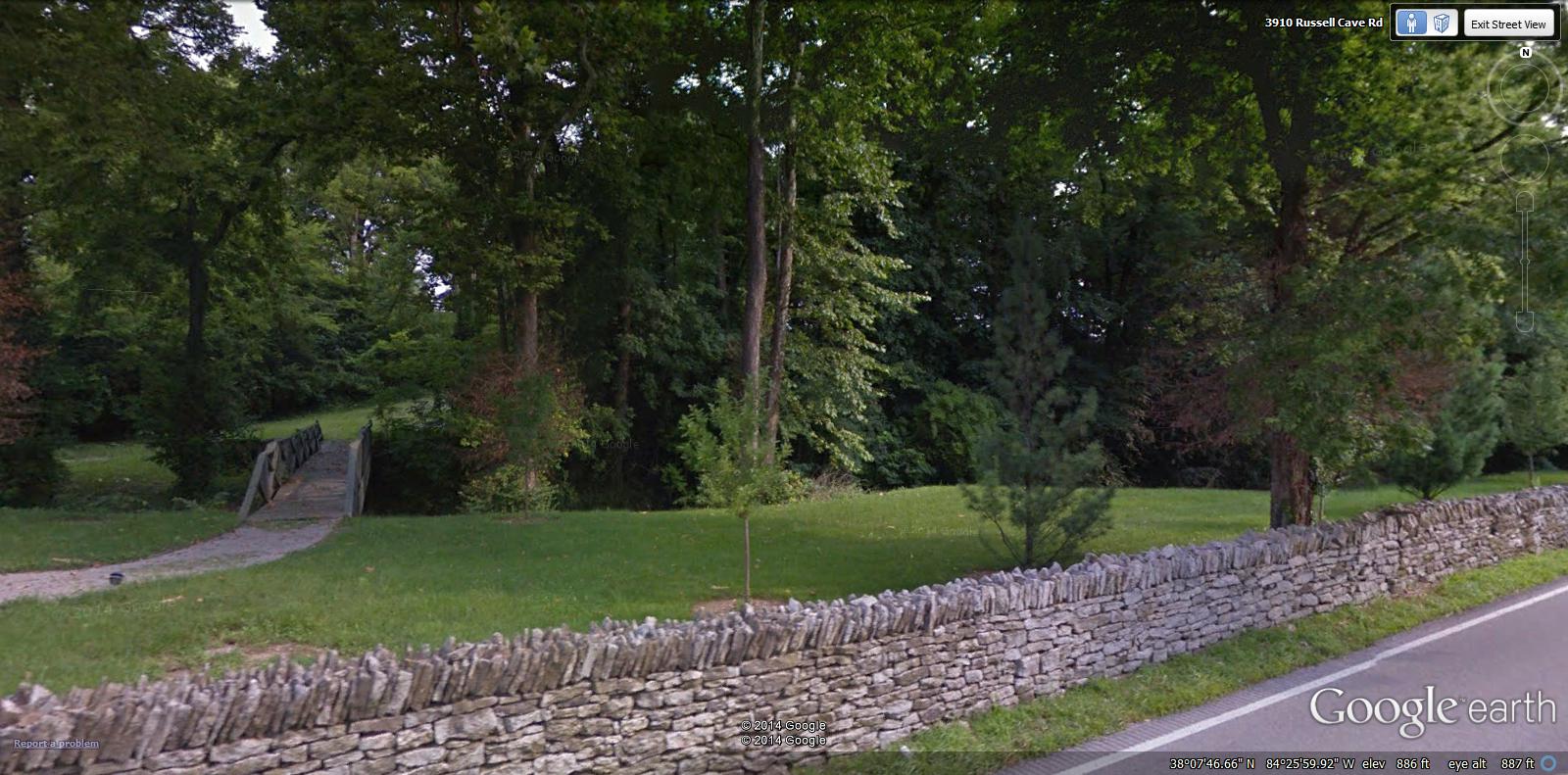
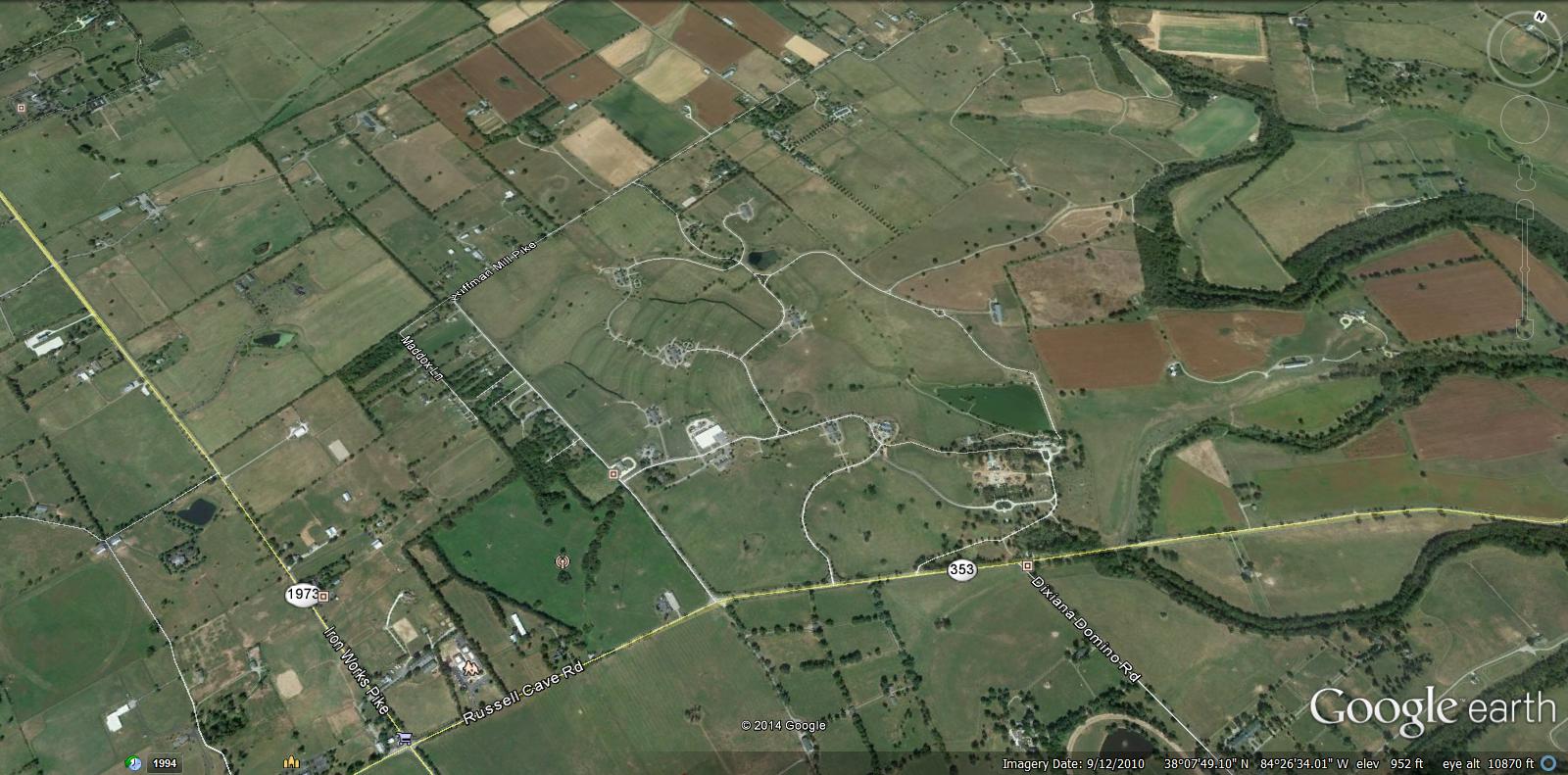
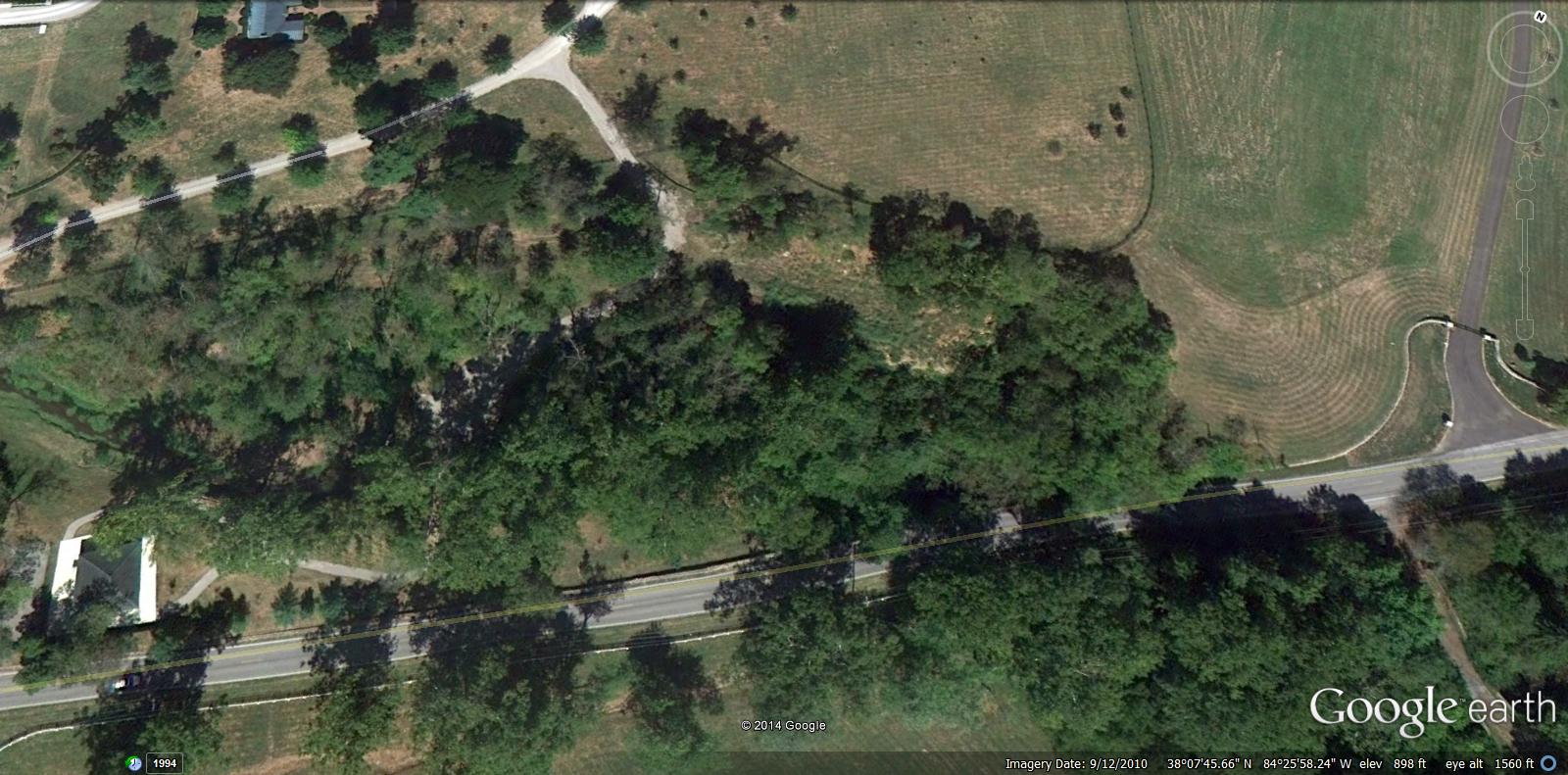
To find the center of the ancient Lexington city it is fairly easy if you know what you are looking for. For those familiar with Lexington simply get off the highway exit that delivers you to the Kentucky Horse Park. Instead of turning in, proceed down Iron Works Pike road for a few miles until you arrive at the store Jot-Em Down. Turn left onto Russell Cave Road. When you arrive at the gate to the destroyed Mt Brilliant mansion you will be there. It was on this property that some of the largest and most organized mounds aligned in a similar way as to the Newark earthworks near Columbus, Ohio once stood. The site on the Mt. Brilliant property first reported by the traveler Thomas Ashe chronicled in the 1872 book by George W. Ranck breaks down the precise measurements as they were before construction and farming destroyed them entirely. But that’s not all, the site was vast extending from the location 6 miles north-east of the downtown area to areas dotting all around the core of the current city. It is difficult now to know how many homes were built through the burial remains of these ancient dwellers, but the account according to Ranck’s book is that it was numerous saying “These well-attested facts, together with the tradition related to this day of an extensive cave existing under the city of Lexington, relieve of its improbable air the statement that a subterranean cemetery of the original inhabitants of this place was discovered here nearly a century ago. In 1776, three years before the first permanent white settlement was made at Lexington, some venturesome hunters, most probably from Boonesborough, had their curiosity excited by the strange appearance of some stones they saw in the woods where our city now stands. They removed these stones, and came to others of peculiar workmanship, which, upon examination, they found had been placed there to conceal the entrance to an ancient catacomb, formed in the solid rock, fifteen feet below the surface of the earth. They discovered that a gradual descent from the opening brought them to a passage, four feet wide and seven feet high, leading into a spacious apartment, in which were numerous niches, which they were amazed to find occupied by bodies which, from their perfect state of preservation, had evidently been embalmed. For six years succeeding this discovery, the region in which this catacomb was located, was visited by bands of raging Indians and avenging whites; and during this period of blood and passion, the catacomb was dispelled, and its ancient mummies, probably the rarest remains of a forgotten era that man has ever seen, were well nigh swept out of existence. But not entirely. Some years after the red men and the settlers had ceased hostilities; the old sepulcher was again visited and inspected. It was found to be three hundred feet long, one hundred feet wide, and eighteen feet high. The floor was covered with rubbish and fine dust, from which was extracted several sound fragments of human limbs. At this time the entrance to this underground cemetery of Ancient Lexington is totally unknown. For nearly three-quarters of a century, its silent chamber has not echoed to a human footfall. It is hidden from sight, as effectually as was once buried Pompeii, and even the idea that it ever existed is laughed at by those who walk over it, as heedless of its near presence as were the generations of incredulous peasants who unconsciously danced above the long-lost villa of Diomedes”
But the heart of this ancient city, its cultural epitaph was on the location of the present day Mt. Brilliant site. For those who know anything about horses and thoroughbred racing the current owner of the Mt. Brilliant property owns the nearby stud barn of Man o’ War who won all but one of his 21 lifetime starts—which is a remarkable accomplishment. That stud barn is right in the middle of this ancient archaeological site of ancient earthworks. Of course farming and construction have all but destroyed all the present day evidence—and if not for the books by Thomas Ashe and George W. Ranck there would be no evidence at all. The closest that history has come to indicating anything at all was amiss in the area were that the Indians in the area were terrified of Kentucky land—as chronicled in the novels by Allan W Eckert. The Indians would hunt in the area, but they never settled a tribe there, and one of their early arguments with the arrival of the white settlers was that the whites did not respect that land as the Indians did. The whites had no fear of the spirits which resided there—as they did fear those ephemeral entities. Their reason was that they viewed the Lexington, Kentucky area as a “dark and bloody ground.” It was a shadow-land to the Indians. In 1800, some Sacs who were in St. Louis said of Kentucky that it was full of the souls of a strange race which their people had long ago exterminated. They regarded this land with superstitious awe. Here they hunted and here they fought, but no tribe was ever known to settle permanently in it.” The eradication of the evidence of that ancient people started in 1774 when Thomas Jefferson granted 2,000 acres of land north of the Kentucky River to William Russell in recognition of his brother Henry’s outstanding military service in the French and Indian War.
The land was eventually divided between William’s two youngest sons, Robert Spotswood Russell and William Russell, Jr. Shortly after the end of the Revolutionary War, young William laid claim to the smaller portion (800 acres) so he could enjoy the mystical cave and ever-flowing spring that add an enchanting ambiance to what is now known as Mt. Brilliant. Russell chose the name to commemorate the Virginia estate of Patrick Henry’s family.
In 1792, Russell built the central portion of the house. Cuming remarked in his 1807 book, “Tour of the West”, that Mt. Brilliant, surrounded by a wall with turrets at each end, lacked “only the vineyards” in its similarity to the French Provincial regions of Languedoc and Provence.
Russell died in 1824 and his heirs sold Mt. Brilliant in 1863. In 1832, Mount Brilliant passed to Hamilton Atchison Jr. The historical connection here is the relation to David Rice Atchison, “President for a Day” between Presidents James Polk and Zachary Taylor, who often visited his cousins at Mount Brilliant. A Lexington native and 1825 graduate of Transylvania, Atchison moved to Missouri and later Kansas. He was a U.S. senator and an organizer of the Atchison-Topeka and Santa Fe Railway Mount Brilliant was sold in 1861 to Thomas Hughes, who later owned historical Elk Hill and Clifton. Arthur Delong acquired Mount Brilliant in 1891, until 1905 when it was purchased by James Ben Ali Haggin. The Haggin family owned the farm for the next 85 years, and it became a fixture in the Kentucky political and social scene in the 20th Century.
In fact, it was at a political rally held at Russell Cave, which lays on the Mt. Brilliant property, that the infamous duel between abolitionist Cassius Clay and Samuel M. Brown took place. Clay, Henry Clay’s cousin, was saved by a stroke of astonishing fortune when the bullet aimed directly for his heart ricocheted off the silver-lined sheath of his Bowie knife. Samuel Brown was in fact a hired assassin sent to kill Clay for his insistence that slavery be banned. It was in that very same cave on the Mt Brilliant property that many escaped slaves hid while on their journey north into Cincinnati. But the cave has a much deeper—and mystical quality that points back to the politics of the day. After all, it is more than a little intriguing that a political rally for which the Clay, Brown duel occurred was in a cave when a perfectly good mansion was available just a few hundred feet away above the creek bed.
Feel free to read more about this history at these links:
Let us now study what was around that cave on the Mt Brilliant property as described in 1872 by George Washington Ranck. I include it here as I have looked for a hard copy of the book but only know of the scanned online copy by Cornell University. Should fortunes change and documentation of such resources online cease—a proper record of the evidence is necessary. It may also be desired to perform some archaeology if the owner would permit it. In the cave, bones were found of these ancient people and has been the site of many turbulent events since. There are few caves in the world that have hosted such a variety of characters as that of Russell Cave, but spelunking is not the most comfortable. Much of it is flooded so trudging through the cold water to the locations where archaeology could be properly performed will take some effort and discomfort. But it is there and only there that the ancient race of people can ever hope to be ascertained, as all the remnants of what is described below has been destroyed except for the text you are about to read. Of that text I have performed some basic editing to make it more digestible. The pictures included I deliberately kept the property of Mt. Brilliant out of the pictures to respect the owners privacy. Only the cave area is zoomed in on due to the historical significance of it. The wide pan shot is of the area described below. The elements described below used to be sprawled out within the picture frame and were quite large. If anything still remains, it would be difficult to detect due to 200 years of aggressive use of the land, and modern construction along with farming. The original text can be found at the concluding link
“Some months after he had examined and described the fortification at the head of Hickman creek, Prof. Eafinesque surveyed the upper group on North Elkhorn, near Russell’s cave, or what is now known as the West place. We quote his description of it, which will be read with more and more interest and wonder as time passes, and slowly but surely levels with the earth and blots out forever all that is left to remind us of a lost race, whose stupendous structures covered the fertile tract which afterward became the favorite hunting ground of savage tribes. He says: “I visited this upper group of monuments, a few days ago, in company with two gentlemen of Lexington. They are situated about six miles from this town, in a north-northeast direction, on the west and back part of Colonel Russell’s farm, which stands on the road leading from Lexington to Cynthiana. “The ground on which they stand is a beautiful level spot, covered with young trees and short grass, or line turf, on the south side of a bend of North Elkhorn creek, nearly opposite the mouth, and close by Hamilton’s farm and spring, which lie west of them. They extend as far as Russell’s cave, on the east side of the Cynthiana road. “No. 1, which stands nearly in the center, is a circular enclosure, six hundred feet in circumference, formed of four parts : 1. A broad circular parapet, now about twenty feet broad, and two feet high. 2. An inward ditch, now very shallow and nearly on a level with the outward ground. 3. A gateway, lying due north, raised above the ditch, about fifteen feet broad, and leading to the central area. 4. A square central area, raised nearly three feet above the ditch, perfectly square and level, each side seventy feet long and facing the four cardinal points. ” No. 2 lies northeast of No. 1, at about two hundred and fifty feet distance; it is a regular, circular, convex mound, one hundred and seventy-five feet in circumference, and nearly four feet high, surrounded by a small outward ditch. ” No. 3 lies nearly north of No. 1, and at about two hundred and fifty feet distance from No. 2. It is a singular and complicated monument, of an irregular square form, nearly conical, or narrower at the upper end, facing the creek. It consists: 1. Of a high and broad parapet, about one hundred feet long and more than five feet high, as yet, above the inward ditch on the south base, which is about seventy-five feet long. 2. Of an inside ditch. 3. Of an area of the same form with the outward parapet, but rather uneven. 4. Of an obsolete broad gateway at the upper west side. 5. Of an irregular raised platform, connected with the outward parapet, and extending toward the north to connect it with several mounds. 6. Of three small mounds, about fifty feet in circumference, and two feet high, standing irregularly around that platform, two on the west side and one on the east. ” No. 4. These are two large sunken mounds, connected with No. 3. One of them stands at the upper end of the platform, and is sunk in an outward circular ditch, about two hundred and fifty feet in circumference, and two feet deep. The mound, which is perfectly round and convex, is only two feet high, and appears sunk in the ditch. Another similar mound stands in a corn-field, connected by a long raised way to the upper east end of the parapet in No. 3. “No. 5 is a monument of an oblong square form, consisting of the four usual parts of a parapet, an inward ditch, a central area, and a gateway. This last stands nearly opposite the gateway of No. 3, at about one hundred and twenty-five feet distance, and leads over the ditch to the central area. The whole outward circumference of the parapet is about four hundred and forty feet. The longest side fronts the southwest and northeast, and is one hundred and twenty feet long, while the shortest is one hundred feet long. The central area is level, and has exactly half the dimensions of the parapet, being sixty feet long and fifty wide. It is raised two or three feet as well as the parapet. The end opposite the gateway is not far from Hamilton’s spring. “Now to No. 6 is a mound without a ditch, one hundred and ninety feet in circumference, and five feet high. It lies nearly west from No. 1.
“No. 7 is a stone mound, on the east side of Russell’s spring, and on the brim of the gully. It lies east from the other monuments and more than half a mile distant. It is ten feet high and one hundred and seventy-five feet in circumference, being formed altogether by loose stones heaped together, but now covered with a thin soil of stone and grass. “No. 8 is a similar stone mound, but rather smaller, lying north of number. 7, at the confluence of Russell’s spring with North Elkhorn. “Among the principal peculiarities, which I have noticed in this .group of monuments, the square area of No. 1, enclosed within a circular ditch and parapet, is very interesting, since it exhibits’ a new compound geometrical form of building. The ditch must have been much deeper once, and the parapet, with the area, much higher; since, during the many centuries which have elapsed over these monuments, the rains, dust, decayed plants, and trees must have gradually filled the ditch, etc. I was told by Mr. Martin that within his recollection, or about twenty-five years ago, the ditch in the monument at the head of Hickman’s creek was at least one foot deeper. “Whenever we find central and separated areas in the Alleghawian monuments, we must suppose they were intended for the real places of worship and sacrifices, where only the priests and chiefs were admitted, while the crowd stood probably on the parapet to look on; and, in fact, these parapets are generally convex and sloping inward or toward the central area. “The ditched mound, No. 2, is remarkable, and must have had a peculiar destination, like the sunken mounds. No. 4, which differ from No. 2 merely by being much lower, and appearing, therefore, almost sunk in the ditch. “The stone mounds, Nos. 7 and 8, are also peculiar and evidently sepulchral. But why were the dead bodies covered here with stone instead of earth? Perhaps these mounds belonged to different tribes, or the conveniency of finding stones, in the rocky neighborhood of Russell’s cave and spring, may have been an inducement for employing them.” Some of these mounds described by Rafinesque were visited in 1846, and found to be nearly obliterated ; others, however, near the dividing line between the old military survey of Dandridge and Meredith, were still distinct, and were described in 1847 as follows: ” The most easterly work is on the estate of C. C. Moore. It is on the top of a high bluff, on the west side of Elkhorn, in the midst of a very thick growth, mostly of sugar trees, the area within a deep and broad circular ditch is about a quarter of an acre of land. The ditch is still deep enough in some places to hide a man on horseback. The dirt taken from, the ditch is thrown outward; and there is a gateway where the ditch was never dug, some ten feet wide on the north side of the circle. Trees several hundred years old are growing on the bank and in the bottom of the ditch and over the area which it encloses, and the whole region about it. There is another work a quarter of a mile west of the above one. It commences on the Meredith estate and runs over on the Cabells’ Dale property, and contains about ten acres of land. The shape of the area is not unlike that of the moon when about two-thirds full. The dirt from the ditch inclosing this area is thrown sometimes out, sometimes in, and sometimes both ways. An ash tree was cut down in the summer of 1845, which stood upon the brink of this ditch, which, upon being examined, proved to be four hundred years old. The ditch is still perfectly distinct throughout its whole extent, and in some places is so deep and steep as to be dangerous to pass with a carriage. A mound connected with this same chain of works was opened in the summer of 1871. It is situated about half a mile west of the earthwork already described as on top of the bluff, and about a quarter of a mile north of the larger oval one. It is on the farm of Mr. James Fisher, adjoining the plantation on which Dr. Eobert Peter at present resides, and is part of the old Meredith property before mentioned. The mound has a diameter of about seventy feet, and rises with a regular swell in the center to the height of three and a half to four feet above the general level of the valley pasture on which it is located, only about fifteen feet above low water in the North Elkhorn creek, and about three hundred and twenty-five feet south from its margin. Mr. Fisher made an excavation into the center of this mound about four to five feet in diameter and about three and a half feet deep, in which, in a bed of wood-ashes containing charred fragments of small wood, he found a number of interesting copper, flint, bone, and other relics of the ancient Mound Builders, which were carefully packed by Dr. Robert Peter (who resides on the adjoining Meredith farm), and transmitted to the Smithsonian Institute, at “Washington, for preservation. The copper articles were five in number; three of which were irregularly oblong-square implements or ornaments, about four inches in length and two and one-eighth to three and three-quarter inches wide and one-quarter inch thick at lower end (varying somewhat in size, shape, and thickness); each with two curved horns attached to the corners of one end, which is wider and thinner than the other end. These were evidently made of native copper, by hammering, are irregular in thickness and rude in workmanship, and have been greatly corroded in the Japseof time, so that they not only have upon them a thick coating of green carbonate and red oxide of copper, but the carbonate had cemented these articles, with adjoining flint arrow-heads, pieces of charcoal, etc., into one cohering mass, in the bed of ashes, etc., in which they were found lying irregularly one upon the other. The other two copper implements were axes or hatchets; one nearly six inches long, the other nearly four inches; each somewhat adze-shaped wider at one end, which end had a sharp cutting edge. With these were found nearly a peck of flint arrow-heads, all splintered and broken, as by the action of fire; also, three hemispherical polished pieces of red hematitic iron ore about two inches in diameter; some door-button shaped pieces of limestone, each perforated with two holes; several pieces of sandstone, which seemed to have been used for grinding and polishing purposes; and many fragments of bones of animals, mostly parts of ribs, which appeared to have been ground or shaped ; among which was one, blackened by fire, which seemed to have been part of a handle of a dagger; also, some fragments of pottery, etc. The fragments of charcoal, lying near the copper articles, were saturated with carbonate of copper, resulting from the oxidation of the copper articles, parts of which were oxidized to the center, although a quarter of an inch in thickness; and many pieces of this coal and portions of flint arrow-heads remain strongly cemented to the copper implements by this carbonate. To what uses these rude, oblong- square horned copper articles were put, except for ornament, cannot be conjectured. No inscription or significant murk was found on any of them. No human bones could be distinguished among the fragments found, but only the immediate center of the mound was opened. The citizens of Lexington may, in truth, muse among the ancient ruins and awe-inspiring relics of a once mighty people. “Who and what were the beings who fought with these weapons, ate from these vessels, built these tombs and mounds and altars, and slept at last in this now concealed catacomb? Where existed that strange nation, whose grand chain of works seemed to have Lexington for its nucleus and center? We can only speculate! One inclines to the opinion that they were contemporaries of the hardy Picts. Another declares them identical with the Alleghawians or progenitors of the Aztecs, and cites as proof, the remains of their temples, which are declared to be wonderfully similar to those of the ancient Mexicans described by Baron Humboldt. The earthen vessels here plowed up from the virgin soil, he says, were like those used by the Alleghawians for cooking purposes. Still another writer, dwelling upon the mummies here discovered, sees in the original inhabitants of Lexington, a people descended from the Egyptians. Other authors, eminent and learned, almost without number, have discussed this subject, but their views are as conflicting as those already mentioned, and nothing is satisfactory, except the negative assurance that the real first settlers of Lexington, the State of Kentucky, and the entire Mississippi valley, were not the American Indians, as no Indian nation has ever built walled cities, defended by entrenchments, or buried their dead in sepulchers hewn in the solid rock. “Who, then, were these mysterious beings? From whence did they come? What were the forms of their religion and government? Are questions that will probably never be solved by mortal man; but that they lived and flourished centuries before the Indian who can doubt? Where they erected their Cyclopean temples and cities, with no vision of the red men who would come after them, and chase the deer and the buffalo over their leveled and grass-covered walls. Here they lived, and labored, and died, before Columbus had planted the standard of old Spain upon the shores of a new world; while Gaul, and Britain, and Germany were occupied by roving tribes of barbarians, and, it may be, long before imperial Rome had reached the height of her glory and splendor. But they had no literature, and when they died they were utterly forgotten. They may have been a great people, but it is all the same to those who came if they were not, for their greatness was never recorded. Their history was never written not a letter of their language remains, and even their name is forgotten. They trusted in the mighty works of their hands, and now, indeed, are they a dead nation and a lost race. The ancient city which stood where Lexington now stands, has vanished like a dream, and vanished forever. Another has well said: “Hector and Achilles, though mere barbarians, live because sung by Homer. Grermanicus lives as the historian himself said, because narrated by Tacitus; but these builders of mounds perish because no Homerarid no Tacitus has told of them. It is the spirit only, which, by the pen, can build immortal monuments.” It is a favorite theory of many that the Indians of North America migrated from Asia; that the once noble race, which has almost melted away, was descended from the ten tribes of Israel which were driven from Palestine seven hundred years before the birth of Christ. But this is a theory only. The advent of the Indians and the stock from which they sprung will never be determined; but that they came after the “Mound Builders” is evident. The appearance of the Indians was the death-knell of that doomed race whose rich and beautiful lands and spoil-gorged cities inflamed the desperate and destitute invaders. The numerous tumuli which yet remain attest the fierceness of the conflict which ensued. A great people were swept out of existence, their cities disappeared, the grass grew above them, and in time the forests.”
Avid readers of the day like Thomas Jefferson and the Illuminati practitioner Harman Blennerhassett knew of Thomas Ashe’s book from his Travels in America—which wasn’t published until 1806, but word of its contents were spreading as Ashe visited taverns and allowed listeners to know the contents of his manuscripts. Ashe was the third son of a half-pay officer, and was born at Glasnevin, near Dublin, 15 July 1770. He received a commission in the 83rd regiment of foot, which, however, was almost immediately afterwards disbanded; and he was sent to a counting-house at Bordeaux. There he suffered a short imprisonment for wounding in a duel a gentleman whose sister he had seduced, but, the wound not proving fatal, the prosecution was not persisted in.
Returning to Dublin, Ashe was appointed secretary to the Diocesan and Endowed Schools Commission, but, getting into debt, resigned his office and retired to Switzerland. He then spent several years in foreign travel, living, according to his own account,[1] in a free and unconstrained fashion, and experiencing a somewhat chequered fortune.
In his later years Ashe was short of money. He died at Bath on 17 December 1835.
Besides recording in his Memoirs his impressions of the countries he visited, Ashe published separately:
Memoirs of Mammoth and other Bones found in the vicinity of the Ohio, 1806; and
A Commercial and Geographical Sketch of Brazil and Madeira, 1812.
He was also the author of novels, including the Spirit of the Book, 1811, 4th edition 1812; the Liberal Critic, or Henry Percy, 1812: and the Soldier of Fortune, 1816.
The skeptic might be reluctant to believe in Ashe’s accounts of an ancient Lexington, and I might too if I did not know that a housing development nearly bulldozed the ancient city of Cahokia outside of St. Louis mistaking the mounds there as simple hills. If nobody had put a stop to the process during construction of the St Louis eastside, Monks Mound would have been leveled as well and the bones within the mounds destroyed nearly unnoticed under the trampling of machinery. In Lexington, with the violent past it had and history with Transylvania added to the complicated history making legitimate archaeological study of the area nearly impossible. Transylvania, or the Transylvania Colony, was a short-lived, extra-legal colony founded in 1775 by Richard Henderson, who controlled the North Carolina based Transylvania Company, which had reached an agreement to purchase the land from the Cherokee in the “Treaty of Sycamore Shoals”. This area was claimed at the time by the Province of Virginia —especially following Lord Dunmore’s War —and North Carolina. It is primarily located in what is now the central and western parts of the State of Kentucky. American pioneer Daniel Boone was hired by Henderson to establish the Wilderness Road going through the Cumberland Gap into central “Kentuckee”, where he founded Boonesborough, the designated capital of the Transylvania colony. Transylvania officially ceased to exist after the Virginia General Assembly invalidated the Transylvania Company’s purchase in 1776. Richard Henderson fancied the start of his own colony prior to the Revolutionary War. If he had succeeded it would have been a 14th colony. So there was some recklessness in the building of Lexington as ownership changed hands, Indians continuously attacked, and only blood thirsty soldiers of fortune and those fleeing religious persecution were the first to fill the land plagued with violence. Lexington was erected as a city under forged conditions—and archaeology was not their primary concern.
But the Illuminati in America knew what they thought that ancient race was, and they built their secrets around that knowledge attempting to tap into that energy believed to reside around them. It is therefore ironic that the horse racing culture emerged so prominently in Lexington of all places, and that the spirited horses born there have an otherworldly appeal. It is also ironic that politics, the abolitionist movement and many important historic events culminated at that very spot around Russell’s Cave for well over 200 years—but the evidence of those happenings has been carefully obscured—and overlooked. Instead modern society is obsessed with the mansions, the gardens, and the horses of that former ancient society. The spender of elegance has disguised the fact that an entire race of people unknown to time was eradicated at that very spot. With earthworks only rivaling the Newark, Ohio site and Serpent Mound a picture of a vast civilization that lived in the Kentucky and Ohio region well before any Indian hunted with a spear or threw a rock is evident. These were people who mummified their bodies, offered sacrifices on stone alters, and had advanced mathematical knowledge. Their evidence has been confined behind a thin veil of opulence associated with the horse racing culture and the hidden knowledge of secret societies.
The political rally in 1843 where so many prominent politicians and events collected themselves for more than the acoustical qualities of a cave, it was known among them that in such a cave the ancients of that great race dwelled and buried their dead. But being part of a new country these early settlers had no predilection in assuming they were the first to arrive in such a vast landscape. They had no Columbus Day to celebrate, or progressive history in maintaining a history of the African-American or Indian people. They simply hoped to learn from those ancient people what they could as they forged a new country and if you were a good little politician or financial donor you might be invited to that secret Illuminati/Masonic knowledge of those strange people who resided in Lexington Kentucky thousands of years before a white man ever arrived—or an Indian.
And so it goes one of the greatest mysteries in the North American continent is buried under the city of Lexington and is only hinted at by the Masonic architecture littering the region, or the artwork at the various mansions around the Lexington horse farms. Knowledge is power, and so long as few people knew of this ancient race, there was unification in that harmonious correspondence with those who were invited to gather in the ancient catacombs of what was left of the great race who originally founded America and were dedicated to the service of freedom for all—even the slaves as Cassius Clay so valiantly defended in the cave’s mouth under the estate of Mt. Brilliant built upon the ruins of a lost race. Lexington was the destruction of a genius lost to history and only known to a few of the most educated and enlightened. But now dear reader—you can count yourselves among them—because you know too the truth long suppressed.
One the night of the winter solstice with this friend Aaron Burr downstream on the Ohio River and his wife and consolidated militia forces gathered from Marietta, Ohio at his palatial home on an island in the middle of the great river, upstream Harman Blennerhassett had bet his aristocratic European fortune on the former Vice-President and lost. Their insurrection had been snuffed out by Thomas Jefferson and now troops sent by the Governor of Ohio were on their way to arrest him forcing him to flee. Soon the entire young country of America would be bearing down on him and there would be no place to go. Being a member of the Bavarian Illuminati and close friends with its founder, Blennerhassett in a last gasp of desperation had heard of the recent discoveries of the secret which his order had been keeping for generations through the Masonic lodges which climbed back into history for thousands of years. General Payne while digging his home in Augusta, Kentucky found an entire grave yard of the ancients laid to rest between Bracken and Locust Creek—under the entire town. A quick ritual might in fact save him with some alchemy and invocation that the spirit of those giants from Kentucky might rise up from the spirit world and give assistance to his fledgling fortune.
If you know anything of such secret societies, this is likely what happened and why Harman Blennerhassett was caught trying to fund an insurrection through Aaron Burr on his island oasis just to the south of Parkersburg, West Virginia. The giants of Kentucky had just been discovered while building Augusta just southeast of Cincinnati on the Ohio River and as it was known then, and now, the corridor of the Ohio River extending from the shores of Pittsburg to the ancient city of Cahokia outside of St Louis was a haven of occult activity. It was in this region that the monstrous terrorists of Point Pleasant, West Virginia haunted the entire town and where the Bird Man god presided over 30,000 ancient people with ritual sacrifice at Cahokia. Roaming Northern Kentucky well before the tallest, and oldest trees of that region were even saplings, giants inhabited the area before any Indians had formed up from China to create the nomadic people attributed as Native Americans. To review the kind of beliefs that Masons and Illuminati members have read the link below. I know a lot of Masons—all of them think of themselves as “men of God” and that their order is a good one. But not a single person has been able to dispute the history and rituals described in the articles starting with the one below and backtracking the links on a journey into the occult that will change the way the world is viewed. But for now, understand that Harman Blennerhassett was in trouble—he had the entire nation of America on his heels and he needed help—any help to save himself and his fortune. In his hour of need, he attempted to contact the spirits of the Giants of Kentucky to provide aid.
Jeffery Scott Holland as well as other sources have assembled an interesting tale of how Aaron Burr came into contact with Harman Blennerhassett, and how the insurrection against America began—which can be seen below. Burr after his duel and killing of Alexander Hamilton was on the political out. The Republican Party did not back him after Jefferson’s easy re-election and most of the Federalists had been driven from American office—except on the Supreme Court. Jefferson attacked and attempted to impeach Justice Samuel Chase but Burr being President of the Senate held off the endeavor which effectively ended his political career. With nowhere to go and on the run from New York because of his killing of Hamilton, Burr assembled a plot to start his own country which took him to the European style mansion built-in the middle of the Ohio River which is still standing to this day. Daily tours of the home are offered and guides will tell of the elegance of a European aristocrat who wanted to bring the same type of “social justice” that Aaron Burr stood for, to the new country. Burr and Blennerhassett shared a belief that the truly educated men of the world had an obligation to free people everywhere of their superstitious burdens and provide enlightenment to a new world order. Since Burr had done all he could politically in the country of America—he knew the only next step for him was to start a new country and bring to it his hopes and dreams of a utopian society as conceived by the early Republicans. Fortunately for him, Blennerhassett wanted the same type of thing and had the money—and social pull to gather up men and resources making Blennerhassett Island a launching point for insurrection.
In 1792, General John Payne made a strange discovery while building his house in the tiny town of Augusta, KY, 63 miles North of Lexington. Payne’s firsthand account is related in Historical Sketches of Kentucky by Lewis Collins:
“The bottom on which Augusta is situated is a large burying ground of the ancients…They have been found in great numbers, and of all sizes, everywhere between the mouths of Bracken and Locust Creeks, a distance of about a mile and a half. From the cellar under my dwelling, 60 by 70 feet, over a hundred and ten skeletons were taken. I measured them by skulls, and there might have been more, whose skulls had crumbled into dust…The skeletons were of all sizes, from seven feet to infant.
David Kilgour (who was a tall and very large man) passed our village at the time I was excavating my cellar, and we took him down and applied a thigh bone to his. The man, if well-proportioned, must have been 10 to 12 inches taller than Kilgour, and the lower jaw bone would slip on over his, skin and all. Who were they? How came their bones here?
When I was in the army, I inquired of old Crane, a Wyandot and of Anglerson, a Delaware, both intelligent old chiefs, and they could give me no information in reference to these remains of antiquity. Some of the largest trees of the forest were growing over the remains when the land was cleared in 1792.”
A few years later, on December 21, 1806, the town of Augusta, KY was visited by Harman Blennerhassett, lawyer, occultist, and member of the Illuminati. Was he aware of the ancient underground civilization in the region?
Blennerhassett was born on October 8, 1764 in Ireland and moved to the USA with his wife, where they settled on Blennerhassett Island on the Ohio River. Blennerhassett was a friend and colleague of Adam Weishaupt, and a member of his Order of the Illuminati, reaching the level of Illuminatus Magus. He was also a friend of Vice President Aaron Burr, with whom he, some allege, engaged in a conspiracy to, among other things, remove President Thomas Jefferson from power. The plot was discovered, and Blennerhassett’s secret camp at Marietta was destroyed on December 19, 1806.
Blennerhassett fled with about 50 of his fellow initiates, leaving his wife, his sons and the rest of his guerrilla troops behind. But here’s what has always puzzled me: instead of making a direct exit, Blennerhassett risked making a mysterious side trip to Augusta, KY, arriving on the day of the solstice. Given his penchant for mystical folderol, it seems clear to me that there must have been some occult significance to his visit to Augusta. But what? We may never know.
U.S. PresidentThomas Jefferson ordered Burr arrested and indicted for treason, despite not providing firm evidence. Burr’s true intentions remain unclear to historians, some of whom claim he intended to take parts of Texas and some, or all, of the Louisiana Purchase, for himself. Burr was acquitted of treason, but the trial destroyed his already faltering political career.
That year Burr traveled down the Ohio River starting in Pittsburgh to the Louisiana Territory.[4] In the spring, Burr met with Harman Blennerhassett, who proved valuable in helping Burr further his plan. He provided friendship, support, and most importantly, access to the island which he owned on the Ohio River, about 2 miles (3 km) below what is now Parkersburg, West Virginia. In 1806, Blennerhassett offered to provide Burr with substantial financial support. Burr and his co-conspirators used this island as a storage space for men and supplies. Burr tried to recruit volunteers to enter Spanish territories. In New Orleans, he met with the Mexican Associates, a group of criollos whose objective was to conquer Mexico. Burr was able to gain the support of New Orleans’ Catholic bishop for his expedition into Mexico. Reports of Burr’s plans first appeared in newspaper reports in August 1805, which suggested that Burr intended to raise a western army and “to form a separate government.”
In early 1806, Burr contacted the Spanish minister, Carlos Martínez de Irujo y Tacón, and told him that his plan was not just western secession, but the capture of Washington, D.C. Irujo wrote to his masters in Madrid about the coming “dismemberment of the colossal power which was growing at the very gates” of New Spain.[5]Irujo gave Burr a few thousand dollars to get things started. The Spanish government in Madrid took no action.
Following the events in Kentucky, Burr returned to the West later in 1806 to recruit more volunteers for a military expedition down the Mississippi River. He began using Blennerhassett Island in the Ohio River to store men and supplies. The Governor of Ohio grew suspicious of the activity there, and ordered the state militia to raid the island and seize all supplies. Blennerhassett escaped with one boat, and he met up with Burr at the operation’s headquarters on the Cumberland River. With a significantly smaller force, the two headed down the Ohio to the Mississippi River and New Orleans. Wilkinson had vowed to supply troops at New Orleans, but he concluded that the conspiracy was bound to fail, and rather than providing troops, Wilkinson revealed Burr’s plan to President Jefferson. Wilkinson was at the time a paid spy for the Spanish crown and wanted to find a way out of the deal with Burr. Not wanting to lose the income he received from Spain as a spy, he sold Burr out to Jefferson.
Jefferson alerted Congress of the plan, and ordered the arrest of anyone who conspired to attack Spanish territory.[7] He warned authorities in the West to be aware of suspicious activities. Convinced of Burr’s guilt, Jefferson ordered his arrest. Burr continued his excursion down the Mississippi with Blennerhassett and the small army of men which they had recruited in Ohio. They intended to reach New Orleans, but in Bayou Pierre, 30 miles north of Natchez, they learned that a bounty was out for Burr’s capture. Burr and his men surrendered at Bayou Pierre, and Burr was taken into custody. Charges were brought against him in the Mississippi Territory, but Burr escaped into the wilderness. He was recaptured on February 19, 1807, and was taken back to Virginia to stand trial.[8]
Chiefly to escape involvement in the United Irishmen’s planned rebellion against British rule, but also to conceal his incestuous marriage, Blennerhassett emigrated to the United States in 1796. There, on the western Virginia frontier, he bought the upper half of an Ohio River island lying 1 1/2 miles downstream from what is now Parkersburg, West Virginia. It became the site of a European-style estate whose centerpiece was an enormous mansion surrounded by extravagantly landscaped lawns and gardens. For a brief period, the Blennerhassetts’ home became famous as the largest, most beautiful private residence in the American West. [1]
The most distinguished of the Blennerhassetts’ many visitors was the former vice president of the United States, Aaron Burr. His three stays on the island resulted in its becoming headquarters for his mysterious 1806-1807 military expedition to the Southwest. Although branded a treasonous plot (supposedly to separate the American West from the Union) by Burr’s enemy, President Thomas Jefferson, the enterprise’s true goal probably was the conquest of Spanish-ruled Texas.
As the result of the president’s call for the arrest of Burr, Blennerhassett, and their 70 followers, the mansion and island were occupied and plundered in December 1806 by local Virginia militia. Blennerhassett fled, was twice arrested, and finally imprisoned in the Virginia state penitentiary. He was only released following Burr’s acquittal at the end of a long 1807 treason trial at Richmond, Virginia. The Blennerhassetts never returned to their island home, which in 1811 was destroyed by fire.
At the Aaron Burr trial another Federalist with an axe to grind against Thomas Jefferson acquitted the former Vice-President of treason—Chief Justice Marshall did not consider conspiracy without actions sufficient for conviction. Burr hadn’t yet made a move against America—he had simply made plans—which were not considered action at the time. Burr was set free as was Harman Blennerhassett who had been stewing in prison with his fortune now eradicated. The spirits of the ancient Kentucky giants had not come to his rescue and he lived the rest of his life penniless and broken. Burr maintained his innocence of insurrection against America up until his dying breath. In truth, Burr came to realize once his coup was dissolved that he would never again be able to amass enough political power to do such a thing leaving him with the political achievements as Vice-President as his legacy—and for him—that would have to suffice.
Yet—and this is pure speculation of course—but when dealing with esoteric events on a world stage that involve political insurrections, incantations to an ancient race of giants, and the Illuminati all things must be considered with a straight face several years later—only about 200 years to be exact the actor George Clooney entered public school built right in the middle of the old graveyard of the giants as a 7th grader. The odd ball little kid would work hard to please his celebrity family’s reputation, his aunt Rosemary, his father Nick and his four times great-grandmother Nancy Hanks who was the mother of Abraham Lincoln. He tried out for the Cincinnati Reds baseball team but did not make the first cut. He attended college in Northern Kentucky University and the University of Cincinnati, but didn’t stick with it not graduating from either. He made most of his money selling women’s shoes, insurance, cutting tobacco and working construction. His luck changed when a television mini-series called Centennial was shot in Augusta in 1978. George got a bit part as an extra. From there a few years later he started doing small spots in television sitcoms like The Facts of Life, The Golden Girls and Roseanne. Soon he moved up the ladder in Hollywood getting his breakthrough role on the popular show ER. From there he stared in a series of movies becoming one of the Hollywood elite and for men chanting rituals residing in the back culture of Hollywood relishing in the Hermetic Order—George Clooney for them was like the second coming of Christ.
George is a political activist who very nearly represents the kind of political viewpoints that Harman Blennerhassett, believed. Clooney supports the United Nations in a way that would have made Adam Weishaupt, the founder of the Illuminati, very proud. Weishaupt and Blennerhassett believed that it was the elite—the educated who had to guide the world away from self-imposed mental imprisonment. Clooney supports this same global view and spends his spare time raising money for the American Foundation for Equal Rights and the Gay, Lesbian and Straight Education Network which creates safe spaces in schools for children who are perceived to be gay, lesbian, bisexual or transgender.
It is unlikely that George Clooney knows anything about the Illuminati or Harman Blennershassett. But anyone who has ever visited a small town and slept in the vicinity of ancient ruins knows the feeling of being forever watched even when the doors are closed and the shades are pulled in tight. It is also unlikely that Clooney or many of the current residents of Augusta, Kentucky know the role they played in the Aaron Burr plot to separate from America—and the giant bones buried under their feet have long been filed away as folklore and mostly destroyed. But perhaps the ghosts of those same bones did answer Harman Blennerhassett’s desperate rituals on the winter solstice of 1806. It just took them a century and a half to answer the plea, but provide the army they did. They didn’t provide assistance by way of military force or succession from the United States into a new country, but they may have provided a charismatic young man to do the work of Harman Blennershassett in the next century to continue the dreams of insurrection and country building by pure Illuminati philosophy as conceived on Blennershassett Island.
Clooney before attending Augusta middle school had went to Western Row Elementary, the same school that my children attended. It was there that my family had a run-in with public education that would last for the rest of my life when they instituted a policy of teaching children to put condoms on a dildo in the fourth grade which my wife and I stood against. Moving from Mason to Augusta Clooney in his first school year developed Bell’s palsy which is a condition that partially paralyzes the face. After nine months the malady went away—but in the darkest moments of his life sleeping in a house built in the middle of a graveyard of ancient giants invoked by the spell of the occultist Harman Blennershassett little George Clooney begged for help—and the paralysis to his face cleared up. He now serves willingly the type of policies born on Blennershassett Island between an Illuminati grand master and the former Vice-President of the United States.
It all makes a very interesting story and there is much need for speculation in order to connect the dots. But nothing can be ruled out if it is known that a great mystery ties all these events together which goes unspoken among the world of the living which may or not be known to the conscious world. Augusta, Kentucky is the quiet little town that seems inconspicuous enough, but was at the heart of a conspiracy to undo America as Burr was on a quest for political power. A powerful, influential actor was raised in Augusta who is now one of the leading progressives in media culture—a pace setter for the same type of behavior that many would consider the undoing of America. And below it all are the graves of an ancient society mysterious and unknown only by what they left being—which was destroyed by the construction of the town itself.
With such paradoxes, nothing can be ignored and even the most fantastic considerations made. For all the stories told above are true—every one. All that is unsupported by fact are the connections I make between them—which is as elusive as the Burr insurrection handled by a Federalist judge hell-bent on revenge against Thomas Jefferson. The Federalists would emerge in the next century as progressives and there are few progressives now as popular politically and in entertainment culture as George Clooney. Aaron Burr had taken the steps toward forming his own country, just as Clooney has shown that he is willing to reform America into the type of vision many of the original Illuminati members from the founding of the United States believed. But often luck requires the helping hand of invisible caretakers and what they all have in common is a race of lost giants in the land of Augusta hidden by folklore and only answerable to the most powerful incantations of alchemy and Masonic ritual. Luck almost never happens and the life and fortune of George Clooeny from Augusta, Kentucky is very lucky indeed.
Watch the videos above for more support material concerning this subject matter of occult and the Founding Fathers and how a race of ancient giants even to this day may involve you.
After all that I have said this week about leadership it should be considered why I am so excited then for the 2014 Gen Con in Indianapolis, Indiana. The event is so massive that at the Indianapolis airport where people come to that event from all over the world there is a giant welcome mat at the bottom of the escalator welcoming people to the best 4 days in gaming anywhere. All the videos on this article should be watched so that context can be given to this text. Nowhere else is table-top gaming so magnificently on display and the ironic thing to note is that the entire movement started underground and has now emerged as one of the largest industries the world over. I have touted the benefits of table top strategy games at great length over the past year. If more people played them—especially my age—and drank less—they’d find they would manage stress a whole lot better, gain greater insight into solving very complex problems, and improve their lives immensely with a balance of mythology—which every human brain craves more than food, intellectual stimulation—the exercise of thought—and bring into their adulthoods the ability to play. It is that last thing which holds the key to success in the future of education. Education is directly linked to play and when we are kids we learn a lot through playing. When we stop playing as adolescents—we stop learning and a very slow decline begins. Death for many people begins at age 14-15. Life may technically end at age 70 to 80, but it begins the moment humans stop playing to keep their minds active. It is that simple. My love and hope during events like Gen Con is that there is a tremendous underground movement which has been completely perpetrated through online media that hinges strictly on the rebellion of “playing.” The people who attend Gen Con and buy the products sold there have brought to their adult lives the ability to play—and thus the continued ability to learn and function.
This movement has been around for a number of years—Gen Con started in 1968—the year I was born. It has remained relatively underground that entire time and out of the eyes of the mainstream. You don’t see advertisements for the Fantasy Flight Games products on Nickelodeon or the Disney Channel. At least not until now—as much as I’ve spoke about Fantasy Flight Games other products, like Arkham Horror and all the spinoffs which came from that line of H.P. Lovecraft games. It is the very recent foray into mainstream myth like Game of Thrones and on an epic scale—Star Wars that has taken the innovative little company from Roseville, Minnesota and launched it into being one of the most influential cultural phenomena’s of the 21st century.
For me, because I love Star Wars and tactical strategy from war gaming—the best thing that has happened to me in years is the Fantasy Flight Games product X-Wing Miniatures. I would say playing that game over the last year has vastly improved my life and taken the edge off. I have always been an adult who still likes to play so I don’t do the normal mid-life activities like hang out on golf courses, gamble at casinos, or drink heavily—because I still enjoy playing as I did when I was a kid. I still love learning and playing and Star Wars X-Wing Miniatures gives me that ability. One of the best conversations I had with my brother in years was at a Long John Silver’s restaurant after church where I was able to introduce him to the game. I brought my ships into the restaurant and showed him how the game worked on a table in the middle of lunch rush. The game can be simple and fun—or deeply complex and ever-changing.
Outside of the Indianapolis Convention Center millions of people are setting up their Fantasy Football picks and watching news from the various NFL camps about their favorite teams. MLB is wrapping up yet another season ahead of the World Series and busy minds mired down with social obligations root themselves passively to the distractions of those games. But inside that same building where Fantasy Flight Games is poised to explode culturally and change those social standards they released a few things that will contribute directly to the Star Wars mythology and the way Disney handles the ownership of their franchise. Fantasy Flight provided a demo of their X-Wing Miniatures sequel Armada.
One of the drawbacks to the X-Wing Miniatures game is that it has so far been impossible to have the kind of large fleet battles that are so prevalent in the novels. In the movies Revenge of the Sith and Return of the Jedi featured what these types of epic battles might look like, but only touched on the surface. On the Hollywood Studios and Disneyland ride Star Tours the scale of the fleet ships is more adequately pronounced and riders get a real feel for what it looks like to be a small ship flying among them. On the X-Wing Miniatures game Fantasy Flight has given some big ships to the game in a grand scale which I will talk more about in a minute. But the need to pull back and make space for them to fit on a tabletop was needed to pull off the task of full-fledged battle and Fantasy Flight has addressed this problem with their Armada release—which hits stores during the first quarter of 2015—about the same time that Disney’s new animated series Rebels will end its first season. FFG had the game at Gen Con and it just looks fantastic and plays very well. For World War II enthusiast who always wanted to take the reins of General MacArthur this type of game in Armada is as close that one can ever get without actually commanding such large fleets of ships. The core set comes with a CR90, Nebulon-B and a Victory-class Star Destroyer which is one of the smallest of the Empire’s fleet ships. Without question Armada will allow for the construction of the really large ships in proportion to scale which will end up encompassing a foot or more of the 3’ X 6’ play area. As the game matures there will be fleets of Victory-class Star Destroyers taking to the table and fighting it out with hoards of Rebel squadrons. Armada was the only good answer to the many problems that were coming up from X-Wing as they extended their play to a large table-top that is only getting bigger as the game itself was pushing the boundaries to extend to a large room just to play. Star Destroyers are a part of the Star Wars universe to such an extent that they needed to be used properly, and Armada is the only real answer. When that game hits shelves I may never again leave my house. I have had loads of fun playing X-Wing which involves only a few ships. What Armada brings to the table is unfathomably interesting.
But my first love is X-Wing and the creative minds at Fantasy Flight did not disappoint. Like last year when they released the first Huge Ships of the X-Wing Miniatures game—a CR90 and a Rebel Transport this year on the second day they announced their further additions to the Epic play format of their hot selling masterpiece. More ships were introduced after their noon annual meeting with the public and what they revealed took the air out of Indianapolis. Ripples of positive energy engulfed the North American continent as those not at Gen Con watched the video feed of the new bounty hunter class ships being put into the glass case at the Fantasy Flight booth. I’ve been to many football and baseball games and I’ve never seen the kind of excitement that accompanied those announcements.
Now that Wave 6 has been announced and that it will feature a bounty hunter faction the Epic Play format for X-Wing is about to explode. I personally find the Huge Ships extremely challenging to play with. After juggling with the energy distribution that makes the Huge Ships work, it is difficult to put the mind back on the smaller ships flying around them. But it takes the game of X-Wing Miniatures about as large as it can go. From there the ships just get too big to carry around to tournaments and play on a table-top, which is why Fantasy Flight came up with the Armada game. There is really nothing more beautiful than a 3’ X 6’ table top filled with these magnificently detailed ships that are in combat with other large ships across the table from a team of real life opponents. The ships and games themselves are just wonderful fun to play—but it is the experiences that they give you which go unmatched.
I’ve been on plenty of adventures—even some recently this past summer. I know what it feels like to get shot at, to be hunted—to hunt. I know what adrenaline pumping through your body knowing the wrong move could end your life and the ramifications of that are. And I can say that some of the best moments I have had regarding those emotions came from games of X-Wing over the last year—particularly in Epic Battles using my Rebel Transport to cross a mine field being patrolled by a never-ending stream of Imperial Tie Fighters. That is the beauty of the game—through play those types of decisions and simulation of reality get explored. When hard decisions are needed in real life—you don’t panic or struggle for the answer—you have it—because you had to exercise those skills just to play a game like X-Wing Miniatures.
For fathers wanting to reach their sons and daughters—I can’t think of any better bonding exercise than in playing one of these Fantasy Flight creations. The people I have met in the gaming community tend to be married, and are happiest when their wives play with them. And what better thing for a couple to do together—but activity—the mind enjoys the exercise and people tend to bond when they do things together. If more people did things like play these games together, there would be a lot less divorce in the world, and a lot more happy lives not relying on drink to carry them to the next moment. For grandparents wanting to bridge the gap between young and old, the experiences that can be gained through X-Wing Miniatures and Armada are infinitely better than sitting around in a basement running a model train around in a circle. These games require thought and complete input from the players unlike a video game where one interacts with the environment created in a program—in these Fantasy Flight Games the miniatures only represent reality just enough to pull the mind into the plot of the game. And it is there that mythology happens and mankind works out complicated problems. Capitol Hill would become much more effective, since they don’t play Chess anymore over cigar smoke—if they spent an afternoon playing X-Wing Miniatures. They might not then debate endlessly over partisan policies framed from K-Street lobbyists. With the new Star Wars television shows and movies coming and the positioning of Star Wars Miniatures poised to meet that interest with a superior product bigger things are happening in Indianapolis than just a bunch of geeks exploding for joy over some cool new models and crafty cards. A cultural revolution is taking place and emerging from underground which is metaphorical to the type of future that Ray Kurzweil has illustrated. CLICK HERE TO SEE MY ARTICLE ON RAY AND WHAT HE HAS PREDICTED FOR THE FUTURE.
The emotional gap that will fill the void left by politics, economic failure, and poor philosophy and leadership throughout the 20th century is being answered at Gen Con. So far there are only a few million who flock to the products of Fantasy Flight Games. Even though attendance at Gen Con was epic keeping the entire building filled for the entire four days—the overall attendance is equal to that of a Superbowl game for the NFL. This type of gaming has not yet entered the mainstream—but it is really, really close and will be fed by the Disney marketing machine through wonderful companies like Fantasy Flight Games who are already way, way, WAY out in front of the curve. The types of philosophy and brain games being created by FFG and the way they have massaged capitalism for such positive endeavors is truly inspiring and is painting a picture of what tomorrow will look like.
The entire progressive movement was started by fewer minds at the start of the 20th century. Those old thoughts are outdated now for really as long as there have been Gen Cons which have steadily supplied the answer to those who asked the question—isn’t there more to life than what has been offered. Now technology and thought are at a crossroads and standing in the center is Fantasy Flight Games. Their products offer what’s best about the human race and have the power to restore to the world a sense of purpose and fill the voids left by all the many failed social experiments. In the game worlds of Gen Con life can begin again every time new cards are added to a deck or ships purchased to add to the X-Wing Miniatures game experience. And with that premise is always a hope that just around the corner problems can be solved and overcome and not simply yielded to.
The reason I make so much out of the geeks who attend Gen Con is that I see in them the hope for tomorrow. They possess in their playful curiosity about life the answers that everyone seeks the world over. Because it is in play—not compliance–that the world advances. And nobody makes play for adults more fun than Fantasy Flight Games. Small things lead to big things, and FFG as shown at the 2014 Gen Con is all about the big things.
Anybody who casts an opinion contrary to the flow of progressive society has been deemed as “unhealthily angry” and treated as an old fogie stuck in the past. It is as if those who are being robbed of values that they desperately wish to see implemented in the world around them are supposed to enjoy being looted of everything they enjoy and not to be angry about it. The classic confrontation between Jeff Specoli and the teacher Mr. Hand has become the battle cry of our day—who owns your time, your opinions, and your life—is it you—or the collective will of society? Is it best to know things like the fogie Mr. Hand or to fall out of a van stoned like Jeff Specoli taking life as it comes without any sense of responsibility or direction? The world has made its decision—and it has chosen Jeff Specoli.
This is why it is important to understand that if you crave values dear reader—then you must be willing to stand alone—society will not back you. You will be alone in virtually every sector of society—and if you chose to stand for something these days—you will be considered a diabolical menace to the “surfer life” of the modern partier fresh from their campus adventures mired in marijuana smoke and valueless endeavor. If you want values, you will have to step away from those people to have them. You will have to stand against the current of the entire world who desires desperately to live the life of Jeff Spicoli and it will be a painful experience. Anger will be a dominate emotion.
Spicoli is part of a surfer culture that was brought to America in a time when communism was being marketed to a conservative public. The surfer life is a very socialist existence and in Fast Times at Ridgemont High, it was shown to have merit compared to all the capitalist failures that the coming of age kids were experiencing. The parents were all goofs, the teachers stuffy caricatures of human bodies, and the main characters had to learn to let go and loosen up to fulfill their journeys through the plot. Jeff Spicoli was the creation of that pre-hippie lifestyle introduced to America through communist infiltration and KGB influence at a time where the actions were denied, but later proven factual. Our nation was invaded—our youth converted into Jeff Spicoli’s, and yet we are told that we aren’t supposed to be angry about it—that we should buy some weed–party—and loosen up.
But the real reason for the accusation toward anger is that those like Spicoli want to live off the efforts of collective society and to keep the interaction civil—they prefer that society gives them no resistance. They want to loot value from your back pocket dear reader and consume it from moment to moment without an eye to the future where all value runs out. A bank robber simply wants you to put your hands up and they wish to rob you without any fight. They simply want your money. They don’t want you to fight to keep it. And so it goes with the modern thief of social value, they don’t want to fight—they just want what you have—and if it is value—they want to consume it then “party” with you so that they can pass by you in the street without guilt.
For those who need social assimilation—they are at a disadvantage when it comes to a world run by Spicoli wanna-bes. They will always have the upper hand when it comes to a public setting because what they stand for is comfort. Today’s real leaders who stand alone for social value must be willing to sit alone in the rain—to distance themselves from the social pressure to be Spicoli and to defend values when the current of ancient communism wishes to wash them out to sea forever hidden by the ocean depths.
The problem is so grand that we now have Spicoli types in the White House and IRS. When the explanation is provided as to why all the IRS emails were destroyed, it sounds like Jeff Spicoli telling Mr. Hand why he was late to class. When the White House gives a press conference, it sounds like the dream Jeff Spicoli had about being a top-tier surfer partying with the Stones in London. And for those who find those explanations repulsive, we are just supposed to accept that Jeff Spicoli will be late to class, doesn’t care about any personal ambition for anything, and is a model citizen who just wants to smoke a joint and eat pizza. To such people of course anyone who finds that lifestyle repulsive will seem angry—because it is disgusting to see such people leech off the public with no ambition or curiosity about life outside of getting high and filling their bellies.
Jeff Spicoli will always be the role that the actor Sean Penn will be known for. Penn is an unapologetic communist and that personality came out so flamboyantly in the Fast Times of Ridgemont High role. The KGB may have created the hippie and surfer culture in California—but they could never have dreamed of what impact the Jeff Spicoli character would have on American youth and that virtually every young person who has seen that movie has in some way adopted the stoned beach bum into their lifestyle. Sean Penn did more to spread the valueless utterances of communism than most of the Russian efforts during the Cold War. And to those who see this erosion of value—they are not supposed to be angry—but accepting and ready to party.
That is why the road to a life of value will be a lonely one—and will be shouldered alone for quite a long time. It is more important than ever that those who are leaders—naturally—will separate themselves from these Jeff Spicoli types and remake the world. Of course we will be called “angry” but consider the sources—and be ready to shrug their opinions away for the value they really have. And it is also important to understand that our local Chambers of Commerce and the political machines of doom are now filled with Jeff Spicoli admirers and that their ideal of leadership is equivalent to ordering a pizza during Mr. Hand’s class.
Before I say what I will next keep in mind that I came from a time where it was very important to participate in sports activities so that a letter for your school jacket could be obtained. I’m sure this is still a concern with young people, but when I was growing up in the 80’s, this was extremely important—and I was on a search as to why. Having tremendous physical aptitude I was successful in any sport I wished to participate in, but elected not to after a run-in with my junior high coach who took the fun of sports and distorted it into a maze of social control. I didn’t approve of the tiered system of social development emerging in grade school where letters of extracurricular participation earned social merit. Those letters determined what kind of girls you could date, what kind of friends you had—and ultimately what type of job and personal life one might hope to obtain, so I was on a search as to why and to question that reality. The sales pitch from that junior high coach was that the more letters on a jacket, the higher on the pecking order of life you could obtain. I rejected this from the outset—which caused major conflict.
Looking for adventure that did not involve the public school a friend talked me into joining his High Adventure Explorer post—a kind of post-graduate Boy Scout program that was co-ed. It was just the kind of thing I was looking for—a quirky group ran by aerospace engineers, school teachers, and bank managers who could set the table for many weekends of adventure which I excelled at. I gave them many headaches and scares as my natural leadership ability and physical aptitude brought a wake of personalities behind me that could get into a lot of trouble. But within two years I was elected vice-president of the Cincinnati Dan Beard Council—which wasn’t exactly the direction I wanted to go in. It was just the current of events that carried a fate to that destination. Like most things when I believe too many people attach themselves to me directly I find a way to shake them off whether it is some controversy, conflict, or direct infusion of animosity freeing me from obligation into their affiliation. The reason why points back to that C.O.P.E. experience for which I am about to explain.
For a rainy spring weekend members of several local Explore Posts attended the Challenging, Outdoor, Physical, Experience otherwise known as (C.O.P.E.). It was a series of obstacles such as large walls, zip lines, and barriers designed to develop leadership skills through joint venture. I attended already being very familiar with Camp Friedlander where C.O.P.E. was held. For two consecutive prior years I attended the Explore Post Olympics they had each summer where all the area Posts competed against each other in events like swimming, softball, obstacle courses, and other acts of stamina. Among them were Police Posts and Fire Fighter Posts which began a rivalry that started way back then and persists to this day. Out of hundreds of area kids my friend and I as 16-year-olds dominated the obstacle course and other physical events against our rivals which paved the way for some very intense and positive experiences. So returning to the camp for a weekend of C.O.P.E. activity was an experience I looked forward to. The event involved pitching a tent and sharing the campground with the fellow participants who would endure the rigors of many challenges over the weekend. As the events proceeded over the next 48 hours natural bonding of relationships occurred and people participating formed friendships—except me, and a few of the same friends who attended the yearly Olympic event. We stayed to ourselves as we usually did—in spite of the bonding activity which drew the attention of the activity directors in a negative way.
On the second day after proving to be among the most physically proficient and creative problem solvers the camp directors had enough of my anti-social behavior. It was time for a celebration lunch to wrap up the weekend and the directors had planned a small feast cooked over Colman stoves and water jugs. Our campsite did have some picnic tables which were covered with a pitched tarp and all the cooking was done under them as a heavy afternoon spring rain rolled in. I socialized in a healthy way, but maintained my distance during the preparation of the food and when it came time to eat; there wasn’t enough space under the tarp to eat at a picnic table along with the other 25 participants. So a friend and I sat at a picnic table out in the rain. We took our food and sat down only shielded by a cowboy style hat which dripped water into my food consistently. But it was better than being cramped at a table with all the other participants trying to eat with no elbow room to move. But, that is exactly what the event directors wanted to see—everyone meshing together cozy and assimilated under their tarp eating together. Ridicule came in my direction for picking up my food to eat in the rain rather to sit with the rest of the group.
It wasn’t that I didn’t like the other people, or that I was trying to take a particular anti-social stand—I just wanted to be comfortable and it was more enjoyable to eat in the pouring rain than to sit crushed together on a bench with other smelly adolescents after a weekend without showering in the woods. For me, the rain was a shower and I enjoyed the cleansing effect of the water. But for the event directors, I saw from them the same kind of animosity that I saw from the junior high gym teacher, kids who valued lettered school jackets and social mechanisms of assimilation as opposed to individual development. The longer we sat in the rain, the angrier the event directors became especially when their condemnation became harsher, but did not change my behavior. The more they said, the more I wanted to sit in the rain.
To this day when groups get together for drinks—I usually don’t go. When they conjugate for whatever reason, I am usually not a part of it. Now as then I would rather sit in the rain than huddle up with perfect strangers to stay dry, and I could spend entire weekends not speaking to anybody and be completely happy. I would say that I could handle months of that type of activity, but can’t conceive that it would ever be possible. People like me are always viewed as suspicious and called things like “lone wolf” and “anti-social” but what is behind those names is resentment that I put up barriers to being looted mentally by those who seek to do so. The camp directors knew that I was one of the stand-outs of the weekend leadership exercise called C.O.P.E. and they needed my buy-in for everyone else to assimilate together into their concept of a “team.” To do that they must get everyone to chase after the goals they set—whether it is letters on a school jacket to show how much extracurricular activity one has participated in—which tells all the girls that you are a socially acceptable male that has future earnings power—or whether the camp directors give you an award for outstanding leadership that can get you elected into higher office politically. The system only works if the best and brightest buy into their interpretation of reality. It takes people of value to endorse those activities. I knew early on that I was one of those people of value and I have never desired to give it away to those trying to curry favor. Not to be mean, or anti-social, but to preserve it for myself to use as I saw fit. In the world of the 20th century, and so far the 21st, that type of mentality is considered selfish—but I would call it sustaining. I learned at those leadership camps the opposite of what they intended.
At Camp Friedlander my Explore Post and those of the police and fire groups fought like cats and dogs. We raided their camps at night with harassment knowing that they were future authority figures and we beat them in the competitions handedly. They were always ran by parents who were cops and firefighters so it gave us great pleasure to throw bug spray into their campfires to explode unexpectedly—so to defy them as authority figures. Sure we got into trouble, but it was well worth it. They were always the most arrogant, so they were the most fun to beat. And I will always be grateful for the experiences I learned there even if it turned out to be the opposite of what the camp directors intended. Most people are taught early in their lives to fear the “lone wolf.” When a crazed gunman unloads bullets into a crowd, the first conclusion usually drawn is that the assailant was one of those dreaded “lone wolfs” who are “anti-social.” But the real fear of such people and anger which comes from that fear is that “lone wolfs” are simply people who refuse to be physically and intellectually looted. Sometimes the pressure of social castigation causes them to crack and they go on some rampage, or seek relief in suicide, or substance abuse. But the cause of that pressure is the invisible barrier between being willingly molested intellectually by the empty vessels of existence or fighting them. Real leadership is in understanding this, not in surrendering to those who wish to do the molesting.
About 15 years after my Camp Friedlander experiences I worked at Cincinnati Milacron and was moved to a repair facility in Lebanon, Ohio. I worked third shift and would spend gladly vast amounts of time alone. I got along well with the five or six other guys who worked with me on that shift, but when it came time for breaks, they all ate together, whereas I would sit and read my books alone. Often, I climbed to the top of a tall hill that was in the back of our facility and look out over the city while reading by a small pocket flashlight. This angered the other guys and they thought of my behavior as “anti-social.” They would say, “do you think you’re too good for us,” or “do you think your shit don’t stink.” In truth, they had hit the nail on the head—but I cared enough about them to not rub their nose in it. On my breaks, I had no desire to talk about drinking, bagging and tagging women, and uttering every other word as a curse term. I had personal higher standards than them, and didn’t wish to surrender those standards in exchange for their approval. Time with them was not worth what I lost in the process.
Leadership is in having values that are likely well out in front of everyone else and acting on them even when it means you have to stand alone. Being a leader is in sitting in the rain when social pressure says you must assimilate, or in joining with the other guys on an off-shift so that they don’t have to feel guilty about their deplorable values when they look at you. In truth they want to hear that you have an extramarital affair, or that you got drunk on a Saturday night because it releases them from judgment based on their own insecurities and behavior. There were times that I climbed up that hill to read my book knowing it brought great pain to my co-workers minds as they chugged away with cigarettes below knowing that I was out of their intellectual reach and that if they wanted to converse, they’d have to step up to my level, not me down to theirs. Their anger is that you—as a leader—set a value judgment that they were too lazy to meet.
At Camp Friedlander it was leadership to be one of the outstanding forces at C.O.P.E. in line to receive a special award from the directors, but to make a value judgment that the other kids stunk after a weekend in the woods and much physical activity without deodorant—and that sitting in the rain made more sense than being locked arm and arm with others just because the event directors wanted a picture of assimilation on the wall of the Friedlander mess hall to show how successful they were in training tomorrow’s leaders to follow directions. Leadership is not in making others feel good, following directions, or making people feel like they are just as good as you are by bringing down your standards to meet theirs. Being a leader is in either bringing others up to your level, or making them look at the contrast so that they might want to improve themselves—or even best you in natural competition. The gym teacher in junior high was wrong in his emphasis on school jacket lettering. Everyone one of those kids today is a mess because the values that were taught to them were not conducive to being the leader of a family—and their lives with spouses and children have disintegrated for the most part—universally. Years proved me right even though at the time the teacher conducted quite a smear campaign against me with terms like “lone wolf” and “social outcast” to coax me into his group assimilation. He wanted me to run track and be on his basketball team, and thought this was the best way to encourage me. The other members of C.O.P.E. who followed directions and ate under the tarp found their lives thereafter less than fulfilling. And the kid who ate with me in the rain more or less had a nervous breakdown a year later. The pressure of what I was teaching was just too great compared to the other forces in his life preaching compliance. We haven’t spoken in 26 years because he turned to drugs for relief which I am vehemently against. The third shift people all lost their jobs soon after I moved to another position and no longer carried the pace of that shift. Without my presence, those workers took longer smoke breaks, and were much less productive because there was nobody to set a standard for them to meet. Ultimately this is what a leader is—someone who sets a standard for others to live by—not one who can be moved through peer pressure to act against their observations.
I learned leadership at Camp Friedlander although not the way they designed it. When I was elected Vice President of the Dan Beard Council it wasn’t because I sat huddled under a tarp with smelly kids, or had a run of successes with my Explore Post in the summer competitions—it was because I was dating the girl whose father was on the council and she begged him for my inclusion. But the reason she liked me above the other competition was because I sat in the rain alone, and I was the first to jump over a wall, climb a tree, or trudge through a cave without a flashlight in neck high water. And every success I have had since that time to the present has been of a similar type. The world is hungry for leaders—but leaders must lead—and not get tricked into being followers—and that is exactly what is happening at the Leadership 21 courses.
I served all of one day as the VP of the Dan Beard Council. Looking back on it the times were murky and it wasn’t always obvious which way was correct. But what I knew I didn’t want was to become another board member bureaucrat so I sabotaged the relationships that put me in that position with malicious action to free me so that once again I was free to sit on top of a hill with my books and look out over a city without the expectations of others trying to pull me into some social context. I have done the same thing many times over the years when I get pulled too closely into the collective thoughts of others. Most notably recently would be the other members of No Lakota Levy. It takes leadership to know when gears need to be shifted and when action must take place. Leadership is not in getting along by yielding values for some perceptual greater good defined by the corrupt. Leadership is seeing and acting on events before anybody else can—and to see clearly often a leader must isolate themselves from the chaos of living and view unhindered the forces amassed on the battlefields of life and make decisions based on their solitary judgment. This runs counter to every other teaching method in public schools and government orthodox, but it takes a leader to understand it. It will be for others to confirm much later on. The pressures of being a leader are enormous and most who try will fail. Those are the “lone wolfs” who go on rampages or falter into drug induced stupors. But for those who make it, and survive, they are what make the world tick—and that cannot be taught in classes like Leadership 21, or C.O.P.E. It has to come from the heart and mind of a real leader and by nature, the masses are not equipped for the task. Instead, they stay hunched under a tarp waiting for the rain to stop while the leader waits for nothing and is a product of their own creation in spite of whatever forces might stand in their way.
Many years ago I attended a leadership course called C.O.P.E. (Challenging Outdoor Physical Experience) which was an early, hard-core version of the same type of thing that members of the West Chester Chamber Alliance conduct through their Leadership 21 course. See the below video for testimonials by the Class of 2012 where Lakota Treasurer Jenny Logan attended. The goal of the endeavor was to force participants to realize that they could not achieve certain tasks alone—but needed to find ways to work together to achieve objectives. Among the tasks was the fall from a ladder, having to work to climb a tall wall with nothing but the people on your team as support, and having to move 15 people across a series of tree stumps using only two 2X4’s without anybody touching the ground. The exercise was designed to destroy the illusion that individuals can go it alone and must rely on others. There were some useful elements to the program, but conclusively what I learned was that as a natural leader I had to bend people to my will to use them to my effect—to get over a wall without tools—and that most everyone else had very little else to contribute to the problem solving efforts. I had to bend them to my will for their own good and the intentions of the task at hand. That is the heavy responsibility that leaders have—but the issue of why some people are leaders, and some not—and why everybody can’t be one is the topic of obsession revolving around the parameter of the Leadership 21 course and public education in general. Over the years I have rejected most of what the C.O.P.E. organizers implemented in their course and proven their theories inaccurate. Sadly, the organizers of Leadership 21 have not yet realized this error in leadership study—and are contaminating the many minds of the West Chester and Liberty Township communities with out-dated tripe.
For those who now understand what Agenda 21 is, and how buzz words like “sustainable development” are indications of the United Nations attempt to supplant local government with government from the United Nations and the progressive politics driving them, it should be easily recognized what Leadership 21 is—it is leadership training for the 21st century. The point of emphasis and I know this first hand—is the recognition that individuals must integrate themselves into collective assistance and that only team building exercises have any social merit. The new class for Leadership 21 2015 is coming up and begins in September of 2014 running through May of the new calendar year and will likely include more involvement from Lakota schools under the guidance of Superintendent Karen Mantia and school board vice-president Lynda O’Conner. In the above video Jenny Logan the Lakota treasurer provided testimony as to the effectiveness of the course saying “this process allowed me to let go…..to learn. I learned more about me, and to let go.” Of course when she says to let go she is referring to the process undermining an individual’s desire to be in control of one’s destiny and to fall into arms of the collective group—the team assembled for the Leadership 21 course. This is most elaborately exhibited in the fall from the ladder backwards into the waiting arms of your teammates with the message that it’s OK to fall, because someone will catch you.
Over the last 20 years I have rejected the things that such leadership courses tried to teach me understanding that the bottom-line to their message was a greater dependency on the social safety net of public services. In my adventures with C.O.P.E. there were many police and fire department organizations who took the exact same course and the message to them was that a social safety net had more power than any one individual. That conclusion of course has proven to be complete, unmitigated hogwash and it is incredibly disappointing to see that one of the wealthiest areas in the State of Ohio—if not the United States—has so little understanding about the nature of entrepreneurship than to adhere to this foolish idea of leadership in the 21st century as it was disseminated by some idiot in Geneva, Switzerland.
The exercises given in Leadership 21 of recognizing certain values in your co-workers—or team members is one to obviously pull the awareness of individuals away from themselves and onto others—to get to know their names, to see changes in their appearance, to pay attention to “others” as a valuable trait. But this has nothing to do with real leadership other than making people feel good about themselves in the presence of others. Leadership is not about making people feel good, or softening the human race’s desire for intense competition. Leadership is about decision-making ahead of a given problem and mathematically there are not many people capable or willing to stand at the cutting edge of a decision-making process to perform a leadership task—otherwise there would be more good leaders.
Business cannot breed leaders through such a class to believe that through collective collaboration and multiple viewpoints that a correct decision about anything can ever be reached. What they are teaching at such courses like Leadership 21 is to follow, not lead. The purpose of Leadership 21 is the same as the C.O.P.E. course I was involved in, and that is to teach that the new leader of the 21st century is “consensus,” and that everyone needed to let go, and surrender to it putting aside their individual needs. The end result, and falsehood of their premise is that following is more important than leading and that the business community needs to adopt these measures to better serve the collective hive of society through public enterprise. Where the emphasis of C.O.P.E. was to ultimately develop firefighters and police officers, Leadership 21 is also concerned with public education and law enforcement. It is ultimately those services which become the pace setters of modern society—according to them—and that is just wrong.
Leadership 21 has an intention of teaching their yearly class of students to migrate out into the community to spread the message of what they learned—and the crux of that consensus always points to more taxation, more legislation, and an expansion of government in general. The purpose of the Leadership 21 alums is to convince all resistance to such expansion to step aside and bend to the will of consensus because it is the collective sum of their merry band of followers who set the course for which society must obey. And this is the primary philosophy taught in public schools—and the reason that Jenni Logan as Treasurer at Lakota was accepted as opposed to another applicant. But another alumni of Leadership 21 is the former superintendent of Lakota Ron Spurlock. The leaders of the 21st century are everyone, not just the few exceptional people with skill and aptitude. In the world of the Leadership 21 types, everyone has a chance to be a leader through collaboration masking their personal incompetency of individual judgment. They intend to end the top down model of a solitary innovator, and entrepreneur who goes it alone and drives GDP with their cutting edge leadership—they hope to attach to such people a host of parasites who can hold such a person up if only they could convince them to fall into the arms of the community from atop a tall ladder.
But leaders are supposed to avoid falling altogether, and if they do their jobs right, there should never be any arms to fall into. They should never have the need. The world of the real leader is out on the edge of perception well in front of the rest of society who watches like timid animals about to step out of a hole where a snake is feared to be perched. A real leader already has gotten by any danger and found the way forward—and followers tow behind as they should—and they need to keep their mouths shut so that the leader can think about what is yet ahead and not be encumbered by some encounter group trying to build the self-esteem of a weak-kneed group.
Leadership 21 is just another instance of how public sector jobs such as police, fire, and education are hanging their star onto the business community through local Chamber of Commerce organizations and taking credit for the good work done by real job creators. The bridge between the two worlds is the West Chester Chamber Alliance and when it comes time for tax increases, the Chamber expects their Alliance members to give generously—after all they have had the chance to sleep with Jenni Logan at camp and helped push her over a wall, and she was there to catch business leaders as they fell from a tall ladder—and when it comes time to pass a school levy—they’ll think of Jenni, Ron, Karen, and Lynda and remember what nice people they were at Chamber dinners and Leadership 21 events—and they’ll support that school levy every 5 to 7 years—even if it costs them a lot of money in additional taxes. The public pressure through the Chamber Alliance is more painful than the money spent. They’ll support that police levy because through the Chamber, they have met some of those public servants and had their political, social, and otherwise individual opinions stripped away from them through Chamber consensus building exercises—like Leadership 21.
The product of Leadership 21 is a loss of intellect and aptitude because both have to be surrendered to participate fully. When Jenni talks about letting go, this is part of what’s lost—and for some there is relief in losing that responsibility. It is much easier to allow a herd to make decisions than to take full responsibility on an individual basis. What starts with a few people at Camp Joy becomes a community of followers willing to take the leadership of public service as their guiding light. And public officials such as school administrators, police, and many others get to use the shield of the productive to protect them from scrutiny because the Chamber Alliance has arranged for a scam to take place where the productive freely give their efforts to the incompetent. Awards are given and dinners celebrate the exchange, but the general objective was and always will be the theft of value from job creators to shield the failed philosophy of those who wish to advance government and the money it consumes. Leadership 21 is just a fancy way to say that the desire of a 21st century world is that everyone has the opportunity to be a leader—but first the real leaders of society must be convinced to give up their claim to such a title. Then they must accept the help of their fellow community participants with the reduced expectations of competency and replace those expectations with a trust in the team building exercises that Leadership 21 is designed to establish with physical reliance as opposed to intellectual aptitude. Thus the message of Leadership 21 is to surrender thought to physical trust and understand that value judgments are relative to individual position which is subservient to the collective will of consensus. And it is for that reason that I reject the entire premise and believe it to be one of the greatest threats disguised behind good-will that we have before us.
People’s political opinions largely are formed by the kind of work they do, so it is not unusual within the Beltway of Washington to find people who think the way Lois Lerner does about “radical right-wingers.” For them, anybody who is not willing to throw endless amounts of money at government jobs and altruistic causes progressives support—is a “dangerous right-winger.” The same mentality caught by the Lois Lerner emails can be found in virtually any public school, or where government workers have unrealistic expectations about wage rates and quality of living under the umbrella of government. The desire for government to always expand is to bring in more employees who will thus protect it from insurgency. It is that concern of rejection that people like Lois Lerner fear—a rejection of their lifestyle and beliefs which is frightening to them.
One of the reasons I have spent the last week talking about the Annie Oakley Festival that I recently attended was because the entire region around Darke County, Ohio where it’s held is so wonderfully free of the type of people who work for government. There are of course police who sit like parasites on the side of the road looking to give out tickets to meet their revenue quotas—there are school teachers, and Post Office workers around town, but a vast majority of the people were farmers or people who have fled the urban life for the rural countryside to get away from government in some form or another. Nobody I met during my visit were radicals, but there were a lot of people who were to the political right of my position who have Don’t Tread on Me flags hanging from their porches, and gun racks in the windows of their trucks and they didn’t vote for Obama—that is for sure. They are the mainstream of rural America which makes up most of the country—and in those lands, they are filed with the kind of people who Lois Lerner fears most—those scary people who call in to talk radio shows and express anti-government opinions.
Lois Lerner and Barack Obama gladly put on blinders to the outside world of the Beltway. Their entire life and culture of their occupations centers around government employment which is not performance based, but measured by kiss-ass ability. Schmoozing, brown-nosing, and boot licking to gain promotions are particularly prevalent in government occupations if they want to accelerate faster than their annual merit increases. The fear that those government employees have of the “radical right” are essentially of those who have value, who likely attend church on Sundays, who are engaged in long marriages to the same spouse, who prefer straight sex over anal sex—in essence people who care about things over those who don’t.
I tend to judge cultures based on the McDonald’s matrix. Since McDonald’s restaurants essentially are the same everywhere—the food is the same, costs are the same and is of the same quality, the only differences from one to another is in the people who generally attend. For instance, if a McDonald’s is attended in Finneytown, Ohio it is common to see women wearing hoochy mama heels looking like they are Vegas prostitutes because the welfare culture in and around the area produces those types of people. I actually had this experience last week during a lunch rush. The people were discombobulated and behaved as if they were perpetually intoxicated. The people in front and behind the counter were fragmented—the static patterns of their lives had major holes that were filled by chaos. The best way to attribute their behavior was that they were the result of government employment—in one way or another they were victims of government employment. They either worked for the government in some way, or they were welfare families mooching off the tax payer for their sustenance. Just days later my wife and I stopped at a very nice McDonald’s in downtown Eaton, Ohio—in the middle of a very rural community. Sitting in the seats were old men reading newspapers and talking to their neighbors, groups of women planning yard sales, and families bringing their kids to play on the vast indoor playground they have there. Behind the counter the young women were very nice, and seemed engaged with life. It looked like the town McDonald’s was a major employer in that remote country town, so people treated the job with care—like it was something to cherish. A truck drove by me outside with a Confederate Flag in the back window and had a sticker of the church they attended on the bumper. This was the land that people like Lois Lerner fears most from the vantage point of the Beltway.
Using the McDonald’s matrix it is easy to determine the quality of people from region to region. Most of the time the root cause of degradation of a population can be determined by properly measuring the amount of government influence there is on a community. In places where welfare checks are more frequent than privately employed citizens, the quality of people goes down dramatically by way of personal values and taste. In places where getting a job at McDonald’s is a coveted occupation the value for the type of clothing one wears, the way they speak, the kind of things they put in their heads goes up dramatically. My trip to the Eaton McDonald’s was in itself a vacation because it was nice to be around people who had value. Beltway types and big government employees would say that such places are racist or “extreme” in their political views simply because they themselves fear such places the way that a demon might fear Holy Water. They ridicule the people in such towns because they don’t have control of them. They don’t fear the people who live in Finnytown.
Lois Lerner is reflective of a Beltway culture from both Republicans and Democrats who live in a bubble of their own making constructed by their social mooching and rampant looting of those who do have value. Since they are fleeing from judgment for their social crimes they have no other recourse but to hate and slander. The very existence of some people is too much for typical government workers to handle. During my entire trip to the Annie Oakley Festival from the time I left my driveway to the show itself, the interaction with the people was wonderfully American in that they were self-motivated and lacking that haze over their eyes that you often get when dealing with government employees—where the light is on, but nobody is home upstairs.
It is this culture of having somebody home who can think with their minds that Lois Lerner and her type of government worker fears so emphatically. They slander it, they tax it, they try with everything they have to destroy it—but when they can’t they hide from it in their Beltway offices and their expensive homes hoping to change the world into their image by other means. And when they can’t, they complain about it. I’ve been to D.C. and have traveled all around the area. I covered enough ground on my trip to the Annie Oakley Festival to eat the land mass of Washington D.C., New York City, and Los Angeles put together. The people who live in that vast summation of land won’t be opening their doors to the type of government interference that has corrupted Finneytown, and the other suburbs of Cincinnati where former glorious homes now rot under the care of the lazy, the addicted, and the minds with nobody home.
To illustrate the point let’s look at some census data between the two regions, Finnytown then Eaton.
In Finnytown the population was 12,741 at the U.S. 2010 census, in 5,294 housing units.[2] However, as of the 2000 census,[3] formerly there had been 13,492 people, 5,194 households, and 3,807 families residing in the CDP. The population density had been 3,382.8 people per square mile (1,305.6/km²). There had been 5,336 housing units in 2000. The racial makeup of the CDP in 2010 was 61.7% White, 33.7% Black, 1.9% Hispanic, with others 1% or less. However, the racial makeup in 2000 had been 72.95% White, 23.83% African American, 0.16% Native American, 1.10% Asian, 0.01% Pacific Islander, 0.45% from other races, and 1.48% from two or more races. Hispanic or Latino of any race had been 0.80% of the population in 2000.
There had been 5,194 households, out of which 34.6% had children under the age of 18 living with them, 55.7% were married couples living together, 14.6% had a female householder with no husband present, and 26.7% were non-families. 23.9% of all households were made up of individuals and 10.7% had someone living alone who was 65 years of age or older. The average household size was 2.57 and the average family size was 3.04.
In the CDP in 2000, the population was spread out, with 27.6% under the age of 18, 6.1% from 18 to 24, 26.3% from 25 to 44, 22.9% from 45 to 64, and 17.1% who were 65 years of age or older. The median age was 38 years. For every 100 females there were 87.9 males. For every 100 females age 18 and over, there were 80.3 males.
The median income for a household in the CDP in 2000 had been $52,219, and the median income for a family had been $58,393. Males had a median income of $41,932 versus $31,250 for females. The per capita income for the CDP was $25,355. About 4.3% of families and 5.9% of the population were below the poverty line, including 7.5% of those under age 18 and 4.1% of those age 65 or over.
In Eaton as of the census[2] of 2010, there were 8,407 people, 3,486 households, and 2,181 families residing in the city. The population density was 1,358.2 inhabitants per square mile (524.4 /km2). There were 3,903 housing units at an average density of 630.5 per square mile (243.4 /km2). The racial makeup of the city was 96.3% White, 0.6% African-American, 0.2% Native American, 1.0% Asian, 0.5% from other races, and 1.5% from two or more races. Hispanic or Latino of any race were 0.8% of the population.
There were 3,486 households of which 30.3% had children under the age of 18 living with them, 44.2% were married couples living together, 13.7% had a female householder with no husband present, 4.6% had a male householder with no wife present, and 37.4% were non-families. 32.7% of all households were made up of individuals and 15.5% had someone living alone who was 65 years of age or older. The average household size was 2.33 and the average family size was 2.90.
The median age in the city was 40.4 years. 23.3% of residents were under the age of 18; 8% were between the ages of 18 and 24; 23.7% were from 25 to 44; 25.7% were from 45 to 64; and 19.1% were 65 years of age or older. The gender makeup of the city was 47.2% male and 52.8% female.
There were 3,274 households out of which 30.3% had children under the age of 18 living with them, 51.3% were married couples living together, 11.2% had a female householder with no husband present, and 33.3% were non-families. 29.1% of all households were made up of individuals and 14.0% had someone living alone who was 65 years of age or older. The average household size was 2.37 and the average family size was 2.89.
In the city the population was spread out with 24.0% under the age of 18, 8.7% from 18 to 24, 27.5% from 25 to 44, 21.6% from 45 to 64, and 18.1% who were 65 years of age or older. The median age was 38 years. For every 100 females there were 89.6 males. For every 100 females age 18 and over, there were 85.6 males.
The median income for a household in the city was $37,231, and the median income for a family was $42,241. Males had a median income of $32,404 versus $24,006 for females. The per capita income for the city was $16,771. About 5.8% of families and 8.7% of the population were below the poverty line, including 10.0% of those under age 18 and 9.5% of those age 65 or over.
Statically, they look very similar they have similar numbers of family size, similar numbers of female lead homes with no husband present and median incomes that are close. The big difference is that Eaton has nearly 9 more males per 100 females than Finnytown. The other statistic that doesn’t show up in this a case like this is the number of those married homes that are from first marriages. Obviously Eaton has a much higher success rate of first marriages than Finnytown leading to fewer fragmented homes and less dependency on government subsidy. One town has a greater welfare culture than the other and produces a mentality in one group that is vastly different from the other.
It is this nasty little secret that Lois Lerner’s type hope to hide from public knowledge and the reason she campaigned against those same groups using the power of the IRS to alter elections and suppress the opinions of those people outside of the Beltway which she felt so comfortable protecting. Just because they are scared doesn’t make government worker reality valid, it just means they have a frame of mind that is weaker due to their dependency on government than the hardier types who live outside the reach of Lois Lerner and her government employees contributing to the daily erosion that takes place with a government issued check in whatever form.