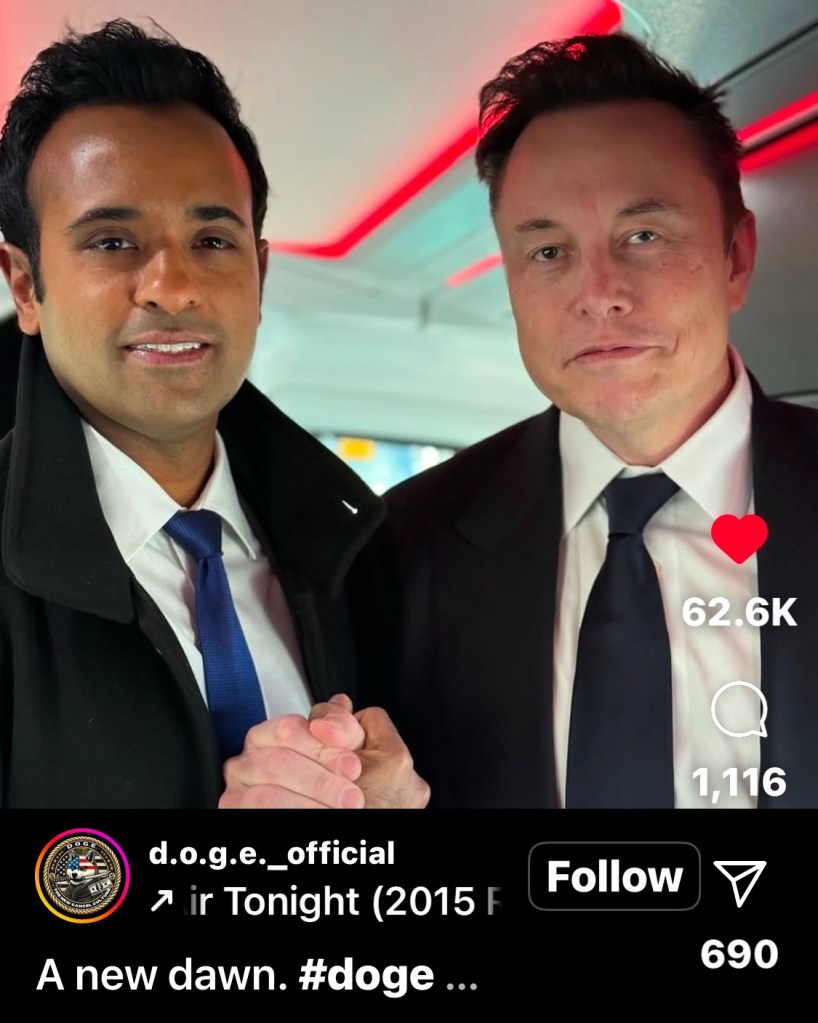
I have been saying for months that this Ohio governor’s race was never going to be as close as the liberal media and the Democratic machine kept insisting. As long as Amy Acton could raise and spend roughly equal amounts of money, they could buy enough advertising to keep the “horse race” illusion alive. That is how the game works in modern politics. Fundraising and media buys create the perception of competitiveness long after the fundamentals have already decided the outcome. But we are now in the middle of July 2026, and the gap is becoming impossible to hide. Elon Musk just put $5 million into the super PAC supporting Vivek Ramaswamy. That single check changes the entire dynamic, and the other side knows it.
I have watched David Pepper and the Marc Elias-style operatives do this routine before. They treat elections like a production where money buys the narrative, and the narrative buys time. They prop up candidates who cannot stand on their own record by flooding the airwaves with ads that soften the edges and attack the opponent on personality or wealth rather than substance. It works until the money runs short. Then the horse stops getting free drinks at the strip joint, and reality walks in. Right now, the money is tightening up for Acton, and the media that was happy to call this a toss-up while the checks were clearing is suddenly quieter about the fundamentals.
Vivek Ramaswamy is the exceptional candidate in this race. He is a Cincinnati native who built real companies, created real value, and succeeded on merit in competitive fields. He is a successful author and thinker who has already proven he can operate at the highest levels of government efficiency efforts alongside Elon Musk in the Department of Government Efficiency. He understands free markets, individual initiative, and the dangers of centralized government that tries to manage every resource and outcome from above. That is the opposite of the society Acton and her backers have spent years promoting—one that empowers mediocre administrators while punishing the very people and policies that generate prosperity.
Acton, by contrast, is a textbook product of the empire of mediocrity. She was the face of Ohio’s COVID lockdowns as state health director. She helped shut down businesses, kept drive-throughs and dining rooms closed at places like McDonald’s under ever-shifting rules, and contributed to the destruction of countless small enterprises that never recovered. Those policies were later exposed in court as unconstitutional overreaches. I had conversations with members of the Ohio Supreme Court back in 2020 as those cases were being prepared, and it was obvious even then that the lockdowns could not survive constitutional scrutiny. Governor DeWine eventually had to back away because the legal foundation was collapsing under him. Acton resigned under pressure from angry citizens protesting in the streets with no clear end in sight. None of that is the record of an exceptional leader. It is the record of someone who followed the centralized script, expanded bureaucratic power, and left real damage behind.
DeWine’s endorsement of Vivek took courage. It is never easy for a term-limited governor to put his name behind a successor who is positioned to outperform him, especially when that successor is running against the person DeWine himself appointed during the pandemic. The fact that he did it anyway tells you something important about where the party and the state are headed. Vivek is not an insider continuation of the old order. He is the disruption the old order needs if Ohio is going to stop losing ground on taxes, education, and economic freedom.
The money tells the real story right now. Vivek’s supporting super PAC has raised serious resources—tens of millions—and is deploying them aggressively. The $5 million from Musk is not just symbolic; it is a signal that serious people who create wealth and understand results are backing him. Acton cannot match that pace. When the advertising dollars dry up, the media loses interest in pretending this is a close contest. Voters are left with the actual records: one candidate who built success and wants to bring that same energy to Columbus, and another whose signature achievement was helping lock down the state economy in ways that proved unconstitutional and economically destructive.
I have been consistent on this since the race took shape. Vivek was always going to outperform the low expectations the media set for him once people looked past the noise. He is rolling out plans on property tax reform, real education choice that puts parents back in charge, and cooperation with a Trump administration that remains popular in Ohio for delivering results on the economy and border security. Acton’s side is still trying to run the old playbook—lawfare, media narratives, and enough cash to keep the “horse race” story alive. But the cash is not keeping up, and the voters are not buying the illusion the way they once did.
This race is a clear choice between two different visions of government. One side believes in self-initiative, free markets, and limited centralized power—the approach that actually lifts societies. The other side believes the government should take from producers and redistribute according to political priorities, the same model that has produced mediocrity and dependency wherever it has been tried at scale. Ohio does not need another governor who manages decline while protecting the administrative class. It needs a governor who will cut waste, reform taxes, fix the schools, and let exceptional people and exceptional businesses thrive rather than punishing them.
We are still a few months from November, but the trajectory is clear. As the funding gap widens and the media can no longer afford to prop up the fiction of a close race, Vivek Ramaswamy is going to pull away. The fundamentals were always on his side. The money is now confirming what the fundamentals already showed. Ohio has a real chance to choose exceptional leadership over the empire of mediocrity that has dominated too much of state government for too long. I have been saying it for months. The evidence is now impossible to ignore.
Footnotes
1. Elon Musk contributed $5 million to V-PAC, the super PAC supporting Vivek Ramaswamy’s campaign for Ohio governor. Cleveland.com, July 15, 2026.
2. Vivek Ramaswamy won the Republican primary for governor on May 5, 2026, with approximately 82.4% of the vote. Ballotpedia, “Ohio gubernatorial and lieutenant gubernatorial election, 2026.”
3. Amy Acton served as Ohio’s state health director and played a central role in the state’s early COVID-19 response and lockdown policies under Governor Mike DeWine.
4. Multiple court challenges in Ohio and elsewhere during 2020–2021 found various lockdown and business closure orders unconstitutional or beyond executive authority.
5. Governor Mike DeWine endorsed Vivek Ramaswamy for governor in 2025–2026, despite Acton having been his appointee during the pandemic period.
6. Ramaswamy’s campaign and supporting super PAC have raised and spent tens of millions, significantly outpacing Acton’s fundraising in key periods of 2026.
Bibliography (selected for further reading)
• Ballotpedia. “Ohio gubernatorial and lieutenant gubernatorial election, 2026” (primary results and candidate profiles).
• Cleveland.com. “Elon Musk puts $5 million behind ex-DOGE partner Vivek Ramaswamy’s governor bid.” July 15, 2026.
• Forbes. “Ramaswamy Wins Republican Primary In Ohio Governor’s Race.” May 5, 2026.
• AP News. “Trump-backed Vivek Ramaswamy wins Ohio Republican Party’s endorsement in 2026 governor’s race.” May 9, 2025.
• Vivek for Ohio campaign materials and platform statements (vivekforohio.com).
• Ohio Capital Journal and other Ohio political reporting on super PAC spending and fundraising totals, 2025–2026.
• Court records and contemporaneous reporting on Ohio COVID-era lockdown litigation and constitutional challenges (2020–2022).
• Various polling aggregates from mid-2026 showing the general election contest between Ramaswamy and Acton.
Rich Hoffman is an author, political consultant, and strategic advisor based in Cincinnati, Ohio, and the creator of The Politics of Heaven—a unique framework that connects biblical theology, ancient history, and modern power structures to explain how moral alignment and spiritual forces shape global events. Blending real-world political experience with deep research into archaeology, UFO phenomena, and suppressed historical narratives, Hoffman offers compelling commentary on topics ranging from ancient civilizations and the Dead Sea Scrolls to modern populist movements, paranormal continuity, and leadership strategy in chaotic environments. As the author of The Gunfighter’s Guide to Business and the forthcoming Politics of Heaven, he brings a grounded yet provocative voice to media discussions, supported by firsthand experiences and a cross-disciplinary approach that bridges science, history, and theology. For interviews, speaking engagements, or expert analysis, visit richhoffmanbooks.com or contact directly via phone at 513-307-5815 or email at rhoffman@richhoffmanbooks.com. If you’ve seen the movie, Disclosure Day and want to talk about it and the implications of Presidnet Trump’s UAP disclosures, let me know and we can bring some color to your coverage. https://richhoffmanbooks.com/media-inquiries-broadcast-topics-and-contact-info/?frame-nonce=ad51e7ecba I do have a firsthand UFO encounter to discuss.
In the spring of 2026, Ohio voters are being told a familiar story by the Democratic ticket led by the stringy-haired Amy Acton. High grocery bills, elevated gas prices, stubborn supply-chain bottlenecks, and the everyday squeeze felt by working families and small manufacturers are, according to Acton’s campaign and its surrogates—Mark Elias, David Pepper, and the usual Democratic spokespeople—the direct result of Trump-era policies and the supposed continuation of that agenda under Vivek Ramaswamy. The irony is staggering. The very architect of Ohio’s most disruptive government intervention in modern history—the woman who, as Director of the Ohio Department of Health in 2020, signed the stay-at-home orders that shuttered schools, closed non-essential businesses, and upended millions of lives—is now positioning herself as the solution to the very economic pain her policies created.
This is not partisan rhetoric. It is a matter of documented cause and effect, visible every day in Ohio’s factories, restaurants, construction sites, and family budgets. The high prices we live with in 2026 are not primarily the fault of tariffs, speculation, or any single administration in Washington. They are the long shadow of a forced economic shock imposed in 2020 by a centralized government decree—one in which Amy Acton played a central role, coordinating with federal health authorities, the CDC, the World Health Organization, and, ultimately, with policies shaped by information flowing from China. The damage was not abstract. It was immediate, structural, and enduring. And while headline statistics have been massaged to suggest recovery, the real economy—especially for midsize manufacturers, small businesses, and working families—never returned to its pre-2019 equilibrium.
To understand why Acton’s record matters now, we must revisit what actually happened in Ohio in the spring of 2020. On March 22, 2020, Acton issued a stay-at-home order effective at 11:59 p.m. that night. Non-essential businesses were closed. Schools shuttered. Gatherings were limited. The order, later extended by Governor Mike DeWine, was not a suggestion; it carried the force of law. Within weeks, Ohio’s unemployment rate exploded from roughly 4.5 percent pre-pandemic to a peak of 16.4 percent in April 2020—the highest level in modern state history. More than 2.1 million unemployment claims were filed that year alone, compared to just 360,000 in all of 2019. Entire sectors—manufacturing, hospitality, transportation, professional services—were suddenly and forcibly interrupted.
This was not a natural recession triggered by market conditions. Ohio’s economy in early 2020 was not overheating. It was not over-leveraged. It was functioning normally until the government decree flipped the switch. The result was a structural break in continuity that no amount of federal stimulus could fully repair. Over 341,000 non-farm jobs disappeared in a single year—a decline of more than 6 percent. Manufacturing, the backbone of Ohio’s economy, absorbed a particularly brutal blow, losing roughly 480,000 jobs at the height of the crisis. Supply chains that had taken decades to optimize were severed overnight. Relationships between suppliers, customers, and workers were shattered. Skills atrophied. Experience was lost.
Federal relief money flowed in—Ohio ultimately received billions through the CARES Act and subsequent packages, with more than $10 billion in direct grant funding allocated early on and additional ARPA dollars later. That money stabilized household consumption and prevented total collapse on paper. It propped up demand. But it did not rebuild labor pools, restore broken supplier networks, or reverse the loss of institutional knowledge. GDP figures eventually rebounded. On the surface, Ohio appeared to recover. Yet for thousands of private, midsize, and industrial firms—the companies that form the real productive core of the state—the recovery never materialized in the way that matters most. Revenue stabilized in some cases, but labor did not return evenly. Supply chains remained fragile six years later. Many businesses entered a new, permanently altered economic reality from which they have yet to exit.
Look at the numbers that actually matter on the ground. Manufacturing employment has clawed back toward pre-pandemic levels in headline counts—hovering near 680,000 statewide by late 2025 and into 2026—but the composition is different. Output rose in aggregate, yet headcount remained flat or declined in many subsectors. Productivity gains came not from rebuilding capacity but from automation, consolidation, and doing more with fewer people. Smaller suppliers absorbed shocks they could not pass along. Material inflation, labor shortages, and customer concentration became permanent features. A 2025 survey of Ohio manufacturers found that around 40 percent still cited material costs as a major concern, with tariffs and other factors playing secondary roles. Speculators and opportunistic pricing certainly contributed to some price spikes—gasoline being the most visible example—but the underlying fragility traces directly back to the 2020 rupture.
Even more telling is the labor force participation rate. Ohio’s rate dropped sharply in 2020 and has never fully recovered. As of March 2026, it stands at approximately 62.1 percent—still roughly 1.3 percentage points below 2019 levels. That gap represents tens of thousands of missing workers. Many retired early. Others shifted to disability. Skilled trades lost experienced hands who never re-entered. The pandemic accelerated trends already underway—remote work, changing employer expectations—but the government-mandated shutdown turned those trends into a structural labor shortage. Employers now pay significantly higher wages without corresponding productivity gains. Chronic hiring difficulties persist. Small and midsize businesses, lacking the scale of large corporations, took the brunt of this hit.
The human and business-level consequences are visible in every corner of the state. Fast-food restaurants that once operated with long lines and reliable staffing still struggle with chronic understaffing. Supply chains that used to move with just-in-time efficiency now carry permanent buffers, higher costs, and longer lead times. Contracts signed in 2018 or 2019 based on pre-pandemic pricing realities cannot be easily renegotiated in 2024 or 2025 when everything from labor to materials has inflated. Large buyers—Walmart, major distributors, big manufacturers—hold suppliers to those old terms while their own costs have risen. Many smaller firms plateaued at lower output, higher risk, and reduced resilience. Nearly half of the Ohio businesses operating in 2019 were no longer active by 2024. New formations occurred, as they often do after crises, but stimulus checks or reconfigured statistics cannot replace the permanent loss of experience, relationships, and localized capacity.
This was not mismanagement or an isolated failure. It was a structured shock imposed by the government, and in Ohio, by Amy Acton directly. The recovery that followed was real on paper but redistributive in practice. Large firms with access to capital, automation, equity markets, and policy cushions emerged stronger. Smaller private companies absorbed transition costs without the same protections. Stimulus prioritized consumption over reconstruction of upstream production capacity. The result is an economy that looks healthier in aggregate GDP and unemployment figures but feels fundamentally different—and more fragile—for the businesses and workers who actually produce goods and services.
Compounding the damage were subsequent policy choices, including repeated minimum-wage adjustments tied to CPI and other labor-market interventions. While intended to help workers, these hikes acted as an artificial price floor that businesses—especially those already reeling from supply-chain disruption—had to absorb by raising consumer prices. In an environment where labor shortages already drove up wages, the added pressure from mandated increases translated directly into higher menu prices, higher retail costs, and thinner margins for the very firms least able to absorb them. Democrats often frame these as acts of compassion, but the economic reality is that they function as another layer of costs passed on to consumers in an economy still recovering from the original government-imposed rupture.
Contrast this track record with the alternative represented by Vivek Ramaswamy. As an entrepreneur who built real companies and created substantial value, Ramaswamy understands from firsthand experience what it takes to navigate supply chains, labor markets, capital allocation, and regulatory hurdles. His platform—aggressive tax cuts (including phasing down the state income tax and meaningful property tax relief), energy independence through expanded natural gas and streamlined permitting, and a laser focus on reducing the regulatory burden—addresses the structural issues that Acton’s policies left behind. Where Democrats offer more stimulus, more government employment, and more wealth redistribution, Ramaswamy offers the conditions for genuine private-sector expansion: lower taxes so families and businesses keep more of what they earn, reduced uncertainty so investment can return, and policies that reward production rather than consumption propped up by printed money.
The political inversion is almost Orwellian. The same network of Democratic operatives—Mark Elias, David Pepper, and their allies—who have spent years litigating, regulating, and centralizing power now seek to pin the enduring consequences of their own policy choices on the very people who warned against them. They want voters to forget that Acton was the public face of the orders that closed Ohio’s economy. They want voters to ignore the long-term scarring visible in labor participation, small-business survival rates, and fragile supply chains. And they want to portray Vivek Ramaswamy—an outsider who built a billion-dollar value through innovation and discipline—as somehow responsible for prices that trace directly to decisions made in 2020 under Democratic-influenced health policy.
This is not ancient history. The effects are measurable today. Manufacturing survived the shock but did not return to its prior equilibrium. Labor-force participation remains depressed. Supply chains are still adapting. Smaller firms operate with lower resilience. High prices at the grocery store, the gas pump, and the restaurant counter are not mysterious. They are the predictable outcome of a forced shutdown followed by stimulus that prioritized short-term consumption over long-term productive capacity. Government did not merely interrupt Ohio’s economy in 2020—it rewired it. And for many companies, especially private midsize and industrial firms, the 2020 era has never truly ended.
Ohioans deserve better than political amnesia. They deserve leaders who understand that real economic vitality comes from production, not redistribution; from predictable policy, not repeated government shocks; and from accountability, not blame-shifting. Amy Acton’s record as Health Director is not a footnote—it is the central chapter in the story of why so many Ohio families and businesses are still paying the price six years later. Vivek Ramaswamy’s background as a value-creating entrepreneur offers the clearest alternative: a governor who will cut taxes, slash red tape, expand energy production, and restore the conditions under which Ohio businesses and workers can thrive again.
The choice in 2026 is not abstract. It is between continuing the politics that created the problem and embracing the policies that can finally heal the damage. Ohio’s real economy—its factories, its family businesses, its working men and women—has waited long enough for that reckoning. But when we have to talk about who is responsible for all the misery we are still feeling, there is only one person to blame, and that is Amy Acton, the Lockdown Lady.
Footnotes
1. Ohio Department of Job and Family Services, Employment Situation Indicators, various monthly releases 2020–2026.
2. Bureau of Labor Statistics and Ohio JFS data on unemployment claims and rates, April 2020 peak.
3. Contemporary reporting on Acton’s stay-at-home order, March 22, 2020 (Ohio Department of Health).
4. Federal COVID-19 grant funding allocations to Ohio, CARES Act, and subsequent packages (approximately $10 billion+ in early grants).
5. Ohio manufacturing employment and labor force participation trends, Ohio LMI and FRED data through March 2026.
6. NFIB and small-business survival analyses post-2020.
7. Surveys of Ohio manufacturers on material costs and supply-chain issues, 2025.
8. Vivek Ramaswamy campaign platform materials on tax relief, energy, and regulatory reform.
9. Additional sourcing from Policy Matters Ohio, the Cleveland Fed, and contemporaneous economic analyses of pandemic impacts.
Bibliography
• Ohio Department of Job and Family Services. Employment Situation Indicators (monthly releases, 2019–2026).
• U.S. Bureau of Labor Statistics. Labor force, employment, and unemployment data for Ohio.
• Acton, Amy. Director’s Stay-at-Home Order, Ohio Department of Health, March 22, 2020.
• Federal COVID relief tracking reports (CARES Act, ARPA allocations to Ohio).
• NFIB Ohio Small Business Economic Trends reports.
• Cleveland Federal Reserve District data briefs on supply-chain disruptions.
• Ramaswamy for the Ohio campaign platform documents.
• Contemporary news coverage from AP, Signal Ohio, and Ohio LMI publications.
Rich Hoffman is an aerospace executive, political strategist, systems thinker, and independent researcher of ancient history, the paranormal, and the Dead Sea Scrolls tradition. His life in high‑stakes manufacturing, high‑level politics, and cross‑functional crisis management gives him a field‑tested understanding of power — both human and unseen.
He has advised candidates, executives, and public leaders, while conducting deep, hands‑on exploration of archaeological and supernatural hotspots across the world.
Hoffman writes with the credibility of a problem-solver, the curiosity of an archaeologist, and the courage of a frontline witness who has gone to very scary places and reported what lurked there. Hoffman has authored books including The Symposium of Justice, The Gunfighter’s Guide to Business, and Tail of the Dragon, often exploring themes of freedom, individual will, and societal structures through a lens influenced by philosophy (e.g., Nietzschean overman concepts) and current events.
In the bustling parking lot of Ohio’s brand-new Buc-ee’s just north of Dayton off I-70, Dr. Amy Acton posed for what was meant to be a wholesome campaign snapshot—a smiling physician-turned-politician standing beside the gleaming Texas-sized travel center, projecting the image of a nice, relatable lady who shops where everyday Buckeyes shop. The first Ohio Buc-ee’s opened in Huber Heights in early April 2026, drawing massive crowds and national attention for its clean restrooms, fresh brisket, and over-the-top convenience. Acton’s team seized the moment, posting the photo to humanize her, to say, “See? She’s just like you.” But the optics couldn’t paper over the deeper story unfolding in this 2026 gubernatorial race. While Acton tried to reset her image with photo ops and bedside-manner charm, Vivek Ramaswamy was drawing genuine, overflowing crowds of longtime Ohio friends, family, and supporters who have known him since he was a boy in Cincinnati—people who remember his parents’ immigrant journey, his entrepreneurial drive, and the decades of personal relationships that speak louder than any staged picture. You can judge a person by the company they keep, and Ramaswamy’s circle spills over with proud, authentic voices from his past who have stuck with him through every chapter of his life. Acton’s campaign, by contrast, feels increasingly desperate, resorting to high-powered Washington lawyers to silence critics rather than defend her record.
NEW ALL-TIME HIGH: Vivek Ramaswamy has a 97.6% chance of being the Ohio Republican Governor nominee pic.twitter.com/d9qj0lLrfo
To understand why this race matters so much to Ohio’s future, you have to go back to the spring of 2020, when Dr. Amy Acton served as Director of the Ohio Department of Health under Republican Governor Mike DeWine. She wasn’t elected; she was appointed. Yet she became the public face of some of the nation’s most aggressive COVID-19 policies. On March 22, 2020—when Ohio had reported just a handful of deaths—Acton helped lead the state into one of the earliest and strictest lockdowns anywhere. Schools closed statewide for the rest of the academic year. “Non-essential” businesses shuttered overnight. Stay-at-home orders restricted movement. Nursing homes were locked down, isolating vulnerable residents from loved ones. Capacity limits, mask mandates, and social-distancing rules followed, all modeled closely on guidance from the CDC and Dr. Anthony Fauci. Acton appeared in daily press briefings alongside DeWine, projecting calm authority while estimating infection numbers that frightened the public into compliance. She resigned in June 2020 amid growing protests outside her home, but the policies she championed reshaped Ohio in ways the state is still recovering from six years later.
The human and economic toll of those decisions has been documented in mounting data. Ohio’s unemployment rate rocketed from 4.9 percent to 16.4 percent in a single month—the sharpest spike in modern state history. Thousands of small businesses, restaurants, gyms, and retailers never reopened. Hospitality and tourism sectors collapsed. Learning loss among schoolchildren, especially in low-income districts, was catastrophic; studies projected lifetime economic losses in the hundreds of billions for Ohio alone due to missed instruction and widened achievement gaps. Mental health crises exploded: overdoses rose sharply, youth depression and suicide ideation increased, and isolation in nursing homes contributed to excess deaths beyond the virus itself—many from untreated conditions, delayed care, or despair. Nationwide analyses, including those examining excess mortality, have increasingly questioned whether the most restrictive measures saved more lives than they cost, when indirect harms are weighed. In Ohio, the early modeling that justified the lockdowns proved overly pessimistic, yet the policies remained locked in place longer than in many peer states. Acton has never fully reckoned with this in her campaign. Instead, she positions herself as “a doctor, not a politician,” emphasizing her roots in working-class Youngstown and her compassion. But for families who lost businesses, kids who fell behind, or elderly residents who died alone, those words ring hollow. The statistics don’t lie: the lockdown playbook—drawn from federal guidance influenced by international models—inflicted measurable, lasting damage on Ohio’s economy, education system, and social fabric.
Fast-forward to 2026, and Acton is the presumptive Democratic nominee for governor, running with David Pepper—former chair of the Ohio Democrat Party—as her lieutenant governor pick. Polls show the race tightening or even tilting her way slightly in some surveys, despite Ohio’s deep Republican lean. Her campaign message focuses on affordability, families, and pushing back against “special interests.” Yet when journalists and commentators like Jack Windsor of the Ohio Press Network dig into her record—whether the 2020 policies, the resurfaced 2019 Bexley police report, or other public details—her team doesn’t debate the substance. They deploy heavy legal artillery. The Acton/Pepper campaign has retained Elias Law Group, the Washington, D.C., firm founded by Marc Elias, the Democratic election lawyer infamous for his role in the 2016 Clinton campaign’s Steele dossier efforts, post-2020 litigation challenging election integrity claims, and aggressive legal maneuvers nationwide. Elias’s firm has sent cease-and-desist letters to outlets and commentators questioning Acton, framing routine investigative reporting as defamation or libel. These aren’t polite corrections; they are designed to intimidate, to force journalists and critics into defensive silence rather than risk costly litigation—even when the recipients know the claims lack merit.
This tactic is classic lawfare, and it’s especially galling because Acton is now a public figure running for the highest office in the state. Under the landmark U.S. Supreme Court precedent New York Times v. Sullivan (1964), public officials and candidates must prove “actual malice”—knowledge of falsity or reckless disregard for the truth—to win defamation suits. The bar is deliberately high to protect robust political debate and press freedom. Elias’s team knows this, yet the letters keep coming. They mirror the same playbook used in the 2020 election challenges: procedural delays, technical objections, and resource-draining threats to bury inconvenient truths under paperwork and fear. David Pepper, Acton’s running mate, has long been a fixture in Democratic politics, and his involvement signals the campaign’s strategy—control the narrative through insiders rather than earn voter trust through transparency. When a police report from August 2019 resurfaced—detailing a verbal domestic dispute at the Acton home over her long work hours, where both she and her husband admitted to drinking, she had taken prescription medication, she shattered a large mirror in frustration, and she was heading toward her car until her husband physically intervened—no charges were filed, and officers noted no physical violence. It was a private family moment turned public by her candidacy. Yet instead of addressing it head-on or releasing more context, the campaign and its allies dismiss questions as “attacks” while Elias’s firm fires off warnings. The report is public record. Citizens have every right to weigh it when evaluating a candidate who once directed public health policy affecting millions.
Contrast this with Vivek Ramaswamy. The Republican frontrunner grew up in Ohio, built a successful biotech company from scratch, and ran a high-profile 2024 presidential campaign that put him in the national spotlight. His support isn’t manufactured through consultants or photo ops. Crowds at his events include people who knew him as a kid, family friends who watched him navigate his Indian-immigrant parents’ sacrifices, and longtime associates who have seen his character tested over decades. That kind of organic loyalty doesn’t come from polling consultants or law-firm intimidation. Ramaswamy’s platform emphasizes prosperity, limited government, school choice, economic freedom, and a rejection of the bureaucratic overreach that defined the COVID era. He has visited every county, secured endorsements from sheriffs, unions in some cases, and grassroots conservatives who remember exactly who was at the podium issuing orders in 2020. His running mate, Senate President Rob McColley, brings institutional knowledge and legislative heft. Together, they represent a future-oriented conservatism rooted in Ohio values—innovation, hard work, and accountability—rather than nostalgia for the administrative state.
The deeper issue here transcends one race. When campaigns hire the likes of Marc Elias to muzzle journalists covering a candidate’s public record—whether COVID policies that harmed families or personal incidents that raise legitimate character questions—they erode the very foundation of representative government. Free speech and a free press exist precisely so voters can vet those who seek power. Ohioans paid a steep price for Acton’s lockdown decisions: lost livelihoods, educational setbacks that will echo for generations, and a lingering sense that government overstepped its bounds under the banner of “following the science.” Data now shows that many of those measures delivered marginal or questionable benefits relative to their costs. Excess mortality studies and economic analyses continue to reveal the trade-offs. Yet instead of debating that record openly, the campaign seeks to shut down the conversation. That’s not leadership; it’s the same insider playbook that has eroded trust in institutions nationwide. Elias’s history—tied to efforts to litigate away election challenges in 2020 and beyond—only underscores the pattern: when the facts are uncomfortable, deploy lawyers to redefine reality.
Ramaswamy, by contrast, invites scrutiny of his record because it stands on merit—entrepreneurial success, family values, and a clear-eyed rejection of the bureaucratic excesses that hurt working families. His supporters aren’t fringe; they’re the backbone of Ohio communities who remember the pre-lockdown economy, the joy of school events, and the freedom to live without constant government edict. They see in him someone who judges people by character and results, not by elite credentials or media spin. The 2026 race is more than a choice between two candidates; it’s a referendum on whether Ohio learns from 2020 or repeats the mistakes. Voters who value prosperity, honest accountability, and open debate have every reason to reject the politics of intimidation and nostalgia for administrative control.
Acton’s team may believe a few more Buc-ee’s photo ops and some strategic legal letters will paper over the past. But Ohioans have long memories. The lockdown lady’s policies didn’t just inconvenience people—they upended lives, and the data backs that up. Police reports, public records, and economic statistics don’t vanish because a Washington law firm sends a letter. When the votes are counted in November 2026, character, record, and authenticity will decide it. Vivek Ramaswamy brings the relationships, the vision, and the backbone to move Ohio forward. Amy Acton’s campaign, built on image management and legal threats, reveals exactly why voters should send a different message. The truth doesn’t need cease-and-desist letters to survive—it just needs voters willing to remember.
Footnotes
1. Ohio’s first Buc-ee’s location details and Acton’s visit: Campaign site and local news coverage, April 2026.
2. Acton’s role as Health Director and lockdown timeline: Contemporary reporting and her Wikipedia entry.
3. Economic and educational impacts of 2020 lockdowns in Ohio: Unemployment data from state labor statistics; learning loss projections from education analyses.
4. 2019 Bexley police report: Public records as covered by NBC News and Ohio outlets, April 2026.
5. Elias Law Group retainers and cease-and-desist letters: Reporting by Jack Windsor/Ohio Press Network and related commentary, 2026.
6. New York Times v. Sullivan precedent: U.S. Supreme Court, 376 U.S. 254 (1964).
7. Vivek Ramaswamy’s Ohio roots and campaign: Polling and news coverage of his events and endorsements.
8. Broader COVID policy critiques: Peer-reviewed studies on excess mortality, mental health, and economic costs (various sources, including PMC and state-specific analyses).
• U.S. Supreme Court case New York Times Co. v. Sullivan (full opinion available via legal archives).
Extended Footnote on New York Times Co. v. Sullivan (1964) and the “Sullivan Doctrine”
The landmark U.S. Supreme Court decision in New York Times Company v. Sullivan, 376 U.S. 254 (1964), fundamentally reshaped American libel law and remains the cornerstone of First Amendment protections for political speech and press freedom. Often called the “Sullivan case,” it gave rise to what legal scholars refer to as the “Sullivan doctrine” or “actual malice” rule—a constitutional standard that has been extended and refined in a line of subsequent Supreme Court cases (collectively the “Sullivan cases”). This body of law was born directly out of the Civil Rights Movement and was designed to prevent public officials from using defamation suits as a weapon to silence criticism.
Facts and Historical Context
In March 1960, amid the escalating sit-in protests and violence against Black students in Montgomery, Alabama, the Committee to Defend Martin Luther King and the Struggle for Freedom in the South placed a full-page advertisement titled “Heed Their Rising Voices” in The New York Times. The ad solicited donations to support King’s legal defense and the broader civil rights cause. It criticized “an unprecedented wave of terror” by Southern officials and police, describing incidents such as the padlocking of a dining hall at Alabama State College and police actions against demonstrators. The advertisement contained several minor factual inaccuracies (e.g., the exact number of times King had been arrested, the songs sung by students, and whether the dining hall was actually padlocked). It was signed by 64 prominent figures (including Eleanor Roosevelt and Jackie Robinson) and listed the names of four Alabama ministers associated with King’s Southern Christian Leadership Conference—some of whose names had been added without their explicit prior approval.
L.B. Sullivan, the elected Montgomery Public Safety Commissioner who oversaw the police department, was not named in the ad. Nevertheless, he sued The New York Times and the four ministers in Alabama state court, claiming the criticism of police conduct defamed him by implication. Under then-prevailing Alabama common-law libel rules, a plaintiff could recover substantial damages merely by showing the statement was false and tended to harm reputation; no proof of actual harm or malicious intent was required, and damages were often presumed. An all-white jury awarded Sullivan $500,000—a staggering sum in 1960. The Alabama Supreme Court affirmed the verdict. Similar libel suits were filed by other Alabama officials, part of a coordinated “libel attack” strategy by segregationists to bankrupt newspapers and intimidate national coverage of the Civil Rights Movement.
The Supreme Court’s Unanimous Ruling
On March 9, 1964, the U.S. Supreme Court reversed the judgment in a 9-0 decision written by Justice William J. Brennan Jr. The Court held that Alabama’s libel law unconstitutionally infringed on the First and Fourteenth Amendments when applied to criticism of public officials’ conduct. Brennan famously declared that the First Amendment “prohibits a State from awarding damages to a public official for defamatory falsehood relating to his official conduct unless he proves that the statement was made with ‘actual malice’—that is, with knowledge that it was false or with reckless disregard of whether it was false or not.” The standard must be proven with “convincing clarity.”
The opinion emphasized that “debate on public issues should be uninhibited, robust, and wide-open, and that it may well include vehement, caustic, and sometimes unpleasantly sharp attacks on government and public officials.” Erroneous statements, Brennan noted, are “inevitable in free debate” and must be protected lest the fear of liability chill essential political discourse. The ruling explicitly rejected the idea that the press could be held to the strict liability standards of ordinary private libel suits when reporting on matters of public concern.
Expansion to Public Figures and the “Sullivan Progeny”
The Sullivan rule was not limited to elected officials. In the companion cases Curtis Publishing Co. v. Butts and Associated Press v. Walker (388 U.S. 130, 1967), the Court extended the actual-malice requirement to “public figures”—prominent private citizens who thrust themselves into public controversies or are drawn into them. Justice Harlan’s plurality opinion refined the standard slightly but preserved the core protection.
Later, in Gertz v. Robert Welch, Inc. (418 U.S. 323, 1974), the Court drew a clearer line: private individuals (who have not voluntarily entered the public arena) need only show negligence by the defendant for compensatory damages, but public figures and officials must still meet the higher actual-malice threshold. Subsequent cases such as Time, Inc. v. Hill (1967) applied similar protections to false-light privacy claims, and Hustler Magazine v. Falwell (1988) extended First Amendment safeguards to parody and emotional-distress claims involving public figures.
Enduring Significance
Sullivan and its progeny were a direct response to the use of libel law as a tool of political suppression during the Civil Rights era. By placing the burden of proof on the plaintiff and raising the fault standard dramatically, the doctrine has made it extraordinarily difficult for public officials or public figures to win defamation suits against the press or critics—precisely the point. It has shielded investigative journalism, opinion writing, and robust political debate for more than six decades, even as critics (including some modern Supreme Court justices) have questioned whether the internet age requires recalibration.
In the context of modern political campaigns, the rule remains vital: candidates who voluntarily seek public office become public figures and must tolerate sharp scrutiny of their records, statements, and character. Cease-and-desist letters or threats of litigation that rely on pre-Sullivan common-law standards rarely survive constitutional review when aimed at commentary on a candidate’s official acts or fitness for office. The doctrine ensures that voters—not lawyers—ultimately decide the truth through open debate.
This historical and legal framework underscores why public-figure plaintiffs today face such a high bar: the Supreme Court deliberately chose to err on the side of protecting speech to safeguard democracy itself. For further reading, see the full opinion at 376 U.S. 254 and analyses in Actual Malice by Samantha Barbas (2023) or the Stanford Martin Luther King, Jr. Research and Education Institute’s primary-source collection.
Rich Hoffman is an aerospace executive, political strategist, systems thinker, and independent researcher of ancient history, the paranormal, and the Dead Sea Scrolls tradition. His life in high‑stakes manufacturing, high‑level politics, and cross‑functional crisis management gives him a field‑tested understanding of power — both human and unseen.
He has advised candidates, executives, and public leaders, while conducting deep, hands‑on exploration of archaeological and supernatural hotspots across the world.
Hoffman writes with the credibility of a problem-solver, the curiosity of an archaeologist, and the courage of a frontline witness who has gone to very scary places and reported what lurked there. Hoffman has authored books including The Symposium of Justice, The Gunfighter’s Guide to Business, and Tail of the Dragon, often exploring themes of freedom, individual will, and societal structures through a lens influenced by philosophy (e.g., Nietzschean overman concepts) and current events.