The Affordability Crisis: Price increases to fill vacant personalities are the folly of socialism looming in the background

The question of housing affordability has become one of the most pressing socio-economic issues in the United States today. With the average home price reaching approximately $400,000 in 2024, many young families and individuals find themselves priced out of the market. This reality raises a critical question: why does the housing industry continue to prioritize large, expensive homes when market signals clearly indicate a growing demand for smaller, affordable housing options? Historically, the American housing model was built on accessibility. Following World War II, the United States experienced an unprecedented housing boom driven by the GI Bill, which provided returning veterans with low-interest mortgages and educational benefits. Between 1945 and 1960, the average home price increased from roughly $8,000 to $12,000 [1], while median household income rose from $2,400 to $5,600 [2]. These homes were predominantly single-story ranch houses designed to be affordable for working-class families. They featured simple layouts, modest square footage, and efficient construction methods that allowed developers to build entire neighborhoods quickly and inexpensively. This model supported rapid suburbanization and contributed to the rise of the American middle class. By contrast, the late 20th and early 21st centuries saw a shift toward larger homes, often called “McMansions.” In 1980, the average home price was $47,000 [3], but by 2000, it had climbed to $120,000 [4], and by 2020, it had skyrocketed to $320,000 [5]. This escalation far outpaced wage growth, creating a structural imbalance in housing affordability and leaving younger generations unable to enter the market. The cultural and economic forces that once prioritized affordability have been replaced by incentives that reward size, luxury, and perceived status, setting the stage for today’s housing crisis.

The persistent trend toward building larger homes is not driven solely by consumer demand but by systemic incentives in the real estate and finance sectors. Developers maximize profits by constructing high-value properties, while municipalities benefit from increased property tax revenues. This dynamic discourages the development of smaller, entry-level homes, even though demographic data suggests that younger generations prefer affordability and functionality over size and luxury. According to recent affordability indices, the ratio of median household income to qualifying income for a median-priced home fell to 0.68 in 2024 [6]. This indicates that homeownership is increasingly unattainable for average earners, reinforcing the argument for a return to smaller, cost-effective housing models. Yet the financial ecosystem—from banks to zoning boards—remains locked into a paradigm that rewards high-margin projects. Mortgage lenders often favor larger loans because they generate higher interest revenue, while local governments prioritize developments that promise substantial tax inflows. These incentives create a feedback loop that perpetuates the construction of oversized homes, even as market demand shifts toward affordability. Furthermore, inflationary pressures and speculative investment exacerbate the problem. Between 2000 and 2024, housing prices grew by more than 230%, while median incomes increased by less than 75%. This disparity underscores the structural imbalance between wages and housing costs, a gap that cannot be bridged solely by traditional market mechanisms. Without intervention, the housing market risks becoming increasingly exclusionary, limiting access to homeownership and eroding the foundation of economic mobility.

Beyond economics, cultural factors play a significant role in shaping housing trends. For decades, the pursuit of status through material possessions influenced consumer preferences, encouraging the construction of larger homes as symbols of success. Golf memberships, luxury cars, and sprawling properties became markers of achievement, reinforcing a cycle of materialism that drove housing design. However, contemporary social values are shifting. Younger generations prioritize experiences, sustainability, and financial flexibility over conspicuous consumption. They are less interested in impressing neighbors with square footage and more concerned with affordability and quality of life. This cultural evolution underscores the need for housing policies and development strategies that align with changing societal norms. Yet the industry has been slow to adapt, clinging to outdated assumptions about what buyers want. Compounding the affordability crisis is the growing influence of institutional investors such as Blackstone, Invitation Homes, and other private equity firms that have acquired tens of thousands of single-family homes across the country. These firms often purchase distressed properties in bulk, outbidding individual buyers with cash offers, and then convert these homes into rental units. This practice accelerates the transition from an ownership-based society to a rental-based one, echoing predictions from the World Economic Forum that “you will own nothing and be happy.” While such statements are controversial, they highlight the structural forces reshaping housing markets globally and the erosion of the American Dream. Institutional investors operate with access to cheap capital and sophisticated financial instruments, enabling them to dominate local markets and set rental prices that further strain household budgets. When ownership becomes unattainable, wealth accumulation stalls, and generational inequality deepens, creating a society increasingly divided along economic lines. The presence of these investors also distorts housing supply, as homes that could serve as affordable entry points for families are removed from the ownership pool and repurposed for profit-driven rental schemes.

Failure to address this imbalance has profound social and economic consequences. Young adults delay marriage and family formation because they cannot afford homes. Communities lose stability as homeownership declines, and wealth inequality deepens as property ownership consolidates among institutional investors. Ultimately, the American Dream of homeownership becomes unattainable for a growing segment of the population. The current housing crisis reflects a failure to adapt to evolving market realities and cultural values. Continuing to build large, expensive homes in the face of declining affordability and changing consumer preferences is economically unsustainable and socially detrimental. A strategic pivot toward smaller, affordable housing—akin to the post-WWII ranch-style model—offers a viable solution to restore accessibility to the American Dream. Developers, policymakers, and financial institutions must recognize that the market is in charge, not the egos of those who seek to maximize profit at the expense of social stability. If this shift does not occur, the consequences will ripple across generations, transforming a nation of homeowners into a nation of renters and undermining the very foundation of American prosperity. The time to act is now: by embracing affordability, sustainability, and inclusivity, the housing industry can realign with the values that once made homeownership a cornerstone of American life.  But price increases, as a solution to fill the empty minds of vacant personalities, are the driving force here.  Everyone can’t be rich; they don’t have a mind for it, nor do they want it.  But we have been caught in giving everyone a sense of wealth without them doing the work of wealth, and in the process, we have opened Pandora’s box of illusion that many are perfectly willing to exploit for a short-term gain.  But the cost of those short-term gains is now before us, and it’s wrapped up in this whole affordability debate.  And looming in the background is the mechanisms of Marxism that knew what they were doing all along.  Once people throw in the towel, what will they want?  That’s what has happened in New York with the new communist mayor there.  And behind it all, there is a push to hide from the world the moral bankruptcy of the instigators if what gets ushered in behind the carnage is socialism and government-driven price controls.  When really, what was needed all along were market-driven sentiments of pure capitalism; if only people had listened to those market forces instead of trying to control them.

References:

[1] U.S. Census Bureau. Historical Housing Data, 1945–1960.

[2] U.S. Census Bureau. Median Income Trends, 1945–1960.

[3] National Association of Realtors. Housing Price Trends, 1980.

[4] Federal Reserve Economic Data (FRED). Median Home Prices, 2000.

[5] Federal Reserve Economic Data (FRED). Median Home Prices, 2020.

[6] Housing Affordability Index Report, 2024.

Rich Hoffman

Click Here to Protect Yourself with Second Call Defense https://www.secondcalldefense.org/?affiliate=20707

Affordability in Crisis: Why Price Hikes Are a Symptom of Deeper Economic Mismanagement

 The Illusion of Prosperity

Affordability has become one of the most pressing economic issues of 2025. Everywhere you look—groceries, housing, dining, even basic services—prices have surged. Politicians blame “corporate greed,” consultants preach “raise your prices,” and consumers wonder why their paychecks don’t stretch as far as promised.

I warned about this years ago in my book, The Gunfighter’s Guide to Business. The affordability crisis isn’t a mystery—it’s the predictable outcome of government interference, consultant-driven short-term thinking, and a cultural abandonment of lean principles. What we’re seeing now is the result of artificial wage inflation, cost-plus pricing models, and a failure to defend capitalism’s core logic.

Section 1: The Wage-Price Spiral—How Policy Broke the Market

The roots of today’s affordability problem lie in political decisions, not market forces. When Democrats pushed for a $15 minimum wage, they claimed it would lift millions out of poverty. On paper, that sounds noble. In reality, it distorted the entire wage structure.

• Minimum wage hikes ripple upward: When entry-level pay jumps, mid-tier and senior wages follow. Businesses face higher labor costs across the board.

• Inflationary pressure kicks in: To cover these costs, companies raise prices. Consultants reinforce this with “cost-plus” advice—pass it on to the customer.

• Purchasing power stagnates: Even if workers earn more nominally, real wages barely improve because goods and services inflate proportionally.

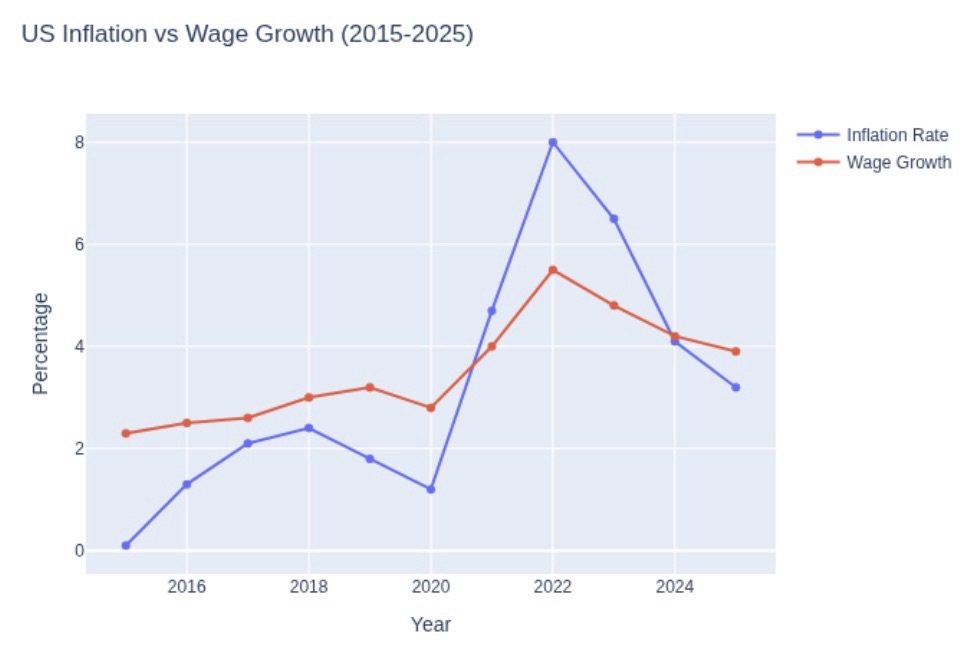
• Nominal wages rose 78.7% since 2006, but real wages (inflation-adjusted) grew only 11.9%.

• Inflation spiked to 9.1% in June 2022, while wage growth lagged at 4.8%, creating the sharpest negative gap in decades.

• From 2024 to 2025, inflation cooled to ~3%, but real wage gains remain modest—about 0.58%.

Timeline of Key Events:

• 2020: COVID pandemic disrupts labor markets.

• 2021: Stimulus checks and remote work incentives distort supply-demand.

• 2022: Inflation peaks amid supply chain chaos and wage hikes.

• 2025: Affordability crisis persists despite cooling inflation.

Section 2: Consultants and the Cost-Plus Trap

Post-COVID, businesses faced unprecedented disruption: supply chain chaos, labor shortages, and regulatory burdens. Enter the consultants—the self-proclaimed saviors of industry. Their universal advice? “Raise your prices.”

This is the lazy solution. Instead of driving waste out of operations, consultants push cost-plus models that normalize inefficiency. Every added layer—compliance costs, consultant fees, expedited shipping—gets baked into the price. Customers end up paying for waste, not value.

I warned about this in The Gunfighter’s Guide to Business:

“Consultants rarely take risks; they profit from yours. They stand on the sidelines, leeching off success, and when times get tough, they tell you to ‘charge more.’ That’s not strategy—that’s parasitism.”

Section 3: Global Contrast—Lean vs. Bloated

While American firms inflate prices to cover inefficiencies, Japanese manufacturers pursue the opposite: lean manufacturing. Rooted in the Toyota Production System, lean focuses on eliminating waste, optimizing flow, and maximizing customer value.

Toyota vs. Boeing: A Tale of Two Philosophies

• Toyota: Continuous improvement (Kaizen), Just-in-Time inventory, and employee empowerment drive costs out of the system.

• Boeing: Historically relied on cost-plus contracts with government clients, but has adopted lean principles in recent years to remain competitive.

• Boeing’s move toward Toyota-style production—standardization, automation, and flow lines—helped reduce assembly time for the 777X and 737 programs.

Key Insight: Toyota’s lean culture treats waste elimination as a moral imperative. Boeing, under pressure from SpaceX and Airbus, is learning that lean isn’t optional—it’s survival. 

Section 4: SpaceX—The Lean Disruptor

SpaceX represents the next generation of manufacturing efficiency. By vertically integrating production and reusing rocket boosters, SpaceX slashed launch costs by over 90%—from $25,000/kg to under $1,500/kg.

Compare that to Boeing and Lockheed’s United Launch Alliance (ULA), which historically charged $400 million per launch. Even after aggressive cost-cutting, ULA’s Vulcan rocket costs $110 million—still far above SpaceX’s $69 million Falcon 9 price.

Why SpaceX Wins:

• Reusability: 98% of Falcon 9 boosters reused.

• Vertical Integration: In-house production of engines and avionics.

• Lean Thinking: Eliminates waste at every stage, from design to launch.

Section 5: Post-COVID Price Chaos

COVID didn’t just disrupt supply chains—it rewired pricing behavior. Firms increased the frequency and size of price changes, often without corresponding improvements in value.

Drivers of inflation post-2020:

• Supply shocks: Energy volatility and shipping delays.

• Demand surges: Stimulus-fueled spending and pent-up consumption.

• Labor market distortions: Remote work incentives and wage bargaining power.

Instead of addressing structural inefficiencies, businesses defaulted to price hikes. Consultants validated this approach, creating a culture of inflationary complacency.

Section 6: Affordability vs. Value—The Chef Ramsay Analogy

Not all high prices are bad. I once paid $4,500 for a dinner at Chef Ramsay’s flagship restaurant in London. Why? The experience justified the cost, offering world-class cuisine, impeccable service, and a behind-the-scenes kitchen tour. That’s value-driven pricing.

Contrast that with a $12 fast-food burger inflated to $18 because of wage mandates and consultant fees. The product didn’t improve; the price did. That’s the essence of the affordability crisis: customers paying more for the same—or worse—experience.  In these examples, it’s all food. The only difference is essentially in the value of the brand built.  Nobody is going to confuse a Chef Ramsey restaurant with the McDonald’s experience.  But even McDonald’s these days is showing really high prices for something where the real value is in affordability.  And the less they cover their margin, the more temptation there is to raise their prices, which then makes fewer people use them for a cheap hamburger on the go.  Everyone loses when prices are raised in this process.

Section 7: Solutions—How to Restore Market Logic

1. Reinstate Market-Driven Wages

    • Stop politicizing pay scales. Let supply and demand set labor value.

2. Drive Waste Out

    • Adopt lean principles: eliminate inefficiencies instead of passing them to customers.

3. Reward True Value

    • Premium pricing should reflect premium experience—not bureaucratic overhead.

4. Reject Consultant Dependency

    • Build internal expertise. Consultants should advise, not dictate.

5. Defend Capitalism

    • Capitalism thrives on competition and efficiency—not government micromanagement or parasitic intermediaries.

The Gunfighter’s Perspective

In The Gunfighter’s Guide to Business, I infused into this discussion:

“If you want to shoot down the bandits in the street, don’t hire a posse of consultants who only loot the carcass after the fight. Learn to aim, pull the trigger, and own the risk.  And take the rewards for yourself, don’t share them with the parasites.  The dandies, who only come after all the hard stuff is done, only steal what is won in the fight after.”

That philosophy matters now more than ever. Affordability isn’t about price tags—it’s about value, efficiency, and courage to reject easy answers.

From the book:

“Shooting from the hip is an example of quality and delivery that should be sought after, not avoided.”
(The book reframes quick, decisive action as a strength in business.) [amazon.com]

“America’s Art of War — this book should be taught in every business school in America.”
(Positioning the book as a modern interpretation of strategic classics.) [amazon.com]

“They may have traded their six guns for ties, pens, and emails, but the goals are the same as they have always been: success!”
(Drawing parallels between gunfighters and modern professionals.) [amazon.com]

“A new view of management is unleashed here, termed by the author as ‘ghosting it.’”
(An original concept in the book about leadership and obscure objectives.) [bookstore….ishing.com]

“The old West is not dead but instead is very much alive as we aim our business goals toward space and look to conquer the next frontier.”

Closing Thoughts

America’s affordability crisis is self-inflicted. We let politics override economics, consultants override common sense, and waste override value. The solution isn’t another round of price hikes—it’s a return to market discipline and operational excellence.

If you want more on this, read The Gunfighter’s Guide to Business. It’s not just a book—it’s a manifesto for reclaiming capitalism from the parasites and restoring sanity to the marketplace.  I knew when I wrote that book that a tough time was coming, and everything is happening exactly as I said it would.  So I’m not just trying to sell you a book so I can fly my family to London to take them out to eat at Chef Ramsey’s signature restaurant again. The book has been out for a few years now, and it’s done what I intended.  But it would help everyone with this current crisis.  At the point where I wrote that book, I had watched for decades as consultants gutted the businesses they intended to help, because they were essentially parasites by nature.  Not that they meant to be that way, but that was their character.  And when it comes to all these affordability problems, it has been layers of Marxism hiding behind capitalism for a long time that caused the problem, and by another kind of evil, that is precisely what is driving people toward more Marxism because the consultants have essentially blamed the free market for everything, when it is too much tampering and collective value that has caused all the trouble.  So with this debate fully resurrected in a healthy Trump economy, it’s time to talk about the details, and when it comes to that, I literally wrote the book on the subject.  Something I have found is that everyone else in the consulting firms is only dancing around because they can’t look in the mirror and admit they’ve always been part of the problem.

Rich Hoffman

Click Here to Protect Yourself with Second Call Defense https://www.secondcalldefense.org/?affiliate=20707