Movie Review of ‘Snowden”: Make the kid a deal and put him to work

I have often thought of Oliver Stone as a brilliant screenwriter, climaxing with the movie Scarface starring Al Pacino.  As a director, I liked JFK and Natural Born Killers—which I thought were very ambitious.  I also liked his movie The Doors for the style of his approach to the subject.  But too often, Stone fizzles out in the second act and his movies never live up to the hype.  Art and activism are tricky bedfellows and most of the time the result just isn’t very good—so when he brought out Snowden just before the 2016 election as an obvious appeal to get a pardon for Edward Snowden stuck in Moscow with his longtime girlfriend unable to return back to the United States due to charges of treason and espionage—I wasn’t all that excited to see it.  However, due to the recent Wikileaks dump from the CIA called Vault 7 I thought it was time to at least see what all the fuss was about and learn the back story of Snowden.  Disappointingly, the last act was flat, as most Oliver Stone movies have been for years where the big payoff sort of sputtered out the moment that Snowden learned that you could turn on a laptop and watch women undressing in their bedrooms.  After that the story was really about a young twenty something who had his sensibilities hurt and had lost his nerve.  A story that was meant to show Snowden as a hero instead showed to me a 29-year-old genius who didn’t know how to handle a veiled threat from the upper levels of the CIA.

When Snowden’s bosses at the CIA let the young contractor know that they had been watching him in his private time he showed a naiveté that couldn’t match his big brain and the two things crashed into each other. Snowden had been given too much access to too much at too early of an age.  That scene based on real life was essentially the moment from the John Grisham novel—The Firm where a bright young prospect is nurtured along by older and wiser mentors only to have them reveal that they have control over every aspect of his life.  It’s essentially a hazing ritual that goes on in just about every place on earth that deals with the flow of money—where gatekeepers want to let someone who might be able to knock them out of a job in a few years, know that they are in control until they decide to hand over the reins.  According to Stone’s movie on Snowden—the kid got cold feet and let his mind erode away his logic.  No, I don’t like that the CIA and FBI are spying on everything we do as Americans, but there is a better way to make the case than what Snowden did out of a neurotic grasp on reality.

One thing that did surprise me was how determined Snowden was to become a special forces trooper, and once he broke his legs joined the CIA. During his entry interview, he was asked what his influences were—artistically, and he stated pretty much verbatim what I would have said, Joseph Campbell, Star Wars, Ayn Rand and Thoreau.  I also didn’t know that Snowden was a pretty straight-laced conservative who didn’t drink or smoke. After the first act I was pretty excited about Edward Snowden—he seemed to me to be a freedom fighter of a reasonable caliber.

But after watching him with his liberal girlfriend who was a sweet girl, but dreadfully naive—then with his co-workers, I realized who the guy was—and he was no hero. He is an excessively smart guy who essentially flew too close to the sun, and his wings melted. Down to earth he fell as The Guardian newspaper from England broke the story which they knew would embarrass the United States who was obviously struggling with a rogue government that had become the Deep State.  There are a lot of parasites out there in the media who want with every fiber of their essence to see any American do anything to embarrass their country even if its justified.  Because they are jealous of America and its reach into and around the world.

Now that the act is done however, there are lessons of plenty to go around. Our intelligence people in the federal government have assumed that everyone wanted to make that deal for security which I illustrated recently in an article about James Comey—and I’m not one of those people.  I don’t need some pinhead in the CIA to protect me from a terrorist.  If I see one, I’ll take care of it—better and cleaner than those idiots.  I practically begged some terrorist in Paris recently to attack me—I was wearing my cowboy hat around a radical poverty-stricken Muslim neighborhood and there were no takers.  These terrorists aren’t nearly as tough as the people in the CIA want to make them out to appear.  The CIA dramatizes everything so that they can get funding and more power—just like everyone else.  And when Snowden was confronted with an invasion of his privacy at the start of the third act of the Stone movie—he should have turned the tables on his bosses.  That would have been the manly thing to do—I would have gathered up pictures of those CIA heads in every compromising position and published them for all to see with even the hint of a threat—instead of overreacting and doing the whole—“I’ll show you” thing and reveal every state secret.  Needless to say, I couldn’t relate to how Snowden handled things in the second part of the film—he went from being very much in control and determined, to being a beaten young man under the emotional manipulation of a liberal girlfriend.   As I said about her, she was sweet and would have been a good match for someone with a fraction of Snowden’s ambitions, and ultimately she likely changed him to the point that he didn’t have the sensibility to work for the CIA anymore seeing people blown up on deserted streets in Syria as designated terrorist cells complete with collateral damage.

The undercurrent of the Snowden film which could have been good—but wasn’t—was that America had no right meddling in other country’s affairs—which of course we do. When other countries don’t solve their own problems, their immigrants come knocking on our doorsteps—so to protect our own nation—we have to go into nations that still entertain socialism, communism, and extreme religions and do what we can to diffuse bad guys planning to harm Americans domestically—and if left alone to their own devices will steal planes and run them into buildings, or bomb us in our many public gatherings as a punishment for embracing capitalism.  Snowden as a conservative changed during the film into something of a millennial crybaby and Stone seized on that aspect of the young man rather than that earlier much more conservative person.  Snowden’s character arch went from something likable to something rather pathetic and I blame the CIA for being second-handers and latching onto the kid so fast because they were essentially out of ideas themselves.

I am all for dismantling the Deep State which was revealed by Snowden and most recently caught manipulating the Presidency of Donald Trump but I’m not willing to throw the baby out with the bath water. If I were Trump I’d make Snowden a deal, I’d prosecute him for sure under Jeff Sessions and make him go through the embarrassment of public scrutiny.  But I’d put him into community service as an intelligence operative for a fraction of the cost of what he’s worth as a brilliant mind for 30 years.  A little freedom cheaply paid is better than rotting in prison, and so long as he’s in Russia, or other places—he’s helping other bad guys out there beef up their personal security and he’s not working on behalf of the United States. With a mind like Snowden—he deserves a second chance not for his benefit, but for the benefit of our country.   But his work would have to be more community service at a low wage instead of being thrown in jail only to be useless.  It’s good to keep enemies close, and Snowden should be in the United States doing work toward the next generation of threats instead of letting people like Oliver Stone make movies like Snowden to support in an indirect way George Soros’ open border network.  Yes, it’s a complicated problem but the solution is very easy.  Make a deal with the kid and put him to work limiting his freedom for decades—and we’ll all be better off.

Rich Hoffman

 CLIFFHANGER RESEARCH & DEVELOPMENT

Sign up for Second Call Defense here:  http://www.secondcalldefense.org/?affiliate=20707  Use my name to get added benefits.

cropped-img_0202.jpg

The Two Ingredients All Successful Societies Must Have: Guns and Books

As I spoke yesterday about the faults of James Comey’s speech on personal security within the United States now I feel I must identify the real answer to what is required for a free society.  I’ve been working out this little problem for a while now and it really took my recent trip to Europe for me to confirm with more than theory the proper contents of what it takes to have a self-governed society functioning healthily in a constitutional republic.  As I’ve said before on other topics, I wish sometimes that life could be so simple for me to have one solitary occupation which I could throw myself into that I could say—I am this—or that.  Such as someone who works as an engineer might say upon introductions—“I’m so and so and I’m an engineer,” my life is a lot more complicated.  And if given the opportunity to be a historian I would do it, because I have an unnaturally complicated relationship with history.  I pursue it for fun and often find myself thinking about it all hours of the day.  Given that, I know much more about history than the average person, so when I say that the two big drivers of misery in Europe throughout the Dark and Medieval ages was the absence of personal protection—weapons—and the ability to read—I would be saying specifically how we can solve these problems going forward and take mankind off the track of the Vico cycle which has plagued us all for tens of thousands of years.  With those two elements absent from those historic societies—for which much of the known world of today is based—battles between church and state dominated the lives of everyone leaving individuality to sacrifice itself to national security many times over.

One thing that astonished me about the many English people who I met during my travels was how literate they were and proud of it.  They like to read in England and they should, the concept was born there.  It’s only been fairly recently that the printing of individual books was even possible for common people.  It was from 1400 AD to really the reign of King Henry VIII that Bibles were printed for individual consumption bringing the word of God to every household and leaving the Church to feel very insecure about their ability to usher mankind through the gates of Heaven for the good of the State.  I felt quite privileged to walk among the ruins of various monasteries in England, such as the great St. Augustine’s Abby because in 1536 AD they were destroyed out of a need for money by the regime.  That left the monks who had previously provided all the intellectual work of translating the scripture to the people who attended their churches to be the symbols of thinking in the medieval world.  After destroying the various monasteries, a power vacuum occurred and the Reformation effort spread as people started to question the relationship between an often corrupt Roman Catholic Church clergy, the various kings, and God.  By the time the first Welsh Bible was published in print during 1567 a lot of discussion regarding the Mathew’s Bible printed in 1537 had taken place.  King Henry VIII was very anxious about letting the lower orders of society read the Bible for themselves because it had severe political and social consequences.

It was only a few years later that Robert Cushman commissioned the Mayflower to flee to America to escape the church’s ever increasing losing grip on the “commoners” such as what happened in Canterbury quite explicitly as Henry’s children struggled with the social changes that reading Bibles had introduced to their society.  This explosion of thought advanced to the days of the pirates over the next hundred years as the exploits of the great Henry Morgan came back to England from the Caribbean region as countries used privateers to rob other countries of the loot they were stealing from the Meso American region.  Democracy was invented on pirate ships as they were functioning governments far removed from the countries of their origin and mankind was turned loose for the first known time in the history of the world—and writers like John Locke were there to record the observations for people like Thomas Jefferson and Ben Franklin to expand upon later.  Secret societies like the Illuminati and the Scottish Rites developed a line of philosophy divorced from the English crown as the publication of books began to create a new kind of human being among the would-be intellectuals who could afford books that in previous centuries were either monks or members of the king’s court.

During the 1750s those inspired by the new books of Europe to flee to America to live as frontiersman erupted into westward expansion.  During the years of the French and Indian War then eventually the Revolutionary War—then the War of 1812, then the Civil War the full fruition of knowledge shared through books were matched with the possession of personal firearms which allowed for the kind of self-reliance that Ralph Waldo Emersion and his friend Henry David Thoreau contemplated as Transcendentalists.  It is important to remember that as of all the events that lead to the Civil War in America books had only been present for reading among human populations for about 250 years.  Personal books were not available outside of state-run institutions until this present time and it was books that led to the explosion in even contemplating individual liberty.

It was all the way up to the beginning of the 20th Century that personal firearms were the keys to American life.  After all, frontiersman and cowboys were able to hunt and forge a life for themselves anywhere in the world so long as they had a gun and a Bible to read by the firelight to their families to pass the time—and human consciousness expanded rapidly.   The American Indian didn’t have a chance against these European escapees armed with personal firearms and the knowledge they had acquired from books printed in New England and shipped west to markets emerging along the many rivers of the new nation.  Indians were a collective based society and they were much like the oriental forces that had been crushed under the expanding French and English empires that were dominating the world driven not by the great military leaders of Napoleon and the likes Wellington—but of those societies having access to the ability to read for the first time.  They were smarter than their opponents and the North American Indian may have been living in accord with nature, but mankind was conquering nature through contemplation derived by reading—and the Indians lost because they couldn’t think as individuals.  Reading is a very individual oriented type of activity.

That gave birth to the American Western—of the cowboy gunslinger, which represented to the world something new—an individual human being protected by their gun and functioning as a self-reliant entity that didn’t need a church for their spiritual awakening—because they could read—and they didn’t need a government to protect them because they had a gun.  It was those two things that created the American cowboy and which eventually led the rest of the world to contemplating personal liberty.  As of the present, the world has not yet accepted the superior philosophic position of the American gunslinger because there is a lot more to it than just having the ability to take the life of another human being, or being able to read a book on their own without the interpretation of a church clergy to tell them what it said.   This is why socialist statists deeply concerned about this wave of personal freedom happening in American like Barack Obama were so weary about the electorate holding on to their “God and their Guns.  They know that it is those two elements that prevented a society from falling in behind the old European model where political elites controlled the commoners through ignorance and superior might.  Modern progressives desire deeply to take society back to the time right before Henry VIII where people could be managed between the church and the state which is why they support so vehemently the introduction of Islamic radicalism into Europe and America because they desire to use that religion to reduce intellectual capacity and drive society back to a theocracy instead of an intellectual republic without central controls.  That is also why liberals are all about gun control regardless of what the stats say on the matter.

It is therefore the ability to read and the ability to own a personal firearm and even to carry it around with you that decentralizes all governments and puts the power truly into the people—and it’s really a new idea which has only flowered in America.  As I said, the English people are very literate and that was refreshing.  But they don’t have guns, and so as a result they still live much the way they did during the Middle-Ages. Currently it’s not the Catholic Church or even the monarchy which drives their society, but their history in those activities still bind their society to that foundation just as Japan still fashions itself to their samurai period.  That leaves them all with one ingredient toward personal freedom, but not the other.

Only in America and only with both the gun and the books of our culture has freedom advanced.  America actually is on over saturation because not only do we have books, but we have 1000s of channels of cable television, 100 years of motion pictures to watch, endless books and countless things to entertain ourselves with—so literacy isn’t as high of a priority as it should be in our society—but there is no way to go back.  Mankind will never surrender their freedoms back to the security of state-run centralized society such as those envisioned by Henry VIII’s friend Thomas More in his book Utopia.  Those days are gone forever because just the act of reading a book like Utopia, or The Communist Manifesto, lead eventually toward a human mind craving freedom.  It’s the Catch 22 for progressives who want to revert back to a theocracy they control whether it is Islam or environmentalism that is worshipped.  Human beings once they get a taste for it won’t go back and if you look at history, you can see clearly a trajectory of thought that leaves us either destroying ourselves or settling space—but we won’t go back.  And societies around the world will not advance on just books and knowledge alone.  They have to allow for personal firearms in order to truly unleash the potential of the human beings in their societies.  You cannot have the good intellectual stuff that comes from a free society without doing the things it takes to have a free society and owning personal firearms is just as important as literacy.  And those are the facts.  You need two things to have a society of free people thriving in a country—any country—they have to be literate with plenty of books and a desire to read them, and they must have guns—lots and lots of them.

Rich Hoffman

 CLIFFHANGER RESEARCH & DEVELOPMENT

Sign up for Second Call Defense here:  http://www.secondcalldefense.org/?affiliate=20707  Use my name to get added benefits.

cropped-img_0202.jpg

Comey’s Disturbing Comments about Privacy: Security individually based as opposed to collectively sanctioned

I kept waiting for someone to do it, but only Sean Hannity that I know of even came close to covering the disturbing comments made by FBI Director James Comey at a Boston College speech on cyber security.  The media keyed in on a rather irrelevant issue that was said about the length of Comey’s remaining tenure as director—but missed the most important element he discussed rather bluntly—which was that no American had a “right” to privacy and that they could be compelled under court order to reveal anything at any time in the name of preservation of our national security.  He called this assumption a “bargain” made to live in a secure world.  I took the time to watch the whole thing because Comey’s most dangerous comments come at the 36 minute mark and context is important.  As presented, Comey sounds reasonable whereas if his comments on compelled information for national security sounded very dystopian if taken alone—so viewing the entire speech was important to this discussion which you should do now before going forth with this article.

I never made that bargain with the FBI or the federal government.  I am able to protect myself in most cases better than they can.  I don’t need the level of security they are assuming I need.  What has happened is that they have imposed themselves on us in reaction to the dangerous world we live in which has at its root, religious intolerance, economic depravity and the age old European tendency toward statism when challenged intellectually—so American intelligence gathering has filled the void of danger with the assumption that every single conversation in the world must be listened to and recorded so that any little bit of terrorist aggression can be stopped before it takes place.

Comey in that speech playing the good cop looking for recruitment into the “economically depraved” conditions of sacrifice for country probably believes what he’s saying while deliberately ignoring the facts of the matter. We know that the federal government cannot be trusted with our privacy.  For instance, just examine the situation with the Marines presently where men and women are placed together in the field only to have nude pictures placed online.  We warned that very situation would happen but the politics of the day said that we can’t discriminate between men and women and that women should be allowed to be in the same combat as men in service to their country.  Well, biology takes over when bullets aren’t flying and things happen when human beings are encouraged into primal circumstances.  The very same emotions that compel a person to run into a swarm of bullets and exploding projectiles are the same ones that procreate the human race.  So if a woman is in a muddy trench with a man, the two are going to want to get naked and explore each other—by their nature.  It should come as no surprise when abuses happen, yet politicians are and they really don’t know how to handle the situation leaving us with the present crises.

While traveling recently all over Europe I had to go through a lot of security—supposedly for the safety of everyone.  The rational was the same as what Comey said about private conversations and even thoughts—that nothing is private if the “state” has a need to know it for the security of everyone.  The assumption is that the “collective” is more valuable than the “individual” which is a false premise. If the individual is protected the natural byproduct is that everyone will be protected by default.  But because our intelligence and security organizations are filled with lazy minded louses most often than not—they default to seeing mankind in the plural rather than the singular because it makes their job easier.  Of course another aspect of modern progressive thought is that gay people can mix with straight people, and that bathrooms can be used by anybody exposing our private parts to the opposite sex without restraint.  This becomes a problem in these security lines.  For instance, at least once recently while going through TSA security I was singled out by a male officer for “extra security” just for the pat down.  I was with my family and wasn’t dressed in a way to provoke any suspicion and I was in line with hundreds of other people.  But the guy was obviously gay—stereotypically so—Beauty and the Beast gay as established by the live action character of LeFou and he wanted to feel my crotch to see if what was obvious was really there.  I suppose his justification was to see if I was smuggling something big in there, but the scanner would have shown that.  In fact they had a clear scanned image of my masculinity right there on the screen which women were able to see completely so I might as well have been nude walking through security.  Yet this security guy wanted to touch it and he used the law to exercise his personal sexual flavor and that was an abuse of power.  If I made a big deal about it, I would have missed my transfer flight and I still wouldn’t have been able to take it all back because that gay guy in the TSA had the might of Comey’s intelligence branch behind him protecting the TSA from individual protests—for the right of the collective.  But that TSA officer and the women watching the scanner were able to use that justification for their own personal pleasure while working on the job.  If an attractive person for their particular sexual tastes comes through the TSA line, and they are obviously always in a hurry to get to their flight—the TSA can indulge in that abuse all they want without fear of retaliation.  They try to give you pat downs of the same sex to preserve some semblance of sexual protection but if the person patting you down is gay, and you are a man—you might as well have given me a woman to do the job.  I never agreed to that bargain.  I can promise that I was able to protect the people on my flight better than those fat slobs working at the TSA—that’s for sure.

But the worst example of all is the recent presidential election of 2016 which James Comey’s FBI played such a large part.  We know that Hillary Clinton lied and that the Justice Department under Barack Obama was radicalized to abuse power for political preservation.  They did it before the election which was exposed by Wikileaks.  Hillary Clinton additionally destroyed evidence on her private server which she had to reduce the ability of government agents to see what crimes she was conducting through the Clinton Foundation.  When “compelled” by the FBI to tell the truth, the Clinton Campaign destroyed the evidence and refused to answer questions—so the whole notion that a judge can compel people to recall their memories falls apart under this examination.  Such an assumption bases itself on the Christian notion that a person will swear to tell the whole truth, nothing but the truth, so help them God. But if the person doing the swearing doesn’t believe in God, but rather is like John Podesta and invests his mind in “sprit cooking” rooted in old pagan rituals designed to conger up the spirits of the dead to help with living circumstances—lying under oath isn’t something they have a problem with.  So what compels a person to reveal their memories or even a conversation with a spouse?  Nothing.

There are some big problems with what James Comey said—the FBI’s position toward security of America is laced with half-baked assumptions designed to conceal their innate laziness as government employees—who are “underpaid” as Comey put it.  Give me a break—as I’ve reported often, government employees of all kinds make roughly 40% more than they would in the private sector, and that includes FBI agents.  I actually know a few and they aren’t hurting for money considering they structure their day around getting coffee every morning at the same time, then planning their lunches and afternoons in very predictable patterns.  They aren’t Eliot Ness types–that’s for sure.  And if they get tape of a couple having sex in their house—they do enjoy it—and they do share it among their other members.  They behave just as the Marines did in the recent sex scandal—when confronted with exclusive information, they often behave with their biological foundations—and they will abuse their power.

We’d like to believe that we can trust these people in our intelligence divisions, but we can’t.  While it’s true that we are better off having them as a layer of security between normal Americans and the bad guys—it doesn’t take much to make the intelligence officers of the FBI, CIA TSA and every other security division the villains—especially when sexes are mixed, gayness is promoted from within, and agents are encouraged to function from their primal instincts under duress.  So a blank check of authority is not the answer—Hillary Clinton proved it.  Wikileaks additionally has proven so by what they’ve released about the CIA.  These are not people we can trust.  They are currently using the power of government to attempt to destroy the Trump presidency—so what do you think they’d do to anybody else in America who challenges them?  The real answer is more private security individually based, not collectively sanctioned—and that requires a shift in basic national philosophy—which is hard for people like James Comey to do.  But that’s the direction we all need to be headed.

Rich Hoffman

 CLIFFHANGER RESEARCH & DEVELOPMENT

Sign up for Second Call Defense here:  http://www.secondcalldefense.org/?affiliate=20707  Use my name to get added benefits.
cropped-img_0202.jpg

Journey into the Firelight: The life and death of Robert James Waller

I don’t typically acknowledge memorials because to me, you live, you die—it’s all transitory.  The spirit of someone is what matters and the body is just a vehicle they ride in.  So when a car stops working, I typically don’t attribute that to the end of a person.  However, in regards to what I think is one of America’s great authors, Robert James Waller who died quietly at his home in Texas yesterday at the age of 77, I’ll make an exception because it’s likely we won’t see any more of his very good literature.  Needless to say, I have been a fan of his since his breakthrough novel, The Bridges of Madison County.  I was quite ecstatic when Clint Eastwood took up the movie project at Warner Bros. to make that very interesting novel into a movie just two years after the novel was released as it was to me a modern Arthurian romance mythology about the nature of love—how duty destroys passion between couples and how to live authentically in the modern world.  Here was my favorite actor/director handling one of my favorite novels—so on the opening day of the film, I was the very first one in line—as if it were a Star Wars movie.  I loved the material and subsequently devoured each book that Waller wrote from then on as they were released.

That little collection is a uniquely western view of the world mixed with the type of mysticism associated with oriental cultures.  Waller captured perfectly the modern conflict of the esoteric and exoteric with out-of-the-box characters yearning like Ayn Rand’s characters always for more.  Waller’s characters were trapped against foundations of social convention and always seeking to flee into the firelight—as he put it often.  My favorite of his characters of course was Robert Kincaid who I always associated with—and was obviously autobiographical for Robert Waller himself.

The negative reviews of his work often confounded Waller, he really didn’t understand why the literary critics hated him so much, yet his novels did so well, especially The Bridges of Madison County.  It was a short book that many desperate women were screaming for as a voice beyond the veil of their social conventions cobbled up like a dry rotted sponge being tossed into an old bucket to wash away the dirt on a car that needed to be cleaned after a long winter on the first good spring day.  Pieces of that sponge of course fell off during the act and it showed culturally in the women and some men who read Bridges—and the critics hated it.  Waller’s Robert Kincaid is exactly the type of man who the literary critics were afraid of—he was too perfect, too powerful, too smart—and the idea that someone like him existed in pickup trucks all across the American landscape honestly terrified them.  For the weakened, defeated males of American culture it was also terrifying to them to consider that somebody like a Robert Kincaid could come along and steal their women by just asking for a cold drink on a hot day.  Waller was essentially writing about T.S. Elliot’s Wasteland in the context of small town America.  That wasteland is much more evident in the big cities, and it’s hard to put a finger on it in within the noise of a cityscape—because everyone is a little neurotic in those places—but to segregate the wasteland motif into the Iowa countryside was dangerous, and accurate.  And the literary gatekeepers let Waller know what they thought of him.

Lucky for us all, Warner Bros has some rebels that have worked there for many years in their film and book publishing divisions that have the imprint of the great Clint Eastwood on them to this day.  Eastwood made all his movies for the most part with Warner Bros. so he has had a large hand in shaping them as a company—culturally.  And to this day, especially in regard to the D.C. comic universe of the Batman, Superman, and Justice League movies, there are some rebel filmmakers who are obvious Ayn Rand fans—and that’s wonderful.  I’d attribute that same trait to the how and why The Bridges of Madison County was published and released with the backing of a major player in entertainment and the content took off brilliantly catapulting Robert James Waller into orbit as one of America’s great writers.  Critics don’t like much that comes out of Warner Bros. for many of the same reasons they don’t like Donald Trump.  It’s also why Warner Bros. still owns the rights to Ayn Rand’s Fountainhead and has Zach Snyder working on a treatment for a modern film about that topic, because Warner Bros. is still a studio that gets it—in the closed-door offices away from the entertainment media.  And Robert James Waller was one of their experiments—and a delightful one to emerge.

Waller was an economics professor and he understood business holding a PhD on the topic, but it was his art that he cherished most of all.  He had acute observations about things and had to get them out.  Unlike me, who lives in the days of the blog, Waller was one of the last writers to emerge before the computer generation exploded so getting access to his work required official publications of his written word.  But he wrote things for years fine tuning his thoughts which came to a very fine point in The Bridges of Madison County.  Robert Kincaid in that novel was essentially to an Iowa farmhouse lived in by the desperate love hungry wife of Francesca Johnson, what John Galt was to Dagny Taggart in the American classic Atlas Shrugged.

We are of course talking about “overman” characters here and that’s what critics didn’t like.  They wanted flawed people who were melting with guilt by their middle lives—and certainly not dripping with life passion as they moved beyond the age of 50.  Robert Kincaid was one of those characters and Waller managed to write about different variations of this uninhibited maleness in future novels, never to quite the same effect, but the characteristics were unmistakable.  But while Ayn Rand focused on the exoteric nature of things which eventually led to her creation of the Objectivist philosophy, Waller spent a lot of time with the esoteric, which women tend to reside in.  They love the idea of mystery and a connection to the unknown which is very oriental in its assumptions and the methods of Robert Kincaid were generally attributed to this esoteric nature.

Without question, Robert James Waller was one of the great American writers and I’ll miss the opportunity to read new work from him.  He lived a good life and his novels captured a bit of it in a way that was unique—and lasting.  So when it comes to the vehicle of Robert James Waller, I am sentimental about the many miles it drove and the quality for which it performed and as he dissolves into the esoteric nature of the universe I am glad that for a shining moment in the good ol’ firelight he was made terrestrial and formulated just enough exoteric language to share it with the world and give a voice to the wasteland which resides inside most people—if only for a fleeting moment.

Rich Hoffman

 CLIFFHANGER RESEARCH & DEVELOPMENT

Sign up for Second Call Defense here:  http://www.secondcalldefense.org/?affiliate=20707  Use my name to get added benefits.

cropped-img_0202.jpg

Life in the Grail Castle: Unexpected treasures from a Canterbury bookstore

I suppose the best vacations are when you have the opportunity to do the things you enjoy most unhindered. If its fishing, hiking, shooting or sculpting—the ideal vacation is when you can do those things without thinking about doing other things as obligations.  And that was my experience recently while living in Canterbury, England for a few weeks in February 2017 shortly after the Trump election.  That’s important to note because I was invested in the election of Donald Trump considerably and if he had not won I was planning to hunker down for a very tough battle, politically, and physically.  But since he did win—I knew that things would be fixed which I recognized needed to be addressed politically before I ever invested in such a big trip—which I had been thinking about for a long time—because let’s face it—you don’t want to travel to the point of  yearning for home but not look forward to returning because the Obama administration constantly reminded you that they were trying to make America into Europe—as opposed to the other way around.  As it stood on this particular trip, Trump was saying exactly what I was saying about Paris as I was standing in the middle of it observing the reality—so it was extra sweet to return back through immigration in Charlotte North Carolina after being overseas for a lengthy period of time.  If Trump had not been in office, I would not have booked such a big trip.  But because he did win, I felt I could relax a bit and enjoy doing something I had been thinking about for a very long time.  It is under this vacation condition that I found myself at the very nice bookstore Waterstones in Canterbury admiring their fantastic selection of books when I saw a real treasure—a 2015 publication I didn’t know about from the Joseph Campbell Foundation called, Romance of the Grail.

I’ve mentioned before that I’ve been a member of the Joseph Campbell Foundation in the past even to the point of attending some of their events way back in the 90s—and I still get updates from them all the time which I enjoy reading. Somehow I had missed this book on Arthurian legends by Evans Lansing Smith written directly from Joseph Campbell lectures given before his death in 1987.  The reading of Joseph Campbell books is something that I cherish greatly and if I wasn’t a whole lot of other things—all action oriented—I would have been quite happy as a scholarly intellectual living off tenure so that I’d have infinite time and resources to read and think. That’s why the vacation to Canterbury was so important to me—for a few weeks I was able to step out of my normal life, read lots of books, look at maps, explore a lot, and attend some of the greatest museums of the world day after day—and honestly, I loved it.  I wrote and read a lot on this trip and every single day I found myself in some bookstore whether it be in London, Paris, or Canterbury looking at books to buy that were not for sale in the States and that’s when I saw that little treasure from the Joseph Campbell Foundation on Arthurian romance while looking through the comparative religion and mythology section of the great Waterstones bookstore which was three stories set in one of the most historic cities in the world—and most literate.  I can say that the day I bought that book it was one of the best days of my life.  Here was a Joseph Campbell book that I had not yet read—of relatively fresh material.  Sure I had heard much of it in old lectures, but having it in print was very nice.  And I was buying and reading it in a city where people loved to read and were sitting about drinking their tea and coffee looking down into the old Roman streets of Canterbury.  The whole thing felt very intellectual and I enjoyed it immensely.

Around the corner was a Burger King, which was much more my type of food, so my wife and I went there after our trip to Waterstones and I sifted through my treasures and started reading the new Joseph Campbell book. I was fully aware that this is exactly why many liberals are out of touch with the reality of the outside world.  It is quite enjoyable to sit on a pedestal and contemplate the mysteries of the universe with a full bank account and access to the luxuries of life without worrying about solving problems day-to-day that affect people’s lives extensively.  It was very pleasurable to read my new Joseph Campbell book without worrying about the time or the events of the world as I was about as removed from my normal circumstances as I could have been.  The only thing I had that reminded me of home was my new books and all the time to read that I wanted—so my Whopper at Burger King tasted fantastic, my new books were treasures that I wouldn’t have traded for a pile of gold and for the first time in a long time I didn’t worry about what was happening in the world—because Trump was on the job in the White House.  The Dow Jones was creeping up to 21,000 and my wife and I had plenty of money so not to worry about buying train tickets to London or Paris, or eating in any restaurant we fancied—so I had a taste of that intellectual life, and I liked it in the context of a vacation.

One of the things that made that particular book so exciting and refreshing was the nature of the story of Parzival by Wolfram von Eschenbach written literally in the setting that I was staying in, a city formed by the Middle Ages of 1200 A.D. I had heard the story of Parzival and read the Eschenbach poem years ago, but it had much more potency reading it in Canterbury for me—because I was surrounded by the landscape of that time period.  The Canterbury Cathedral was literally everywhere I looked as it dominated everything that happened in that town even to this very day—so it was very revealing to me to read through the updated Joseph Campbell book on Arthurian legends the story of Parzival once again there. Essentially a lot the way I do things was inspired by that story as I read it early enough to give meaning toward my natural inclination toward absolutely reckless behavior.  I understood why I did such things after I read the story of Parzival.  I knew it instinctively before, but I understood it intellectually after Joseph Campbell explained the metaphors of the Eschenbach version of Parzival.  The Arthur legends are very laissez-faire, for instance you only get to the Grail Castle to meet the Grail King by holding the reins on your horse very loose. You can only do such things in life by living authenticlly—by living of your own accord.  That’s what makes these old stories so important—they are the first of their kind which identifies the individual as an architect of their own destiny.  In the context of history, this was big stuff—so I absolutely treasure these Arthurian stories specifically of Parzival and the Grail Castle.

Given all that, it was a great vacation because of the literature and the ability for me to reach back to some of my roots away from the immediate catastrophe of every little thing that happens every single day. It was a window into how the intellectual class in our society lives, and I can see why they enjoy it.  But, vacations are not reality—the real effort is in productive enterprise, and when the vacation was over, it was over.  Yet gratitude is there in abundance for The Joseph Campbell Foundation for producing such a great book, and for Waterstones in Canterbury for being such a great bookstore set in such a fine, historical city.  And for Canterbury itself—for surviving over 2000 years of evolution to provide my wife and I a nice vacation from the realities of life.  It was a good trip, and I’m happy that books were able to be an important part of it.  In my own way, it was my own little Grail Castle, and I was able to bring it home with me.  And that is a real treasure.

Rich Hoffman

 CLIFFHANGER RESEARCH & DEVELOPMENT

Sign up for Second Call Defense here:  http://www.secondcalldefense.org/?affiliate=20707  Use my name to get added benefits.

cropped-img_0202.jpg

The Real Problem with Illegal Immigration: Changing what people are running from in the first place

It was an interesting interview between Fox News host Tucker Carlson and Univision News anchor Jorge Ramos because it exhibited quite wonderfully the problem over illegal immigration. When Carlson asked—“do I not have a right to not like that the country does not look like the one I grew up in” he asked a very powerful question.  Of course Ramos exhibited the modern George Soros open border viewpoint that the United States is changing and that these are facts of life that we should all just accept.  But the real essence to the question is not whether or not America should look like a particular color of people—but that the idea of America be preserved no matter who the majority ethnic group might be—because the function of any people in moving to the United States over the last 400 years—likely much longer—was to get away from something to live better in North America.  However, open border advocates assume that when people come to America through illegal and legal immigration that those new people have a right to bring the culture they are running from with them—and that just isn’t the case.

If an immigrant is coming from Venezuela, Nepal, Vietnam, India, Columbia, Mexico—or anywhere that has had their economy destroyed by communism and socialism—they do not have a right to bring that garbage into America to change the nature of our country. The situation is not one of skin color, or even sex—it’s all about the values that make up a society.  America works as a capitalist nation and those coming to the United States for opportunity must respect that opportunity and they can’t bring the garbage they are running from with them.  That is the essence of the immigration argument.  People coming from someplace else have an obligation to assimilate to where they are going.  They don’t have a right to change the nature of the American idea.

I know far more immigrants than I do people from Appalachia America—or in other words I know many more people who are not of white skin color than I do those of my own skin color, and I like those people because often they have good families and strong personal values. But I’m clear with them that I will respect them so long as what they want in life is to work hard and live the American dream.  However, if they start voting for socialists in America and seek to turn our nation into some third world armpit of communism—then I have a problem with them.  It has nothing to do with the color of their skin or their country of origin.

Additionally, I was just able to travel through Europe and I have seen firsthand the trouble I have been reading about and watching on the news for years. Europe is under siege from the former communist block of east European countries and the communist insurgency injected into the Middle East during the 1970s—which is hiding behind the religion of Muslim faith to penetrate the “west” for revenge over Sykes Picot and the centuries long battle of the first Crusades.  Muslims are pouring into Paris and London at an alarming rate not to assimilate—but to change those great European cities from the inside out—and they have been attempting to do the same in America.

Unfortunately for open border advocates like Ramos there isn’t much Mexican history to go on to justify their society as a long-established entity. When there are claims that Texas was taken from Mexico or that there are open disputes along the border into Arizona and elsewhere the truth is that the Spanish conquered the Aztecs in 1519 and sacked the Mayan civilization around the same time—as well as the Incan Empire in South America.  The Spanish looted all the treasure of those cultures and hauled them back to Europe leaving the French and English to fight over what was left—leaving Mexico, Central America and South American depleted and destroyed.  The Spanish mixed with the beaten Aztec and Mayan people creating the people we see today and socialism replaced their former great economy under the Aztec Empire into one of a welfare state centered on Marxist ideas.  So what does Mexico, Central America or any country in South America have to bring to the United States but ideas that would collapse our economy because the people born of those regions were created under the flag of conquest?  We aren’t living in a world where everybody gets a trophy.  In North America, the Indians were beaten in the war over land.  So the rights go to the victor.  In Mexico, the people were beaten.  They don’t get rights to live equally in a world against a culture built on superior ideas.  And that is the problem for people like Ramos.  Admitting that the United States is a superior culture is something that nobody is willing to accept—yet there is a reason that people are willing to put themselves into danger to come to America in the first place—and those reasons need to be respected—and protected.  In order for those people to have opportunity in America the preservation of what makes America special must be preserved.

Mexico never had their act together—they were built from a culture of conquest and pillaging—and they never got their feet set as a country of ideas from the time the Aztecs were beaten to the present—over 500 years later. That’s not something to celebrate.  If anything, Mexico should be taking notes from America—not pouring into North America to bring socialism to our economy to turn it into the backwoods armpit that Mexico is presently.  Mexico could be great, but under the current conditions, it is terrible and I feel sorry for the people imprisoned there.  If they want to become United States citizens—I’m happy to welcoming them—but they aren’t allowed to destroy our culture in the process.

The North American Indian was not native to America—that falsehood was perpetuated by lazy science not willing to accept new discoveries made over the last 150 years that declare pre-Columbian archaeology had a much more advanced culture than what we typically associate with the nomads discovered by Columbus. And the same in Mexico, the Aztecs and whatever culture built the pyramids at Teotihuacan were far more advanced than the Spanish conquistadors who settled in the area and looted that culture into the despots we have now in that region.  If open border advocates wish to acknowledge those historical aspects, then they might get some historical agreement from people like me.  But they are defending conquered countries and insisting that the European translation of history serve as the backdrop of migration justification.  For instance, the slave trade in America was a European inheritance that was eventually eliminated as a result of our American Revolution—but Europe committed far worse atrocities when they looted Central and South America of its former wealth—yet that is never discussed.  But the evidence is still present in the people of today and they flee to America looking for hope and opportunity—but bring with them all the troubles they are trying to flee from.  That is not a sane option.

Understanding all that, Europe is falling apart, Russia doesn’t even have an economy that exceeds the one American company like Apple, China is a communist nation, and Japan is struggling with debt and limited resources—who in the world can save the rest of it from their long histories of bad decisions currently holding down many people from living good lives. Is the answer to let all the world into America as immigrants so to topple the last free and just place on earth—or should the rest of the world take notes from the United States and start forming their cultures around what works in our nation?  If open border supporters like Jorge Ramos really want to save their people in Mexico, Central America and into South America than how about proposing that those counties become more like America and embrace a capitalist form of economy abandoning what they have been doing which is causing so much misery.  We can’t let the world bring communism and socialism into America and expect it to remain a place of hopes and dreams—because those immigrants will just turn our cities into the slums they are running from by nature—because they haven’t changed their patterns of behavior.  Rather, those immigrants should in most cases stay put and adopt American ideas in the Middle East, in Mexico, in all of South America—India—Indonesia—Vietnam—everywhere so that opportunity could be found in their own backyard and not halfway around the world under illegal conditions.  The real issue is that these places that immigrants are fleeing from should change their ways so people aren’t so eager to leave.  That should be the concern of Jorge Ramos—because only when you fix that problem will everything else snap into place.

Rich Hoffman

 CLIFFHANGER RESEARCH & DEVELOPMENT

Sign up for Second Call Defense here:  http://www.secondcalldefense.org/?affiliate=20707  Use my name to get added benefits.

cropped-img_0202.jpg

The Mistress Abu Dhabi: Unleashing the wealth of the world when temptations urge change

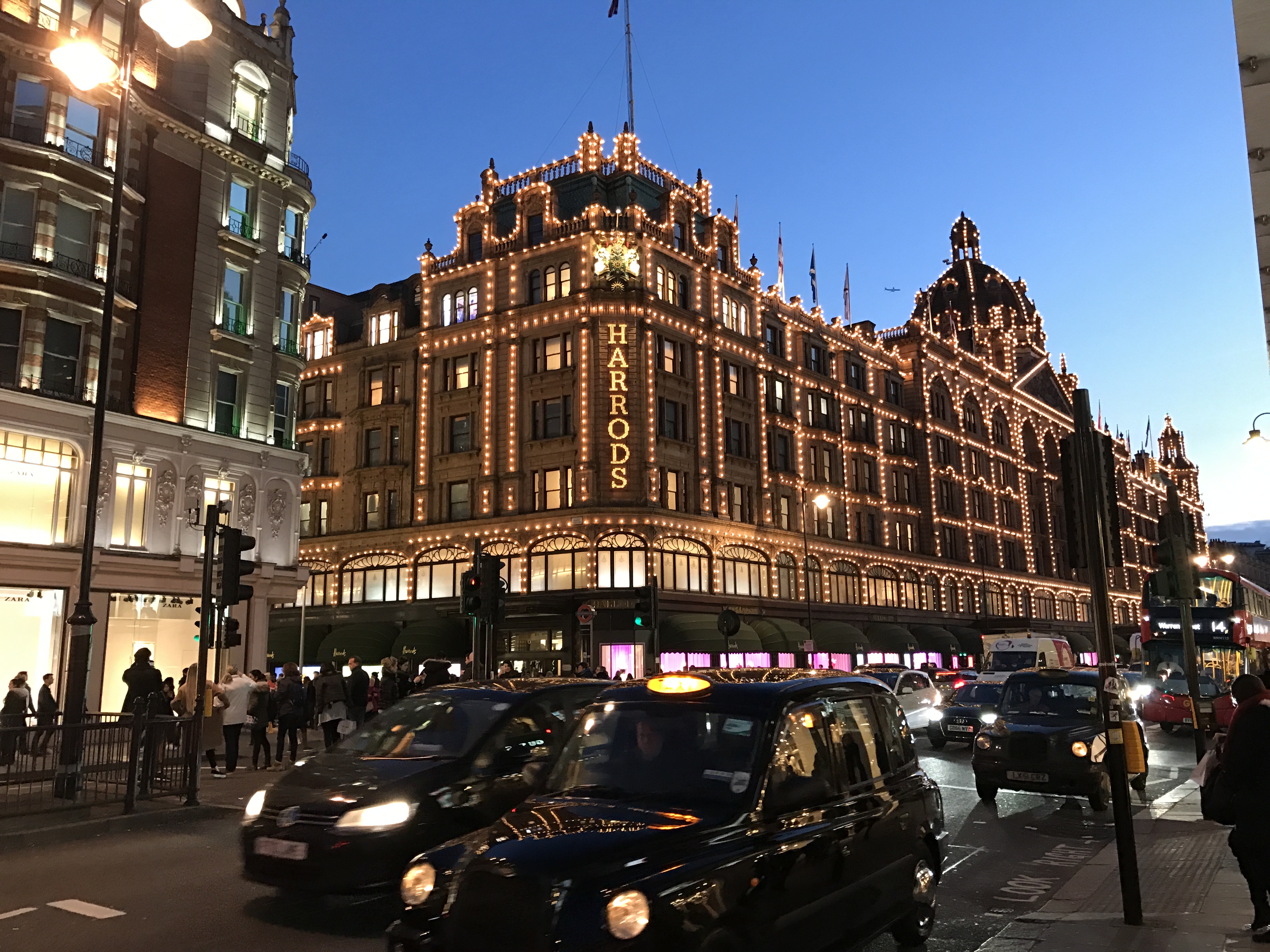
img_2471My wife was sentimental toward Harrod’s in London because of the long history that luxury department store had with the city that was respectable—so she wanted to do some shopping there which was quite an experience.  It was a very luxurious multilevel department store right on the edge of Hyde Park and was the anchor of all activity in that part of the city.

It was what Tiffany & Co. of New York or Sak’s Fifth Avenue were to the United States but Harrod’s had a little extra flair that I thought was quite glorious in its audacious embrace of capitalism in essentially a country that had embarked too long down the spiral of doom with socialism.  Harrod’s was all about luxury and excess declaring proudly that mankind had stepped beyond the limits of a hunting and gathering culture into the full light of an advanced society that produced more than it needed.  Harrod’s was a celebration of that and offered no apologies which surprised me in a good way.img_2451

As usual however I looked under the covers at the real situation.  I had noticed around London each time that I had been there over a two-week period that Muslim immigrants were in many service jobs at all levels of society and that for them it was a reversal of the Crusades period. Instead of the Christian world this time going into the Middle East to conquer the Muslims into conversion and acceptance of a Christian God—now it was the Muslim’s turn to handicap that originating country of the Crusades with social justice legislation through the EU then slowly convert the Christians which have been convinced to give up on the church into Islamic faithful—and they planned to do it peacefully without firing a shot.

This time there would be no attacking fortresses held by kings only to be slaughtered with superior technology.  There would be no Treaty of Versailles or the Sikes Pikot Treaty—this time the missionaries were coming from the Middle East under a banner of peace to integrate with English society then to convert their children into tolerant-open minded pacifists while the target of the next generation would be full acceptance of Sharia Law.  But that’s still about thirty years away by the attack plan well-known throughout the Muslim insurgents—for now they were peaceful and working in London—and they were shopping and working at Harrod’s.img_2459

You could see the power moves made particularly by Qatar Airlines and Turkish Airways in London to establish themselves as the new superior airline of the world marketing themselves as the next best thing.  And subtly, it was obvious at Harrod’s that they were no longer owned by the Charles Henry Harrod family but by Qatar Holdings.  This was particularly obvious when one of the many floors of that shopping complex was dedicating to promoting travel to Abu Dhabi as the next great metropolis city on earth.  And by the plans presented and so far implemented in that city which is as of now about the size of Cincinnati, Ohio by population density—it has all the benefits of a new city completely built on new wealth by the oil industry as  recently as 1971.  The Sharia Law country of Qatar is only 200 miles to the west of Abu Dhabi as Iran is right across the Persian Gulf 100 miles to 40 miles depending on where you measure from—the number one sponsor of terrorism.  Abu Dhabi is being set up as a fountainhead of capitalism thriving off the oil industry and convincing the West to turn its aggressions away out of a love for what they see there and using that wealth to bolster the terrorist countries which surround the region for their aims as a global caliphate.img_2453

Abu Dhabi is like a mistress to the civilized world—she doesn’t have the baggage of knowing her for 30 years and all the mistakes it takes to make a relationship—and showing that on her face as scars, sagging skin and menopausal hot flashes the way that Paris, London and New York are experiencing now.  Abu Dhabi is the fresh 18-year-old who loves the flash of gold and Rolex watches who would gladly trade sex with one gross looking middle-aged man to save herself from sex with many middle-aged men as an official prostitute in an economically deprived communist country such as China, Vietnam, Cambodia or even India.  She is clean and eager to please so long as she has access to the great wealth that the oil industry showers her with and this is what was on display at Harrod’s in London under the new ownership of Qatar Holdings.

Abu Dhabi was planning big things by the full-scale models of the city revealed at Harrod’s and they planned to be a big part of the international economy—which was a cover story for Islamic expansion to the far reaches of the world.  For instance, it’s not New York or Los Angeles who are looking to be the first to implement the new Hyperloop technology, it’s Abu Dhabi and India because that’s where the money is, and the freedom to build such a thing with loose regulation to allow for proper development of an emerging technology.  Within four years of this writing there will be a Hyperloop between Dubai and Abu Dhabi and an economic center of serious influence will challenge all the greatest cities of the world with new money influence.img_2460

While San Francisco, New York, London, Paris and Tokyo struggle under their welfare states built by old economic rules, the new money of Abu Dhabi, Dubai, and Qatar won’t have those burdens and it will force the world literally to eat out their hand.  However, things don’t have to be this way.  Sometimes all a woman needs is love and the new mistress isn’t all it’s cracked up to be.  I think it’s too late for Paris and London, but America is sitting on vast amounts of wealth—particularly oil of its own and could easily rival the wealth of Abu Dhabi  by unleashing it.  Commercial space travel is being developed in the United States as well as great work by the Apple Company—and of course the Hyperloop is American in its origin as well as countless medical breakthroughs which are seeing the light of day under the new Trump administration.  Between those things and a resurgence of old means of economics capped off by an activist EPA—America could produce extraordinary wealth that would stop this global incursion, which was on full display at Harrod’s in London.  And that’s exactly what is causing all the trouble between the Trump administration and the world powers that have set up this whole chess board.

Trump understands what I’ve said here and his election was a decision by the American people not to surrender tomorrow to the insurgents of today.  We could still have all that Abu Dhabi is offering in the United States if we could climb out from under our debts and embrace being the only country in the world that is truly free, and fiscally independent.  Because the 18-year-old mistress that likes gold and Rolex watches gets old too and within a few years will just be another has-been.  The best investment is to keep what you have nice, and fresh by treating her nice all along and loving her even when middle age provides a second wind.  For London to be saved from these mistakes America has to be there as an ally and for that to happen, we need our own versions of Abu Dhabi.

Rich Hoffman

 CLIFFHANGER RESEARCH & DEVELOPMENT

Sign up for Second Call Defense here:  http://www.secondcalldefense.org/?affiliate=20707  Use my name to get added benefits.

cropped-img_0202.jpg

Old Sarum: Speaking to us from a time that earth forgot

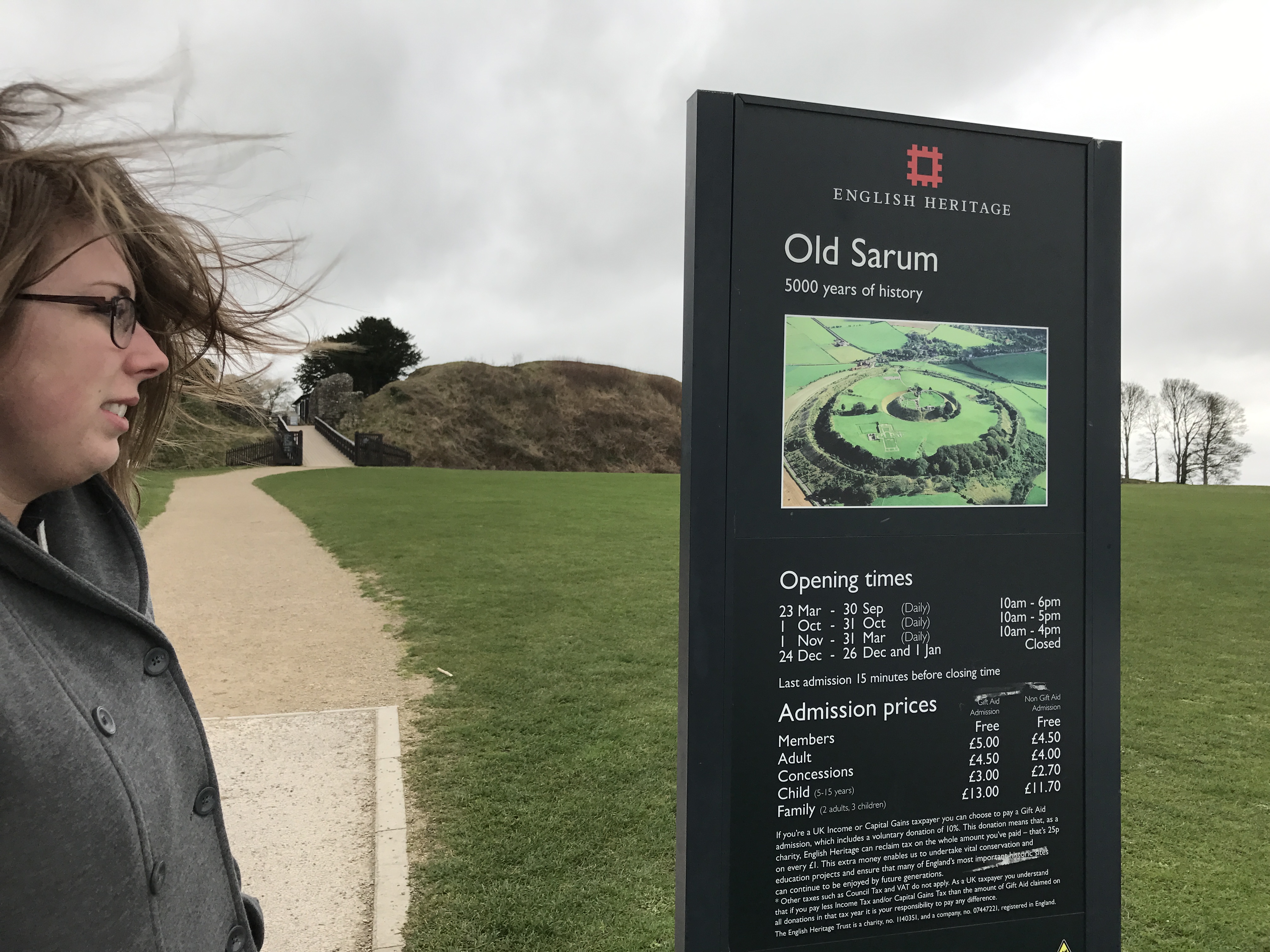
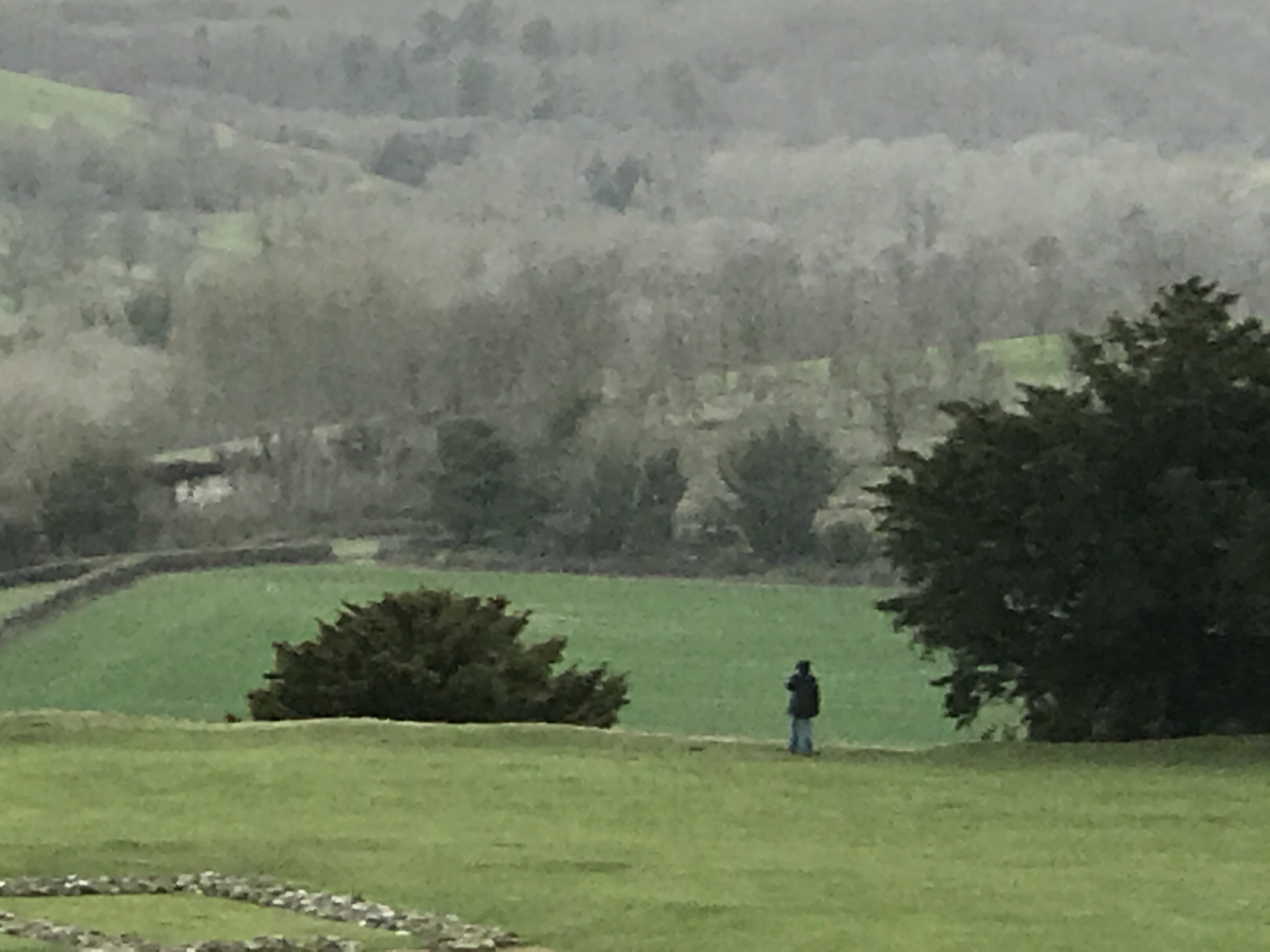
img_4063Like Dover Castle, Old Sarum was fascinating because on top of previously built prehistoric mounds the Romans, the Normans, then several successions of English kings built magnificent castles providing many layers of study. While I was impressed with the amount of earth moved to make the mountain Dover Castle sits upon I was simply awestruck when I saw Old Sarum.  To think that human beings well before any mechanical earth moving machines made these tremendous mounds is literally jaw dropping.  In the case of Old Sarum, there is over 5000 years of history at the site which places it as part of the earthworks culture just 6 miles north at Stonehenge which I have previously written about.  CLICK HERE to review. That made the location a must see for me.  Additionally, just two more miles to the south from Old Sarum is the Salisbury Cathedral which holds one of the four original Magna Cartas under the spire which shoots up over 400 feet into the air declaring itself the highest point along the vast plain.  Of course the American Constitution was based on the Magna Carta so there is a lot going on in this very small region of the world, and I would argue that the preservation of all this history is due to the primary event by William the Conqueror when at Old Sarum he forced the land owners of England to come and commit themselves to his rule which was a dominating act in itself, but one that protected the region around Old Sarum for the next thousand years and preserved all these wonderful historical monuments.  Old Sarum was more than a fortress which would inspire thousands of fantasy films, Arthurian romances and provide the stereotypical backdrop for a medieval castle—it was literally a protector of a snapshot of human history saving the area much the way it would have appeared to William the Conqueror upon arriving for the first time.

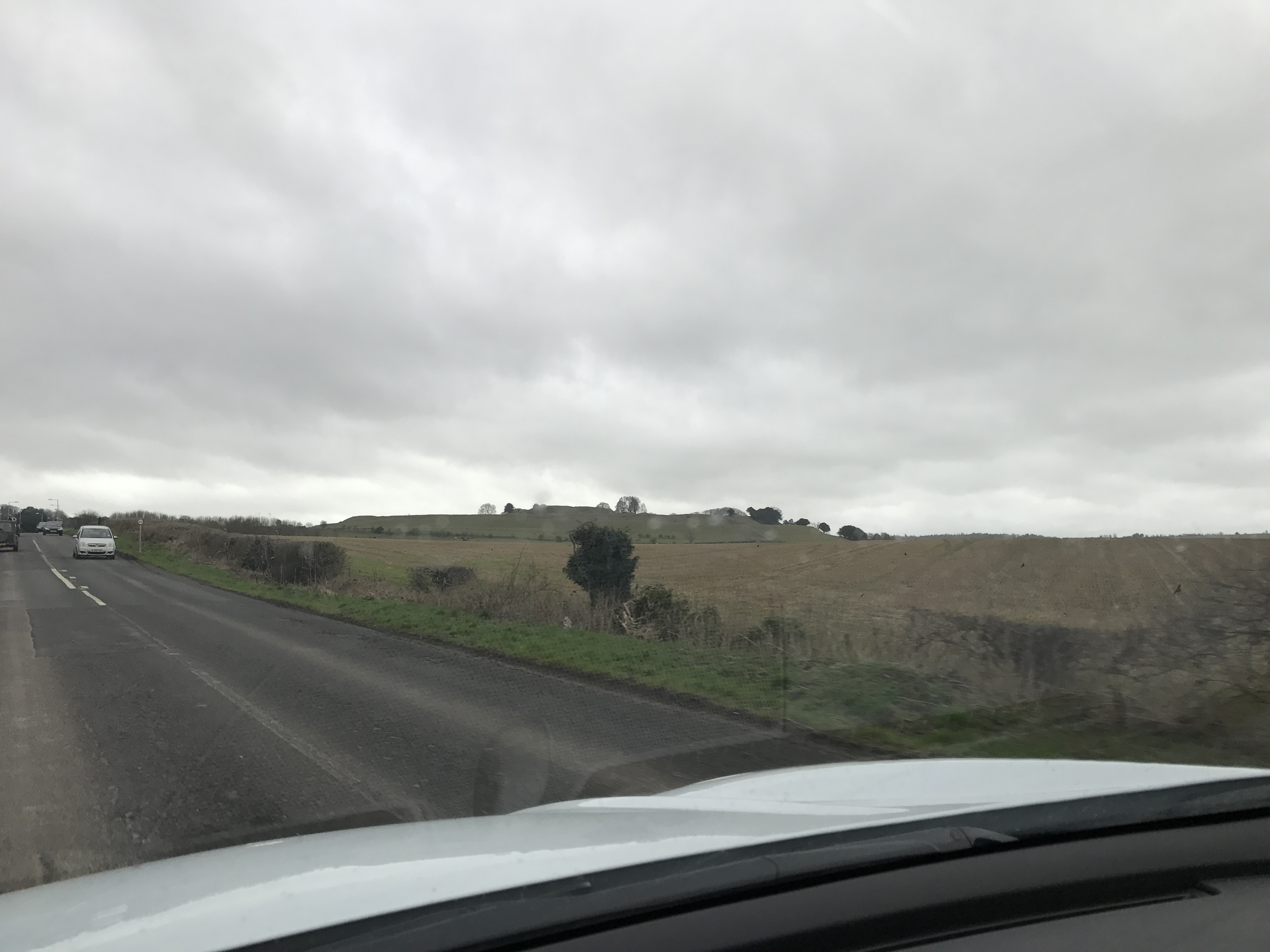
There is no way photographs can capture the sheer scale of Old Sarum. It’s one of those places that only a human eye can rationalize upon being there.  When arriving from the north the fortress completely dominates the skyline and to fathom that it was being worked on at the same time as Stonehenge is something to behold.  I’ve been to the Cahokia mound site outside of St. Louis and this Old Sarum is much larger.  The ditches around the two-layered fortification are deep, and considering the amount of erosion that had occurred over the years, were still extremely steep.  To think human beings carried away all the dirt to make this complex is just inconceivable.  The castle and full cathedral which used to be on top of the earthworks are gone now, but just to think of the massive amount of human effort to build everything is astonishing.  I always felt that what Old Sarum suffered from is that archaeologically, it gets tossed into the medieval study group, so the people who work the digs put an emphasis on that period of time, from around 1070 AD until the time that the new cathedral was moved from Old Sarum down into Salisbury in 1227 AD.  The regional politics of the area were such that from the time that William the Conquer used the site to unite his kingdom and solidify his rule, to housing the Magna Carta in the new facilities, up to the present time, the entire region has been uniquely protected for modern study, which makes it extremely special around the world.

I would argue that it is because of the influence that the Romans had on the area, and the huge political effort excerpted by William the Conqueror then the personal care of Henry II all the way up the line that the 50-mile radius around Old Sarum has been spared from war, looting, and further religious defacements which protected sites like Stonehenge and Avebury to the far north. Farmers did move into the area, but other major cities never rose up around Old Sarum and no foreign attacker ever dared to come close to penetrating the English countryside from that angle of the island continent.  I think the evidence is quite conclusive that these mound building cultures were all over the world—these exact types were certainly in North America—but Russia, China and many other places have their share of these earthen reflections.  img_4108However, their borders have often changed many times over the centuries and hostile immigration often accompanied such movements and the thing to do was to deface the culture that was previously there.  For instance, the ISIS terrorists in the Middle East recently have been plundering the museums around Iraq and Syria and destroying great archaeological sites to preserve their Quran history of the region—so not to have any contradictory influences in their spreading of their religion into new borders—the way such things have been done for thousands of years to a greatly destructive effect.  The Quran text is a very new Muslim religion, written down for the first time in 632 AD so the cultures that built Stonehenge and Old Sarum are much older and would have been susceptible to a competing religion defacement if they had been located in a region of the world that was unstable.   But because of the might of England’s long reins of power extending into the modern world Old Sarum has been spared the spoils of war and its ominous influence protected it until the establishment of an imperial global presence.   This gives us the purest look in the world into our own history.img_4118

China has a number of unique earthworks, but study there is regulated to the communist government which censors everything. They are currently in the business of editing their own history so that their current communist regime won’t be challenged by their more than a billion residents. That kind of censorship has been going on in the United States for a long time as the political desire to show that the Indians were harmed during westward expansion has taken precedence of true archaeological study.  In North America, the mound builders have been associated as groups of Indians—in an effort to designate them as the oppressed people harmed by Christopher Columbus’s journey across the Atlantic and to blame Europe for discovering the New World in 1492 AD.  The problem for modern science is that the plot doesn’t fit the politics—obviously, the cultures that built Old Sarum, Stonehenge, and Avebury were able to bring gigantic 30 ton rocks down from Wales by sea and carry them up the shallow Avon River—but we are to believe that they weren’t sailing across the channel into France, Ireland, Greenland, and North America at a time many thousands of years before Christ was born.  This is because Christianity dominated Medieval thought all the way up through the Renaissance and now all the political boundaries of the world have been established based on those histories and nobody wants to change them now with all this new evidence—because of politics.img_4111

Old Sarum and the archaeology of the entire Salisbury plain say otherwise and reluctantly established science is beginning to change their minds off the assumptions of their grant funding from previous quickly deduced discoveries such as the characteristic that the Druids were the builders of Stonehenge which came from the Anglo-Saxons out of German shortly after the Romans left and the Normans invaded England. The people who worked and lived in the area of Stonehenge and Old Sarum were much older, and more organized than anybody has given them credit for previously—and how they came to know what they do about astronomy is just mind bending—for a supposed “primitive” people.  Those same people were in North America doing work like can be seen at Old Sarum and Stonehenge well before the Chinese began migrating into and settling the New World centuries before Columbus.  In fact, the North American “Indian” it is proving out was just a Hodge podge of global cultures abandoned by the Vico cycle only to begin again as hut dwellers who could barely thatch together a roof—let alone build massive structures that aligned with the stars, the sun and the moon on particular days of the year and had monuments on the ground visible from space to appease gods who were only passed down through oral tradition.img_4069

Old Sarum was to thank for the preservation of a culture that would otherwise be destroyed in other regions of the world and it is due to its massive political influence over a great period of time landing it in the present. Without Old Sarum I would say that Stonehenge never would have survived into modern times—it would have been looted over and over again and likely would have had someone’s church or mosque built upon it to hide what had been there before.  And so long as this is the way of the world, we can’t assume to know anything about our past or who did what when—because politics and religion have essentially erased most sites like Old Sarum from the maps of our understanding.  Even giant mounds like the one at Old Sarum have been built over and destroyed due to human migration that didn’t know the large hill they built their house upon, or a city was an ancient dwelling of any kind.  So it was quite a special to roll through the old English countryside to see the massive behemoth of Old Sarum perched high among the landscape defying convention.  The place was fascinating to me not for the Medieval archaeology it presented, but for the window into the past that it preserved, and for that I am very grateful.  What a fabulous site.  I am very happy to have seen it, in many ways it was more spectacular than Stonehenge, but more importantly, because of it, Stonehenge can still speak to us from a time that earth forgot.img_4112

Rich Hoffman

 CLIFFHANGER RESEARCH & DEVELOPMENT

Sign up for Second Call Defense here:  http://www.secondcalldefense.org/?affiliate=20707  Use my name to get added benefits.
cropped-img_0202.jpg

Paris is a Disaster: Stepping beyond progressivism and the metaphor of Sainte Chapelle

I’ve listened to people rattle on about how wonderful Paris is, the “great city of lights” for years now, and I really thought I was missing something. Not allowing for a lack of being there to shape my opinions I felt I needed to give the place a chance to win me over even though I knew going in that France was a socialist country and that I’d likely be disappointed.  My family is of the type that we can make something good out of anything, so a little video of our trip can be seen below as we hit the major tourist sites, Notre Dame, Sainte Chapelle, the Louvre, the bridge of locks, and the Eiffel Tower and everything in between as we walked the entire length from the Eurostar train station all the way down to the tower.  We didn’t do the tourist thing of riding in a taxi or a bus to get through the “quaint” neighborhoods with all their “great” personality to arrive at our destinations.  We came to know the city through hard work—and boy did we get to see it up close.  We did hire a bicycle cart to take us from the Eiffel Tower back up to Notre Dame because my wife had developed a massive blister on her foot and we wanted to get her back up to the Boulevard de Strasbourg for the heaviest part of the walk so not to risk being late for our train at the Gare du Nord.  Given that little explanation, this is what our trip looked like getting to and leaving Paris.

But let me say this—Paris is a disaster. A city living off its past that has been destroyed by the chaos of kingdoms, religion, and now open border socialism.  What I saw along just the Boulevard de Strasbourg was enough to convince me to shut down the city and start over, because they have a mess.  It was more of a third world country than one of the premier capitals of the world—and their undisciplined immigration and loose lifestyles have eradicated the city of any nobility of character.  The first sign of trouble came just a block from the train station where two men were arguing, one of them looked homeless.  He had a large concrete block over his head threatening to throw it through a window while the other man cussed at him in French with great passion to put it down.  We had to walk between them to get down the sidewalk and apparently, this goes on all the time because the other people with us on the crowded sidewalk were just going about their business.  If that guy were doing something like that in the United States, somebody would have shot him, it’s that simple.  The whole ordeal was just a hot mess representation of what a country with open borders and progressive socialism produces—anger, frustration, extreme poverty and dirty filth everywhere.  But they do have diversity.  There were immigrants from as far away as Sri Lanka to mass gatherings of Muslim Central Africans and associated cultures.  Only an idiot would think that so many people without common beliefs packed on top of each other and prostitutes thrown into the mix was a good idea and evidence of a successful country.  Prior to coming I had only heard about how wonderful the walk down the Boulevard de Strasbourg was.  Well, those people must have been smoking crack, because it was among the worst that I’ve seen in any slum area in the United States—a defeated community failing by the day.  And if it was that bad in the tourist area just think how terrible it would be just a few blocks in on both sides where the tourists don’t go.  My thoughts were to give those people guns, let them fight it out and whoever wins, they would decide the nature of the community because as it is now, pickpockets, prostitutes and con artists are defining the nature of the city and that’s not a good thing.

After about six blocks of this things did improve as we came closer to the river Seine and armed police stood around everywhere with assault weapons ready to gun down any terrorist insurgents. Just two weeks’ prior an Islamic terrorist had assaulted people at the Lourve, which is one of the biggest tourist areas of Paris, so they weren’t taking any chances along the river which is the breadbasket of tourism for Paris.  As long as we were near the river, I could see a glimpse of the Paris that people have been talking about.  But it was like visiting a relative in the hospital whom you know is about to die.  They are there talking to you and you reflect on their life while they are still speaking.  But you can see the specter of death over their shoulders beckoning them to come hither.  Paris was already dead, but the body of tourism just hadn’t yet cooled to show the menace to the drunken westerners looking to fill their illusions of the famous Moulin Rouge and the Hugo epic Les Misérables.   It was a depressing situation far from the kind of optimism I’m used to in America.

As I said, we did get to visit our key sites and I couldn’t help but ponder the layers of mistakes. As beautiful as the old cathedrals like Notre Dame were, everything I could see was just piled up forms of socialism with the churches of the Middle Ages being the first to usher in the kind of collectivism that set Paris up for failure over a thousand years ago, I have read more about this stuff than most people would care to do in a lifetime and I was explaining a bit of it to my kids when were at the Sainte Chapelle because that is a perfect example of what’s wrong with Paris.  In the lower chamber of Sainte Chapelle is a mini cathedral which represents our time on earth.  On both sides of this room are tight spiral staircases which take you up and into the grand room above with large vaulted ceilings and stained glass enclosures 25 feet high.  The spiral staircase represents death—or the birth canal into re-birth into heaven and this was the point of emphasis for the entire Middle Ages for which Paris was founded and the historic foundation visitors relish to this very day.  I was happy to see it but I felt sad for all the suckers over the last thousand years who came to Sainte Chapelle after throwing their piss and shit out their windows into the streets below to worship in this truly magnificent place when the Greek and Romans had lived better 1000 and 2000 years earlier—and to think that what they were doing was cutting edge wonder—is just stupid.  Paris was a city built on the back of the Vico cycle reverting back to the beginning to make the same mistakes all over again which were showing up just a short time later in 2017 where the culture had broken down to this scribbled mess of ancient religions which no longer spoke to the world due to their failure to update themselves to modern science.

Naturally a society so collectively based, and willing to throw away the here and now for the promise of everlasting life shown in the great cathedrals socialism became their new standard and that has led to the present despicable situation. On the way into Gare du Nord by train my wife and I marveled at the beautiful French countryside, but not in the way you might think.  It looked much the way it had for many centuries, and hadn’t changed much.  There were a lot of empty fields and very little industry.  Then suddenly we were in Paris and then the frustrations of poverty were clear with all the defacing graffiti and long looks on the faces of the residents who have been poor all their lives and like the mythology of the Sainte Chapelle have retreated to religion to show them a light at the end of the tunnel. France had chosen poverty for its people and used environmental worship as just the latest religion to control the thoughts of their people into keeping their lives easily confined to the lower room metaphorically of the Sainte Chapelle where the average European has been for over 2000 years.

If France had adopted capitalism that countryside would have shown signs of more factories, nicer homes, and more commercial options like would be found in the United States—like an occasional Crackler Barrel for god’s sake. France and its socialist residents might come to the United States and balk at our unrepentant splendor of capitalism, of our big houses, cars and lifestyles where every few miles across the country are just about anything you could want and eat.  And just like their past in Paris in forcing people into the Catholic religion and the cathedrals there to provide a state sponsored view of the everlasting, they haven’t improved.  Sure they have a separation of church and state now, but not really.  Instead of their religion being a Catholic one inherited from the Roman Empire that conquered them just a few years after the crucifixion of Christ they now have a progressive view of the world where any religion from any place can come and interact freely and without State regulations—which essentially allows every ethnic community to impose their version of Sainte Chapelle on everyone else.  That terrorist who was shot recently at the Louvre threatening tourists with a knife is the same loser who for millennia before was beheading people for not following the rules of the cathedrals and adhering to the state sponsorship of the everlasting.  Now the new religion is environmentalism and it is purposely keeping people poor so that they must look to the “State” for guidance which has created the deplorable situation along the Boulevard de Strasbourg. Sure women are “free” to walk around topless and earn as much money as a man.  The men have been subverted into little shrimps of human flesh walking around in their cosmopolitan “skinny jeans” which obviously have shoved their genitals back up into them squeezing off their masculinity.  And this has left nobody to challenge the failures of their vast socialism and the carcass of Paris which is cooling by the minute as rigor mortis is fast setting in.

Anyone who thinks Paris is a stunning city of “lights” is stuck in the distant past remembering the life that might have been from the vantage point of ignorance. It’s like remembering that abusive parent while they are on their death bed and the one time they bought you a nice snack somewhere, then beat you to a pulp because you used all their money in the act.  Paris has committed suicide many years ago and has slowly been bleeding out all this time leaving us with a fine example of what not to do.  Like all cities of socialism, it was a dirty place filled with crime leaving people desperate to make any money at all begging for it at every opportunity.  Graffiti and crime are only the most obvious signs, but sex workers are the next layer.  When people start selling sex in exchange for opportunity, that’s when you know you have a failing society and need to pass on some of those open green fields and build a few factories.  Paris never had it right, not when they were conquered by the Romans, or settled by the Celts, or spent years at war with Spain and England pawning off their daughters for the promise of peace with a rival kingdom.  Paris has always been a city of suppression even as women celebrate their nudity and their unshaved armpits as Madonna did for Playboy in the eighties to sell America on this garbage—like a big sister trying to get their innocent sibling to smoke cigarettes for the first time.  The socialism of France was sold to us all through rebellion, with sex, violence, and red flagged upheavals—and their net result has been garbage and decay.

I was so glad to get out of Paris that the Coke I had on the way out on the fast train back to England never tasted better. The city lights faded quickly because there was nothing going on in the French countryside past 9 PM, nothing productive.  Nobody was up late working third shift to make bowls for a thriving export, nobody was inventing the newest revelation of science and technology—the French people were just sleeping and paying respect to their latest religion hoping to climb those circular stairs upon their deaths to arrive in the grand room of heaven.  And I was happy to speed right on by for the English Channel.  As we went under the water and came up on the other side, and the time changed I felt relief to have been out of that dreadful place.  England has its problems with socialism too, but at least they are intellectually curious people rooted in the capitalism of language.   It was like that feeling you have after a funeral where the sad stuff is out of the way and you could get back to what you would normally do—you can take off the stuffy suit and put on some shorts and relax with your thoughts. Paris was a disaster and it will take anyone who follows it with it into the oblivion of death—which is the primary driver behind Brexit.  Thank goodness, we are waking up in America because Paris was not an example anybody should follow, and I can say that now with firsthand experience.

Rich Hoffman

 CLIFFHANGER RESEARCH & DEVELOPMENT

Sign up for Second Call Defense here:  http://www.secondcalldefense.org/?affiliate=20707  Use my name to get added benefits.
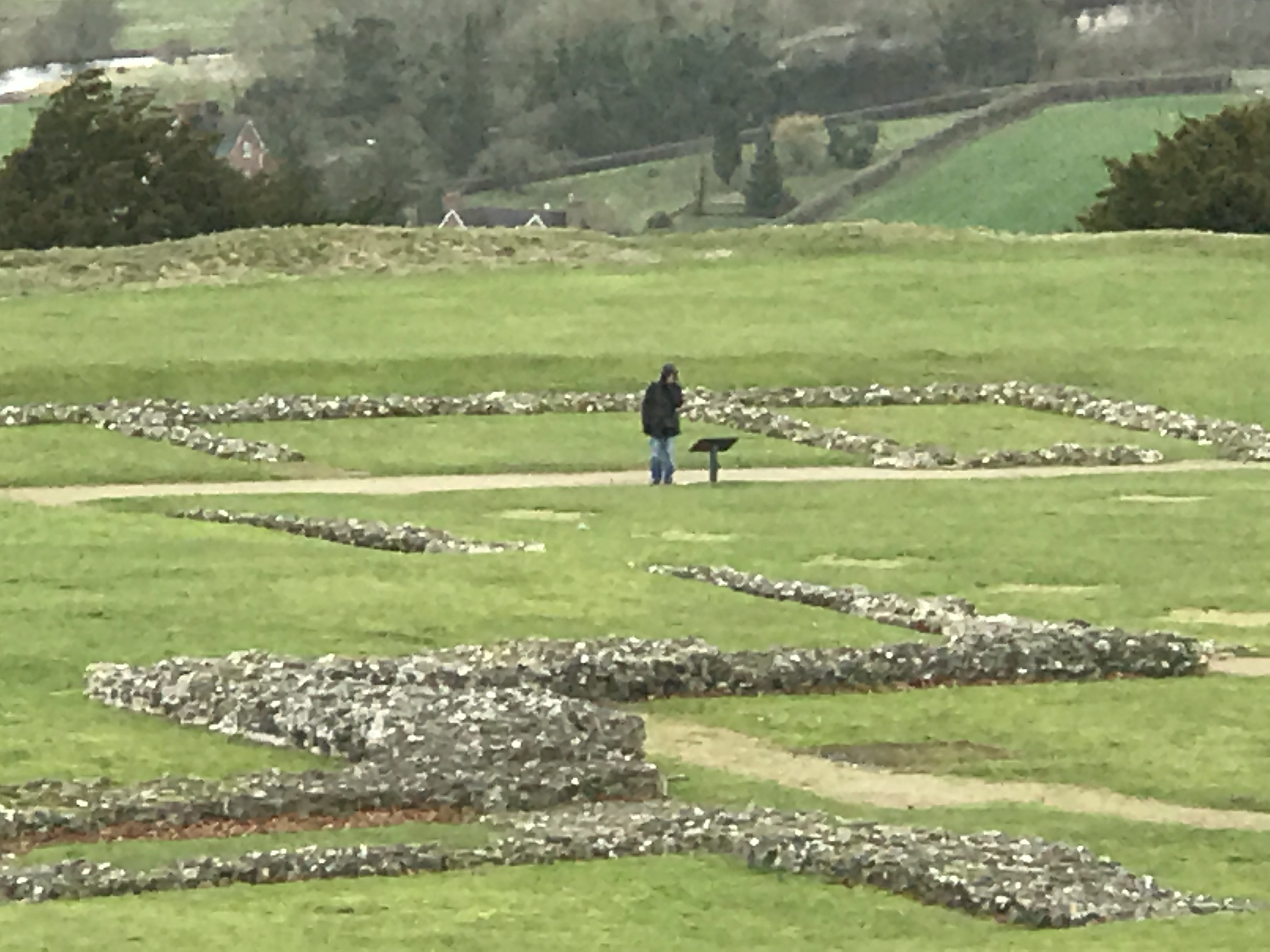
cropped-img_0202.jpg

The Next Generation of Mass Transit: America’s version of Europe’s train system

img_3759


I’ve never had much of a passionate thought about train travel because in the United States—we just don’t do it. We have cars and massive highways, and we love our independence. My main experience with trains is in the novel Atlas Shrugged, the monorail at Disney World, and the train ride at Kings Island, the amusement park near my home in Cincinnati, Ohio.  So during a recent trip to Europe and being without a car, I had to learn quickly how to use trains, because honestly, they are the most efficient way to get around.  European cities are just so densely packed as they frustrate suburban development forcing most of their residents into their metropolises.  So having a car in London, or Paris, just as it is in New York in the U.S. just doesn’t make much sense—because parking is nearly impossible and traveling down the roads is ridiculously slow.  With that in mind, getting around London, Paris or between them into the countryside requires trains which I’ve used heavily lately and to a great effect.  The trains in England are quite nice and I have enjoyed using them covering ground from as far south as Brighton, to Canterbury and using the Eurostar from London to Paris under the English Channel.  It was the combination of those experiences which launched my mind on the new train technology being developed in the United States called the Hyperloop—which is an Elon Musk initiation that is being extensively tested this summer outside of Las Vegas.  In fact it looks like the UAB will be among the first cities of the world to buy into the concept which will make the Eurostar look like an archaic dinosaur regarding train travel.  The Hyperloop will take passengers at near the speed of sound and faster which will significantly change the world.

I love that America is built around individualized transportation, but I personally have a need to get around the country quickly—so these high-speed trains are appealing to me. I would love to take a train to Orlando, Florida from Cincinnati to justify a season pass to Disney World so I could take my grandkids there many times throughout the year.  Flying is just a bit too expensive leaving an alternative form in need to fill the market demand.  Since America doesn’t yet have a complex train system like they do in Europe this leaves the United States prime to develop one of their own using the new hyperloop technology as the centerpiece.

This whole train thing really came to life for me at the St. Pancras station in London which shares space across the street from Kings Cross. My wife and I were eating some sushi from the dining area and I was watching all the people coming and going as we awaited our train into the countryside to visit Canterbury.  It was like a mini airport that was carrying a tremendous amount of people to and from.  I was able to visit many more thereafter at Ashford International and as far south as Gare Du Nord in Paris and I have to say it was an impressive system that allowed me to get around an enormous part of Northern Europe quickly and without insulting my time.  While on the trains I was able to read and rest which I appreciated and I found myself hundreds of miles away within an hour and that was something that would greatly benefit the American economy because of the vast spaces we enjoy in North America.

Trains are best in relieving traffic. I experienced this of course in London and Paris, but over the last year have seen it most effectively used in Kobe, Japan where dinner guests came up from the south quicker than they ever could have by car, simply because dense cities don’t have anywhere to park leaving the roads stagnant messes.  To solve the problem of America’s dying cities, wealth needs to be imported back into them by a means that allows people to utilize what they offer.  For instance, Cincinnati, Atlanta and Detroit should be part of a shared market—people should be able to conduct business between those places easily and within the same day—such as a lunch meeting in Atlanta for an hour or two then jumping back up to Detroit by the end of the business day.

When Ayn Rand wrote, Atlas Shrugged she believed that America would have a series of train systems like the Eurostar all over the country, and that they would be privately owned—which would be optimal.  One of the weaknesses of the publicly owned ones in Europe that has solicited private investment and is doing a better job in turning a profit, but the ghosts of their government owned days is evident–they are not always on time.  And at this point, I would love to have a Eurostar type of system in America.  Since we don’t I would think that the Hyperloop would be the technology that would demand the investment priorities.  In the video included from Twitter I was thinking about how fast we were really going while my wife was buying us some snacks in the dining car.  It was easy to walk around and the drinks didn’t slide around on our tables never threatening to tip over.  The ride was very smooth and comfortable which has been the promise of the Hyperloop.  At the time I took the video the Eurostar was going about 150 MPH, and sometimes it was going faster.  The distance between Paris and London which was the length we were traveling is 459 miles and we did it in just under 2 hours.  It would have taken three times longer by car.  This allowed my family to go to Paris for the day and still be back in London in time for dinner.  Without the Eurostar we would have never been able to do such a thing.  Flying would have been too expense and too complicated and driving would have taken way too long.  And regarding security and passport verifications, everything was done for us before we even got on the train.  Once we were in Paris, we simply got out of the train and headed to our destinations with the immigration issues already don’t at the front of the line—quickly.  Having something similar in America would certainly lead to economic expansion for the cities and would even have an impact on the voting patterns—because currently only liberals live in cities making it impossible for Republicans to get elected.  The best way to change a city’s culture is to allow people of value from other places to come in and have an impact—but you don’t want to trap them otherwise they’ll keep their money and input into the suburbs.

I can see Hyperloop terminals all over the United States much like Europe has train stations. They could be vibrant places that move people across vast distances quickly, and cheaply expanding our economic output.  And it could be a uniquely American thing, just as Europe has established itself on trains.  Trains are too slow for me, but Hyperloop could be the best answer for a nation that hasn’t yet invested in mass transit.  I would love to have something like St. Pancras station in West Chester, Ohio—or Monroe.  There was something exciting about sitting at that station and knowing that I could buy an affordable ticket to Italy and be there in a few hours while eating sushi.  It was strange to send a text to my daughter who was in Canterbury from London and saying to her that we’d be there within an hour.   It’s only 61 miles, but with the tiny roads that they have in England, it would be more than a two-hour drive.  That allowed us to step onto a train and be at her doorstep before she could get ready for dinner and that was an efficient use of time.  Something that America could use and the Hyperloop is just the right technological advance.

Rich Hoffman

 CLIFFHANGER RESEARCH & DEVELOPMENT

Sign up for Second Call Defense here:  http://www.secondcalldefense.org/?affiliate=20707  Use my name to get added benefits.
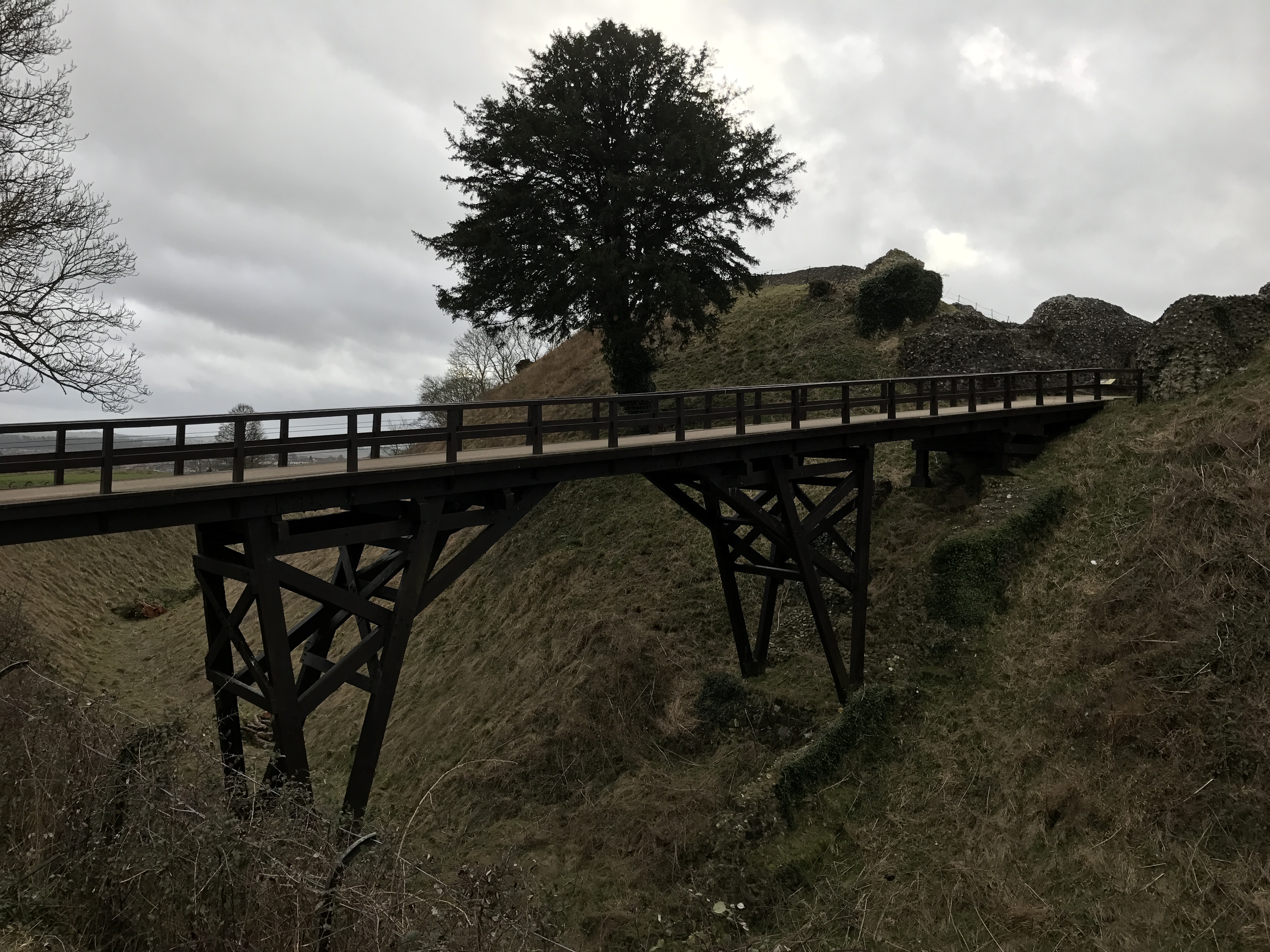
cropped-img_0202.jpg