Nameplate Gods: The Royalty of Politics

Something Doc Thompson said the other day sent me down a dark abyss of contorted anger. He mentioned Roxanne Qualls, who was at a budget meeting he attended.

Roxanne used to be Mayor of Cincinnati, and I have some experience with politicians in that grand city hall. It was in that building that I learned at the early age of 25 the principles of politics.  (Pictures referenced from Wikipedia.  CLICK HERE to learn more.)
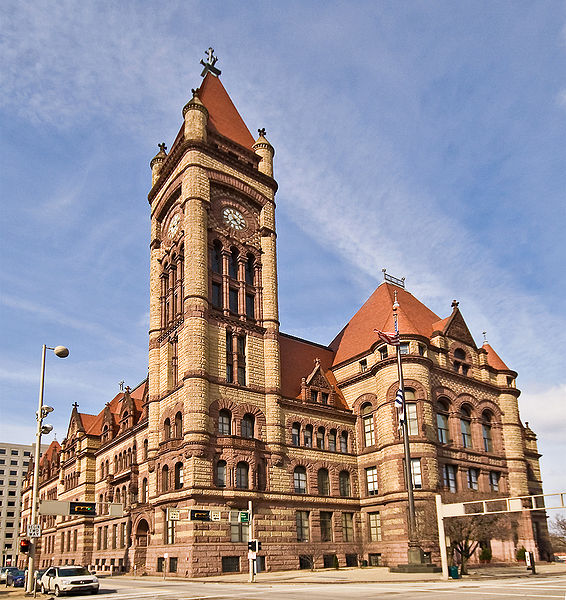
It was refreshing to hear Doc talk about his experiences with a city council member that gave him the cold shoulder at that budget meeting, when in fact that very same day, Doc had that council member on 700 WLW to explain how important his integrity was to him.

Doc’s comments were classic, and refreshing, because it confirmed in me that I am not alone in my experiences with politicians, and that at least one other person in the world had virtually the same opinion of them.

I sat in front of Roxanne Qualls in her large, opulent office while her staff worked outside the door and watched Qualls giggle smugly at my suggestion that she support lower taxes. Her look made me feel as if she were telling me, “you poor naive young man, you don’t understand that we’ve already made all the decisions. We only have the public meetings to facilitate the public into believing they play a part of the process.”

I learned much later that the technique used by virtually every politician is the Delphi Technique, or some variation of it. I received the same look when I explained to Todd Portune in his office how my idea for a non-alcoholic night club would benefit the pleas of desperate moms pleading with Cincinnati City Council to do something about the under aged drinking that was going on at the University of Cincinnati campus, specifically a nightclub called COOTERS.
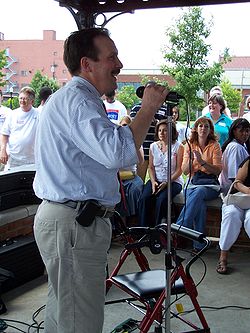
A few weeks after my meeting with Mr. Portune the Corryville Business Association put pressure on the owner of the building I was trying to lease, and I couldn’t figure out for the life of me how they found out what I was up to. I knew they would be upset with my non-alcoholic nightclub idea, because back then, bars had to close at 2 AM. If I operated an establishment without a liquor license that would put a lot of pressure on the surrounding bar establishments that would lose some of their under-aged business to me, because kids under 21 don’t like the hassle of possibly being turned away, or getting caught with a fake ID, and I’d be able to stay open all night.

But my business idea died as quick as it rose. I found out that Mr. Portune at the time, a council member was also the attorney for that nightclub. So it had to be him that tipped off the nightclub to what I was doing.

It was a hard lesson of the nature of politics. It struck me hard with disillusionment and anger at the process that crushed fresh ideas before they ever had a chance to move forward. You find in every council meeting across the nation, every trustee meeting, every school board, every state congress and senate, and each federal congress and senate is that same blank elitism that Doc described.

I think it starts with a love of titles, and people who love them tend to crave positions of power, and the perception of politics is that being elected is a reception of power. It’s a puerile idea which appears to be inherited through the collective learning process gained over the centuries of human development.

The United States Constitution was designed to alleviate the need for much of this political trouble. But, unfortunately the weaker human minds, the ones that crave power, that crave material things, that crave the adoration of the public, they are the ones that run for office, and they are the ones that want to sit behind a desk and decide the fate of many. In their hearts, they truly want royalty and the false respect that comes with it.

As I’ve said, I’ve sat across the table from many of these types of people, and they all have the same glass-eyed blankness that seems more appropriate of a jack-o-lantern two weeks after Halloween.

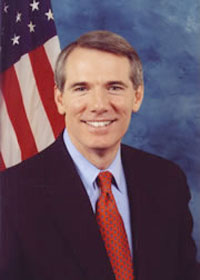
I shouldn’t say all. I’ve met a few here and there that had a light on behind their eyes. Rob Portman is one; I had several long talks with him in the early 90’s back when a thing called the Reform Party was making news in the papers. I also met a few of Ross Perot’s children and they were all bright-eyed and unspoiled. I could see the light on there as well. But those people are the very rare exceptions. Most of the rest are ready to make a deal, for there is no ethical avenue to guide their movements. After a public meeting the voting public just looks to each other for a moment of disbelief as if to wonder what just happened, because the deals had already been made well before anyone showed up for the meeting.
I once attended a meeting the Cincinnati City Council had with the public to figure out what to put on the river. They wanted ideas, this was sometime around 1993. I watched my friend and several other citizens give very impassioned speeches about how to develop the riverfront. The council members would scribble stuff down and nod their heads, and thank the speakers for their input.

After the meeting, the common people would go up and try to speak to the council members, but the council people were only interested in speaking to the developers, or in other words, the people who may contribute future campaign funds. My friend had made by far the best speech of anyone, and not a single council member wanted to shake his hand or would even look him in the eye. They shunned him because his input wasn’t really wanted. The whole process was just a show for the papers, to report to the public that the council people were listening to the people speak. The real deals were going on elsewhere.

I saw the same thing in zoning issues all over Liberty and West Chester Twp, and I’ve recently seen it within the Lakota School district at school board meetings.

Politicians are dangerous because most of what they crave is false, honor through title, respect by name plates, and wealth through side deals. In too many cases, they are hungry attorneys who use political contacts to bring business to their practice. They aren’t interested in being public servants.

That’s why they cower behind their little desks and office doors and cling to the frail appendages of reality they shape through public opinion. Because if you get too close to them, and gaze upon the soul that drives the body, you’ll find the seat vacant. Instead you’ll find the wires and gears responding to a remote control, and the real pilot no place to be found.

So goes the future of our country while the weak seek to govern the strong through the weapon of name plates.

Rich Hoffman
http://twitter.com/#!/overmanwarrior
www.overmanwarrior.com
The Standoff!

I’m going to try something different.  I spend a lot of time thinking about abstract concepts, and piecing together things that don’t always easily appear to connect.  I can give a lot of evidence as to why it’s important to think outside the box, and I can even help some that are close to being able to think that way, cross over that invisible line and begin practicing it.  


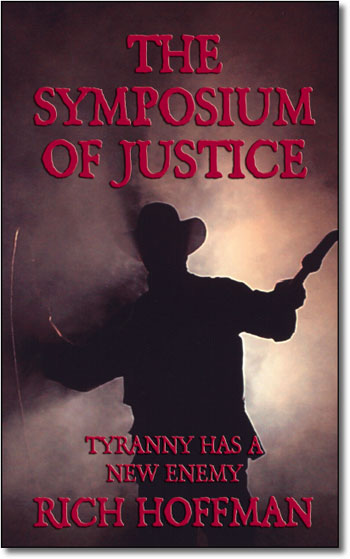
But for the general person busy with their lives, that need information quickly, and in a form they understand, fiction is the best way to lay out an argument.  As an artist, the best way for a writer to convey an argument is with a work of fiction so that the concept can be held up to reality and measured.  The following short piece is from a work connected to my Symposium of Justice novel. And I will begin letting out small bits of that work to support some of the concepts discussed at this site.  


So enjoy this small work titled The Standoff, and think of it in an abstract before trying to apply any meaning.

Fletcher appraised the massive influx of the troops as they surrounded the parameter of his property.  He noted that they stayed off about 100 yards.  They were going to try and take him by force as opposed to an air strike.  That was the best option for him, although it wouldn’t have mattered either way.  The result would be the same. 

He knew they’d try to gas him out, and if that didn’t work they’d shell his home.  He could see the mortar placements set up at the appropriate range.  He could also see the snipers stationed strategically in the distance.  Many of them were well over 100 yards, and he thought he could see most of them.  He suspected that there were others hidden on the rooftops, and in trees that eluded him, but that wasn’t important.  Knowing the details of their where-a-bouts where not important to his strategy, in fact, that was their intent, to overwhelm him.  He would do fine as long as he didn’t allow himself to get lost in the details. 

He had heard that the devil was in the details by more than one person in his life.  But the devil seeks to corrupt the mind with those same details by pulling the mind into his domain where he can corrupt and inflict doubt.  Very few human beings in their entire lifetimes found a way to master the art of details. 

Misty walked up next to him and gently placed her hand on his shoulder.  “There’s too many this time.”

“This is no different than before.”  Fletcher was aware that he sounded harsh, but he was mentally prepared for war.  “Whether it’s ten or ten thousand, their failure is in their trust that numbers will be to their advantage.”

“What will you do?”

“I want you to take the kids and go to the grocery.”

“The grocery?”

“Yes, don’t react to this as if anything is any different from any other day.  You take the kids and go to the store.  Bring back some food for later.  That will keep you safe and off my mind.”

“They’ll never let us leave.”

“Yes they will, they can’t afford to have women and children slaughtered in this media event they are holding.  They’ll be glad to see you go.  They have not formally charged you with any crimes and you can move about unimpeded.  To restrain you now will only irritate me further and they won’t risk that.  They seek a peaceful end before the day is out.  That is why they’ve already lost.  Because I seek war, and blood and I will spill it at their expense.”

“But what will you do?”

“I will lure them away from the castle.  They think I built it to hold off an onslaught.  Their strategy is to get me to emerge from it by lack of choice.  I will do so quickly at the beginning of the fight.  I will go into their lines where their mortars, snipers and heavy weapons will destroy their own people.  I will not stay here on ground they dictate.”

“Can you get out there that fast?  That will be a lot of ground to cover.  They’ll have lots of open chances to take a shot at you.”  Misty was not a military woman, but in her marriage to Finnegan she had learned his ways.  She had seen enough to make the kinds of observations that would make a general proud.  She had seen Fletcher do amazing things and was accustom to his late night workouts.  She knew his mind believed he could manipulate physical law with sheer confidence, and had seen it work on much smaller numbers.  He had survived incredibly the standoff at the river last year at Ben Carter’s residence against a small attachment of elite troops and the police force of Fort Seven Mile.  That day Fletcher had returned to her covered in scratches and holes penetrated his clothing where bullets had narrowly missed him hundreds of times.  She had called him lucky where he refuted her with similar characters in history.  George Washington had dodged similar odds when he acted heroically at Fort Duquesne having his body riddled with bullet holes that had never found their mark.  Stonewall Jackson had showed the same kind of valor needed in the battle of Bull Run to defy all odds.  And General Patton also survived numerous brushes with death, and Fletcher often cited how both Jackson and Patton had suffered silly accidents that either caused amputations, or were paralyzed prior to their deaths.  It was a fascinating fact that some of the great minds of military like Patton believed that he was directly reincarnated from Hannibal. 

Fletcher believed that in the heat of battle great men rose to great achievement because their minds were focused on the task and their beliefs manipulated all the events on the battlefield.   Where some would believe that some sort of force such as karma was responsible for balancing out the lives of these same men be subjecting them to freakish accidents, Fletcher believed those men despised times of peace so intensely that their strong minds actually attracted the negative events that sealed their fates. 

It was not unusual for him to stay up late into the night reading volumes of books and would tell her of his night time adventures when she awoke for breakfast.  Alexander the Great, Frederick Nietzche, Socrates, Galileo, and many others found illness, and social castration part of their later lives leaving only history to vindicate their work into a respectable status.  Nietzche was a favorite of Fletcher and she was shocked to learn that copies of the fourth installment of Thus Spoke Zarathustra, arguably Fletcher’s favorite book, only saw a printing of 40 initial copies. 

Fletchers other favorite book was The Book of Five Rings by the undefeated samurai Miyamoto Musashi and she knew that Fletcher’s standoff here was modeled from his study of that book.  It was Musashi that had been independent of any social clans in Japan, and offered himself as a samurai for hire.  That left him a target to every political entity and forced him to survive many battles where he was severely outnumbered. 

Fletcher had already achieved much of what Musashi had.  His standoff at the river should have been enough.  There would be stories told for years about his exploits and if he were not considered an outlaw, society would make him the hero of the nation.  Quietly, the political powers that made up “The System,” had shown an interest in making peace with Fletcher.  Once his identity was revealed, and it was known that he had wealth, they sent representatives to make peace, but Fletcher could not be bought.  He sent them away with the same audacity that he had these last two visitors. 

Was it madness that looked out across the yard and showed no fear at 5000 troops with the taste of blood in their throats for his death?  She wasn’t sure.  What she did know was that if she stopped him he would be perpetually unhappy.  Even though social duty may dictate that she talk her husband out of this, he would never-the-less be arrested and thrown in jail for many years at this point so there really wasn’t any turning back.  After all, nobody in history had survived a standoff of this magnitude.  Nobody but Buddha had ever done such a thing. 

Fletcher Finnegan did not attribute himself with the Buddha, but there wasn’t any other image that came to her mind as she studied her husband gazing calmly out the window.  Mara, the evil one had tried to prevent the enlightenment of the Buddha with temptations, one of the most dramatic of which was a massive army that promised the Buddha annihilation if he did not remove himself from his immovable spot.  She was never completely clear why Mara called off his army and left the Buddha to his enlightenment.  She could see for herself that Fletcher’s calm resistance to this army would not bring peace.  He would have to go and fight and all logic would guarantee his destruction. 

At any other time in history, if this would have been Christ, he would have been captured uneventfully and killed brutally.  In fact, in all of history she couldn’t think of any time that surrender was not considered the noblest thing to do, and that didn’t make any sense to her.  Even with the world seemingly at her doorstep wanting to kill her husband and destroy everything that was her family, she couldn’t think of another time where another human being would be poised to make such a stand.       

It is said that Mara, the evil one, tried to prevent this great occurrence.  He first tried to frighten Siddhartha with storms and armies of demons.  Siddhartha remained completely calm.  Then he sent his three beautiful daughters to tempt him, again to no avail.  Finally, he tried to ensnare Siddhartha in his own ego by appealing to his pride.  That, too, failed.  Siddhartha, having conquered all temptations, touched the ground with one hand and asked the earth to be his witness.

“I will give them nothing to shoot at.”  Fletcher was aware of her thoughts, but did not remove his war readiness.  He knew she understood.  “You have to understand, they want only for this event to be over.  The shooters out there rely on the next man to take the shot, and nobody is solely responsible, which is why they will fail.  They have spent their time from arrival to now with fat thoughts like their leader.  They trust that mass alone will do the job even though they have been instructed by their superiors to take this situation with utmost seriousness.  The men behind those guns will be looking for where they think I’ll be.  At the distance they are placed they will be severely restricted in movement.  To get a clear shot at me, they will need me to be as still and predictable as possible.”

She looked at what he looked at, and noticed that most of the infantry was in the front.  “Are you going to use the tunnel?”

“When we built the place, I suspected something like this would happen eventually.  It comes out right in the middle of their mass.  It will take away their guns and put them at close range for hand to hand combat.  Many will seek to back away from the fight when it starts but will trample their own in an attempt to make their guns useful.  I will use their confusion as my troops.”

“But you said they would probably resort to the B2 bomber.”

“They may try that, and if that’s the case, you and the kids need to be far away from here, at least forty miles.”  He turned to her.  “Do you understand?” 

“And this town will be annihilated.  All the work you’ve done to bring justice to this community would be for nothing.  Thousands of people will be killed, and for what?  If you surrender you could save them all.”  She said that knowing what his reaction would be, but she felt she needed to say something. 

“Save them in what way?  They are all on strings they can’t see, living lives that aren’t their own.  It is not me that brings death to them.”

“But your actions brought them.”

“The responsibility to annihilate this community with nuclear destruction will be up to executives.  We’ll see what happens.”

“If you last that long.”

Fletcher doesn’t offer a response.  Her point is clear and he isn’t in a position to make promises.  Fate is much of what you make of it, and he was making his moment by moment.  He was in uncharted water here. 

“There is no way to camouflage any of this but as an act of terrorism.  You will be labeled an enemy of the United States.”

“You know I love this country.  Most of its history was formed on war, and this is no different.  You know that.”

Misty paused a long time.  Troop movements had settled down and everyone was in place.  “I know you do.”

“Only in the context of history will anyone understand.  Long after the dead from today are buried and their relatives evaporate into earth.  When the sensibilities of orthodox behavior align society into rational thought, much more will be understood.”

Rich Hoffman

http://twitter.com/#!/overmanwarrior

www.overmanwarrior.com
Bullwhip Economics: Pubic versus Private Sector (The Lakota School System)

It has been an interesting debate over this last month regarding the Lakota School Levy, and what has emerged is a philosophic difference. There is a portion of the population that is either working for the public sector in some form or another, or there are people who don’t. Among those that don’t there are some that wish they did, because the benefits are so good.

For a guy like me though I would never want a public sector job. The idea of being paid by the tax payer is an abomination that cuts to my core beliefs of self-reliance.

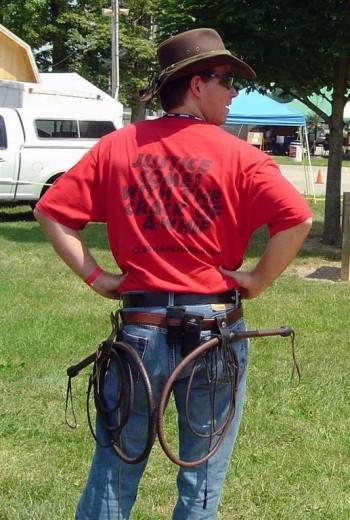
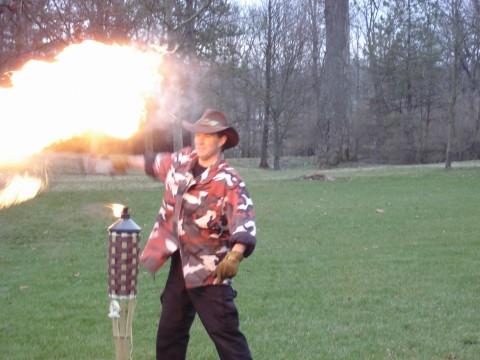
When my Whip Trick to Save America did so well at the start of the No Levy Campaign, I received a lot of requests to make another video using my bullwhips to explain some of the complicated budget issues that center around public versus private sector jobs.

Most of the video my wife and lovely assistant holds targets in her mouth while I cut them out explaining how it relates to the economics of public versus private sector jobs.

At the end of the video I do more whip work in slow motion while Scott Sloan of WLW Radio reads the Lakota Teachers Contract to a member of the Pro Levy Group. The discussion is valuable because it helps put the mindset of public sector sympathizers into the proper framework.

They are a fascinating species these public sector oriented employees. The bottom line is it’s easy to spend money that isn’t yours. Public officials have been over spending for a long time, which has made public jobs too lucrative, actually putting our country on the verge of bankruptcy. So now we have to fix it. And fixing it starts with local issues like school levies, and city government. I hope this video inspires everyone to pay attention to the small stuff, and to vote on November 2nd, 2010.

Rich Hoffman

www.NoLakotaLevy.com

How to fix a Neurotic Person

It is my observation that much of the legislation and panic that runs rampant in our society is the result of neurotic people. The fix is easy according to the makers of Family Guy.

Rich Hoffman

www.overmanwarrior.com

The Impact of Free Will

The Impact of Free Will

A topic that always comes up regarding what role the individual plays in a social context against the responsibility of government is the idea of what free will is by definition. There is always a lot of debate on what government should do for the people, which we will hear a lot about during this coming political season. But none of them seem to grasp all aspects of the argument. And to do that, one has to go down the Rabbit Hole a bit. Politicians in general are unequipped to contemplate anything much beyond the law because they are generally, classically trained, and unable to see much beyond the field of their specializations. And the public often looks to politicians incorrectly as their leaders. So the true natures of things don’t often get discussed.

So let’s discuss free will.

What if we take the explanation from the film, What the Bleep, Down the Rabbit Hole where they explore the quantum nature of a particle and compare that to the larger concept of the nature of choice, or otherwise, free will? In What the Bleep, a very good and informative film, they used a basketball player to describe the multiple tangents of the shooter tossing the ball in the basket. In that situation, all variations of the actions of the player exist simultaneously most of them involving the ball missing the basket, however only one or two of all those simultaneous possibilities involve the ball going into the basket.

I am using a basket ball here because that was the example used in the film. I tend to think about these types of issues while practicing bull whips, which bring about the same types of conclusions. Anyone that aims at a target will experience these types of ideas.

So given that thought, it is determined that all those potentialities will occur. But it is free will that chooses the one that involves the ball going through the basket. Now to grasp that thought, one has to accept that there are simultaneous realities occurring at any given moment for every object in existence and the way those objects interact with other objects is mathematically infinite for the sake of discussion. Such concepts are part of quantum theory, and just because it is difficult to accept such a thing, it is foolish to discard the theory. It’s like saying radio waves don’t exist because we can’t see them. In fact they always existed, all through time, and we were unable to detect them until we invented the radio.

So back to our issue of tossing a basketball into a basket, the entity making the choice is the one shooting the ball into the basket.

This brings up the idea of what an enlightened society is. Is it a society that does not have war, but yet has a social hierarchy where everyone understands their peeking order? Is it a society where nobody acts out of self interest or aggression? Or is a society where everyone climbs into bed together without care of gender or social pact, such as in marriage, where thoughts of property are the center piece of such a covenant and abandoned in favor of community property. Or is it to mimic nature, where the strong survive and lift up the weak by example and peer pressure? Where an occasional forest fire destroys all but the most robust plant life and the killing of a thing is done by the one that eats it, and not shared as a social burden? Many politicians pick one of the above as their platform, and all of them lack a true understanding of the total situation.

I would argue that all forms of social engineering are subject to corruption, because governments don’t understand all the mechanisms at work. They function from a vantage point where each individual soul thinks itself to be a bodhisattva on their own kingdom lotus petal. And no enlightened society will ever occur with laws, but with the proper understanding of one’s own ego in relation to the universe. And we have a long way to go on that path. Each individual is the ruler of their own existence. It is each and every person that moment by moment must chose the correct choice among the countless possibilities in the shared timeline of collective existence.

I personally think the world the way human beings truly want it now most exists in Key West, Florida. There, under the protection of the United States, that tiny island has no dictators, or power hungry politicians. Mallory Square nightly and without organization of any kind has performers breathing fire and escaping from coffins of nails like Houdini, but the heart of much of the island gathering there is to watch the sun set. There are many different ideologies co-existing in Key West within a fairly confined space.

Now some of that bothers me, in that much of the interest in such a place is to be free of inhibitions. But, it does provide a good window into the kind of world humans would make for themselves if left alone, without politics. There is virtually no crime in Key West, and people for the most part leave other people to live the way they want. It says to me, that it is politics and the politician needing bloc voting, and for people to always be in conflict that causes most of the trouble in a society.

A drive down US 1 will show this tendency very well. I had the fortune to make the trip to Key West by motorcycle last year with my wife, and I can say from the back of that steel horse, I could see the subtle change island by island as politics from Miami, and the United States in general gradually fell away more and more the closer we got to Key West.

I would say that is one of the best examples in the world of such a society, because there aren’t many places that have a nice road that takes you 160 miles into the middle of the ocean away from the mainland of a country. And the people there have decided for themselves how they want to live.

So I would argue that as a bench mark, Key West is the reference of what humans want from a Republic. And it is one of the best examples on planet earth of what free will in a collective society will chose as each person navigates their own decisions along with every object they come in contact with. Everyone must choose wisely for themselves in order for all life to flourish.
There isn’t a single politician alive that is capable of shooting the ball for you. They can’t even see the ball. Just a metaphor, but hopefully, you get the point.

Rich Hoffman

www.overmanwarrior.com