I read all the reviews for the Atlas Shrugged Part 1 film as they began to pour in on April 14, 2011. The reviews were predictably not kind for all the same reasons that Frank Oz was overlooked in 1981 for an Academy Award in his portrayal of Yoda in The Empire Strikes Back. The reason back then was that the Screen Actors Guild did not regard puppeteers as actors. The Directors Guild also clamped down on George Lucas for putting all the credits at the end of the movie instead of the beginning which prompted Lucas to quit the guild and make Return of the Jedi using Richard Marquand, who at the time was not a member of the guild. Marquand at the time had only a few credits to his name, The Legacy and the TV movie Birth of the Beatles.
I am reminded of that little piece of history because so many critics seem hungry to criticize Atlas director Paul Johansson for his lack of experience directing only One Tree Hill episodes. The criticism that the film received a flat screen treatment meaning it seemed to resemble a high production value television show is sophomoric and is uttered strictly from the mouths of the unions, and have no merit. What are they comparing Atlas to as far as a film of value, something like Jackass 3-D? Atlas Shrugged is an ambitious film that takes on a lot of ground. I personally think they went too fast in the development of the story. They could have gotten away with another 50 minutes of film time, something the producers may want to release as a director cut when the film comes out on DVD. There were exposition shots of the government action in the macrocosm that needed to be there to develop why building the train line was such a big deal, and people who have not read the book might find it difficult to follow the story without repeated viewings. Because the cut of the film is trying to fit into under 2 hours at 1 hour and 40 minutes Atlas focused on the microcosm of the characters Dagney and Rearden. I understood it because I know the book so well, and people who do know the book will be happy to see that the filmmakers went to a lot of trouble to stay true to the nature of the book.
I see the film version of Atlas Shrugged as an experiment rather than a literal film meant to be taken on its own. It’s a work of philosophy put into visual form, and it requires a level of sophistication to begin with. Film is supposed to be like that. I can think of Koyannisquatsi, the great film by Godfrey Reggio that featured just a series of sped up images taken from all over the world to articulate the evolution of man in the current age into a society oddly similar to a microchip. Powaqqatsi a few years later did much the same to the soundtrack of Philip Glass.
I thought of those films while watching Atlas Shrugged. The filmmakers of Atlas were capturing the images of the book without attempting to duplicate Ayn’s work. The most notable and effective elements of this filmmaking style was John Galt in the opening scene only referred to in exposition by Rand where Galt stops Midas Mulligan on a rainy street and convinces him to leave the “outside” world. The other was the scene involving Hugh Akston. I thought the part of the film involving the static electric motor and Akston’s knowledge of it was hurried through due to the films running time, but when Askton hit the screen there was instant uttering’s of approval from the people in the theater watching the movie with me. All Akston had to do was appear on screen and the members of the audience were satisfied with the visual rendition of his character. In this way, the film version is interesting and fun because it serves as a visual companion to the book instead of a replacement, which I think many traditional thinking people might not understand.
Atlas Shrugged is an independent film. I’ve seen a lot of them, been to more than a couple of film festivals and seen a lot of bold attempts by young, and old filmmakers. Independent film has emerged as a powerful force because Hollywood does get stuck in its business model, which has been controlled by the political left, and has virtually ignored the portions of the market that go to Tea Party rallies and read books like Atlas Shrugged. To Hollywood, films like Hangover, and the next Scream film is the safe bets that fit into their understanding of things. Atlas Shrugged is about a foreign world to many on the political left, and they are not used to seeing views that are conservative in nature competing with their ideas and they don’t like it.
Atlas Shrugged because of the amount of characters and scale of the story will not work as a traditional film, with a lead like Angelina Jolie as Dagney and Brad Pitt as Rearden with a top-level director making over one million for his work along with all the supporting characters of John Galt, Francisco, James Taggert, and the other 50 or 60 characters that would all require SAG minimums depending on the scale driven off Jolie’s 20 million minimum and Pitt’s 20+ million per picture. Before anybody shot one frame of film there would be over 80 million in just wages alone committed to the film, which is why the movie had not been done up to this point. And a movie like Atlas Shrugged will never pull a ROI at the box office if the budget exceeds 100 million. This is a film for thinking people, so the scope of the film must match the intention, and that is to bring an epic story to thinking people and keep the budget to where the filmmakers can actually produce parts 2 and 3 without the contingency of waiting for DVD sales to refill the budget coffers.
My wife and I sat till the last credit scrolled across the screen at approximately 12:45 in the morning. I had to catch the late show because I attended the Tax Day Rally in Glendale where Doc Thompson was the MC. We left that event to catch the 8:20 showing at Newport on the Levee. I arrived about 7:45 to find the film sold out! Crowds of people swarmed around the ticket windows trying to get a ticket to Atlas Shrugged. So we bought a ticket to the 10:45 showing and killed our time at a nearby Irish Pub and enjoyed the storm that swept across the Ohio River while we waited. Our late show was about half full, which surprised me. What also surprised me was that many of the viewers were by themselves. I can’t recall seeing a movie that had a majority of the audience showing up by themselves. Now, the left normally would criticize those types of people as loners, and belittle them. But wishing them not to exist will not make them go away. These loners are the people who reject TV shows like How I Met Your Mother, or Two and a Half Men. These are also the types that reject reality TV shows, so their only entertainment is books, and the History Channel, because Hollywood isn’t making their kind of movies anymore. Atlas Shrugged is their kind of movie and many of them clapped at the end and stayed for most of the credits.
I sat with my arms crossed taking in what I had just seen and watching the reaction and found that the John Galt theme was racing through my head, which is a good sign. That means it was an effective soundtrack. I realized that Atlas Shrugged was the kind of movie that moves so fast and covers so much ground in such a short time that it requires repeated viewings. One viewing will not do it.
It was well acted. I thought Dagney was a believable person. In fact, the characters weren’t so beautiful that they were beyond the realm of reality which I think helps the film a lot. Again, with A list actors, that would have been a problem. Our society has become used to seeing extraordinarily beautiful people in leading roles, and that takes the situations out of our contemporary realities. When we leave the theater people don’t look like what we see in the films. So films take on a mystic of escapism. Atlas Shrugged is not out to do that. It seeks to place itself into the mind of the viewer’s experience, which is another reason for the cast to appear as it was. I thought the casting of Francisco D’Anconia played by Jsu Garcia was very good. Also of Paul Larkin by Patrick Fischler, that actor captured perfectly the treason of the good friend that was supposed to be of Mr. Larkin. Grant Bowler who played Rearden was excellent. This film is an obvious set-up for the part two which goes down the psychological rabbit hole, and I can’t wait to see Bowler stand in front of the federal court and tell them he does not acknowledge their authority or right to exist. Bowler will be able to pull it off.
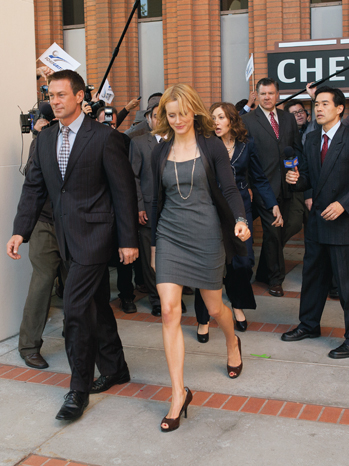
Now the criticism that I’ve read is one from people who don’t understand what the big deal is. “Why is she so upset?” “What’s going on?” “So what, the guy left and burnt down his oil field. All conservatives are a bunch of greedy, oil loving bastards, serves them right!” Besides the fact that fuel costs were excessively high and Ellis was one of the only hopes in the United States for bringing the costs back down, why don’t people make the connection between oil and their own prosperity? Reardon asked the question in Atlas Shrugged, “What’s wrong with people?” Paul answered, “Why ask questions that have no answer?” He’s right, because the reason for those statements is because there are an alarming number of people in our society that no longer feel the pressure of a promise, because to care about a promise to a friend, wife or business partner, you have to care, and sadly, many people no longer care about things like a promise. So the lack of understanding directed at the confusion of Dagney’s motives in the film is more of a commentary on modern life, which is what Dagney is screaming at. She is afraid of becoming what we actually are. I would pay to see Atlas Shrugged 20 more times just to see that last scene. I thought it was vividly powerful. I loved how the camera pulled back to reveal the sign that Ellis left as his oil fields burned while she stood helpless to stop it. The reason for her “robotic” behavior is because she is determined to succeed no matter what the cost. My wife nailed Dagney’s performance by saying, “she reminds me of the terminator from Terminator 3.” And she’s right, Dagney will not be stopped. If she wants something, she will achieve it. And the scream represents that with all her ambition, with all her good will, all her energy, cleverness, and innovation, she could not stop Ellis from giving up. She saw the look in his eyes when Ellis was in her office chastising her for her brother’s incompetence and she thought if she did everything right, that she could keep Ellis from leaving wherever all the “men of the mind” were going.
I also read criticism of how the exposition was displayed with news broadcasts and this was somehow bad. I don’t agree. I think it was wonderfully done in this film. It reminded me of how the director Paul Verhoeven used newscasts from the film Robocop to propel the complicated aspects of the story along. Hollywood and critics in general have gotten used to the type of films produced in the 90’s and 2000’s that pamper to their every wish. This is something that Roger Ebert and Gene Siskal started. Those two reviewers created an industry of film critics and gave them much more power than they deserve. Movie reviewers have become breakers or makers of box office results, and that’s not necessarily healthy. Because the views of the reviewers become the editors of public opinion, and if those reviewers are progressive types, then studios will cater to those reviewers to get the “thumbs up.” I actually respect Roger Ebert quite a bit. He’s usually right on. But when he runs into something above his intellectual capacity, he gets stumped. You can see how Siskal and Ebert used to bounce off each other in this review of White Hunter Back Heart, which is one of my personal favorites films.
Ebert was fair from his perspective in his review. He knows Atlas Shrugged is loved by millions so he was careful in his comments. I think his mistake is he should have reviewed the film more the way he’d review an independent film like Koyannisquatsi. He like many people who go to see this film will mistakenly watch this film as a literal film, not as an atmosphere of images reflecting a philosophy. That’s the reason for the cityscape shots and the views of the mountains. Once all the films are completed, it will make sense. This first film is just an introduction. It’s also an experiment in filmmaking that I think is very healthy. It’s bold and deserves credit for that boldness alone. The merit of Atlas Shrugged will be felt down the road. It is the first step of bringing a new kind of entertainment to popular culture so it will suffer from opinion in the short run, but will stand the test of time over the long haul.
For the rest of us, those that don’t have to struggle to understand it, we can enjoy the treat of seeing on film the images we’ve painted in our minds while reading the book. Some of my favorite scenes were the opening with John Galt in the diner with the pouring rain outside, different from in the book, because Galt made an instant appearance in this film. I also liked that he was in Akston’s diner at the end. The appearance of Galt in the diners reminded me of the many day’s I’ve spent in such places at 3:30 and 4:30 am in the morning reading, writing and listening to the stories of the “night roamers,” those loners of society that everyone overlooks, but come out when everyone is asleep. It’s a subconscious understanding from people who understand John Galt and his motives, not an image intended for the masses looking for Batman. Subtle little changes to the book like that I thought were fun and artistic. But I’ll say that the bridge that Rearden built was magnificent to look at. Watching the train run down that track was fantastic.
My review of the film is that I like it a lot. I think it will be better when viewed with the other two films. For the DVD release I hope they can lengthen the running time with more exposition that had to be cut to keep the film under two hours. (the reason is to squeeze more showings in a day, very important for recovering a films costs.) And I think the film needs to be watched in the context of an artistic piece, just to sit back and enjoy the sights and sounds without trying to follow every word. The film moves too fast to be watched once. Repeated viewings are essential.
So go see it not just once, but several times!
Rich Hoffman
https://overmanwarrior.wordpress.com/2010/12/04/ten-rules-to-live-by/
http://twitter.com/#!/overmanwarrior
www.overmanwarrior.com