The events at Lakota Local School District in northern Cincinnati, Ohio, on February 12, 2026, represent a microcosm of broader national tensions surrounding student political activism, school administrative responses, potential teacher facilitation, and the influence of progressive ideologies in public education. In a predominantly conservative area of Butler County, students at Lakota East and Lakota West high schools engaged in walkouts protesting U.S. Immigration and Customs Enforcement (ICE) policies, including expanded enforcement, raids, and alleged excessive force under the Trump administration. These actions involved students exiting classrooms (at Lakota East around 1 p.m.), marching with signs, chanting slogans against ICE, and positioning themselves visibly along roadsides for media attention. At Lakota West, the protest occurred after school hours and off-campus to limit direct disruption.
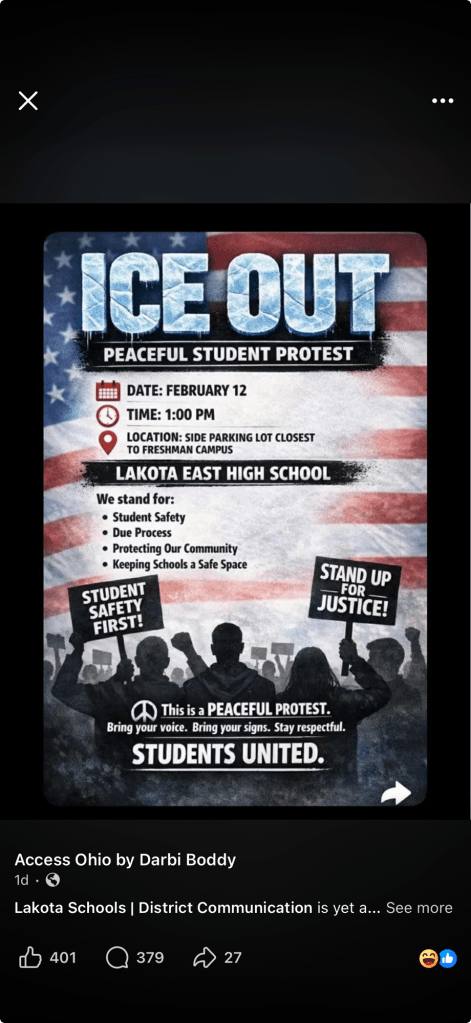
Local media, such as WKRC Local 12, reported these demonstrations as student-led responses to federal immigration tactics, noting similar actions across the Tri-State region (Ohio, Kentucky, Indiana). Principals from multiple Lakota schools (including East, West, Hopewell Junior, Liberty Junior, and others) issued a letter to parents on February 11, 2026, preemptively addressing rumors of a “voluntary” walkout. The letter upheld students’ First Amendment rights to peaceful protest and civic expression while warning that unexcused absences would be subject to Ohio law and district policy—participation did not qualify for excused status (e.g., illness, emergencies), and preplanned requests would be denied. It emphasized respect for diverse views, noncoercion, a safe environment, and the requirement to report to the office before leaving the building.
Critics, like me, have labeled the letter evasive, arguing it downplayed administrative or teacher involvement while allowing the event to proceed. Eyewitness observations suggest that protest signs were prepared in classrooms with teacher awareness or permission, and that the walkouts occurred during school hours with limited enforcement. Participants rerouted around obstacles such as snowbanks to remain visible in high-traffic areas (e.g., near I-75), indicating deliberate efforts to maximize impact and media coverage. Coverage portrayed the protests as expressions of community solidarity in a Republican-leaning region, although turnout appeared modest relative to enrollment.
Lakota school board member Benjamin Nguyen publicly opposed the demonstrations, issuing a statement calling non-participants “patriots” and citing crimes by undocumented immigrants. Despite warnings of unexcused absences, many participants reportedly faced minimal repercussions, fueling claims of tacit approval to avoid liability or conflict.
The Nationwide Wave of Anti-ICE Student Protests in Early 2026
The Lakota walkouts aligned with a massive surge of “student-led” demonstrations (organized through teacher union radicalism) across the U.S. in January and February 2026, often coordinated via social media by progressive groups and spurred by intensified ICE operations, including detentions, and tragic incidents like fatal shootings involving agents in Minneapolis. Thousands participated nationwide, with actions in dozens of states and cities.
In the Cincinnati area:
• Walnut Hills High School: 300–400 students walked out on February 4, 2026, holding signs like “Abolish ICE” in cold weather.
• Princeton High School: Hundreds walked out on February 10, emphasizing opposition to racial profiling in a diverse student body.
• Other schools, including the School of Creative and Performing Arts (dozens marching with chants on February 11) and Sycamore High School (tied to January actions), joined the wave.
Elsewhere in Ohio and nationally:
• Central Ohio districts (Worthington, Hilliard, Upper Arlington) saw January walkouts after ICE’s Operation Buckeye.
• Northeast Ohio (Cleveland Heights): Hundreds marched on February 12.
• Other states: Texas (Hutto, Austin, Pflugerville), Kansas (Lawrence, Free State), Utah (multiple Salt Lake County schools with hundreds marching), California (Los Angeles Unified estimating thousands), Minnesota (lawsuits over ICE near schools), and more.
Protests focused on protecting immigrant families, creating “safe spaces,” and opposing overreach. Some districts threatened disciplinary action or investigated facilitation; others remained neutral or supportive. Conservative critics highlight the coordination, media amplification, and involvement of younger students as evidence of external influences beyond organic concern.
Teacher Unions, Political Leanings, and Potential Facilitation of Activism
Central to the controversy is whether these protests were student-driven or amplified by teachers and unions. Public school teachers often lean liberal/Democrat in surveys, and unions like the National Education Association (NEA), American Federation of Teachers (AFT), and Ohio affiliates (Ohio Education Association, Columbus Education Association) have advocated on immigration, condemning ICE near schools, supporting “sensitive locations” protections, and amplifying solidarity efforts.
In 2025–2026, unions pushed for reforms limiting enforcement near educational sites, filed lawsuits (e.g., Minnesota districts and unions), and issued statements opposing ICE actions that create fear in immigrant communities. Ohio unions, such as the OEA, strongly opposed enforcement in or around schools, citing trauma and learning disruptions. Critics argue that this normalizes progressive views in classrooms under the rubrics of “civic education” or “social justice,” potentially pressuring neutral spaces and facilitating activism (e.g., walkout guides or symbolic acts).
In conservative areas like Butler County, public schools are viewed as “liberal incubators” with limited oversight, allowing teachers to instill values diverging from parental ones. Many parents treat schools as convenient childcare, rarely scrutinizing political influences, enabling unchecked messaging. This contributes to generational shifts, with youth adopting radical positions via taxpayer-funded systems.
Implications, Reform Needs, and Long-Term Trajectories
These incidents reveal tensions between student free speech (protected under Tinker v. Des Moines for non-disruptive expression) and school neutrality. If teachers aided protest activities (e.g., by creating signs during class), this raises questions about resource use and impartiality. In polarized regions, such actions appear to leverage youth for adult agendas, thereby eroding trust.
Reform demands include stricter policies on political activities during school hours, transparency in responses, parental oversight, and union accountability. School choice could allow value-aligned options, reducing perceptions of indoctrination. Without reforms, public education risks prioritizing ideology, exacerbating divides, and alienating funding communities.
The Lakota protests, framed as civic engagement, highlight eroding confidence when schools seem to enable partisan activism in conservative strongholds. Balanced, impartial education is essential to serve all families properly. These protests, as the Lakota one proves, show a much deeper scheme of radical left-wing politics using children to advance their political agendas at taxpayer expense. It is a mechanism of injustice that must be stopped.
Footnotes
¹ Local 12 (WKRC), “Students at 2 Tri-State schools protest against ICE, treatment of immigrants,” February 12, 2026.
² Journal-News, “Some local students are organizing protests, campus discussions about ICE enforcement,” February 12, 2026.
³ Cincinnati Enquirer, “Walnut Hills High School anti-ICE walkout draws 300 to 400 students,” February 4, 2026.
⁴ The Guardian, “These are the high schoolers taking a stand against ICE,” February 9, 2026.
⁵ Education Week, “Free Speech Debates Resurface With Student Walkouts Over ICE Raids,” February 5, 2026.
⁶ Ohio Capital Journal, “Central Ohio high school students protest ICE, teacher unions condemn ICE activity near schools,” January 23, 2026.
⁷ American Experiment, “When teachers’ unions turn schools into political stages,” January 21, 2026.
⁸ Chalkbeat, “Growing number of education groups criticize impact of ICE operations on students,” January 28, 2026.
Bibliography
1. Local 12 (WKRC). “Students at 2 Tri-State schools protest against ICE, treatment of immigrants.” February 12, 2026. https://local12.com/news/local/students-at-multiple-butler-county-cincinnati-ohio-school-schools-walk-out-class-protest-against-ice-immigration-customs-enforcement-agents-officers-president-donald-trump-protesting-politics-political-immigrants-lakota-west-east
2. Journal-News. “Some local students are organizing protests, campus discussions about ICE enforcement.” February 12, 2026. https://www.journal-news.com/news/some-local-students-are-organizing-protests-campus-discussions-about-ice-enforcement/X6DUPL4VLRCL3OKCKKCP5B6FHA
3. Cincinnati Enquirer. “Walnut Hills High School anti-ICE walkout draws 300 to 400 students.” February 4, 2026. https://www.cincinnati.com/story/news/education/2026/02/04/some-300-to-400-walnut-hills-high-school-students-join-anti-ice-walkout/88510660007
4. The Guardian. “These are the high schoolers taking a stand against ICE.” February 9, 2026. https://www.theguardian.com/us-news/2026/feb/09/us-high-schoolers-protest-ice
5. Education Week. “Free Speech Debates Resurface With Student Walkouts Over ICE Raids.” February 5, 2026. https://www.edweek.org/leadership/free-speech-debates-resurface-with-student-walkouts-over-ice-raids/2026/02
6. Ohio Capital Journal. “Central Ohio high school students protest ICE, teacher unions condemn ICE activity near schools.” January 23, 2026. https://ohiocapitaljournal.com/2026/01/23/central-ohio-high-schools-students-protest-ice-teacher-unions-condemn-ice-activity-near-schools
7. American Experiment. “When teachers’ unions turn schools into political stages.” January 21, 2026. https://www.americanexperiment.org/when-teachers-unions-turn-schools-into-political-stages
8. Chalkbeat. “Growing number of education groups criticize impact of ICE operations on students.” January 28, 2026. https://www.chalkbeat.org/2026/01/28/education-groups-say-ice-immigration-enforcement-is-hurting-students
Rich Hoffman
More about me
Click Here to Protect Yourself with Second Call Defense https://www.secondcalldefense.org/?affiliate=20707