The Mystery of Mt. Brilliant: Archaeological evidence of an ancient city under modern day Lexington, Kentucky

Reports were coming in from all over the strange new land of America that similar to the ruins of Greece and Rome, this new world had watched many cultures rise and fall.  A mysterious people called Indians were presently occupying the west relative to Washington City where Thomas Jefferson was president and very curious about the history that lay beyond sight.  Staving off an attempt by his former vice-president to split the union Jefferson had ordered the arrest of Aaron Burr and his financier the Illuminati member Harman Blennerhassett.  Blennerhassett a lover of the occult built his home in the middle of the earthen mounds of his fascination in Marietta, and the various structures in West Virginia likely sought protective council during the winter solstice of 1806 in a graveyard of buried giants that had resided undisturbed before being destroyed by the building of Augusta, Kentucky.  Among his beliefs was that the spirit of the ancients might answer his desperate call.  There is a belief within some of these cult groups that such ancient locations beheld magical properties and could draw on the spirits of the dead to assist with the living—if the proper sacrifices to the proper gods were made.  In association with the lost race of Augusta Giants which Blennerhassett knew of for his mysterious summit with destiny was the 1783 reports coming in from Thomas Ashe from his 1806 book Travels in America.  In that book came the report of an ancient race of people who had settled in the area where Lexington was being built and the ruins there dwarfed much of what was being discovered in and around Ohio.  Click to review a previous article on this topic for a proper back story.

To find the center of the ancient Lexington city it is fairly easy if you know what you are looking for.  For those familiar with Lexington simply get off the highway exit that delivers you to the Kentucky Horse Park.  Instead of turning in, proceed down Iron Works Pike road for a few miles until you arrive at the store Jot-Em Down.  Turn left onto Russell Cave Road.  When you arrive at the gate to the destroyed Mt Brilliant mansion you will be there.  It was on this property that some of the largest and most organized mounds aligned in a similar way as to the Newark earthworks near Columbus, Ohio once stood.  The site on the Mt. Brilliant property first reported by the traveler Thomas Ashe chronicled in the 1872 book by George W. Ranck breaks down the precise measurements as they were before construction and farming destroyed them entirely.  But that’s not all, the site was vast extending from the location 6 miles north-east of the downtown area to areas dotting all around the core of the current city.  It is difficult now to know how many homes were built through the burial remains of these ancient dwellers, but the account according to Ranck’s book is that it was numerous saying “These well-attested facts, together with the tradition related to this day of an extensive cave existing under the city of Lexington, relieve of its improbable air the statement that a subterranean cemetery of the original inhabitants of this place was discovered here nearly a century ago.  In 1776, three years before the first permanent white settlement was made at Lexington, some venturesome hunters, most probably from Boonesborough, had their curiosity excited by the strange appearance of some stones they saw in the woods where our city now stands. They removed these stones, and came to others of peculiar workmanship, which, upon examination, they found had been placed there to conceal the entrance to an ancient catacomb, formed in the solid rock, fifteen feet below the surface of the earth. They discovered that a gradual descent from the opening brought them to a passage, four feet wide and seven feet high, leading into a spacious apartment, in which were numerous niches, which they were amazed to find occupied by bodies which, from their perfect state of preservation, had evidently been embalmed. For six years succeeding this discovery, the region in which this catacomb was located, was visited by bands of raging Indians and avenging whites; and during this period of blood and passion, the catacomb was dispelled, and its ancient mummies, probably the rarest remains of a forgotten era that man has ever seen, were well nigh swept out of existence. But not entirely. Some years after the red men and the settlers had ceased hostilities; the old sepulcher was again visited and inspected.  It was found to be three hundred feet long, one hundred feet wide, and eighteen feet high. The floor was covered with rubbish and fine dust, from which was extracted several sound fragments of human limbs. At this time the entrance to this underground cemetery of Ancient Lexington is totally unknown. For nearly three-quarters of a century, its silent chamber has not echoed to a human footfall. It is hidden from sight, as effectually as was once buried Pompeii, and even the idea that it ever existed is laughed at by those who walk over it, as heedless of its near presence as were the generations of incredulous peasants who unconsciously danced above the long-lost villa of Diomedes”

But the heart of this ancient city, its cultural epitaph was on the location of the present day Mt. Brilliant site.  For those who know anything about horses and thoroughbred racing the current owner of the Mt. Brilliant property owns the nearby stud barn of Man o’ War who won all but one of his 21 lifetime starts—which is a remarkable accomplishment.  That stud barn is right in the middle of this ancient archaeological site of ancient earthworks.   Of course farming and construction have all but destroyed all the present day evidence—and if not for the books by Thomas Ashe and George W. Ranck there would be no evidence at all.  The closest that history has come to indicating anything at all was amiss in the area were that the Indians in the area were terrified of Kentucky land—as chronicled in the novels by Allan W Eckert.  The Indians would hunt in the area, but they never settled a tribe there, and one of their early arguments with the arrival of the white settlers was that the whites did not respect that land as the Indians did.  The whites had no fear of the spirits which resided there—as they did fear those ephemeral entities.   Their reason was that they viewed the Lexington, Kentucky area as a “dark and bloody ground.”  It was a shadow-land to the Indians. In 1800, some Sacs who were in St. Louis said of Kentucky that it was full of the souls of a strange race which their people had long ago exterminated. They regarded this land with superstitious awe. Here they hunted and here they fought, but no tribe was ever known to settle permanently in it.”  The eradication of the evidence of that ancient people started in 1774 when Thomas Jefferson granted 2,000 acres of land north of the Kentucky River to William Russell in recognition of his brother Henry’s outstanding military service in the French and Indian War.

The land was eventually divided between William’s two youngest sons, Robert Spotswood Russell and William Russell, Jr. Shortly after the end of the Revolutionary War, young William laid claim to the smaller portion (800 acres) so he could enjoy the mystical cave and ever-flowing spring that add an enchanting ambiance to what is now known as Mt. Brilliant. Russell chose the name to commemorate the Virginia estate of Patrick Henry’s family.

In 1792, Russell built the central portion of the house. Cuming remarked in his 1807 book, “Tour of the West”, that Mt. Brilliant, surrounded by a wall with turrets at each end, lacked “only the vineyards” in its similarity to the French Provincial regions of Languedoc and Provence.

Russell died in 1824 and his heirs sold Mt. Brilliant in 1863. In 1832, Mount Brilliant passed to Hamilton Atchison Jr. The historical connection here is the relation to David Rice Atchison, “President for a Day” between Presidents James Polk and Zachary Taylor, who often visited his cousins at Mount Brilliant. A Lexington native and 1825 graduate of Transylvania, Atchison moved to Missouri and later Kansas. He was a U.S. senator and an organizer of the Atchison-Topeka and Santa Fe Railway Mount Brilliant was sold in 1861 to Thomas Hughes, who later owned historical Elk Hill and Clifton. Arthur Delong acquired Mount Brilliant in 1891, until 1905 when it was purchased by James Ben Ali Haggin. The Haggin family owned the farm for the next 85 years, and it became a fixture in the Kentucky political and social scene in the 20th Century.

In fact, it was at a political rally held at Russell Cave, which lays on the Mt. Brilliant property, that the infamous duel between abolitionist Cassius Clay and Samuel M. Brown took place. Clay, Henry Clay’s cousin, was saved by a stroke of astonishing fortune when the bullet aimed directly for his heart ricocheted off the silver-lined sheath of his Bowie knife.  Samuel Brown was in fact a hired assassin sent to kill Clay for his insistence that slavery be banned.  It was in that very same cave on the Mt Brilliant property that many escaped slaves hid while on their journey north into Cincinnati.  But the cave has a much deeper—and mystical quality that points back to the politics of the day.  After all, it is more than a little intriguing that a political rally for which the Clay, Brown duel occurred was in a cave when a perfectly good mansion was available just a few hundred feet away above the creek bed.

Feel free to read more about this history at these links:

http://mtbrilliant.com/about/history

http://haggin.org/Mount.Brilliant.History.html

http://www.theconspiracyzone.org/posts/27710

http://www.mcguiresplace.net/Discovery/

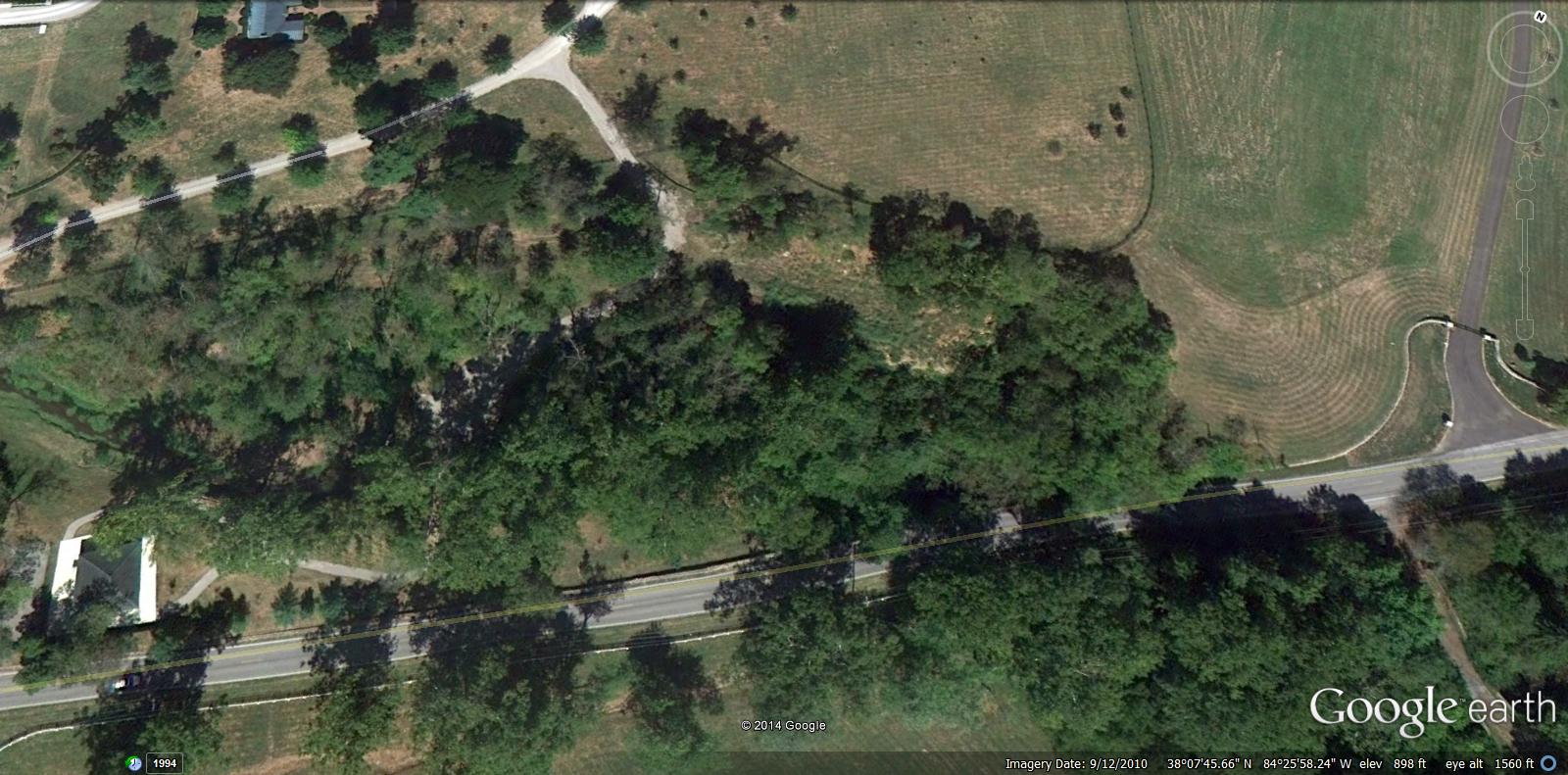
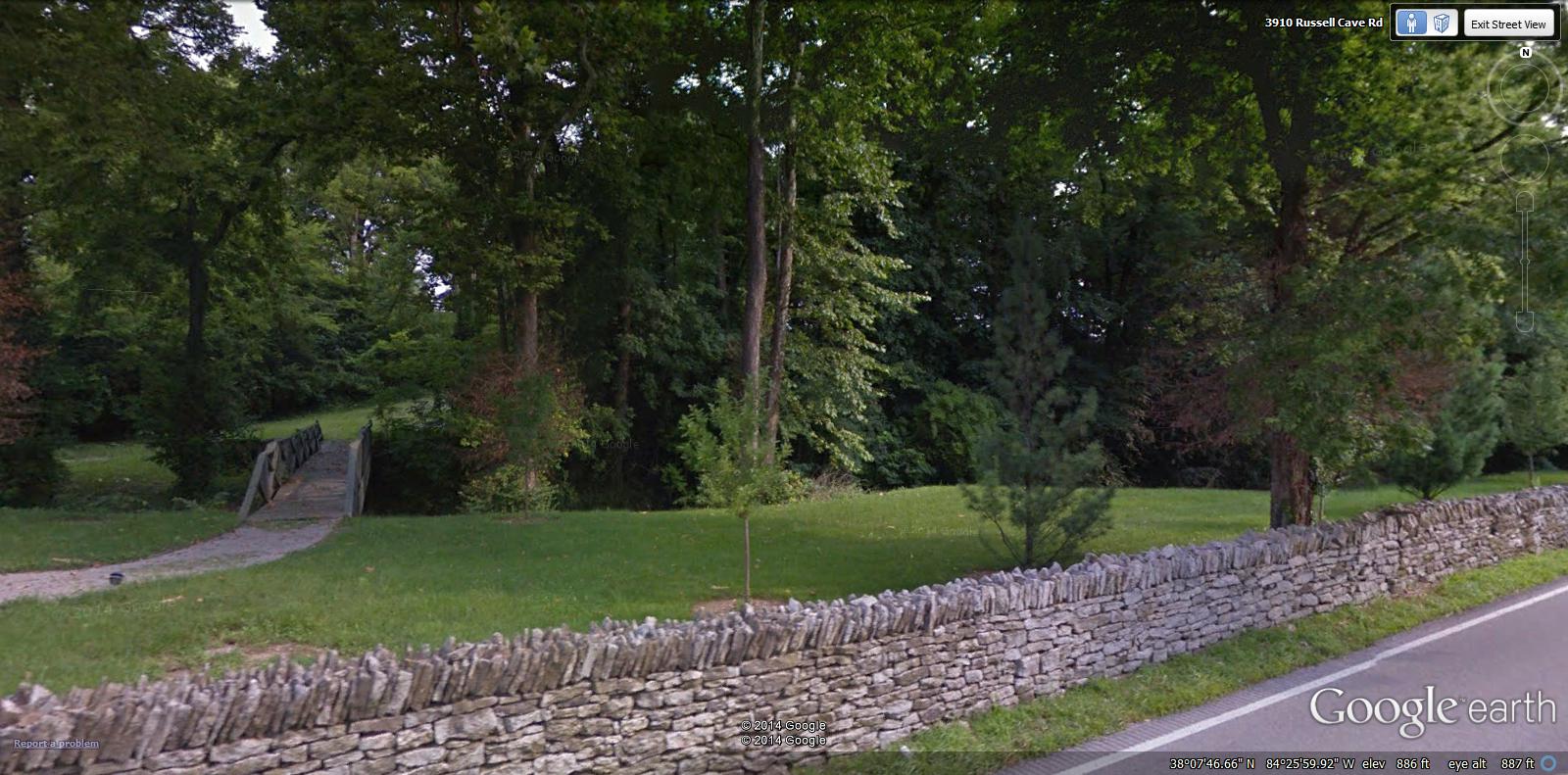
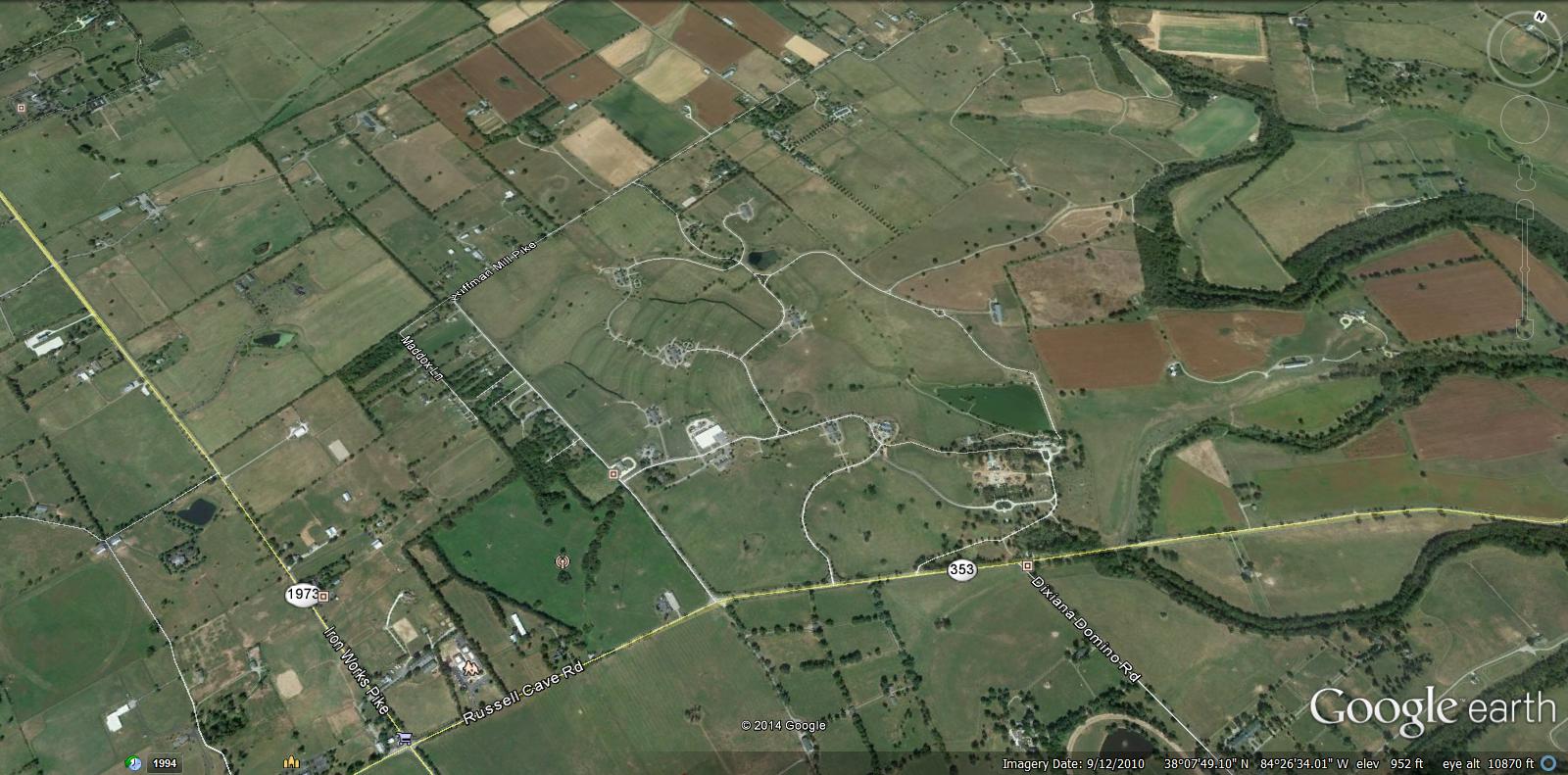
Let us now study what was around that cave on the Mt Brilliant property as described in 1872 by George Washington Ranck.   I include it here as I have looked for a hard copy of the book but only know of the scanned online copy by Cornell University.  Should fortunes change and documentation of such resources online cease—a proper record of the evidence is necessary.  It may also be desired to perform some archaeology if the owner would permit it.  In the cave, bones were found of these ancient people and has been the site of many turbulent events since.  There are few caves in the world that have hosted such a variety of characters as that of Russell Cave, but spelunking is not the most comfortable.  Much of it is flooded so trudging through the cold water to the locations where archaeology could be properly performed will take some effort and discomfort.   But it is there and only there that the ancient race of people can ever hope to be ascertained, as all the remnants of what is described below has been destroyed except for the text you are about to read.  Of that text I have performed some basic editing to make it more digestible.  The pictures included I deliberately kept the property of Mt. Brilliant out of the pictures to respect the owners privacy.  Only the cave area is zoomed in on due to the historical significance of it.  The wide pan shot is of the area described below.  The elements described below used to be sprawled out within the picture frame and were quite large.  If anything still remains, it would be difficult to detect due to 200 years of aggressive use of the land, and modern construction along with farming.  The original text can be found at the concluding link

“Some months after he had examined and described the fortification at the head of Hickman creek, Prof. Eafinesque surveyed the upper group on North Elkhorn, near Russell’s cave, or what is now known as the West place. We quote his description of it, which will be read with more and more interest and wonder as time passes, and slowly but surely levels with the earth and blots out forever all that is left to remind us of a lost race, whose stupendous structures covered the fertile tract which afterward became the favorite hunting ground of savage tribes. He says:  “I visited this upper group of monuments, a few days ago, in company with two gentlemen of Lexington. They are situated about six miles from this town, in a north-northeast direction, on the west and back part of Colonel Russell’s farm, which stands on the road leading from Lexington to Cynthiana.  “The ground on which they stand is a beautiful level spot, covered with young trees and short grass, or line turf, on the south side of a bend of North Elkhorn creek, nearly opposite the mouth, and close by Hamilton’s farm and spring, which lie west of them. They extend as far as Russell’s cave, on the east side of the Cynthiana road.  “No. 1, which stands nearly in the center, is a circular enclosure, six hundred feet in circumference, formed of four parts : 1. A broad circular parapet, now about twenty feet broad, and two feet high.  2. An inward ditch, now very shallow and nearly on a level with the outward ground.  3. A gateway, lying due north, raised above the ditch, about fifteen feet broad, and leading to the central area.  4. A square central area, raised nearly three feet above the ditch, perfectly square and level, each side seventy feet long and facing the four cardinal points.  ” No. 2 lies northeast of No. 1, at about two hundred and fifty feet distance; it is a regular, circular, convex mound, one hundred and seventy-five feet in circumference, and nearly four feet high, surrounded by a small outward ditch.  ” No. 3 lies nearly north of No. 1, and at about two hundred and fifty feet distance from No. 2. It is a singular and complicated monument, of an irregular square form, nearly conical, or narrower at the upper end, facing the creek. It consists: 1. Of a high and broad parapet, about one hundred feet long and more than five feet high, as yet, above the inward ditch on the south base, which is about seventy-five feet long. 2. Of an inside ditch. 3. Of an area of the same form with the outward parapet, but rather uneven. 4. Of an obsolete broad gateway at the upper west side. 5. Of an irregular raised platform, connected with the outward parapet, and extending toward the north to connect it with several mounds. 6.
Mt. Brilliant caveOf three small mounds, about fifty feet in circumference, and two feet high, standing irregularly around that platform, two on the west side and one on the east.  ” No. 4. These are two large sunken mounds, connected with No. 3. One of them stands at the upper end of the platform, and is sunk in an outward circular ditch, about two hundred and fifty feet in circumference, and two feet deep. The mound, which is perfectly round and convex, is only two feet high, and appears sunk in the ditch. Another similar mound stands in a corn-field, connected by a long raised way to the upper east end of the parapet in No. 3.  “No. 5 is a monument of an oblong square form, consisting of the four usual parts of a parapet, an inward ditch, a central area, and a gateway. This last stands nearly opposite the gateway of No. 3, at about one hundred and twenty-five feet distance, and leads over the ditch to the central area. The whole outward circumference of the parapet is about four hundred and forty feet. The longest side fronts the southwest and northeast, and is one hundred and twenty feet long, while the shortest is one hundred feet long. The central area is level, and has exactly half the dimensions of the parapet, being sixty feet long and fifty wide. It is raised two or three feet as well as the parapet. The end opposite the gateway is not far from Hamilton’s spring.  “Now to No. 6 is a mound without a ditch, one hundred and ninety feet in circumference, and five feet high. It lies nearly west from No. 1.  

“No. 7 is a stone mound, on the east side of Russell’s spring, and on the brim of the gully. It lies east from the other monuments and more than half a mile distant. It is ten feet high and one hundred and seventy-five feet in circumference, being formed altogether by loose stones heaped together, but now covered with a thin soil of stone and grass.  “No. 8 is a similar stone mound, but rather smaller, lying north of number. 7, at the confluence of Russell’s spring with North Elkhorn.  “Among the principal peculiarities, which I have noticed in this .group of monuments, the square area of No. 1, enclosed within a circular ditch and parapet, is very interesting, since it exhibits’ a new compound geometrical form of building. The ditch must have been much deeper once, and the parapet, with the area, much higher; since, during the many centuries which have elapsed over these monuments, the rains, dust, decayed plants, and trees must have gradually filled the ditch, etc. I was told by Mr. Martin that within his recollection, or about twenty-five years ago, the ditch in the monument at the head of Hickman’s creek was at least one foot deeper. “Whenever we find central and separated areas in the Alleghawian monuments, we must suppose they were intended for the real places of worship and sacrifices, where only the priests and chiefs were admitted, while the crowd stood probably on the parapet to look on; and, in fact, these parapets are generally convex and sloping inward or toward the central area.  “The ditched mound, No. 2, is remarkable, and must have had a peculiar destination, like the sunken mounds. No. 4, which differ from No. 2 merely by being much lower, and appearing, therefore, almost sunk in the ditch.  “The stone mounds, Nos. 7 and 8, are also peculiar and evidently sepulchral. But why were the dead bodies covered here with stone instead of earth? Perhaps these mounds belonged to different tribes, or the conveniency of finding stones, in the rocky neighborhood of Russell’s cave and spring, may have been an inducement for employing them.”  Some of these mounds described by Rafinesque were visited in 1846, and found to be nearly obliterated ; others, however, near the dividing line between the old military survey of Dandridge and Meredith, were still distinct, and were described in 1847 as follows: ” The most easterly work is on the estate of C. C. Moore. It is on the top of a high bluff, on the west side of Elkhorn, in the midst of a very thick growth, mostly of sugar trees, the area within a deep and broad circular ditch is about a quarter of an acre of land. The ditch is still deep enough in some places to hide a man on horseback. The dirt taken from, the ditch is thrown outward; and there is a gateway where the ditch was never dug, some ten feet wide on the north side of the circle. Trees several hundred years old are growing on the bank and in the bottom of the ditch and over the area which it encloses, and the whole region about it. There is another work a quarter of a mile west of the above one. It commences on the Meredith estate and runs over on the Cabells’ Dale property, and contains about ten acres of land. The shape of the area is not unlike that of the moon when about two-thirds full. The dirt from the ditch inclosing this area is thrown sometimes out, sometimes in, and sometimes both ways. An ash tree was cut down in the summer of 1845, which stood upon the brink of this ditch, which, upon being examined, proved to be four hundred years old. The ditch is still perfectly distinct throughout its whole extent, and in some places is so deep and steep as to be dangerous to pass with a carriage.  A mound connected with this same chain of works was opened in the summer of 1871. It is situated about half a mile west of the earthwork already described as on top of the bluff, and about a quarter of a mile north of the larger oval one. It is on the farm of Mr. James Fisher, adjoining the plantation on which Dr. Eobert Peter at present resides, and is part of the old Meredith property before mentioned. Area of interestThe mound has a diameter of about seventy feet, and rises with a regular swell in the center to the height of three and a half to four feet above the general level of the valley pasture on which it is located, only about fifteen feet above low water in the North Elkhorn creek, and about three hundred and twenty-five feet south from its margin. Mr. Fisher made an excavation into the center of this mound about four to five feet in diameter and about three and a half feet deep, in which, in a bed of wood-ashes containing charred fragments of small wood, he found a number of interesting copper, flint, bone, and other relics of the ancient Mound Builders, which were carefully packed by Dr. Robert Peter (who resides on the adjoining Meredith farm), and transmitted to the Smithsonian Institute, at “Washington, for preservation.  The copper articles were five in number; three of which were irregularly oblong-square implements or ornaments, about four inches in length and two and one-eighth to three and three-quarter inches wide and one-quarter inch thick at lower end (varying somewhat in size, shape, and thickness); each with two curved horns attached to the corners of one end, which is wider and thinner than the other end. These were evidently made of native copper, by hammering, are irregular in thickness and rude in workmanship, and have been greatly corroded in the Japseof time, so that they not only have upon them a thick coating of green carbonate and red oxide of copper, but the carbonate had cemented these articles, with adjoining flint arrow-heads, pieces of charcoal, etc., into one cohering mass, in the bed of ashes, etc., in which they were found lying irregularly one upon the other.  The other two copper implements were axes or hatchets; one nearly six inches long, the other nearly four inches; each somewhat adze-shaped wider at one end, which end had a sharp cutting edge.   With these were found nearly a peck of flint arrow-heads, all splintered and broken, as by the action of fire; also, three hemispherical polished pieces of red hematitic iron ore about two inches in diameter; some door-button shaped pieces of limestone, each perforated with two holes; several pieces of sandstone, which seemed to have been used for grinding and polishing purposes; and many fragments of bones of animals, mostly parts of ribs, which appeared to have been ground or shaped ; among which was one, blackened by fire, which seemed to have been part of a handle of a dagger; also, some fragments of pottery, etc. The fragments of charcoal, lying near the copper articles, were saturated with carbonate of copper, resulting from the oxidation of the copper articles, parts of which were oxidized to the center, although a quarter of an inch in thickness; and many pieces of this coal and portions of flint arrow-heads remain strongly cemented to the copper implements by this carbonate.  To what uses these rude, oblong- square horned copper articles were put, except for ornament, cannot be conjectured. No inscription or significant murk was found on any of them.  No human bones could be distinguished among the fragments found, but only the immediate center of the mound was opened.  The citizens of Lexington may, in truth, muse among the ancient ruins and awe-inspiring relics of a once mighty people. “Who and what were the beings who fought with these weapons, ate from these vessels, built these tombs and mounds and altars, and slept at last in this now concealed catacomb? Where existed that strange nation, whose grand chain of works seemed to have Lexington for its nucleus and center? We can only speculate! One  inclines to the opinion that they were contemporaries of the hardy Picts. Another declares them identical with the Alleghawians or progenitors of the Aztecs, and cites as proof, the remains of their temples, which are declared to be wonderfully similar to those of the ancient Mexicans described by Baron Humboldt. The earthen vessels here plowed up from the virgin soil, he says, were like those used by the Alleghawians for cooking purposes. Still another writer, dwelling upon the mummies here discovered, sees in the original inhabitants of Lexington, a people descended from the Egyptians. Other authors, eminent and learned, almost without number, have discussed this subject, but their views are as conflicting as those already mentioned, and nothing is satisfactory, except the negative assurance that the real first settlers of Lexington, the State of Kentucky, and the entire Mississippi valley, were not the American Indians, as no Indian nation has ever built walled cities, defended by entrenchments, or buried their dead in sepulchers hewn in the solid rock.  “Who, then, were these mysterious beings? Burial caveFrom whence did they come? What were the forms of their religion and government? Are questions that will probably never be solved by mortal man; but that they lived and flourished centuries before the Indian who can doubt? Where they erected their Cyclopean temples and cities, with no vision of the red men who would come after them, and chase the deer and the buffalo over their leveled and grass-covered walls. Here they lived, and labored, and died, before Columbus had planted the standard of old Spain upon the shores of a new world; while Gaul, and Britain, and Germany were occupied by roving tribes of barbarians, and, it may be, long before imperial Rome had reached the height of her glory and splendor. But they had no literature, and when they died they were utterly forgotten. They may have been a great people, but it is all the same to those who came if they were not, for their greatness was never recorded. Their history was never written not a letter of their language remains, and even their name is forgotten. They trusted in the mighty works of their hands, and now, indeed, are they a dead nation and a lost race. The ancient city which stood where Lexington now stands, has vanished like a dream, and vanished forever. Another has well said: “Hector and Achilles, though mere barbarians, live because sung by Homer. Grermanicus lives as the historian himself said, because narrated by Tacitus; but these builders of mounds perish because no Homerarid no Tacitus has told of them. It is the spirit only, which, by the pen, can build immortal monuments.”   It is a favorite theory of many that the Indians of North America migrated from Asia; that the once noble race, which has almost melted away, was descended from the ten tribes of Israel which were driven from Palestine seven hundred years before the birth of Christ. But this is a theory only. The advent of the Indians and the stock from which they sprung will never be determined; but that they came after the “Mound Builders” is evident. The appearance of the Indians was the death-knell of that doomed race whose rich and beautiful lands and spoil-gorged cities inflamed the desperate and destitute invaders. The numerous tumuli which yet remain attest the fierceness of the conflict which ensued. A great people were swept out of existence, their cities disappeared, the grass grew above them, and in time the forests.”
https://archive.org/stream/cu31924028845993/cu31924028845993_djvu.txt

Avid readers of the day like Thomas Jefferson and the Illuminati practitioner Harman Blennerhassett knew of Thomas Ashe’s book from his Travels in America—which wasn’t published until 1806, but word of its contents were spreading as Ashe visited taverns and allowed listeners to know the contents of his manuscripts.  Ashe was the third son of a half-pay officer, and was born at Glasnevin, near Dublin, 15 July 1770. He received a commission in the 83rd regiment of foot, which, however, was almost immediately afterwards disbanded; and he was sent to a counting-house at Bordeaux. There he suffered a short imprisonment for wounding in a duel a gentleman whose sister he had seduced, but, the wound not proving fatal, the prosecution was not persisted in.

Returning to Dublin, Ashe was appointed secretary to the Diocesan and Endowed Schools Commission, but, getting into debt, resigned his office and retired to Switzerland. He then spent several years in foreign travel, living, according to his own account,[1] in a free and unconstrained fashion, and experiencing a somewhat chequered fortune.

In his later years Ashe was short of money. He died at Bath on 17 December 1835.

Besides recording in his Memoirs his impressions of the countries he visited, Ashe published separately:

  • Travels in America in 1806, 1808;
  • Memoirs of Mammoth and other Bones found in the vicinity of the Ohio, 1806; and
  • A Commercial and Geographical Sketch of Brazil and Madeira, 1812.

He was also the author of novels, including the Spirit of the Book, 1811, 4th edition 1812; the Liberal Critic, or Henry Percy, 1812: and the Soldier of Fortune, 1816.

http://en.wikipedia.org/wiki/Thomas_Ashe_(writer)

The skeptic might be reluctant to believe in Ashe’s accounts of an ancient Lexington, and I might too if I did not know that a housing development nearly bulldozed the ancient city of Cahokia outside of St. Louis mistaking the mounds there as simple hills.  If nobody had put a stop to the process during construction of the St Louis eastside, Monks Mound would have been leveled as well and the bones within the mounds destroyed nearly unnoticed under the trampling of machinery.  In Lexington, with the violent past it had and history with Transylvania added to the complicated history making legitimate archaeological study of the area nearly impossible.  Transylvania, or the Transylvania Colony, was a short-lived, extra-legal colony founded in 1775 by Richard Henderson, who controlled the North Carolina based Transylvania Company, which had reached an agreement to purchase the land from the Cherokee in the “Treaty of Sycamore Shoals”. This area was claimed at the time by the Province of Virginia —especially following Lord Dunmore’s War —and North Carolina. It is primarily located in what is now the central and western parts of the State of Kentucky. American pioneer Daniel Boone was hired by Henderson to establish the Wilderness Road going through the Cumberland Gap into central “Kentuckee”, where he founded Boonesborough, the designated capital of the Transylvania colony. Transylvania officially ceased to exist after the Virginia General Assembly invalidated the Transylvania Company’s purchase in 1776.  Richard Henderson fancied the start of his own colony prior to the Revolutionary War.  If he had succeeded it would have been a 14th colony.  So there was some recklessness in the building of Lexington as ownership changed hands, Indians continuously attacked, and only blood thirsty soldiers of fortune and those fleeing religious persecution were the first to fill the land plagued with violence.  Lexington was erected as a city under forged conditions—and archaeology was not their primary concern.

http://en.wikipedia.org/wiki/Transylvania_(colony)

But the Illuminati in America knew what they thought that ancient race was, and they built their secrets around that knowledge attempting to tap into that energy believed to reside around them.  It is therefore ironic that the horse racing culture emerged so prominently in Lexington of all places, and that the spirited horses born there have an otherworldly appeal.  It is also ironic that politics, the abolitionist movement and many important historic events culminated at that very spot around Russell’s Cave for well over 200 years—but the evidence of those happenings has been carefully obscured—and overlooked.  Instead modern society is obsessed with the mansions, the gardens, and the horses of that former ancient society.  The spender of elegance has disguised the fact that an entire race of people unknown to time was eradicated at that very spot.  With earthworks only rivaling the Newark, Ohio site and Serpent Mound a picture of a vast civilization that lived in the Kentucky and Ohio region well before any Indian hunted with a spear or threw a rock is evident.  These were people who mummified their bodies, offered sacrifices on stone alters, and had advanced mathematical knowledge.  Their evidence has been confined behind a thin veil of opulence associated with the horse racing culture and the hidden knowledge of secret societies.

The political rally in 1843 where so many prominent politicians and events collected themselves for more than the acoustical qualities of a cave, it was known among them that in such a cave the ancients of that great race dwelled and buried their dead.  But being part of a new country these early settlers had no predilection in assuming they were the first to arrive in such a vast landscape.  They had no Columbus Day to celebrate, or progressive history in maintaining a history of the African-American or Indian people.  They simply hoped to learn from those ancient people what they could as they forged a new country and if you were a good little politician or financial donor you might be invited to that secret Illuminati/Masonic knowledge of those strange people who resided in Lexington Kentucky thousands of years before a white man ever arrived—or an Indian.

http://bowieknifefightsfighters.blogspot.com/2011/03/cassius-clay-sam-brown-fight-eyewitness.html

And so it goes one of the greatest mysteries in the North American continent is buried under the city of Lexington and is only hinted at by the Masonic architecture littering the region, or the artwork at the various mansions around the Lexington horse farms.  Knowledge is power, and so long as few people knew of this ancient race, there was unification in that harmonious correspondence with those who were invited to gather in the ancient catacombs of what was left of the great race who originally founded America and were dedicated to the service of freedom for all—even the slaves as Cassius Clay so valiantly defended in the cave’s mouth under the estate of Mt. Brilliant built upon the ruins of a lost race.  Lexington was the destruction of a genius lost to history and only known to a few of the most educated and enlightened.  But now dear reader—you can count yourselves among them—because you know too the truth long suppressed.

Rich Hoffman

www.OVERMANWARRIOR.com


The American Amorites: Secrets of the Illuminati stationed on the Ohio River

 So why did Harman Blennerhassett decide to build his home in the middle of the Ohio River just downstream from Marietta, Ohio?  He was a very cultured man, educated extensively in Europe and was best friends with Adam Weishaubt, the founder of the extremely feared Bavarian Illuminati.  Blannerhassett married his niece and lived a nice quiet life in that home for about 8 years until he conspired with Aaron Burr to destroy America—otherwise—according to lovers of that modern-day tourist center, Blennerhassett Island operating out of Parkersburg, West Virginia was a quiet uneventful soul.  And why when his plot with Burr unraveled did he flee to the ancient graveyard of the Augusta Giants during a winter solstice for mysterious aid?  CLICK HERE TO REVIEW.

Well, Blennerhassett placed his house within close proximity to the ancient Serpent Mound just to the west of his location, and many major earthworks in West Virginia and Pennsylvania.  Also the Newark earthworks just to the east of Columbus, Ohio were nearby as well and could be reached fairly easily even in those primitive days of travel.   The ancient society of Cahokia was just down the river and even though not discovered until the middle of the 20th century, legends of these massive pre-Columbian cities permeated the secret texts of the very learned from Europe.   In fact, if you take the summation of beliefs found in The Book of Mormon, the various secret beliefs of the Bavarian Illuminati, the Masonic Lodges, Scientology as well as thousands of little fringe groups espousing a multitude of beliefs—then examine the kind of things that federal grant starved scientists are “withholding” from the public record you get an answer that goes something like what is explained in the below video.  Watch closely.  You will learn a lot dear reader and will begin to understand why the Illuminati had their eye on Ohio even from the distant castles of Europe.

I have an entire encyclopedia of books that I inherited from my grandmother called The Living Bible Encyclopedia in Story and Pictures published in 1968.  She lived deep in the county when I was a kid and when my parents would go on a date night they would drop me off at her house to spend the night which I always enjoyed—because there were always adventures at grandma’s house. I trust older books more than newer ones so when I want to confirm something suspicious I revert back to those old books that I used to pour through when those times arrive.  Back then public education wasn’t so progressively militant.  It was still very bad, but the agenda driven dialogue had not yet matured.  When I first started browsing through those stacks of books the Department of Education had just been formed, so some of the mound building cultures were still taught in Ohio History and other similar classes.   So when looking into these claims from many sources that the skeletons of giants found all over America—particularly in Ohio and Kentucky were a society of Amorites I turned to my old books and found a definition of them on page 86 volume 1 of 152.  On that page I found a very similar definition as to what I found on Wikipedia which is shown below.

The Amorites (Sumerian MAR.TU, Akkadian Tidnum or Amurrūm, Egyptian Amar, Hebrew אמורי Ĕmōrī, Ancient Greek Αμορίτες) were an ancient Semitic-speaking people[1] from ancient Syria who also occupied large parts of Mesopotamia from the 21st century BC. The term Amurru in Akkadian and Sumerian texts refers to them, as well as to their principal deity.

In the earliest Sumerian sources concerning the Amorites, beginning about 2400 BC, the land of the Amorites (“the Mar.tu land”) is associated not with Mesopotamia but with the lands to the west of the Euphrates, including Canaan and what was to become Syria.

They appear as an uncivilized and nomadic people in early Mesopotamian sources, especially connected with the mountainous region of Jebel Bishri in Syria called the “mountain of the Amorites”. The ethnic terms  Amurru and Amar were used for them in Akkadian and Ancient Egyptian respectively. From the 21st century BC, possibly triggered by a long major drought starting about 2200 BC, a large-scale migration of Amorite tribes infiltrated southern Mesopotamia. They were one of the instruments of the downfall of the Sumerian Third Dynasty of Ur, and Amorite dynasties both usurped native Sumero-Akkadian rulers of long extant south Mesopotamian city states (such as Isin, Larsa, Eshnunna and Kish), and also established new city-states, the most famous of which was Babylon, although it was initially a minor and insignificant state.

Known Amorites wrote in a dialect of Akkadian found on tablets at Mari dating from 1800–1750 BC. Since the language shows northwest Semitic forms and constructions, the Amorite language was presumably a northwest Semitic dialect of the Canaanite language group, as opposed to the east Semitic Akkadian language. The main sources for the extremely limited knowledge about Amorite are the proper names, not Akkadian in style, that are preserved in such texts.

http://en.wikipedia.org/wiki/Amorites

Given a culture that is rumored to have built the Hanging Gardens of Babylon, the Tower of Babel and a number of ancient wonders which are now off-limits to proper scientific research because they are in perpetual war-torn counties like Iraq, Syria, Jordan, Israel, and Iran it is not hard to believe the accounts that the Amorites had the ability to circumnavigate the globe and operated this gigantic trade network out of ports in the Persian Gulf and Mediterranean.  There are many modern speculations about the emergence of similar cultures as to what was found in Mesopotamia at the time springing up all over the world and that UFO’s were picking up travelers and hauling them all over the planet to converse with far distant people and settlements—but the logical conclusion is that the Amorites had risen and fell as a technological power and had the ability to reach every corner of the world before a single page of the Bible was ever written.

From my trusted book it says additionally of the Amorites, “They were a very prominent people in pre-Israelitish (sic) days, for it is believed that at one time their kingdom occupied the larger part of Mesopotamia and Syria, with their capital at Aaran.  The Mari tablets throw a flood of light on them and it is now thought that Amraphel King of Shinar (Gen. 14:1), was one of their kings.  People from the north drove them from this region, causing them to settle in Babylonia, where they brought that entire area under their control, giving to Babylonia one of the richest periods in her history.  When after several hundred years, they were defeated by the Hitties, they settled throughout a large portion of Canaan and may even have ruled in Egypt for a time.”

It should then be viewed the movie Lawrence of Arabia to understand how T.E. Lawrence was essentially used by the British government and King Feisal of the Saudi Arabian region to conquer the Middle East from Turkish rule to pave the way for the kind of division that occurs in the Middle East to this day. The ending of that movie about the real life exploits of T.E. Lawrence is quite powerful—and telling.  What the English empire wanted was to re-create the nation of Israel against the tide of Islamic rule in the region and they used Lawrence to achieve the task and ease tensions with the natives.  The reason would point back to the same type of secret societies operating in England at the time and Bavarian style Illuminati hatched in Germany of which Blennerhassett was so much a part.  Of those Illuminati beliefs was that the mounds of Ohio and the American “west” were the far-flung cultures of the Armonites who were in fact the ancestors of the Israelites—the so-called “lost tribe” theory.

As the Armonites fell from power in the Middle East, as all great powers do when their culture collapses against their philosophy, what was left of them ended up around the world particularly in North America where rich copper mines and land without much by way of competing civilizations would allow them to flourish.  They were rumored to be a large people of above average height which today might be considered giants and they are what accounts for some of the large graves found around the Ohio valley containing large groups of very tall people.  As generations died off and were cut from their homeland in the Middle East their science and technology evaporated from their culture.  As the Chinese were also traveling the world in a similar manner they bred with the Amorites and produced the type of people seen today as “Indians.”

Legend fills the secret writings of many societies obsessed with the occult.  And for an Illuminati member like Harmon Blennerhassett he was quite happy in the land of legend with a European style home helping to transform the world in the same manner that his descendents would eventually perform in the Middle East during the time of Lawrence just ahead of the Treaty of Versailles.  The Illuminati after all were not all bad—they did want freedom for every human being.  They wanted to end slavery and empower women.  They planned secretly to throw off the chains of European kingship forever and replace it with a New World Order.  Their intent was a good one from that perspective.  But, where they failed then and continue to fail is that they believe they are the ones who should govern in the place of kings as cultured intellectual beings.  They believe in Plato’s Republic that philosopher kings should guide society and that it is they “the illuminated ones” who should provide that service.  One of the ways that they stay in control is by suppressing information which is why nobody is teaching this kind of thing about the mound builders in public school.  Instead schools teach that the mounds were built by Indians so to give weight to the culture of “Native Americans” and therefore guilt for destroying their race during the creation of America.  In this way, America is viewed as a villain that served a strategic purpose for the Illuminati—but once that purpose is filled, people will gladly throw off the nation in favor of something more inclusive to Indians—and fair.  The Illuminati after all is on a strategic course with a long vision for the world and are operating in much the same way that the English used the Lawrence of Arabia to conquer the Middle East for the empire.  For the Illuminati and high degree Masons, it is the  kind of hidden knowledge that helps keep their  membership up and gives people something to strive for to learn.

Yet when time ran out on Blennerhassett he resorted to the alchemy of his craft perfected in the Illuminati with a belief that ritual sacrifice of some type might invoke the spirits of the dead to their aid in the real world.  So obviously members of the Illuminati were not so “bright.” But it was 1806 after all, and Blennerhassett was on the frontier of a strange new land—so some slack can be given to him for his infantile beliefs.  But much of this ancient belief system is coming out in the politics of our day.  The New World Order is still playing their games and causing strife with local people so to fulfill a prophesy they believe has been handed down to them from ancient people like the Amorites.  Through war, regulation, and emotional strife they attempt to keep their secret hidden just a bit longer—but the essence of their belief is just as stupid as Harman Blennerhassett trying to invoke the spirits of some Kentucky Giants to bring down the walls of Jericho upon the heads of his enemies in hot pursuit of he and Aaron Burr.  But what he learned was that those giants were only bones left by a dead civilization suppressed from the public record.  And that their culture died of its own accord built by pillars of ultimate ignorance because even though they displayed great mathematics and science—their society still failed.    And there is no amount of effort that a secret society or some chants from a blood sacrifice can do to alter history because the ghosts of those people will not be able to help. If they could—they would have helped their own culture instead of just piling up mounds of dirt to appeal to the heavens and the people who left them on earth to begin with.  With knowledge as the reference point, it is easy to see that even the dreaded Illuminati in times of crises and direct confrontation are as inept as the ancient Amorites and were only able to flourish as a culture when strife was not part of their society.

Just some things to consider when weighing out the motivations of the current world political movements and their end results.  Like the Amorites, their day in the sun has been done for quite a long time.  They just don’t know it yet.  Their graves are not in Augusta, Kentucky or the Mounds of Ohio, but in the courtrooms and political establishments of America and Europe.  They are the living dead—ghosts of their own making.

Rich Hoffman

www.OVERMANWARRIOR.com


The Giants of Kentucky: Aaron Burr’s insurrection and George Clooney’s rise to power in Augusta

Before getting too far along with unfamiliar subject matter, it is important to understand what is meant by a race of giants inhabiting America.  CLICK HERE TO REVIEW for more explicit information. 

One the night of the winter solstice with this friend Aaron Burr downstream on the Ohio River and his wife and consolidated militia forces gathered from Marietta, Ohio at his palatial home on an island in the middle of the great river, upstream Harman Blennerhassett had bet his aristocratic European fortune on the former Vice-President and lost.  Their insurrection had been snuffed out by Thomas Jefferson and now troops sent by the Governor of Ohio were on their way to arrest him forcing him to flee.  Soon the entire young country of America would be bearing down on him and there would be no place to go.  Being a member of the Bavarian Illuminati and close friends with its founder, Blennerhassett in a last gasp of desperation had heard of the recent discoveries of the secret which his order had been keeping for generations through the Masonic lodges which climbed back into history for thousands of years.  General Payne while digging his home in Augusta, Kentucky found an entire grave yard of the ancients laid to rest between Bracken and Locust Creek—under the entire town.  A quick ritual might in fact save him with some alchemy and invocation that the spirit of those giants from Kentucky might rise up from the spirit world and give assistance to his fledgling fortune.

If you know anything of such secret societies, this is likely what happened and why Harman Blennerhassett was caught trying to fund an insurrection through Aaron Burr on his island oasis just to the south of Parkersburg, West Virginia.  The giants of Kentucky had just been discovered while building Augusta just southeast of Cincinnati on the Ohio River and as it was known then, and now, the corridor of the Ohio River extending from the shores of Pittsburg to the ancient city of Cahokia outside of St Louis was a haven of occult activity. It was in this region that the monstrous terrorists of Point Pleasant, West Virginia haunted the entire town and where the Bird Man god presided over 30,000 ancient people with ritual sacrifice at Cahokia.  Roaming Northern Kentucky well before the tallest, and oldest trees of that region were even saplings, giants inhabited the area before any Indians had formed up from China to create the nomadic people attributed as Native Americans.  To review the kind of beliefs that Masons and Illuminati members have read the link below.  I know a lot of Masons—all of them think of themselves as “men of God” and that their order is a good one.  But not a single person has been able to dispute the history and rituals described in the articles starting with the one below and backtracking the links on a journey into the occult that will change the way the world is viewed.  But for now, understand that Harman Blennerhassett was in trouble—he had the entire nation of America on his heels and he needed help—any help to save himself and his fortune.  In his hour of need, he attempted to contact the spirits of the Giants of Kentucky to provide aid.

https://overmanwarrior.wordpress.com/2014/02/18/charles-ansbachers-denver-international-airport-gargoyles-demon-horses-and-paintings-of-death-mayhem-and-violence-enjoy-your-trip/

Jeffery Scott Holland as well as other sources have assembled an interesting tale of how Aaron Burr came into contact with Harman Blennerhassett, and how the insurrection against America began—which can be seen below.  Burr after his duel and killing of Alexander Hamilton was on the political out.  The Republican Party did not back him after Jefferson’s easy re-election and most of the Federalists had been driven from American office—except on the Supreme Court.  Jefferson attacked and attempted to impeach Justice Samuel Chase but Burr being President of the Senate held off the endeavor which effectively ended his political career.   With nowhere to go and on the run from New York because of his killing of Hamilton, Burr assembled a plot to start his own country which took him to the European style mansion built-in the middle of the Ohio River which is still standing to this day.  Daily tours of the home are offered and guides will tell of the elegance of a European aristocrat who wanted to bring the same type of “social justice” that Aaron Burr stood for, to the new country.  Burr and Blennerhassett shared a belief that the truly educated men of the world had an obligation to free people everywhere of their superstitious burdens and provide enlightenment to a new world order.  Since Burr had done all he could politically in the country of America—he knew the only next step for him was to start a new country and bring to it his hopes and dreams of a utopian society as conceived by the early Republicans.  Fortunately for him, Blennerhassett wanted the same type of thing and had the money—and social pull to gather up men and resources making Blennerhassett Island a launching point for insurrection.

In 1792, General John Payne made a strange discovery while building his house in the tiny town of Augusta, KY, 63 miles North of Lexington. Payne’s firsthand account is related in Historical Sketches of Kentucky by Lewis Collins:

“The bottom on which Augusta is situated is a large burying ground of the ancients…They have been found in great numbers, and of all sizes, everywhere between the mouths of Bracken and Locust Creeks, a distance of about a mile and a half. From the cellar under my dwelling, 60 by 70 feet, over a hundred and ten skeletons were taken. I measured them by skulls, and there might have been more, whose skulls had crumbled into dust…The skeletons were of all sizes, from seven feet to infant.

David Kilgour (who was a tall and very large man) passed our village at the time I was excavating my cellar, and we took him down and applied a thigh bone to his. The man, if well-proportioned, must have been 10 to 12 inches taller than Kilgour, and the lower jaw bone would slip on over his, skin and all. Who were they? How came their bones here?

When I was in the army, I inquired of old Crane, a Wyandot and of Anglerson, a Delaware, both intelligent old chiefs, and they could give me no information in reference to these remains of antiquity. Some of the largest trees of the forest were growing over the remains when the land was cleared in 1792.”

A few years later, on December 21, 1806, the town of Augusta, KY was visited by Harman Blennerhassett, lawyer, occultist, and member of the Illuminati. Was he aware of the ancient underground civilization in the region?

Blennerhassett was born on October 8, 1764 in Ireland and moved to the USA with his wife, where they settled on Blennerhassett Island on the Ohio River. Blennerhassett was a friend and colleague of Adam Weishaupt, and a member of his Order of the Illuminati, reaching the level of Illuminatus Magus. He was also a friend of Vice President Aaron Burr, with whom he, some allege, engaged in a conspiracy to, among other things, remove President Thomas Jefferson from power. The plot was discovered, and Blennerhassett’s secret camp at Marietta was destroyed on December 19, 1806.

Blennerhassett fled with about 50 of his fellow initiates, leaving his wife, his sons and the rest of his guerrilla troops behind. But here’s what has always puzzled me: instead of making a direct exit, Blennerhassett risked making a mysterious side trip to Augusta, KY, arriving on the day of the solstice. Given his penchant for mystical folderol, it seems clear to me that there must have been some occult significance to his visit to Augusta. But what? We may never know.

http://unusualkentucky.blogspot.com/2010/10/land-of-tomorrow.html

The Burr conspiracy in the beginning of the 19th century was a suspected treasonous cabal of planters, politicians, and army officers allegedly led by former U.S. Vice President Aaron Burr. According to the accusations against him, Burr’s goal was to create an independent nation in the center of North America and/or present-day Southwest and parts of present-day Mexico. Burr’s version was that he intended to take possession of, and farm, 40,000 acres (160 km²) in the Texas Territory leased to him by the Spanish Crown.

U.S. President Thomas Jefferson ordered Burr arrested and indicted for treason, despite not providing firm evidence. Burr’s true intentions remain unclear to historians, some of whom claim he intended to take parts of Texas and some, or all, of the Louisiana Purchase, for himself. Burr was acquitted of treason, but the trial destroyed his already faltering political career.

That year Burr traveled down the Ohio River starting in Pittsburgh to the Louisiana Territory.[4] In the spring, Burr met with Harman Blennerhassett, who proved valuable in helping Burr further his plan. He provided friendship, support, and most importantly, access to the island which he owned on the Ohio River, about 2 miles (3 km) below what is now Parkersburg, West Virginia. In 1806, Blennerhassett offered to provide Burr with substantial financial support. Burr and his co-conspirators used this island as a storage space for men and supplies. Burr tried to recruit volunteers to enter Spanish territories. In New Orleans, he met with the Mexican Associates, a group of criollos whose objective was to conquer Mexico. Burr was able to gain the support of New Orleans’ Catholic bishop for his expedition into Mexico. Reports of Burr’s plans first appeared in newspaper reports in August 1805, which suggested that Burr intended to raise a western army and “to form a separate government.”

In early 1806, Burr contacted the Spanish minister, Carlos Martínez de Irujo y Tacón, and told him that his plan was not just western secession, but the capture of Washington, D.C. Irujo wrote to his masters in Madrid about the coming “dismemberment of the colossal power which was growing at the very gates” of New Spain.[5]Irujo gave Burr a few thousand dollars to get things started. The Spanish government in Madrid took no action.

Following the events in Kentucky, Burr returned to the West later in 1806 to recruit more volunteers for a military expedition down the Mississippi River. He began using Blennerhassett Island in the Ohio River to store men and supplies. The Governor of Ohio grew suspicious of the activity there, and ordered the state militia to raid the island and seize all supplies. Blennerhassett escaped with one boat, and he met up with Burr at the operation’s headquarters on the Cumberland River. With a significantly smaller force, the two headed down the Ohio to the Mississippi River and New Orleans. Wilkinson had vowed to supply troops at New Orleans, but he concluded that the conspiracy was bound to fail, and rather than providing troops, Wilkinson revealed Burr’s plan to President Jefferson.  Wilkinson was at the time a paid spy for the Spanish crown and wanted to find a way out of the deal with Burr.  Not wanting to lose the income he received from Spain as a spy, he sold Burr out to Jefferson.

Jefferson alerted Congress of the plan, and ordered the arrest of anyone who conspired to attack Spanish territory.[7] He warned authorities in the West to be aware of suspicious activities. Convinced of Burr’s guilt, Jefferson ordered his arrest. Burr continued his excursion down the Mississippi with Blennerhassett and the small army of men which they had recruited in Ohio. They intended to reach New Orleans, but in Bayou Pierre, 30 miles north of Natchez, they learned that a bounty was out for Burr’s capture. Burr and his men surrendered at Bayou Pierre, and Burr was taken into custody. Charges were brought against him in the Mississippi Territory, but Burr escaped into the wilderness. He was recaptured on February 19, 1807, and was taken back to Virginia to stand trial.[8]

http://en.wikipedia.org/wiki/Burr_conspiracy

Chiefly to escape involvement in the United Irishmen’s planned rebellion against British rule, but also to conceal his incestuous marriage, Blennerhassett emigrated to the United States in 1796. There, on the western Virginia frontier, he bought the upper half of an Ohio River island lying 1 1/2 miles downstream from what is now Parkersburg, West Virginia. It became the site of a European-style estate whose centerpiece was an enormous mansion surrounded by extravagantly landscaped lawns and gardens. For a brief period, the Blennerhassetts’ home became famous as the largest, most beautiful private residence in the American West. [1]

The most distinguished of the Blennerhassetts’ many visitors was the former vice president of the United States, Aaron Burr. His three stays on the island resulted in its becoming headquarters for his mysterious 1806-1807 military expedition to the Southwest. Although branded a treasonous plot (supposedly to separate the American West from the Union) by Burr’s enemy, President Thomas Jefferson, the enterprise’s true goal probably was the conquest of Spanish-ruled Texas.

As the result of the president’s call for the arrest of Burr, Blennerhassett, and their 70 followers, the mansion and island were occupied and plundered in December 1806 by local Virginia militia. Blennerhassett fled, was twice arrested, and finally imprisoned in the Virginia state penitentiary. He was only released following Burr’s acquittal at the end of a long 1807 treason trial at Richmond, Virginia. The Blennerhassetts never returned to their island home, which in 1811 was destroyed by fire.

http://en.wikipedia.org/wiki/Harman_Blennerhassett

A through account of the life of Blennerhassett can be found at the link below which is from a book by William Safford from Chillicothe, Ohio in 1850.

http://books.google.com/books?id=qqNKAAAAcAAJ&pg=PA297&dq=blennerhassett+the+north+american+review&hl=en&sa=X&ei=T6DvU5OdO8amyATz5YKwCQ&ved=0CCEQ6AEwAA#v=onepage&q=blennerhassett%20the%20north%20american%20review&f=false

http://www.illuminatiofficial.org/illuminati/illuminati-in-kentucky-illuminati-information/

At the Aaron Burr trial another Federalist with an axe to grind against Thomas Jefferson acquitted the former Vice-President of treason—Chief Justice Marshall did not consider conspiracy without actions sufficient for conviction.  Burr hadn’t yet made a move against America—he had simply made plans—which were not considered action at the time.  Burr was set free as was Harman Blennerhassett who had been stewing in prison with his fortune now eradicated.  The spirits of the ancient Kentucky giants had not come to his rescue and he lived the rest of his life penniless and broken.  Burr maintained his innocence of insurrection against America up until his dying breath.  In truth, Burr came to realize once his coup was  dissolved that he would never again be able to amass enough political power to do such a thing leaving him with the political achievements as Vice-President as his legacy—and for him—that would have to suffice.

Yet—and this is pure speculation of course—but when dealing with esoteric events on a world stage that involve political insurrections, incantations to an ancient race of giants, and the Illuminati all things must be considered with a straight face several years later—only about 200 years to be exact the actor George Clooney entered public school built right in the middle of the old graveyard of the giants as a 7th grader.  The odd ball little kid would work hard to please his celebrity family’s reputation, his aunt Rosemary, his father Nick and his four times great-grandmother Nancy Hanks who was the mother of Abraham Lincoln.  He tried out for the Cincinnati Reds baseball team but did not make the first cut.  He attended college in Northern Kentucky University and the University of Cincinnati, but didn’t stick with it not graduating from either.  He made most of his money selling women’s shoes, insurance, cutting tobacco and working construction.  His luck changed when a television mini-series called Centennial was shot in Augusta in 1978.  George got a bit part as an extra.  From there a few years later he started doing small spots in television sitcoms like The Facts of Life, The Golden Girls and Roseanne.  Soon he moved up the ladder in Hollywood getting his breakthrough role on the popular show ER.  From there he stared in a series of movies becoming one of the Hollywood elite and for men chanting rituals residing in the back culture of Hollywood relishing in the Hermetic Order—George Clooney for them was like the second coming of Christ.

George is a political activist who very nearly represents the kind of political viewpoints that Harman Blennerhassett, believed.  Clooney supports the United Nations in a way that would have made Adam Weishaupt, the founder of the Illuminati,  very proud.  Weishaupt and Blennerhassett believed that it was the elite—the educated who had to guide the world away from self-imposed mental imprisonment.  Clooney supports this same global view and spends his spare time raising money for the American Foundation for Equal Rights and the Gay, Lesbian and Straight Education Network which creates safe  spaces in schools for children who are perceived to be gay, lesbian, bisexual or transgender.

It is unlikely that George Clooney knows anything about the Illuminati or Harman Blennershassett.  But anyone who has ever visited a small town and slept in the vicinity of ancient ruins knows the feeling of being forever watched even when the doors are closed and the shades are pulled in tight.  It is also unlikely that Clooney or many of the current residents of Augusta, Kentucky know the role they played in the Aaron Burr plot to  separate from America—and the giant bones buried under their feet have long been filed away as folklore and mostly destroyed.  But perhaps the ghosts of those same bones did answer Harman Blennerhassett’s desperate rituals on the winter solstice of 1806.  It just took them a century and a half to answer the plea, but provide the army they did.  They didn’t provide assistance by way of military force or succession from the United  States into a new country, but they may have provided a charismatic young man to do the work of Harman Blennershassett in the next century to continue the dreams of insurrection and country building by pure  Illuminati philosophy as conceived on Blennershassett Island.

Clooney before attending Augusta middle school had went to Western Row Elementary, the same school that my children attended.  It was there that my family had a run-in with public education that would last for the rest of my life when they instituted a policy of teaching children to put condoms on a dildo in the fourth grade which my wife and I stood against.  Moving from Mason to Augusta Clooney in his first school year developed Bell’s palsy which is a condition that partially paralyzes the face.  After nine months the malady went away—but in the darkest moments of his life sleeping in a house built in the middle of a graveyard of ancient giants invoked by the spell of the occultist Harman Blennershassett little George Clooney begged for help—and the paralysis to his face cleared up.  He now serves willingly the type of policies born on Blennershassett Island between an Illuminati grand master and the former Vice-President of the United States.

It all makes a very interesting story and there is much need for speculation in order to connect the dots.  But nothing can be ruled out if it is known that a great mystery ties all these events together which goes unspoken among the world of the living which may or not be known to the conscious world.  Augusta, Kentucky is the quiet little town that seems inconspicuous enough, but was at the heart of a conspiracy to undo America as Burr was on a quest for political power.  A powerful, influential actor was raised in Augusta who is now one of the leading progressives in media culture—a pace setter for the same type of behavior that many would consider the undoing of America.  And below it all are the graves of an ancient society mysterious and unknown only by what they left being—which was destroyed by the construction of the town itself.

With such paradoxes, nothing can be ignored and even the most fantastic considerations made.  For all the stories told above are true—every one.  All that is unsupported by fact are the connections I make between them—which is as elusive as the Burr insurrection handled by a Federalist judge hell-bent on revenge against Thomas Jefferson.  The Federalists would emerge in the next century as progressives and there are few progressives now as popular politically and in entertainment culture as George Clooney.  Aaron Burr had taken the steps toward forming his own country, just as Clooney has shown that he is willing to reform America into the type of vision many of the original Illuminati members from the founding of the United States believed.  But often luck requires the helping hand of invisible caretakers and what they all have in common is a race of lost giants in the land of Augusta hidden by folklore and only answerable to the most powerful incantations of alchemy and Masonic ritual.  Luck almost never happens and the life and fortune of George Clooeny from Augusta, Kentucky is very lucky indeed.

Watch the videos above for more support material concerning this subject matter of occult and the Founding Fathers and how a race of ancient giants even to this day may involve you.

Rich Hoffman

www.OVERMANWARRIOR.com


Fantasy Flight Games at Gen Con 2014: Star Wars Armada and new X-Wing faction ships

After all that I have said this week about leadership it should be considered why I am so excited then for the 2014 Gen Con in Indianapolis, Indiana.  The event is so massive that at the Indianapolis airport where people come to that event from all over the world there is a giant welcome mat at the bottom of the escalator welcoming people to the best 4 days in gaming anywhere.  All the videos on this article should be watched so that context can be given to this text.  Nowhere else is table-top gaming so magnificently on display and the ironic thing to note is that the entire movement started underground and has now emerged as one of the largest industries the world over.  I have touted the benefits of table top strategy games at great length over the past year.  If more people played them—especially my age—and drank less—they’d find they would manage stress a whole lot better, gain greater insight into solving very complex problems, and improve their lives immensely with a balance of mythology—which every human brain craves more than food, intellectual stimulation—the exercise of thought—and bring into their adulthoods the ability to play.  It is that last thing which holds the key to success in the future of education.  Education is directly linked to play and when we are kids we learn a lot through playing.  When we stop playing as adolescents—we stop learning and a very slow decline begins.  Death for many people begins at age 14-15.  Life may technically end at age 70 to 80, but it begins the moment humans stop playing to keep their minds active.  It is that simple.  My love and hope during events like Gen Con is that there is a tremendous underground movement which has been completely perpetrated through online media that hinges strictly on the rebellion of “playing.”  The people who attend Gen Con and buy the products sold there have brought to their adult lives the ability to play—and thus the continued ability to learn and function.

This movement has been around for a number of years—Gen Con started in 1968—the year I was born.  It has remained relatively underground that entire time and out of the eyes of the mainstream.  You don’t see advertisements for the Fantasy Flight Games products on Nickelodeon or the Disney Channel.  At least not until now—as much as I’ve spoke about Fantasy Flight Games other products, like Arkham Horror and all the spinoffs which came from that line of H.P. Lovecraft games.  It is the very recent foray into mainstream myth like Game of Thrones and on an epic scale—Star Wars that has taken the innovative little company from Roseville, Minnesota and launched it into being one of the most influential cultural phenomena’s of the 21st century.

For me, because I love Star Wars and tactical strategy from war gaming—the best thing that has happened to me in years is the Fantasy Flight Games product X-Wing Miniatures.  I would say playing that game over the last year has vastly improved my life and taken the edge off.  I have always been an adult who still likes to play so I don’t do the normal mid-life activities like hang out on golf courses, gamble at casinos, or drink heavily—because I still enjoy playing as I did when I was a kid.  I still love learning and playing and Star Wars X-Wing Miniatures gives me that ability.  One of the best conversations I had with my brother in years was at a Long John Silver’s restaurant after church where I was able to introduce him to the game.  I brought my ships into the restaurant and showed him how the game worked on a table in the middle of lunch rush.  The game can be simple and fun—or deeply complex and ever-changing.

Outside of the Indianapolis Convention Center millions of people are setting up their Fantasy Football picks and watching news from the various NFL camps about their favorite teams.  MLB is wrapping up yet another season ahead of the World Series and busy minds mired down with social obligations root themselves passively to the distractions of those games.  But inside that same building where Fantasy Flight Games is poised to explode culturally and change those social standards they released a few things that will contribute directly to the Star Wars mythology and the way Disney handles the ownership of their franchise.  Fantasy Flight provided a demo of their X-Wing Miniatures sequel Armada. 

One of the drawbacks to the X-Wing Miniatures game is that it has so far been impossible to have the kind of large fleet battles that are so prevalent in the novels.  In the movies Revenge of the Sith and Return of the Jedi featured what these types of epic battles might look like, but only touched on the surface.  On the Hollywood Studios and Disneyland ride Star Tours the scale of the fleet ships is more adequately pronounced and riders get a real feel for what it looks like to be a small ship flying among them.  On the X-Wing Miniatures game Fantasy Flight has given some big ships to the game in a grand scale which I will talk more about in a minute.  But the need to pull back and make space for them to fit on a tabletop was needed to pull off the task of full-fledged battle and Fantasy Flight has addressed this problem with their Armada release—which hits stores during the first quarter of 2015—about the same time that Disney’s new animated series Rebels will end its first season.  FFG had the game at Gen Con and it just looks fantastic and plays very well.  For World War II enthusiast who always wanted to take the reins of General MacArthur this type of game in Armada is as close that one can ever get without actually commanding such large fleets of ships.  The core set comes with a CR90, Nebulon-B and a Victory-class Star Destroyer which is one of the smallest of the Empire’s fleet ships.  Without question Armada will allow for the construction of the really large ships in proportion to scale which will end up encompassing a foot or more of the 3’ X 6’ play area.  As the game matures there will be fleets of Victory-class Star Destroyers taking to the table and fighting it out with hoards of Rebel squadrons.  Armada was the only good answer to the many problems that were coming up from X-Wing as they extended their play to a large table-top that is only getting bigger as the game itself was pushing the boundaries to extend to a large room just to play.  Star Destroyers are a part of the Star Wars universe to such an extent that they needed to be used properly, and Armada is the only real answer.  When that game hits shelves I may never again leave my house.  I have had loads of fun playing X-Wing which involves only a few ships.  What Armada brings to the table is unfathomably interesting.

But my first love is X-Wing and the creative minds at Fantasy Flight did not disappoint.  Like last year when they released the first Huge Ships of the X-Wing Miniatures game—a CR90 and a Rebel Transport this year on the second day they announced their further additions to the Epic play format of their hot selling masterpiece.  More ships were introduced after their noon annual meeting with the public and what they revealed took the air out of Indianapolis.  Ripples of positive energy engulfed the North American continent as those not at Gen Con watched the video feed of the new bounty hunter class ships being put into the glass case at the Fantasy Flight booth.    I’ve been to many football and baseball games and I’ve never seen the kind of excitement that accompanied those announcements.

Now that Wave 6 has been announced and that it will feature a bounty hunter faction the Epic Play format for X-Wing is about to explode.  I personally find the Huge Ships extremely challenging to play with.  After juggling with the energy distribution that makes the Huge Ships work, it is difficult to put the mind back on the smaller ships flying around them.  But it takes the game of X-Wing Miniatures about as large as it can go.  From there the ships just get too big to carry around to tournaments and play on a table-top, which is why Fantasy Flight came up with the Armada game.  There is really nothing more beautiful than a 3’ X 6’ table top filled with these magnificently detailed ships that are in combat with other large ships across the table from a team of real life opponents.  The ships and games themselves are just wonderful fun to play—but it is the experiences that they give you which go unmatched.

I’ve been on plenty of adventures—even some recently this past summer.  I know what it feels like to get shot at, to be hunted—to hunt.  I know what adrenaline pumping through your body knowing the wrong move could end your life and the ramifications of that are.  And I can say that some of the best moments I have had regarding those emotions came from games of X-Wing over the last year—particularly in Epic Battles using my Rebel Transport to cross a mine field being patrolled by a never-ending stream of Imperial Tie Fighters.  That is the beauty of the game—through play those types of decisions and simulation of reality get explored.  When hard decisions are needed in real life—you don’t panic or struggle for the answer—you have it—because you had to exercise those skills just to play a game like X-Wing Miniatures.

For fathers wanting to reach their sons and daughters—I can’t think of any better bonding exercise than in playing one of these Fantasy Flight creations.  The people I have met in the gaming community tend to be married, and are happiest when their wives play with them.  And what better thing for a couple to do together—but activity—the mind enjoys the exercise and people tend to bond when they do things together.  If more people did things like play these games together, there would be a lot less divorce in the world, and a lot more happy lives not relying on drink to carry them to the next moment.  For grandparents wanting to bridge the gap between young and old, the experiences that can be gained through X-Wing Miniatures and Armada are infinitely better than sitting around in a basement running a model train around in a circle.  These games require thought and complete input from the players unlike a video game where one interacts with the environment created in a program—in these Fantasy Flight Games the miniatures only represent reality just enough to pull the mind into the plot of the game.  And it is there that mythology happens and mankind works out complicated problems.  Capitol Hill would become much more effective, since they don’t play Chess anymore over cigar smoke—if they spent an afternoon playing X-Wing Miniatures.  They might not then debate endlessly over partisan policies framed from K-Street lobbyists.  With the new Star Wars television shows and movies coming and the positioning of Star Wars Miniatures poised to meet that interest with a superior product bigger things are happening in Indianapolis than just a bunch of geeks exploding for joy over some cool new models and crafty cards.  A cultural revolution is taking place and emerging from underground which is metaphorical to the type of future that Ray Kurzweil has illustrated.  CLICK HERE TO SEE MY ARTICLE ON RAY AND WHAT HE HAS PREDICTED FOR THE FUTURE.

The emotional gap that will fill the void left by politics, economic failure, and poor philosophy and leadership throughout the 20th century is being answered at Gen Con.  So far there are only a few million who flock to the products of Fantasy Flight Games.  Even though attendance at Gen Con was epic keeping the entire building filled for the entire four days—the overall attendance is equal to that of a Superbowl game for the NFL.  This type of gaming has not yet entered the mainstream—but it is really, really close and will be fed by the Disney marketing machine through wonderful companies like Fantasy Flight Games who are already way, way, WAY out in front of the curve.  The types of philosophy and brain games being created by FFG and the way they have massaged capitalism for such positive endeavors is truly inspiring and is painting a picture of what tomorrow will look like.

The entire progressive movement was started by fewer minds at the start of the 20th century.  Those old thoughts are outdated now for really as long as there have been Gen Cons which have steadily supplied the answer to those who asked the question—isn’t there more to life than what has been offered.  Now technology and thought are at a crossroads and standing in the center is Fantasy Flight Games.  Their products offer what’s best about the human race and have the power to restore to the world a sense of purpose and fill the voids left by all the many failed social experiments.  In the game worlds of Gen Con life can begin again every time new cards are added to a deck or ships purchased to add to the X-Wing Miniatures game experience.  And with that premise is always a hope that just around the corner problems can be solved and overcome and not simply yielded to.

The reason I make so much out of the geeks who attend Gen Con is that I see in them the hope for tomorrow.  They possess in their playful curiosity about life the answers that everyone seeks the world over.  Because it is in play—not compliance–that the world advances.  And nobody makes play for adults more fun than Fantasy Flight Games.  Small things lead to big things, and FFG as shown at the 2014 Gen Con is all about the big things.

Rich Hoffman

www.OVERMANWARRIOR.com


Why So Angry: The Jeff Spicoli America

The entire world minus a few exceptions seems directly inspired to become the Spicoli character from the movie Fast Times at Ridgemont High.  Those who are the exception are categorized as “angry” and treated much the same way the teacher who took away the pizza from Spicoli’s character in that movie was.  As a continuation of my article yesterday on leadership this one addresses the impact of what happens when leaders are removed from families, business, communities, and politics being replaced by a mindless push into oblivion precluding any judgment what-so-ever about anything (CLICK TO REVIEW).  The modern push by virtually every sector of society is to be “cool” and be a complete douche bag like Spicoli–have fun, live life, make no judgment assessments, and have pizza.  Those who are angry about the destruction of the American family, the failed education system, the corrupt politics, the leeching effect of lawyers in our society, the failed fiscal policies of nations, the attempt at religions to reignite the “crusades,” the mask of the civil rights movement to hide bad behavior behind racism and further encourage the disintegration of entire races of people, the merged sexual relationships of people and a loosening of the boundaries between right and wrong—are termed in a negative connotation as though they were somehow diseased and sick.  Even the national media has bought into this notion—anyone who has strong opinions is to be feared, ridiculed, and treated as a menace.  After all, what they learned in their colleges was not journalism—but how to party—and live the life of Spicoli.  Visit any college in America right now—and what you will find is a swarm of Spicoli’s that number the drops of water in the Atlantic Ocean—and those are tomorrow’s “leaders,” as termed by Liberty Township’s Leadership 21 classes.

Anybody who casts an opinion contrary to the flow of progressive society has been deemed as “unhealthily angry” and treated as an old fogie stuck in the past.  It is as if those who are being robbed of values that they desperately wish to see implemented in the world around them are supposed to enjoy being looted of everything they enjoy and not to be angry about it.  The classic confrontation between Jeff Specoli and the teacher Mr. Hand has become the battle cry of our day—who owns your time, your opinions, and your life—is it you—or the collective will of society?  Is it best to know things like the fogie Mr. Hand or to fall out of a van stoned like Jeff Specoli taking life as it comes without any sense of responsibility or direction?  The world has made its decision—and it has chosen Jeff Specoli.

This is why it is important to understand that if you crave values dear reader—then you must be willing to stand alone—society will not back you.  You will be alone in virtually every sector of society—and if you chose to stand for something these days—you will be considered a diabolical menace to the “surfer life” of the modern partier fresh from their campus adventures mired in marijuana smoke and valueless endeavor.  If you want values, you will have to step away from those people to have them.  You will have to stand against the current of the entire world who desires desperately to live the life of Jeff Spicoli and it will be a painful experience.  Anger will be a dominate emotion.

Spicoli is part of a surfer culture that was brought to America in a time when communism was being marketed to a conservative public.  The surfer life is a very socialist existence and in Fast Times at Ridgemont High, it was shown to have merit compared to all the capitalist failures that the coming of age kids were experiencing.  The parents were all goofs, the teachers stuffy caricatures of human bodies, and the main characters had to learn to let go and loosen up to fulfill their journeys through the plot.  Jeff Spicoli was the creation of that pre-hippie lifestyle introduced to America through communist infiltration and KGB influence at a time where the actions were denied, but later proven factual. Our nation was invaded—our youth converted into Jeff Spicoli’s, and yet we are told that we aren’t supposed to be angry about it—that we should buy some weed–party—and loosen up.

But the real reason for the accusation toward anger is that those like Spicoli want to live off the efforts of collective society and to keep the interaction civil—they prefer that society gives them no resistance.  They want to loot value from your back pocket dear reader and consume it from moment to moment without an eye to the future where all value runs out.  A bank robber simply wants you to put your hands up and they wish to rob you without any fight.  They simply want your money.  They don’t want you to fight to keep it.  And so it goes with the modern thief of social value, they don’t want to fight—they just want what you have—and if it is value—they want to consume it then “party” with you so that they can pass by you in the street without guilt.

For those who need social assimilation—they are at a disadvantage when it comes to a world run by Spicoli wanna-bes.  They will always have the upper hand when it comes to a public setting because what they stand for is comfort.  Today’s real leaders who stand alone for social value must be willing to sit alone in the rain—to distance themselves from the social pressure to be Spicoli and to defend values when the current of ancient communism wishes to wash them out to sea forever hidden by the ocean depths.

The problem is so grand that we now have Spicoli types in the White House and IRS.  When the explanation is provided as to why all the IRS emails were destroyed, it sounds like Jeff Spicoli telling Mr. Hand why he was late to class.  When the White House gives a press conference, it sounds like the dream Jeff Spicoli had about being a top-tier surfer partying with the Stones in London.  And for those who find those explanations repulsive, we are just supposed to accept that Jeff Spicoli will be late to class, doesn’t care about any personal ambition for anything, and is a model citizen who just wants to smoke a joint and eat pizza.  To such people of course anyone who finds that lifestyle repulsive will seem angry—because it is disgusting to see such people leech off the public with no ambition or curiosity about life outside of getting high and filling their bellies.

Jeff Spicoli will always be the role that the actor Sean Penn will be known for.  Penn is an unapologetic communist and that personality came out so flamboyantly in the Fast Times of Ridgemont High role. The KGB may have created the hippie and surfer culture in California—but they could never have dreamed of what impact the Jeff Spicoli character would have on American youth and that virtually every young person who has seen that movie has in some way adopted the stoned beach bum into their lifestyle.  Sean Penn did more to spread the valueless utterances of communism than most of the Russian efforts during the Cold War.  And to those who see this erosion of value—they are not supposed to be angry—but accepting and ready to party.

That is why the road to a life of value will be a lonely one—and will be shouldered alone for quite a long time.   It is more important than ever that those who are leaders—naturally—will separate themselves from these Jeff Spicoli types and remake the world.  Of course we will be called “angry” but consider the sources—and be ready to shrug their opinions away for the value they really have.  And it is also important to understand that our local Chambers of Commerce and the political machines of doom are now filled with Jeff Spicoli admirers and that their ideal of leadership is equivalent to ordering a pizza during Mr. Hand’s class.

Rich Hoffman www.OVERMANWARRIOR.com


HOW TO BE A LEADER: Tales from the rain at Camp Friedlander

It is time to have a straight conversation about a delicate topic.  After my previous article on Leadership 21 it is excessively evident that a definition of leadership must be established aside for context to mature.  For me, the pivotal realization I gained about leadership came from the referenced C.O.P.E. leadership development training mention in that previous article.  CLICK HERE TO REVIEW.  Like the Leadership 21 group, I had to spend a weekend at camp with a group of people intent on the same aims—to bond with the fellow participants through a common experience driven by rigorous endeavor deigned to break down physical and emotional barriers—a kind of mini-boot camp.

Before I say what I will next keep in mind that I came from a time where it was very important to participate in sports activities so that a letter for your school jacket could be obtained.  I’m sure this is still a concern with young people, but when I was growing up in the 80’s, this was extremely important—and I was on a search as to why.  Having tremendous physical aptitude I was successful in any sport I wished to participate in, but elected not to after a run-in with my junior high coach who took the fun of sports and distorted it into a maze of social control.  I didn’t approve of the tiered system of social development emerging in grade school where letters of extracurricular participation earned social merit.   Those letters determined what kind of girls you could date, what kind of friends you had—and ultimately what type of job and personal life one might hope to obtain, so I was on a search as to why and to question that reality.  The sales pitch from that junior high coach was that the more letters on a jacket, the higher on the pecking order of life you could obtain.  I rejected this from the outset—which caused major conflict.

Looking for adventure that did not involve the public school a friend talked me into joining his High Adventure Explorer post—a kind of post-graduate Boy Scout program that was co-ed.  It was just the kind of thing I was looking for—a quirky group ran by aerospace engineers, school teachers, and bank managers who could set the table for many weekends of adventure which I excelled at. I gave them many headaches and scares as my natural leadership ability and physical aptitude brought a wake of personalities behind me that could get into a lot of trouble.  But within two years I was elected vice-president of the Cincinnati Dan Beard Council—which wasn’t exactly the direction I wanted to go in.  It was just the current of events that carried a fate to that destination.  Like most things when I believe too many people attach themselves to me directly I find a way to shake them off whether it is some controversy, conflict, or direct infusion of animosity freeing me from obligation into their affiliation.  The reason why points back to that C.O.P.E. experience for which I am about to explain.

For a rainy spring weekend members of several local Explore Posts attended the Challenging, Outdoor, Physical, Experience otherwise known as (C.O.P.E.).  It was a series of obstacles such as large walls, zip lines, and barriers designed to develop leadership skills through joint venture.  I attended already being very familiar with Camp Friedlander where C.O.P.E. was held.  For two consecutive prior years I attended the Explore Post Olympics they had each summer where all the area Posts competed against each other in events like swimming, softball, obstacle courses, and other acts of stamina.  Among them were Police Posts and Fire Fighter Posts which began a rivalry that started way back then and persists to this day.  Out of hundreds of area kids my friend and I as 16-year-olds dominated the obstacle course and other physical events against our rivals which paved the way for some very intense and positive experiences.  So returning to the camp for a weekend of C.O.P.E. activity was an experience I looked forward to.  The event involved pitching a tent and sharing the campground with the fellow participants who would endure the rigors of many challenges over the weekend.  As the events proceeded over the next 48 hours natural bonding of relationships occurred and people participating formed friendships—except me, and a few of the same friends who attended the yearly Olympic event.  We stayed to ourselves as we usually did—in spite of the bonding activity which drew the attention of the activity directors in a negative way.

On the second day after proving to be among the most physically proficient and creative problem solvers the camp directors had enough of my anti-social behavior.  It was time for a celebration lunch to wrap up the weekend and the directors had planned a small feast cooked over Colman stoves and water jugs.   Our campsite did have some picnic tables which were covered with a pitched tarp and all the cooking was done under them as a heavy afternoon spring rain rolled in.  I socialized in a healthy way, but maintained my distance during the preparation of the food and when it came time to eat; there wasn’t enough space under the tarp to eat at a picnic table along with the other 25 participants.  So a friend and I sat at a picnic table out in the rain.  We took our food and sat down only shielded by a cowboy style hat which dripped water into my food consistently.  But it was better than being cramped at a table with all the other participants trying to eat with no elbow room to move.  But, that is exactly what the event directors wanted to see—everyone meshing together cozy and assimilated under their tarp eating together.  Ridicule came in my direction for picking up my food to eat in the rain rather to sit with the rest of the group.

It wasn’t that I didn’t like the other people, or that I was trying to take a particular anti-social stand—I just wanted to be comfortable and it was more enjoyable to eat in the pouring rain than to sit crushed together on a bench with other smelly adolescents after a weekend without showering in the woods.  For me, the rain was a shower and I enjoyed the cleansing effect of the water.  But for the event directors, I saw from them the same kind of animosity that I saw from the junior high gym teacher, kids who valued lettered school jackets and social mechanisms of assimilation as opposed to individual development.  The longer we sat in the rain, the angrier the event directors became especially when their condemnation became harsher, but did not change my behavior.  The more they said, the more I wanted to sit in the rain.

To this day when groups get together for drinks—I usually don’t go.  When they conjugate for whatever reason, I am usually not a part of it.   Now as then I would rather sit in the rain than huddle up with perfect strangers to stay dry, and I could spend entire weekends not speaking to anybody and be completely happy.  I would say that I could handle months of that type of activity, but can’t conceive that it would ever be possible.  People like me are always viewed as suspicious and called things like “lone wolf” and “anti-social” but what is behind those names is resentment that I put up barriers to being looted mentally by those who seek to do so.  The camp directors knew that I was one of the stand-outs of the weekend leadership exercise called C.O.P.E. and they needed my buy-in for everyone else to assimilate together into their concept of a “team.”  To do that they must get everyone to chase after the goals they set—whether it is letters on a school jacket to show how much extracurricular activity one has participated in—which tells all the girls that you are a socially acceptable male that has future earnings power—or whether the camp directors give you an award for outstanding leadership that can get you elected into higher office politically.  The system only works if the best and brightest buy into their interpretation of reality.  It takes people of value to endorse those activities.  I knew early on that I was one of those people of value and I have never desired to give it away to those trying to curry favor. Not to be mean, or anti-social, but to preserve it for myself to use as I saw fit.  In the world of the 20th century, and so far the 21st, that type of mentality is considered selfish—but I would call it sustaining.  I learned at those leadership camps the opposite of what they intended.

At Camp Friedlander my Explore Post and those of the police and fire groups fought like cats and dogs.  We raided their camps at night with harassment knowing that they were future authority figures and we beat them in the competitions handedly.  They were always ran by parents who were cops and firefighters so it gave us great pleasure to throw bug spray into their campfires to explode unexpectedly—so to defy them as authority figures.  Sure we got into trouble, but it was well worth it.  They were always the most arrogant, so they were the most fun to beat.  And I will always be grateful for the experiences I learned there even if it turned out to be the opposite of what the camp directors intended.  Most people are taught early in their lives to fear the “lone wolf.”  When a crazed gunman unloads bullets into a crowd, the first conclusion usually drawn is that the assailant was one of those dreaded “lone wolfs” who are “anti-social.”  But the real fear of such people and anger which comes from that fear is that “lone wolfs” are simply people who refuse to be physically and intellectually looted.  Sometimes the pressure of social castigation causes them to crack and they go on some rampage, or seek relief in suicide, or substance abuse.  But the cause of that pressure is the invisible barrier between being willingly molested intellectually by the empty vessels of existence or fighting them.  Real leadership is in understanding this, not in surrendering to those who wish to do the molesting.

About 15 years after my Camp Friedlander experiences I worked at Cincinnati Milacron and was moved to a repair facility in Lebanon, Ohio.  I worked third shift and would spend gladly vast amounts of time alone.  I got along well with the five or six other guys who worked with me on that shift, but when it came time for breaks, they all ate together, whereas I would sit and read my books alone.  Often, I climbed to the top of a tall hill that was in the back of our facility and look out over the city while reading by a small pocket flashlight.  This angered the other guys and they thought of my behavior as “anti-social.”  They would say, “do you think you’re too good for us,” or “do you think your shit don’t stink.”  In truth, they had hit the nail on the head—but I cared enough about them to not rub their nose in it.  On my breaks, I had no desire to talk about drinking, bagging and tagging women, and uttering every other word as a curse term.  I had personal higher standards than them, and didn’t wish to surrender those standards in exchange for their approval. Time with them was not worth what I lost in the process.

Leadership is in having values that are likely well out in front of everyone else and acting on them even when it means you have to stand alone.  Being a leader is in sitting in the rain when social pressure says you must assimilate, or in joining with the other guys on an off-shift so that they don’t have to feel guilty about their deplorable values when they look at you.  In truth they want to hear that you have an extramarital affair, or that you got drunk on a Saturday night because it releases them from judgment based on their own insecurities and behavior.  There were times that I climbed up that hill to read my book knowing it brought great pain to my co-workers minds as they chugged away with cigarettes below knowing that I was out of their intellectual reach and that if they wanted to converse, they’d have to step up to my level, not me down to theirs.  Their anger is that you—as a leader—set a value judgment that they were too lazy to meet.

At Camp Friedlander it was leadership to be one of the outstanding forces at C.O.P.E. in line to receive a special award from the directors, but to make a value judgment that the other kids stunk after a weekend in the woods and much physical activity without deodorant—and that sitting in the rain made more sense than being locked arm and arm with others just because the event directors wanted a picture of assimilation on the wall of the Friedlander mess hall to show how successful they were in training tomorrow’s leaders to follow directions.  Leadership is not in making others feel good, following directions, or making people feel like they are just as good as you are by bringing down your standards to meet theirs. Being a leader is in either bringing others up to your level, or making them look at the contrast so that they might want to improve themselves—or even best you in natural competition.  The gym teacher in junior high was wrong in his emphasis on school jacket lettering.  Everyone one of those kids today is a mess because the values that were taught to them were not conducive to being the leader of a family—and their lives with spouses and children have disintegrated for the most part—universally.  Years proved me right even though at the time the teacher conducted quite a smear campaign against me with terms like “lone wolf” and “social outcast” to coax me into his group assimilation.  He wanted me to run track and be on his basketball team, and thought this was the best way to encourage me.  The other members of C.O.P.E. who followed directions and ate under the tarp found their lives thereafter less than fulfilling.  And the kid who ate with me in the rain more or less had a nervous breakdown a year later.  The pressure of what I was teaching was just too great compared to the other forces in his life preaching compliance.  We haven’t spoken in 26 years because he turned to drugs for relief which I am vehemently against.   The third shift people all lost their jobs soon after I moved to another position and no longer carried the pace of that shift.  Without my presence, those workers took longer smoke breaks, and were much less productive because there was nobody to set a standard for them to meet.  Ultimately this is what a leader is—someone who sets a standard for others to live by—not one who can be moved through peer pressure to act against their observations.

I learned leadership at Camp Friedlander although not the way they designed it.  When I was elected Vice President of the Dan Beard Council it wasn’t because I sat huddled under a tarp with smelly kids, or had a run of successes with my Explore Post in the summer competitions—it was because I was dating the girl whose father was on the council and she begged him for my inclusion.  But the reason she liked me above the other competition was because I sat in the rain alone, and I was the first to jump over a wall, climb a tree, or trudge through a cave without a flashlight in neck high water.  And every success I have had since that time to the present has been of a similar type.  The world is hungry for leaders—but leaders must lead—and not get tricked into being followers—and that is exactly what is happening at the Leadership 21 courses.

I served all of one day as the VP of the Dan Beard Council.  Looking back on it the times were murky and it wasn’t always obvious which way was correct.  But what I knew I didn’t want was to become another board member bureaucrat so I sabotaged the relationships that put me in that position with malicious action to free me so that once again I was free to sit on top of a hill with my books and look out over a city without the expectations of others trying to pull me into some social context.  I have done the same thing many times over the years when I get pulled too closely into the collective thoughts of others.  Most notably recently would be the other members of No Lakota Levy.  It takes leadership to know when gears need to be shifted and when action must take place.  Leadership is not in getting along by yielding values for some perceptual greater good defined by the corrupt.  Leadership is seeing and acting on events before anybody else can—and to see clearly often a leader must isolate themselves from the chaos of living and view unhindered the forces amassed on the battlefields of life and make decisions based on their solitary judgment.  This runs counter to every other teaching method in public schools and government orthodox, but it takes a leader to understand it.  It will be for others to confirm much later on.   The pressures of being a leader are enormous and most who try will fail.  Those are the “lone wolfs” who go on rampages or falter into drug induced stupors.  But for those who make it, and survive, they are what make the world tick—and that cannot be taught in classes like Leadership 21, or C.O.P.E.  It has to come from the heart and mind of a real leader and by nature, the masses are not equipped for the task.  Instead, they stay hunched under a tarp waiting for the rain to stop while the leader waits for nothing and is a product of their own creation in spite of whatever forces might stand in their way.

Rich Hoffman

www.OVERMANWARRIOR.com


Why You Should Cancel Your Membership To The Chamber of Commerce: The hidden hand of politics

The Chamber of Commerce in any local town in America is filled with second-handers who seek to use the thin disguise of “team building” exercises to leech off the truly productive and steer those same minds politically into their desired—collective direction.  In my home town it was the Superintendent of Lakota hired by Lynda O’Conner who immediately worked on the members of No Lakota Levy through the Chamber of Commerce to sway them away from any kind of public dialogue that might prevent the public school of Lakota from achieving a tax increase.  The goal was to facilitate opinion through networking with Chamber membership and if they could not change their mind about taxing themselves into oblivion—they might at least shut their mouths publicly.  At the Four Bridges Country Club in fact on August 12th 2014 Lynda is the emcee for a Chamber discussion about the Affordable Care Act.  Members of the Chamber, non members, and walk-ins are welcome of course—and hand-holding is deeply encouraged.  After all, what better way to associate with others at the elegant Four Bridges Country Club than through Chamber activity and once there—a subtle stream of collective oriented politics uttered by second-handers permeates the events.  (For those not familiar with a popular term I use regarding second-handers—they are people who live off the efforts of other people.)  It is not uncommon for local celebrities to speak at such functions so to bring a gravitas of influence that may be used for leverage at a later date—otherwise known as “networking.”

This use of celebrity arranged by Chamber of Commerce groups all over the country is quite common.  Many of these members, just as they are in my town, believe they are staunch Republicans—like Patti Alderson whose husband Dick will receive the Everest Award at the Cincinnati Marriott North on August 15th 2014, an event emceed by Clyde Gray of Channel 9, with Archie Griffin as the keynote speaker.  (No wonder Channel 9 pulled away from covering the Lakota levy opposition)  One of the sponsors of this event is the Cox Media Group who runs the local newspaper……hmmmm, isn’t it interesting how all these things go together.  Patti has the ear of the Governor of Ohio as well as the current Speaker of the House and she has her name on virtually every charity event that local Chamber members are a part of, and politics is a big part of these occasions—even though nobody actually talks about politics.  They talk around them—but always there is a subtle push to support the collective opinion of the membership leaders—like Patti who supports higher taxes, lame duck politicians (like her good friend John Boehner,) and lots of touchy feely second-hander efforts of community—because she is the definition of second-hander behavior.

On the national stage The Chamber team was scrounging around for ideas, desperate for a silver bullet that might alter the course of the many close campaigns around the country where Tea Party challengers were going up against deeply entrenched Republicans.  The national Chamber teams enlisted famous Republicans like Mitt Romney and Jeb Bush to star in television ads for their favored candidates. The formula had paid off. In the Georgia Senate race, they looked beyond politics, convincing Herschel Walker, the iconic University of Georgia football hero whose in-state star power is second only to Jesus, to cut an ad supporting Jack Kingston, the Chamber-backed candidate.

They needed something similar in Mississippi. That’s when Pickering, an acquaintance of former NFL quarterback legend and southern Mississippi native Brett Favre, piped up.

“I think I can get to Brett,” Pickering said.

Reed pulled out his cell phone immediately and thrust it across the table. “Call him.”

The idea set off a madcap scramble to locate Favre, convince him to get involved in a political campaign, and produce a television ad compelling enough to pierce the political clutter on TV and sway new voters who hadn’t participated in the primary, which Cochran lost by only 1,400 votes. An initial survey of the runoff, conducted in the days after the June 3 primary by Chamber pollster Tony Fabrizio, showed Cochran trailing McDaniel by eight points.

“We knew the clock was ticking,” Reed recalls. “Our strategy was to grow the electorate. It was the only way to win. We knew if it was a closed primary, we would have lost. So we made a play for Reagan Democrats. Bubba. And who better than Brett? Especially in southern Mississippi where he is an icon, and where Thad had underperformed.”

It took three days to track down Favre, who was out of the state on vacation. The Chamber also sought out Eli Manning, another NFL standout who starred at Ole Miss. But he passed on the idea. By Monday, just eight days before the runoff, Favre agreed to shoot a pro-Cochran ad on his farm near Hattiesburg. Favre’s parents were schoolteachers; they sold him with Cochran’s promise to protect federal education funding.

“Brett is not a political guy,” says Rob Engstrom, who, along with Reed, helms the Chamber’s political operation. “But when we talked to him about it, he looked at it and said, ‘This is about our state.’ It appealed to him. He said yes right away.”

Back at Chamber headquarters in Washington, across the street from the White House, Reed and Engstrom scrambled the jets.

Their go-to film crew drove through the night across the Gulf Coast from Pensacola, Florida, to Hattiesburg. Their creative director caught a seat on the last flight south out of Dulles. Tuesday morning was spent shooting the commercial on Favre’s 460-acre farm.

Satisfied with the footage, the film crew flew back to Washington that night. The ad was in edit the next morning, and by Wednesday night the commercial — which showed Favre sitting on the bed of a truck, telling viewers that “Thad Cochran always delivers” — was shipped to television stations in Mississippi. The Chamber put $100,000 behind the spot every day for the final six days of the campaign.

Brett Favre, who grew up near Hattiesburg, starred in a Chamber-produced TV spot for Thad Cochran in Mississippi that saturated airwaves in the state for the final week of the runoff election.  Cochran pulled off a miracle, winning in narrow and dramatic fashion by only 6,700 votes — a result still being disputed by a flabbergasted McDaniel campaign.

It wasn’t the Chamber’s ad alone that did it. The Cochran campaign made a concerted push to grow turnout after the primary, a push that involved recruiting African-American voters and Republicans who might have otherwise stayed home. Other outside allies coordinated to do the same. But the Chamber’s role in helping drag Cochran over the finish line is undisputed.

“The guys at the Chamber are pros,” says Henry Barbour, a veteran GOP operative and Cochran supporter who ran a super PAC supporting the candidate. “They helped orchestrate an overall strategic effort that at the end of the day helped Sen. Cochran close the margins and win the election.”

The Mississippi runoff was a signal moment for the Chamber in what’s quickly becoming the most aggressive political cycle in its 102-year history.

The conservative-leaning outfit, known mainly for its heavyweight policy and lobbying practices — it spent $74 million on lobbying in 2013, according to the Center For Responsive Politics — has emerged as one of the most powerful actors in American political campaigns, with roughly $17 million spent so far on Senate and House races, all of it on behalf of Republicans friendly to the business community.

In doing so, the Chamber has planted itself firmly on the front line of the GOP establishment’s push to extinguish tea party ideologues wherever they threaten business-backed candidates — in Mississippi, Alabama, Ohio, Kentucky, and elsewhere.

http://www.cnn.com/interactive/2014/politics/hamby-midterms-chamber-tea-party/?utm_source=Tea+Party+Patriots+List&utm_campaign=b62cefdc37-Fundraising_5_235_23_2013&utm_medium=email&utm_term=0_1649e1cb69-b62cefdc37-235685329

I can attest to this effectiveness, it was through Chamber membership that many of my members of the No Lakota Levy were convinced to sit on their hands and keep quiet during the Lakota tax increase of 2013.  I am not a member of the Chamber Alliance—which is what it is called in my community.  At the links below, a quick look will tell why.  In their publication called the “The Voice” by reading the March edition we were told by Lynne Rhul and Denise DiStasi that “Culture eats strategy for breakfast,” which is an enormously stupid statement.  Further during their March 2014 luncheon those two brilliant minds of entrepreneurship stated that there are three main problems with false perceptions of observation—the first is the belief that your way is the right way, even though some of your actions are just based on habit. The second is the fear of the unknown, and the third main problem is making assumptions, including those based on looks or cultural stereotypes.  All those things can be applied to how we do business.  Lynne further stated that “all life has value, otherwise we would feel entitled to treat others poorly–respect should not be earned, but rather given.”  Oh, isn’t that so sweet—and when Lynne said it—the heads in the room were nodding—YES.  It is in events like that luncheon that much damage is done in politics.  What Lynne Rhul and Denise DiStasi were articulating were basic progressive politics uttered behind the perceptual façade of a conservative business oriented organization.

https://www.thechamberalliance.com/

If that wasn’t enough jump up to the June/July edition of a ”The Voice” at the link below and read about the Leadership 21 segment from William Greenwald—the founder and chief “Neuroleaderologist” from the Windsor Leadership Group.  He says that the best way to manage stress is to:

  • Exercise, exercise, exercise (it’s like “cognitive candy” for the brain)
  • Recruit positive emotions (e.g. watch a funny movie, get together with a friend, recruit happy memories.)
  • Control your physiological arousal (e.g. deep breath exercises)
  • Perform a spiritual activity (e.g. visit your church or take time to say a prayer for someone else.)
  • Practice mindfulness techniques and self-reflect on forms of gratitude.

Seriously, have a look for yourself.

https://www.thechamberalliance.com/pages/Voice/

So I am not a part of my local Chamber.  It is a cesspool of second-handers who want suck off the efforts of those who are actually doing things in the world—taking their money and using their influence gained to manipulate celebrity, finance, politics, and the media to steer society into a progressive direction.  The only use that Chamber of Commerce organizations have for their members is to provide a social outlet for people to bang wine glasses together occasionally and feel sophisticated.  But what really occurs is that those who are truly sophisticated are used to prop up those who are not and usually it is the ring masters of these events who are doing the leeching.  They don’t have a quality event unless the best and brightest from the community attend their luncheons, and ceremonies.  So I stay away.

When it is wondered why nothing ever happens in politics and why the status quo seems unmovable—it is because the money that feeds the political machine is either funneled through local Chambers of Commerce or the people who possess such money have their minds encumbered with progressive tripe like the examples provided—spoon fed to them by their local Chamber leaders.    All these nice ideas about “all life has value, otherwise we would feel entitled to treat others poorly, respect should not be earned, but rather given,” sound nice while having a luncheon with what everyone thinks are the smartest minds of West Chester nibbling on a catered lunch—but in reality those people haven’t visited a neighborhood in downtown Hamilton recently where crack addicts have destroyed themselves and their children, or the prostitutes on East Avenue continue to spread disease and mayhem to scum bag husbands cheating on their wives—some of which were at that same luncheon.  It is reckless, and foolish for Lynne Rhul to preach “no judgment” when everything that one should do in business is make decisions based on judgment—and leadership—not that kind of crap that William Greenwald is talking about—but the kind of leadership that can see things happening for they actually arrive—being at the front of the train instead of in the back—being on the “cutting edge.”  Greenwald through the Chamber wastes enormous amounts of productive time steering members toward ridiculous stress management techniques that might as well be taken from an Indian bathing in the Ganges.  Following those methods will not lead a community to victory and productive enterprise—it will lead to a dirt road in the middle of a third world country.

But what’s worse than the progressive opinions of these contributors are the hidden efforts to keep the politics of a community from drifting too conservatively away from progressive strategies.  I know many of the people who are members of my local Chamber—especially Lynda O’Conner—and even though she sells herself to conservative groups and comes to conservative events—she is not a conservative—not in the way that I am, that’s for sure.  And Patti Alderson is of the same mind as Lynda.  Those two ladies might be good for arranging a picnic and raising money for some hungry kids, but they have no place “leading” a community to anything with the title “leadership” at its heading—which the Chamber of Commerce groups all across the nation continuously abuse.  Chamber of Commerce organizations all across America are simply deployment stations for second-handers who need to suck off the energy of the truly productive.  Many people who operate businesses believe that they must take part in these activities—there is a bit of vanity in them which desires to be loved by other human beings for the power and wealth they have accumulated—so they participate because of the social aspects.  But they cannot keep second-handers from sucking off of them and then using that looted value to manipulate politics back toward moderate positions contaminated by progressive influence.

If you dear reader really want to fix the world—you should withdrawal your Chamber of Commerce memberships.  For those who really want to succeed in business, you won’t learn much from the people who are emcees at Chamber events—and what you do learn will be all the wrong types of things.  “Judgment” in business is one of the most important aspects of it—and when it is asserted that judgments should be avoided—you know you are talking to an idiot when it comes to fiscal responsibility, and business enterprise.

Rich Hoffman

www.OVERMANWARRIOR.com


Hercules was a Murderer and Homosexual: The fault of mythic heroes rooted in sacrifice

I have not yet seen the new film about Hercules by Dwayne Johnson but its release does bring up an interesting issue which needs to be addressed. Hercules was a failed hero—in spite of the world believing that he was the highest human beings had to offer. Hercules was a murderer and in the end sacrificed himself much the way Christ would many years later paving the way for a culture the world over obsessed with the notion of sacrifice as opposed to creation. The basic premise of Hercules if looked at beyond his extraordinary Paul Bunyan type of mythic folklore feats was that he was a troubled man easily manipulated by hidden spirits—in this case his jealous step mother Hera. Hercules killed and destroyed others and no matter how strong he was—his only way to divine settlement was through sacrifice. The constant resurrection of the Hercules myth as a superhero of human civilization is faulty and built on a terrible weakness imposed on history—the notion that sacrifice is the highest strength that even Hercules would eventually discover and that the moral to his story is that all who follow him may someday reach the same destination. The Hercules story is simply a prequel to Christ—both have a similar ending and the adventures leading up to that ultimate decision were extraordinary and laced with miracles. But it is the motive of Hercules to begin with which should bring great trepidation to all listeners of the old Greek tale of a half man-half god—created by a love affair through his father Zeus, the early prototype for Yahweh.

After killing his music tutor Linus with a lyre, Hercules was sent to tend cattle on a mountain by his foster father Amphitryon. Here, according to an allegorical parable, “The Choice of Heracles”, invented by the sophist Prodicus (c. 400 BCE) and reported in Xenophon‘s Memorabilia 2.1.21–34, he was visited by two nymphs—Pleasure and Virtue—who offered him a choice between a pleasant and easy life or a severe but glorious life: he chose the latter. This was part of a pattern of “ethicizing” Heracles over the 5th century BCE.[15]

Later in Thebes, Hercules married King Creon‘s daughter, Megara. In a fit of madness, induced by Hera—Zeus’ jealous wife, Heracles killed his children by Megara. After his madness had been cured with hellebore by Antikyreus, the founder of Antikyra,[16] he realized what he had done and fled to the Oracle of Delphi. The story at this point differs somewhat depending on various translations, in some stories Hercules also killed Megara bathing in the blood of his family. In others Heracles gave his wife, Megara, at the age of thirty three, to his nephew Iolaus, then only sixteen years old[4] – ostensibly because the sight of her reminded him of his murder of their three children. In either version, Hercules was a haunted man prone to murder and far from being a pillar of strength. Even with all his great strength, he failed to secure his family from the forces of the gods—which clearly promotes the ideal that no man can stand against the unseen forces of Mt Olympus.

Unbeknownst to him, the Oracle was guided by Hera. He was directed to serve King Eurystheus for ten years and perform any task Eurystheus required of him. Eurystheus decided to give Heracles ten labours, but after completing them, Heracles was cheated by Eurystheus when he added two more, resulting in the Twelve Labors of Heracles.

Hercules was the Roman name for the Greek divine hero Heracles. The Romans adapted the Greek hero’s iconography and myths for their literature and art under the name Hercules. In later Western art and literature and in popular culture, Hercules is more commonly used than Heracles as the name of the hero. Hercules was a multifaceted figure with contradictory characteristics, which enabled later artists and writers to pick and choose how to represent him.[1] This article provides an introduction to representations of Hercules in the later tradition.

Hercules is known for his many adventures, which took him to the far reaches of the Greco-Roman world. One cycle of these adventures became canonical as the “Twelve Labours,” but the list has variations. Driven mad by Hera, Heracles slew his own family. To expiate the crime, Heracles was required to carry out ten labors set by his archenemy, Eurystheus, who had become king in Heracles’ place. If he succeeded, he would be purified of his sin and, as myth says, he would be granted immortality. Heracles accomplished these tasks, but Eurystheus did not accept the cleansing of the Augean stables because Heracles was going to accept pay for the labor. Neither did he accept the killing of the Lernaean Hydra as Heracles’ nephew, Iolaus, had helped him burn the stumps of the heads. Eurysteus set two more tasks (fetching the Golden Apples of Hesperides and capturing Cerberus), which Heracles performed successfully, bringing the total number of tasks up to twelve.

One traditional order of the labours is found in the Bibliotheca as follows:[2]

  1. Slay the Nemean Lion.
  2. Slay the nine-headed Lernaean Hydra.
  3. Capture the Golden Hind of Artemis.
  4. Capture the Erymanthian Boar.
  5. Clean the Augean stables in a single day.
  6. Slay the Stymphalian Birds.
  7. Capture the Cretan Bull.
  8. Steal the Mares of Diomedes.
  9. Obtain the girdle of Hippolyta, Queen of the Amazons.
  10. Obtain the cattle of the monster Geryon.
  11. Steal the apples of the Hesperides.
  12. Capture and bring back Cerberus.

This is described in Ovid‘s Metamorphoses Book IX. Having wrestled and defeated Achelous, god of the Acheloos river, Heracles takes Deianira as his wife. Travelling to Tiryns, a centaur, Nessus, offers to help Deianira across a fast flowing river while Heracles swims it. However, Nessus is true to the archetype of the mischievous centaur and tries to steal Deianira away while Heracles is still in the water. Angry, Heracles shoots him with his arrows dipped in the poisonous blood of the Lernaean Hydra. Thinking of revenge, Nessus gives Deianira his blood-soaked tunic before he dies, telling her it will “excite the love of her husband”.[54]

Several years later, rumor tells Deianira that she has a rival for the love of Heracles. Deianira, remembering Nessus’ words, gives Heracles the bloodstained shirt. Lichas, the herald, delivers the shirt to Heracles. However, it is still covered in the Hydra’s blood from Heracles’ arrows, and this poisons him, tearing his skin and exposing his bones. Before he dies, Heracles throws Lichas into the sea, thinking he was the one who poisoned him (according to several versions, Lichas turns to stone, becoming a rock standing in the sea, named for him). Heracles then uproots several trees and builds a funeral pyre, which Poeas, father of Philoctetes, lights. As his body burns, only his immortal side is left. Through Zeus’ apotheosis, Heracles rises to Olympus as he dies.

In addition to the life of Hercules he was not only a womanizing adulterer but a homosexual. Heracles had a number of male lovers. Plutarch, in his Eroticos, maintains that Heracles’ male lovers were beyond counting. Of these, the one most closely linked to Heracles is the Theban Iolaus. According to a myth thought to be of ancient origins, Iolaus was Heracles’ charioteer and squire. Heracles in the end helped Iolaus find a wife. Plutarch reports that down to his own time, male couples would go to Iolaus’s tomb in Thebes to swear an oath of loyalty to the hero and to each other.[20][21]

One of Heracles’ male lovers, and one represented in ancient as well as modern art, is Hylas. Though it is of more recent vintage (dated to the 3rd century) than that with Iolaus, it had themes of mentoring in the ways of a warrior and help finding a wife in the end. However it should be noted that there is nothing whatever in Apollonius’s account that suggests that Hylas was a sexual lover as opposed to a companion and servant.[22]

Another reputed male lover of Heracles is Elacatas, who was honored in Sparta with a sanctuary and yearly games, Elacatea. The myth of their love is an ancient one.[23]

Abdera‘s eponymous hero, Abderus, was another of Heracles’ lovers. He was said to have been entrusted with—and slain by—the carnivorous mares of Thracian Diomedes. Heracles founded the city of Abdera in Thrace in his memory, where he was honored with athletic games.[24]

Another myth is that of Iphitus.[25]

Another story is the one of his love for Nireus, who was “the most beautiful man who came beneath Ilion” (Iliad, 673). But Ptolemy adds that certain authors made Nireus out to be a son of Heracles.[26]

Pausanias makes mention of Sostratus, a youth of Dyme, Achaea, as a lover of Heracles. Sostratus was said to have died young and to have been buried by Heracles outside the city. The tomb was still there in historical times, and the inhabitants of Dyme honored Sostratus as a hero.[27] The youth seems to have also been referred to as Polystratus.

There is also a series of lovers who are either later inventions or purely literary conceits. Among these are Admetus, who assisted in the hunt for the Calydonian Boar;[28] Adonis;[29] Corythus;[29] and Nestor, who was said to have been loved for his wisdom. His role as lover was perhaps to explain why he was the only son of Neleus to be spared by the hero.[30]

A scholiast on Argonautica lists the following male lovers of Heracles: “Hylas, Philoctetes, Diomus, Perithoas, and Phrix, after whom a city in Libya was named”.[31] Diomus is also mentioned by Stephanus of Byzantium as the eponym of the deme Diomeia of the Attic phyle Aegeis: Heracles is said to have fallen in love with Diomus when he was received as guest by Diomus’ father Collytus.[32] Perithoas and Phrix are otherwise unknown, and so is the version that suggests a sexual relationship between Heracles and Philoctetes.

http://en.wikipedia.org/wiki/Hercules

http://en.wikipedia.org/wiki/Heracles

Clearly the continued attempt to perpetuate the Hercules myth by contemporary society—frustrated by the pacifism of Christianity is to point them into the direction of the very flawed personality of Hercules. It should be no wonder then that men to this very day are confused as to how to act—as the heroes that history has pointed them to are men such as Hercules—men of strength who could create the rocks of Gibraltar, bed thousands of women and men, and still be considered a hero even though they killed their entire family.

The power of myth is far stronger than the rule of law—it is what people believe deep inside and what types of religions that they will seek to support that belief system which shapes society. Myth is what creates that belief system—it is the epistemology of philosophy. When Hercules is held as the highest form of man, then these are the parameters that mankind sets for themselves. If the Hercules story did not evolve into the Christ story which has then become the largest religion on planet earth and shaped the minds of most every human being that has ever breathed—then the faults of the story could be dismissed. But even after thousands of years, there is still a desire to resurrect such a flawed character as Hercules as the finest example of what a human being can be—which is pretty pathetic.

Hercules was nothing more than a sexually obsessed murderer easily manipulated by the forces of Mt Olympus—the spirit world—who ultimately killed himself to be free of its grip. And to this very day, human beings still believe wrongly that sacrifice is the way to heaven instead of higher virtues associated with production, enterprise, and genuine goodness.

When a guy in a bar on a business trip far from home is encountered by a woman also on a business trip far from home with a few drinks in her decide they want to play with each other sexually, the man might go through his list of heroes in his mind who helped shape his thoughts and think of Hercules. Even Disney has made a hero of the old Greek protagonist—so the modern references are there as most superheroes can point back to the old Greek myths for their origins. The man about to bed the woman might think of his wife back home and justify that Hercules did it, and so can he. After all, isn’t death awaiting all of us at some point—so all we must do is do some little appeasement to the gods and all will be forgiven—so why not bed the drunk woman in the bar?” And so the saga goes, and thus one more case of adultery, and the path to yet another destroyed family ensues where little kids lose hope that the men of their life can provide role models and that the state is all anyone can depend on. And those who run the state reside on Mt Olympus and live like gods and must be appeased with sacrifice. So long as those things happen, life is a free for all ending in death and resurrection—no matter how great the sins are. After all, Hercules killed his family and to atone for it he did many heroic deeds which serviced ultimately all of society and in the end sacrificed himself so that he could become a member of Olympus with the other gods and live happily ever after.

Our society needs new heroes to fill the void of mythic storytelling. Hercules was a loser, and not the type of character that should set the standard of behavior for our entire society. But as of now—he is—and Hollywood yet again is resurrecting him as a way to keep the old beliefs intact for a new generation. And what that generation will find if they follow Hercules is a pyre of wood at the end of their life and nothing else. Sacrificial redemption is the only value of such a society and the ultimate failure of the ancient past that is relevant to our modern times through art and myth. Hercules was a fallen hero who should be rejected, not honored, and points to the deep need that the human race has for better characters far more powerful than Hercules–and far more dependable.

Rich Hoffman

www.OVERMANWARRIOR.com


The Collegiate Deception: A grim reality regarding the lies of higher education

The great fear that those who support the collegiate system of education most have is the revelation to their minds that all the money they spent and mental energy expended—that it was for nothing. Their fear—which is quite extensive and the root of much anxiety is the discovery by the world what they know themselves—that they were unable to purchase skill and prestige in society with a college degree—and that their path to success was paved with deception. There are many people who pursue degrees at colleges largely due to the marketing efforts of the last forty or so years by collegiate institutions and governments that education could be purchased by attendance—and on the back side of such endeavors good jobs and social respect awaited them. But that has not been the case. People who succeed in college do so because they tend to succeed in everything they do, and would in most cases succeed whether or not they ever attended a collegiate school at all. As for the rest—the masses—those most ardent supporters of higher education—and education in general—college has proven to be a scam that has not been able to buy respect from society in general just with the presence of a framed piece of paper.

College cannot make a poor mind into a good one. It cannot make a lazy person into a successful bastion of productivity. College cannot make the stupid into the smart—and this is in violation of the promise that has been made to those who have attended. The great crises of our day is when a highly educated bastion of collegiate endeavor sits down across the table with a person who is a truly hard worker, and has gained all their knowledge in life by doing, and applying skills directly to a task—that the collegiate supporter is out-witted in nearly every instance. The reason is that skill, and aptitude cannot be cheated with the purchase of an institutional endorsement. Experience cannot be bought with a yearly tuition and a life of ease not obtained by simply graduating college. This is what has been sold to America—and it was a lie.

It was a grand plan concocted by the same types of people who thought that communism was a good ideal in the 1930s, and to this day believe that global warming is caused by man, that equality in every human being is the highest form of endeavor, and that stylish diversity in hiring practices constitute quality. While those are noble features of an advanced civilization, the lack of understanding of what makes some people better than others and what truly drives innovation, productivity and ultimately national GDP the failures are self-evident. Rooted in the college system is the old socialism of lower case “communism” where all people are equal if given equal access to education. Like the atrocious experiment with public education called “Common Core” colleges have found that they must penalize the good so to prop up their bad and sell the whole package to the public through their sports programs to divert inquiring eyes away from the failures and ultimate castigation that will ensue once fault has nowhere else to go but to the perpetrator. That castigation is upon us due to the continued failure of the college system in America to do as it promised—but has instead delivered massive debt to families who spent money on the system and students heavily liberalized into a progressive mentally who are more dependent on government instead of less. The success that college graduates are finding is not the promise of a life of ease in the private sector unless they can secure a government job—because in private enterprise where nearly all innovation and productivity occurs—it is experience that counts most.

There is behind the collegiate system an old superstition that comes from the dawn of civilization—that kings were descendents of gods and that bloodlines deserved to be persevered.   Those who believe in modern college are most apt to be concerned over a company’s organizational chart so that they can see on a map of progression who is above them and who is below them. Particularly in males is the concern over what males are superior to them and which are inferior. Males are and have always been most concerned about their place in the peeking order of other males—and for the collegiate supporter is the fantasy that they can gain superiority over others by obtaining a magic fleece called a college degree, which gives them some advantage. So long as the world functions from that old falsehood of bloodlines, and that social ordainment can be obtained through organizational charts—then the illusion of merit can be sustained. The crisis comes when they come face to face with a man or woman forged from the pressures of endeavor and has succeeded legitimately. When paired off with such a person—the collegiate supporter is unarmed and easily destroyed in every category—and this is the real terror of their present condition.

Social position does not equate to a quality position and this is the tremendous difference between the capitalist system of The United States and every other country in the world—particularly Europe—which still endorses the ridiculous notion that blood and social position dictate who the movers and shakers are in the world. In America—traditionally the decision makers are those who prove most able through entrepreneurial endeavor—Walt Disney and Bill Gates come to mind. A quick glance through the most successful people in human history, CLICK HERE TO SEE WHO THEY ARE, will prove that success and college are not tied together. All that can be obtained through college which can sustain profitable lifestyles is the adhesion to the old mantra of the “power of pull” the ability to network and relate to others not based on merit—but on social order reflective of bloodlines and organizational charts.

Not all things learned in college are a waste of time. Often students enter the work force knowing how to give PowerPoint presentations and to conduct conference calls. They learn how to interact professionally with the outside world—but they do not learn to think with a mind toward quality. They think with a mind toward deception—which they learned through their institutional instruction. They don’t learn to solve problems, but how to mask them with dialogue that would make Saul Alinsky proud. The are so good at it they deceive themselves and continue to until they come face to face with someone who does not play by their rules and can easily sidestep their authority.

The best path to success is not to think that it can be purchased, but to live every day honestly and with a curiosity toward solving problems. Experience has been and will always be the sure ticket to a good life—and the more experience one obtains, the greater their success in life. If a person wants success, they should not let organization charts stop them from learning, or doing the correct things in life. Success will not be obtained allowing some scholastic peasant stuck in the old European ways to bottleneck innovation so to protect their status in the peeking order of corporate politics. The most terrifying thing in the world for such people is for a person they believe is beneath them to shut their office door and instruct them on how little they really know about the world around them and to destroy their perception of peaking order reality. Large displays of embarrassment are not needed—only the knowledge that there are people functioning that are beyond the reach of a chart of hierarchy which was supposed to protect them from the knowledge that they aren’t all that smart and that their purchased status did not magically make them into quality people—but buffoons on parade using excuses as masks for their incompetency.

College is not a ticket to success—but only a stepping stone. For those able, it is best to leap over the stepping-stones all together and proceed through life with bold action that leads to the most experience. But for those not so strong, and not so able, college can help obtain experience—but success cannot be purchased. Anyone who has said such things is lying and is either a proponent of communist beliefs, or a victim of them. The frame-work for our modern tendency toward collegiate autocracy is rooted in a time in American society where communism was entering a capitalist culture with a promise that anybody who paid the money could enter the gates of the able and productive. But that is not, and never has been the case. Still, the only way to real success is through experience and hard work. To truly obtain such things, they cannot be cheated. They simply must be acquired with adventure and curiosity followed by a strong desire to persevere.

Rich Hoffman

www.OVERMANWARRIOR.com


Welcome To The Wasteland: I told you people……………..

I’m not surprised and neither should you dear reader. For around a decade now I’ve been warning about the world we’re living in. People have avoided direct knowledge of this crisis by removing the evidence—which has resulted in many firings from jobs, editorial censorship, and social castigation. They have also sought to inebriate themselves with intoxicants, or hide behind those mind altering substances with social orthodox. But they cannot hide from the terrible reality that under their watch—they have destroyed the world and the United States for the next generation out of their sheer stupidity, arrogance, and pretension. The impact of this debacle was covered on a recent O’Reilly Factor Talking Points Memo which released the most recent poll numbers from Americans who normally lean left. The situation is not good at all, and the people who have avoided knowing about the severity of this problem are to blame. You get the world you deserve—due to the contents of what you put into your minds. This is what you get.

In a lot of ways I’ve already moved on beyond this crisis. I know longer feel a need to report daily on the kind of issues warning like Paul Revere what threats are on the horizon. The threats are now here and people either used the knowledge or they are suffering as a result. But there is no debate as to the validity of my warnings—or those others out there who have spent considerable time trying to save fools from the plight of their own stupidity.

Sadly most of my articles most read on a daily basis are those I wrote years ago—as people are just now arriving at the conclusion that they need to learn more about those particular issues. While it is nice to see that they are interested, they are about 3 to 4 years too late now to avert the impact. It’s too late. It is as if a light suddenly came on and the masses turned off E Television, or the afternoon tabloids and realized that they screwed everything up and want to suddenly fix it—but can’t. It takes a long time to arrive at this point, and it requires so much apathy—and it’s simply too late. It will take generations to repair the damage now—the inevitable debacle of mismanagement is unavoidable.

My daily emphasis naturally will change from warnings to repair. There is no longer time to save who we can—it is now time to write off those who have failed, or will fail and concentrate on those who can fix things. So my tone and content will naturally change. I have to help those who can be helped. Just like I spent the last dozen years writing about how to avoid this current America, I will now put the needs of the world a dozen years out from now so that those people will have the tools to solve the riddles presented then. But there is no time for regret at the sense of loss in seeing the first generation of America leave the world less than it found it drifting out to sea lost to time and sympathy. They did it to themselves with sheer apathy and neglect.

On Adult Swim recently I watched the premier of Black Jesus—a comedy show about a modern Black Jesus who smokes pot and tries to save members of the “hood” with compassion. It was a ridiculously stupid show and was terrifying ignorant. But—it represents modern culture and there is no way the people those actors are portraying which have real life counterparts in urban areas—are equipped intellectually to deal with modern problems. After Black Jesus sat with a group of guys smoking dope I turned the show off and found on VH1 a show where a couple were swimming together naked, then showered next to the pool. It was a dating show, and the ritual of romance had been cheapened to such an extent that their public nudity wasn’t a big deal in the least. There was nothing taboo in the presentation—and that’s the problem. There is no way the couple presented will ever be equipped to solve any problems in their lives let alone their country. They represent a generation lost to sheer animal action between promiscuity and bodily pleasure. There is nothing intellectual about their life—so they have no capacity to solve intellectual problems—only physical ones. Out of 60+ channels on television at 11:00 PM there was really nothing on and society is feeding off that content. The by-product is the collapse of politics, philosophy, art, entertainment, economic power, and every endeavor of productive enterprise. Welcome to the wasteland of T.S. Eliot—a creation directly brought to America by Europe.

I warned you people………………….

People thought they could neglect the topics of the day and not pay attention to what was being written in the newspapers. They thought they could have government employees teach their children without impact, and adhere to ideals that are corrupt to logic. But they couldn’t. And now there is Hell to pay, and we have only seen the first payment. It will get much, much worse from here. The old school ways still function in the world to a small extent. In a few years, there will be no common sense left. Our society the world over will be filled with the kind of people who think that Black Jesus is a funny show, and have filled their minds with tripe from VH1 reality television shows—and lived nearly exclusively existences in social media.

My focus will change to the next decade, to the people who are not yet lost—to their hopes and ambition. Everyone else had their time and chance, and they blew it.

Rich Hoffman www.OVERMANWARRIOR.com