‘The 15:17 to Paris’: Sully’s very American story

I was very excited to learn that the next movie Clint Eastwood is working on is the film version of the book by Spencer Stone, Anthony Salder and Alek Skarlatos, called The 15:17 to Paris. The book like the movie chronicles the heroics of those three young men as they stopped a terrorist attack on a train to Paris and became worldwide heroes before even turning 25 years of age.  The heroes are all boyhood friends and the story will display how their lives intersected to that key point in history, and honestly, I think only Clint Eastwood could make the movie version of that book.  Even more stunning to me was that Clint has cast the guys to play themselves in the film which is really unprecedented for a feature presentation.  Clint Eastwood is such a good director, and the three guys so naturally charismatic that they all felt only those people could tell this very unique story and I’m excited about it.  If anyone wondered what Clint Eastwood’s answer to American Sniper might be, this is certainly it.  This film will play well in the core of America and will resonate around the world deeply concerned about terrorism.

But the news about that film reminded me that I had not yet seen Sully, Eastwood’s last movie about the Miracle on the Hudson where Chesley Sullenberger lost both engines in his commercial flight A320 aircraft over New York City and had to land somewhere.  The trouble was that in New York at only a few thousand feet altitude there was no place to land without coming down on someone’s home or building.  People were going to die one way or another unless Sully—the 40+ year airman working for US Airways could think of something fast—which he did.  He landed the big plane on the Hudson River, literally the only place he could have and it was his unusually quick thinking that saved the lives of all 155 passengers on board.

Well, I knew the story and had read the book so I felt I knew what was going to happen so I waited for the film to come to home entertainment systems and was a little upset that it wasn’t available to rent on either the PlayStation network or Amazon Prime. A film that had done as well as it had should have had a decent rent value.  It did make $238 million worldwide so it was inconvenient to me that it wasn’t easy to watch—because I wanted to see it over the weekend after I had heard the announcement of The 15:17 to Paris. So we went to Wal-Mart, bought the Blue-rey, and watched the film over some carry-out from Chili’s—and it was just a wonderful movie.

It is a shame that Clint Eastwood is now 87 years old because I want to watch movies directed by him for the next hundred years. The guy is just sooooo good at what he does.  It’s the kind of thing that only a person with 60 years in the business could pull off.  Eastwood does these big, gigantic true stories full of top-tier actors and production talent and he presents them as small piano music scores underplayed just right   From a production stand-point Sully is a great movie.  It was nicely paced, wonderfully photographed and compelling—even though we thought we already knew the story.  But the NTSB needed someone to blame for the insurance claim made by US Airways and that was where the drama really kicked in and had me very interested.  Again, I think only Clint Eastwood could have told this story in this way.

I love the competency of pilots. They are one of America’s greatest contributions to the word.  They are by their very nature solid people who do not panic easily—otherwise they wouldn’t be pilots.  Watching the bonus footage on the Blue-rey I learned that Harrison Ford is really the person who got the story rolling by introducing Sully’s book to the producer Frank Marshall.  From there it found its way to Eastwood and production started right after American Sniper was making a lot of money at the box office for Warner Bros.  But this was a movie about pilots from pilots and Harrison Ford may be known for his roles in Star Wars and Indiana Jones, but in reality, what he really is, is a pilot.  We might recall the time he landed his vintage aircraft on a golf course shortly after having engine trouble out of Santa Monica.  His landing was very similar to Sully’s only he hit harder.  Sully at least had water to soften the hit.  So here were a couple of pilots bringing to light a story about pilots and securing a director who knew better than to get in the way of the story.  What ends up on-screen is really a wonderful depiction of the employees of US Airlines—not just Chesley Sullenberger.

Eastwood also cast some of the real people to play in this film, like the air traffic controller and the ferry driver who first arrived on scene to rescue people from the stranded aircraft. What all these people did in a moment of crises was very admirable and Sully turned out to be one of the most inspirational films I have seen in a long time.  I had a feeling it would be good which is why I went out of my way to see it, but it turned out to be one of those extraordinary movies that you just don’t forget.  Eastwood not only captured the heroics of the Miracle on the Hudson, but he captured well the spirit of New York in a crisis.  In the end, even though the National Transportation Safety Board had been looking for someone to blame they came around to seeing things Sully’s way and the story really became an interesting commentary on the nature of individualism standing up to the necessities of institutional collectivism without really making anybody look bad.  The members of the NTSB were after all just doing their jobs in the context of it—but the situation was so extraordinarily individualistic that no part of that institutional framework had even considered such a possibility—even in hindsight during simulation runs.

History will remember these late in life film contributions of Clint Eastwood as being a very accurate commentator on American life. Taken as a three-part trilogy, first with American Sniper then with Sully culminating with The 15:17 to Paris Eastwood is telling of the same type of lost America that he did in his Dirty Harry movies—only now with the all-encompassing view of an 87-year-old man who has literally seen it all and done it all.  And he’s telling these true stories in a way that will resonate for centuries.  Clint Eastwood is proud of the role that America plays in the world and he finds that joy in these little stories without being cheesy, or over-the-top.  Now that I’ve seen Sully and will likely watch it several more times, I am really excited for The 15:17 to Paris. That film may turn out to be the best of all and it will come out in a time where Trump is reshaping the concept of Americanism to fit Eastwood’s vision—and that has a lot of power—and it will happen at a perfect time.

Rich Hoffman

Sign up for Second Call Defense here:  http://www.secondcalldefense.org/?affiliate=20707  Use my name to get added benefits.

Disney’s Fantasy Island: Where imagination intersects with reality to create mythology

I have been just a little enamored by all the news coming out of D23 in Anaheim, California over the weekend of 7/14–7/16.  I know many of my readers come here looking for political commentary, or uplifting insight into some complicated matter, but for anyone who knows me; the key to living that I find most valuable is mythology.  I credit the great Joseph Campbell as being the only teacher I ever really found valuable as I spent much of my youth digesting his vast work in the realm of mythology.  And in the modern sense, Star Wars is the greatest realization of modern myth that there is.  To the extent that Star Wars can expand the imagination of the human race is something I find infinitely valuable and is important if we look out beyond the limits of our present political entanglements. Even in the realm of education, Star Wars is changing the game and now under Disney’s guidance the results to me are mind bending—as was revealed by the entertainment company at their D23 Expo.

When I was a kid there was a popular television show called Fantasy Island that came on Saturday nights and I enjoyed it immensely. The premise was that whatever fantasy a visitor might have they could visit Fantasy Island and live it out only to learn some life lesson by the end of their trip that was important to their return to the regular world.  Well, Disney with all their resources are using the mythology of Star Wars to create their own version of a real “Fantasy Island” at Hollywood Studios with an exhibit they are calling now “Galaxy’s Edge” which is a fully immersive Star Wars land designed to take the theme park experience to the next level.  I wrote about that the other day, click here to review.  But in addition to that they are opening a Star Wars resort which is a completely immersive “fantasy island type of experience where you actually will be a part of a Star Wars story which I think is phenomenal on many levels as these videos will reveal.

Many years ago as I was one of the core members of The Joseph Campbell Foundation invited to Washington D.C. by Campbell’s wife Jean and a few other people who were very close to George Lucas who at that time was a board of director member—to review a very special Star Wars exhibit at the Smithsonian Air & Space Museum.  It was a big event and we had the VIP experience of getting there first before it was opened to the public.  So I took my kids because I knew it would be important in their lives.  And they never forgot it—and neither did I.  It was an experience that bonded us all very tightly—and that is what a good mythology can do.  You should never get lost in some fantasy and avoid living life, but I often say that Star Wars to me is like a vacation that I take in my mind.  I’m always thinking about very intense things and get myself into very stressful acts—and Star Wars in the form of some video game, book, or movie puts ideas onto a place where I can see them differently and usually solve problems by changing the perspective a bit.  For instance I’m currently very excited for the release of Battlefront II.  When it comes out I’ll probably spend a month playing it very diligently because it helps me manage very complex real life situations through the problem solving that you get while playing acting in battlefield strategies and war-time scenarios set in a Star Wars context.  I thought that these Battlefront games from Electronic Arts were the ultimate first person Star Wars experience.  Until this year’s D23—a Star Wars resort with a new land within Hollywood Studios called Galaxy’s Edge.  Compared to when I took my kids to the Star Wars exhibit at the Smithsonian in 1997 as a proud member of the Joseph Campbell Foundation from the perspective of a “mythology insider,” what Disney is doing is incredible, and I’m a big fan of it.

But that wasn’t all.  Over the past year I mentioned that I bought a Playstation VR device essentially so I could play the Battlefront Star Wars VR mission that came out on it over the previous Christmas.  It was to me a jaw-dropping experience and it has been a feature attraction to anybody who has come to my home over the last 6 months. The ability to fly an X-Wing Fighter into combat in and around a Star Destroyer was incredibly well done and if that was the extent of it I would be forever impressed.  But now a company called Lenovo has teamed up with Disney to create what is called an “augmented reality” experience meaning that you can see reality as you normally would only with a special headset new things can be introduced to it.  In this case you can embark on Jedi light saber training and play the Holo Chess that was so popular in the Star Wars films with this “augmented reality.”  That brings the experience of Star Wars and its mythology even more to the private world of the home environment.   Mythology is driving technology in ways that are then coming back to the personal experience of living the power of myth.   I will certainly be getting the new “augmented reality” headset by Lenovo as soon as it hits Best Buy likely this fall.

http://www3.lenovo.com/us/en/jedichallenges/?irgwc=1&clickid=3rq2DwQpgXfOxH8WRAzR8SUQUkhS2J0hMXAvQk0&PID=27795&acid=ww:affiliate:bv0as6

But this home technology only hints at what a company like Disney can do at these theme parks now to provide that truly Fantasy Island experience for their guests.  Star Wars is a powerful mythology.  On the surface it’s for kids, but the themes it contains are very primal and communicate with people in ways that nothing else currently does.   For adults Las Vegas has created some of that Fantasy Island mystic, but it doesn’t contain enough mythology to be a truly beneficial experience.  You get the sights and sounds of some fantasy thought, but not the problem solving that comes with experiencing an “augmented reality.”  I typically read a lot which works for me, but most people don’t take time for that kind of experience and the mind does get fatigued if it is not fed a steady dose of imagination.  A mind filled with imaginative elements whether from a fantasy situation or just from stimuli works better than a mind weighed down with the weights of reality.  Mythology helps people think bigger about things and that is a truly beneficial service.   But the ability to move directly into a mythic circumstance is truly revolutionary.  It is a real Fantasy Island type of experience and I think it will have vast importance over the coming decade culturally.

I knew when Universal Studios opened up that Harry Potter experience in their Florida parks that we were moving into a new kind of mythic experience.  And I knew that Disney would have an answer.  But I didn’t think it would be possible to be this cool.  What is happening is far exceeding my expectations and the possibilities are obvious.  I remember all too well how powerful Star Wars was to me and my family when these new options were not available.  What they will do to the mind of the up and coming to me is truly mind-blowing with benefits.  And I’m very excited to see more.  I was looking forward for quite a number of months to see what this year’s D23 would reveal.  What they showed was far more than I anticipated which is hard to do.  That leaves an astounding thought, what will be next?

Rich Hoffman

Sign up for Second Call Defense here:  http://www.secondcalldefense.org/?affiliate=20707  Use my name to get added benefits.
 

The Beauty of a Long Goodbye: Institutional failure and a new kind of day


I think the best way to explain it is that we are now in a generation of people—mostly youth driven—who grew up entirely with The Simpsons, South Park, and The Daily Show.  Those people went to college, were fed large doses of Marxist influence, graduated from some form of journalism and are now working in the media and other culture shapers within our professional institutions.  Their cynicism and hatred of Donald Trump comes from some foreign place for sure.  For instance, we are now on over a week of the whole Russia, Donald Trump Jr. story—which is nothing yet the ferocity for which the media presents the information is truly amazing.  The subconscious message to the Trump family has been that they did not use the professional pundits, lawyers, and inside the box thinkers—and pay them accordingly during the presidential campaign, so they feel entitled to pounce on the Trumps for their inexperience.  But if a few controversies emerge from saving the kind of money Trump did during the election with just good ol’ fashion hard work, then why not.  That is the biggest difference between the parades of phonies that typically would act as a foreign representative to major events.  President Trump is doing a great job—and he’s doing it rather easily.  At the Bastille Day parade the newly elected French President Emmanuel Macron and his wife had a very sincere reaction to President Trump and Melania’s departure resulting in a long handshake that virtually everyone made fun of who presented it through the media.  I thought it was a beautiful thing—four people with very important jobs who are normally very fake with one another in similar circumstances were overflowing with positive emotion.  It showed me that Macron might be a guy who will actually do a decent job in socialist France—but to the media, they saw nothing but negativity and they pounced in a way that was clearly out-of-touch with the flow of modern observation.

When Trump was running for president and I was so vocally supportive it was fun to watch these establishment types squirm in dealing with Trump.  It is fascinating to me because it is a microcosm of a much more systemic problem and I always knew that if a sincere businessman as opposed to a person breed within the political institutions—a person from Harvard—the typical Skull and Bones initiate—a military guy, or a senator formed within the fraternity of Capital Hlll—or even a state governor who was at least a part of an association, ran for any politically powerful position that they would excel because business has a way of forcing people to deal with reality and they’d do a far more superior job.  So I knew Trump would be very effective and I wanted to see that change.  What is happening with the stock market having all the incredible gains it is producing and the global reaction to President Trump’s natural charisma was something I counted on.  Trump as a personality has always loved controversy and attention, but under it all he’s always been smart.  Just read a few of his books and its very obvious that Trump knows exactly what he’s doing, including the whole controversy of the Don Jr. story.  Trump isn’t the only one with these skills—most people who are good at business have similar abilities and they get them outside of the institutional systems that we have in America—but that was always the point.

Clearly Jeffery Zucker who is running things at CNN is deeply jealous of Donald Trump.  He wants to think that he made Trump through The Apprentice when he was head of NBC Universal.  Now he’s the president of CNN Worldwide and the evidence that it wasn’t him who was so successful, but was the talent around him has been a harsh reality.  He’s failing miserably because he has gone after Trump in a way to sink the President in a very personal way.  For a guy whom Trump spoke so highly of in the book Think like a Billionaire, Zucker hates Trump because the evidence within the circles of business is so obvious.   As they parted ways leaving Zucker to run CNN in 2013 and Trump to run for president in 2015 there was nobody for the former NBC head to hide behind.  Zucker fell from grace quickly as just another overpaid institutionalist while Trump no matter what anybody threw at him continued to succeed.  Nobody understood it at the time, but the situation was obvious.   People build the institutions, the institutions do not make people—that is a basic law that all successful people understand.  I knew that if someone who had always made things work behind the institutional façade that they’d be great in politics for a change—and that is what is going on with Trump.  He’s always been good at anything he does because he loves to work, he’s intellectually curious about the world around him, and he has a natural love of life that emerges from whatever he’s involved with.  Once people had a taste of that, they’d never go back to the old institutional model—but business people would from now on be the choice of every political office, from school board members to future presidents.  The mold has effectively been destroyed and now everyone involved can see that it was always people like Trump who made the Jeff Zucker’s in life, not the other way around.

Ayn Rand wrote about this phenomena many years ago, it was obvious to her how institutions fail and how it is individuals who constantly carry them as a value.  Without strong individuals institutions always fail.  They are only propped up by a kind of social ignorance which has always been used as a collective way to hide the truth from human beings.  Whether the institution was a church, a television network, or a political party their effectiveness is always a mask hiding the reality that there must always be a strong individual who is doing all the heavy lifting that makes the institutions successful.  It is never the collective whole that does it.  Trump will always be successful whether he’s working at NBC with Jeff Zucker or running the Republican Party as he his now—but Zucker cannot be successful on his own without someone to carry him.  Within just four years of running CNN Jeff Zucker has nearly destroyed that network.  It may not be so obvious now, but they’ll never recover from his terrible management where he went after a popular president in very personal ways just to prove that it was the institutions that made Trump, not the other way around.   The failure of The New York Times, CNN, and NBC to recognize the basic talents of Trump is proving to be their undoing—and these young people who grew up over the last twenty years watching The Simpsons and South Park have been taught to either trust institutions too much, or to make fun of them without offering solutions.   Virtually everyone has missed the point except for those who understand that individuals make institutions, institutions do not make individuals.  Pouring hundreds of thousands of dollars into any institution, whether it be a college, a network or even a religion cannot make success.  Only individuals who have mastered basic elements of life can do that and that reality is essentially what people are upset about in Trump.

It’s not always easy to see but the reaction that foreign leaders have in Trump whether it’s Russia, Saudi Arabia, China or the newly elected president of France, displays clearly the skills of a person at the top of his game in communication.   That’s because Donald Trump is a real person—a star of his own making.  The institutions tried to keep him at NBC working on a television show, but as a self-made person not really interested in millions of dollars for hosting a popular show, he wanted to apply his skills at the highest level and he walked away from the money.  Money is usually used to soften up individuals so that they never challenge the supremacy of the institutional controls that are used to mask the individual contributions of their talent.   Trump stepped away from one institution to another—one that had previously been forbidden.  He won and is now doing such a marvelous job and the institutions themselves have no other means of correcting the situation except for resorting to an infantile rejection of the behavior.  But the results can’t be ignored and the evidence was on full display between Macaron and Trump.  The French President didn’t want Trump to leave—that much was obvious.  Institutions can be scary because in them are a lot of little people like Jeffery Zucker who want to take credit for what good individuals do—but when someone like Trump comes along, things aren’t nearly so scary because it’s obvious that he’s the source of success and people want to be close to it, including the French president.   The truth has been revealed and all the institutions can do in defense of themselves is to use their young employees to verbally assault Trump hoping to protect themselves from further embarrassments.  But it’s too late.

Rich Hoffman

Sign up for Second Call Defense here:  http://www.secondcalldefense.org/?affiliate=20707  Use my name to get added benefits.

cropped-img_0202.jpg

D23 Reveals the new Star Wars Land: Where science and technology meets mythology and imagination

I’ve been saying it for quite a long time and for fun you should go back and read what I first said about this topic way back in October of 2012—but this year at the D23 Expo in Anaheim, California Disney finally unveiled their elaborate plans for Star Wars Land.  The immense impact that I think this has on the human race is incalculable.  It’s not just another revenue stream for Disney’s massive media company, it is a launching point for new ways in thinking about mankind’s role in the cosmos and it is a jaw dropping culmination of imagination, engineering and philosophical debate all splashed down into a reality created from myth to be shaped by minds into an actual future.  What they revealed to me at D23 exceeded my expectations by a lot and it is certainly worth talking about.

I remember when I was a kid what it was like to ride the submarine at Disney World way back in the early 80s for the 20 Thousand Leagues Under the Sea exhibit.  It was I thought really well done.  I loved that Jules Verne classic both in novelization and the Disney film and it was very fascinating to me as a young pre-teen to see that ship in some scale that represented reality.  To be up close to it, to touch it, to ride inside it as it went slightly under water was something I’ll never forget.   And that was the case for much of Disney World back then, I had seen all these movies and at the early days of the Disney World’s Magic Kingdom before even the Epcot Center was built really launched me into adult pursuits mixed with adventure, a very detailed love of engineering, entrepreneurship, and literacy.   Even though I knew the exhibits were not real it always fascinated me to the level that Disney Imagineering was able to simulate what the imagination could create and apply real engineering marvel to those creations taking our minds from conception to reality.

I’ve always loved Star Wars maybe more because of how the movies were made than in what the stories actually said.  Most of my youth I watched and read of how my favorite movies were made and Star Wars filled my mind with technical details of how simple things were made into big things to make those films appear to be set in a galaxy far, far away a long time ago.  Largely, Star Wars was shaped by the Imagineering at Disney World because what they were able to do early on at Disney was carried directly into the production of Star Wars so the enormous market potential created by Disney Imagineering is really incalculable.  It is extremely difficult to know how deeply our modern society has been affected by just the very rudimentary exposure that we’ve seen in technology from 1970 until the present.   So by applying the same trajectory of thought, what they have been exploring in “Imagineering” at Disney over just the last decade is truly uncharted ground.  There are literally millions of young people inspired into the sciences by their experiences at these amusement parks.

When Universal Studios did their multipark Harry Potter experience I knew that we were unlocking a whole new theme park experience.    If Disney World set the stage for how these theme parks took movie magic and made them into a reality then Universal Studios took things to the next level and what they did in Orlando at Universal Studios with the literature of Harry Potter, first from the books then to the movie experience was just phenomenal, and it continues to be.   A visit to Universal Studios in Orlando is a trip into the imaginary worlds that Jules Verne and H.G. Wells could have never comprehended as a reality for young people.  And if you visit the NASA complex at the Kennedy Space Center you’ll quickly see how much reverence they have for the author Jules Verne.  The book From the Earth to the Moon framed early engineers and scientists at NASA and the rocket program before the space agency was created, into flying to the moon.   The human imagination is a very powerful tool and many of the products we see today are a direct result of our ability to think then make those imaginings into some sort of reality.

Well, Star Wars went several steps further in what had previously been done with imaginative thinking and once Disney acquired the property I had a feeling they would do something with Star Wars that would put it on a grand scale.  And now, at D23, they have shown us the model of what they are building—a 14 acre deep dive into the depths of extreme imagination.  The Disney Imagineers have been given a free hand to create something with Lucasfilm that will take visitors not only into the films that are so popular, but into a story they can then invest in themselves.   These Disney people weren’t just trying to duplicate some memorable events from the movies but they are going several steps further—and what they are coming up with will have explosive results on our human population.  I can only imagine what impact it will have on young minds visiting these Star Wars Lands in both Anaheim, and Orlando by having their minds ignited toward careers spawned from that experience.

You have to remember dear reader that while all this Star Wars stuff is going on at Disney, in new movies, theme park worlds and video games, NASA has been given the green light to return to space working with the private industry.   President Trump literally wants to return to the moon just a year after Disney opens up this new Star Wars Land—so space is going to be on everyone’s minds very soon.  I can say that I’m presently looking at what role I can play in this new space race as a grown adult.  There will be opportunities to build hotels and factories in space, on the Moon and on Mars over the next twenty years so for me as an adult it will be very fun, and stimulating to visit Star Wars Land and bridge reality to what the imagination has come up with there.  The idea of space ports interacting with many different species coming together over a vast galaxy is a strong philosophic concept that must be reconciled before actual science takes us to those places—and as the news of these phenomenal events begin to fill our basic reality soon, these fantastic theme parks are literally going to inspire us in ways that From the Earth to the Moon couldn’t.  I don’t think these Star Wars Lands are just for fun and excess—I think they will actually advance our technology and science by inspiring young people in ways that we’ve never experienced as a species thus far in our evolution.

I always enjoy the news that comes out of D23 and other science and fantasy conventions whether the topics are theme parks or from Fantasy Flight Games where our imaginations are stretched out for comprehension of new ideas massaged in brand new ways.  But this year is quite different.  If you combine the science and imagination of what Disney has been planning now for over five years—from when I first wrote about this story—with the optimism of the Trump presidency—we are talking about some very special days ahead for us all.  Even those who don’t think much of the Star Wars movies will find that the basic spill over of that fantasy will flow directly into our science of tomorrow—and THAT is a very exciting prospect that leaves me hungry for each new day and what might be revealed yet to come.

Rich Hoffman

Sign up for Second Call Defense here:  http://www.secondcalldefense.org/?affiliate=20707  Use my name to get added benefits.

cropped-img_0202.jpg

Skycars are Finally Here: The use of sour gas as a next generation fuel supply

I’ve been saying it for many years and now it’s here, Skycars are a reality.  As many know I have been a fan of the great work that Paul Moller has been doing with his M400 Skycar for many years, well before drone technology changed the marketplace.  Paul Moller was there first, and I’ve been writing about him for decades.  People who listened to me and bought stock in some of these skycar companies are going to become very rich.  So the next time I tell you something—be sure to listen.  Fortunately for Paul his technology has evolved into the engine design at Freedom Motors which will eventually be the go to power plant for all these other skycar companies that are essentially taking the drone concept to the mass transit market.   The Freedom Motors engines are small, durable and extremely powerful making them ideal for the emerging skycar market.  As things stand now the first skycars are going to be of the single seat electric variety—which won’t run long per charge.  Eventually as the public gets used to the idea the fuel of choice will be sour gas which is a byproduct of landfills.  This is an extraordinary opportunity and will open up a new market completely by turning garbage literally into a usable, viable technology.

http://www.moller.com/

http://www.freedom-motors.com/

http://mailchi.mp/moller/moller-internationalfreedom-motors-may-2017-newsletter-2737421

As much as I hate to say it, but I’ve told you this too dear reader, China is about to unleash its Autonomous Aerial Vehicle (AAV) over Dubai this month (July 2017).   The craft is called the EHANG184 and is capable of carrying a single human being through the air to the destination of their choice.   It is essentially a large drone that you could otherwise purchase at Best Buy.  The drawback is the large open blades that could easily slice into people as they come and go from the craft, but it’s a start.  It won’t take long for people to begin using these craft to get across the city instead of using a taxi.  Using the air of cities to take the pressure off ground traffic is the solution of the future for transportation, and it’s been like that for a long time.  The key issue that needed to be worked out was GPS navigation and altitude reasoning within 3D space, and the reliability of the power plants to use multi speed function to make subtle adjustments to pitch, and roll to maintain precise directional control.  Now that the drone market has opened people up to the idea of stable flight, they are ready to ride them and Dubai will be the first.

But that’s just the beginning, Italdesign and Airbus have unveiled the Pop.Up, a trailblazing modular ground and air passenger concept vehicle system.  During the 87th Geneva International Motor Show, Italdesign and Airbus world- premiered Pop.Up, the first modular, fully electric, zero emission concept vehicle system designed to relieve traffic congestion in crowded megacities. Pop.Up envisages a modular system for multi-modal transportation that makes full use of both ground and airspace.

Pop.Up System consists of a three layers concept: – an Artificial Intelligence platform that, based on its user knowledge, manages the travel complexity offering alternative usage scenarios and assuring a seamless travel experience; – a vehicle shaped as a passenger capsule designed to be coupled with two different and independent electric propelled modules, the ground module and the air module. Other public means of transportation (e.g. trains or hyperloops) could also integrate the Pop.Up capsule; – an interface module that dialogues with users in a fully virtual environment.

The Pop.Up vehicle combines the flexibility of a small two-seater ground vehicle with the freedom and speed of a vertical take-off and landing (VTOL) air vehicle, thus bridging the automotive and aerospace domains.

At the heart of the concept is a capsule: designed to accommodate passengers. This high-tech, monocoque carbon-fibre cocoon measures 2.6 metres long, 1.4 metres high, and 1.5 metres wide. The capsule transforms itself into a city car by simply coupling to the ground module, which features a carbon-fibre chassis and is battery-powered.

For megacity journeys with high congested traffic, the capsule disconnects from the ground module and is carried by a 5 by 4.4 metre air module propelled by eight counter-rotating rotors. In this configuration, Pop.Up becomes an urban self-piloted air vehicle, taking advantage of the third dimension to get from A to B efficiently whilst avoiding traffic congestion on the ground.

Once passengers reach their destination, the air and ground modules with the capsule autonomously return to dedicated recharge stations to wait for their next customers.

That Airbus design is kind of a level two-phase, the final phase will be personal transportation vehicles that come and go from your driveway and it is there that the M400 style of vehicles will make their mark and it will be the small, but extremely powerful Freedom Motors which power them.  The previous versions will still be in use around the cities, those of the Pop Up and the Italdesign, but the future will be with Freedom Motors and the M400.  There will of course be other manufacturers besides Moller International, but those Freedom Motor engines running off multiple types of fuel are the keys to the skycar market success.  Electric power will always have its sustainable drawbacks for long flights—anything over 30 minutes, but the use of sour gas is a phenomenal new market opportunity that could easily fill our skys with personal transportation allowing us to get around the world far more cheaply and independently.

As space opens up and the commercial business of flying from spaceports to job opportunities in orbit and on the moon increase, ground based flying—relative to the horizon of the earth—will become normal.   Driving in cars and trucks on our roadways will still be relevant, but it will be much less desirable as these skyway options open up.  There just isn’t any reason to be stuck on a highway in traffic wasting all that productive time.  As human beings, we have many more important things that we could be doing.  While the electric cars being done by Tesla are impressive, the technology being developed by them will essentially launch the new generation of skycar technology which will change transportation forever.   Once we go there, we’ll never return to strictly ground based systems.   They are too slow and too inefficient.

But the time is now.  We are in the age of personal air transportation and it’s about time.   In the 90s I pitched the skycar concept to everyone I ran into.  I tried to get delivery companies to use the M400 Skycar to replace FedEx vans and UPS—but the engines were not yet stable enough and the governments of the world were way too slow to accept something so new and fresh.  I even included the M400 in several of my published works such as The Symposium of Justice (2004) and my Curse of Fort Seven Mile series—(2015) just to get people to start thinking of the viability of skycar technology. So finally, it’s here—not the way I’d like it to be—the United States should have been the first to use it but due to our overly aggressive regulatory environment we can hardly fly a paper airplane anymore—so Dubai is doing it first.  We’ll of course follow the world from America even though Paul Moller is a good California inventor who essentially was 40 years ahead of the rest of the world.  What really matters is that it’s finally happening and we will all be a lot better off because of it.

Rich Hoffman

Sign up for Second Call Defense here:  http://www.secondcalldefense.org/?affiliate=20707  Use my name to get added benefits.

cropped-img_0202.jpg

Mark Welch for 2017 West Chester Trustee: Maintaining the great economic growth of a Cincinnati suburb correctly managed

IMG_4719.JPGI feel privileged to live in one of the best places in the United States, West Chester, Ohio.  I remember when it was called Union Township and was much more rural as a kid, and have watched it grow into essentially a city without losing its spirit of accomplishment which is rare in the world.  Over the years I could have moved anywhere and would have if I thought the opportunities for my family would have been better, but they aren’t.  While I don’t live in West Chester, I do work there and it is a part of my daily life most days of the week.   I have to credit George Lang with a lot of the government foundations which have allowed West Chester to become such a wonderful place.  As a politician you have to know when to manage a situation and when to leave it alone and George has managed to do that over the years even when hostile liberals pretending to be Republicans operated openly in ways that usually destroy communities—people like Cathy Stoker and Lee Wong—so it hasn’t been easy.   But George has done a very good job of being active where he needed to be and hands off depending on the situation and that style of government should be the model for the rest of the country.  The best thing however that happened to West Chester from the perspective of government is when Mark Welch joined George as a trustee in 2013. Over the last four years West Chester has exploded with opportunity and a lot of that silent credit goes to those two guys who have removed the barriers of creation and investment into business and landed many great opportunities to such a thriving, and diverse community.  If the benefits of Republican run government could be better shown anywhere in the United States I’d know about it—but that evidence has yet to present itself.
http://markwelchfortrustee.com/

I was having lunch with some friends at the new Chuy’s Tex-Mex restaurant that just opened in West Chester and had the opportunity to sit outside on a mild day that was very pleasant.   From there the Top Golf facility towered over my head, the Main Event was thriving with business and Barnes and Noble sat proudly as one of the few area bookstores to have survived the hard transition of Amazon’s influence on the publishing industry. Across the highway hotels had sprung up much to my advantage because out-of-town guests now had many places to stay when they visited—I no longer had to drive them to downtown Cincinnati to stay in a decent place for the night when visiting on business.  West Chester, the relatively new exit along I-75 had the optimistic feeling that I typically feel when I visit the Disney World complex in Orlando—the money is flowing which is the lifeblood of any economy and people were enjoying themselves on a daily basis with lifestyle options.

My kids had told me about Chuy’s and recommended that I try it out.  We had all just returned from Canterbury, England where we had dinner at a Tex-Mex place they had in the center of town there—which we thought at the time was the best we had ever had.  The decorations alone were extraordinary so we thought that type of experience was a once in the lifetime event.   But then Chuy’s opened and it was everything and more that you’d expect from a Tex-Mex style of operation, so in that context I was quite impressed.  As I turned around from my seat I could see the newly opened Deluth Trading company complex offering yet another shopping experience to West Chester guests.  Behind Deluth IKEA loomed on the horizon and I had to think how many people it took to make all this happen—and the answer is a good Republican plan that transpired over many years to make it happen and attract all these investments from all over the world to build West Chester into such a world-class destination for commerce.  George Lang and Mark Welch were smart enough to not inject themselves into the mechanisms and when they needed to they did a lot of soft selling to help push some of those deals over the top—and that really has been the difference.

I mentioned that I grew up around West Chester so I’ve had a front row seat to many of the positive things that have taken place over the last three decades of development.  But my optimism doesn’t come from a lack of perspective.   My observations from Chuy’s comes after I recently took my wife shopping at Harrod’s in London after having dinner at the Restaurant Gorden Ramsay in Chelsa just a few weeks prior to that experience.  We also had plenty of experiences in Paris which most people swoon over—but I have to say, having lunch at Chuy’s with Deluth literally right next door was far better as an experience than anything I’ve seen overseas.   I also recently had a trip to Japan where they have several facilities like Top Golf to serve as entertainment destinations in their land restricted environment—but none of them that I was able to see were as good as that West Chester facility.  Top Golf is an entertainment destination that is a very high quality experience—quite remarkable.  It is worth an out-of-town visit just to stay at that facility and play golf in such a unique way.   Mark Welch didn’t build any of these places, but as a successful businessman and corporate sales executive prior to his own entrepreneurial activities he had the experience to get out-of-the-way when all these investment opportunities were considering utilizing what West Chester offered, economically, demographically, and in supported infrastructure.

But of course I’ve just been talking about one little part of what has become one of the top interstate exits in the Cincinnati region.  Just north of these West Chester destinations are three more exits of the same type of explosive growth—everything from a new Cabela’s to the Cox Road shopping destinations. Which are extensive.  For a community that still has a small town tradition it now has all the amenities of a big city including a great hospital.  And in the middle of all this activity is one of the largest Metro Parks anywhere at the Voice of America, lots of top-level soccer fields, baseball fields, fishing, hiking, and boating—it is an astonishing place for something that is just a few hundred yards from the entrance to a Target, or a T.G.I Fridays across the street.

Mark Welch is up for election this year and has done so much in his first term that it would be crazy not to return him to the current position he holds which is president of the board of trustees.   There are a lot of con artists out there who put the much-needed “R” in front of their political affiliation to get elected in Butler County, but Mark is the real deal.  It isn’t easy to manage such a large township with so much fiscal wealth flowing into it, and still represent people the correct way.  Not everyone gets what they want, but I have watched Mark balance some really intense debates over the last few years with great skill and still not discourage investment.  Not an easy thing to do.  I attribute a lot of that skill to his success as a private citizen well before he was ever a trustee.  Now he has an opportunity to do it again for another term.   It’s important to keep him in the role he is currently so that more opportunity even yet may continue to flourish in West Chester.

It is important for everyone involved to work toward the correct objectives in this upcoming election.  After November, likely there will be a special election for another trustee seat and when that occurs we’ll need another strong Republican to work with Mark to keep the votes out of the hands of the many closet liberals who are lingering in the shadows looking for some way to get attention for themselves. So a clear strategy is needed to settle the minds of the many business opportunities that are looking at West Chester for stability and continued growth.   The first objective of course is to get Mark re-elected.  The second is to hold that second vote.  The ability to do that will go a long way to maintaining the explosive opportunities that West Chester residents have gained over this last decade, and to carry great optimism into the next and beyond.  West Chester is a unique place in the world and we should keep it that way with good government led by Mark Welch who truly understands how to go about it.

Rich Hoffman

Sign up for Second Call Defense here:  http://www.secondcalldefense.org/?affiliate=20707  Use my name to get added benefits.

cropped-img_0202.jpg

Donald Trump’s Tomorrowland: Making “Failure’s Not An Option” great again!

I kept looking for it but have yet to see any news really covering what Donald Trump’s administration has been doing in regard to American space exploration.  It was only just before July 4th 2017 that Trump signed an executive order reactivating the National Space Council at NASA and  making Mike Pence the is the chairman of the board.  Then just a few days after that great American Holiday Mike Pence was giving a speech at the Vehicle Assembly Building at Kennedy Space Center announcing that the first meeting of the new council would before summer ended.  It was a big speech with grand national appeal but it was eclipsed behind Trump’s G20 visit and the first face to face meeting with Russia’s Vladimir Putin.  The news media was completely consumed with the news of this oversea visit and the antics of Trump’s combat with the various news organizations—so they missed the announcements about America’s new role in space that sounded much more spectacular than when Kennedy gave in his famous challenge ahead of the Apollo program in the 60s.  Trump was thinking bigger—much bigger and Mike Pence is about to make his mark as a very strong VP in the vastness of space.

As Trump and Pence were unleashing space once again the Wall Street Journal had a very interesting article which was quite familiar to me, that “smart medicine” was in fact the wave of the future and ultimate cure to illness on earth.  And to what effect?  We don’t need to get sick as humans and die of old age—we can fix all that now and until very, very recently–publications like the Wall Street Journal were not covering those regenerative technologies.   I bring it up here because space exploration takes time and the best way to embark on such an adventure is to live the amount of time that Noah did from the Bible, to see many years of development to and from the vastness of space and to colonize the once unthinkable.  We’ll want every human being and more available today for such adventures. There were so many magnificent quotes given in Trump’s speech then Pence’s speech at the Kennedy Space Center to be played back to history for many years.  I thought many of those quotes were better than when Kennedy made his famous challenge to the American people when he announced that he intended to put man on the moon within a decade.   In case you haven’t heard, Trump wants to do that by 2020.  Trump then wants to be on Mars by 2024.  Those are ambitious goals for a space agency that has literally been turned off to study climate science and Islamic contributions to science.  Trump’s commitment to space is actually astonishing and will carry with it a new era in adventure, science, philosophy and politics.

https://www.wsj.com/articles/the-smart-medicine-solution-to-the-health-care-crisis-1499443449

I haven’t been down to our family retreat at Cape Canaveral for a few years now.  I have often spoken glowingly about my visits there to my favorite beach in the world, Cocoa Beach and the many famous landmarks that evolved in the wake of the space program at NASA.  From our condo we can see the Vehicle Assembly Building at Kennedy Space Center.  My kids are especially in love with the place and have watched several launches from that four story balcony.  They were there to see the last Space Shuttle mission return home under the Obama administration and they have recently seen the Space X rocket tests and have been enthusiastic about it still.  But they don’t know it like I do—where Space Shuttles seemed to take off every month and we were on a fast track to life outside of earth.  I love the optimism of space, the promise not only of adventure but of new discoveries and opportunities, such as mining Helium-3 off the moon for real nuclear power.   There is great talk now of going to Mars in weeks not just months which of course would allow us to mine the moons of Jupiter and even Saturn realistically and carry our civilization toward a Type 1 classification—where we master our solar system for resources to advance our technology.  Having that promise ripped away by the Obama administration and other previous presidents has been extremely disheartening.

It was my fault; back when my kids were getting more home school from my wife and I than anything they learned in ten years of school I took my children on a very special trip to Florida to visit the Kennedy Space Center then directly to Disney’s Epcot center.  The entire trip was focused on science and technology showing them the possibilities that were in front of their lives.  That was in 2003, George W. Bush was in the White House and I really thought he was serious about returning America back to the moon.   So I took my kids to the family condo at Cape Canaveral and let them meet astronauts at the Space Center and literally turned their imaginations loose.   Since then there really hasn’t been any ambition for space by virtually anybody.  This has been reflected in a few very forward-looking movies, like Tomorrowland based on the Disney attraction at Magic Kingdom and the very good Christopher Nolan movie, Intersteller.   I was very surprised to learn from my oldest daughter that her favorite movie so far in her life is Intersteller.  It made me a little sad because it was I who planted those seeds so long ago and in her life nothing had so far came from it.  So many kids in her generation have had their minds turned off and now they look at the world inwardly instead of outwardly.  Their vision is small because they have their faces pressed into the feces of their own existence and that folly is literally destroying mankind with remarkable swiftness.  And bright thinkers like my daughters—ignited by an overly optimistic dad have seen little to match that zeal from their generation.  When Trump said that in the vastness of space many of our problems would seem small—he’s right.  The solution to much that sickens us as a species will be solved in space and in the journey of mastering it.

It was during that trip that I bought a t-shirt from the NASA shop stating “Failure is not an option” which was the classic line from the Apollo 13 mission that was made into a movie by the great movie director, Ron Howard.  I wore it everywhere because it matched my optimism for everything.  Anyone who deals with me knows that this is my basic philosophy.  Failure is never an option for me—and never has been.  It is kind of an innate instinct that I have always had, but the space program in America framed the spirit in a way I have always fed from.   It was quite remarkable to wear that shirt to Epcot Center the next day with my kids asking questions and taking them to Tomorrowland to see all the optimism contained there for our future.   Even though my kids were impressed, I was frustrated because I felt we could be doing so much more as a country—but from the very top—in the White House we lacked vision and the great dreamers had been grounded, seemingly on purpose.

If you’ve ever been through a NADCAP audit dear reader you’ll understand what I’m talking about.  For many decades now government has imposed so many rules and regulations onto the aerospace industry that we’ve stifled creativity and brave innovations with so much bureaucratic red tape that the love for adventure that used to be present even in engineers has been stuffed into a bottle and sealed up tight.  The days where World War II fighter pilots were the test pilots and advisors for NASA are over—they have been replaced by pin headed politicians and paper pushers whose only adventure in life is to decide who will make the coffee run to Starbucks.  The industry bureaucrats have replaced the type of horse sense innovation that actually invented space travel with static manufacturing plans designed to take the thinking away from production leaving us all with a cold—dead work environment of people disconnected from the passion that can be garnered from being a part of the industry.   Aerospace today from the top to the bottom look for reasons not to do things than in how to do them because the regulatory zeal placed upon it by government has crushed the desire to achieve things.  The good news of Trump’s commitment to space means so much more than just going back to the moon—it means uncovering that American spirit that put us there in the first place and going back to what worked—and allowing young people to dream of a work culture that stated “Failure is Not an Option” and spent every last breath of their lives articulating that type of thinking.

It was as if there were a cloud of negativity that has taken over the world and until Trump unleashed his big ideas that cloud has been in full rebellion.  It doesn’t want Trump to succeed in these quests and it has been so thick that even the magnanimity of the two speeches done after the 4th of July 2017 by first the President then the Vice President down at Kennedy Space Center that nobody heard about these events.  They were probably the most important news stories of the week, yet nobody covered them—not even Fox News.  Even supporters of Trump’s administration like Jessie Watters and Eric Boiling didn’t make a mention of these bold speeches on their coverage that I could see watching them through the following weekend—the news was all about CNN’s fake news coverage and the G20 Summit.  Nothing about America’s new commitment to space or the wonderful science that will come from it—we are talking about a new dawn for the human race while the attention is on keeping our heads in the waste of our lives by cowardly bureaucrats who want to keep our feet firmly in concrete sealed to the shallow history of European stagnation.

Everyone should have seen this coming, after all Trump is all about thinking big, and by the time he is done our previous visits to space will seem like distant history—not to be forgotten, but certainly not the focus of future visits of people to the Kennedy Space Center. Based on what Mike Pence said, Cape Canaveral is poised to be a true space port where private sector and government truly work properly toward the goal of expanding mankind into the vast cosmos above our heads. Instead of saying “remember that” we will be making t-shirts of what was just said in a board room off in the corner of the Vehicle Assembly Building as some engineering problem revealed major headaches for everyone.   It is in the thrill of overcoming those obstacles that the adventure of space happens—not from the losers who throw their hands up in because the word “the” is placed in the wrong place in a manufacturing plan.

But that those plans will be written once more as discovery happens and innovation dictates light feet and an indomitable spirit.  Yes, Trump’s commitment to space is the best thing to happen in America over many years and I am proud once again of our space program.  It won’t take long to see the results even though at this point very few people are talking about it.  Soon however, that won’t be the case.  It will prove to be one of the biggest things to have ever happened to the human race and its happening right now. And not a moment too soon!  We’ve needed this, and now Donald Trump is starting that train of successes in science moving again and the results will be positive for every single human being on planet earth—and that’s not an understatement.

Rich Hoffman

Sign up for Second Call Defense here:  http://www.secondcalldefense.org/?affiliate=20707  Use my name to get added benefits.

cropped-img_0202.jpg

Critics of the Ark Encounter and the Trump Presidency: A collision of east and western thought

While doing a little research on the Ark Encounter for an article reporting my recent visit there I ran across a number of really disturbing trends which correlate perfectly to the Trump presidency.   It’s no secret that evangelicals supported Donald Trump massively in the last election and that they would continue to be a solidifying electorate base—so obviously the criticism leveled at the type of evangelicals who were behind the Ark Encounter project were the same who wanted to end the Trump presidency with bizarre conspiracy theories and constant small-minded thinking—especially in the example below from the lunatic making fun of not only the Ark Encounter, but the type of people who live in Kentucky.  What we are seeing is a classic battle between traditionalists and the progressives from the coastal territories and the urban viewpoints that their culture is superior from a European mindset, contains all the arrogance which articulates our current crises in America—and they are of course dead wrong.

I am not a “young earth” believer and I see many flaws in the foundation beliefs of the Ark Encounter presentation.   I watched with great effort the great debate at the Ark Encounter between Bill Nye, the Science Guy and the amusement park’s founder, Ken Ham.  My view is that both were functioning from a mythic perspective represented by their two foundational philosophies.  I admired Ken Ham’s passion and his beliefs even though I think there is more evidence that is needed to tell the story.  After all, my father-in-law is a geology professor and I have many friends around the world who are archaeologists, historians, and paleontologists and many of the sciences they are working on is showing that earthly civilizations are much older than 6000 years, that human societies are millions of years old and that a Vico cycle has dominated human thought for many cycles over that time for which the Noah story is all but the most recent one.  But I also reserve the right that everyone might be wrong and that evidence may come forward that shines light in a totally new direction—so from my perspective the stories of these cultures—including our present one provide some of the best insight that we have to work with and serves as a proper starting point for any discussion.  But with Bill Nye—he’s clearly functioning from the European Marxism which has crippled western civilization from the start and the foundation of his entire premise is rooted in global warming being the dominate threat of all mankind.  So as radical as he wants to make Ken Ham out to be for the Ark Encounter’s “young earth” debates both sides are essentially arguing over basic religious views.  The modern progressive is proposing a new religion in earth worship to correct obvious flaws in their traditional thinking and to do that they have to eliminate people like Ken Ham from the discussion to make their own pieces of thought fit and that is why they are so hostile.

I think the Ark Encounter is actually a wonderful place to provoke actual philosophic debate that is badly needed.   I compared it to not only the movie Jurassic Park, but also the Universal Studios attraction which is based on hard science but has many fictional elements added to psychologically tell a story our human minds need to deal with, real philosophical challenges provided by DNA manipulation and other modern concerns,  There is incredible value in that particular modern mythology that cannot be taken factually, but as part of an immersive story.  The Ark Encounter’s value is not in its factual elements—whether Noah built the Ark in 2200 BC and that once all the waters of the world receded from the Biblical flood the vessel ended up on top of Mt Ararat in Turkey.   It’s in the study of good and evil and how decisions on the furtherance of mankind should be articulated in relation to the primal actions of biological urges.   Should human beings allow themselves to be basic primal organisms eating, drinking, and procreating as a blob of cellular activity or should human thinking exceed biological necessity?  As primal as many might blame Ken Ham’s evangelical perspective it is actually the basic foundation which asks the question of mankind—shouldn’t we be more than just a biological mechanism of earth’s many life forms?  If mankind is actually unique in that spectrum and has a special place in a universe created by God on the sixth day of a grand construction project—than shouldn’t we act on an elevated platform?   Such discussion are meant for the temples of the world but at the Ark Encounter Ken Ham has actually revisited the great debates known to Greek society back into the modern world and the effect is quite dramatic—and valuable.  Scholarship shouldn’t be afraid of the truth—because in debating these things, we learn a lot about ourselves and our positions.  The real value isn’t always in the facts which are hard to know when evidence is slow to emerge from science—but the stories that are told contain elements of a hidden truth that our psychology requires to behold advanced concepts beyond the primal necessity of our biological requirements.

As sophisticated as Bill Nye’s reliance on actual science might appear his basic premise is that we live, we die, we leave behind other collective organisms to continue our species—but that humans are not particularly special compared to dogs, cats or ocean animals—and that the greatest threat facing our modern times is man-made global warming.  It is from the Bill Nye type of thinkers that the NASA program was all but shut down in the past and that they don’t want humans thinking too much about themselves intellectually but instead need to find their happy place on planet earth and learn to live there in harmony with nature.   The evolution of this progressive thinking actually comes from medieval Europe where the Christian church proposed by the remnants of the Roman Empire had been adopted by that society which actually came from oriental sentiment considered in India at the time and collided with the individual thinking of the Troubadours and Arthurian romances already in bloom.  The two vantage points never fit together correctly and Europe has been fragmented in its thinking for well over a thousand years now and that essential problem is at the heart of everything concerning conflict between the eastern and western worlds.  The people of the Middle East will admit that they are collectivists so it’s easy for them to submit themselves to angry gods who rule from the heavens.  Eastern societies are also collectivists and will sacrifice their individuality in a moment to the higher powers of celestial involvement.  However Europe was already asking hard questions about the role of the individual soul well before Roman brought that eastern religion of Christianity to its empire and people didn’t agree, and they still don’t leaving us with a very fragmented religious element that still desires to put the individual at the front of thought while the collective nature of all religion seeks to remain the superior force.

The critics of The Ark Encounter fail because they essentially insist that the new religion of earth worship be the dominate bond that unites America with the rest of the world in “progressive” thought.  Their religion is actually one that the Nazi movement was based heavily on—a kind of Celtic reinvention from a time before the Roman Empire used Christianity to unit its empire with common thought.  But, the Celtics were not the Troubadours so there are factions of people who uniquely professed to the world that individuality was important and that our souls were special in the role of the universe—that God would have Noah be the keeper of the world’s animals and that he alone with his three sons and their wives would save all mankind on earth for another round on the Vico cycle.  To me it’s a story that says a lot more than history can put its finger on at the moment.  To others it is the path to eternal life to harbor their individual souls spiritually.  To others it’s a threat to that classic European problem—an eastern religion mixed with western thought to provide so much conflict and pain, that ancient religions long destroyed by the Roman Empire are still desired behind the mask of “earth worship.”

What’s important is the discussions that pour forth and who would have ever known that little Williamstown, Kentucky would be such a center for philosophic discussion.  It’s not New York or Chicago or even London that is the center of modern debate such as Athens served in the past—but a little exit along I-75 where Ken Ham built a massive recreation of Noah’s Ark and invited debate on a campus designed to spark discussion.   That is the aspect to all this that is beautiful and those who don’t want the debate—but just want to lazily accept the conclusions of religions that came before us as fact of course don’t want those debates to occur—just as they don’t want Donald Trump to Make America Great Again.  They just want to live, die, and be forgotten so that the Earth can live its life as a celestial sphere only to eventually die itself as the sun runs out of fuel and the universe will never know that we ever had a human race that thought, built and contemplated new ways of thinking aside from the inherit violence of a universe expanding, contracting, and dying itself for reasons that defy reasoning.  At least at the Ark Encounter there is a defined purpose for living that is presented and that maybe the greatest threat of all.

Rich Hoffman

Sign up for Second Call Defense here:  http://www.secondcalldefense.org/?affiliate=20707  Use my name to get added benefits.

cropped-img_0202.jpg

The Ark Encounter: A real life Jurassic Park with a noble goal of saving its guests from eternal damnation

IMG_4753After visiting many Buddhist shrines in Japan and having direct contact with their national culture it has been very obvious that the United States has been deeply damaged by the loss of Christianity as the primary, unifying religion.  In Japan they have at least a basic understanding of culture as a nation which unifies them toward basic tasks successfully.  So I have watched what Ken Ham has been doing down in Kentucky for quite some time with a hopeful eye.  I’m not a “young earth” believer but as any reader here knows I love functional mythologies and think that often there are great truths in the stories of culture that point to important needs all human beings have—so a functional mythology is essential to human existence.  By allowing Christianity to be pushed from our culture as a solidifying force, it has harmed the United States politically, economically—but most of all spiritually.  So When Ken Ham and his organization opened the Ark Experience a year ago as of this writing I was very intrigued.  I have been meaning to go but have been very busy with travels around the world—particularly a visit to the Canterbury Cathedral and Stonehenge that were high on my priority list.  However, a day shy of its one year anniversary my wife and I took a midweek Thursday afternoon trip to see the recreation of Noah’s Ark in the Kentucky hillsides and were quite astonished by what we found there relative to our travels.

My primary objective in going was to compare the size of the Ark to the Zheng He treasure ships of 1401 AD which were just a bit smaller than the massive 510 foot long, 51’ high Noah’s Ark recreation at Williamstown, Kentucky—one of those previously lonely exists on I-75 about halfway between Lexington and Cincinnati.  After all, a ship that big would clearly show how ancient cultures traveled the world well before Christopher Columbus so I was able to visit the Ark Experience with a clear understanding that much of our sciences are still in their infancy and are not correct about traditional historic formulations.   People have been building ships the size of Noah’s Ark for many years.

One of the reasons that the Christopher Columbus and Mayflower voyages were so miserable was that the ships were just so small.  Water was hard to come by and living quarters were cramped.  Zheng he was able to grow food on the decks of his massive fleet back in 1421 as he was circumnavigating the globe showing off the wealth of the Ming Dynasty to the world.  But even better was the access to all the fresh water that the big ships captured from rain at sea. The large decks could sustain a massive crew for quite a long time allowing travelers to navigate long voyages for a sustained period of time without hardship—and that was the key to ancient travel around the world much earlier than European historians wanted to admit.   So Ken Ham’s Ark and the details of how it worked was something I was interested in seeing.

What I discovered was that The Ark Encounter was essentially the emergence of a real life Jurassic Park which was all I could think of while visiting—only the theme was not resurrecting long dead dinosaurs—which ironically are part of the Ark Experience—but it was in resurrecting the Christian evangelicals into a theme park of their own by dusting off the 2000 year old religion into a modern functional mythology.  It was an ambitious enterprise to say the least.  After just returning from Stonehenge the way that Ken Ham had the whole park set up reminded me of how the English Heritage have set up that classic site to tourists.  All have taken a page out of the Disney playbook at the Magic Kingdom in that you can’t get to their attractions on foot; you have to be transported there to separate you from the outside world.  In the case of the Ark Experience tour busses take you from the parking lot to the Ark itself over a mile long road that carries you to the destination.   After buying our $40 dollar tickets and noticing that the parking lot was filled at just 10 AM in the morning with cars from every single state east of the Mississippi River—and many cars from well west, it was obvious that something very special was going on.  The way that you got onto the buses and arrived at Noah’s Ark reminded me of the way John Hammond took visitors to his fictional Jurassic Park in the now famous book and movie.

In doing a little research for The Ark Encounter it was obvious to me that Ken Ham was very much like a John Hammond type of person.  I always liked the Jurassic Park movies but I was always impressed with John Hammond’s character in the novel—which was given great respect in the first Jurassic Park movie with the charismatic Richard Attenborough.  It takes a lot to start a theme park in the middle of nowhere—especially when the cost of entry is so high.   At least the fictional John Hammond character of Jurassic Park had dinosaurs to lure in visitors. What the real life Ken Ham has done was significantly harder—he endeavored to create a $100 million dollar evangelical amusement park about essentially recruiting people back to Christ.  Using the Ark as a metaphor to tell the story of God’s first attempt to save mankind from sin by picking the favored Noah to be all that saves life on planet earth from the punishment of mankind’s wicked ways—the third floor inside the Ark delivers the essential message—that Christ is the second ark and all you have to do to ride it is accept Jesus Christ as your savior and all is good in the world.  It was nothing short of optimistic but as I watched the presentation which was very carefully planned to overcome whatever modern opposition a visitor might have had from the outside world it was easy to like what Ken Ham was doing.

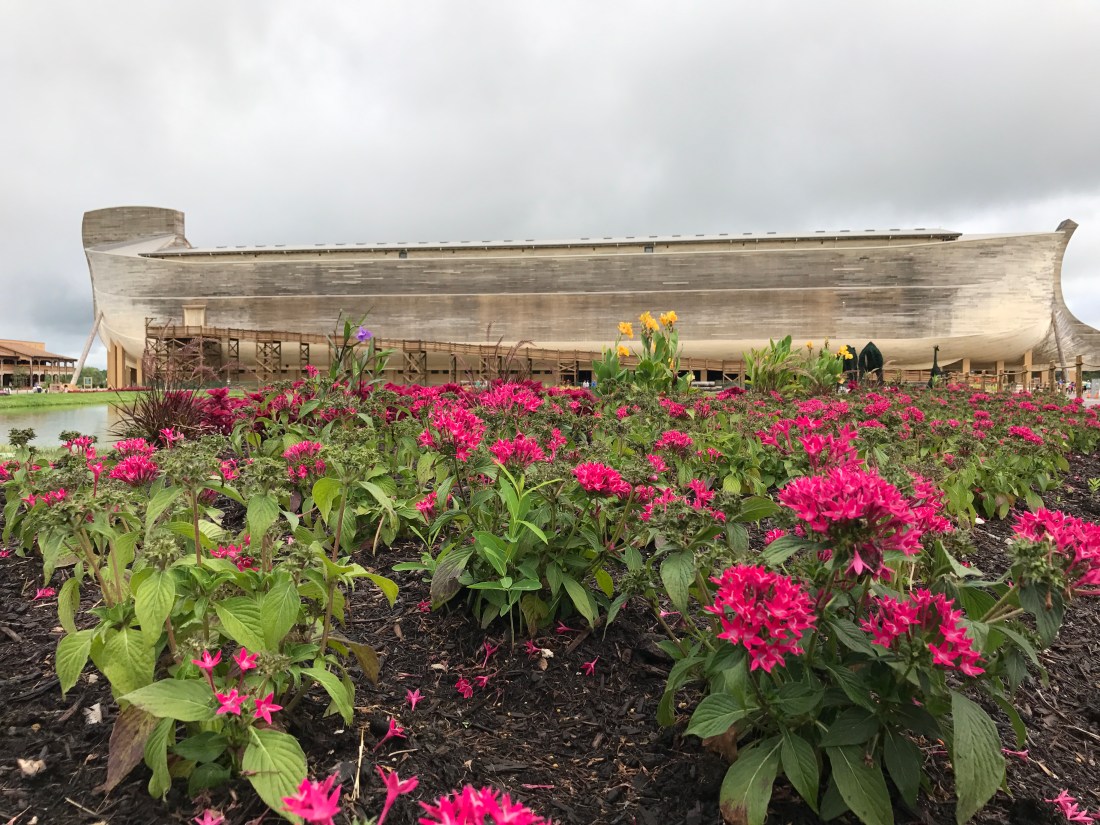
Like Jurassic Park the Ark Encounter isn’t quite finished–but they had what counts—the massive Ark which is the largest wooden structure on earth currently.  It is worth the price of admission just to see it.  Built by Amish craftsman to the kind of perfection they are known for, it became obvious quickly that the entire site serves to inspire people toward Christianity with overwhelming optimism.   The park itself had construction going on everywhere and was led by a charismatic president of the operation who narrated the arrival with the kind of fanfare only seen previously in fiction.  By only hiring people of the faith, there are no gay people or sour employees who were covered in body piercings and experimenting with atheism to muddy the experience, the whole place had a workforce much like Chick-fil-A where they wanted to be there and enjoyed the visit by the guests.   They currently have open the Ark—which by itself is worth the money, but they also have a nice little zoo and a few gift shops.  There is a zipline experience to help bring a little adventure to the park with obvious big ideas blooming later as the park matures.  But I think where the Ark Experience really shined was at their very nice restaurant called Emzara’s.IMG_4790

The gift shop was very impressive at the back of the Ark.  In it was a lot of material designed to be keepsakes, but I thought the best of it was of course the book selections.  There is a lot of reading material to delve into.  I don’t think it’s important at a place like the Ark Encounter for everything to be factual—after all, I’ve been to the actual Jurassic Park at Universal Studios and nothing they had there was real—but people suspended belief long enough to enjoy a functional mythology designed to get visitors to at least ask the “what if” questions.  At the Ark Encounter there is an obvious message of evangelical scholarship that is going on.  Nobody is force feeding anything but the opportunities are obvious and they most bloom from that short walk from the back of the Ark into the wonderfully spacious Emzara’s restaurant.

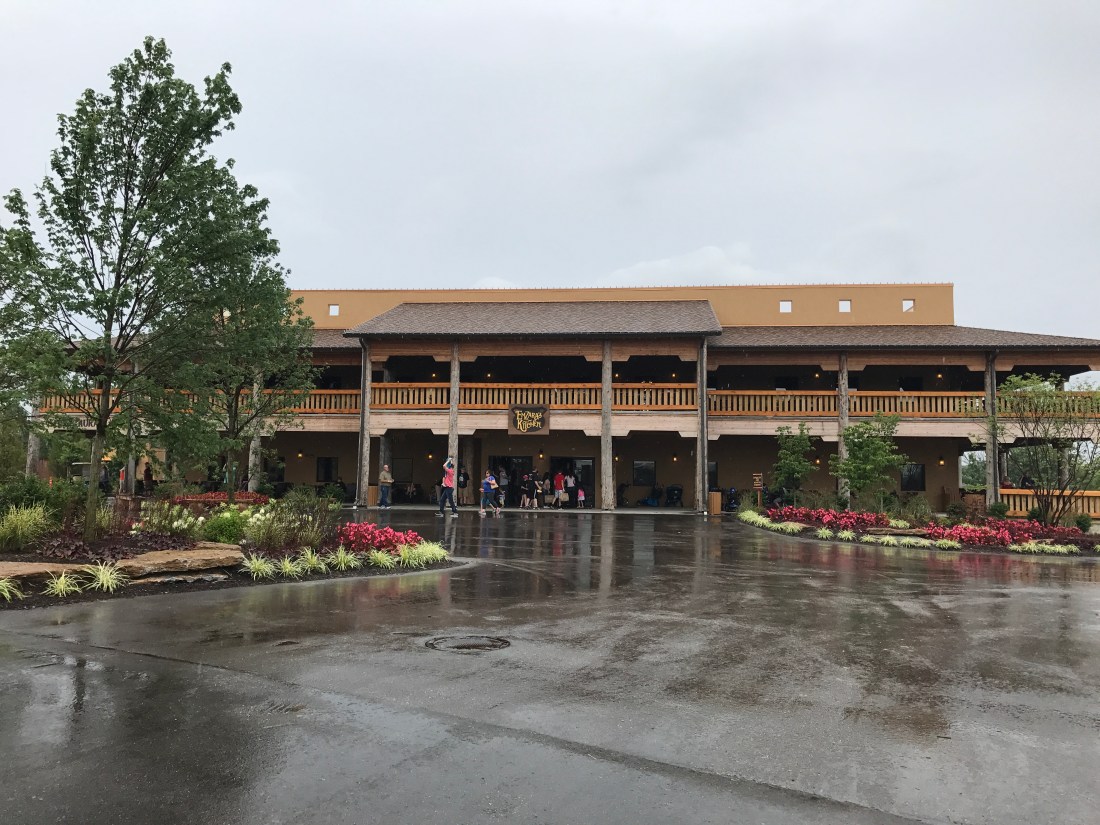
That place had a buffet style offering with abundant food to satisfy the sensibilities of southern expectations in America—and it’s big—designed to handle thousands of customers comfortably.  The building is two stories and also offers outside seating very spaciously provided.   That’s where my wife and I ate, away from the noise downstairs where things were a bit quieter on the second story.  It was up there where I saw several young people with open laptops off in the corner reading and doing Christian based research with their peers.  It was like church only at an amusement park with all the optimism that comes from such a place.  That’s where it was most obvious the brilliance of Ken Ham’s work there.   He has essentially created a Biblical refuge from the outside world where scholarship can be explored in the context of real scale to open up the thought process toward evangelical thinking.

Obviously, and it’s already happening, Ken Ham plans to make that 1-75 exit 154 an evangelical dedicated enterprise where the persecuted can gather to recharge together in the masses and return to the world to spread the word of God.  What he has created from nothing reminded me a lot of the early days of Disney World in Orlando.  It doesn’t take much imagination to see where things are going—rapidly.  The place is built to handle crowds and as I said, we were there on a Thursday afternoon just an hour after the place opened and the parking lot was full.  People were coming from more than 1000 miles in some cases to visit and I didn’t see a single beat up car in the parking lot.  The kind of people I saw visiting were good, hard-working people who were personally successful enough to have new cars to drive and families with two to four children who attend church regularly.  They were not the dregs of society let me put it that way–and they were willing to drive out of their way and spend a lot of money to see a life-sized Ark, shop at the abundant gift shop and eat at Emzara’s.  There is no pretense that you have to agree with Ken Ham’s “young earth” theories.  If viewed as a functioning mythology, there are a lot worse things for people to be thinking about.  But at least at the Ark Experience good people have been given an opportunity to spend some time around other good people with a soft sale of immortal enlightenment and let me tell you something folks—that’s a very powerful thing in our young American culture.  The Ark Experience is worth the trip, the money, and the hope it has for the soul of mankind and its “think big” massage is timely, and potent.  I predict big things happening in Williamstown, Kentucky over the next decade—and beyond.  And maybe, just maybe—we’ll find that America can find its national identity and return to a foundation rooted in Biblical scholarship which unifies our nation productively, and spiritually for the better.

Rich Hoffman

Sign up for Second Call Defense here:  http://www.secondcalldefense.org/?affiliate=20707  Use my name to get added benefits.

cropped-img_0202.jpg

Hollywood Down 8% in 2017: Trading politics for profit to destroy an industry

This is far more important than most people think—the movie box office for July of 2017 was down 8% from the same period a year ago.  Additionally Disney has lost around 4 million subscribers to its Disney Channels over the past three years as kids turn to other forms of entertainment.  More and more homes are cutting their cable service as it’s just too expensive for what people get,  and theater owners are struggling to survive with Hollywood giving them very little to work with to justify the big investment that a movie ticket costs these days.  That same home theater market is keeping people home more rather than go to the theater to see movies that could otherwise just be seen on Netflix.  If you couple all that with the Donald Trump versus the media battle—which will hurt traditional media extensively, the entertainment industry is in big trouble—which I have been saying for a long time.  All the stocks are down for the theater owners—which I feel sorry for.  The distributors have let them down by pushing a product that was just too liberal for mainstream American audiences and now they’ve all been hung out to dry.

http://www.hollywoodreporter.com/news/box-office-hollywoods-franchise-crisis-worsens-july-fourth-1018493

http://www.tubefilter.com/2017/07/05/disney-channel-freeform-ratings-falling/

For about 20 years I bounced around with tentative meetings within Hollywood.  For me it was more than a treasure hunt, I really wanted to make movies and to contribute to the library of wonderful movies that I had grown up with.  The business end was something I didn’t have much patience for since most of the people running the industry were radically more liberal than I was.  So I’d get a project floating around out there but it would go cold.  The money guys were also liberal so the project proposals I suggested were either heavily scrutinized with extensive re-writes to soften them up, or they just weren’t getting off the ground.  In a few cases I was offered positions in the industry, but my wife didn’t want to move to California—and without living in such a way that you could network in that town, it was pretty much impossible to get any project off the ground.  I went to several film festivals, won a few screenwriting awards and ended up doing a few bull whip stunts for legitimate studios but the last time I flew back from Hollywood in 2008 I knew that the industry was in trouble from a business perspective.   They weren’t going to make it which made me sad, because I liked traditional Hollywood—I always liked Howard Hughes, George Lucas, Steven Spielberg, Albert Hitchcock, John Wayne and Clint Eastwood.  These new filmmakers in Hollywood were too political and I was from a flyover state so things just weren’t going to work out.  After that last trip I put my focus into other business opportunities and waited for the inevitable which is now upon us.

Movies cost too much to make, the labor unions which represent all the industry people has forced them all to think too collectively to stay in touch with the American people.  Reading with great interest how the Han Solo movie fell apart at Lucasfilm it’s obvious that the new generation is just too soft and manipulated by their director’s guilds—into liberal politics which the movie going audiences can’t stand.   Even though I warned of all this years ago, and have written extensively about it since, it still hurts to see an entire industry collapsing on itself.  The Hollywood product is now on life support with only a few big Disney releases carrying most of the industry.  Warner Bros. has done well with Wonder Woman, and Marvel had their usual hits with Guardians of the Galaxy Vol 2.   Small films like Baby Driver did respectable business, but big films like Pirates of the Caribbean 5 were down a quarter from the previous installment worldwide and that isn’t good news.   Critics have been hard on these new movies as they have an extreme political slant to most reviews and once the Rotten Tomatoes scores hit online people are so turned off they just don’t go see these films and that cycle is worsening.

Hollywood is about more than just the movies themselves—it’s about an entire industry from print media like Entertainment Weekly, The Hollywood Reporter, to the television shows Inside Edition and Entertainment Tonight.   Critics for the big newspapers have national audiences in some cases and they have abused their relationships and let that stardom go to their heads giving themselves the power to sink or swim a picture—so essentially they have cut off their own noses to spite their faces.  I remember a very specific day in Glendale, California where several day time television programs were set up on the same street to shoot exteriors and I was having lunch with some people who worked the trade publications who were full of themselves way too dangerously.  I tried to make them aware of the fragile eco system that was on full display and they had the kind of attitude that the gravy train was going to go on forever.  Well, within two years every one of those people was out of a job and their publications had folded.   They should have listened, but of course they didn’t.  Most of those big name trade publications won’t be around much longer because nobody really cares what they have to say. The media stars they talk about are today far more political than they used to be and they have aligned themselves against Trump who is set to be a very popular and successful president, and now there just aren’t enough fans of their material to carry them into the next decade.

There are going to be a lot of bankruptcies—and even the Disney Company will feel the squeeze.  While I continue to be very impressed with what Disney is doing at their parks and with the Star Wars movies as one giant mythology spanning many platforms—computer games, etc—they still rely too much on theater owners to distribute their core products and those theater owners need more than just Disney to stay afloat.   They need every weekend to have people wanting to go to the theaters to buy over-priced popcorn and soda to watch a movie they don’t want to wait for release on the home market where likely the televisions they have at home is far better than what is offered at the theater.  I will have to add that when my wife and I went to see The Book of Henry that the Regal Cinemas we went to had adjusted their prices down for popcorn and pop to a very reasonable level.  The theater owners out there are doing their jobs and adjusting to the marketplace, but Hollywood hasn’t.  They keep making the same crap and trying to repackage it instead of turning loose people with great ideas to constantly keep material fresh.  I know I wasn’t the only one trying to get new ideas to production companies—it was mainly a cultural problem.   Studio execs were too interested in getting laid at the multiple parties around town by telling chicks that they were for this liberal cause or that—so they were making decisions at the executive level in producing products that American audiences did not want to see.   Once they got their blow job they had already committed their studio to ten films for production the next year which nobody would want to see because of their overly liberalized political overtones.   Sure the chick who was giving blow jobs at the party liked the Matt Damon movie about fracking—but nobody in America wanted to see it and the budget was blown.

So the industry is toast—it won’t recover in its present form.  Of course there will be investment opportunities in new styles of media, but the Hollywood game is over.  The industry just hasn’t come to terms with it yet.  There are a few $1 billion dollar earners yet to be released in 2017 but it won’t be enough.  By the end of the year the gains will be so far down that they won’t even be worth discussing.   And life outside of Hollywood will go on.   All I can say to those people who were so haughty 10 years ago is that I sincerely tried to tell you this would happen, but you didn’t listen.  I wish you had.  So now it’s time to pay—and it will be painful.  But you people did it to yourselves.   America will be great again and Hollywood has removed itself from being a part of it—and that’s a damn shame.

Rich Hoffman

Sign up for Second Call Defense here:  http://www.secondcalldefense.org/?affiliate=20707  Use my name to get added benefits.

cropped-img_0202.jpg