Solar Panels at the Cincinnati Zoo: Great innovations that should be more heavily utilized

Many think that because I’m to the political right of Ted Cruz, that I don’t enjoy green technology. Contrary to the belief, I enjoy innovative technology regardless of the political sensibilities. I’m certainly not against green technology when it makes sense and is not uttered with religious-like fervor through belief in speculative science which indirectly attempts to undercut capitalist endeavors. With that said I was in for several surprises at the Cincinnati Zoo which greatly impressed me when I went there for the first time in several years in early April 2015 just as the flowers were blooming after a day of heavy rain.

I was loosely keeping track of events at my hometown zoo which I have always been proud of. My wife and I had been there so many times and never really saw any improvements so we took a break for a bit. I haven’t even driven down that particular stretch of Vine Street in at least six years, so I had no idea about the wonderful solar panels built in the new Vine Street parking lot. My wife and I have often given out season passes to the zoo during Christmas because we like to support the zoo, but we personally hadn’t gone in a while.   My kids are all in their twenties now and our grandchildren have been too young. We have one grandson who is at the prime age, so we went with him for the first time and I was astonished by what we had discovered at the Cincinnati Zoo.

imageWhen I was a kid I loved going to the zoo. The Cincinnati Zoo is the second oldest zoo in America and has always been considered one of the top destinations in the country. At 16 years old I went to the San Diego Zoo, which was considered the best in America in the mid 1980s but I always thought it wasn’t by much. The zoo in Cincinnati has always been something I was proud of in my home town so I was eager to share it with my grandson and now grown daughter.
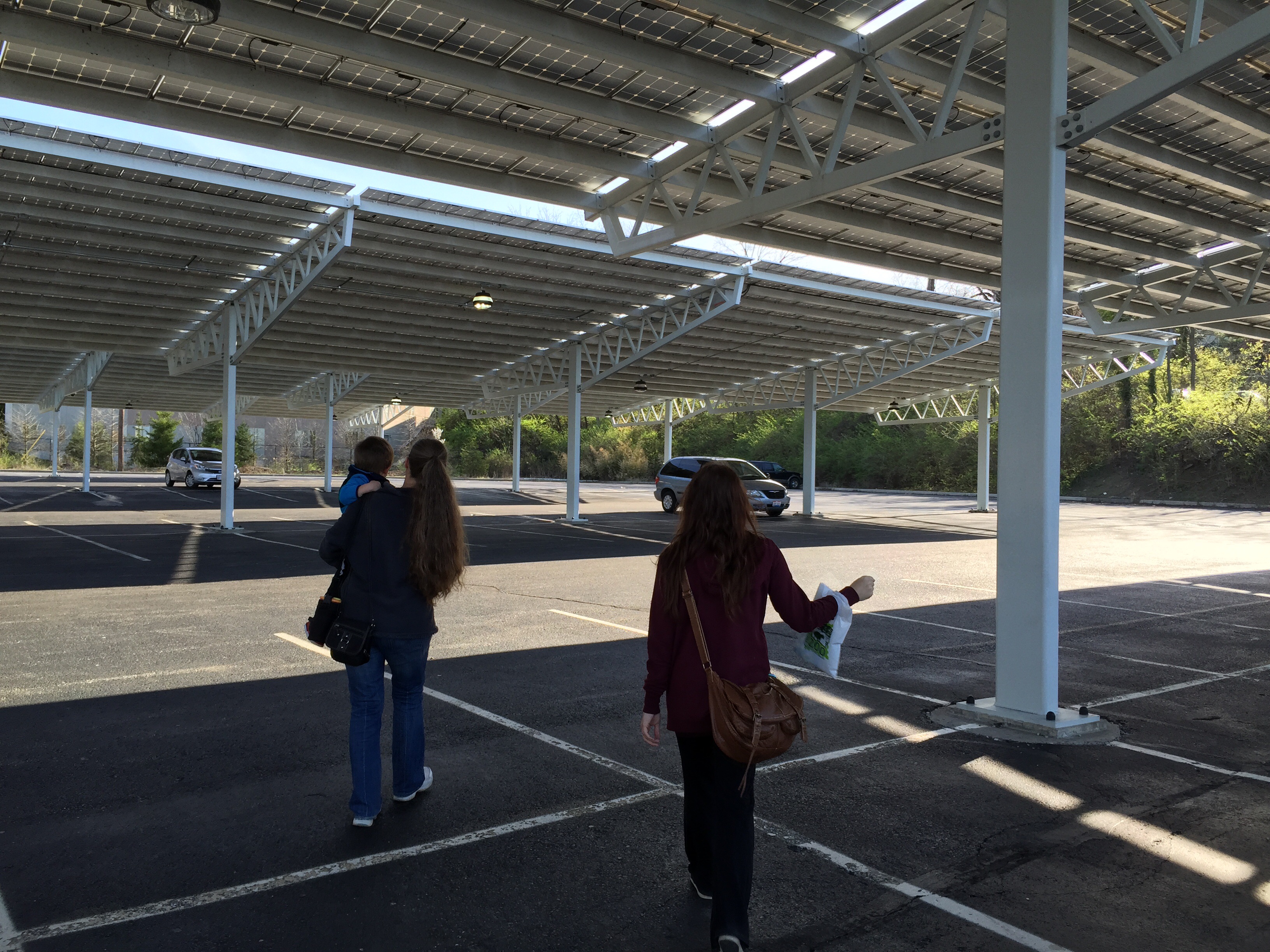
So I was in for a surprise when I tried to enter the parking lot that I always did when I was a child—the old one. I found I had to drive all the way around the block and park at the Vine Street entrance. I remembered that they were building a new Vine Street entrance when we came down for the Festival of Lights a half a decade ago, so I knew about the parking lot, but I had never seen the bridge that went over Vine Street or the new buildings consisting of the new heavily renovated entrance which turned out to be spectacular. That’s when we pulled in and I was astonished to see all the solar panels covering the parking lot.image

I’m not a very big fan of solar panels because they take up so much space for what you get in energy feed back. However, the way that the Cincinnati Zoo utilized them was absolutely perfect; they essentially spent something around $11 million dollars to cover the parking lot for their guests dramatically cooling down the surrounding air during their intense summer season. The whole parking lot was basically a large car port which would really help visitors keep their cars cool while they enjoyed the zoo avoiding that terrible heat that often happens when a car has sat in the sun all day when visiting amusement parks as the sun beats on those cars for hours. The Cincinnati Zoo led by Mark Fisher had done something that I thought was incredibly smart with solar panel technology and found the perfect dual use. They gave their millions of yearly visitors a car port to park under while generating approximately 20% of their power needs at the zoo. Solar panels are expensive and spending $11 million to save a bit on the electric bill by itself doesn’t make much immediate sense. But improving the customer experience while doing so does, and I was extremely impressed by what the zoo had done with just the parking lot. Then we went inside.image

The Cincinnati Zoo and Botanical Garden is as I said the second oldest zoo in America, just 14 months younger than the Philadelphia Zoo. On Vine Street in Avondale when the neighborhood was the premier suburb of Cincinnati in 1874 visitors entered off that classic street which extends from there to the south through the University of Cincinnati to downtown. The first thing visitors would see off that original entrance was the Reptile House which is the oldest zoo building in the United States built in 1875. So we are talking about some legitimate history here. The architect building the new entrance did a noticeably fabulous job of constructing a skyline from the vantage point of the parking lot that was consistent with the homes built around Vine Street. If I didn’t know where the zoo was, I would have thought that the new entrance was simply part of the community, and not the entrance to a major amusement park, which the Cincinnati Zoo is. It was an ascetic decision that greatly impressed me. But not as much as what the zoo had done to the original old parking lot which I noticed instantly after we had visited the new giraffe area.image

Starting in 2010 through 2014 were four phases of a long-planned exhibit called Africa, which sat on 8-acres of former parking lot. A fifth phase was still under construction which would feature Nile hippos opening in 2016, but the four opened phases simply stunned me with their innovation.   New to the zoo were these magnificent glass barriers which put little kids right up to the lions and gave the feeling of an open African savannah teeming with Africa’s most spectacular animals, like zebras, gazelles, impalas, ostriches, storks, cranes, and of course lions. It was very Jurassic Park inspired and was a massive improvement over my previous visits.image

Yet even more impressive was the new Base Camp Café which is rumored to be the “greenest” restaurant in America, which was so effective I didn’t even think about it. It sat on a bit of a hill overlooking the four phases of the African exhibit with the kind of charm and utilization found in Disney theme parks. The dining area outside of the Base Camp was vast and well suited to allow diners to watch the animals while they ate. As we ordered our food gone were the employees at the zoo from old where they were sometimes a little grumpy and acted as if they were doing you a favor by talking to you. Here were very energetic employees who knew they were in competition with other tourism dollars and they wanted our money. They were polite, helpful, and fast with an eye on quality. They had an expediter at the counter to keep food moving from a very well-staffed kitchen working hard. That was good to see. Upon getting our food and sitting down to eat it outside I kept thinking that vacationers to Disney World or the actual African Serengeti were not so lucky to have such a view. The food was of a high enough quality to be considered good, but the view was simply spectacular. There really wasn’t a bad seat in the house and the whole Base Camp restaurant was stationed at such an angle that all the exhibits blended together into one giant plain. The animals were of course separated by different elevations of pooled water, which kept the lions from eating the gazelles, but from the point of view of the restaurant you really couldn’t tell. That was another brilliant move by the architect—who clearly knew what they were doing.image
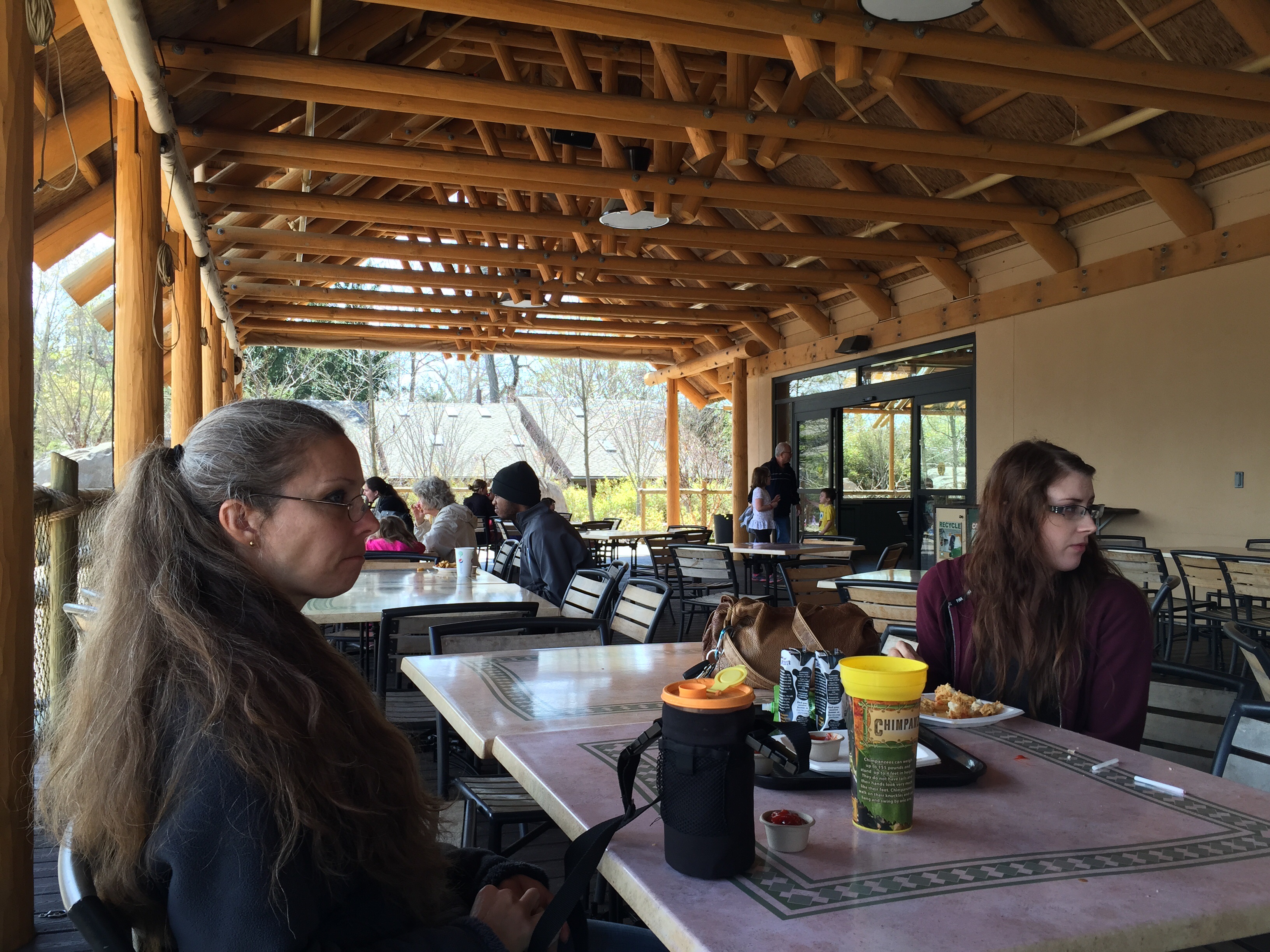
Throughout the rest of the park were small little improvements that showed a major investment of energy in updating the historic zoo to the level of competition influenced by the Disney Parks and offerings of Kings Island just up the road. Everything was just top-notch and improving. To make matters even better were all the flowers that had been planted and were blooming in the early April sun. The colors were just stunning. I love spring anyway, but the zoo took everything I love about spring and accentuated it dramatically with a visual display that rivals their winter time Festival of Lights.image

Needless to say, I had a nice visit to the zoo with my family. It made me happy my daughter had kids just because it gave me an opportunity to return to a zoo I had gone to all my life, but had grown used to. If not for my little grandson, I might not have gone to the zoo so soon, because I thought I had seen and done everything that they could offer at such a city zoo location. But the Cincinnati Zoo showed that they were not happy just being one of the oldest zoos in the country with a respectable reputation for innovation over the years. They were still growing and wanting to get better. Their work with the parking lot and the African exhibit showed me that they were willing to compete directly with Disney World and Sea World for tourism dollars because they are offering a comparable experience. I had no problem spending a good deal of money at the zoo as if we were traveling to some exotic location to see the animals. I would go to the zoo again just to have lunch at the Base Camp.image

I was surprised to learn that only the Cincinnati Zoo had utilized the solar panel parking lot concept. Conceived in 2011 it is still the only one of its kind anywhere—which again surprised me. I mean the sun shines regardless of whether someone captures some of it’s energy—so why not grab some of it for lights and to run a few of the water pumps that filter the water at theme parks like Disney World and Kings Island? I can only imagine what the impact would be at those two destinations if they did with their parking lot what the zoo had done. I have been to Disney World in the heat of mid summer and have returned to a car so hot that it took the whole ride back to the hotel to cool off with the windows down and air blowing. If they did what the Cincinnati Zoo had done, the cars would have all been shielded by the sun and the parks would have received some power to help with their energy costs. For a park like Disney World it would likely cost $200 million dollars which is a third of the cost of a whole new park. But it would enhance the customer experience while cutting down energy costs with their electric bill. The Cincinnati Zoo should be the showcase of how and why we should use solar panels, and if more businesses did the same type of thing, the cost might actually come down.image

The solar panels at the zoo set up on just 6,400 solar arrays take about six acres and could power 200 homes of average size for a year. It really exhibits how roofing material made of solar arrays could capture energy to soften the blow of escalating electric bills. It’s a smart idea that should be gaining traction, but nobody but the zoo has yet to take that step. Granted, it’s a radical departure from tradition, and it is science that steps beyond politics. I’m sure Duke Energy would lobby the Ohio senate such as what is behind Ohio Senate Bill 310 to freeze state renewable energy standards for 2015 and 2016. imageThe zoo was able to pay for the solar array with a multitude of options like tax credits, accelerated depreciation, and some debt financing, but it all paid off in what they were able to create. In my opinion, there should be a lot more of these solar panels anywhere that the sun beats down on a car in the hot summer sun, from shopping malls, to Cedar Point, and sports stadiums. It was a remarkably innovative idea that should be copied by everyone. And it made me proud to see that my favorite zoo, The Cincinnati Zoo, was the first to use them in a way that made sense and paved the way for what our future should hold. The Cincinnati Zoo is an organization that has always pushed the limit with innovation, and that is a tradition that looks to continue into the future. And what a treat it is to see that innovation at work. It made my trip to the zoo a wonder which I hadn’t expected. It reminded me of what a special place the Cincinnati Zoo is, and made me proud of all those season passes we passed out over the years even though we hadn’t gone ourselves. It was a pleasant surprise to say the least.

Rich Hoffman

 CLIFFHANGER RESEARCH & DEVELOPMENT

Listen to The Blaze Radio Network by CLICKING HERE.

Vote No on the Midpointe Library System: Philosophy and the changing way of expanding knowledge

I am against the MidPointe Library System in Butler County, Ohio for all the same reasons I am against school levies. Even though I tend to love people who strive for knowledge and desire to feed minds with information, the quality of those efforts can cast people adrift all of their lives ruining them, and a library in many subtle ways contribute to that personal destruction. Before detailing why and how, here is the case that the MidPointe Library System makes for itself looking for more money from voters during the upcoming May 5th 2015 election.   Essentially to make a long story short, they make the same arguments that public schools make, helping the children, offerings to the community, and all that kind of nonsense.

The MidPointe Library System will have a renewal levy on the ballot on Tuesday, May 5.  Please find information regarding this levy, as well as why the Library is asking for continued community support below:

Something for Everyone in the Community

With current funding levels, the MidPointe Library System is able to provide many resources, materials, services, and programming to the residents of eastern Butler County. 

MidPointe offers a collection of over a half million items, and partnership in the SearchOhio lending consortium gives patrons access to over 16 million items from across the state. In 2014 over 2 million items were checked out. Additionally, MidPointe provides internet access and public computers to assist people in finding jobs, accessing data and doing school work.

In 2014, MidPointe offered over 2000 programs.  These are as diverse as yoga class and technology instruction for adults, to storytime and early literacy book clubs for children.  The Library’s Summer Reading Program, which promotes literacy for all ages, reached record involvement last year, with nearly 10,000 patrons participating. 

MidPointe’s influence expands well beyond the buildings. Librarians visit schools and community centers to engage young people in the joy of reading. Educators are able to stock their classrooms with books as a result of MidPointe’s “Teacher Collections.” The MidPointe Outreach Services Department delivers materials to over 200 patrons who are unable to physically visit the Library.

Library Budgeting

For the past two decades, Libraries in the state of Ohio have faced reduced funding.  In 2008, the most drastic of these cuts occurred and as a result, the Library had to dramatically reduce hours, services and staffing.   For the first time, the Library approached the public with the possibility of a .75 mill levy to supplement operations.  The voters of our Library district passed the levy, which represents almost 40% of the MidPointe budget. Overdue fines and fees only represent 3.25% of the Library’s overall budget.

The overwhelming majority of the Library’s expenses are devoted to collection development and public service and programs. Administrative costs represent only 12.5% of overall expenses and the MidPointe Library System has continually been recognized as one of the most cost-effective in the state. 

Levy Details

  • The levy on the May 5 ballot is a renewal. This is not a new tax.
  • Levy funds make up 40% of MidPointe’s budget.
  • Levy Millage:  .75 mill
  • Length of Levy:  5 years
  • Cost: The cost of this levy to the owner of a $100,000 home is approximately $22.97 a year(less than the cost of one hardback book).

Levy funds will:

  • Maintain services and materials at all MidPointe locations.
  • Continue to provide current technological resources to the public.
  • Allow for sensible expansion in our growing community.
  • Sustain programs for children, teens and adults.


http://www.midpointelibrary.org/news/renewal-levy-information/

Essentially they simply want more money to continue a practice that is rooted in socialism. I have never liked libraries because I have never liked sharing my books. I like buying them, and owning them—collecting them like treasures to be guarded by me as part of a life’s journey. It has always seemed wrong to “borrow” a library book from the library where they maintain “collective” ownership. The concept of a shared resource is disgusting. Library books are routinely abused because nobody owns them and are reflective of the type of society that is not centered on personal responsibility and individual ownership.image

I have not been to a library for years. In my community within my little network of a neighborhood I have one of the best libraries in the entire country, the West Chester Library, yet I never, ever use it. I would not borrow a book or movie from them, because I don’t want to use someone else’s stuff. However, I go to one of two Barnes and Nobles book stores about two times a week. The children sections in both of those book stores are tremendous services to children and show how much better private investment is in constructing the mind of young people. The book store in Newport, Kentucky is just fabulous and is still one of my favorites anywhere—which is pictured within this article. It is a temple of knowledge and I love it—yet it is struggling to stay afloat in the changing climate of online offerings. Unlike the MidPointe Library System, Barnes and Noble cannot ask for a tax increase to stay afloat in a changing economy. So they have to adapt—where libraries are doing the same things they always have—and they lose a lot of money because of it. They are essentially money pits and their offerings to the community are not beneficial as they pretend.

The job of teaching children to read falls on the parents or less directly, the extended family members of a child—aunts, uncles, grandparents and so on. Not a socialist librarian or volunteer who has a subtle agenda of encouraging sharing as opposed to ownership. The world of a capitalist society like the United States is rooted in ownership—not sharing. When something of value maintains its worth because someone owned it and cared for it, it is then valuable to someone who might want to purchase it for their own. Libraries encourage sharing and while that might sound good on the surface—the mentality created from this exchange of ideas often leads to various acceptances of degrees of socialism—like public education, public housing, public assistance and so on.image

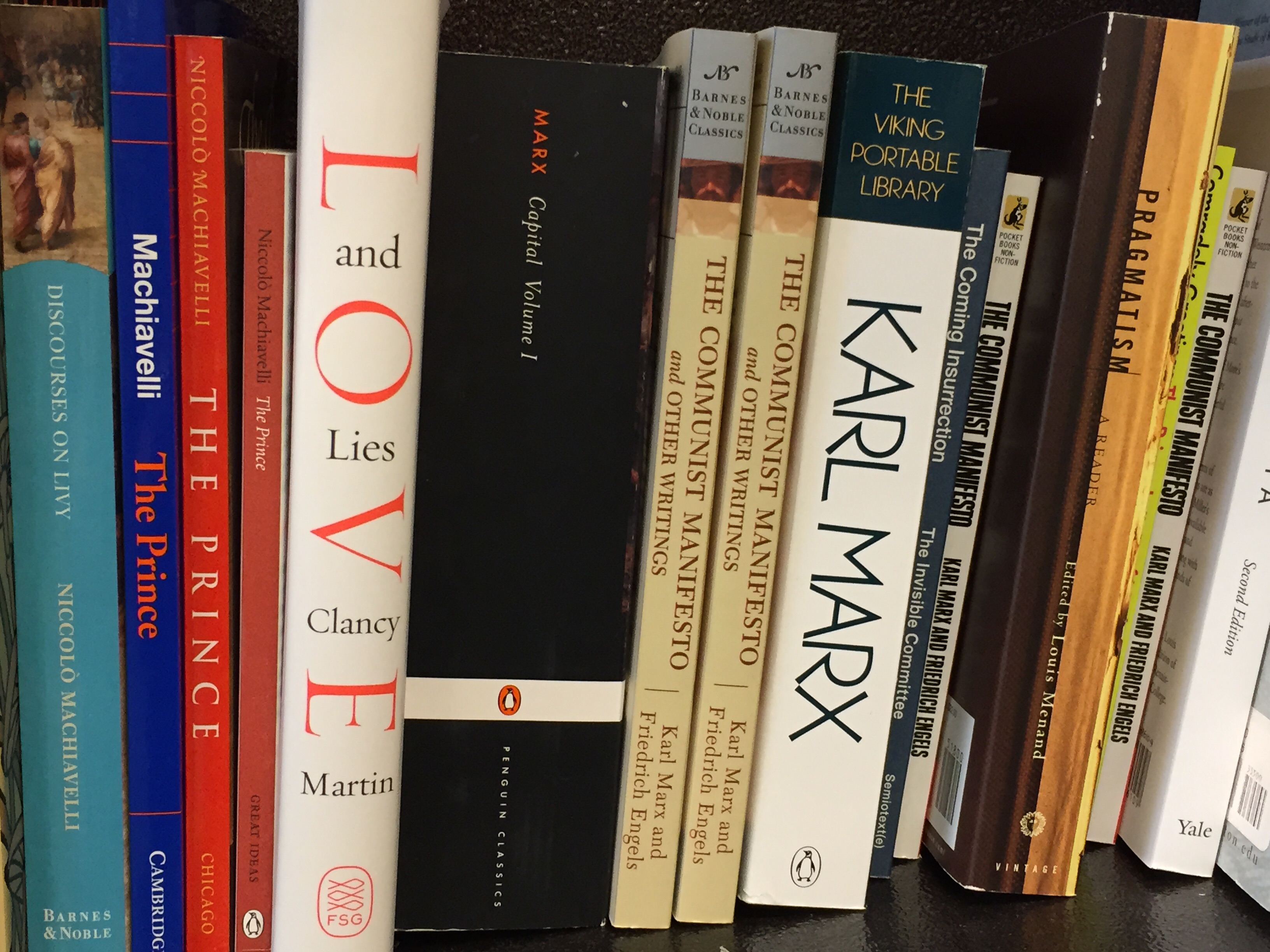
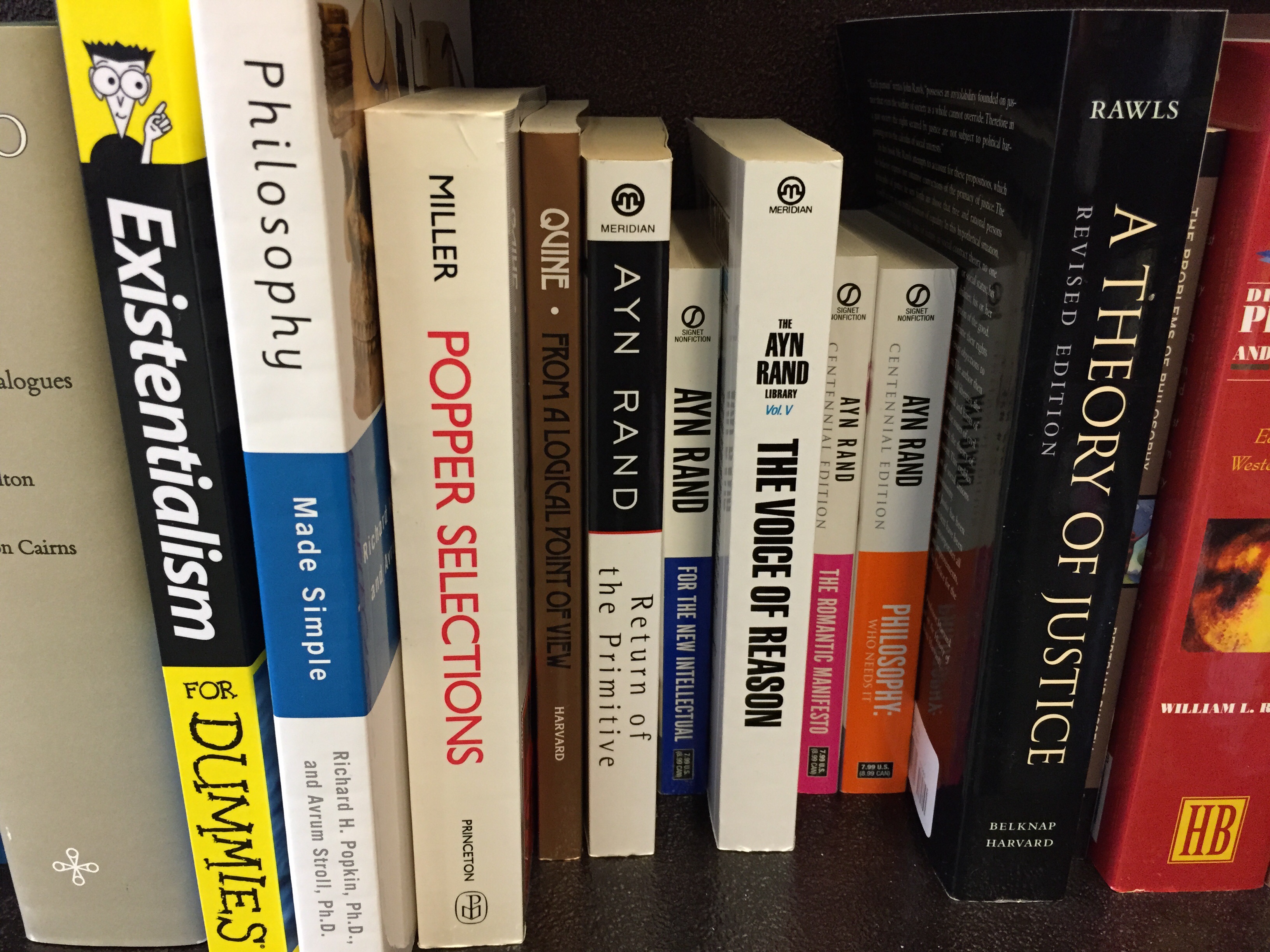
From the book shelves at Barnes and Noble in Newport, Kentucky in my favorite section—the philosophy section—the two primary competing ideas regarding philosophy are on full display—because that is what people are buying. Amazon.com can provide obscure books within a few days and at a great price. Barnes and Noble put on their shelves titles that sell. All the other sections in the book store, politics, fiction, and cooking, current events—etc, all stem from the philosophy section. People think the way they do and are attracted to some things rather than other things based on their personal philosophy, so I see it as the most important section. In the various schools of thought in Western philosophy everything is basically built off two individuals, Plato and Aristotle. In the east it is Confucius, which leans toward Western Platonic thought. What that translates to through a long line of philosophic thought is essentially Karl Marx and Ayn Rand. imageI certainly lean toward Ayn Rand—yet I think her Objectivism is limited to Einstein’s Theory of Relativity and that there will be new schools of thought stemming from her Objectivism that will have to encapsulate the bizarre behavior of quantum mechanics now being discovered. But Karl Marx has been a failure and is a dying philosophy that will either be extinct within the next two hundred years, or it will destroy our civilization. I have no use for Karl Marx in any fashion. Libraries are part of a Karl Marx mentality.image

I love libraries for their historical significance—especially the library in Alexandria. At the time the cost of printing books was prohibitive and everyone couldn’t own a book. So the borrowing of books at a library was the best way to achieve an exchange of knowledge. But that time has passed. Now there are so many books printed that the market is saturated with knowledge. It is easier, and more efficient for people to upload books onto their devices, or just buy them at Amazon.com. Stores like Barnes and Nobel fill the traditional role of a library being a center of learning—especially for kids. But as for motivation into intellectual endeavors, libraries are not a substitute for a good parent or mentor. The reason I don’t go to the West Chester library is because it feels like a socialist utopia to me. But Barnes and Nobel feels like the intellectual center of a capitalist country and I could essentially move into every one of them and be very happy. It is for that reason that I will vote no for the MidPointe levy on May 5th. I feel sorry for them, but they are a dying enterprise that will evaporate under the changing times—and it would be better for them to see that happen now than prolonging the agony. Community isn’t very valuable unless the members of that community believe in an Aristotelian logic as opposed to a Platonic sentiment. A community of socialists is a destructive force, and that will be the unintended consequence of a continuation of the library system in America. It is time for a replacement and it begins with a withdrawal of funds from the black hole of tax increases for which libraries currently represent.

Rich Hoffman

 CLIFFHANGER RESEARCH & DEVELOPMENT

Listen to The Blaze Radio Network by CLICKING HERE.

The Art of Playing: Celebrating life and happiness

imageIt was my 47th birthday today and I spent it in an unusual fashion compared to some, but quite the standard within my family. During it I was reminded of a conversation I had recently with some pretty important and powerful people about the nature of living and how I manage to do so many things at several layers of severity and risk,  but still manage to lay my head down on my pillow each night for sleep without wanting to jump off a roof. It’s a secret that I feel compelled to teach the world, just so that I might remove just a bit of their suffering and change the direction of their life’s focus. It’s a method that everyone would benefit from if they embraced it more and would drop the broken stereotypes of the past—because they don’t work. As a brief intro to the concept please understand that my wife could have given me just about anything for my birthday—a new Apple Watch, an expensive vacation, a dinner at Cincinnati’s exclusive restaurants, even a new car—but what she did give me was infinitely more interesting and fun. She gave me a Zoomer Dinosaur. She has been watching my grandson and he knew what she had bought me, and at just over 2 years old, he couldn’t wait to tell me. So he guided me to where she was hiding it and we opened it up. She didn’t care because he was so excited to see it move. After opening it, we put the little dinosaur on the ground and began playing with it—which set the tone for the entire birthday celebration.

My mother taught her kids how to play, even late in life. Growing up we played a lot and had very diverse interests. My grandmother also played at life a lot and made growing up very fun. Every trip to the grocery store was fun because they made it that way, and as a result I carry that into my own life-even in tragic situations. I try to have fun every day of my life—no matter what is going on. That is a pattern started in my childhood by my mom. My brother and sister have a similar love of playing and as a result as grown adults, they don’t have any mental problems or issues with social interaction. They are not drug abusers of even a slight nature and have no real insecurities of any mention. Now with kids of their own, they are bringing that element of play to their own offspring with very positive results. But out of all the members of my family, I learned to play more than the others and I am more obvious in my dedication to it.

One of my best memories as a kid was when I had to go to soccer practice one evening when I really didn’t want to. I always loved sports, but only the games themselves. I didn’t like all the team work crap—ever, or the social infusion with the community. When my team would win the parents were always excited for some mysterious reason and used the word “we” a lot. Yet they never did anything to help win the game except yell like a bunch of idiots on the sideline. It never made sense to me, and as the years moved on, I stepped away from sports because of the heavy emphasis on team building and derision on individual achievement. If I had different teachers and social influences as a young kid I might have moved into professional sports of my choosing, but because the wrong influences were around me focused on the wrong things, I abandon sports at my first opportunity—as a freshman in high school. But of that wonderful memory, I was at soccer practice, miserable because honestly I had a huge set-up in the basement of my home dedicated to Star Wars and I wanted to be there playing with all my toys rather than running around at soccer practice. It was spring time, my dad was out-of-town on business, and I was hoping to be home so I could have some play time before bed. It was the middle of the week and I had school the next day, so my time to play at the things was short. My mom picked me up from practice and we headed home. Only this was different, my brother and sister were in the car dressed like we were going somewhere, and there was the smell of popcorn from the trunk. I didn’t think much about it until we took a different route home and ended up on roads I wasn’t familiar with. Those roads eventually took us to a drive-in theater in Hamilton that was playing the very first Star Wars movie as a re-release. My mom took us all to see it for what I think was the 7th time at that point. It was wonderful and I cherished deeply every frame of film. During the scene where Han Solo and Luke were rescuing the princess, which is the high point of the film for me, I was sitting in a lawn chair with my soccer cloths still on listening to the echo of all the portable speakers around the drive-in playing the sound of the movie with a slight delay during that specific scene—the clouds were high in the sky and slightly blotting out a big bright moon on a spring night—and I thought about how wonderful life was. It really didn’t get any better than that.

But every day I try to make the day better than that day at the drive-in, and most days I come close. I am always looking for a way to have fun with a situation, and most of the time I do. I avoid people who don’t know how to have fun. If they are depressed people trapped in emotions constructed around neurosis, I usually paint them out of my life for my own preservation. If they can’t keep up, I leave them behind without looking back. I like to have fun, I love to play, and I hate people who don’t know how. I’m happy to teach “happiness” to them, but if they don’t show much of an effort, I drop them quickly. I understand and sympathize that they didn’t have a mom like mine who showed them how to play, even as adults, so I take the time to teach them. But I won’t sacrifice myself to their misery. If they want to be miserable, I leave them to it. I might write an article like this to help show them the way, but I won’t take their burden on myself if they wish to be stubborn about it.

I have known many adults who give Rolexes to their spouses and new cars for birthdays—but most of the time those gifts are laced with a desire for social approval more than developing happiness in the recipient. Behind such gifts is the desire to brag to someone else about the value of the gift, and thus, the amount of social pull that person has in the world of mixed economies. So it means quite a lot that my wife out of all the things she could have given me picked the cute little dinosaur which I think is quite a leap in scientific development. The little sensors in it for a kids play toy are very advanced, and the gyroscope system which balances it on two wheels is quite extraordinary. I could play with it all day and night if left to my own devices. It is intriguing, and intellectually stimulating. I love it!

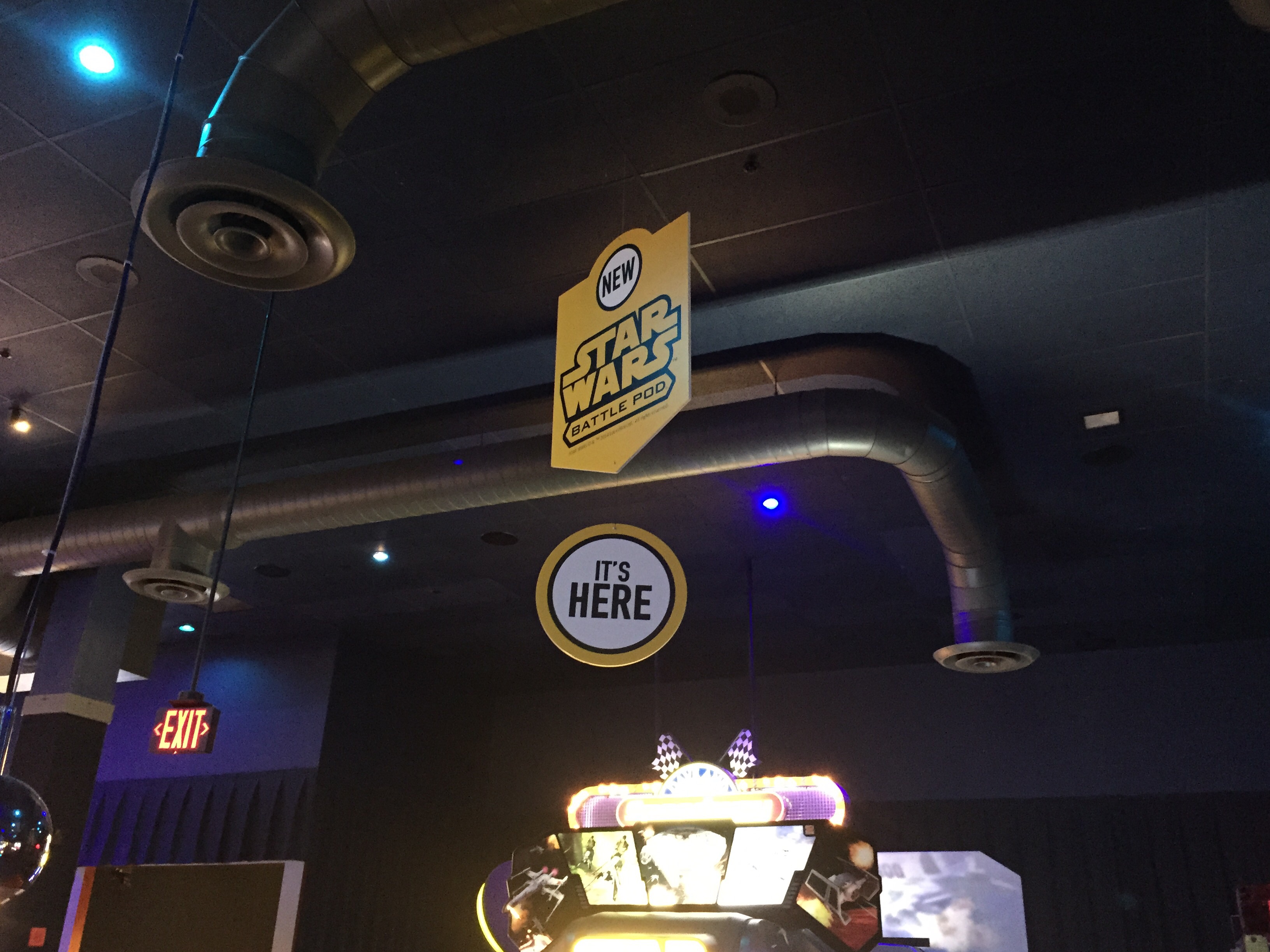
imageBut of course there was a gathering with my family like we usually do later in the day during my birthday. This year we went to Dave and Busters so that we could……………play…………….as a family. Specifically there is a new video game called Star Wars Battle Pod which is a kind of flight simulator for Star Wars. It is the newest, and greatest of what technology has to offer, complete with a breeze simulator to replicate actual environmental conditions. It has a wrap around screen that totally engulfs your vision allowing you to invest your intellect into the experience without distraction. The food was great, as it usually is at Dave and Busters, but playing Battle Pod was for me the best thing I’ve done for a birthday in years. In my family, most of us are intense Star Wars fans so we loved taking time to play it together. It was a stunning game to play, and fly. I had to reflect back to that drive-in surprise where my mom played like she was just picking me up from soccer practice on a school night, but instead took us all to see Star Wars one more time on a big screen, before it was gone forever—or so we thought at the time. Now, because of Battle Pod, people can play in the Star Wars universe in a way that was only a remote fantasy for someone like me years ago.

At Hollywood Studios my favorite restaurant is the Sci-Fi Dine-In Theater. It tries to simulate the drive-in movie experience I had in my youth, with my best memory being that Star Wars outing. There are still drive-ins, but they don’t carry the same impact as they did when I was a kid. Now they are viewed as a cheap alternative to the cinema experience as opposed to a first-rate experience. But when I go to Hollywood Studios, I have to stop by the Dine-In Theater and have a hamburger. It reminds me of that Star Wars presentation after the soccer game, and reminds me of the importance of playing at life instead of taking things too serious.

In reference to the important people I was talking about the best of us realize hopefully before they arrive at 60 years of age that career climbing and ass-kissing doesn’t get anybody anywhere. People are most effective and ultimately better when they retrain, or relearn the art of playing—as they did when they were kids. Typically, I don’t get along very well with people in my own age group, because most of them suffer from socially created illnesses. The people I most get along with are kids and old people because generally they aren’t worried about the ridiculous social rules which construct our network of associations. They would do far better for themselves to spend their time playing with other members of their families than in chasing the tail of someone higher in the peaking order hoping to schmooze their way to the top instead of letting their actions speak for themselves. One of the people I was talking to is a guy I enjoy quite a lot. He has a PHD in an advanced field of endeavor, but has not lost his love of playing. He’s is the grandpa of some lucky grandkids and the father to some fortunate children. Yet he solves problems like they don’t even exist, the kind of problems that might hang up regular people in the related field of endeavor. The difference is that this smart guy never forgot how to play at life, and therefore solves problems the way a child does, with resiliency and creativity. We teach our children to stop doing these things, and that is our first mistake. Instead, we should be teaching them to develop it further and to do so through their infantile 20s and 30s. But until everyone else gets on that page and recognizes that this is the way to conduct their lives—with playing at life for their entire lives—then I will continue to recharge myself the way I have. And for that, the little dinosaur my wife gave me along with Star Wars at Dave and Busters was a wonderful experience that gives me more than anything money can buy–a chance to play.

Rich Hoffman

 CLIFFHANGER RESEARCH & DEVELOPMENT

Listen to The Blaze Radio Network by CLICKING HERE.

Duke Wins NCAA Championship: College athletes rising to greatness in spite of institutional failure

United States Senator Claire McCaskill, of Missouri, illustrated without really thinking too much about it a great crisis for many when she tweeted after the 2015 NCAA Championship between Duke and Wisconsin:

“Congrats to Duke, but I was rooting for team who had stars that are actually going to college & not just doing semester tryout for NBA.”

http://www.msn.com/en-us/sports/ncaabk/missouri-sen-claire-mccaskill-takes-shot-at-duke-after-title-win/ar-AAawu1y?ocid=LENDHP

Saturday Night Live just prior to the big game made similar jokes in the same spirit, assuming that college athletes had an unspoken duty to their institutional education as opposed to the financial opportunity of leaving college after one or two years to join the NBA as young millionaires. These points of view are lost to ideology rooted in a hatred for capitalism where the old-fashioned belief was that citizens were supposed to learn a vocation which served society and that was the purpose of the college experience. Instead the perception and accusation is that student athletes were selfishly serving the all mighty dollar and colleges were letting them do it for the big money generated by the popular basketball tournament. The common villain in the whole exchange was money.

This is where the old progressives have failed to understand where they are, and what young people are supposed to learn in college. The NCAA Tournament is all about production, sixty-eight college teams fighting it out for the number one spot. The heroes get drafted into the NBA, thousands of sports bars cash in on a spike in business—beer is sold, chicken wings etc. Advertisers get exposure for their products and schools get an increase in their profile with national exposure—meaning likely increased enrollment in their colleges which then pay the salaries of their staff. There is very little wrong with the NCAA basketball tournament known as March Madness. I’m not even a big basketball fan, yet I find myself enchanted by the festivities every spring.

College as it was conceived is a failure. The thought of shaping young minds into soft-minded government employees is currently failing. Going to college is not the path to a vibrant economy. Fresh, unimpeded ideas are. Too much government restricts the economy so the college experiment failed right out of the gate. Instead of giving their children a better life than they had, lifestyles regressed just two generations after the implementation of a global acceptance of widespread college education. Kids today have been spoiled rotten by parents guilty over their own life decisions and those students are entering the workforce with house payments thrown at colleges’ indebting them for their entire working years. They are arriving at jobs that pay half of what they expected and not having expendable income to help float the economy leaving epic stagnation. Since most of what the colleges taught was progressive values, nobody learned how to do anything but show social sensitivity, because nobody knows anything anymore about anything. That is the fault of modern colleges instituting misplaced values.

One of the only things kids can look forward to is that their college sports team might do well and give them some sense of pride in their alma mater—for all the money they’ve spent on their educations. Lucky kids can use their college years to get a job interview, but it doesn’t do much to prepare those former students for the marketplace of ideas. College was sold as a way to buy success for children—but all it really bought were kids flat lined economically and socially neurotic. They have been molded into dismal human beings.

That is the system that Senator Claire McCaskill and Saturday Night Live defended through their various parodies. It reminded me of my fourth grade teacher who took my class on a field trip to the Cincinnati Music Hall to listen to the symphony play a concert dedicated to Star Wars which had just come out and was grotesquely popular. During the concert slides from the movie were shown on a big screen and kids cheered with the display of their favorite characters. It was a very energetic and positive experience—until we arrived back to our class. Our fourth grade teacher who was just shy of 30 years old at the time chastised our entire class for enjoying the concert. I sat there completely dumbfounded as her reaction was completely opposite to what I was feeling. I had a great time, and so did the rest of my class. I didn’t understand. My teacher went on to say that cheering for the characters on the slides would hurt the feelings of the members in the symphony and that Star Wars was all about making money and success—so it should be shoved aside in favor of “high art.” The same arguments are constantly thrown at the Disney Company, and even Nickelodeon for exploiting children for the all mighty dollar, as if making money was somehow evil. Yet if not for Star Wars would any of those kids have sat through a musical concert featuring a symphony? No.

Colleges would be more successful in capitalist America if they stopped copy-catting off the socialist Europeans and started teaching kids that making money is the most important thing they could learn from college. And under that criteria what is wrong with a freshman basketball player from Duke University leaving school for the NBA the very next year because they are so good that team owners want to make 20-year-old kids millionaires? Even better, college sports often highlight minority children…….there is nothing wrong with the situation. Notice how none of the sports bars around America had angry white men protesting black basketball players covered in tattoos. Nobody cared, everyone picked a team and rooted for somebody giving kids the opportunity to be a star no matter what their background or appearance—and receiving a chance to make more money before they are thirty than the lifetime incomes of everyone watching the games in a BW3s. Colleges, as institutions and the products coming from them have missed the point of the NCAA Tournament completely because they refuse to acknowledge the real truth of what the offering of higher education was supposed to be. People want upward mobility—not just a chance to receive a government check and a pension after age 55, but real, substantive wealth—the kind of wealth that could purchase their own island in the Caribbean.   Until colleges face that music, they will continue to lose in the marketplace of ideas, and will struggle to keep their public image as high as it currently is. If not for college sports, how many Americans would still support college as an option? That is an answer that United States Senator Claire McCaskill doesn’t want to know.

Rich Hoffman

 CLIFFHANGER RESEARCH & DEVELOPMENT

Listen to The Blaze Radio Network by CLICKING HERE.
Ayn Rand and Social Security: Confiscated money that is owed eventually

As far as Ayn Rand and her modern footprint into politics and philosophy many on the left have attempted to discredit her based on the notion that she drew from Social Security late in her life. As a small government advocate deeply suspicious of America’s steps toward socialism—which she had fled from, and lost her family to, many progressives have identified her as a danger to their Kant driven philosophy doing whatever they could to discredit her writings using the Social Security issue to lead the charge against the logic she presented. Recently my friend Mark Etterling ran across just such a person on his email musings with the far left and radical nut cases hoping to shut off the world to wisdom, so to disguise their treacherous attempts against righteousness—specifically a strong economy driven by capitalism. Mark presented a strong case in favor of Ayn Rand which I thought was effective enough to repeat below. Many assume that Social Security is a government entitlement when in fact as Mark presents; it’s supposed to be an investment. The distinction is important as Etterling explains in greater detail:

From: Mark Etterling Date: April 5, 2015 at 1:31:22 PM EDT Subject: Moron, expose theyself Reply-To: Mark Etterling


Recently I read a Facebook post from a liberal that was meant to be a “gotcha” moment against conservatives and in this case the now deceased author Ayn Rand in particular. Upon reading the post I actually found myself laughing out loud. Not only was this a hilariously bad attempt at painting the right as hypocrites, but was so moronic that the poster had no idea who he was actually insulting.

The post was a story about how the vaunted die-hard capitalist Ayn Rand had actually dared to collect on Social Security in her old age in defiance of her own writings demonizing big government. This is the same tired assault that liberals have tried for years by claiming conservatives are hypocrites for railing against intrusive government up until such time as it’s their own turn to stand in line for some government goodies.

So for the umpteenth time allow me to explain what the half-wits on left just simply can’t seem to grasp. SOCIAL SECURITY ISN’T A GOVERNMENT HANDOUT! Let me put this in simple terms. If you loan someone $100 today and then later return to collect on your loan that doesn’t make you greedy, a thief, a handout recipient, a hypocrite, or any other such non-sense. It simply means that you are collecting a return of what was rightfully yours all along. The fact that the government forcibly confiscates that money from you (and the matching funds from your employer) throughout your working life on the promise of returning it to you later (if you’re fortunate enough to live that long) doesn’t constitute even the remotest concept to anyone above the IQ of a horsefly that it somehow magically becomes a handout.

To prove my point all you need to do is look at your pay stub. You have separate line item deductions for Social Security and Medicare because those moneys are SUPPOSED to be placed in a separate government trust fund so that people won’t foolishly waste all their money before they reach retirement age. The reason I capitalized the word supposedly above is because under this scenario the ugly truth is that it’s been the government all along who has foolishly wasted your money instead as they have basically borrowed and spent against all that money until the actual trust fund is pretty much an empty vault of IOU’s. Personally, as an intelligent adult I would have preferred it if big brother government would have simply butted out of my life so that I could have invested that total of 15% annual matching funds on my own instead of through a glorified government sanctioned Ponzi scheme. However, now that they have it, you can bet your @ss I want it back!

It blows my mind every time I hear some idiot from the left proclaiming that the elderly are better off because of Social Security. In saying that they are not only stating by proxy that all Americans are too stupid to be trusted with something like their own retirement (same thing for healthcare), but completely forget that had the government not interfered the money that was confiscated would have been the people’s money all along (plus interest) anyway. It’s like a thief robbing you and then expecting a big old “thank you” for returning the things they should have never stolen at government gun point in the first place. Here’s another way to think of it for when they ignorantly try to insult conservatives for trying to collect what is rightfully theirs. Is it right that someone should be forced to pay for a meal in advance and then demonized simply because they would now like a chance to eat it before it’s all gone? Honestly, I wish I could think of a stronger word than “moron” in situations like this.

Morons are morons and nothing will ever change that. However, in posting what he posted this particular moron doesn’t even realize that who he has basically insulted isn’t just conservatives, but every American who has worked all their life and is now old enough that they are simply trying to retrieve what was rightfully theirs all along. The checks they are now receiving aren’t government handouts. They’re long overdue reimbursements. Personally, I hope he reposts his article over and over. In doing so he’ll be accomplishing far more to expose his own true self-insulting ignorance than any rebuttal I could ever hope to write.

P.S. As a side note please remember that it was DNC Chairwoman Debbie Wasserman-Shultz who recently proposed the idiotic idea of having the government confiscate everyone’s IRA’s and 401K’s and using that money to shore up the missing funds from Social Security. As you can see, these people aren’t just simple morons. They’re morons that are hell-bent on ruining all our lives.

Social Security was a stupid idea, and it never should have been enacted. It is an insult to stick the government in between Americans and their so-called retirements. I resent every deduction taken from my paycheck as a theft stolen from me, because the government will never be in a position to pay me back all the money I have “invested” under coercion. I have personal friends who hate Social Security so badly they have essentially given up their citizenship over the issue. One of those friends had began plotting his deferral from the Social Security system in the 5th grade—no kidding. He was a very smart kid and while the other kids were talking about the rock band KISS and the new show on television called The Dukes of Hazzard, he was planning on how to legally refuse his obligations toward Social Security. As an adult, he gave up his citizenship after years of legal entanglement—but—he doesn’t pay into the system, because as he was always right, Social Security is stolen money not granted by an infant when they are issued a card after being registered by their parents. His argument was that his parents didn’t have a right to commit him to a life obligation into such a contract with the government.

The rest of the world isn’t willing to take such extremes, so we just pay into it knowing that its wrong—because we don’t want the hassle of fighting the government—and they know that. My friend had a lifelong crusade against Social Security which continues to this very day—but I have always found it easier to just outwork the money grabbing hands of the government. I have infinite energy which they don’t posses. With me it’s a delicate balance; government knows they need me to be productive to pay their salaries, so they generally leave me alone. But, I have to accept that they will steal a portion of my money every week because they made laws enabling them to do so. I have the same deal with insects in my house. I know they are there in the cracks, but if they come out in the open, they are disposed of. I don’t want to see them even though they are likely hidden in every crevice available. The government takes my money before I even get to see it each week. They get first dibs on my earnings—which is why more Americans aren’t angered by the stolen money because they figure they never had it in the first place. But when it comes time to get that money back—everyone expects it—just like we expect tax returns at the end of each year for the overpayments interest free we make to the government through the same withdrawal system. The idiots who came before us who voted in favor of this kind of thing made a major mistake, and it should be rectified. But until then, like Mark Etterling said in his article—I want my money back at the first opportunity I can get it. And I won’t apologize for wanting it either. It was stolen from me without my permission, and I want every dime back before it’s all said and done. When Ayn Rand needed the money she put into the system, I don’t fault her for getting it. She paid into it, so she deserved to get it back. But, she would have been the first to argue, if the government had stayed out of the exchange in the first place that same money may have made her rich, instead of needing Social Security in the first place. She was more qualified to handle her own money than the government was, and that is the tragedy we all face—at some point in time.

Rich Hoffman

 CLIFFHANGER RESEARCH & DEVELOPMENT

Listen to The Blaze Radio Network by CLICKING HERE.
The Science of a Resurrection: Understanding the essence of a human soul

 In lieu of the recent discussions that always follow Easter Sunday and the resurrection of Jesus, the topics of concern from a religious point of view center on the nature of life and death. Older people tend to look at death as an end; young people do what they can to avoid thinking about the end, because they are just at the beginning. As Easter came and went I was editing the latest installments of my Cliffhanger series from The Curse of Fort Seven Mile stories which have been building up to a discussion about this very topic. I can successfully state that I no longer acknowledge death as an end to anything, but the vehicle which beholds consciousness—otherwise termed as the soul. We are living in an age where computer power will allow us to upload everything contained within the memories of a brain into an artificial intelligence. But we will likely miss the opportunity to replicate what we call the soul of a person—because it exists in a quantum level and can exist anywhere and everywhere in the universe, or multi verse simultaneously without any concern for time and space. In the context of my Cliffhanger stories, this means that villains killed or deceased are still a threat to the fabric of mankind. Just because a life on earth has ended does not mean that the desires they held in life are not still being utilized in some fashion because their soul is still roaming about looking to create havoc just as they did in life. A human body is but a vehicle that the soul rides within and uses to navigate through a terrain of space and time. Once that vehicle is removed, the soul is free to move about under the rules of quantum mechanics instead of in the Theory of Relativity.

When you look at a dead body, it is quickly obvious that there is nothing there. They look strangely vacant even though the facial features and other aspects of their living life can be seen. Even if the contents of memory and brain capacity are fully uploaded into a computer program that can replicate human behavior what will still be lacking is the information at the quantum level which contains our immortal elements. The big challenge for human beings of the 21st century and on is to divorce themselves of this notion that a human body is the beginning and end of a life. To know yourself, and others you care about, you have to see who they really are and look beyond the scope of bodily limitations. To grasp a bit of this concept here is an article about the work of Stuart Hameroff and Roger Penrose and their work toward understanding the quantum aptitude of the human soul.


Soul quanta

So, there is abundance of places or other universes where our soul could migrate after death, according to the theory of neo-biocentrism. But does the soul exist?

Professor Stuart Hameroff from the University of Arizona has no doubts about the existence of eternal soul. Last year, he announced that he has found evidence that consciousness does not perish after death.

According to Hameroff, the human brain is the perfect quantum computer, and the soul, or consciousness, is simply information stored at the quantum level. It can be transferred, following the death of the body; quantum information carried by consciousness merges with our universe and exists infinitely. In his turn, (Robert) Lanza proves that the soul migrates to another universe. That is the main difference his theory has from the similar ones.

Sir Roger Penrose, a well-known British physicist and expert in mathematics from Oxford, supports this theory and claims to have found traces of contact with other universes. Together, the scientists are developing a quantum theory to explain the phenomenon of consciousness. They believe that they have found carriers of consciousness, the elements that accumulate information during life and “drain” consciousness somewhere else after death. These elements are located inside protein-based microtubules (neuronal microtubules), which previously have been attributed a simple role of reinforcement and transport channeling inside a living cell. Based on their structure, microtubules are best suited to function as carriers of quantum properties inside the brain. That is mainly because they are able to retain quantum states for a long time, meaning they can function as elements of a quantum computer.


http://www.learning-mind.com/quantum-theory-proves-that-consciousness-moves-to-another-universe-after-death/

In my Curse of Fort Seven Mile series, the introduction to villains still desiring mayhem even after their death is introduced based on the science of quantum mechanics and the understanding of 5th dimensional branes. From this vantage point, souls without bodies can still enact strategies against humanity for the same purposes they did in traditional life—only they do it without the limits of a human body. Even though this may seem like science fiction, I would say that it is more fact than fiction. I stopped believing in death years ago which then pokes holes in all aspects of religious mythology and forces new definitions to deal with that emerging reality. If beings whether they be in the form of humans, honey bees, or even trees live on in a form of their innate soul only using the vehicles of existence as a temporary carrier of their true essence, than what can we attribute life to if not the birth of a living thing and the death of it? I would even propose that a human body has the potential to live as long as we can repair it, just like a car. After all a body is simply a series of mechanical parts biologically assembled. There is no reason a human being couldn’t live for thousands of years only dying in cases where the body is destroyed by tragedy. Old age is a sickness that is curable and is only not utilized because of a silly belief that the body and soul are connected in ways that are more revered than they really are pulling our thoughts into a timeline consisting of a beginning, middle, and end. But this is unnecessary.

Yes I believe in resurrection—but to be more accurate, I don’t believe in death, so resurrection is a relative term confined to the bodies of 4 dimensional existences. What makes living dangerous is that the evil of minds like the mass murderers of history are like Jesus, still living—only in a different form and if they wish to, they can still terrorize targets of their desire for needs unknown to the living unaware of the motivations and desires contained within the quantum world. But one thing is clear in such an understanding, if life doesn’t end in death—than what happens when evil people are punished or removed from their bodies by killing them? Are they not free to roam the universe causing terror and mayhem for eternity, and how could such creatures be combated if death is no longer a threat to them. That ladies and gentlemen, is the topic of the next century and the answer will change the way we view everything—most notably death itself. But before we can begin to comprehend such a thing, we have to change the way we view life and death and divorce it from the bodies which carry our souls through existence.

Hell is a concept invented by humans to separate the good from the bad in human behavior. What humans have failed to do is define the necessity of judgment against evil and given the responsibility to a deity of worship—such as we say when declaring that “Jesus will come again to judge the living and the dead.” This will no longer work knowing now what we do about the nature of life and death. The old mythology of birth, death, and resurrection will no longer function now that we know where the soul resides and the reality of uploading ourselves into another body, or even a machine becomes a more plausible in the very near future. We must force ourselves to define evil once and for all, not as an act that kills, maims and destroys culture ending the lives of innocents—but in something else much more literal. For that is a task of our age, and it will have ramifications that will span the universe.

Rich Hoffman

 CLIFFHANGER RESEARCH & DEVELOPMENT

Listen to The Blaze Radio Network by CLICKING HERE.

What Makes Harrison Ford Great: An actor recovering after a crash landing that belongs in a movie

There are a lot of phonies in Hollywood. Most of the time actors will tell you that they are nothing like the people they play in a movie. Some actors even try hard to find roles that are not even close to their real personality. I’ve had a chance to meet some of them, and I always walked away from those projects feeling let down. Even though my adult mind knows and understands show business well enough to comprehend that actors are just actors—when they attempt to portray tough people in the context of a story but are afraid of a bug that crawls across the table during lunch—it’s a let down. But I have high expectations because one of my favorite actors is Harrison Ford, and he has always been at his core—the carpenter that he was when he first started. He’s always been very physical in his roles which obviously goes back to the days that he broke into the business while building a studio for a producer when George Lucas asked him to read some lines for Star Wars as Han Solo. I’m one of those people who think that Star Wars and Indiana Jones would have never been as good as they were without Harrison Ford because of what he does to bring his characters to the screen.

When the 72-year-old crashed shortly after taking off his vintage era World War II single engine craft to the air at the Santa Monica airport due to engine failure I was a little worried for him. I understand he’s old, but he’s been one of my favorite actors for most of my life. I don’t expect him to live forever, but it would be sad to see him lose his life in such a ridiculous fashion—after playing some of the most loved and most action oriented roles of any actor. Ford has played a hot-shot pilot in the Star Wars films and in every Indiana Jones movie; airplanes are a very important part of the story lines. In two films, Indiana Jones and the Temple of Doom and the Last Crusade, the feature character had to crash-land airplanes. I raised my kids on those movies so it would have been sad to see Ford die in a plane crash like so many other stars have in years past.

As details emerged from the crash it turned out that Ford was in real life every bit as creative and dynamic as Indiana Jones or the role only he could have played—Han Solo. According to a NTSB report filed after an investigation of the March 5th 2015 crash Ford took off from Santa Monica which is in a heavily residential area–lost power nearly immediately not even getting any altitude to give time to glide away from the city or make a ditch in the ocean. Ford as a very good and experienced pilot made a critical decision to turn left back to the airport instead of right because of some quick thinking of making an emergency landing. He made a call back to the tower to make an emergency landing hoping to glide back in, but realized quickly that he wasn’t going to make it. So he set up an unpowered landing over the golf course spotting a place that would take him away from the people below and hit the ground before he overshot the narrow patch of turf and into the road beyond.

He cut his head badly and broke some bones. It was the second time in a year that Ford had broken bones in his leg; the first was during the filming of Star Wars: The Force Awakens. Now it was during a recreational flight he was taking between film projects as he has been lobbying for another Indiana Jones film from Disney. Some would say that Ford should hang it up—that he’s too old to do these kinds of activities and that all these broken bones should tell him to stop for his own safety—but that is why I like the actor—because he’s always been an incredibly physical person and his characters have shined because of him.

In Raiders of the Lost Ark during the filming of the flying wing fight, Ford tore his ACL when the plane ran over his leg during a stunt. Then in the Temple of Doom Ford herniated a few disks in his spine aggravated by riding elephants. The film was brutal for even actors in great shape. There was even more crawling around and tumbles that Ford had to do even with his stuntman Vic Armstrong doing most of the back to camera work. Because of all the injuries on the set of Temple of Doom it is unlikely that a major film will ever feature so many live action stunts again. Liability insurance these days make such a thing prohibitive. Ford was out a month nearly shutting down the picture—ironically just as was the case for the upcoming Force Awakens. Ford spent more time hurt as a younger man in his thirties and forties than he has in his 50s and 60s and it’s good to see him getting back into the kind of roles that made him a household name in the first place.

One of my very first favorite books was The Making of Raiders of the Lost Ark which chronicled the day-to-day efforts of making that classic film. Harrison Ford was every bit as much of an action hero off the screen as he was on it, and in many ways I liked the story of making the film more than the actual film. I loved the stunt guys and the general attitude on the set and I never stopped loving everything about that movie, from the sound editing, the music, to the screenplay—but most of all the dirty, gritty daily life of an action movie set in the desert. I’ve judged movies off the Raiders standard ever since—fair or unfair. I think for Ford it shaped him as an actor as well—it set the bar so high that he had to live up to it, and as a hard worker first, an actor second, Ford never shied away from holding himself to that standard. As good as he was playing Han Solo; it was really Raiders of the Lost Ark that put Ford into another universe as an actor.

For me what makes his roles better is knowing that the real person playing these roles is an authentic, and sincere person—and Ford is. He’s everything an iconic actor should be on and off the screen. When Indiana Jones crash lands a plane in the Last Crusade you want to think that such things are possible so you can believe in it when you see it on the screen. One of my favorite sequences from Temple of Doom is the plane crash in that film where Indiana Jones and the gang jumped out in a life raft which inflated during the decent. It was a real stunt and I’ve never seen it topped in any film since—and it just might work in a life and death situation. So when Ford crash landed his vintage aircraft on a Santa Monica golf course there was more at stake than an old man dying from his injuries. There was the fear that the magic of movies would remain in the realm of fiction, and that real people actually buckled under such pressure and succumbed to fate. Instead Harrison Ford always the good pilot no matter what the conditions had an escape plan already in mind when his engine cut out at the most dangerous period of flight—the take-off. Ford knew the plane was going down so he set up a situation that would do the least amount of damage to himself, his plane, and the property and lives around him. He hit a very narrow window to achieve the best case scenario.

A month later Ford was at home recovering and telling his old-time friend and producer Frank Marshall that he was ready to play some tennis. Marshall was the Nazi pilot in the flying wing sequence, so he has seen the actor hurt on set many times. And as the producer reported, “Harrison is at home and he’s up and about, he’s recovering remarkably. He made an incredible landing, to his credit. He is after all Indiana Jones.” And that is the difference between Harrison Ford and every other actor. If Disney truly wants to make more Indiana Jones films, Harrison Ford will have to be a part of them; otherwise the audience just won’t buy into the change. Indiana Jones is much better than James Bond—the fan base won’t follow a new actor the way they did Harrison Ford because there is always the belief when the actor is seen on the screen that all the things the adventurer is doing is possible in real life. At 72 years old, Harrison Ford is showing that a life lived is more important than a life saved at the expense of safety. When it comes time to make the hard decisions, Ford is as able as any fantasy character created in the mind of a writer—and that is what makes his characters better and his movies timeless—like the man himself.

Rich Hoffman

 CLIFFHANGER RESEARCH & DEVELOPMENT

Listen to The Blaze Radio Network by CLICKING HERE.
The Glory of Spring in a Capitalist Culture: Loving life and the flowers that emerge from it

I have to take a moment to just step away from the treacherous topics of the day and utter an appreciation for the majestic opulence of spring. I continue to be amazed by American culture within capitalist climates and how resilient they are to positive stimulation. We have invented for ourselves a continuous parade of positive celebration which is fueled throughout the year with a new activity every other week. When I speak to foreign nationals and explain American culture to them my optimism is not a false one. Recently we just had a Super Bowl in the hardest part of winter, then some minor holidays like Valentines Day, St Patrick’s Day and so on, then there was the Final Four, and coming up is the opening day of baseball, the NFL draft, and every weekend there is NASCAR racing. But there is nothing that sets the tone for human activity more than the period around Easter when spring is in the air and a renewal of life begins. Stepping into Wal-Mart the other day the shelves were filled with flowers waiting to be planted and the freshness of a heavy rain was filtering the outside air with an ionized cleanliness that only comes after a spring time storm.   Easter decorations were complete with their vibrant colors and promises of family gatherings, and I knew that life was good.image

Spring is where all the fun starts for a human being in free, capitalist society. It’s about lawn mowers, radio broadcasted baseball games around the grill, and landscaping private property in a way that reflects the pride of ownership. It’s about fresh water and flowers as buds emerge from trees coming alive again after the stifling cold of winter. Spring tells us that we have gotten through it and are ready for the sun, the pool, and amusement parks in the upcoming summer months. I never tire of spring—ever.

I love the upcoming summer movie season where every weekend produces a potential blockbuster of some sign stimuli meaning, and then there are the holidays, first Mother’s Day, then Memorial Day, Father’s Day, then the Fourth of July. I am always a little sad when Labor Day hits in September and the WEBN Fireworks blast away the memories of summer in my downtown of Cincinnati. But the NFL starts the weekend after and every weekend for the rest of the year is a festivity of epic drama as we pick our favorite teams for Sunday clashes. Then there is Halloween and the cool air of October and all the mythology of pagan rituals long forgotten. Then there is Thanksgiving and Black Friday—time with family and all day football games around a raging fireplace. After all that comes Christmas and New Year where the world takes a deep breath and some time off work to appreciate everything and everyone in their lives only to start the whole process all over again—with every two weeks or so producing some new product of some human beings mind.

But I love most of all when stores put out their flowers for spring planting because it means more to the human consciousness than anyone cares to articulate. I love to get the lawn mower started for the first cut of the year as Reds baseball plays in the background, with drawers to my tool boxes opened for the many gadgets and gizmos I’ve picked up over time. The air in Ohio is just cool enough to not wear a jacket, but not hot enough to sweat and the sun begins to direct its rays with more precision into the Northern Hemisphere—and the plants reach out to it like fans at some great concert listening to a symphony that the rest of our solar system cannot conduct—because it lacks human beings to organize all the elements around a centerpiece of culture.

When it comes down to it, I’m not in love with the nature of what the earth provides, the rain, the flowers and the trees which spring forth in this particular time part of the year. I love what human beings do with those elements to enrich their lives—I love the creativity of the human spirit to invent something to always look forward to—to always lean forward as a means to awake each day to face new challenges. I love the way America celebrates the seasons and I wish every culture on earth would take notes from us and do better in their own cultures.

It would be fair to say that I’m rather obsessed with culture building. Most of the contents of this blog are a means to successfully recognize elements in our lives—mostly political—that allow for a successful culture. Management of resources after all is all about building a culture whether the intent is to fuel the lives of individual people with a livelihood or to deliver products to a global marketplace. The best kinds of culture are those which do both things and I never tire of contemplating the best means of achieving those elusive tasks. For me spring represents the best aspects of creation—it’s about creativity and the innate possibility for renewal.

My wife and I use our outside hot tub nearly every day—even on the harshest winter days. It gives us a reason to go outside and stare at the sky. If not for the hot tub, we wouldn’t typically spend an hour a day nearly everyday outside looking up. I love to study the weather patterns across the vast canvas of the sky, to watch the clouds form along cold fronts, or the high thin clouds of a hot day. But equally I like the menacing storms that roll in and dump a lot of rain and are propelled along by gusts of wind. From our hot tub we watch them all and the formlessness of their configurations never gets tiring. But another element that never goes away is the wonder of watching the stars come out at night as a roar of a train blowing out its horn emerges from the valley at the end of my street. I love trains because they are big, powerful, and they haul around the heavy products of mankind to markets a long way from their base of manufacture. When I hear the evening trains travel into the night from my hot tub as I count the stars in the sky on a blackened canvass I think often that out of most of those stars they are all lacking a culture—a simple train that is carrying products to market from the mind of imagination—and I feel sorry for them. I don’t think of the oceans and volcanoes on distant planets—I think about the products of human kind—and the happiness they bring to minds able to appreciate them.

I was at my daughter’s house yesterday and their dog was playing with my grandson. To cool off he lay down in a puddle of freshly placed water which had come from the last torrential downpour of the day. The dog just wanted to be a part of the water and to cool off after playing hard outside. The dog is one who was raised to be nearly human, my daughter talks to him like another person, so he tries with all his ability to be—human. But he doesn’t of course have all the senses and intellect to pull off the task and gets frustrated when he can’t carry on a conversation. I often look into his eyes and feel sorry for him because he cannot be a person—because he obviously wants to be. He would love to put on a pair of pants and hunt Easter eggs with my grandson and trade in his four legs for our two in less than a second. Then later I was taking a shower when a newly hatched bug fell into the bottom of the tub. I scooped him up before he went down the drain and took him outside. The little fella’ just hatched and being sucked down a drain right out of the gate is a rough life to live. Again, I felt sorry for the little bug, because it was just acting out of impulse toward living. But it didn’t have the intellectual facilities to appreciate the culture of spring and even though I saved it from certain death, it still wouldn’t enjoy life the way I do every day. However, that is the beauty of spring in a lot of ways. It happens whether or not we want it to and it comes again and again always offering a chance at renewal. Spring is best appreciated by the human being—and it is there that everyone should consider themselves lucky. The rest of the star laced sky would love to trade with us in our American culture and our continuous parade of celebration created by many minds for the pure service of our intellectual entertainment. When it comes to appreciating a season, I do spring more than any other for all these reasons and many more. Life is good—because through living, we get to experience all the culture of our imaginations—and the products of that enterprise never ceases to amaze me.

We bought some of those flowers at Wal-Mart, and I was glad we did.

Rich Hoffman

 CLIFFHANGER RESEARCH & DEVELOPMENT

Listen to The Blaze Radio Network by CLICKING HERE.

Doc Thompson and Skip LeCombe: The Henry Reardens of talk radio

Doc Thompson and Skip LeCombe on their Morning Blaze radio show have been doing daily wrap-ups for the topics they covered during their 6 AM to 9 AM time slot on a video summary. Below is a sample of their show from April 1st 2015 which I picked because at the end Doc shows off his Rearden Steel t-shirt. The two of them have done a great job keeping a lively and informative broadcast that has become for me essential to beginning my day. Breakfast just wouldn’t be breakfast without Doc and Skip on The Blaze Radio Network.

One of the best parts of the Morning Blaze Show is the police blotters that come on at around ten minutes to 7 AM. Doc reads various news stories featuring police arrests in an old-fashioned style that is laced with rhyming comedy. It takes some work everyday, but they put their time in and do it right leaving me openly laughing during the segment much of the time. The segment encapsulates to what extent Doc and Skip do just a little bit extra above everyone else in talk radio to give their audience something fresh.

Most radio hosts show up on the radio and talk for 1 to 3 hours—take a few calls and essentially read the news to listeners, which for me is a valuable service. But Doc and Skip go just a bit further every day consciously mixing comedy with some rather pointed commentary on contemporary events. They know their subjects and relish in breaking down some of the most complicated topics of the news cycle.

In a lot of ways the Doc and Skip Show on the Morning Blaze reminds me of something that would come out of Atlantis in the book Atlas Shrugged. I know Doc enjoys that book—I wasn’t sure how much over the years he had retained his enjoyment, but obviously he enjoys it enough to wear a shirt featuring it. Ayn Rand for many conservatives is tricky stuff, mainly because she was an atheist, and I know that Doc is a Christian. In my own life, I wouldn’t call myself a Christian, and I wouldn’t say I’m a libertarian—I’m certainly not a social liberal. I’m not loosy goosy on topics of conduct. There is a lot I like about Ayn Rand’s philosophy of Objectivism just as I like a lot about the Christian faith as a religion, but neither tenant of thought goes far enough for me. The problem with Christianity is that I love the values, but I hate the notion of surrendering life to a deity in a spirit of sacrifice. Ayn Rand is really one of the only writers to emerge to capture the spirit of productivity and to embrace capitalism as a moral premise. But the religions of the world—Christianity included—are at odds with it. Rand dared to ask why sacrifice was necessary for a productive society, as capitalism is the mode of the creative. If people are creative and make things from their minds, why is sacrifice needed in a culture at all? That is the greatest moral dilemma of our age and humanity is facing it for the first time.

Over the years I have become less religious not leaning toward atheism in any fashion, but in developing a thought process that has the values of Christianity, but the empowerment of Objectivism. Current religions don’t go far enough in my opinion to solve the riddles of our age—and instead stay too far anchored into the past. I want to see more responsibility out of individuals instead of just pointing to the heavens and declaring that God wills something to be done in my life, so thus it shall be done—good or bad. That doesn’t work for me and never has.

Henry Rearden from Atlas Shrugged, the head of the company on Doc’s shirt—was a very self-empowered person, and there is a serious lesson to be learned from that book which should be expanded and promoted in a much greater fashion.   Of those in modern media, there aren’t many like Doc who has not run away from an association with Ayn Rand’s philosophy. He may not agree with everything about Rand’s Objectivism—but he understands the message of personal responsibility that pours from it in defining why some people do things that are really important in life, and why some just become parasitic entities for their entire existence. Without that very important distinction, there would be no proper identification in our art to properly explain why capitalism is important to societies.

Much of what Doc does on his show is paint the world from a vantage point as though he were broadcasting from a real life Atlantis featured in Atlas Shrugged. Viewed through the prism of a person who has read and understood the Ayn Rand classic, the news on the Morning Blaze is unquestionably in that spirit—which is why it has become a must in the morning for me. As the world crashes down around us, there are pockets of sanity popping up around the country that are migrating to The Blaze to live our lives independent of the wrecked economies of socialism, including the embrace of American culture of more European style collectivism.

In my own life I feel like every character who was a protagonist in Atlas Shrugged wrapped up into one person—and I’m living that life currently. I have a little Ragnar, a lot of Rearden, but even minor characters like Richard Halley I understand all too well. In my own work I am seeking to step beyond Rand’s musings, which is now over 50 years old and explore topics spawning off her initial concepts. I am less interested in pleasing the masses of society, and have instead come to broadcast them to a much smaller audience in a metaphorical Atlantis for the same reasons that Halley did in Atlas Shrugged. My Curse of Fort Seven Mile is one of those projects that I know going into it that will not be accepted in New York literature circles, and I don’t care. I write those stories for people like Doc Thompson—not for the pop culture icons of progressive definitions of coolness. Since I read Atlas Shrugged and The Fountainhead I have wanted more to the story, but there just isn’t many writers out there who can write that kind of material with the authority and definition that Ayn Rand did. First of all they lack the experience, but mostly they lack the personal conviction and couldn’t write such a thing in their wildest fantasies. Just as there are a lot of talk radio hosts, there really aren’t any like Doc Thompson who puts forth just a bit more effort shown proportionally throughout his endeavors, like his police blotters.

Doc Thompson could be a talk show host at the level of Howard Stern if he wanted to be. I remember when he was brought to Cincinnati to take over as the primary man on WLW. But Doc has never really played well with others, not where it had to compromise who he is—even if the opportunity for more money and fame threw themselves at his feet. He has stubbornly been like Henry Rearden from Atlas Shrugged and conducted his radio show his way for his own purposes, and it took someone like Glenn Beck to recognize the benefits and to give him a prime slot on a global network. But even with the reach of The Blaze, the primary audience is an extreme minority—like the members of the fictional Atlantis from Atlas Shrugged. For those people Doc and Skip put on a great daily show. To the rest of the world, they are sadly being left behind. Even though the broadcast is easy and free to them, most of the time they will find themselves the butt of Doc’s jokes, instead of on the side of the typical audience member—and laughing intellectually at the follies of the world.

Rich Hoffman

 CLIFFHANGER RESEARCH & DEVELOPMENT

Listen to The Blaze Radio Network by CLICKING HERE.

I’m Sick of Homosexual Marketing: Their lifestyle choices are imposing, and disrespectful

Personally I’m really sick of the whole social homosexual issue and don’t have much sympathy for the Indiana and Arkansas governors under protest from gay groups over their recent legislation which should be covered already by the 1st Amendment anyway. I’m not gay, and don’t personally associate with gay people because they typically don’t share my values, and I have no plans to change that value judgment. I think the Rocky Horror Picture Show was a terrible movie, and I hate gay pride parades because of all the stupid color combinations. Yet in spite of the opinions of the progressive left and right, that does not make me a homophobe—as they like to call people who don’t share their appreciation for anal intercourse—which is gross in any fashion—man or woman. When I look at people I try not to think about what kind of sex they enjoy, just as I don’t want to know if they like fried chicken or sushi. Whatever their choices—keep it to themselves, because I likely don’t want to know. Sex is a very small part of existence, so policy should not be built around any sexual orientation. Gay people don’t have a right to molest straight people with audacity and gross behavior in public—then cry foul when people don’t like what they see. When those people utter such, they don’t deserve to be called names and attacked socially by a collective mob to change their behavior under coercion, which is what has been happening in Indiana. At that point gay people lost their sympathy and have simply become bullies. They may have a rainbow inspired aggression—but they are still bullies.

An example of how gays step over the line all too often occurred when I was much younger—I was at a video game arcade using the rest room when a very wiry person came up to the stall next to me. Now it was a big bathroom so there were many other stalls he could have used, instead he stood right next to me. That was problem number one, because I don’t like people too close to me unless there is no other option—and there were options. Then he tried to have a conversation with me, which was mistake number two. I really don’t like to talk to people when using the restroom. I like to get finished as quickly as possible and get out of those places—because they usually smell bad. So I didn’t want to talk to him. Then he tried to look over the divider at my assets, and he was not shy about it. I’m not ashamed of anything there, so that didn’t bother me so long as I’m dealing with a heterosexual. But as it turned out, the guy was gay, and he asked me if he could perform oral sex. That was it. I called him a fag. He called me a hater and grabbed my shoulder to look me in the face as if he had authority to touch me, so I punched him. I heard a pop when my fist hit his face and he went down and stayed there. I stood there for a moment to see if he would move, which he did a little. I finished with my bathroom visit taking extra time to see if the guy would try to engage in conversation—but he didn’t. Instead he stood up, refused to engage in any further conversation not even bothering to wipe the blood from his face in the sink and left. It was a really strange ending to a really uncomfortable trip to the restroom.   He was obviously embarrassed that he ended up on the floor after trying to engage in sexual activity, and left quickly once he could stand again. I expected security to come, but they never did so after waiting around for about 15 minutes, I left never to see that guy again. If that had been today, I would have had an army of PC police there to put my face on the news and the newspapers would have written about it until they ran out of ink—but back then distinctions in such behavior were still judged as something negative—and the sentiment toward change has not enriched our culture. There have been similar incidents over the years, but that was the worst and most obvious—and the question I’ve always had is–why should I have to put up with those people?

Men and women have separate bathrooms for a reason, so that sexual conduct doesn’t get mixed together. But with gay people, there are no barriers, and they defiantly have the advantage because only they really know if they are gay or not. If a guy wants to use the stall next to me in the restroom, my wife has a right to know if some rival for her affection is trying to get a mental picture of her private affairs. If the guy is heterosexual, she doesn’t have a rival, but if he’s gay, she does. This is a problem, as a straight person, I should have a right to use the restroom without sexual advances—and in this modern society—you never know. If you’re endowed, you can’t hide that stuff behind a stall, so the eyes of a gay person can see everything clearly—if they want to. So where are the rights of heterosexuals in this whole discussion over non discrimination—because in order to protect ourselves from sexual advancements, one must make a value judgment against those who clearly are willing to cross the lines of acceptability?

It is baffling to me how critics of the new Indiana law interpreted The Religious Freedom Act. Gay advocates as reported by The Blaze in the following article reflect the lunacy.

MSNBC host Ed Schultz clashed with a conservative guest from the Heritage Foundation Tuesday night over Indiana’s controversial religious freedom law.

The liberal host opened up his show asking Ryan Anderson, “How does this law open it up for blatant discrimination?”

“This law doesn’t open the door for discrimination,” Anderson quipped back. “This is the law that’s been on the federal books … and it governs over 30 states.”

“Wait a minute, that’s not true,” Schultz responded, contending those laws don’t have “the definition of a person connected to a corporation.”

“No, no it does,” Anderson rebutted. “The Supreme Court held just last term that the definition of person in the federal RFRA includes corporate persons.”

“Cut his mic off! Cut his mic off! We’ll bring him back if he wants to be courteous.”

Share:

Schultz disagreed and reiterated his view that the law opens the door open for discrimination against gay and lesbian individuals.

“Corporations do have rights!” Anderson said. “The New York Times has free press rights. It goes not just to each reporter, but to the institution. … In the same way, people who form organizations also have their religious liberty rights protected.”

Schultz then asked Anderson if it was the position of the right-wing that business owners should be permitted to tell gay people to “get the hell out” of their restaurants.


http://www.theblaze.com/stories/2015/03/31/msnbcs-ed-schultz-loses-it-on-conservative-guest-over-controversial-indiana-law-cut-his-mic-off/

To make matters even worse, members of the UConn coaching staff are boycotting the Final Four in Indianapolis because of the Religious Freedom Act saying “UConn is a community that values all of our members and treats each person with the same degree of respect, regardless of their background and beliefs, and we will not tolerate any other behavior.” Well, given that they are a progressive institution to begin with, their statement is consistent with the teachings of the progressive movement—but they fail to identify one glaring issue. In order for this whole thing to work—this equality thing, it requires people like me to put up with swanky perverts who want to turn our bathrooms into pick-up joints and to treat them with some level of restraint. If I were to walk into a women’s bathroom undoubtedly there would be quite a stir as woman would likely scramble to cover their private parts from my male eyes. But we are supposed to disregard this restraint in the presence of gays and allow them to view without any feelings of guilt the fruits of our privacy for the benefit of their sexual perversions. The action on their behalf requires nothing. But for someone like me, it requires an abandonment of value and preservation reserved typically between the sanctity of a husband and wife.

If there is a business that typically caters to a religious crowd, don’t they have a right to discriminate against those who might drive away other members of their business who seek refuge in their endeavors? Don’t straight men and women have a right to use the restroom without being eye candy to the deviant—or will UConn protest the term deviant to describe a person who spends too much time thinking about sex? Don’t businesses have a right to sport productive enterprises that might be negatively impacted by a couple of dudes making out in public with pink tights and a hat full of flowers? Of course they would. To argue otherwise is insane. Yet the progressives have done just that and revealed to what extent they wish to impose themselves on society. They want normal people to lower their expectations to the level of the valueless, and to allow themselves to be sacrificed to the mass whims of collectivism. And when faced with such a vile understanding, the conservatives don’t even have the guts to speak out against it—except for Ryan Anderson from the Heritage Foundation. He defended the law quite well and you saw what progressive Ed Schultz did—he cut off his microphone.

The only way that gays can win their position is to stop the debate against them with name calling, or break down any moral retribution that might be cast in their direction due to them being entirely too focused on sex instead of higher elements of mental acuity. In both cases they act as a parasitic organism against society at large, and personally, I’m tired of hearing about their feelings. Homosexuals represent between 2% to 10% of the total population depending on the survey source. At best they are asking 90% of the rest of the country to put up with their marketing efforts toward finding more dating options. That’s pretty much what it boils down to. And for the rest of us, particularly me, I’d say we’ve heard enough from them. I’d like to go to the can without worrying about some rainbow princess trying to watch me, and if two drag dressing transvestites want to suck face in a business of mine, I should have a right to toss them out to keep from intruding on the privations of the other customers, and all their kids. At some point enough is enough, and we’re there.

Rich Hoffman

 CLIFFHANGER RESEARCH & DEVELOPMENT

Listen to The Blaze Radio Network by CLICKING HERE.