How Much is $15 per Hour, Really: Understanding money and how its measured

Somehow the world has gone insane. I place the blame on our educations system, but that is even too general. It really comes down to the basic philosophies that we function from as a species—the thought processes which defines our motivations. The insanity is endemic from modern Greece to the local high school kid working at a fast-food restaurant. Most people today do not understand that money is a measurement of productivity and that without productivity it has little value. Matt Walsh from The Blaze incited great controversy during the third week of April 2015 when he properly articulated the demand from the workers of fast food—specifically in Seattle—to be paid $15 dollars an hour. Even Bill O’Reilly has come out in favor of a minimum wage increase to something in the ten-dollar per hour range—and the movement has migrated as far away as Brazil—which is a functioning socialist country. I can understand that Brazil doesn’t understand the economic value McDonald’s brings to their country, but Seattle, Washington should know better. They obviously don’t.

Fast food workers are being incited into a frenzy by socialist organizations to increase the minimum wage to $15 dollars an hour which is simply astonishing to me. By watching the videos on this site—all of them—especially the PBS video, it is just astonishing that so many people do not understand the value of money and have not been taught that their actions—their choices in life—have a direct impact on the results of their life. It wasn’t that long ago that I worked fast food and made only $6 to $7 dollars an hour. I have worked in those places—several of them, and I always appreciated the job. I have worked at McDonald’s, Frisch’s, Wendy’s and had success in those places. I worked hard and used those jobs as a platform to re-launch my life after devastating events that pulled the rug out from under my family at times. I have had much harder conditions in my life than the woman shown in the PBS video above, let me reiterate that. Yet I never contemplated that I should make $15 dollars an hour for that labor. I never contemplated, or lobbied to make $10 per hour.   I never planned to live off a fast food job, just to supplement my income so I could keep my wife home with my children. I used fast food jobs as a second job—and I enjoyed the work. I love eating at McDonald’s—to this very day. I love all the places I ever worked, and I appreciated the opportunities they afforded me. Yet we are dealing with an entitlement culture that expects to sit around and get paid for nothing—no actual productivity. Instead, they always think to cheat the system to their advantage and wish to place the burden for their lives on their employer. And they have completely lost touch with how much $15 an hour is in our current economy and what measure it has in value to productivity. To comprehend that read the Matt Welsh quote below followed by the two links.

Dear fast food workers,

It’s come to my attention that many of you, supposedly in 230 cities across the country, are walking out of your jobs today and protesting for $15 an hour. You earnestly believe — indeed, you’ve been led to this conclusion by pandering politicians and liberal pundits who possess neither the slightest grasp of the basic rules of economics nor even the faintest hint of integrity — that your entry-level gig pushing buttons on a cash register at Taco Bell ought to earn you double the current federal minimum wage.

I’m aware, of course, that not all of you feel this way. Many of you might consider your position as Whopper Assembler to be rather a temporary situation, not a career path, and you plan on moving on and up not by holding a poster board with “Give me more money!” scrawled across it, but by working hard and being reliable. To be clear, I am not addressing the folks in this latter camp. They are doing what needs to be done, and I respect that.

Instead, I want to talk to those of you who actually consider yourselves entitled to close to a $29,000 a year full-time salary for doing a job that requires no skill, no expertise and no education; those who think a fry cook ought to earn an entry-level income similar to a dental assistant; those who insist the guy putting the lettuce on my Big Mac ought to make more than the emergency medical technician who saves lives for a living; those who believe you should automatically be able to “live comfortably,” as if “comfort” is a human right.

http://www.theblaze.com/stories/2015/04/19/grow-up-blaze-readers-react-to-matt-walshs-message-for-fast-food-workers-who-demand-15-an-hour/

http://www.theblaze.com/contributions/fast-food-workers-you-dont-deserve-15-an-hour-to-flip-burgers-and-thats-ok/

A monetary value is not a “human right.” If all those fast food workers were paid $15 dollars an hour the measurement of that money would be inflated beyond market parameters. That means that instead of an Xbox game costing $59 it would soon cost roughly $89 dollars because a disproportionate number of the economic population have been paid roughly double their market value without productivity matching it. The value of a video game would be the same, but the measurement of that value would be inflated. The numerical values would be $89 instead of $59—that’s called inflation. So raising the minimum wage does not create wealth. The “world government” will never defeat “poverty” as they pretend to by throwing good money at bad—unproductive behavior. It will never, ever, work—not in a hundred million years. The “rich” can never be looted enough to make the “poor” have value because the bad, unproductive behavior that makes people poor is never dealt with.

Take the woman in the PBS piece, described above. She seems like a nice lady—she’s a line trainer at McDonald’s and wants a “living wage.” She has a criminal background, children without a father in the home, an old car that eats up her money as fast as she makes it and a number of other conditions that she caused for herself to toss her life into an existence of poor productive value. The work she does at McDonald’s is entry-level work and does not command a respectable salary of $15 dollars an hour—which is roughly $29,000 per year. In a dual income home if both husband and wife make $29,000 per year the household income is roughly $58,000 per year which is actually above the average in the United States which in 2013 was $51,939. That’s not bad—it’s a respectable amount of money. To make that kind of money and still keep my wife home with my children I often worked two full-time jobs at approximately that value to bring home the average household median income needed to live off of. Obviously a job at McDonald’s did not pay $15 dollars an hour; it only paid something like $6.50. I would have to work a decent full-time job with some overtime on the weekends to close the gap. I never, no matter how hard things were—expected value for tasks that the market didn’t support.

When I had economics in college I don’t remember it being overtly liberal. At least there the professors seemed to enjoy money as a measurement of GDP and understood these things. So it is baffling how so many people these days believe otherwise. In my levy fights with teachers in the affluent school district I live in where the average median income is around $90,000—well about the national average, I have seen many of the same arguments. Those government employees believe incorrectly that because they teach in such an affluent area that they have the same worth to instruct children essentially liberal points of view. They ignore the laws of economics with the same disregard that someone who wishes to fly might ignore the laws of physics and jump off a cliff expecting to float. Their average wage rate at the government school of Lakota is upwards of $63,000 per year per teacher which is outrageously high for services offered which is essentially a glorified babysitter while those high income earning parents build their careers at the expense often of their families.   The teachers in that case were like the fast food workers expecting a union wage that exceeds the market value of the task they offer. The reason I bring it up is because that same lack of economic understanding has been taught to our children so that by the time they enter the job pool they expect jobs at McDonald’s at $15 per hour which is just ridiculous. Such a wage rate breaks the laws of productive equity—the tasks of a burger maker at McDonald’s is not worth the market value of an average income earner in the United States. If McDonald’s were forced to pay such a rate the cost of their services would have to go up to meet the labor because the measurement of that productive effort has a fixed market presence that is rooted to the demand for the product produced—and the effort to produce it. Anyone who doesn’t understand that needs to re-learn everything in their life—because their foundation beliefs are totally incorrect.

I have heard for years what many wealthy people have heard often—why do I have things that others do not—why can I live in a nice area while others cannot? The answer is that it is unlikely that anybody reading this has the ability or the desire to out-work me. I’ve never met a single person who can outwork me. I’m sure somebody out there can challenge my efforts, but it’s highly unlikely they can constantly surpass my work ethic. And of the people I know who are affluent, that is the case in all of them. Very few people just fall off the wagon and make millions of dollars.

I shake my head constantly at the people who buy lottery tickets at a convenience store and actually scratch off the numbers on their steering wheels hoping to win $10 to $1000 dollars for nothing. The same agony is seen in any casino where desperate lazy people toss fate to the wind hoping to win a jackpot of money that thousands of fools have tossed a little bit into. What a stupid idea—lottery tickets and gambling. Everyone who wins such jackpots blows the money nearly as quickly as they made it because the money is not representative of any productive measurement—just wishful sentiment of being able to sit on their ass and buy things without doing anything productive to earn those things. That is not the American dream. That type of behavior is just as stupid as the fast food worker hoping to make an average income by doing nothing more than showing up for an entry-level job.

I blame our education system for these radial and stupid ideas that young people have today. Now we have several generations of people who don’t understand basic economic theories and they actually believe they are entitled to something because their mothers gave birth to them. Teachers believe the community owes them something because they baby sit their children, and the students of those teachers believe that everybody owes them something just because they are human beings—and they are all dreadfully wrong. Dreadfully! $15 dollars an hour is a lot of money—it’s higher than the national average. Just giving that monetary value to people won’t increase the purchasing power of those people. It won’t end poverty. And it won’t make the world a better place. The only way to make the world better is to get up off your ass and work. Work hard—do so every day, and never stop working—and you might earn the right to make $15 an hour. Anything less than that will cause inflation—and that is not beneficial to anybody, anywhere.

Rich Hoffman

 CLIFFHANGER RESEARCH & DEVELOPMENT

Listen to The Blaze Radio Network by CLICKING HERE.

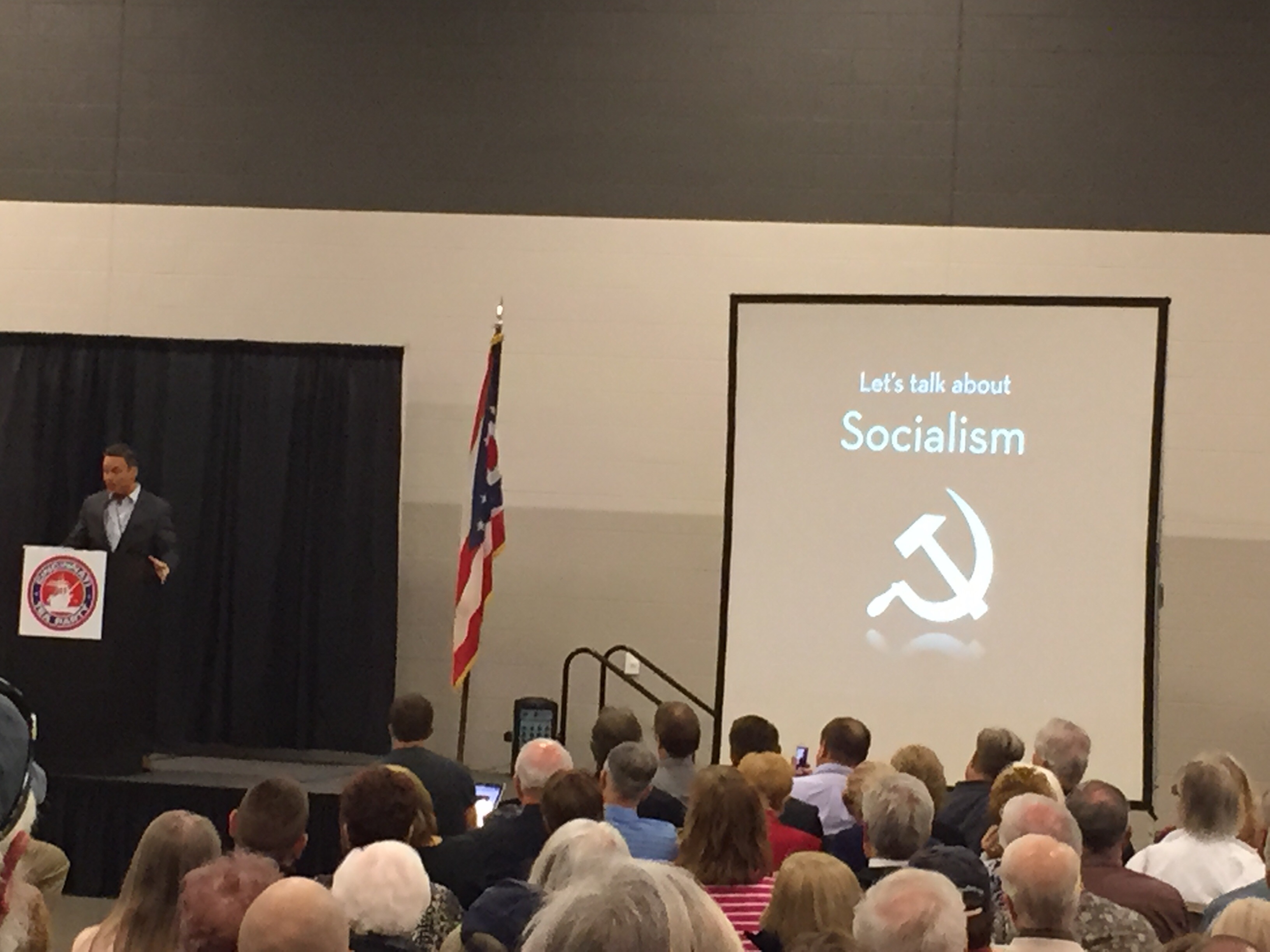
Meet Matt Kibbe Speaking at the Cincinnati Tea Party: Six years of success projecting many more

It says a lot that after six years the Cincinnati Tea Party still draws such huge crowds such as they did during the 2015 Tax Day rally at the Sharonville Convention Center. Ann Becker and her band of righteous rebels have done a very good job of keeping everything together even when the established political party of Republicans has openly sought to destroy the fledgling movement. The Cincinnati Tea Party has so much influence throughout the country that it attracts national personalities like Matt Kibbe to speak at its events such as what can be seen in the following clip from that event.

Matthew B. “Matt” Kibbe is the President and CEO of FreedomWorks, a position he has held since 2004. He originally joined the organization (previously known as Citizens for a Sound Economy) as a policy analyst in 1986. He previously worked as Chief of Staff to U.S. Representative Dan Miller (R-FL), Senior Economist at the Republican National Committee (where he resigned in protest when George H. W. Bush violated his no new taxes pledge),[3] Director of Federal Budget Policy at the U.S. Chamber of Commerce, and Managing Editor of Market Process, an academic economics journal published by the Center for the Study of Market Processes at George Mason University.[4][5]image

Kibbe has been published in publications including The Wall Street Journal,[6] The Washington Times,[7] USA Today, RedState.com, America Spectator and Reason Magazine.[8] On television, Kibbe has appeared on MSNBC’s The Dylan Ratigan Show, MSNBC’s Hardball, FOX News’ Fox & Friends, FOX News’ Glenn Beck, NBC’s The Today Show, FOX News’ America’s Newsroom, CSPAN, FOX News’ Neil Cavuto, FOX Business Network’s Happy Hour, and HBO’s Real Time with Bill Maher[9]

http://en.wikipedia.org/wiki/Matt_Kibbeimage

I enjoyed meeting Kibbe as he’s someone who has done some great national work on behalf of the Tea Party. If not for him, and a few like him, it would have been hard to continue this act of rebellion against big government for such a long period of time. As Kibbe said in his speech, there has been a shift in the power of new media to allow discussions of freedom to rise to the top in spite of attempts from the old world to confine them. Kibbe pointed out that John Boehner should have been in attendance since he lives up the road, but was scared because he knows what the Tea Party means to established Republicans.

Of the upcoming presidential nominees from the Republican Party so far, all are Tea Party candidates. There wasn’t anybody like these guys in 2008 when McCain ran against Obama—so this election of 2016 will naturally have some debate that the rest of America has not heard before. People within the Tea Party of course have been hearing these arguments for quite a long time, but now there will be a national audience that will be cast in competition against the ideas of the past—traditionally regulated to the progressive elements of the two-party systems. The Tea Party has not died, as many hoped, but has remained a force for change from a corrupt system into a more philosophic endeavor poised to provide definitions to economic and social boundaries that have long been ignored.image

Kibbe with all his great experience was very at ease on stage and provided a wonderful talk. I came in behind him as he was registering at the VIP entrance once the crowds had settled inside the auditorium at the beginning. He was extremely unassuming and confident using logic to make his points as opposed to emotion. Even when nobody was looking Matt Kibbe was a solid representative of sound economic policy. I knew who he was but didn’t bother him as he gets hammered by fans everywhere he goes. He was very polite to everyone who tried to engage him and gave him their books hoping to get coverage on his FreedomWorks network. But Kibbe stayed on point and focused until it was time for him to speak.

In contrast was Benn Swan who I have also had some interaction with in the past who gave a speech with a pretension that projected he thought he was the next Glenn Beck. Kibbe has had a lot higher profile than Swan who made a name for himself at Channel 19 in Cincinnati. Swan ducked out as soon as his speech was over shaking hands and behaving like a star wanting to sign all his autographs. Kibbe stood next to me in the back of the room looking like the kind of guy you’d want to have a beer with. We spoke a bit but otherwise he kept his profile low and his attention on the task at hand. He was as much of a class act as I hoped he would be.

imageKibbe’s speech left me thankful that he does all that he does. His contributions are direct, and having a dramatic effect. He is certainly one of the people in my opinion who have helped populate the field of current presidential candidates. His national work has after all these years began showing results–and for those in the Tea Party movement, they are favorable. It is certainly because of people like Ann Becker that the Cincinnati Tea Party is still so respected, but it is because of those like Matt Kibbe that advances in political, and economic philosophy have brought to fruition an option in thought that just wasn’t present in American politics six years ago. It has been a great six years, and the next six will produce advancements unfathomable to the John Boehner types of yesteryear. And the responsibility for many of those advancements will fall directly to the antics of Matt Kibbe and his FreedomWorks network. It is for that reason I enjoyed meeting him so much.

Rich Hoffman

 CLIFFHANGER RESEARCH & DEVELOPMENT

Listen to The Blaze Radio Network by CLICKING HERE.

‘Batman Versus Superman: The Dawn of Justice’ from the lens of Ayn Rand

Essentially the argument in question revolving around the new Batman Versus Superman: The Dawn of Justice movie is a philosophic argument between Plato/Aristotle and Nietzsche/Ayn Rand. Batman represents the old human concept of law and order whereas Superman represents the overman.   It is a compelling argument and one that I didn’t entirely expect to be conveyed so openly in a comic book movie—but here it is.

Of course it should be expected where my sentiments fall. And I’m sure Ayn Rand would be aghast that I compared her to Frederick Nietzsche. She would break things down by stating that she is more like Aristotle whereas Nietzsche is aligned more properly with the sentimental mysticism of Plato—but for this line of thought I’m breaking down philosophic development into the boundaries of western civilization itself. The minds of man have brought us into the modern age on the philosophy established in Greece. Ayn Rand and the concept of the overman is the future—it is the graduation of mankind from the boundaries of intellectual confinement driven by thousands of years of madness.

I have stated my love for both film franchises, of course the Batman films of Christopher Nolan and the Man of Steel film by the same producer. Both Christopher Nolan renditions of the comic legends have heavy doses of Ayn Rand in them—collectivism versus the individual. Yet Hollywood is directly opposed to Ayn Rand currently favoring heavily the Kantian philosophy of collectivism, altruism, and human depravity. The director of the Man of Steel films and the upcoming Dawn of Justice is Zach Snyder who obviously like Christopher Nolan, prefers Ayn Rand and even though Hollywood may not like it—the hot handed director is at the helm and is poised to deliver a powerful money-making franchise to Warner Bros that will compete directly with the wonderful Marvel Avengers films from Disney.

I’m actually going deeper into this line of thought with my Cliffhanger project, but for the masses right now at the start of the 21st century this Batman versus Superman battle needs to happen, and the trailer captured the essence of it very well. All through human history mankind has fallen in love with power and it has corrupted their minds. An overman on the other hand has no such love for power, because they understand the nature of it. Power is not given to other people through democratic measures. Just because one person can command hundreds, perhaps thousands from the lofty perches of a social title of some kind—there is no real power there—just an acknowledgment of collective will. Real power comes from an individual and will remain no matter what circumstances emerge.

In many ways in a modern since the director Ridley Scott surprisingly grasped this concept in his 2000 release of Gladiator, which won best picture that year along with a best actor award for Russel Crowe. Scott isn’t typically an Ayn Rand fan, but he did grasp the power of the individual in that film where Maximus—the protagonist had been the favored general of Marcus Aurelius due to his skill on the battlefield, but once the Emperor died, his son Commodus, deeply jealous of Maximus sought to put the general to death and kill his family. Maximus escaped, but not in time to save his family. The great man lost everything and is captured and toured around as a gladiator—one step always from death. Yet Maximus is so skilled at fighting that he quickly rose back to the top and eventually challenged again the Emperor of Rome as a masterful tactician. It is clearly one of the best films of its kind and is oozing with Ayn Rand strength centering on the individual over the collective. There is a truth in that particular film that Ridley Scott unintentionally released. I have put that truth to test many times and have discovered that it’s immensely accurate. You can take a great man and cast him onto a remote island in the middle of nowhere and he or she—will succeed in spite of the collective efforts to hold them down. Great people are not driven by collective salvation or sacrifice—they are creators of their own fates and can make success out of any situation—because success is an act of creation—not something granted by luck or the “gods.” A great person will always rise back to the top by default and there is a science to it that is predictable.

Zach Snyder seems compelled by this same resiliency and all the characters in his films embody some aspect of this. So it’s no accident that Christopher Nolan put Snyder in charge of the Superman franchise. There really is no better director today who knows how to handle the Man of Steel mythology. Superman is a superior being from another planet who simply wanted to help mankind become greater. He has absolute power, and came from a planet that collapsed under that power—not by his hand, but those of his people. Superman’s job is to ensure that the same thing doesn’t happen to earth. Batman on the other hand is a broken man who lost his parents at a young age and has spent his life righting wrongs essentially out of a vigilante need to rectify justice. But that justice is very terrestrial as it has been formulated around human perception. Batman is a second generation man of wealth meaning he inherited much of what his father made for him, but he is competent enough to sustain that wealth and apply it to fighting crime. Batman is always one step away from falling off the cliff whereas there is never any real danger that Superman would or could fall. Because no matter what happens Superman will always rise back to the top just like Maximus did from the Gladiator. So Snyder in the second film of his Man of Steel series is pitting these two heroes of entirely different philosophies against each other which is essentially the debate of our day.

The essential suspicion is that no man can resist the temptation toward corruption if given the opportunity. So Superman is a threat to the world even though all his efforts have been in trying to save it. But Superman is not a man of this world; he is essentially an alien functioning from an inner self-assurance that is a graduation of mankind’s limits. Yes, he has absolute power, but he also is immune to the desire to abuse it for the sake of social adornment. An overman knows where their power comes from so the appeasement of the masses does nothing for them. The only measure they have is themselves for success. Whereas the traditional western perspective is that if the masses support the power and authority of an individual that power is thus provided to control those people. This ultimately leads to a collapse of the individual ego upon itself because power is not generated from within, but from without.

It was the Fabian socialist George Bernard Shaw who termed the name “overman” or otherwise “superman” in his 1902 play Man and the Superman which would later inspire the comic. In the play established in Act 1 is the concept that the more things a man is ashamed of, the more respectable he is. This of course leads to a disastrous life making men miserable for most of their existence. As Shaw states in his play, “A lifetime of happiness! No man alive could bear it: it would be hell on earth.” This is the world of Batman—he’s never really happy and feels he is a Dark Night that stands in the shade between right and wrong. However Shaw was a socialist who did not believe in the abilities of mankind to overcome such faults so he regulated his sentiments toward collectivism being lead by the elite in charge—which of course took Nietzsche’s work and perverted it into the Nazi regime. A couple of high school kids from Cleveland, Ohio inspired by many science fiction writers from the early 20s—inspired by Shaw’s play—invented the comic Superman to fight for the rights of left-leaning causes during the Red Decade coming out in 1933. The big difference between Nietzsche’s overman and Siegel and Shuster’s “superman” was that one transcended the limitations of society, religion, and conventional morality while still being fundamentally human. The other was alien and gifted with incredible powers choosing honorable human moral codes, holding himself to a higher standard of adherence to them, purposely. Over time Superman has evolved ending up in the middle of those two viewpoints under Zach Snyder’s care. And that is a good and healthy thing.

So Batman versus Superman is more than another popcorn movie about superheroes. It’s a philosophy for our age that needs articulation. A lot of history has passed since Shaw wrote his play but what has come out in the end is a fully fleshed out philosophy that works. That philosophy is what the theme of this upcoming movie is between two of the most well-known and loved superheroes of our modern mythology. Under Zach Snyder’s care I think he’s going to produce something revolutionary and I’m very excited about it. But in that battle I know already who will win. The overman always comes out on top—because it’s in their nature to always do so.

Rich Hoffman

 CLIFFHANGER RESEARCH & DEVELOPMENT

Listen to The Blaze Radio Network by CLICKING HERE.

The Difference Between Good Guys and Bad Guys: Previews for Star Wars ‘Battlefront’ and ‘Force Awakens’

I have been saying it for quiet a while, its coming—quick. Its more important than the 2016 presidential election, it has more emotional power than a whole childhood of public school. For many it’s more meaningful than the relationship they have with their parents and siblings. It has more sustenance than any goals obtained in a commitment to a career. For many—a lot more than it used to be—the next six years will be some of the best and most emotional years of their life, and the direction of human society will be decided not by the religions of the world, or the billions and billions of dollars of money spent on education. It will be defined and implemented by the new Star Wars movies that are coming out between 2015 and 2020. Star Wars is already one of the most important cultural phenomenons that exist to human beings. But what will occur over the next five years will shake the foundations of our society to their bare essence. This week during the 2015 Star Wars Celebration in Anaheim, California the preview to the second trailer for The Force Awakens played to the world, and many grown adults reacted in a similar way as seen in this clever Mathew McConaughey clip shown below.

So why all the excitement?

I was very close to taking my family on vacation to Anaheim this year to attend the Star Wars Celebration. The reason we didn’t go is because we are trying to stay a bit on the fence—we are all fairly invested in the Expanded Universe and want to make sure that the new films are not utterly screwed up continuity wise. If we had known that Jaina Solo would be in the new films, we likely would have dropped $20,000 for a no holds vacation to California. But right now we don’t know much about the future of characters we love as a family, and Disney really didn’t get a huge presence into their theme parks yet—which was the other qualifier. It’s only been three years, but I had hoped that Disney would have had more Star Wars specific attractions by now, especially since they put the Celebration event right next to Disneyland. But they didn’t so given the unknowns, we held onto our money for the time being. However, that didn’t mean we couldn’t see what was going on. The event was live streamed for the entire weekend, which my daughter and I watched religiously trying to see each and every interview shown. We were like many millions around the world scrapping up every bit of Star Wars news coming out of the convention—which from a mythology perspective was quite extraordinary.

The reason for all the fuss is that Star Wars is all about values and the world has in many cases been deliberately starved of them to fulfill various political agendas. Star Wars is really the first global influence which clearly attempts to define good and evil in a way that every culture from every segment of society can relate to. Religion used to be that vehicle, but it no longer works properly for most, and Star Wars is filling that void.

Another massive revelation which came out of the convention the day after the movie preview for The Force Awakens was shown was the new Battlefront video game which features Star Wars scenarios in some of the most intense battlefield action seen to date—themed to the original films. I am currently playing Star Wars: Commander on my iPhone 6 just to fill the time between game platforms. My wife and I just finished playing Star Wars: The Old Republic which we played every day for nearly two years and now we are waiting for Battlefront which can be seen in the following clip. This is a new reality that fans around the world can enjoy playing in real-time against real people at all hours of the day no matter where they reside. When Battlefront comes out, I may retire again and spend most of my days playing that game. Here’s why—I never get enough of this type of activity!

One aspect to Star Wars: Commander that continues to amaze me is how many people chose to play on the side of the Empire. In Star Wars the Empire represents the bad guys and I have been mystified as to why people would or could play the bad guys. There is a segment of the population, and I see this extensively in the table top games from Fantasy Flight, like X-Wing and now Armada that roughly half the human population identifies with the bad guys so much they prefer to use them as representatives to themselves while the other half chooses to play on the side of the good. According to many who prefer the bad guys, the Empire is poorly understood and is on the side of institutional justice. There is a power in the bad guys that is attractive to these people and ironically it does affect their morality in real life—it will affect their decisions at the voting booth in favor of marijuana legalization, immigration strategies and generally the size and scope of government. There is quite a science to the natural appeal of those who love bad guys over those who don’t. In Commander there is never a shortage of bad guys to play against in live combat. No matter what time of day or what part of the week there is an Imperial base to attack because that many people love the bad guys of Star Wars so much that they are willing to invest the massive amount of time it takes to build up to a level 8 base—which is what I have.

A common theme throughout the years 2000 through 2010 among from young men who knew me was that many liked the villains of Star Wars much more than the heroes. I was trying to mentor them, most came from homes where the fathers were terrible. They only identified with the bad guys, whereas young men who had strong fathers that they could look up to tended to agree with me, that the good guys were the ones to cheer for in Star Wars. I would get pretty animated at these young boys who loved Boba Fett and Darth Vader over characters like Han and Luke and tell them that there was harm in liking the bad guys, which I still believe probably more so today than I did even then. Yet I could not convince them otherwise because their foundation thoughts were set in stone from early in their youth. I suspect this is the case for many who love Star Wars from the point of view of the bad guys. Somewhere along the line a mentor of some kind let them down, leaving them to turn toward institutional consensus to behold their values.

Of those young people who argued with me in favor of the bad guys over the good every single one of them has had a rough life a decade later. Often drugs were part of their lives, but also they suffer from relationship issues and generally low self-esteem. I still feel if they had listened to me, they would have been greatly improved as human beings but their desire to identify with the bad guys in Star Wars indicates a much more systemic issue than anything that can be quickly cured with some motivational speaking.   If the wires are crossed during their infancy, there isn’t much anybody can do to fix them later unless they recognize the error of their identification.

As a kid, and still now, I could never play the bad guys—I never felt comfortable flying a TIE fighter against an X-Wing fighter in the video game series X-Wing. I could have never put on a Boba Fett costume—and certainly not a stormtrooper. When the game Force Unleashed came out I did not play it at first because you had to play as an agent of Darth Vader—which I couldn’t do. I literally could not physically show aggression toward what I considered to be the good guys in Star Wars. It actually makes me sick to do so—to play a bad guy. I’ve been like that my whole life—down to my earliest moments. In kids both male and female the love of good guys or bad guys seems to come down to the relationship they have with mentors in their lives. If they are short on proper mentors, they tend to love the Empire. If they have several positive mentors in their lives, they love the good guys. One of my nephews really became angry with me when he tried to justify Darth Maul as a cooler character than Obi-Wan Kenobi. He had a really manipulative father—so no matter how much I tried to inspire him to something better, he always snapped right back into loving Darth Maul over Obi-Wan. After several years of trying I stopped—understanding that the static patterns had already been established and it would take a major crisis in his life to shake him into wanting new heroic archetypes.

But what’s great about Star Wars, even those who love the bad guys, is that the stories from that franchise are about essential values and are some of the most powerful works of philosophy and religion currently being explored anywhere. Star Wars is shaping the tone and values of the 21st century and is defining the next thousand years of humanity. It is becoming our new Bible wither or not people like it or not. In a society that is lacking values—purposely implemented—Star Wars and a few other comic related franchises are all they have. In most cases, parents have failed them, schools have failed them, mentors have failed them, entertainment, religion, economics—etc, have all failed them so they turn to Star Wars for the values uttered in those stories. That is why all the emotion over a simple preview in anticipation for one of the most epic experiences most people will ever have even in relation to the life and death of loved ones—the opening of the next Star Wars movie. It’s much more than a film franchise designed to make money as a capitalist endeavor. It is that—but it’s much, much more. Star Wars is about values, and people weep over just hearing the music because it makes them emotional to have those empty voids filled within their minds where values should be—values that have in some cases deliberately been withdrawn as a means to control the population through political efforts. Star Wars is about recreating those values and the result of that endeavor usually puts people on one side or the other. But whichever side it is, they are at least better off than valueless slugs awaiting the commands of a political class that rules by the void of valueless utterances. Star Wars provides those values, and the world is far better off because of it.

Rich Hoffman

 CLIFFHANGER RESEARCH & DEVELOPMENT

Listen to The Blaze Radio Network by CLICKING HERE.

Mason High School’s Covered Girl Challenge: Public education purposely turning children against you

As public education advocates were marching on Columbus to protest Governor Kasich’s budget cuts to affluent school districts, the Mason school system showed what the government schools are really about. For those who think that my criticisms of public schools are exaggerated check out the activity that was being organized at Mason. Keep in mind that Christianity is heavily ridiculed in government schools yet in Mason, Ohio—one of the wealthiest regions in the country students are being encouraged to wear a Muslim hijab to school as a gateway to Islam. What is interesting in this is that radical ISIS beheadings are the news topic of our day and thousands of years of archaeology is being destroyed in the Middle East by radical Muslim terrorists—yet here is a publicly funded institution encouraging the spread of Islam. Here is the memo that went out to students and their parents announcing the upcoming event.

Mason High School is blessed to have a unique and diverse student body. In order celebrate this diversity and promote open-mindedness, the Muslim Student Association is inviting all female students to participate in “A Covered Girl Challenge” which will allow students to wear a headscarf for the whole school day. Afterwards, there will be a discussion (open for all students, male & female) held in Z223 to share experiences and reflections.

In order to participate, students and/or parents should attend the informational meeting offered and turn in the attached permission slip to Student Activities or Mrs. Jenkin’s room in Z223.

On the morning of April 23rd, there will be booths set up in A2, C1, and Z1 to help participators adjust their scarves and answer any questions.

To learn more about what the Covered Girl Challenge is all about and what a headscarf is watch this video: https://youtu.be/_WosD_GTz_E

Please note the important dates below: Informational meeting: April 20th after school in Z223 Covered Girl Challenge Thursday April 23rd during school day

Covered Girl Challenge Discussion after school on Thursday April 23rd in Z223 Flyer and permission slip are at the link below:

http://www.edline.net/pages/Mason_High_School/2684432697290919314/Student_Activities/FORMS/EMA

If anyone has any questions please email masonhsmsa@gmail.com


http://www.jihadwatch.org/2015/04/ohio-public-high-school-hosting-a-covered-girl-challenge-asking-students-to-wear-hijab-for-a-day

Now, what conclusion would any rational person make by that event? It’s not like Mason is some backwater school in the middle of nowhere—its right in the heart of America.

Here’s the deal, public schools are all about using confiscated wealth and breeding into the minds of youth nice little socialist followers who will support an aggressive agenda once they are of voting age. They are unhealthy places that no parent who truly loves their child should send an innocent mind. Public schools are bad places that intend bad things for newly formed minds. What other conclusion is there about the Covered Girl Challenge at Mason High School? Think about that and let me know…………………………………………………………

Why are we paying for these palaces of doom to destroy our children?

Send this to a friend and ask them the same question………………….why?

Rich Hoffman

 CLIFFHANGER RESEARCH & DEVELOPMENT

Listen to The Blaze Radio Network by CLICKING HERE.
Black-clad Lakota Teachers Against Merit: A system only designed by Lucifer himself


It would be a comedy if it wasn’t reality, but sadly it is. The Lakota teacher union is at it again—thinking incorrectly that everyone in opposition to their radical community expectations have gone back to sleep. Foolishly they exposed their true agenda with the same old tired tactics that belong in a lampoon film. They are a satire of themselves. At a recent school board meeting they protested the school board over the issue of merit pay, which I immensely support. The mere mention of merit pay gives me hope that the Lakota school board may actually do something correctly in relation to management of their employees. Merit pay means that good employees get paid better than bad ones—it’s pretty much that simple. For example, a teacher my kids had at Lakota East, Mr. Duff I would have considered an exceptionally great teacher. I wouldn’t care if the school paid him $200,000 per year, because he was worth it. However, the many teachers from Lakota reported by this site that were caught in various scandals and poor choice behavior recently clearly aren’t worth so much money. They may have value in some education capacity, but certainly are not equal to Mr. Duff. The Lakota teachers are a progressive organization under their LEA union leadership and they believe in strict collective bargaining or nothing—meaning all boats rise to the top regardless of the quality of their employees. Because of their insistence on this collectivize bargaining/no merit pay formula the budget tax payers are forced to fund is outrageously high. Lakota like every organization should be functioning under the 10-80-10 rule, which generally cites that roughly 10% of a work force are exceptionally good—like Mr. Duff and should be compensated accordingly. 80% are average and should make wages in accordance with their meagerness. Then the bottom 10% are the child molesters, the sexting addicts, and general bottom feeders who should be on the chopping block of termination upon their first mistake. The union helps those bottom feeders while penalizing the top by minimizing their worth as equal to the lowest 10%. Here is how my old buddy Michael Clark reported the issue in the Cincinnati Enquirer. The complete article is at the end of the segment. Read it while you can—because the Enquirer starving for revenue takes these articles down not long after they are published. Typically articles like this one are forgotten in a few weeks, and during the next levy attempt, we’ll want to remember it.

LIBERTY TWP. – In the middle of key Lakota Schools’ contract talks, dozens of teachers made a symbolic but silent appearance Monday night in the union’s first public demonstration since negotiations began.

About four dozen teachers – many of them clad in black – joined a full audience at Lakota’s school board meeting as labor talks continue this week for Southwest Ohio’s second largest school system.

Some of the teachers say they are concerned about the possibility of merit pay being contractually installed for the first time in Lakota’s 59-year history.

“I’d like to see more positive changes for teachers here in the future, but I don’t think merit pay is the way to go,” said Brandon Bright, a science teacher at Lakota East High School.

Sharon Mays, president of the 923-member Lakota Education Association (LEA), declined to comment about union members’ appearance at the board meeting or on the status of the contract talks, which began last month.

http://www.cincinnati.com/story/news/2015/04/13/talks-continue-lakota-teachers-demonstrate/25743561/

I read the comments at that link from some of the teachers and they were even funnier than those idiots standing outside of the administration building dressed in black for emphasis fighting merit pay. They have an opinion of themselves that is much higher than their real value. They are spoiled brat public employees who work, think, and have expectations on par with the most grotesquely out-of-touch IRS employee. They have no sense of service, but somehow believe that the community works for them instead of the other way around. No wonder so many children raised in public education environments over the last two or three decades enter life feeling entitled to everything—because they learned the behavior from these idiots!

Public teachers like those at Lakota own the problems of our modern age–the sex driven antics of youth, the low morality, the poor ethics, and the terrible work habits. Union employed teachers have successfully offered free baby sitting to lazy self-absorbed parents making the public school the primary driver of youthful upbringing and it has been a disaster. Public schools do not get a free pass when everything goes wrong—they don’t get to point at the parents and call them names to justify the poor home lives of children. The public schools offered themselves as a substitute and they failed—at best.

But why did they fail–the public schools like Lakota? Well it’s because the teachers have collective bargaining agreements and step increase schedules that give them money no matter how good of a teacher they are. So bad teachers are kept around and considered equal to the top ten percent, and the really good have no incentive to continue being great, because they get paid the same as the slugs working next to them. The public school system is the epitome of Karl Marx communism. It’s just not called that by name, but the assumption that all employees are equal is taken straight out of the text of The Communist Manefestro. Public education is a joke. Exceptional employees are looted of their value in favor of the weakest and most demonstrative. Values in such a system are re-distributed to those without it, just like wealth in the community which funds the whole mess. The public education system might as well have been designed by Lucifer.

Lakota to their credit as an administrative measure have thankfully listened to the complaints over the years—and are considering merit pay—which would go a long way to solving a great many of the problems at that district. But it’s a drop in the bucket and the unions instantly jumped all over the issue with protest. All they really managed to do was to show just how grossly out-of-touch they really are by protesting in this day and age—after all that’s happened at Lakota—in such a dramatic fashion. Really? They know I’m not going to let it die and will bring it up from now until infinity—yet they did it anyway.

I suppose they figure they have the votes for a new levy, and they think nobody reads Overmanwarrior’s Wisdom just because they don’t and don’t hear me on WLW radio any more. But they’d be wrong. The stat numbers on my site for the topic of politics is quite high, and daily provides information to those not quite up to date on things. Most people miss Enquirer articles like the one above the first time around and only care during elections. Since the Enquirer charges for their information people turn to sites like this one. Because of Overmanwarror’s Wisdom, during the next election when people Google “Lakota teacher salary” or “Lakota election” articles like this one will come up. Then they may know about the Enquirer article, they’ll have access to the quote I provided, but they’ll click on the link and discover that the link no longer works. So they’ll read my site instead of the Enquirer and form their opinion based on the data given.

It used to be that teachers union scum bags and merit pay protestors only had to bend the ear of reporters like Michael Clark from the Enquirer or the Pulse. But media has changed over the last five years. If it’s not on Twitter, nobody will see it. People don’t read traditional news any more, and they care even less about some story about black clad Lakota teachers written by a reporter eating out of the hand of Sharon Mays. But come election time, they’ll find me, and will ignore the flowery newspaper articles that always come out prior to an election—just so that papers can sell advertising back to the school through direct and indirect sales. When they do read this article in the upcoming years voters will remember what a bunch of idiots the Lakota teachers were over merit pay. Once they do, they’ll become an informed voter and will cast their ballots as such.

Meanwhile, the Lakota teachers participating in that protest are satirical limericks of personal destruction—they are caricatures of sanity pasted against the theater of time apparently solely for our amusement. Because no truly sane person would argue against merit, unless they are a thief wanting to steal while nobody is looking. But guess what? Everyone is looking—and they are wide awake.

Rich Hoffman

 CLIFFHANGER RESEARCH & DEVELOPMENT

Listen to The Blaze Radio Network by CLICKING HERE.

The Hilarious Hillary: A trip down memory lane–body bags, scandals, and lies

We knew it was coming, so the news was sort of flat, but Hillary Clinton is running for president which is evidence of just how terrible the Democratic Party really is. Hillary with all her scandals and baggage is the best candidate for President of the United States that the Democrats can put forth. Think about just how pathetic that is for a moment……………………………..

On the Doc Thompson Show heard on The Blaze Radio Network they had some fun with the topic which I found funny. They compared Hillary Clinton to the 80s rock group Poison that used to be all the rage. Poison used to fill stadiums with screaming fans, but now thirty years later they are still together but playing in much smaller venues. It was some funny radio and held within its criticism of Hillary a grain of truth that is true for the entire Democratic Party. Their message is tired and worn out. Her message only has appeal to people looking for government freebies—which was quite clear by her really slow and overly dramatic launch video. She has no message except the same tired old communist banter of playing the poor against the rich and suggesting that government cover the balance through wealth-redistribution.

The worst of Hillary Clinton is that she is completely incompetent. She has accomplished nothing in all her years of public service except leave in her wake controversy and betrayal. Even if it is true that she and her husband played a part in all the dead bodies surrounding their lives—it is beyond refute that she has personally known and associated with some of the worst people in the known world—and has been very arrogant about it. When she has held positions of direct responsibility, such as her fairly recent stint as Secretary of State, she fumbled epically on a grand stage and thought she could smile her way through it. Her time as Secretary of State was so bad that she had to have her own email server to hide her faults and give her control to delete all her correspondences showing evidence of her vast debacles particularly the Benghazi incident.

And here is a woman who has been an enabler of one of the most sexist womanizers ever to hit the public stage who wants to be the first female president just because she happens to have the physiology of it. She wants to represent the freedom of women, and to epitomize the women’s movement—which all she has really accomplished is to show the world what a truly dysfunctional household looks like. Hillary Clinton is a joke as a mother, a joke as a grandmother, a joke as a wife, a joke as a politician, a joke as a person, and yet she wants to be president with no credentials or competency shown just because she’s a female.

Well one thing is for sure, it will be an interesting race. I have serious doubts that Hillary will be able to pack an arena just as the rock band Poison would struggle now. Their messages are more of nostalgia than of substance. Hillary will have to appear relevant with a lot of smoke and mirrors, and a lot of help from the media that wants desperately to see a progressive return to the White House. But in live events, Hillary won’t drive much passion which is why she is doing this cross-country tour trying to appear like she is one of the “people” posing for photos that will help her market herself as a “common folk.” Her life is a lie and people see that. People won’t line up to see a lie, or a has-been. And for the Democrats they are truly in trouble. If Hillary is the best that they have, they might as well be extinct. Because with her at the helm once again—they will be.

Rich Hoffman

 CLIFFHANGER RESEARCH & DEVELOPMENT

Listen to The Blaze Radio Network by CLICKING HERE.

Why Individualism is not Selfish: Refuting critics of Ayn Rand with the work of Joseph Campbell

Watching the below segment of The Daily Show featuring a question intended to be sarcastic regarding Ayn Rand it came to my mind that its time to make a legitimate argument against the general sentiment of today’s average political centralist, and Democrat. The segment attacked Ayn Rand’s philosophy in favor of self-interest over altruism by placing candidates running for president currently in alignment with the work of the controversial writer as a way to indirectly associate them as representatives of meanness. Politics in 2015 have been moved so far to the political left after over 100 years in argument in favor of altruism and collectivism, that today’s centralist would have been considered a radical left-winger in yesterday’s world—the world where America produced the Greatest Generation. So it is clearly time to re-evaluate the situation as Ayn Rand’s work was created on the heels of the greatest generation as the radical communists and extreme leftists were making themselves known—which today is the new standard. People are so confused as to what the proper behavior is for their society, that they no longer know what is up, down, left or right. They only react to the feelings and temperament of contemporary society shaped by years of chaos and wrecked philosophy.

The biggest attack against Ayn Rand is her philosophy which features a priority on self-interest. For generations of people raised within strict religious leanings featuring altruism as a sign of goodness, and a political system built on wealth-redistribution backing their inner mentality shaped by those same religious motivations the question has failed to be asked or answered as to whether or not we should help the poor and destitute. The comment was simply made that we should because it’s good—but good was never properly defined—so a valueless assumption was required to accept the proclamation which then constitutes the typical Democratic voting behavior. There should have been a sought after proven answer framing the cause of what makes people poor to begin with. But there wasn’t, only a kind of primitive belief similar to the tribes of yesteryear who believed that a rain dance would bring rain to their dried up crops. What factors make an individual poor? That is a question that deserves an answer such as why won’t my car start? Well, for the car, it might be a low battery, a bad starter, the car may be out of gas—those types of things. But in essence it makes logical sense—there is a cause and an effect. However, for the poor person, there is no attempt to designate a cause because the assumption is based on faith that some mythical gods have granted advantages to some while denying opportunity to others. While this was true in Medieval Europe, America was an invention to out-grow those limitations driven by philosophy which challenged the previous vantage point of victim hood.

The rest of the world largely driven by philosophies of collectivism, as they had been for millennia the last several thousand years worshipping kings and gods putting the sanctity of their nationality before their individual rights have set the stage for our current dilemmas in politics. America formed with an emphasis on individuality and rights as opposed to sacrifice. The economical means of this nation was capitalism—driven by individual need and desire. In America money was created not dispatched to the population through a top down hierarchy from kings and a ruling class. The rest of planet earth functioned from classic collectivism whereas America was experimenting with a practice specific to individual value using money as a measurement of productive enterprise. In Europe, Russia, Africa and the rest of Asia the general philosophy of those regions is that things happen to you due to an ancient belief that some god was in charge and that people were just along for the ride through life. In America, even though it was formed by religious men, they sought to run their nation by rational decisions conducted by men for the higher moral purpose of goodness—and that goodness eventually benefited God. The economical means to measure that goodness was money—because it was the only way to guarantee that good products purchased by individual self-interest would bring to the surface the best and brightest of our society. Capitalism couldn’t prevent people from wanting to cheat and take short cuts to wealth, but generally, a free society is able to reject the services of an organization they deem unworthy—and could vote with their dollars.

Trickle down economics such as what works best in America takes into account that not all people work hard, or are creative, but those who do and are—create opportunities for everyone. Those who take the most risk and have the most skin in the game generally make the most money as opposed to those most highly connected to the political structure of a ruling class. Over time, Washington D.C. has elected themselves the type of power that the ruling classes of Europe still enjoy—and have always benefited from. But those politicians do not represent the essence of America—or the philosophy which emerged from the rapid benefits which exploded from capitalism’s American experiment. That is the reason for the current issues of political corruption and the cries of the people for European style socialism, and communism. Under this corruption, communism has been as attractive to young people as it has been in Europe where peasants have no other means of stepping out of poverty and living equally to the richest of their nation. America has been and continues to be a place where anybody who works hard can brush shoulders with the very rich and powerful. In America classes are not divided as they are in Europe as upper, middle, and lower—they are divided by those who work hard and those who don’t—at least traditionally. Slowly over time as the nation has moved so far to the radical left, more European influence has won the day as opposed to the righteousness of the American experiment.

After witnessing all these elements several writers emerged to chronicle the pros and cons of what had occurred during the first two hundred years of American experience. One of course was Ayn Rand who has run up against the classic opposition such as what was seen in the Daily Show episode—where her announcement that self-interest is what actually leads to morality was considered preposterous viewed through the lens of the classic European progressive model. But another writer whom I think is much more important than Ayn Rand did at the same time much broader work which arrived at essentially the same conclusions by comparing all the mythologies and religions of the world and came up with the now popular term, “Follow your bliss.”

As Ayn Rand was writing The Fountainhead and Atlas Shrugged, Joseph Campbell was writing The Hero with a Thousand Faces. These books were uniquely American and have turned the literary world upside down challenging thousands and thousands of years of human thought. Campbell unlike Rand is much more inclusive in his comparative studies. He has a reverence for many progressive leaders uttering insight from the early 20th century, like Nietzsche, Jung, Joyce, Mann, Steinbeck and many others whom he read incessantly then compared them to his vast encyclopedia of knowledge of the world’s religions. His conclusions were that every individual on the face of planet earth needed to “follow their bliss” meaning their own internal call to living. They had to listen with an individual’s ear to the calls of their own life’s adventures. This was really revolutionary work done by Campbell as he was conducting it during the Red Decade in the presence of extreme left-winged radicals and open communists. Yet he took a path to scholarship that was unique to him and let the facts come in as he analyzed them—and his report was what is likely the most important book of the previous century and so far of the 21st. The Hero with a Thousand Faces explains why Atlas Shrugged is so powerful to so many people.

The Hero of a Thousand Faces would not have been written by a lettered academic at Oxford or any other major institution. Joseph Campbell led a life of unique individuality and his scholarship is a direct product of a very unusual life remarkably free of social strings conducting his thoughts and conclusions. His life’s work essentially became the Star Wars saga which is currently unleashing upon the world brand new updated religions and philosophies. George Lucas himself will declare that he could not have made Star Wars without the influence of Joseph Campbell. In Campbell’s work the individual has much more value over the collective—as described in the Navaho legend of the Twin War Gods who were on a quest to meet their father the Sun. They had to leave their village on a grand adventure as their people were being attacked by monsters. Everyone had tried just about everything and nobody had a solution, so the Twin War Gods had to travel in a direction nobody else had yet tried and endured a number of trial and tribulations to bring the boon of their discovery to their people.

There is no politics in Campbell’s work. His admires include radical leftists like Jerry Garcia from the Grateful Dead to Bill Moyers from the very left leaning PBS network. Campbell just let the facts speak about the nature of reality, and he was uniquely qualified to surmise the details through stories of this own. It is the clear distinction that Campbell makes through a lifetime of scholarship that it is the individual that moves the world and not the sacrifice of individuals to the collective good. Although sacrifice has been the mode of behavior that has driven most of society, it is the individual following their own unique bliss that brings the boons to society. Society does not bring boons to the individual. It is a fantasy that a collectivist hierarchy can bring joy and wonder to people of differing needs. The best way for people to serve each other is to allow their own lives to live to their own potential for the aims of their individual achievements. By doing that they create things that the rest of the world needs. Joseph Campbell’s outlook is uniquely American, just as Ayn Rand was. Both were authors of works that shook the foundations of thought, and their conclusions are here to stay leaving in their wake the destruction of the old modes of operation. Collectivism and religions of sacrifice are a way of the past that is in quick decline. The Daily Show in their presentation against Rand knows it. That much is evident by the type of people running for president in 2016. On one hand you have the collectivist Hillary Clinton representing the socialists and Democrats, then on the other, at least two candidates directly formed by the freedom loving Tea Party—the type of people who openly love the work of Ayn Rand.

As much as many from the old European world would like to see a continuation of their brand of collectivism, it is writers like Ayn Rand and Joseph Campbell who are shaping the world of tomorrow—and that is why their popularity is increasing while the desire for extremists like Karl Marx is declining. The weak and lazy still look to Marx, but there is no “Following your Bliss” in communism. You do what you are told, and that is not the way to lifetime fulfillment—just stifled misery and suffering due to unlived lives encumbered by sacrifice to speculative assumptions. Capitalism allows individuals to “Follow their Bliss” which is a long storied concept that started for Campbell in the radical troubadours of the High Middle Ages, (1100-1350AD ) from France. They were some of the first to challenge the collectivism of arranged marriages and sacrifice of the self to the many. America inherited from them the concept of courtly love and chivalry which eventually found their way into our western mythology. Before the troubadours marriages were all arranged for the benefits of a collective need and the individual was looked upon as something to be despised, and vanquished out of preservation for the many. But it never worked and never will work because whenever the collective is served values are what is sacrificed, because value is an individual assessment—not a collective one. Once values are sacrificed, a society crumbles into nothing to create the four-part cycle of Giambattista Vico–the age of gods, the age of heroes, the age of man and the age of chaos—more expressively described as theocracy, aristocracy, democracy and anarchy. Joseph Campbell and Ayn Rand proposed to Americans the notion that civilization should get off the circular highway going nowhere in between the aristocracy and democracy portions of that cycle and to emerge independent of collective influence toward an unknown horizon. By action out of each and every person’s “bliss” individuals would then do the job they were created for in the first place—and this is what gives the old world the anger toward Rand that they have—that management of those individual lives does not come from the church, or the political order—but the very essence of the soul encapsulated within every living thing. To grapple with such a thing means that society at large need to understand what a soul is, and how it functions within them. And to find that out, one cannot be told by a parent, a grandparent, a teacher or a lover what it is—you have to find it out for yourself. For the timid and weak, this is a scary prospect. For the brave and valiant—it is the essence of adventure. For society—it is through adventurers that new things come to sustain all life. It is in the timid that all things decay. The timid should not be cast aside, but should follow in the path of the brave toward a destiny their lack of courage would have never allowed them to behold otherwise. And the brave should allow those in their wake to follow their example without robbing them of the treasures of discovery—taken on an individual basis. Not everyone can slay a dragon, or race a car through danger, but everyone can find discoveries under a common rock and a path paved by their own intentions in their own way.

The answer to what makes wealth is found in the adventurer and the cure to the poor is to spark in them the essence of life—and for them to follow their own bliss instead of becoming dependent off a collective society. Once they find themselves dependent on others, they find themselves either poor, or like the classic European peasant—begging for bread and water by the political elites. And among them, there will always be other weaklings like Hillary Clinton who desires the old way of Europe so that meaning to their meaningless lives can have some measure of fulfillment. The way to make the poor into the rich is to get them to follow their bliss—and that is what Ayn Rand’s novels were all about. It is always why collectivists of all sizes and shapes hate her—because they can see within her work the end of their line of thought. But as to the science of why Ayn Rand works, all one need to do is look toward Joseph Campbell’s The Hero with a Thousand Faces. Heroes are not collectivists, and they don’t sacrifice themselves aimlessly for the needs of the many unless they discover that it is part of their bliss to do so—a bliss arrived at through their own individuality.

Rich Hoffman

 CLIFFHANGER RESEARCH & DEVELOPMENT

Listen to The Blaze Radio Network by CLICKING HERE.

Jurassic World: A new step in science and philosophy

I’m not kidding, I am ecstatic about the opening of the new Jurassic Park franchise film Jurassic World. I may actually be more excited than that—but needless to say, I can’t wait. I love those movies deeply because they embody questions very relevant to our times regarding philosophy, science, morality, and economy that are not explored more effectively than in any other venue. It was Jurassic Park that really introduced over twenty years ago the concept of DNA replication to bring to life extinct species. A lot of science has been unraveled since then really demanding this latest edition—where scientists needing a ratings boost in park attendance make a hybrid dinosaur that gets loose and destroys the fully realized Jurassic World—the dreamy creation of the former John Hammond whose dream of a fully realized dinosaur park is finally made into a reality.

I loved the Michael Crichton books when they first came out, Jurassic Park and then The Lost World. When the movie hit in 1993 I made a big deal about it and took my little girls at the time to see it on opening night. They still remember that movie as their first theater experience. For this last Christmas my youngest daughter gave me a Jurassic Park t-shirt as a present because it is something that is specifically our thing. To this day she loves biology, botany, and paleontology because of her childhood spawned from the first Jurassic Park movie. A few years later when The Lost World came out I drug my wife’s side of the family, something like 25 people who had been gathering at a lake house on Nolan Lake to Elizabethtown, Kentucky to see the opening night in the only theater within fifty miles of the remote residence. The family often gathered at that lake for Memorial Day. In that group of people are a lot of science lovers, particularly my father-in-law who held multiple degrees in geology and was a school teacher—so they all wanted to see it. We packed up in several cars and made a pilgrimage into town to watch The Lost World. My kids were older at the time and had an absolute blast with their cousins.   I don’t think they ever forgot the experience.

When Dr. Grant returned to Jurassic Park III my kids were in high school and I let them take a day off to go see the movie on opening day. Dr. Grant was always my favorite character so I was excited and my kids were excited because I was. It was a marvelous experience. The movies declined in quality a bit from the first one, especially as Steven Spielberg moved away from direct involvement with the franchise as the director, but they are still good regardless. Each movie is like the approach to a theme park at the beginning of the day when the sun is out, the air is cool, and eagerness fills the mind. There is nothing quite like the morning approach to a Orlando park whether it be Universal Studios, Disney, Sea World, a day at the local zoo, a thrill park, there is magic in the air that is unique to the human experience emerging from such a creation. Each Jurassic Park film embodies that same type of optimism where act one is filled with that type of energy. Act two in the movies becomes something of a Hitchcock type mystery where problems of clashing philosophies set up act three. In that third act all the optimism from act one gets tossed out the window and the films become a haunted house experience where a new thrill is around every turn that is wrapped up nicely at the end with heroics and fanfare. They are fun in the least, but at their best they ask deep questions very relevant to modern science—and they drive advancements in technology.

In my family we all loved playing Jurassic Park Builder on XBox and later on our cell phones. My kids play those types of simulators often and that love started with seeing the movies and dreaming of what it would really be like to see a fully realized Jurassic Park. So it will be wonderful to see what a Jurassic World will look like in the movie, where the whole island originally conceived in the very first film has finally been built into a fully functioning amusement park. I overlook the obvious attacks on capitalism which always spawn in the second act as a simple plot device to ask “what if.” If not for capitalism there wouldn’t be anything relevant about Jurassic Park so without it, there wouldn’t be any dinosaurs or topic to contemplate. Rather the theme of the movies is what happens when undisciplined use of capitalism leads people astray, which is what happens in Jurassic World.

As cool as all the dinosaurs are, the cost of running such a large theme park is excessive so they need increased attendance just to cover their costs. So they invent a new dinosaur which is wrong in so many different ways. But what is to stop human kind from doing such a thing. Very soon genetic research which was in its infancy in the first Jurassic Park movie, will allow people to alter themselves into whatever they want to be. All you have to do is manipulate your DNA code and we can all be taller, faster, and prettier—whatever we wish. The same topic of conversation is emerging in the discussions of giving birth once again to extinct species of animals. What is to stop zoos from making a wholly mammoth when they can change it into something that has never before existed. What are the limits in playing God?   Religions will say that nobody should play God, but science dictates that we should—so where is the happy medium? Those types of questions are what the Jurassic Park movies explore and leave movie goers talking about those very topics on the way home after the movie. That is why these movies are important, because they put hard science into the spotlight of what we should and should not do as a species with very advanced tools in our possession.

Needless to say, I am excited and will continue to be the closer the movie gets to a release date. There are a lot of great movies lined up for the summer, but none of them are as exciting to me as Jurassic World. Will it be as good as the first one? Probably not. Likely it will be somewhere between the second and third film—it probably won’t make as much money at the box office as Universal hopes it will, but it will still be enjoyable, and relevant. I hope it does well enough to justify another movie in the franchise, because I could watch them forever. It is always fun no matter how many times we go, to pull up to Disney World for a fresh adventure. There is always optimism in the morning before attending an amusement park. And those are the same type of emotions experienced before seeing a Jurassic Park movie. It is one of the few films of its kind that really captures that optimism fully. That is the reason I simply can’t wait for the movie to open. When it does, I will be one of the first in line!

Rich Hoffman

 CLIFFHANGER RESEARCH & DEVELOPMENT

Listen to The Blaze Radio Network by CLICKING HERE.

Secrets of the Moon: We are not alone, and never have been

The great danger of having the government in control of so much, particularly education, is that it makes it easy for them to conceal information that they do not wish to emerge. And this has never been more evident than in the issue over mankind’s actual origins or its relationship to the heavens. For instance, NASA recently had a press conference announcing that it would be likely that mankind would discover alien life within the next decade as seen in the video below. This was a remarkable statement by a government organization that has traditionally tried to debunk some of the wild UFO theories that have emerged throughout the years. Yet innately we all seem to understand that there is something not quite right about the stories we were given as children, and we look to the heavens as if yearning for home. We hide those yearnings behind religion and trust in government because the implications are just too terrifying to us in discovering, (or rather re-discovering) the truth. But the truth is headed in our direction quicker than mankind can deal with it and is on a collision course with destiny that none of us are ready for. Government has some idea, although it’s unlikely any one person in government has the whole story. For instance, NASA is planning on getting a manned mission to Mars by 2035 and they already have a pretty good idea what we’ll find once we get there. Just recently it was discovered that there was a vast ocean that covered the Northern Hemisphere of Mars and at a time, the red planet was very earth like. If there was water, it is likely that some form of life was in it. It is even possible that a whole life cycle of intelligent life rose and fell well before humans were even mating with (angels) in the time before the Deluge.

The most suspicious giveaway of this massive cover-up is the fact that mankind has not returned to the moon since the 1970s. Our journeys to the moon came to a sudden stop never to return or even send a probe. When the Apollo missions were over, everything just came to an end. NASA moved into a phase of launching shuttles and building an “International Space Station” content to float above the earth, but never to venture out too far from our home planet. The moon was strangely off limits suddenly.

The moon is pretty easy to see and amateur astronomers have been looking at it for many years. No matter where we are on earth, we all see the same side of it, never seeing anything on the back side as the same face always gazes at us—yet human beings have been more curious than their governments have been comfortable with. They have seen strange events happening on the moon and speculate as to why or how. But the real evidence that gives away the mystery is that nobody has returned, and if they have, it was a secret not disclosed to the public. When mankind does return to these other planets we’ll confirm the long-held suspicion that we are not alone. We were never alone, in fact, our galaxy is teeming with life—most of it very primitive, some of it advanced, but we will share with that advanced life an origin story that will be difficult for all of us. It will shatter our religious convictions and a perceptual understanding of reality—so for now our governments protect our fragile emotions with the thin veil of concealment like children still wanting to believe in Santa Clause. We want to believe in the Leaky theories of evolution, in the hand of God shaping us into our present form. But what we’ll discover very soon is that God was not some deity in the heavens but only part of the story of a race of people who came to earth from someplace else and made the world into the image of their homeland. Likely some of these relics will be found on Mars which will finally put all the speculation to rest. And before Mars was settled, there are other home worlds some of which still host life and have with them the origin stories what will shatter our current perceptual knowledge and leave mankind reeling with panic. The government isn’t all sinister, just filled with human frailty and an understanding that such revelations will shake the very foundations of society to its very core—and they have an innate desire to stay in charge and protect their “flock” from such trauma. But, it’s too late. It’s coming whether or not we want it to.

It is common in government schools for children to ridicule other children for believing in UFOs even though the evidence in support of alien life far surpasses the official press releases provided by government. The government has shown that it will lie collectively about small things, like Benghazi, or the true nature of a deal with Cuba and lifting sanctions with Iran—so it is quite a mystery why anybody would be so willing to believe the government in regard to alien life. But in public schools the government helps shape the consensus of learning. Children are encouraged to keep up with all the latest trends in pop culture and social concerns filling their brains with irrelevant material doomed to revision once government gets caught concealing the truth. That time is coming quick especially with independent private sector companies moving into the space race. Government will have to come clean or put a stop to free will because they can’t prevent the curious from uncovering the origins of mankind any longer. There are just too many tools available to the modern adventurer. Kids still make fun of other kids in school who dare to ask questions that have their answers outside of the latest happenings of a boy band singing the latest greatest hits. Many young minds are happy for a time to turn off their thoughts so they can feel the boobies of some girl during their adolescent years, but eventually their curiosity will catch up to them. And the evidence won’t be concealed any longer.

It wasn’t that long ago scientists—(individuals functioning under government grants) doubted that there was life anywhere but earth and that water was unusual to our planet. Now we know that Mars had an ocean—a big one and given the nature of our personal mythologies and early “pagan” religions, that in our background on earth there is evidence of life that was quite vast and intricate. Before there were governments in the form that we have them today, there were kingdoms and religion was used to control the minds of those within those kingdoms to serving their kings as a link to the heavens. Government has expanded this role, it is no longer just one or two monarchs sitting on a throne, but a whole class of people we are supposed to trust to manage our affairs as we work to pay our taxes to them and pick one of the few religions provided to us to focus our eye toward some version of immortality after the death of our bodies on earth. We are taught in our public schools to cattle prod our classmates into staying in the lines and not believing the strange reports of UFOs that flood in from the curious. But later, when the school days are done and government doesn’t provide answers to the strange things we see around us but to tell us to look somewhere else and keep our minds focused on some religion to answer our questions, all we have to do is look up and see ancient relics looking back at us.  The moon is right there—yet human kind does not see it for what it really is..

The moon itself is an ancient artifact and this will be confirmed once we finally return and stay on its surface. There won’t be concealment of the truth any longer and NASA can see the day within the next few decades when this reality will occur. So they are slowly floating out to the public what is expected to be discovered, so that mankind has a chance to grapple with the implications. And those implications will shatter the religions of the world too stringent to accept the reality that we have never been alone but were only a colony on earth from a vast species that still roams the universe. And from there is the real origin story that will bring with it many new religions and a destiny not rooted in such sure footing. The strongest evidence to the fact is in what NASA or the government in general has avoided doing. The moon is so close, yet so far away. It is right there in the sky and on it is the truth—a truth we ran away from after the Apollo program. But a truth that is catching up to us faster than government can conceal the information.

Rich Hoffman

 CLIFFHANGER RESEARCH & DEVELOPMENT

Listen to The Blaze Radio Network by CLICKING HERE.