

I have spent decades talking about extraterrestrial life, unidentified aerial phenomena, and what it all might mean for our place in the cosmos. For years, I’ve said the universe is teeming with life, that interactions with Earth have been ongoing for a very long time, and that the real story is far more layered—and far less apocalyptic—than the government narratives or Hollywood thrillers would have us believe. Now, in this moment of partial disclosure, with President Trump directing the release of the first tranche of UAP and UFO files just days ago on May 8, 2026, it feels like the conversation I’ve been having privately and publicly is finally stepping into the open. The Pentagon has begun posting declassified documents, videos, and reports spanning decades—no redactions on the core encounter data. More releases are promised in the weeks ahead. Even Jon Stewart, a voice not often aligned with Trump, has acknowledged the significance of this push for transparency. It’s a rare point of bipartisan curiosity: Hillary Clinton pushed for it, Barack Obama’s team explored it (including through Netflix projects), and now the files are coming out. People on the left and right alike have wondered about this for generations. Yet for me, the excitement isn’t about shock or fear. It’s about finally peeling back layers of distraction and getting closer to honest questions about who we are, where we came from, and what we’ve inherited from a solar system that bears the scars of ancient catastrophe.
My own thoughts on aliens and extraterrestrials have never been about little green men invading or superior beings dictating our future. I’ve always viewed them as fellow lifeforms—complex, varied, and interacting with our world in ways both subtle and overt. I believe Earth itself was seeded, settled, or at least profoundly influenced by beings from elsewhere in our solar system. Mars, I suspect, was once inhabited or used as a waystation by civilizations much like our own. Other planets or moons in the system likely hosted outposts too. Over time, evidence will mount showing human-like peoples once thrived across the inner solar system. The asteroid belt between Mars and Jupiter? I’m convinced that was once a full planet—sometimes called Phaeton in the old hypotheses—that was catastrophically destroyed. Its annihilation sent debris raining across the system, devastating Mars, scarring Earth, and leaving the rubble we see today as the asteroid belt. Fragments from that event, massive meteorites and nitrogen-rich impacts, have been documented in our geological record and even in Smithsonian collections. These events didn’t just reshape landscapes; they left a deep, often hidden trauma in human culture—a collective memory encoded in myth, biology, and the very ground we walk on.
That trauma, I think, explains so much of our species’ drive for meaning, our fascination with the stars, and our recurring encounters with the unexplained. Consider Serpent Mound in southern Ohio. This ancient effigy, shaped like a coiling serpent and built by Native American cultures around 1000 AD (though some estimates place related activity earlier), sits directly on the edge of a confirmed impact crater over 300 million years old. The Serpent Mound Impact Structure is an eight-kilometer-wide scar left by an asteroid or comet strike during the late Paleozoic era. Modern geology only confirmed its impact origin in the 20th century through shatter cones, shocked quartz, and other unmistakable signatures. Yet the builders of the mound chose that precise location with extraordinary intentionality. They couldn’t have known—through any conventional surveying available to them in 100 BC or 100 AD—that they were perched on the rim of an ancient cosmic wound. The crater had long been eroded and buried under sediment; its true nature was only revealed by modern science. So how did they know? I believe knowledge was passed down through generations, perhaps via oral tradition, visiting intelligences, or some lingering cultural memory of the original seeding events. They didn’t build it randomly while “staring at the stars.” They responded to a profound psychological and spiritual imperative: mark the site of catastrophe, honor the memory, perhaps even encode a warning or a map of resilience. Serpent Mound isn’t just art or ritual; it’s a living footnote to solar-system history.
These ideas didn’t come to me overnight. I’ve studied crop circles for years—those intricate, often overnight formations in fields worldwide that defy easy explanation. Some are hoaxes, sure, but many show geometric precision, bent-not-broken stalks, and electromagnetic anomalies that suggest something more. I see them as one modern expression of the same intelligence that might have influenced Serpent Mound or the biblical visions. They’re messages, experiments, or territorial markers from intelligences that move through dimensions or technologies we’re only beginning to glimpse. And now, as we approach the June 2026 release of Steven Spielberg’s new film Disclosure Day—a return to his roots in Close Encounters and E.T.—the cultural timing feels deliberate. Spielberg has always understood that the alien question taps into something primal: wonder mixed with unease. His movie will likely amplify the conversation, but I hope it steers us toward curiosity rather than panic.
The most dangerous element in all this disclosure talk has never been the extraterrestrials themselves. It’s the governments that have hoarded the information. I’ve said for years that the real threat is institutional secrecy used to justify black budgets, psychological operations, and technological monopolies. Look at Roswell in 1947. The official story flipped from “flying disc” to “weather balloon,” but witnesses and leaked documents point to recovered craft and non-human bodies. Those materials, lore insists, ended up at Wright-Patterson Air Force Base—specifically in facilities whispered about as Hangar 18. Bodies allegedly preserved, materials studied. I don’t see these beings as gods or conquerors. They’re more like mosquitoes in a photograph of a flower—another lifeform sharing the frame, interacting at their level. Some may be biological drones or probes; others, advanced explorers. The government, however, amplified the threat narrative: super-intelligent invaders with gravity-defying tech. Why? To rationalize endless funding for reverse-engineering programs. And the timeline fits suspiciously well. We went from propeller planes to supersonic jets, stealth technology, and radar-evading systems in a historical blink—right after Roswell. Coincidence? Or harvested knowledge traded or reverse-engineered? I suspect the latter. We would have reached these breakthroughs eventually through human ingenuity, but the acceleration smells of external influence.
I’ve had my own encounters with flying saucers. I won’t dramatize them here as some heroic standoff; they were quiet, observational moments that left me with a profound sense of perspective rather than fear. These crafts didn’t feel hostile or overwhelming in a superior way. They moved with technology that suggests mastery of dimensions or energy we’re still grasping—faster travel, perhaps interdimensional shifts. But the beings behind them strike me as competitors for space and resources, not infallible overlords. They’re lifeforms, flawed and curious like us. Demonizing them serves power structures more than truth. It keeps the public dependent: “Big government will protect you from the scary unknown.” I reject that entirely. Disclosure should empower individuals, not centralize control.
This perspective doesn’t undermine faith or the Bible; it enriches it. Scripture is filled with accounts that read like modern UAP encounters when viewed without preconception. Ezekiel’s vision of the wheel within a wheel—fiery, spinning, moving with purpose—sounds an awful lot like a technological craft. Elijah’s chariot of fire ascended in a whirlwind. The “watchers” and Nephilim in Genesis are echoed in the Book of Enoch and in fragments from the Dead Sea Scrolls found at Qumran. Those scrolls, preserved in caves near the Dead Sea, contain texts like the Genesis Apocryphon that fuel speculation about otherworldly parentage and paranormal events. Enoch walks with angels, receives heavenly knowledge; giants roam the earth before the flood. These aren’t contradictions to a creator God. They’re records of a cosmos alive with activity—paranormal, multidimensional, ongoing for millennia. Ancient alien speculations, while sometimes fanciful, ask the right questions: What if the “gods” of old were visitors? What if our myths encode real interactions? Modern science’s comfortable Darwinian narrative—life evolving slowly in isolation—feels increasingly convenient rather than complete. It suited a materialist worldview that ignored inconvenient anomalies. The real answers likely lie in a synthesis: seeded life, guided evolution, cosmic neighbors, all under a divine framework far grander than we imagined.
Human culture carries this hidden trauma—the memory of planetary destruction, of refugees or colonists arriving here after catastrophe. The Phaeton event (or whatever we ultimately call the lost planet) wasn’t just astronomical; it was existential. Mars shows scars of sudden devastation. Earth endured meteor showers and climatic upheavals. Our biology and psychology may still echo that displacement. Serpent Mound stands as one deliberate act of remembrance. Crop circles might be another. Even our drive to explore space, to reach Mars and beyond, could be a subconscious return to ancestral homes. The files now being released—Apollo mission transcripts mentioning anomalies, military pilot encounters, recovered materials—will force us to confront this inheritance.
As more documents roll out, I expect confirmation of what many have suspected: that interactions are real, that bodies and craft have been studied, and that the phenomenon spans history. But the takeaway shouldn’t be terror or worship. It should be humility and agency. We are not alone, yet we remain responsible for our planet, our societies, and our moral choices. Extraterrestrials aren’t here to save or enslave us; they’re part of a larger ecology. The government’s role in demonizing or gatekeeping has been the true barrier to understanding. Transparency, as Trump is delivering, shifts power back to the people. We get to decide what it means.
I’ve advocated this view for years because the questions matter more than the tidy answers science or institutions once offered. Ancient alien theories entertain, but they also challenge laziness in our worldview. Why assume isolation when evidence—geological, textual, anecdotal—points to connection? The Spielberg film will dramatize one vision of disclosure; the real one is unfolding now through declassified files and open dialogue. I hope that we approach it with the same discipline and clarity I’ve applied to every other domain of life: prepare through knowledge, reject fear as a control mechanism, and embrace responsibility.
The cosmos is vast, ancient, and inhabited. Earth’s story is intertwined with it. From the ruins of Phaeton to the precision of Serpent Mound, from Roswell’s wreckage to biblical chariots, the thread is continuity—not conquest. Disclosure isn’t the end of our story; it’s the beginning of a more honest chapter. I look forward to what comes next—not with dread, but with the quiet confidence that comes from long reflection on these matters. We’ve always been part of something bigger. Now we get to see it clearly.
Footnotes
¹ Presidential Unsealing and Reporting System for UAP, Department of War release, May 8, 2026.
² Pentagon initial tranche of UAP files, May 8, 2026.
³ Phaeton (hypothetical planet), Wikipedia, and historical astronomical hypotheses.
⁴ Ohio Department of Natural Resources, Serpent Mound Impact Structure documentation.
⁵ Wikipedia and Earth Impact Database entry on Serpent Mound crater.
⁶ Steven Spielberg’s Disclosure Day official teaser and release details, Universal Pictures, 2026.
⁷ Wright-Patterson Air Force Base and Roswell lore, including Hangar 18 references.
⁸ Dead Sea Scrolls scholarship, Genesis Apocryphon, and Enochic literature.
⁹ Ezekiel’s vision and biblical UAP interpretations in scholarly and popular analysis.
Bibliography & Further Reading / Viewing
UFO/UAP Disclosure & Government Files
• Department of War / Pentagon UAP release archives (war.gov/ufo, May 2026 tranche).
• The Roswell Report: Case Closed (U.S. Air Force, 1994/1997 updates).
• David Grusch congressional testimony and related UAP hearings (2023 onward).
Ancient Catastrophe & Solar System History
• Phaeton (Hypothetical Planet) – Titius-Bode law and disruption theories (various astronomical histories).
• Keith Milam et al., Guide to the Serpent Mound Impact Structure (Ohio DNR Geological Survey).
• Richard Firestone et al., The Cycle of Cosmic Catastrophes (on Younger Dryas and impact events).
Biblical & Ancient Texts
• The Book of Enoch (R.H. Charles translation; Dead Sea Scrolls fragments).
• Genesis Apocryphon from Qumran (Dead Sea Scrolls).
• Josef Blumrich, The Spaceships of Ezekiel (NASA engineer’s technical analysis).
Cultural & Speculative
• Erich von Däniken, Chariots of the Gods? (foundational ancient astronaut theory).
• Graham Hancock, Fingerprints of the Gods (catastrophe and lost civilizations).
• Steven Spielberg, Disclosure Day (forthcoming 2026 film).
• Jacques Vallée, Passport to Magonia (folklore and UFO parallels).
Historical Tools & Archives
• Smithsonian Institution meteorite and impact collections.
• Library of Congress historical UFO report archives.
• University of New Brunswick Earth Impact Database.
Rich Hoffman
More about me
Click Here to Protect Yourself with Second Call Defense https://www.secondcalldefense.org/?affiliate=20707
About the Author: Rich Hoffman
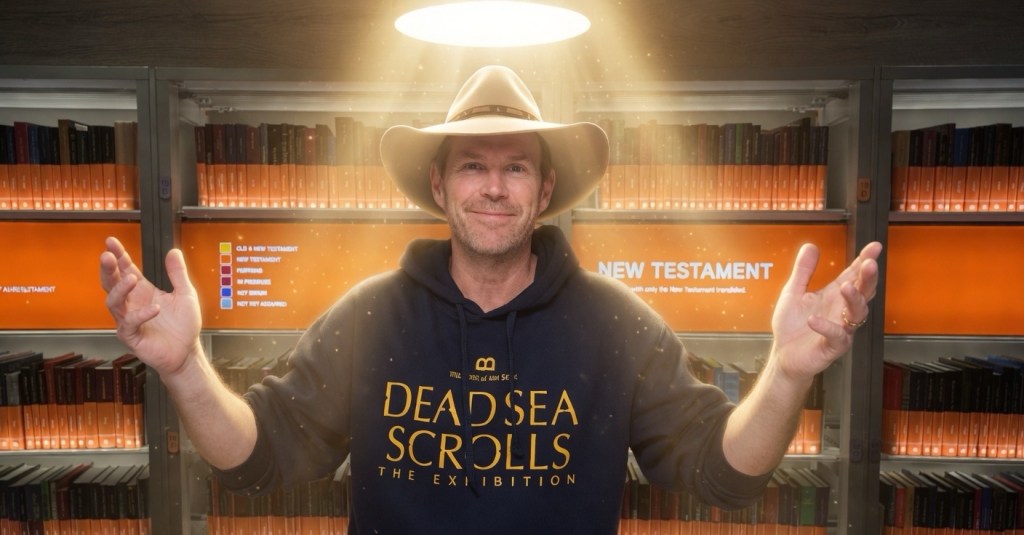
Rich Hoffman is an aerospace executive, political strategist, systems thinker, and independent researcher of ancient history, the paranormal, and the Dead Sea Scrolls tradition. His life in high‑stakes manufacturing, high‑level politics, and cross‑functional crisis management gives him a field‑tested understanding of power — both human and unseen.
He has advised candidates, executives, and public leaders, while conducting deep, hands‑on exploration of archaeological and supernatural hotspots across the world.
Hoffman writes with the credibility of a problem-solver, the curiosity of an archaeologist, and the courage of a frontline witness who has gone to very scary places and reported what lurked there. Hoffman has authored books including The Symposium of Justice, The Gunfighter’s Guide to Business, and Tail of the Dragon, often exploring themes of freedom, individual will, and societal structures through a lens influenced by philosophy (e.g., Nietzschean overman concepts) and current events.

