The IRS is guilty of misleading the American public and the Obama Administration has proven itself at the very least incompetent to manage government offices. The Obama White House is most likely very guilty of much, much worse—with a series of scandals that far eclipse Watergate. To understand the severity of these crimes, here is just the IRS timeline of who knew what and when they knew it.
Dear reader, the best thing you can do is send a copy of this article to your congressman and let them see the IRS timeline for themselves. Also, make sure to instruct them you expect Congress to treat the IRS in the same way that the IRS treats all of us.
Freeze all their paychecks till the matter is resolved.
Take back any bonuses paid during the above timeline.
Freeze all assets till innocence is proven.
And padlock their doors till legal justification for holding a position of authority can be restored.
If any of us were in trouble with the IRS and caught in just a fraction of the trouble that they are currently in, that is what would be done. So the same needs to happen to the IRS. Without the urging of the public, Congress will lose their back-bone and let justice subside to back-room negotiations, and this cannot be allowed to happen.
You have seen the evidence. Now act on it. And if you have doubts……the below video was filmed one week before the IRS bomb dropped. Obama was well aware of what was going on……………he is lying, and that is against the law. And he knows it.
On Thursday morning, May 23, 2013 The Morning Blaze with Doc Thompson and producer Skip Lacombe broadcasted for 24 straight hours to raise money for Mercury One’s Midwest Tornado Relief Fund with support from The Blaze Radio Network‘s Glenn Beck, Jay Severin, Buck Sexton, Pat & Stu and other special guests such as yours truly. The broadcast began at 6AM Thursday morning and ran through 9 AM Friday Eastern time 5/24 from Oklahoma. The time over that 27 hour period that Doc and Skip were not on the air was during Glenn Beck’s regular 9 AM to 12 PM broadcast. The marathon broadcast was quite an achievement as Doc and Skip spoke straight for the entire time with a performance that far exceeded Rand Paul’s recent filibuster in the Senate and successfully helped generate over $1.5 million dollars for victims of the Oklahoma tragedy. It was halfway through this marathon that I came on with Doc to talk about the IRS situation surrounding Lois Lerner and how much mutual affection we had for one another.
I have worked long periods of time that also exceeded 24 hour intervals, so I have an appreciation for what Doc and Skip achieved. Since Doc joined The Blaze, I leave their streaming audio on just about everywhere I go. With phone apps being what they are these days and computers being so mobile The Blaze Radio can be heard anywhere through streaming audio, so I never have to worry about signal strength that was so typical of AM radio. I can now travel anywhere in the country never having a break in a broadcast, and that is the single best reason for using The Blaze as my new primary news source. But I wasn’t willing to give it a chance until my good friend Doc joined The Blaze. Now that he has, I am hooked.
I left Doc and Skip’s broadcast on for the entire period and was surprised to hear them displaying the same enthusiasm at 4 AM as they did at 6 PM the previous day. Before the 27 hour marathon performance, Doc and Skip had done remote broadcasts from Washington D.C. and Richmond, Virginia, in the same week which demonstrated the strength of The Blaze’s Radio program to pick up from one location and successfully set up a remote in another location so quickly. The innovation that was being used at The Blaze means that Doc and Skip due to their iron man-like endurance no longer have to be constrained by cumbersome equipment as other radio stations are limited to. The phone screener no longer has to be in a booth in the next room communicating to the radio host through a glass window. Modern equipment efficiency allows part of an operation like The Blaze to function out of New York City, Dallas, Texas, and then the road team represented by Doc and Skip communicated over computer networks through headsets in real-time. This means that ambitious projects like the Oklahoma fundraiser on the heels of an already extensive road trip are possible because Skip can pack up their radio studio and put it in their car easily to set up in the next town quickly. The Blaze has been one of the first, and best of their kind, who have a large news organization that is so mobile, and is free of FCC regulation. That makes them very unique.
After Doc left the air to catch up on some much-needed sleep, The Blaze Radio Network switched over to Glenn Beck who was broadcasting from The American Dream Labs in Salt Lake City and immediately stepped into coverage of the London terrorist incident where a young soldier was beheaded by a radical extremists in the city streets. The Blaze is a creation of Glenn Beck built by the money he earned off his popularity gained at CNN and Fox News. Instead of becoming a pompous ideologue, like so many do who have even a fraction of Beck’s talent, he took his money and did great things with it as an entrepreneur. It is because of Beck’s commitment to The Blaze that it is such a dynamic radio program and had the ability to send Doc and Skip on the road to Oklahoma to raise money for the victims there so efficiently, and effectively.
As I’ve said, more than once I have worked 24 hours or more, and I know how tired Doc and Skip had to have been. But add to that the need to talk for such a long period of time without the assistance of visual aids, or even music to fill the time. The entire show had to be filled with Doc and Skip’s voices and that is difficult, because to do so, there has to be enough thought in the mind to articulate words in a voice. As a fairly frequent guest on talk radio, and occasional public speaker, I can talk for hours without notes—but this is due to the many books and information I put into my head with a daily education that I work hard to maintain. So I can appreciate the sheer volume of thought it takes to generate 24 hours of straight talking with only breaks at the top and bottom of each hour for the news. Doc’s performance with Skip was a Marconi Award winning endeavor in my opinion. No other radio host in the country could come close to what Doc pulled off. Doc and Skip’s unique brand of news radio and commentary is laced with comedy that is the conservative equivalent to Jon Stewart from The Daily Show, it was funny stuff at 6 AM Thursday, and it was still funny 27 hours later at 9 AM Friday.
Doc didn’t just get to such a level over night. When he was in Cincinnati Doc did 6 hours of radio every single day. He did three hours at 700 WLW then 3 hours in Richmond, Virginia at 1140 WRVA for well over a year. I used to think that was a lot of radio for a voice to perform, but Doc blew that trend out of the water with his marathon Oklahoma performance.
Doc’s iron man tenacity in radio was reflected in his broadcast, and ultimately, it is that type of on-air personality that makes The Blaze a much better news organization than is offered any place else. The Blaze hires and recruits out-side-the-box types of employees like Doc and Skip, and the results are overwhelmingly obvious. The Doc Thompson Show on The Blaze demonstrates a passion for the material that is simply unheard of anywhere else. It was a pleasure to listen to Doc and Skip on the radio for more than 24 hours. I came away from that broadcast wishing that every day could be so wonderful as to hear the Doc Thompson Show on the radio with fresh content every hour of the day for the entire duration. I feel fortunate to have witnessed it, and even participated in a small way—to be a part of that magnificent history. Doc’s broadcast was a shining example of how individuals come together in a crisis without government coaxing, to do good things for good people with all the ingenuity and tenacity that is typical of the American spirit. All those elements were present on The Blaze Radio Network’s 24 hour fund-raising efforts in Oklahoma during a tragedy that brought good will to millions upon millions of listeners who were joined to a great cause by the voice of Doc Thompson and his producer and sidekick, Skip Lacombe.
Because of all the IRS news lately, and considering that I have been in the center of the storm, Matt Clark wanted me to come on his radio show at WAAM in Ann Arbor, Michigan. Unlike my friend Justin Binik Thomas who is a very nice guy whose previous interview with Matt sparked my visit seen and heard below, I do not trust the system to fix anything. I hope that everyone in congress does what they are supposed to and defend the name of Justin and those involved in the recent IRS scandal where that government collection agency attacked Tea Party groups maliciously out of their innate desire for self-preservation. But I have serious doubts. I don’t like the IRS, or what it represents. And I sure don’t like how it goes about its job, and I’ve never been shy to talk about it. The IRS represents government statism in all the worst ways, leaving their intrinsic social debauchery to migrate unmolested into the American experience.
For my part in the IRS scandal I produced two videos for the Liberty Township Tea Party that fell under the questioning by agents harassing them for information. The IRS wanted DVD copies of my videos because they were shown at a Tea Party event for education reasons. The first video was one that was produced by me and a group I was working with called the State Sovereignty Committee of the LTTP. The basic function of the group was to get together once or twice a month for several months and learn about The Tenth Amendment. We would then present our findings to the larger group of the Liberty Township Tea Party. As we uncovered information in our little research group I discovered that the situational abuse of the Commerce Clause was detrimental and highly scandalous. So I suggested that our group present our findings in a nice video that made the complex topic easier to understand. That is the video you can see below.
The other video involved the Immigration Committee of the LTTP, which was assembled and put together in much the same fashion for the same reasons. For that video it simply made sense to sit down with one of the most vocal advocates of immigration reform in the entire United States, Sheriff Jones of Butler Country and interview him. Both videos were then shown to the larger Liberty Township Tea Party group for purely educational reasons. The complete expense of the videos was covered by me to keep everything easy. The reason that I publish this website of Overmanwarrior’s Wisdom without any subscription fees is to avoid having to file any IRS forms that give them regulatory power over my work. With those videos, no money changed hands—they were simply the result of my donated time, and of those who worked on those projects with me. I do offer my published works on my website for money, but I do not sell them direct. The books are sold exclusively through my publisher. This keeps an accurate record of my quarterly royalty checks which are indisputable with the IRS since the payment comes from a company that keeps sales clean and beyond refute. Publishers like authors to sell their books directly because the profit margin is much higher instead of sharing the revenue with third-party book distributers; it also allows authors to lower the price selling more titles. Bill O’Reilly even with all his name recognition does this better than anyone and for the same reasons. In his case his increased profit margins go directly to charity instead of third-party distributors. I do not use this method because of my controversial endeavors knowing that everything I do is watched closely by the IRS and the other arms of tyranny which make up the federal government.
As innocent as the videos were, which in essence were no different from any typical YouTube video, the IRS included them on their lists of questions to the Liberty Township Tea Party as though some great scandal had been committed, which was simply laughable. But I did have to provide actual DVD copies of the videos to the IRS, which seemed ludicrous to me as there were 4000 IRS employees in Cincinnati any one of which could have downloaded their own copies from the YouTube postings. As I spent a whole Saturday afternoon finding and creating DVDs of the videos I wondered what those IRS employees did all day—and the more I thought about it the angrier I became. Regardless, I turned in the videos and the Liberty Township Tea Party satisfied all their questions given to them by the IRS. About a month later this scandal broke to the level it currently is.
In a lot of ways, the 10th Amendment video inspired me to create this site because that was the moment I realized how corrupt our government truly was. The way congress split hairs over the Commerce Clause, the 14th Amendment and any other hook they managed to get over states rights violating the Constitution in the process showed me what the game of government was really about. The proof was overwhelming, and obvious. I saw the same thing happening in our public schools, in the Obama administration, the United Nations, and exemplified in the statist philosophy of the IRS. So I started this site to help educate others as to how the scam has been perpetrated upon Americans for many years. Once I admitted to myself that the level of deceit was not just a suspicion I had, but the proof was discovered in that 10th Amendment video, I came to understand that more information had to get out to more people, more often. I spent 4 months making that 10th Amendment video with a team of other people—and that was too slow. The Tea Party only met once a month, and that was too slow for educational purposes, so I started this site to accelerate the process of learning.
So is the IRS right to notice that my videos have had a role in the Tea Party effort? Yes they are right, and they understand that if people learn the truth of their intentions then more people will turn against the IRS grip on the public. So for their own preservation, they are right to target those videos—as innocent as they are—for what the videos represent. However, the IRS is still confined to the law—at least the perception of law. They cannot openly violate the Constitution; they must do so with deceit and fear hoping to get others to comply out of dread instead of legal knowledge. And it is my intention to take those weapons away from such scoundrels by re-teaching people how to think for themselves.
As usual it was fun to do Matt’s show. It is even more fun to see the IRS squirm on the chopping block for once. However, I don’t trust what I see or feel of the situation. There is more to the story and the sacrificial lambs of the IRS thrown upon an alter by the President of the United States indicates a deeper, darker, much more sinister problem that has yet to indicate its magnitude. For that beast, my eyes follow the evidence trail of dismembered lives, treachery, lies, and every conceivable sham to the lair where the real trouble resides. It is there that the head of such a monster must be removed through the preferred method of defunding—by starving it out of its hiding place. But I do not regulate my thoughts to a peaceful end where the process will correct itself. Logic says that before it’s over, the nasty beast of government will attack to protect its lair where many future baby monsters are laid like eggs—awaiting to be hatched. The monster of the federal government wants to preserve its young so that they can grow up to become great monsters of their own. It is the task of all right thinking people to prevent that from happening. I hope Justin is right about trusting the process, but logic says that in the end it will be my methods that we’ll see first.
Before it was all said and done there were around 500 people who joined the crowd protesting the gross intrusion of the IRS into the lives of Tea Party Patriots.
CINCINNATI – The furor over the IRS’s improper targeting of conservative groups went on full display in downtown Cincinnati on Tuesday.
More than 200 people turned out for a noon rally sponsored by local tea party groups, according to 9 On Your Side’s Scott Wegener. Some carried signs that read “Audit the IRS,” “Internal Revenge Service, Stop” and “Stop the Abuse of Power.” Some chanted, “Hey, hey, ho, ho, the IRS has gotta go.”
“I think we need to do something about the abuses of government,” said Dennis Hogan of Maineville.
After gathering on Fountain Square, protesters marched two blocks to the IRS office at the federal building at 550 Main St. That where IRS workers improperly targeted conservative groups in their applications for tax-exempt status over the last few years, a Treasury Department inspector general’s report states.
Lined up along the sidewalk, protesters chanted, “You work for us. You work for us,” while Homeland Security officers stood nearby.
“It’s ungodly, it’s un-American and it’s just plain wrong to target Americans because of what they say about the government,” said Paul Johnson of the Grassroots tea party of Boone County.
“We want them to cease and desist harassing us conservatives,” said Andrew Pappas of the Anderson tea party.
To that end, protesters signed a large placard and Ann Becker, president of the Cincinnati tea party, gave it to officers to deliver to the IRS.
“This isn’t about party. It’s about individual freedom,” Becker said.
Becker has called for the immediate resignation of all involved in the targeting scandal.
“There shouldn’t be a political attack based on our beliefs, and we believe that’s what the IRS has done,” Becker said.
“That it turned out to be going on in the Cincinnati office is fairly ironic considering the strong tea party presence in this area,” said George Brunemann. “I’d say there’s about 20,000 members in Hamilton, Butler, Warren and Clermont (counties).”
Brunemann said he and his wife were audited and his wife’s business was audited after they started the SouthWest Cincinnati tea party. He doesn’t believe the IRS officials who claim low-level Cincinnati IRS workers came up with the idea to target conservative groups.
“The IRS agent who told us we were being audited said it was directly because of our involvement with the tea party. She was almost apologetic,” Brunemann said.
He said he knows a small business owner who was audited by the IRS and investigated by OSHA after joining.
“To me, that’s what screams that this is not lower-lever IRS workers. This goes all the way up the food chain. The president might not be personally involved, but his people are,” Brunemann said.
Some tea party groups are planning lawsuits in connection with the investigation.
Five present or former Cincinnati IRS workers were called to Washington to give transcribed interviews in advance of a House committee hearing on Wednesday.
The scandal has already led to at least three congressional hearings.
It’s always the cover-up that brings to light institutional failure because the participants will stoop to no low to protect the organization of which they’re a part. With the same denials seen during the Penn State child molestation case where thousands of individuals protected Jerry Sandusky because of his legendary contributions to the football team’s defense, employees of the IRS are willing to do the same to keep their jobs and protect the institution. The IRS employs over 100,000 employees all across the nation, 4000 of which work in Cincinnati alone. It is a giant monster of a bureaucracy and no reform is possible due to the billions of dollars that are stolen out of the treasury to pay for all those employees—which are largely unmanaged positions with payroll values as ridiculously high as public school teachers teeming with incompetence for the same reasons. The IRS is the judge, jury and executioner of their own crime syndicate and every human being that works for them places their individual judgment into the back of their minds serving blindly an institution created by government to perpetually grow uncontrolled of service to itself and nothing else. This issue was particularly well articulated by Darryl Parks during his midday radio show on 700 WLW during May 18, 2013.
Darryl was right; there isn’t a politician in the Ohio region who will take on the IRS scandal any further than the Ways and Means hearings because they cannot in all consciousness go against the government institution for which they serve. People who think in such ways have lost their individual judgment, or their value assessment for other individuals because they are in service to an institution—and their primary task at that point becomes to protect that institution with any sacrifice necessary to further its continuation. That means lying under oath is on the table of possibility because most individuals who serve like slaves to the government and all its divisions have lost touch with their individuality not fearing even eternity in hell if the preservation of the institution can be preserved.
Local Republican politicians have known about this IRS scandal for over two years. I know personally because I have been intimately involved with the Liberty Township IRS harassment case. John Boehner knew all about it. Rob Portman knew all about it. Mitch McConnell knew all about it, yet nobody did anything about it because they all primarily serve the institution of the federal government. They do not serve the interests of the individuals who elect them. This is the fault of our social commitment to altruism which informs these institutional soldiers that individuals should always sacrifice themselves to the “greater good” and that individual judgment should be suspended for collective causes. Republicans willingly play their roll in preserving institutions at the expense of the individual—even at a cost to themselves.
If I had a quarter for every kitchen I stood in where the children disrespected their parents and the women looked wistfully toward every horizon for some great lover to sweep them off their feet in a passionate romance even though their families all live well in large houses with perpetual financial security, I would have already amassed all the world’s wealth in my possession. I can speak that in Cincinnati I have been on 90% of the roads of the city covering approximately 150 square miles. And at one point in time I have stood in the kitchen of at least one house in every neighborhood in all those communities and always the stories are the same, especially when one or both parents work for the federal government. There is a soulless look on the faces of such bureaucrats that is the direct result of such lack of individuality. The children of these households are attracted to any presence which might contain some sense of individual structure and they flow toward these personalities like water seeking a glass to hold some semblance of their personal identities. These children do not respect their parents because their parents do not serve the family, they serve their employer—the government first and foremost which is hidden to nobody. The women in such relationships if they are still young and attractive have affairs with any man with tattoos, long hair and some external exhibition of individual merit. Later, when they’ve become shells of their younger physical bodies and such men are no longer attracted to them, they fill up the nail salons’ getting manicures and pedicures so that they can have some sense of individual pampering trying to rekindle their individual identities which has been consumed by the institutions they serve. The effort is to feel individually special, since their jobs do not offer such entitlement—as they are in service to an institution. The men fare far worse in such arrangements. They drink to evade their social realities, they have affairs to feel young so to hide from themselves what they’ve become, and they all end up the same way. By the time they hit 40 they are physical wrecks often overweight with skin problems, eyesight deficiencies, and heart illnesses. Their broken hearts are more mental than physical, but the muscle of the heart reflects the broken dreams of every bright-eyed little boy who wishes to save the world with heroics, only to discover that they are middle-aged sell outs afraid of their own shadows. They become empty husks as the institutions they serve drain them of all their worth feeding off them like a parasite till their deaths.
The commitment to institutions over individual need is the leading cause of misery in American culture and the IRS is filled with these types of people. Most of them are suffering from the same ailments shown above, even though they have new cars, nice homes, and comfortable retirement packages. The 4000 employees who work in the Cincinnati IRS fit the above profile by nearly 95%. They are willing to trade their lives away for the security the IRS provides as an employer because the pay and benefits are good—better than they’d get at a comparable job elsewhere. They do not care that the value they reap as institutional employees is stolen from millions of tax payers with looted money in a system that mimics slavery in every definition of the word.
This is why the IRS is allowed to attempt ruining the lives of individuals no matter how severe the imposition. This is also why the IRS has so many supporters who are willing to lie on its behalf. This makes the testimony provided to the Ways and Means committee on May 17, 2013 that much more potent because if the IRS employees are willing to admit to their specific targeting of individuals in the Tea Party case, then what deeper imposition are they actually protecting? The IRS didn’t just decide to release a statement that it knew would anger millions of Tea Party protestors like a match thrown on piles of dry paper sprinkled with gasoline. The IRS itself as an employee of the much larger federal government is seeking to protect the institution of statist government from something the same way that individuals protect the IRS from institutional scandal. The answer to what that scandal is defines the real scoop of the current problem. For my money, I would bet on Benghazi.
I can understand why the un-ambitious, physically frail, intellectually insufficient, culturally lacking and otherwise fearful human beings would be attracted to socialism. Competition is a frightening ideal to those who lack the confidence to advance themselves to a level of performance that is needed to overcome rivals. Such attitudes are what drive capitalism and bring freedom to the lives of everyone in subtle ways, yet the idea that there are winners and losers in life must be accepted. For the characters who wish to be handed victory trophies in life for simply existing—because they fear competition, socialism gives them the ability to feel they are equal to those who are clearly better at some skills and set the bar high for all others to meet. Socialism is more attractive to the weak and feeble masses because it keeps them from having to compete for merit. Socialism will always be appealing to those types of people.
But ironically socialism is not good for the collective society because it removes the merits gained through competition. When competition is missing from any endeavor, performance drops dramatically in every activity attempted under any effort. While socialism protects the individual from collective pressure exerted upon those who fall short in life it destroys the individual merits that a society enjoys because of competition driven by the best and brightest succeeding.
Americans for many generations, particularly since the 1930s have been inundated with socialism imported from the deficient European political theater, and it has harmed the American way of life dramatically. But since socialism was introduced so long ago, many modern Americans do not know life without it. They have socialism in their retirement packages, their collective bargaining agreements, in every aspect of their governments, in their taxation, in their medicine, in virtually every aspect of their lives because a democracy is ruled by the masses and the masses find socialism more appealing than capitalism—that is until they find their freedoms evaporating as a result.
When a football team starts losing because the best quarterback is on the bench because the head coach does not like the individual, or believes that other team quarterbacks deserve a chance but are clearly lacking in ability relative to the better player, the whole team loses and they will begin to embrace methods of capitalism to put the best players on the field so they can win. But such pressure is only introduced if the other teams are actually trying to win the game by putting their best players against other team’s best players. If all teams fail to recognize who the best players are from bad players then the game loses appeal to any audience as chaos and boredom are due to follow. Fans in the stands that pay money to be entertained and watch the game will quickly realize that they could perform at the same hapless level, and will stop attending football games. They’ll just organize their own games. So a level of competence and an attempt at becoming the best is required in such endeavors. Socialism harms this process.
Yet the same rules that make football a great game apply to science, business, education, even gardening—competition drives the level of society higher with quality being better wherever competition is present. The most dramatic example of such competition can be seen in Orlando, Florida. My absolute favorite McDonald’s to eat at in the entire country is the fabulous giant of a restaurant which resides just outside of Universal Studios. It is one of the largest McDonald’s restaurants in the world and is made that way out of a need created by competition. Universal Studios in Florida has two amusement parks just down the road and both are absolutely fantastic. But they became fantastic because they are in competition with the four Disney parks just down the highway at the next exit and all the wonderful entertainment options that connect the two multi-park complexes with International Blvd. And in between these two massive amusement destinations is the Sea World complex which has done so much good for marine wildlife research due to their excessive revenue generating capacity. It is competition and capitalism that make all the fabulous activity in Central Florida work so well. Without competition, Universal Studios could afford to cut corners and present the bare minimum investment needed to bring visitors through their admission gates. But they can’t, because Disney drove the market higher always pushing the other parks to become better, or go out of business. The result to all this dynamic is that an average fast food restaurant like McDonald’s which everyone takes for granted in their home town communities is driven to become better and more spectacular. Whenever I’m in Central Florida, I make a point to visit this McDonald’s so I can relish capitalism displayed in such a fantastic fury. There is no place on earth like Central Florida because capitalism has defined it and made it what it is.
Elsewhere, where socialism injects itself, such as in public education, any unionized effort, or any government position competition is missing. This is why such efforts struggle perpetually to maintain any level of quality—because they are essentially combating nature itself attempting to fight off the effects that destroyed the U.S.S.R and every communist country in the entire world that functions with a socialist foundation. Every village in Africa where starving residents struggle to live from day-to-day is due to the regulatory limits set upon them by their village authority. Those limits may only be religious, political, emotional, or any other variation, but they do not involved competition. Village chiefs do now as they always have, attempted to drive their collective society’s desire for competition into their military so that proof of valor and manhood merit is designated to bravery on the battlefield instead of creativity in manners of business. This is the result of socialism and has been going on since before such a term had a definition.
Socialism is the easy way for the masses to avoid not feeling the pressure of competition. Socialism as we see it today in medicine, in education, and in all government would be equivalent to Universal Studios being allowed to exist without having to compete with Disney World. Another tendency of socialism is to use the power of pull to eliminate competition such as the theoretical circumstance of Universal Studios using politics to apply too many regulations selectively enforced on Disney World to attack the fact that they have a broader revenue base and force Universal Studios to perform at a higher level than they might otherwise do if they didn’t have to compete with Disney. Using politics to sap all the wealth of Disney away into nothing, Universal through socialism could eliminate their competition through regulation. This would mean McDonald’s would only have to build a normal free-standing store since Universal Studios would be the only park around, meaning McDonald’s wouldn’t have to compete with the restaurants that are in business down by Disney World in the absence of such competition, Universal could afford to do the bare minimum of everything driving up costs but dramatically lowering quality.
This is the situation with Social Security, Obama Care, the Post Office, public schools and virtually everything that socialism touches through government. Socialism allows the average to sell their services as “superior” because they have eliminated competition. This is the spirit behind every collective bargaining contract—they are socialist attempts at fairness—but the fairness comes at a cost to quality, and dynamics.
So when it is said that people want to see better things out of government, they have to reject the socialism that they are currently addicted to as a safety net to their own incompetence. It is easy to declare that the entire world should be fair, but the cost of that fairness is terrible, as it pushes society into a black hole where nothing of any good can ever escape. The grand myth by socialism lovers is that if they collectively believe in something through the power of democracy that they can deny the laws of nature, but they can’t. Their beliefs are never realized, and their commitments to socialism destroy the world for everyone instead of just the targeted well-to-dos which they rally against. It is those who are best whether it be richer, stronger, faster, or even more attractive which set the standard for all others to reach up to. Without such goal posts, society just flaps in the wind and recedes backwards. The masses may never achieve the level of greatness that comes from the best. Universal Studios may never be as great as Disney World and McDonald’s may never be a good as The T-Rex Café but it is the attempt through competition which raises the performance of all to achieve heights they otherwise would never accomplish. Before society can every become better at anything it must reject socialism and embrace capitalism—because until they do, there is no reason for the average and mediocre to attempt to be more than they currently are—to strive for greatness, and goodness in a spirit only competition can provide.
For those who have not been keeping up with the news, here is the chance to catch up. Glenn Beck puts his thoughts together on how the IRS scandal, the Benghazi terrorist attacks, and the AP News story are all connected. Glenn’s thoughts are very much aligned with my own. Watch, listen, and share with a friend. For those who read here and hold “important” positions and know “important” people, make sure to share this with your networks so they understand what kind of game is going on.
With three major scandals enveloping the White House, Glenn spent time on radio this morning breaking down how they are all rooted in the idea of fundamental transformation.
“We have Benghazis, IRS, and the AP. I tried to figure out what these things were really all about. In the end what do these three scandals have in common? And what they have in common is the arrogance of transforming the world,” Glenn said.
In Benghazi, Glenn believes that Obama was trying to transform the Middle East by supporting revolution. Glenn theorizes that the CIA was involved with running guns to the Syrian rebels, a theory that has been supported by other members of the media in recent days.
“In Benghazi he was transforming the Middle East. He wanted to run guns, support the Muslim Brotherhood and Saudi Arabia. Saudi Arabia was the one who asked us to support the Muslim Brotherhood in Syria. So support the Muslim Brotherhood in the entire Middle East, run guns to the Muslim Brotherhood through Turkey into Syria and cede revolution, not just in Syria but all throughout the Middle East. This is the transformation of the Middle East. That’s his policy,” Glenn said.
How about the IRS scandal? Glenn said that’s about transforming political dissent and how the government deals with political dissent. He said the scandal specifically shows the evolution of intimidation and control from “nudge”, encouraging people to only trust sources with an acceptable bias like Al Jazeera and Huffington Post, to “shoot” where the IRS is used as a weapon to attack people’s reputation and finances.
“This scandal is about shoot. We’ve gone from nudge, to shove – which is destroy your reputation and I’m going to send the union thugs out after you ‑ to shoot. I’m actually going to use the union thugs to beat you, and I’m also going to destroy your life and finance through the IRS. I will destroy you. I will bankrupt you. When it comes to the only kind of gun the IRS has, they’ve just fired it at the American people,” Glenn said.
Finally, the AP scandal is about transforming the media.
“The progressives have been trying to transform the media for quite some time, and they’ve done a great job. We’ve all seen it,” Glenn said.
“Now, this, I want you to hear this fact clearly. This president has gone after and is prosecuting more whistleblowers than all of the other presidents combined in American history. By the way, he’s had five years. In five years he has gone after more whistleblowers than all other presidents combined. Understand that’s during the Communist hunts. That’s during Vietnam. That includes all of World War II, all of World War I and Woodrow Wilson. That includes Abraham Lincoln and the Civil War. All other presidents combined,” Glenn said.
Glenn said that in order to transform the media, you first have to threaten the watchdogs who are trying to show what the government is doing. And when a few of the watchdogs are able to break through, you go after the press and intimidate them until they are unwilling to investigate.
“This is the last part of the fundamental transformation. What do all of these have in common? Transformation: Transform the Middle East, transform the First Amendment, and transform the media and the watchdogs. Transform, fundamental transformation of the United States of America,” Glenn said.
As Justin communicated with me his thoughts on the IRS revelation on May 10, 2013 he had just wrapped up a very busy day with the media finishing up with ABC World News Tonight, among many other television news programs. He was far from “satisfied” and I couldn’t blame him. Here is the prior article about the issue with the IRS and Justin.
* Reaching out to liberty groups and tea party groups is political in nature – an affront to liberty. I accept the organization (IRS) has a policy against it, but would like to know what actions are taken to assure this does not recur.
* Asking a group about a tax status, unless politically motivated, is ok. What leadership does in their free time is of no relevance to what the organization does. Asking about an individual, particularly an unrelated individual, is troubling. What purpose could it serve? Why was that individual, me in this case, not contacted or informed of outreach?
* As of writing I have not received anything in writing from the IRS besides the initial denial. It would be nice to receive an apology and to receive assurance it will not happen again and that responses, if any, will not be held against me the individual.
The IRS had attacked the Liberty Township Tea Party out of blind speculation that they were involved with Justin Binik-Thomas as he was a founding member of the Cincinnati Tea Party and the assumption was that the Liberty Township group had a way of getting to Thomas. So Liberty Township was maliciously selected for “enforcement.” This essentially meant that the leadership at Liberty Township had to jump through any hoops the IRS decided like mere animals doing tricks for their livelihoods. One of the targets of this IRS inquiry were videos I made featuring Sheriff Jones discussing immigration reform and another I put together featuring the current congressional violations against the 10th Amendment.
I felt bad that my videos were under scrutiny and that some of my antics had gotten other people in trouble with the IRS. At one point in the early winter of 2013 I told some of that leadership just to blame the videos on me, that I was the sole owner of their content, and that I’d deal with the agents on my own. The Liberty Township group did a stand-up job of dealing with the IRS and took care of the situation, which was much more gracious than I was willing to provide, which probably saved a lot more headache. I provided the information the IRS was looking for, and once all those leads went nowhere, the IRS backtracked.
The entire witch hunt started as a direct assault on Justin, and the IRS was simply using mass peer pressure to force Thomas to comply, or back off his Tea Party actions. The IRS was essentially harassing the Liberty Township Tea Party as a way to get at the nerves of Justin Binik-Thomas, and that is not just wrong, it was criminal. So the apology from the IRS is nice, but way too late. It also hints at something else that is amiss.
I am very suspicious of government. I think of even the best of their representatives as habitual liars and con artists. I wouldn’t trust them to walk a dog on an empty leash. So their timing on this apology is actually alarming. The first thought that came to my mind is why are they doing it? And, why now?
Using pure deduction, based on the behavior of government in the past, the same government that lied under oath many times in the past declaring that the IRS did not do the things they just admitted to doing, I would say that the IRS as a member of the federal government is employing the old “bend but don’t break” defensive football strategy. The government knows that they are guilty over the Benghazi situation and are caught in a serious lie. They know that the Tea Party is still full of members that are very active and highly charged even after the re-election of Barack Obama. The government knows that there is an active campaign to remove Republican Governor Kasich from office in the next primaries for turning against the Tea Party, so they fear what might happen to them if the Tea Party gets even more detail out of the Benghazi hearings, which have been carried on Fox News, and extensively by The Blaze Network. The Blaze is a huge supporter of the Tea Party movement and it is getting bigger by the day. The IRS of course knows all this since they have the ability to pry into all our lives at will in the name of “revenue” for the always hungry government. During the Benghazi hearings The Blaze website had over 15 million unique visitors, which is a lot of Americans looking for the truth. So I contend that the IRS is taking a calculated move in relation to the rest of the government and yielding a little to the Tea Party in hopes of taking the edge off the really bad stuff coming out of the modern-day Watergate—which is Benghazi.
This is the trouble with a “collective” organization who thinks more like an ant colony protecting the “queen” than a society of free individuals. The IRS understands what their brothers and sisters are going through in Washington D.C. regarding Benghazi, and they are hoping to take the edge off the story with a nice little monumental revelation that seems so scandalous that it sucks the life out of the Benghazi story. But so what—what is anybody going to do to the IRS? So what if the IRS breaks the law and pisses off the Tea Party, what do they care if they make anybody angry? They revealed they lied in testimony, and that they actually target individuals whom they politically disagree with. So their admission means nothing, it gets played on the news and it makes many Tea Party members believe—falsely—that “the government” is coming around, that they are trying to be good, and honest for a change wishing to redeem themselves for sins of the past—which is far from the truth.
Experience tells me that the behavior of the IRS indicates a bigger fish to fry just outside of perception, and the attempt to throw the world off the scent is the real strategy of this sudden revelation by the IRS. So it would be my advice to those who read here frequently to not take your foot off the throats of those who seek to rule over you. Instead, push down and do not become distracted with this petty admission. I know Justin doesn’t feel happy about spending the last two years targeted personally by the IRS just because he existed. I know the Liberty Township Tea Party would like to have back the dozen or so 2 hour meetings they had to deal with just IRS compliance measures. And as for my time, where do I get back my Saturday that I wasted making DVD copies of my published videos so some pin head at the IRS can have hard copies of evidence gathered from the Liberty Township Tea Party? The answer is that I don’t, the IRS stole my time for no reason, and they don’t care one bit about it. Their apology is not one of sincerity, but of further cover-up of the many sins coming out of Washington D.C. One of my Saturday’s is more valuable and productive than the entire IRS building full of people over any given year. Every minute of my life creates jobs, hopes, and fulfills dreams for others, so wasted time on the IRS takes those things away from others which are why they are such a bad organization whose only primary role is wealth-redistribution.
The shocking revelation by the IRS is not out of goodness, but to cover up further deceit. For them to show humility toward Justin Binik-Thomas who was the real target behind the Cincinnati IRS probes is in the hope that the Tea Party becomes too compassionate to press on with the much more destructive injustices that are hidden just beyond sight. The General Petraeus affair was made of the same type of distractions. The tactical General was planning to retire anyway, so why not throw a juicy story to the hungry wolves hunting a guilty government in order to throw them off the trail? But the Tea Party didn’t take the bait and run back to their caves to eat the meat as hoped. Instead they sniffed and determined that the target was insignificant—and pressed on toward the real villain. Just the other day Obama declared to students at Ohio State that they “should not listen to these anti-government” groups. Pay no attention to the man behind the curtain—was essentially what he meant. Government is feeling the pressure from the Tea Party and the strain is showing. Government knows they are guilty—all of them—of serious crimes, much more so than the situation of targeting Tea Party groups of tax exempt status then lying about it. And it is on those crimes that everyone must remain focused—which is what’s happening.
One of the Liberty Township Tea Party members in that leadership group most affected by the IRS inquiry released a statement which I will now provide on the matter. It’s from Mark Etterling, and articulates the problem very well, and provides insight to the next steps that are to come. Mark’s thoughts reflect my own.
An IRS spokesperson recently issued a verbal apology to the various Tea Party and Patriot groups whom they had specifically targeted for extreme scrutiny over their applications for 501C3 tax exempt status. Even though I can’t speak for our group, which happened to be one of those that was targeted, or any of the other groups for that matter, I can at least issue my own personal response. Your apology is NOT accepted. In fact, I’m willing to go so far in my response as to say that I would personally like to see those responsible not only fired, but also brought up on both criminal as well as civil charges for violating our civil rights via a direct abuse of power.
Exactly one month ago I wrote a commentary stating that I was fed up with all the bogus mea culpa’s. An apology based on an accident is one thing. However, an apology that is derived solely from being caught committing overt actions related to a political agenda is something else entirely. An apology isn’t enough after a school suspends a kid over eating a Pop Tart into the shape of a gun just so that the administrators can push a gun control agenda. Using the IRS to exercise extreme scrutiny against specific political groups is nothing more than an overt attempt to curtail the opposing voices of those groups. Therefore, an apology doesn’t cut it there either.
Those that are currently in power like to scoff at those of us who protest against what we view as tyrannical actions by claiming we are simply being paranoid. However, if you look up the Merriam-Webster definition of Tyranny it’s easy to see that bringing the full power and weight of the IRS to bear on a specific political group for the sole purpose of stifling their oppositional viewpoint fits the very definition of tyranny.
3: a rigorous condition imposed by some outside agency or force
4: an oppressive, harsh, or unjust act : a tyrannical act
I’m not acting out of hypocrisy just because this happens to be an incident that struck home for me. In fact, in the book I wrote two years ago I specifically stated that even though I disagree with almost everything liberals like Chris Matthews or Rachel Maddow ever say, I would still fight for their right to speak no matter how much I disagree with them. The reason is that freedom and censorship cannot coexist. The presence of one will automatically destroy the other. A person cannot profess a love of freedom and yet practice a tolerance of those things that destroy freedom at the same time. Therefore, your choice is to either tolerate the abuse of tyrannical censorship, or be as outraged about this as I am. I would suggest that no matter what your political leanings you should think about this carefully and choose wisely. Otherwise, the next time you might find yourself being on the wrong end of such tactics yourself where the tyrants will have already chosen for you.
My wife and I transplanted a Black Walnut tree in our yard during August of 2012 knowing that the little tree would struggle. August is a bad time of year in Ohio to move any kind of living thing that grows in the soil, but to compound matters there was a drought in August that year which meant we had to constantly water it. Then just six weeks later, the tree had already been looking withered when it suffered through the first frost of the year. Looking at the bits of ice accumulated on the tiny stump of a tree, I thought that was the end of its life. The little budding leaves shriveled up and fell off within days. All through October, November and December I looked at the little stump for a sign of life but there wasn’t any. So the plan was that we’d dig it back up in the spring and find a replacement. But as March came, then April I held out hope that the little tree would show some sign of life. Then, in the fourth week of April, little buds sprang out at the base of the tree. It was trying to grow again.
About the time that I was watching this tree I was reading Ayn Rand’s Capitalism: The Unknown Ideal on my front porch. I immediately drew a metaphoric parallel between capitalism represented by the little tree and the cruel nasty world that was trying to kill it represented by socialism. I thought of socialism because we had to remove the tree from where it was growing naturally as I was worried about mowing over it with the lawn mower. Landscaped yards always remind me of socialism as they are planned associations of plants in relationships concocted by the owner of a property that may not naturally be compatible. We had moved the tree to save the tree which brought to my mind George W. Bush’s famous socialist quote “I had to abandon free market principles in order to save the free market.” If I had not removed the tree, it would have died. But why did I have to move the tree—because I desired that my landscaping look a certain way. It wasn’t the poor little tree’s fault; it was just trying to live where a seed had fallen. As the dictator of my property, I can decide what lives and dies. My plants do not have freedom from me. They are completely reliant upon my compassion to keep them alive or to kill them at my discretion. That is why landscaping to me always reminds me of a planned society resembling socialism.
I tend to let things grow where they want to as much as possible, as they do in nature. I don’t like to tamper and trim too much unnecessarily, because I like the plants on my property to know that they have a certain amount of freedom to do as they please, and that I will let them. That also tends to be my leadership tendency when I have to lead others; I let them do their thing as much as possible as long as it doesn’t violate my overall vision. But the vision is always mine, and if something or someone gets in the way of that vision, they get cut down ruthlessly. That is the way of nature.
But that is not how it is supposed to be in a free country with free people. The government is not the people’s gardeners. The government is not supposed to transplant trees, cut the grass, and plant flowers just because they think such arrangements look pretty, or are pleasant esthetically. The government is not supposed to move businesses around, tamper with people’s cultures for bloc voting advantage, or pick winners and losers in enterprise. They are not supposed to be involved in health care, otherwise known as the watering of the population, but should allow growth to occur as robust and dynamic as the economy and the minds of the people can allow. The populations of earth should be allowed to grow to the highest trees of the California Redwoods as opposed to the well manicured trees of a football stadium, where the building is more emphasized visually than the plant growth of the landscaping.
These are the problems that are tackled and solved in Ayn Rand’s classic book about the philosophy of an economy which make excellent arguments in favor of capitalism. Reading the book felt like discovering an old archeological relic which held the keys to solving most of society’s problems, and finding such material after it had been buried away from man’s eyes for generations. Capitalism: The Unknown Ideal is a remarkable book written from essays first published in The Objectivist magazine during the 1960s. Capitalism is The Unknown Ideal because it never really had a chance to get off the ground in America, where the Ideal was invented. The result to America and to the world has been explosive economic growth that gave every individual operating under capitalism the opportunity to live and thrive based on their own ambitions.
Yet every statist oriented government in the world, which has dominated the human mind for millennia fear capitalism the way a panicky home owner worries that the grass of their well manicured lawns are growing too robust. For the property owner, it is generally accepted that the trees and every blade of grass on a property are the possessions of the owner. Governments, princes, princesses, monarchs of every kind, dictators, even United States presidents believe in their heart of hearts that people belong to the “leaders” of a culture in the same way that plant life on a property belongs to the owners and this is the cause of statist governments which find capitalism repulsive.
They fear an unmanaged economy because the evidence is that the growth can quickly overwhelm their property and remind them that it is the plant life that will always outlast their attention and place demands on the property owner–the leaders of statist governments. The growth of such plant life always threaten to overtake government which is what they fear most, so they diligently cut back any sign of extensive growth like maniacs fearful of their own shadows. Capitalism: The Unknown Ideal digs into the history of these fears and provides psychological reasoning for them in a way that is unique to this particular book.
Years ago when I studied economics at The University of Cincinnati there was not one mention of this book which had been out to the public for over 25 years at that point. The economics professor would have had much more success as an instructor if he had not attempted to explain variations of Keynesian economics and the cause and effect of business cycles but had simply taught his class upon the contents of Capitalism: The Unknown Ideal. Those business cycles, depressions, recessions, and all economic growth are caused by statist governments tampering with the robust desire for economic activity to flourish naturally, and without restriction. To maintain their control, governments are always cutting back on growth to satisfy their aesthetic tendencies which is the cause of most misery in economic development.
The book is incredibly well written, and easy to understand. But its concepts are contrary to what entire generations of civilization have been taught in their public education establishments and colleges. So most readers will go through a phase of troubled thought when reading, as they have to unlearn all the garbage that they have been taught over many years, but for the sake of review—in pulling together such remote thoughts into a single metaphor, the little Black Walnut tree and its tenacity at living reminded me of the lessons articulated in the wonderful book Capitalism: The Unknown Ideal. If every human being in the world read just this book, they would find their lives much better off. This book is the Dead Sea Scrolls of modern economics. Capitalism has been attacked and transplanted many times by over aggressive statist governments for many years. It has suffered harsh winters, frosts, lack of nourishment, and abuse of many who want to kill it. Yet, like any gardener learns when they take an extended vacation, or neglect their yard work, the grass always grows, and the trees spread out their branches. Capitalism finds a way to grow even under the harshest governments, under the most vicious advocates of socialism. It keeps crawling its way toward the light in spite of destructive restriction and gardeners who trim their yards to simply exert control over the plant life. Statist governments control economic activity in the same way, they cut, trim and manipulate to satisfy their vision, not the individual desires of the people who put them into power to begin with. This is the cause of their failure, and the reason for economic recessions.
ALINSKY: Sometimes it seems to me that the question people should ask is not “Is there life after death?” but “Is there life after birth?” I don’t know whether there’s anything after this or not. I haven’t seen the evidence one way or the other and I don’t think anybody else has either. But I do know that man’s obsession with the question comes out of his stubborn refusal to face up to his own mortality. Let’s say that if there is an afterlife, and I have anything to say about it, I will unreservedly choose to go to hell.
If you’ve wondered how the government can so openly lie about tragedies like Benghazi to the public, or manipulate voters with the innocence of children to pass school levies and commit every evil in between, then your answer is in the work of Saul Alinsky. Saul Alinsky is the embodiment of self professed evil and sadly a large majority of the modern American population respects, and studies his methods. It is Alinsky strategies that inspired the cover-up in Benghazi from the Obama administration and like the mobster Al Capone, whom Alinsky studied, the world is eager to fall for the lurid appeal of such Hell bound villains. The following interview will tell you everything you need to know about the political strategist whom was a community organizer from Chicago and a mentor to Barack Obama. The interview was duplicated into six parts listed at The Progress Report from a 1972 interview with Playboy magazine just a few months before his death. The words below are those of The Progress Report, Playboy magazine, and Saul Alinsky himself from that time shown in their entirety. Alinsky was not shy about his intentions. He dedicated his work to Lucifer and at the end of this article he expressed his desire to live in Hell instead of Heaven. Alinsky has been successful in calling the virtuous “fat cats” and stealing from them the value of that virtue so to fill those without it—the masses whom are either too lazy, or devoid of value by default to act upon it. Saul Alinsky admits as much in this interview. It is because of him that situations like the one I’ve described in my home school district occur. CLICK HERE TO REVIEW.
The following is long. I suggest running off a hard copy so that the contents can be read in their entirety. While reading consider that virtually every government employee has been exposed to these methods–every school, every teachers’ union, every organized group over the last 50 years. I won’t offer further commentary as the information provides plenty. Just understand that it is Alinsky who has taught the world to be what it is today, especially on the political left. Alinsky didn’t consider himself a socialist, but his behavior was undeniably collectivist and served their interests well. The result is the world we currently live in. And with that, read the following thoroughly, from the long ago interview with Playboy magazine in the words and mouths of those who dance with the devil—literally, and are proud of it.
Saul Alinsky is, along with Thomas Paine, Henry George, and Dorothy Day, one of the great American leaders of the nonsocialist left.Response to our earlier article dealing with Alinsky has been so great that we worked to obtain this extensive interview with him, conducted by Playboy magazine in 1972. It is, by far, the most detailed conversation with Alinsky that we know of. The interview will be appearing in weekly installments here at The Progress Report.
Introduction
For the past 35 years, the American establishment has come under relentless attack from a bespectacled, conservatively dressed community organizer who looks like an accountant and talks like a stevedore. According to The New York Times, Saul Alinsky “is hated and feared in high places from coast to coast” for being “a major. force in the revolution of powerless people — indeed, he is emerging as a movement unto himself.” And a Time magazine essay concluded that “it is not too much to argue that American democracy is being altered by Alinsky’s ideas.”
In the course of nearly four decades of organizing the poor for radical social action, Alinsky has made many enemies, but he has also won the respect, however grudging, of a disparate array of public figures: French philosopher Jacques Maritain has called him “one of the few really great men of this century,” and even William Buckley, Jr., a bitter ideological foe, has admitted that “Alinsky is twice formidable, and very close to being an organizational genius.” He was preceded by his reputation on a recent tour of Asia, where he was hailed by political and student leaders from Tokyo to Singapore as the one American with concrete revolutionary lessons for the impoverished Third World.
Not bad for a slum kid from the South Side of Chicago, where he was born on January 30, 1909. After working his way through the University of Chicago, Alinsky attended graduate school for two years, then dropped out to work as an Illinois state criminologist. In the mid-Thirties, as a side line, he began to work as an organizer with the then-radical C.I.O., in which he soon became a close friend and aide to John L. Lewis. Then, in 1939, he phased himself out of active participation in the labor movement and into the role of community organizer, starting in his own back yard — the Chicago slums. His efforts to turn scattered, voiceless discontent into a united protest aroused the admiration of Illinois governor Adlai E. Stevenson, who said Alinsky’s aims “most faithfully reflect our ideals of brotherhood, tolerance, charity and the dignity of the individual.” In 1940, Alinsky elicited a generous grant from liberal millionaire Marshall Field III, who provided funds to establish the Industrial Areas Foundation, which has remained Alinsky’s primary base of operation. Throughout the next decade, with Field’s financial backing, Alinsky repeated his initial success in a score of slum communities across the nation, from Kansas City and Detroit to the barrios of Southern California.
In the Fifties, he turned his attention to the black ghetto, and again began in Chicago. His actions quickly earned the enmity of Mayor Richard J. Daley (who, while remaining firmly opposed to Alinsky’s methods over the years, recently conceded that “Alinsky loves Chicago the same as I do”). He also redoubled his travel schedule as an “outside agitator.” After long but successful struggles in New York State and a dozen different trouble spots around the country, he flew to the West Coast, at the request of the Bay Area Presbyterian Churches, to organize the black ghetto in Oakland, California. Hearing of his plans, the panic-stricken Oakland City Council promptly introduced a resolution banning him from the city, and an amendment by one councilman to send him a 50-foot length of rope with which to hang himself was carried overwhelmingly. (Alinsky responded by mailing the council a box of diapers.)
When Oakland police threatened to arrest him if he entered the city limits, he crossed the Bay Bridge with a small band of reporters and TV cameramen, armed only with a birth certificate and a U.S. passport. “The welcoming committee of Oakland police looked and felt pretty silly,” Alinsky fondly recalls. Oakland was forced to back down, and Alinsky established a local all-black organization to fight the establishment.
By the late Sixties, Alinsky was leaving most of the field work to his aides and concentrating on training community organizers through the Industrial Areas Foundation Training Institute, which he calls a “school for professional radicals.” Funded principally by a foundation grant from Midas Muffler, the school aims at turning out 25 skilled organizers annually to work in black and white communities across the nation. “Just think of all the hell we’ve kicked up around the country with only four or five full-time organizers,” Alinsky told newsmen at the school’s opening session. “Things will really move now.”
He was right — if his subsequent success as a radical organizer can be measured by the degree of opposition and exasperation he aroused among the guardians of the status quo. A conservative church journal wrote that “it is impossible to follow both Jesus Christ and Saul Alinsky.” Barron’s, the business weekly, took that odd logic a step further and charged that Alinsky “has a record of affiliation with Communist fronts and causes.” And a top Office of Economic Opportunity official, Hyman Bookbinder, characterized Alinsky’s attacks on the antipoverty program (for “welfare colonialism”) as “outrageously false, ignorant, intemperate headline-seeking.”
Perhaps the one achievement of his life that has drawn almost universally favorable response was the publication of his new book, “Rules for Radicals,” which has received glowing reviews in practically every newspaper and magazine in the country. To show his staff exactly how he felt about all this unaccustomed approbation, he called them in to say, “Don’t worry, boys, we’ll weather this storm of approval and come out as hated as ever.” It provided Alinsky with some consolation that the book provoked a hostile reaction in at least one major city — his own. The Chicago Tribune greeted the publication of “Rules for Radicals” with a lead editorial headlined “ALINSKY’S AT IT AGAIN” and concluded:
“Rubbing raw the sores of discontent may be jolly good fun for him, but we are unable to regard it as a contribution to social betterment. The country has enough problems of the insoluble sort as things are without working up new ones for no discernible purpose except Alinsky’s amusement.”
To which Alinsky responded: “The establishment can accept being screwed, but not being laughed at. What bugs them most about me is that unlike humorless radicals, I have a hell of a good time doing what I’m doing.”
To find out more about why Alinsky is doing what he’s doing, and to probe the private complexities of the public man, PLAYBOY sent Eric Norden to interview him. The job, Norden soon discovered, was far from easy: “The problem was that Alinsky’s schedule is enough to drive a professional athlete to a rest home, and he seems to thrive on it. I accompanied him from the East Coast to the West and into Canada, snatching tape sessions on planes, in cars and at airport cocktail lounges between strategy sessions with his local organizers, which were more like military briefings than bull sessions. My first meeting with him was in TWA’s Ambassador Lounge at Chicago’s O’Hare Airport. He was dressed in a navy-blue blazer, buttondown oxford shirt and black knit tie. His first words were a growled order for Scotch on the rocks; his voice was flat and gravelly, and I found it easier to picture him twisting arms to win Garment District contracts than organizing ghettos. As we traveled together and I struggled to match his pace, I soon learned that he is, if nothing else, an original. (Alinsky to stewardess: ‘Will you please tell the captain I don’t give a f— what our wind velocity is, and ask him to keep his trap shut so I can get some work done?’)” “Nat Hentoff wrote last year, ‘At 62, Saul is the youngest man I’ve met in years,’ and I could see what he meant. There is a tremendous vitality about Alinsky, a raw, combative ebullience, and a consuming curiosity about everything and everyone around him. Add to this a mordant wit, a monumental ego coupled with an ability to laugh at himself and the world in general, and you begin to get the measure of the man. “And yet late at night, in a Milwaukee motel room, his face was gray, haggard and for once he showed the day’s toll (three cities, two speeches, endless press conferences and strategy sessions). A vague sadness hung around him, as if some barrier had broken down, and he began to talk — off the record — about all the people he’s loved who have died. There were many, and they seemed closer at night, in airport Holiday Inn rooms, sleeping alone with the air conditioner turned high to drown out the roar of the planes. He talked on for an hour, fell abruptly silent for a minute, then sprang to his feet and headed for the door. ‘We’ll really f— ’em tomorrow!’ The race was on again.”
Norden began the interview by asking Alinsky about his latest and most ambitious campaign: to organize nothing less than America’s white middle class.
PLAYBOY: Mobilizing middle-class America would seem quite a departure for you after years of working with poverty-stricken black and white slum dwellers. Do you expect suburbia to prove fertile ground for your organizational talents?
ALINSKY: Yes, and it’s shaping up as the most challenging fight of my career, and certainly the one with the highest stakes. Remember, people are people whether they’re living in ghettos, reservations or barrios, and the suburbs are just another kind of reservation — a gilded ghetto. One thing I’ve come to realize is that any positive action for radical social change will have to be focused on the white middle class, for the simple reason that this is where the real power lies. Today, three fourths of our population is middle class, either through actual earning power or through value identification. Take the lower-lower middle class, the blue-collar or hard-hat group; there you’ve got over 70,000,000 people earning between $5000 and $10,000 a year, people who don’t consider themselves poor or lower class at all and who espouse the dominant middle class ethos even more fiercely than the rich do. For the first time in history, you have a country where the poor are in the minority, where the majority are dieting while the have-nots are going to bed hungry every night.
Christ, even if we could manage to organize all the exploited low-income groups — all the blacks, chicanos, Puerto Ricans, poor whites — and then, through some kind of organizational miracle, weld them all together into a viable coalition, what would you have? At the most optimistic estimate, 55,000,000 people by the end of this decade — but by then the total population will be over 225,000,000, of whom the overwhelming majority will be middle class. This is the so-called Silent Majority that our great Greek philosopher in Washington is trying to galvanize, and it’s here that the die will be cast and this country’s future decided for the next 50 years. Pragmatically, the only hope for genuine minority progress is to seek out allies within the majority and to organize that majority itself as part of a national movement for change. If we just give up and let the middle classes go to the likes of Agnew and Nixon by default, then you might as well call the whole ball game. But they’re still up for grabs — and we’re gonna grab ’em.
PLAYBOY: The assumption behind the Administration’s Silent Majority thesis is that most of the middle class is inherently conservative. How can even the most skillful organizational tactics unite them in support of your radical goals?
ALINSKY: Conservative? That’s a crock of crap. Right now they’re nowhere. But they can and will go either of two ways in the coming years — to a native American fascism or toward radical social change. Right now they’re frozen, festering in apathy, leading what Thoreau called “lives of quiet desperation:” They’re oppressed by taxation and inflation, poisoned by pollution, terrorized by urban crime, frightened by the new youth culture, baffled by the computerized world around them. They’ve worked all their lives to get their own little house in the suburbs, their color TV, their two cars, and now the good life seems to have turned to ashes in their mouths. Their personal lives are generally unfulfilling, their jobs unsatisfying, they’ve succumbed to tranquilizers and pep pills, they drown their anxieties in alcohol, they feel trapped in longterm endurance marriages or escape into guilt-ridden divorces. They’re losing their kids and they’re losing their dreams. They’re alienated, depersonalized, without any feeling of participation in the political process, and they feel rejected and hopeless. Their utopia of status and security has become a tacky-tacky suburb, their split-levels have sprouted prison bars and their disillusionment is becoming terminal.
They’re the first to live in a total mass-media-oriented world, and every night when they turn on the TV and the news comes on, they see the almost unbelievable hypocrisy and deceit and even outright idiocy of our national leaders and the corruption and disintegration of all our institutions, from the police and courts to the White House itself. Their society appears to be crumbling and they see themselves as no more than small failures within the larger failure. All their old values seem to have deserted them, leaving them rudderless in a sea of social chaos. Believe me, this is good organizational material.
The despair is there; now it’s up to us to go in and rub raw the sores of discontent, galvanize them for radical social change. We’ll give them a way to participate in the democratic process, a way to exercise their rights as citizens and strike back at the establishment that oppresses them, instead of giving in to apathy. We’ll start with specific issues — taxes, jobs, consumer problems, pollution — and from there move on to the larger issues: pollution in the Pentagon and the Congress and the board rooms of the megacorporations. Once you organize people, they’ll keep advancing from issue to issue toward the ultimate objective: people power. We’ll not only give them a cause, we’ll make life goddamn exciting for them again — life instead of existence. We’ll turn them on.
PLAYBOY: You don’t expect them to beware of radicals bearing gifts?
ALINSKY: Sure, they’ll be suspicious, even hostile at first. That’s been my experience with every community I’ve ever moved into. My critics are right when they call me an outside agitator. When a community, any kind of community, is hopeless and helpless, it requires somebody from outside to come in and stir things up. That’s my job — to unsettle them, to make them start asking questions, to teach them to stop talking and start acting, because the fat cats in charge never hear with their ears, only through their rears. I’m not saying it’s going to be easy; thermopolitically, the middle classes are rooted in inertia, conditioned to look for the safe and easy way, afraid to rock the boat. But they’re beginning to realize that boat is sinking and unless they start bailing fast, they’re going to go under with it. The middle class today is really schizoid, torn between its indoctrination and its objective situation. The instinct of middle-class people is to support and celebrate the status quo, but the realities of their daily lives drill it home that the status quo has exploited and betrayed them.
PLAYBOY: In what way?
ALINSKY: In all the ways I’ve been talking about, from taxation to pollution. The middle class actually feels more defeated and lost today on a wide range of issues than the poor do. And this creates a situation that’s supercharged with both opportunity and danger. There’s a second revolution seething beneath the surface of middle-class America — the revolution of a bewildered, frightened and as-yet-inarticulate group of desperate people groping for alternatives — for hope. Their fears and their frustrations over their impotence can turn into political paranoia and demonize them, driving them to the right, making them ripe for the plucking by some guy on horseback promising a return to the vanished verities of yesterday. The right would give them scapegoats for their misery — blacks, hippies, Communists — and if it wins, this country will become the first totalitarian state with a national anthem celebrating “the land of the free and the home of the brave.” But we’re not going to abandon the field to them without a long, hard fight — a fight I think we’re going to win. Because we’ll show the middle class their real enemies: the corporate power elite that runs and ruins the country — the true beneficiaries of Nixon’s so-called economic reforms. And when they swing their sights on that target, the sh– will really hit the fan.
PLAYBOY: In the past, you’ve focused your efforts on specific communities where the problems — and the solutions — were clearly defined. But now you’re taking on over 150,000,000 people. Aren’t you at all fazed by the odds against you?
ALINSKY: Are you kidding? I’ve been doing this for 30 years now, and the odds haven’t bothered me yet. In fact, I’ve always taken 100-to-one odds as even money. Sure, it’s true that the middle class is more amorphous than some barrio in Southern California, and you’re going to be organizing all across the country instead of in one city. But the rules are the same. You start with what you’ve got, you build up one community around the issues, and then you use the organization you’ve established as an example and a power base to reach other communities. Once you’re successful in, say, Chicago — one of the cities where we’re organizing the middle class — then you can go on to Cincinnati or Boston or Dubuque and say, “OK, you see what we did in Chicago, let’s get movin’ here.” It’s like an ink-blot effect, spreading out from local focal points of power across the whole country. Once we have our initial successes, the process will gather momentum and begin to snowball.
It won’t be easy and, sure, it’s a gamble — what in life isn’t? Einstein once said God doesn’t throw dice, but he was wrong. God throws dice all the time, and sometimes I wonder if they’re loaded. The art of the organizer is cuttin’ in on the action. And believe me, this time we’re really going to screw the bastards, hit ’em where it hurts. You know, I sort of look at this as the culmination of my career. I’ve been in this fight since the Depression; I’ve been machine-gunned, beaten up, jailed — they’ve even given me honorary degrees — and in a way it’s all been preparation for this. I love this goddamn country, and we’re going to take it back. I never gave up faith at the worst times in the past, and I’m sure as hell not going to start now. With some luck, maybe I’ve got ten more good productive years ahead of me. So I’m going to use them where they count the most.
PLAYBOY: How did you ever get into this line of work?
ALINSKY: I actually started organizing in the middle Thirties, first with the C.I.O. and then on my own. But I guess I would have followed the same path if there hadn’t been a Depression. I’ve always been a natural rebel, ever since I was a kid. And poverty was no stranger to me, either. My mother and father emigrated from Russia at the turn of the century and we lived in one of the worst slums in Chicago; in fact, we lived in the slum district of the slum, on the wrong side of the wrong side of the tracks, about as far down as you could go. My father started out as a tailor, then he ran a delicatessen and a cleaning shop, and finally he graduated to operating his own sweatshop. But whatever business he had, we always lived in the back of a store. I remember, as a kid, the biggest luxury I ever dreamed of was just to have a few minutes to myself in the bathroom without my mother hammering on the door and telling me to get out because a customer wanted to use it. To this day, it’s a real luxury for me to spend time uninterrupted in the bathroom; it generally takes me a couple of hours to shave and bathe in the morning — a real hang-up from the past, although I actually do a lot of my thinking there.
ALINSKY: A lot of Jews were active in the new socialist movement at that time, but not my parents. They were strict Orthodox; their whole life revolved around work and synagogue. And their attitude was completely parochial. I remember as a kid being told how important it was to study, and the worst threat they could think of was that if I didn’t do well at Yeshiva, I’d grow up with a goyischer kop — with a gentile brain. When I got into high school, I remember how surprised I was to find all those gentile kids who were so smart; I’d been taught that gentiles were practically Mongoloids. And that kind of chauvinism is just as unhealthy as antiSemitism.
PLAYBOY: Did you encounter much antiSemitism as a child?
ALINSKY: Not personally, but I was aware of it. It was all around us in those days. But it was so pervasive you didn’t really even think about it; you just accepted it as a fact of life. The worst hostility was the Poles, and back in 1918 and 1919, when I was growing up, it amounted to a regular war. We had territorial boundaries between our neighborhoods, and if a Jewish girl strayed across the border, she’d be raped right on the street. Every once in a while, it would explode into full-scale rioting, and I remember when hundreds of Poles would come storming into our neighborhood and we’d get up on the roofs with piles of bricks and pans of boiling water and slingshots, just like a medieval siege. I had an air rifle myself. There’d be a bloody battle for blocks around and some people on both sides had real guns, so sometimes there’d be fatalities. It wasn’t called an urban crisis then; it was just two groups of people trying to kill each other. Finally the cops would come on horses and in their clanging paddy wagons and break it up. They were all Irish and they hated both sides, so they’d crack Polish and Jewish heads equally. The melting pot in action. You don’t have that hostility in Chicago anymore; now Italians, Poles, Jews and Irish have all joined up and buried the hatchet — in the blacks. But in those days, every ethnic group was at each other’s throat.
I remember once, I must have been ten or eleven, one of my friends was beaten up by Poles, so a bunch of us crossed over into Polish turf and we were beating the shit out of some Polish kids when the cops pulled us in. They took us to the station house and told our mothers, and boy, did they blow their tops. My mother came and took me away, screaming that I’d brought disgrace on the family. Who ever heard of a good Jewish boy being arrested, she moaned to the cops, and she promised the sergeant I’d be taken care of severely when I got home. When we left, my mother took me right to the rabbi and the rabbi lectured me on how wrong I was. But I stood up for myself. I said, “They beat us up and it’s the American way to fight back, just like in the Old Testament, an eye for an eye and a tooth for a tooth. So we beat the hell out of them. That’s what everybody does.” The rabbi just looked at me for a minute and then said very quietly, “You think you’re a man because you do what everybody does. But I want to tell you something the great Rabbi Hillel said: ‘Where there are no men, be thou a man.’ I want you to remember it.” I’ve never forgotten it.
PLAYBOY: Did you beat up any more Polish kids?
ALINSKY: No, the rabbi’s lesson sank home. I don’t even tell Polish jokes.
PLAYBOY: Were you a devout Jew as a boy?
ALINSKY: I suppose I was — until I was about 12. I was brainwashed, really hooked. But then I got afraid my folks were going to try to turn me into a rabbi, so I went through some pretty rapid withdrawal symptoms and kicked the habit. Now I’m a charter member of Believers Anonymous. But I’ll tell you one thing about religious identity: Whenever anyone asks me my religion, I always say — and always will say — Jewish.
PLAYBOY: Did you rebel in areas other than religion?
ALINSKY: Yes, in little ways I’ve been fighting the system ever since I was seven or eight years old. I mean, I was the kind of kid who’d never dream of walking on the grass until I’d see a KEEP OFF THE GRASS sign, and then I’d stomp all over it. I remember one time when I was ten or eleven, a rabbi was tutoring me in Hebrew and my assignment was to read the Old Testament and then he’d ask me a series of questions. One particular day I read three pages in a row without any errors in pronunciation, and suddenly a penny fell onto the Bible. I looked up and the rabbi told me that God had rewarded me for my achievement. Shit, I was awe-struck. All that day and through the night, I thought about it. I couldn’t even sleep, I was so excited, and I ran over all the implications in my mind.
Then the next day the rabbi turned up and he told me to start reading. And I wouldn’t; I just sat there in silence, refusing to read. He asked me why I was so quiet, and I said, “This time it’s a nickel or nothing.” He threw back his arm and slammed me across the room. I sailed through the air and landed in the corner and the rabbi started cursing me unto the fourth generation. I’d rebelled against Godl But there were no lightning bolts, nothing, just a rabid rabbi on the verge of a coronary.
It wasn’t defiance so much as curiosity in action, which seems to others to be defiance. My father, for example — he was far from permissive and I’d get my share of beatings, with the invariable finale, “You ever do that again and you know what’s going to happen to youl” I’d just nod, sniffling, and skulk away. But finally one day, after he’d really laid into me, he stood over me swinging his razor strap and repeated, “You know what’s going to happen to you if you do that again?” and I just said through my tears, “No, what’s going to happen?” His jaw dropped open, he was completely at a loss, he didn’t know what the hell to say. He was absolutely disorganized. I learned my lesson then: Power is not in what the establishment has but in what you think it has.
PLAYBOY: Was your relationship with your father uniformly hostile?
ALINSKY: Yeah, pretty much so. My parents were divorced when I was 18 and my father, who’d begun to make some money out of his crummy sweatshops, moved out to California. For the next few years, I shuttled back and forth between them, living part of the time with my mother in Chicago and the rest with my father in California. I shouldn’t really say living with him, because the minute I’d arrive, he’d shunt me off to a furnished room somewhere and I’d never see him till I’d leave. Our only words to each other were “Hello” and then, three months later, “Goodbye.” It was a funny kind of life. When I was 16, I started shackin’ up with some old broad of 22 — and believe me, at 16, 22 is positively ancient. Between moving around in Chicago with my mother and going back and forth to California, I must have attended a dozen different schools; in fact, I wound up with four high school diplomas when I went to college. That’s one of the reasons I always stayed close to my kids when they were growing up; I didn’t want them to have to go through that.
PLAYBOY: A psychoanalytic interpretation of your life might conclude that your subsequent career as a radical was motivated more by hatred of your father than by opposition to the establishment.
ALINSKY: Parlor psychoanalysis isn’t my bag. Anyway, I don’t think I ever hated the old man; I never really knew him, and what little I did know just didn’t interest me. And the feeling must have been reciprocated. I remember, when I graduated from college at the height of the Depression, I had exactly four bucks between me and starvation, and my mother was so broke I didn’t want to add to her troubles. So in desperation I sent a registered letter to my father, asking trim for a little help, because I didn’t even have enough for food. I got the receipt back showing he’d got the letter, but I never heard from him. He died in 1950 or 1951 and I heard he left an estate of $140,000. He willed most of it to an orchard in Israel and his kids by his previous marriage. To me he left $50.
PLAYBOY: How did you feel when you learned of his death?
ALINSKY: Maybe the best way I can explain it is to tell you what happened when my mother heard he’d died. She understood his body had been shipped to Chicago and she called me up and asked me to check all the undertaking establishments to see if he was there and what arrangements had been made. I didn’t want to, but she insisted, so I sat down with the phone book and started running through the funeral parlors. After a half hour or so of this, I heard hysterical laughter coming out of the living room and I went in to find my wife, Helene, doubled up in hysterics. I asked her what the hell was so funny and when she finally got control of herself she said, “Do you have any idea what you’re doing?” I said, “Why, what are you talking about?” and she said, “Let me give an imitation of you: ‘Hello, Weinstein’s undertaking parlor? Oh, well, look, do me a favor, will you? My name is Alinsky, my father’s name is Benjamin, would you mind looking in the back room and seeing if by any chance you’ve got his body laid out there?'” And as I listened to her, I understood all the deadly silences I’d been getting at the other end of the phone. That was how much it affected me.
PLAYBOY: Were you equally estranged from your mother?
ALINSKY: Oh, no, we were very close. Momma’s great, she’s still around and going strong. She speaks more Yiddish than English, but she collects all my clippings, even though she’s confused about what I’m doing, and she gloats over the fact that I’m the center of a lot of attention. “My son the revolutionary,” you know. Once I was the lead speaker at a mass meeting in Chicago and I thought she’d enjoy seeing it, so I had her picked up and taken to the auditorium. Afterward, I drove her home and I said, “Momma, how did you like my speech?” And she said, all upset, “That’s a fine thing you did, to do a thing like that, what will people think of your mother, how will they think I brought you up?” I said, “Momma, what was it I said?” And she said, “You don’t know? You ask me, when twice, twice you wiped your nose with your hand when you were talking? What a terrible thing!” You know, I’m 68 years old and what are her first words to me on the phone? “Have you got your rubbers? Are you dressed warm? Are you eating right?” As a Jewish mother, she begins where other Jewish mothers leave off. To other people, I’m a professional radical; to her, the important thing is, I’m a professional. To Momma, it was all anticlimactic after I got that college degree.
ALINSKY: Not in any organized sense. I started going to the University of Chicago in 1926, when the campus was still shook up over the Loeb-Leopold case. I suppose I was a kind of instinctive rebel — I got into trouble leading a fight against compulsory chapel — but it was strictly a personal rebellion against authority. During my first few years in school, I didn’t have any highly developed social conscience, and in those placid days before the Depression, it was pretty easy to delude yourself that we were living in the best of all possible worlds. But by my junior year, I was beginning to catch glimpses of the emperor’s bare ass. As an undergraduate, I took a lot of courses in sociology, and I was astounded by all the horse manure they were handing out about poverty and slums, playing down the suffering and deprivation, glossing over the misery and despair. I mean, Christ, I’d lived in a slum, I could see through all their complacent academic jargon to the realities. It was at that time that I developed a deep suspicion of academicians in general and sociologists in particular, with a few notable exceptions.
It was Jimmy Farrell who said at the time that the University of Chicago’s sociology department was an institution that invests $100,000 on a research program to discover the location of brothels that any taxi driver could tell them about for nothing. So I realized how far removed the self-styled social sciences are from the realities of everyday existence, which is particularly unfortunate today, because that tribe of head-counters has an inordinate influence on our so-called antipoverty program. Asking a sociologist to solve a problem is like prescribing an enema for diarrhea.
PLAYBOY: Was sociology your major in college?
ALINSKY: God, no. I majored in archaeology, a subject that fascinated me then and still does. I really fell in love with it.
PLAYBOY: Did you plan to become a professional archaeologist?
ALINSKY: Yeah, for a while I did. But by the time I graduated, the Depression was in full swing and archaeologists were in about as much demand as horses and buggies. All the guys who funded the field trips were being scraped off Wall Street sidewalks. And anyway, much as I loved it, archaeology was beginning to appear pretty irrelevant in those days. I was starting to get actively involved in social issues, and during my last year in college, a bunch of us took up the plight of the Southern Illinois coal workers, who were in a tough organizational fight — tough, Christ, the poor bastards were starving — and we got some food and supplies together and chartered some trucks and drove down to help them.
PLAYBOY: Was it at this time that you became active in radical politics?
ALINSKY: It was at this time I became a radical — or recognized that I’d always been a radical and started to do something concrete about it. But I wasn’t a full-time activist; I remained in school, and I suppose a lot of my ideas about what could and should be done were as muddled as those of most people in those chaotic days.
PLAYBOY: What did you do after graduation?
ALINSKY: I went hungry. What little money my mother had was wiped out in the Crash and, as I’ve told you, my old man wasn’t exactly showering support on me. I managed to eke out a subsistence living by doing odd jobs around the university at ten cents an hour. I suppose I could have gotten some help from a relief project, but it’s funny, I just couldn’t do it. I’ve always been that way: I’d rob a bank before I accepted charity. Anyway, things were rough for a while and I got pretty low. I remember sitting in a crummy cafeteria one day and saying to myself: “Here I am, a smart son of a bitch, I graduated cum laude and all that shit, but I can’t make a living, I can’t even feed myself. What happens now?” And then it came to me; that little light bulb lit up above my head.
I moved over to the table next to the cashier, exchanged a few words with her and then finished my coffee and got up to pay. “Gee, I’m sorry,” I said, “I seem to have lost my check.” She’d seen that all I had was a cup of coffee, so she just said, “That’s OK, that’ll be a nickel.” So I paid and left with my original nickel check still in my pocket and walked a few blocks to the next cafeteria in the same chain and ordered a big meal for a buck forty-five — and, believe me, in those days, for a buck forty-five I could have practically bought the fuckin’ joint. I ate in a corner far away from the cashier, then switched checks and paid my nickel bill from the other place and left. So my eating troubles were taken care of.
But then I began to see other kids around the campus in the same fix, so I put up a big sign on the bulletin board and invited anybody who was hungry to a meeting. Some of them thought it was all a gag, but I stood on the lectern and explained my system in detail, with the help of a big map of Chicago with all the local branches of the cafeteria marked on it. Social ecology! I split my recruits up into squads according to territory; one team would work the South Side for lunch, another the North Side for dinner, and so on. We got the system down to a science, and for six months all of us were eating free. Then the bastards brought in those serial machines at the door where you pull out a ticket that’s only good for that particular cafeteria. That was a low blow. We were the first victims of automation.
PLAYBOY: Didn’t you have any moral qualms about ripping off the cafeterias?
ALINSKY: Oh, sure, I suffered all the agonies of the damned-sleepless nights, desperate ‘soul-searching, a tormented conscience that riddled me with guilt — Are you kidding? I wouldn’t have justified, say, conning free gin from a liquor store just so I could have a martini before dinner, but when you’re hungry, anything goes — There’s a priority of rights, and the right to eat takes precedence over the right to make a profit — And just in case you’re getting any ideas, let me remind you that the statute of limitations has run out.
But you know, that incident was interesting, because it was actually my first experience as an organizer — I learned something else from it, too; after the cafeterias had outflanked us, a bunch of the kids I’d organized came up to me and said, “OK, Saul, what do we do next?” And when I told them I didn’t have the slightest idea, they were really pissed off at me. It was then I learned the meaning of the old adage about how ‘favors extended become defined as rights.’
PLAYBOY: Did you continue your life of crime?
ALINSKY: Crime? That wasn’t crime — it was survival — But my Robin Hood days were short-lived; logically enough, I was awarded the graduate Social Science Fellowship in criminology, the top one in that field, which took care of my tuition and room and board — I still don’t know why they gave it to me — maybe because I hadn’t taken a criminology course in my life and didn’t know one goddamn thing about the subject — But this was the Depression and I felt like someone had tossed me a life preserver — Hell, if it had been in shirt cleaning, I would have taken it. Anyway, I found out that criminology was just as removed from actual crime and criminals as sociology was from society, so I decided to make my doctoral dissertation a study of the Al Capone mob — an inside study.
PLAYBOY: What did Capone have to say about that?
ALINSKY: Well, my reception was pretty chilly at first — I went over to the old Lexington Hotel, which was the gang’s headquarters, and I hung around the lobby and the restaurant. I’d spot one of the mobsters whose picture I’d seen in the papers and go up to him and say, “I’m Saul Alinsky, I’m studying criminology, do you mind if I hang around with you?” And he’d look me over and say, “Get lost, punk.” This happened again and again, and I began to feel I’d never get anywhere. Then one night I was sitting in the restaurant and at the next table was Big Ed Stash, a professional assassin who was the Capone mob’s top executioner. He was drinking with a bunch of his pals and he was saying, “Hey, you guys, did I ever tell you about the time I picked up that redhead in Detroit?” and he was cut off by a chorus of moans. “My God,” one guy said, “do we have to hear that one again?” I saw Big Ed’s face fall; mobsters are very sensitive, you know, very thin-skinned. And I reached over and plucked his sleeve. “Mr. Stash,” I said, “I’d love to hear that story.” His face lit up. “You would, kid?” He slapped me on the shoulder. “Here, pull up a chair. Now, this broad, see . . .” And that’s how it started.
Big Ed had an attentive audience and we became buddies. He introduced me to Frank Nitti, known as the Enforcer, Capone’s number-two man, and actually in de facto control of the mob because of Al’s income-tax rap. Nitti took me under his wing. I called him the Professor and I became his student. Nitti’s boys took me everywhere, showed me all the mob’s operations, from gin mills and whorehouses and bookie joints to the legitimate businesses they were beginning to take over. Within a few months, I got to know the workings of the Capone mob inside out.
PLAYBOY: Why would professional criminals confide their secrets to an outsider?
ALINSKY: Why not? What harm could I do them? Even if I told what I’d learned, nobody would listen. They had Chicago tied up tight as a drum; they owned the city, from the cop on the beat right up to the mayor. Forget all that Eliot Ness shit; the only real opposition to the mob came from other gangsters, like Bugs Moran or Roger Touhy. The Federal Government could try to nail ’em on an occasional income tax rap, but inside Chicago they couldn’t touch their power. Capone was the establishment. When one of his boys got knocked off, there wasn’t any city court in session, because most of the judges were at the funeral and some of them were pallbearers. So they sure as hell weren’t afraid of some college kid they’d adopted as a mascot causing them any trouble. They never bothered to hide anything from me; I was their one-man student body and they were anxious to teach me. It probably appealed to their egos.
Once, when I was looking over their records, I noticed an item listing a $7500 payment for an out-of-town killer. I called Nitti over and I said, “Look, Mr. Nitti, I don’t understand this. You’ve got at least 20 killers on your payroll. Why waste that much money to bring somebody in from St. Louis?” Frank was really shocked at my ignorance. “Look, kid,” he said patiently, “sometimes our guys might know the guy they’re hitting, they may have been to his house for dinner, taken his kids to the ball game, been the best man at his wedding, gotten drunk together. But you call in a guy from out of town, all you’ve got to do is tell him, ‘Look, there’s this guy in a dark coat on State and Randolph; our boy in the car will point him out; just go up and give him three in the belly and fade into the crowd.’ So that’s a job and he’s a professional, he does it. But one of our boys goes up, the guy turns to face him and it’s a friend, right away he knows that when he pulls that trigger there’s gonna be a widow, kids without a father, funerals, weeping — Christ, it’d be murder.” I think Frank was a little disappointed by my even questioning the practice; he must have thought I was a bit callous.
PLAYBOY: Didn’t you have any compunction about consorting with — if not actually assisting — murderers?
ALINSKY: None at all, since there was nothing I could do to stop them from murdering, practically all of which was done inside the family. I was a nonparticipating observer in their professional activities, although I joined their social life of food, drink and women: Boy, I sure participated in that side of things — it was heaven. And let me tell you something, I learned a hell of a lot about the uses and abuses of power from the mob, lessons that stood me in good stead later on, when I was organizing.
Another thing you’ve got to remember about Capone is that he didn’t spring out of a vacuum. The Capone gang was actually a public utility; it supplied what the people wanted and demanded. The man in the street wanted girls: Capone gave him girls. He wanted booze during Prohibition: Capone gave him booze. He wanted to bet on a horse: Capone let him bet. It all operated according to the old laws of supply and demand, and if there weren’t people who wanted the services provided by the gangsters, the gangsters wouldn’t be in business. Everybody owned stock in the Capone mob; in a way, he was a public benefactor. I remember one time when he arrived at his box seat in Dyche Stadium for a Northwestern football game on Boy Scout Day and 8000 scouts got up in the stands and screamed in cadence, “Yea, yea, Big Al. Yea, yea, Big Al.” Capone didn’t create the corruption, he just grew fat on it, as did the political parties, the police and the overall municipal economy.
PLAYBOY: How long were you an honorary member of the mob?
ALINSKY: About two years. After I got to know about the outfit, I grew bored and decided to move on — which is a recurring pattern in my life, by the way. I was just as bored with graduate school, so I dropped out and took a job with the Illinois State Division of Criminology, working with juvenile delinquents. This led me into another field project, investigating a gang of Italian kids who called themselves the 42 Mob. They were held responsible by the D.A. for about 80 percent of the auto thefts in Chicago at the time and they were just graduating into the outer fringes of the big-time rackets. It was even tougher to get in with them than with the Capone mob, believe me. Those kids were really suspicious and they were tough, too, with hair-trigger tempers. I finally got my chance when one of the gang’s leaders, a kid named Thomas Massina, or Little Dumas, as he called himself, was shot and killed in a drugstore stick-up. The minute I heard about it, I went over to the Massina house, hoping to get in good with Dumas’ friends. But they were as leery as ever.
By a stroke of luck, though, I heard Mrs. Massina, Dumas’ mother, weeping and wailing, repeating the same thing over and over in Italian. I asked one of the kids what she was saying and he said she was bemoaning the fact that she didn’t have any pictures of Dumas since he was a baby, nothing to remember him by. So I left right away, picked up a photographer friend of mine and rushed down to the morgue. I showed my credentials and the attendant took us in to the icebox, where Dumas was laid out on a slab. We took a photograph, opening his eyes first, then rushed back to the studio to develop it. We carefully retouched it to eliminate all the bullet holes, and then had it hand-tinted. The next morning, I went back to the wake and presented the photograph to Mrs. Massina. “Dumas gave this to me just last week,” I said, “and I’d like you to have it.” She cried and thanked me, and pretty soon word of the incident spread throughout the gang. “That Alinsky, he’s an all-right motherfucker,” the kids would say, and from that moment on they began to trust me and I was able to work with them, all because of the photograph. It was an improvised tactic and it worked.
PLAYBOY: It was also pretty cynical and manipulative.
ALINSKY: It was a simple example of good organizing. And what’s wrong with it? Everybody got what they wanted. Mrs. Massina got something to hold onto in her grief and I got in good with the kids. I got to be good friends with some of them. And some of them I was able to help go straight. One of the members is now a labor organizer and every time things get hot for me somewhere, he calls me up and growls, “Hey, Saul, you want me to send up some muscle to lean on those motherfuckers?” I just thank him and say I can handle it, and then we chat about the old days. Anyway, after I finished working with the 42 Mob, I left the division of criminology and went to work as a criminologist at the state prison in Joliet, but I was already getting bored with the whole profession and looking for something new.
PLAYBOY: Why were you getting bored this time?
ALINSKY: There were a lot of factors involved. For one thing, most of the people I was working with — other criminologists, wardens, parole officers — were all anesthetized from the neck up. God, I’ve never in my life come across such an assemblage of morons. I was beginning to think the whole field was some kind of huge outpatient clinic. And on a human level, I was revolted by the brutalization, the dehumanization, the institutionalized cruelty of the prison system. I saw it happening to me, too, which was another important motivation for me to get out. When I first went up to Joliet, I’d take a genuine personal interest in the prisoners I’d interview; I’d get involved with their problems, try to help them. But the trouble with working in an institution, any institution, is that you get institutionalized yourself. A couple of years and 2000 interviews later, I’d be talking to a guy and I was no longer really interested. I was growing callous and bored; he wasn’t important to me as a human being anymore; he was just inmate number 1607. When I recognized that happening inside me, I knew I couldn’t go on like that.
I’ll tell you something, though, the three years I spent at Joliet were worth while, because I continued the education in human relationships I’d begun in the Capone mob. For one thing, I learned that the state has the same mentality about murder as Frank Nitti. You know, whenever we electrocuted an inmate, everybody on the staff would get drunk, including the warden. It’s one thing for a judge and a jury to condemn a man to death; he’s just a defendant, an abstraction, an impersonal face in a box for two or three weeks. But once the poor bastard has been in prison for seven or eight months — waiting for his appeals or for a stay — you get to know him as a human being, you get to know his wife and kids and his mother when they visit him, and he becomes real, a person. And all the time you know that pretty soon you’re going to be strapping him into the chair and juicing him with 30,000 volts for the time it takes to fry him alive while his bowels void and he keeps straining against the straps.
So then you can’t take it as just another day’s work. If you can get out of being an official witness, you sit around killing a fifth of whiskey until the lights dim and then maybe, just maybe, you can get to sleep. That might be a good lesson for the defenders of capital punishment: Let them witness an execution. But I guess it wouldn’t do much good for most of them, who are probably like one of the guards at Joliet when I was there — a sadistic son of a bitch who I could swear had an orgasm when the switch was thrown.
PLAYBOY: Did you agitate for penal reform while you were at Joliet?
ALINSKY: There wasn’t much I could do, because as a state criminologist, I wasn’t directly involved in the actual prison administration. Oh, I made a lot of speeches all over the place telling well meaning people that the whole system wasn’t working, that rehabilitation was a joke and our prisons wer vanguard of the 14th Century, and they all applauded enthusiastically and went home with their souls cleansed — and did nothing. Those speeches got me a reputation as a troublemaker, too. You know, all the experts in criminology and all the textbooks agreed that the primary causes of crime were social conditions — things like poor housing, racial discrimination, economic insecurity, unemployment — but if you ever suggested doing something to correct the root causes instead of locking up the results, you were considered something of a kook. A number of times my superiors called me aside and said, “Look, Saul, don’t sound off like that. People will think you’re a Red or something.” Finally, I quit Joliet and took a job with the Institute for Juvenile Research, one of those outfits that were always studying the causes of juvenile delinquency, making surveys of all the kids in cold-water tenements with rats nibbling their toes and nothing to eat — and then discovering the solution: camping trips and some shit they called character building. Frankly, I considered that job pretty much a sinecure to free me for more important work.
PLAYBOY: Such as?
ALINSKY: The causes that meant something in those days — fighting fascism at home and abroad and doing something to improve the life of the masses of people who were without jobs, food or hope. I’d spend all my free time raising funds for the International Brigade in the Spanish Civil War and for Southern sharecroppers, organizing for the Newspaper Guild and other fledgling unions, fighting the eviction of slum tenants who couldn’t pay their rent, agitating for public housing, when it was still considered a subversive concept. This was the time I began to work alongside the C.I.O. You know, a lot of kids today are bored when their old man tells them what he went through in the Depression, and rightly so in most cases, because it’s generally used as a cop-out for doing nothing today. And God knows, too many people who were radicals in the Thirties have since finked out, from either fear of McCarthyism in the Fifties or co-optation by the system or just plain hardening of the political arteries. But there are still a lot of lessons to be learned from those days, lessons that apply explicitly and directly to what’s happening today.
PLAYBOY: How close was the country to revolution during the Depression?
ALINSKY: A lot closer than some people think. It was really Roosevelt’s reforms that saved the system from itself and averted total catastrophe. You’ve got to remember, it wasn’t only people’s money that went down the drain in 1929; it was also their whole traditional system of values. Americans had learned to celebrate their society as an earthly way station to paradise, with all the cherished virtues of hard work and thrift as their tickets to security, success and happiness. Then suddenly, in just a few days, those tickets were canceled and apparently unredeemable, and the bottom fell out of everything. The American dream became a nightmare overnight for the overwhelming majority of citizens, and the pleasant, open-ended world they knew suddenly began to close in on them as their savings disappeared behind the locked doors of insolvent banks, their jobs vanished in closed factories and their homes and farms were lost to foreclosed mortgages and forcible eviction. Suddenly the smokestacks were cold and lifeless, the machinery ground to a halt and a chill seemed to hang over the whole country.
People tried to delude themselves and say, “None of this is real, we’ll just sleep through it all and wake up back in the sunlight of the Twenties, back in our homes and jobs, with a chicken in every pot, two cars in every garage.” But they opened their eyes to the reality of poverty and hopelessness, something they had never thought possible for themselves, not for people who worked hard and long and saved their money and went to church every Sunday. Oh, sure, poverty might exist, far off in the dim shadowy corners of society, among blacks and sharecroppers and people with funny names who couldn’t speak English yet, but it couldn’t happen to them, not to God’s people. But not only did the darkness fail to pass away, it grew worse. At first people surrendered to a numbing despair, but then slowly they began to look around at the new and frightening world in which they found themselves and began to rethink their values and priorities.
We’ll always have poor people, they’d been taught to believe from pulpit and classroom, because there will always be a certain number of misfits who are too stupid and lazy to make it. But now that most of us were poor, were we all dumb and shiftless and incompetent? A new mood began stirring in the land and a mutual misery began to eat away the traditional American virtues of rugged individualism, dog-eat-dog competition and sanctimonious charity. People began reaching out for something, anything, to hang on to — and they found one another. We suddenly began to discover that the ruthless law of the survival of the fittest no longer held true, that it was possible for other people to care about our plight and for us to care about theirs. On a smaller scale, something similar occurred in London during the blitz, when all the traditional English class barriers broke down in the face of a common peril.
Now, in America, new voices and new values began to be heard, people began citing John Donne’s “No man is an island,” and as they started banding together to improve their lives, they found how much in common they had with their fellow man. It was the first time since the abolitionist movement, for example, that there was any significant black-white unity, as elements of both races began to move together to confront the common enemies of unemployment and starvation wages. This was one of the most important aspects of the Thirties: not just the political struggles and reforms but the sudden discovery of a common destiny and a common bond of humanity among millions of people. It was a very moving experience to witness and be part of it.
PLAYBOY: You sound a little nostalgic.
ALINSKY: Yeah, those were exciting days to be alive in. And goddamn violent days, too. Whenever people wail to me about all the violence and disorder in American life today, I tell them to take a hard look back at the Thirties. At one time, you had thousands of American veterans encamped along the Anacostia petitioning the Government for a subsistence bonus until they were driven out at bayonet point by the Army, led by “I shall return” MacArthur. Negroes were being lynched regularly in the South as the first stirrings of black opposition began to be felt, and many of the white civil rights organizers and labor agitators who had started to work with them were tarred, feathered, castrated — or killed. Most Southern politicians were members of the Ku Klux Klan and had no compunction about boasting of it.
The giant corporations were unbelievably arrogant and oppressive and would go to any lengths to protect their freedom — the freedom to exploit and the freedom to crush any obstacle blocking the golden road to mammon. Not one American corporation — oil, steel, auto, rubber, meat packing — would allow its workers to organize; labor unions were branded subversive and communistic and any worker who didn’t toe the line was summarily fired and then blacklisted throughout the industry. When they defied their bosses, they were beaten up or murdered by company strikebreakers or gunned down by the police of corrupt big-city bosses allied with the corporations, like in the infamous Memorial Day Massacre in Chicago when dozens of peaceful pickets were shot in the back.
Those who kept their jobs were hired and fired with complete indifference, and they worked as dehumanized servomechanisms of the assembly line. There were no pensions, no unemployment insurance, no Social Security, no Medicare, nothing to provide even minimal security for the worker. When radicals fought back against these conditions by word or deed, they were hounded and persecuted by city police and by the FBI under J. Edgar Hoover, who back in those days was already paranoid, while in Washington the House Un-American Activities Committee hysterically sounded the alarm against the gathering Bolshevik hordes. As bloody strikes and civic disorder swept the nation, the big cry was for law and order. Nobody talked about pollution then; yet the workers in coal and steel towns were shrouded in a perpetual pall of soot and black dust, while in cities like Chicago, people in the meatpacking areas grew up amid a stench so overpowering that if they ever ventured out into the country, the fresh air made them sick. Yeah, those were the good old days, all right. Shit, the country was far more polarized and bitter then than it is today.
PLAYBOY: When did you involve yourself full time in the radical movement?
ALINSKY: Around 1938. I stuck to my job with the Institute for Juvenile Research as long as I could, doing as little as I could, while I grew more and more active in the movement. But unlike most of the people I was working with, I still had my feet in both camps, and if things ever got too hot, I always had a cushy job I could lean back on, which began to bother me. Also, it was bugging me that suddenly people were calling me an expert in criminology, newspapers were describing me as the top man in my field and I was being asked to speak at all these chicken-shit conferences and write papers and all that crap. It just shows the crummy state of criminology; anybody who has even a flickering shadow of intelligence automatically becomes a national authority.
So all this bothered me, and apart from everything else, I was just plain bored again; I knew the field, I’d gotten all there was to get out of it and I was ready to move on to more challenging pastures. But I still had the problem of making a living, and for a while I sort of rationalized, “Oh, well, at least this way I’ve got my integrity. If I took a job in business, I’d have to butter customers up, agree with them. But here I’m free to speak my mind.” Integrity! What shit. It took me a while to realize that the only difference between being in a professional field and in business was the difference between a five-buck whore and a $100 callgirl.
The crunch came when I was offered a job as head of probation and parole for Philadelphia at a salary of $8000 a year, with the added bonus of a visiting lectureship at the University of Pennsylvania for $2400 a year and a weekly column in the Philadelphia Evening Public Ledger on how to keep your kiddies on the straight and narrow. Remember, $10,400 then was equal to $30,400 now [in 1972; that’s over $100,000 today]. So this was the turning point for me. I could picture myself in a nice house in the suburbs, just two hours from New York, with all its theaters and concerts, with money in the bank, a car, all the goodies. And I could already hear the rationalizations I’d make: “I’d better not jeopardize this setup. After all, I can do so much more for the cause by stimulating students than by getting personally involved. I can write speeches or papers and put the real message between the lines or in footnotes, and really have an impact.” Or: “This will give me the financial freedom to participate effectively.” Bullshit. Once you get fat and comfortable and reach the top, you want to stay there. You’re imprisoned by your own so-called freedoms. I’ve seen too many lean and hungry labor leaders of the Thirties grow fat-bellied and fat-headed. So I turned down the job and devoted myself to full-time activity in the radical movement.
PLAYBOY: What was your first organizational effort?
ALINSKY: My first solo effort was organizing the Back of the Yards area of Chicago, one of the most squalid slums in the country. I was helped a hell of a lot by the moonlighting I’d done as an organizer for the C.I.O., and I’d got to know John L. Lewis very well; I later mediated between him and F.D.R. when their political alliance grew shaky. We became close friends and I learned a lot from him. But I always felt that my own role lay outside the labor movement. What I wanted to try to do was apply the organizing techniques I’d mastered with the C.I.O. to the worst slums and ghettos, so that the most oppressed and exploited elements in the country could take control of their own communities and their own destinies. Up till then, specific factories and industries had been organized for social change, but never entire communities. This was the field I wanted to make my own — community organization for community power and for radical goals.
PLAYBOY: Why did you pick the Back of the Yards district as your first target?
ALINSKY: It appealed to me for a number of reasons. For one thing, it was the area behind the Chicago Stockyards that Upton Sinclair wrote about in The Jungle at the turn of the century, and nothing at all had been done to improve conditions since then. It was the nadir of all slums in America. People were crushed and demoralized, either jobless or getting starvation wages, diseased, living in filthy, rotting unheated shanties, with barely enough food and clothing to keep alive. And it was a cesspool of hate; the Poles, Slovaks, Germans, Negroes, Mexicans and Lithuanians all hated each other and all of them hated the Irish, who returned the sentiment in spades.
Native fascist groups like the German American Bund, Father Coughlin’s National Union for Social Justice and William Dudley Pelley’s Silver Shirts were moving in to exploit the discontent, and making lots of converts. It wasn’t because the people had any real sympathy for fascism; it was just that they were so desperate they’d grab on to anything that offered them a glimmer of hope, and Coughlin and Pelley gave them handy scapegoats in the Jews and the “international bankers.” But I knew that once they were provided with a real, positive program to change their miserable conditions, they wouldn’t need scapegoats anymore. Probably my prime consideration in moving into Back of the Yards, though, was because if it could be done there, it could be done anywhere. People would say to me, “Saul, you’re crazy; try any place but Back of the Yards. It’s impossible, you’ll never get anywhere.” You’ve got to remember that, to most people in those days, the concept that the poor have the intelligence and ingenuity to solve their own problems was heresy; even many radicals who paid it lip service in principle were elitist in practice. So the more I was told it was impossible the more determined I was to push ahead.
PLAYBOY: How did you go about organizing a community like Back of the Yards?
ALINSKY: Well, the first thing I did, the first thing I always do, is to move into the community as an observer, to talk with people and listen and learn their grievances and their attitudes. Then I look around at what I’ve got to work with, what levers I can use to pry closed doors open, what institutions or organizations already exist that can be useful. In the case of Back of the Yards, the area was 95 percent Roman Catholic, and I recognized that if I could win the support of the Church, we’d be off and running. Conversely, without the Church, or at least some elements of it, it was unlikely that we’d be able to make much of a dent in the community.
PLAYBOY: Wasn’t the Catholic Church quite conservative in those days?
ALINSKY: Nationally it certainly was, which was why a little two-bit Hitler like Coughlin was never censured or silenced until the war. But Chicago in those days was a peculiar exception; under Cardinal Mundelein and Bishop Bernard Sheil, it was the most socially progressive archdiocese in the country. Sheil was a fine man, liberal and prolabor, and he was sympathetic to what I wanted to do in Back of the Yards, but the key thing was to win over the local priests; some of whom were much more conservative. Now, it’s always been a cardinal principle of organizing for me never to appeal to people on.the basis of abstract values, as too many civil rights leaders do today. Suppose I walked into the office of the average religious leader of any denomination and said, “Look, I’m asking you to live up to your Christian principles, to, make Jesus’ words about brotherhood and social justice realities.” What do you think would happen? He’d shake my hand warmly, say, “God bless you, my son,” and after I was gone he’d tell his secretary, “If that crackpot comes around again, tell him I’m out.”
So in order to involve the Catholic priests in Back of the Yards, I didn’t give them any stuff about Christian ethics, I just appealed to their self-interest. I’d say, “Look, you’re telling your people to stay out of the Communist-dominated unions and action groups, right?” He’d nod. So I’d go on: “And what do they do? They say, ‘Yes, Father,’ and walk out of the church and join the C.I.O. Why? Because it’s their bread and butter, because the C.I.O. is doing something about their problems while you’re sitting here on your tail in the sacristy.” That stirred ’em up, which is just what I wanted to do, and then I’d say, “Look, if you go on like that you’re gonna alienate your parishioners, turn them from the Church, maybe drive them into the arms of the Reds. Your only hope is to move first, to beat the Communists at their own game, to show the people you’re more interested in their living conditions than the contents of your collection plate. And not only will you get them back again by supporting their struggle, but when they win they’ll be more prosperous and your donations will go up and the welfare of the Church will be enhanced.” Now I’m talking their language and we can sit down and hammer out a deal. That was what happened in Back of the Yards, and within a few months the overwhelming majority of the parish priests were backing us, and we were holding our organizational meetings in their churches. To fuck your enemies, you’ve first got to seduce your allies.
PLAYBOY: How did you win the backing of the community at large?
ALINSKY: The first step was getting the priests; that gave us the right imprimatur with the average resident. But we still had to convince them we could deliver what we promised, that we weren’t just another do-gooder social agency strong on rhetoric and short on action. But the biggest obstacles we faced were the apathy and despair and hopelessness of most of the slum dwellers. You’ve got to remember that when injustice is complete and crushing, people very seldom rebel; they just give up. A small percentage crack and blow their brains out, but the other, 99 percent say, “Sure, it’s bad, but what can we do? You can’t fight city hall. It’s a rotten world for everybody, and anyway, who knows, maybe I’ll win at numbers or my lottery ticket will come through. And the guy down the block is probably worse off than me.”
The first thing we have to do when we come into a community is to break down those justifications for inertia. We tell people, “Look, you don’t have to put up with all this shit. There’s something concrete you can do about it. But to accomplish anything you’ve got to have power, and you’ll only get it through organization. Now, power comes in two forms — money and people. You haven’t got any money, but you do have people, and here’s what you can do with them.” And we showed the workers in the packing houses how they could organize a union and get higher wages and benefits, and we showed the local merchants how their profits would go up with higher wages in the community, and we showed the exploited tenants how they could fight back against their landlords. Pretty soon we’d established a community-wide coalition of workers, local businessmen, labor leaders and housewives — our power base — and we were ready to do battle.
PLAYBOY: What tactics did you use?
ALINSKY: Everything at our disposal in those days — boycotts of stores, strikes against the meat packers, rent strikes against the slumlords, picketing of exploitive businesses, sit-downs in City Hall and the offices of the corrupt local machine bosses. We’d turn the politicians against each other, splitting them up and then taking them on one at a time. At first the establishment dismissed us with a sneer, but pretty soon we had them worried, because they saw how unified we were and that we were capable of exerting potent economic and political pressure. Finally the concessions began trickling in — reduced rents, public housing, more and better municipal services, school improvements, more equitable mortgages and bank loans, fairer food prices.
I’ll give you an example here of the vital importance of personal relationships in organizing. The linchpin of our struggle in Back of the Yards was unionization of the packing-house workers, because most of the local residents who worked had jobs in the stockyards, and unless their wages and living standards were improved, the community as a whole could never move forward. Now, at that time the meat barons treated their workers like serfs, and they had a squad of vicious strikebreakers to terrorize any worker who even opened his mouth about a union. In fact, two of their goons submachined my car one night at the height of the struggle. They missed me and, goddamn it, I missed them when I shot back. So anyway, we knew that the success or failure of the whole effort really hinged on the packing-house union. We picketed, we sat down, we agitated; but the industry wouldn’t budge. I said, “OK, we can’t hurt ’em head on, so we’ll outflank ’em and put heat on the downtown banks that control huge loans to the industry and force them to exert pressure on the packers to accept our demands.” We directed a whole series of tactics against the banks, and they were a little wobbly at first, but then they formed a solid front with the packers and refused to give in or even to negotiate.
We were getting nowhere on the key issue of the whole struggle, and I was getting worried. I racked my brain for some new means of applying pressure on the banks and finally I came up with the answer. In those days, the uncontested ruler of Chicago was the old-line political boss Mayor Kelly, who made Daley’s machine look like the League of Women Voters. When Kelly whistled, everybody jumped to attention, from the local ward heeler to the leading businessman in town. Now, there were four big-city machines in the country at that time — Kelly’s in Chicago, Pendergast’s in Kansas City, Curley’s in Boston and Hague’s in Jersey City — and between them they exercised a hell of a political clout, because they were the guys who delivered the swing states to the Democrats at election time. This meant that Roosevelt had to deal with them, but they were all pretty disreputable in the public eye and whenever he met with them he smuggled them through the back door of the White House and conferred in secret in some smoke-filled room. This was particularly true in Kelly’s case, since he was hated by liberals and radicals all across the country because of his reactionary anti-labor stand and his responsibility for the Memorial Day Massacre in Chicago in 1937. In fact, the left despised Kelly as intensely in those days as they did Daley after the Chicago Democratic Convention [1968].
Now, Kelly was a funny guy; he was a mass of contradictions — like most people — and despite his antilabor actions he really admired F.D.R.; in fact, he worshiped him, and nothing hurt him more than the way he was forced to sneak into the White House like a pariah — no dinner parties, none of those little Sunday soirees that Eleanor used to throw, not even a public testimonial. He desperately wanted acceptance by F.D.R. and the intellectuals in his brain trust, and he really smarted under the second-class status the President conferred on him. I’d studied his personality carefully, and I knew I’d get nowhere appealing to him over labor’s rights, but I figured I might just be able to use this personal Achilles’ heel to our advantage.
Finally I got an audience with Kelly and I started my spiel. “Look, Mayor,” I said, “I know I can’t deliver you any more votes than you’ve already got” — in those days they didn’t even bother to count the ballots, they weighed ’em, and every cemetery in town voted; there was a real afterlife in Chicago — “but I’m going to make a deal with you.” Kelly just looked bored; he was probably asking himself why he’d even bothered to see this little pip-squeak radical. “What’ve you got to deal with, kid?” he asked me. I told him, “Right now you’ve got a reputation as the number-one enemy of organized labor in the country. But I’ll make you a liberal overnight. I’ll deliver the national C.I.O. endorsement for you and the public support of every union in Chicago. I’ve arranged for two of the guys who were wounded in the Memorial Day Massacre to go on the radio and applaud you as a true friend of the workingman. Within forty-eight hours I’ll have turned you into a champion of liberalism” — Kelly still looked bored — “and that’ll make you completely acceptable to F.D.R. on all occasions, social and political.”
Suddenly he sat bolt upright in his chair and his eyes bored into mine. “How do I know you can deliver?” he asked. I handed him a slip of paper. “That’s the unlisted number of John L. Lewis in Alexandria, Virginia. Call him, tell him I’m here in your office, tell him what I said, and then ask him if I can deliver.” Kelly leaned back in his chair and said, “What do you want?” I said, “I want you to put the screws on the meat packers to sign a contract with the union.” He said, “It’s a deal. You’ll get your contract tomorrow.” We did, and from that time on victory for Back of the Yards was ensured. And I came out of that fight convinced that the organizational techniques we used in Back of the Yards could be employed successfully anywhere across the nation.
PLAYBOY: Were you right?
ALINSKY: Absolutely. Our tactics have to vary according to the needs and problems of each particular area we’re organizing, but we’ve been very successful with an overall strategy that we adhere to pretty closely. For example, the central principle of all our organizational efforts is self-determination; the community we’re dealing with must first want us to come in, and once we’re in we insist they choose their own objectives and leaders. It’s the organizer’s job to provide the technical know-how, not to impose his wishes or his attitudes on the community; we’re not there to lead, but to help and to teach. We want the local people to use us, drain our experience and expertise, and then throw us away and continue doing the job themselves. Otherwise they’d grow overly dependent on us and the moment we moved out the situation would start to revert to the status quo ante. This is why I’ve set a three-year limit on the time one of our organizers remains within any particular area. This has been our operating procedure in all our efforts; we’re outside agitators, all right, but by invitation only. And we never overstay our welcome.
PLAYBOY: How does a self-styled outside agitator like yourself get accepted in the community he plans to organize?
ALINSKY: The first and most important thing you can do to win this acceptance is to bait the power structure into publicly attacking you. In Back of the Yards, when I was first establishing my credentials, I deliberately maneuvered to provoke criticism. I made outrageous statements to the press, I attacked every civic and business leader I could think of, and I goaded the establishment to strike back. The Chicago Tribune, one of the most right-wing rags in the country at the time, branded me a subversive menace and spokesmen for the meat packers denounced me as a dangerous enemy of law and order. Now, these were the same forces that were screwing the average Joe in Back of the Yards, and the minute he saw those attacks he said, “That guy Alinsky must be all right if he can get those bastards that pissed off; he must have something or they wouldn’t be so worried.” So I used what I call psychological jujitsu on the establishment, and it provided me with my credentials, my birth certificate, in all the communities I ever organized.
But over and above all these devices, the ultimate key to acceptance by a community is respect for the dignity of the individual you’re dealing with. If you feel smug or arrogant or condescending, he’ll sense it right away, and you might as well take the next plane out. The first thing you’ve got to do in a community is listen, not talk, and learn to eat, sleep, breathe only one thing: the problems and aspirations of the community. Because no matter how imaginative your tactics, how shrewd your strategy, you’re doomed before you even start if you don’t win the trust and respect of the people; and the only way to get that is for you to trust and respect them. And without that respect there’s no communication, no mutual confidence and no action. That’s the first lesson any good organizer has to learn, and I learned it in Back of the Yards. If I hadn’t, we would never have won, and we could never have turned that liellhole into a textbook model of progressive community organization. Twenty-five years later, the Back of the Yards Council is still going strong, and a whole generation has grown up not even knowing that their neighborhood was once one of the foulest slums in the country. Even Mayor Daley lives there now — about the only argument I’d ever buy for restrictive covenants.
PLAYBOY: Mayor Daley’s presence in Back of the Yards symbolizes what some radicals consider the fatal flaw in your work: the tendency of communities you’ve organized eventually to join the establishment in return for their piece of the economic action. As a case in point, Back of the Yards is now one of the most vociferously segregationist areas of Chicago. Do you see this as a failure?
ALINSKY: No, only as a challenge. It’s quite true that the Back of the Yards Council, which 20 years ago, was waving banners attacking all forms of discrimination and intolerance, today doesn’t want Negroes, just like other middle-class white communities. Over the years they’ve won victory after victory against poverty and exploitation and they’ve moved steadily up the ladder from the have-nots to the have-a-little-want-mores until today they’ve thrown in their lot with the haves. This is a recurring pattern; you can see it in the American labor movement, which has gone from John L. Lewis to George Meany in one generation. Prosperity makes cowards of us all, and Back of the Yards is no exception. They’ve entered the nightfall of success, and their dreams of a better world have been replaced by nightmares of fear — fear of change, fear of losing their material goods, fear of blacks. Last time I was in Back of the Yards, a good number of the cars were plastered with Wallace stickers; I could have puked. Like so many onetime revolutionaries, they’ve traded in their birthright for property and prosperity. This is why I’ve seriously thought of moving back into the area and organizing a new movement to overthrow the one I built 25 years ago.
PLAYBOY: This process of co-optation doesn’t discourage you?
ALINSKY: No. It’s the eternal problem, but it must be accepted with the understanding that all life is a series of revolutions, one following the other, each bringing society a little bit closer to the ultimate goal of real personal and social freedom. I certainly don’t regret for one minute what I did in the Back of the Yards. Over 200,000 people were given decent lives, hope for the future and new dignity because of what we did in that cesspool. Sure, today they’ve grown fat and comfortable and smug, and they need to be kicked in the ass again, but if I had a choice between seeing those same people festering in filth and poverty and despair, and living a decent life within the confines of the establishment’s prejudices, I’d do it all over again. One of the problems here, and the reason some people just give up when they see that economic improvements don’t make Albert Schweitzers out of everybody, is that too many liberals and radicals have a tender-minded, overly romantic image of the poor; they glamorize the povertystricken slum dweller as a paragon of justice and expect him to behave like an angel the minute his shackles are removed. That’s crud. Poverty is ugly, evil and degrading, and the fact that have-nots exist in despair, discrimination and deprivation does not automatically endow them with any special qualities of charity, justice, wisdom, mercy or moral purity. They are people, with all the faults of people — greed, envy, suspicion, intolerance — and once they get on top they can be just as bigoted as the people who once oppressed them. But that doesn’t mean you leave them to rot. You just keep on fighting.
PLAYBOY: Spokesmen for the New Left contend that this process of accommodation renders piecemeal reforms meaningless, and that the overthrow and replacement of the system itself is the only means of ensuring meaningful social progress. How would you answer them?
ALINSKY: That kind of rhetoric explains why there’s nothing left of the New Left. It would be great if the whole system would just disappear overnight, but it won’t, and the kids on the New Left sure as hell aren’t going to overthrow it. Shit, Abbie Hoffman and Jerry Rubin couldn’t organize a successful luncheon, much less a revolution. I can sympathize with the impatience and pessimism of a lot of kids, but they’ve got to remember that real revolution is a long, hard process. Radicals in the United States don’t have the strength to confront a local police force in armed struggle, much less the Army, Navy and Air Force; it’s just idiocy for the Panthers to talk about all power growing from the barrel of a gun when the other side has all the guns.
America isn’t Russia in 1917 or China in 1946, and any violent head-on collision with the power structure will only ensure the mass suicide of the left and the probable triumph of domestic fascism. So you’re not going to get instant nirvana — or any nirvana, for that matter — and you’ve got to ask yourself, “Short of that, what the hell can I do?” The only answer is to build up local power bases that can merge into a national power movement that will ultimately realize your goals. That takes time and hard work and all the tedium connected with hard work, which turns off a lot of today’s rhetorical radicals. But it’s the only alternative to the continuation of the present system. It’s important to look at this issue in a historical perspective. Every major revolutionary movement in history has gone through the same process of corruption, proceeding from virginal purity to seduction to decadence. Look at the Christian church as it evolved from the days of the martyrs to a giant holding company, or the way the Russian Revolution degenerated into a morass of bureaucracy and oppression as the new class of state managers replaced the feudal landowners as the reigning power elite. Look at our American Revolution; there wasn’t anybody more dedicated to the right of revolution than Sam Adams, leader of the Sons of Liberty, the radical wing of the revolution. But once we won the fight, you couldn’t find a worse dictatorial reactionary than Adams; he insisted that every single leader of Shays’ Rebellion be executed as a warning to the masses. He had the right to revolt, but nobody had the right to revolt against him. Take Gandhi, even; within ten months of India’s independence, he acquiesced in the law making passive resistance a felony, and he abandoned his nonviolent principles to support the military occupation of Kashmir. Subsequently, we’ve seen the same thing happen in Goa and Pakistan. Over and over again, the firebrand revolutionary freedom fighter is the first to destroy the rights and even the lives of the next generation of rebels.
But recognizing this isn’t cause for despair. All life is warfare, and it’s the continuing fight against the status quo that revitalizes society, stimulates new values and gives man renewed hope of eventual progress. The struggle itself is the victory. History is like a relay race of revolutions; the torch of idealism is carried by one group of revolutionaries until it too becomes an establishment, and then the torch is snatched up and carried on the next leg of the race by a new generation of revolutionaries. The cycle goes on and on, and along the way the values of humanism and social justice the rebels champion take shape and change and are slowly implanted in the minds of all men even as their advocates falter and succumb to the materialistic decadence of the prevailing status quo.
So whenever a community comes to me and asks me for help and says, “We’re being exploited and discriminated against and shafted in every way; we need to organize,” what am I going to say? “Sorry, guys, if I help organize you to get power and you win, then you’ll all become. just like Back of the Yards, materialistic and all that, so just go on suffering, it’s really better for your souls.” And yet that’s what a good many so-called radicals are in fact saying. It’s kind of like a starving man coming up to you and begging you for a loaf of bread, and your telling him, “Don’t you realize that man doesn’t live by bread alone?” What a cop-out. No, there’ll be setbacks, reverses, plenty of them, but you’ve just got to keep on sluggin’. I knew when I left Back of the Yards in 1940 that I hadn’t created a utopia, but people were standing straight for the first time in their lives, and that was enough for me.
PLAYBOY: What was your next organizational effort after your success in Back of the Yards?
ALINSKY: Well, in the aftermath of Back of the Yards, a lot of people who’d said it couldn’t be done were patting me on the back, but none of them were offering any concrete support for similar organizational efforts. Then in 1940 Bishop Sheil brought me together with Marshall Field III, one of those rare birds, a millionaire with a genuine social .conscience. There was a funny kind of chemistry between us right from the beginning, and Field became really enthusiastic about what I was trying to do. And what’s more, unlike a lot of do-gooding fat cats, he was willing to put his money where his mouth was. He gave me a grant that would allow me the freedom and mobility to repeat the Back of the Yards pattern in other communities, and with his money I established the Industrial Areas Foundation in Chicago, which is still my primary base of operations. Between Field and Sheil, I got $10,000 as an annual budget for salary, office, staff and travel expenses. Those were the days! I started moving across the country, working in different slum areas and forming cadres of volunteer organizers to carry the work on when I’d left. Those were pretty hectic times; I remember I had cards made up reading, “HAVE TROUBLE, WILL TRAVEL.”
PLAYBOY: Did you run into much trouble yourself?
ALINSKY: Yeah, I was about as popular as the plague. I used to save on hotel bills, because the minute I’d arrive in a new town the cops would slap me right in jail. There wasn’t any crap about habeas corpus and the rights of the accused in those days; if they thought you were a troublemaker, they just threw you behind bars, and nobody bothered to read you your constitutional rights. I really used to enjoy jail, though. When you jail a radical, you’re playing right into his hands. One result is that the inherent conflict between the haves and the have-nots is underlined and dramatized, and another is that it terrifically strengthens your position with the people you’re trying to organize. They say, “Shit, that guy cares enough about us to go to jail for us. We can’t let him down now.” So they make a martyr out of you at no higher cost than a few days or weeks of cruddy food and a little inaction.
And actually, that inaction itself is a valuable gift to a revolutionary. When you’re out in the arena all the time, you’re constantly on the run, racing from one fight to another and from one community to another. Most of the time you don’t have any opportunity for reflection and contemplation; you never get outside of yourself enough to gain a real perspective and insight into your own tactics and strategy. In the Bible the prophets could at least go out into the wilderness and get themselves together, but about the only free time I ever had was on a sleeper train between towns, and I was generally so knocked out by the end of the day I’d just pass out the minute my head hit the pillow. So my wilderness, like that of all radicals, turned out to be jail.
It was really great; there weren’t any phones and, outside of one hour every day, you didn’t get any visitors. Your jailers were generally so stupid you wouldn’t want to talk to ’em anyway, and since your surroundings were so drab and depressing, your only escape was into your own mind and imagination. Look at Martin Luther King; it was only in Montgomery jail that he had the uninterrupted time to think out thoroughly the wider implications of his bus boycott, and later on his philosophy deepened and widened during his time in prison in Birmingham, as he wrote in “Letter from a Birmingham Jail.” So jail is an invaluable training ground for radicals.
PLAYBOY: It also removes you from active participation in your cause.
ALINSKY: Oh, I’m predicating this on the jail sentence being no more than two months at the maximum. The problem you face with a heavy sentence is that you’re knocked out of action for too long and can lose your touch, and there’s also the danger that if you’re gone from the fight long enough, everybody will forget about you. Hell, if they’d given Jesus life instead of crucifying him, people would probably be lighting candles to Zeus today. But a relatively short jail term is a wonderful opportunity to think about what you’re doing and why, where you’re headed and how you can get there better and faster. It’s in jail that you can reflect and synthesize your ideas, formulate your long-term goals with detachment and objectivity and shape your philosophy.
Jail certainly played an important role in my own case. After Back of the Yards, one of our toughest fights was Kansas City, where we were trying to organize a really foul slum called the Bottoms. The minute I’d get out of the Union Station and start walking down the main drag, a squad car would pull up and they’d take me off to jail as a public nuisance. I was never booked; they’d just courteously lock me up. They’d always give me a pretty fair shake In jail, though, a private cell and decent treatment, and it was there I started writing my first book, Reveille for Radicals. Sometimes the guards would come in when I was working and say, “OK, Alinsky, you can go now,” and I’d look up from my papers and say, “Look, I’m in the middle of the chapter. I’ll tell you when I want out.” I think that was the first and only time they had a prisoner anxious not to be released. After a few times like that, word reached the police chief of this nut who loved jail, and one day he came around to see me. Despite our political differences, we began to hit it off and soon became close friends. Now that he and I were buddies, he stopped pickin’ me up, which was too bad — I had another book in mind — but I’ll always be grateful to him for giving me a place to digest my experiences. And I was able to turn his head around on the issues, too; pretty soon he did a hundred percent somersault and became prolabor right down the line. We eventually organized successfully and won our major demands in Kansas City, and his changed attitude was a big help to that victory.
PLAYBOY: Where did you go after Kansas City?
ALINSKY: I divided my time between a half-dozen slum communities we were organizing, but then we entered World War Two, and the menace of fascism was the overpowering issue at that point, so I felt Hitler’s defeat took temporary precedence over domestic issues. I worked on special assignment for the Treasury and Labor Departments; my job was to increase industrial production in conjunction with the C.I.O. and also to organize mass war-bond drives across the country. It was relatively tame work for me, but I was consoled by the thought I was having some impact on the war effort, however small.
PLAYBOY: You didn’t think of fighting Hitler with a gun?
ALINSKY: Join the Army? No, I’d have made a lousy soldier. I hate discipline too much. But before Pearl Harbor, I was offered a commission in the OSS. From what little I was told, it sounded right up my alley; none of the discipline and regimentation I loathed. Apparently General “Wild Bill” Donovan thought my experience in fighting domestic fascism could have an application to the resistance movements we were supporting behind enemy lines. I agreed. I was really excited; I pictured myself in a trench coat and beret, parachuting into occupied France and working with the maquis against the Nazis. But it wasn’t meant to be. The Assistant Secretary of State blocked my commission because he felt I could make a better contribution in labor affairs, ensuring high production, resolving worker-management disputes, that sort of thing. Important, sure, but prosaic beside the cloak-and-dagger stuff. I’ve got to admit that one of the very, very few regrets I have in life was being blocked from joining the OSS.
After World War Two — Jousting with McCarthy and Organizing an African American Slum
PLAYBOY: What did you do after the war?
ALINSKY: I went back to community-organization work, crisscrossing the country, working in slums in New York and Detroit and Buffalo and in Mexican barrios in California and the Southwest. Reveille for Radicals became the number one best seller, and that helped drum up more support for our work, but then the Cold War began to freeze and McCarthyism started sweeping the country, making any radical activity increasingly difficult. In those days everybody who challenged the establishment was branded a Communist, and the radical movement began to disintegrate under the pressure.
PLAYBOY: What was your own relationship with the Communist Party?
ALINSKY: I knew plenty of Communists in those days, and I worked with them on a number of projects. Back in the Thirties, the Communists did a hell of a lot of good work; they were in the vanguard of the labor movement and they played an important role in aiding blacks and Okies and Southern sharecroppers. Anybody who tells you he was active in progressive causes in those days and never worked with the Reds is a goddamn liar. Their platform stood for all the right things, and unlike many liberals, they were willing to put their bodies on the line. Without the Communists, for example, I doubt the C.I.O. could have won all the battles it did. I was also sympathetic to Russia in those days, not because I admired Stalin or the Soviet system but because it seemed to be the only country willing to stand up to Hitler. I was in charge of a big part of fund raising for the International Brigade and in that capacity I worked in close alliance with the Communist Party.
When the Nazi-Soviet Pact came, though, and I refused to toe the party line and urged support for England and for American intervention in the war, the party turned on me tooth and nail. Chicago Reds plastered the Back of the Yards with big posters featuring a caricature of me with a snarling, slavering fanged mouth and wild eyes, labeled, “This is the face of a warmonger.” But there were too many Poles, Czechs, Lithuanians and Latvians in the area for that tactic to go over very well. Actually, the greatest weakness of the party was its slavish parroting of the Moscow line. It could have been much more effective if it had adopted a relatively independent stance, like the western European parties do today. But all in all, and despite my own fights with them, I think the Communists of the Thirties deserve a lot of credit for the struggles they led or participated in. Today the party is just a shadow of the past, but in the Depiession it was a positive force for social change. A lot of its leaders and organizers were jerks, of course, but objectively the party in those days was on the right side and did considerable good.
PLAYBOY: Did you consider becoming a party member prior to the Nazi-Soviet Pact?
ALINSKY: Not at any time. I’ve never joined any organization — not even the ones I’ve organized myself. I prize my own independence too much. And philosophically, I could never accept any rigid dogma or ideology, whether it’s Christianity or Marxism. One of the most important things in life is what judge Learned Hand described as “that ever-gnawing inner doubt as to whether you’re right.” If you don’t have that, if you think you’ve got an inside track to absolute truth, you become doctrinaire, humorless and intellectually constipated. The greatest crimes in history have been perpetrated by such religious and political and racial fanatics, from the persecutions of the Inquisition on down to Communist purges and Nazi genocide. The great atomic physicist Niels Bohr summed it up pretty well when he said, “Every sentence I utter must be understood not as an affirmation, but as a question.” Nobody owns the truth, and dogma, whatever form it takes, is the ultimate enemy of human freedom.
Now, this doesn’t mean that I’m rudderless; I think I have a much keener sense of direction and purpose than the true believer with his rigid ideology, because I’m free to be loose, resilient and independent, able to respond to any situation as it arises without getting trapped by articles of faith. My only fixed truth is a belief in people, a conviction that if people have the opportunity to act freely and the power to control their own destinies, they’ll generally reach the right decisions. The only alternative to that belief is rule by an elite, whether it’s a Communist bureaucracy or our own present-day corporate establishment. You should never have an ideology more specific than that of the founding fathers: “For the general welfare.” That’s where I parted company with the Communists in the Thirties, and that’s where I stay parted from them today.
PLAYBOY: Did the McCarthy era affect you personally?
ALINSKY: No, not directly, but the general malaise made it much more difficult to organize for radical goals. And in the long run, McCarthy really did a terrible injury to the country. Before McCarthy, every generation had its radicals who were prepared to stand up and fight the system. But then McCarthy transformed the country into a graveyard of fear; liberals who had casually joined the party or its front groups broke and ran for cover in an orgy of opportunism, many of them betraying their friends and associates to save their own skins. The fire-breathing radicals of the Thirties turned tail and skulked away, leaving behind a pitiful legacy of cowardice. And there was no one left except a few battered holdouts to hand the torch on to the next generation of radicals. That’s why so many kids today sneer at their parents as cop-out artists, and they’re right.
The saddest thing is that if liberals and radicals had just held a united front against McCarthy, they could have stopped him cold. I remember in the early Fifties his committee came to see me; they told me that if I didn’t supply them with lists of names of people I’d known, they’d subpoena me and McCarthy would destroy my reputation. I just laughed in their faces, and before I threw ’em out I said, “Reputation? What reputation? You think I give a damn about my reputation? Call me as a witness; you won’t get any Fifth Amendment from me. He can force me to answer yes and no, but once I get out into the corridor with the press, then he can’t stop me from talking about the way he courted Communist support for his Senate fight against La Follette in ’46. Tell McCarthy to go to hell.” They had come in all arrogant, expecting me to crawl and beg, but when they left they were really whitefaced and shook up. I continued organizing throughout the Fifties without any trouble from Washington, although I caught a lot of flak from local police in the communities where I was working.
PLAYBOY: What was your major organizational effort of this period?
ALINSKY: The Woodlawn district of Chicago, which was a black ghetto every bit as bad as Back of the Yards had been in the Thirties. In 1958, a group of black leaders came to me and explained how desperate conditions were in Woodlawn and asked our help in organizing the community. At first, I hesitated; we had our hands full at the time, and besides, I’d never organized a black slum before and I was afraid my white skin might prove an insurmountable handicap. Friends of mine in the civil rights movement who knew I was considering the idea told me to forget it; nobody could organize Woodlawn; the place made Harlem look like Grosse Pointe; it was impossible. But there was only one way to find out: Try it. So the decision was go.
At first, it did look as if my whiteness might be a major obstacle, but then, as always, the good old establishment came to my rescue. The University of Chicago, which controlled huge hunks of real estate in the area, was trying to push through an urban-renewal program that would have driven out thousands of Woodlawn residents and made their property available for highly profitable real-estate development, which naturally made the U. of C. a universally hated and feared institution in Woodlawn. The saying in the ghetto then was “Urban renewal means Negro removal.”
Once I announced my intentions to organize Woodlawn, the man in the street looked on me as just another white do-gooder. All the university needed to do to knock me out of action effectively was to issue a statement welcoming me to the neighborhood and hailing me as an illustrious alumnus. Instead, their spokesmen blasted hell out of me as a dangerous and irresponsible outside agitator, and all the Chicago papers picked up the cue and denounced me as a kind of latter-day Attila the Hun. Off the record, the university was charging that I was funded by the Catholic Church and the Mafia! Crazy. Well, this was great; right away, people in Woodlawn began to say, “Christ, this guy must not only be OK, he must have something on them if he bugs those bastards so much,” and they became receptive to our organizing pitch.
Anyway, we quickly gained the support of all the Catholic and Protestant churches in the area and within a few months we had the overwhelming majority of the community solidly behind us and actively participating in our programs. Incidentally, my leading organizer at the time was Nicholas von Hoffman, who has since become a writer and is now with The Washington Post. Nick’s contribution was crucial. We picketed, protested, boycotted and applied political and economic pressure against local slumlords and exploitive merchants, the University of Chicago and the political machine of Mayor Daley — and we won.
We stopped the urban-renewal program; we launched a massive voter-registration drive for political power; we forced the city to improve substandard housing and to build new low-cost public housing; we won representation on decisionmaking bodies like the school board and anti-poverty agencies; we got large-scale job-training programs going; we brought about major improvements in sanitation, public health and police procedures. The Woodlawn Organization became the first community group not only to plan its own urban renewal but, even more important, to control the letting of contracts to building contractors; this meant that unless the contractors provided jobs for blacks, they wouldn’t get the contracts. It was touching to see how competing contractors suddenly discovered the principles of brotherhood and racial equality.
Once TWO had proved itself as a potent political and economic force, it was recognized even by Mayor Daley, although he tried to undercut it by channeling hundreds of thousands of Federal anti-poverty dollars to “safe” projects; Daley has always wanted — and gotten — all Federal money disbursed through City Hall to his own housebroken political hacks. But perhaps our most important accomplishment in Woodlawn was intangible; by building a mass power organization, we gave the people a sense of identity and pride. After living in squalor and despair for generations, they suddenly discovered the unity and resolve to score victories over their. enemies, to take their lives back into their own hands and control their own destinies. We didn’t solve all their problems overnight, but we showed them that those problems could be solved through their own dedication and their own indigenous black leadership. When we entered Woodlawn, it was a decaying, hopeless ghetto; when we left, it was a fighting, united community.
PLAYBOY: Were the tactics you employed in Woodlawn different from those you would have used in a white slum?
ALINSKY: Race doesn’t really make that much difference. All tactics means is doing what you can with what you have. Just like in Back of the Yards, we had no money at our disposal in Woodlawn, but we had plenty of people ready and willing to put themselves on the line, and their bodies became our greatest asset. At one point in the Woodlawn fight, we were trying to get Chicago’s big department stores to give jobs to blacks. A few complied, but one of the largest stores in the city — and one of the largest in the country — refused to alter its hiring practices and wouldn’t even meet with us. We thought of mass picketing, but by now that had become a rather stale and familiar tactic, and we didn’t think it would have much of an impact on this particular store. Now, one of my basic tactical principles is that the threat is often more effective than the tactic itself, as long as the power structure knows you have the power and the will to execute it; you can’t get anywhere bluffing in this game, but you can psych out your opponent with the right strategy.
Anyway, we devised our tactic for this particular department store. Every Saturday, the busiest shopping day of the week, we decided to charter buses and bring approximately 3,000 blacks from Woodlawn to this downtown store, all dressed up in their Sunday best. Now, you put 3,000 blacks on the floor of a store, even a store this big, and the color of the entire store suddenly changes: Any white coming through the revolving doors will suddenly think he’s in Africa. So they’d lose a lot of their white trade right then and there. But that was only the beginning. For poor people, shopping is a time-consuming business, because economy is paramount and they’re constantly comparing and evaluating prices and quality. This would mean that at every counter you’d have groups of blacks closely scrutinizing the merchandise and asking the salesgirl interminable questions. And needless to say, none of our people would buy a single item of merchandise. You’d have a situation where one group would tie up the shirt counter and move on to the underwear counter, while the group previously occupying the underwear counter would take over the shirt department. And everybody would be very pleasant and polite, of course; after all, who was to say they weren’t bona-fide potential customers? This procedure would be followed until one hour before closing time, when our people would begin buying everything in sight to be delivered C. O. D. This would tie up delivery service for a minimum of two days, with additional heavy costs and administrative problems, since all the merchandise would be refused upon delivery.
With the plan set, we leaked it to one of the stool pigeons every radical organization needs as a conduit of carefully selected information to the opposition, and the result was immediate. The day after we paid the deposit for the chartered buses, the department-store management called us and gave in to all our demands; overnight, they opened up nearly 200 jobs for blacks on both the sales and executive levels, and the remaining holdout stores quickly followed their lead. We’d won completely, and through a tactic that, if implemented, would be perfectly legal and irresistible. Thousands of people would have been “shopping” and the police would have been powerless to interfere. What’s more, the whole thing would have been damned good fun, an exciting outing and a release from the drab monotony of ghetto life. So this simple tactic encompassed all the elements of good organization — imagination, legality, excitement and, above all, effectiveness.
PLAYBOY: And coercion.
ALINSKY: No, not coercion — popular pressure in the democratic tradition. People don’t get opportunity or freedom or equality or dignity as an act of charity; they have to fight for it, force it out of the establishment. This liberal cliche about reconciliation of opposing forces is a load of crap. Reconciliation means just one thing: When one side gets enough power, then the other side gets reconciled to it. That’s where you need organization — first to compel concessions and then to make sure the other side delivers. If you’re too delicate to exert the necessary pressures on the power structure, then you might as well get out of the ball park. This was the fatal mistake the white liberals made, relying on altruism as an instrument of social change. That’s just self-delusion. No issue can be negotiated unless you first have the clout to compel negotiation.
PLAYBOY: This emphasis on conflict and power led Philip M. Hauser, former chairman of the University of Chicago’s Department of Sociology, to say at the time of your Woodlawn struggle that any black who follows you “may be the victim of a cruel, even if unintended, hoax … [because] the methods by which [Alinsky] organized TWO may actually have impeded the achievement of consensus and thus delayed the attaining of Woodlawn’s objectives.” How would you respond to him?
ALINSKY: I think the record of Woodlawn’s evolution refutes it more convincingly than I could with words. In fact, I strongly doubt Hauser would say the same thing today; the university is now proud of TWO and fully reconciled to its goals. But apart from the specific criticism, this general fear of conflict and emphasis on consensus and accommodation is typical academic drivel. How do you ever arrive at consensus before you have conflict? In fact, of course, conflict is the vital core of an open society; if you were going to express democracy in a musical score, your major theme would be the harmony of dissonance. All change means movement, movement means friction and friction means heat. You’ll find consensus only in a totalitarian state, Communist or fascist.
My opposition to consensus politics, however, doesn’t mean I’m opposed to compromise; just the opposite. In the world as it is, no victory is ever absolute; but in the world as it is, the right things also invariably get done for the wrong reasons. We didn’t win in Woodlawn because the establishment suddenly experienced a moral revelation and threw open its arms to blacks; we won because we backed them into a corner and kept them there until they decided it would be less expensive and less dangerous to surrender to our demands than to continue the fight. I remember that during the height of our Woodlawn effort, I attended a luncheon with a number of presidents of major corporations who wanted to “know their enemy.” One of them said to me, “Saul, you seem like a nice guy personally, but why do you see everything only in terms of power and conflict rather than from the point of view of good will and reason and cooperation?” I told him, “Look, when you and your corporation approach competing corporations in terms of good will, reason and cooperation instead of going for the jugular, then I’ll follow your lead.” There was a long silence at the table, and the subject was dropped.
PLAYBOY: Can’t your conflict tactics exacerbate a dispute to a point where it’s no longer susceptible to a compromise solution?
ALINSKY: No, we gauge our tactics very carefully in that respect. Not only are all of our most effective tactics completely nonviolent but very often the mere threat of them is enough to bring the enemy to his knees. Let me give you another example. In 1964, an election year, the Daley machine was starting to back out of some of its earlier commitments to TWO in the belief that the steam had gone out of the movement and we no longer constituted a potent political threat. We had to prove Daley was wrong, and fast, particularly since we couldn’t support Goldwater, which boxed us in politically. So we decided to move away from the traditional political arena and strike at Daley personally. The most effective way to do this wasn’t to publicly denounce or picket him, but to create a situation in which he would become a figure of nationwide ridicule.
Now, O’Hare Airport in Chicago, the busiest airport in the world, is Mayor Daley’s pride and joy, both his personal toy and the visible symbol of his city’s status and importance. If the least little thing went wrong at O’Hare and Daley heard about it, he was furious and would burn up the phone lines to his commissioners until the situation was corrected. So we knew that was the place to get at him. But how? Even if we massed huge numbers of pickets, they’d be virtually lost in the thousands of passengers swarming through O’Hare’s terminals. So we devised a new tactic. Picture yourself for a moment on a typical jet flight. The stewardess has served you your drinks and lunch or dinner, and afterwards the odds are you’ll feel like going to the john. But this is usually awkward because your seat and those of the people sitting next to you are blocked by trays, so you wait until they’re removed. But by then the people closest to the lavatories have got up and the OCCUPIED signs are on. So you wait a few more minutes and, more often than not, by the time the johns are vacant, the FASTEN SEAT BELTS signs are on, so you decide to wait until landing and then use one of the terminal restrooms. You can see this process in action if you watch the passenger gate at any landing airplane. It looks like almost half the debarking passengers make a beeline for the lavatories.
Here’s where we came in. Some of our people went out to the airport and made a comprehensive intelligence study of how many sit-down pay toilets and stand-up urinals there were in the whole O’Hare complex and how many men and women we’d need for the country’s first “shit-in.” It turned out we’d require about 2500 people, which was no problem for TWO. For the sit-down toilets, our people would just put in their dimes and prepare to wait it out; we arranged for them to bring box lunches and reading material along to help pass the time. What were desperate passengers going to do — knock the cubicle door down and demand evidence of legitimate occupancy? This meant that the ladies’ lavatories could be completely occupied; in the men’s, we’d take care of the pay toilets and then have floating groups moving from one urinal to another, positioning themselves four or five deep and standing there for five minutes before being relieved by a co-conspirator, at which time they would pass on to another rest room. Once again, what’s some poor sap at the end of the line going to say: “Hey, pal, you’re taking too long to piss”?
Now, imagine for a second the catastrophic consequences of this tactic. Constipated and bladder-bloated passengers would mill about the corridors in anguish and desperation, longing for a place to relieve themselves. O’Hare would become a shambles! You can imagine the national and international ridicule and laughter the story would create. It would probably make the front page of the London Times. And who would be more mortified than Mayor Daley?
PLAYBOY: Why did your shit-in never take place?
ALINSKY: What happened was that once again we leaked the news — excuse me, a Freudian slip — to an informer for the city administration, and the reaction was instantaneous. The next day, the leaders of TWO were called down to City Hall for a conference with Daley’s aides, and informed that they certainly had every intention in the world of carrying out their commitments and they could never understand how anyone got the idea that Mayor Daley would ever break a promise. There were warm handshakes all around, the city lived up to its word, and that was the end of our shit-in. Most of Woodlawn’s members don’t know how close they came to making history.
PLAYBOY: No one could accuse you of orthodoxy in your tactics.
ALINSKY: Well, quite seriously, the essence of successful tactics is originality. For one thing, it keeps your people from getting bored; any tactic that drags on too long becomes a drag itself. No matter how burning the injustice and how militant your supporters, people will get turned off by repetitious and conventional tactics. Your opposition also learns what to expect and how to neutralize you unless you’re constantly devising new strategies. I knew the day of the sit-in had ended when an executive of a major corporation with important military contracts showed me the blueprints for its lavish new headquarters. “And here,” he said, pointing out a spacious room, “is our sit-in hall. We’ve got plenty of comfortable chairs, two coffee machines and lots of magazines and newspapers. We’ll just usher them in and let them stay as long as they want.” No, if you’re going to get anywhere, you’ve got to be constantly inventing new and better tactics. When we couldn’t get adequate garbage collection in one black community — because the city said it didn’t have the money — we cooperated with the city by collecting all our garbage into trucks and dumping it onto the lawn of the area’s alderman. Regular garbage pickup started within 48 hours.
On another occasion, when Daley was dragging his heels on building violations and health procedures, we threatened to unload a thousand live rats on the steps of city hall. Sort of a share-the-rats program, a form of integration. Daley got the message, and we got what we wanted. Such tactics didn’t win us any popularity contests, but they worked and, as a result, the living conditions of Woodlawn residents improved considerably. Woodlawn is the one black area of Chicago that has never exploded into racial violence, even during the widespread uprisings following Martin Luther King’s assassination. The reason isn’t that their lives are idyllic, but simply that the people finally have a sense of power and achievement, a feeling that this community is theirs and they’re going somewhere with it, however slow and arduous the progress. People burn down their prisons, not their homes.
PLAYBOY: What was your next organizational target after Woodlawn?
ALINSKY: I kept my fingers in a number of pies throughout the Sixties, organizing community-action groups in the black slums of Kansas City and Buffalo, and sponsoring and funding the Community Service Organization of Mexican-Americans in California, which was led by our West Coast organizer at the time, Fred Ross. The staff we organized and trained then included Cesar Chavez and Dolores Huerta. But my next major battle occurred in Rochester, New York, the home of Eastman Kodak — or maybe I should say Eastman Kodak, the home of Rochester, New York. Rochester is a classic company town, owned lock, stock and barrel by Kodak; it’s a Southern plantation transplanted to the North, and Kodak’s self-righteous paternalism makes benevolent feudalism look like participatory democracy. I call it Smugtown, U.S.A. But in mid-1964 that smugness was jolted by a bloody race riot that resulted in widespread burnings, injuries and deaths. The city’s black minority, casually exploited by Kodak, finally exploded in a way that almost destroyed the city, and the National Guard had to be called in to suppress the uprising.
In the aftermath of the riots, the Rochester Area Council of Churches, a predominantly white body of liberal clergymen, invited us in to organize the black community and agreed to pay all our expenses. We said they didn’t speak for the blacks and we wouldn’t come in unless we were invited in by the black community itself. At first, there seemed little interest in the ghetto, but once again the old reliable establishment came to the rescue and, by overreacting, cut its own throat. The minute the invitation was made public, the town’s power structure exploded in paroxysms of rage. The mayor joined the city’s two newspapers, both part of the conservative Gannett chain, in denouncing me as a subversive hatemonger; radio station WHAM delivered one-minute editorial tirades against me and told the ministers who’d invited me that from now on they’d have to pay for their previously free Sunday-morning air time. A settlement house that had pledged its support to us was promptly informed by the Community Chest that its funds would be cut off if it went ahead; the board retracted its support, with several members resigning. The establishment acted as if the Golden Horde of Genghis Khan was camped on its doorstep.
If you listened to the public comments, you’d have thought I spent my spare time feeding poisoned Milk-Bones to seeing-eye dogs. It was the nicest thing they could have done for me, of course. Overnight, the black community broke out of its apathy and started clamoring for us to come in; as one black told me later, “I just wanted to see somebody who could freak those mothers out like that.” Black civil rights leaders, local block organizations and ministers plus 13,000 individuals signed petitions asking me to come in, and with that kind of support I knew we were rolling. I assigned my associate, Ed Chambers, as chief organizer in Rochester, and prepared to visit the city myself once his efforts were under way.
PLAYBOY: Was your reception as hostile as your advance publicity?
ALINSKY: Oh, yeah, I wasn’t disappointed. I think they would have quarantined me at the airport if they could have. When I got off the plane, a bunch of local reporters were waiting for me, keeping the same distance as tourists in a leper colony. I remember one of them asking me what right I had to start “meddling” in the black community after everything Kodak had done for “them” and I replied: “Maybe I’m uninformed, but as far as I know the only thing Kodak has done on the race issue in America is to introduce color film.” My relationship with Kodak was to remain on that plane.
PLAYBOY: How did you organize Rochester’s black community?
ALINSKY: With the assistance of a dynamic local black leader, the Reverend Franklin Florence, who’d been close to Malcolm X, we formed a community organization called FIGHT — an acronym for Freedom, Integration, God, Honor, Today. We also established the Friends of FIGHT, an associated group of some 400 dues-paying white liberals, which provided us with funds, moral support, legal advice and instructors for our community training projects. We had a wide range of demands, of which the key one was that Kodak recognize the representatives of the black community who were designated as such by the people and not insist on dealing through its own showcase “Negro” executive flunky with a Ph.D. Kodak naturally refused to discuss such outrageous demands with us, contending that FIGHT had no legitimacy as a community spokesman and that the company would never accept it as such.
Well, that meant war, and we dug in for the fight, which we knew wouldn’t be an overnight one. We realized picketing or boycotts wouldn’t work, so we began to consider some far-out tactics along the lines of our O’Hare shit-in. At one point we heard that Queen Elizabeth owned some Kodak stock, and we considered chartering an airplane for a hundred of our people and throwing a picket line around Buckingham Palace on the grounds that the changing of the guard was a conspiracy to encourage picture taking. This would have been a good, attention-getting device, outrageous enough to make people laugh, but with an undertone serious enough to make them think.
Another idea I had that almost came to fruition was directed at the Rochester Philharmonic, which was the establishment’s — and Kodak’s — cultural jewel. I suggested we pick a night when the music would be relatively quiet and buy 100 seats. The 100 blacks scheduled to attend the concert would then be treated to a preshow banquet in the community consisting of nothing but huge portions of baked beans. Can you imagine the inevitable consequences within the symphony hall? The concert would be over before the first movement — another Freudian slip — and Rochester would be immortalized as the site of the world’s first fart-in.
PLAYBOY: Aren’t such tactics a bit juvenile and frivolous?
ALINSKY: I’d call them absurd rather than juvenile. But isn’t much of life kind of a theater of the absurd? As far as being frivolous is concerned, I say if a tactic works, it’s not frivolous. Let’s take a closer look at this particular tactic and see what purposes it serves — apart from being fun. First of all, the fart-in would be completely outside the city fathers’ experience. Demonstrations, confrontations and picketings they’d learned to cope with, but never in their wildest dreams could they envision a flatulent blitzkrieg on their sacred symphony orchestra. It would throw them into complete disarray. Second, the action would make a mockery of the law, because although you could be arrested for throwing a stink bomb, there’s no law on the books against natural bodily functions. Can you imagine a guy being tried in court on charges of first-degree farting? The cops would be paralyzed. Third, when the news got around, everybody who heard it would break out laughing, and the Rochester Philharmonic and the establishment it represents would be rendered totally ridiculous. A fourth benefit of the tactic is that it’s psychically as well as physically satisfying to the participants. What oppressed person doesn’t want, literally or figuratively, to shit on his oppressors? Here was the closest chance they’d have. Such tactics aren’t just cute; they can be useful in driving your opponent up the wall. Very often the most ridiculous tactic can prove the most effective.
PLAYBOY: In any case, you never held your fart-in. So what finally broke Kodak’s resistance?
ALINSKY: Simple self-interest — the knowledge that the price of continuing to fight us was greater than reaching a compromise. It was one of the longest and toughest battles I’ve been in, though. After endless months of frustration, we finally decided we’d try to embarrass Kodak outside its fortress of Rochester, and disrupt the annual stockholders’ convention in Flemington, New Jersey. Though we didn’t know it at the time — all we had in mind was a little troublemaking — this was the seed from which a vitally important tactic was to spring. I addressed the General Assembly of the Unitarian-Universalist Association and asked them for their proxies on whatever Kodak stock they held in order to gain entree to the stockholders’ meeting. The Unitarians voted to use the proxies for their entire Kodak stock to support FIGHT — 5620 shares valued at over $700,000.
The wire services carried the story and news of the incident rapidly spread across the country. Individuals began sending in their proxies, and other church groups indicated they were prepared to follow the Unitarians’ lead. By the purest accident, we’d stumbled onto a tactical gold mine. Politicians who saw major church denominations assigning us their proxies could envision them assigning us their votes as well; the church groups have vast constituencies in their congregations. Suddenly senators and representatives who hadn’t returned our phone calls were ringing up and lending a sympathetic ear to my request for a senatorial investigation of Kodak’s hiring practices.
As the proxies rolled in, the pressure began to build on Kodak — and on other corporations as well. Executives of the top companies began seeking me out and trying to learn my intentions. I’d never seen the establishment so uptight before, and this convinced me that we had happened onto the cord that might open the golden curtain shielding the private sector from its public responsibilities. It obviously also convinced Kodak, because they soon caved in and recognized FIGHT as the official representative of the Rochester black community. Kodak has since begun hiring more blacks and training unskilled black workers, as well as inducing the city administration to deliver major concessions on education, housing, municipal services and urban renewal. It was our proxy tactic that made all this possible. It scared Kodak, and it scared Wall Street. It’s our job now to relieve their tensions by fulfilling their fears.
PLAYBOY: What do you mean? Surely you don’t expect to gain enough proxies to take control of any major corporation.
ALINSKY: No, despite all the crap about “people’s capitalism,” the dominant controlling stock in all major corporations is vested in the hands of a few people we could never get to. We’re not even concerned about electing four or five board members to a 25-member board, which in certain cases would be theoretically feasible. They’d only be outvoted by management right down the line. We want to use the proxies as a means of social and political pressure against the megacorporations, and as a vehicle for exposing their hypocrisy and deceit.
The proxy tactic is also an invaluable means of gaining middle-class participation in radical causes. Instead of chasing Dow Chemical recruiters off campus, for example, student activists could organize and demand that the university administration turn over the Dow proxies in its portfolio to them. They’d refuse, but it would be a solid organizational issue, and one or two might even be forced to give in. By assigning their proxies, liberals can also continue attending cocktail parties while assuaging their troubled social consciences.
Proxies can become a springboard to other issues in organizing the middle class. Proxy participation on a large scale could ultimately mean the democratization of corporate America, and could result in the changing of these corporations’ overseas operations, which would precipitate important shifts in our foreign policy. There’s really no limit to the proxy potential. Pat Moynihan told me in Washington when he was still Nixon’s advisor that “proxies for people would mean revolution — they’ll never let you get away with it.” It will mean revolution, peaceful revolution, and we will get away with it in the years to come.
PLAYBOY: You seem optimistic. But most radicals and some liberals have expressed fear that we’re heading into a new era of repression and privacy invasion. Are their fears exaggerated, or is there a real danger of America becoming a police state?
ALINSKY: Of course there’s that danger, as this whole national fetish for law and order indicates. But the thing to do isn’t to succumb to despair and just sit in a corner wailing, but to go out and fight those fascist trends and build a mass constituency that will support progressive causes. Otherwise all your moaning about a police state will just be a self-fulfilling prophecy. That’s one of the reasons I’m directing all my efforts today to organizing the middle class, because that’s the arena where the future of this country will be decided. And I’m convinced that once the middle class recognizes its real enemy — the megacorporations that control the country and pull the strings on puppets like Nixon and Connally — it will mobilize as one of the most effective instruments for social change this country has ever known. And once mobilized, it will be natural for it to seek out allies among the other disenfranchised — blacks, chicanos, poor whites.
It’s to that cause I plan to devote the remaining years of my life. It won’t be easy, but we can win. No matter how bad things may look at a given time, you can’t ever give up. We’re living in one of the most exciting periods of human history, when new hopes and dreams are crystallizing even as the old certainties and values are dissolving. It’s a time of great danger, but also of tremendous potential. My own hopes and dreams still burn as brightly in 1972 as they did in 1942. A couple of years ago I sat down to write a new introduction to Reveille for Radicals, which was first published in 1946, and I started to write: “As I look back upon my youth. . . .” But the words stuck, because I don’t really feel a day older. I guess having been out in the front lines of conflict for most of my life, I just haven’t had the time to grow older. Anyway, death usually comes suddenly and unexpectedly to people in my line of work, so I don’t worry about it. I’m just starting my 60s now and I suppose one of these days I’ll cop it — one way or another — but until then I’ll keep on working and fighting and having myself a hell of a good time.
PLAYBOY: Do you think much about death?
ALINSKY: No, not anymore. There was a period when I did, but then suddenly it came to me, not as an intellectual abstraction. but as a deep gut revelation, that someday I was going to die. That might sound silly, because it’s so obvious, but there are very few people under 40 who realize that there is really a final cutoff point to their existence, that no matter what they do their light is someday going to be snuffed out. But once you accept your own mortality on the deepest level, your life can take on a whole new meaning. If you’ve learned anything about life, you won’t care any more about how much money you’ve got or what people think of you, or whether you’re successful or unsuccessful, important or insignificant. You just care about living every day to the full, drinking in every new experience and sensation as eagerly as a child, and with the same sense of wonder.
PLAYBOY: Having accepted your own mortality, do you believe in any kind of afterlife?
ALINSKY: Sometimes it seems to me that the question people should ask is not “Is there life after death?” but “Is there life after birth?” I don’t know whether there’s anything after this or not. I haven’t seen the evidence one way or the other and I don’t think anybody else has either. But I do know that man’s obsession with the question comes out of his stubborn refusal to face up to his own mortality. Let’s say that if there is an afterlife, and I have anything to say about it, I will unreservedly choose to go to hell.
PLAYBOY: Why?
ALINSKY: Hell would be heaven for me. All my life I’ve been with the have-nots. Over here, if you’re a have-not, you’re short of dough. If you’re a have-not in hell, you’re short of virtue. Once I get into hell, I’ll start organizing the have-nots over there.
PLAYBOY: Why them?
ALINSKY: They’re my kind of people.
———————-
Saul Alinsky died a few months later, on June 12, 1972.


 “If they attack first………..blast em’!”
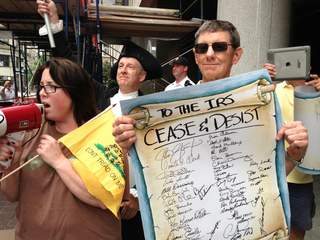 “It’s ungodly, it’s un-American and it’s just plain wrong to target Americans because of what they say about the government,” said Paul Johnson of the Grassroots tea party of Boone County.
