
How the DOJ and Lois Lerner Demanded the need for more Guns: Government pleads stupidity as a defense

Let’s see if we can get this straight, the Department of Justice has used a legal criterion of incompetence to justify not prosecuting Lois Lerner as she abused her power at the IRS for political reasons. DOJ officials reported that “substantial evidence of mismanagement, poor judgment and institutional inertia leading to the belief by many tax-exempt applicants that the IRS targeted them based on their political viewpoints. But poor management is not a crime,” thus establishing forever by attorneys everywhere that government can act against private citizens so long as they can prove they were too incompetent to manage a situation. So in essence, the DOJ has given all government employees a future way out of any abuse of power situation—all anyone has to do is plead stupidity to be relieved of whatever crime they may have committed.

Well, isn’t that interesting. That means hypothetically that if the President of the United States is given intelligence data suggesting that someone like me is a threat to national security and they send a squad of people to apprehend me—hypothetically speaking of course—but they go to the wrong house and bump into one of my neighbors who then opens fire and a firefight ensues similar to something like what happened at Waco, Ruby Ridge and other places—and a lot of people are killed–that those guilty of the whole thing would be let off the hook at the DOJ because bad management is not illegal.

Or suppose that a Secretary of State sets up a private server that she runs all her top-secret email through so she can scrub the information later for deniability—but then gets caught—that all she has to do is plead stupidity and all will be forgiven. They will even get the opportunity to run for president—wait, that’s actually happening right now with Hillary Clinton. That is not a hypothetical, but you get the point.

The DOJ has just provided the primary reason that government is too large and needs to be scaled back. They have just established why Washington D.C. should not be one of the highest per capita employment regions in the country—because they are too incompetent as a collective group to occupy so much wealth. Through their labor unions there are no expectations of performance and now with the DOJ decision over the Lois Lerner case regarding the IRS, there is no legal expectation regarding performance either making the federal government fully motivated to hire the dumbest people they can get their hands on so there is always an escape if something goes wrong.

The Department of Justice further stated, “we found no evidence that any IRS official acted based on political, discriminatory, corrupt, or other inappropriate motives that would support a criminal prosecution. We also found no evidence that any official involved in the handling of tax-exempt applications or IRS leadership attempted to obstruct justice. Based on the evidence developed in this investigation and the recommendation of experienced career prosecutors and supervising attorneys at the department, we are closing our investigation and will not seek any criminal charges.” That statement was provided in a letter to selected members of congress by Assistant Attorney General Peter Kadzik. So let’s strip away the legalese rhetoric there and get to the heart of what Kadzik was saying. In essence the investigation was run by government employees against government employees for the end goal of protecting government employment. Lerner was told to plead the fifth, say nothing, get out of public office and let the government clean up the mess with a defense of stupidity to conceal their tracks. The government declared of itself that they were too stupid to properly conduct themselves with tax payer resources and that there will never be ramifications for incompetence in public office. Without question, we will get a lot more of the behavior as a result.

Now you know dear reader yet again—with evidence provided from the highest law enforcement office in the land—why we have a Bill of Rights established by the anti-Federalists during the formation of our Constitution at the start of the American concept. We have freedom of speech so that we can call such abuses of power by their true implication—because obviously the DOJ has no interest in doing anything but protecting government employment as a direct arm of radicalized union labor. And we have the right to arm ourselves in case our military and police fall under the malice of future incompetent idiots like Lois Lerner at the IRS. If the IRS can abuse its power why not the local National Guard post? We need guns to protect ourselves by the DOJ definition of incompetence, because they have shown that they will take the side of the fool over the righteous expecting the good to surrender their lives to the bad for the “greater good.” Greater in this case is established by all the hoards of knuckle-draggers who are employed by the federal government. Their employer actually permits stupidity so those of a sane mind out of the Beltway need a way to protect themselves from the stupid—because nobody else will take up the job.

Because of this ruling by the DOJ we now have evidence that under no circumstances we should reduce the number of firearms in our society, because in a time when the DOJ is using stupidity as a defense the only way we can enforce respect among the corrupt is by promising to end their life—because they don’t respect the law. So they must respect the guns we possess—because in reality, that’s all that really protects us from the bad management decisions of the federal government. When they think they can abuse their power—as they have many times and been caught—they are very inclined to continue the behavior. The IRS attacked my friend Justin Binik Thomas and my local Tea Party group at Liberty Township because they assumed that everyone were nice people not inclined toward rambunctious violance—so they were easy targets for showing the vast authority of the IRS as a way to build up their brand of enforcement. As nice as Justin was however, they didn’t expect him or the Liberty Township Tea Party to stick up for themselves using the First Amendment. So the situation backfired on the IRS in a spectacular way. The IRS was clearly guilty of abuse of power and the only way out for them was for the Obama controlled DOJ to plead stupidity to avoid prosecution. If the case had been allowed to fester, the original guilt would have put it within the White House through union connections which was the likely origin Lois Lerner’s radicalism.

These same idiots are the people declaring that we need fewer guns in society. It’s like a robber scouting out potential hits complaining that people have bars on their windows to prevent break-ins. The government wants easy targets and a compliant people, because they are too stupid to deal with a challenge or any philosophic position in favor of freedom, so they want to confiscate guns to have their way and be allowed to mismanage our society. Without guns people like Lois Lerner would be in charge of everything and the abuse of their offices completely unfettered. It is for this very reason that gun sales are so high in America right now. It makes us sleep better at night knowing we can at least take care of ourselves if something dreadful happens. It is quite obvious that we can’t count on the DOJ, the IRS, the White House, the Secretary of State, local law enforcement, the National Guard or even the local school, because they have been given the gift of stupidity to protect them from the ramifications of their own devastating decisions. In the end the thin blue line that resides between justice and chaos is not law enforcement led by more government employees—its in the Second Amendment and under the right to bear arms that Thomas Jefferson as Secretary of State authenticated, “A well regulated militia being necessary to the security of a free state, the right of the people to keep and bear arms shall not be infringed.” That militia is not a group of idiots ran by the federal government—its individuals fighting for their right to protect their private property and to take back their government when and if that government fails them in the future. With the decision by the DOJ over the IRS case—it is clear that there was a lot of wisdom in Thomas Jefferson’s assumptions. So the best thing to do is to protect yourself from future stupid people. Join the NRA if you haven’t already. Sign up for Second Call Defense. And buy a gun. If you already have one, or two, or a hundred—buy another gun so that the DOJ can get a taste of what their bad decisions cause regarding social behavior patterns.   And if you live near me, buy that gun from the good guys at Right 2 Arms, which is essentially at the end of my street in Liberty Township. It’s government’s problem for their bad decisions—not yours dear reader. Protect yourself from them by using the rights provided at the outset of the country. The lawyers, politicians and theatrical fools have strayed away—and Lois Lerner is the proof of just how bad it really is. The DOJ just confirmed it.

Rich “Cliffhanger” Hoffman

 CLIFFHANGER RESEARCH & DEVELOPMENT

Listen to The Blaze Radio Network by CLICKING HERE.


The Politically Incorrect Review of Liberty Center: How the future allows people of value to enjoy life

I have written about the Liberty Center development for a long time because I had the fortune of knowing quite a lot about it during the early stages, and have been fascinated by the people building it. I have had the opportunity to travel a lot and know what’s out there, and what’s good and bad about the places I’ve been. Of course since it is in my community I have spent a considerable amount of time there over the last week—and I have to say that I really enjoy it. But if people want a politically correct review of Liberty Center, they can go to the Chamber sites, or read about it in the newspaper. Since my concerns are more philosophically based regarding humanity, and I’m not so concerned about my social status within my community—I can say things that other people can’t—so I will in regard to the monstrous success that Liberty Center has seen during its first week of operation, and the subsequent months and years that it will enjoy, articulate the reason and necessity for its construction.

I was a bit surprised that Tom Farrell who is a trustee in my community and a pretty good guy revealed a bit about why he thought Liberty Center would be successful in the mainstream news. He quite flatly stated that from a trustee point of view—the management of the community—that Liberty Center provided a city-like experience without the crime. I thought that was a bit bold for an area Republican, and it gave me hope that he and others just might be learning something from Donald Trump. It’s far better for everyone if you just tell it like it is. It might hurt some feelings but in the end, it will help everyone. After all, if you take your car to the shop to figure out what’s wrong with it, because its ticking in the engine someplace unseen—it doesn’t do any good for the mechanics to tell you your tire pressure is too low—because those things are not connected. If you want to fix the problem, an accurate diagnosis is needed. Tom hit on a very, very important point that I hope the rest of the country will learn from—because within Liberty Center is the solution to much of what’s wrong with America—which is why I’ve been so excited about it for such a long time.

Lately as I puzzled through my thoughts about Liberty Center I spent some time in downtown Cincinnati. After a recent Bengal game my family walked around the Banks development just as we have enjoyed Newport on the Levy a lot over the years. I have also spent considerable time at Fountain Square, Mt. Adams, Kenwood, Eastgate, Florence and many other places that I consider to be quality “living centers” where shopping complexes and living are brought together in unique ways. I also have the fortune to have in-laws who live in one of the most unusual communities I’ve ever seen in Brevard County, Kentucky right near the intersection of I-265 and I-71. Most of the homes are million dollar bits of real-estate that contain their own office park, shopping and restaurant experience providing a very self-contained experience. Residents can go to the doctor, shop, eat and live within a mile of their home and crime is non-existent. If some slug walks around that community, there is security that runs them out post-haste—no fooling around. You don’t see slackers standing around on street corners, you don’t hear cursing, and you don’t get “undesirables.”

What are undesirables? Well let me define it for you with an example of the new Over-the-Rhine renovations that the city of Cincinnati has spent a lot of money trying to resurrect. My daughter is a professional photographer who spends a lot of time there because people want to capture the history of the area with a photographers spin on the topic of downtown. Her customers want the romance of downtown without the garbage. What her camera doesn’t pick up are the thugs standing on street corners with their pants half down cursing every other word making embarrassments of themselves. Yes Cincinnati has a nice streetcar they are building, yes Over-the-Rhine has been cleaned up a bit—they have some nice restaurants, and during the days it’s a pretty nice place-now. But there are still undesirables standing around everywhere—and that’s not race related activity. If people like Ben Carson were standing on the street corner there would be no problem. But when people who look and act like they want to kill you are standing around looking like detrimental thugs it takes away the fun of going out on the town. Undesirables are people who have personal conduct that is equitable to animal behavior—where their primary objectives are sexual pursuits and pecking order mentality. People of a higher level in life don’t want to deal with undesirables—because they have other things on their mind than just primal desires.

Liberty Center understood this problem from day one in their design. They intended to do something similar to the development I mentioned in Kentucky—which is primarily occupied by horse racing families close to the sport—certainly the upper crest of Louisville society—and do something on a much larger scale in Liberty Township. The residential buildings at Liberty Center are all around five stories to give the illusion down below that people walking on the streets are within a city-scape. The buildings are positioned around the shopping complex so that the area within feels removed from the rural landscape on the outside. Also, useable living space is stacked to utilize bridges and staircases to provide the illusion that there is more complexity to the area than there really is, which is actually a video game programming trick that is quite effective to giving the impression that there is a lot more to something. For what Liberty Center is trying to do, it’s enormously effective.

The sum of the experience is to provide a city simulation without the crime and displeasure of an actual urban environment. My mom for instance stopped going to Tri-County over ten years ago when undesirables essentially pushed her out. I know many people who won’t even go the Costco in Tri-County just because they are afraid of the type of people who now reside around that old shopping district. Undesirables come in all shapes, sizes, sexes and colors—but what they all have in common is that they function from the basic animal instincts of a pubescent teenager. Teenagers are supposed to grow out of that phase with careful parental supervision, but in our society of today—where being a forever teenager is desired, there are just too many people out there who are grown-up teenagers functioning from raw animal instincts, and older people with money and success in their life don’t want to be around those low life scum bags.

After working really hard at your life and making smart decisions—it is fun to dress up with your spouse and go have a nice dinner—and a movie. Liberty Center allows me to take my wife to a nice place and be around nice people. I can go to a movie where only adults can attend, who are older than 21 keeping the teenagers out, so you don’t have to worry about bratty kids kicking the back of your seat, or giggling at boobies on the theater screen. You get to have an experience free of undesirables as much as possible. It’s a free country so low life scum bags can come to Liberty Center, but unlike a real city ran by progressive city governments, the shopping complex is privately owned as opposed to publicly owned. Liberty Center management can hire their own security to make sure that nobody causes any trouble as they are more competent than a city council or a mayor to deal with such issues.

The real benefit of Liberty Center is that it’s a private enterprise managed by competent people who are motivated by profit as opposed to elected bureaucrats. It will stay looking nice and will give everyone what they want from a city without the mess of mismanagement. Liberty Township doesn’t even have a police department which is wonderful. Trustees aren’t running Liberty Center; they just enjoy it with everyone else. The Steiner Group runs the place, and that puts it in the hands of competent management who provide their own security—much better than a bunch of unionized, expensive government workers who are politically accountable to a mayor and city manager. The presence of competency is what makes Liberty Center feel different. It’s not a public park or a community owned monstrosity where thugs, derelicts and panhandlers will be allowed to accost the affluent from Wetherington. Those types of people will not be allowed to bring down the level of quality within Liberty Center. In America being a derelict is a choice. There are too many opportunities for people, all it requires is for people to reach out and grab them. For those too lazy to reach for anything, they will become undesirables because they are parasites on those who aren’t lethargic.

I remember well what it was like when Forest Fair Mall opened over two decades ago. It was like Liberty Center in many ways—it had high hopes of appealing to the upper-class while maintaining the lofty goal of elevating the standard of living for Forest Park and Fairfield. Unfortunately, people who work hard to have money do not like conversing with people who are on welfare, or are just plain lazy, and the two demographics just didn’t mix. The money went to Tri-County for another ten years, or to Kenwood. Forest Fair Mall died slowly because the people around the community were not the type of people who financially affluent people wanted to spend their leisure time with. People are not just people—some are better than others and that is usually determined by their ambition. The Mall was directly reliant on city governments to create the demographic who would shop at their establishment, and the politicians screwed it up. The Mall out of desperation turned toward the nightclub crowd to bring life back to the once promising palace. But that brought more undesirables and pushed out the money. Soon all the Mall had to offer were cheap pieces of crap aimed at teenagers or adults who wanted to be teenagers leaving everyone else to shop somewhere else.

Liberty Center is not reliant on city government for its success. They bring their own management to both living and commercial enterprises and take care of both. And like everything else, things run better as a private sector enterprise than they do as public endeavors. The local government gets to collect a little bit more tax money each year, but they don’t have to make any management decisions about the complex itself. That’s up to Steiner’s people and they are a whole lot more motivated to make sure consumers get what they want—as opposed to professional politicians who seek to coddle the masses to get votes to stay in office. In a lot of ways Liberty Center is a creation out of necessity. People don’t want to associate with undesirables. They want to be around people with shared values and Liberty Center promises that type of experience, without the hassle of low-level people. Not everyone in the world is equal. Some people work harder and more valiantly than others and they deserve a place to go where they can enjoy life. For them, Liberty Center is that place. They get all the benefits of a city without the hassle of cat-calls, and panhandling. And for people in Liberty Township who have been losing their children to the exotic nightlife of New York, Los Angeles, and Chicago, Liberty Center has just given those kids an alternative without being too far away from home and can have all the fun without the downsides of crime. It is the way of the future, and the reason for it is a direct response to the gross mismanagement of public officials as opposed to private ones. That is why Liberty Center is so special and why it will become the standard everyone else in the future will have to live by. Cities will have to clean up their act or they will lose everything to private sector driven developments—which is fine with me.

Rich “Cliffhanger” Hoffman

 CLIFFHANGER RESEARCH & DEVELOPMENT

Listen to The Blaze Radio Network by CLICKING HERE.

Attacking Gunslingers: Why “shooting from the hip” makes a great business leader

I have a bit of a reputation professionally and personally for shooting from the hip, metaphorically speaking. People who say that about me speak it as if it were a bad thing that indicates recklessness. They also say the same type of thing when professional quarterbacks are quick to throw the ball down the field under risky circumstances—they call those people “gunslingers,” as if the term concocted abandon of calculation and patience. So I need to set the record straight on a couple of things that I have been thinking about as I have contemplated the root cause of my sudden obsession with Cowboy Fast Draw. Like my bullwhip work, most of the targeting is done more through feeling than in properly lining up the barrel with a target with careful assessment. I happen to be good at quick targeting, as I have shown under many competitions of speed and accuracy with bullwhips and am routinely very good at the Ohio Bullwhip Fast Draw that we perform each year at the Annie Oakley Days in Greenville, Ohio. There is no time to take care and to aim the bullwhip at a target. I have learned through muscle memory where all the points of trajectory are, how wind affects my aim, and to consider all the factors of targeting under stressful, timed conditions. I have it down to seconds with a bullwhip, and my new obsession with Cowboy Fast Draw is to further speed up my thinking to the hundredths of a second instead of just a second or two. That’s why I’m personally attracted to those types of hobbies—but I find society’s labeling of those types of people to be disturbing and indicative of something much more symptomatic of an overall disease that is crippling our country.

There is a new breed of American, and world bureaucrat educated with modern scholastic emphasis on metaphorically taking more aim before one shoots in life who have deliberately, and maliciously sought to smear the name of the bold and the reckless that stand behind just about every profitable enterprise in the history of mankind.   This has left our nation and world in a state where the very timid and fragile minded rule the world through paperwork, regulations and an emphasis on calculation as the mode of representing quality instead of how quickly a target is hit. Using guns as a metaphor, the modern bureaucrat believes the quality of an endeavor is in the form of the aim, not in the objective of shooting. The reason of course is that since the masses cannot think and act fast, they have placed upon the world a mandate through democracy that the weakest and most timid can rule the corporate world by handcuffing the strong and decisive with mundane regulation and law that they create to give themselves a shot at equality.

With the Cowboy Fast Draw Association what I love most is that the aim and accuracy of the endeavor is all performed by shooting from the hip. If a shooter takes the time to aim, they will lose. Too much time is taken off the clock unless a shooter literally plucks the gun from their holster and levels the barrel just above the rim with a quick pivot and unleashes a shot within a hundredth of a second from seeing a light indicating that action needs to take place. I have thought about this concept for years with my bullwhip work and the net result for me is that when I need to make a hard decision fast, I can and do with tremendous accuracy. I have a great track record of making good decisions in a split second manner. But that’s not good enough for me. I want to be faster, so I am taking up Cowboy Fast Draw to improve myself. When I say that I intend my official career to be that of a gunfighter, this is part of why I reference it this way.

Just because something is shot from the hip or struck without a proper aim—traditionally defined, it does not mean the act is reckless or without skill. Quite the contrary—in many ways shooting from the hip for those skilled in the act is a way to encompass both speed and accuracy into as seamless of an action possible.   Whereas the typical academic is focused on only one of those elements, they have attempted to define the quality of an endeavor based on the time it takes. If speed is desired, then they instantly reference more people to accomplish the task because it plays into their overall collectivist mindset. They don’t like that an individual can provide both speed and accuracy when it comes to complicated tasks, so they have found countless ways to instill laborious monstrosities of inefficiency to give themselves more time to think—which they love to do. But they hate action—actually pulling the trigger at a decision gate.

That is why in many manufacturing fields across the United States, from aerospace to auto manufacturing our ability to produce has been greatly crippled by allowing these timid types who require of themselves to aim very carefully in order to hit a target to strangle our productivity because their primary objective in life has been to diminish the input of the traditional gunslinger—the bright eyed problem solver who shoots from the hip often and hits most of the time. Their jealousy and need for social equality have actually crippled our manufacturing capacity with mundane academics that are so timid to pull the trigger on anything for fear of not landing a mark that they shoot slowly and miss often. When they declare that “so and so” “shoots from the hip” they mean it as an insult, but what they reveal is the source of a vast detriment—the root cause for the declining effectiveness of American manufacturing through improper association toward definitions of quality.

In Cowboy Fast Draw the rules are strict, just as they are in the world of manufacturing. You must have your gun holstered and your hand cannot be in the trigger guard. You must use a single action firearm. The distances you shoot from are 15’, 18’, and 21’, which is quite a distance for a firearm. You cannot shoot before the light comes on. Within that context, you must figure out a way to draw your gun, hit your target and do it within a fraction of a second. If you miss, yet beat your rival to the draw, you don’t get a score. You must have speed and accuracy—just like in our bullwhip competitions. The goal of the skill is to develop both, not just be strong in one facet. You have to be accurate and fast, not just fast, not just accurate. By that unit of measure the timid fuddy-duddy is just as wrong as the hasty fool who is often referenced as a “gunslinger.” So when the bureaucrat says that the person who shoots from their hip is reckless, they are just as dangerous, because their inaction is just as detrimental as a mistake. Just because a shot isn’t taken doesn’t mean it wasn’t needed.

In the field of life, there are many targets and most of them have to be hit at 21’ or less, metaphorically speaking. And they require speed and accuracy to deal with them. Necessity dictates that the quickest to the target gets the prize, and in the competition of life, the first to draw and hit their target wins. Time does not wait for the timid to pull their gun, aim the sights, take a deep breath, let out half of it, then to squeeze the trigger at just the right moment. In life, you have to draw and shoot before an eye can blink. Bureaucrats try diligently to stop time itself with mountains of paperwork to hide the fact that they don’t have the courage to draw and fire. Both actions require decision-making rooted in having a conceptual understanding of the target and hitting it without the aid of eyes and time to guide the bullet to the intended destination. You have to know where the target is in space and time and trust yourself to hit it faster than a mind can think about it.

Those who are successful at shooting from the hip are those like the people in Cowboy Fast Draw. There they dress up in cowboy outfits from the late 1800s period of American history. But they might as well be the deal makers and job creators who have made the economy of America the greatest in the world. Shooting from the hip for them is necessary, and a skill that few have. In their hands, it’s a competent task. But in the hands of the bureaucrat it’s a serious risk that is nearly a guaranteed failure.   Bureaucrats are incorrect to assume that all people shooting from the hip are reckless just because the skill in being successful at it is something they lack. Rather, they should work hard to become better and to stop trying to stop the world with paperwork so that they can “feel” successful. In life you have to hit your targets and you have to do it quickly—before someone else does. The world doesn’t stop for anybody—especially those laced with indecision and timidity that lead to massive bureaucracy. Success finds those who shoot from the hip, because they are able to do things in life with the two ingredients necessary for accomplishment—to perform tasks with speed and accuracy. Nothing else is suitable for a definition of success—and that is why the term “gunslinger” has been slandered to hide the real incompetence of the typical bureaucrat.

Rich “Cliffhanger” Hoffman

 CLIFFHANGER RESEARCH & DEVELOPMENT

Listen to The Blaze Radio Network by CLICKING HERE.
Welcome to the Future: Liberty Center opens and a city unfolds within a small town community

imageI really didn’t think it was possible. I always did love the Back to the Future films, especially the second one when they traveled from 1985 to October 21st 2015, which was just a few days ago as of this writing. So I had those old movies on my mind when Liberty Center opened in my neighborhood on October 22, 2015—one day after Back to the Future Day. I parked in the back parking garage behind the new movie theater a little displaced because for my entire life this area had been an empty field alongside I-75. I never imagined that anything of any importance would ever be where I parked my car on that sunny October day. I was meeting my family at the Rusty Bucket but wasn’t quite sure where lead to where, so I made my way south until I found the main road which ran through the center of the complex. It was ironically just like the scene in Back to the Future II, where I came out of an alley into the hard sun of a fall afternoon and the future hit me right in the face. It looked just like Hill Valley from that famous movie series, square and all.

Short of hover boards and flying cars, it was the future as I never would have imagined it. The stores were modern versions of the type I grew up with, but the way they were presented were very tech heavy and architecturally specific. Living space was stacked in creative ways to make a dynamic world that really has not been possible before in any other shopping experience I’ve ever seen. As I thought of some of the places I’ve been, such as Downtown Disney, La Isla in Cancun, or the Americana in Glendale, California, nothing was like what I saw at Liberty Center in my hometown. It was more astonishing than I thought it would be. The reason we ate at the Rusty Bucket was because it was next door to the Cobb movie theater which is extremely important to me. I wanted to talk to the owners about some upcoming plans, and that was why my family was there on opening day. It was as nice as I would have imagined a luxury theater to be that has made its mark in Tampa, Florida where another shopping destination that I love a lot, The International Mall is rather common.

As a guy, I don’t like shopping very much—my wife does, but I don’t like the task of actually shopping. I do love the exhibition of capitalism, especially when it’s as openly unapologetic as it is at Liberty Center. As I’ve said many times, I have a soft spot for developers because they are often the first cogs in the wheel toward economic development. Because of their creations money moves through an economy and in an age where the shopping experience is competing directly with online sales, something new has to be tried, and they did at Liberty Center—a long time in the making.

Yes they have an Apple Store. Yes, they have a really nice Victoria’s Secret which is good for me and my wife. She likes the quality of that store and it makes me happy to see her happy. Yes they have a number of upper crust restaurant experiences. Looming over the square I was in was a large facade of a Marriot hotel looking down into the action below. It replaced the clock tower in the Back to the Future film regarding iconic skyline. As I hiked and drove the back roads that used to pass through that location way back in 1985 I never would have imagined that in 2015 there would be terraced gardens exotic fountains, and advanced shopping destinations in such a place, unless I could have been placed into a time machine and shown first-hand.

And that’s where my family found me, they were perched above the shops on a patio waving to me to come up and join them in the sun. Step for step I felt just as Marty McFly when he first saw Hill Valley in 2015. It was a strange experience that I couldn’t have anticipated even as I watched them build the place brick by brick. Liberty Township instantly had a downtown district that was every bit as cultured and sophisticated as any of the big cities of America or the world for that matter. As I thought of the countless hours I’ve spent around Fountain Square in Cincinnati on business and pleasure surrounded by skyscrapers and dozens of neatly tucked restaurants situated everywhere, the rural community of Liberty Township had instantly built for itself a downtown that looked big time, but was small enough to still have the feel of a tight-knit community.

If engineers designing living conditions for intergalactic space travelers had to design something that divided function, luxury, and necessity into an all-encompassing package Liberty Center would be it. It was small and enormously large all at the same time and surrounded shoppers with an all-encompassing experience. People walked the streets without worrying about prostitutes and beggars—which is impossible in most big cities these days totally ruining the experience of economic frivolity. A quick trip down Times Square in New York or the strip in Vegas as a couple out for a night together means you are often molested by whores and malcontents. Vegas is terrible for that kind of thing. Times Square is nearly as bad. Liberty Center was free of that mess—but it had all the good things left behind. It was for all matters of thought a conservative utopia. If John Galt had built a shopping center, this is what he would have designed, from the famous novel Atlas Shrugged. It had all the plus elements of an economic development without all the trash created by liberal city governments who mismanage their downtowns into a trash heap of mixed values and nonsense. Liberty Center was built for people who like the good life, and know how to live it.

I heard up to his opening that Liberty Center would essentially be a carbon copy of The Greene in Dayton, or Newport on the Levy in Northern Kentucky—but it was obvious that it was different right from the start. It was the infusion of sophistication mixed with rural charm that really is unequal and reminded me almost of a movie set, something that is common at Universal Studios where complicated streets change the whole feel of a place just one block from a previous position. Clearly the designers had learned something from those entertainment complexes in Florida as far as space utilization where geographically the terrain may seem simple, but architecturally a visitor might feel like they had visited a new world getaway by the time they walked from one end to the other.

It was special more for me because I picked just the right spot to walk in at just the right time of day to nearly simulate a Back to the Future moment. As I stepped onto a sidewalk out into the Center square a car went by, a modern looking Cadillac nearly on queue with the events of when the same thing happened to Marty McFly. All that was missing were the flying cars and the holographs, but that technology isn’t that far off, and Liberty Center looks staged up to take advantage when it does hit the market. On one end was an enclosed mall that led to Dillards and Dick’s Sporting Good, both marvelous stores in their own right. At the other a Marriott hotel and a gorgeous movie theater that really was designed in one of my dreams—and in the middle was everything else.

It was for me, the future.

Rich “Cliffhanger” Hoffman

 CLIFFHANGER RESEARCH & DEVELOPMENT

Listen to The Blaze Radio Network by CLICKING HERE.
Metaphysics of Quality in Guns: Unexpected wonder in Cowboy Fast Draw Association products

With me it’s always about quality—as in the Metaphysics of Quality defined by the philosopher Robert Pirsig. As I get excited about something, like I often do when I take the time to write about things it is because whatever it is shows obvious signs of the Metaphysics of Quality. To me, that MOQ is very important. More important than most everything else, so when I see it, I get very excited and I gush about how wonderful it is. That is why I love architectural achievements like the Liberty Center shopping complex near my home—because it has obvious elements of MOQ within its construction, vision and implementation. I enjoy fine restaurants for the same reason even if I might stand against the social placement of those economic devices—if I see that there is a positive MOQ involved I get excited about whatever it is. I see MOQ as being more important than legal concerns or personal rights because not all people are of a “high quality.” That can be a dangerous road to travel down, but my criteria for judgment is contained with the Metaphysics of Quality as defined by the fine book Zen and the Art of Motorcycle Maintenance. It’s a very important concept to behold.

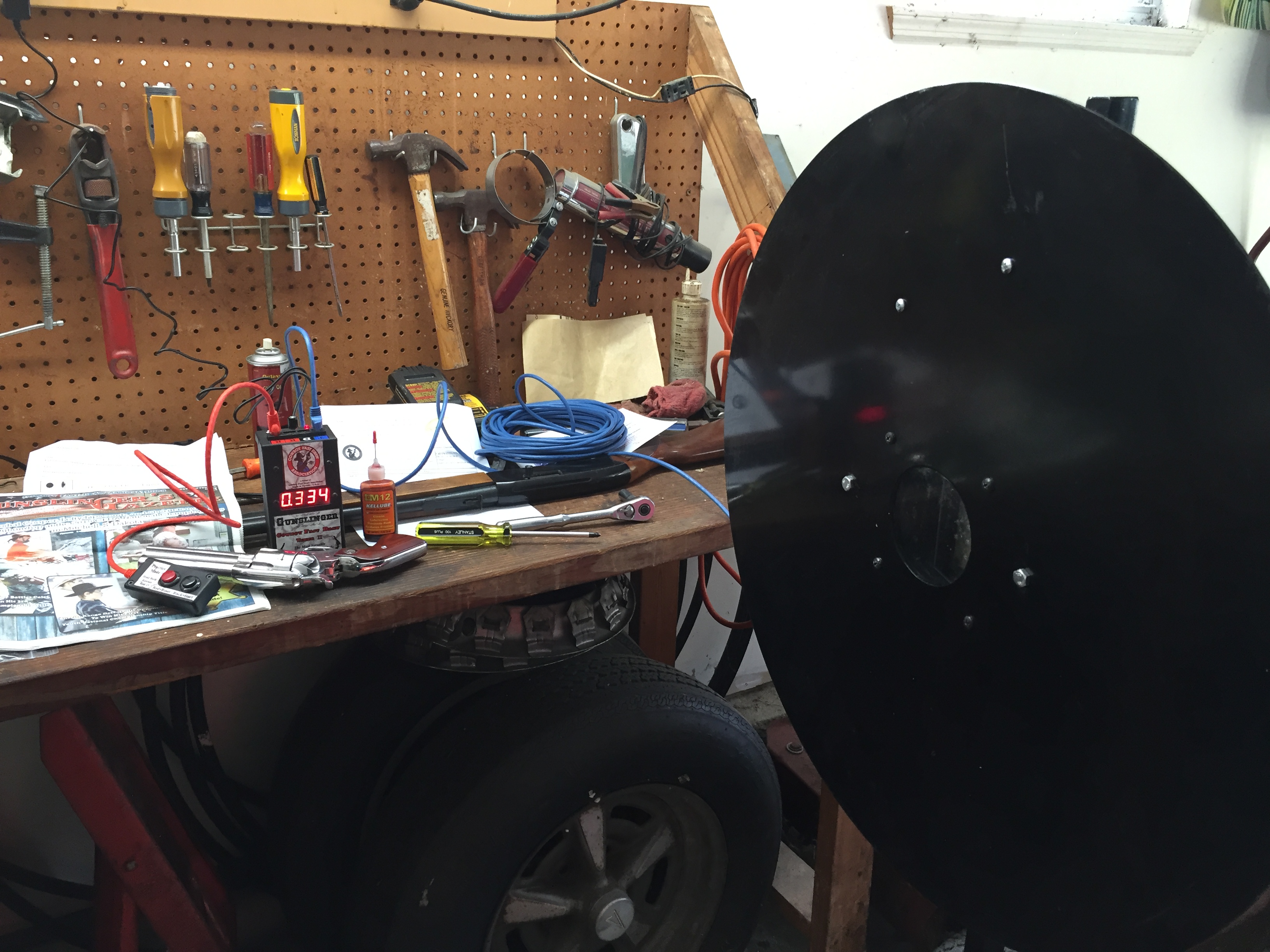
So I was rather stunned to open up the box from my new group, the Cowboy Fast Draw Association containing my membership information and my targeting equipment. I’ll have to admit, I know a lot of these cowboy types and over the years, most of them barely scrape by. As good of people as they are, they often don’t have much money and do live from paycheck to paycheck. Their idea of quality is usually something very tacky from a flea market. When I placed a very expensive order with the Cowboy Fast Draw Association, I’ll have to admit that I didn’t have very high expectations. I anticipated that what they’d send me I’d have to spend hours at Radio Shack trying to piece together additional parts. I had ordered a Cowboy Fast Draw shooting lane, which consists of a metal target, a light, sensor, a switch to start the timer and a clock that breaks down the time to thousands of a second. A lot of the equipment is fairly advanced stuff—so my expectations where that there would be issues with assembly.

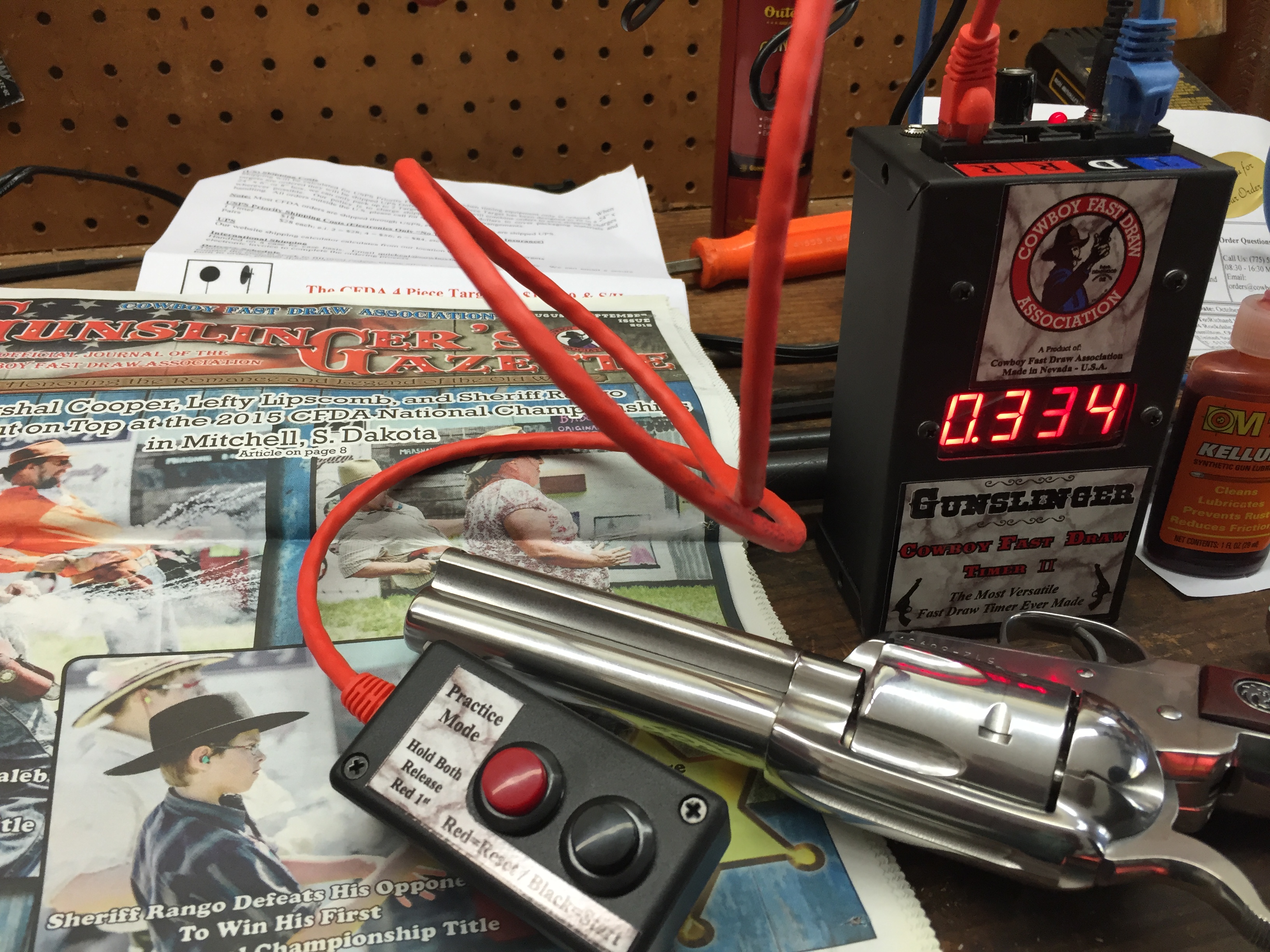
The way the system works is that you buy a fast draw gun, for me it was a Vaquero, a speed draw custom holster, wax bullets for ammunition, special .45 Colt ammunition cases specially designed to hold a shotgun primer. Then you set all that up to the Fast Draw Target System.   A light comes on the target, you draw and shoot the metal plate and the time it takes to hit the target is recorded. There are a couple of different modes, there is competition mode and practice mode. Under practice the timer will randomly run through different start times so that the shooter can’t anticipate the light. That helps the shooter develop properly their reaction time to the start light. It is pretty sophisticated for a shooting range, but once built, makes shooting relatively cheap—about six cents per shot. The wax bullets are about $44 for a thousand and the primers can be obtained for a similar cost. Once it’s all set up, it’s easy to use and efficient.

Putting together the target assembly was simple; the wires were color coded, the sensors screwed to the target plate and the start light attached with a magnet behind the target that shines through a Plexiglas hole in the face. Within about 15 minutes I had the whole thing together—which surprised me greatly. I had budgeted about 3 hours for the effort, and it took a lot less time. Even more remarkable was that everything worked. That shouldn’t have shocked me, but it did. Even on all the little timers were label indicators for Cowboy Fast Draw very professionally done. If I didn’t know better I would have thought I bought the whole setup from Cabela’s for several thousand dollars. It was good enough to sell as a mass market item—not what I would have expected for an organization with not yet 5000 members.

That’s when it hit me that these people running the Cowboy Fast Draw Association were people functioning naturally from the MOQ philosophy by their very nature. I doubt it’s something they are consciously aware of, but they had taken the time to do all the little things very right—including the packaging of the equipment within the box they shipped it to me in. Everything was very carefully wrapped and complete—someone who really cared about the contents put the whole thing together. But even slicker was that somebody had figured out how to make all these things work together to make one of the best secrets of modern shooting possible. And they didn’t skimp on anything; all the components were good quality items built to stand the rigor of shooting at them with firearms.

That’s where I really started increasing my respect for the Cowboy Fast Draw Association. Part of what killed the Wild West Arts Club which I had been a part of for quite some time was that they over expensed themselves. They charged way too much money for items to cover areas of their operational costs that they had gone into the red on. The result is all that’s left of them is what consists of my little Annie Oakley group that meet each year in Greenville, Ohio during the last weekend of July. One of the reasons for me picking bullwhips to work with as opposed to firearms was because nobody had figured out how to make such a thing work in a neighborhood setting—a place that didn’t require 100 acres of land to go shooting—so there was no way to practice or get good. With this targeting system that the Cowboy Fast Draw Association had come up with, a typical gun range could be set up in a garage. The shotgun primers are not much louder than a cap gun and the bullets fly out about the same rate as a juiced up pellet gun. It really isn’t much harder than the projectiles used in paintball—which is perfect for practicing the western arts of fast draw and gun spinning. These guys had figured out a lot of very neat concepts and they weren’t trying to make a killing off it—they just want to expand the sport, so everything was very reasonably priced. It was priced for expansion—not grotesque profit. There is no way the Cowboy Fast Draw Association has large margins on their sales. Yet they still put all the effort into the job as if they were making millions of dollars. That was impressive.

It doesn’t happen very often. But when it does, I write about it. Cowboy Fast Draw is one of those associations that have their roots in the Metaphysics of Quality. Not only was the sport of Fast Draw something that is good for all American shooters, the association itself was filled with quality people who took the extra steps to exceed expectations. I find that same attention to detail with Brownells, they are always very conscious about what and how they ship items. For that matter gun companies in general are so pleasant to work with. They really put an emphasis on quality and customer service. Even down to an association like Cowboy Fast Draw, the emphasis on American ingenuity and quality is assumed as an afterthought. If I liked firearms a lot before I assembled my target lane from CFDA I really respected them after—because even a very specific field of endeavor such as fast draw brings out the best of what is left in America.

When people wonder what I expect from others it is best embodied by CFDA. I expected a group of people barely hanging on to throw some things in a box and toss it my way for the exchange of some easy money. What I received as a lot of love and care for firearms and tradition that was obvious by the way the box was taped up. The products were reasonably priced and still the people cared about what they were doing. America used to be filled with those types of people. Now it’s a rarity—so much so that I’m very happy when I meet people or organizations that possess a level of Metaphysics of Quality that are respectable. Especially when it is unexpected—if I pay $70 dollars for a steak dinner, I expect quality—if I’m buying wax bullets and fast draw targets, I expect the kind of service that you might find at a casino or flee market. And in the case of CFDA, I was extremely surprised to find a very quality organization equal to a fine steak dinner.

Rich “Cliffhanger” Hoffman

 CLIFFHANGER RESEARCH & DEVELOPMENT

Listen to The Blaze Radio Network by CLICKING HERE.
Firewhips in Slow Motion: Being authentic when it matters most

My whip making friend David Crain came over to have a look at my new Cowboy Fast Draw Association equipment and to deliver some repairs he made to my firewhips, which had evolved into a bad state. The firewhips hold up well under regular use, but I am hard on them and apply more force and speed than they are intended to handle. When they are typically used in shows, they are more or less a cosmetic application. Most people are happy to see a bullwhip on fire. But the way I use them I do the way I write about them in my Cliffhanger stories. There have been readers who have read The Curse of Fort Seven Mile chapter titled “Sacrifice to Santa Maurta” who have doubted that Cliffhanger could have eradicated a whole gang of drug dealing scum bags armed with guns using just a few flaming firewhips which tore open their necks with precision cuts. Even when I do the firewhips in regular speed it is hard for people to see what’s going on, so David and I slowed down the action with footage photographed at 240 fps so that viewers could see what was really going on with firewhips as they circle around my body during use. In the case of the Cliffhanger story, the bandits didn’t have a chance. The action happened  so fast that their superior numbers were no match for the flaming whips—which is usually how it is in real life as well. Like I’ve said, my fiction has to reflect reality. This video will show a bit about what I’m talking about.

During that video I sped up the time to normal a little over the halfway point to show how fast the whips were really traveling so that it could be seen what was going on during all the slow motion footage. With all the smoke it is easy to see the shock waves that come from the sonic booms at the end of the whip, and it is also easy to see the precision of the cuts. If those cuts are directed at a target they do lay open flesh with the same ease that a knife cuts away flesh. So whips can be extremely dangerous to work with. It should also be noted that I am not wearing any kind of gloves for protection, and that I am easily slinging the whips around a poncho, just the way Cliffhanger does in that particular fight scene. For the uninitiated I can understand that they might think that scene was the work of fiction rooted in impracticability, because firewhips seem like a very exotic device devised in the modern-day of CGI graphics. But, they are quite real and I wouldn’t write about them the way I do if I couldn’t or haven’t experienced such a thing in reality at some point.

I have worked with bullwhips for years and have even used them in very urban settings, so when I write I am working with a pretty extensive library of experience. The poncho that I’m wearing is something I’ve had for a very long time and is one of my favorite items of clothing. Most people know me from suits and other forms of business attire, but around my home it’s what I wear the most. Many years ago I lived on the University of Cincinnati campus for over a year. It was during a time when the grunge music scene was just emerging and people were starting to dress to reflect that Seattle music invasion which to me was a meditation on communist propaganda. So I rebelled in my own way from the trends of that day and as a young man in my mid-twenties who was very pleasant to look at, decided to go into a different direction. Attracting women was never a problem for me—so looking back on it with some measure of pride it took a lot of guts to walk around campus the way I did. I dressed exactly the way I appeared in that video everywhere I went. The poncho allowed me to wear my bullwhips around with me up and down Vine Street at 3 AM without anybody knowing they were there. When I rented movies, or went out for a bite to eat in the middle of the night, I dressed exactly the way that I appeared in that video—with that exact poncho. When all the other kids were cruising McMicken going from bar to bar with their hats turned backward and their polo shirts looking for love in all the wrong places, I was dressed with my poncho and hat just the way I appeared in that video. I dressed like that everywhere I went—and I did that for several years.

And I did get into trouble, a lot of it at times. But I’m still standing and a lot of people aren’t. History has a way of defining winners and losers and I certainly applied that knowledge to my Cliffhanger character. So yes, the firewhips are real and the use of the poncho is too. I have a lot of experience with it. The poncho doesn’t catch on fire the way I work firewhips. The poncho is effective in such combative circumstances that it conceals the weapons around the body of a fighter and it can also hide the hands so would-be assailants don’t know what your hands are doing or what direction to look from. Those types of tactics can buy those precious fractions of a second when most things happen.

I dressed the way I did at that time because the temptation to assimilate was incredible at that age. It would have been very easy for me to put on the nice cloths that were expected of me and to become quite a gigolo. People much less gifted than me were having quite a lot of fun living that type of life. I purposely dressed that way because of the Cowboy Way that I have been talking about so much lately. I stood in opposition to the grunge scene and I lived as authentically to my values as possible in a hostile environment. I observed that nightlight on McMicken where girls dressed as sluts, Goth types wore their black lipstick and tattooed freaks roamed around with their new piercings in those early days of Seattle grunge that people didn’t expect to be harassed. So if a guy wanted to walk around with a poncho and outback hat everywhere nobody should gaze in my direction with scrutiny either. That’s the way I figured things should be. I mean most of the young men on Vine Street barely had their pants on as the whole pulling down the pants thing was beginning to appear in the ghetto culture—so my poncho and hat were not out of step. Of course people didn’t know what to make of it, because nobody else on campus dressed that way, but they had no right to say anything—because dressing the way they did—they had no room to talk.

It’s like what I told my son-in-law about why I wore a cowboy hat, which I have previously discussed. The outfit to me was a signifier of distinction. I was not like those other people and I had no plans to ever be. And I’ve never looked back and wished I had done things differently. I can wear business attire now in professional environments because I know internally that I have done the hard work of affirming my authenticity at a critical point in my life when I was being measured from that point on regarding the scale of social orthodox. Society was moving in a direction I wasn’t going to go. So I held my ground when it mattered and maintained my authenticity. I learned a lot in college, I learned that to succeed in that environment I’d have to pretend to not be so smart, and that I’d have to make personal concessions to enjoy success. I wasn’t willing to do that starting with my attire and I’m very happy now that I held my ground.

There was a Frisch’s down on Central Parkway where I ate breakfast and read my books each morning so that I could enjoy the buffet. Out of all my time on the U.C. campus those mornings were my favorite—I could read what I wanted, eat as much as I wanted, and be generally left alone. Most of the people at Frisch’s during that time were the old timers who had watched their neighborhoods fall into mismanagement during their lifetimes going from prestigious homes during the 1950s to slums by the 1990s—they enjoyed the way I dressed. Once a cop who ate there every day also and took notice of my outfit asked me why I wasn’t out with all the other kids “getting laid” and having a good time. I held up my book and my plate of eggs and bacon and told him that I was having a good time.

Over two decades later I still dress the same way and pretty much do the same things. My friend David came over to my house and we played with fire for a while the way men are supposed to on a Saturday night. It’s the little things in life that matter and speaking of that—the Cowboy Fast Draw equipment that I assembled shortly after I wrote about it yesterday was much better than I had thought it would be. The Cowboy Fast Draw Association really has their act together. I was very impressed with how my order from them was organized. One thing became clear as I was assembling it—that there will be reason to make a whole lot of new slow motion videos with firearms just as I have with firewhips over the years.   And that action will be even faster! I may dress the same, but in life speed and accuracy matters, and the older you get—you should get even better. I plan to.

Rich “Cliffhanger” Hoffman

 CLIFFHANGER RESEARCH & DEVELOPMENT

Listen to The Blaze Radio Network by CLICKING HERE.
Cowboy Fast Draw Member 4265: My alias is Cliffhanger

About a decade ago when my oldest daughter’s boyfriend from Europe was trying to win me over for support, he put more than the average effort in to impress me. He joined me with my bullwhip friends in competitions and became pretty good. He and I worked for many hours in my backyard developing further the bullwhip fast draw modeled after the Ohio Fast Draw Association that also competed at our events for years. He even started dressing like me in some ways, with his own spin to the outfit. This of course made my daughter very happy and convinced her to make a long-term commitment to the fella. Whereas bad fathers are the type of people who make the common sluts and bar trash that are so prevalent these days, good fathers raise girls who think about bigger things so endorsements of potential mates are important to such daughters. For her the icing on the cake was that my future son-in-law bought himself an outback hat similar to mine and started wearing it everywhere very proudly.image image image

One night, he and I were philosophizing about life and the nature of it in my backyard and he asked me about why I wore a hat so much. I told him that it was to distinguish myself from the common flock of people. In America the Cowboy Way was a code of conduct that exhibited a value system which exceeded modern boundaries and that my hat was an obvious show of support for that value system. Wearing the hat was my way of dressing for the part and my role in preserving that way of life. I went on to say that my values exceeded even those of the Cowboy Way—I was more stringent on many of them and went further on others. My favorite cowboy movies were not the John Wayne classics, or even the Lone Ranger, but they were Zorro and the famed Clint Eastwood westerns like Pale Rider and The Outlaw Josie Wales. High Planes Drifter to me is one of the most sophisticated westerns ever filmed—it was essentially Ayn Rand set in the west—it was an overman which came to a town to straighten out the justice which was long overdue. Whether the protagonist was a ghost from the past or a highly skilled more than man type—it was my favorite western and when I wore my hat, it was a tribute to those types of philosophic ideals.

I’ve been content to keep things pretty much independent of the outside world. I don’t need a lot of social support, so my way of doing things has worked just fine for me. My adherence to the Cowboy Way has been a silent code that I have not rammed down the throats of everyone I have met too much—other than wearing my hat in public most of the time. It did the job with my son-in-law and let him know what kind of family he was marrying into and I was happy with that. However, the days where that was enough are gone—the world has moved further away from that Cowboy Way in recent years and I don’t find that acceptable. Politically the Trump run for president has been a godsend, because he is covering a lot of the topics I have for the last five years, but on a bigger stage with the press eating out of his hand. So I don’t feel a need to continue beating on that drum, since somebody else has it covered—at least for now. Additionally I have a respectable number of grandchildren all of a sudden, and like that impressionable potential mate that my future son-in-law was—kids need much more of a role model figure much earlier which is my job—and I take it very seriously. My son-in-law was around 15 to 16 at the time of our talk in the backyard; he’s now climbing toward thirty fast. Time does move quickly and if you want to make an impression, you better do it quick. Kids are ruined if you don’t get to them by the age of 11 or 12. In my son-in-law’s case he was lucky to have been raised in England with a traditional way which protected him from the corruption of progressive cities like London, New York, and San Francisco. But he wanted more and he was on my doorstep looking for it, and it was my job to make sure the young lad was at least pointed in the right direction not just for his sake, but my daughter’s. After all, you raise these kids, give them all this hope, and they need to have people in their lives who share those values. The task is a rather large one. But by the time I knew him, most of his foundation thoughts were already in place. What I was saying might have small influences over how he conducted his life, but major ones probably wouldn’t be possible that late in his climb toward manhood. I promised myself that when I started having grandchildren that I would step up this Cowboy Way philosophy for their sake so that they’d have the right tools equipped intellectually to deal with a modern world spiraling over the precipice. I am one hundred percent sure that the Cowboy Way is the answer to much of what sickens America right now, and that is one major thing that Donald Trump cannot have much impact on as a presidential candidate. So I have taken major steps in advocating the Cowboy Way in a fashion that I had long been thinking about—taking up Cowboy Fast Draw as a sport.

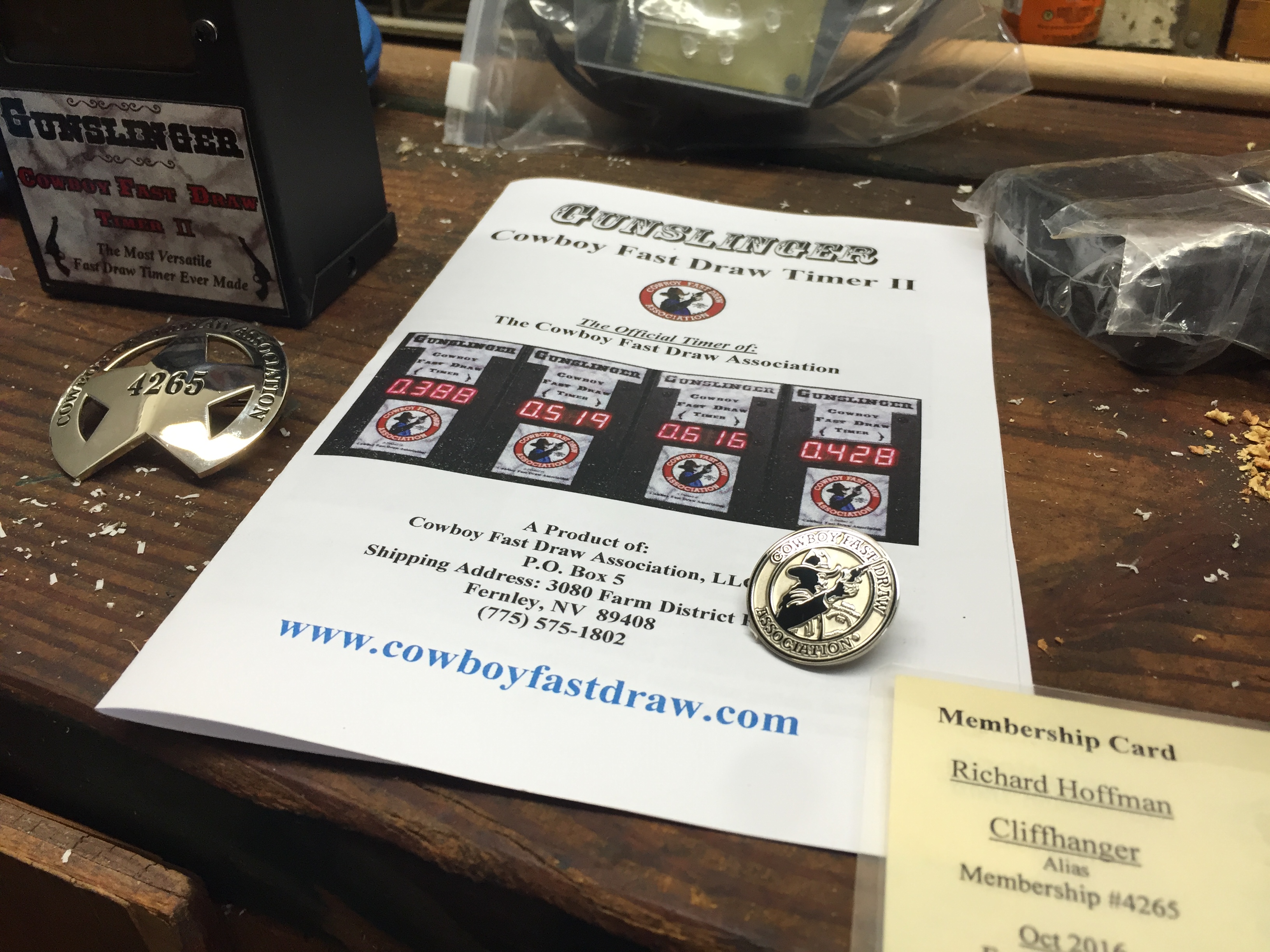
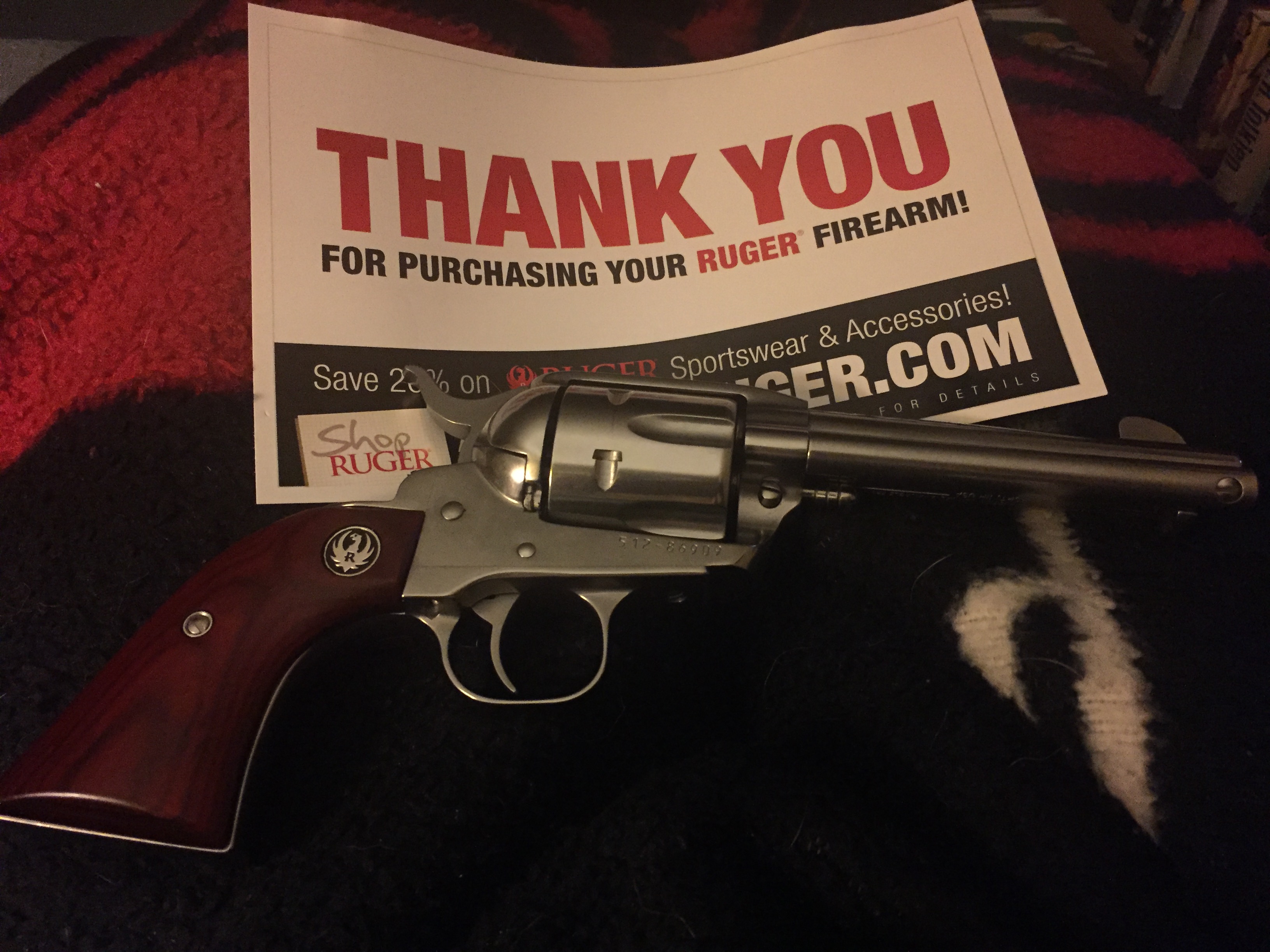
As a grown man I probably shouldn’t have been so excited to join up with the Cowboy Fast Draw Association. My package of materials arrived the day that my new granddaughter arrived home from the hospital after being born. It was a huge forty pound package that contained a lot of lights, timers and targeting equipment. Included was my new membership card and some pins that will come in handy down the road. My membership number is 4265 and of course my alias is Cliffhanger. In Cowboy Fast Draw all members must have an alias so of course mine would be Cliffhanger which is the philosophic foundation of this whole endeavor. In my fictional pulp series The Curse of Fort Seven Mile I wanted advance the direction of the character—but before I could do that of course I had to live the reality first—as my fiction has to reflect reality—otherwise I’m not interested in doing it. My membership card clearly has CLIFFHANGER written on it with a disclaimer on the back for police officers saying, “THE BEARER OF THIS CARD IS A PROFESSIONAL FAST DRAW COMPETITOR AND CARRIES SINGLE ACTION REVOLVERS FOR PURPOSES OF DEMONSTRATION AND COMPETITION.” In short, when roaming around wherever and need to maintain my practice with single action revolvers to maintain and increase my skills toward the Cowboy Way, cops shouldn’t be concerned or alarmed, because I’m a member of the Cowboy Fast Draw Association. Of course if that isn’t enough and I end up in some kind of self-defense altercation, I’ll call my buddies at Second Call Defense and let them handle the police—which is the other reason I have suddenly become so openly pro gun and an advocate of Second Call Defense. I have to protect my investment.

The Cowboy Fast Draw Association reminds me of how our Wild West Arts Club used to be over a decade ago. In a lot of ways, its much better. It was quite a privilege to open up my membership material and see several issues of the Gunslinger’s Gazette included. The group is working on expanding their membership base to over 5000 of which I was number 4265. I’d like to see it at over 20,000 and climbing, because I think it contains within it the essence that every American should be striving to behold as a nation built on philosophy and freedom—the Cowboy Way. The Gunslinger’s Gazette is essentially a publication dedicated to the Cowboy Way so it was wonderful to see a physical copy of the paper instead of the online edition I had been reading.

But to top it off the culmination of all this has not been easy. I have been a bullwhip guy for many decades, so accepting a new skill has not been painless for me. However, I have done pretty much what I can with bullwhips. I like what some of my friends have done to break records with them, but as a symbol of the Cowboy Way, bullwhips need help because they are not part of the American consciousness the way that single action firearms have been. So I needed to add that skill to my wheelhouse and I promised myself at a certain time “professionally” that I would buy my new Vaquero by Ruger and start this journey. Well that time came for me a few weeks ago. It had taken me a long time to get there, but I eventually did, and the very first thing I did was purchase the Vaquero which now sits by my side everywhere I go. I have to work with it all the time to build the muscles up in my hands, and that was the final gate to this new section of my life.

Needless to say, I’m proud to be affiliated with the Cowboy Fast Draw Association under the name of Cliffhanger. I’m also proud to be a part of Second Call Defense which helps make this new sport possible with the legal support that will help protect the validity of that membership card by CFDA. Having a firearm is an essential part of the Cowboy Way just like wearing the hat. One of the reasons my son-in-law was attracted to American life was that they didn’t allow firearms in England. He met my daughter and wanted to win me over essentially so that he could own firearms. It was my job to help him find what he was looking for. But that need doesn’t end with him, there are millions of people in just the same situation—they just don’t know how to go about it. That’s where introducing them to the Cowboy Way will help—it explains why the Second Amendment is so important and if the police get too power hungry at the sight of Cowboy Fast Draw Association members armed with single action Ruger Vaqueros on the plain states of Iowa, or Montana at a local burger joint on the way to a competition, Second Call Defense will be there to help preserve that Cowboy Way when the questions are asked. It is within these types of people who America needs to get to know itself once again—those who read the Gunslinger’s Gazette.

My grandchildren are going to get what they need; I’ll make sure of it. And of that necessity is a strong understanding of the Cowboy Way. I don’t preach to people who don’t want to listen, and I raise children that way, under a laissez-faire approach that allows individuals to invest of themselves into what I’m selling. If they walk away, they walk away, and I won’t track them down to the ends of the earth to help them. Rather I live by example, which is one of the most important parts of the Cowboy Way. And with my new membership into the Cowboy Fast Draw Association, and my friends at Second Call Defense, the gunsmithing equipment at Brownells the powder purchases from Cabela’s and many other support organizations, we’re going to protect that Second Amendment from the trying times that are before us. And it all starts with the beauty and simplicity of the Ruger Vaquero. This is going to be fun!

Rich “Cliffhanger” Hoffman

 CLIFFHANGER RESEARCH & DEVELOPMENT

Listen to The Blaze Radio Network by CLICKING HERE.
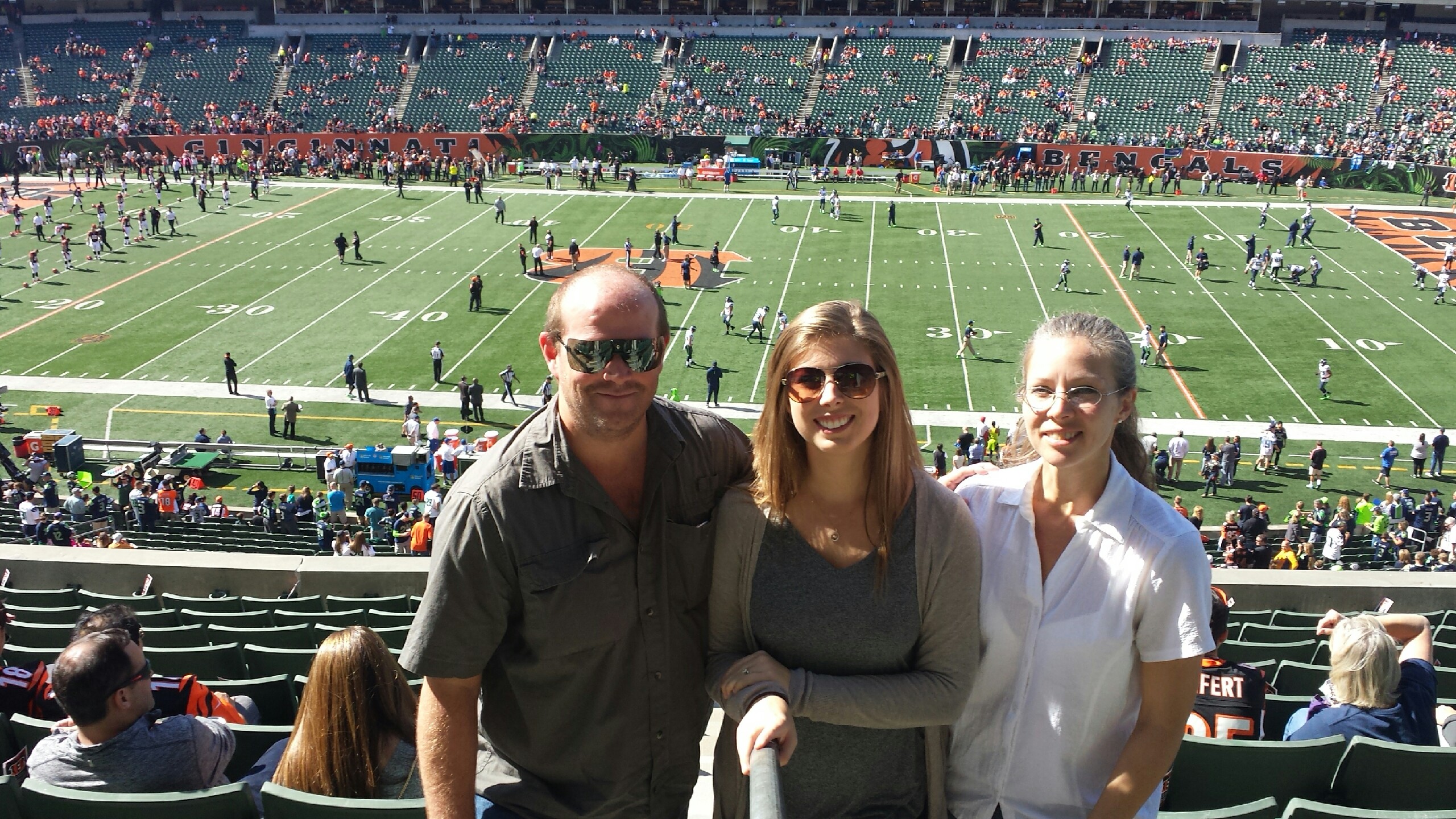
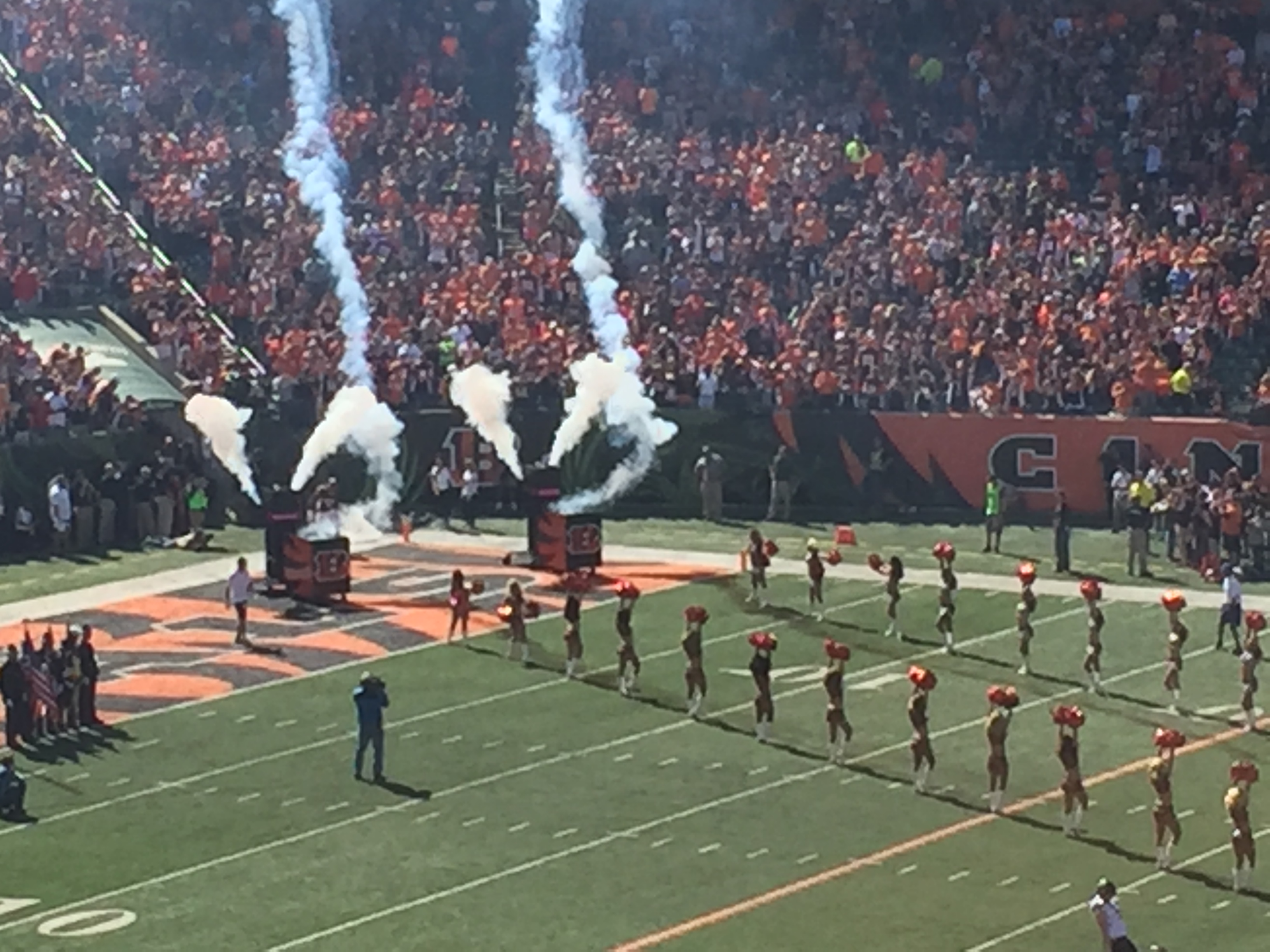
The Bengals Did Well: Carlos Dunlap saves Cincinnati

As a Tampa Bay Buccaneer fan I don’t put much investment emotionally into my hometown team of the Cincinnati Bengals. I’m not a fan of Mike Brown and think the stadium deal he made with the city was a bad one compounded by a mediocre product he has put on the field over the last several decades. Even though lately his teams have been in the playoffs year after year, they always end up a disappointment. But the Bucs haven’t been very good this year, as they weren’t last year. They seem to have fixed many of their offensive problems, but the defense just isn’t working—and for me and Tampa Bay, I get excited about defense. So it’s been a pretty mundane year so far. Because of all those elements, I don’t get to the local Bengal games very often. I have always loved the NFL experience, but don’t often get down to a game. However, it was a good week for me last week and I had a packed weekend full of activities and an opportunity to go to the Bengal game against the Seahawks presented itself so I went with my family.

image imageThe game itself was fabulous, an overtime thriller that nobody will forget anytime soon. It was a magnificent October afternoon and we spent some extra time before and after the game enjoying the new Banks developments and all the tailgating activities. It was sunny, warm—the leaves were changing color—it was a wonderful day for football and two very good teams were playing in the usual ramped up rock n roll environment typical of professional football. The Ohio State marching band was at the game performing—which was impressive—the game itself and all the festivities around it were just perfect including the overtime win that rocked the stadium with much deserved enthusiasm. I was very glad I went to that particular game at that particular time.

But those kinds of things to me are never just about the game—I enjoy the larger picture. I like Paul Brown Stadium because it’s the hometown arena even though I think it’s not nearly as spectacular as Raymond James Stadium in Tampa. The Club area at PBS is everything you’d want it to be—luxurious, well-managed, and optimistic. It was quite enjoyable to watch all the NFL games occurring from the lounge within the high intensity environment of the Bengal game. The Bengals have done a much better job of capitalizing off their mascot theme of a Bengal tiger the last several years. The video promotions shown around the stadium were much better than they have been in the past even though the stupid song they play with each touchdown sounds like a broken 45 vinyl record from a crusty old man’s treasure chest. It sounds outdated and lost—but the whole experience was otherwise very exciting and stimulating. The people were from all walks of life and in many cases had spent thousands of dollars to be there which put my nose on the economics of what was happening.

I love the NFL experience for the things connected to the events. The economic stimulus connected to the National Football League is staggering—everywhere there are advertisements for various products, promotion work for various cancer fighting awareness, and lots and lots of beer being sold. People generally stayed relaxed and enjoyed themselves for a much-needed four hours of bliss on a Sunday in October. The rock music, the video images, the connectivity to the entire stadium network around the country simultaneously is quite something to behold.

There are several interesting things going on at football games. Fans are quick to assimilate to the phrase “we” when talking about their favorite team. It’s a form of collectivism that is dangerous to our society as perfect strangers were brought together by rooting for their favorite team to score points. When the Bengals went to overtime with a last-minute field goal the stadium was nearly in an orgy of enthusiasm for each other. There were hugs and high-fives everywhere as people who normally wouldn’t speak to each other held one another in warm embrace. That was very interesting.   Clearly politicians utilize the same type of unifying force to solidify support for their various impositions. Yet in spite of that alarming trend the essence of capitalism was unmistakable. There was no way that the collective unification of the masses would adhere to any kind of communist banter if it meant robbing them of their Sunday afternoon football.

I enjoyed immensely the pre-game ceremonies of tail gating, the obvious recklessness of the activity being conducted on a mass scale. It wasn’t my first time of course, but with a football team that had a chance to be 5-0 after coming off a playoff year previously, there was a lot of hope in the air. Because the weather was warm there were the typical fair weather types mixed with the hard-core maniacs who come all dressed up to the stadium for war. Some people had fixed up school buses dedicated to the Bengals they tail gated out of, some had million dollar RVs all decorated up in the team colors. There was an obvious sizable investment that people had dedicated themselves to for the exclusive enjoyment of those three hours of battle. So it was even more intense that all the pent-up emotion before the game was released after the game with an overtime win against a good team. The economic engine driving the experience mandated a bold support of capitalism to generate that type of energy. There was no danger of Bolsheviks generating a communist revolution among NFL tailgaters. There was a lot of conflicting human behaviors on full display, but generally it was all very optimistic and healthy—and uniquely American.

If I had to pick a hero of that particular game it wasn’t the enthusiastic crowd, Andy Dalton, A.J. Green or the coaching staff—it was Carlos Dunlap. I watched him carefully between downs even when the fourth quarter started; the Seahawks had the ball and were up 17 points surely headed to a victory. Dunlap, number 96, was in position dancing around as enthusiastic as if the game were just starting. I put the victory on his shoulders because it was obvious that the Bengals as a team fed off his energy. His body language carried the crowd and the team in a time when it would have been acceptable to start looking toward the next game regarding the present one as hopeless. I thought he was the unsung hero of the day. It’s that kind of football that makes a distinct difference between the one that is played around the rest of the world with soccer and rugby. In American football, sure it’s a team sport, but the individual often has a more important role than the collective efforts of the team. Not everyone understands that, but it’s obvious if you know what you are looking for. Carlos Dunlap had it. It didn’t show up on the games I’ve watched on television, but it was sure present in the stadium while the TV audience was in commercial breaks. Dunlap was all energy all the time and that had to be the momentum killer for Seattle. I know the story of the game was that Dalton went after Sherman and all that—but it was Dunlap who led the way for the Bengals to win that game. In the fourth quarter that defense turned down the screws and that is what put the offense back on the field three times in the fourth to secure a tie, then an eventual win. That was the key to the game led by Carlos Dunlap.

Overall, the Bengals did a good job as an entire organization. I have been critical of them, but I admired the effort from the people behind the scenes who made all the graphics on the score board, to the sound guys, to the people who scheduled all the special guests—to the employees in the Club section who were professional and enthusiastic about providing a great experience for the people in those areas. Even the police outside trying to manage the traffic were in on the fun. It was a wonderful experience for me. I liked it so much that I almost bought a Carlos Dunlap jersey—almost. If there had been one in the pro shop outside my seat entry at the Club section, I would have bought it. The product of the Bengals had improved enough for me to consider it.

I waited for the crowd to clear after the game and sat in the lounge watching recaps of the other NFL games. My Tampa Bay Bucs had won 38 to 31 but that didn’t impress me because they gave up way too many points for my liking. Still, it was a pretty good day to cap off a nice week. The NFL offers a great product that is important to American philosophy—a mixture of not such good things with a whole lot of things that are. But one thing that it isn’t is calm, passive, or in any form conciliatory against fever pitched competition. And that’s what I loved most; the intensity, the furious melodrama of strategic objectives set against a ticking clock, and the high-pitched temperament of a packed crowd excited about a 5-0 start to the season after an overtime win on a beautiful afternoon. It was something I will always treasure as a sports fan.

Rich Hoffman

 CLIFFHANGER RESEARCH & DEVELOPMENT

Listen to The Blaze Radio Network by CLICKING HERE.
What Carlos Todd and Donald Trump Had in Common: Eminent domain and the opening of Liberty Center

The Donald Trump speech from Norcross, Georgia at the North Atlanta Trade Center on Saturday October 10, 2015 was particularly telling of American politics. It was a great speech and it should be watched—seen below. Just a day later after the Sunday morning talk shows Trump continued to beat on the same kind of drum. Trump’s accusations were confirmed when Obama appeared on 60 Minutes later that same day after the football games and was grilled by Steve Kroft over the destabilization of the Middle East, also shown below. In that 60 Minutes segment was discussion over the upheavals in the Republican Party after a week of nobody wanting to be Speaker of the House—because of the Freedom Caucus. There is a lot going on, and it’s very clear that only someone like Donald Trump is equipped to handle the very volatile situation. Obama clearly is not privy to the current trends—he’s in extreme denial—as is most of the Beltway.

On issues regarding the Second Amendment, trade, immigration and economic growth, Trump is a far right conservative—so much so that Republicans should be drooling within the party at his intentions. He has the ability to market the Party in a new way they haven’t enjoyed since Ronald Reagan and they’d do well to embrace him. On the other hand, he is rather liberal regarding taxes, healthcare, and eminent domain. I could argue all day long with Trump on those issues—but they are his thoughts and he couldn’t do any worse than what we’ve had so far. I am willing to take what’s right with Trump metaphorically, and literally and offset the negatives because he is the kind of person who can get things done—and things need to get done. The Party bosses may not like Trump, but they’d be stupid to pass up on the chance of a lifetime. Trump would build a wall on the southern border, he’d expand the military, and he’d restructure the tax system all while stimulating the economy which are all things he’s capable as president to have a direct influence on, and at 70 years old, Trump has enough gas in the tank for one last spectacular decade of his life and America should give him a shot to go out with a bang. Obama has already embarrassed America—stepped all over the Constitution, and caused irreparable damage on Capital Hill. Only extreme success can fix the situation now.

As the Liberty Center shopping complex begins to open in my hometown it is ironic that one of the biggest Republican Party bosses in Butler County’s history was laid to rest. Essentially the Liberty Center shopping complex was made possible because of eminent domain. I was always against the Butler County Regional Highway construction which ran right through all the areas I used to play as a kid. Carlos Todd was a developer who built the Republican Party base in Butler County to essentially use crony capitalism to complete his building projects. Our political system is so dysfunctional that the only way to get projects done on a massive scale is to purchase politicians with money and loyalty—and Carlos Todd was one of the masters. He died at 77 eventually to his battle with cancer leaving quite a power vacuum in his wake.

I was in firm opposition to Todd and his Butler County associates Michael Fox and Bob Shelly as the Butler County Regional Highway used largely eminent domain to destroy my childhood home, a cemetery that had Revolutionary War soldiers in it, and several Indian Mounds that populated the area destroying a lot of potential archaeology. I thought of Todd as evil incarnate on the face of the earth because the Republican Party led by him was buying up property to develop for their projects stepping all over the rights of private citizens in the process. It was incredibly wrong and I was made even more furious when they took my father to a baseball game where the developers had a nice private box and convinced him to sell to Todd all in the name of progress. Their basic sales pitch was, sell and profit, or fight and be destroyed. They had the power of government to destroy, so he should take the money. I had been willing to fight them to the ends of the earth with any means necessary, but it was my father’s property—and his right to do with it whatever he wanted. So the developers got their way.

Well, Michael Fox eventually went to jail, Bob Shelley got into sexual harassment troubles and was pushed out of his trustee seat, and Todd drifted off into the shadows as his grandson took over the family business. There has been a lot of change and upheaval since then as the Regional Highway was built and slowly development began to appear around it. Bridgewater Falls is just such a development, which I have slowly come to enjoy over the years. Liberty Center is the latest, and most spectacular, but was it worth all the pain it caused people to run all over their property rights to build it?

When I started No Lakota Levy all the characters from those eminent domain fights joined together with me to fight the Lakota levy because the local public school was blocking out some of those developers from further work and the district had reached a saturation point. Developers had built all the buildings they could hope to ever construct leaving the taxes enormously high on all future development tipping the balance away from everything that had been built by them. I had always been against the explosive growth because of the sustainability of it, so now I was on the same side as people like Carlos Todd and the developers he largely controlled. It was strange to get to know all of them from a perspective on the other side of the fence. Most of the emails I sent or received had Carlos Todd copied on them so he was well aware of what we were doing and it threw me back to when I was in opposition with him and I was able to map out how he controlled things from a distance. My hatred subsided toward him because I saw what he was doing—he used government—which had stuck itself in every crevice it could over a long period of time—to hedge the bets for his projects in his favor. I couldn’t argue his method or reasoning. The developers were productive people making things that didn’t exist previously—and that was a good thing. Some of them I liked quite a lot, some I didn’t. I worked with them and just did my thing eventually doing as I always do—just sort of taking over. When the heat got too hot for them they checked out and we parted ways. Every time we’d meet toward the end they’d try to poke me into running for office, so I deliberately sabotaged the relationship with them to get out of that circle not because I disliked them, but because I needed to maintain my own course.

I’m sure Todd would have liked to see the Liberty Center open, but he didn’t quite make it. I am proud that its there, and of all the hard work many people endeavored to construct it. I think it’s a miracle of economic activity and the best minds of architecture. But was it worth it? Was it worth the building of the Butler County Regional Highway? The destroyed lives, the destroyed history and the integrity of Butler County politics? The answer is yes—even though it cost me personally. True, the world would have been better if everything had been left alone, but there’s a lot to be said about creating something from nothing and I appreciate that more than stagnation for the benefit of sentimentality.

The reason I told that story is that establishment Republicans, many of which were put in place because of people like Carlos Todd have mostly committed vast amounts of evil using eminent domain to destroy the lives of many. Donald Trump is not alone in that effort and he shares a lot in common with Carlos Todd, a developer who used politics to get what he needed to accomplish done. Getting to know Todd and his troops well from the other side of the fence I was able to see what was really in their heart. Sure, some people were bad, and they went to jail, lost their seats or ended up wiped from the face of the earth one way or another. But the good ones endured because through competition there really is no other way to sustain your essence, but through authenticity, and Carlos Todd was authentic—just as Donald Trump is. No question when you do things that relate to other people, they will have an opinion one way or the other. The judgment of a person’s character is determined by how they act under pressure. What people do under pressure validates their worth—and Todd showed that he had a lot. I might not always like what he planned to do, but his effort had purity to it. But within that purity there were many people who were trampled on and were smacked around quite a lot.

The real answer is to get politics out of development and remove many of the regulations that cause all this evil. Until that happens people like Carlos Todd and Donald Trump will work the system to their advantage. That is why I feel that Trump—after a lifetime of making deals and running over people can actually straighten out the mess of politics and its terrible relationship to business. Ideological people who have not built things themselves but were relegated to just giving their opinions about things do not have the benefit of my life where I’ve been very active on both sides and know clearly where the line is drawn. I can only treasure that opportunity because it gave me the philosophic foundations to understand all these complexities without losing sight of the real objective—economic growth, the sanctity of private property, and the evil of a system that the most clever among us learn to use to get things done—in spite of the desire of that system to destroy all thought and action. Donald Trump is an insider, and I would love to see what someone like him—who likely hates the system as much as I do, would commit himself to if given a chance to right the ship in ways that Carlos Todd never came close to achieving. But for Republicans to turn on Trump as a radical maniac who would wreck the party—they are in denial at what put them in office in the first place. They’d be wise to get behind Trump for the strength he provides and for giving them an opportunity to have their office seats. Because without people like Carlos Todd, Donald Trump and eminent domain—most of them would still be small time hacks looking for an opportunity that would never come otherwise.

The only way to change the system is from the inside by someone who knows it better than anybody. That’s why I’m voting for Trump. His use of eminent domain and the guilt I’m sure he feels about it I think would make a person determined to correct that situation for the benefit of economic wonder which everyone would eventually enjoy. Trump is in a position to morally build a philosophy of growth by utilizing the lessons learned from crony capitalism into a more laissez-faire system perhaps for the first time since the first few decades of America’s creation. And that would be wonderful.

Rich Hoffman

 CLIFFHANGER RESEARCH & DEVELOPMENT

Listen to The Blaze Radio Network by CLICKING HERE.

My New Ruger Vaquero: A best friend that brings out the best in humanity

There is nothing about my new Ruger Vaquero .45 that speaks of violence to me. Looking at it all I think about is cowboy trick shooting and stunts that can be performed with it. It is to me equivalent to a nicely made basketball intended to be thrown into a net by a good athlete, or a wonderful pair of golf clubs meant to drive a ball across a vast green into a hole 400 yards away in increments.   Shooting with the Vaquero shown in the picture is essentially a sport where science and skill combine into hitting a target under timed circumstances. There is nothing violent about the act whatsoever. Guns might have been invented out of war like necessity and the sport of shooting to practice for that eventuality—but the sport of shooting is just another human endeavor intended to test skill against adversity with the drama of competition to drive image

What struck me on this particular gun—as they all do these days is the nice messaging that often comes with them. Ruger in this case was grateful for my purchase and the supplied literature made it clear. It showed to me a serious interest by the Ruger Company to build a solid base of customer support for a product unquestionably made in America by good, hard working people. The gun feels like a well-crafted work of art, its machining is immaculate, the tolerances on its critical junctures well inspected, and it feels incredibly competent. This is not a company that should be targeted by liberal hate groups. Ruger is not a company making death—it makes life, and tradition. There is nothing about my Ruger Vaquero that speaks of violence if a person really understands what shooting is all about in the world of sport. It’s a fine tool to me for exhibiting traditional American art forms, and it’s a miracle of modern science—more sophisticated than driving a golf ball into a hole, or throwing a football 50 yards down field into the arms of a waiting receiver. To me the Vaquero by Ruger is the ultimate individual sport where great power is incorporated into the mechanisms of great engineering and it deserves to be respected as such.

But it’s not lost to me how grateful the Ruger Company is with each purchase made of their firearms. It is because of their attitude toward their customers that I get a special feeling whenever I see the emblem blazed across a t-shirt of hat, or on a banner at a competition. I know they care about their customers in spite of a world led by liberals that wants to eradicate them from the face of the planet because those political minds want to make the company into a representation of hate and violence. Football is a violent sport, golf clubs are sometimes used as weapons of hate when they are slammed over the head of a victim, but political advocates don’t seek to ban golf courses or the sport of golf. The gun has a special hatred aimed at it because liberals have no idea or desire to understand that guns like the Vaquero are designed for much more than hunting or self defense—they are built for the sport of the Cowboy Fast Draw.

In such groups as those in the preservation of the Wild West arts are some of the best people I have ever met. The world would be a whole lot better off if more people interacted with these great Americans. And on the hips of most of them are often Vaqueros by Ruger. They wear them openly in public often and nobody ever gets shot, and there are seldom ever hard words spoken to others. There is almost always respect for their fellow shooters. Within that alliance of sportsman they revere each other with camaraderie that is exceptionally healthy and overwhelmingly positive.

When I picked up my Vaquero at Right 2 Arms it was the owner’s parents who were working the store and were armed behind the counter. There was no reason to feel apprehension at that visible support of what looked like a Glock holstered on the father. We proceeded to have a very nice conversation about Gatlinburg, Tennessee while the background check came through for me. They were good people and I looked over my Vaquero as they spoke about their upcoming vacation plans. It was good, healthy conversation among highly armed people who invoked no danger whatsoever. Instead, the presence of guns elevated our interaction to something of respectful banter united under support for the 2nd Amendment.

Just two days prior I had a wonderful lunch with some VIP’s within the shooting world. We talked about gun ranges, plans for helping the youth through learning marksmanship, and the bad rap that guns were getting in the wake of the Oregon shooting.   I enjoyed the company more than I would if the conversation were a usual business lunch where all the things that people really like are talked around because of political correctness. With these guys, we could all just be ourselves which was refreshing. It was much better to talk about things that really interested us instead of sports scores and the season trajectory of our favorite football teams. There always is a solid foundation of realness that comes from those types of lunches as opposed to others that feel like a clip on tie at a wedding. It confirmed much of what I have been feeling lately about firearms and their role behind the American experience. We need to be more proud of that heritage, not less so.

I mentioned to the guys at the power lunch that we needed to market firearms differently as a public perception—that as shooters we needed to stop riding the ropes of the obvious political fights we are without question in. We need to get into the center of the ring and control the fight from that position instead of just taking the shots to the face and hoping to outlast our opponents—the gun grabbers, the liberal radicals teaching in our public schools, and the political class that wants to turn America back into an aristocracy similar to Europe—instead of one founded on independence from gun possession.

The reason my Vaquero as opposed to other guns I have bought is so special is that its purpose is exclusively for use as a cowboy shooter for the sport of Western Arts. It is the type of single action that won the West in America and that means a lot to me symbolically, and the sports that have risen up in the wake of that historical memory is not much different from the battlefield strategies of football. The games might have been invented by inclinations of war, but they evolve into camaraderie and tradition that brings out the best that a society has to offer. The gun in America exhibits the best of this example.

The summation of my contacts the week that I picked up my Vaquero at Right 2 Arms is guns make people better—not worse as progressive politics suggests. The political left had misdiagnosed the root cause of human evil and sold it back to society in a package of deceit. When that deceit is removed and Americans are allowed to wear their firearms on their hips, and discuss them as extensions of themselves, a higher quality in people emerges built out of respect. The knowledge that domination of the another person is not possible—so a respectful exchange emerges between human beings when both have guns. The trouble emerges when that relationship is lopsided, where a maniac is armed and a peaceful person is not—that’s where abuse happens. But Ruger is not about feeding that fear—they are about making America a better place and that sentiment begins with the simple thank you note that they package with their guns. I felt honored to open up my new Vaquero. It’s an honor to have such a fine gun from such a quality company. As is typical of most gun manufacturers, they are examples of what’s best about American manufacturing and that is certainly the case with Ruger. They are one of the very best, and every time I look at my Ruger Vaquero, I will think of what’s best about America and the culture that should otherwise thrive in a society open to gun use for the skills that emerge from them in sports.

Rich Hoffman

 CLIFFHANGER RESEARCH & DEVELOPMENT

Listen to The Blaze Radio Network by CLICKING HERE.