Ron Howard Directing the New Han Solo Film: Why hating Donald Trump is toxic for people in the entertainment industry

There is no way I couldn’t do it because it was only the biggest news story of the week—bigger than Donald Trump’s latest speech, bigger than the latest terrorist threat in Europe—it was so big that it actually led the headlines for three solid days worldwide.  The new Han Solo Star Wars movie production fired its two directors—whom I liked—Phil Lord and Christopher Miller with just three weeks left on the schedule and a summer of re-shoots still needing completion.  Obviously, I have designated myself as a Star Wars fan and out of all the characters in that fantasy sci-fi series Han Solo is my absolutely favorite character.  So even though there are thousands of other topics I might otherwise discuss—I must cover this issue by default of its cultural importance—because as I’ve said many times, Star Wars is not just a movie.  For many people it is a nearly religious event with tremendous cultural ramifications.  And yes, this was big news to a lot of people—and to the film industry as a whole.  My first inclination was optimism for reasons that I’ll describe because it tells me that Kathy Kennedy has her arms around these Star Wars movies—she understands what needs to be done and she isn’t afraid to do it—and I respect that.  Her pick for the next director couldn’t have been better—Ron Howard fresh off the Genius National Geographic drama about Albert Einstein.

I understand now that it was the kid playing the young Han Solo who actually started the process, Alden Ehrenreich.  He apparently was concerned that the directors known for their comedy in films like 21 Jump Street were not taking the picture to a place it needed to go and he spoke to people about it.  His instincts were correct, Han Solo is serious business even though there is comedy that surrounds a character like that—it’s a very fine line.  After Ehrenreich stated his concerns the word got back to Kathy Kennedy who took a look at the dailies and the film just wasn’t working.  It’s not necessarily the fault of Lord and Miller, but if they weren’t getting that fine line—then they needed to be fired.

Additionally, and this is something I don’t think any of them would admit, I noticed that both Miller and Lord were openly protesting Donald Trump and were members of this new Hollywood “resistance” which happens to be the same name of the group that works against the Empire in the new Star Wars films—and this was making Disney and Kathy Kennedy nervous.  The Han Solo film went into production in February of this year and I just happened to be in London at the same time so I was seeing news that wasn’t so available in the United States and I was very concerned that these new Star Wars directors were so openly against Trump and were fully supporting demonstrations in the streets of London.  There is no question that some of that radicalism was finding its way into the new Star Wars movie—where it clearly didn’t belong.  By pissing off half the country in America with political activism in a Star Wars film it would certainly take a hit at the box office and the franchise led by Kennedy these days can’t afford something like that, directly or indirectly.  It was so bad that I actually Tweeted the kids to knock it off—they needed to keep their eyes on the big picture.

Just this week Johnny Depp effectively ended his career when he stated that he thought that a modern actor should assassinate Donald Trump—he was speaking to a group in England where that kind of talk is quite popular these days and he forgot really how far his statements might go—and once it hit the American media it was too late for him.  Depp’s latest Pirates of the Caribbean film had done decent business and if he had kept his mouth shut, he might have recovered as an actor.  His recent divorce and difficulties on the set of Dead Men Tell No Tales have flagged him as a has been that can’t deliver at the box office.  His money was over extended and he really needed to just ride the wave of Pirates and actually hope for another one to pull him out of this slump. But now—he’s toxic. Like it or not, Trump is president and many people are having a positive experience because of it—and they don’t want to hear a bunch of spoiled brat actors and directors taking shots at their president in movies they pay to see. It’s just not good business.  I think Johnny Depp—as much as I like him as an actor—just killed his career forever.  He’ll never recover. He literally just went from riches to rags—because with his financial problems he needed to stay on top to get large pay checks and he just killed that opportunity.

Although I was critical of the Genius show on the National Geographic Channel, Ron Howard did a great job as he always does directing it.  He is one of the top filmmakers in the world clearly functioning from a different place—and when it was announced that Lucasfilm had hired him to replace Lord and Miller I was very happy about it.  Ron Howard knew how to keep the modern politics out of his projects just like many older directors could. For instance, I never knew whether or not George Lucas or Steven Spielberg were conservatives or liberals in the 80s.  When Ronald Reagan invited them to the White House they went and took pictures and they certainly didn’t protest in politics.  If Return of the Jedi had references to the Vietnam War in it sympathetic to the Vietnamese—I couldn’t tell by watching the product.

I was quite shocked to find in the 90s that Spielberg and Lucas gave money to the Clintons and were becoming more active within the Democratic Party—and as much as I liked them—I thought differently about them since then.  No longer did I rush out and see their movies because they had shown themselves to be against conservative positions—and honestly they never recovered their former positions culturally because of it.  However, Ron Howard has never lost that and is the closest thing we have in Hollywood to a good traditional director and actor who established his roots on the Andy Griffin Show.  He knows how to walk that fine line so that people can enjoy a project of his without thinking about the modern politics of the moment—because ten to twenty years from now—you still want the film to be relevant.

For this Han Solo movie to have the kind of appeal that Disney needs out of it they really need to pull off something special and it’s a credit to Kathy Kennedy that she took action before it was too late.  Ron Howard will know what to do and I’m relieved for it.  The world is changing and that radicalism that Hollywood has embraced cannot find its way into something that needs to stay relevant well into the future.  By the time this Han Solo movie is released in May of 2018 we will be living in a different world–largely shaped by Donald Trump’s presidency—and a lot of people will be supportive of him.  They don’t want to see a movie made by people who openly hate him and have filled their Twitter pages with disparaging Trump remarks.  They’ll want to go to the darkened theater and enjoy a new Star Wars movie without politics trying to shape their opinions—and Ron Howard knows how to do that.  After all, it wasn’t Howard’s fault that I liked Albert Einstein less after his Genius series.  It was to Howard’s credit that I was able to get to know Einstein much better than ever before.  As an artist he just presented the facts—he didn’t tell me how to feel—and that is the difference between a great director and people who are just average.  That is why hiring Howard to direct the Han Solo movie will prove to be so brilliant—and I’m glad the production had the courage to do it—before it was too late.

Rich Hoffman

Sign up for Second Call Defense here:  http://www.secondcalldefense.org/?affiliate=20707  Use my name to get added benefits.

cropped-img_0202.jpg

Alden Ehrenreich will be a Great Han Solo: ‘Star Wars’ is making a nice comeback

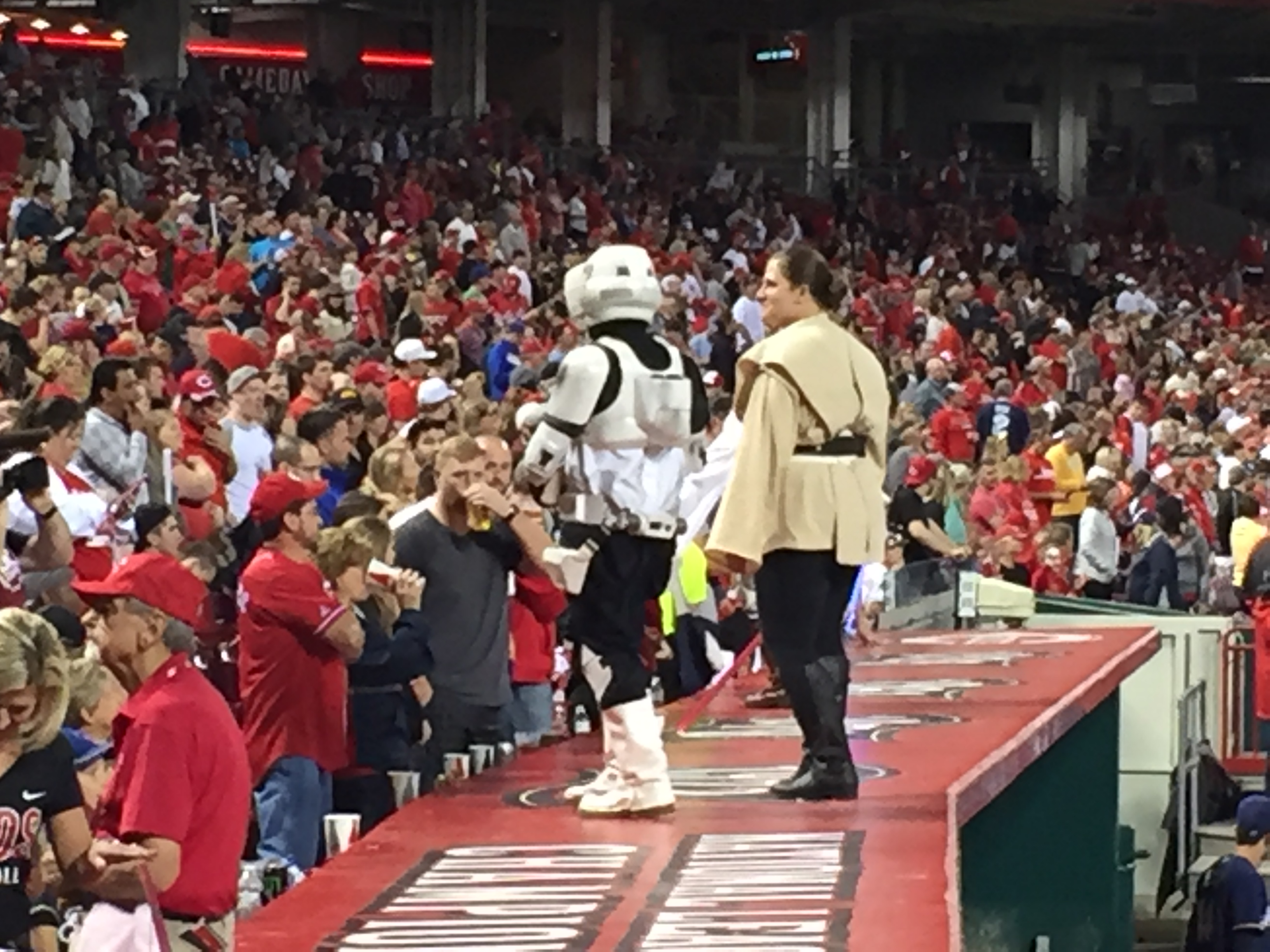
Star Wars3For me Star Wars has always been something of a vacation for my mind—a place to go for leisure and to think about basic formulations regarding good and evil.  I am one who believes that books are far superior to movies made from them, so I am still extremely disappointed with what Disney has done with the franchise.  However, I accept because of the Metaphysics of Quality that they do not understand at Disney how to do anything original and that they are essentially mining the old Star Wars novels for their new projects and claiming them as originals from the new regime at Lucasfilm.  It has really bothered me.  But of late I have respected what Lucasfilm has been doing with Disney—some of it anyway.  I think Rogue One will be a great movie.  It will likely be a combination of a lot of books that I’ve read, especially the A.C Crispin Han Solo novels and the video game Dark Forces but I have come to think that we shouldn’t throw the baby out with the bath water.  The essential stories are still good even if they are mangled by Disney.  To me, the books will always rule.  But for kids, the way that the books have been reinvented and put up on the silver screen has value—real value and I have found that in this really rough world that we are all living in, that Star Wars certainly is one of the best things in it for families and little kids.  They aren’t as good as they were when George Lucas was in charge, but they are still pretty good.  My mood lightened a lot about Star Wars after I watched Harrison Ford introduce the new Star Wars land in Disney World, seen below.  Lucasfilm finally announced that they found their pick for the new Han Solo films, and I had an opportunity to watch a Reds baseball game on their yearly Star Wars weekend where on Friday night they always do a fabulous fireworks display to John Williams music—which is always wonderful.

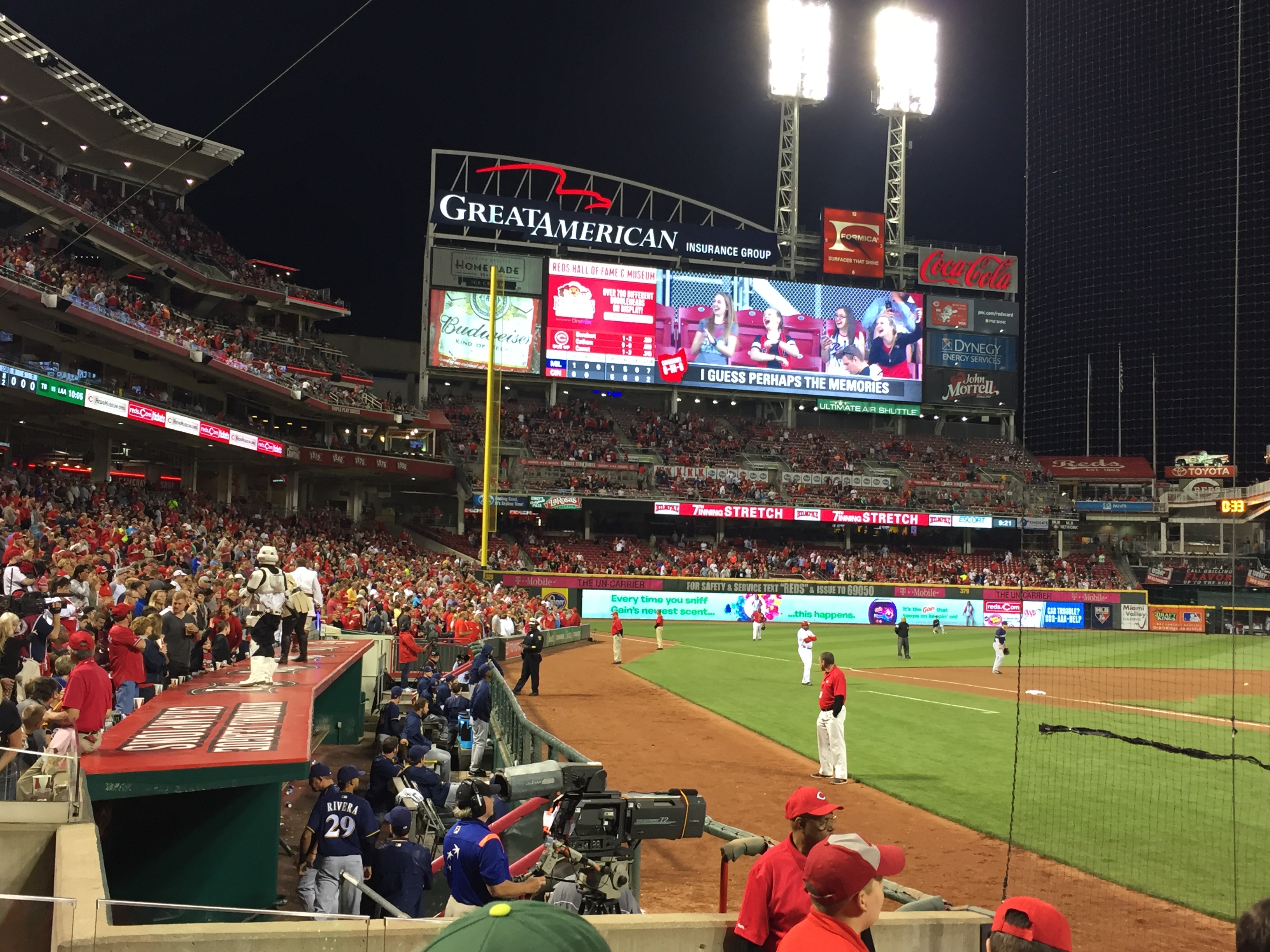
It was a beautiful night in May 2016.  I was at the Reds game watching the sold out crowd enjoy the Star Wars festivities and noticing how much the kids in the audience were excited about the event. I was also thinking about the kid Alden Ehrenreich who got the part of playing the new Han Solo in the upcoming stand alone films.  As I said many months ago I thought they would be smart to put Han Solo into all three of those new movies, and it looks like that’s what they are going to do.  With the casting of Alden Ehrenreich I was suddenly very excited about that possibility.  Even though I was very disappointed with The Force Awakens death of Han Solo, the possibility of a lot more Han Solo adventures suddenly perked me up and I found myself enjoying Star Wars for really the first time in months.

I remembered how much I loved Han Solo as a kid.  Of course I’ve long outgrown that character, but I still love the idea of Han Solo and always loved Star Wars because of him.  Without Han Solo for me there is no Star Wars.  But now, with this new kid whom I am very impressed with, I am suddenly having fun in that world again.  I am actually looking forward to the new films which is a bit of a relief, because like I said, for my mind which is very active, Star Wars was always kind of a vacation.  star wars1I probably enjoy the behind the scenes art stories about how Star Wars is made more than I do the actual movies.  So for the prospect of new Han Solo stories—of seeing some of the elements of the old A.C. Crispin novels about a young Han Solo being put up on a screen for everyone to enjoy, I’m excited about it.

As I was thinking of Rogue One, coming out this Christmas the prospect of Han Solo making a guest appearance is pretty exciting.  It will be nice to share those new adventures with my grandkids even though they may never read the same books I did.  I decided it was more valuable to share those experiences with them than to just check out.  I am still concerned about all the progressive trends that are emerging because essentially the young people making all these new Star Wars movies are fans of the original films that grew up with more progressive values as opposed to the original westerns that George Lucas grew up on.  I don’t think the new films will be nearly as good for me as the originals were, but for kids who don’t know any better—it will be very special to them.

More than anything, which was very obvious to me while watching the fireworks at the Reds game, the John Williams music alone was a proper bridge that is just beautiful to behold.  The new themes from the most recent Star Wars film fit in quite nicely with the old ones and it was a special fireworks display for me because of it.  It’s the first time I have heard the new pieces put together with the old and that’s when I thought—what the hell.  There will be six new Star Wars films over the next 5 years and a lot of new music—and Han Solo will be back in the Millennium Falcon with Chewbacca, and those are some fun stories.  And in just a few years there will be my dream of seeing a full-sized Millennium Falcon in Disney World.  That will be a dream come true and I am far more excited about that than I should be.  So even though Matt Clark and I torched Disney’s handling of Star Wars on the radio when The Force Awakens came out—I will give credit when I do see a reason for it and Disney is doing a good job—lately. Hopefully that trend will continue.

For the imagination, there is a lot to look forward to.  For me, Star Wars is all about imagination and possibilities.  That quest for the imagination is what makes me get up each day to face real world problems and work through massive tribulations.  At the end of all those tribulations, it has always been nice to have Star Wars to rest my mind in.  So in that context, it is nice to see that I may be able to continue enjoying it.  Alden Ehrenreich was a very good pick.Star Wars2

Rich Hoffman

 CLIFFHANGER RESEARCH & DEVELOPMENT

Sign up for Second Call Defense here:  http://www.secondcalldefense.org/?affiliate=20707  Use my name to get added benefits.

Why Disney Destroyed Han Solo: Progressive activism and attacking “white, American, family men”

I knew there was trouble on June 3rd 2015 when Marvel comics announced that Han Solo had an ex-wife in its comic #6 issue.  I didn’t want to believe it, but after later seeing The Force Awakens, I am 100% sure that what I was watching Disney do was on the scale of the old medieval churches in Europe re-writing history with their printing of Bibles to control the mass population through religion.  Star Wars was becoming something of a religion around the world, and now that the Disney Corporation had paid 4 billion dollars for it they were taking great liberties with very important characters in an attempt to change their original meaning to the overall story.   They didn’t have to, because the property had already been developed by George Lucas over three decades into a positive household name with no signs of abating.  Even more alarming was that Han’s revisionist wife was a black woman named Sana Solo proving that Disney was more interested in establishing progressive values in their ownership of Star Wars instead of just continuing the story that so many loved.   Disney was deliberately smearing the market impression that Han Solo had on the Star Wars stories and they were doing it not to be more successful, but because they wanted to change the meaning and mythic impact of the overall story arc.  That is why if you were listening to WAAM today at 1 PM in the afternoon, you would have heard Matt Clark and I dismantling Disney’s ownership of the Star Wars franchise.  If you missed it, you can hear it again here and above this paragraph in two parts:

http://dorksideoftheforce.com/2015/06/03/meet-sana-solo-han-solos-wife-star-wars-6/

I am quite a believer that the Bible has been revised to such an extent by political forces over the years that it has lost much of its original meaning—so I don’t trust it.  One fine example is the missing Book of Enoch which would have been an important part of Genesis.  It is not considered by Jews and many other Christian groups to be part of the Biblical “canon” and knowing that one can only wonder what else has been left out, or added to the stories that have made three of the world’s religions, Jews, Christians and Muslims.  Like it or not, Star Wars has become something of a religion.  Another few hundred years and it will likely have more influence over mass populations than Christianity does today—and that all starts with these seemingly simple stories being shown in our lifetime.  So it concerned me greatly when Han Solo was introduced in Marvel #6 with a black wife—which I didn’t believe at the time.  My wife and I talked about it a bit, I was then involved in a large motorcycle accident which soaked up a lot of time and attention.  I was also involved in a massive international project that was taking a lot of time.  But my concern was so great that I stopped buying Star Wars merchandise at that moment.  I had been reading the books and comics to alleviate the daily pressure associated with my life.  But upon the release of Star Wars #6 under Marvel Comics, I stopped, immediately.

When Marvel took over the comics which were supposedly Pablo Hidalgo approved from the Star Wars story group six months earlier from Dark Horse I was curious that they didn’t show a desire to connect the story material between the two publishing conglomerates.  I didn’t let that bother me too much because comics I don’t consider to be as important as novels—especially the New York Times bestselling books that had taken over the Star Wars canon for two decades in a really positive way.  But under Disney’s ownership of Marvel they had introduced a black woman to be Han Solo’s wife in an effect to emphasize negative character traits of one of the most popular characters in Star Wars Solo was a white guy superman type of character, so I wondered if Disney’s direction was a political one.  Later when I saw The Force Awakens, it clarified it emphatically.   Disney had revised the Star Wars canon personally created by George Lucas to make the stories more progressive politically.  They were essentially destroying a major character for the sake of editing the impact the character had on established mythology.  This was equivalent to the way that progressives have attacked Thomas Jefferson as a real historic figure with the Sally Hemings allegations, or to attack Jesus and his relationship with Mary Magdalene, the prostitute in the Bible who traveled with Jesus and was there at his execution.  We have witnessed revised history taking place in our public schools and colleges for the purpose of erasing history and now it was happening in Star Wars—an entertainment property that was just supposed to be for fun.  Yet Disney was purposely destroying the character of Han Solo because of the impact he had on so many fans as being a very strong, and reliable character. My suspicions were confirmed at the beginning of September when a gay character was included in the new Star Wars novel Aftermath, which I reported a warning to Disney upon release.  CLICK HERE TO REVIEW. 

I’m not against black characters in Star Wars, or even alternative sexual types.  However, Star Wars has always been an updated western, a space opera intended to communicate mythic stories that propelled our society with foundation philosophies.  Until Star Wars comic #6, then the novel Aftermath followed by the confirmation of all my concerns with the movie The Force Awakens, I felt I could trust Lucasfilm with a story canon that was personally managed by George Lucas.   I could read a story in a book or comic and believe that it had meaning to the overall collection of stories that had been canon until the Disney acquisition of Lucasfilm from George Lucas.  Now in a very short time, Disney didn’t even try to cover their intentions with subtlety.   They disrespected the long-time fans so much that they counted on sheer numbers to justify their collective activism of taking a deeply traditional story like Star Wars and turning it into a progressive mess.  Disney was showing itself to be much more interested in selling the politics of the Obama White House than in just telling a story set in a galaxy far far away.   Disney was promoting gay sex and interracial marriages over protecting the value of what made Star Wars successful to begin with.  So for me, the only Star Wars canon is the one that took place before Disney took over.  The last official book in the Star Wars canon under the guidance of George Lucas was the very good book The Crucible.  It takes place 45 years after the Battle of Yavin in the film A New Hope  After watching A Force Awakens, which takes place around 15 years earlier I had thought that there was some time travel going on that gave the Star Wars story group an out if things went wrong with their progressive activism, but I’m now convinced that it’s too late.  Disney executives have made progressive concepts their priority which has ruined Star Wars forever, they can’t go back now—they are too committed.  Here is how The Crucible went and is officially the way that Han Solo and the other characters of the George Lucas canon rode off into the sunset of storytelling. 

http://www.starwarstimeline.net/

When Han and Leia Solo arrive at Lando Calrissian’s Outer Rim mining operation to help him thwart a hostile takeover, their aim is just to even up the odds and lay down the law. Then monstrous aliens arrive with a message, and mere threats escalate into violent sabotage with mass fatalities. When the dust settles, what began as corporate warfare becomes a battle with much higher stakes–and far deadlier consequences.

Now Han, Leia, and Luke team up once again in a quest to defeat a dangerous adversary bent on galaxy-wide domination. Only this time, the Empire is not the enemy. It is a pair of ruthless geniuses with a lethal ally and a lifelong vendetta against Han Solo. And when the murderous duo gets the drop on Han, he finds himself outgunned in the fight of his life. To save him, and the galaxy, Luke and Leia must brave a gauntlet of treachery, terrorism, and the untold power of an enigmatic artifact capable of bending space, time, and even the Force itself into an apocalyptic nightmare.

I have praised George Lucas often because I think he’s a great filmmaker.   He is too liberal for me, but I respect him greatly.  He does have a black wife, which I don’t think is a big deal and he supports Obama.  I gave high praise for his film Red Tails because it was an important story that needed to be told.   When he sold Star Wars to Disney he did it because he was 70 and wanted to retire—but he had a massive company with over 2000 employees.  It would have been better for Star Wars if Lucas would have just maintained control of his property, but then he couldn’t just let his employees rot—at least in his mind.  So he sold Star Wars to a corporation he thought might preserve it, and washed his hands of the responsibility of being a major employer.  I can understand all that.  I thought it was a good move so long as Disney respected what George Lucas had built.

There is a lot more of George Lucas in Han Solo than in any other character I think.  I’m sure George would say that he’s Artoo Detoo, or Yoda and that Star Wars is all about Luke Skywalker.  But Han Solo is the old drag racer that Lucas used to be—and in many ways still is.  I have read hundreds of Star Wars novels, most of them have Han Solo in the stories so I know the character very well—and he’s what George Lucas wanted to be.  And let me say, Han Solo would have never had a wife during A New Hope.  He had a long time girlfriend who was a drug addict prior to meeting Princess Leia, but he was not a sleep around.  He wanted to be as far away from attachments as possible to protect himself from the obligation of maintaining those relationships and violating his opportunities for freedom.  He wanted nothing more to limit his loyalties to his Wookie friend Chewbacca and to travel the galaxy in his hot rod Millennium Falcon.  Much of his gruffness toward others was an act, just as he deliberately kept the Millennium Falcon looking like a wreck to disguise the power within it—the ship was the embodiment of Han Solo himself.  Solo would have never had a wife, and once he did, he would have never left her. Han Solo is not the kind of character who gets drunk on Nar Shaddaa and wakes up with a wife.  Han Solo was the embodiment of all the cowboys that George Lucas grew up loving as a kid, and he created a character that modern kids could look up to.  That’s why he was always my favorite character, so it was very easy for me to see the revisionist history that Disney was attempting to perform without getting caught.  Only, they got caught.  I know too much about all this stuff not to see it.  I know Star Wars not just from the surface but the structure of it—where it all started from the perspective of the Joseph Campbell Foundation.  I was a member way back when George Lucas was on the Board with Campbell’s wife Jean running things.  I’m not just a fan boy who didn’t want to see Han Solo killed in The Force Awakens.  I’ve studied history and I know the impact of mythology, and why politics seeks to capture stories to control mass populations.  That’s what Disney is doing with Han Solo, destroying him so that they can rebuild him in a progressive way to satisfy their political activism.

Star Wars fans really want to like The Force Awakens.  I’m one of them.  My opinions as of now are in the extreme minority.  Just like a religion, when people find out something is wrong with a mythic device that contains all their foundation thoughts, people tend to get defensive—and some of that could be heard on the broadcast I did with Matt Clark on WAAM radio.  But being in the minority does not make me wrong.  A million fools cannot erase a truth and what Disney is doing will bite them in the ass—because they are changing essential portions of the Star Wars mythology to satisfy current political concerns.  But those concerns will change over the next 60 years and these gay subplots will seem silly to future readers—especially when they seek out the original stories under George Lucas and compare the activism that occurred under Disney.  Disney could have made a lot of money and done something really good by just leaving Star Wars alone and letting the profits from the endeavor follow.  But they chose to be activists politically—for progressive reasons.  Executives at Lucasfilm and Disney looked at Han Solo and noticed that he was a strong, traditional white male, and they wanted to dirty him up.  So they gave him a wife that he was cheating on, and she was a woman of color to make her more of a victim.  Then they had Han leave Leia in A Force Awakens to return to smuggling as if that was all Han Solo was ever good for without his marriage to a woman of stature and prestige.  They purposely muddied up the character to make a point and create more social diversity because that is their value system.  And that is why the Star Wars stories for me ended with The Crucible, a New York Times bestseller that has as much value to me as the novel Lord of the Rings, or The Bridges of Madison County.  Disney by corporate design to elevate minorities, gays, and women in their stories to appear more diverse, politically, took the strongest character in the Star Wars mythology and erased his essence with a revised canon that makes him into a scumbag more relatable to modern audiences.  We are living in an age where a lot of children cannot relate to a Han Solo type, a man who stays with his wife and is loyal to a fault. So Disney tried to weaken the character to appeal to younger audiences—but all they did was cause trouble for themselves.  I’m not the only fan who will reject their product.  Many others over the years to come will follow and Disney will only have themselves to blame.

For me this whole exercise has provided proof of something I’ve long suspected, that mythologies over time are radically redesigned by politics in all cultures to justify the failures of social mismanagement.   The Bible has certainly been altered over the years to reflect the values of the Roman Empire, and the churches of Europe who wanted to use religion as a natural extension of that imperial control.  Modern progressives are trying constantly to re-write history from the vantage point of the conquered Indian to erase the merits of cowboy capitalism in the West.  And China prohibits proper archaeological study of their many pyramid-shaped mounds to suppress the real history of their ancient culture.  Those are just a few examples.  And right in front of our faces we have watched Disney revise something in our lifetimes in spite of the many witnesses.  I read just the other day a defense of the movie A Force Awakens straying from the original plots created in the Expanded Universe by declaring that Solo had a wife in the EU.  No, Solo did not have a wife under the EU.  That plot device was created six months before the release of the 2015 Disney film to justify why Solo left Princess Leia after Return of the Jedi to become a typical white, American male—a Homer Simpson loser who can’t keep his pants on, and is unreliable to family life.  In Disney’s desire to make Star Wars more accessible to women, and minorities, they have deliberately tampered with what made Han Solo one of the most popular characters in the saga—and they did it out of political activism, not intellectual necessity.

Rich “Cliffhanger” Hoffman

 CLIFFHANGER RESEARCH & DEVELOPMENT

Sign up for Second Call Defense here:  http://www.secondcalldefense.org/?affiliate=20707  Use my name to get added benefits.
‘The Force Awakens’ Killed off Han Solo: Why the prequels were a lot better and how Disney blew it

Piiiiiiiiiiiiiiiiiiiiiiiiiiiiiiiiiiiiiiiiiiiiiiiiiiiissssssed off, that is the feeling I have walking out of The Force Awakens.  

Sadly, the news I was so excited about three years ago regarding the new Star Wars film is tragic—the worst of what I feared might happen, did.  Taken by itself, The Force Awakens is a very good movie, the acting is good, the special effects everything that you’d expect, the directing, the writing all very good—then there’s the music by John Williams—upper level wonder.  Unfortunately for Disney, Star Wars is much more than one movie now and Disney did exactly the wrong thing.  Like rumored, they abandoned the Expanded Universe and they killed off Han Solo in the first movie of a three-part trilogy which was my favorite character.  While on the business side I can understand why they did—Harrison Ford was 73 at the start of The Force Awakens, so it’s not a bad idea to start planting the seeds for future characters.  However, killing off Solo without having the context of the greater story developed over the last two decades is extremely problematic for the Star Wars franchise.  Here’s why.

About 15 years ago a super Star Wars fan was talking to me about the novels that came out every few months and wondered why I wasn’t reading them.  I explained that if the books didn’t come straight from the mind of George Lucas that I didn’t consider them part of the Star Wars canon.  However, the novels leaned very much on the character of Han Solo and his marriage to Princess Leia and their three children Jaina Jacen and Anakin.  So figured I’d give the books a try.  I had tried the Thrawn trilogy by Timothy Zahn and couldn’t accept it, but decided to try again with Vector Prime.  It was a great book—although Chewbacca died—and I was hooked.  I have since read most of the Expanded Universe novels which have greatly over-shadowed the original movies in sheer content and emotional story arcs.

I thought there was a whale of a story developing at the end of Apocalypse involving The Abeloth and that The Force Awakens would be about that massive galactic conflict—which would have been great.  Disney could have given the hard-core Star Wars fans what they wanted while giving a new generation of fans what they wanted.  The old characters could have faded out leaving the new very strong character of Jaina Solo to have filled the boots of her father nicely—and that would have been appropriate.  Everyone could have had what they wanted out of Star Wars.  But that’s not what Disney did with the help of J.J. Abrams, and Kathleen Kennedy.  They thought they knew better than all the minds who had been guiding the Star Wars stories through three decades of New York Times best sellers so they screwed with the story with a progressive agenda which was the worst of my fears.

If they had stayed with the Expanded Universe storyline, they could have still had a Latino lead character, a black character and a strong female lead to reach all their target demographics.  But they did more than that—they weakened Han Solo considerably and made him a self-sacrificial parent who threw himself on the sword of Kylo Ren at the end.  He and his marriage to Leia obviously went bad and the kids were damaged leading to his son (Ben) turning to evil.  Suddenly the very strong characters of the Expanded Universe were modernized into dysfunctional parents who had screwed up their children and felt guilty about it.  At the end of The Force Awakens, “General Leia” is alone with no signs of family—except the daughter Rey to find out who she truly is.  This is probably the most disappointing aspect of The Force Awakens—in the novels the son of Han, Jacen falls to the dark side over many books and his intentions were always good.  Han stayed with his wife for many years and they had a pretty good family life.  Han was always a rock solid person in those stories giving Star Wars geeks the father figure they didn’t have in real life—and it worked well in a mythological way.  The daughter Jaina was the new light of the next generation—The Sword of the Jedi.

J.J. Abrams and Lawrence Kasdan essentially took the big themes of the novels and retold the story of Jacen’s fall to the dark side moving around the names of the characters and having him confront his sister—in an epic lightsaber battle.  Knowing all that felt cheap to me.  It took Star Wars from an epic pinnacle of the highest mythological order and dumbed it down to be simply another Avengers movie.  It was fun to look at, but the content was certainly watered down from the types of bold stories that were told in the novels.  I will probably see future Star Wars movies just to see what they do and how they look—like I would a superhero type of film—the many times the Batman story has been told, or Spiderman—even Superman.  But with Star Wars, Disney had a unique opportunity to build on a massive story arc, and they screwed it up—rehashing the old by putting their own stamp on it in a way that did a disservice to the fans who helped carry the franchise for so long with their loyal support.  Clearly the emphasis by Disney and Kathleen Kennedy was to weaken the original characters from the bold embodiments of their youth into guilt driven losers in the future—which might make them relatable to a larger audience who feels the same anxieties.  Of course they had to plant the seeds of an interracial romance—which felt forced—and was distracting.  Han returned to his days as a smuggler instead of the reliable family man that he was in the books.  Luke was in hiding feeling guilt for creating Kylo Ren though his failure in teaching future Jedi—which in the books Luke had built an entirely new Jedi Order.  In the books all the lead characters were strong and determined personalities who had suffered through unimaginable sorrows, but were still people a reader could lean on and trust to do the right thing in the end.  In The Force Awakens it is obvious that the all the old characters were flawed, especially Han Solo.  This was obviously a conscious choice to make him more relatable to the modern viewing audience instead of just trusting the story the way it had evolved over the years with great success.

There has been an effort from The Alliance to Save the Star Wars Legends Expanded Universe shown at the link below to save the storyline of these movie from just this kind of misery.  But, Disney didn’t listen and they’ll pay for that.  The Force Awakens will make a lot of money, but it won’t be as much as they could have made.  They just handed the next generation a bunch of loser characters not quite sure of themselves putting an emphasis on progressive values instead of American traditional ones.  The Force Awakens is about sacrifice and the greater good whereas a theme which always ran through the original trilogy was individualism and following a personal bliss.  Han Solo as the individual always had the answers to save the Luke and Leias of the galaxy from their altruistic tendencies.  In The Force Awakens it is Han Solo that needs saving from his guilt over failing their son in ways that aren’t yet shown.  Essentially the decision to turn Han Solo from an Ayn Rand type of character into a Shakespearian tragedy was meant to erase his lineage of strength into something modern audiences could identify with.

https://www.facebook.com/AlliancetoSavetheStarWarsLegendsExpandedUniverse

http://twibbon.com/support/star-wars-legends-never-die

The result for me, and I’m sure many others, is that I completely reject these new stories by Disney.   I just came out of seeing a premier showing before it opened officially on December 18th 2015 and my sorted emotions tell me that this story in The Force Awakens is not real.  I can’t accept it as cannon.  It’s actually pretty stupid.  It represents another case of activist filmmakers trying to plant progressive Huffington Post values into a very traditional American story for the sake of unifying the world around common values.  To do that they dumbed down the American influences of individuality, and created a much more “inclusive” universe that was the obvious intent they had in making the film.  People like Arianna Huffington will love this new Star Wars.  John Wayne would have hated it.

I can deal with the death of my favorite character.  What I have a problem with is weakening their presence out of a desire to appeal to a weakened society—where movies are made by committee rather than by strong individuals.  The Force Awakens obviously understands that few people have intact families these days and that people can’t relate to the type of strength that Han Solo projected which has carried the franchise quite frankly for forty years.  They made a conscious decision to weaken Solo—hand over the Millennium Falcon to a “girl” (his daughter) and reflect the values of the present global community instead of the values of the story itself.  They cheapened Star Wars in ways that will be very costly in the years to come.  So while the movie was beautiful to look at and had many elements that are respectable on the surface, the underlining message was feeble and a tremendous disservice to the fans who have stuck with the story religiously all these years.  Star Wars had a chance to be above modern politics, but the filmmakers failed to carry it to those lofty heights.  Instead, they surrendered to the currents of modernism—and the movie shows it desperately.  The movie felt to me like a fake and something to reject—which is not what Disney wanted, I’m sure.  Forever for me, and many like me, there will always be the Expanded Universe where Han didn’t leave his wife and fail his children with some “force bending” scheme of time to save his daughter from the wrath of her brother, Han’s failed son—and the Jedi master Luke who lost his pupil to the dark side.  I’m sure there is a story of redemption in the next episodes, but by then—who cares.  Disney already screwed up the story with renamed characters and repeated themes which were already told in the novels years ago.  And in that respect, The Force Awakens fails in every way that it never intended.

The prequels were a LOT better.

Rich “Cliffhanger” Hoffman

 CLIFFHANGER RESEARCH & DEVELOPMENT

http://www.secondcalldefense.org/?affiliate=20707

Robert Tracinski, Rich Hoffman and Matt Clark on WAAM: Why ‘Star Wars’ is better than ‘Star Trek’

Matt Clark had me on his show to actually co-host with him as we spoke to Robert Tracinski who writes for The Federalist. He had written an interesting article about how it was unlikely that J.J. Abrams could screw up the new Star Wars film, The Force Awakens, so long as he stuck with the formula. There were some condescending aspects to Tracisnski’s article which I was willing to overlook, because he was right about a lot of things. But more than anything Tracisnski had been dismissive of the original trilogy as not being very good—which I thought was odd. So I was eager to talk to him. It only took a few moments into the interview however to learn the root of his issues—he was a Star Trek fan and had only come to Star Wars through his children. His position was that Star Trek was philosophically superior to Star Wars and that these new movies were kid stuff that he was enjoying with his children. Listen to that interview here:

I don’t care much for Star Trek, to me it is the United Nations in space. While Robert Tracinski is not a liberal and is a pretty committed Objectivist, which is Ayn Rand’s philosophy—it was clear to me quickly why Robert didn’t like Star Wars much in his article. I disagree with him on a number of topics regarding the formula of Star Wars, or its appeal. I think the Star Wars films are deeply philosophical; especially The Empire Strikes Back—much more so than Star Trek. I mean, people are not lining up across the world to see the latest Star Trek movie, and Star Wars isn’t as popular as it is because it’s just adults living out their childhoods once again through a movie. It’s more complicated than that. As we were talking to Tracinski, because of his background with Ayn Rand I kept wondering if I had met him someplace before, so I wanted to cut him some slack. Everyone comes to things in their own time and if he came to Star Wars late in life through his kids—so be it. One aspect that Tracinski got right in his article was the perception that Han Solo is the key to the franchise—so I stuck to that topic in our conversation.

Matt and I spent the first segment of his Saturday WAAM show talking about Disney and their progressive activism with a gentle warning about messing with the formula of Star Wars and the impact that might have on their massive investment. Matt and I love Disney—the Uncle Walt version. I love that Disney is a family friendly entertainment group—so I am willing to overlook a little of their liberal activism. Something that Robert Tracinski did bring up on his show that was true.  George Lucas and Steven Spielberg were the best conservative filmmakers coming out of the 80s. I personally think they were both seduced by Bill Clinton in the 90s and have lost their minds since. The reason their early films were so successful was because they all had conservative leanings to them. Once both directors had achieved their monstrous success and essentially stepped away from the Objectivist roots of their film careers, their movies started making a lot less money. Without question George Lucas was at least attracted to Ayn Rand in his early days—when she was at the height of her influence—and Han Solo was a character that represented that struggle within George. As he become more liberal with age and success—perhaps feeling a little guilty that all his liberal employees were constantly berating him for his capitalist tendencies, he softened up on his stance for individualism and began to accept collectivism to a much higher degree, which was clearly represented in the prequel  films—which were noticeably absent of the Han Solo type of character.

Where I disagree with Tracinski about the prequel films is that I don’t think George Lucas ever intended those films to be successes. They were dark movies about the failure of a Republic—and have great political merit to them. They are very philosophical from the position of how poorly constructed philosophies can destroy a body of government. Even though Lucas had been moving to the left—politically, his message about the failure of groups to detect evil, and how institutional failure is indicative of all government cycles is powerful stuff that set the stage for some pretty deep storytelling. As much as people dismiss the prequel films as silly, they are important in the larger scope of the intended message. The movies did lack heroics on the scale of a Han Solo, but that was on purpose. A lot of characters including Yoda and Obi-wan Kenobi made mistakes that they spent the rest of their lives correcting. So the films were never supposed to be heroic repeats of the original trilogy. For that story Han Solo was the savior, he kept Luke alive, married his sister Leia and that set up the events of these new films. Solo is an Ayn Rand character and Disney even with all their activism against conservative causes—can’t ignore that the magic of Star Wars isn’t Luke Skywalker, or anything about the Force—it’s about Han Solo’s position against hooky religions and ancient weapons not being as competent as a good blaster at your side.

Just a few days before Matt and I had our radio show together Harrison Ford was on with Jimmy Kimmel dressed up for Halloween as a hot dog. It was a funny segment and of course Ford was asked about the new Star Wars film. I thought his comments were interesting to say the least. He stated that nobody would be disappointed—at all. That was a remarkable statement considering what’s at stake. He knows the potential cost of over-anticipated hype—so his comments had me very curious in relation to Disney’s strategy going forward. Han Solo is going to be playing a larger role in Star Wars than he has in the past largely because the character tests well demographically. His children will without question be the subject of the new stories but Disney will find every opportunity to insert a younger Han Solo into the movies at every juncture. To be successful at that, Disney will have no choice but to adopt the obvious aspects of Han Solo’s Objectivism view points—his natural conservatism and love of capitalist endeavors if they want Star Wars to continue being successful.

After Matt’s show I spent time at my children’s house going trick or treating with my grandkids—and kids. Late into the night my oldest daughter and I spent time talking about Han Solo and how it seems obvious now that Disney will find a way to put him in the stand alone films as much as possible just to use him as a springboard to success. Like Robert Tracinski and I spoke about on Matt’s show, without Han Solo, I think the Star Wars saga crashes and burns. If they try to turn him into a sacrificial collectivist Disney will lose a lot of money because people will reject the premise. The ticket buying public will only accept the Objectivist Han Solo—and nothing less—the hero who acts in his own self-interest. Even though the moment at the end of A New Hope was intended to show that Solo was able to act for others, the need to save Luke at the last moment was out of Solo’s self-interest because he was starting to like the kid. Like I said, Star Wars is a lot more philosophical than people give it credit for, and I’d think that as much as Tracinski likes Ayn Rand, that he’d prefer Star Wars over the United Nations in space—Star Trek and all that “needs of the many outweigh the needs of the few” crap. Screw Spock and his pointy ears—he’s a damn collectivist. Solo is a rugged, gun slinging individualist who acts out of his own self-interest. That’s why Star Wars is better than Star Trek.

We’ll see what happens, time will tell. It was a good conversation that was worth listening to, especially given what Star Wars will mean when it opens in a few weeks. There will be no escape; the opening of The Force Awakens will impact just about everyone no matter where they live. It will be impossible to not notice something about it as the merchandising around Christmas will be everywhere. Just watch the Duracell commercial shown above. Star Wars will literally be everywhere in just a few weeks of this writing. There will be nothing like it ever—history is being made both commercially and philosophically. The question will be whether or not The Force Awakens will be as anticipated on the 19th of December as it was on the 18th after people start seeing the movie. To be as successful as Disney needs it to be people will need to see the film several times. And to have that kind of power over the mind of fans—Han Solo will have to be a part of it with an Objectivist approach—otherwise the whole thing falls apart. It’s not the lightsaber battles and space antics that make Star Wars so great—it’s the Objectivist leanings of its basic premise:

Han Solo—“marching into the detention area is not what I had in mind.”

Luke Skywalker—“but she’s rich.”

Han Solo—“How rich?”

Luke Skywalker—“More wealth than you can imagine.”

Han Solo—“I don’t know, I can imagine quite a bit.”

Luke Skywalker—“you’ll get it.”

Han Solo—“I better!”

Luke Skywalker—“You will!”

Han Solo—“Alright kid, what’s your plan?”

That’s Star Wars—it’s an Objectivist love fest designed before George Lucas was overly liberalized. It’s also why twice during the broadcast with Matt that I uttered to his millions and millions of listeners—“Han shot first!” When Lucas changed Star Wars in 1997 to have the bounty hunter Greedo shoot at Han first in the Mos Eisley cantina fans were angry. It was a liberalized mistake for Lucas to cave under the pressure from the liberal film community to make Han Solo not appear as such a blood thirsty killer. But Solo acting out of self-interest shot first because that is the nature of his character—he’s an Ayn Rand survivalist and the heart of what makes Star Wars great.

Rich “Cliffhanger” Hoffman

 CLIFFHANGER RESEARCH & DEVELOPMENT

Listen to The Blaze Radio Network by CLICKING HERE.

The Millennium Falcon is my Thing: Wonderful news from Disney’s D23 Expo

Stunning is all I have to say about the news out of Disney regarding Star Wars.  Everyone who reads here and knows me understands that I am a Star Wars fan.  They know that my primary love in life is that of mythology and the power of it.  That one of my great personal teachers was the maverick professor at Sarah Lawrence College—Joseph Campbell and that I spent many of my formative years associating with the Joseph Campbell Foundation of which George Lucas was one of the Board of Directors.  And I have said on many occasions that I think the new Star Wars films, and all the books and media that will follow will reshape our modern culture not only regionally, but globally. There is tremendous power in Star Wars and Disney’s marketing machine will only accentuate that in glorious ways that only capitalism can fully extract.  The news around the upcoming film The Force Awakens is exciting.  But that’s not all, a whole slate of new films following that one are upcoming.  All the mythology that the previous six Star Wars films have produced over the last 30 years will soon be eclipsed by the six new films in the pipeline produced over the next six years.  And supporting those will be all new novels, video games, commercial products but best of all a new Star Wars land at the Disney parks.  Click here to read some of my previous work on this topic.  I predicted this a long time ago in a galaxy not so far away. 

For me the biggest news of this century which has stirred in me a delight that is quite epic is the information that not only will Disney build a 14 acre Star Wars specific land in both the Anaheim location and Orlando location, but that a full-sized Millennium Falcon will be present.  That is a game changer in these films that I have been wanting to see my entire life.  And now I’m going to get to see it.   At the D23 Expo over this last weekend Bob Iger released the details and showed the concept art and that just did it for me.  I have been in love with the Millennium Falcon since I was very young and it may actually be stronger today than even when I was a kid because not only through the movies, but the many novels, I have spent a lot of time on that ship in my head—and I completely understand the world it traverses through.  I am very happy that Disney as a company has done precisely what I said they would do with the Star Wars acquisition when they first bought it in 2012 and at the heart of it they intend to keep the Millennium Falcon a central character to the entire saga.

Honestly if Jesus Christ came again to judge the living and the dead on judgment day and I had a chance to attend that or to go see the Millennium Falcon in real life, I would choose the Falcon.  I am pretty stoic when it comes to controlling my emotions.  I don’t get crazy about many things—especially sad things. But I do allow myself to feel elation over positive things, and I really don’t know how I will handle seeing a Millennium Falcon in real life—seriously.  When the place opens I may take a week of vacation just to reside in that land day after day soaking up everything—because I love the Star Wars mythology from top to bottom—and within that world I have a love of the Millennium Falcon that is central to that passion.  Still to this day, out of all the successes and experiences I’ve had—which are quite extraordinary, things I’ve won and achieved—one of the best memories I have ever had was seeing the real life model of the Millennium Falcon in the Smithsonian in 1997.  I really felt when I put my hands against the glass that I had died and gone to heaven.  It was one of the most beautiful things I’ve ever put my eyes on.  Given that context I really don’t know how I’ll react to seeing a model of the Falcon in full-scale that I can walk up to and see close.

Han Solo is the modern embodiment of the classic western cowboy.  His quick draw pistol is famous within the Star Wars storyline and his super fast Millennium Falcon gives a tip of the hat to two film genres, the classic car hot rod and a gun fighting cowboy.  Those two things are just impossible not to like—and to top that off, the Falcon was a pirate ship within that galaxy—so I’m not the only one who finds the Millennium Falcon appealing.  I was amazed to see Harrison Ford on stage at D23, and that it was Han Solo who made the cut on the new poster for The Force Awakens.  There will be a new film about specifically Han Solo as a young 20 something that will be exciting, so there is a lot of news coming from Disney to be excited about for—particularly for Millennium Falcon fans.  I know how I feel about all this information, so I can’t help but think of the scientific implications of it.

As recently as last week I was thinking of a way to build a real Millennium Falcon as a real usable space vessel moving to and from earth to explore the reaches of space.  I really don’t think we are that far away, and one design with sentimental value is as good as any other.  The Falcon offers a lot of options for deep space travel particularly in its circular design.  A change of scenery is important when spending a lot of time in space, and the Falcon is cleverly designed for just such an experience.

Also announced at D23 was the new photo for Rogue One which showed Felicity Jones as the main actress standing among a group of daredevils and hackers about to steal the Death Star plans leading up to the original Star Wars film,  A New Hope.  As I looked at that I couldn’t help but wonder if she wasn’t playing Bria Tharen who was one of Han Solo’s girl friends from the Expanded Universe.  If she was her back story could easily be a part of the stand alone Han Solo film coming on May 25th 2018.  I’m already in line!  Likely being that young, Han Solo wouldn’t yet have the Millennium Falcon, but I’m sure it will make an appearance in that film as the ship owned by Lando Calrissian.   It is obvious that Disney, knowing the popularity of the vessel is finding ways to put it in most of the new Star Wars films in some support role or another.  There will also be a Boba Fett film and in that story I’m sure he will be chasing around a younger Han Solo in the Millennium Falcon—so there is a theme emerging that is quite justifiable in placing a full-sized Falcon in the center of the new Star Wars land at Disney.

Knowing the effect the Falcon has had on me I shudder to think of what effect it will have on a new generation who can actually walk up and touch it.  I got goose bumps the first time I saw new footage of the Falcon in a hangar on the Star Tours ride in Orlando.  Part of the ride flies off behind the popular vessel in a dog fight and I was blasted with excitement in just seeing it sit there.  For my birthday this year we went to Dave & Busters just so I could fly the Falcon in the video game there exclusive to the popular gaming destination.  But these are all images that take imagination to enjoy.  They are not something you can put your hands on and feel.  Disney is now taking that step and I am emphatically excited about it.  I think the influence it will have on science for years to come will be extraordinary.  These new films will open up the mythology in ways that nobody thought was possible before and the effect they will have on civilization will be extremely powerful.  Being able to reach out and touch it will just make it that much more influential as a mythic device.  So yes, there is a lot of good news floating around out there.  But for me, nothing is more exciting than the D23 news coming out of Disney.  I would pay $100,000 just to see an actual movie prop of the Falcon on set.  I would spend unknown amounts to see one all dressed up at Disney World.  The Millennium Falcon is my thing—and I share that with a lot of other enthusiasts. It was probably the best thing that Disney could have done with Star Wars—and they are just getting started.  I can’t wait to see what’s next!

Rich Hoffman

 CLIFFHANGER RESEARCH & DEVELOPMENT

Listen to The Blaze Radio Network by CLICKING HERE.

Cliffhanger’s Morality on Capitalism” Elon Musk and Han Solo–the unseen value

A few years ago I spent a good part of a summer vacation on the balcony of a condominium reading the Ayn Rand books that my son-in-law had recently bought for me—particularly her collection of essays on capitalism. For as long as I had been alive capitalism was always portrayed as evil, which I never bought into. Yet nobody ever offered any competing theory. Even my favorite character from Star Wars, Han Solo was an unfettered capitalist without any apologies provided. George Lucas by the end of the original trilogy wanted to make Han into a more compassionate person who saw the errors of his ways—and thought about others more than himself—but I never personally bought into that theory. I’ve always seen capitalism as the way to making better things from nothing and had a far superior moral platform to project goodness than the altruistic sacrificial victim of yesteryear. After all if people are asked who they like more in Star Wars, Han Solo or Luke Skywalker who do you think they’ll pick? The results are well documented—just Google it.

I spent much of that summer thinking about those books as they provided a support that was found no place else in favor of capitalism. People like Milton Freeman were before my time, Walt Disney died when I was a little kid, and John Wayne was only fondly remembered in old movies. Reagan pretended to embrace capitalism as a continuation of his spokesman job he had at GE—but there really wasn’t anybody openly defending the morality of capitalism—and there needed to be. After all, from the world that I know people like Elon Musk, Richard Branson, Steve Jobs, and many others like them are doing far more for people than the person who sacrifices their time and energy at a soup kitchen helping the poor. While donating time is a nice thing to do for people down and out—the cause of why people are down and out in the first place is the real issue that needs to be explored—not the result. Capitalism has in it a morality which deserves a hero so that people can understand the value.

Even stories I really like, such as Robin Hood, and Zorro have in their underlying value a kind of socialism—the villains are the rich, the protagonists are the poor. Batman who is a direct evolutionary character of Zorro was like Don Diego a wealthy man who took his gained assets acquired through his family’s success and did good to fight crime.   But what always bothered me about Zorro and Batman is that they inherited their wealth; they didn’t do as Elon Musk did and make it from nothing into becoming one of the most influential people on planet earth. Without Elon Musk and Richard Branson where would the world really be? The wealth they create for the overall economy makes it even possible for people to donate their time to a soup kitchen for the poor. The inventions of the wealthy create spare time and resources so that something can be given back. Without that infusion of wealth, Harrison Ford wouldn’t be able to donate his time to left leaning causes.

Harrison Ford is my favorite actor—maybe just a bit ahead of Clint Eastwood. Ford made a lot of money as an actor because American capitalist culture had expendable income to go see his movies in a darkened theater. He has turned around and done a lot of great things with that money. Individually he became a private pilot most notably crash landing his crippled vintage craft into a golf course saving the craft, people and even himself in a way that defies the actions of most Hollywood actors. But Ford is also a very giving person to the poor, to environmental causes, and to virtually everyone in his life. He is a person who is easy to respect. But what would he be without George Lucas creating the Star Wars and Indiana Jones films? He would have been just another actor jumping from job to job. Lucas used capitalism to create wealth not just in monetary value, but in philosophy. Without the creation of capitalism all the good things that Ford does in his private life would go nowhere. If he didn’t have excess as a result of his success, he’d have nothing to give away to others by his own volition.

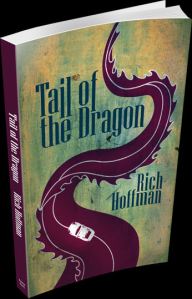
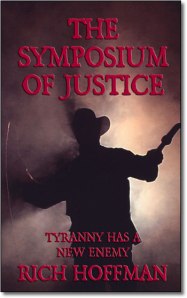
That is why capitalism needs a real hero—and unapologetic champion. I had started formulating that champion years ago in my own character of Cliffhanger. In my novel The Symposium of Justice it is eluded that the protagonist made all his wealth by winning a lottery ticket. However, this is a falsehood created by his political enemies who are protecting their old money political connections from the reality of what Cliffhanger represents—creation and justice. Most people who win the lottery are broke within a few years because they lack the internal value as people to support the sudden infusion of wealth. Unlike people like Elon Musk, most people lack the ability to create wealth, so they assume that it’s a finite resource open for equal distribution discussion. But they are dreadfully wrong. As the Cliffhanger series The Curse of Fort Seven Mile continues to evolve over the coming installments it becomes quite clear who and what Cliffhanger is and why people who can perform such creation are so important to society.

When I was in high school I was the only kid who actually wore a t-shirt featuring Howard Hughes on it. I’ve always liked Hughes and Harrison Ford’s recent plane crash reminded me a lot of a similar incident that Hughes had, in the same area years ago. Hughes was extremely rich, and did a lot of really good things with his money—particularly advancements in aviation that simply would not have happened without his actions. He was an eccentric whose mind ended up collapsing on itself, but the world is much better off because of his life than without it. Yet thousands, even millions of people flash upon the earth in a lifetime and disappear just the same and nobody notices. Is that fair? Aren’t they equal to Howard Hughes? The answer is no. The ability to create something from nothing is more important than equal distribution of fairness.

This brings us back to that summer in Florida with the Ayn Rand books. She was on to something and to my mind she broke through the first layer of an important revelation. In philosophy this is called the creation of Objectivism. I agree with most of the tenants of Objectivism. However Ayn Rand was a lot more socially liberal than I am. She was much more permissive on drugs and sex which hurts her position on capitalism. It allowed liberals to attack her as a product of excess greed and selfishness, which is an inaccurate assessment. The books of hers that I read were very valuable because what she was doing was on the cutting edge of a new way of thinking, so context is needed. Capitalism needed champions, and she officered them particularly in her novels The Fountainhead and Atlas Shrugged. Other than those characters there really aren’t any other champions of capitalism in novels or movies—with the rare exception of Harrison Ford’s film characters particularly Han Solo. In almost every other circumstance, most notably the man everyone loved to hate in the 80s television show Dallas—in JR, or Boss Hogg from the Dukes of Hazzard, rich people are evil and need to have something taken from them and given to people supposedly repressed and in need of equality.

The truth of the matter is that people who don’t have things are in that condition by choice most of the time. The big difference between people like Elon Musk and the typical volunteer at a local soup kitchen is that one creates wealth that enriches our entire culture and the other just does good deeds. Both are important, both may be good men, but only one makes something from nothing which leads to good options for everyone. The creation of Space X is more important than a local charity asking people to throw money into a hat for the needy. Space X creates expendable income to toss into the hat. Without it, there is nothing to donate to the needy.

The efforts of my new Cliffhanger installments are to further this exploration into the morality of capitalism in a way that has been utterly ignored. Ayn Rand started the process and did a lot of great work along that line of thought, but there is much, much more to do. This Cliffhanger project will likely go on for many years but already the stories feel like a continuation of the type of material I wanted to read more of after that summer vacation in Florida. After I ran out of those Ayn Rand books I wanted more, but since she died in the early 80s, there was nothing more to read. But there needed to be. So it is up to us in this new generation to expand on those arguments and further peel back the mysterious goodness of capitalism and to properly define why collectivism is a vile evil—even when its been told to us for centuries that it’s the only path to redemption. These are difficult subjects, but they need to be explored—and through Cliffhanger—they will be.

Rich Hoffman

 CLIFFHANGER RESEARCH & DEVELOPMENT

Listen to The Blaze Radio Network by CLICKING HERE.

I am Han Solo: The ‘Star Wars’ personality test

I’m Han Solo—at least that’s what the new Star Wars personality test told me when I took it.  A friend of mine told me that The Blaze did a story on a new Star Wars personality test by www.Zimbio.com which was actually more sophisticated than I thought it would be.  The questions are involved and pretty good about bringing to the surface the raw nature of a person’s personality as related to the Star Wars film series.  For instance, while taking the test I thought I’d come out as Obi-Wan Kenobi—whom I personally admire for his love of wisdom and the philosophic chess matches he tends to play on a galactic scale.  But Han Solo has always been my favorite character and that trait emerged during the test even though I was consciously aware of avoiding it.  So it was a pretty neat test.  At the end of The Blaze article linked below it was revealed that most of the staff at The Blaze including Glenn Beck, Doc Thompson and Skip LeCombe had taken the test and were enthusiastic about their results which they promised to cover on air.  I thought this remarkable because it provides insight to all that I have been saying lately about the cultural impact of Star Wars and the future of our society.  There are few things which can unite minds quicker than Star Wars does in discussions with other people and it’s not just nerds anymore—but mainstream acceptance.  NFL football used to be that topic item breaker that anybody could discuss with any other person in business or other affairs, but quickly Star Wars is overtaking it.  It’s hard to find someone who doesn’t know about Star Wars who is under 55 years old and doesn’t have an opinion about the film series.

http://www.theblaze.com/stories/2014/01/18/are-you-a-yoda-luke-skywalker-or-maybe-a-princess-leia-take-the-star-wars-personality-test/

I took the test while on the road at my sister-in-law’s house with many family members present so we all took the test and had a good time with the results.  I was surprised how many of them came back as Yoda, and the young men who took it mostly came back as Boba Fett—which was remarkably accurate.  There were no Darth Vader’s in our group which says a lot about the quality of our family.  That much didn’t surprise me—but the number of Yodas did—my wife included.  It could not be ignored how many of our family members instantly understood what the test was and the intent which reflected the response of The Blaze staff.  Star Wars is something that touches just about everyone as good memories of their childhoods flood back to them upon the mention of Han Solo, Luke Skywalker or Princess Leia.

I remember what it was like to be a kid in the late 70s and early 80s.  Star Wars was everywhere—it was on the radio, it was at the stores, it was on television, it was in comics, magazines—it defined popular culture from about 1977 to 1985 when it began to subside just a bit.  Even popular films like Back to the Future and ET the Extra Terrestrial made frequent Star Wars references—so it was a huge part of that 8 year period and anybody who was a child during that period knows what I’m talking about.  That doesn’t mean that everyone was an open Star Wars fan.  Many of the kids in my school made fun of kids who openly loved Star Wars—kids like me who had Star Wars notebooks, wore Star Wars t-shirts, and drew pictures on my homework papers of Star Wars space ships.  I didn’t care what other kids said, once I got past the 7th grade, I was never picked on for Star Wars again because I had so many fights at school that kids stopped trying.  The more they made fun of me the more I rubbed it in their face.  I had a Star Wars shirt for every day of the week—my favorite was a Han Solo shirt that I never got tired of wearing.  I wore it so much that it fell apart.  I developed a rivalry with another kid in Junior High school at Lakota who was a Star Trek fan and hated Star Wars.  We actually had fist fights over Star Wars and which movie was better.  It got so bad that I shoved the kid right into the principles office as he was trying to escape me after I was waiting outside his bus in the morning to catch him with a confrontation before class started.  He had previously declared during lunch period that Captain Kirk would beat Han Solo any day of the week—so I was going to teach him otherwise. I’d give him some real life Han Solo through me—and as he was running away from he thought he’d get safety inside the principles office—which he didn’t.  I took the fight straight there shocking all the other kids in the hallway and the adults alike when I grabbed hold of the Star Trek lover by the back of his shirt and threw him right into the front door with the principle and secretary standing right there.  Nobody had been so audacious before—and nobody knew what to make of it.  Nobody understood that I loved Han Solo that much because the character represented everything I wanted to become when I grew up—and calling him names was the same as calling me names—and I wasn’t going to stand for it.

My brother and I had so many Star Wars figures that we set up our basement with elaborate hand-made models featuring Star Wars toys. Every Christmas and birthday was an opportunity to increase our holdings for these gigantic Star Wars set-ups.  On Friday and Saturday nights our friends would come over and we’d build new Star Wars buildings and ships late into the night staying up until 3 and 4 AM in a world of our own making inspired by Star Wars.  My parents couldn’t afford to give me a Millennium Falcon like many of my friends had, so I built my own out of a cardboard box.  That creation was destroyed during my late teens—and I never got over it.  During the Christmas of 1995 my wife finally bought me a Millennium Falcon when Kenner re-released the old toys with minor updates in anticipation of the Special Editions to the films which occurred in 1997.  The world we created in that basement had so much reverence for me that I wanted to do little else but create my own world in the context of that one.  We had entire areas around our set-ups in the basement sectioned off with black felt to simulate the darkness of space and on the ceiling was white felt to simulate clouds.  We had our own power supply, there were floating asteroids, and epic worlds re-created to model scale.  It was the happiest place for me on earth.

I was never shy about my admissions.  Star Wars represented limitless possibilities and an escape from oppression and Han Solo was the kind of guy who was full of confidence and a never say die attitude.  He was the model of a man who I would grow up and become.  Many other kids one-on-one loved my enthusiasm, but would never admit it in the light of day.  But privately most of them felt as strongly as I did, they just didn’t show it publicly.  I carried this love into my adulthood and it never really subsided.  With my children I raised them on Star Wars, and now with the Disney acquisition of Star Wars, my grand children will benefit—and with everything I just described, the cultural impact under Disney’s guidance will far eclipse my experience.  There will be more toys, more clothing, more music, video games, posters, magazine articles-virtually everything in our society will be touched by Star Wars and a whole new generation will find solace within the story lines.  Unlike me—who had good parents who really cared and behaved in a traditional sense–kids today have broken families, step parents and lack structure as a result of progressive social engineering policies.  The strongest thing to a real family a lot of modern kids will have is the characters of Star Wars—which as sad as that may sound—is absolutely true.

The character of Han Solo was never intended to be a hero in the way he turned out.  Fans of the films were supposed to yearn for Luke Skywalker, not Han Solo, but I could never relate to Luke’s naïveté.  I wanted to grow up and become the space pirate Solo who is more like a character out of Ayn Rand’s Atlas Shrugged than any other creation ever put on-screen.  A lot of people thought this was destructive, but it has made me into an interesting adult—one who thought I’d be more like Obi-Wan Kenobi than Han Solo as more mature years are now upon me. But upon seeing the test results I was actually relieved to see that many of my core values are still intact after all these years and I can honestly say that I’ve lived my own Han Solo type of life and behaved in a very similar way when pressed.  The difference between being a young person and an old person is the experience.  People are drawn to certain types of things based on their core personality—something this Star Wars test is attempting to uncover.  When I was a kid I hoped that when faced with perilous situations that I would behave with the same valor and skill that Han Solo did in Star Wars.  Now as an adult, I no longer have any doubt.  With a string of car chases, crashes, narrow escapes, and perilous follies of virtually every type now behind me, I can rest easily now knowing I measure up to the highest hopes I had as a child.

It is for that reason that this Star Wars test is flooding office buildings and places of business with a fury.  Most of the adult population had similar hopes for themselves, and they want to know how they measure up after all these years.  Now with some of the social stigma of fandom removed, people want to know how far they have fallen from their childhood dreams.  For me—not far at all.  I would have considered Obi-Wan Kenobi to be a concession—an honorable one—but a concession.  Han Solo, out of all the characters in Star Wars was my target, and now as a grown man who has grandchildren of his own—I have hit the bull’s-eye, and for that I am very, very proud.  Setting those high standards actually made me a better grown-up than Han Solo—considerably.  But under pressure—and when it really counts—it is good to know I’m still more like Han Solo than Obi-Wan Kenobi.

And I was there……………….Han shot first!

Take the Star Wars Test for yourself and see who you are most like.  CLICK THE LINK BELOW.

http://www.zimbio.com/quiz/Ukldm8Pi5Ub/Star+Wars+Character

Rich Hoffman

 www.OVERMANWARRIOR.com


‘Les Misérables’ and ‘Star Wars’: A trip to the book store to buy ‘Scoundrels’

Before I get into a lengthy diatribe of translating the good experience of taking my grandson to his first book store as a 4 month old lad, I must comment on the video below featuring a middle-aged couple being hounded by their grown children after seeing the new movie release of Les Misérables featuring Hugh Jackman, Russell Crow and Anne Hathaway in a fantastic rendition of the popular play and book.  The couple is noticeably emotional as they left the theater and were in the car on the way home.  The sons of the couple thought the sight of their parents emotional state worth capturing for the YouTube archives.  Les Misérables (usually pron.: /l ˌmɪzəˈrɑːb/; French pronunciation: ​[le mizeʁabl(ə)]) is a French historical novel by Victor Hugo, first published in 1862, that is widely considered one of the greatest novels of the nineteenth century. In the English-speaking world the novel is usually referred to by its original French title, which can be translated from the French as The MiserableThe WretchedThe Miserable OnesThe Poor OnesThe Wretched Poor, or The Victims. Beginning in 1815 and culminating in the 1832 June Rebellion in Paris, the novel follows the lives and interactions of several characters, focusing on the struggles of ex-convict Jean Valjean and his experience of redemption.[1]


I don’t have the same experience with Les Misérables as the couple above.  For me, the French Revolution was a failure, and the aftermath led them to become a country continuously conquered by the Germans thereafter.  But, in American society, much of the love of Paris, Mardi Gras festivals, and even the roots for socialism among the so-called educated and cultured East Coast residents can be traced back to the popular play and their love of it.  For me, the characters in Les Misérables do not have enough Übermensch in them, which is all that I find worthy in works of art these days.  But I was thinking of that poor couple as my wife and I took our grandson to our weekly outing to the bookstore to stock up on more books for the week.  Before our shopping spree however we went to Chili’s as I watched the preview show for the BCS Title game between Notre Dame and Alabama on ESPN.  As I looked around the bar, everyone’s eyes were fixated on the same information being broadcast from the flat screen televisions all around the restaurant.  As we ate, I discussed all these elements with my wife and grandson, we spoke about the BCS game, Brian Kelly in leaving the University of Cincinnati to bring Notre Dame to dominance in just two years, the consistency of the Alabama program,  and why the poor couple coming home from the Les Misérables movie were so sad.  I explained to my grandson that many adults have turned off their minds.  Football, even though I enjoy the drama of the game is an accepted entertainment that occupies the neural development of the brain’s core processes and serves as a great distraction from the helpless, out-of-control nature many people feel in their lives.  Many adults have turned their minds off to many forms of mythology unless the orthodox society has determined that something has great sophisticated merit over other forms.  In other words, most adults wish to believe that they have arrived in their advanced age at a place of mental superiority over children like my grandson.

My grandson looked at me gurgling milk bubbles from his mouth as I spoke for nearly a half hour without pause.  I’m not sure how much he understood, but he looked at me and didn’t interrupt as my wife fed him his bottle.   I was feeling relaxed as we are on the third week of our unconventional vacation in the Star Wars galaxy of The Old Republic video game, and my wife and I have been having a blast.  Unlike Les Misérables or sports of any kind, the philosophy of Star Wars deals often with topics of the  Übermensch so more and more I turn to it for the level of thinking I enjoy indulging in, and two solid weeks of gaming on the new MMO The Old Republic with my wife and kids solving various political problems as Jedi Knights on the worlds of Nar Shaddaa, Coruscant and the shattered world of the once thriving Taris, I am at the closest place to complete bliss that I think is possible, and I suddenly felt very sorry for my adult contemporaries who only had the BCS Title game to look forward to, or a screening of Les Misérables.  To me, those are passive—or dead mythologies.  But Star Wars has always been a vast and creative mythology.  The concepts set in the mind a motion that unifies complex ideas under the powerful process of mythology and in human history, there is nothing like Star Wars, and sadly parents like the couple crying over Les Misérables deny themselves the same experience with Star Wars because they mistakenly believe that Star Wars is for kids alone.  It’s not.  For the adults who can share those mythologies with their children—and in our case—grandchildren, Star Wars is the building blocks to the next great philosophic movement.

The start of this new philosophic/religious awaking is just beginning.  Star Wars the Clone Wars just had their 100th episode aired on the Cartoon Network during the second Saturday of January 2013 and Kathy Kennedy is moving the production of the new movie trilogy into the casting stage.  The servers are thumping for the MMO game that my wife and I were eager to get back to after our dinner and trip to the book store—so BioWare has been successful in bringing new interest to the game which I think is very valuable.  But the reason for our outing was not to buy a new video game, see a movie, or even to eat out with our grandson.  The purpose of our journey to the book store was to buy the new Star Wars book called Scoundrels which just came out on January 1st and is a book that my wife has salivated over for nearly 6 months.  So after dinner we headed over to our favorite bookstore and suffered through the numerous people who wished to stop our progress and gaze at our grandson who was wide awake and smiling.  I was happy to show him such a place of freedom—a book store.  For me personally, there is no place better on Earth.  I love the smell of them.  I like the people in them.   And I treasure the vast vaults of knowledge contained in them.  So long as there is a free press, tyranny of any kind can never take full hold in any culture.  Bookstores are the backbone to freedom and this was my grandson’s first experience in one–his first of millions—I will make sure of it.

For me, when I was only 9 or 10 years older than my grandson is now, I would spend all of my time away from home in two places, the arcade and the book store.  When I ran out of money in the video arcade, I would then go to the book store and read through the titles for hours and hours never getting bored.  In fact, I read the Egyptian Book of the Dead complete with hieroglyphic translations during these visits before I was able to purchase my own copy many years later once I started working at age 13.  Back then, Star Wars as a mythology only centered on the original trilogies and had three novels out, the novelization of A New Hope (the first Star Wars film) a novel called A Splinter in the Mind’s Eye, and a book called Han Solo At Star’s End.  Now, there are hundreds of novels, and they take up an entire section of the book store.  In fact, there is no other section in any book store that is larger than most of the sections dedicated to Star Wars books.  And I am proud to say that my wife and I possess every single Star Wars novel or junior book ever written and have them in our personal library.  She has read them all, I have read about 2/3rds of them.

The book we came to get, Scoundrels was sold out in just two days.  The book features Han Solo in a Timothy Zhan story taking place immediately after A New Hope.   My wife really wanted to read this one, because it takes Solo back to the time of his late 30’s.  In the books that will lead up to the new films being produced by Lucasfilm and Disney where Harrison Ford will reprise his role and introduce Han Solo’s glorious daughter Jaina to the silver screen, Solo is well into his 70’s—so he’s been around a long time. (No Lucasfilm has not confirmed that Jaina will be in the new film.  I just know it to be the case—my own deductive reasoning.)  Well, apparently we weren’t the only ones wanting to buy Scoundrels.  The book store employee who was very excited to talk about the Star Wars books he’s been reading with us, called around town to find a store that had the new book.  While we waited, a young man was in the Star Wars section buying up four paperbacks while his girlfriend waited patiently.  I was impressed to see his ambition as he declared to me that he “loved Star Wars.”  I saw on his face a more mature and controlled emotion than the one shown by the distraught  Les Misérables viewers.  With that being said, I noticed that the book store had more Star Wars books than usual and it was explained to me that a combination of the BioWare game The Old Republic, The Cartoon Network television show The Clone Wars, and the announcement of a new Star Wars trilogy coming to theaters in 2015 along with a very aggressive publishing effort pumping out books like Scoundrels every couple of months–nothing is selling hotter than Star Wars these days.

I enjoyed the passion of the young man in the Star Wars section and the book store worker.  I saw on their faces an enthusiasm that was much different from the patrons at the Chili’s bar watching the BCS pregame statistics.  That football game will come and go and be forgotten within months.  Star Wars will be remembered and built upon by the fans who read the books in a mythology that takes place over 37,000 years of interconnected story that spans thousands of characters arcs.  Nothing against   Victor Hugo’s Les Misérables but as a literary endeavor alone, Star Wars is the greatest single work of literature ever created—and it’s not just for kids.  Adults could learn a lot.

We traveled across town and picked up the book that was being held at the counter for us.  Barnes and Noble at The Streets of West Chester had a copy left and my wife erupted into delight when she put her hands on the meaty hard cover book.  “It will be so nice to read a story where Han and Chewie are together again”  There was a love on her face that was much more sophisticated and honest than the poor people who were broken up over the ending of Les Misérables.  There is a truth in Star Wars that is eluding the rest of our 21st century society and only Lucasfilm has really managed to put their finger on it fully.   I have been visiting book stores for  nearly 35 years and this was the first time it really hit me that a wave of new philosophy is about to impact the human race with a freshness that modern mankind has never experienced.  And it happened during my grandson’s first visit to a book store to get a Star Wars novel.

If there is one thing that I have learned on my 3 week vacation in the Star Wars galaxy it is that there is a New Hope manifesting in reality.  It is percolating subtly through art, politics, and philosophy through the work of children’s stories that contain within them the answers we are all seeking.  If Les Misérables is about the harsh conditions and sympathies toward revolution and oppression, Star Wars is about the hope of crushing that oppression with a balanced life of kindness defended with passion and aggression—a very different message than the one provided by the great Victor Hugo novel which Ayn Rand loved so much.

http://exaltedmoments.blogspot.com/2009/06/ayn-rand-on-victor-hugo.html

But Star Wars is the next artistic step in mankind’s long quest for truth, justice, religious purpose, and the endless desire to discover what’s over the next horizon.  At least, that’s what I told my grandson, and judging by is facial expressions—he was listening intently, even if he has not yet constructed the ability to express himself with anything more than a smile.

If  you’d like, visit me while I take a personal vacation, not in some faraway place, but on Star Wars: The Old Republic.  CLICK HERE TO SEE MORE.

Rich Hoffman

www.tailofthedragonbook.com

Han Solo from ‘Star Wars’ “SHOT FIRST!”: ‘Atlas Shrugged’ is also about Science Fiction

The release of the latest Atlas Shrugged Part 2 film in theaters all across America has again touched off a firestorm of debate in the media, as the gate keepers of the political left have revealed how deeply entrenched many of the parasite destined proletariats of progressive propaganda wish to propel The United States. They have like demons thrashed about as if involved in an exorcism involving Holy Water and the incantations of a sorcerer priest to dislodge the evil spirit from the body of an unsuspecting victim upon hearing the simple words…………….Ayn Rand—or Atlas Shrugged. The most universal attack against Rand by these progressive thinkers is to say that she was selfish, and that all her work is a mindless manifestation of capitalism that stands at odds with global socialism, and it is not to be tolerated. The characters of Atlas Shrugged have been attacked for being one-dimensional, lacking emotional depth, being self consumed, and in general being angry—reprehensible—and entirely too self confident. In fact, such utterances about the new film version of Atlas Shrugged Part 2 would have viewers believe that the movie was just a boring discussion about the virtues of capitalism versus socialism—that the lovers of socialism find the message of ASP2 a threat to their core beliefs, and their screams over the plot have masked the real nature of Atlas Shrugged as a story—which is that of science fiction. Yet it is, Atlas Shrugged the movies, as are the books, very much about action, adventure, and the unfettered exploration of the human soul against the sands of time, where the villains are those who wish to prevent the full development of the individual imagination. The picture shown above is from the new film, and declares that Atlas Shrugged is not just about political philosophy, but is a magnificent work of science fiction, and the roots of it predate some of the most beloved movies in American culture. In fact, the picture above reminds me of another film that virtually every American knows well—a film that when I first read Atlas Shrugged I felt I had uncovered a long-lost Rosetta Stone from the past. And the most popular character from that film went on to become the most popular film series in history and is a character that is right off the pages of any Ayn Rand novel. The movie is Star Wars, and the character that is undeniably Randian is Han Solo.

Atlas Shrugged the novel was written in 1957 and a young George Lucas in love with Jules Verne novels, Flash Gordon comic strips, and Walt Disney films without question ran across the work of Ayn Rand. You can see her influence in his film THX-1138, and in Star Wars, Atlas Shrugged is all over the very first film A New Hope. Lucas being a smart businessman who knew how to play his cards close to his vest knew not to show too much love of Ayn Rand publicly because of her controversy, so he changed many of the themes and events of Atlas Shrugged and set them in “A Galaxy A Long Time Ago in a Land Far, Far Away” and used Joseph Campbell’s great book The Hero of a Thousand Faces to build mythic themes for his space saga that would tell the vast story arc of Luke Skywalker, the rise of a Galactic Empire, and the sad fate of Darth Vader as a failed victim and perpetuator of a vast and tyrannical political system intent to crush individuality. But Lucas wisely and quietly used the character of Han Solo played by Harrison Ford to help all the giant themes go down the mind’s eye with a character right off the pages of Atlas Shrugged. Han Solo is a combination of virtually every hero in Atlas Shrugged–he’s competent, self-proclaimed to be out for himself, and he’s unstoppable. Han Solo is one of the two most popular characters from Star Wars; the other is Boba Fett, the bounty hunter and nemesis to Captain Solo. Solo is a pirate in the Star Wars films, while Fett is an independent assassin. Both characters come right out of the Sergio Leone films that Clint Eastwood played so effectively—The Man With No Name—who are also the type of characters apparently very influenced by Atlas Shrugged in the 1960’s.  Bill Whittle below covers an intense recent controversy of how there was a lot of Hollywood pressure to re-edit the scene from the original A NEW HOPE  in a classic gun fight scene involving Han Solo inspired from those same Sergio Leone films to meet the modern temperament of progressive thought–much to the discontent of millions of fans. 

Lucas after his box office flop THX-1138 knew it was possible he’d never make another movie but his friend Francis Ford Coppola helped him make American Graffiti, forcing Lucas to learn to sell his ideas disguised behind contemporary plot devices. Coppola, was the director of The Godfather and it was the producer of those fantastic movies Albert Ruddy who purchased the rights to Atlas Shrugged in the mid 1970’s just before the release of Star Wars, and worked heavily with Ayn Rand to bring her book to the big screen. The deal almost worked, except Rand insisted on final script approval which Ruddy couldn’t give her. The film was killed eventually when Fred Silverman rose to become president of NBC.

Lucas watching all this activity by his film mentors placed into his Han Solo creation all the gallant traits of Ayn Rand’s classic heroes. But he sold it brilliantly on the screen by having Solo interact with the idealistic youthful Princess Leia, who represented the progressive feminist movement, and served as a vehicle for the audience to fall in love with Solo, just as the young princess did. Also there is Luke Skywalker, who represents the silly yearnings of all young people and their impractical quests built off good intentions. However, it is always Han Solo who saves everybody in the end. It is Solo’s bold rescue of the princess lured by Luke exclusively over money that would eventually save the entire rebellion effort against the evil empire, and Solo would save Luke on many occasions just at the right moment. Han Solo was chastised by Leia and Luke in the film for being selfish–conceited—recklessly bold—and a menace to the life of all mercenaries, but such accusations never pierce the thick skin of Solo.

At the end of A New Hope while the rebels are fighting to destroy the dreaded Death Star Solo is told by Luke that he’s “only out for himself” as Solo takes his reward and threatens to leave rather than get killed attacking the dreaded weapon of the enemy. In the end, Solo saves Luke without violating the rules of self-interest. Solo likes Luke and saves the kid out of self-interest without giving up his reward, or his independence. In fact the Death Star in A New Hope serves exactly the same purpose as Project X does in Atlas Shrugged. And Solo during The Empire Strikes Back would go through a very similar torture scene as John Galt had to undergo in Project F, near the end of Atlas Shrugged. Lucas had done with Han Solo something that no filmmaker in Hollywood has been able to do since; he brought to the screen the best rendition of Ayn Rand’s classic characters since Sergio Leone and Clint Eastwood in a work of fiction that would sell the ideas without the contemporary fuss that we see in 2012. Without question the same people who criticize Ayn Rand and Atlas Shrugged as being a loathing work of selfishness and capitalist propaganda, most likely love Star Wars, and secretly love best Han Solo or Boba Fett—two of the space sagas most “selfish” characters.

George Lucas is a brilliant man. There are not many like him and nobody working in Hollywood today can match his unique ability to create characters like he has in his films. The later Star Wars films produced from 1999 to 2006 did not have a character like Han Solo in them to keep the audience interested in the story, and the films suffered as a result. In fact, there have been few movies made since The Empire Strikes Back in 1980 that have had characters anywhere close to being as strong and personally confident as Han Solo. Solo in the end solves his problems on his own, he wins the girl, and gains his wealth on his own terms, and he stays loyal to the causes he deems are important. When Lucas tried to appease the idealistic side of his sensibilities which he shared with many other Hollywood types then and since, Star Wars lost some of its power. In The Return of the Jedi where Luke saved Han Solo from the vile gangster Jabba the Hut, something ends up lost in the story. The movie was still fun, but it lacked the honesty and punch of A New Hope and The Empire Strikes Back—primarily because Han Solo was turned into the role of the victim. Solo also let his old friend Lando fly his beloved Millennium Falcon on another Death Star run which was a form of sacrifice that psychologically was rejected by millions in the audience. Another story failure was the scene on Endor where Solo showed Princess Leia that he could be “compassionate,” by giving her a hug when she was in a state of turmoil. Lucas was by this time trying to show the Han Solo had “evolved” as a character, which is standard fare in progressive Hollywood. He tried to show that Solo had learned to think of others more than he thinks of himself, and the story suffered as a result. Sacrifice as a theme in Star Wars is only accepted superficially in the standard dialogue that religions function. Deep in people’s hearts, it is Han Solo that holds the entire story together which Lucas seemed to learn as he progressed through the story. For Lucas, what started out as a simple plot device inspired by Ayn Rand’s classic novel became the glue that held the entire thing together and separated Star Wars from every other attempt in film history to duplicate, including Star Trek. If not for Han Solo, Star Wars and Star Trek would have very few distinguishing characteristics to separate one from the other. In Star Trek there is The United Federation, which is a socialist idea, and in Star Wars there is the rebellion against individual conquest. However, the means to get there is not through organizations, Jedi Councils, rebel Leaders, and these tend to always fail as they are rooted in collectivism. It is always through rogue pirates like Han Solo, and his belief in himself, for his own preservation that directly results in the success of everyone in his wake. It is because of him that rebellions succeed and wealth is created.

Han Solo is so important to Star Wars that even after over 200 books written since Return of the Jedi when Solo and Princess Leia go off to supposedly live happily ever after, Solo is still alive in his 80’s and still flying his Millennium Falcon, gun slinging bad guys and performing acts of death-defying bravery. His kids, his wife, his brother-in-law Luke, along with all their friends are all magical Jedi with super powers that defy logic. But Solo is always there when courage is needed and logic is in short supply. He has gifts that no magic Jedi can utilize and no author can overcome in plot necessity. If a story wants to be successful it must have characters like Han Solo, and since Star Wars came out in 1977, there have been watered down versions that were enjoyed, but never achieved quite at the same level of love as Han Solo. It was the character of Han Solo that made Harrison Ford a star, and without Solo, there would have never been an Indiana Jones and Harrison Ford would have lived out his days as a carpenter trying to get work in Hollywood as a bit player. Han Solo is the ultimate producer, the fearless advocate of individuality, and the bridge between common sense and fantasy. Without him Star Wars is just another mythic tale that would hit the movie screen, make a little money, then disappear from the minds of mankind forever.

But because Lucas wisely intentionally or unintentionally made Han Solo to resemble Ayn Rand’s classic characters Star Wars will forever be as loved as Ayn Rand’s books are. The film makers of the modern Atlas Shrugged films know they are doing something special and their enthusiasm comes out in scenes like the one shown in the picture above. When I saw the mysterious plane taking off in Colorado trying to escape from the pursuit of a hunter, I thought of the Millennium Falcon piloted by Han Solo blasting off from Mos Eisley in Star Wars: A New Hope. The modern filmmakers however are businessmen, so they tend to focus on the politics and business aspects of Atlas Shrugged. Lucas however being a lover of history, comparative religion and world mythology captured wonderfully the essence of what Ayn Rand created in her novels in the much beloved film series called Star Wars. But it doesn’t change the fact that the rules of plot dictate a severe discrepancy between what progressive media types and film makers acknowledge as truths, and stories that show strong characters in a reality that is subconsciously understood. This later idea is where Ayn Rand was functioning from, and this has caused much anxiety from the social reformers who wish to socially engineer these traits from the mind of all human beings. It is the same people who root for Han Solo to win in Star Wars who also try to commit society to the schemes that gave rise to the evil Empires in that galaxy far, far way—a long time ago. Their duality is a result of social sickness that has not yet come to terms with their inner workings and instead have attempted to achieve the work that creative people like George Bernard Shaw, and H.G. Wells tried to create—which Lucas attacked in Star Wars. Atlas Shrugged as a novel was the first of its kind to show what the potential of man can be, and George Lucas was the first to successfully place on the movie screen a character that Ayn Rand would have written if she had been the author of Star Wars. Instead the torch was handed down to the next generation, and yet again a new generation is struggling to maintain such heroes for the preservation of ideas that will propel into tomorrow the magnificent potential of the human race—personified by characters like Han Solo. It is that fight and tendency that critics of the new Atlas Shrugged film scream about in protest, and is also why there has not been another character like Han Solo in any film since 1980.
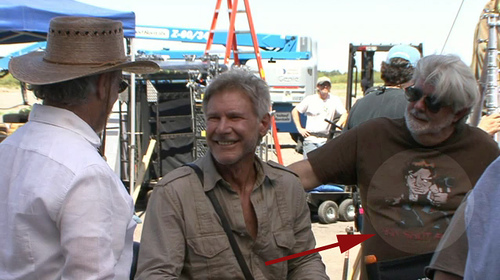
For the record, Han Solo SHOT FIRST and it will be up to the next generation to make sure everyone remembers it so that all the great heroes of the future can “Live Long and Prosper.” (Star Trek)  George Lucas in the quiet of his home I think would agree, and it will take filmmakers like those producing the modern Atlas Shrugged films to help make a Hollywood who will defend Han Solo along with all the men and women like him, and not try to re-write history to fit the agenda of modern politics.  Even the best and brightest sometimes lose their way when the wonder they gained from reading a book like Atlas Shrugged in their youth gets pounded out of them in the realities of life.  As Lucas has said, sometimes while trying to tell the story of Luke Skywalker you can become Darth Vader lost in the blind devotion to a system not of your own making.   And this is what happens to many good people who find through years of philanthropy that they lose the Han Solo in them and become Darth Vader, or even the naive Luke Skywalker–fighting for a sacrifice to something other than themselves.  It is in those dark moments of “maturity” that these poor souls need Han Solo to save them from the crushing weight of service to a system that is brainless collectivism paving a way to hell with a brick road each marked with a good intention.  It is in those moments when the question must be asked……………………….”WHO IS JOHN GALT.”

To go down the rabbit hole even further CLICK HERE:

 Rich Hoffman

I appreciate the support my readers here provide me with by clicking on the pictures below to enter the doors to even more adventure.  The support is providing the tools needed to expand life in ways that will ultimately create the means to boundless imagination.  For a sample of such projects, click here and witness one of my ever reaching projects.