As I was doing research for my novel Tail of the Dragon I was shocked to learn that a major public relations firm that was heavily utilized in New York City had been owned by a British organization. Since the dangers of public relations are one of the themes in my novel, I wrote about it in the context of the story, but in the process, my editors had removed the direct references during subsequent revisions of the draft. For obvious reasons, my publishing company did not want to anger a public relations firm that is so instrumental in shaping the way Americans view the world around them, which I can’t blame. But during the process, I learned first-hand how media is censored quietly with implied threats instead of direct ones, and how truths are suppressed while fluffy dialogue is used to propagate complete falsehoods. Such is the true story of treachery that is centered on the very real issue of amnesty for current illegal immigrants in The United States. There are many wealthy forces in the world who have spent a lot of money on public relations promotion to advocate why it is important for America to give illegal immigrants a fighting chance at freedom, as those same forces do everything they can to undermine American freedom by replacing the Constitution with a new document created by The United Nations. These powerful forces support a borderless world where no country is any better than another, as all nations on the face of planet earth would be equal in every way that equality is measured. What those forces do not say is that their method of government would be socialism/communism and that rich nations like America would be made to be poor nations like Uganda, and that the immigration policy they advocate is designed strategically to overwhelm America to the point that it is suffering from the same problem as the rest of the world which is described in the following video. Watch closely:
Those globalist oriented European elite, who have seduced the wealthy of The United States with a kind of country club desire to be among their own kind, have mistakenly designated themselves as the equalizers of justice, in bringing to the world such equality as displayed in the video above. Their failure is one of philosophy as they deeply wish to hold down the human race by maintaining their grip on power. This is why these capitalists who made their wealth with free enterprise advocate government that is socialist in nature. They want their country club to remain intact with people they understand, and wish to exclude competition to their accepted order. However, it is their policy of socialism that has given all those indicated nations such abysmal poverty and living conditions not much better than a common insect. So to purify their crime, but still maintain their elite status, they hope to destroy America so that no place on earth can stand against their socialist supported governments.
If you’ve ever witnessed a group of politicians meeting one another in a private setting, the ass-kissing and back slapping that permeates is ridiculous. But at the core of the strange ritualistic behavior is the deepest, darkest desire of the human mind—an infantile desire to be accepted by one’s peers. This is how evil is conducted in politics, and this is how a handful of wealthy donors can control the political process from top to bottom. When a politician takes money from a donor, they are like a common whore who sells their body and mind to the donor, and forgo their private action in exchange. In this way Barack Obama is no better than a common whore on K-Street and neither is John Boehner. In countries where socialism functions fully, it is unmistakable that the poverty level of all those countries is the ones that are the most governmentally restrictive.
In capitalist countries the poor are even rich by the standards of the Ugandas, or the Chinas. The poor in capitalist countries are poor because of their failure to participate in capitalism. They are poor because they allow socialism into their lives. Socialism and political systems rooted in any form of collectivism produces financially poor people. Countries that embrace capitalism are much wealthier; in fact the degree to which they are rich depends on the level of capitalism present in their society. More capitalism, the wealthier the social culture. Less capitalism the, the poorer.
But the advocates of amnesty in America–the wealthy donors who contribute fortunes of their money to political candidates too stupid to know any better believing they will gain votes from illegal immigrants if they provide amnesty, support socialism among governments so to maintain their exclusivity to wealth. They do feel bad that their method of government creates poor people, so they rationalize their sin by making such a condition “equal” across the world. They hope that God in whatever form they worship will see their actions as noble, buying their way into the heaven of their choice with global sacrifice. They spend vast fortunes on public relation firms convincing Americans that illegal immigration, amnesty, and socialism are good for them. For an example of how this is done, investigate the review of the recent Superman movie Man of Steel from the Empire Online.
“There is dramatic tension to be wrung from this: not only is he (Superman) an illegal immigrant, he’s a man-sized weapon of mass destruction. Of course the US government will distrust him.”
Notice how the immigration issue ended up in a movie review for a summer blockbuster? You can read the whole review at the link below:
The immigration issue is placed on the mind of virtually everyone with such methods, especially newspaper reviewers and other progressive think-tanks with their hand in the entertainment industry. The thoughts were placed there by public relations professionals who received the thoughts from clients–the wealthy radicals who want global socialism. This is how amnesty appears to politicians as a good thing when in fact it is a Trojan Horse for global socialism advocated by a wealthy elite terrified of competition from their betters.
People have been battered into apathy though constant public relations with a monotonous insistence on insane propositions – that a valuable country like America should have an open border, and that anybody who wishes could enter the country and sign up for its entitlement programs. Those same public relation firms paid for by the same wealthy elitists also wish the world to believe that entitlement programs can be supplied to an infinite amount of people for an infinite amount of time—which of course is false. What the public relation firms never ask, or seek is the real meaning behind the message—global collapse of capitalism so that socialism, misery, and a world of equally poor inhabitants can permeate the modern age removing competitors from the international market using government to preserve financial empires while at the same time appealing to God almighty in bringing equality to an impoverished world they created through a philosophy of sacrifice. Impoverished citizens make wonderful subjects willing to kneel before the gods of religion and politics—or so such evil is always justified.
The solution to the world’s problems would not be to destroy America so that the poor will have brothers and sisters to share their misery on the North American continent, but to spread the message of America to those countries so that they too could have wealth, by giving them the joy of capitalism. If the do-gooders of the world really wanted to rid the world of poverty, they would expand capitalism and abandon socialism. Upon such an action by the governments of the current impoverished nations, whose citizens make less than $2 dollars a day, poverty would be defeated if capitalism was practiced, instead of tyrannical control and micromanaging of their citizens. Instead public relations firms—because they are paid like whores to do so—are advocates for more poverty, more control by the wealthy elite shielding them from unwanted competition, and the attack of the only free country on earth which happens to be the premier destination of all who hope to have a life of some worth. The public relations companies are paid to convince Americans to give up their worth so that it will cease to be a destination of desire. And part of that removal of worth is by taking away the value of border control, so that no such borders exist leaving value to be determined by chaos.
It may now be obvious why the reference to public relation firms in my novel were removed during the editing process. I was able to accomplish the same thing without naming the names once the final draft went to print. But a window to how the process worked at many different levels was available to me. Knowing that much, it is easy to conclude then what is behind the amnesty for current illegal immigrants. The action is not one of justice, fairness, or even hope that such people will become productive voters within the American system. The goal is collapse of America by those who hate the country and pay homage to their European ancestors of the past who tried to destroy the freest nation on earth with guns, tanks, and politics. Instead, the new attackers of America are using bankruptcy backed by political socialism to destroy their greatest competition on the world stage with a secret desire to keep everyone dirt poor, and hopeless so that the destitute masses will chastise themselves to sacrifice themselves to their wealthy masters.
The other morning over breakfast my wife and I had a raging debate of mankind’s need and desire to behold simple “concepts,” as philosophy defines them. It is because of concepts that I occasionally detour away from the normally serious matter at this site and dwell in great detail about the nature of Hollywood movies and published books. In my private life I have two basic loves which drive me, a love of philosophy and the mythologies of thought which attempt to frame them to the human world through “concepts.” Most everything else I care about in life drips off the leaves of knowledge from those basic forms of art esthetically. The reason for the raging debate over breakfast with my wife was over the value of concepts in people’s lives versus a given morality. My wife values morality among mankind as the highest honor, even over the air she breaths. If she had to choose between morality and taking another breath, she would choose morality. However, my side of the debate declared that the ability to behold a “concept” of morality is far more important, because without having the ability to grapple with conceptual ideas, morality falters in both human beings and animals 100% of the time. I explained to her that the ability to understand concepts was like getting popcorn into a bowl that has been popped in a kitchen. If a person’s mind is small, they have a small bowl from which they can place popcorn in from which to consume. If a person’s mind is large they can hold a lot more popcorn. In my metaphor I was of course transposing popcorn with ideas, or in this case “concepts” in order to explain why mankind is so sick these days. We spend the first five years of our lives being given gigantic “concepts” from our parents, grandparents, friends, and extended family through the toys we play with and ideas they give us. We are given from birth extremely large bowls which hold a lot of metaphorical popcorn so that concepts can be formed in our minds allowing us to walk, speak, and develop ranges of physical movement. But from every year after our first kindergarten class in public school, we find that our bowls get smaller and by age 10 to age 15 our ability to hold thinking concepts diminishes greatly so that by the time we are grown adults, instead of holding a bowl of popcorn with most of what could possibly be popped in the kitchen, we are lucky to get a few small kernels into our 35-year-old brains. I view human mythology as a way of expanding our metaphorical bowls so that our minds can hold more philosophy about the way life should be lived, and today in all of human history it is the movies produced from Hollywood which are the strongest creators of modern mythology, which makes them of great interest to me. This basic preamble is needed before I say that I understand why so many critics stated that they did not enjoy the new movie which I have been raving about—Man of Steel. They did not like the movie because they are suffering from conceptual handicaps given to them by their crumbling society, of which the most recent rendition of Superman clearly was conceptually articulating. So I will provide you dear reader with a conceptual handicap free review so that you can understand why a slight tear was running down your face at the end of the movie, and why you thought about standing up and clapping at the end while others actually did with a ruckus ovation.
I have spoken before about how important the concept of Superman is to my family in a previous article. CLICK HERE TO REVIEW. Before seeing the film, we went to Newport on the Levee to view the new Man of Steel film by Zach Snyder and one of my favorite modern film producers, Christopher Nolan and have dinner at Claddah’s Irish Pub. My daughter, son-in-law, and wife wanted to make a big event out of this film with me so we went to that particular theater and dining location to place the experience in proper perspective. The AMC theaters at Newport are built three stories above the mall below, and are unique in their design. Going up the escalator to arrive in the lobby is literally like arriving in some heavenly plateau which is appropriate for a modern viewing of Superman, especially for my family. The reasons I love Ayn Rand’s characters in The Fountainhead and Atlas Shrugged are because her characters created during the same era as Superman are about the same elevated sense of mankind’s potential. For Ayn Rand, Superman is in all men who have a thinking mind. Yet for the character of Superman created by writer Jerry Siegel and artist Joe Shuster, high school students living in Cleveland, Ohio, in 1933 their large concept ultimate man had extraordinary powers given to him from the sun’s energy on earth. But all these creations of the mind were a direct answer to the communism being imported into the United States by progressives during the roaring twenties and early thirties. It was a time when President Calvin Coolidge was going door to door running for office with a miniature chalk board trying to educate voters on the perils of socialism. Superheroes were born in literature as a way to protect the concept of Americanism against the anti-concept of European communism. Young Jerry Siegel and Joe Shuster created Superman to define what living life in America was all about creating a symbol that allowed the concept of Americanism to be defined in a single character named Kal-El from the planet Krypton.
To understand what this 2013 version of Superman is all about, let me explain how the film ends without giving away any particular spoilers. Superman smashes out of the sky a drone aircraft which is attempting to spy on him and proceeds to lecture the U.S. military of his need for privacy even though he understands the military is afraid of all his vast powers. Superman continues to make clear that nothing the military can do will hurt him anyway, so the effort is useless. The military then asks Kal-El, how they can know Superman won’t use his superior powers against the American people. Superman explains with a smile, “I grew up in Kansas and am as American as there is; you’re just going to have to trust me.” This is almost the last scene of the film. Superman was metaphorically speaking on behalf of all Americans to their modern government which is currently plagued by scandals such as the IRS, Benghazi, and spygates against the American people. Superman represented in mythic form the power of every individual American who may not be able to leap about like Superman, or shoot lasers from their eyes, but hold the potential to be super in their own way which Ayn Rand would get more specific about in her own overmen exploits of literary endeavor. The message at the end of Man of Steel is that Superman wanted to be left alone to live as an American and that if he wanted to he’d crush anybody who stood in his way of achieving that goal. He chose to value the people of earth for the hope he had for them which was something that was lost to his dying planet of Krypton.
Russell Crow who played Kal-El’s father in Man of Steel was very good in his role of explaining how Krypton became doomed in the first place. The highly technological society of the Kryptonians had enjoyed a period of great expansion in their culture where they planted seed societies throughout known space. But as time moved on, their society had become more politically corrupt leaving them to pursue short-sighted goals like stripping out their own planet’s core for power, instead of harnessing the power from neighboring star systems, as they had in the past. The Krypton metaphor was clearly in reference to our own times where space travel has been cut away to virtually nothing in America as left-leaning politicians squabble in endless debate with political apathy serving as the centerpiece of their action. On Krypton, as many are attempting to suggest here on earth, they devolved from a flourishing society that embraced personal freedom and enterprise to one that micro managed the smallest detail of their lives including the birth of children which had been taken over by a technology called the Codex. Jor-El and his wife gave birth to the first free-born child in centuries on Krypton. That child was Kal-El–Superman, a free-born creation of two loving parents. Knowing that Krypton was imploding on itself, even as the political class squabbled in denial of the impending doom Jor-El sent his child to earth to allow the best of what Krypton was to live on elsewhere. All this while General Zod was staging a rebellion to turn Krypton back into a society under his managed care. In Man of Steel, Zod is a collectivist born under the dystopian care of the Codex, not having natural parents, but instead being raised to and for the collective Krypton society. (I knew Christopher Nolan would not let me down.) I was very concerned about how Krypton’s demise would be handled in the film, and it is very appropriate to the direction our current society is devolving. Man of Steel just in this regard is conceptually brilliant……….but that’s not all.
Even Kal-El’s adoptive parents were heroic as Jonathan Kent died in the Man of Steel defying a tornado’s wrath. He ran into the blistering storm as it consumed cars and entire homes to save a few more people only to get caught because he broke his ankle and couldn’t run away fast enough……..but he saved Kal El’s dog! That is a great dad! The good guys in the film were all heroic in their own way. Ultimately the pinnacle decision of the film was Kal-El having to decide whether the society of Krypton deserved to be resurrected on earth through the Codex killing all of humanity, or should the people who live on the planet be given the opportunity to have hope for their own future. Superman ultimately decided that Krypton had its chance, and it screwed it up. The people of earth had a real chance to get it right, and Superman had made a decision to lead them to the light under his guidance. Superman made a value judgment between the two societies, Krypton had taken a noticeably collectivist route and destroyed itself, and earth was headed in the same direction, but could still change course.
On the way home from the movie my family was philosophizing about the very idea of Superman, a man who was invincible and could be harmed by nothing on earth. For many this is a boring idea because the wish is to see conflict in their heroes brought about by fear and weakness. But that is not what Superman is all about. Superman could decide to rule the earth if he wanted as there would be nobody to stop him, but he doesn’t, because he is a good man who chooses to spend his time helping humanity instead of acting as a parasite off of it to feed his own ego. What Kal-El gained from his adoptive parents was a sense of knowing the difference between right and wrong which would be the key to allowing the grown-up Superman to use his powers for good, instead of evil. General Zod, with all his good intentions openly declared at the end of the film that his sole purpose in life was to serve the greater good of Krypton by any means necessary. He was speaking as a product of the collective and might as well have been a Russian revolutionary from 1917 marching around Petrograd destroying any life that stood in the way of communism, as the greater good of mother Russia was more important than the whims of any individual who might think they were serving good as it is defined by anybody. As I was explaining all this to my family a drunk driver nearly ran into the side of our minivan. I reacted as I have hundreds and hundreds of times over the years, with quick aversion out of harm’s way. It happened so quick that I barely paused in my sentence structure and after the danger was averted, I proceeded with the explanation of my metaphor without pause. Such situations are only dangerous if the mind surrenders itself to panic, and I don’t. After years of training myself, there is little that worries me. And it is this kind of attitude that Kal-El maintained throughout the Man of Steel once he had become comfortable in his role as Superman, savior of the planet earth from falling to a similar fate as his home planet Krypton. All men and women come to such a place in their own minds once the concept of goodness is understood by them. But first they must have a bowl big enough to hold the concept of such goodness and behold the definitions of evil in the same container. Once there, the mind can eliminate danger from its life-like avoiding a drunk driver by simply taking evasive action without any fanfare. Panicky social commentary asking politicians for more public safety never works. The truth is politicians are actually quite powerless to provide any safety without stealing from some to give to others in legalized theft. All they can really do is react as a second-hander and write new laws which bring our present society that much closer to the fictional fate of Krypton.
At the conclusion of Man of Steel my family sat till the end of the credits as viewers gradually left the theater. We were the last to leave. Several young men who might look like gang-like thugs in any other circumstance from the streets of Cincinnati were wearing the Superman emblem on their shirts and had obviously given up for the evening any youthful decadence they might otherwise engage in to see a story of “hope” unfold upon the silver screen. A young man covered in tattoos and body piercings saw me smiling at his big “S” imprinted across his shirt as he left the theater to descend the escalator back down into the shopping complex of Newport on the Levee. His first reaction was a bit of anxiety as he thought I was laughing at his immature love of Superman. But I gave him a reassuring wink as he walked by to let the young man know that I understood. He was attempting to behold a higher concept of what “man” should be, and I didn’t want him for a moment to think I didn’t approve. He smiled boyishly as he walked by, realizing that my gaze at him was not condescending, but quite the opposite.
Small-minded reviewers after they saw the movie found that without large concepts in their own imaginations to allow them to behold the messages of the film they were regulated to commenting on the physical appearance of Henry Cavell, the young man who played Kal-El or criticizing the 40 minute climax which took place in an epic battle all over the globe ending in a fist fight between Superman and Zod which migrated into space at times where even satellites fell from the sky in destruction. Critics spoke about the metaphors of 9/11 as half of the city of Metropolis was destroyed in the gigantic battle leaving a crater of cleared buildings in the center where the two earthly gods did battle in the climatic ending with Superman snapping the neck of Zod. When Kal-El broke the neck of the villain there was emotion in the audience. It was 1 AM in the morning, and the audience was filled back to the projection booth. One man yelled out from the crowd………….”damn!” Others clapped. Some whistled. It was not a critical appraisal, but one of approval from the audience, of seeing a battle between right and wrong, good and evil displayed clearly in front of them, resolving itself with the clear decision of a nearly decapitated villain.
Man of Steel is about “big concepts” and it assists the viewer in grasping those ideas which require large conceptual bowls to hold. It is why in spite of the attempts by established Ellsworth Toohey type film critics taught in their institutions of learning to have small concepts in their lives, not large ones; Man of Steel will become the next $1 billion dollar film franchise. Shortly after the drunk driver nearly hit us on the way home, and I dropped my kids off at their house, I thought of the export potential of this film. Man of Steel is about undeniably American ideas and it didn’t waiver from that responsibility for even a moment. Superman didn’t say he stood for “truth, justice, and the American way,” at the end of the movie, he simply said…………..”I’m an American.” What a wonderful thing for kids throughout the world to see whether they are in London, or Delhi. The best vehicle for projecting American ideas to the world is the film industry of Hollywood, which has traditionally been consumed by left leaning communist ideologues, like what’s represented in the upcoming Matt Damon film Elsyium. Most movies that Hollywood produces like Elsyium or the 2012 fall attempt with Tom Hanks called Cloud Atlas are not so subtle attempts to sell socialism to America and the world. But the box office take usually tells the story as fans reject the message. They will go see the movies for entertainment, but quickly drop them, as word of mouth does not spread like wild-fire, the way it does during the very capitalist movie messages like Iron Man, and now Man of Steel, which is going to break records during its opening weekend. The film made $21 million just off Thursday midnight shows, and $50 million on Friday alone.
Man of Steel is a fantastic film. It is worth watching many more times than once. It is a pleasure to live in a culture that can produce films like Man of Steel where the story telling is first class, the visual effects epic, the music astonishing, but most importantly, the concept is huge. The value of Man of Steel is in its ability to generate a concept that is epic in scope and definitive in its message. There is no question where the message of Man of Steel intends to go, and it is in no way complimentary to evil, weakness, or even blind dedication to a race of people just because they represent one’s ancestors. It is more valuable as an American export than all the money that is currently spent on defense because the message is clear, and void of politics from any party. Man of Steel is film making at its best and the message to everyone in the world with a mind to think is one of goodness! It is a big bowl of philosophy that will take multiple viewings for those functioning with small bowls of conceptual thinking and will require expanding enough to behold the real message of Superman, which is certainly one of hope. A hope that earth will find its way and not fail the way Krypton did, leaving that society to live on in the rebellion of an innovative young couple who decided to go against their entire society and have a natural child who would have to flee their planet and live again as the shining beacon of truth, justice, and the American way for not just on a continent in North America, but the entire world which desperately needs the message of Man of Steel.
One particular scene in Man of Steel defines the entire film. It’s a scene when young Kal-El is being picked on by a group of bullies who are around 10 years old. The little Superman is reading a book, called Plato’s Republic. It wasn’t Tom Sawyer, or the Diary of Anne Frank. It was a work of philosophy that the budding superhero was reading, and a message to all viewers was that Man of Steel is not just an action movie, it’s a work of conceptual philosophy designed to give mankind the tools it needs to save itself. All society needs to do is listen to the message and allow their minds to conceptually hold the memorandum of goodness which is represented immaculately by Superman: Man of Steel.
As I was working in the garage trying to fix a broken pool pump, I was listening to some sports radio commentary. I have been listening to The Blaze Radio continuously of late, but decided to turn on the old AM radio to see what was going on in the world of local sports when I heard the commentator state about a former star player’s fall from grace that, “he thought he was bigger than the team.” Upon hearing this I tossed my wrench aside and turned up the radio and the commentator said it again, “the player fell from grace because he thought he was bigger than ‘the team.’” I turned off the radio and turned The Blaze back on as I heard the words of Buck Sexton come over the airwaves talking about things that actually matter.
One of the largest misunderstandings that modern society has is this ridiculous notion that a “team” is greater than any individual, and that individuals should “sacrifice” themselves for the good of it. This is the menace that is being taught by high school sports all across the county, and the belief is re-enforced by idiots, beer drinkers, and drunk scallywags everywhere who contemplate why some sports teams are better than others between belches and greasy chicken wings. Knowing a thing or two about the management of people, I can report that the best way to get a team to do what a couch or manager wishes to accomplish is to get a group of individuals to aim their focus in the direction the leader establishes. But to do this, a leader must not crush the individuality of the “team members.” The leader must know that the individual attributes are much more important to the “team” than the collective sacrifice of a player to a cause “bigger than themselves.” Such an idea of sacrifice is hogwash.
In sports, all individuals are bigger than the team concept, for if any individual fails, the team will be weaker. All individuals must do their jobs to their highest ability, and as independently from one another as possible. For a team to be good, it needs a group of strong individuals who all do their jobs uniquely well to succeed, and the self-assurance to understand that they are the best at what they do, and not worried about being replaced by another because they are so good at their job.
In the case of the radio commentator, the star player in question had become a show-boater and was eventually ejected out of professional sports. But he was not ejected for being a show-boater, but because it was realized too late, that he was playing above his actual skill level. The player used his show-boating ability to cover his incompetence, which was eventually exposed. The way this lack of skill went undetected is that the management of the “team” this player played for was unable to evaluate individual attributes as their focus was on “the team.” This show-boating player uplifted the entire team with his antics, which made the coaching staff believe falsely that their team was better than it really was, because they assimilated the value of the show-boating in the same way that the player used to hide his incompetency. This failure was the fault of the “team concept.”
When some idiot says that there is no “I” in team, they are speaking of their vast ignorance on the matter. When a radio commentator says foolishly that “no player is bigger than the team,” they are speaking with a mind that is greatly deficient. All players are more important than a “team.” A team is only great if the individuals on it are superior to other individual players. A team is just a collection of individual wills and nothing more. A leader’s job is to direct those wills toward a tactical goal they set without crushing the individualism of the participants.
The lazy leader attempts to crush the individual will of each player to consider the self-sacrifice of the collective unit. The fool will allow the personal identities of individuals to be destroyed through hazing rituals, and other group assimilation hoping that by putting the “team concept” above individual ego, that success will follow…………….but it never does. Many sports players when they give interviews repeat blindly the whole team first concept, but if they are great players, they have never accepted it. They have learned to simply utter the lie to the press so to create good public relations for their teams, but they know that it is the extra hours they practice beyond the “team practice,” the extra work they do as individuals to become better than their competition that makes the difference between success and failure.
Team sports are never about the “team” but the individuals who make up the team. The leader’s job on teams is to align individual behavior with the team needs, but never to crush individual contribution as a kind of sacrifice for the collective whole. Such an idea is completely foolish which is why it shocked me to hear a sports commentator speak such an idea so openly. A lot of people say such things mindlessly because they have been taught incorrectly to think in such ways, but they are wrong. And for a sports commentator who spends their entire life thinking about sports, it would be assumed that they’d understand such an elementary concept. But this particular commentator was quite serious when he stated the error of a star player believing that they were “greater than the team.” Individuals are ALWAYS greater than a team. ALWAYS!
As I heard the statement I thought of all the dads all across the country who were also in their garages working on something similar who heard the same thing I did and thought……….yeah………he’s right. They tell their kids who play for some high school sports team the same thing, and the coaches of those teams also utter the same nonsense—then they are all confused why their teams are always mediocre. It is because their philosophy on the matter is wrong. Their understanding of the values needed to be a winner is incorrect, and they are teaching the young student athlete to grow up not to be successful contributors to all the future teams they will play on from sports to business, but only mediocre sacrificial lambs ready to throw themselves upon whatever alter the foolish coach tells them to. That same student athlete will then grow up to be mediocre, to raise mediocre children, live a mediocre life with vacations that are mediocre at best. They’ll cheat on their spouses with mediocre replacements and have mediocre friendships that are as deep as a dry river bed in a scorching desert and they’ll wonder why they are failures at life. It will be because they allowed in their mind the ridiculous, preposterous, nonsensical notion that no individual is greater than the “team” when the truth of the matter is the exact opposite.
Many of the failures experienced in modern society are the improper understanding of how to create a proper epistemology for the philosophy of their lives. By epistemology it is meant to know what sort of things we can know and how we know it. Most people these days are so uncertain of themselves, lacking self-confidence that they are unable to properly think and this is due to the notion that they have been taught by their public education institutions that nobody can know anything unless a professional tells them first what to think and how to think it. This is why government schools are so terrible for our present society. It is because they are providing generations of people an epistemology that is wrong, deliberately not teaching people how to think, but instead regulating their thought to “professionals” who can provide those epistemologies for the masses as centralized leaders of collective sacrifice.
This is a big problem. Human beings in the year of 2013 seek with mind numbing tenacity to continue a destructive practice of mental evasion. For instance, when it is asked what a particular person is going to do over the weekend, and the person responds, “I’m going to get ‘shit-faced’ drunk,” the person is really saying that not thinking is more preferred over a “thinking” exercise. They wish to get drunk so that they can escape the process of thought. This mentality was given to them by public education laying a foundation of philosophic epistemology that dictates surrendering thought to government employees who know better. The conflict in the individual who wishes to get drunk comes from the persistent thoughts which come to their mind telling them that the world is different from the one they are living. So for them, to get “drunk” so that they can be eased of the burden of thinking it is a vacation from their conflict which is highly desired.
Identifying this failure in epistemology can than explain why so many teenagers drink so heavily as part of their assimilation to the adult population. It is expected that young people will between the ages of 15 to 22 drink themselves into mindless bliss, and this is a direct result of the public education system providing a philosophic epistemology that states thinking should be done by “the experts” and not individual citizens. The result is that culturally, society must develop a method to turn off their minds to escape thought—because their minds tell them that what they are learning is wrong. So drunkenness is their only escape.
Public schools do not preach drunkenness, but it is the result of their failed epistemology which creates the problem in the same way that public schools do not preach sexual deviance, but it is the direct result of their teaching as the epistemology is created by a curriculum designed to place no responsibility on individual behavior. Such a system was designed by statist governments to advance programs for the working poor, welfare recipients, and down-trodden who are secretly desired to remain in such a state forever, for the benefit of the state. In a state-run school, a public education curriculum cannot make the people it wishes to target for state supplied services feel bad for their bad decisions in life, so the goal of school curriculums is to make all right thinking people think like the bad ones and preach that sex has no consequences, and is not the responsibility of the participants. The epistemology that is taught is a kind of Kantian remoteness, which sex just happens biologically without the thinking participants having any say. The epistemology that is given to the students in public school then has the unintended consequences of sexual promiscuity that lasts their entire lives. The teachers did not teach children to have reckless sex in their teenage years, but were socially unable to condemn the behavior that is conducted routinely in poor communities so that food stamp qualifications can be enhanced. So the teachers instruct an epistemology that destroys the lives of all students in every community because their instruction does not teach that personal responsibility is the key to life success, planned families, and a healthy existence.
A proper epistemology is the key to living a successful life and if the education system creates an improper philosophy, then failure is imminent. Government workers, political theorist–particularly those who wish to believe that communism is viable to the human mind, believe that any kind of politics can work so long as a society believes something. This is simply not true. That “something” must be good, and goodness is determined by a proper epistemology. If the epistemology is bad, then the philosophy of a person and thus the society will also be bad. There is no way to avoid the catastrophe of a bad epistemology. In this way, public education institutions are bad for the human race not because their intentions are not good—they often are, but the epistemology of what they teach is terribly insufficient which makes them detriments to the human condition. Methods of philosophy cannot be changed in and out of a person’s life like socks on the feet of a human being each morning before they are placed in one’s shoes. A personal philosophy is the most important part of anyone’s life, for if one does not believe in anything, they will fall for everything. But due to the catastrophe of a thinking mind being in drastic contrast to the types of epistemology that have been taught to it by institutions of modern learning, drunkenness is pursued to escape from the duality of the thinking mind being required to not think in order to survive the political stresses of the day which inform the world of an epistemology that is faulty.
When one considers what makes a person become an alcoholic, or a drug abuser this duality is always at the core. A weak mind is the first step to not surviving the duality of an improper epistemology that is in conflict with one the thinking mind wishes to live by. The weaker the mind, the easier it is to surrender mental evasion to alcoholism and other forms of intoxication. This is the product of our modern institutions and why many consider drunkenness to be a vacation worthy of pursuit in their leisure time, because they wish to be free of the epistemological conflict given to them by a society which seeks to impose on the mind a system of thought that is not productive to individual welfare.
Solving the problem of individual epistemology is the key to solving many of the social ills our society currently suffers from. Identifying a proper epistemology is the first step to solving all social problems. Problems do not happen to people’s lives like some mystical voodoo card of chance happening. Everything starts from a source and like simple addition and subtraction, one thought leads to another, then another. If a person has a bad life, if they are poor, if they are jobless, if they are alcoholics, drug abusers, bad parents, bad people, the failure comes from their poor epistemology. The fault is theirs for not living their lives with values that their minds agree with. Surrendering their thoughts to others who create their epistemology for them will not improve their life. “Getting drunk” will only exasperate the situation further and cause failures in life instead of giving the relief a mind in conflict with itself has from an epistemology that is imposed upon it from sources that are not from one’s own mind. Until individual people realize that the source of their failures are their trend to not take responsibility for their own thoughts, then misery will continue to riddle their life with duality. No individual can make the society happy with their collective desire, and yet make themselves happy. When the decision to make society happy supersedes the individual then a crushed, suppressed and miserable life ensues. And to date, it is public schools that most create the epistemology of the greatest number of people, and for that, they are in drastic fault.
Your only choice is whether you define your philosophy by a conscious, rational, disciplined process of thought and scrupulously logical deliberation—or let your subconscious accumulate a junk heap of unwarranted conclusions, false generalizations, undefined contradictions, undigested slogans, unidentified wishes, doubts and fears, thrown together by chance, but integrated by your subconscious into a kind of mongrel philosophy and fused into a single, solid weight: self-doubt, like a ball and chain in the place where your mind’s wings should have grown.
Ayn Rand — Speech to the United States Military Academy at West Point on March 6th 1974.
That was the first thought I had upon closing the book to Gavin Menzies masterpiece, 1421: The Year China Discovered the World or more specifically, discovered America. I had put the Menzies book on my “to read” list a long time ago, and recently found a window to give it the kind of attention I wanted. The birth of the desire to read Menzies book was sent my way when a strategy game my family enjoyed playing released a very rare constructible 10-Masted Jade Rebellion Treasure Ship called the Baochuan with Admiral Zheng He as the crew. The game was called Pirates: The Constructible Strategy Game. The objective was to buy cards at a local Wal-Mart or Target in the gaming section, take them home and build the ships that were in the packs of cards, then use those ships to wage war on other gamers by turning every kitchen table available into a roaring sea of treasure hunting, naval warfare, and epic drama, CLICK HERE TO REVIEW. My wife presented me with the valuable ship as a father’s day present in 2006 and to this day it is one of my most treasured possessions, as it can be seen from the picture below. The gift was more than a miniature card cut-out that gave me a dramatically tactical advantage in that game, but it was the first exposure I had ever had to the gigantic treasure fleets of Zheng He constructed by 3rd Emperor of the Ming Dynasty Zhu Di. The gigantic ships were over 400 feet long, half the size of the Titanic and were able to cross the oceans with sustainable living conditions which were absolutely unheard of with any sea fairing fleet anywhere in the world at that time. The treasure ship my wife gave me as a simple game piece placed upon my mind countless answers to questions I had been trying to piece together my entire life, so the gift was magnificent not for the material value, but for the adventure it carried my mind on as the wings of my imagination grew even larger than they had been previously.
The Wiz Kids gaming company had read Menzies book, and incorporated his theories into the overall mythology of the popular role-playing pirate game, which went to great lengths to unify sea fairing folklore with actual history. It took me some time to accept the reality of the giant Chinese ships because they made the European counterparts of the Portuguese and Spanish fleets look like child’s toys in comparison. So I did not run out and buy the Menzies book right away as I had a lot on my plate at the time professionally and such a concept of Chinese superiority that Menzies was making, would have long-range ramifications on world history, which would require special time to explore the concept. So for over six years now, I have looked at my model of the Boachuan and wondered about the giant Chinese junks which explored the entire world while all of Europe and the occupants of the Mediterranean Sea were paddling around comparatively in canoes. Finally, after many years, I had a window to read the Menzies book, and I took it.
The results were astonishing. One of the apprehensions I had about Menzies was that most of his statements in the book were based on educated conjecture formulated by his unique life. Once I started reading, the conjecture with which Menzies assembled his theories was no different from the failures of scholarship revealed so wonderfully in the great book Forbidden Archeology or the Leakey theories of mankind’s origin in Africa. Menzies as a retired British submarine lieutenant commander and author had already traveled every corner of the world prior to his multi-year research which went into 1421: The Year China Discovered the World but he did it again as a researcher plotting with great accuracy detailed analysis of the navigation maps which were generated well before Columbus ever set sail from Spain. Reading 1421 was like taking a trip around the world. I feel I know the currents and wind directions of the world’s distant oceans and understand how to navigate ships by the star Polaris. In the book, Menzies takes the reader on a journey at approximately 4 to 6 knots across the entire globe, from China to India, then to the coasts of Africa. The fleet of Zheng He which numbered in the hundreds, if not thousands divided up their efforts and traveled in many different directions from there. Some returned to China, some rounded Africa and moved up into the Atlantic splitting up once again near the Caribbean Sea. Some of the Chinese went on to North America, some went to South America. The fleet in South America split up once again to explore Antarctica traveling back to the East toward Australia. The remainder traveled around the tip of South America then proceeded to Australia to split up once again, some heading back out into the Pacific and circling around by Canada and the west coast of North America interacting with land and indigenous people the entire distance. Back to the journey of the east coast of North America, I learned of the Menzies theory off North Bimini Island which has long-held that the strange remains there are left over from Atlantis. Menzies using the same conjecture that he constructed the entire book with logic, evidence, and a vast knowledge of how life at sea works, provided the best explanation I have ever heard of those strange remains which I contemplate heavily every time I visit Florida and look off to the east across the choppy ocean at the ruins that are a day’s boat ride from our family condo.
Without question, Christopher Columbus did NOT discover America. Rather, he and his brother ripped off maps from the Portuguese government who had acquired charts of the world during trade with the Chinese in Calicut which were made during the Zheng He voyages. The Chinese at the time under Emperor Zhu Di wished to show their world domination of the arts, which at the time had no rival. After the Occident lost its power and influence during the terrible loss of the Library in Alexandria, which I have written about also, then lost Rome to the barbarians soon after, Europe and most of the northern Africa was plunged into the Dark Ages. If not for the Muslims, the works of Greek philosophers might never have seen the light of day again. China did not experience such an intellectual set-back, and instead progressed on only experiencing an invasion by the Mongolians that did not have the same effect as the European Dark Ages. The culture of China was not destroyed in the same way and once the Mongolians were defeated in rebellion, the Ming Dynasty took over and re-instated themselves as the dominate culture in the world. Emperor Zhu Di rebuilt the Great Wall of China, and constructed the Forbidden City. With the same zeal he built the largest fleet of ships ever constructed and the largest ever built prior to that time with only one exception, the tessarakonteres of Greek legend in the second century A.D. In doing so the Emperor nearly bankrupted China of its resources leaving his successors to erase the far-reaching scope of the heart-broken Emperor who lost his favorite concubine in a fire started during a lightning strike igniting the Forbidden City in flame. Upon the Emperor’s death, the records of the great treasure fleets of Zheng He were purged so that the taint of foreign cultures could not rot China as it had during Zhu Di’s reign. The mandarin overseers destroyed all evidence except for a few personal diaries of the mammoth voyages to put the walls up against the world which had shown itself to be backward, and lost to ignorance. This was a period where China would experience to a much less degree the loss of culture that the Occident experienced after the destruction of the Library at Alexandria. This was the great purge of the Orient.
Under Zhu Di, he had wished to show the world how powerful China was by trading with every country his fleets could reach using a tribute system to keep every nation on earth in debt to the glory of China. The Chinese would routinely give fine porcelain to villages along the African coastline and get in return jewelry of sea shells, which were worthless in comparison. But the Chinese didn’t care, because the debt between the values kept the African countries in perpetual obligation to the Emperor. It was this policy that the mandarins later would resent, and cause future Emperors to not duplicate the errors of Zhu Di by draining China of its wealth just to prove its superiority to the barbarian nations of the world who couldn’t even figure out how to use gunpowder.
The key to these wondrous voyages were the massive ships, the extremely large treasure ships half the size of the Titanic. But with those gigantic vessels were hundreds of support ships, most of which would still dwarf any European ship in the early 1400s. Most of the support junks were anywhere from 100 to 300 feet in length. For comparison, the Victoria, which Magellan used to circumnavigate the world was only 70 feet long. The treasure ships provided fresh water in gigantic tanks which actually housed sea lions which were used to herd fish into their nets at sea. The treasure ships held horses which consumed roughly 3 gallons of water each every day along with other animals from all over the world. The Chinese had the ability to desalinate their water while in transit keeping fresh water in plentiful supply. On the decks of the big ships were vast gardens so that fresh vegetables could be constantly grown to provide a balanced diet while months at sea between landfalls. If hostile nations attempted to attack the ships, the treasure fleets easily eradicated their opponents as these ships were the first to have cannons. A confrontation with the treasure fleet would spell doom to anyone who tried to stand in their way. With such ships 50 to 60 foot waves were much more manageable than the typical European vessel that would find themselves tossed about like toys. The key to accepting the voyages of Zheng He who clearly mapped the world while Europe was still in the Dark Ages is in understanding that the Chinese had the ability to build such large ships, which have been denied as an impossibility by traditional scholars. Yet the evidence is apparent, and even though the ships have long decayed, historians who have built vast careers on the myth that Christopher Columbus discovered America, or are willing to grudgingly concede that the Vikings entered North America as a bunch of barbarian hoards raping and pillaging wherever they went, the idea that the Chinese were trading goods and services all over the world well before the Europeans learned to put a sail to the wind on the open sea is not a pleasant one.
The reason I thought of the Ayn Rand quote stated at the beginning of this article after reading 1421 is because the evidence that Menzies provided convinced me beyond a shred of doubt that the Chinese were far superior to Europe during the same time, and had in fact most likely settled North America not just through migration across the Bering Strait tens of thousands of years ago, but were trading with the Mayans, and forming tribes in America that would later be called “Native Americans” such as the Shawnee, the Navajo, and the ancient Cahokians. Modern academia found the Menzies information “inconvenient” and an attack on their world view, so they have rejected him. Of Menzies 2002 release of 1421 historian Robert Finlay said in 2004 that “Unfortunately, this reckless manner of dealing with evidence is typical of 1421, vitiating all its extraordinary claims: the voyages it describes never took place, Chinese information never reached Prince Henry and Columbus, and there is no evidence of the Ming fleets in newly discovered lands.” The comments of Robert Finlay and many other academics that attacked Menzies for his extremely educated conjecture epitomize the quote stated at the start from Ayn Rand illuminating their fragmented minds built upon years of academic denials unable to accept that their own conjectures were incomplete upon their utterances and the new evidence provided by further research destroyed their previous theories. Columbus did not discover America!
Menzies to my mind has accomplished a level of expertise that many of the academic critics of his work are desperately lacking. Gavin Menzies as a British submarine lieutenant commander had a unique perspective shaped by years at sea. Then in his retirement under the finance of his wife, he spent years and years skipping around the globe gathering up evidence, reading maps and charts in a way that only an old submarine commander could, and touched the far corners of the world by following in the footsteps of Zheng He the way a blood hound catches the scent of a target they cannot see or touch but can smell. Academics and political progressives who wish to cover their faulty minds, their junk heap of unwarranted conclusions, false generalizations, undefined contradictions, undigested slogans, unidentified wishes, doubts and fears, thrown together by chance, have no choice but to slander the great work of Menzies from the comfort of their academic offices where the chill of the outside air gives them goose bumps. They are all too willing to abandon logic for belief, and they wish to continue believing that Christopher Columbus discovered America. To admit anything less is to change the way they see European history, and they might have to go to all the trouble of removing Columbus Day from their calendars which usually means a day off for government workers in the United States. Nobody wants to give up a free holiday, so it is much easier to attack Gavin Menzies for a theory that will change the way human history sees itself.
For me the journey started with the little model junk that my wife gave me for Father’s Day, which provided me a new idea taking me to Menzies book six years later. I have seen countless examples of modern academia standing in the way of science and the Menzies case is no different. Academic arguments are not built upon logic, reason, or even a strict adherence to scientific validation. Menzies has provided in his books the exact locations of several ship wrecks that are most likely the junks from Zheng He’s fleet, yet governments operate the waters of these wrecks, and governments work with academics to hold together the acceptable parameters of human thought. There is no desire to dive those wrecks by established science and governments to prove Menzies correct even though the evidence is right under the water and is known to all. Rather, governments and academics would rather drag their feet so to maintain plausible deniability of any truth that is contrary to their continued belief that it was the Europeans who settled North America not ships from half a world away. Menzies developed a rare ability in all his years traveling the world’s oceans and putting into exotic ports even in the most remote portions of the globe–he developed wings for his mind where imagination meets reason to logically conjecture the evidence which has been destroyed to hide truths from a public who are to look to academics and politicians with the grace of royalty. Those wings which the average academic lacks, takes Menzies to places where most historians can’t even dream to go, and upon reading 1421: The Year China Discovered the World the reader of that fine book has no choice but to grow wings of their own and follow on a journey that is epic in scope, and history altering in its implication. It is a book of writing that is the best of the best in every category for which the written word was ever intended to paint a picture with imagination that will change the way those with wings upon their own minds see the world forever. It is an epically brilliant book that is now one of my all-time favorites.
Now, please do watch the above documentaries so that the picture of this book’s importance can be placed in perspective. Then read the book! Out of ten stars, I give 1421: The Year China Discovered the World a perfect TWENTY!
You can get the book from Gavin’s website and follow all the latest discoveries which he continues to unravel each and every day.
Reflecting on the administration’s recently-discovered massive domestic surveillance programs, Rush Limbaugh argued on his radio show that there is a “coup” taking place to subvert the kind of country the United States has always been. Listen for yourself.
Welcome to the party Rush. Many have been right where you are now for a long time. But there is room on the bench for new faces who are just now coming to understand how sinister the Obama administration truly has been all along. Pass along to a friend.
The modern rebellion of the Tea Party against large statist governments was never more illuminated than in the below collection of clips from those liberty groups who testified before congress of their harassment by the IRS. Doc Thompson and his producer Skip LaCombe assembled the clip and played it during their show on Wednesday, June 5th culminating in a full week of aggressive coverage by the Blaze Radio Network regarding the tyranny of the government represented by the IRS in harassing genuinely good people. Unlike other places in the world, this modern rebellion in America is not being conducted by despots for control over the world’s resources—as might normally be the case—but by indisputably good people who are reclaiming their independence as sovereign citizens of The United States. It seems ironic that the rebels of our modern age are family people, church goers, and otherwise responsible citizens as opposed to the villainy of the modern progressive. The clip below captured the spirit of the week centering around IRS testimony in a way that was heard no place else but The Blaze.
The testimony was powerful stuff and gives the world a look into the way average Tea Party supporters think. With all the radical assertions which have been tossed toward the Tea Party with derogatory dialogue—particularly in calling them by the sexual reference as “Tea Baggers” which Obama himself has used on multiple occasions, the voices who gave testimony represent well the multitudes of people I have associated with in Southern Ohio who have lent their time and talent to American liberty. Those who support statist government have made themselves treacherously obvious to their cause because the contrast to the good people of the Tea Party movement is obvious. The only way Tea Party opponents have been able to maintain their moral high ground is to keep the Tea Party out of the news, and now because of the IRS debacle, the world can see what the rebellion in America is really about. The heart of the matter is good against evil, with the good represented by the Tea Party and evil represented by the ever-growing statist government.
The government is evil because “it” insists on imposing itself upon individual will. “It” requires blind submission of all individuals to the adherence of the political elite, and this is just not what America is about, and never has been. Many will point to the debacles which followed the Civil War and more specifically to the progressive events of 1913 where America turned basically into a large federal bank with the creation of the Federal Reserve, and implemented an income tax. Most people have forgotten that it was the work of Karl Marx and associates who advanced their views of communism through the Progressive Party represented so well by Teddy Roosevelt and Woodrow Wilson allowing the philosophy of Marx into the American system of self-government. Since that time, the gradual erosion of liberty has steadily progressed through the entire 20th Century. The way America is today, and has been for several decades is not the way it was intended. The progressive political machine had cast its large sails to capture the global winds of communism and reshape politics in America in a way that is not sustainable or acceptable from even before Roosevelt was president.
When people have asked me what the goal of the Tea Party is, and more specifically, if I want to return America back to the period of the Old West, as I respect immensely traditional American arts, such as gun slinging, bull whip work, and knife throwing, I respond that it is not the period of the Old West that is the goal, it is the period well before that. For myself, I appreciate the values of the traditional Anti-Federalists of which Thomas Jefferson was one of the founding members. I more specifically appreciate the values of the American transcendentalists–people like Ralph Waldo Emerson and Henry David Thoreau. Even though many of their philosophical conclusions were still rooted in mysticism, the path they were on was the correct one for the “American Way.” These ideas were being worked out twenty to thirty years before Karl Marx and his despots of ignorance did their work through American newspapers advocating the philosophy of communism as a superior mode of political thinking over capitalism. Through newspaper journalists and editors, particularly Walter Lippmann who hung out constantly at the Long Island home of Roosevelt after the start of the Progressive Party, they changed the name of communism to progressivism, in order to make the concept more palatable to Americans who loved their freedom, and wanted nothing to do with statist governments. The ploy for the progressives was hatched by the Fabian Socialists of England of which playwright George Bernard Shaw was a respected member along with H.G. Wells. Their theory was that socialism; (soft communism) could be implemented not radically the way it was done in the Soviet Union during 1917, but slowly, over a long period of time. This was the best way to by-pass the American Constitution and deliver The United States back into the fold of European control. After all, as the Fabian Socialists reasoned, if global socialism/communism was the goal, America would have to go down and join in; otherwise it would always be an option for freedom lovers who refused the socialist collectivist aims of statism. For the English, they had tried one hundred years prior during the War of 1812 to retake America as an English colony, but that effort was not successful, so a more indirect—much more patient ploy needed to be implemented—this is how America ended up with progressive politics.
Many in America today have just accepted these little bits of statism provided by gradual socialism inspired by Karl Marx and the failures of collectivist thinking. Over a long period of time, as the Fabian Socialists schemed, Americans gave away bits of their freedom in exchange for “Social Security.” For the progressive who views their century of social gains the Tea Party is a tremendous threat to them, because those kind, innocent Americans of that patriotic group have dedicated themselves to learning how America was supposed to function all along, and know they have been scammed, and they want to undo the progressive advancements and return to the original principles of the Constitution. In that regard, my personal position is that I would argue with Alexander Hamilton who in 1780 was considered a major statist from the Federalist Party with the kind of Anti-Federalist arguments reflected by Thomas Jefferson. The modern Tea Party wants to return to the Constitution that was shaped by Hamilton in the Federalist Papers, which I consider “TOO EXTREME.” Compared to the modern Fabian Socialist, the progressives, the global communists, Alexander Hamilton’s views of government seem radical so the two sides are not reconcilable. Socialists and capitalists cannot live together. One wants to be left alone, the other needs collective participation to survive, so the two are not compatible.
The Tea Party rebellion as it is, are simply nice people who are waking up to the fact that the world they thought they were living is not what they were sold. They are discovering that progressives for their entire lives have gradually ruined the American idea for not only them, but their children, grandchildren and great-grandchildren, and they are not happy about it. They are the sleeping giant of world society that are waking up, and they aren’t going to complacently go along with the scam any longer. This posses a major problem for progressives who have built an entire education system around statist principles, a government fueled by coercion for the benefit of the political class, and a hopeless tomorrow trying to return America back to the fold of European foolishness. The American of tradition—of ideology, have no intention of being serfs, even if they have served such a role unknowingly for many years. Through the Tea Party, they are learning what their rights should always have been, and they are learning more about the laws which founded the country than many of the current politicians holding office know presently.
One of the ways that slave holders in the American South kept free men and women obligated to serfdom were by keeping those poor souls ignorant. For slaves, an act of rebellion was to sneak away from their master’s gaze deep in the heart of night and to do the diabolical act of “reading” so to educate their minds so that they might come to know better than to live under the tyranny of a “master” of any kind. And so it is in our modern age, but the activity is not so secret. Tea Party patriots are getting together as education organizations to read, and intelligently petition a government the way all free people should be able to, and the statist regimes whether they come from big banking corporations, or Fabian Socialists require an ignorant population in order to sell their utopia of hopelessness to the world population. Statist masters cannot stand for the “slaves” to become educated, so they have done all that they could do to stop the process, and harass those who attempt such a rebellious act, such as reading the truth for themselves.
The biggest difference between the rebellion of 2013 and that of 1773 is that the rights were already won once with blood and bullets. Now there are freedom fighters like Doc and Skip on The Blaze Radio Network who are truly doing news reporting that is light years from anything ever done in America. For the first time in American history there are free people who are learning what their rights are because they are “reading” for themselves, and they are listing to Doc Thompson who drives home the point free of FCC regulation spouting out a truth that is equivalent to the escapades of Fredrick Douglass during the most noted revolution against slavery to ever occur in the world. Only in America would such a thing as the Civil War occur over the rights of man, even of another skin color and varied religions. But now that fight has extended to all men and women of all colors and religions who share in common a distinct desire to be exempt from the faulty morality of the diabolical progressive and their statist plans of doom. To arrive at that point, those freedom fighters are reading and learning what they have been missing with a revolution that is taking place not with bullets and bayonets, but books and bold speeches like the ones given against the IRS on Capital Hill captured so well in the summation by Doc Thompson and his crafty producer Skip.
I have always stood ready to defend my freedom from the statist controllers. But joining me now are the moms, wives, and patriots who want a good life for their children and have the courage to go against the progressive plans to achieve it. Instead of tuning in to the local music broadcasts on radio stations, or listening to sports oriented talk radio, they are discovering The Blaze Radio Network who is at the front of the freedom movement and the fuel behind the next steps toward freedom. Glenn Beck has reinvested vast sums of his personal wealth into this endeavor and just this past week hired Laurie Dhue from Fox News to deliver news on their Blaze Television which is now seen on The Dish Network. It is only a matter of time before Glenn Beck’s network, which is dedicated to education, is directly competing with ABC, CBS, NBC, CNN and FOX. When that direct competition occurs, those other stations will discover that they cannot abate, or rationalize the rebellion of the mind which is happening beyond their control.
Americans are reclaiming their lives, and the potent moment which is the modern-day shot heard around the world are the clips from the IRS testimony given by the Tea Party patriots. In that testimony the previously obscured normal people who have been buried under progressive altruism have been given a voice, and they made full use of it. Their words are more powerful than bullets as the intended slave masters who wish to rule the world through various statist schemes require ignorance, in the same manner that southern plantation owners kept slaves unable to read, and always lacking of substance. Ignorance is required to advance statism no matter what the political method of attack, be it socialism, modern-day progressivism, or forceful communism. Before such methods can be employed, one must turn off their mind, and empty everything that it once held. This is why progressives want control of the education process and want children in their institutions of tyranny from the time of their first conscious thoughts. But the momentum has already shifted, and the Tea Party is doing things that nobody previously expected. The Tea Party is “reading” and learning the way the world is supposed to be, and they are acting on their own behalf to free themselves and others from suffering the same fate. It is too late to stop such a thing. Ignorance has been discarded in favor of intelligence, starting with a few Tea Party types who are now small in number, but growing through an evolving rebellion that is not centered on violence, but knowledge.
Thus, now all know why I write so much here upon these pages. I know that most readers browse these articles and quit reading after the first two sentences, and that I would be even more popular if I catered to traditional notions of journalism, by keeping the articles under 400 words and within the average person’s attention span. But a few read the entire 1500 to 2000 word works in their entirety and out of the 500 to 1000 who read every day, about 30 to 40 read every word, sometimes twice, and they come back day after day. Of those, I know several who read every day looking to these words as a lighthouse guiding their way through a thick ocean fog of modern life. Some of those people are very important and influential in modern politics, so the words are not wasted. My goal is to get people thinking so that their minds are prepared to ask questions, and to “seek” ending their chains to statism with thought leading to action. The act of rebellion is not a ruckus act of villainy, or violent attempt at suppression, but the diabolical notion of filling the mind with intelligence, which is the greatest weapon against the tyrant ever devised.
“Flash, I love you, but we only have 14 hours to save the earth!” With that line of dialogue from the 1980 film Flash Gordon I knew what I wanted to be when I grew up. When Dale Arden said those words to Flash Gordon, Flash was battling a rival on a floating circular platform in a bullwhip fight to the death as metal spikes came up out of the floor to puncture the fighters. If the fighters fell off the platform they would fall from the sky for miles to their death. The movie was cheesy, and unrealistic as viewed by my adult eyes, but there is a swagger to it that I love to this day which is exhibited so clearly in the theme song done by the rock band Queen, which can be seen in the music video from that long ago time in a film forgotten to modern ingenuity.
It was Flash Gordon and the old Zorro films from the 40s and 50s Republic serials that captured my interest in learning to use bullwhips. After watching the 1980 version of Flash Gordon at least 10 times at the theater I set up a mock platform in my back yard to learn how to fight with bullwhips on a similar platform so I’d have the skills to save the earth the way Flash Gordon did in that famous movie. I was in the sixth grade at the time and my career choice was made for me after watching that movie. I didn’t want to grow up to be a doctor, a dentist, or a mechanic. I wanted to be a superhero who would save the world with my own two hands and a bull whip.
For three decades now I have played that Queen song from my car stereo and blasted it from my home theater system incessantly. At times I have played the song over and over for hours never growing tired of it—because I always identified with the message. As the rest of our modern world looks to the conspiracies of our day with anxiety, I am excited. I look for the black helicopters to circle the sky, and for the hummers to storm my neighborhood releasing me from the social shackles of order for which we all live day by day. I am eager for the day I can defeat the Ming’s of Merciless tyrants I hated as a youth, and still hate as an adult with more than fiction and metaphors, but with action brought from imagination to grim reality.
In that regard, I can report that I am in a blissful existence. The world is corrupt with evils beyond imagining, and they are obvious. The villains are as obvious as the sun in a cloudless sky at noon in the desert. And those villains require valor to defeat, and souls willing to meet them on the battlefield of life. It is in that spirit that I wait patiently with yearning at the first moves of the real life Ming’s of Merciless to advance their plots in a way that defies the law and provides license for action to extend beyond the realm of thought, to actual existence. I still practice on a type of “disk of death” in my back yard so that the skills are present when they are needed.
Most people supposedly grow up and away from these kinds of thoughts, the hero fantasies young people have of saving the world. Sadly, almost every living, breathing human being in the entire world stops growing physically and mentally by the age of 15. The typical 50-year-old wants the same things that the typical 15-year-old wants food, sex, and social status. Our current society considers this—maturity. But the higher needs and desires come from the youth of a mind uncorrupted by age and cynicism, which has not yet hit puberty and developed a desire for the opposite sex. In this phase, a young mind sees the big picture without interruption. It is during this phase that young people think that saving the world is realistic, and they endeavor to do so all by themselves.
However, once young people start submitting themselves to hazing rituals to belong to a sports team, or surrender themselves to a classroom bully, they start making concessions for which there is no return. Once they’ve kissed the feat of the Ming’s of Merciless’ in their life they turn their attention to their social status, sex and food once they’ve learned their place in the social peaking order. I have always felt sorry for these terribly lost fools. They have lost the magic of youth, the knowledge in their own minds that they are ruled by nobody but their own imaginations. Once they are broken—socially—they stay that way for the rest of their years nearly 100% of the time.
What I always loved about Flash Gordon—especially the cheesy 1980 version of the classic character was that he wasn’t afraid of anything. He also survived everything the bad guys threw at him and had to peel the girls off him with a pry bar. Flash Gordon was fearless, and he never felt he needed to apologize otherwise.
Years ago I worked for a conveyor manufacturer who had a big contract with Amazon.com. I was clearly one of the best assemblers out of the 400 person work force. It was a union shop, but due to a recent strike, they had allowed Right-to-Work provisions. I was one of the first after the agreement to take the job without accepting union representation. Because of my work ethic, I was put on the big sorter job, which was the most complicated conveyor segment this particular company built. They were big and had a lot of moving parts which had to be precisely measured. The very aggressive building hours on those units was 16 hours, which required two 8 hour shifts of a union employee building them at 100% efficiency to complete. However, most of the time, the union employees performed at a 40% to 60% efficiency, so even with two assemblers, the job still took two days. When the shop foramen put me on the job he warned me that if I worked too fast, that it would cause trouble. But he admitted to me that he was putting me on those units to expose the poor performance of the much more experienced assemblers. I gladly went to the cell and set up. Within one week of working on the very technical job, I was building those units every 7.5 hours. Within a month, I had the time down to 6 hours. When I worked double shifts, which was unheard of at this manufacturing facility I could build two per day by myself and have the next unit for set up for first shift construction. This earned me the nick-name, “SUPERMAN.” It’s a name that has traveled with me everywhere I’ve ever worked and people do not mean it in a complementary way. Quite the opposite, they mean it as an insult. The union employees believed that by signaling me out with such a name, I would feel self-conscious and stop trying to “be so good.” So in response to their “insult” I would start my shift every day with the theme song to Superman on my personal boom box sitting on top of my tool box. I put together a mix tape back then, and right after Superman, the Queen song “Flash” would come on to drive my point home. My co-workers would scratch their heads and try to turn up their radios onto classic rock to attempt to drown out my movie classics.
After a while of these music wars, they decided to step up their harassment by threatening to fight me in the break room, bathroom, and parking lot. Different groups of individuals attempted the deed until the whole plant had stacked up massive collective failure. When that didn’t work they tried to rally the whole plant against me with a giant fight in the parking lot imagining that the threat of a mob would put me in my place. But it never did, instead they learned the same lessons that many have had to learn about themselves under such circumstances—that they were cowards in their adult lives discovering that valor had left their lives. Those same adults tell their sons to “grow up,” not out of a desire for their children to have better lives than they had, but to prevent their children from stepping beyond them in social stature. Those adults tell their daughters “don’t hold out for a hero, because there are none.” The truth is not that society lacks heroes anymore, but that the hope is that those heroes will be suppressed so that guilt doesn’t riddle the minds of all the 15-year-olds who have stopped dreaming of honor, and traded in their ambition for social security as 40-year-old slobs whose new idea of success is to save the world by schmooze politically on the golf courses of life.
The plot of Flash Gordon would have been boring if Flash just did what he was told, and kissed the ring of Ming the Merciless. But he didn’t, and that’s why Flash Gordon is such a great and honorable character. The same holds true in real life—it is easy to kiss the rings of those who wish to rule us. But there is also opportunity for honor and adventure when such rings are offered and the ring is spit on instead of kissed. That is why I look at our current world and have a hard time containing my excitement. There are a lot of modern spiked platforms that contain a million perils upon them. The danger is what I yearn for—with the same ambition that a 7 to 8 year-old kid looks upon a fantasy film with wide-eyes declaring that when he grows up, he will also be fearless and heroic. For me the biggest difference between the adult and the child is that the child at such a young age has no choice but to dream and ascertain images which they find attractive, so they can set personal goals to live up to. The adult has to take the responsibility to live those dreams, and to have the bravery to stand on their own ideals even if the world or universe stands against them. It is in such moments that I hear the theme song to Flash Gordon, from Queen, and relish that I have fought on many dangerous platforms and heard in my mind the words of many metaphorical Dale Ardens without turning away from the danger. But I never get tired of hearing it, and yearn for more of it every day of my life.
When I was a child, I simply bought another movie ticket and watched the same movie over and over again. But as a man, I simply get out of bed and face the day with a smile on my face for the danger which awaits me. It’s a wonderful time to be alive!
It’s that time of year again, time for the Bilderberg meeting where the self-professed movers and shakers of the entire world get together, pat each other on the back and dream they can micromanage the entire world and solve all its problems with their intelligentsia. For some people, these names incite terror as they represent the 1% of the mythical 1% of the world population that runs the entire economic globe through bank finance, political influence, and media relations. To me they are a mixed bag of geniuses, hardy capitalists with a long train of social moochers, looters and die-hard progressives riding their coat tails. Regardless of what one might think about this list of names, or the power that the Bilderberg meeting has on world affairs—the hopes and dreams of these people are presumptuous. They assume they have value which the rest of society does not. This mistake places them in the failed company of thousands upon thousands of global leaders all over the world through all history who reached their death with the grim realization that all the money and power in the world could not make them “good” people. So their attempts to use their power and influence to do some “good” in the world is misguided, and will 100% of the time lead to the failure of their objectives. So fret not over the names on this list. They are only human, and being such is an act to out-grow, not relish.
Hertfordshire, England 6-9 June 2013
Current list of Participants
Status 3 June 2013
FRA
Castries, Henri de
Chairman and CEO, AXA Group
DEU
Achleitner, Paul M.
Chairman of the Supervisory Board, Deutsche Bank AG
DEU
Ackermann, Josef
Chairman of the Board, Zurich Insurance Group Ltd
GBR
Agius, Marcus
Former Chairman, Barclays plc
GBR
Alexander, Helen
Chairman, UBM plc
USA
Altman, Roger C.
Executive Chairman, Evercore Partners
FIN
Apunen, Matti
Director, Finnish Business and Policy Forum EVA
USA
Athey, Susan
Professor of Economics, Stanford Graduate School of Business
TUR
Aydıntaşbaş, Aslı
Columnist, Milliyet Newspaper
TUR
Babacan, Ali
Deputy Prime Minister for Economic and Financial Affairs
GBR
Balls, Edward M.
Shadow Chancellor of the Exchequer
PRT
Balsemão, Francisco Pinto
Chairman and CEO, IMPRESA
FRA
Barré, Nicolas
Managing Editor, Les Echos
INT
Barroso, José M. Durão
President, European Commission
FRA
Baverez, Nicolas
Partner, Gibson, Dunn & Crutcher LLP
FRA
Bavinchove, Olivier de
Commander, Eurocorps
GBR
Bell, John
Regius Professor of Medicine, University of Oxford
ITA
Bernabè, Franco
Chairman and CEO, Telecom Italia S.p.A.
USA
Bezos, Jeff
Founder and CEO, Amazon.com
SWE
Bildt, Carl
Minister for Foreign Affairs
SWE
Borg, Anders
Minister for Finance
NLD
Boxmeer, Jean François van
Chairman of the Executive Board and CEO, Heineken N.V.
NOR
Brandtzæg, Svein Richard
President and CEO, Norsk Hydro ASA
AUT
Bronner, Oscar
Publisher, Der Standard Medienwelt
GBR
Carrington, Peter
Former Honorary Chairman, Bilderberg Meetings
ESP
Cebrián, Juan Luis
Executive Chairman, Grupo PRISA
CAN
Clark, W. Edmund
President and CEO, TD Bank Group
GBR
Clarke, Kenneth
Member of Parliament
DNK
Corydon, Bjarne
Minister of Finance
GBR
Cowper-Coles, Sherard
Business Development Director, International, BAE Systems plc
ITA
Cucchiani, Enrico Tommaso
CEO, Intesa Sanpaolo SpA
BEL
Davignon, Etienne
Minister of State; Former Chairman, Bilderberg Meetings
GBR
Davis, Ian
Senior Partner Emeritus, McKinsey & Company
NLD
Dijkgraaf, Robbert H.
Director and Leon Levy Professor, Institute for Advanced Study
TUR
Dinçer, Haluk
President, Retail and Insurance Group, Sabancı Holding A.S.
GBR
Dudley, Robert
Group Chief Executive, BP plc
USA
Eberstadt, Nicholas N.
Henry Wendt Chair in Political Economy, American Enterprise Institute
NOR
Eide, Espen Barth
Minister of Foreign Affairs
SWE
Ekholm, Börje
President and CEO, Investor AB
DEU
Enders, Thomas
CEO, EADS
USA
Evans, J. Michael
Vice Chairman, Goldman Sachs & Co.
DNK
Federspiel, Ulrik
Executive Vice President, Haldor Topsøe A/S
USA
Feldstein, Martin S.
Professor of Economics, Harvard University; President Emeritus, NBER
FRA
Fillon, François
Former Prime Minister
USA
Fishman, Mark C.
President, Novartis Institutes for BioMedical Research
GBR
Flint, Douglas J.
Group Chairman, HSBC Holdings plc
IRL
Gallagher, Paul
Senior Counsel
USA
Geithner, Timothy F.
Former Secretary of the Treasury
USA
Gfoeller, Michael
Political Consultant
USA
Graham, Donald E.
Chairman and CEO, The Washington Post Company
DEU
Grillo, Ulrich
CEO, Grillo-Werke AG
ITA
Gruber, Lilli
Journalist – Anchorwoman, La 7 TV
ESP
Guindos, Luis de
Minister of Economy and Competitiveness
GBR
Gulliver, Stuart
Group Chief Executive, HSBC Holdings plc
CHE
Gutzwiller, Felix
Member of the Swiss Council of States
NLD
Halberstadt, Victor
Professor of Economics, Leiden University; Former Honorary Secretary General of Bilderberg Meetings
FIN
Heinonen, Olli
Senior Fellow, Belfer Center for Science and International Affairs, Harvard Kennedy School of Government
GBR
Henry, Simon
CFO, Royal Dutch Shell plc
FRA
Hermelin, Paul
Chairman and CEO, Capgemini Group
ESP
Isla, Pablo
Chairman and CEO, Inditex Group
USA
Jacobs, Kenneth M.
Chairman and CEO, Lazard
USA
Johnson, James A.
Chairman, Johnson Capital Partners
CHE
Jordan, Thomas J.
Chairman of the Governing Board, Swiss National Bank
USA
Jordan, Jr., Vernon E.
Managing Director, Lazard Freres & Co. LLC
USA
Kaplan, Robert D.
Chief Geopolitical Analyst, Stratfor
USA
Karp, Alex
Founder and CEO, Palantir Technologies
GBR
Kerr, John
Independent Member, House of Lords
USA
Kissinger, Henry A.
Chairman, Kissinger Associates, Inc.
USA
Kleinfeld, Klaus
Chairman and CEO, Alcoa
NLD
Knot, Klaas H.W.
President, De Nederlandsche Bank
TUR
Koç, Mustafa V.
Chairman, Koç Holding A.S.
DEU
Koch, Roland
CEO, Bilfinger SE
USA
Kravis, Henry R.
Co-Chairman and Co-CEO, Kohlberg Kravis Roberts & Co.
USA
Kravis, Marie-Josée
Senior Fellow and Vice Chair, Hudson Institute
CHE
Kudelski, André
Chairman and CEO, Kudelski Group
GRC
Kyriacopoulos, Ulysses
Chairman, S&B Industrial Minerals S.A.
INT
Lagarde, Christine
Managing Director, International Monetary Fund
DEU
Lauk, Kurt J.
Chairman of the Economic Council to the CDU, Berlin
USA
Lessig, Lawrence
Roy L. Furman Professor of Law and Leadership, Harvard Law School; Director, Edmond J. Safra Center for Ethics, Harvard University
BEL
Leysen, Thomas
Chairman of the Board of Directors, KBC Group
DEU
Lindner, Christian
Party Leader, Free Democratic Party (FDP NRW)
SWE
Löfven, Stefan
Party Leader, Social Democratic Party (SAP)
DEU
Löscher, Peter
President and CEO, Siemens AG
GBR
Mandelson, Peter
Chairman, Global Counsel; Chairman, Lazard International
USA
Mathews, Jessica T.
President, Carnegie Endowment for International Peace
CAN
McKenna, Frank
Chair, Brookfield Asset Management
GBR
Micklethwait, John
Editor-in-Chief, The Economist
FRA
Montbrial, Thierry de
President, French Institute for International Relations
ITA
Monti, Mario
Former Prime Minister
USA
Mundie, Craig J.
Senior Advisor to the CEO, Microsoft Corporation
ITA
Nagel, Alberto
CEO, Mediobanca
NLD
Netherlands, H.R.H. Princess Beatrix of The
USA
Ng, Andrew Y.
Co-Founder, Coursera
FIN
Ollila, Jorma
Chairman, Royal Dutch Shell, plc
GBR
Omand, David
Visiting Professor, King’s College London
GBR
Osborne, George
Chancellor of the Exchequer
USA
Ottolenghi, Emanuele
Senior Fellow, Foundation for Defense of Democracies
TUR
Özel, Soli
Senior Lecturer, Kadir Has University; Columnist, Habertürk Newspaper
GRC
Papahelas, Alexis
Executive Editor, Kathimerini Newspaper
TUR
Pavey, Şafak
Member of Parliament (CHP)
FRA
Pécresse, Valérie
Member of Parliament (UMP)
USA
Perle, Richard N.
Resident Fellow, American Enterprise Institute
USA
Petraeus, David H.
General, U.S. Army (Retired)
PRT
Portas, Paulo
Minister of State and Foreign Affairs
CAN
Prichard, J. Robert S.
Chair, Torys LLP
INT
Reding, Viviane
Vice President and Commissioner for Justice, Fundamental Rights and Citizenship, European Commission
Co-Chairman, Council on Foreign Relations; Former Secretary of the Treasury
NLD
Rutte, Mark
Prime Minister
AUT
Schieder, Andreas
State Secretary of Finance
USA
Schmidt, Eric E.
Executive Chairman, Google Inc.
AUT
Scholten, Rudolf
Member of the Board of Executive Directors, Oesterreichische Kontrollbank AG
PRT
Seguro, António José
Secretary General, Socialist Party
FRA
Senard, Jean-Dominique
CEO, Michelin Group
NOR
Skogen Lund, Kristin
Director General, Confederation of Norwegian Enterprise
USA
Slaughter, Anne-Marie
Bert G. Kerstetter ’66 University Professor of Politics and International Affairs, Princeton University
IRL
Sutherland, Peter D.
Chairman, Goldman Sachs International
GBR
Taylor, Martin
Former Chairman, Syngenta AG
INT
Thiam, Tidjane
Group CEO, Prudential plc
USA
Thiel, Peter A.
President, Thiel Capital
USA
Thompson, Craig B.
President and CEO, Memorial Sloan-Kettering Cancer Center
DNK
Topsøe, Jakob Haldor
Partner, AMBROX Capital A/S
FIN
Urpilainen, Jutta
Minister of Finance
CHE
Vasella, Daniel L.
Honorary Chairman, Novartis AG
GBR
Voser, Peter R.
CEO, Royal Dutch Shell plc
CAN
Wall, Brad
Premier of Saskatchewan
SWE
Wallenberg, Jacob
Chairman, Investor AB
USA
Warsh, Kevin
Distinguished Visiting Fellow, The Hoover Institution, Stanford University
CAN
Weston, Galen G.
Executive Chairman, Loblaw Companies Limited
GBR
Williams of Crosby, Shirley
Member, House of Lords
GBR
Wolf, Martin H.
Chief Economics Commentator, The Financial Times
USA
Wolfensohn, James D.
Chairman and CEO, Wolfensohn and Company
GBR
Wright, David
Vice Chairman, Barclays plc
INT
Zoellick, Robert B.
Distinguished Visiting Fellow, Peterson Institute for International Economics
Bilderberg Agenda
The 61st Bilderberg meeting is set to take place from 6 until 9 June 2013 in Hertfordshire, UK. A total of around 140 participants from 21 European and North American countries have confirmed their attendance. As ever, a diverse group of political leaders and experts from industry, finance, academia and the media have been invited. The list of participants is available on http://www.bilderbergmeetings.org
The key topics for discussion this year include:
• Can the US and Europe grow faster and create jobs?
• Jobs, entitlement and debt
• How big data is changing almost everything
• Nationalism and populism
• US foreign policy
• Africa’s challenges
• Cyber warfare and the proliferation of asymmetric threats
• Major trends in medical research
• Online education: promise and impacts
• Politics of the European Union
• Developments in the Middle East
• Current affairs
For twenty years I have been puzzling out the reason for two things, why the first and largest city in America fell into abandonment by 1300 AD, and why to this very day thousands upon thousands of people drive by the ruins outside of St. Louis every day on a highway that passes by the third largest pyramid in the world by volume without paying any attention. I have the answer, and I write about that answer here at Overmanwarrior’s Wisdom. But my arrival to that answer took a long time so naturally the information here is extensive. It will take a while to read and watch all the material on this article, but its worth it to understand the complexity, and context of the claims. The result of my investigation was chronicled in a screenplay I wrote, which won a few awards but was not desired by Wilshire Blvd agents for the radical violence, heart pounding action sequences, and dire political revelations it contained. That screenplay was called The Lost Cannibals of Cahokia and was about two college anthropology students who are given a scholarship task of writing a thesis on the demise of the lost city of Cahokia—America’s first city, and was at one time larger than London which is to this day hidden in plain sight just a few miles east of downtown St. Louis.
The hero of my story was Cameron Loveless, a mixed martial arts fighter who was paying her way through college by cage fighting. Her rival was named Tina Lane, a young “progressive” beauty who decided to sleep her way to the top of the anthropology field instead of doing the hard work of digging. The story was based on my experiences at the time in college, my work with the Joseph Campbell Foundation—particularly my experiences in Washington D.C., and the many adventures I had been on in a particular region of the world with a good friend who sometimes shows up here as The Oracle. The point of the story was to explain my theory for why the ancient city evaporated from the earth as a region of immense political power to just a collection of abandoned earth mounds that developers wanted to build East St. Louis upon. The plot of the story would take Cameron Loveless and her friends to the deepest hells of earth, through dank caves flooded with cold rising water, dangerous insects, and many other perilous natural disasters as she puzzled out why the city of Cahokia had failed. But there was no danger that she or her friends encountered which would prepare her for the ultimate horror, the Lost Cannibals of Cahokia which were deformed descendents of the ancient city who needed to consume human flesh to abate their illness. At this point in the story, I took some creative liberty with the facts so to create a metaphorical analysis of the real evil which destroys our world then and today.
The story is a favorite of many who have read it, and it did bounce around Hollywood for a few years. The general opinion from the Hollywood community was the story needed to figure out what it was. Was the story a high adventure action story? Was it a horror story? Or was it a political drama? Ironically the number one problem that agents had with The Lost Cannibals of Cahokia was that Cameron Loveless was “too strong” of a character, and that she got along “too” well with her fiancé Shane. Several agents told me that I needed to re-write the story with an emphasis on one of those themes, and that Cameron needed to have more “conflict” with her relationship to Shane.
I couldn’t endure to do such a thing as make the story weaker to make it relatable to a general audience, so I shelved the story for some later time. My oldest daughter and my son-in-law love the story so much that they want me to turn the screenplay into a novelized version. After all it was my experiences with that screenplay that turned me to writing novels instead of movies as a passion. With a novel, there are no Brand Blvd parties to attend, and if people don’t like the book, they don’t buy it. Writing a novel is one of the most solitary things a person can do, which is why it is so appealing to me. Screenplays are much more collaborative, which I quickly lost interest in. But as to turning Cannibals of Cahokia into a novel, I had already passed my point of interest on that particular story. I wrote it in essence during my late 20’s and I have moved on. At the time it was freshly learned by me what ended the city of Cahokia that many scholars still debate. But where I succeeded and they failed, and still fail, are they ignore one key ingredient of what all societies that fizzle out have in common–a sense of “collective sacrifice.” A city like Cahokia during its growth phase embodied many of the attributes that would be considered “philosophic capitalism” at the time—an idea of growth, of individual profit, and a yearning to become better. The cycle usually takes 200 to 300 years, but eventually once the growth is done and the adventurers who establish such cities die off or move away, a parasitic political class is emerges in the wake, and these entities use religion to control the masses not with profitability, but a sense of sacrifice.
In Cahokia’s case, human sacrifice was as common as it was among the Aztec, Mayans, or any Mesopotamian culture. Once sacrifice becomes part of any community, the destiny of the society is in the hands of “the gods” and not the individuals who build pyramids, city walls, or perform warfare against their neighbors to gain new territory. While some of those activities might be destructive, they do involve thought—which is the lifeblood of any culture. But when a culture stops thinking, and starts sacrificing to the “Gods” they turn off their minds and return to the state of a typical primitive. Ayn Rand in her great little book Anthem described this process effectively, and it is the missing element in explaining why societies fail.
Modern scientists and political engineers wish to believe societies like Cahokia didn’t even exist, because it does not fit their version of what the American Indian was. When the lawyer and amateur historian Henry Brackenridge found the massive site of Cahokia in 1811 he tried to get his friend Thomas Jefferson to get the word out about the wonder he had discovered in the middle of the North American continent, a city that rivaled the Egyptian pyramids. But newspapers paid little attention to Jefferson’s wild ideas. After all, America was in the middle of the Indian Removal Act of 1830 and could not afford to think about the North American Indian being sophisticated and capable of building cities larger than any in Europe. Indians were to be considered savages. The result is to this very day, the evidence is right in front of millions, but nobody wishes to see it—because the evidence does not fit the anticipated reality.
In my story Cameron wanted to prove that Cahokia didn’t fail by lack of rain, or crop failure like many modern anthropologists suggest. Cahokia ended because its political structure collapsed on itself in the same way that modern-day Detroit is failing. The result of social sacrifice 100% of the time leads mankind back to the state of the primitive, not the sophisticate. Her rival Tina simply slept with her college professor, adopted the theory of those giving out the foundation grant she wanted, and played along like so many modern-day scientists who wish to have funding for their projects, surrendering their thinking to the politics of their institutions no matter what the facts indicate. Cameron wanted to prove otherwise, and did so with overwhelming evidence. To get a taste of my screenplay what follows are three scenes from it taken from ACT I, ACT II and ACT III. Scene changes are indicated below with terms such as “DISSOLVE TO:” and when characters are speaking, they are centered on the page and shown in all capital letters. It takes some getting used to, but is worth the effort. To make it even easier, I put all the character names in red so that the reader knows they can ignore that text as it is intended to be read by the actors only. All the action and crazy cannibal stuff is left out, featuring instead only the parts of the Cahokia story that are known to be true as they are relevant to the case at hand.
——————————————————————————-
The Lost Cannibals of Cahokia
By
Rich Hoffman
Draft 2
Current Revisions by
Rich Hoffman 4/15/2006
WGA #116135
CUT TO:
EXT. UNIVERSITY OF CINCINNATI – DAY
College students rush across the lawn to get to their classes under a splendid afternoon sun.
INT. ANTHROPOLOGY CLASSROOM – DAY
PROFESSOR TIPPIT is a tall, 55 year-old bald man dressed in a blazer that covers a t-shirt. He wears jeans and some dirty hiking boots. He’s poised confidently in front of a class of about thirty students pointing to drawings on the chalk board.
TIPPIT
Many of the 120 mounds at the
Cahokia site have been wiped out
by farming or modern construction.
On the sheet you have in front of
you, which I have drawn on the
chalk board, is a replica of the
site as we now know it.
We see all the students fumbling though their papers, looking for their diagram. Next to the window along the east wall we see Cameron sitting calmly in her chair studying her copy of the diagram, rubbing the fresh bruises on her face. She is clean and looks very well-groomed. Her hair is in a pony tail just like Jose who is sitting next to her looking pretty much the same as she did the last time we saw her.
TIPPIT (V.O.)
Only 92 mounds appear on this
diagram. The original shape of 47
of them are no longer
recognizable.
Tippit points to a group of object drawn on the chalk board.
TIPPIT
The remaining 45 fall into four
classes. Single platforms, double
platform, mounds marking the north-south,
east-west axis, and conical
mounds.
Josie nudges Cameron’s arm.
JOSIE
(whispering to
Cameron)
The “blond wonder” is checking you
out.
Cameron looks to her right on the far side of the room and notices TINA LANE gazing right at her. Tina is a woman about their age with dyed white/blond hair. She’s wearing black eye shadow and wears several earrings on her right ear. Her nose and lip are pierced. Her cloths sport the “grunge” look to a tee. Tina blows her a kiss.
TIPPIT (V.O.)
Now we need to address the issue
of Woodhenge.
Cameron and Josie give each other an anticipated look. Tippit points to a spot on the diagram to the west of the large square in the middle. Over the large square is labeled “Monks Mound.” the spot he points to is a circle. Above the circle he writes with ABRASIVE FRICTION, “Woodhenge.”
TIPPIT
Those of you that went on last
summer’s dig at Cahokia, know that
during the spring equinox you can
stand at this spot–
(pointing to a spot
in the middle of the
circle)
And witness the sun appear to rise
out of Monks Mound. This
astronomical observation device
was rebuilt several times over the
centuries and ended up over 400
feet wide, resembling an
elliptical shape. The Cahokians
used red ceder posts 15 to 20
inches in diameter and they stood
20 feet tall.
We can see that everyone in the class seems to be bored except for Cameron, Josie and Tina. One guy in front is asleep.
TIPPIT (V.O.)
I think it’s safe to say that the
current belief is that the
Cahokian leaders used this site to
prove they had mastery over the
sun to their people. They could
point to the horizon on a given
day and show which key post the
sun would rise on, and which one it would set.
The sleeping guy comes alive and rubs the drool from his mouth.
SLEEPING GUY
(sarcastic)
Wow.
A gentle RUMBLE OF LAUGHTER moves throughout the classroom.
TIPPIT
It’s really quite amazing. We
have a culture here in the
Mississippi valley dating 700 a.d.
To 1400 a.d. That is very similar
to early Mesopotamian culture of
3000 years earlier.
SLEEPING GUY
So what? I really don’t
understand why that’s important?
Every primitive culture seems to
recognize astronomical
observations.
TIPPIT
(laughs)
If you hadn’t been sleeping, you
may see the significance.
The class LAUGHS, this time louder. Tippit scores a point.
TIPPIT
(continuing)
Can anyone explain to our sleeping
friend here the significance of
this observation…keep in mind,
Mound 72.
(he turns and draws
more images on the
chalk board)
Those of you that didn’t go to
last summer’s extravaganza to the
sight wouldn’t know this, because
we haven’t covered it yet, but
when Mound 72 was excavated they
found an apparently important man
in his 40’s buried on a bed of
about 20,000 shell ornaments, and
about 800 unused arrows. With him
were buried four men, we think
they represent the four cardinal
directions of the compass. These
men were buried with their heads
and hands cut off indicating human
sacrifice.
The classroom gives a disgusted reaction to this news. The sudden shift in talk from numbers to human sacrifice has woken everyone up. Tippit senses this and runs with it. Cameron and Josie get a laugh out of the sudden shift in attention, a satire on the human condition.
TIPPIT
(continuing)
Also buried with this apparent
king was 53 women between the ages
of 15 to 25 years old. So imagine
this. You are living in Cahokia,
and your leader dies. You are
virgins—
The whole class BREAKS OUT LAUGHING at the impossibility that any girl in the classroom in that age group could possibly be a virgin. Cameron and Josie again laugh to themselves, it’s a private joke between them. Another satire on the human condition.
TIPPIT
(continuing; laughing)
You are virgins and you have been
summoned. You must escort your
king into the next life. So what
do you do?
A guy that looks like a mop sitting in the back of the room raises his hand.
MOP HEAD
Why would anybody willingly follow
some old dude into death? I still
don’t understand this whole mass
sacrifice stuff.
TIPPIT
As we’ve studied, it’s common in
all planting cultures. Human
sacrifice, whether cannibalism
mass graves or both, is a dominant
ritualistic practice.
MOP HEAD
We are European descendants, and
we didn’t do that kind of thing.
We planted sit and stuff just like
these people.
TIPPIT
Sure we do. Only our culture does
it symbolically. In the Roman
Catholic sacrificial mass, you
break bread symbolizing the body
of Christ, and drink wine, symbolizing the blood of Christ.
SLEEPING GUY
That’s not the same, man.
TIPPIT
Sure it is. The Roman Catholic
Church realized what these mass
grave cultures overlooked, that
religion requires subjects, and
the Catholics figured out that if
everyone died, nobody would be
left to go to their church and
give them money.
The class ERUPTS IN LAUGHTER.
TIPPIT
(continuing)
Back to the mass graves. In
Mesopotamia we have the Royal
Tombs of Ur, during 2500 to 2350
B.C. Here we have hundreds of
people going to death for their
kind and queen. They even buried
chariots, and horses, and courts
of musicians. So here in Cahokia
we have mass burials just the
same, right here in our own back
yard, just under a thousand years
ago. So again, imagine you’re a
young woman, the same age as most
of you now, and you look upon life
for the last time. You are
prepared with ornaments and then
strangled, most likely, ’till you
die. You do this so you can
accompany this great king, who
lived like a God atop Monks Mound.
Would anybody like to explain why
this is significant, and what can
we learn from this?
Cameron and Tina’s hands shoot up. Tippit isn’t surprised. He looks a little disappointed that the rest of the class is sitting on their hands.
TIPPIT
(continuing)
Funny, the only two students in
this class, the same two students
competing for the verbal
presentation on Cahokia’s demise.
By the way–
(looking from Tina to
Cameron)
After class I have information that will be useful to the two of
you in your research. So see me
after class.
(he looks at Tina)
All right, give us the
significance in the Woodhenge
construction for sleepy here.
(putting his hand on
the sleepy guy’s
shoulder)
TINA
Well, first, by showing that the
Cahokian leadership could predict
the movement of the sun, they
could prove to the citizens that
they were significant, and had a
special relationship with the
Gods.
TIPPIT
(looking at the rest
of the class, then
to Cameron)
Good. But why is that important?
CAMERON
It’s important to study the
primordial effects of dependency
upon the human psyche. By showing
their dominance, they justified
their existence and their desire
to abuse power at the hand of
their infantile ego systems. They
do this by using the public to
serve their needs, much like
modern-day politicians. They
created a sense of urgency and
then volunteered themselves to
fill that need.
Tina is looking angry as competitive aggression oozes from her eyes.
TINA
I’d like to add that by placing
the spring equinox at rising out
of the kings home, atop Monks
Mound, the people by default
identified the king as a heavenly
figure. This is why they
willingly subjected themselves to
the mass suicides.
Cameron and Josie look at each other shaking their heads at Tina’s need to outdo her.
SLEEPING GUY
This is all very interesting,
but we have cultures like this
already in Mexico. The Maya and
the Aztecs practiced the same type
of rituals.
CAMERON
(cutting in)
This is true, but Cahokia is
isolated from them. It seems to
have developed totally on its own.
The strongest argument made for
the rise of the Maya and later the
Aztecs is that they moved across
the Pacific from Mesopotamia, and
after a couple thousand years of
parallel settlement, established
themselves in Mexico. Most of
what we know of the Native
American Indian tribes of North
America would indicate diffusion
across the Bearing Straight,
coming from China, Siberia,
Alaska, Canada, then spreading out
into tribes into the rest of North
America. The Maya were on their
way out by 700 a.d. 200 years
before the slightest hint of
activity at Cahokia. The Aztecs
didn’t rise to power until early
1300 a.d. Cahokia is a mystery
totally self-contained, not
following the logic of its
neighbors.
The class stares open-mouthed at Cameron. Josie is laughing to herself as she stares out the window. It doesn’t matter if she’s in a boxing ring, or in a classroom debate, we see that Cameron Loveless will fight with everything she’s got. Tippit looks proud. But his proud look quickly dissolves as he turns around and writes “Spinden’s Correlation” on the chalk board. He turns around and smiles at Cameron. Cameron understands immediately and covers her face from mild embarrassment.
TIPPIT
You are forgetting Ms. Loveless,
that the Mayan dates when
translated to our own calender
gave us false dates. The common
practice is to use the Thomas-
Goodman correlation. When doing
so, add about 260 years. That being the case,
we can look at the fall of the Maya to be around 900
to 950 a.d.
The bell RINGS and the class jumps out of their seats wasting no time. Tina is smiling as she makes her way to the professor’s desk. Josie is already there, but Cameron is still sitting. After the last of the students leaves the room, Shane walks in looking secure. He is dressed in black swat team type pants and a t-shirt covered with cartoon characters. He makes eye contact with Cameron and that brings a smile from her. It’s a soft smile that we haven’t seen yet. She does the same for him. She gets up and meets Tippit at his desk where he is sitting down.
TIPPIT
(continuing)
Sorry Cameron, I was just keeping
you on your toes.
CAMERON
That’s ok. I ran right into that
one.
TINA
(staring at the
bruises on Cameron’s
face)
Looks like that’s not all you ran
into.
JOSIE
Why don’t you back off for a
change!
TIPPIT
Ladies! Ladies, let’s not fight
again. Chill out.
Shane steps up behind Cameron and puts his arms around her stomach giving her a gentle hug. Josie and Tina eye each other than give their attention to Tippit.
TIPPIT
(continuing)
Cameron. Tina. I have some bad
news, and some good news. I
waited ’till after class to tell
you because it really only affects
the two of you.
TINA
What is it?
TIPPIT
Well, remember Paul P. Jacobs from
last summer’s dig at Cahokia?
TINA/CAMERON
(together)
Yeah.
TIPPIT
Well, this may be tough. You two
are the only ones from this
University to take part in his
scholarship opportunity for post
graduate tuition.
CAMERON
Yeah, two years of paid tuition
for my masters. I’m depending on
it.
TINA
(to Cameron)
So am I. If I don’t get that
money I’m sunk.
TIPPIT
Well, this will make things harder
for you two girls than they
already are. I know you both need
that money, and only one can get
it. I wish I could change it, but
I can’t.
JOSIE
What about Jacobs?
TIPPIT
Well, you girls knew he’s been
missing since the fall.
CAMERON
I didn’t know that.
TINA
(to Cameron)
I did.
Cameron gives Tina a look of pathetic disgust.
TIPPIT
Yes, he’s been missing for about
six months. Well, he turned up
last week. At least part of him.
TINA
Part of him?
TIPPIT
A fisherman found his head in
a lake in Tennessee.
There is an uncomfortable silence among them.
TIPPIT
(continuing)
He was down there doing some
research for Cahokia.
JOSIE
(trying to lighten up
things)
Did his head still have skin on it?
Cameron pushes Josie in a playful attempt to silence her.
TINA
Why would he be doing work for
Cahokia down there?
TIPPIT
Before I answer that I have to
give you the rest of the news.
the Paul P. Jacobs foundation has
decided to have a funeral to give
closure to his family.
JOSIE
I hope it won’t be an open casket?
Shane can’t help but laugh, and Cameron fights back a smile.
Tina is horrified.
TIPPIT
I should think not. But I’m
afraid that something has happened
that will affect the scholarship
award.
Cameron and Tina’s faces drop to an expression of gloom.
TIPPIT
(continuing)
This weekend is the spring equinox
and the Foundation is gathering
there to pay tribute to his life’s
work at Cahokia. They’ve already
cremated his remain and they plan
to spread them over Monks Mound.
JOSIE
That’ll be a real small vase.
CAMERON
How’s this affect the scholarship?
TIPPIT
Next Friday, one week from today,
the Foundation is going to award
the scholarship to one of you.
TINA
But we haven’t turned in our
essays yet.
TIPPIT
They don’t want just an essay.
They are going to release some
unpublished work of Dr. Jacobs and
they are holding a special
ceremony to award the scholarship.
CAMERON
So what do we have to do?
TIPPIT
They are asking that you give a
verbal explanation on the demise
of Cahokia based on the incomplete
evidence of Dr. Jacobs’ latest
findings.
They will judge your presentation
and the winner will get all of
your post-graduate studies paid in
full for two years and your
presentation will be published in
the book their planning to release
in tribute to Paul.
CAMERON
(looking at her
friends, then at
Tina)
That’s not enough time.
(then leaning against
the desk, her fists
clinched)
I can’t afford to blow this.
TIPPIT
Don’t panic. You both know
Cahokia very well. Probably
better than the Foundation people.
Just do your best.
(beat)
I do have some information that
Dr. Jacobs E-mail me right before
he disappeared. I could forward
it to the two of you if you wish.
You may find it useful.
CAMERON
Why? What’s in it?
TIPPIT
Well, Paul was studying possible
trade routes from North Carolina.
You know, mica origins. He
stopped by a little store in some
tiny little town on the border of
Kentucky and Tennessee, close to
where he was found. Anyway, he
bought some jewelry.
JOSIE
Jewelry? So what?
TIPPIT
Sea shells…sea shell jewelry
mixed with mica figures dangling
from the shells. Very elaborate.
TINA
For once I agree with Josie. So
what?
TIPPIT
They are very similar to the kind
of ornamentation found in Mound
72. He believed they were
connected in some way.
TINA
In the middle of Tennessee!
TIPPIT
Like I said. He was looking for
trade routes, and he thought he
found one. These ornament were
far too elaborate, and primitive
to be made by the locals. At
least that’s what he thought. He
never was able to get a carbon-14
on them. Maybe if one of you
could get an age on those
ornaments, and put them at around
the time of Cahokia’s height of
power and influence, it could help
prove something, or make a
connection to your theories.
TINA
My theory can’t be proven like
that.
TIPPIT
Well the information is there if
you want it. I’ll E-mail it to you both. Also, I’ll be going to
St. Louis this weekend to meet the
foundation members. They want to
spread the ashes tomorrow, so
you’re both welcome to come along
and meet them. It might give you
some idea as to what they’re
looking for.
(beat)
I know this is short notice, but
you’ll both have to make the best
of it. I know you were going to
have all summer to put together a
theory, but this is the way things
work. Make it work to your
advantage.
TINA
(looking pale)
If you don’t mind, I’d like to go
with you Professor. I’m not about
to waste valuable time hunting
down sea shells.
Cameron looks up at Shane who stares back nervously.
JOSIE
(agitated)
Surely there’s some way to delay
this.
TIPPIT
I’m caught between a rock and a
hard place here. Both of you need
the money. Both of you expect to
win. All I can do is tell you the
rules. I’m not the one holding
the money. All I can say is there
are two possible options here.
You two can meet the people who
will judge you. You can get to
know hem, learn what they like. or
you can see if Paul was onto
anything new in this Tennessee
place.
(picking up his books)
But I have to go right now. I’m
late for an appointment. I’ll Email
the Dr. Jacobs message to
both of you as soon as I get home.
I’ll be leaving for St. Louis
around 3 P.M. If either of you
want to go, meet me here around
2:30 with whatever you’re taking
along.
Professor Tippit leaves in a rush. The atmosphere is tense.
CAMERON
Damn.
TINA
Please tell my you’re not planning
on going with me.
CAMERON
I’ll go where you don’t.
(getting closer to
Tina’s face)
I’d rather work than kiss ass.
TINA
Good. Then I won’t have to
compete for attention.
JOSIE
No, you can just take off your
clothes and dance for them, like
you do everyone else.
TINA
(to Josie then to
Cameron)
You guys are just in denial.
You’re mad because he money has
come easy for me, and you have to
struggle.
(beat)
Look at you. You actually think
your way is better.
CAMERON
I sleep better.
TINA
You haven’t been over to see me
sleep lately, now have you.
SHANE
No, but everyone else has.
Tina gives Shane a piercing gaze but quickly retreats when
she realizes it doesn’t affect him.
TINA
(storming out of the
room)
Good luck. You’ll need it.
(from out in the hall)
I’ll be sure to guarantee my luck.
SHANE
(looking at Cameron)
I just had to throw that in.
JOSIE
Man, is she a slut. You know what
she’s going to do don’t you?
CAMERON
(chews on her cut lip)
I’m not going to mingle with a
bunch of fruitcakes. That’s her
way. She bullshits. I dig.
that’s what anthropologists are
supposed to do.
Shane rubs the side of Cameron’s face. She yields to it. The tough talker suddenly melts like butter. She falls into his strong arms.
DISSOLVE TO:
INT. JEEP – NIGHT
It is dark outside the confines of the jeep. The only light is a soft glow given off by the laptop. Cameron’s face is excited, lit with a blue hue from the screen.
SHANE
So what’s our objective? I know
you have to prove how Cahokia fell
from power but how are we going to
do that?
CAMERON
Well, the theory I’ve been working
on deals with competition from
other settlements along with
Mississippi as being the primary
cause of Cahokia’s fall between
1200 a.d. And 1300 a.d.
(shaking her head)
Tina believes that a small global
cooling trend around 1250 caused
the fall by damaging the growing
season.
SHANE
Is there any validity to her
theory?
JOSIE
Sure there is. But Cameron’s idea
is far more practical.
SHANE
(to Josie)
Are you just saying that because
she’s your friend?
JOSIE
No, see even if the crops failed
around that time, we had buffalo
migrating across the Mississippi
in this same century. So that
should have made up for the poor
farming results.
CAMERON
Tina only clings to that theory
because Tippit suggested it last
summer. Mr. Jacobs on the other
handmade much more sense.
JOSIE
She’s got a crush on Tippit.
CAMERON
She’s got a crush on anything that
moves. That’s why she’s so
disgusting. She’s like water.
She’ll take on the shape of
whatever you put her in. That’s
how she gets her way.
SHANE
Is there anything in those notes
about where we’re headed?
CAMERON
Well, Dr. Jacobs says that he went
to a little gas station just south
of the Tennessee border and found
elaborated Cahokian style
ornaments on sale at a tourist
trap bait shop.
SHANE
Tennessee has a long border.
South of what. Give me a
reference point.
CAMERON
Looks like Monticello, Kentucky.
That’s the only major town he
mentions.
JOSIE
Are we going to stop and eat
someplace? I’m starving. I
haven’t eaten since this morning.
CAMERON
Monticello is probably the last
reliable place to eat, so we’ll
stop there. Everything south of
that at that time of night will
probably be closed. It’s the
Bible belt.
Josie opens a map.
JOSIE
You’re right. There’s like
nothing south of Monticello.
Definitely hick land.
SHANE
So what’s the back-up plan if this
turns out to be a dud.
CAMERON
We don’t have one. All I can say
is that this better work. I was
planning on working on this all
summer. Now we’re supposed to
come up with something out of the
blue. I need that money.
DISSOLVE TO:
INT. CONFERENCE ROOM – DAY
Six days later, it’s the same hotel the Foundation had been staying at for the funeral ceremony. They are all seated at a long banquet table situated in front of a single podium. They sit there like judges, determining the fate of the speaker at the podium. Tippit and Tina are sitting off to the side along the partition wall. Tina looks happy as she holds Tippet’s hand. Shane and Josie are sitting at the opposite wall, watching Tippit and Tina, shaking their heads. A sad example of the effects kissing ass can have on a lonely man’s heart. Alone, confident, and poised for greatness, Cameron gives her presentation at the podium. Behind her are drawings, pictures taken from the video tape they made, and enlarged copies of the pictographs she and Josie had discovered. Hanging on the front of the podium was a picture of Birdman lying on the bed of shells. With all the visual aids and the revelation of new discoveries about Cahokia’s demise, Cameron is a sure win for the scholarship.
But Tina seems too confident. The scene begins where the explanation left off at the cave. Cameron has already told the story we already heard in the burial chamber.
CAMERON(professional)
…and so we can say with
certainty, with all the given
evidence that I have provided,
that our friend here, Birdman, a
dissident of Cahokia’s rigid
political system, went south and
encouraged other settlements to
rebel against this great trade
center. We know this because he
traveled Cahokia’s trade routes
where he eventually settled into
this underground chamber to leave
his story behind…to us. And
than God he did.
The members don’t look impressed. Cameron notices this and gives an uneasy glance at her friends, then to Tina. Tina just closes her eyes smiling. Her look says “got ya.”
CAMERON
(continuing)
I think Dr. Jacobs would be happy
to know that his search and his
sacrifice in the name of
anthropology led to a great
discovery that will change what we
know of the fate of Cahokia.
Cameron expects an applause of some kind. What she gets is the cold shoulder, big time.
LARRY
(mechanical)
Thank you…miss…us…Loveless.
Nice job.
Cameron, Shane and Josie all have the same perplexed look.
CAMERON
“Nice job?”
MARY
Yes, very interesting theories.
Yet I’m not totally convinced.
I’m inclined to believe in my
husband’s earlier work. It’s a
little more proven. It still seems
more probable that a climate
change affected the farming.
Cameron’s mouth is hanging open. After all she went though, it comes to this. Shane is shaking his head in disgust. Josie jumps to her feet.
JOSIE
When Tina spoke, she had no visual aids and
a five-minute speech.
Are you trying to say that all the evidence Cameron has given
you has failed to make you question that original theory?
LARRY
Young lady. I don’t mean to sound
rude but…but this doesn’t
concern you.
Josie’s nostrils flair. Shane has to grab her before she takes off after the man. Cameron looks defeated, then perks up. She’s never been a quitter and she’s not about to start now.
CAMERON
With all due respect…sir…but
you’d have to understand what we
went through to bring you this
information. I don’t mean to
sound like a poor sport or
anything like that but…
TODD
But what? You expect us to
believe in these wild theories?
CAMERON
(shocked)
Wild theories?
(very animated)
You know, we not only uncovered a
completely unknown burial chamber
out in the middle of nowhere, and
found writing as reliable as the
Rosetta Stone telling us what
happened at Cahokia…which is
what this whole scholarship was
supposed to be about…but we also
found evidence of cannibalism
still practiced in the area as a
result of this Birdman, from tis
period, the Morrehead Phase…the
fall of Cahokia, between 1200 to
1250 a.d.
JOHNATHAN
So you expect us to believe that
cannibalism is still practiced.
Why?
CAMERON
As I’ve told you, as indicated by
the drawings and witnessed by me
and my friends, there are terrible deformities
among the people surrounding this burial chamber.
MARY
You’re saying that my husband was
a victim of this cannibalism?
CAMERON
These people have ceremonies every
fall and spring. Because of their
deformities they haven’t migrated
away from the area, and still
practice the same rituals as was
practiced in Cahokia.
LARRY
(laughing)
And they cut off people’s heads in
the fall and eat them in the
spring?
CAMERON
(determined)
Yes. Frazer in his book “The
Golden Bough” deals with this kind
of behavior by explaining “the
savage commonly believes that by
eating the flesh of an animal or
a man that he acquires not only
the physical, but even the moral
and intellectual qualities of that
life form.”
LARRY
So they killed Dr. Jacobs so they
could gain intelligence?
CAMERON
No! They wanted his body, to keep
the deformities from getting
worse. They cast away the head
hoping it would spring forth and
grow into new life.
The Foundation members all give each other impossible glances. Even Tina and Tippit participate. Tina feels her grip on the Foundation weakening.
TINA
Why this isolated little place in
the middle of nowhere?
CAMERON
(motioning to Josie
but addressing Tina)
This wasn’t. Cannibalism was
practiced in the area up to 1600 a.d.
The Foundation members are really rocked now. This is all new to them. Josie hands Cameron a picture. It’s a color photo of a circular object pale white in color. It’s a painted man, it looks like an archeological relic from mexico in design. In his right hand is a severed head. Cameron holds up the picture so everyone can see.
CAMERON
(continuing)
This is an engraved shell gorget.
this was uncovered from a mound at
Catlian Springs, in Sumner County,
Tennessee. It dates back to
around 1200 to 1600 a.d. The sand
Prairie Period.
LYNE
I didn’t know that.
CAMERON
That’s the point. There are a lot
of things we don’t know. we get
so wrapped up in trivial things.
(to Tina)
Like copying off a great man’s
work word for word because we are
not think for ourselves.
(to the Foundation)
We can get stuck by saying that
Cahokia, as a great city, failed
because of some crop damage. But
as the evidence suggests, that
would be the easy way out.
LARRY
So what’s this picture prove in
relation to your argument?
CAMERON
(amazed at Larry’s
ignorance)
Isn’t it obvious? In the next
period of the Mississippian
cultures, after Cahokia, we have
ceremonies similar to the city’s,
even off the main Mississippi
river way. This relic was
uncovered only fifty or so miles
west of this cave burial. This
goes along with Birdman’s cave
painting. He was a principal
advocate in leading other
Mississippi river cultures into
creating their own independent
societies, cutting out Cahokia,
weakening the ruler. It’s a
political upheaval.
There is confusion and tension among the Foundation members. Cameron reads it and addresses it like she does everything, directly.
CAMERON
(continuing)
You know…it doesn’t take a
genius to figure out what’s going
on here.
(pointing to Tina)
You’ve made buddies with her, and
you have made a conscious, or
subconscious decision to award her
the scholarship.
MARY
We haven’t made our decision final.
CAMERON
(holding up her hand)
It’s ok. I’ve worried about this
damn thing nearly all this school
year. I thought that by doing an
exceptional job, I’d surely get
it. But I’ve learned some real
lessons on this expedition…all
of these cities we’ve studied in
my four years of college have
something in common. They’re not
around any more. Most cities only
have a couple hundred years of
history…why?
She has everyone’s complete attention.
CAMERON
(continuing)
To me…this is why we study the
past…so that we can learn where
they failed and how we can
succeed. But there isn’t any
hope. Even in something as small
as us in this little room, in this
little hotel, we have political
upheavals and dysfunction.
LARRY
Miss!
CAMERON
(stern)
Let me finish! I bring you
overwhelming evidence of a great
number of key issues that not only
personally affect your supposed
goals, but also the issues that
greatly affect anthropology in
North America…and what do you
say? You attack me…hoping I’m
wrong so you can award your stupid
little scholarship to your new
friend.
Tina and Tippit look distressed.
CAMERON
(continuing)
I understand how the world works,
maybe all too well. I know deals
are made over important issues
that greatly affect our lives
every day over cups of coffee, and
a trip to an NBA basketball game.
And if you don’t participate in
those social activities, you’re
cast out. That’s how it works,
and I accept that.
The room is silent.
CAMERON
(continuing)
Just remember something. Remember
that if you give her this
scholarship based on how much you
like her, and not on the merit of
the work, you are participating in
an evil system that is tearing
apart the very world we live in.
If you want any evidence in that,
have a look at our political
system. Try to tell me we aren’t
falling right into our ancestor’s
foot steps.
(looking angry)
Go visit the White House, or
Capital Hill, and tell me they
aren’t different from this mound
at Cahokia…constructed to
impress, but serves nothing else
as a social function. Constructed
to manipulate a gullible public.
A tear rolls down Mary’s cheek. She is reminded of all the reasons she and her husband got involved in anthropology to begin with. How did she stray away from the path? How had they become so lost in a wilderness of lies and false smiles It takes a lecture from a young, idealistic woman…someone they’d all like to be, and were at one time…to remind them.
CAMERON
(continuing)
Just look where all the societies
that came before us ended up.
Then ask yourself if you want to
continue in their social
practices.
Cameron stands like a God above them on the podium and stares without fear. Then she turns around and RIPS down all her drawings and pictures. She KICKS over the podium. It falls with a HOLLOW THUD.
CAMERON
(continuing)
I’m outta here.
Shane puts his arm around her and leads her toward the back of the room. Josie gives the Foundation a death look as she passes them. Tippit looks distressed. He abruptly stands up.
TIPPIT
Cameron…wait!
Cameron stops at the back of the room by the door. It’s obvious that she’s been heartbroken and still clings to the hope that something positive will happen.
TIPPIT
(continuing; to Mary)
I think what’s happened here is
we’ve created a competition that
has brought out the worst result.
(to Tina)
It’s obvious that Cameron did
superior work on this project. I
think I have a solution where we
all benefit.
Cameron is interested, but totally confused.
————————————————————————–
I was not satisfied that Cahokia’s demise was the standard until my wife and I visited the ancient Mayan city of Chichen Itza on the Yucatan Peninsula. We had visited the Cahokia site before and I wanted to compare the ancient city with one of the closest neighbors to the south, the Chichen complex with its iconic stone pyramids all built with astrological recognition, just like at Cahokia.
See clips from that trip here:
At Chichen Itza human sacrifice was the norm and the site was magnificent as it had been abandoned by 1204 AD from a once thriving metropolis, rivaling any city anywhere in the world. Obviously, there was trading going on between Chichen Itza and the Mississippi Culture of North America that was quite sophisticated. Both societies rose and fell around the same time within 100 years of one another. In Cahokia the people there worshiped “Bird Man” and in Chichen Itza they worshiped Kukulkan the featherd serpent – otherwise, another “birdman.” Chichen Itza rose to power just as its large neighbor to the north Teotihaucan fell from grace. Teotihuacan (pronounced /ˈtɛɔˌtiwɑˈkɑn/),[1] also written Teotihuacán, was a pre-Columbian Mesoamerican city located in the Basin of Mexico, 30 miles (48 km) northeast of modern-day Mexico City, which is today known as the site of many of the most architecturally significant Mesoamerican pyramids built in the pre-ColumbianAmericas. Apart from the pyramids, Teotihuacan is also anthropologically significant for its complex, multi-family residential compounds, the Avenue of the Dead, and the small portion of its vibrant murals that have been exceptionally well-preserved. Additionally, Teotihuacan produced a thin orange pottery style that spread through Mesoamerica.[2]
The city is thought to have been established around 100 BC and continued to be built until about 250 AD.[3] The city may have lasted until sometime between the 7th and 8th centuries AD. At its zenith, perhaps in the first half of the 1st millennium AD, Teotihuacan was the largest city in the pre-Columbian Americas, with a population of perhaps 125,000 or more,[3][4] placing it among the largest cities of the world in this period.[5] Teotihuacan began as a new religious center in the Mexican Highland around the first century AD. This city came to be the largest and most populated center in the New World. Teotihuacan was even home to multi-floor apartment compounds built to accommodate this large population.[3] The civilization and cultural complex associated with the site is also referred to as Teotihuacan or Teotihuacano. Oh, and guess what, the consensus among scholars is that the primary deity of Teotihuacan was the Great Goddess of Teotihuacan.[30] Politics were based on the state religion; and the religious leaders were the political leaders.[31]
Teotihuacanos practiced human sacrifice: human bodies and animal sacrifices have been found during excavations of the pyramids at Teotihuacan. Scholars believe that the people offered human sacrifices as part of a dedication when buildings were expanded or constructed. The victims were probably enemy warriors captured in battle and brought to the city for ritual sacrifice to ensure the city could prosper.[32] Some men were decapitated, some had their hearts removed, others were killed by being hit several times over the head, and some were buried alive. Animals that were considered sacred and represented mythical powers and military were also buried alive, imprisoned in cages: cougars, a wolf, eagles, a falcon, an owl, and even venomous snakes.[33]
After our visit to Chichen Itza my wife and I had a very elegant dinner that night but I didn’t taste a morsel of food. From our seat the Caribbean Sea was brilliantly captured by nighttime broken clouds outlined by a full moon. My wife was wearing a very elegant dress that blew about carelessly in the constant breeze, yet I ate the food without tasting any of it as my mind was thousands of miles away on Cahokia. I told my wife after our visit to Chichen Itza that my theories about the demise of Cahokia were 100% correct and society did not have the courage to look itself in the eye and admit the truth—that sacrifice is the key to all social decline. The sense of giving things up is the sign that soon, mankind will resort back to spears and grass skirts as opposed to elegant food, silk dresses, perfumed bodies and the gusts of wind from the Caribbean Sea carrying the aroma a well-prepared food across open air elegant restaurants.
Without question when Cahokia, Chichen Itza and Teotihaucan were being built, the people had a sense of purpose. There was need for innovation, creativity, and much thought. But once the cities were built, the second-handlers came into play, the politicians, the religious leaders and the bureaucrats took over and attempted to claim the good work of the creators with mystic dedication and sacrifice to Gods only they could see, for devices only they could understand. Thus, the receipt for disaster is present whenever sacrifice is utilized in any society as the highest attribute. Social decline is a foregone conclusion.
Many times over the years out of need for money I considered making Cannibals of Cahokia into strictly a “horror” script. I thought about dumbing it down so the bar-hopping socialites in Santa Monica could get their minds around the story and accept it. I thought of doing all the things they suggested, but ultimately shelved it instead. By changing the story, I would be surrendering to the kind of evil that destroys society. I would be yielding to the kind of villains that Cameron was fighting at the end of The Lost Cannibals of Cahokia—and I couldn’t do it.
When I talk about the failure of education in modern society, or the villainy of communism, socialism, and all degrees of statism, it is not out of modern propaganda, but in a knowledge of history that has resulted from personal experience that took two decades to learn. I essentially made Cameron Loveless a female version of myself, and I couldn’t betray her for the same reasons I can’t betray myself.
I read in the January 2011 edition of National Geographic where writer Glenn Hodges provided a discouraged report of his trip to Cahokia by stating, “I’m standing at the center of what was once the greatest civilization between the deserts of Mexico and the North American Arctic — America’s first city and arguably American Indians’ finest achievement — and I just can’t get past the four lane gash that cuts through this historic site. Instead of imagining the thousands of people who once teemed on the grand plaza here, I keep returning to the fact that Cahokia Mounds in Illinois is one of only eight cultural World Heritage sites in the United States, and it’s got a billboard for Joe’s Carpet King smack in the middle of it.” Hodges is essentially dealing with a pain that I dealt with at the start of writing The Lost Cannibals of Cahokia.
I thought that by writing the screenplay and having it made into a movie, that I could bring awareness to Cahokia, and help Americans learn an important part of their heritage that had long been forgotten — and even ignored. But soon I realized that the ending of my screenplay reflected too accurately the reality of modern politics, which is persistent in virtually every human endeavor. And that reality wants to ignore Cahokia, not remember it. After all, there is nothing like a giant 100 foot pyramid sitting next to one of the busiest highway systems in world to tell everyone that it’s there. Yet people do not see it — they don’t want to see it — because they are inclined to make the same mistakes as the Cahokians did with a dedicated life to sacrifice instead of thinking creativity. Therefore, America as it stands now is in the declining epoch of its cycle, approaching 300 years of life, and failing because its philosophy of self-reliance and freedom has abated to the soothsaying mystics of Europe and their persistent desire to rule the world through regulations, paper, and legislation they control to the Gods only they wish to see. This is why when Europeans first came to America they saw the American Indian not in a state of peace with nature, but in a degraded state of primitive re-invention. This is also why Europe was cast into the Dark Ages after Rome fell to the barbarian hoards. The cycle repeats over and over and over again, because human beings never learn, and have no desire to even look at the evidence that is so obvious. The reason is that the information is inconvenient, and requires courage in thought, the kind of courage that made Cameron Loveless such a heroic character who lives in an age when she is hated for her goodness, and ability to see what is really there.



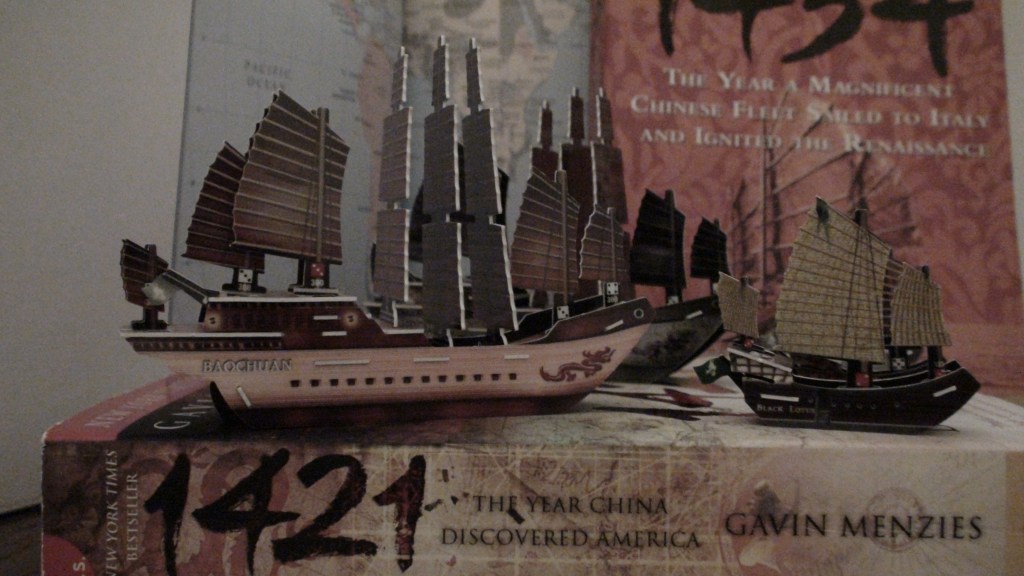
 The text of Menzies book contains castrations, gallivants with concubines, dangerous naval warfare, journeys to exotic lands, political intrigue, betrayal, cannibalism, and correspondence with the supernatural.