Yikes, I watched recently what may be the worst movie I have ever seen—which is very embarrassing for the movie. I mean, Jesus Christ—it was absolutely terrible. Diabolically ridiculous, lampoonist, flawed, disjointed—it was a wrecked concoction of poor philosophy, disastrously stupid politics, and a sheer waste of the three hours I spent watching it. Tragically, I hoped it would be good, Tom Hanks was in it, Halle Berry was as well, the Wachowski family was involved who did films like the Matrix and Speed Racer—so even though I thought I would dislike the politics—which were noticeably progressive—I hoped the movie would have its moments. It didn’t. It was just terrible and the only reason I am reviewing it is so that I can show readers here that not every movie review is good. Some people have accused me of working for Warner Brothers because of my glowing reviews of the Batman films, and Eastwood projects—but this—this Cloud Atlas—it was just wretched. It was like looking at something a dog puked up after eating feces in the yard mixed with freshly cut grass and garbage out of the hamper. It is unbelievable that anybody ever gave a green light for that movie because if that is what people in Hollywood think is a good movie, we are in big trouble.
I gave the film a chance because Roger Ebert loved it—he said he thought it was one of the most ambitious films ever made and was a complicated riddle that deserved multiple viewings. And parts of it were very ambitious, the budget was large, the visionary attempt was epic, and it had stars. Susan Sarandon’s inclusion almost made me not even watch it because of her active progressivism—but I recorded it on my DVR in March and finally got around to watching it in June out of obligation really. I felt because of what Ebert said that the film deserved attention, but I knew it was a progressive film—so I treated it like a trip to the dentist—something you don’t really enjoy, but is needed from time to time for basic maintenance. My conclusion was that Roger Ebert lost his mind. Cloud Atlas was that terrible.
The foundation of Cloud Atlas is deeply flawed making all the interesting interconnected storylines worthless. The film is about gay love, slavery, feminism, and is clearly against big oil. It is also about the worthless nature of individual lives and only concerned about how they fit into the larger tapestry of existence. Considering Ebert died shortly after Cloud Atlas I’ll give him a pass—maybe the idea of resurrection through a future life was something appealing to him in those last moments and he saw in the Cloud Atlas insanity a ray of hope for himself. The film was released around the same time that Atlas Shrugged Part II hit theaters and I remember well having to defend that film from people who loved Cloud Atlas. So I made a point to see the film at the first available moment which is why I recorded it. Being an open supporter of the filmmakers producing the Atlas Shrugged films, I wanted to understand how the other side could make such comparisons, and what I learned was that Cloud Atlas is the exact opposite philosophy of Atlas Shrugged. The two couldn’t be further apart in values—they have nothing in common other than the word “Atlas” in their titles.
And before anybody says that I didn’t understand the film………………….please, don’t waste the time. I understood all the metaphors in the film and I get the interaction of the characters and the various time periods. But to what point—so that the sick guy on the ship trying to get home to his wife who was really the future goddess of civilization could tell her bigoted father that she was running off with her husband? That was the closing scene and the climax of the picture?????????????????????????????? No, there was another climax, the one with Tom Hanks and Halle Berry married and living happily on another planet well into the future telling the story of Cloud Atlas to his grandchildren who wanted to look up at the stars and know which one was earth. Really???????????????????? I wasted three hours to come to that stupid revelation? You can refund money but you can’t refund time—and I am resentful that I lost three hours of my life to Cloud Atlas.
However, one thing that I did learn is that everything I say about progressives is absolutely 100% correct. Their world vision was on full display in Cloud Atlas and philosophically, they are like children right out of the womb—yet they believe they are at the height of human knowledge. Cloud Atlas was presented as an exclamation point and epic triumph toward progressive thought. Tom Hanks is a smart guy and a great actor—so he consciously took on multiple roles in the film. It was obviously for him a labor of love—he believed in the project intensely—and that concerns me greatly for his very mental health. There was nothing profound about Cloud Atlas. It was like watching the news with a progressive slant. It was ridiculously simple and anti-climatic. I mean crap…………..it was just terrible.
I understand that I hate progressive and liberal philosophy. Those idiots can call me a right-winger all they want—because if Cloud Atlas is what they think merits thought—they are thoughtless. They do not even have the ability to make a compelling argument if that is the best they can do. Cloud Atlas is the culmination of that kind of crappy Hollywood politics where screenplays are written by boot lickers at parties where drugs flow freely and everyone thinks they are brilliant from the vantage point of the little flat of land nudged up between the Pacific Ocean and the Nevada desert mountains. The Wachowski family is not the second coming. They likely ripped off the concept of the Matrix from another writer and have struggled to make a good film since—even though studios have thrown massive budgets at them. Larry Wachowski wrecked his life in the Hollywood Dungeon when he started hanging around with Iisa Strix and Buck Angel the transsexual known as “The Dude With a Pussy.” Worse yet, one of the directors of Cloud Atlas was Lana—who used to be Larry after he went through a sex change operation—so he is one of those LGBT people and that wrecked identity became Cloud Atlas.
It’s not that the many incidences in Cloud Atlas where male characters play females, and females play males was artistically wrong—it was just too simple. Anyone who bases their identity purely on sexual function is a lost cause—and in essence, this is what was going on in Cloud Atlas. The premise of the characters is from the vantage point of the kind of person who desires to engage in bondage in the Dungeon which is a huge part of that transsexual community in Los Angeles. But for the rest of the nation—it’s considered stupid. So while Cloud Atlas had a 10 minute standing ovation at Sundance and progressives raved about the film—it is only hard-core progressives who enjoyed it. For everyone else—it is ridiculously simple—and tragically limited in its philosophical outlook. What makes a person is not the holes they have in their bodies which allow for sexual penetration—it is the content of their minds—and in Cloud Atlas, the minds are disasters who made a film seething with liberal talking points ridiculously displayed as a work of art that belong nowhere else but in a litter box.
Ironically, I didn’t even know that Larry had turned himself into Lana before I watched Cloud Atlas. I discovered that trying to figure out why the movie was so fu**ed up. I was trying to understand how and why Warner Brothers distributed the film and discover who put up the money for the project and learn what on earth the directors were thinking. That’s when I learned that Larry never recovered from his divorce after being caught with the dominatrix Strix in the Dungeon—and had poured way too much mental energy into becoming a woman. He then directed a film about the quality of a soul regardless of gender roles over a long-span of time to justify his/her terrible decisions in life.
Wow……………………………
Do yourself a favor———never watch Cloud Atlas. Something’s are better left alone—and that movie is one of them.
Let’s make something clear since Jay Carney brought it up on his last day as the White House spokesman—the Bush administration was not a good 8 years for America. And certainly, Obama has been bad for American just in even worse incompetence. There isn’t a competition between the Republican loser in office and the Democrat—they both were terrible. At the end of Obama’s second term, America will have seen 16 years of terrible presidents and America has suffered terribly for it. America will be well over $18 trillion dollars in debt and will have virtually everything that has been taken for granted–good jobs, a flourishing economy, food, power, and medical help in question as Obama leaves the White House. However, the folly doesn’t start there—Clinton was a terrible president, and Bush the senior wasn’t a cup of tea either. It is then no wonder that America is a shell of its former self as the political leadership has reflected a society on the decline. The people who have elected these losers are of less quality than previous generations and the result has been horrible leadership in the White House that has had a detrimental effect on America’s quality in every category.
Nobody will argue that Dick Cheney was far from the best vice president—just as Joe Biden appears to be a complete buffoon in the same position. Jay Carney’s reference to the poor Bush presidency as a defense of the Obama presidency is like saying that thunder is better than lightning in a rain storm—as they accompany each other in the grand scheme of things. It is best to not have a storm at all if no damage is desired—and in politics, it is best to avoid terrible presidents—so to avoid damage once they leave.
Yet is it clear now why America went to war in Iraq? It was to prevent the spread of terrorism, not because of “oil.” It was to keep wealth and resources out of the hands of diabolical terrorists. Does everybody now understand why there must be a border between Mexico and The United States that is secure—because all the impoverished countries from the south in Central America are flocking to the border hoping for relief from their circumstances? The cause of those circumstances is the socialist and tyrannical policies of their corrupt governments giving America the obligation to protect itself by imposing freedom on those places. When such strength is not present—there is no reason for tyrants to oppress their people with no option but to flee those lands of terror in pursuit of opportunities for freedom.
America never should have to concern itself with the affairs of other countries, but when it is the only good place in the world beholding freedom—and immigrants flood our boarders looking for freedom from oppression, America has a right to defend itself by helping those countries have freedom on their own. But if those countries do not have a philosophy that allows for freedom, then it won’t last, like what has happened in Iraq. It is not enough to give a country a set of laws and turn them loose in pursuit of democracy. If most people in the country are corrupt by bad, collectivist thinking, they will not be able to maintain freedom under any circumstances.
For over twenty years now bad presidents have led America on a chase mimicking these bad global governments instead of standing for what was right in defense of freedom. At least Ronald Reagan as an actor/president understood that America had an obligation to help oppressed people so that freedom would spread around the world instead of tyranny—his presidency was a strong one that left the entire world a better place. There were presidents before Reagan who were also pretty good at defending that basic premise from both political parties—but as for the last twenty years, representation for freedom from the White House to the world has been terrible.
Many of the problems experienced presently in the American nation are due to weak leadership and foreign policy vision. Bush and Obama have very little understanding of economics and abandoned capitalism under their terms. Clinton was simply a socialist who defended his corruption with his legal skills as a diabolical lawyer. Without question, he is likely enjoying these current problems as they fit his open border philosophy where the value of America is diminished in favor of a new global government.
The premise that every time Obama is criticized for being a complete idiot, which he is, a defense for his stupidity is not to point at George W. Bush and say “he did it too.” They were both idiots, and they have both left America worse as a nation than it was when they took over as president. But for context, the Pentagon moved the Aircraft carrier George W. Bush off the coast of Iraq to show the terrorist insurgents that America is nearby. That brought forth the thought that it is now unimaginable that a future aircraft carrier would be named, the “Barack Obama.” Such a carrier would be a laughing-stock, and certainly would not incite fear into the opposition. It is in that reality that the quality of the presidents can best be determined. For as bad as Bush was for the free market, he at least understood how to project strength in the military—even if it was at times overreaching. It is better to reach too far in foreign policy than to not reach at all—like Obama has. Lack of American projection of strength to the world leads every cockroach to come forth as a potential tyrant and ruthless dictator—which is what is happening from Russia to the Middle East. And in the end, that is why Barack Obama will forever be known as the worst president in the history of America, and make the top ten list of worst leaders of all time the world over. Obama will own that designation on his own and no deflection to George W. Bush will cover his ignorance from the responsibility of that title.
It is not enough to simply defeat a dictator or to send military support—or to throw money at countries who are functioning from poor philosophic beliefs and collectively based cultures. When that sense of collectivism carries over into religion these countries become even more dangerous to themselves and others. What all poor countries have in common is collective based economies based on Karl Marx and Keynesian thought, and religions based on sacrifice and worship through collective yielding to higher powers. Those failures of thought are what cause hopeful immigrants to pour into the U.S. border and terrorists to believe they have a right to impose religious law against non-believers through force and terror. The failure of the American presidents of the last 20 years is that they failed to identify this root cause—and have instead let them fester unchecked until presently the world is in disarray. Money cannot be thrown at the problem of poor philosophy, and neither can lip service. People have to think differently. They have to “think” like Americans instead of just running to America hoping to be put on welfare and cared for by the tax payer in The United States for the rest of their lives. They have to adopt new philosophies that allow them to have flourishing economies and religions that don’t require the eradication of those who don’t believe the same things under the premise of social collectivism. If traceability between these two differences in thought could be made it is the difference between Immanuel Kant, and Adam Smith—or the difference between Aristotle and Plato. The root cause of evil is in philosophy, and it is the philosophy of poor nations which leave people looking to escape into The United States, or to flee tyrants on their way into Bagdad that causes the trouble. The only way to really help the people of the world is to change the way those people think—and Obama, Bush, Clinton as well as many other presidents have put American value into reactive defense instead of assertive projection of philosophies born on American soil—which would do far more good than all the tanks, planes and missiles in world history of stopping tyrants in their tracks. Recent American presidents have failed to show pride in that American philosophy born of Adam Smith, John Locke, Thomas Jefferson, Ben Franklin and Ayn Rand—and that is why they are embarrassments in the context of history—all of them.
I have a long history of dealing with people who believe that they are the smartest people in the room—people who work very hard to be masters of a specific field of endeavor—no matter what it is. I have dealt with some of the worst people imaginable—from actual killers of men hired for the task so to suppress competition—and those who just believe that they are smarter than everyone else hiding their true intentions behind a veil of confident mastery over specific fields of endeavor. However, I have always had since the age of a very small child the unique ability to see through any level of bullshit into the soul of the perpetrator and know exactly what they are up to and why. Some might call it a gift from God—my unique skill which sets me aside from virtually everyone. Some people can run fast, some can calculate complicated mathematics without a calculator, some can read pages and pages of legal documentation and actually retain the knowledge—etc, but almost nobody who I’ve ever met had the ability to see into, and through people the way I do. Some might think it a curse—but I wouldn’t trade that ability for all the gold in the world and a life of ease and immortality on a paradise island with only pleasure in the forecast—I enjoy my ability that much.
So I started this blog as a way to address the crimes that I was seeing and challenge the premise that those same crimes were committed under—specifically by a class of people who sincerely believed they could get away with harming intellectually others while hiding their maliciousness behind a superior intellect. They can’t. To demonstrate my effectiveness, I have now written millions of words in this blog, virtually every article is over 1200 words each, and I’ve done it every day since 2010. It has changed the lives of many people for the better and shattered the once confident hiding places of those most vile in our society—who hope to perpetrate their ill will toward mankind in obscurity. They have tried every trick imaginable—but have failed utterly to shake me off their scent—which to me was never in question.
The good thing about the blog is that with all those words and the public forum of it—where anybody can answer my comments and pick holes in my theories, to date they have not been able to do so. They can certainly insult—but they cannot answer or refute my claims and they’ll never be able to—and they hate it. The proof is in the vast swath of articles I have produced in such a short time—relatively speaking. At this point in this blog’s history I could take all the books of Ayn Rand and Leo Tolstoy and combine them—and I have written more than they have specifically targeting the crimes of our modern age. I will certainly not proclaim that these works are as well edited—most of the articles are raw, and from the heart, the way a writer’s notes would be when formulating an idea for refinement—but that doesn’t take away the results which are enormous, and likely only rivaled over the entire Internet by a few outlets.
I mostly deal with excessively smart people who universally believe they are the smartest people around at any given time. It is my task to show them that they are not—so that their efforts do not become a detriment to an enterprise—but a contributor and this often causes resentment. This has been my task for four decades now, so I knew that by taking on the established thinking especially in regard to politics and education, what I was getting into. That is the history of this blog to this point. It has evolved away from the more specific task of identifying education industry crime—and has evolved more into a philosophic analysis of mythology and how it impacts the static patterns of the human race. Because it is within that phrase that my special gift shines most brightly—when I go into long tirades about Star Wars, or some new game, literary work, or musical effort, it is because I see the impact of those achievements well before the rest of society does. What I say today, will become the standard of thought approximately 15 years from now. I am so confident in my assertions that I write these things audaciously for free on the Internet for future testimony without revisionist deflection. People may not always understand why or what I’m doing, but if they did—they’d be the ones writing about them instead of me—but they aren’t, and they can’t.
Because they can’t, this leaves critics bitterly resentful, and constantly plotting and scheming so that they can return to the safety of their cloaked behavior within society. Most people from the perpetrators of injustice currently sitting in The White House to the local labor union leaders within the education industry spend large amounts of their time trying to stay hidden—and they despise anyone who can see what they are really about—so they plot, scheme, and manipulate any way possible to return to that status. But in regards to this blog, it makes it impossible for them. Readers here have taken my words and used them as tools to change behavior and flush out the pretentious thugs of their localities in much the same way and embolden their efforts at justice—which is all I want. But those motives still elude the most dastardly terrorists of the mind and within their circles of self-imposed exile have begun spreading reference to me in the following fashion:
“Our universe explained by the god Rich Hoffman”
On my blog I can see the site stats hour by hour of the kind of terms people use to find it online—and that phrase has been coming up more often by different origin IP addresses lately. This is an indication of the temperament of the critics out there and how they view this blog. It is unfathomable to them that any individual would attempt to declare that they unshakably know facts, and can see into their hearts unless those individuals were supernatural. So this is their new derogatory term used to confront the light which shines into their lives grudgingly preventing them from hiding in plain sight. We live in a time where information is easier to get than ever before in human history—yet people are expected to be dumber than at virtually any point since the dawn of man. People are expected to remain stupid so to prevent inquiry into the nature of crimes that those who think they are smarter than everyone else, wish to commit upon the innocent—and genuinely good-hearted.
Referring to me as a “god” in their context is not a compliment—but I take it that way—because it shows me more about them than they wish for me to see. At the start of this blog I knew I was challenging people who thought they were the smartest people in existence, and the shattering impact that they were not has often proven too much for them to handle—which serves them right. It is ultimately best for them to learn that they cannot use their intelligence for evil—but should utilize it for good, productive ends—and they’ll only do that if they are not allowed to hide behind an industry that does not question their merit for what it is.
A “God” is universally accepted as one who can see everything at all times—they are omnipotent. Does that accurately describe me? That is for me to know, and nobody else. But my enemies do see me that way—and that is because they have been unable to match my assertions which leaves them metaphorically stripped naked for all to witness—and the sight is not a pleasant one. But it is one that makes society and all endeavor better—which makes me sleep better at night knowing that I did the work that was required—and if some see that as the work of a “god” well—so be it. I may be a lot of things to a lot of people depending on the context—but one thing I am not is humble. Humbleness is a waste of time when the only goal of it is to make others feel better about their life decisions and ultimate fall from grace. And that is not a business I want to be a part of.
Over the Memorial Day weekend there were a lot of issues discussed among family and friends–the sports scores of the local baseball teams, the Hockey playoffs, the NBA playoffs, how well the respective NFL teams did in the recent draft, the latest summer box office films and the general emptiness of economic purchases. But the extent of discussion about what is really important, topics like politics and philosophy, only general rumblings about President Obama made the cut. Over the weekend, my father-in-law turned 70 and we wanted to treat him to the movie Godzilla. Along the way to the theater, from his very affluent neighborhood and the surrounding area which is well above average in per capita income—economic activity was vibrant. Restaurants were full, stores were packed, and the movie house was crowded—there was no trace of the generally terrible economic news which is about to hit America. All seemed well.
After the movie there was a very nice party for my father-in-law who loved the Godzilla film and was enjoying his birthday to a live blue grass band hired for his personal entertainment. I watched the party goers closely, mostly avoiding the devastating news that the American economy is nowhere near as good as it appeared. There is trouble coming, which is in evidence by the fact that the news no longer covers the terrible events of Greece, Italy, or Cyprus, because there is no end in sight for them to prosper economically. Their financial crises did not go away—they just stopped being covered—and the same fiscal cliff is headed for our shores in North America.
I thought of an article I had just read by Brandon Smith of Alt-Market.com which did a good job of painting a picture of how bad the economy actually is caused in part by the Federal Reserve quantitative easing practices. While reading it I thought of my father-in-law who has been fiscally very successful and came a long way in his life, and he has seen it all. He saw the post World-War II boom, the communist years of the 60s, the economic destruction of the 70s, the vibrancy of the 80s, and 90s, and the sharp decline of American economic power since the terrorist acts of 9/11 occurred in 2001. It would be important to note that the intent of those attacks was to shatter not just the symbol of American capitalism—The World Trade Center—but the actual economy itself. Now $17 trillion dollars in deficit spending later the picture is clear—America will not recover easily from this economic tsunami. When one does the math, if America spent all of the profit of its GDP for the next 20 years on reducing the deficit—it would not succeed. The enemies of America know it. Most people are vaguely aware of it—but they avoid naming it as thought by refusing to acknowledge its existence, a different reality will present itself. But it won’t. To illustrate this condition I refer you dear reader to Brandon Smith’s article—at least a very relevant portion of it. The whole article can be seen at the link below.
On the surface, the economic atmosphere of the U.S. has appeared rather calm and uneventful. Stocks are up, employment isn’t great but jobs aren’t collapsing into the void (at least not openly), and the U.S. dollar seems to be going strong. Peel away the thin veneer, however, and a different financial horror show is revealed.
U.S. stocks have enjoyed unprecedented crash protection due to a steady infusion of fiat money from the Federal Reserve known as quantitative easing. With the advent of the “taper”, QE is now swiftly coming to a close (as is evident in the overall reduction in treasury market purchases), and is slated to end by this fall, if not sooner.
Employment has been boosted only in statistical presentation, and not in reality. The Labor Department’s creative accounting of job numbers omits numerous factors, the most important being the issue of long-term unemployed. Millions of people who have been jobless for so long they no longer qualify for benefits are being removed from the rolls. This quiet catastrophe has the side bonus of making it appear as though unemployment is going down.
U.S. Treasury bonds, and by extension the dollar, have also stayed afloat due to the river of stimulus being introduced by the Federal Reserve. That same river, through QE, is now drying up.
While many people assume that the stimulus measures of the Fed are driven by a desire to save our economy and currency, I see instead a concerted program of destabilization which is meantto bring about the eventual demise of our nation’s fiscal infrastructure. What some might call “kicking the can down the road,” I call deliberately stretching the country thin over time, so that any indirect crisis can be used as a trigger event to bring the ceiling crashing down.
In the past several months, the Fed taper of QE and subsequently U.S. bond buying has coincided with steep declines in purchases by China, a dump of one-fifth of holdings by Russia, and an overall decline in new purchases of U.S. dollars for FOREX reserves.
With the Ukraine crisis now escalating to fever pitch, BRIC nations are openly discussing the probability of “de-dollarization” in international summits, and the ultimate dumping of the dollar as the world reserve currency.
The U.S. is in desperate need of a benefactor to purchase its ever rising debt and keep the system running. Strangely, a buyer with apparently bottomless pockets has arrived to pick up the slack that the Fed and the BRICS are leaving behind. But, who is this buyer?
At first glance, it appears to be the tiny nation of Belgium.
While foreign investment in the U.S. has sharply declined since March, Belgium has quickly become the third largest buyer of Treasury bonds, just behind China and Japan, purchasing more than $200 billion in securities in the past five months, adding to a total stash of around $340 billion.
The article may be dismissed by Keynesian economists as the work of conspiracy theorists but it is actually quite true in content. Power is being divided up throughout the world and America is not being considered a player in that effort. Rather the very rich, who already know of the coming crises have mostly sold off their investments in America so they can capitalize off its fall from power. Belgium, as a small country is suddenly interested in American Treasury bonds? This is no accident.
Sadness washed over me at the event for my father-in-law as the sun set on the horizon and the blue grass music played on and darkness shrouded everyone listening, and talking. The metaphor was a proper one, and soon in America what used to be clear in the light of day and taken for granted would be cloaked in darkness and difficult to see without assistance. The economic vitality that virtually everyone was taking for granted was coming to an end, and nobody wanted to know it—even though they can feel the chill in the air of a coming darkness in American history.
The economic collapse is a military strategy, not a purely fiscal accident—and every American celebrating Memorial Day should see it for the threat that it is. This attack is not with tanks and troops, but of quantitative easing and Treasury bonds—sold to Belgium of all places—and the chanting fools of old Europe who wish once again to take their homeland and make it the most relevant place on earth—once America is out-of-the-way and no longer in charge.
Thomas Jefferson said in 1802:
“I believe that banking institutions are more dangerous to our liberties than standing armies.
If the American people ever allow private banks to control the issue of their currency, first by inflation, then by deflation, the banks and corporations that will grow up around the banks will deprive the people of all property – until their children wake-up homeless on the continent their fathers conquered.”
One of the unspoken reasons which I discussed in yesterday’s article of why communism fails is a trait that I am intimately aware of. It might be said that it’s my specialty and most practiced attribute—defeating passive aggression in rivals and allies for strategic objectives. I can spot passive aggressive behavior 4 million light years away, and I have no sympathy for it when I see it. I also have no patience for it—and it is a growing trait taught in our public schools, advocated by our political system, and embraced by our business methods. It is wrong and must be changed as a fundamental behavior pattern in modern society or the GDP of all the nations on earth will struggle and collapse under the burdens placed upon their social expectations.
For the proper definitions of passive-aggression disorder I will turn to Wikipedia, because they have a nice concise definition there that is easy for a layman to understand. Without question, this is the number one attribute threatening modern business, and is the nail in the coffin for those advocating communism. Even though the push for communism in public schools has perpetuated passive -aggressive behavior in society at large, it has formed in the human mind as a natural rebellion toward authority figures. The more authority figures try to assert their domination over others—the more control those authority figures have over others, the more that passive-aggressive attitudes will form as a line of defense in the human mind. It is a trait that I understand as I despise authority figures myself. But when passive-aggression is coupled with other human frailties, such as sexual addiction, financial irresponsibility, obesity, various psychological insecurities, drug addiction, and other acts of personal liability—they are devastating to the act of productivity which makes them a national threat of epic proportions. When passive-aggressive trends are allowed to fester up like lava under the earth only to be released through a volcanic explosion, the politics of our day and economic order of all involved are threatened. So for those who are not aware of what passive-aggressive behavior is, the below definitions will begin to cast a light upon everything you knew was always there in the darkness—but lacked the vision to see clearly.
Passive-aggressive behavior is the indirect expression of hostility, such as through procrastination, sarcasm, hostile jokes, stubbornness, resentment, sullenness, or deliberate or repeated failure to accomplish requested tasks for which one is (often explicitly) responsible.
For research purposes, the DSM-IV describes passive-aggressive personality disorder as a “pervasive pattern of negativistic attitudes and passive resistance to demands for adequate performance in social and occupational situations”.
Concept in different areas
In psychology
In psychology, passive-aggressive behavior is characterized by an habitual pattern of passive resistance to expected work requirements, opposition, stubbornness, and negativistic attitudes in response to requirements for normal performance levels expected of others. Most frequently it occurs in the workplace where resistance is exhibited by such indirect behaviors as procrastination, forgetfulness, and purposeful inefficiency, especially in reaction to demands by authority figures, but it can also occur in interpersonal contexts.[1]
Passive-aggressive may also refer to a person who refuses to acknowledge their own aggression (in the sense of “agency”), and who manages that denial by projecting it. This type of person insists on seeing themselves as the blameless victims in all situations.[citation needed]
According to Living with the Passive-Aggressive Man, a self-help book, a passive man does little to get what he wants as it is too much effort to do so, and ranges from the inept “loser” type to the conformist who does anything to be liked, avoids making waves and rarely says what he feels.[3]
In social protest
Passive-aggressive behavior is not the same as nonviolent resistance exhibited in groups by social protesters. The nonviolent campaigner is working to defeat demands for social behavior required by others as a method of defiance of authority figures. The person characterized by passive-aggressive behavior is not working with others toward a defined social goal.
In conflict theory
In conflict theory, passive resistance is a rational response to demands that may simply be disagreed with. Passive-aggressive behavior can resemble a behavior better described as catty, as it consists of deliberate, active, but carefully veiled hostile acts which are distinctively different in character from the non-assertive style of passive aggression.[4]
Passive-aggressive behavior from workers and managers is damaging to team unity and productivity. Warner in the ad for his online ebook says: “The worst case of passive-aggressive behavior involves destructive attitudes such as negativity, sullenness, resentment, procrastination, ‘forgetting’ to do something, chronic lateness, and intentional inefficiency.” If this behavior is ignored it could result in decreased office efficiency and frustration among workers.[5] If managers are passive-aggressive in their behavior, it can end up stifling team creativity. De Angelis says “It would actually make perfect sense that those promoted to leadership positions might often be those who on the surface appear to be agreeable, diplomatic and supportive, yet who are actually dishonest, backstabbing saboteurs behind the scenes.”[6]
Passive-aggressive personality disorder was listed as an Axis II personality disorder in the DSM-III-R, but was moved in the DSM-IV to Appendix B (“Criteria Sets and Axes Provided for Further Study”) because of controversy and the need for further research on how to also categorize the behaviors in a future edition. According to DSM-IV, passive-aggressive personality disorder is “often overtly ambivalent, wavering indecisively from one course of action to its opposite. They may follow an erratic path that causes endless wrangles with others and disappointment for themselves.” Characteristic of these persons is an “intense conflict dependence on other and the desire for self-assertion.” Although exhibiting superficial bravado, their self-confidence is often very poor, and others react to them with hostility and negativity. This diagnosis is not made if the behavior is exhibited during a major depressive episode or can be attributed to dysthymic disorder.[1]
Millon’s subtypes
The psychologist Theodore Millon has proposed four subtypes of ‘negativist’ (‘passive-aggressive’).[7] Any individual negativist may exhibit none or one of the following:
Emotions fluctuate in bewildering, perplexing, and enigmatic ways; difficult to fathom or comprehend own capricious and mystifying moods; wavers, in flux, and irresolute both subjectively and intrapsychically.
Opposition displayed in a roundabout, labyrinthine, and ambiguous manner, e.g., procrastination, dawdling, forgetfulness, inefficiency, neglect, stubbornness, indirect and devious in venting resentment and resistant behaviors.
Contentious, intransigent, fractious, and quarrelsome; irritable, caustic, debasing, corrosive, and acrimonious, contradicts and derogates; few qualms and little conscience or remorse. (no longer a valid diagnosis in DSM)
Children who sugarcoat hostility may have difficulties being assertive, never developing better coping strategies or skills for self-expression. They can become adults who, beneath a “seductive veneer,” harbor “vindictive intent,” in the words of US congressman/psychologist Timothy F. Murphy, and writer/practicing therapist Loriann Oberlin.[9] Alternatively individuals may simply have difficulty being as directly aggressive or assertive as others. Martin Kantor suggests three areas that contribute to passive-aggressive anger in individuals: conflicts about dependency, control, and competition, and that a person may be termed passive-aggressive if they behave so to most persons on most occasions.[10]
Murphy and Oberlin also see passive aggression as part of a larger umbrella of hidden anger stemming from ten traits of the angry child or adult. These traits include making one’s own misery, the inability to analyze problems, blaming others, turning bad feelings into angry ones, attacking people, lacking empathy, using anger to gain power, confusing anger with self-esteem, and indulging in negative self-talk. Lastly, the authors point out that those who hide their anger can be nice when they wish to be.[11]
Passive-aggressive behavior was first defined clinically by Colonel William Menninger during World War II in the context of men’s reaction to military compliance. Menninger described soldiers who were not openly defiant but expressed their aggressiveness “by passive measures, such as pouting, stubbornness, procrastination, inefficiency, and passive obstructionism” due to what Menninger saw as an “immaturity” and a reaction to “routine military stress”.[13]
According to some psychoanalytic views, noncompliance is not indicative of true passive-aggressive behavior, which may instead be defined as the manifestation of emotions that have been repressed based on a self-imposed need for acceptance.
The DSM-III-R stated in 1987 that passive-aggressive disorder is typified by, among other things, “fail[ing] to do the laundry or to stock the kitchen with food because of procrastination and dawdling.”[13]
Increased public exposure to the term has led to websites like Passive-Aggressive Notes, which uploads purportedly passive-aggressive emails, notes and signs, although many of the examples are not correctly passive-aggressive in nature.
It might be said accurately that my experiences with passive-aggressive disorders are the number one reason I have turned against public education institutions and colleges. They have bred more of this behavior in society not less of it—because of their authoritarian approach to education. This has taken America’s workforce and infested their minds with the disorder making doing business with them nearly impossible. I have done well in my life stepping around the disorder in a way that does not destroy the people suffering from it—but it takes a lot of work. I sincerely wish more people would have success in overcoming it, but the problem is so pervasive that I only know of a handful of people anywhere who can accurately diagnose the effects and can side-step the attacks without destroying the opportunity at productivity.
Passive-aggressiveness is a direct result of the rise of communism in the 20th Century. It was the human mind’s defense against such a social intrusion upon their individual sanctity. The way to counter it is to respect the free will of those victimized while at the same time helping them find objectives in their lives which align their true goals with the needs for productivity. When dealing with people who don’t truly know what they want in life—it is really too much to ask to do the work for them, but often that is what is required—and it can be taxing. However, when the cause and effects are understood it is possible. Human beings and their brains are simply computer programs. If there are errors which occur during the uploading of data throughout their lives, their minds become fragmented and a simple defrag of their mental processing will get them pointed in the right direction. Ultimately, people simply want all the same things; they want shelter, food, love, and a sense of purpose. Once you can help them achieve those things, the negatives of passive—aggressive behavior can be overridden.
Social engineers, climate terrorists, over indulgent managers, power-hungry politicians, and all addicts of authoritarian regime are the causes of passive aggression because they attempt to manipulate the basic needs of human beings. If the basic needs of a human being are threatened in some way, passive-aggression will raise up to counter the effect. There are no drugs that can help this condition—they can only turn the mind off to the pain of duality. The problem is one of social context where others wish to impose upon individuals their needs—which threaten the basic needs of human beings. For instance, the social reaction to the Michael Sam kiss with his boyfriend on ESPN after being drafted by the St. Louis Rams NFL team was negative and is the cause of much passive-aggressive anxiety currently. ESPN owned by the Disney Corporation overplayed the situation because they want the political groups backed by the LGBT community to not attack their parent company. ESPN feels they must demonstrate the proper level of “progressivism” to keep lawyers representing parasitic social groups from attacking their productive assertions. Society at large wishing to find love, have babies and grow old with a spouse see such a thing as gay “love” as a threat to their core wishes, yet they cannot express their frustration because the media has stated that accepting gay activity is needed for an advanced society forcing individuals to relieve their aggression toward their anxiety—in a passive—acceptable way. Progressives have set the table in every instance, making Disney fearful of lawsuits for not embracing same-sex demographics, teaching society through public education to repress their behavioral judgment and critical thinking to accept social advances advocated by progressives. This has changed surface behavior, but not the core desires of human beings.
As an example, an obese young woman in her late twenties functioning through life without a boyfriend and a houseful of cats may say publicly about the Michael Sam kiss—“good for them. They are in love, and happy, and now Sam can play on an NFL team.” But that same young woman may look at Sam’s boyfriend and find him attractive and be resentful that there is one less man in the world available to her to marry and have babies with. She may have considered adoption, but it’s not the same as giving birth to a genetic child of her own born from the love she longs to share with a husband. She is likely to develop a severe passive-aggressive attitude toward gay sexuality that she will mask in public, but act out against in private. She would be the one to spit in the drink of a gay couple if she was a waitress in a restaurant they were attending, or short change them in an exchange of currency at a movie theater—just to rectify her deeply hidden anxiety over not having a mate in a society that is 50% male. She will find it personally devastating that two men would rather be with each other than for one to pick her as a mate. She could become a lesbian, but that won’t help her have a biological child of her own—so instead she spits in the drink of the gay couple and smiles inwardly to herself at her revenge.
After years of such passive-aggression people become very good at it, and soon they are performing it whenever their boss asks them to perform a task, or their parents demand a family get together when they have an otherwise overwhelming busy schedule, or a spouse wants sex when the partner isn’t in the mood. Soon, people’s lives are consumed with passive-aggressive disorder and they lose sight of strategic goals that might actually help them because they can’t see the forest for the trees—because their minds are so rotten with anxiety due to too much authority in their lives, which they act against their own needs without realizing it.
The problem of passive-aggression was created by the academic elite because of their love of communism, yet it also prevents communism from ever working—because communism is not aligned with the needs of the human mind—it does not provide shelter unless trust in the state can be maintained—which will fail because of the faulty nature of bureaucracies. It cannot deal with individual needs as communism is focused on collective salvation—so personal relationship issues are completely neglected. And any kind of Gross Domestic Product produced under a communist regime will be under performed because of the passive-aggressive disorders of their society. Why do people think that even with the GDP of China about to overtake the United States that Chinese workers are committing suicide off the top of iPhone factories and still seeking anyway possible to leave that country and come to America—because they want freedom first—over economic vitality. The GDP of an individual in China means nothing because it goes toward the collective and there isn’t enough passive-aggressive behavior in such places that can offset such a reality without destroying their very lives. At least in America passive-aggression can still gain traction because individual freedom is still entertained as a viable option. But communism will not end passive-aggression; it will make more of it—and in America we are already dangerously close to perpetual inaction in virtually every productive field of endeavor.
Passive-aggressive disorder is a byproduct of too much authority and not enough attention to individual sanctity. In America it is the result of a failed education system and a nation that has lost its values for individual liberty. Socially, the politics of our day have forced people with social castigation, financial hardship, and perpetual punishment if they show displeasure at two men kissing on national television—but deep down inside are a whole range of human emotions that are fighting to defend themselves from such an intrusion. And thus…………….that is the beginning of passive-aggressive disorder and the destructive events which fall in its wake.
For me, movies have always been a measurement about the temperament of a society in general. The kinds of films that make money, and those that don’t speak largely about the values of earthly civilizations. I enjoy most films, small art pictures like Atlas Shrugged sometimes because they don’t make much money and speak to a very focused and intelligent audience. I also like films like the new Godzilla movie which speaks directly to the masses with enthusiastic hope. What is different now as opposed to even a decade ago is that occasionally, huge blockbuster films like Godzilla are released simultaneously around the world and provide a very clear picture of what those worldly economic conditions are relative to the United States which can be directly measured by ticket sales.
Godzilla earned an estimated $103 million from 64 overseas markets this past weekend—during its opening. Warner Bros. reported that 51 percent of those sales were from 3D showings.
The movie’s biggest markets were the U.K. ($10.4 million) and Russia ($9.1 million), and it had the top opening of the year in Australia ($6.1 million). Other major territories included Mexico ($8.9 million), France ($6.5 million), Korea ($4.5 million), Brazil ($4.2 million), Italy ($3.6 million) and Spain ($1.6 million).
Godzilla opens in China in June, and then Japan in July. If it lives up to its potential in those two markets, it should wind up with over $400 million from overseas sales.
Produced by Legendary Pictures and released by Warner Bros., the monster movie reboot earned an impressive $93.2 million at the domestic box office.
Godzilla‘s domestic debut ranks second in 2014: it wound up in between Captain America: The Winter Soldier ($95 million) and The Amazing Spider-Man 2 ($91.6 million). It also opened significantly higher than last summer’s World War Z ($66.4 million), and more-than-doubled Pacific Rim‘s $37.3 million.
To sum all this up properly just in the North American continent Godzilla made $93 million dollars. Over the entire rest of the world the film made $103 million without China and Japan being factored. Those countries will see the film over the next couple of months. With all politics removed from public relations jargon promoting all these other countries as equal to the United States, and the demand for Godzilla being universally equal all over the world—it could be observed that dollar for dollar—The United States—a capitalist country has the buying power of the rest of the world combined.
For instance, Brazil is a large country, but because they lean in the direction of socialism, they have a per capita income that is far below that of The United States. $4.2 million is about how much most states made in America displaying vividly that in Brazil there are not nearly enough movie theaters available to show the film. In America, I have around seven different theaters to choose from to see Godzilla while in Brazil, there may only be a few theater in each major city. The rural areas of Brazil are lucky to have power let alone have a theater down the road from their house making it impossible to even think of seeing Godzilla. So as a country, their demand to see the movie was high, but their people because they are poor did not have much opportunity to attend a theater. Even more pressing to the whole problem is that there is not enough per capita income to dictate that an investor could even open and operate a movie theater in the country. Italy and Spain are both socialist countries and put out a pathetic number in response to the Godzilla box office. Again, it is not that people did not want to see the movie. Those that could did. But in those countries, there just aren’t enough theater owners who want to embark on the entrepreneurial activity of theater ownership.
France put up a respectable number as they have several major cities that have movie theaters. In the future however because of the socialist policies of the current government penalizing the rich, there will likely be far less real-estate investment into movie theaters leading the country back into something like what Spain, Italy and Brazil are putting out as far as economic activity.
Economic activity is of course the access of investment into theater ownership and access to money to attend a movie by the general population through disposable income. If taxation consumes much of that income, then movie attendance will of course decrease. After China loosened up a bit toward western films and actually allowed their citizens to watch movies like Godzilla, they are usually good for around $40 million in opening weekend box office totals out of a population matrix of over a billion people. Much of this market base is around the capitalist region of Hong Kong, but the communist portions of the country are still deeply deprived of business investment and disposable income to even purchase a movie ticket. There are likely millions of children within China who would love to see Godzilla, but they can’t because no movie theater owners want to deal with the communist government to operate such things with all the restrictions involved. After all, China only allows ten films a year from America. The rest of the year there aren’t many opportunities to see movies that are good. China isn’t making many movies, and neither is the rest of the world. Only America makes movies like Godzilla and only a select few are allowed to be seen within a communist country. Godzilla will be one of them—thank goodness.
Here is a sad statistic; the entire country of Australia which is a large landmass, only produced $6.1 million in Godzilla sales—mostly on the east coast of the country. Australia has also functioned under socialism for a number of years which has killed their economic growth and the results can easily be seen in the terribly deficient movie theaters available. Obviously people in Australia would love to see Godzilla, but they do not have enough movie theaters to allow such a thing. They have not been friendly enough toward entrepreneurial activity to allow their people such a positive leisure time activity like seeing Godzilla.
Is it fair to judge the world against such standards—well, yes it is. Godzilla is the kind of movie that boys, girls, young, old, virtually every market demographic in the world would like to at least see, but those opportunities do not exist in countries struggling with socialism, communism, and over restrictive governments. Countries like Russia have at least stepped up to the plate and allowed for western films to be shown in their city multiplexes and they produced a respectable $9.1 million, just shy of England which boosts a much smaller landmass and total population. Such comparisons speak very accurately about the economic strength of the cultures viewing the film Godzilla.
Godzilla is s global phenomena built with Japanese branding for many years, so it is a stable platform to make such comparisons. And the economic status of the world is easy to measure against such a globally unified reference point. If you want to measure the strength of a nation, just look at how many people attend movie blockbusters and determine if they have access to a movie theater, have expendable income, or live in a country that allows the kind of free speech needed to see such a thing. Then ask why they can’t, and you will have the answer as to which political systems work best for the people they are supposed to serve, and which ones simply use people as a platform for their own self-importance.
I bet dear reader—that you had no idea that the new Godzilla movie told so many stories on so many levels—but now you do.
Lakota once again is plastered all over the Tri-State news market for sheer stupidity and carelessness among their reckless administrators and general employees. Word from within the Lakota school system has said that a former student from Adena Elementary came to the school to see his old teacher. Jeff Kline bluffed his way past the supposed beefed up security which was improved after the recent levy passage in November and enjoyed something of a hero’s welcome as he paraded the halls talking about his experiences playing for the Jacksonville Jaguars. Here is how Fox 19 reported the story.
At Adena Elementary School in West Chester, you have to check in, get a visitor’s badge and have an escort. That’s what an ex-student did last week. He committed no crime and was “who he represented himself to be,” says a school spokesman.
However, he lied about his career, saying he played in the NFL, according to police, and letters sent home by school staff.
That sent up some red flags, and leaves a lot of “What ifs” in the minds of parents. The incident has the school looking over their security plans and policies.
“We have officers that are assigned to the beat. They’re obviously going to increase their presence. When you have concerns, when parents are concerned, they want to see that presence up there,” said Capt. Brian Rebholz of the West Chester Police Department.
Police have spent time on the school grounds as students are coming and going from the property.
As to the name of the former student no media outlets are reporting it for some reason—the kid is over 18, so saving the boy from embarrassment as a former student is rather stupid—considering they say they are desiring to fix the problem going forward. Channel 19 did put up the name of a fourth grader in their report, so why the police and school would protect a person who lied their way past security to massage his ego around a bunch of children is unfathomably idiotic. The Cincinnati Enquirer has the name because they checked NFL records to see if the kid had actually ever played professional football even as a practice squad member—which he didn’t. Lakota, after the incident is now boosting their police presence, which they stated was the reason for the latest school levy—and they got caught being star struck by a former student who could have just as easily have used the same story to get into a classroom and bring harm to students. There are so many things wrong with this situation that is being ignored that it is literally unbelievable all the people involved actually consider themselves intellectually mandated to advance society as educators—and they have really missed the mark. As anybody who knows anything about dealing with such matters understands, you must identify the cause, not the effect. These news outlets have reported the effect of the issue, but not the cause. Throwing more police into the halls of an elementary school at Lakota and sending home a strongly worded letter might make all the parents feel safe and secure—but it does not solve the problem.
The former student obviously wanted to return back to Adena to fulfill some goal established during his days there as a student. This is the danger of children bonding more with teachers than their own parents as children. The parents of this NFL imposter should really be ashamed of themselves for producing such a shallow young man ill prepared for the world. I mean what was he thinking—even after he went to Adena to have all the little kids and teachers suck up to him with his made up NFL experience—he would still have to return back to his car to drive away knowing that he is a loser who hasn’t done anything yet in life. The fact that he was willing to put on a cloak of such deception speaks loudly as to his actual values. He cares more about what people think of him than what he really is, and this will lead to a disaster as this event is just a prequel.
Then there are the idiotic teachers so hungry to believe that their work with the young man led to something wonderful, like an NFL career. The fact that they so willingly bought the story says that they wished to be deceived—they wanted to believe that their adopted son—a former student of the Lakota school system, could punch out into the world and be successful based on their instruction—and all they really did was raise a liar. And who would be surprised, after all isn’t that what Lakota is really about? Aren’t they more concerned with appearances than actuality? Lakota is about raising money through taxes for their unionized teachers disguised as basically pre-adult day care. Parents drop their children off to daycare facilities up to age 5 and conduct their lives almost independently—as though they were disconnected from their children leaving the little minds to be raised by baby sitters. When the children become of age for public school, they are then placed in an older version of day care organized by the state to spur job creation among the men and women who reside within its borders. Much of what actually happens in public school is about illusion anyway—so that those busy parents don’t feel guilt and change their behavior. The employees of this ridiculous system wish so fervently that it would work and inspire children to greatness that they will soak up any little morsel of success story as a fact without any analysis contrary to their desire.
Interesting how the school board president Julie Shafer didn’t put the young man’s name up on her Facebook account like she did when I called her levy supporting friends’ fat-assed whores—which they are. They are metaphorical whores to the needs of the state at the cost of their children which sickens me. If Lakota wanted to stop the kind of behavior shown at Adena they would have released the kid’s name to put the scare into anyone else thinking of doing such a thing—but Lakota is actually terrified that future students might not do the same and become deterred from massaging their egos with the illusion that their efforts at public education are worthy—and successful. Lakota school administrators and teachers want to believe that they can teach a child to grow up and become a gladiator in an arena filled with drunken fools and scantily clothed cheerleaders to destroy other human beings with the force of their own head. Their bodies may become ruined after only 15 years of this behavior, but heck, they might get on ESPN a few times. That is success—a really good player might be able to purchase a boat in Florida and pour $10,000 into the G-String of strippers on a Saturday night before a big game. Without question these are the thoughts of the teachers giving Kline a hero’s welcome in the halls of Adena elementary with children present and watching closely the adult behavior.
Ultimately, Lakota produced a child in Kline who would rather lie about his career just to impress others—which could be said about every level of the Lakota organization. Suppressing stories are the same as lying because the attempt is to hide the truth. The parents of Kline are even worse, they surrendered the instruction of the young mind of their son to a bunch of pretentious Lakota babysitters who created such a deep yearning for acceptance in the young lad that he actually made up a story about his success to visit an elementary teacher he should have long outgrown and forgotten about. The story is actually a serious one—it’s not about lying to breach security, it’s about the deep need to lie, so to make a former teacher show once again respect to a grown man who still has unresolved issues from his childhood. Lakota just as they taught the young fellow did what they always did, they threw a few more cops at the situation to make parents sleep better at night, and will undoubtedly throw more money at the situation which is essentially like throwing gas on a fire—but it makes everyone feel better about themselves.
The cause of this tragedy is that the student, Jeff Kline, desired to actually visit a former teacher and get their approval. To do it, he had to give the school what he thought they valued to get them once again to look favorably upon him like they did when he was a child yearning for a gold star to be put at the top of his work assignments. Lakota taught Kline to strive for that appeasement at whatever cost, even if lying is the method of obtaining the objective. After all, that’s what Lakota does—so why wouldn’t their rudderless students do the same? The answer is they will do as they were taught—and to that effect Jeff Kline did.
If you have ever tried to start a business, start a new product within a large organization, or make anything that involves the participation of the population at large you will undoubtedly have run up against tremendous opposition that needlessly seems intent to derail your plans. Deep pocket old money tends to purchase away opposition to their projects with political contributions and under the table buy-offs. But new money innovation has only one way through the gauntlet—and that is by surprise. A fledgling entrepreneur must hope that they can take the market by surprise before the parasites zero in and destroy their efforts. Currently in America—as in most places in the world, it is nearly impossible to do business as most organizations are plagued with do-nothing bureaucrats created by government for the purpose of job creation—without any zeal for production of any kind. They have a parasitic relationship with production—the key to any economic endeavor–and simply get in the way of creating anything of value. The reason for this issue is actually extremely complicated and must be understood by examining closely the map below. It is not enough to complain that the situation is one of economic theory or political philosophy—but is much more primal than that and extends back to the beginning of the human race.
Looking at the map it will be seen the pattern of ritual cannibalism cultures as they flourished during various periods throughout the world. The map is useful and comes from the book Atlas of World Mythology: Way of the Seeded Earth PartII and is one of the most treasured books in my collection. The map is not concerned with periods by millennia so much as the pattern and residual effects of cultures that had foundations of cannibalism and human sacrifice in their societies. In Europe this was a dominate ideal which can clearly be seen in the Biblical translations that flourished in Europe during the times of the first printing presses and the Roman Catholic Church who built their version of Christianity around such ideals of sacrifice.
Across the Middle East it will also be noticed that the entire region from Greece down to the Persian Gulf had elements of cannibalism which should be obvious to the students of Zoroastrianism which became the foundation of Christianity and Islamic faith—both riddled with deep beliefs in sacrifice serving as their foundations. It should not be a surprise that the concept of Sharia Law allows for it’s followers to sacrifice themselves in this world for promises in the next—which is the basic premise behind the human bomb terrorism acts. The notion of human sacrifice is alive and well behind every Islamic terrorist. The goal of the terror is to convert people into Islamic faith through fear—to force them to take the path of least resistance. They are not asking people to become committed to the Muslim faith through religious purity—but through fear. This is a tribal remnant to their ancient tendency toward cannibalism. Their mythology which formulated the philosophy of their society is rooted in human sacrifice. The fundamentals of their faith believe falsely that something must be given up before something can be gained.
Cannibal cultures seen in the zones indicated on the above map tended to be agriculturally based. The workers of the fields at the time as they do today—tend to plant seeds in the ground and hope that the gods bring them rain to nourish the seeds to healthy crop yields. They felt they needed assurances that crops would grow prosperously and developed mythologies which attempted to appease nature by viewing the crops as gifts from some mystical source which desired some kind of payment. Because of this they developed human sacrifice rituals and other types of blood gifts hoping that they would not starve with bad crops.
The correct way to view agricultural activity then and now is to see the work of planting seeds as productive and the science as stable. If you perform the work, you tend to yield the results. This is why under American capitalism farmers tend to thrive where other countries not as free tend to starve if given the same type of land, the same access to water, and the same general labor force. The cannibal cultures of the past which led to the major religions of the world started with an incorrect premise that pointed their entire societies in the wrong direction. The emphasis of their religions is on sacrifice instead of productivity.
In business this old irrational notion congers itself up in the bureaucrats against industry who still believe that something must be sacrificed if something is to be built—as if all things were created in a finite state and that something must be given up to have something new. Job creation is an act of invention—of making something that wasn’t there before like a painting, a sculpture, or a literary work. A goat doesn’t have to be sacrificed to create a job. The gods do not hand them out to those who have been naughty or nice—jobs are created by minds able to make them. However, for those who do not understand such things, they believe their role in the process is similar to those old cannibals of yesteryear. They will sabotage creativity at every opportunity and attempt to stop any productive enterprise with an ancient commitment to the notion of greed—that a job creator is trying to build something without giving something up. For any such person in an altruistic society is viewed as greedy if they wish to make something—profit off it—and prosper without some kind of sacrifice to the gods of the past. These definitions are left over from their ancestors who literally believed that death of something had to occur before life could prosper.
Christianity is riddled with this type of behavior. The very core aspect of the religion is that Christ died for our lives and that we were condemned of sin at birth. But because Christ gave his life—we are allowed to prosper as human beings and that we should participate in some kind of sacrifice to give thanks to the effort. This is just an old variant of human sacrifice as it was propelled across the European region shown on the map. To replace the sacrificial tendencies of the Pagans Roman Catholics in a desire to preserve their empire used the notion of Christ’s sacrifice as a way to pull belief into their desire for a pacifist kingdom united under the flag of Christianity. There are of course wonderful values in Christianity, but the essence of it is false, the ideal of sacrifice as being needed to be productive.
Work is done by individuals. Goodness is not a gift from out there somewhere in the universe, but within our own hearts. Goodness is made by the mind of man. And everything that comes from the mind of man is considered productive when it is applied to reality. Productivity is the act of planting a seed into the ground and watering it with labor. Productivity is creating a job that was not there before to fill a market need that also wasn’t there before a mind made a need imagined by someone’s mind.
Productivity is not the government regulator who hampers creativity in business to protect a turtle habitat, or the union steward who keeps workers from hitting their piece rate while nearing a labor contract. It is not a mindless bureaucrat that thinks productivity is compliance to some stupid rule that man came up with out of a silly notion rooted in sacrifice—sacrifice to Mother Earth, sacrifice to mother government, sacrifice to our fellow man—sacrifice, sacrifice, sacrifice–ancient beliefs that were flawed four thousand years ago and are still wrong today.
When something productive is attempted the old cannibals of our society come out in full attack—and this is something that will not stop until the mythologies that form their cultures changes. As long as terrorists are willing to blow themselves up to gain access to a bunch of virgins in another world, or sins are removed from behavior because Christ was killed for disrupting the political order of the Pharisees—there will be lots of opposition to real productivity. And starting businesses, creating jobs, and conducting anything productive will be a constant uphill battle riddled with anxiety. That anxiety is needless, but is a direct result of old cannibal cultures and their stupid belief that sacrifice trumps production. Clearly all those who think in such a way are wrong—they just don’t have the ability to understand what a detriment they are to the human race.
I had the opportunity to watch the movie 42 about Jackie Robinson, who was the first black baseball player in the Major Leagues. I normally avoid progressive films, and there is a fine line between progressive propaganda with a political agenda and genuinely good stories, which is what 42 was. The film is one that needed to be made and while watching provoked many thoughts that deserve comment.
Jack Roosevelt “Jackie” Robinson (January 31, 1919 – October 24, 1972) was an American baseball player who became the first African-American to play in Major League Baseball (MLB) in the modern era.[1] Robinson broke the baseball color line when the Brooklyn Dodgers started him at first base on April 15, 1947. As the first major league team to play a black man since the 1880s, the Dodgers ended racial segregation that had relegated black players to the Negro leagues for six decades.[2] The example of Robinson’s character and unquestionable talent challenged the traditional basis of segregation, which then marked many other aspects of American life, and contributed significantly to the Civil Rights Movement.[3][4]
In the film Harrison Ford played Branch Rickey wonderfully which I thought was a heroic story in and of itself. I loved Ford’s role and portrayal and found myself wishing that more people in the world were like Branch Rickey.
I found it interesting that Rickey is yet another innovative celebrity from Ohio and in the film the scenes that took place with the Cincinnati Reds at the old Crosely Field were stunning. It was a reminder again of how much Cincinnati and specifically Ohio helped shape the nature of America. I enjoy baseball, and love the role Crosely Field played in the early days of Cincinnati’s development, so it was fun to see Crosely Field alive in the film 42. To learn more about Crosely Field, click the link below for a complete history and lots of photographs.
Jackie Robinson and Branch Rickey were noble men from an era that I desperately love. I would never support racism, and respected Robinson’s crusade. I have been friends with many black men over my life, and my experience has been similar to the kind of people Robinson was. I respected their politeness, their manly swagger, and their deep commitment to goodness. Goodness does not know color and clearly, especially after watching Jackie Robinson’s story in 42, as a baseball player he wanted to do “good” and the world is far better off for it.
However, the premise of racism as it is today is to allow bad behavior to go unchecked because of skin color, and this is not right. Jackie Robinson if he were alive today would likely condemn rappers like Jay-Z and Snoop Dog for taking the very things he fought for as a black man and squandering them away using the color of their skin to be detrimental paradoxes of oblivious conduct. Robinson was careful to always present himself as a gentleman to the public and he ultimately won the battle against racism by capturing the high moral ground of the public. Yet against his memory looters, scum bags and social malcontents want moral judgment against their bad behavior obliterated behind a mask of racism. After watching 42 I came away feeling that Robinson loved his wife, loved his children, loved his teams, was honorable and appreciative of Branch Rickey and was a gentleman in every way to the press. That is the kind of person all Americans regardless of skin color should try to emulate.
Yet too many people of color today wish to hide their poor life choices from judgment by conjuring up memories of the kind of racism that Jackie Robinson dealt with—which is an injustice that is not forgivable. For the welfare mothers abusing the system to get free money from the government with out-of-wedlock children, they are disgracing the good work that Jackie Robinson conducted. To the dope smoking gangstas’ from the inner cities—Robinson didn’t fight so hard and put up with so much to have low moral values hide behind the race card. Or to the man who romps around the African-American communities like a bee to flowers impregnating as many women as possible without any sense of responsibility, Robinson did not fight so that you could be such a loser.
I loved the scene in 42 where the little African-American kid chased the train until it was out of sight because Robinson was on it. Jackie Robinson was the boy’s idol. Young people need those kinds of idols, and it doesn’t matter the skin color, it is the conduct of those people who can set the pace of young people forever and give them something to live up to. All Snoop Dog and Jay-Z are doing is justifying why people should stay down and shoot low—and if anybody questions them on their poor lives—call them racists.
42, the movie gave me hope for Hollywood. I loved the movie and will see it again. It was a very patriotic film which deserves its place in history. I’m glad it was made and I’m glad I took the time to watch it. It is my hope that other films like it will be made in the future. Because in such stories are the story of all of us who call ourselves Americans—and no place else in the world are such things done as they are in The United States—even in our games of leisure and evenings of entertainment—of which baseball has a long tradition.
Friedrich Nietzsche only lived to be 55 years old and most of that last decade he was at a complete loss of his mental faculties. His thoughts at the time were extremely profound—but incomplete. He was on a journey that would require more tweaking over several centuries, but mentally he was going to places no human mind had ever quite dared. And his mind folded over on itself. I think about Nietzsche a lot because I am of that same age as he was and I know the pressure of going against a tide—and am always aware of the fragility of mental stability. The topics I am interested in, Like Nietzsche challenge our views of the world and the way we are all raised. When those foundations are challenged it is possible for a mind to lose its footing and fall into insanity. I came to know Nietzsche through Joseph Campbell’s writing and enjoy his views against institutionalism primarily. When I challenge education establishments with the promise that I could walk into their classrooms and teach better than any four of them put together I fully mean it. When I look out into the world and declare that the entire education structure is false and failing I am doing it with the same audacity that Nietzsche did by declaring that “God is dead.” Education has for many become a kind of religion, so by challenging their premise—they react in much the same manner as religious radicals do—with fearful aggression and empty dares—such as invitations to teach their classrooms.
Teaching for me has always been easy. I do it every single day of my life to people of all ages. But I enjoy it most with children. By the end of this article you will dear reader understand why. Because I cannot explain such a thing until the proper context has been established. But I offer it out there to those who read here from that education industry and are perplexed by my statements in much the same way that orthodox members of the church read Nietzsche and wondered how he could pronounce such an audacious declaration. I am different from Nietzsche as he only conceptualized the ideal of an overman. His body was sickly and his mind was not ready to deal with the weight of such realizations, and he crashed into his own thoughts. Hindsight provides good maps, and I know how to read them. This lesson I take seriously as I pronounce that “Education is dead.” Here is why.
My wife and I had our grandson for the evening over the weekend so we took him to Frisch’s for dinner. At this point he is only a year and a half old, so his mind is turning on rapidly and everything is an adventure. I enjoy this age in kids the best because their minds are unwritten by corruption, and everything is literally a possibility. I use these opportunities to teach. We arrived at the restaurant and I took my grandson out of his car seat. I did not carry him, but let him walk across the parking lot by himself, step up onto the sidewalk, alone, and proceed right along with his grandmother and me as an equal.
We were greeted by a kindly old woman who was a hostess and she was instantly dazzled by my grandson’s audacity. He confidently walked into the dining room like a big person very serious seeing for the first time a world approached in such a way under his own power. Along the wall by the pickup window were five young waitresses ages 19 to 25 who instantly fell in love with my grandson. Most children these sizes are carried in like a purse, and nuisance to tired parents. This little guy was self-reliant—at least he gave off that impression and it was attractive to see such an open mind so confident. I let him walk to the booth the hostess guided us to and only helped him a little into a seat next to me. The hostess asked if we wanted a booster seat which I declined. I didn’t want my grandson to be stuck in such a thing reminding him that he was different from us.
We ordered our food and I let my grandson conduct himself as an adult. I showed him how to color with the crayons the hostess had provided by letting him copy my efforts. I didn’t tell him to color in the lines of his kids menu, but to simply use the crayons to his desire. The food came, and he ate with us pleasantly. Occasionally he would spontaneously wave at the waitresses who were very happy to respond back to him. To me all these kids are only a few years apart, but to the girls and my grandson, they are about to inject themselves into relationships where they can have kids of their own and they of course hoped they could have children as cute as he was. But more than that, adults love the presence of innocence—of a mind uncorrupted by the perils of life—a mind filling itself with potential and it makes them feel happy. We often look at teenage kids and young adults with disdain because as they make choices that we know will fail them, we despise what they will become. 9 out of 10 adults know that those rambunctious teenagers will end up just like them in a few years—and sadness ensues. But for a child the age of my grandson, everything is yet unwritten and it is nice to see such hope in the eyes of a child. Most of the adults in the Frisch’s dining room was looking in our direction with a smile on their faces.
After dinner we conducted ourselves the same repeating the exercise of self-reliance. We then proceeded to Hallmark to make some Mother’s Day purchases. My grandson cannot yet talk in sentences, but he is very expressive and we spoke to him like he was a normal person—again equal to us. Of course we know he isn’t, but there is no need to show our superiority over him. Life will provide enough blowback to his enthusiasm. What little people like him need most is samples to learn from—they learn by example—so providing context to memorize is the most important attribute—and success to build from. For a kid his age every step in life is a success—so such evenings are opportunities to have a lot of little success. At Hallmark again I let him walk into the store on his own. Instantly every female in the store stopped and looked his way.
For my grandson the sights and sounds of the Hallmark store were too much for him. Everything was a new adventure and he quickly saw Disney characters he knew from television and wanted to pick up everything and carry it around with him. I let him. As he moved from object to object I put away the things he discarded as his mind filled with the feel of textures, the smell of various products, and the visual stimulation of their color tones. My grandson was erupting with enthusiasm.
Again the girls working the store were of the same age as the Frisch’s waitresses and they had the same reaction. They couldn’t help but be enchanted by him. He was the kind of child they hoped to have themselves soon. On their minds were not thoughts of saving the rain forest, or equal rights for same-sex couples, or even equal pay for women. They wanted to be moms and to have children like this little fellow and they would do so in less than a second if they could manage to find men in their lives who weren’t douche bags who wanted the sex, but not the responsibility of raising a family. Most of their boyfriends only wanted sex with them to satisfy their biological hunger so they could then return back to their Xbox to play games that are much more interesting than girlfriends. There was sadness in the eyes of these girls and I felt sorry for them.
I let my grandson roam about inside the store and outside it for about a half hour while my wife shopped. We discovered all kinds of things. I let him walk around the busy parking lot outside and stood in such a way to keep cars from running into him. If he wanted to walk across the street, I stopped the traffic to allow him the freedom of movement. We found outside lots of strange bugs, rocks, and varying surface profiles of the pavement. When he would step into one of these declinations in surface he would say, “down.” “Yes, that is down.” My wife bought him a new Mickey Mouse ball which was his favorite thing in the store and a nice memory to the evening. At the counter I held him so he could watch the cashier who was nearly in tears over his adult like cuteness ring up the ball. I told him, “we are conducting an exchange of currency so you can have your ball.” Two other girls standing nearby erupted into smiles and a woman who had been watching us for the entire half hour boldly said, “if he says that……….it will be too much for me. “ I kept my focus on my grandson and explained to him the value of the money my wife was giving the cashier was to evenly exchange the value of the ball that he would take home with him so he’d understand that something had to be produced to have something he desired.
That was just a sample of a few hours of one evening. There have been others like it and there will be many more and that is the task of learning. The reason my grandson was cute to the adults around him was not just his miniature mimicking of adult behavior, but the untarnished potential of the life in front of him. He literally has the whole world before him, and it is delightful to see the light come on in his mind. This is no doubt why many people become mothers and teachers—to experience this joy. However, when minds are stifled to statism and handcuffed by social prerogative which says that one is too small to sit in a booth by themselves, or the road is too dangerous, or you must color in the lines provided, or don’t pick up all the colorful contents of a store, or items they desire magically appear in their arms from a loving grandmother without having any idea how it came to be, we destroy the minds of those children and within a few short years, those bright lights in their mind’s eye go out.
Children grow up with the limits we give them, and it starts at a very young age. For every teacher, parent, or guardian too lazy to put back things on a shelf, or doubt their ability to protect children from a speeding car or to explain the value of money to a mind still assembling connectivity—everything they do or don’t do has an impact on the child. The limits they place will continue on with a child their whole life and will either destroy them, or benefit them. If teaching is not 100% concerned with this adventure in learning, but simply in compliance—it is failing. At that point it can be said that education in America is dead, and it will not be resurrected under the current pretense. It will have to be reinvented.


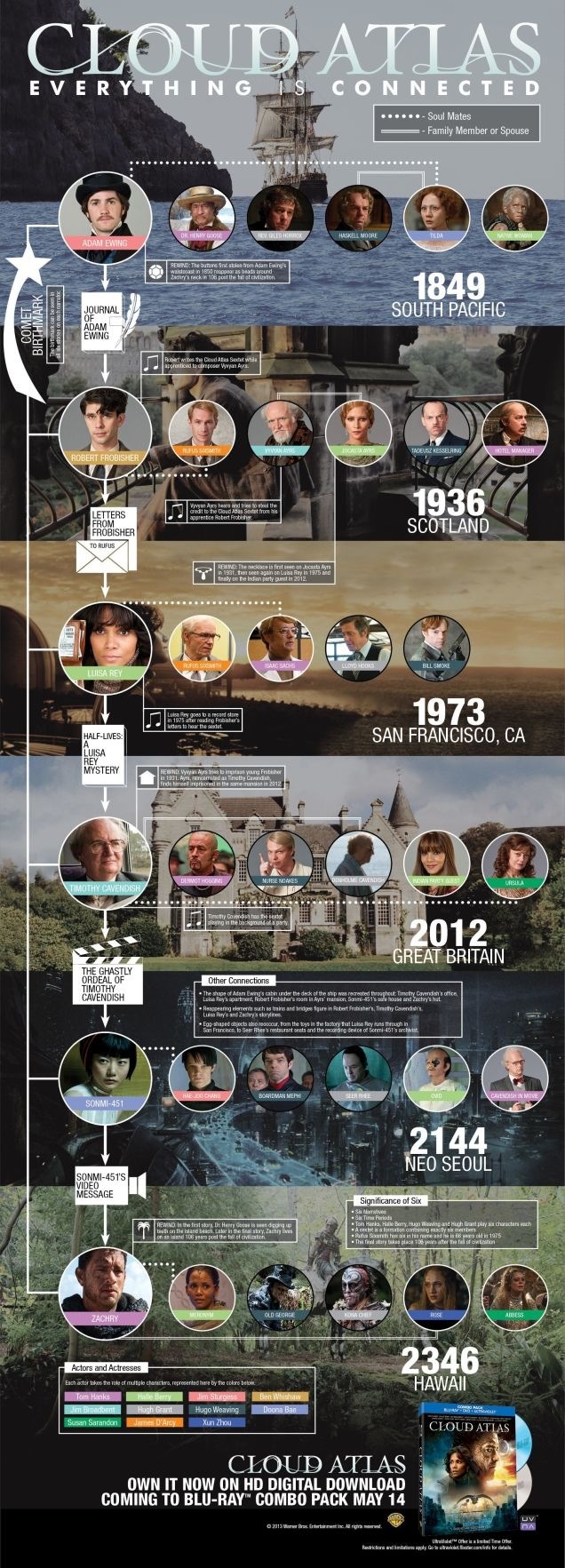 However, one thing that I did learn is that everything I say about progressives is absolutely 100% correct. Their world vision was on full display in Cloud Atlas and philosophically, they are like children right out of the womb—yet they believe they are at the height of human knowledge. Cloud Atlas was presented as an exclamation point and epic triumph toward progressive thought. Tom Hanks is a smart guy and a great actor—so he consciously took on multiple roles in the film. It was obviously for him a labor of love—he believed in the project intensely—and that concerns me greatly for his very mental health. There was nothing profound about Cloud Atlas. It was like watching the news with a progressive slant. It was ridiculously simple and anti-climatic. I mean crap…………..it was just terrible.