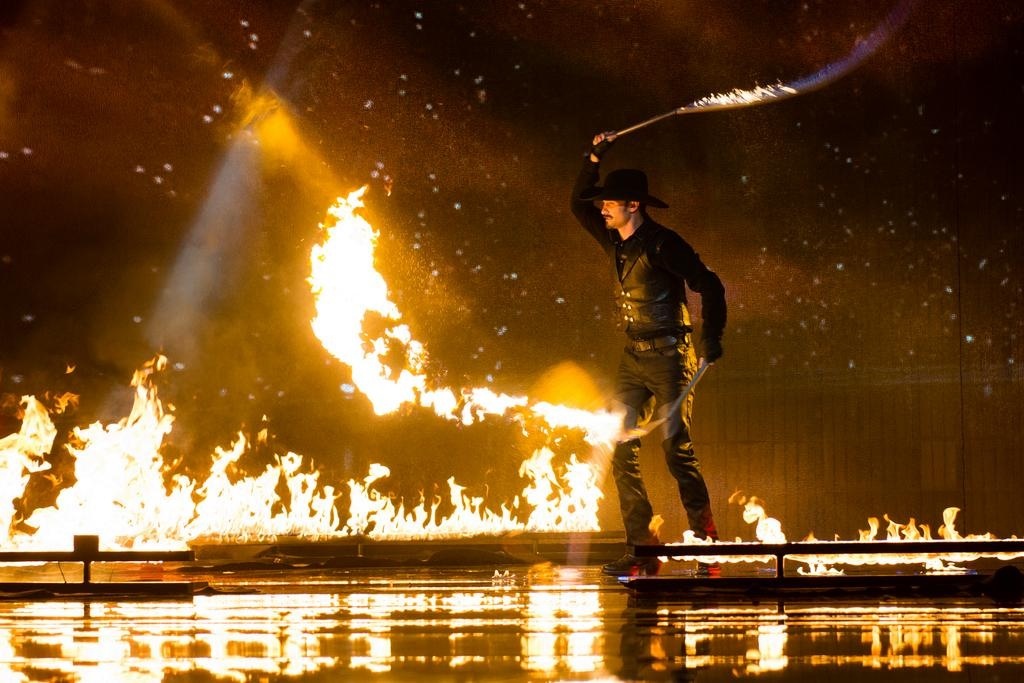
HOW TO BE A LEADER: Tales from the rain at Camp Friedlander

It is time to have a straight conversation about a delicate topic.  After my previous article on Leadership 21 it is excessively evident that a definition of leadership must be established aside for context to mature.  For me, the pivotal realization I gained about leadership came from the referenced C.O.P.E. leadership development training mention in that previous article.  CLICK HERE TO REVIEW.  Like the Leadership 21 group, I had to spend a weekend at camp with a group of people intent on the same aims—to bond with the fellow participants through a common experience driven by rigorous endeavor deigned to break down physical and emotional barriers—a kind of mini-boot camp.

Before I say what I will next keep in mind that I came from a time where it was very important to participate in sports activities so that a letter for your school jacket could be obtained.  I’m sure this is still a concern with young people, but when I was growing up in the 80’s, this was extremely important—and I was on a search as to why.  Having tremendous physical aptitude I was successful in any sport I wished to participate in, but elected not to after a run-in with my junior high coach who took the fun of sports and distorted it into a maze of social control.  I didn’t approve of the tiered system of social development emerging in grade school where letters of extracurricular participation earned social merit.   Those letters determined what kind of girls you could date, what kind of friends you had—and ultimately what type of job and personal life one might hope to obtain, so I was on a search as to why and to question that reality.  The sales pitch from that junior high coach was that the more letters on a jacket, the higher on the pecking order of life you could obtain.  I rejected this from the outset—which caused major conflict.

Looking for adventure that did not involve the public school a friend talked me into joining his High Adventure Explorer post—a kind of post-graduate Boy Scout program that was co-ed.  It was just the kind of thing I was looking for—a quirky group ran by aerospace engineers, school teachers, and bank managers who could set the table for many weekends of adventure which I excelled at. I gave them many headaches and scares as my natural leadership ability and physical aptitude brought a wake of personalities behind me that could get into a lot of trouble.  But within two years I was elected vice-president of the Cincinnati Dan Beard Council—which wasn’t exactly the direction I wanted to go in.  It was just the current of events that carried a fate to that destination.  Like most things when I believe too many people attach themselves to me directly I find a way to shake them off whether it is some controversy, conflict, or direct infusion of animosity freeing me from obligation into their affiliation.  The reason why points back to that C.O.P.E. experience for which I am about to explain.

For a rainy spring weekend members of several local Explore Posts attended the Challenging, Outdoor, Physical, Experience otherwise known as (C.O.P.E.).  It was a series of obstacles such as large walls, zip lines, and barriers designed to develop leadership skills through joint venture.  I attended already being very familiar with Camp Friedlander where C.O.P.E. was held.  For two consecutive prior years I attended the Explore Post Olympics they had each summer where all the area Posts competed against each other in events like swimming, softball, obstacle courses, and other acts of stamina.  Among them were Police Posts and Fire Fighter Posts which began a rivalry that started way back then and persists to this day.  Out of hundreds of area kids my friend and I as 16-year-olds dominated the obstacle course and other physical events against our rivals which paved the way for some very intense and positive experiences.  So returning to the camp for a weekend of C.O.P.E. activity was an experience I looked forward to.  The event involved pitching a tent and sharing the campground with the fellow participants who would endure the rigors of many challenges over the weekend.  As the events proceeded over the next 48 hours natural bonding of relationships occurred and people participating formed friendships—except me, and a few of the same friends who attended the yearly Olympic event.  We stayed to ourselves as we usually did—in spite of the bonding activity which drew the attention of the activity directors in a negative way.

On the second day after proving to be among the most physically proficient and creative problem solvers the camp directors had enough of my anti-social behavior.  It was time for a celebration lunch to wrap up the weekend and the directors had planned a small feast cooked over Colman stoves and water jugs.   Our campsite did have some picnic tables which were covered with a pitched tarp and all the cooking was done under them as a heavy afternoon spring rain rolled in.  I socialized in a healthy way, but maintained my distance during the preparation of the food and when it came time to eat; there wasn’t enough space under the tarp to eat at a picnic table along with the other 25 participants.  So a friend and I sat at a picnic table out in the rain.  We took our food and sat down only shielded by a cowboy style hat which dripped water into my food consistently.  But it was better than being cramped at a table with all the other participants trying to eat with no elbow room to move.  But, that is exactly what the event directors wanted to see—everyone meshing together cozy and assimilated under their tarp eating together.  Ridicule came in my direction for picking up my food to eat in the rain rather to sit with the rest of the group.

It wasn’t that I didn’t like the other people, or that I was trying to take a particular anti-social stand—I just wanted to be comfortable and it was more enjoyable to eat in the pouring rain than to sit crushed together on a bench with other smelly adolescents after a weekend without showering in the woods.  For me, the rain was a shower and I enjoyed the cleansing effect of the water.  But for the event directors, I saw from them the same kind of animosity that I saw from the junior high gym teacher, kids who valued lettered school jackets and social mechanisms of assimilation as opposed to individual development.  The longer we sat in the rain, the angrier the event directors became especially when their condemnation became harsher, but did not change my behavior.  The more they said, the more I wanted to sit in the rain.

To this day when groups get together for drinks—I usually don’t go.  When they conjugate for whatever reason, I am usually not a part of it.   Now as then I would rather sit in the rain than huddle up with perfect strangers to stay dry, and I could spend entire weekends not speaking to anybody and be completely happy.  I would say that I could handle months of that type of activity, but can’t conceive that it would ever be possible.  People like me are always viewed as suspicious and called things like “lone wolf” and “anti-social” but what is behind those names is resentment that I put up barriers to being looted mentally by those who seek to do so.  The camp directors knew that I was one of the stand-outs of the weekend leadership exercise called C.O.P.E. and they needed my buy-in for everyone else to assimilate together into their concept of a “team.”  To do that they must get everyone to chase after the goals they set—whether it is letters on a school jacket to show how much extracurricular activity one has participated in—which tells all the girls that you are a socially acceptable male that has future earnings power—or whether the camp directors give you an award for outstanding leadership that can get you elected into higher office politically.  The system only works if the best and brightest buy into their interpretation of reality.  It takes people of value to endorse those activities.  I knew early on that I was one of those people of value and I have never desired to give it away to those trying to curry favor. Not to be mean, or anti-social, but to preserve it for myself to use as I saw fit.  In the world of the 20th century, and so far the 21st, that type of mentality is considered selfish—but I would call it sustaining.  I learned at those leadership camps the opposite of what they intended.

At Camp Friedlander my Explore Post and those of the police and fire groups fought like cats and dogs.  We raided their camps at night with harassment knowing that they were future authority figures and we beat them in the competitions handedly.  They were always ran by parents who were cops and firefighters so it gave us great pleasure to throw bug spray into their campfires to explode unexpectedly—so to defy them as authority figures.  Sure we got into trouble, but it was well worth it.  They were always the most arrogant, so they were the most fun to beat.  And I will always be grateful for the experiences I learned there even if it turned out to be the opposite of what the camp directors intended.  Most people are taught early in their lives to fear the “lone wolf.”  When a crazed gunman unloads bullets into a crowd, the first conclusion usually drawn is that the assailant was one of those dreaded “lone wolfs” who are “anti-social.”  But the real fear of such people and anger which comes from that fear is that “lone wolfs” are simply people who refuse to be physically and intellectually looted.  Sometimes the pressure of social castigation causes them to crack and they go on some rampage, or seek relief in suicide, or substance abuse.  But the cause of that pressure is the invisible barrier between being willingly molested intellectually by the empty vessels of existence or fighting them.  Real leadership is in understanding this, not in surrendering to those who wish to do the molesting.

About 15 years after my Camp Friedlander experiences I worked at Cincinnati Milacron and was moved to a repair facility in Lebanon, Ohio.  I worked third shift and would spend gladly vast amounts of time alone.  I got along well with the five or six other guys who worked with me on that shift, but when it came time for breaks, they all ate together, whereas I would sit and read my books alone.  Often, I climbed to the top of a tall hill that was in the back of our facility and look out over the city while reading by a small pocket flashlight.  This angered the other guys and they thought of my behavior as “anti-social.”  They would say, “do you think you’re too good for us,” or “do you think your shit don’t stink.”  In truth, they had hit the nail on the head—but I cared enough about them to not rub their nose in it.  On my breaks, I had no desire to talk about drinking, bagging and tagging women, and uttering every other word as a curse term.  I had personal higher standards than them, and didn’t wish to surrender those standards in exchange for their approval. Time with them was not worth what I lost in the process.

Leadership is in having values that are likely well out in front of everyone else and acting on them even when it means you have to stand alone.  Being a leader is in sitting in the rain when social pressure says you must assimilate, or in joining with the other guys on an off-shift so that they don’t have to feel guilty about their deplorable values when they look at you.  In truth they want to hear that you have an extramarital affair, or that you got drunk on a Saturday night because it releases them from judgment based on their own insecurities and behavior.  There were times that I climbed up that hill to read my book knowing it brought great pain to my co-workers minds as they chugged away with cigarettes below knowing that I was out of their intellectual reach and that if they wanted to converse, they’d have to step up to my level, not me down to theirs.  Their anger is that you—as a leader—set a value judgment that they were too lazy to meet.

At Camp Friedlander it was leadership to be one of the outstanding forces at C.O.P.E. in line to receive a special award from the directors, but to make a value judgment that the other kids stunk after a weekend in the woods and much physical activity without deodorant—and that sitting in the rain made more sense than being locked arm and arm with others just because the event directors wanted a picture of assimilation on the wall of the Friedlander mess hall to show how successful they were in training tomorrow’s leaders to follow directions.  Leadership is not in making others feel good, following directions, or making people feel like they are just as good as you are by bringing down your standards to meet theirs. Being a leader is in either bringing others up to your level, or making them look at the contrast so that they might want to improve themselves—or even best you in natural competition.  The gym teacher in junior high was wrong in his emphasis on school jacket lettering.  Everyone one of those kids today is a mess because the values that were taught to them were not conducive to being the leader of a family—and their lives with spouses and children have disintegrated for the most part—universally.  Years proved me right even though at the time the teacher conducted quite a smear campaign against me with terms like “lone wolf” and “social outcast” to coax me into his group assimilation.  He wanted me to run track and be on his basketball team, and thought this was the best way to encourage me.  The other members of C.O.P.E. who followed directions and ate under the tarp found their lives thereafter less than fulfilling.  And the kid who ate with me in the rain more or less had a nervous breakdown a year later.  The pressure of what I was teaching was just too great compared to the other forces in his life preaching compliance.  We haven’t spoken in 26 years because he turned to drugs for relief which I am vehemently against.   The third shift people all lost their jobs soon after I moved to another position and no longer carried the pace of that shift.  Without my presence, those workers took longer smoke breaks, and were much less productive because there was nobody to set a standard for them to meet.  Ultimately this is what a leader is—someone who sets a standard for others to live by—not one who can be moved through peer pressure to act against their observations.

I learned leadership at Camp Friedlander although not the way they designed it.  When I was elected Vice President of the Dan Beard Council it wasn’t because I sat huddled under a tarp with smelly kids, or had a run of successes with my Explore Post in the summer competitions—it was because I was dating the girl whose father was on the council and she begged him for my inclusion.  But the reason she liked me above the other competition was because I sat in the rain alone, and I was the first to jump over a wall, climb a tree, or trudge through a cave without a flashlight in neck high water.  And every success I have had since that time to the present has been of a similar type.  The world is hungry for leaders—but leaders must lead—and not get tricked into being followers—and that is exactly what is happening at the Leadership 21 courses.

I served all of one day as the VP of the Dan Beard Council.  Looking back on it the times were murky and it wasn’t always obvious which way was correct.  But what I knew I didn’t want was to become another board member bureaucrat so I sabotaged the relationships that put me in that position with malicious action to free me so that once again I was free to sit on top of a hill with my books and look out over a city without the expectations of others trying to pull me into some social context.  I have done the same thing many times over the years when I get pulled too closely into the collective thoughts of others.  Most notably recently would be the other members of No Lakota Levy.  It takes leadership to know when gears need to be shifted and when action must take place.  Leadership is not in getting along by yielding values for some perceptual greater good defined by the corrupt.  Leadership is seeing and acting on events before anybody else can—and to see clearly often a leader must isolate themselves from the chaos of living and view unhindered the forces amassed on the battlefields of life and make decisions based on their solitary judgment.  This runs counter to every other teaching method in public schools and government orthodox, but it takes a leader to understand it.  It will be for others to confirm much later on.   The pressures of being a leader are enormous and most who try will fail.  Those are the “lone wolfs” who go on rampages or falter into drug induced stupors.  But for those who make it, and survive, they are what make the world tick—and that cannot be taught in classes like Leadership 21, or C.O.P.E.  It has to come from the heart and mind of a real leader and by nature, the masses are not equipped for the task.  Instead, they stay hunched under a tarp waiting for the rain to stop while the leader waits for nothing and is a product of their own creation in spite of whatever forces might stand in their way.

Rich Hoffman

www.OVERMANWARRIOR.com


The Chamber Alliance Error: Leadership 21 efforts to make a community of followers

Many years ago I attended a leadership course called C.O.P.E. (Challenging Outdoor Physical Experience) which was an early, hard-core version of the same type of thing that members of the West Chester Chamber Alliance conduct through their Leadership 21 course.  See the below video for testimonials by the Class of 2012 where Lakota Treasurer Jenny Logan attended.  The goal of the endeavor was to force participants to realize that they could not achieve certain tasks alone—but needed to find ways to work together to achieve objectives. Among the tasks was the fall from a ladder, having to work to climb a tall wall with nothing but the people on your team as support, and having to move 15 people across a series of tree stumps using only two 2X4’s without anybody touching the ground.  The exercise was designed to destroy the illusion that individuals can go it alone and must rely on others.  There were some useful elements to the program, but conclusively what I learned was that as a natural leader I had to bend people to my will to use them to my effect—to get over a wall without tools—and that most everyone else had very little else to contribute to the problem solving efforts.  I had to bend them to my will for their own good and the intentions of the task at hand.  That is the heavy responsibility that leaders have—but the issue of why some people are leaders, and some not—and why everybody can’t be one is the topic of obsession revolving around the parameter of the Leadership 21 course and public education in general.  Over the years I have rejected most of what the C.O.P.E. organizers implemented in their course and proven their theories inaccurate.  Sadly, the organizers of Leadership 21 have not yet realized this error in leadership study—and are contaminating the many minds of the West Chester and Liberty Township communities with out-dated tripe.

For those who now understand what Agenda 21 is, and how buzz words like “sustainable development” are indications of the United Nations attempt to supplant local government with government from the United Nations and the progressive politics driving them, it should be easily recognized what Leadership 21 is—it is leadership training for the 21st century.  The point of emphasis and I know this first hand—is the recognition that individuals must integrate themselves into collective assistance and that only team building exercises have any social merit.  The new class for Leadership 21 2015 is coming up and begins in September of 2014 running through May of the new calendar year and will likely include more involvement from Lakota schools under the guidance of Superintendent Karen Mantia and school board vice-president Lynda O’Conner.  In the above video Jenny Logan the Lakota treasurer provided testimony as to the effectiveness of the course saying “this process allowed me to let go…..to learn.  I learned more about me, and to let go.”  Of course when she says to let go she is referring to the process undermining an individual’s desire to be in control of one’s destiny and to fall into arms of the collective group—the team assembled for the Leadership 21 course.  This is most elaborately exhibited in the fall from the ladder backwards into the waiting arms of your teammates with the message that it’s OK to fall, because someone will catch you.

Over the last 20 years I have rejected the things that such leadership courses tried to teach me understanding that the bottom-line to their message was a greater dependency on the social safety net of public services.  In my adventures with C.O.P.E. there were many police and fire department organizations who took the exact same course and the message to them was that a social safety net had more power than any one individual.  That conclusion of course has proven to be complete, unmitigated hogwash and it is incredibly disappointing to see that one of the wealthiest areas in the State of Ohio—if not the United States—has so little understanding about the nature of entrepreneurship than to adhere to this foolish idea of leadership in the 21st century as it was disseminated by some idiot in Geneva, Switzerland.

The exercises given in Leadership 21 of recognizing certain values in your co-workers—or team members is one to obviously pull the awareness of individuals away from themselves and onto others—to get to know their names, to see changes in their appearance, to pay attention to “others” as a valuable trait.  But this has nothing to do with real leadership other than making people feel good about themselves in the presence of others.  Leadership is not about making people feel good, or softening the human race’s desire for intense competition.  Leadership is about decision-making ahead of a given problem and mathematically there are not many people capable or willing to stand at the cutting edge of a decision-making process to perform a leadership task—otherwise there would be more good leaders.

Business cannot breed leaders through such a class to believe that through collective collaboration and multiple viewpoints that a correct decision about anything can ever be reached.  What they are teaching at such courses like Leadership 21 is to follow, not lead.  The purpose of Leadership 21 is the same as the C.O.P.E. course I was involved in, and that is to teach that the new leader of the 21st century is “consensus,” and that everyone needed to let go, and surrender to it putting aside their individual needs.  The end result, and falsehood of their premise is that following is more important than leading and that the business community needs to adopt these measures to better serve the collective hive of society through public enterprise.  Where the emphasis of C.O.P.E. was to ultimately develop firefighters and police officers, Leadership 21 is also concerned with public education and law enforcement.  It is ultimately those services which become the pace setters of modern society—according to them—and that is just wrong.

Leadership 21 has an intention of teaching their yearly class of students to migrate out into the community to spread the message of what they learned—and the crux of that consensus always points to more taxation, more legislation, and an expansion of government in general.  The purpose of the Leadership 21 alums is to convince all resistance to such expansion to step aside and bend to the will of consensus because it is the collective sum of their merry band of followers who set the course for which society must obey.  And this is the primary philosophy taught in public schools—and the reason that Jenni Logan as Treasurer at Lakota was accepted as opposed to another applicant.  But another alumni of Leadership 21 is the former superintendent of Lakota Ron Spurlock.  The leaders of the 21st century are everyone, not just the few exceptional people with skill and aptitude.  In the world of the Leadership 21 types, everyone has a chance to be a leader through collaboration masking their personal incompetency of individual judgment.  They intend to end the top down model of a solitary innovator, and entrepreneur who goes it alone and drives GDP with their cutting edge leadership—they hope to attach to such people a host of parasites who can hold such a person up if only they could convince them to fall into the arms of the community from atop a tall ladder.

But leaders are supposed to avoid falling altogether, and if they do their jobs right, there should never be any arms to fall into.  They should never have the need.  The world of the real leader is out on the edge of perception well in front of the rest of society who watches like timid animals about to step out of a hole where a snake is feared to be perched.  A real leader already has gotten by any danger and found the way forward—and followers tow behind as they should—and they need to keep their mouths shut so that the leader can think about what is yet ahead and not be encumbered by some encounter group trying to build the self-esteem of a weak-kneed group.

Leadership 21 is just another instance of how public sector jobs such as police, fire, and education are hanging their star onto the business community through local Chamber of Commerce organizations and taking credit for the good work done by real job creators.  The bridge between the two worlds is the West Chester Chamber Alliance and when it comes time for tax increases, the Chamber expects their Alliance members to give generously—after all they have had the chance to sleep with Jenni Logan at camp and helped push her over a wall, and she was there to catch business leaders as they fell from a tall ladder—and when it comes time to pass a school levy—they’ll think of Jenni, Ron, Karen, and Lynda and remember what nice people they were at Chamber dinners and Leadership 21 events—and they’ll support that school levy every 5 to 7 years—even if it costs them a lot of money in additional taxes.  The public pressure through the Chamber Alliance is more painful than the money spent.  They’ll support that police levy because through the Chamber, they have met some of those public servants and had their political, social, and otherwise individual opinions stripped away from them through Chamber consensus building exercises—like Leadership 21.

The product of Leadership 21 is a loss of intellect and aptitude because both have to be surrendered to participate fully.  When Jenni talks about letting go, this is part of what’s lost—and for some there is relief in losing that responsibility.  It is much easier to allow a herd to make decisions than to take full responsibility on an individual basis.  What starts with a few people at Camp Joy becomes a community of followers willing to take the leadership of public service as their guiding light.  And public officials such as school administrators, police, and many others get to use the shield of the productive to protect them from scrutiny because the Chamber Alliance has arranged for a scam to take place where the productive freely give their efforts to the incompetent.   Awards are given and dinners celebrate the exchange, but the general objective was and always will be the theft of value from job creators to shield the failed philosophy of those who wish to advance government and the money it consumes.  Leadership 21 is just a fancy way to say that the desire of a 21st century world is that everyone has the opportunity to be a leader—but first the real leaders of society must be convinced to give up their claim to such a title.  Then they must accept the help of their fellow community participants with the reduced expectations of competency and replace those expectations with a trust in the team building exercises that Leadership 21 is designed to establish with physical reliance as opposed to intellectual aptitude.  Thus the message of Leadership 21 is to surrender thought to physical trust and understand that value judgments are relative to individual position which is subservient to the collective will of consensus.  And it is for that reason that I reject the entire premise and believe it to be one of the greatest threats disguised behind good-will that we have before us.

Rich Hoffman www.OVERMANWARRIOR.com


Why You Should Cancel Your Membership To The Chamber of Commerce: The hidden hand of politics

The Chamber of Commerce in any local town in America is filled with second-handers who seek to use the thin disguise of “team building” exercises to leech off the truly productive and steer those same minds politically into their desired—collective direction.  In my home town it was the Superintendent of Lakota hired by Lynda O’Conner who immediately worked on the members of No Lakota Levy through the Chamber of Commerce to sway them away from any kind of public dialogue that might prevent the public school of Lakota from achieving a tax increase.  The goal was to facilitate opinion through networking with Chamber membership and if they could not change their mind about taxing themselves into oblivion—they might at least shut their mouths publicly.  At the Four Bridges Country Club in fact on August 12th 2014 Lynda is the emcee for a Chamber discussion about the Affordable Care Act.  Members of the Chamber, non members, and walk-ins are welcome of course—and hand-holding is deeply encouraged.  After all, what better way to associate with others at the elegant Four Bridges Country Club than through Chamber activity and once there—a subtle stream of collective oriented politics uttered by second-handers permeates the events.  (For those not familiar with a popular term I use regarding second-handers—they are people who live off the efforts of other people.)  It is not uncommon for local celebrities to speak at such functions so to bring a gravitas of influence that may be used for leverage at a later date—otherwise known as “networking.”

This use of celebrity arranged by Chamber of Commerce groups all over the country is quite common.  Many of these members, just as they are in my town, believe they are staunch Republicans—like Patti Alderson whose husband Dick will receive the Everest Award at the Cincinnati Marriott North on August 15th 2014, an event emceed by Clyde Gray of Channel 9, with Archie Griffin as the keynote speaker.  (No wonder Channel 9 pulled away from covering the Lakota levy opposition)  One of the sponsors of this event is the Cox Media Group who runs the local newspaper……hmmmm, isn’t it interesting how all these things go together.  Patti has the ear of the Governor of Ohio as well as the current Speaker of the House and she has her name on virtually every charity event that local Chamber members are a part of, and politics is a big part of these occasions—even though nobody actually talks about politics.  They talk around them—but always there is a subtle push to support the collective opinion of the membership leaders—like Patti who supports higher taxes, lame duck politicians (like her good friend John Boehner,) and lots of touchy feely second-hander efforts of community—because she is the definition of second-hander behavior.

On the national stage The Chamber team was scrounging around for ideas, desperate for a silver bullet that might alter the course of the many close campaigns around the country where Tea Party challengers were going up against deeply entrenched Republicans.  The national Chamber teams enlisted famous Republicans like Mitt Romney and Jeb Bush to star in television ads for their favored candidates. The formula had paid off. In the Georgia Senate race, they looked beyond politics, convincing Herschel Walker, the iconic University of Georgia football hero whose in-state star power is second only to Jesus, to cut an ad supporting Jack Kingston, the Chamber-backed candidate.

They needed something similar in Mississippi. That’s when Pickering, an acquaintance of former NFL quarterback legend and southern Mississippi native Brett Favre, piped up.

“I think I can get to Brett,” Pickering said.

Reed pulled out his cell phone immediately and thrust it across the table. “Call him.”

The idea set off a madcap scramble to locate Favre, convince him to get involved in a political campaign, and produce a television ad compelling enough to pierce the political clutter on TV and sway new voters who hadn’t participated in the primary, which Cochran lost by only 1,400 votes. An initial survey of the runoff, conducted in the days after the June 3 primary by Chamber pollster Tony Fabrizio, showed Cochran trailing McDaniel by eight points.

“We knew the clock was ticking,” Reed recalls. “Our strategy was to grow the electorate. It was the only way to win. We knew if it was a closed primary, we would have lost. So we made a play for Reagan Democrats. Bubba. And who better than Brett? Especially in southern Mississippi where he is an icon, and where Thad had underperformed.”

It took three days to track down Favre, who was out of the state on vacation. The Chamber also sought out Eli Manning, another NFL standout who starred at Ole Miss. But he passed on the idea. By Monday, just eight days before the runoff, Favre agreed to shoot a pro-Cochran ad on his farm near Hattiesburg. Favre’s parents were schoolteachers; they sold him with Cochran’s promise to protect federal education funding.

“Brett is not a political guy,” says Rob Engstrom, who, along with Reed, helms the Chamber’s political operation. “But when we talked to him about it, he looked at it and said, ‘This is about our state.’ It appealed to him. He said yes right away.”

Back at Chamber headquarters in Washington, across the street from the White House, Reed and Engstrom scrambled the jets.

Their go-to film crew drove through the night across the Gulf Coast from Pensacola, Florida, to Hattiesburg. Their creative director caught a seat on the last flight south out of Dulles. Tuesday morning was spent shooting the commercial on Favre’s 460-acre farm.

Satisfied with the footage, the film crew flew back to Washington that night. The ad was in edit the next morning, and by Wednesday night the commercial — which showed Favre sitting on the bed of a truck, telling viewers that “Thad Cochran always delivers” — was shipped to television stations in Mississippi. The Chamber put $100,000 behind the spot every day for the final six days of the campaign.

Brett Favre, who grew up near Hattiesburg, starred in a Chamber-produced TV spot for Thad Cochran in Mississippi that saturated airwaves in the state for the final week of the runoff election.  Cochran pulled off a miracle, winning in narrow and dramatic fashion by only 6,700 votes — a result still being disputed by a flabbergasted McDaniel campaign.

It wasn’t the Chamber’s ad alone that did it. The Cochran campaign made a concerted push to grow turnout after the primary, a push that involved recruiting African-American voters and Republicans who might have otherwise stayed home. Other outside allies coordinated to do the same. But the Chamber’s role in helping drag Cochran over the finish line is undisputed.

“The guys at the Chamber are pros,” says Henry Barbour, a veteran GOP operative and Cochran supporter who ran a super PAC supporting the candidate. “They helped orchestrate an overall strategic effort that at the end of the day helped Sen. Cochran close the margins and win the election.”

The Mississippi runoff was a signal moment for the Chamber in what’s quickly becoming the most aggressive political cycle in its 102-year history.

The conservative-leaning outfit, known mainly for its heavyweight policy and lobbying practices — it spent $74 million on lobbying in 2013, according to the Center For Responsive Politics — has emerged as one of the most powerful actors in American political campaigns, with roughly $17 million spent so far on Senate and House races, all of it on behalf of Republicans friendly to the business community.

In doing so, the Chamber has planted itself firmly on the front line of the GOP establishment’s push to extinguish tea party ideologues wherever they threaten business-backed candidates — in Mississippi, Alabama, Ohio, Kentucky, and elsewhere.

http://www.cnn.com/interactive/2014/politics/hamby-midterms-chamber-tea-party/?utm_source=Tea+Party+Patriots+List&utm_campaign=b62cefdc37-Fundraising_5_235_23_2013&utm_medium=email&utm_term=0_1649e1cb69-b62cefdc37-235685329

I can attest to this effectiveness, it was through Chamber membership that many of my members of the No Lakota Levy were convinced to sit on their hands and keep quiet during the Lakota tax increase of 2013.  I am not a member of the Chamber Alliance—which is what it is called in my community.  At the links below, a quick look will tell why.  In their publication called the “The Voice” by reading the March edition we were told by Lynne Rhul and Denise DiStasi that “Culture eats strategy for breakfast,” which is an enormously stupid statement.  Further during their March 2014 luncheon those two brilliant minds of entrepreneurship stated that there are three main problems with false perceptions of observation—the first is the belief that your way is the right way, even though some of your actions are just based on habit. The second is the fear of the unknown, and the third main problem is making assumptions, including those based on looks or cultural stereotypes.  All those things can be applied to how we do business.  Lynne further stated that “all life has value, otherwise we would feel entitled to treat others poorly–respect should not be earned, but rather given.”  Oh, isn’t that so sweet—and when Lynne said it—the heads in the room were nodding—YES.  It is in events like that luncheon that much damage is done in politics.  What Lynne Rhul and Denise DiStasi were articulating were basic progressive politics uttered behind the perceptual façade of a conservative business oriented organization.

https://www.thechamberalliance.com/

If that wasn’t enough jump up to the June/July edition of a ”The Voice” at the link below and read about the Leadership 21 segment from William Greenwald—the founder and chief “Neuroleaderologist” from the Windsor Leadership Group.  He says that the best way to manage stress is to:

  • Exercise, exercise, exercise (it’s like “cognitive candy” for the brain)
  • Recruit positive emotions (e.g. watch a funny movie, get together with a friend, recruit happy memories.)
  • Control your physiological arousal (e.g. deep breath exercises)
  • Perform a spiritual activity (e.g. visit your church or take time to say a prayer for someone else.)
  • Practice mindfulness techniques and self-reflect on forms of gratitude.

Seriously, have a look for yourself.

https://www.thechamberalliance.com/pages/Voice/

So I am not a part of my local Chamber.  It is a cesspool of second-handers who want suck off the efforts of those who are actually doing things in the world—taking their money and using their influence gained to manipulate celebrity, finance, politics, and the media to steer society into a progressive direction.  The only use that Chamber of Commerce organizations have for their members is to provide a social outlet for people to bang wine glasses together occasionally and feel sophisticated.  But what really occurs is that those who are truly sophisticated are used to prop up those who are not and usually it is the ring masters of these events who are doing the leeching.  They don’t have a quality event unless the best and brightest from the community attend their luncheons, and ceremonies.  So I stay away.

When it is wondered why nothing ever happens in politics and why the status quo seems unmovable—it is because the money that feeds the political machine is either funneled through local Chambers of Commerce or the people who possess such money have their minds encumbered with progressive tripe like the examples provided—spoon fed to them by their local Chamber leaders.    All these nice ideas about “all life has value, otherwise we would feel entitled to treat others poorly, respect should not be earned, but rather given,” sound nice while having a luncheon with what everyone thinks are the smartest minds of West Chester nibbling on a catered lunch—but in reality those people haven’t visited a neighborhood in downtown Hamilton recently where crack addicts have destroyed themselves and their children, or the prostitutes on East Avenue continue to spread disease and mayhem to scum bag husbands cheating on their wives—some of which were at that same luncheon.  It is reckless, and foolish for Lynne Rhul to preach “no judgment” when everything that one should do in business is make decisions based on judgment—and leadership—not that kind of crap that William Greenwald is talking about—but the kind of leadership that can see things happening for they actually arrive—being at the front of the train instead of in the back—being on the “cutting edge.”  Greenwald through the Chamber wastes enormous amounts of productive time steering members toward ridiculous stress management techniques that might as well be taken from an Indian bathing in the Ganges.  Following those methods will not lead a community to victory and productive enterprise—it will lead to a dirt road in the middle of a third world country.

But what’s worse than the progressive opinions of these contributors are the hidden efforts to keep the politics of a community from drifting too conservatively away from progressive strategies.  I know many of the people who are members of my local Chamber—especially Lynda O’Conner—and even though she sells herself to conservative groups and comes to conservative events—she is not a conservative—not in the way that I am, that’s for sure.  And Patti Alderson is of the same mind as Lynda.  Those two ladies might be good for arranging a picnic and raising money for some hungry kids, but they have no place “leading” a community to anything with the title “leadership” at its heading—which the Chamber of Commerce groups all across the nation continuously abuse.  Chamber of Commerce organizations all across America are simply deployment stations for second-handers who need to suck off the energy of the truly productive.  Many people who operate businesses believe that they must take part in these activities—there is a bit of vanity in them which desires to be loved by other human beings for the power and wealth they have accumulated—so they participate because of the social aspects.  But they cannot keep second-handers from sucking off of them and then using that looted value to manipulate politics back toward moderate positions contaminated by progressive influence.

If you dear reader really want to fix the world—you should withdrawal your Chamber of Commerce memberships.  For those who really want to succeed in business, you won’t learn much from the people who are emcees at Chamber events—and what you do learn will be all the wrong types of things.  “Judgment” in business is one of the most important aspects of it—and when it is asserted that judgments should be avoided—you know you are talking to an idiot when it comes to fiscal responsibility, and business enterprise.

Rich Hoffman

www.OVERMANWARRIOR.com


Hercules was a Murderer and Homosexual: The fault of mythic heroes rooted in sacrifice

I have not yet seen the new film about Hercules by Dwayne Johnson but its release does bring up an interesting issue which needs to be addressed. Hercules was a failed hero—in spite of the world believing that he was the highest human beings had to offer. Hercules was a murderer and in the end sacrificed himself much the way Christ would many years later paving the way for a culture the world over obsessed with the notion of sacrifice as opposed to creation. The basic premise of Hercules if looked at beyond his extraordinary Paul Bunyan type of mythic folklore feats was that he was a troubled man easily manipulated by hidden spirits—in this case his jealous step mother Hera. Hercules killed and destroyed others and no matter how strong he was—his only way to divine settlement was through sacrifice. The constant resurrection of the Hercules myth as a superhero of human civilization is faulty and built on a terrible weakness imposed on history—the notion that sacrifice is the highest strength that even Hercules would eventually discover and that the moral to his story is that all who follow him may someday reach the same destination. The Hercules story is simply a prequel to Christ—both have a similar ending and the adventures leading up to that ultimate decision were extraordinary and laced with miracles. But it is the motive of Hercules to begin with which should bring great trepidation to all listeners of the old Greek tale of a half man-half god—created by a love affair through his father Zeus, the early prototype for Yahweh.

After killing his music tutor Linus with a lyre, Hercules was sent to tend cattle on a mountain by his foster father Amphitryon. Here, according to an allegorical parable, “The Choice of Heracles”, invented by the sophist Prodicus (c. 400 BCE) and reported in Xenophon‘s Memorabilia 2.1.21–34, he was visited by two nymphs—Pleasure and Virtue—who offered him a choice between a pleasant and easy life or a severe but glorious life: he chose the latter. This was part of a pattern of “ethicizing” Heracles over the 5th century BCE.[15]

Later in Thebes, Hercules married King Creon‘s daughter, Megara. In a fit of madness, induced by Hera—Zeus’ jealous wife, Heracles killed his children by Megara. After his madness had been cured with hellebore by Antikyreus, the founder of Antikyra,[16] he realized what he had done and fled to the Oracle of Delphi. The story at this point differs somewhat depending on various translations, in some stories Hercules also killed Megara bathing in the blood of his family. In others Heracles gave his wife, Megara, at the age of thirty three, to his nephew Iolaus, then only sixteen years old[4] – ostensibly because the sight of her reminded him of his murder of their three children. In either version, Hercules was a haunted man prone to murder and far from being a pillar of strength. Even with all his great strength, he failed to secure his family from the forces of the gods—which clearly promotes the ideal that no man can stand against the unseen forces of Mt Olympus.

Unbeknownst to him, the Oracle was guided by Hera. He was directed to serve King Eurystheus for ten years and perform any task Eurystheus required of him. Eurystheus decided to give Heracles ten labours, but after completing them, Heracles was cheated by Eurystheus when he added two more, resulting in the Twelve Labors of Heracles.

Hercules was the Roman name for the Greek divine hero Heracles. The Romans adapted the Greek hero’s iconography and myths for their literature and art under the name Hercules. In later Western art and literature and in popular culture, Hercules is more commonly used than Heracles as the name of the hero. Hercules was a multifaceted figure with contradictory characteristics, which enabled later artists and writers to pick and choose how to represent him.[1] This article provides an introduction to representations of Hercules in the later tradition.

Hercules is known for his many adventures, which took him to the far reaches of the Greco-Roman world. One cycle of these adventures became canonical as the “Twelve Labours,” but the list has variations. Driven mad by Hera, Heracles slew his own family. To expiate the crime, Heracles was required to carry out ten labors set by his archenemy, Eurystheus, who had become king in Heracles’ place. If he succeeded, he would be purified of his sin and, as myth says, he would be granted immortality. Heracles accomplished these tasks, but Eurystheus did not accept the cleansing of the Augean stables because Heracles was going to accept pay for the labor. Neither did he accept the killing of the Lernaean Hydra as Heracles’ nephew, Iolaus, had helped him burn the stumps of the heads. Eurysteus set two more tasks (fetching the Golden Apples of Hesperides and capturing Cerberus), which Heracles performed successfully, bringing the total number of tasks up to twelve.

One traditional order of the labours is found in the Bibliotheca as follows:[2]

  1. Slay the Nemean Lion.
  2. Slay the nine-headed Lernaean Hydra.
  3. Capture the Golden Hind of Artemis.
  4. Capture the Erymanthian Boar.
  5. Clean the Augean stables in a single day.
  6. Slay the Stymphalian Birds.
  7. Capture the Cretan Bull.
  8. Steal the Mares of Diomedes.
  9. Obtain the girdle of Hippolyta, Queen of the Amazons.
  10. Obtain the cattle of the monster Geryon.
  11. Steal the apples of the Hesperides.
  12. Capture and bring back Cerberus.

This is described in Ovid‘s Metamorphoses Book IX. Having wrestled and defeated Achelous, god of the Acheloos river, Heracles takes Deianira as his wife. Travelling to Tiryns, a centaur, Nessus, offers to help Deianira across a fast flowing river while Heracles swims it. However, Nessus is true to the archetype of the mischievous centaur and tries to steal Deianira away while Heracles is still in the water. Angry, Heracles shoots him with his arrows dipped in the poisonous blood of the Lernaean Hydra. Thinking of revenge, Nessus gives Deianira his blood-soaked tunic before he dies, telling her it will “excite the love of her husband”.[54]

Several years later, rumor tells Deianira that she has a rival for the love of Heracles. Deianira, remembering Nessus’ words, gives Heracles the bloodstained shirt. Lichas, the herald, delivers the shirt to Heracles. However, it is still covered in the Hydra’s blood from Heracles’ arrows, and this poisons him, tearing his skin and exposing his bones. Before he dies, Heracles throws Lichas into the sea, thinking he was the one who poisoned him (according to several versions, Lichas turns to stone, becoming a rock standing in the sea, named for him). Heracles then uproots several trees and builds a funeral pyre, which Poeas, father of Philoctetes, lights. As his body burns, only his immortal side is left. Through Zeus’ apotheosis, Heracles rises to Olympus as he dies.

In addition to the life of Hercules he was not only a womanizing adulterer but a homosexual. Heracles had a number of male lovers. Plutarch, in his Eroticos, maintains that Heracles’ male lovers were beyond counting. Of these, the one most closely linked to Heracles is the Theban Iolaus. According to a myth thought to be of ancient origins, Iolaus was Heracles’ charioteer and squire. Heracles in the end helped Iolaus find a wife. Plutarch reports that down to his own time, male couples would go to Iolaus’s tomb in Thebes to swear an oath of loyalty to the hero and to each other.[20][21]

One of Heracles’ male lovers, and one represented in ancient as well as modern art, is Hylas. Though it is of more recent vintage (dated to the 3rd century) than that with Iolaus, it had themes of mentoring in the ways of a warrior and help finding a wife in the end. However it should be noted that there is nothing whatever in Apollonius’s account that suggests that Hylas was a sexual lover as opposed to a companion and servant.[22]

Another reputed male lover of Heracles is Elacatas, who was honored in Sparta with a sanctuary and yearly games, Elacatea. The myth of their love is an ancient one.[23]

Abdera‘s eponymous hero, Abderus, was another of Heracles’ lovers. He was said to have been entrusted with—and slain by—the carnivorous mares of Thracian Diomedes. Heracles founded the city of Abdera in Thrace in his memory, where he was honored with athletic games.[24]

Another myth is that of Iphitus.[25]

Another story is the one of his love for Nireus, who was “the most beautiful man who came beneath Ilion” (Iliad, 673). But Ptolemy adds that certain authors made Nireus out to be a son of Heracles.[26]

Pausanias makes mention of Sostratus, a youth of Dyme, Achaea, as a lover of Heracles. Sostratus was said to have died young and to have been buried by Heracles outside the city. The tomb was still there in historical times, and the inhabitants of Dyme honored Sostratus as a hero.[27] The youth seems to have also been referred to as Polystratus.

There is also a series of lovers who are either later inventions or purely literary conceits. Among these are Admetus, who assisted in the hunt for the Calydonian Boar;[28] Adonis;[29] Corythus;[29] and Nestor, who was said to have been loved for his wisdom. His role as lover was perhaps to explain why he was the only son of Neleus to be spared by the hero.[30]

A scholiast on Argonautica lists the following male lovers of Heracles: “Hylas, Philoctetes, Diomus, Perithoas, and Phrix, after whom a city in Libya was named”.[31] Diomus is also mentioned by Stephanus of Byzantium as the eponym of the deme Diomeia of the Attic phyle Aegeis: Heracles is said to have fallen in love with Diomus when he was received as guest by Diomus’ father Collytus.[32] Perithoas and Phrix are otherwise unknown, and so is the version that suggests a sexual relationship between Heracles and Philoctetes.

http://en.wikipedia.org/wiki/Hercules

http://en.wikipedia.org/wiki/Heracles

Clearly the continued attempt to perpetuate the Hercules myth by contemporary society—frustrated by the pacifism of Christianity is to point them into the direction of the very flawed personality of Hercules. It should be no wonder then that men to this very day are confused as to how to act—as the heroes that history has pointed them to are men such as Hercules—men of strength who could create the rocks of Gibraltar, bed thousands of women and men, and still be considered a hero even though they killed their entire family.

The power of myth is far stronger than the rule of law—it is what people believe deep inside and what types of religions that they will seek to support that belief system which shapes society. Myth is what creates that belief system—it is the epistemology of philosophy. When Hercules is held as the highest form of man, then these are the parameters that mankind sets for themselves. If the Hercules story did not evolve into the Christ story which has then become the largest religion on planet earth and shaped the minds of most every human being that has ever breathed—then the faults of the story could be dismissed. But even after thousands of years, there is still a desire to resurrect such a flawed character as Hercules as the finest example of what a human being can be—which is pretty pathetic.

Hercules was nothing more than a sexually obsessed murderer easily manipulated by the forces of Mt Olympus—the spirit world—who ultimately killed himself to be free of its grip. And to this very day, human beings still believe wrongly that sacrifice is the way to heaven instead of higher virtues associated with production, enterprise, and genuine goodness.

When a guy in a bar on a business trip far from home is encountered by a woman also on a business trip far from home with a few drinks in her decide they want to play with each other sexually, the man might go through his list of heroes in his mind who helped shape his thoughts and think of Hercules. Even Disney has made a hero of the old Greek protagonist—so the modern references are there as most superheroes can point back to the old Greek myths for their origins. The man about to bed the woman might think of his wife back home and justify that Hercules did it, and so can he. After all, isn’t death awaiting all of us at some point—so all we must do is do some little appeasement to the gods and all will be forgiven—so why not bed the drunk woman in the bar?” And so the saga goes, and thus one more case of adultery, and the path to yet another destroyed family ensues where little kids lose hope that the men of their life can provide role models and that the state is all anyone can depend on. And those who run the state reside on Mt Olympus and live like gods and must be appeased with sacrifice. So long as those things happen, life is a free for all ending in death and resurrection—no matter how great the sins are. After all, Hercules killed his family and to atone for it he did many heroic deeds which serviced ultimately all of society and in the end sacrificed himself so that he could become a member of Olympus with the other gods and live happily ever after.

Our society needs new heroes to fill the void of mythic storytelling. Hercules was a loser, and not the type of character that should set the standard of behavior for our entire society. But as of now—he is—and Hollywood yet again is resurrecting him as a way to keep the old beliefs intact for a new generation. And what that generation will find if they follow Hercules is a pyre of wood at the end of their life and nothing else. Sacrificial redemption is the only value of such a society and the ultimate failure of the ancient past that is relevant to our modern times through art and myth. Hercules was a fallen hero who should be rejected, not honored, and points to the deep need that the human race has for better characters far more powerful than Hercules–and far more dependable.

Rich Hoffman

www.OVERMANWARRIOR.com


The Collegiate Deception: A grim reality regarding the lies of higher education

The great fear that those who support the collegiate system of education most have is the revelation to their minds that all the money they spent and mental energy expended—that it was for nothing. Their fear—which is quite extensive and the root of much anxiety is the discovery by the world what they know themselves—that they were unable to purchase skill and prestige in society with a college degree—and that their path to success was paved with deception. There are many people who pursue degrees at colleges largely due to the marketing efforts of the last forty or so years by collegiate institutions and governments that education could be purchased by attendance—and on the back side of such endeavors good jobs and social respect awaited them. But that has not been the case. People who succeed in college do so because they tend to succeed in everything they do, and would in most cases succeed whether or not they ever attended a collegiate school at all. As for the rest—the masses—those most ardent supporters of higher education—and education in general—college has proven to be a scam that has not been able to buy respect from society in general just with the presence of a framed piece of paper.

College cannot make a poor mind into a good one. It cannot make a lazy person into a successful bastion of productivity. College cannot make the stupid into the smart—and this is in violation of the promise that has been made to those who have attended. The great crises of our day is when a highly educated bastion of collegiate endeavor sits down across the table with a person who is a truly hard worker, and has gained all their knowledge in life by doing, and applying skills directly to a task—that the collegiate supporter is out-witted in nearly every instance. The reason is that skill, and aptitude cannot be cheated with the purchase of an institutional endorsement. Experience cannot be bought with a yearly tuition and a life of ease not obtained by simply graduating college. This is what has been sold to America—and it was a lie.

It was a grand plan concocted by the same types of people who thought that communism was a good ideal in the 1930s, and to this day believe that global warming is caused by man, that equality in every human being is the highest form of endeavor, and that stylish diversity in hiring practices constitute quality. While those are noble features of an advanced civilization, the lack of understanding of what makes some people better than others and what truly drives innovation, productivity and ultimately national GDP the failures are self-evident. Rooted in the college system is the old socialism of lower case “communism” where all people are equal if given equal access to education. Like the atrocious experiment with public education called “Common Core” colleges have found that they must penalize the good so to prop up their bad and sell the whole package to the public through their sports programs to divert inquiring eyes away from the failures and ultimate castigation that will ensue once fault has nowhere else to go but to the perpetrator. That castigation is upon us due to the continued failure of the college system in America to do as it promised—but has instead delivered massive debt to families who spent money on the system and students heavily liberalized into a progressive mentally who are more dependent on government instead of less. The success that college graduates are finding is not the promise of a life of ease in the private sector unless they can secure a government job—because in private enterprise where nearly all innovation and productivity occurs—it is experience that counts most.

There is behind the collegiate system an old superstition that comes from the dawn of civilization—that kings were descendents of gods and that bloodlines deserved to be persevered.   Those who believe in modern college are most apt to be concerned over a company’s organizational chart so that they can see on a map of progression who is above them and who is below them. Particularly in males is the concern over what males are superior to them and which are inferior. Males are and have always been most concerned about their place in the peeking order of other males—and for the collegiate supporter is the fantasy that they can gain superiority over others by obtaining a magic fleece called a college degree, which gives them some advantage. So long as the world functions from that old falsehood of bloodlines, and that social ordainment can be obtained through organizational charts—then the illusion of merit can be sustained. The crisis comes when they come face to face with a man or woman forged from the pressures of endeavor and has succeeded legitimately. When paired off with such a person—the collegiate supporter is unarmed and easily destroyed in every category—and this is the real terror of their present condition.

Social position does not equate to a quality position and this is the tremendous difference between the capitalist system of The United States and every other country in the world—particularly Europe—which still endorses the ridiculous notion that blood and social position dictate who the movers and shakers are in the world. In America—traditionally the decision makers are those who prove most able through entrepreneurial endeavor—Walt Disney and Bill Gates come to mind. A quick glance through the most successful people in human history, CLICK HERE TO SEE WHO THEY ARE, will prove that success and college are not tied together. All that can be obtained through college which can sustain profitable lifestyles is the adhesion to the old mantra of the “power of pull” the ability to network and relate to others not based on merit—but on social order reflective of bloodlines and organizational charts.

Not all things learned in college are a waste of time. Often students enter the work force knowing how to give PowerPoint presentations and to conduct conference calls. They learn how to interact professionally with the outside world—but they do not learn to think with a mind toward quality. They think with a mind toward deception—which they learned through their institutional instruction. They don’t learn to solve problems, but how to mask them with dialogue that would make Saul Alinsky proud. The are so good at it they deceive themselves and continue to until they come face to face with someone who does not play by their rules and can easily sidestep their authority.

The best path to success is not to think that it can be purchased, but to live every day honestly and with a curiosity toward solving problems. Experience has been and will always be the sure ticket to a good life—and the more experience one obtains, the greater their success in life. If a person wants success, they should not let organization charts stop them from learning, or doing the correct things in life. Success will not be obtained allowing some scholastic peasant stuck in the old European ways to bottleneck innovation so to protect their status in the peeking order of corporate politics. The most terrifying thing in the world for such people is for a person they believe is beneath them to shut their office door and instruct them on how little they really know about the world around them and to destroy their perception of peaking order reality. Large displays of embarrassment are not needed—only the knowledge that there are people functioning that are beyond the reach of a chart of hierarchy which was supposed to protect them from the knowledge that they aren’t all that smart and that their purchased status did not magically make them into quality people—but buffoons on parade using excuses as masks for their incompetency.

College is not a ticket to success—but only a stepping stone. For those able, it is best to leap over the stepping-stones all together and proceed through life with bold action that leads to the most experience. But for those not so strong, and not so able, college can help obtain experience—but success cannot be purchased. Anyone who has said such things is lying and is either a proponent of communist beliefs, or a victim of them. The frame-work for our modern tendency toward collegiate autocracy is rooted in a time in American society where communism was entering a capitalist culture with a promise that anybody who paid the money could enter the gates of the able and productive. But that is not, and never has been the case. Still, the only way to real success is through experience and hard work. To truly obtain such things, they cannot be cheated. They simply must be acquired with adventure and curiosity followed by a strong desire to persevere.

Rich Hoffman

www.OVERMANWARRIOR.com


Welcome To The Wasteland: I told you people……………..

I’m not surprised and neither should you dear reader. For around a decade now I’ve been warning about the world we’re living in. People have avoided direct knowledge of this crisis by removing the evidence—which has resulted in many firings from jobs, editorial censorship, and social castigation. They have also sought to inebriate themselves with intoxicants, or hide behind those mind altering substances with social orthodox. But they cannot hide from the terrible reality that under their watch—they have destroyed the world and the United States for the next generation out of their sheer stupidity, arrogance, and pretension. The impact of this debacle was covered on a recent O’Reilly Factor Talking Points Memo which released the most recent poll numbers from Americans who normally lean left. The situation is not good at all, and the people who have avoided knowing about the severity of this problem are to blame. You get the world you deserve—due to the contents of what you put into your minds. This is what you get.

In a lot of ways I’ve already moved on beyond this crisis. I know longer feel a need to report daily on the kind of issues warning like Paul Revere what threats are on the horizon. The threats are now here and people either used the knowledge or they are suffering as a result. But there is no debate as to the validity of my warnings—or those others out there who have spent considerable time trying to save fools from the plight of their own stupidity.

Sadly most of my articles most read on a daily basis are those I wrote years ago—as people are just now arriving at the conclusion that they need to learn more about those particular issues. While it is nice to see that they are interested, they are about 3 to 4 years too late now to avert the impact. It’s too late. It is as if a light suddenly came on and the masses turned off E Television, or the afternoon tabloids and realized that they screwed everything up and want to suddenly fix it—but can’t. It takes a long time to arrive at this point, and it requires so much apathy—and it’s simply too late. It will take generations to repair the damage now—the inevitable debacle of mismanagement is unavoidable.

My daily emphasis naturally will change from warnings to repair. There is no longer time to save who we can—it is now time to write off those who have failed, or will fail and concentrate on those who can fix things. So my tone and content will naturally change. I have to help those who can be helped. Just like I spent the last dozen years writing about how to avoid this current America, I will now put the needs of the world a dozen years out from now so that those people will have the tools to solve the riddles presented then. But there is no time for regret at the sense of loss in seeing the first generation of America leave the world less than it found it drifting out to sea lost to time and sympathy. They did it to themselves with sheer apathy and neglect.

On Adult Swim recently I watched the premier of Black Jesus—a comedy show about a modern Black Jesus who smokes pot and tries to save members of the “hood” with compassion. It was a ridiculously stupid show and was terrifying ignorant. But—it represents modern culture and there is no way the people those actors are portraying which have real life counterparts in urban areas—are equipped intellectually to deal with modern problems. After Black Jesus sat with a group of guys smoking dope I turned the show off and found on VH1 a show where a couple were swimming together naked, then showered next to the pool. It was a dating show, and the ritual of romance had been cheapened to such an extent that their public nudity wasn’t a big deal in the least. There was nothing taboo in the presentation—and that’s the problem. There is no way the couple presented will ever be equipped to solve any problems in their lives let alone their country. They represent a generation lost to sheer animal action between promiscuity and bodily pleasure. There is nothing intellectual about their life—so they have no capacity to solve intellectual problems—only physical ones. Out of 60+ channels on television at 11:00 PM there was really nothing on and society is feeding off that content. The by-product is the collapse of politics, philosophy, art, entertainment, economic power, and every endeavor of productive enterprise. Welcome to the wasteland of T.S. Eliot—a creation directly brought to America by Europe.

I warned you people………………….

People thought they could neglect the topics of the day and not pay attention to what was being written in the newspapers. They thought they could have government employees teach their children without impact, and adhere to ideals that are corrupt to logic. But they couldn’t. And now there is Hell to pay, and we have only seen the first payment. It will get much, much worse from here. The old school ways still function in the world to a small extent. In a few years, there will be no common sense left. Our society the world over will be filled with the kind of people who think that Black Jesus is a funny show, and have filled their minds with tripe from VH1 reality television shows—and lived nearly exclusively existences in social media.

My focus will change to the next decade, to the people who are not yet lost—to their hopes and ambition. Everyone else had their time and chance, and they blew it.

Rich Hoffman www.OVERMANWARRIOR.com


Why There is Trouble in the Middle East: The whole issue explained–“one side wants the other side dead”

Many find the situation in the Middle East confusing, and have little ideal why there is any trouble there. The political left wishes to deny there is anything wrong at all, and sides with the Palestinian/Muslim factions, the political right with Israel along the typical Christian conservatives. Each side points to the other and says there is no evidence to support their theories of aggression and this is largely due to the fact that tyrants, thieves and cut throats in our modern age have destroyed evidence so that proper arguments against them can never be rooted. Common sense explanations about the Middle East seldom occur like they have in the video below—because few people are left in the world who can make value judgments based on observation—due to the evidence that is so cryptic as to who is the villains really are.


The video featured nationally syndicated radio talk show host Dennis Prager, who is known for his strong conservative views, the pro-Israel YouTube video aims to explain the Middle East conflict in under six minutes.

“The Middle East conflict is framed as one of the most complex problems in the world,” the video claims. “But, in reality, it’s very simple.”

“It may be the hardest to solve, but it is the easiest to explain,” Prager says. “In a nutshell, it’s this: one side wants the other side dead.”

According to Prager, the “simple” problem is difficult to solve because most Palestinians and Arabs “do not recognize the right of the Jewish state of Israel to exist.”

To support his thesis, Prager briefly overviews several decades of history, contending Israel has always sought peace with its neighbors. The conservative talk show host concludes the video leaving viewers with one final thought.

“If tomorrow, Israel laid down its arms and announced, ‘We will fight no more,’ what would happen? And if the Arab countries around Israel laid down their arms and announced, ‘We will fight no more,’ what would happen?” Prager asks. “In the first case, there would be an immediate destruction of the state of Israel and mass murder of its Jewish population. In the second case, there would be peace the next day.”

The video, officially titled “The Middle East Problem,” has amassed more than 3 million views since it was uploaded in late April. According to YouTube statistics, most of the views have poured in over the past couple weeks.

http://www.theblaze.com/stories/2014/08/04/some-are-calling-this-the-most-important-video-about-israel-ever-made-and-its-taking-the-internet-by-storm/

While that may seem simplistic, it is in fact the case, there is nothing that Palestinians will ever do to accept the 1947 creation of a Jewish state—erected out of the violence of World War II to attempt to bring peace to the Biblically driven people. Likely some of that decision by the members of the United Nations at the time believed that it was their earthly obligation to restore the nation of Israel to God’s chosen people.

Revelation 12:12-17 speaks of how the devil will make war against Israel, trying to destroy her (Satan knows his time is short– Revelation 20:1-3, 10). It also reveals that God will protect Israel in the wilderness. Revelation 12:14 says Israel will be protected from the devil for “a time, times, and half a time (“a time” = 1 year; “times” = 2 years; “half a time” = one-half year; in other words, 3 1/2 years). So if the root cause of the establishment of the Jewish state were analyzed, it is likely that religious superstition was at the heart of it more than compassion for a tortured people.

Read more: http://www.gotquestions.org/Revelation-chapter-12.html#ixzz39XFilWoN

On 2 April 1947, the United Kingdom delegation addressed a letter to the Acting Secretary-General of the United Nations requesting that the question of Palestine be placed on the agenda of the next regular session of the General Assembly.[88] On 15 May the General Assembly resolved (Resolution 106) that a committee, United Nations Special Committee on Palestine (UNSCOP), be created “to prepare for consideration at the next regular session of the Assembly a report on the question of Palestine”.[89] In July 1947 the UNSCOP visited Palestine and met with Jewish and Zionist delegations. The Arab Higher Committee boycotted the meetings. At this time, there was further controversy when the British Foreign Secretary Ernest Bevin ordered an illegal immigrant ship, the Exodus 1947, to be sent back to Europe. The migrants on the ship were forcibly removed by British troops at Hamburg after a long period in prison ships.

The principal non-Zionist Orthodox Jewish (or Haredi) party, Agudat Israel, recommended to UNSCOP that a Jewish state be set up after reaching a religious status quo agreement with Ben-Gurion regarding the future Jewish state. The agreement would grant exemption to a quota of yeshiva (religious seminary) students and to all orthodox women from military service, would make the Sabbath the national weekend, promised Kosher food in government institutions and would allow them to maintain a separate education system.[90]

In the Report of the Committee dated September 3, 1947 to the UN General Assembly,[91] the majority of the Committee in Chapter VI proposed a plan to replace the British Mandate with “an independent Arab State, an independent Jewish State, and the City of Jerusalem” …, the last to be under “an International Trusteeship System”.[92] On November 29, 1947, in Resolution 181 (II), the General Assembly recommended to the United Kingdom, as the mandatory Power for Palestine, and to all other Members of the United Nations, the adoption and implementation, with regard to the future government of Palestine, of the Plan of Partition with Economic Union set out in the resolution.[93] The Plan was to replace the British Mandate with “Independent Arab and Jewish States” and a “Special International Regime for the City of Jerusalem administered by the United Nations”. The Plan of Partition in Part 1 A. Clause 2 provided that Britain “should use its best endeavors to ensure than an area situated in the territory of the Jewish State, including a seaport and hinterland adequate to provide facilities for a substantial immigration, shall be evacuated at the earliest possible date and in any event not later than 1 February 1948”. Clause 3. provided that “Independent Arab and Jewish States and the Special International Regime for the City of Jerusalem … shall come into existence in Palestine two months after the evacuation of the armed forces of the mandatory Power has been completed but in any case not later than 1 October 1948.”

Neither Britain nor the UN Security Council took any action to implement the resolution and Britain continued detaining Jews attempting to enter Palestine. Concerned that partition would severely damage Anglo-Arab relations, Britain denied UN representatives access to Palestine during the period between the adoption of Resolution 181 (II) and the termination of the British Mandate.[94] The British withdrawal was finally completed in May 1948. However, Britain continued to hold Jews of “fighting age” and their families on Cyprus until March 1949.[95]

In the immediate aftermath of the General Assembly’s vote on the Partition plan, the explosions of joy among the Jewish community were counterbalanced by the expression of discontent among the Arab community. Soon after, violence broke out and became more and more prevalent. Murders, reprisals, and counter-reprisals came fast on each other’s heels, resulting in dozens of victims killed on both sides in the process. The impasse persisted as no force intervened to put a stop to the escalating cycles of violence.[96][97][98][99] By the end of March, there was a total of 2,000 dead and 4,000 wounded.[100] These figures correspond to an average of more than 100 deaths and 200 casualties per week in a population of 2,000,000.

Shielded Jewish convoy during the blockade of Tel Aviv–Jerusalem road

From January onwards, operations became increasingly militarized, with the intervention of a number of Arab Liberation Army regiments inside Palestine, each active in a variety of distinct sectors around the different coastal towns. They consolidated their presence in Galilee and Samaria.[101] Abd al-Qadir al-Husayni came from Egypt with several hundred men of the Army of the Holy War. Having recruited a few thousand volunteers, he organized the blockade of the 100,000 Jewish residents of Jerusalem.[102] To counter this, the Yishuv authorities tried to supply the city with convoys of up to 100 armored vehicles, but the operation became more and more impractical as the number of casualties in the relief convoys surged. By March, Al-Hussayni’s tactic had paid off. Almost all of Haganah‘s armored vehicles had been destroyed, the blockade was in full operation, and hundreds of Haganah members who had tried to bring supplies into the city were killed.[103]

While the Jewish population had received strict orders requiring them to hold their ground everywhere at all costs,[104] the Arab population was more affected by the general conditions of insecurity to which the country was exposed. Up to 100,000 Arabs, from the urban upper and middle classes in Haifa, Jaffa and Jerusalem, or Jewish-dominated areas, evacuated abroad or to Arab centers eastwards.[105] This situation caused the US to withdraw their support for the Partition plan, thus encouraging the Arab League to believe that the Palestinian Arabs, reinforced by the Arab Liberation Army, could put an end to the plan for partition. The British, on the other hand, decided on February 7, 1948, to support the annexation of the Arab part of Palestine by Transjordan.[106]

Supply convoy on its way to besieged Jerusalem, April 1948 Although a certain level of doubt took hold among Yishuv supporters, their apparent defeats were due more to their wait-and-see policy than to weakness. David Ben-Gurion reorganized Haganah and made conscription obligatory. Every Jewish man and woman in the country had to receive military training. Thanks to funds raised by Golda Meir from sympathizers in the United States, and Stalin’s decision to support the Zionist cause, the Jewish representatives of Palestine were able to sign very important armament contracts in the East. Other Haganah agents recuperated stockpiles from the Second World War, which helped improve the army’s equipment and logistics. Operation Balak allowed arms and other equipment to be transported for the first time by the end of March.

Ben-Gurion invested Yigael Yadin with the responsibility to come up with a plan in preparation for the announced intervention of the Arab states. The result of his analysis was Plan Dalet, which was put in place from the start of April onwards. The adoption of Plan Dalet marked the second stage of the war, in which Haganah passed from the defensive to the offensive. Within the framework of the establishment of Jewish territorial continuity foreseen by Plan Dalet, the forces of Haganah, Palmach and Irgun intended to conquer mixed zones. Palestinian Arab society was shaken. Tiberias, Haifa, Safed, Beisan, Jaffa and Acre fell, resulting in the flight of more than 250,000 Palestinian Arabs.[107]

The British had, at that time, essentially withdrawn their troops. The situation pushed the leaders of the neighboring Arab states to intervene, but their preparation was not finalized, and they could not assemble sufficient forces to turn the tide of the war. Most Palestinian Arab hopes lay with the Arab Legion of Transjordan’s monarch, King Abdullah I, but he had no intention of creating a Palestinian Arab-run state since he hoped to annex as much of the territory of the British Mandate for Palestine as he could. He was playing a double game and was just as much in contact with the Jewish authorities as with the Arab League.

On May 14, 1948, on the day in which the British Mandate over Palestine expired, the Jewish People’s Council gathered at the Tel Aviv Museum and approved a proclamation declaring the establishment of a Jewish state in Eretz Israel, to be known as the State of Israel.[108] The 1948 Palestine war entered its second phase with the intervention of the Arab state armies and the beginning of the 1948 Arab–Israeli War.

The Arab League members Egypt, Transjordan, Syria, Lebanon and Iraq refused to accept the UN partition plan and proclaimed the right of self-determination for the Arabs across the whole of Palestine. The Arab states marched their forces into what had, until the previous day, been the British Mandate for Palestine. The new state of Israel had an organized and efficient army, the Haganah, under the command of Israel Galili. The Arab forces were of varying quality, but Arab states had heavy military equipment at their disposal. The invading Arab armies were initially on the offensive but the Israelis soon recovered from the initial shock of being invaded on all sides. On May 29, 1948, the British initiated United Nations Security Council Resolution 50 and declared an arms embargo on the region. Czechoslovakia violated the resolution supplying the Jewish state with critical military hardware to match the (mainly British) heavy equipment and planes already owned by the invading Arab states. On June 11, a month-long UN truce was put into effect.

Following the announcement of independence, the Haganah became the Israel Defense Forces (IDF). The Palmach, Etzel and Lehi were required to cease independent operations and join the IDF. During the ceasefire, Etzel attempted to bring in a private arms shipment aboard a ship called “Altalena“. When they refused to hand the arms to the government, Ben-Gurion ordered that the ship be sunk. Several Etzel members were killed in the fighting. Large numbers of Jewish immigrants, many of them World War II veterans and Holocaust survivors, now began arriving in the new state of Israel, and many joined the IDF.[110]

After an initial loss of territory by the Jewish state and occupation of Arab Palestine by the Arab armies, from July the tide gradually turned in the Israelis favor and they pushed the Arab armies out and conquered some of the territory which had been included in the proposed Arab state. At the end of November, tenuous local cease fires were arranged between the Israelis, Syrians and Lebanese. On December 1, King Abdullah announced the union of Transjordan with Arab Palestine west of the Jordan, the new state name being the Hashemite Kingdom of Jordan. He adopted the title “King of Arab Palestine”; only Britain recognized the annexation.

http://en.wikipedia.org/wiki/History_of_Israel

Many, including Christians have an untrustworthy eye toward Jews for a lot of reasons, the first of which was the assassination of their savor Jesus Christ by the Pharisees. The Pharisees didn’t want Jesus cutting in on their religious action in Jerusalem so they conspired to kill him. This has left a strange discombobulating effect between the Biblical New Testament and the Old—the two books are essentially different books of religion with the land of the Jews serving as the essential bridge. In the Old Testament, God is all about revenge, fire and brimstone, and conquest over oppressors, as the New Testament is about churchless religion which Jesus preached from hill tops—a religion of peace, pacifism, and love of life—except when Jesus got into that argument with the fig tree because it didn’t have any fruit.

What the Jews and Muslims have in common is that they both revere the same essential Biblical text—the Old Testament as their sacred document of religion.   The problem is that the Islamic states call their text the Koran, but the characters are essentially the same—only the viewpoint are changed. So there is no rectifying peace even between Christians and Jews where real trust takes place—let along two religions fighting over a version of the same characters from the same book, one called the Old Testament, the other called the Koran. Of course when faced with all this “evidence” and opinion—ideologues who wish to protect their point of view from reality—and facts—will declare that what has been presented here is too simplistic and that nobody understands their problems. But in essence, the Jews just want to live life and visit the temple of their King David. Muslims want to kill Jews. It really is that simple—and has been that way for many thousands of years—because both religions share the same Biblical stories, but one is a peaceful religion and the other is one of violence and conquest. So long as Jews live, Muslims will seek to destroy them and that is the essence of the trouble in the Middle East.

As a lesson to the United Nations, they never accomplished the micromanagement of the State of Israel correctly, so they should expect the same trouble everywhere they wish to tamper, whether it is the United States in pitting progressives from the coasts against the conservatives of the Heartland, or communists against capitalists, or dogs against cats. The United Nations has no ability to bring people together without antagonizing tensions. The only way for life to flourish and people to solve any problems is to change their foundation thoughts—and that cannot be done with silly laws or lines on a map. People have to change the way they think—and in that absence violence will dominate always.

Rich Hoffman www.OVERMANWARRIOR.com


Loop Rawlins ON FIRE: Why there are more little kids today wearing cowboy hats

imageThere are more little children wearing cowboy hats today after watching Loop Rawlins on America’s Got Talent than there was a week ago. Loop and his wife were invited to the quarter finals at Radio City Studio in New York to perform the next phase of his AGT journey. Prior acts for AGT by Loop were flaming lassos with some acrobatic stunt work and gun spinning. But airing for millions of Americans on Tuesday August 5, 2014 Loop Rawlins lit the stage on fire and performed with firewhips in what turned out to be a spectacular event that captured the imagination of America. It was quite an exhibition of imagination and talent.  

As I was watching I couldn’t help but think of Chris Camp’s 2010 run which was as great as his stage show usually is. But Chris didn’t make it as far along as Loop has, and that is largely due to the fact that Rawlins has managed to perfect a number of western arts and mix up his act from one night to the next—and he has modernized the performance in a way that isn’t a reoccurrence of the old vaudeville acts that look stuffy on a national stage. Loop’s act is a perfect blend of tradition, mixed with modern innovation. Loop’s firewhips were notably from Riz, they are the same ones that I have used many times, but the new element was in lighting the stage on fire—it was very dramatic and infinitely cool. In one evening Loop won more fans for the western arts than several decades of similar work by many other performers just because the size of the stage was so large, and Loop had the ability to make it so far along with possessing so much variety in his skill sets.

A few weeks ago I didn’t pay much attention to Loop because I know more than a few western art performers who have done big shows like AGT. But, their performances have often been out of politeness—out of a show business respect for the acts of old. As good as Chris Camp and his wife are, they weren’t invited to go nearly as far as Loop has. Loop has managed to play his cards just right using social media to maximum effect during his run, being complimentary to the production of AGT while really putting on a variety of acts on stage when it counted most. Leading up to the Tuesday show, I watched with curiosity as Loop and his wife handled their life in the big city with style and grace for a couple of young people looming on fate. Loop presented himself in a traditional way without being exclusionary to the trends of the present with a sincerity that everyone could admire.

I enjoy hearing stories about young people who marry young and dream hard—and I love it even more when they actually scratch at success from such an early age. It was refreshing to see that Loop’s wife supports his endeavors with vigor and that the two of them are working at this whole thing as a nice team. They represent the hope I have of subsequent generations and the kind of people who the western arts produce. Just the practice of those arts help bring out character traits that are beneficial, and respectful to America in general. They should be presented without apology—and Loop does this without coming across as arrogant.

Increasingly, after my own experiences with entertainment, politics, and the innocent joy of the Western Arts, Loop Rawlins has the ability to reach more people with genuine patriotism than all the current talk radio hosts put together. Because of that, I would think the hill of success at AGT for Loop to climb would have been much steeper—due to the resistance there is out there to promote westerns or cowboys in a positive way by modern entertainment producers. Part of Loop’s skill has been to overcome that opposition with genuine wonder even by the most skeptical. Watching some of Loop’s work it is his gun act that he has left up his sleeve and can be exploited for most dramatic effect—but overcoming a New York culture that is rabidly anti-gun may be detrimental to his quest. It is a tough line to walk and so far Loop has walked it well. It will be hard to overcome his Tuesday performance with anything short of a live horse on stage—so I will be eager to see what he comes up with. But the fun is that he actually has a shot to take—and it is his skills off stage that give him that ability as much as what he does on stage.

There is a chance to reach many more people in a positive way with venues like America’s Got Talent than hundreds of hours of talk radio and meetings of restoration in American spirit. Loop speaks to the heart of all Americans no matter what their political backgrounds and embodies all the things that little kids hope to grow up to become. That is why there are more kids today wearing cowboy hats because they saw Loop on AGT and they fantasize about doing something similar in their own life.

I said the other day that I was proud of Loop Rawlins—he is the next progression of an art form that means something very dear to me—and its exciting to see it develop in a world that has become so cynical of goodness—and clean fun. Loop’s act is everything that Mark Allen hoped for when he founded the Wild West Arts Club several decades ago and he is the brightest current star in that endeavor. It is in him that I see a hope that has been vacant for such a long time and it was a real privilege to see him ignite those firewhips on such a large stage and show metaphorically the plight of a western arts performer standing in the middle of all the fire society can launch and handle it with the grace and valor that destiny often imposes

Eight years ago I performed the below firewhip act at a film festival during a stunt demonstration for the World Stunt Association.   From that one performance it led producers to make a number of attempts to put firewhips into movies like the Immortals, the recent Hercules, and films in development by A list stars.  Review it now and consider the implications of Loop’s firewhip act on a much larger stage–then it will become evident why I am excited.  Back then nobody had ever seen a firewhip–but now, millions of people have and the evolution of such an art can take place with vigor.

Oh, and Loop, you should come to the last WWAC convention left in America.  You’d enjoy the company.  CLICK HERE to see this most recent year.  We have it each year during the last weekend of July.

Rich Hoffman www.OVERMANWARRIOR.com


Bullwhips For Self-Defense: The techniques of Anthony De Longis

One thing that is different from my view of bullwhip work and many of my friends who spend a lot of time working on technique with an emphasis on dance like choreography is that I find the whip most useful as a melee weapon in martial arts. In my novel The Symposium of Justice, the main character Cliffhanger uses bullwhips exclusively as his primary weapon to fight the forces of evil. Even when firearms and modern technology present options that might otherwise be considered more attractive—Cliffhanger uses two bullwhips to slice up and dominate his rivals with blistering effectiveness. My friend Gery Deer runs the only bullwhip instructional studio in the world, and his emphasis has always been non-combative instruction. So when the two of us get together we politely avoid the subject. Most bullwhip artists feel the same way that Gery does—and for good reason. There is a stigma that bullwhips are naturally violent weapons, so to promote the sport, they put emphasis on the non combative aspects of it. But, bullwhips by their nature are very violent, and are among the most flexible and versatile weapons ever created by a human being. And a guy who has made quite an extensive living teaching bullwhip combat techniques is Anthony De Longis.

Anthony has a long history with bullwhips and has done a good job of promoting them within Hollywood. Once while I was doing a short picture in Glendale, California which is Anthony’s hometown his name came up often by the stunt people and stunt coordinators. He is well-known within the Hollywood community as the go-to guy for bullwhips in film and he has worked with great passion to create interest in his spare time.

As a published writer, De Longis has contributed articles on the sword and the bullwhip to both martial arts and stage combat publications. These include articles on the Spanish Mysterious Circle, published in Fight Master, Inside Karate and Martial Arts Insider, and on sabre in Black Belt. Articles on the bullwhip have appeared in Inside Karate, Black Belt and Inside Stunts.

Off-camera, De Longis was Fight Director for the Los Angeles Music Center Opera from 1985 to 2003. He was Swordmaster / Stunt Coordinator for episodes 1-6 of The Queen Of Swords, and Swordmaster for Secondhand Lions.

He is also a professional stage movement and combat instructor, teaching in academic (UCLA Theatre Arts Dept. 1974-1993), small group and private settings seminars. He was inducted into the Black Belt Hall of Fame as 2008 Weapons Instructor of the Year and into the International Knife Throwers Hall of Fame in 2009,

http://www.delongis.com/Biography.html

He shares with many of the people I most associate with a love of these kinds of skills—these western arts–and his impact to the industry deserves respect. He and I share specifically a love for Terry Jacka made bullwhips from Australia as most of the rest of the industry leans toward Joe Strain. There are others, but those two names are among the highest in the business. Samples of both their work can be found at Western Stage Props. However, both whip makers can be found at their individual sites.

http://www.westernstageprops.com/

But when it comes to combat and the bullwhip, I can think of no better weapon in the world to deal with an armed thug in melee combat. There isn’t a martial artist that I’ve met, or a weapon used in those arts which surpasses the ability of a bullwhip. They can be coiled up for easy transportation and stuffed into a bag for concealment, but can become a projector of danger as lethal as knives from a safe distance of 8’ to 10’. They can disarm a foe, or tie up their feet if they are trying to run away from a treacherous act, or bullwhips can choke an assailant to within inches of their life with the leverage needed to cut off the oxygen and blood to their brain with much more effectiveness than bare hands even among the strongest man.

Years ago I sold cars and spent a lot of time on the car lot waiting for customers to visit so I could sell them something. To kill time, I often practiced with my bullwhip in the back lot, which attracted the attention of the various lot techs and mechanics. On one particular occasion a couple of strong guys who thought they were particularly tough wanted to spar with me, their knives and baseball bats from the trunk of their car against my whip. Three of them against me and my bullwhip. It wasn’t even close. I was able to get the 12’ whip around me so quick that they couldn’t attack without getting hit. When they tried to come all at the same time I was easily able to go after the head of one of them to break their line and step out behind it keeping them from trapping me. If they elected to take the hit, it would have hurt them catastrophically—which was the intention because we were playing that kind of game. One of them finally got smart and stepped on the end my whip as it was so long, it took a lot longer to move around than some of the smaller 6’ whips. Once he had the end of the whip trapped, he thought he and his friends had me defenseless. But what they didn’t know was that I could then close ranks and wrap the whip around their necks and use the handle as a club—very similar to a blackjack.

My grandfather used to carry a police style blackjack in his pocket and considered this adequate to knock away most foes he met around town in times of crises. I used it a few times, but retired it quickly realizing that it was best to get distance away from your opponents as opposed to being close enough to use a small club. I replaced the blackjack with a bullwhip and have never since stopped. If an opponent has control of the end of the whip it essentially takes their hands out of the fight. This gives the bullwhip wielder the advantage in a conflict because they can then use the handle as a club against an unarmed victim.

My use of bullwhips has always been combat related as opposed to showmanship. Recently a reader of my daughter’s website wondered why I had a bullwhip with me on our trip to the Ghost Ship of Cincinnati. Well, there were reports that some of the locals might be hostile and often take shots at people who visit the Ghost Ship. That turned out not to be the case—the people I met were quite nice—but you never know when you might run across some drug dealer’s marijuana patch, or someone burying a body deep in the woods—and in times like that you don’t want to be unarmed. So I bring my bullwhip as I always have. When people think of such things, they think of Indiana Jones—but the truth of the matter is, Indiana Jones is a practical adventurer—he knew how to dress for occasions and what to bring. Ironically, my daughter and I used my bullwhip to climb up the side of the ship. Of course I didn’t use one of my Jacka whips for that task—I used one of my long rawhide whips which are very tough. With those whips you can swing across things and climb trees—or disassemble someone who means to do you harm.

I could tell many stories about bullwhips, and when it comes to combat work with bullwhips, Anthony De Longis is the current spokesman at the entertainment level. What he has been preaching is real, and really just begins to touch on the possibilities. But those possibilities are infinitely exciting when it comes to weapons and their effectiveness.  In my opinion learning any other skill for any other weapon is pointless and a waste of time. There is nothing that I’d choose to use for self-defense than a bullwhip and that includes a firearm. Most firearms are shot at a close range and often miss their mark the first time—just because of the implication of what it means to shoot another person—death—long jail times, that kind of thing. The bullwhip will put an end to such threats within 1.5 seconds which is often the time it takes to decide to pull a trigger. The legal impact to such a self-defense measure is far less, and much more beneficial to staying out of court in the aftermath. Anybody who has been thinking of learning such a skill might want to visit Anthony out at his ranch to learn a thing or two about combat bullwhip techniques. That skill will likely save the life of you and those who mean you harm with the most effective way to remove threats under circumstances of coercion.   His site can be reached by the link above.

Rich Hoffman

www.OVERMANWARRIOR.com


The Great Loop Rawlins: Doing for a living what’s driven by passion

I remember well when a bunch of us as young men—Gery Deer, Chris Camp, and of course myself were watching the work of Mark Allen and Alex Green out in Las Vegas and trying to improve on the western arts that they were putting on for America.  And we became faster, more accurate and more exciting as a result.  Gery Deer and Chris Camp have in fact really elevated the western arts act to new levels throughout the last two decades and I have done some work in Hollywood and literature that we all hoped would ignite the next generation.  And while we are far from done, the seeds of all that hard work are finally paying off.  Last year I spoke about the “Rise of Adam Winrich” who came out of the Ohio WWAC class of 2005, CLICK HERE TO REVIEW, and even as the national WWAC (Wild West Arts Club) ran by Mark Allen which I was a member of for many years finally died out in the late 2000s, it looks like the legacy is living on in the young man named Loop Rawlins.  Loop is just a few years older than my oldest son-in-law and is of around the same age as Adam—and like those vigorous, hungry youth who want to surpass the efforts of their elders—in this case—us, Loop has taken the various western arts, gun spinning, whip work, and particularly the lasso and really moved them to a new level as a recent member of America’s Got Talent during the month of July 2014.

Loop did a fabulous job on America’s Got Talent and even though he is very good with bullwhips, he chose to do an act with the lasso.  His musical selection was wonderful and his on stage presence was energetic proving that there is quite a dramatic hunger for this art form that is uniquely American.  Gery has appeared on that show and so has Chris, but Loop has taken the energy to a new level.  Loop had in fact met at an early age many of the same people I call friends, he was at the 2002 Wild West Arts Convention conducted by Mark Allen and it is there that he won five international awards as a young burgeoning talent.  He has since worked for Cirque Du Soleil and shot some commercials for McDonald’s, MTV and an award-winning Western film.

For people who still look at western arts performers and wonder why they do it, there is a purity to them that simply isn’t found anywhere else in any other professional venue.  Loop represents the best of what America has to offer the world and it is for people like him that programs like America’s Got Talent are designed.  It should be noticed that many of the young men performing regularly in Wild West Arts today have beautiful young women on their arms—particularly Adam and Loop.  They are today’s “rock stars.”  When I was their age, heavy metal band members attracted the type of women that are now flocking to see Adam and Loop perform.  But what’s different about these young Wild West Performers is that they are straight-laced and dedicated.  With the same energy they put into the thousands of hours of practice it takes to become good at these art forms, they are able to maintain long-standing relationships with attractive women.

For women with limited options these days, where 9 ½ out of 10 men in the world from the ages 16 to 60 are just absolute douches—low ambition slugs who struggle to wake up every morning with a positive thought—they know that people like Loop Rawlins is a wonderful catch.  Even with all his success so far, it is hard to make a living with the Western Arts—it is hard to do what you love to do, because there aren’t many people willing to pay for it.  The reason is that there just aren’t very many people in show business who know how to write about the Western Arts in an exciting way that modern audiences find attractive.  In many ways, I have dedicated my efforts at resolving that end of the business—by writing content that producers might want to hire people like Loop and Adam for.  My friend Gery Deer was brought in as a whip consultant for the movie The Rundown.  His whip holstering system worked great, and we still use them to this day primarily because of his experience working on films like that.  But the amount of motion pictures produced that calls for those skills is just dismal.  Television is even worse—ironically.  As I’ve reported, this is largely due to the perseverance of progressive politics which has entered show business.  One of the founders of the Wild West Arts Club, Alex Green appeared in thousands of television shows and movies because in his day, Hollywood produced them and needed a Western Arts performer.  These days, Anthony DeLongis is the only whip coach in Hollywood—primarily—because there just isn’t enough production going on to justify more.  But in spite of the cool reception among popular culture, the new rebellion for attractive young women hoping to land a real man who thinks, loves, and lives life with traditional passion—Western Arts performers are their ticket to a good husband—feminism has left most women with few options that their biological clocks can be set by—and for them, they know Loop is the catch of a century.

When my own son-in-law was young and was attending the Ohio WWAC conventions, he had the ambition to do all the things that Loop is doing now.  He wanted to learn roping, knife throwing, gun spinning, but he managed to get pretty good with a bullwhip.  He even managed to win for several years the bullwhip fast draw.  But he had to make a living and it is hard to get really good at what you love and still make a living that doesn’t involve that passion. I’ve managed in unique ways.  I wear my whip holster with me everywhere I go, the one that Gery made for me after his experiences at The Rundown set—to remind me of what’s important.  Everyone who deals with me knows about my real passion and it’s not unusual for me to pull my whips out in a parking lot of an expensive restaurant dressed in a suit and tie and crack targets out of the mouth of the curious.  Like Loop, I have a family and the choices I made during my child raising years was to not take the hard life of a performer and enter business so I could make the kind of money needed to care for them.  Recently I was with Chris Camp as he was unloading his “show” from the back of his van. Chris Camp is one of the best Western Acts around—he is the current high mark—but even after all his years and passion, he works hard to make ends meet.  It’s not easy to say the least and he has traveled all over the world to do shows—much the way Loop is currently.  Chris’s van likely has over 200,000 miles on it and it’s hardly new.  But he approaches every show with enthusiasm and love no matter if the audience is several thousand to just twenty-five.  When Loop said at the beginning of his America’s Got Talent presentation that he wanted to make a living for his family doing what he loved, it hit even Howard Stern hard—because like anybody who has been around knows—that is the real trick.  The real dream we all have in life is to do what we love—not just work to make money.  It is best to have those values aligned.

So it was nice to see Loop pushing the limits of those set before him and taking Western Arts to new levels.  I wish America was filled with millions of young men just like Loop, and if I have it my way, they will be.  The best thing that could happen in America is that the ratio of good men might evolve from 9 ½ out of 10 bad ones to something like 6 out of 10.  Women who want good husbands deserve that opportunity if they want it, and right now—even those that want it can’t have one–because they don’t exist.    But Loop is one of the good ones and it is good to see that he is pushing to break through barriers which are quite thick, and that he is determined, hopeful, and resolute to keep trying, to keep practicing, and to find that secret treasure in life defined by aligning what we do as a living with our passions.  Loop’s energy at America’s Got Talent is derived from that hope and the promise that people might see the need for his art in the quest we all share toward creating a productive society built by values rooted in American culture.

Rich Hoffman

www.OVERMANWARRIOR.com